

Speaking of Homer
Homer has obvious pedagogical appeal due to what Phillips (Reference Phillips2019, para. 9) rightly credits as the ‘poetry’s inexhaustible fecundity’. This ‘fecundity’ has been exploited through a range of approaches and methodologies. As creative examples, Gilrain (Reference Gilrain2015) engages children with the Odyssey through mural paintings and rap; Hinds’ (Reference Hinds2010) graphic novel of the same poem comes with a teachers’ guide; turning to the Iliad, Olden (Reference Olden2011) describes how his class made digital shields replicating the story of Achilles. As Classics embraces Generative AI (GenAI), illustrated this journal in Cavaleri et al.’s (Reference Cavaleri, Hersch and Kolde2025) corpus-based feedback tool to gamify Latin prose composition, Homer is certain not to be left behind. The purpose of this article is to demonstrate the application of GenAI to teaching a particularly fruitful area of Homer, the speeches, drawing on narratology as a theoretical framework to contextualise the use of the technology.
Pedagogically, such an approach would be relevant to students who, within the developmental framework of the UNESCO (2024) AI Competency Framework for Students, are able ‘to critically evaluate and leverage free and/or open-source AI tools’ (p. 41). Within formal education, an emphasis on criticality suggests secondary and tertiary contexts (Sun and Hui, Reference Sun and Hui2012). Outside of school/university scenarios, a GenAI approach may create the coveted ‘level playing field’ effect (McDermott and O’Donoghue, Reference McDermott and O’Donoghue2024) for learners who lack the resources provided by educational establishments. With a host of free GenAI tools available, an internet connection is the sole requisite. Equity aside, my argument for a GenAI approach in combination, not contrast, with more traditional approaches rests on its compatibility with inquiry-based learning, an experiential student-centred emulation of the research process that lends itself to deeper engagement (Feldt and Petersen, Reference Feldt and Petersen2021). As a caveat to a student-led approach, trusted resources such as trained teachers and, especially, knowledge of Greek are not to be replaced lightly. For independent learners, perhaps reading Greek in translation, facility in autonomous study would need to be underpinned by a high level of GenAI literacy.
Turning to the content, speeches are a core element of Homer. Griffin (Reference Griffin1986) calculated that direct speech makes up almost 55% of the two poems, contrasting the neutral third-person narrative (a detachment disputed by de Jong, Reference de Jong2004) with the emotional appeal of the speeches. The ancients realised the speeches distinguished the text. Most famously, Plato in the Republic (Plat. Rep. 393e–394a) reconstructed the confrontation between Chryses and Agamemnon in the first book of the Iliad in order to compare Homer’s original direct speech with a prose version incorporating indirect speech. Plato does not analyse the competing representations in terms of literary merit – his interest is in epic as a model for inculcating civil values – but he demonstrates that the use of speeches stylistically marks the text, the prime example of how poetry can manipulate ‘ἅ τε λεκτέον καὶ ὡς λεκτέον’ [what is to be said and how it is to be saidFootnote 1 ] (Rep. 392c).
Contemporary commentators have approached Homer’s speeches from a number of angles. The tradition of philology is still very much in evidence. For example, De Decker’s (Reference De Decker2022) corpus study of irrealis and verb mood in the Iliad finds the subjunctive to be preferred to the optative in speech: the subjunctive describing the probable, the optative that which is less likely. Typological studies include Tsagalis (Reference Tsagalis2004) on γόος (grief) as a class of speeches and Dickson (Reference Dickson1990) on the role of mediation speeches in crisis management. Deborah Beck’s (Reference Beck2021) work on speech acts has connected Homer to the wider linguistic theory of pragmatics, the study of language in a communicative context (Yule, Reference Yule1996), and also generated (Reference Beck2013) a widely used searchable database of speeches in Homer.
However, my own theoretical lens on the speeches is narratology, the study of the relationship between the text as a linguistic phenomenon and the narrative it represents. As argued by Grethlein and Rengakos (Reference Grethlein and Rengakos2009), the main value of narratology is as a ‘heuristic tool for interpretation’ (p. 3), whereby it moves beyond structuralist classification into a reading of the text that opens up new meanings. In this context, there are two reasons for my focus on narratology. The first is its ‘crucial narratological distinction between narrator-text and character-text’ (de Jong, Reference de Jong2014, p. 10). Character-text, speech, frequently represents a shift in what narratologists call focalisation, how the story is perceived and communicated. Although a new term, Nunlist (Reference Nunlist2003) argues that the scholia recognised the concept of focalisation when interpreting troublesome passages. An example from Nunlist is when the b scholia on Il. 1.355 (Erbse, Reference Erbse1969) explain Achilles’ deferential description of Agamenon as ‘εὐρὺκρείων’ (wide-ruling), a note of respect at odds with the resentment Achilles feels, by the fact that ‘εὐρὺκρείων’ is focalised from the perspective of Homer, not Achilles. Bill Beck’s (Reference Beck2025) translation of the scholia adds a footnote agreeing that this focalisation represents an ‘intrusion upon Achilleus’ speech by the primary narrator’ (p. 143). Although narrator-text and character-text are differentiated, direct speech does not preclude the narrator’s own focalisation to complement the speaker’s.
Indeed, focalisation is often a complex phenomenon because the speech can represent other characters’ viewpoints, as demonstrated in Muich’s (Reference Muich2011) discussion of Andromache’s laments, where the female speaker includes male perspectives. Furthermore, as emphasised by Bakker (Reference Bakker, Grethlein and Rengakos2009), focalisation is nuanced by the performance aspect of the poems. This is not just the fact that the rhapsode could use dramatic techniques including gesture and voice to engage the audience, what Lively (Reference Liveley2019), assessing Plato’s parody of the rhapsode Ion, calls the ‘affectivity of storytelling’ (p. 14). Both narrator-text and character-text count as direct speech in performance, so the narrative would be experienced as a changing of roles managed by the performer.
To relate focalisation to a concrete passage, in book 3 of the Iliad, Aphrodite instructs Helen to take Paris to her bed after his aborted duel with Menelaos. The beginning of Helen’s response to Aphrodite shows her frustration with this arrangement.
δαιμονίη, τί με ταῦτα λιλαίεαι ἠπεροπεύειν;
ἦ πῄ με προτέρω πολίων εὖ ναιομενάων
ἄξεις, ἢ Φρυγίης ἢ Μῃονίης ἐρατεινῆς,
εἴ τίς τοι καὶ κεῖθι φίλος μερόπων ἀνθρώπων,
οὕνεκα δὴ νῦν δῖον Ἀλέξανδρον Μενέλαος
νικήσας ἐθέλει στυγερὴν ἐμὲ οἴκαδ᾿ ἄγεσθαι (Il. 3.399–404)
Goddess, why do you strive to deceive me like this?
Is it that you will lead me further to one of those well-populated cities,
whether Phrygia or pleasant Maeonia,
if you have a kindred mortal there,
because now Menelaos has bettered noble Paris
and wants to lead my shameful self to home?
The emotionally charged δαιμονίη (as Krieter-Spiro, Reference Krieter-Spiro and Olson2015 notes, δαιμονίη as a vocative is unique in early epic when addressing a god) immediately fronts Helen’s anger and resentment. Aphrodite and Paris can find satisfaction by means of Helen: the goddess of love because she enjoys exerting control over a human rival, Paris because he can obtain sexual gratification after the humiliation of the duel. But there is no satisfaction for Helen, only the painful consciousness of her lack of agency in a world controlled by gods and men. No doubt Helen is exaggerating in the fanciful notion of her being spirited away to ‘ἢ Φρυγίης ἢ Μῃονίης’ (without a Helen in situ, the Iliad hardly works), but this emphasises her tone of bitter resignation. The speech focalises Helen’s rejection of a solution which accommodates Aphrodite and Paris but only cements her own disempowerment.
My second justification for narratology is pedagogical. Narratology invites a close reading of the text, whether in the original or translation, but allows for multiple interpretations. For instance, while I have rendered Helen’s speech as an admission of a lack of agency, effectively self-belittlement, it could be argued that the tone is defiant. Rather than quietly acquiesce and join Paris, Helen protests. It is a futile protest because the gods cannot be thwarted, but it does show Helen is conscious of her position and cognisant that the larger narrative transcends her own agency. This would put Helen on a par with Achilles in terms of self-awareness, which is a much more positive appreciation of Helen’s status. My point is that narratology puts no limits on the degree of interpretation, nor does it have a notion of a definitive answer. I suggest that this freedom of response is refreshing and motivating for students. Epistemologically, it also aligns to socio-constructivism in the recognition that meaning is not fixed but negotiable, open to new interpretations emerging from dialogue and shared understanding. This does not mean that anything goes: the text of Homer as received cannot be perverted, and some responses will be more convincing than others. Narratology encourages students to explore the text to maximise its meaning potential.
In the following section I will demonstrate how GenAI can facilitate this process, but I should point out that work bringing together Homer and large language models has already begun. For instance, Cole (Reference Cole, Liveley and Slocombe2025), ingeniously conflating the Homeric question with the question of GenAI authorship, trained four GenAI authoring tools on translations of the Odyssey in order to generate ‘Homeric attempts’ in English. However, these ‘Homeric attempts’ also reveal limitations of the process, which essentially boil down to the fact that any output is confined by its parameters. In particular, the training data, the status and reliability of translated texts, remains obscure to the end user. As this end user is a student, an important component of GenAI literacy is evaluating the academic rigour of the output. Because students will be at different levels of general cognitive development and experience with reading Homer, this entails a definite role for the teacher in supporting and guiding students in this interpretation task.
Speaking for Homer
The methodology for examining Homer’s speeches is straightforward. Students select the speech of interest and then put questions about the speech to a GenAI chatbot. The responses of the chatbot can then lead to reflection and the formulation of more pointed questions. In this way GenAI becomes a dialogic partner as described by Pratschke (Reference Pratschke2024); interrogation makes learning active because students probe for new meaning as the question–answer sequence builds up their understanding of the text incrementally. Dialogic learning is particularly appropriate when studying the speeches because this mirrors the patterning of the text. Speeches typically occur in clusters – the norm is three (Tsagalis, Reference Tsagalis2024) – with characters negotiating the turn-taking. The resultant dialogue is highly structured, characterised by ring composition and opening and closing formulae marking off each speech (Tsagalis, Reference Tsagalis2024). In particular, the formula ‘ἀπαμειβόμενος προσέφη’ [in answer spoke] is used 39 times in the Iliad to introduce a new turn. In this dialogue with the student, it is a case of ‘ἀπαμειβόμενος προσέφη GenAI’ as GenAI responds to the student’s prompts and furthers the learning.
Peddar (Reference Peddar2025) details a similar activity whereby pupils generated a chatbot of a Roman personality to question. Virtual engagement with figures from the Roman world was found to increase engagement and foster a critical approach. For example, when ‘Caesar’ expressed remorse after his conquest of Gaul, pupils queried, given what they knew about the real Julius Caesar, whether the chatbot was acting in character. My approach differs in that it focuses on text rather than historical personage, a defined piece of discourse rather than a reconstructed actor. This anchors the dialogue to the language of the poem. Students are encouraged to understand the speeches differently: no reading is ever definitive, but the interpretation they offer must be based on the text as received.
Key to making the exercise meaningful is prompt engineering, ‘the strategic crafting of inputs to elicit desired responses or behaviors from AI systems’ (Walter, Reference Walter2024, p. 13.) Put in data-science terms of ‘garbage in, garbage out’, poorly formulated questions are unlikely to lead to a learning opportunity. Ngo and Hastie’s (Reference Ngo and Hastie2025) empirical study of international students learning English found prompt engineering to be a core component of AI literacy. The authors highlight the importance of making the request specific and contextualised, giving examples, detailing the expected format of the output and making fresh input reactive to responses. A delicate and occasionally frustrating process, students need training and practice in prompt engineering. The learner profile is also important: Ngo and Hastie were working with university students, not schoolchildren, whose cognitive skills are still developing. However, while not situated in Classics, their cohort was also working in a second language. The use of GenAI cannot be appreciated in a vacuum: the learning context, which will include the degree of training in prompt engineering, is paramount. Hence, the following two accounts of analysing Homer’s speeches are merely illustrative of the potential of GenAI. They do not attempt to factor in the multiple variables impacting on the classroom, although such is the complexity of the learning and teaching environment it is difficult to see how the most elaborate account could capture the issues involved. Rather than describe best practice as evidenced, my modest aim is to introduce a theoretically motivated methodology for harnessing GenAI, substantiated through text-based analysis.
The use of GenAI will be illustrated through two of Homer’s speeches, one from the Iliad, Achilles to his friend Patroclus (16.7–19), and one from the Odyssey, Odysseus to the treacherous maid Melantho (19.71–88). The speeches have been selected using Beck’s (Reference Beck2013) database referred to above. The database shows Achilles and Odysseus to make the most speeches in the Iliad and Odyssey respectively, so they are natural choices as speakers. I have selected addressees contrasting in sympathy and gender, although both share a common fate at the end of the poem – death.
Achilles to Patroclus
As context, students would need to know that this exchange comes at a crucial juncture because, unable to persuade Achilles to return to action, Patroclus will don the mantle (rather, armour) of his great friend and be killed. Achilles picks up on Patroclus’ doleful mood.
τίπτε δεδάκρυσαι, Πατρόκλεις, ἠύτε κούρη
νηπίη, ἥ θ᾿ ἅμα μητρὶ θέουσ᾿ ἀνελέσθαι ἀνώγει,
εἱανοῦ ἁπτομένη, καί τ᾿ ἐσσυμένην κατερύκει,
δακρυόεσσα δέ μιν ποτιδέρκεται, ὄφρ᾿ ἀνέληται;
τῇ ἴκελος, Πάτροκλε, τέρεν κατὰ δάκρυον εἴβεις.
ἠέ τι Μυρμιδόνεσσι πιφαύσκεαι, ἢ ἐμοὶ αὐτῷ,
ἦέ τιν᾿ ἀγγελίην Φθίης ἐξ ἔκλυες οἶος –
ζώειν μὰν ἔτι φασὶ Μενοίτιον, Ἄκτορος υἱόν,
ζώει δ᾿ Αἰακίδης Πηλεὺς μετὰ Μυρμιδόνεσσι,
τῶν κε μάλ᾿ ἀμφοτέρων ἀκαχοίμεθα τεθνηώτων –
ἦε σύ γ᾿ Ἀργείων ὀλοφύρεαι, ὡς ὀλέκονται
νηυσὶν ἔπι γλαφυρῇσιν ὑπερβασίης ἕνεκα σφῆς;
ἐξαύδα, μὴ κεῦθε νόῳι, ἵνα εἴδομεν ἄμφω. (Il. 16.7–19)
‘Why are you crying, Patroclus, like a young girl,
childish, who running after her mother mithers to be picked up,
grabbing her dress and stopping her in her haste,
weeping she looks up at her until she gets picked up?
Like her, Patroclus, you are pouring out soft tears.
Do you have something to say to the Myrmidons or to me myself,
either you alone have heard some message from Phthia –
they say Menoetius, son of Actor, is still living,
Peleus son of Aeacus still lives with the Myrmidons,
the death of them both we would really grieve –
or are you sore about the Argives, that they perish
by their hollow ships because of their impertinence?
Speak out, don’t hide it in your head, so we can both know.
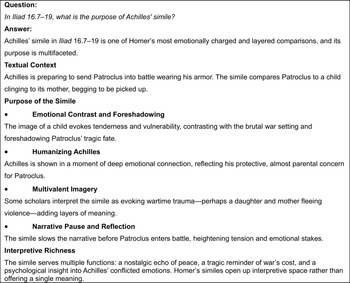
Probably the most striking feature of Achilles’ speech is the simile comparing Patroclus to a tearful girl, so this makes a good starting point for GenAI. The GenAI model used is Microsoft Copilot (Microsoft, 2024), which is an updated version of Bing Chat based on Microsoft and OpenAI technologies (Muchmore, Reference Muchmore2025). An advantage of Copilot is convenience, as it is integrated into Microsoft 365 packages. Copilot is multimodal, meaning it accepts input by text, voice or image, but the basic keyboard function is used here to prompt the question, Figure 1, about the simile.
Copilot on Achilles’ simile.
Microsoft, Copilot, personal communication, generated on 3 August 2025 by W. Rimmer.
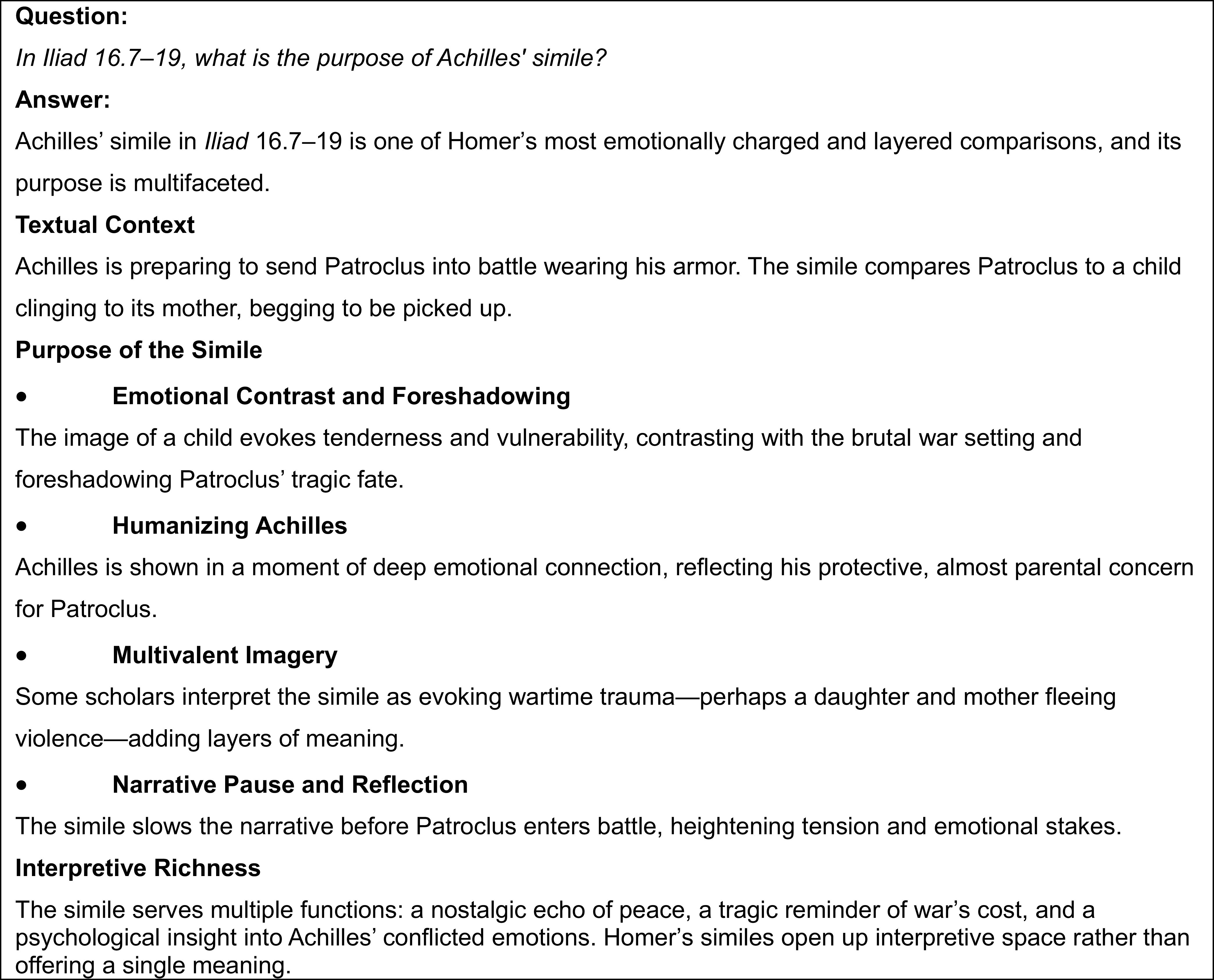
Copilot’s response would be helpful to students because it is structured and offers different avenues to explore further. Much is made of the inaccuracies of GenAI, Lee et al. (Reference Lee, Kim, Lim and Shin2025) estimate that the hallucination rate varies between 20% to 60%, but here the only questionable content seems ‘Achilles is preparing to send Patroclus into battle wearing his armor’. It is unlikely Achilles has premediated arming his companion as it is Patroclus’ own suggestion: ‘δὸς δέ μοι ὤμοιιν τὰ σὰ τεύχεα θωρηχθῆναι’ [give me your arms to strap on my shoulders] (l. 40), earlier prompted in almost the exact words by Nestor (11.798) in advising Patroclus. However, accepting the notion of ‘interpretive space’ in the last line of Copilot’s answer, it would be possible for students to construct an argument where Achilles is goading Patroclus into action; possibly Patroclus’ exploits will allow Achilles vicarious satisfaction while still maintaining his stand-off.
Narratologically, the simile is Achilles’ focalisation of Patroclus and their relationship. Janko’s commentary (Reference Janko1992) connects this to other similes in the Iliad depicting Achilles and Patroclus where ‘[Achilles] is usually cast in the protective parental role, Patroklos in that of the protected party’ (p. 316). Students’ next prompt, Figure 2, could examine the language of the simile and how it leverages focalisation.
Copilot on Achilles and Patroclus.
Microsoft, Copilot, personal communication, generated on 3 August 2025 by W. Rimmer.
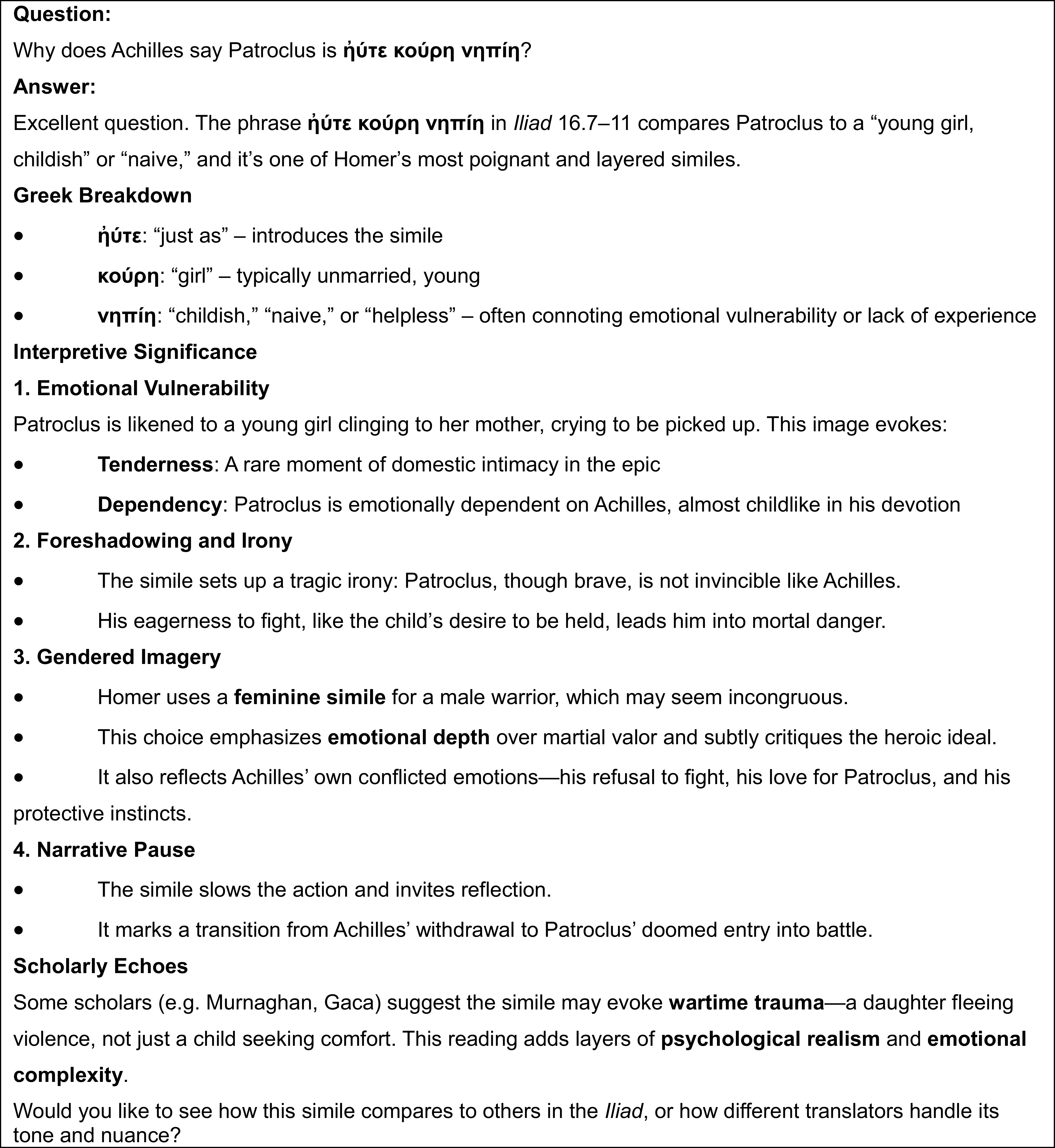
There is repetition in Copilot’s response – for example, the evocation of ‘wartime trauma’ – but also new stimulus – for example, critique of the ‘heroic ideal’ (admittedly a provocative notion without further explanation as it suggests unanimity of purpose and self-identification across a mixed bag of protagonists). The translation of the Greek is accurate, correctly identifying that ‘νηπίη’ is pejorative. However, Copilot does not pick up the textual cohesion in that νηπίη is repeated after the heroes’ exchange in 1. 46:‘ Ὣς φάτο λισσόμενος μέγα νήπιος·’ [Thus he [Patroclus] spoke praying, the great fool]. It is significant that this pronouncement comes outside of character speech as Homer’s voice. Janko (Reference Janko1992) shows how the focalisation changes. Achilles cast Patroclus as νηπίη, the gender feminine, for weeping and falling a victim to emotion; Homer’s νήπιος, gender masculine, is full of pathos as it signals that Patroclus is ignorant of the consequences of his fateful decision to wear Achilles’ armour. Homer as omniscient author has foresight that Achilles, or any character, lacks, and he can see how events will play out. The image may portray Achilles as protective parent, but he can do nothing to prevent Patroclus’ death. The poet knows this; the targets of the simile, Achilles and Patroclus, do not. Copilot’s gloss on νηπίη does not extend much beyond translation, which is an opportunity missed.
What Copilot does identify, under ‘Narrative Pause’, is the narratological strategy of retardation, where the plot is deliberately slowed down or even halted for effect (de Jong, Reference de Jong2014). The visual equivalent is slow motion. The exchange between Achilles and Patroclus represents a quiet opening to book 16, but the pace accelerates soon after with furious scenes of battlefield action, culminating in Patroclus’ death. Copilot’s bullet-point exposition has little detail on ‘Narrative Pause’, but it could prompt students to consider retardation more fully both in this passage and across the poem. For instance, retardation is often credited with building suspense, literally left hanging (suspendo) because what follows is uncertain. However, in the Iliad the outcome is determined, certainly as regards the main characters and events: we know Patroclus will die and Troy will fall. The Iliad is no whodunnit. Suspense then must have another quality in Homer. Ready (Reference Ready2023) identifies suspense as an element of immersion, the atmosphere created when the audience experiences the narrative like the protagonists. Thus, the suspense felt in this speech comes through sympathy with the interlocutors and the awful realisation that this is but a pause in a narrative sequence leading to Patroclus’ death. The suspense comes not from not knowing what will happen, but knowing what will happen and having to wait out an interaction that essentially amounts to a sideshow. That the characters know less than the audience is conducive to suspense because there may be tragic consequences that play out regardless of the characters’ words and actions. If Copilot initiated an inquiry into the impact of the narrative limiting characters’ knowledge, this would be a fruitful direction for students.
In summary, students could learn a lot about Achilles’ speech through the considered use of GenAI. The responses are largely accurate and provide multiple directions to explore, with or without further dialogue with Copilot. And GenAI need not be used in isolation. ‘Traditional’ methods such as consulting commentaries and class discussion could be at least as equally productive, with the caveat that most commentaries are orientated towards students with Greek (an exception is Jones’ Reference Jones2003 commentary of the Iliad based on translation). Furthermore, narratology can supply a theoretical framework for interpreting the responses. The application of a conceptual framework, however partial, fosters a more critical approach as students must filter GenAI-generated text to make connections with theory. Nor does theory pose any limitations. Copilot can never offer a complete response, so students can always go further in analysing the text as narrative.
Odysseus to Melantho
Odysseus in Odyssey 19 is in a similar position to Achilles in that he has become an outsider. Achilles is on strike away from the Greek camp, while Odysseus hides his identity and enters the home in the guise of a beggar, the outsider inside. One of Penelope’s maids, Melantho, introduced in book 18 as once indulged by Penelope but now in cahoots with the suitors, has taken a dislike to the beggar Odysseus. After Melantho lashes out at Odysseus, he responds in kind:
δαιμονίη, τί μοι ὧδ᾿ ἐπέχεις κεκοτηότι θυμῷ;
ἦ ὅτι δὴ λιπόω, κακὰ δὲ χροῒ εἵματα εἷμαι,
πτωχεύω δ᾿ ἀνὰ δῆμον; ἀναγκαίη γὰρ ἐπείγει.
τοιοῦτοι πτωχοὶ καὶ ἀλήμονες ἄνδρες ἔασιν.
καὶ γὰρ ἐγώ ποτε οἶκον ἐν ἀνθρώποισιν ἔναιον
ὄλβιος ἀφνειὸν καὶ πολλάκι δόσκον ἀλήτῃ,
τοίῳ ὁποῖος ἔοι καὶ ὅτευ κεχρημένος ἔλθοι·
ἦσαν δὲ δμῶες μάλα μυρίοι, ἄλλα τε πολλὰ
οἷσίν τ᾿ εὖ ζώουσι καὶ ἀφνειοὶ καλέονται.
ἀλλὰ Ζεὺς ἀλάπαξε Κρονίων· ἤθελε γάρ που·
τῷ νῦν μή ποτε καὶ σύ, γύναι, ἀπὸ πᾶσαν ὀλέσσῃς
ἀγλαΐην, τῇι νῦν γε μετὰ δμῳῇσι κέκασσαι,
μή πώς τοι δέσποινα κοτεσσαμένη χαλεπήνῃ,
ἢ Ὀδυσεὺς ἔλθῃ· ἔτι γὰρ καὶ ἐλπίδος αἶσα.
εἰ δ᾿ μὲν ὣς ἀπόλωλε καὶ οὐκέτι νόστιμός ἐστιν,
ἀλλ᾿ ἤδη παῖς τοῖος Ἀπόλλωνός γε ἕκητι,
Τηλέμαχος· τὸν δ᾿ οὔ τις ἐνὶ μεγάροισι γυναικῶν
λήθει ἀτασθάλλουσ᾿, ἐπεὶ οὐκέτι τηλίκος ἐστίν. (Od. 19.71–88)
Witch, why are you getting at me with your angry heart?
Is it because I am oily, wearing horrible clothes,
and I beg up and down? But want forces me.
This is the lot of beggars and those of no fixed abode.
But once I had a lovely house and was
blessed, then often I used to give to wanderers,
whoever was in want and whatever he needed.
I had lots of maids, and a lot of that
considered essential to live well and wealthily.
But Zeus son of Chronos ruined all this. Because he wanted to.
So, woman, watch out that you don’t lose all your
splendour, which now marks you out over the other maids,
that your mistress will anger and get mad,
or Odysseus will return. For there is still room to hope.
But if he has perished and there is no chance of a return,
then he now has a son, thank Apollo, in his image,
Telemachus. None of the maids’ antics inside
escape his notice, since he’s no longer a kid.
This time I adopted a different approach, Figure 3, by asking Copilot to answer in character. A major theme in the Odyssey is deception, with Odysseus often needing or choosing to dissemble. He speaks to Melantho as a beggar, focalising from that perspective, so I was interested in uncovering how Odysseus would focalise, i.e., what he is thinking himself.
Copilot thinks as Odysseus.
Microsoft, Copilot, personal communication, generated on 9 August 2025 by W. Rimmer.
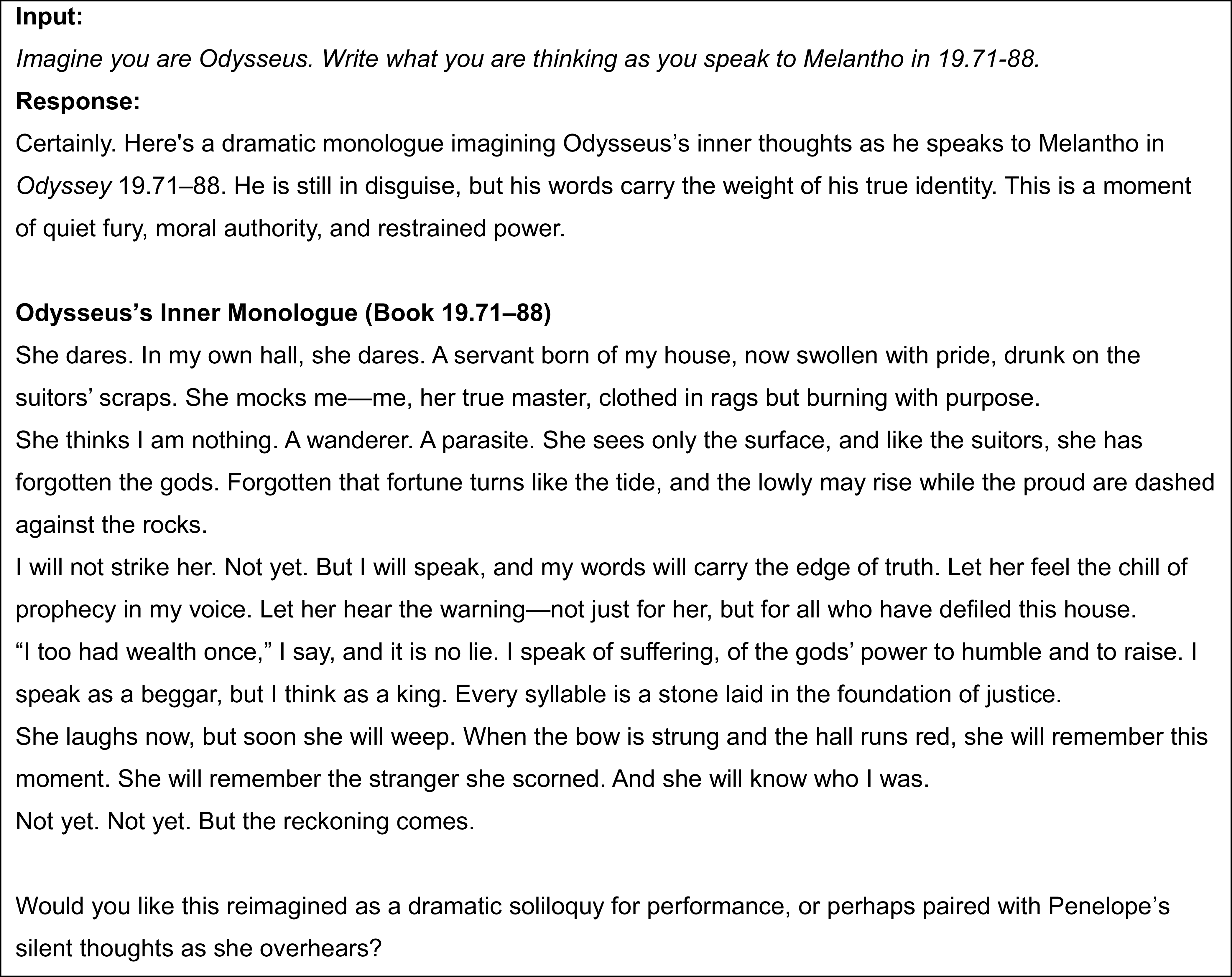
Copilot’s reconstruction of Odysseus’s thoughts is in prose rather than verse, but it clearly aims at an aesthetic effect. Rhetorical devices include repetition (‘Not yet. Not yet.’) and minimal sentences (‘She dares.’). There is actually no contradiction between Odysseus’ words and thoughts – both predict Melantho’s comeuppance – but the inner monologue is made in awareness of his own power and agency, manifest in the reference to the bow. Students could consider what is left out by Copilot, either by comparing the inner monologue to the speech or reflecting on the poem as a whole. For instance, there is no mention of Telemachus. The powerless beggar needs to offer an avenger, but Odysseus is confident in his own strength. Copilot also does not refer to Odysseus’ participation in the Trojan War, which seems an omission given that this, which must be concealed in speech, is his main claim to status and kleos. Perhaps Melantho is so contemptible that he does not need to fall back on his heroic credentials; it is enough that she has insulted the master of the house.
Nor is Odysseus represented as thinking about Penelope, although she is referred to in the speech (‘δέσποινα’). However, the last line of Copilot’s response (‘Penelope’s silent thoughts as she overhears’) shows awareness that Penelope is listening to Odysseus too. Indeed, in her narratological commentary on the Odyssey, de Jong (Reference de Jong, de Bakker and de Jong2021) cites this as an instance of indirect dialogue because Odysseus is speaking obliquely to his wife. Referring to the poem, students can debate the nature and impact of this communication. Odysseus’ complaint may have a pragmatic function, to arouse Penelope’s pathos and recruit her as a protector. With the reference to his former prosperity (‘ὄλβιος’), it might be a further clue to Penelope as to his identity. Or the gnomic acknowledgement of the caprice of the gods (‘ἀλλὰ Ζεὺς ἀλάπαξε Κρονίων’) could be a caution to Penelope’s hopes. What students should realise is the complexity of the narrative layering: the main character (Odysseus) focalising as a minor character (a beggar), speaking directly to one (Melantho) but indirectly to another (Penelope).
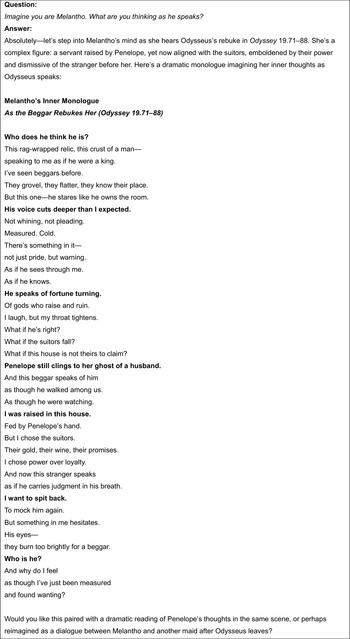
Students could also use GenAI to investigate the recipient of the speech, Melantho. She is a minor character in status and plot involvement, yet she is of interest as a representative of the hostile camp.
Again, Copilot, Figure 4, has fashioned a literary response. For example, there is the stylistic parallelism of three ‘What if…’ questions in succession. This is probably more engaging for students than a dry paragraph of fabricated prose, and the apprehensive tone adds a touch of pathos that is totally lacking in Homer. On this point, students should note a degree of artistic licence: there is no evidence in the text that Melantho regards the beggar as anything but a beggar. Prompts which encourage GenAI to be creative (‘Imagine…’) may elicit a response that takes more liberties with Homer. This extends the inquiry and can be fun, but students should respect the boundaries of the text and not infer what is not there.
Copilot thinks as Melantho.
Microsoft, Copilot, personal communication, generated on 9 August 2025 by W. Rimmer.
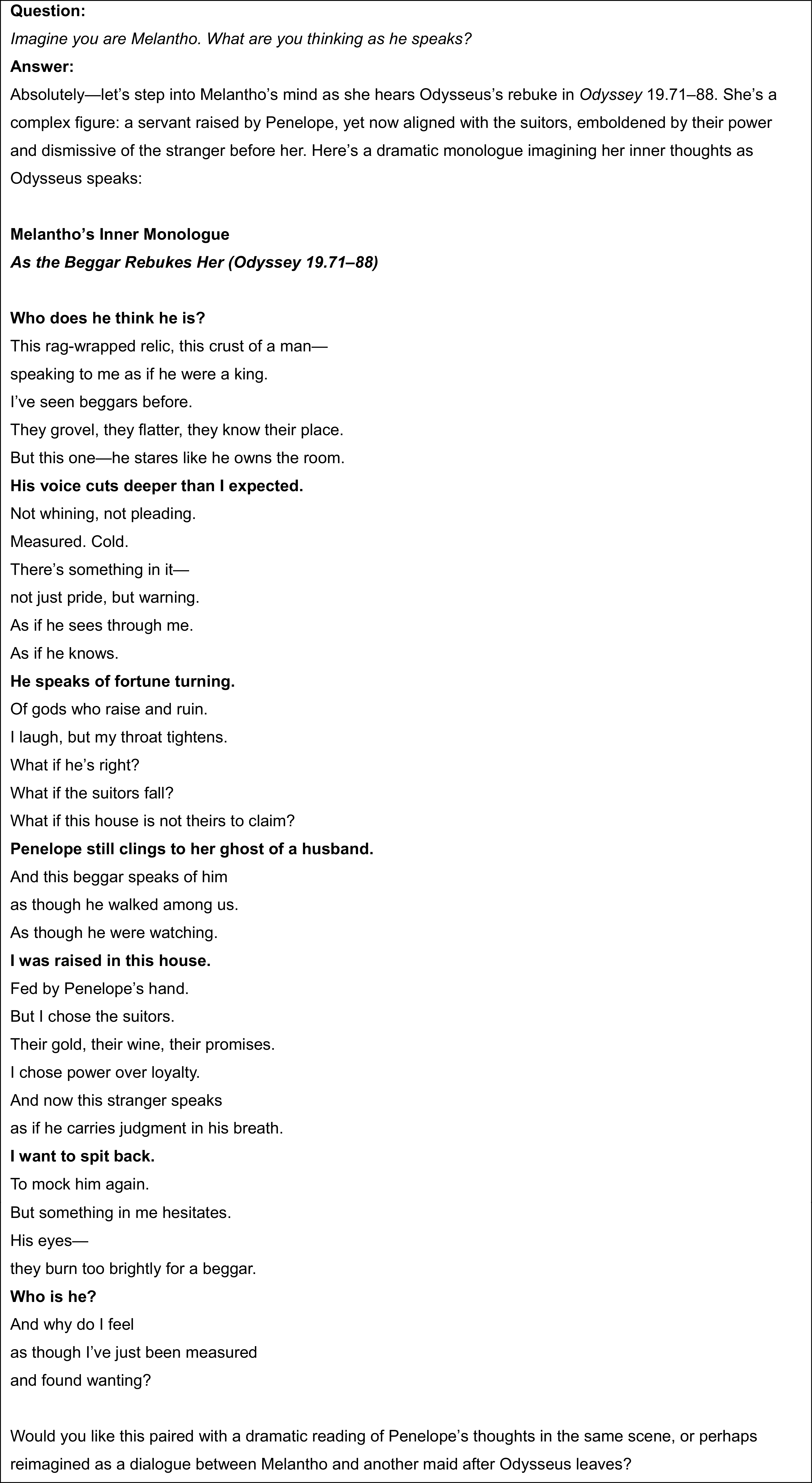
One area from Copilot that students could work on is metaphor, as in ‘Penelope still clings to her ghost of a husband’. This is marked as a metaphor because whatever Melantho’s belief in an afterlife, it is impossible to physically embrace a ghost, as pathetically demonstrated in book 11 when three times Odysseus tries and fails to embrace the shade of his mother in Hades. The speech in Odyssey 19 has no matching metaphor, but the possibility of Odysseus being dead is expressed hypothetically with ‘εἰ δ᾿ μὲν ὣς ἀπόλωλε…’ [If [Odysseus] has perished…]. In Copilot, Melantho sees the dead Odysseus still exercising power, as a spirit still revered after death. Similarly, the beggar sees Odysseus having agency beyond death, through his son and avenger, Telemachus. Thus, students can take from Copilot’s ghost metaphor the speakers’ recognition that the influence of Odysseus transcends death. For Penelope and the beggar this is a comfort; for Melantho this is a threat. Students could then embark on a wider study of metaphor in the poem. For while metaphor has been less studied than simile, research – for example, Rimmer (Reference Rimmer2025) on night as a metaphor in Iliad 10 – shows metaphor to be a powerful linguistic device to create coherence in a narrative.
To summarise from this second speech, prompting Copilot to answer in character is revealing about the text. In terms of narratology, it allows for the focalisation to change, representing what the character thinks rather than says, or reimagining the perspective of a separate stakeholder in the speech. Copilot entered into the spirit with some gusto, producing inner thought and speech that were stylised and interesting to read in their own right. It is easy to imagine students having fun during this activity as there are no boundaries in what they can ask Copilot. Hence, students might need to be pulled back on occasion to the actual Homeric text, the benchmark for any GenAI probing.
Conclusion
We are constantly told that GenAI is changing at a rate which outstrips any commentary. As Prather et al. (Reference Prather, Leinonen, Kiesler, Benario, Lau, MacNeil, Norouzi, Opel, Pettit, Porter, Reeves, Savelka, Smith IV, Strickroth and Zingaro2024) observe in a preface to their meta-analysis of the literature on GenAI and education, ‘[w]ith so much happening so quickly, it is difficult to know what has been done, why it is being done, what works, and where this is all headed’. By change we can understand the technology of GenAI itself and our responses to it, the latter inevitably lagging behind the former. Like any discipline, Classics is playing catch-up, and in its enthusiasm to embrace GenAI, it is important to distinguish between uses of GenAI that genuinely contribute to learning and uses which have marginal value or are ethically problematic. An example of the latter is the phenomenon of ‘Jesus chatbots’ purporting to offer divine inspiration (Verhoef, Reference Verhoef2025). As demonstrated, the use of GenAI to explore Homer’s speeches is pedagogically well motivated as it opens up the richness of the text and stimulates inquiry-based learning. GenAI does not provide answers as such to the complexities of the speeches, so those seeking a lazy path will be disappointed, but it does give direction, which most students will appreciate. Above all, GenAI helps celebrate the excellence of Homer, credited by Plato (Ion 530c) as ‘τῷ ἀρίστῳ καὶ θειοτάτῳ τῶν ποιητῶν’ [the best and most godly of poets], through the power of the poetry. While the contribution and future of GenAI is open to debate – Heikkilä et al. (Reference Heikkilä, Bradshaw, Criddle and Hammond2025) argue the technology has plateaued – there is no uncertainty about the value of Homer in the curriculum. The only question is how we can keep the study of Homer fresh for new generations of students and combat the stale charges that Classics is old-fashioned and elitist. It is posited that GenAI may have a role to play in safeguarding the legacy of Homer.
Competing interests
The author declares none.
Author biography
Wayne Rimmer has a doctorate in Education and is a PhD candidate in Classics at the University of Manchester.



 Open access

