


Over the past several decades, researchers have struggled with how to define healthy diets among the population. Several different types of methodologies, such as (i) factor and cluster analyses(Reference Farchi, Mariotti and Menotti1, Reference Hulshof, Wedel and Lowik2), (ii) nutrient inadequacies(Reference Madden and Yoder3) and (iii) dietary quality indices(Reference Clark and Wakefield4–Reference Murphy, Rose and Hudes6), have been proposed, including those which have also been associated with various health outcomes(Reference Burke, Beal and Kirkwood7–Reference Kushi, Lew and Stare9). Factor and cluster analyses identify food consumption models or patterns in the data set (e.g. similar food intakes among a group of individuals) yet do not allow for comparisons against current dietary recommendations(Reference Dubois, Girard and Bergeron10). Measures of nutrient inadequacies compare an individual’s nutrient intake with national recommendations, yet multiple days of food intake are needed to determine usual intake levels(Reference Garriguet11, Reference Nusser, Carriquiry and Dodd12). Finally, dietary quality indices evaluate the combination of different nutrients, foods or dietary constituents in relation to current dietary guidelines and/or specific health outcomes(Reference Dubois, Girard and Bergeron10, Reference Kant13, Reference Veugelers, Fitzgerald and Johnston14). Numerous diet quality indices exist(Reference Kant13), yet must be chosen with a specific population and health outcome in mind to ensure the comprehensiveness and suitability of the index.
Within Canada, dietary quality indices have been used with adults(Reference Dubois, Girard and Bergeron10, Reference Shatenstein, Nadon and Godin15) and children and adolescents(Reference Veugelers, Fitzgerald and Johnston14, Reference Glanville and McIntyre16, Reference Woodruff, Hanning and Lambraki17). Dubois et al.(Reference Dubois, Girard and Bergeron10) adapted three different measures of dietary quality with the 1990 Canadian nutrition recommendations, to analyse the Québec Nutrition Survey data (2103 males and females, aged 18–74 years). The authors adapted (i) the Dietary Quality Index (DQI)(Reference Patterson, Haines and Popkin18), (ii) the Healthy Eating Index (HEI)(Reference Kennedy, Ohls and Carlson19) and (iii) the Healthy Diet Indicator (HDI)(Reference Huijbregts, Fesken and Rasanen20). The results(Reference Dubois, Girard and Bergeron10) suggested that the HEI was the best indicator for their data set: correlations existed between the HEI and the mean adequacy ratio (MAR, which averages the proportion of dietary recommendations met by an individual for each nutrient; similar to what has been reported by Mirmiran et al.(Reference Mirmiran, Azadbakht and Azizi21) in children and adolescents). Furthermore, Dubois et al.(Reference Dubois, Girard and Bergeron10) concluded that because the HEI measure is a continuous measure (as opposed to discrete), it is easy to interpret and allows for a greater variety of statistical analyses.
Recently, Glanville and McIntyre(Reference Glanville and McIntyre16) adapted the HEI(Reference Kennedy, Ohls and Carlson19) to reflect (then) Canada’s Food Guide to Healthy Eating (CFGHE)(22) and used this to assess diet quality of low-income mothers (n 129) and children and adolescents (1–3 years, n 82; 4–8 years, n 147; 9–14 years, n 74) from Atlantic Canada. The variety score and sodium category were changed from the original HEI(Reference Glanville and McIntyre16). The variety score was manipulated to a score based on consuming at least one serving from each food group, rather than the total number of different foods consumed. The sodium category was changed to the number of servings consumed from the other food group according to CFGHE (e.g. all foods that do not fit into the other four categories). Based on the Canadian modifications to the original HEI derived by the US Department of Agriculture (USDA), Glanville and McIntyre(Reference Glanville and McIntyre16) termed their measure the HEI-C (refer to Table 1 for how to calculate). Possible scores range from 0 to 100, with 100 points referring to a perfect diet quality and any deviation(s) from the recommendations resulting in lower scores. Participants’ diets can be categorized as ‘poor’ (HEI-C score ≤ 50), ‘needs improvement’ (HEI-C score = 50–80) or ‘good’ (HEI-C score > 80)(Reference Glanville and McIntyre16, Reference Kennedy, Ohls and Carlson19).
Minimum and maximum scores of the HEI-C v. HEIC-2009 for 9- to 13-year-old children and adolescents
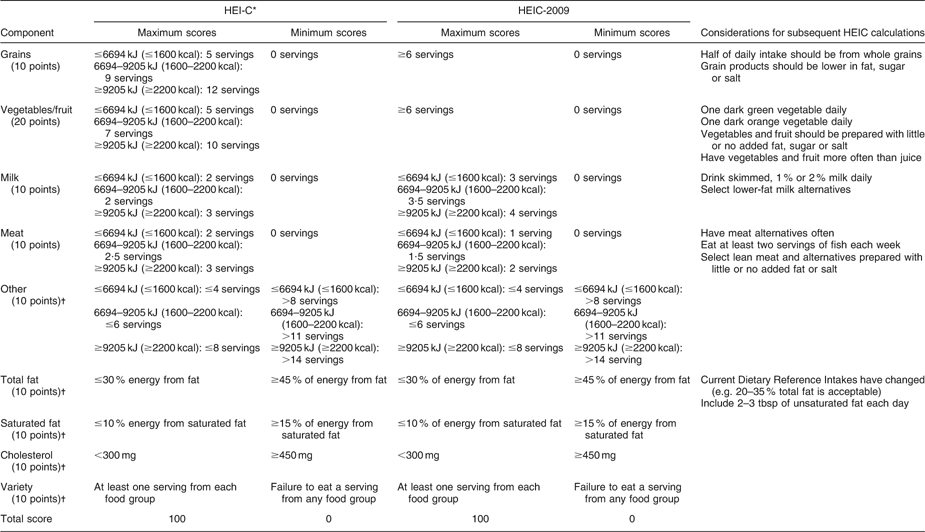
HEI-C, Canadian Healthy Eating Index; HEIC-2009, HEI-C adapted with Canada’s new food guide recommendations (2009).
*Individuals with servings between the minimum and maximum cut-offs are assigned a proportional score for the category.
†Score calculations are not different between HEI-C and HEIC-2009.
In 2005, the USDA Center for Nutrition Policy and Promotion and the National Cancer Institute revised the original HEI (now being referred to as the HEI-2005)(Reference Guenther, Reedy and Krebs-Smith23, Reference Guenther, Reedy and Krebs-Smith24). This update, in conjunction with the release of Eating Well with Canada’s Food Guide (EWCFG)(25), has prompted a revision of the HEI-C. The purpose of the current paper was, therefore, to update the HEI-C with Health Canada’s new EWCFG recommendations (herein referred to as the HEIC-2009) for children and adolescents and to discuss potential limitations and future research directions.
Methods
Participants
A cross-sectional study design was used. Participants were recruited from the Region of Waterloo District School Board in Southern Ontario, Canada. Schools were selected to represent a cross-section of neighbourhoods in Waterloo Region based on a comparison of socio-economic and demographic variables from the 2001 Statistics Canada Census and the 2001 Urban Poverty data. A total of 405 students (48 % males and 52 % females) from grade 6 classrooms in fifteen schools completed the web-based survey, representing a student response rate (i.e. students who were in class on the day of the survey with a returned parental consent form) of 57 %. All procedures were approved by the University of Waterloo’s Office of Research Ethics.
Procedure
The validated web-based Food Behaviour Questionnaire(Reference Hanning, Royall and Toews26) was used to assess nutrient intake and food behaviours through the use of a 24 h dietary recall and other nutrition behaviour questions. Details of the survey and procedures have been reported elsewhere(Reference Woodruff, Hanning and Lambraki17, Reference Hanning, Royall and Toews26, Reference Vance, Woodruff and McCargar27). Briefly, participants completed the questionnaire independently during class time (in the school’s computer lab), which took approximately 30–40 min. The 24 h recall collects data separately for breakfast, lunch, dinner and other times. Nutrient analysis software (The Food Processor version 7·9; Esha Research, Salem, OR, USA) processed the 24 h recall measures of food intake based on portion-size definitions of the 2001b Canadian Nutrient File database and according to (then) CFGHE(22). Some participants (n 10) were excluded from further analysis due to implausible energy intakes (<837 kJ/d (<200 kcal/d) or >25 104 kJ/d (>6000 kcal/d), n 4), and/or unrealistic intakes based on visual inspection of any record with >3 times the upper servings recommendation from any food group (n 7), or both (n 3).
New scoring for the HEIC-2009
Based on the new EWCFG(25) recommendations, a new HEIC-2009 dietary quality index is proposed in which half of the scores (50 out of 100 points) have been revised. Table 1 compares the minimum and maximum scores of the HEI-C and the newly updated HEIC-2009 for those aged 9–13 years. The primary changes are the grains and vegetables/fruit components, as EWCFG(25) recommends 6 servings from grains (rather than 5–12 servings) and 6 servings of vegetables/fruit (rather than 5–10 servings) for 9- to 13-year-olds. Moreover, the recommendation is absolute, v. relative to energy, and therefore no longer scored taking into account total energy (kJ/d, kcal/d).
Results
The index scores revealed that participants scored higher (74·5 v. 69·6, P < 0·001) using the HEIC-2009 compared with the HEI-C (see Table 2); even though both index scores are rated in the needs improvement category. Moreover, grain, vegetables/fruit and meat scores were all higher and milk scores were lower in the HEIC-2009 version compared with the HEI-C. Not surprisingly, this follows the same pattern as the EWCFG(25) recommendations: the new guidelines generally have lower recommendations for grains (6 servings/d v. a range of 5–12), vegetables/fruit (6 servings/d v. a range of 5–10) and meat (now 1–2 servings/d v. 2–3) and higher for milk (now 3–4 servings/d v. 2–3). Finally, when the participants’ scores were categorized into poor, needs improvement and good, the HEIC-2009 classified all participants in the same category, except a small group (14 of 29) of participants previously categorized in the poor category who were now categorized in the needs improvement category (see Table 3). The theoretical and measured differences (even among a small sample such as this) between the two indices (HEI-C and the newly updated HEIC-2009) have prompted some concerns about using the new HEIC-2009 as a measure of healthy eating among children and adolescents.
HEI-C v. HEIC-2009 scores of grade 6 participants (n 395) from the Region of Waterloo, Canada
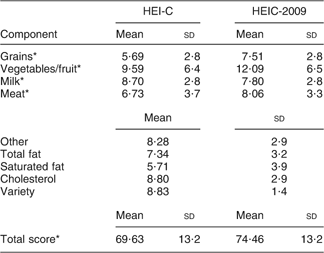
HEI-C, Canadian Healthy Eating Index; HEIC-2009, HEI-C adapted with Canada’s new food guide recommendations (2009).
*Paired t tests suggest that the HEI-C and HEIC-2009 are statistically different, P < 0·001.
Comparison of HEI-C and HEIC-2009 rating classifications

HEI-C, Canadian Healthy Eating Index; HEIC-2009, HEI-C adapted with Canada’s new food guide recommendations (2009).
*Kendall’s coefficient of concordance suggests good agreement (κ = 0·97, P < 0·001).
Discussion
Using a sole indicator of healthy eating, such as the HEI-C/HEIC-2009, provides various advantages over other methodologies, particularly at the population level(Reference Dubois, Girard and Bergeron10, Reference Kant13). Besides using Canadian recommendations, the ease of using a single measurement of diet quality rather than numerous indicators individually (such as overall energy intake, servings of food groups from a food guide, or nutrient intakes in relation to current recommendations) provides various statistical advantages(Reference Dubois, Girard and Bergeron10). Individuals consume foods, generally in combination with others(Reference Kant13, Reference Veugelers, Fitzgerald and Johnston14), so that investigating the overall diet using a comprehensive approach may be more useful than simply comparing individual nutrients with a specific health outcome. By analysing the diet in this manner, we are likely not to overlook other aspects of the diet and/or allow a deviation in one component to affect all of the other components(Reference Dubois, Girard and Bergeron10, Reference Kant13, Reference Veugelers, Fitzgerald and Johnston14). Potentially problematic, however, is the associated weighting of each component. Calculated as it is, all components are weighted similarly (e.g. 10 points) with the exception of vegetables/fruit (20 points) and a combined 20 points for total fat and saturated fat. The components may (or may not) all have equal effects on healthy eating, and therefore future research should attempt to determine which components and/or combination of components, in combination with weighting factors, are the most useful to include in a healthy eating index.
A noted difference in the HEIC-2009 (v. the HEI-C) is that it calculates all of the food serving scores (e.g. 50 points or 50 % of the total score) based on a discrete recommended serving, rather than using a density approach (based on total energy consumed). EWCFG was developed using population-based nutrient modelling with the Estimated Average Requirement (EAR) and Adequate Intake (AI) as criteria for nutrient adequacy(28). To ensure that nutrient requirements could be met without consuming excess energy, the modelling scenarios were based on the Estimated Energy Requirement (EER) for a sedentary physical activity(28). Opposing, the density approach has the advantage, perhaps, of being dependent on an individual’s energy intake, and does not discriminate between individuals who consume lower or higher amounts of energy. Without such an approach, those who consume high amounts of energy daily will have a better chance at achieving the recommendations simply because they are consuming more food, which may not necessarily mean they are consuming a healthier diet. For example, the energy levels do not take into account individuals with inappropriately low energy intakes due to meal skipping or dieting, or higher energy intakes due to overeating. Interesting to note is that the recently revised USDA HEI-2005(Reference Guenther, Reedy and Krebs-Smith23, Reference Guenther, Reedy and Krebs-Smith24) has adopted a density approach to score all of the individual components (total fruit, whole fruit, total vegetables, dark green and orange vegetables and legumes, total grains, whole grains, milk, milk and beans, oils, saturated fat, sodium, energy from solid fats, alcoholic beverages, added sugars) such that all scores are expressed per 4184 kJ (1000 kcal). Then again, using a density approach for all components may be problematic, because of the difficulties in obtaining a true energy intake level. Under-reporting is a known limitation associated with nutrient intake, especially among adolescents(Reference Vance, Woodruff and McCargar27, Reference Bandini, Schoeller and Cyr29), females(Reference Vance, Woodruff and McCargar27, Reference Johansson, Solvoll and Bjorneboe30) and those classified as overweight or obese(Reference Vance, Woodruff and McCargar27, Reference Briefel, Sempos and McDowell31). However, since a different approach was used to revise EWCFG(25), a different strategy will be necessary to establish a scoring scheme.
Certain aspects or components of the HEI-C/HEIC-2009 may influence the overall score. The diet quality scores are based on: grains (10 points), vegetables/fruits (20 points), milk products (10 points), meat and alternatives (10 points), other foods (10 points), total fat (10 points), saturated fat (10 points), cholesterol (10 points) and variety (e.g. more than 1 serving from each food group for 10 points). The inclusion of total fat and saturated fat, for a combined total of 20 points (a fifth of the score), may be high and rather unnecessary, especially for growing children and adolescents. Further, dietary cholesterol is not a major health indictor in children and adolescents. It may have been better to include body weight status (albeit not an indicator of healthy eating, but known to be highly correlated with healthy eating), added sugar intake, fast food frequency, sugar-sweetened beverage consumption, snacking or meal skipping, in lieu of one of the fat and/or cholesterol categories, as these are known nutritional issues in children and adolescents.
It is important for researchers (and those wanting to work with a healthy eating index) to reach a consensus about what defines healthy eating, so that the necessary components can be included. If a revised index were fully based on the recently released EWCFG(25), several new components should be included (see Table 1), some of which have been included in the recently revised HEI-2005(Reference Guenther, Reedy and Krebs-Smith24, 25), such as: eating at least one dark green and one orange vegetable each day, eating vegetables and fruit more often than juice, choosing whole grains at least half of the time, drinking lower-fat milk (skimmed, 1 %, 2 %) each day, consuming meat alternatives such as beans, lentils and tofu more often, eating at least two servings of fish each week, consuming a small amount of unsaturated fat each day, satisfying thirst with water, and finally choosing foods lower in fat, sugar and salt. Perhaps these new messages should be incorporated in the healthy eating index. A challenge will be trying to quantify or account for the new messages, such as ‘more often’ and/or ‘each week’, especially where data collection relies on the use of 24 h recalls.
Finally, limited validation research has been done with eating indices(Reference Guenther, Reedy and Krebs-Smith32), particularly with inter- and intra-individual variability of the component scores with multiple days of food records. Further, validation of a Canadian healthy eating index against biomarkers and anthropometric and clinical parameters of nutrition status should also be completed. While the HEIC-2009 provides various advantages in the meantime, future research that investigates these limitations needs to be completed.
Acknowledgements
The research was funded by the Region of Waterloo Public Health. None of the authors had a personal or financial conflict of interest. S.J.W. and R.M.H. were both key contributors to this research. S.J.W. led in the manuscript writing, but both authors participated in methodology design, data collection and data interpretation.



