



Caffeine-containing energy drinks are relatively new commercially available beverages intended to increase activeness, vigour and overall performance in situations of physical and mental stress. These drinks contain different amounts of carbohydrates, taurine and group B vitamins, although the ingredient of current interest is caffeine( Reference Del Coso, Munoz-Fernandez and Munoz 1 ). In the sport setting, energy drinks have become one of the most used supplements among young and elite athletes( Reference Hoyte, Albert and Heard 2 ), probably because of the well-recognised ergogenicity of caffeine. The popularity of caffeine and caffeine-containing products has been also increased because this substance is no longer considered a doping substance( Reference Del Coso, Munoz and Munoz-Guerra 3 ). Although the use of caffeine in sports was considered doping from 1984 to 2004 (when athletes’ urinary caffeine concentration exceeded 12 µg/ml), caffeine was placed on the World Antidoping Monitoring Program in 2004, to track the trends of its use and to assess its future re-inclusion in the banned list( 4 ).
Several investigations have determined the ergogenicity of energy drinks during soccer( Reference Del Coso, Munoz-Fernandez and Munoz 1 , Reference Lara, Gonzalez-Millan and Salinero 5 ), basketball( Reference Abian-Vicen, Puente and Salinero 6 ), volleyball( Reference Del Coso, Perez-Lopez and Abian-Vicen 7 ) and rugby competitions( Reference Del Coso, Ramirez and Munoz 8 , Reference Del Coso, Portillo and Munoz 9 ) when ingested in an amount equivalent to providing 3 mg of caffeine/kg of body mass. Interestingly, the ergogenicity of caffeinated energy drinks is not present when the amount of energy drink provides only 1 mg/kg caffeine( Reference Astorino, Matera and Basinger 10 , Reference Del Coso, Salinero and Gonzalez-Millan 11 ). All these investigations have been carried out during team sports matches that combine bouts of high-intensity exercise with periods of lower intensity or recovery during a relatively long period of time. Nevertheless, the results obtained with these team-sports players can hardly be used to infer the effect of caffeine in other continuous and power-based sports such as swimming. Moreover, the scientific information about the ergogenicity of caffeine in swimming is very limited and contradictory.
Collomp et al.( Reference Collomp, Ahmaidi and Chatard 12 ) provided 250 mg of caffeine or a placebo substance to trained and untrained swimmers before a 2×100 m freestyle time trial. After the ingestion of the caffeine, trained swimmers reduced the time needed to complete the trial by approximately 2 %, but this performance benefit was not evident in the untrained swimmers. However, both groups of swimmers presented higher post-exercise blood lactate concentrations with the ingestion of caffeine when compared with the placebo. MacIntosh & Reference MacIntosh and WrightWright ( Reference MacIntosh and Wright 13 ) evaluated the benefits obtained after the ingestion of 6 mg/kg of caffeine during a 1500 m swim-time trial. Swimmers reduced their test time by 1·8 % with the ingestion of caffeine, and this performance benefit was accompanied by higher levels of blood glucose after the test. Finally, Pruscino et al.( Reference Pruscino, Ross and Gregory 14 ) investigated the effects of caffeine ingestion (6 mg/kg) alone or in combination with sodium bicarbonate (0·3 g/kg) on a 2×200 m freestyle time trial. The ingestion of caffeine, alone or combined with sodium bicarbonate, was not effective in reducing the time undertaken to complete the swim test. Therefore, with the available data it is complex to determine whether caffeine or caffeine-containing energy drinks are effective in improving swimming performance.
The aim of this investigation was to determine the effectiveness of a commercially available caffeinated energy drink (3 mg of caffeine/kg of body mass) in improving aspects of swimming performance in competitive sprinters. On the basis of previous investigations, we hypothesised that the pre-exercise ingestion of the caffeinated energy drink would reduce the time needed to complete a 50 m simulated swimming competition.
Methods
Subjects
In all, fourteen young male swimmers volunteered to participate in this investigation. They had a mean age of 20·2 (sd 2·6) years, height of 183 (sd 7) cm, body mass of 73·9 (sd 8·3) kg and body fat of 8·3 (sd 1·9) %. We established as inclusion criteria that all the potential participants had obtained the qualifying standards for the 2013 National Spanish Championship in 50 m swimming competitions, had swimming experience of at least 5 years and had trained at least 6 d/week during the previous year. For these reasons, we classified this study sample as competitive sprint swimmers. The swimmers were light caffeine consumers (less than one can of soda or energy drink per d), had no previous history of cardiopulmonary diseases and had no musculoskeletal injuries in the previous 3 months. The swimmers were also encouraged to avoid medications or nutritional supplements for the duration of the study. At 1 week before the onset of the study, the participants were fully informed of the experimental standards and the risks and discomforts associated with the research, and gave their informed written consent to participate in the investigation. The study was approved by a Research Ethics Committee in accordance with the latest version of the Declaration of Helsinki.
Experimental design
A double-blind, placebo-controlled randomised experimental design was used in this study. Each swimmer took part in two experimental trials carried out in the same swimming facility and under the same experimental conditions (ambient temperature 25·3 (sd 1·1)°C; water temperature 27·0 (sd 0·1)°C). In one trial, swimmers ingested a powdered caffeine-containing energy drink (Fure®, ProEnergetics) dissolved in 250 ml of tap water. The amount of energy drink was individually set to provide a dose of 3 mg of caffeine/kg of body mass (3 mg/kg). In another trial, swimmers ingested the same energy drink with no caffeine content (e.g. placebo energy drink; 0 mg/kg) but with the same taste. The beverages were ingested 60 min before the onset of the experimental trials and were provided in opaque plastic bottles to avoid identification. Both experimental beverages also contained taurine (18·7 mg/kg), sodium bicarbonate (4·7 mg/kg), l-carnitine (1·9 mg/kg) and a small amount of carbohydrate (6·6 mg/kg in the form of maltodextrin) to sweeten the taste of the drinks. However, the amount of exogenous energy provided in the form of carbohydrate with the beverages was negligible (approximately 8.4 kJ (2 kcal)). Moreover, these substances were ingested in identical proportions in the two experimental trials. Both experimental trials started at the same time of day (10.00 hours) and were separated by 7 d to allow for complete recovery and caffeine washout.
Experimental protocol
The swimmers were nude-weighed at 2 d before the first experimental trial to calculate the amount of energy drink needed to provide an individual a dose of 3 mg/kg caffeine. In addition, swimmers were encouraged to refrain from all dietary sources of caffeine, alcohol or stimulants for the duration of the study. Before a period of 24 h of each experimental trial, the swimmers mimicked their habitual routines before competition and thus refrained from strenuous exercise and adopted a pre-competition food and fluid regimen. On the day of the experimental trials, the swimmers woke up 4 h beforehand and had a pre-competition breakfast. Then, they rested until their arrival at the swimming facility. All these standardisations were reported to the technical staff of the team, and food and fluid diaries were obtained and analysed to ensure compliance. In the second experimental trial, all these standardisations were repeated.
At 10.00 hours, the experimental beverages were individually provided in coded bottles. Players ingested the beverage in its entirety and investigators supervised that players drank only from their own labelled bottle. Then, swimmers performed a 45 min standardised warm-up. Just 60 min after the completion of the beverage intake, the swimmers performed two maximal countermovement jumps with 1 min of rest between repetitions. During the jump, participants placed their hands on their waists in order to remove the influence of the arms on jump height. Leg muscle power output during the impulse phase (concentric part of the jump) and jump height were determined using a force platform (Quattro Jump; Kistler). The height of the highest jump was used for statistical analysis.
After 3 min, the swimmers performed a handgrip maximal force production test with both hands (Grip-D). Participants performed two attempts with each hand, with 1 min of recovery between repetitions, and the highest value obtained with each hand was used for analysis. After 5 min of recovery, the participants performed a simulated 50 m competition in their habitual swimming style (seven swimmers selected crawl, three selected back stroke, three selected breast stroke and one selected butterfly stroke). The swimmers replicated their pre-competition routines regarding physical and mental preparation. The test was performed in an official 25 m swimming pool, and swimmers started the test from a homologated platform. The competition was started with an acoustic signal, and swimming time was measured by three experienced trainers using 0·01 chronometers (Geonaute), as recommended by the International Swimming Federation( 15 ). When two of the three watches recorded the same time and the third disagreed, the two identical times were used as the official test time. When all three watches disagreed, the watch recording the intermediate time was used as the official test time( 15 ). The simulated competition was performed in the central swimming lane, and there were no other swimmers in the pool at the time of the test. Three synchronised video cameras (Sony Handycam HDR-XR200VE; Sony) were placed at the start, at 12·5 m from the start line and at the end of the pool to analyse stroke frequency and stroke length during the whole test.
After 10 min of recovery, the swimmers performed a 45 s maximal swimming test in a swim ergometer (Vasa Ergometer; Vasa). For this test, participants lay prone on a bench and replicated the upper-body movements during breast stroke. The resistance during the simulated swimming was provided by an airflow resistance system connected with metal wires to paddles, which were adjusted to the swimmers hands. For this test, the swimmers started in a stationary position and swam as fast as possible against the resistance produced in the paddles. The power produced during each stroke, the stroke rate and the heart rate (Polar) were instantaneously recorded and analysed afterwards. Maximal and mean values during this test were used for analysis. After 1 min of the end of the ergometer test, a capillary blood sample was obtained from a fingertip to assess blood lactate concentration (Lactate Pro; Arkray Global Business).
Then, the swimmers were required to fill out a questionnaire about their sensations of power, endurance and perceived exertion during the swimming-specific tests. This questionnaire included a one- to ten-point scale to assess each item, and participants were previously informed that one point meant a minimal amount of that item and ten points meant a maximal amount of the item. This questionnaire has been used previously to assess subjective feelings of power, endurance and fatigue in other sport situations( Reference Del Coso, Portillo and Munoz 9 ). In addition, participants were provided with a survey to be filled out the following morning about sleep quality, nervousness, gastrointestinal problems and other discomforts. This survey included six items on a yes/no scale, and it has been used previously to assess the side effects derived from energy drink ingestion( Reference Del Coso, Salinero and Gonzalez-Millan 11 ). This survey also included specific questions to evaluate the success of the participant blinding procedure.
Statistical analysis
Normality was tested for each variable with the Shapiro–Wilk test. All the variables included in this investigation presented a normal distribution (P>0·05), and parametric statistics were used to determine the effectiveness of the caffeinated energy drink to increase swimmers’ performance. Differences between the caffeinated v. placebo energy drink in the variables obtained once in each experimental trial (e.g. 50 m competition time, subjective feelings, blood lactate concentration and so on) were determined using paired t tests. Differences between the caffeinated v. placebo energy drink in the variables obtained twice or more in each experimental trial (power production and heart rate during the swim ergometer test and so on) were determined by two-way ANOVA (beverage×time) with repeated measures. After a significant F test (Geisser–Greenhouse correction for the assumption of sphericity), differences between means were identified using Tukey’s HSD post hoc. Differences on side effects after beverage intake were analysed using the McNemar test. The data were analysed with the statistical package SPSS version 20.0 (SPSS Inc.). The results are presented as mean values and standard deviations for fourteen sprint swimmers. The significance level was set at P<0·05.
Results
In comparison with the placebo energy drink, the pre-exercise ingestion of the caffeinated energy drink increased the jump height during a countermovement jump by 3·0 (sd 7·0) % (P<0·05, Table 1), although the increase in leg muscle power output during the jump obtained with the caffeinated energy drink did not reach statistical significance. The caffeinated energy drink increased handgrip force in the right hand by 3·5 (sd 4·9) % (P<0·05; Table 1), although the change in the left hand was not statistically significant. During the 50 m simulated competition, swimmers reduced their time by 0·9 (sd 1·5) % when they ingested the caffeinated energy drink in comparison with the placebo energy drink (P<0·05; Table 1). However, there were no differences in stroke frequency (1·30 (sd 0·43) v. 1·29 (sd 0·47) strokes/s; P=0·92) or stroke length (1·58 (sd 0·55) v. 1·59 (sd 0·61) m/stroke; P=0·62) between experimental trials. Peak power during the 45 s swim ergometer test was 11·2 (sd 5·4) % higher with the caffeinated energy drink than with the placebo energy drink (P<0·05), and there was a tendency towards increased mean power during this test (P=0·08; Table 1). Fig. 1 depicts averaged swimming power at 5-s intervals during the ergometer test. Although swimming power with the caffeinated energy drink was greater than with the placebo drink during the entire test, the differences were only significant at the end of the test (P<0·05; Table 1). Blood lactate concentration at the end of the swim ergometer test was 6·0 (sd 3·2) % (P<0·05) higher with the caffeinated energy drink than with the placebo drink, but there were no differences in the peak heart rate obtained during the test.
Swimming power production during a 45 s test on a swim ergometer with the ingestion of a caffeinated energy drink (3 mg of caffeine/kg of body weight) or the same drink without caffeine (placebo drink). Data are means for fourteen sprint swimmers, with standard deviations represented by vertical bars. *Different from the placebo drink (P<0·05).  Placebo drink;
  energy drink.

Physical performance in swimming-specific testing with the ingestion of a caffeinated energy drink (3 mg of caffeine/kg of body weight) or the same drink without caffeine (placebo drink) (Mean values and standard deviations; fourteen competitive sprint swimmers)

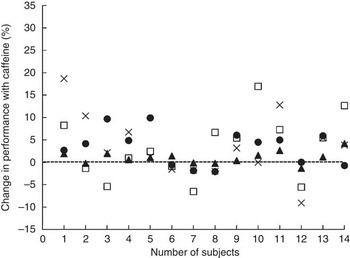
Fig. 2 depicts the individual changes produced by the ingestion of the caffeinated energy drink (when compared with the values obtained with the placebo drink) in all the performance tests carried out in this investigation. Positive values indicate that performance was superior with the caffeinated energy drink v. the placebo drink. Although most participants presented a positive response to the ingestion of the caffeinated energy drink in one or several tests, participant 6 did not benefit from caffeine ingestion while participants 7 and 12 presented a clear ergolytic effect in most tests.
Changes in swimming-specific performance with the ingestion of a caffeinated energy drink (3 mg of caffeine/kg of body weight) v. the same drink without caffeine (placebo drink). Each data point represents the individual change in performance with the caffeinated energy drink with respect to the placebo drink on handgrip force (an averaged change of the two hands), jump height, 50 m swimming time and swimming power.  , Handgrip force;
  , jump height;
  , 50 m performance;
  , swimming power.
The subjective feelings of muscle power during the swimming-specific tests were increased after the ingestion of the caffeinated energy drink in comparison with the placebo (P<0·05; Table 2). However, self-reported endurance fitness and fatigue after the testing were similar with the two experimental beverages. Furthermore, the prevalence of side effects in the hours following the ingestion of the experimental beverages was similar with the caffeinated and placebo energy drinks (Table 2). Only 36 % (five out of fourteen) of participants correctly guessed the order of the trials, indicating successful blinding of the participants to the interventions.
Rates of perceived fitness during the swimming-specific testing and prevalence of side effects in the following hours after the ingestion of a caffeinated energy drink (3 mg of caffeine/kg of body weight) or the same drink without caffeine (placebo drink) (Mean values and standard deviations; fourteen competitive sprint swimmers)

Discussion
The aim of this investigation was to determine the efficacy of a caffeinated energy drink (in an amount equivalent to providing 3 mg/kg of caffeine) to improve aspects of sprint swimming performance. For this purpose, fourteen competitive swimmers performed several swimming-specific tests and a 50 m simulated competition after the ingestion of the caffeinated energy drink or the same drink without caffeine. The pre-exercise ingestion of the caffeinated energy drink increased jump height during a countermovement jump, improved handgrip force in the right hand and augmented peak power during a 45 s swim ergometer test (Table 1). In addition, the caffeinated drink reduced the time needed to complete the 50 m simulated swimming competition (Table 1). Although these ergogenic effects were accompanied by increased self-perception of muscle power, the caffeinated energy drink did not increase the prevalence of side effects typically found after the ingestion of caffeine-containing products (Table 2). All this information suggests that caffeinated energy drinks are a potential ergogenic aid to increase aspects of physical performance in competitive sprint swimmers.
Despite the abundant amount of scientific information about the ergogenicity of caffeine or caffeine-containing products for physical performance in endurance disciplines( Reference Burke 16 ) and team sports( Reference Holway and Spriet 17 ), only a few investigations have been geared to determining the ergogenicity of caffeine for swimming performance( Reference Collomp, Ahmaidi and Chatard 12 – Reference Pruscino, Ross and Gregory 14 ). Moreover, the results of these latter investigations are inconclusive to determine the ergogenic effects of caffeine on swimming performance because of differences in the swimming test used (2×100 m with 20 min of passive recovery v. 1500 m time trials), the dosage of caffeine administered (an absolute 250 mg dose v. individualised 6 mg/kg doses) and the combination with other substances. The present investigation offers new information on this topic because the results indicate that the ingestion of 3 mg/kg caffeine in the form of an energy drink improved physical performance in several physical tests and reduced the time needed to complete a 50 m swimming competition. In fact, the results of the jump test suggest that caffeine might confer some advantage during the start of the competition (Table 1), whereas the results of the swim ergometer test indicate that the application of effective power during swimming was improved with the caffeinated energy drink (Fig. 1). Previous and current outcomes suggest the ergogenicity of caffeine for swimming, at least in short-duration and high-intensity trials.
Apart from the objective data obtained during the physical testing, the sprint swimmers also reported increased self-perceived muscle power after the ingestion of the caffeinated energy drink (Table 2), although the feelings of endurance and fatigue were similar between beverages. The improved self-perception of physical fitness after the ingestion of caffeinated energy drinks has been previously reported in basketball( Reference Abian-Vicen, Puente and Salinero 6 ), soccer( Reference Lara, Gonzalez-Millan and Salinero 5 ), volleyball( Reference Del Coso, Perez-Lopez and Abian-Vicen 7 ) and rugby players( Reference Del Coso, Portillo and Munoz 9 ). Accompanying the increased feelings of fitness, most investigations have also found that athletes report increased activeness and nervousness and a higher prevalence of insomnia during the hours following the ingestion of caffeinated drinks( Reference Lara, Gonzalez-Millan and Salinero 5 , Reference Del Coso, Perez-Lopez and Abian-Vicen 7 , Reference Del Coso, Portillo and Munoz 9 ), as previously reported with other caffeine-containing beverages( Reference Dorea and da Costa 18 ).
Although caffeine was removed from the World Antidoping Agency (WADA) list of doping substances in 2004( Reference Del Coso, Munoz and Munoz-Guerra 3 ), national and international antidoping authorities are still concerned about the use and misuse of this substance in sports. Caffeine has been periodically included in the WADA Monitoring Program( 4 ) to assess the use of this substance during sport competitions and to determine the adequacy of its future re-inclusion in the doping list based on the prevalence of side effects derived from the use of caffeinated products. Previous investigations have determined that the ingestion of the caffeinated energy drinks (with 3 mg/kg of caffeine) increased the prevalence of side effects such as insomnia( Reference Lara, Gonzalez-Millan and Salinero 5 , Reference Del Coso, Perez-Lopez and Abian-Vicen 7 , Reference Abian, Del Coso and Salinero 19 ), vigour and activeness( Reference Abian-Vicen, Puente and Salinero 6 , Reference Del Coso, Salinero and Gonzalez-Millan 11 ). However, in the present investigation with sprint swimmers, activeness and insomnia were rated similarly after the ingestion of the caffeinated energy drink and the placebo drink. The absence of these side effects after the ingestion of the caffeinated beverage was probably because all the experimental trials were performed in the morning, whereas previous investigations were carried out with an administration of caffeinated beverages in the afternoon( Reference Lara, Gonzalez-Millan and Salinero 5 – Reference Del Coso, Perez-Lopez and Abian-Vicen 7 , Reference Del Coso, Salinero and Gonzalez-Millan 11 , Reference Abian, Del Coso and Salinero 19 ). In any case, the low prevalence of side effects derived from the ingestion of 3 mg/kg caffeine in the form of an energy drink does not preclude the recommendation of these beverages to improve swimming performance in sprint swimmers. Although it was not included in this investigation, it is necessary to investigate the impact of the chronic use of caffeinated energy drinks on both performance and side effects, especially for the vulnerable populations such as children( Reference Ruxton 20 ).
Previous investigations have suggested a number of explanations for the ergogenicity derived from caffeine ingestion. Initially, it was believed that caffeine enhanced free fatty acid oxidation and consequently helped to spare muscle and liver glycogen( Reference Davis and Green 21 ). However, it seems unlikely that this theory explains the ergogenicity found in the present investigation because all tests lasted 45 s or less and muscle and liver glycogen were not depleted. Other suggested mechanisms for caffeine ergogenicity are the enhanced calcium mobilisation in the sarcoplasmic reticulum, the inhibition of phosphodiesterase or the enhanced Na+/K+ pump activity, although all these peripheral mechanism are rarely found in vivo and with normal/physiological plasma caffeine concentrations( Reference Magkos and Kavouras 22 ). The most recent investigations indicate that caffeine might improve sports performance via enhanced central drive rather than peripheral changes( Reference Davis and Green 21 ). On the basis of this hypothesis, caffeine acts antagonistically on adenosine receptors and inhibits the negative effects of adenosine on neural drive( Reference Davis, Zhao and Stock 23 ). Although this hypothesis has been mainly tested in animals, investigations with humans have determined an improved voluntary contraction( Reference Del Coso, Estevez and Mora-Rodriguez 24 ) and better intra- and inter-muscular coordination during muscle contractions( Reference Del Coso, Salinero and Gonzalez-Millan 11 ) after the ingestion of 3–6 mg/kg caffeine.
In the present investigation, we did not assess the origin of the ergogenicity obtained with the ingestion of the caffeinated energy drink. However, we found that sprint swimmers presented higher blood lactate concentrations after the swim ergometer test with the caffeinated energy drink, as compared with the placebo drink (Table 1). This same effect on blood lactate concentration has been found after a 2×100 m swimming time trial with 250 mg of caffeine( Reference Collomp, Ahmaidi and Chatard 12 ), whereas an increased blood glucose concentration has also been reported in swimmers after the ingestion of 6 mg/kg caffeine( Reference MacIntosh and Wright 13 ). All these data suggest that the enhanced aspects of performance obtained with caffeinated products in sprint swimmers was related to a higher utilisation of the anaerobic (e.g. glycolysis) pathways.
The effect of caffeine on exercise performance has been typically presented as a group mean. However, a few studies have reported caffeine effects individually during short-term activities( Reference Doherty 25 − Reference Womack, Saunders and Bechtel 29 ). In these studies, most but not all individuals presented better performances after the ingestion of 2–6 mg/kg caffeine, but there were individuals with minimal ergogenic effects or even slight ergolytic effects (e.g. ‘non-caffeine responders’). Similarly, our investigation presented positive performance effects on most but not all sprint swimmers (eleven out of fourteen swimmers), whereas three swimmers did not increase performance in any of the test with the caffeinated energy drink ingestion (Fig. 2). The physiological causes for a lack of ergogenic response to caffeine ingestion in some individuals have not been completely identified, but they might be related to the cytochrome P450 gene (CYP1A2). Briefly, the effects of caffeine in several physiological responses are different in individuals with the C variant v. the A variant of the CYP1A2 polymorphism( Reference Hallstrom, Melhus and Glynn 30 ). Individuals who are AA homozygous for the CYP1A2 allele are considered ‘rapid’ caffeine metabolisers, whereas carriers of the C variant are ‘slow’ caffeine metabolisers( Reference Cornelis, El-Sohemy and Kabagambe 31 ). In fact, individuals homozygous for the A allele of this polymorphism presented higher ergogenic effects with the ingestion of 6 mg/kg caffeine before a simulated 40 km time trial, as compared with C allele carriers( Reference Womack, Saunders and Bechtel 29 ). Future studies are necessary to establish the impact of the CYP1A2 polymorphism on caffeine metabolism and ergogenicity during exercise. However, our results suggest the existence of innate differences in the performance response to caffeine ingestion.
A limitation of the present investigation is the use of manual timing to assess swimming times during the simulated 50 m competition instead of using automatic officiating equipment. Although swimming times were measured by three experienced trainers using 0·01 s chronometers, as recommended by the International Swimming Federation( 15 ), the use of manual timing implies a loss of sensitivity and reliability for the assessment of swimming performance. In addition, some important information of interest (e.g. reaction time off the blocks) has not been analysed in this investigation. A second limitation of the investigation is the co-ingredients included in the experimental drinks (both the caffeinated one and the placebo). The experimental drinks contained not only caffeine but also slight amounts of carbohydrate, taurine, sodium bicarbonate and l-carnitine. Because these components were included in the same proportions in both experimental drinks, we suggest that caffeine is the only substance responsible for the effects obtained with the caffeinated energy drink. However, more information is necessary to elucidate whether the co-ingestion of these substances is necessary to obtain the purported benefits of caffeine.
Conclusions
In summary, the ingestion of a commercially available energy drink, with 3 mg of caffeine/kg of body mass, was effective to increase swimming peak power during a 45 s swim ergometer test and to reduce the time needed to complete a 50 m simulated competition. These outcomes suggest that swimming performance can be increased by using moderate doses of caffeine rather the larger doses (>6 mg/kg) often used by swimmers and other athletes( Reference Del Coso, Munoz and Munoz-Guerra 3 ). Moreover, the ingestion of the caffeinated energy drink did not increase the rate of typical side effects found after a swimming competition. The low prevalence of side effects is particularly important in a sport like swimming in which major competitions require multiple performances over several days. Although the ergogenicity of the caffeinated energy drink was present in most participants in this investigation, some of them (three out of fourteen) did not benefit from the energy drink intake. Thus, caffeinated energy drinks are a potential ergogenic aid to increase aspects of physical performance for most competitive sprint swimmers.
Acknowledgements
The authors thank the participants for their invaluable contribution to the study. The authors also want to acknowledge the work of Juan Camus in recruiting the participants.
Contributions of authors were as follows: B. L. and J. D. C. formulated the research question; B. L., D. R.-V., F. A., J. A.-V., J. J. S., C. G.-M., C. G.-S. and J. D. C. designed the study; B. L., D. R.-V., F. A., J. A.-V., J. J. S., C. G.-M., C. G.-S. and J. D. C. carried out the study; B. L., J. J. S. and J. D. C. analysed the data; B. L., J. J. S. and J. D. C. wrote the article; D. R.-V., F. A., C. G.-M. and C. G.-S. revised the article.
This study did not receive any funding. The energy drinks were provided by Fure (ProEnergetics, Spain).
The authors declare that they have no conflict of interest derived from the outcomes of this study.



