





We all want to change the world for the better. But we face myriad complex questions, which together compose “the problem of social change” (Zheng Reference Zheng2022: 2, original emphasis).
-
• Which features of the social world should we target for improvement?
-
• Which changes count as improvements?
-
• By what mechanisms might we make the world better?
-
• What kinds of agents bear responsibility for pursuing progress?
Alongside these and related questions, we face a question of strategic orientation. Should our efforts to achieve social progress be systematically oriented toward a long-term ideal? Should we instead focus more narrowly on piecemeal improvements without any definite long-term target in sight? Or should we perhaps adopt some objective beside these?
Political theorists have devoted significant attention to this question of orientation, roughly dividing themselves into two camps: “ideal theorists”, who argue for an ideal-oriented strategy (e.g. Buchanan Reference Buchanan2004; Robeyns Reference Robeyns2008; Simmons Reference Simmons2010; Shelby Reference Shelby2016), and “problem-solvers”, who reject distant ideals in favour of a strategy oriented toward piecemeal improvements (e.g. Sen Reference Sen2009; Anderson Reference Anderson2010; Schmidtz Reference Schmidtz2011; Wiens Reference Wiens2012).Footnote 1 The key insight of this debate is that our choice between candidate strategies involves a basic trade-off (see Gaus Reference Gaus2016: 82). On one hand, problem-solving strategies promise to deliver steady social improvements, yet they are prone to move us away from the ideal and we may end up getting stuck at less-than-ideal social states; on the other hand, ideal-oriented strategies promise eventual realization of an ideal, yet they are prone to forfeit short-term progress and we may need to take socially regressive steps in pursuit of the ideal. To this point, however, theorists have had little to say about the magnitude and significance of these trade-offs. What is the probability that we will fail to reach the ideal using a problem-oriented strategy? Is a problem-oriented strategy prone to get us stuck at social states that are much worse than the ideal? Are the benefits of steady progress great enough to compensate for failing to achieve the ideal? How often might an ideal-oriented strategy recommend socially regressive steps, and how regressive could these steps be? Are the costs of these regressions worth the benefit of achieving the ideal? Answering these questions is crucial to our understanding of the relative merits of the different orientations we might adopt. Alas, the best we can do with conventional empirical and philosophical methods is guess about these matters.
We can do better than swap impressionistic hypotheses. In this paper, we show how. We introduce a computational model – a structured thought experiment (cf. Mayo-Wilson and Zollman Reference Mayo-Wilson and Zollman2021) – that depicts agents using different strategies to navigate a set of possible social states. We use this model to advance debate about strategic orientation in two ways. First, we use it to think concretely and precisely about how to conceptualize core aspects of the problem: in particular, the structure of the possibility space, agents’ epistemic capacities, the navigational rules that constitute the candidate strategies, and the criteria we might use to assess the relative costs and benefits of candidate strategies. By leaving these aspects vague, the existing literature allows several variations of the problem to persist undetected. This impedes progress because our assessment of the trade-offs between candidate strategies depends on how we specify the problem. Our effort to construct a tractable model exposes a range of candidate problem specifications and forces us to think through our reasons for and against adopting any particular specification.Footnote 2
Second, we use our model to conduct two preliminary thought experiments, which concretely illustrate the possibilities for assessing the trade-offs between candidate strategies and suggest hypotheses for future exploration. In our first experiment, we assume that agents can move freely within the space of possible social states with full knowledge of its structure. Predictably, ideal-oriented agents always reach the ideal, while problem-solving agents fail to reach the ideal a significant majority of the time and, on average, their stopping point falls notably short of the ideal.Footnote 3 We present these results as a baseline against which to compare the results of more complicated models. This will allow us to draw inferences from future research about how various complications suggested in the existing literature should affect our expectations about the performance of candidate strategies. To illustrate how our baseline model can incorporate such complications, our second experiment introduces a preliminary model of feasibility constraints: we scatter obstacles to movement throughout the terrain, which are capable of preventing agents from reaching the ideal. This second experiment sharpens our understanding of the potential risks associated with an ideal-oriented strategy. Specifically, while ideal-oriented agents continue to reach the ideal more often than problem-solving agents, they now fail to do so at a substantial rate and, even when they eventually reach the ideal, they are liable to incur significant costs along the way.
Ideal theory sceptics may be tempted to conclude from our latter results that we should abandon an ideal orientation in favour of problem solving, but this is hasty. As we hope will become clear, we cannot adequately investigate, in a single article, the full range of issues that bear on this debate. Indeed, we doubt any single model could definitively settle this debate: either it would oversimplify important aspects of the problem or become too complex to deliver clearly meaningful insights. To make progress, we must develop a suite of models that examine different aspects of the problem and produce results that, taken together, provide a systematic accounting of the trade-offs we face in choosing among strategic orientations. Having examined the issue from various angles, we must then exercise normative judgement about how to weigh the various costs and benefits associated with our candidate strategies. Our model, although relatively simple, serves as a foundational first step in a larger research programme that can inform our judgement on these matters by clearly revealing the places where theoretical assumptions must be operationalized concretely and identifying hypotheses and model extensions for further investigation.
1. The Basic Trade-Off
Following John Rawls’s claim that ideal theory provides a “long-term goal [to] be achieved, or worked toward, usually in gradual steps” (Reference Rawls1999: 89), numerous political theorists have argued that our efforts to bring about progressive social change should be oriented toward realizing an integrated picture of a society that best realizes certain normative criteria – that is, toward an ideal (e.g. Buchanan Reference Buchanan2004; Robeyns Reference Robeyns2008; Stemplowska Reference Stemplowska2008; Shelby Reference Shelby2016). Some theorists resist this idea, arguing that we should instead focus on “overcoming actual problems rather than on closing some gap between the actual and an ideal” (Wiens Reference Wiens2012: 53) because focusing on ideal scenarios leaves us liable to neglect important aspects of our current situation when formulating responses to injustices (e.g. Mills Reference Mills2005; Anderson Reference Anderson2010; Schmidtz Reference Schmidtz2011). Amartya Sen has introduced a metaphor to motivate a problem-solving orientation: if we think of progressive social change as akin to climbing to higher altitude within a mountainous terrain, then knowing the location of the highest peak is neither necessary nor sufficient for attaining higher ground (Sen Reference Sen2009: part 1). Instead of focusing on identifying the highest peak, we should focus on identifying and diagnosing the obstacles to moving up and finding ways to go over or around them.
Ideal theorists have turned Sen’s metaphor against problem-solvers. Simply put, problem-solvers are too modest in their ambitions: we should aim to attain the highest peak in the territory, not merely climb to higher ground. To do this, however, we need to know something (and perhaps quite a bit) about the ideal (Simmons Reference Simmons2010). For some, orienting ourselves to an ideal thus becomes a matter of creating “a complete ‘navigation map’”, which in turn allows us to identify “an entire path of justice-enhancing actions” on the way to the highest peak (Robeyns Reference Robeyns2012: 160). Some are sceptical that we can pursue ideals in this far-sighted manner (e.g. Gaus and Hankins Reference Gaus, Hankins, Vallier and Weber2017; Barrett Reference Barrett2020). Even still, we can “aim at an ideal” in a more near-sighted manner, assuming we know its coordinates, by steadily moving toward it (e.g. Christiano and Braynen Reference Christiano and Braynen2008; Gilabert Reference Gilabert2012: 243; Valentini Reference Valentini2012a: 42). Less metaphorically, assuming we know what it looks like, we can use an ideal to orient our pursuit of progress by surveying the possibilities we can reach from the status quo and adopting a course of action that moves us to a state of affairs that, descriptively speaking, is most similar to the ideal.
Some sceptics have challenged the plausibility of ideal orientation by casting doubt on the thought that our judgement of what’s ideal is constant over time (Gaus Reference Gaus2016; Rosenberg Reference Rosenberg2016; Nili Reference Nili2018; Barrett Reference Barrett2020). Theorists have responded by encouraging a provisional and experimental approach to pursuing social progress. One version of this reply argues that we should treat ideals as provisional guides, adjusting these as we explore the space of social possibilities (Herzog Reference Herzog2012; Carroll Reference Carroll2022). A second version argues that we should establish institutions and practices that enable us to learn how to improve upon the status quo through social experimentation (Gaus Reference Gaus2016; Barrett Reference Barrett2020).
Whatever position one takes in this debate, we face the same basic trade-off: Should we risk short-term normative losses to pursue an ideal that is at some remove from the status quo? Or should we instead solve well-defined problems here and now, perhaps foregoing progress toward a long-term ideal so that we can make readily attainable improvements? Exactly how we characterize this trade-off depends on how we think about the space of social possibilities – in particular, what we can know about the structure of this space and our options for moving between possibilities. For brevity, consider just one scenario. Suppose we can chart complete transitional paths between possibilities, as Robeyns’s and Simmons’s far-sighted model assumes. An ideal-oriented strategy has the benefit of eventually achieving the ideal, but risks travelling along a path that temporarily takes us away from the ideal (e.g. to avoid obstacles that would be confronted along more direct routes), and it might also take us along paths that require us to make some short-term normative sacrifices for the sake of eventually achieving the ideal. A problem-solving strategy has the benefit of making steady improvements and avoiding short-term sacrifices, but risks failing to ever realize the ideal.Footnote 4 The case for adopting an ideal-oriented strategy might seem quite strong in this scenario.Footnote 5 Even still, given the trade-offs, our judgements about where the balance of considerations lies are entirely impressionistic. Even if the structure of the possibility space and our knowledge of it guarantees that we will eventually reach the ideal, we still need to know whether the benefit of achieving an ideal outweighs the costs of pursuing it. How long are the available paths to the ideal from the status quo? What obstacles are we liable to encounter along these paths, and how costly will it be to avoid or overcome them? In addition, we can’t decide against a problem-solving strategy (and in favour of pursuing an ideal) until we have some idea of its downsides. Myopically pursuing local improvements risks leading us away from the ideal toward “local peaks”, leaving us stuck at less-than-ideal scenarios; but how likely is this outcome? And how much less valuable than the ideal are these “local peaks”? If they are not much less valuable than the ideal, then maybe, on balance, steadily climbing to a lesser peak is better than wending our way (perhaps along a gruelling route) to a distant ideal.
The questions in the previous paragraph indicate that – even in the scenario where we can chart complete paths from the status quo to the ideal – we cannot decide between a problem-solving strategy or an ideal-oriented strategy without forming expectations about the sequences of social changes that might lead us to achieve the ideal, about the normative value of the intermediate states of affairs brought about by those sequences, and about the normative value of the states of affairs we might bring about if we instead myopically focus on addressing present social failures. What basis might we have for forming determinate expectations about these matters?
2. Beyond Mere Impressions
We want to get past impressionistic speculation about the magnitude and significance of the trade-offs between different orientations to pursing social progress. To do this, we need to track agents moving through a sequence of social states using different candidate strategies and compare their performance – the normative value of the intermediate states along the paths they travel, the kinds of obstacles they encounter and the normative costs these entail, whether they reach the ideal or, instead, get stuck at a non-ideal state, and so on. How might we do this?
Imagine we could observe two groups of people pursuing social progress, one of which is resolved to address social failures as they arise without any long-term aim, the other of which resolutely implements a sequence of changes devised to eventually realize a long-term ideal. Suppose the two groups agree on all matters of descriptive and evaluative relevance. At any time, they agree about what counts as a social failure and about which interventions would address that failure and bring about an improved state of affairs. They also agree about which state of affairs is ideal and which sequences of actions would lead to its realization. Their only difference is their strategic orientation. Accordingly, we can record their progress through time from their own shared perspective: at regular intervals, we can record the normatively significant features of their current state and an all-things-considered assessment of the normative value of that state. Finally, suppose the time period over which we can observe these groups (and their successor generations) is long enough for the ideal-oriented group to achieve its goal. Given these assumptions, we could construct an extensive dataset recording the groups’ movements through a sequence of social changes according to their respective strategies, and, using these data, we could compare the relative costs and benefits of the two strategies.
Of course, we cannot conduct the described longitudinal study. But even if we could, it would be a thin basis for forming expectations about the relative performance of the two strategies. The study would have to be conducted in specific social circumstances: the groups must start from a specific social state, bring about changes drawn from a specific set of viable possibilities, and one of them must pursue a specific ideal. In different circumstances – given different starting points, different sets of viable changes, or different ideals – the two strategies might perform differently, for entirely contingent reasons.Footnote 6 Recognizing this possibility should make us reluctant to draw general conclusions about the trade-offs implied by the two strategies from a single comparison between them. A series of such longitudinal studies might allow us to draw some inferences about the average performance of the two strategies. Empirically, this is obviously hopeless. And we haven’t even begun to catalogue the myriad factors that would confound any empirical study of these trade-offs: disagreement about the normative value of various social states (including which state is ideal), disagreement about which sequences of states lead to the ideal, failures to consistently follow a strategy due to failures of will and collective action problems, and so on.Footnote 7
What about a series of thought experiments, in which we imagine ourselves observing hypothetical groups of people pursuing social progress with different strategies across a range of different contexts? It may be clear to many why this won’t help, but it is instructive to explain why. In a pure thought experiment of this kind there is nothing to constrain our construction of the circumstances and our musings about the relative performance of the two groups within these imagined circumstances. One would rightly suspect that our construction of these thought experiments would be shaped by our intuitions about which strategic orientation is preferable. But this suspicion undermines the value of the thought experiments, which depends on the extent to which they capture shared intuitions about how to conceptualize the problem. To anchor shared intuitions, we need to constrain our imagination by providing a publicly accessible basis for checking and disputing our claims about how well an ideal-oriented or a problem-solving group might be expected to perform in any such thought experiment, even more so across a series of them. While pure thought experiments can be useful for identifying potential trade-offs and formulating hypotheses for exploration, their limitations prevent us from using them to systematically examine the contours of these trade-offs and adjudicate debates over which strategy manages them best.
Spelling out these problems indicates several desiderata for a method that we can use to examine the trade-offs we face in choosing a strategic orientation. First, as in our ideal experiment, we want to be able to observe groups of people pursuing social progress using the two strategic orientations in a way that allows us to attribute differences in their performance to differences in their strategic orientations. Second, to ensure that our results do not depend on any particular specification of the context, we want to be able to observe groups of people using the two strategies across a wide range of contexts, which vary the groups’ starting point, the location of the ideal, the number and magnitude of obstacles along paths to the ideal, and so on. Third, to avoid the problems faced by pure thought experiments, we want the groups’ movements as dictated by their respective strategies to be shaped by a social possibility space, the structure of which is not designed specifically to favour any particular strategy and cannot be manipulated midway through the trial so as to improve the performance of the analyst’s favoured group.
Computer simulations satisfy our three desiderata. Using a computer, we can construct numerous determinate model universes of social states, which vary with respect to the comparative normative value of the states as well as the network of transitional paths that connect social states to each other. We can then simulate the performance of different strategies for pursuing progress by populating these universes with agents who move from one state to another along defined transitional paths according to rules that operationalize their strategic orientation. After measuring the performance of many hypothetical agents across hundreds if not thousands of universes, we can use the resultant data to calculate the average performance for different types of strategies, thereby formulating expectations about the trade-offs between different strategic orientations that transcend the specifics of any particular model universe.
Before we describe our model and simulations, we address the objection that computer simulations are too simplistic to tell us anything about the performance of different strategic orientations in the real world. True enough, the models we will describe below are highly simplified representations of the real universe of social possibilities. Our first reply is that we do not intend to say anything specific about how different strategic orientations would in fact perform given actual conditions. This would be a fool’s errand. Even if there are facts to discover about, say, the pathways of social change by which we can in fact access some ideal, it is impossible for us to say what these are. Since we cannot know how the actual universe of social possibilities is structured, we aim instead to form expectations about the performance of different strategies across a wide range of hypothetical universes that we can plausibly treat as structurally analogous to the actual universe.
Our second reply is that, in the context of our present inquiry, simplification is a virtue rather than a vice. It is precisely the complexity inherent in real-world processes of social change that prevents us from using empirical observations to formulate expectations about the trade-offs between different strategic orientations. Our simulations abstract from this complexity so that we can isolate a small number of variables that are relevant for thinking about the trade-offs involved – the length of the paths from the initial status quo to the ideal; the likelihood of getting stuck at a non-ideal social state; the normative value of the states encountered along the paths prescribed by the candidate strategies; the normative value of the end states reached by the candidate strategies; and so on – and systematically examine how their interaction affects the two strategies’ performance.Footnote 8
3. Strategy Performance: A Baseline Comparison
As we have posed it, the question of strategic orientation assumes the following rough picture:
-
1. People can intentionally produce social change, performing courses of action by which they deliberately change features of their social environment and thereby move themselves from their current state of affairs (the status quo) to a target state.
-
2. People can form beliefs about the normatively significant features of some subset of possible states and about the courses of action that can lead them from one state to another.
-
3. People can form beliefs about the relative normative value of some subset of possible states; that is, they can form beliefs about which states are better than others and about which state is best and thus ideal.
The purpose of our model is to provide a concrete representation of this abstract picture, which renders it determinate enough to begin the task of examining the trade-offs between different strategies for pursuing social progress. We do not claim that our model is uniquely appropriate for investigating these trade-offs. There are several plausible models to choose from, each corresponding to different ways of conceptualizing key aspects of our rough picture, and we believe different models can yield valuable insights. We aim instead to develop a model that makes for a good first step in a larger research programme that is capable of delivering a systematic accounting of the trade-offs we face in choosing between strategic orientations. To this end, we develop a model that is is both intuitive and suggestive: intuitive in the sense of being straightforward to grasp without much knowledge of the technical aspects of computational modelling; and suggestive in the sense of provoking our thinking about potential model extensions or alternative models and revealing hypotheses for further investigation.
3.1 The State Space
We conceptualize the universe of possible social states as something akin to a chessboard: a $33 \times 33$
grid of contiguous equally-sized “patches”, with each patch representing a possible social world. This way of modelling the state space allows us to think of social states as being arranged in possibility space according to the similarity of their normatively significant features, with states close to each other on the grid being more similar than states that are far apart.Footnote 9 We can think of the two dimensions of the grid as defined by variables that we might use to describe states’ features. To avoid tying our model to any particular description of states, we use
$33 \times 33$
grid of contiguous equally-sized “patches”, with each patch representing a possible social world. This way of modelling the state space allows us to think of social states as being arranged in possibility space according to the similarity of their normatively significant features, with states close to each other on the grid being more similar than states that are far apart.Footnote 9 We can think of the two dimensions of the grid as defined by variables that we might use to describe states’ features. To avoid tying our model to any particular description of states, we use $X$
and
$X$
and $Y$
to label the variables for the horizontal and vertical dimensions respectively, but these can be anything we like. For example,
$Y$
to label the variables for the horizontal and vertical dimensions respectively, but these can be anything we like. For example, $X$
could represent forms of political authority, ranging from most inclusive (e.g. direct democracy) to most exclusive (e.g. personalist dictatorship), and
$X$
could represent forms of political authority, ranging from most inclusive (e.g. direct democracy) to most exclusive (e.g. personalist dictatorship), and $Y$
could represent forms of economic coordination, ranging from least centralized (e.g. laissez-faire markets) to most centralized (e.g. central state planning). What’s important here is that movement between neighbouring states represents incremental social change (more on this shortly). We can describe each social state using its
$Y$
could represent forms of economic coordination, ranging from least centralized (e.g. laissez-faire markets) to most centralized (e.g. central state planning). What’s important here is that movement between neighbouring states represents incremental social change (more on this shortly). We can describe each social state using its $\left( {x,y} \right)$
“coordinates” within the grid, with
$\left( {x,y} \right)$
“coordinates” within the grid, with $x$
representing a state’s value for
$x$
representing a state’s value for $X$
and
$X$
and $y$
representing its value for
$y$
representing its value for $Y$
. For example, if we assume
$Y$
. For example, if we assume $X$
and
$X$
and $Y$
are, respectively, measures of political inclusion and economic centralization, then the patch at coordinates
$Y$
are, respectively, measures of political inclusion and economic centralization, then the patch at coordinates $\left( {10,25} \right)$
represents a possible social world that realizes a value of 10 on our measure of inclusion and a value of 25 on our measure of centralization.Footnote 10 We could add dimensions to accommodate any number of variables we might use to describe social states, with more variables (and variables with more gradations) allowing more fine-grained descriptions. We stick with two descriptive dimensions to simplify our exposition.Footnote 11
$\left( {10,25} \right)$
represents a possible social world that realizes a value of 10 on our measure of inclusion and a value of 25 on our measure of centralization.Footnote 10 We could add dimensions to accommodate any number of variables we might use to describe social states, with more variables (and variables with more gradations) allowing more fine-grained descriptions. We stick with two descriptive dimensions to simplify our exposition.Footnote 11
We represent social change as movement between patches in the grid, with movement along the horizontal axis representing a change in the variable measured by $X$
and, likewise, movement along the vertical axis representing a change in
$X$
and, likewise, movement along the vertical axis representing a change in $Y$
. Since patches are discrete, we think of social change as being discrete rather than continuous, with the differences between neighbouring patches representing an incremental yet notable change. What exactly counts as a minimally notable change depends on how we define the variables we use to describe social states and, more generally, the scales at which we are conceptualizing the kind of change we are interested in. If we are thinking in terms of relatively fine-grained changes, then movement between neighbouring patches can represent fairly minor changes – e.g. one point changes in the corporate tax rate. If, instead, we are thinking in terms of relatively large-scale changes, then movement between neighbouring patches can represent fairly substantial changes – e.g. the institutional or policy adjustments required to meaningfully alter racial wealth disparities. The time scale corresponding to movement between neighbouring patches will depend on what’s required to bring about a minimally notable change – perhaps months or years in the case of small-scale changes, decades or generations in the case of larger-scale changes.Footnote 12 Although our model is flexible enough to accommodate many interpretations of the scale and pace of change, we note that participants in this debate – especially ideal-oriented theorists – tend to think in terms of relatively major changes over long time frames.
$Y$
. Since patches are discrete, we think of social change as being discrete rather than continuous, with the differences between neighbouring patches representing an incremental yet notable change. What exactly counts as a minimally notable change depends on how we define the variables we use to describe social states and, more generally, the scales at which we are conceptualizing the kind of change we are interested in. If we are thinking in terms of relatively fine-grained changes, then movement between neighbouring patches can represent fairly minor changes – e.g. one point changes in the corporate tax rate. If, instead, we are thinking in terms of relatively large-scale changes, then movement between neighbouring patches can represent fairly substantial changes – e.g. the institutional or policy adjustments required to meaningfully alter racial wealth disparities. The time scale corresponding to movement between neighbouring patches will depend on what’s required to bring about a minimally notable change – perhaps months or years in the case of small-scale changes, decades or generations in the case of larger-scale changes.Footnote 12 Although our model is flexible enough to accommodate many interpretations of the scale and pace of change, we note that participants in this debate – especially ideal-oriented theorists – tend to think in terms of relatively major changes over long time frames.
Should we assume that every combination of values for the two variables can be realized by a social state? Plausibly, some locations within the grid are practically unrealizable – for instance, perhaps one finds it plausible that, in actual practice, personalist dictatorship cannot be combined with laissez-faire markets. Once we acknowledge that some states may be practically unrealizable, we can represent this thought by removing patches from the grid to produce “gaps” at certain coordinates. For the sake of establishing a baseline, however, we assume that there are no missing patches. We are, in effect, bracketing a question about feasibility by assuming that every combination of values for the two variables corresponds to a realizable social state. We return to the issue of feasibility in our second experiment below.
With our grid of patches in place, we introduce a third dimension to represent a measure of a social state’s all-things-considered normative value. Conceptually, we think of a state’s normative value as being a function of the variables ( $X$
and
$X$
and $Y$
) we use to describe its normatively significant features. Practically, we use a computer algorithm to set these values for the patches.Footnote 13 We start by specifying the number of “peaks” to place on the grid, with each peak being the patch with the highest value among surrounding patches within some (unspecified) radius. We let the algorithm set the location of the peaks, ensuring that there is a unique global peak (the ideal). Once these are set, we let the algorithm set the value of the remaining patches according to a probability distribution. We specify this distribution so that the transitions between neighbouring patches are relatively smooth – there are no sharp changes in value between neighbouring patches. Once the values for the patches are set, they do not change as agents move around the space.Footnote 14
$Y$
) we use to describe its normatively significant features. Practically, we use a computer algorithm to set these values for the patches.Footnote 13 We start by specifying the number of “peaks” to place on the grid, with each peak being the patch with the highest value among surrounding patches within some (unspecified) radius. We let the algorithm set the location of the peaks, ensuring that there is a unique global peak (the ideal). Once these are set, we let the algorithm set the value of the remaining patches according to a probability distribution. We specify this distribution so that the transitions between neighbouring patches are relatively smooth – there are no sharp changes in value between neighbouring patches. Once the values for the patches are set, they do not change as agents move around the space.Footnote 14
Finally, we need to set the pathways for movement within the space. Basically, we need to decide which patches are directly accessible from each patch (i.e. can be reached in a single step); this assumption determines, in turn, which patches are indirectly accessible from each patch (i.e. can only be reached by a sequence of steps). For the sake of simplicity, we assume that, starting from any patch, agents can directly access the eight patches that immediately surround their current position. This implies that agents cannot directly access any patches outside their “Moore neighbourhood”. They can, however, indirectly access every patch outside their immediate neighbourhood by travelling along unobstructed paths in any of the cardinal (N, S, E, W) and ordinal (NE, SE, NW, SW) directions.Footnote 15
3.2 Agents and Strategies
Since we want to assess the trade-offs involved in choosing between a problem-solving strategy and an ideal-oriented strategy, we populate a given grid of social states with agents that move from patch to patch using specified versions of these strategies. We must first choose how to operationalize these strategies to fit the structure of the terrain and certain assumptions about agents’ epistemic capacities.
We operationalize our two candidate strategies as follows. Let $Q$
denote the agent’s current position.
$Q$
denote the agent’s current position.
Ideal-oriented strategy. Survey the eight patches immediately surrounding $Q$
and identify the three patches that are closest to the ideal.Footnote 16 Focusing on the three patches closest to the ideal, move to the patch with the highest value. If two or more patches are equal highest value, choose one at random. If no neighbouring patches are closer to the ideal (i.e. if
$Q$
and identify the three patches that are closest to the ideal.Footnote 16 Focusing on the three patches closest to the ideal, move to the patch with the highest value. If two or more patches are equal highest value, choose one at random. If no neighbouring patches are closer to the ideal (i.e. if $Q$
is the ideal), stop. (For reasons we discuss below, we call this strategy “Flexible ProxMax” or FPM.)
$Q$
is the ideal), stop. (For reasons we discuss below, we call this strategy “Flexible ProxMax” or FPM.)
Problem-solving strategy. Survey the eight patches immediately surrounding $Q$
. Move to the patch with the highest value. If two or more patches are equal highest value, choose one at random. If no neighbouring patches are more valuable than
$Q$
. Move to the patch with the highest value. If two or more patches are equal highest value, choose one at random. If no neighbouring patches are more valuable than $Q$
(e.g. if
$Q$
(e.g. if $Q$
is a local peak), stop. (We call this strategy “Ascend” because, assuming it is on a gradient, it steadily climbs upward until it reaches a peak.)
$Q$
is a local peak), stop. (We call this strategy “Ascend” because, assuming it is on a gradient, it steadily climbs upward until it reaches a peak.)
To test the hypothesis that adopting some strategic orientation is better than random movement, we also consider a third type of agent, which moves about the terrain randomly as follows.
Random strategy. If $Q$
is the ideal, do not move. If
$Q$
is the ideal, do not move. If $Q$
is not the ideal, then with 90% probability, randomly choose one of the eight patches immediately surrounding
$Q$
is not the ideal, then with 90% probability, randomly choose one of the eight patches immediately surrounding $Q$
and move to it; with 10% probability, stop
$Q$
and move to it; with 10% probability, stop
We trust that our operationalizations of the random and problem-solving strategies are self-explanatory. We expect, however, that our ideal-oriented strategy requires some discussion.
We think of Flexible ProxMax as a compromise between two extreme options. At one extreme is an option that operationalizes the idea of “charting complete transitional paths” (Robeyns Reference Robeyns2008; Simmons Reference Simmons2010). Such a strategy requires agents to survey possible paths from the status quo to the ideal in an effort to identify the “best” (or perhaps an “acceptable”) path according to specified criteria. In our view, the idea that we can scan entire paths to an ideal that lies some distance in the future and credibly assess their normative benefits and costs is fanciful (see e.g. Gaus and Hankins Reference Gaus, Hankins, Vallier and Weber2017; Barrett Reference Barrett2020). In addition to these doubts, our model of the state space raises the possibility that identifying a “best” path is computationally intractable for humans. Just within our grid, there are, from most patches, hundreds of millions of possible paths to the ideal; in a more expansive space (which is probably more realistic), the number of possible paths to the ideal would be much larger.Footnote 17 In view of these difficulties, we assume that agents are epistemically myopic: they can form credible beliefs about social states within their vicinity but not beyond.Footnote 18
At the other extreme, we could model ideal-oriented agents as following a myopic “proximity maximizing” strategy: scan the eight patches immediately surrounding the current position and move to the patch that’s closest to the ideal (call this strategy “ProxMax”). This strategy has the drawback of prohibiting agents from sidestepping the least desirable patches they can foresee along the most direct path to the ideal. With this drawback in view, we can see that ProxMax is an uncharitable interpretation of what ideal theorists have in mind. As we understand the thought, an ideal is supposed to orient our pursuit of progress in two senses: first, it provides the final destination for our efforts; second, it provides a general bearing for our movements. Neither of these ideas implies strict proximity maximization. Given its drawback, we expect ideal theorists would reject ProxMax as inadequate to operationalize the kind of strategy they have in mind.
What we need, then, is a strategy that falls somewhere between these two extremes: a strategy that can be implemented by agents with limited foresight and provides the flexibility to avoid foreseeable pitfalls, while still capturing the idea of being oriented toward an ideal. We propose Flexible ProxMax as such a strategy.Footnote 19 It captures the thought that agents take their general bearing from the ideal by limiting them to focus on states that are within a right-angled cone centred on the ideal, yet it allows agents to sidestep the least desirable patches on the way to the ideal.Footnote 20
To be sure, FPM is not the only available compromise strategy. One possibility is to revise FPM to give agents even more flexibility, allowing them to move to the highest-value patch among the four or five that are closest to the ideal. Note, however, that expanding agents’ focus from the three closest to the four (or more) closest patches strains the idea that FPM operationalizes an ideal-oriented strategy.Footnote 21 Another possibility is to allow agents to look to patches beyond their immediate neighbours, charting a path to the ideal via a series of “intermediate ideals” within some radius of the status quo (Herzog Reference Herzog2012; Carroll Reference Carroll2022). We think this is a possibility worth exploring, although it raises thorny questions about how to model the limits of human foresight and requires us to introduce some complicated modelling techniques, which could make it more difficult to grasp the intuition behind the model. This approach also raises concerns about the extent to which the resultant strategy is ideal-oriented, since the path connecting the intermediate targets can, under certain conditions, lead away from the global ideal. We leave it to future research to work through these issues. For now, we put forward FPM not as the all-things-considered best way to operationalize the ideal-oriented strategy, but as an intuitive and suggestive starting point for future research.
3.3 Experimental Protocol
Since we do not know how the actual universe of social states is structured – in particular, we don’t know where the ideal is relative to the status quo, the sequences of changes that could lead us to the ideal, or the location and number of “local peaks” – we do not try to assess how the two strategies would perform were we to implement them in the actual world. Instead, we estimate the expected performance of the two strategies under the modelled conditions by observing their movements across numerous simulations or trials and then calculating averages for various performance criteria (see below). Each trial places agents in a different universe of social states, varying the location of the ideal as well as the number and location of lesser peaks.
For each trial, we start by specifying the number of peaks in the state space. Once this is set, we let a computer algorithm assign normative values to each patch in the grid, as described above. Importantly, peaks are randomly assigned to their locations. Also, while we do not specify the values of any peak, the simulation algorithm guarantees that one of them will be more valuable than the rest. Letting $p$
denote the number of peaks in a terrain, we run 500 trials for each
$p$
denote the number of peaks in a terrain, we run 500 trials for each $p \in \left\{ {1,3,5, \ldots, 19} \right\}$
.
$p \in \left\{ {1,3,5, \ldots, 19} \right\}$
.
After we have set the features of the state space, we place 250 of each type of agent at randomly assigned starting patches within the grid. Once we have populated the grid, we set the agents in motion and let them move around until their assigned strategy (as specified above) tells them to stop. As agents move around the space, for each patch an agent occupies (including their starting and stopping patch), we record its normative value and whether the patch is higher or lower than the agent’s starting patch. We also record the number of patches an agent occupies on their path from their starting point to their stopping point. We then use these raw data to calculate several performance statistics.
3.4 Performance Criteria
To form expectations about the relative performance of our candidate strategies, we need to settle on criteria for measuring a strategy’s performance. We are especially interested in performance criteria that give us traction on central aspects of the trade-offs involved in choosing between our two candidate orientations.
Several criteria stand out immediately upon our description (above) of the trade-offs between the two strategies (with shorthand labels in parentheses). We calculate each of the following while grouping agents by strategy type.
Percent Ideal (PI). The percentage of agents that reach the ideal.
Expected Stop Value (ESV). The average value of agents’ stopping points as a percentage of the value of the ideal.
Expected Percent Climb Down (EPCD). The percentage of an agent’s steps that lead to a decrease in normative value relative to the status quo, averaged across all agents of the specified type.
Expected Path Percent Sacrifice (EPPS). The percentage of an agent’s steps that are below that agent’s starting point, averaged across all agents of the specified type.
The first two criteria should be straightforward. An agent’s stop value is the value of the patch where they stop in accordance with their assigned strategy. Since the absolute value of a patch’s height has no substantive meaning, we calculate each agent’s stop value as a percentage of the value of the ideal. Our ESV measure reports the expected (relative) value of agents’ stopping points.Footnote 22 These two criteria give us traction on the question of how often problem-solving agents fail to reach the ideal and how much of a difference this makes.
The third and fourth criteria may require some explanation. Recall that an agent’s path consists of the sequence of patches it occupies from its starting point to its stopping point. We calculate EPCD by, first, counting the number of times an agent steps from one patch to another with lower value and dividing this count by the total number of patches in the agent’s path, and, second, averaging this quantity across all agents of a specified type. This criterion gives us a sense of how often FPM directs an agent to make a short-term normative sacrifice. In similar fashion, we calculate EPPS by, first, counting the number of patches an agent occupies with a normative value that is lower than that of its starting point and dividing this by the total number of patches in the agent’s path, and second, averaging this quantity across all agents of a specified type. This criterion gives us a different perspective on the costs associated with the ideal-oriented strategy.Footnote 23
Since we collect data on the value of each patch occupied by each agent, we can calculate the Path Average Value (PAV) for each path travelled by agents by simply summing the values of the patches occupied along a single path and dividing this sum by the number of patches. PAV gives us a rough summary of the balance of high points and low points encountered along a path. Given that we want to form general performance expectations, we calculate the average for this statistic across a population of agents.
Expected Path Average Value (EPAV). For each strategy type, the average PAV relative to the value of the ideal.Footnote 24
For our baseline results, we calculate these performance statistics by aggregating across the full set of trials, which includes $10 \times 500 \times 250 = 1,\!250,\!000$
observations for each type of agent.
$10 \times 500 \times 250 = 1,\!250,\!000$
observations for each type of agent.
3.5 Results
Table 1 summarizes the results from our first experiment.Footnote 25 We note, first, that it’s worth being strategic in pursuit of social progress: across all measures, both problem-solving and ideal-oriented agents perform better than agents who move randomly about the terrain.
Results for Baseline Experiment (1,250,000 observations per agent type)

We report ESV and EPAV as percentages of the value of the ideal. (We report interquartile ranges in parentheses.)
Unsurprisingly, 100% of ideal-oriented agents reach the ideal; notably, only 35% of problem-solving agents reach the ideal. Moreover, the latter’s failure to reach the ideal is somewhat costly: on average, the value of the lesser peaks at which Ascenders get stuck is roughly 73% of the value of the ideal. These differences depend on the number of peaks in the space. For instance, when there is only one peak, just over 54% of Ascenders reach the ideal.Footnote 26 This number steadily declines until we get to 9 peaks, at which point, the proportion of Ascenders that reach the ideal stabilizes around 29%. Also, when there is one peak, Ascenders’ ESV is roughly 59% of the ideal value. This rises as the number of peaks increases, stabilizing at around 78% of the ideal value once there are nine or more peaks. (For a more detailed picture of how the number of peaks affects these results, see the box plots in the online appendix.)
The two strategies’ EPAVs are nearly identical. We found this somewhat surprising. Given the significant differences between the two along other dimensions, it seems a summary measure such as EPAV can be misleading.
So far, we have given a determinate picture of FPM’s advantages. But the benefits of pursuing the ideal come at a cost. Specifically, roughly 17% of ideal-oriented agents’ steps are downward (i.e. to less valuable states), and they spend, on average, 12% of their paths to the ideal at patches with values below that of their starting patch. In substantive terms, these results indicate sacrifices of normative value for the sake of reaching the ideal. How large are these sacrifices? It clearly depends on how we describe social states and how we think about the time scale of movement across the terrain; to wit, a small decrease in normative value for a couple of months is not too worrisome. If, however, we follow the spirit of the debate by thinking in terms of longer time scales, then our results suggest that FPM directs agents to make notable normative sacrifices for roughly one generation out of every six, and to consign roughly one generation in eight to a situation that is normatively worse than the starting point.
Setting this interpretative issue aside, there are aspects of our model that make it hard to talk about the substance of these sacrifices. For starters, we don’t measure the magnitude of decreases in value nor how far below its starting patch an FPM agent might find itself (i.e. these are ordinal rather than cardinal measures). Nor do we measure the exact points along their paths at which these agents take downward steps or dip below their starting points; they could descend from relatively low or relatively high points in the grid. One thing we can say concerning EPPS is that the expected cost of pursuing an ideal is spending about an eighth of that pursuit at patches with values that are less than 24% that of the ideal; this stays roughly the same regardless of the number of peaks (see the plot in the online appendix). The EPCD results are affected by the number of peaks in the space; with only one hill, FPM agents step downward about 10% of the time and this increases until we reach 7 peaks, at which point, things stabilize around 18% (see the plot in the online appendix). In contrast, problem-solving agents have the same average starting value but (by design) never spend any time below that value.
In sum, our baseline experiment suggests the following trade-offs when choosing between the two orientations in the modelled conditions:
-
• Problem-solving agents never make short-term sacrifices of normative value, but they do so at the expected cost of having anywhere from a 45–70% chance of getting stuck at lesser peaks, with stop values ranging from 59–78% of the value of the ideal. (These costs, along both dimensions, are correlated with the number of lesser peaks.)
-
• Ideal-oriented agents always reach the ideal but at the expected cost of stepping downward 17% of the time and spending 12% of their paths at altitudes that are significantly below the ideal (at values less than roughly 24% that of the ideal). (These costs don’t depend much on the number of lesser peaks.)
We close this section by noting that our baseline model is extremely generous to an ideal orientation. We concede to ideal-oriented theorists on nearly every point of debate: ideal-oriented agents know the location of the ideal, which is held constant; they can move anywhere in the space without obstacle, so they are guaranteed to reach the ideal; and there are no drastic jumps in value between neighbouring patches.Footnote 27 Theorists who favour problem-solving would, of course, object to these concessions: our experiment can’t shed light on the trade-offs between the two strategies because we bracket most of the potential problems faced by ideal-oriented strategies. Recall, however, that our aim with this first experiment is to set a baseline against which to compare the results of more complicated models. To get a sense for how, say, feasibility constraints or epistemic constraints might affect these trade-offs, we must first generate results while bracketing those constraints. But we agree that a systematic accounting of these trade-offs should explore more complicated models. To illustrate the possibilities, we take a first step in this direction in the next section.
4. Beyond the Baseline: Adding Feasibility Constraints
In this section, we describe an extension of our baseline model, in which we introduce a simple operationalization of feasibility constraints on agents’ movement. We do not aim to provide a fully adequate analysis of how feasibility constraints affect these trade-offs. We instead aim to vindicate the idea that our assumptions about the structure of the state space and agents’ knowledge affect the trade-offs between the two strategies, and to motivate further research in this vein.
In the model for this extension, everything about the state space is the same as in the baseline model with one exception: we remove a certain percentage of randomly chosen patches from the grid. This produces “gaps” in the grid, which we interpret as social states that are practically unrealizable (although they are possible in some thin sense, e.g. logically or conceptually possible). For each number of peaks $p \in \left\{ {1,3,5, \ldots, 19} \right\}$
, we run 500 trials in which we remove
$p \in \left\{ {1,3,5, \ldots, 19} \right\}$
, we run 500 trials in which we remove $x{\rm{\% }}$
of the patches in the terrain for each
$x{\rm{\% }}$
of the patches in the terrain for each $x \in \left\{ {3,6,9, \ldots, 39} \right\}$
. This gives us
$x \in \left\{ {3,6,9, \ldots, 39} \right\}$
. This gives us $10 \times 13 \times 500 = 65,000$
trials. As above, for each trial, we place 250 of each agent type at random starting points, giving us 16.25 million observations for each strategy.
$10 \times 13 \times 500 = 65,000$
trials. As above, for each trial, we place 250 of each agent type at random starting points, giving us 16.25 million observations for each strategy.
Removing patches raises the question of what agents will do when they encounter an unrealizable state. For problem-solving agents, this is straightforward: keep moving to the most valuable neighbouring patch that is realizable until there are no realizable neighbouring patches that are more valuable than the status quo. With ideal-oriented agents, though, there is a question of how they should proceed when the patches that are closest to the ideal are unrealizable. We programme them to include unrealizable states when identifying the three states that are closest to the ideal. This is to keep them headed in the general direction of the ideal by requiring them to focus on states that are within a right-angled cone centred on the ideal. We prevent them, however, from moving to unrealizable states; instead, we programme them to move to the most valuable realizable state within the limits of their focus. This implies that, when the three neighbouring states that are closest to the ideal are all unrealizable, ideal-oriented agents can “get stuck” and stall short of the ideal.
Those who favour an ideal orientation will no doubt want to avoid these costs, perhaps by revising FPM to have agents focus on the three realizable states that are closest to the ideal. Such a revision will prevent these agents from getting stuck, but it raises a question of whether it abandons the idea of orientation toward an ideal in doing so. Once we allow these agents to move to the patches that are fourth, fifth, and sixth closest to the ideal, we are allowing them to move along trajectories that are, at a minimum, orthogonal to the direction of the ideal, and they may even move in the opposite direction. Such moves could be justified as ideal-oriented if we know they lie along complete paths that end at the ideal. But once we give up the idea of charting complete paths, it’s hard to see how moves away from the ideal count as ideal-oriented.Footnote 28 Our model thus exposes a pressing question for theorists who support orientation toward an ideal: How should we conceptualize the ideal-oriented strategy such that it avoids getting stuck in the face of feasibility constraints yet still counts as oriented toward an ideal (without resorting to claims of charting complete paths to the ideal)? We leave further examination of this issue to future research.
Given that ideal-oriented agents can now stall short of the ideal, we introduce a new performance measure to provide further insight into the potential costs of pursuing an ideal.
Percent Stop Below (PSB). For each strategy type, the percentage of agents that stop at a patch that has a lower value than their starting patch.
By assumption, problem-solving agents never get stuck below their starting patch.
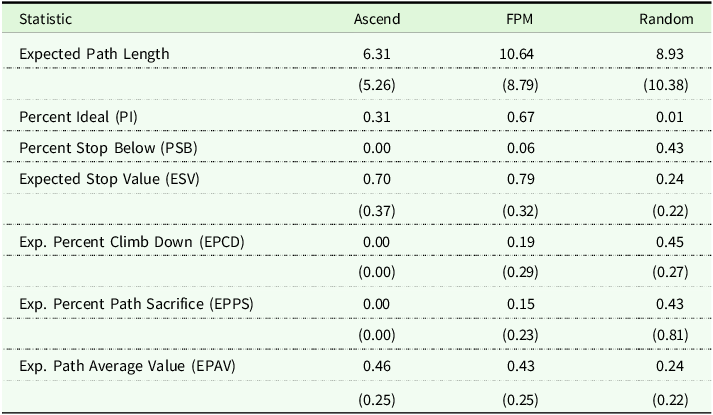
Table 2 reports the results for our extension. Introducing feasibility obstacles to the terrain makes some difference to the performance of problem-solving agents. Now 31% of Ascenders reach the ideal (down from 35%). This is affected by the proportion of unrealizable states: with only 3% of patches removed, roughly 32% reach the ideal, which drops to 28% with 21% removed and then to 18% with 39% removed. Ascenders’ ESV is now about 70% (down from 73%); this is not much affected by the proportion of unrealizable states: from 3–18% of patches removed, their ESV is roughly 75%, dropping to roughly 64% when 39% of patches are removed. (See the online appendix for a more detailed picture.)
Results for Experiment with Feasibility Constraints (16.25 million observations per agent type)

We report ESV and EPAV as percentages of the value of the ideal. (We report interquartile ranges in parentheses.)
The introduction of feasibility constraints makes a more significant difference for ideal-oriented agents. On average (across all feasibility conditions), these agents now fail to reach the ideal about a third of the time (67% of them make it). Their performance on this dimension is significantly affected by the proportion of unrealizable states. With 6% of patches removed, 98% of them reach the ideal; this drops to roughly 77% when 18% of patches are removed. When about one-third of states are unrealizable, only 39% of ideal-oriented agents reach the ideal. Overall, feasibility constraints make only a small difference to the amount of time ideal-oriented agents spend below their starting point (15% now versus 12% in the baseline) and the rate at which ideal-oriented agents take downward steps (19% now versus 17% in the baseline), and their performance on this criterion is not affected much by the proportion of unrealizable states. Finally, about 6% of FPM agents stop on a patch with a value that is lower than their starting value, and this is significantly affected by the proportion of unrealizable states: with 12% of patches removed, only 2% of FPM agents stop below their starting value, but 13% do so with 33% removed. (See the online appendix for a more detailed picture.)
Looking at Table 2, some may think the overall picture still favours the ideal-oriented strategy. It continues to reach the ideal at a higher rate than the problem-solving strategy, has a higher ESV than the latter, and with only a small increase in costs (EPCD and EPPS) compared with the baseline condition. Yet things are more complicated than this overall picture suggests. To give a sense of these complications, we display random samples of 100 paths for each type of agent in Figures 1 and 2. Each pane depicts a subsample: both agent types were initially split into paths that reach the ideal (“successes”) and paths that fail to reach the ideal (“failures”); the FPM successes were then split into “efficient” successes and “costly” successes (more on this distinction shortly). In each pane, the thin lines plot actual paths travelled by ideal-oriented and problem-solving agents. The bold lines are constructed using the subsample averages for our performance statistics: they start at the average starting value, end at the average stop value, take the average number of downward steps, and so on. These are meant to depict the central tendencies of each subsample. We note that these samples are not exactly representative of the full population of paths; if anything, these samples are generous to the two strategies along most criteria when compared with the full population. Nonetheless, they are useful for concretely exposing the complications that lurk behind the overall picture.Footnote 29
Ascend Sample Paths (100 total paths).

FPM Sample Paths (100 total paths).

We start with our sample of problem-solving paths, which is shown in Figure 1. The results here are straightforward. In both panes, we see steadily ascending paths, which consist of nine steps on average; 30% of these paths reach the ideal, while 70% stop short of the ideal (roughly the same as the full population). For those that fail to reach the ideal, the ESV is roughly 76% of the ideal value (which is up from 56% in the full populationFootnote 30); 13 (out of 70) paths stop below 50% of the ideal value, and the lowest stop value is 30%.
Our sample of ideal-oriented paths gives a more complicated picture, shown in Figure 2. Let’s start with the failures. FPM fails to reach the ideal much less often than Ascend, although it fails more often in the full population (33%) than in our sample (22%). But FPM’s failures are more costly than Ascend’s: their ESV is roughly 43% of the ideal value (up from 37% in the full populationFootnote 31); 15 (out of 22) paths stop below 50% of the ideal, and the lowest stop value is 6% (compared with 30% for Ascend). Without making too much of these specific quantities, these results and their comparison with Ascend’s failures sharpen questions about risk management in pursuit of the ideal. How high does the probability of reaching the ideal need to be to compensate for the risk of costly failure? At what point should we be willing to accept a lower probability of reaching the ideal to give ourselves a better chance at making fairly significant progress? More generally, at what point should we be willing to “satisfice” rather than maximize expectations when choosing a strategic orientation? While these questions have floated around the periphery of existing debates, our model extension brings them to the fore and gives tangible direction to our efforts to answer them.
A closer look at FPM’s successes only reinforces these questions. While it’s true that 78% of FPM paths in our sample reach the ideal (up from 67% in the full population), visual inspection suggests important qualitative differences between these successes. In particular, some of these paths are “efficient” in the sense of making their way to the ideal with few downward steps, while others are “costly” in that they encounter significant setbacks on the way to the ideal. As a heuristic, we use the average number of downward steps among all successes to define the two subgroups: “efficient” paths are those with 3 or fewer downward steps, while “costly” paths have more than 3 downward steps. This gives us 46 efficient successes and 32 costly successes. The top left pane of Figure 2 shows that FPM’s efficient successes are comparable to Ascend’s successes, although with occasional minor setbacks and a tendency toward longer path lengths. The top right pane of Figure 2 tells a very different story. Although these paths eventually reach the ideal, they incur substantial costs along the way. As the bold “average path” illustrates, many of these successes take a substantial number of downward steps (on average, a third of their steps are downward) and they spend a substantial amount of time below their starting value (on average, a third of their steps occur below their start value). Again, how to interpret the significance of these costs depends on how we interpret the time scale of a “step”. If we think in terms of decades or generations, following many participants in this debate, then our results suggest that, even when successful, an ideal-oriented strategy implies a significant risk of deliberately consigning several generations to substantial normative losses.
We can think concretely about the risks and rewards associated with each strategy by using our results to roughly characterize them as lotteries.
The Ascend Lottery. 1 in 3 chance of realizing the ideal without short-term sacrifices; 2 in 3 chance of falling short of the ideal while avoiding short-term sacrifices, with an expected stop value of around half of the ideal value (taking the failure ESV for the full population) and never less than 30% of the ideal value.
The FPM Lottery. 2 in 3 chance of realizing the ideal (taking the population success rate); among these successes, roughly 3 in 5 incur only occasional short-term sacrifices (about 40% overall), while 2 in 5 incur substantial and prolonged normative sacrifices (about 26% overall); 1 in 3 chance of falling short of the ideal, with an expected stop value of around 40% of the ideal value and potentially lower than 10% of the ideal value. Or, carving things up differently: 2 in 5 chance of realizing the ideal with occasional short-term costs; 3 in 5 chance of incurring substantial normative costs, with roughly half of these never realizing the ideal.
Our model doesn’t provide a conclusive way to decide between these lotteries.Footnote 32 For one thing, our model extension leaves out many factors that we should account for when thinking about the trade-offs between the strategies. In any case, our model’s value doesn’t lie in conclusively resolving this debate – we still need normative judgement. Its value lies in enabling us to think systematically about the risks and rewards associated with each strategy so we can bring our normative judgement to bear on a concrete choice. With further examination of a range of model extensions, we can sharpen our understanding of the choice we face, as well as explore alternatives to these strategies that might combine their strengths while mitigating their weaknesses.
5. Conclusion
What kind of objective should orient our efforts to achieve social progress? Political theorists have largely focused their attention on two orientations: that of attaining an ideal society and that of solving well-defined social problems in piecemeal fashion. Plainly stated in this way, the two orientations seem perfectly compatible: we can attain an ideal society by serially solving well-defined social problems; put another way, we can solve well-defined social problems on our way to an ideal. But existing debate on this issue has revealed a basic trade-off: our pursuit of an ideal may sometimes require us to forego solutions to current social problems and our efforts to solve current problems may sometimes impede our pursuit of an ideal. Theorists have traded conjectures about the contours of this trade-off. Given their impressionistic nature, however, these conjectures give us little sense of the practical significance of these trade-offs, much less where the balance of considerations lies.
To make progress on this question of orientation, we have introduced a general analytical framework for conducting structured thought experiments, which enables us to operationalize and systematically examine a wide range of hypotheses about the considerations for and against different strategies for pursuing social progress. Our framework consists of a set of tools and techniques for representing and experimentally observing hypothetical agents moving through a space of social possibilities and an initial set of measures for evaluating the relative performance of different strategies these agents might use. Using our framework to test extant hypotheses requires us to formulate them with a certain level of precision, which has the virtue of exposing our assumptions to critical scrutiny. Our framework has the additional virtue of being readily adapted to accommodate a wide range of competing assumptions: about how the space of social possibilities is structured; about what agents can know about this space as they move around it; about the operationalizations of competing strategic orientations. Our framework thus enables us to methodically catalogue how the performance of various strategies depends on our assumptions about these matters. We can, in turn, use this catalogue to guide our thinking about the trade-offs we are liable to encounter when choosing between different strategic orientations in real-world situations and, ultimately, about where the balance of considerations lies.
As a proof-of-concept, we implement this framework using a specific set of assumptions. Given the simplicity of our assumptions, our analyses can only be first steps in a larger research programme that aims to think concretely and systematically about the trade-offs between different orientations to pursuing progress. In the spirit of further exploration, we conclude by indicating some of the next steps that we and others could take.
One class of extensions focuses on the operationalization of agents’ strategies. For example, we could explore alterations to FPM and Ascend that give agents more flexibility in how they handle feasibility constraints. We could also introduce strategies that mix ideal and problem-solving orientations in various ways – for example, strategies that pursue a series of “provisional ideals” that fall within agents’ “radius of vision”, which can be more or less restricted (Herzog Reference Herzog2012; Carroll Reference Carroll2022). Which kinds of strategies we will be motivated to examine will depend on our assumptions about what agents can know about the space of possibilities and, in particular, the location of the ideal. For example, we could assume that agents are uncertain about the location of the ideal; given this, we will want to examine a range of experimental strategies, which allow agents to formulate hypotheses about the location of the ideal and use these hypotheses to orient their movements (e.g. Anderson Reference Anderson2010; Gaus Reference Gaus2016; Barrett Reference Barrett2020). In the same vein, we could extend our framework to model disagreement about the normative value of social states, in which case different agents would perceive the structure of the space differently (e.g. Gaus Reference Gaus2016; Muldoon Reference Muldoon2016).
Another class of extensions focuses on altering our assumptions about the structure of the possibility space. For one example, rather than represent feasibility constraints as missing patches in an otherwise dense space, we could restrict the available paths between social states to a greater or lesser extent, allowing agents to move to only a subset of their neighbouring states. Alternatively, we could allow agents to move directly to a limited number of states anywhere in the space. For another example, we could allow value transitions between neighbouring patches to be more or less smooth. This extension would allow one to model the idea that small changes in institutional details can produce substantial variation in normative value (e.g. Coram Reference Coram and Goodin1996). Additionally, following suggestions in the existing literature, we could extend our framework to allow agents to learn about the normative value of particular states as they explore the space, in which case the “altitude” of particular states shifts over time (e.g. Gaus Reference Gaus2016; Rosenberg Reference Rosenberg2016).
At present, we have little more than vague impressions of how different strategies for pursuing progress might perform. But with these and other extensions of our framework, we can attain a determinate and systematic accounting of the trade-offs we face, which we can use to guide our choice of orientation in real-world situations.
Supplementary material
For supplementary material accompanying this paper visit https://doi.org/10.1017/S0266267126100698.
Acknowledgements
Earlier versions of this article were presented at: the 2023 annual meeting of the PPE Society; the Benson Center for Western Civilization at the University of Colorado; the Population Well-Being Initiative at the University of Texas, Austin; the FAX4 Workshop at the University at Buffalo; the Center for the Study of Social Justice seminar at Nuffield College, University of Oxford; and the Colloquium in Social and Political Philosophy and Ludwig-Maximilians-Universität München. We are grateful to the organizers for these opportunities and to the audiences for their many helpful comments. Thanks in particular to Jacob Barrett, Jeff Carroll, Sahar Fard, Zeynep Pamuk, Laura Valentini, as well as the Editor, Peter Vanderschraaf, and two anonymous referees for this journal. Thanks to Ben Gross, Maya Pupo and Eli Prager for help with debugging code and generating data visualizations. Wiens thanks Jon Bendor for a lengthy correspondence many years ago, which helped to crystallize some of the ideas that led to this article. Muldoon’s contribution was made possible through the support of Grant 63350 “Diversity, dynamism and inclusion: a new multi-method approach for studying liberalism” from the John Templeton Foundation.
Competing interests
The authors have no conflicts of interest to declare.
Keith Hankins is the R.C. Hoiles Endowed Chair in Business Ethics and Free Enterprise and Associate Professor of Philosophy at Chapman University. He is the PPE section editor of Philosophy Compass. His work, which focuses on how individuals navigate the frictions associated with living in community with others, has been published in journals such as Ethics, Philosophy & Phenomenological Research and Journal of Politics.
Ryan Muldoon is Professor of Philosophy at University at Buffalo. He is the author of Social Contract Theory for a Diverse World: Beyond Tolerance (Routledge, 2016), and with Fred D’Agostino and Jerry Gaus, the editor of The Routledge Companion to Social and Political Philosophy (2024). His current work focuses on the value of diversity, dynamism and discovery in social and political philosophy.
David Wiens is Associate Professor of Political Science and Faculty Affiliate in Philosophy at the University of California, San Diego. He has published numerous articles on methodology in political theory and related topics in journals such as American Journal of Political Science, Journal of Politics, Philosophy and Phenomenological Research, Philosophy and Public Affairs and Politics, Philosophy, and Economics. He is the author of From the Best to the Rest: Idealistic Thinking in a Non-Ideal World (Oxford University Press).




 Open access

