

“To be politically active in the Netherlands, one needs to be Dutch and nothing else. It is unacceptable that people with a double nationality and thus a double loyalty take their place in parliament, government, municipality council, provincial council, and in other representative bodies” (Geert Wilders leader of the populist Party for Freedom; 15 February 2019).
International mobility provides a challenge to political membership within territorial boundaries and raises two critical questions. The first question concerns who should be allowed to enter the country, and the second one relates to the granting of citizenship to those that have entered. These two questions have stirred considerable public debate in many western societies. However, although there is a relatively longstanding research tradition on attitudes towards immigration and immigrants (Hainmueller and Hopkins Reference Hainmueller and Hopkins2014), there is only very limited research on public attitudes towards immigrants’ citizenship acquisition and dual citizenship in particular (Kusow and DeLisi Reference Kusow and DeLisi2016; Vink et al. Reference Vink, Smeets and Mennes2019). Further, experimental research has examined the criteria (e.g., language, skin tone) that determine whether people have less or more favorable attitudes towards immigration (e.g., Valentino et al. Reference Valentino, Soroka, Iyengar, Aalberg, Duch, Fraile, Hahn, Hansen, Harell, Helbling, Jackman and Kobayashi2019), but there is to our knowledge no experimental research that has investigated when people are less or more accepting of dual citizenship. As more than 50 countries worldwide permit dual citizenship, it is important to understand how the wider public perceives and responds to individuals with dual citizenship, including the extent to which such individuals are granted their freedoms despite their legal rights to do so.
Dual citizenship
Citizenship is a critical marker of legal and political community membership that provides security, protection, and equal civil, social, and political rights and responsibilities (Bloemraad Reference Bloemraad2015; Marshall, Reference Marshall1964). An increasing number of countries permit dual citizenship for immigrants, and nowadays, tens of millions of persons hold citizenship in more than one country (Harpaz Reference Harpaz2019; Harpaz and Mateos Reference Harpaz and Mateos2019). Such changes have led to politicized questions about national citizenship and concerns about the divided loyalties of such individuals, especially when they are perceived as becoming the targets of external political influence, becoming members of representative bodies, gaining government employment, and taking jobs related to national security. Dual citizenship is a contentious political issue that raises continuing questions of divided loyalty in many countries (see opening quote; e.g., Kusow and DeLisi Reference Kusow and DeLisi2016). Immigrants gaining dual citizenship lead to suspicions among the public of multiple loyalties and the belief that national unity, coalition, and security are compromised (Jasinskaja-Lahti et al. Reference Jasinskaja-Lahti, Renvik, Van der Noll, Eskelinen, Rohmann and Verkuyten2020; Kunst et al. Reference Kunst, Thomsen and Dovidio2019).
However, public concerns about multiple loyalties might depend on the perceived reasons that immigrants give for naturalization and acquiring dual nationality. Citizenship rights and benefits refer to the legal status bestowed by the state, and in countries that allow dual citizenship, immigrants can apply for a second citizenship for a variety of reasons (Diehl and Blohm Reference Diehl and Blohm2003; Pogonyi Reference Pogonyi2019; Ronkainen, Reference Ronkainen2011). Specifically, there often is a combination of emotional reasons of identification and attachment and more instrumental reasons for naturalization. Despite the combination of motives that immigrants might have, in political and public debates, the emphasis can be more on the alleged former or latter type of reason, and this might influence public perceptions of dual citizens’ loyalty to the host country (vs. country of origin) and the political tolerance of immigrants (Baron, Reference Baron2009; Ditlmann et al., Reference Ditlmann, Purdie-Vaughns and Eibach2011; Politi, Roblain et al., Reference Politi, Roblain, Gale, Licata and Staerklé2020).
In the present preregistered experimental research, we aim to investigate whether perceived emotional or instrumental reasons for dual citizenship affect how immigrants’ national loyalties are evaluated by native-born members, and whether these evaluations have ramifications for their political tolerance. We examine these questions among a representative sample of Dutch natives using a survey experiment in which we compare people’s reactions to an immigrant’s second citizenship (i.e., host country, in addition to country of origin) acquired mainly for emotional reasons (i.e., identification with the host country, feeling of belongingness) or rather for instrumental reasons (i.e., secure legal status, freedom of movement).
National loyalty and dual citizenship
In several countries, including the Netherlands, naturalizing immigrants need to officially declare their solidarity to the country with a loyalty pledge. Loyalty towards a nation implies the moral responsibility and obligation to act in a way that supports its unity, functioning, and continued existence. Behavior that is partial in enhancing group welfare is considered loyal (Zdaniuk and Levine, Reference Zdaniuk and Levine2001), and national loyalty implies the expectations of national commitment, trustworthiness, and sacrifice (Hildreth et al., Reference Hildreth, Gino and Bazerman2016). Thus, when immigrants are presented and perceived as having a competing loyalty with their country of origin, it might become more difficult to politically trust, accept, and tolerate them (e.g., Faist et al., Reference Faist, Gerdes and Rieple2004; Jasinskaja-Lahti et al., Reference Jasinskaja-Lahti, Renvik, Van der Noll, Eskelinen, Rohmann and Verkuyten2020; Kunst et al., Reference Kunst, Thomsen and Dovidio2019).
The question of dual loyalty is a central part of political and religious nationalism in Europe (Baron, Reference Baron2009). Research has found that native-born citizens perceive dual citizens as being more disloyal towards the host nation and more loyal to their country of origin, compared to naturalized citizens who renounced their previous nationality (Jasinskaja-Lahti et al., Reference Jasinskaja-Lahti, Renvik, Van der Noll, Eskelinen, Rohmann and Verkuyten2020; Kunst et al., Reference Kunst, Thomsen and Dovidio2019). However, it is likely that the reasons for naturalization matter for how immigrants with dual citizenship are perceived and whether they are tolerated politically. A distinction between emotional and instrumental reasons for naturalization is commonly made in political and public debates, and also by immigrants themselves (e.g., Diehl and Blohm, Reference Diehl and Blohm2003; Ditlmann et al., Reference Ditlmann, Purdie-Vaughns and Eibach2011; Harpaz and Mateos, Reference Harpaz and Mateos2019; Politi, Chipeaux et al., Reference Politi, Roblain, Gale, Licata and Staerklé2020). From a communitarian perspective, naturalization applicants are expected to show high degrees of attachment and belonging to the country of settlement. The focus is on the sentimental value of citizenship as a symbol of national belonging and emotional attachment (Bloemraad, 2005). Naturalization applicants who want their sense of host country belonging and commitment recognized in the form of dual citizenship can be seen as valuing the nation of settlement and truly wanting to become “one of us.” Naturalized citizens predominantly moved by the desire to belong report, themselves, that they often feel socially accepted and recognized as full members of the national community by the native population (Diehl and Blohm, Reference Diehl and Blohm2003; Pogonyi Reference Pogonyi2019; Politi, Roblain et al. Reference Politi, Roblain, Gale, Licata and Staerklé2020).
In addition to emotional attachment to the country of settlement and the wish to call it home, there also can be instrumental reasons for applying for host society citizenship. Various studies have analyzed the practical incentives of obtaining an additional citizenship, such as better opportunities, higher status, more extensive rights, and greater freedom of global movement (Diehl and Blohm Reference Diehl and Blohm2003; Harpaz Reference Harpaz2019). It is even argued that there is a worldwide trend toward strategic citizenship (Harpaz and Mateos Reference Harpaz and Mateos2019) in which the acquisition and use of citizenship are driven by the advantages that it brings (Joppke Reference Joppke2019). However, host society natives can perceive this instrumental orientation as lacking the true commitment and attachment which citizenship would require or imply. In general, instrumental motives tend to be more conditional and malleable than emotional sentiments and attachments. Furthermore, naturalized citizens driven by instrumental motives report that the public more often denies their recognition as full members of the national community (Diehl and Blohm Reference Diehl and Blohm2003; Politi, Roblain et al. Reference Politi, Roblain, Gale, Licata and Staerklé2020).
The emphasis on the one or the other reasons for naturalization can be expected to differentially impact on the perceived loyalty to the country of settlement and country of origin. We examined this in an experiment with three conditions. Specifically, immigrants who are considered to acquire second citizenship out of the emotional desire to belong to the national community can be expected to be perceived as being more loyal to the country of settlement and less loyal to the country of origin, compared to those who are considered to have instrumental reasons, and relative to a control condition in which no reasons are mentioned. Including a no-information control condition allows us not only to examine whether there is a difference in perceived loyalties between presenting the application for dual citizenship for emotional or instrumental reasons but also whether suspicions about multiple loyalties exist when no reasons are mentioned. Previous research indicates that immigrant-origin individuals with dual citizenship are perceived as having equally high country of origin loyalty as immigrants who only have citizenship of their country of origin (Jasinskaja-Lahti et al., Reference Jasinskaja-Lahti, Renvik, Van der Noll, Eskelinen, Rohmann and Verkuyten2020; see also Kunst et al. Reference Kunst, Thomsen and Dovidio2019). Furthermore, instrumental reasons underlying immigrants’ naturalization can be perceived as trying to benefit from two societies, and interpreted – also by naturalized citizens themselves – as only wanting to maintain their heritage culture (Politi, Chipeaux et al. Reference Politi, Roblain, Gale, Licata and Staerklé2020). This could mean that immigrants’ national loyalties are perceived similarly in the instrumental and control experimental conditions.
Political tolerance
As the opening quote illustrates, the question of political tolerance of dual citizens is a debated one. Political tolerance is one of the central pillars of liberal democracy. The rights of speech, demonstration, association, and holding governmental positions apply to all, and a tolerant person believes that all citizens should be able to express their views and be involved in civic and political life. There is a rich literature that has examined the levels and correlates of political tolerance (e.g., Mondak and Sanders Reference Mondak and Sanders2003), the effects of situational conditions on tolerance (e.g., Nelson et al. Reference Nelson, Clawson and Oxley1997), and the drivers and changes in tolerance (e.g., Mutz Reference Mutz2002). Here we examine whether immigrants’ expressed reason for a second citizenship impacts on political tolerance of these dual citizens. We additionally examine whether framing differing expressed motivations for becoming a dual citizen impacts political tolerance through changes in perceived loyalty to the country of settlement versus country of origin. We expect that stronger perceived loyalty to the country of settlement is associated with higher tolerance and stronger perceived loyalty to the country of origin with lower tolerance. Combined with the expressed reasons underlying naturalization, we tested a mediation model in which emotional (compared to instrumental) reasons lead to higher perceived country of settlement loyalty that is subsequently associated with higher political tolerance, and instrumental (compared to emotional) reasons lead to higher country of origin loyalty and thereby indirectly to lower political tolerance.
We tested these predictions in the context of the Netherlands. In this country, around half of the population opposes dual citizenship, and a third accepts it, with around one in five being neutral or undecided (Vink et al. Reference Vink, Smeets and Mennes2019). This public attitude reflects political debates in which many political parties have reservations about dual citizenship, as well as the existing government policy. In contrast to most European countries, the Netherlands has a rather restrictive citizenship policy with the expectation that naturalized citizens renounce their previous citizenship when their country of origin allows this: “In the event of naturalization, the Dutch government wants to limit dual nationality as much as possible.”Footnote 1 However, despite this policy, the number of dual citizens is around 1.4 million (7.8% of the population) which is also due to children from parents with different citizenship acquiring dual citizenship at birth.
Method
Participants
A sample of 427 Dutch respondents participated with consent in an online survey. Potential respondents were selected by a survey company (Kantar) which maintains a representative panel for fieldwork in the Netherlands. From this online panel, a national sample of the native Dutch population aged 18 years and older was compiled via a random stratification procedure based on the characteristics gender, age, education, household size, and region. The response rate was 54%, which is common in the Netherlands (Stoop et al. Reference Stoop, Billiet, Koch, Fitzgerald, Stoop, Billiet, Koch and Fitzgerald2010). The sample closely matches the general Dutch population in terms of demographic characteristics, but with a slight overrepresentation of older people and higher educated (Statistics Netherlands 2020). The sample was relatively evenly divided in terms of gender (51.0% male), and age ranged from 18 to 89 years (M = 49.52, SD = 18.25). Based on the classification of low, moderate, and high education levels by Statistics Netherlands (2020), 13.1% of the sample were classified as having low levels of education, 48.6% as moderately educated, and 38.5% as highly educated. Participants were relatively evenly distributed in their political orientation (self-placement from 1 (“extreme left”) to 7 (“extreme right”), M = 4.14, SD = 1.44; 22.8% center, 28.2% left-leaning, 34.5% right-leaning, 14.5% non-response or indicating they did not know). With weights applied, the sample was representative for the Dutch population in terms of gender, age, education level, and political orientation. These variables were also included as control variables in the mediation model tested. The study was preregistered, and the materials as well as data can be found at https://osf.io/dchx6/?view_only=4e0d4fed204647bfa9236bf692e5ae43 (Verkuyten et al. Reference Verkuyten, Gale, Yogeeswaran and Adelman2022).
Experimental procedure
Participants were randomly assigned to one of three conditions reflecting either expressed emotional reasons (N = 142), instrumental reasons (N = 136), or a control condition (N = 148). Based on ongoing public debates about dual citizenship and using the design of previous research (Ditlmann et al. Reference Ditlmann, Purdie-Vaughns and Eibach2011; Hindriks et al. Reference Hindriks, Verkuyten and Coenders2015; Matera et al. Reference Matera, Stefanile and Brown2011), participants were presented with a short excerpt from a fictitious interview that “was recently published in a well-known morning newspaper.” In this excerpt, a 25-year-old Turkish immigrant – Ahmed – was interviewed about the Dutch passport that he had recently acquired. Immigrants with a Turkish background can legally possess dual citizenship in the Netherlands, and Turks are the largest and one of the most prominent immigrant-origin groups in the country with transnational social and political ties to Turkey (e.g., Østergaard-Nielsen Reference Østergaard-Nielsen2003). Ahmed first described himself as being born in Turkey, just like his parents were, and that he feels a strong connection with his motherland. He continued with saying “But I live already 10 years in the Netherlands and in addition to my Turkish passport I now also have a Dutch passport.” Then, the interviewer asked whether he was happy that he now also was Dutch legally, and he responded with “yes, I like that very much.” Subsequently, the interviewer asked him to explain why exactly he had become a Dutch citizen. In the emotional condition, he responded with “Because I have the feeling that I belong here, that this is also my country. I really feel at home and connected to the Netherlands. I feel like a real Dutch person and I am glad that I now also am Dutch legally.” In the instrumental condition, he responded with “Because a Dutch passport is useful and makes life easier. I now have more rights in the Netherlands, can more easily sign up for things and can also travel freely to other countries.” In the control condition, the interviewer did not ask to explain why he had become a Dutch citizen.
Measures
Perceived loyalty with the host country and country of origin, and political tolerance were latent constructs comprised of multiple items for which respondents indicated their agreement on 7-point Likert scales.
Perceived loyalty with the host country was measured with the following two items: “How loyal do you think that Ahmed is to the Netherlands” and “How strong do you think that Ahmed is committed to the Netherlands” (r = .64; M = 4.14, SD = 1.11).
Perceived loyalty with the country of origin was measured with the following two items: “How loyal do you think that Ahmed is to Turkey” and “How strongly do you think that Ahmed is committed to Turkey” (r = .61; M = 5.23, SD = 0.95).
Political tolerance was measured with asking participants “How much do you think that people like Ahmed should be able to….” followed by six items including “hold public demonstrations,” “organize political meetings,” “give public speeches,” “work as a civil servant at a ministry,” “work for the internal security service,” and “hold a high position in the army” (ρ = .94; Raykov Reference Raykov2017; M = 4.42, SD = 1.44).
Results
Data analysis was conducted using Mplus version 8.2 (Múthen and Múthen 2018), including assessment of the measurement model, analysis of descriptive statistics, and hypothesis testing via structural equation modeling. Weights were applied for all analyses.
Measurement model
A confirmatory factor analysis was first conducted to assess the measurement model of latent variables loyalty to host country, loyalty with the country of origin, and political tolerance. Cut-off criteria of fit indices were determined according to Hu and Bentler (Reference Hu and Bentler1999) and Lai and Green (Reference Lai and Green2016). Fit statistics for the basic model were less than adequate, χ2(32) = 334.75, RMSEA= .15, CFI =.84, SRMR =.06, although modification indices indicated that the fit would be substantially improved by including error covariances between two pairs of items used to assess political tolerance, namely between the item suggesting people like Ahmed should be allowed to work for the internal security service (fifth item) and that they should be allowed to hold a high position in the army (sixth item), and between the item suggesting people like Ahmed should have the opportunity to hold public demonstrations (third item) and that they should have the opportunity to work as a civil servant in a ministry (fourth item). These modifications were applied resulting in an adequate model fit, χ2(30) = 134.75, RMSEA = .09, CFI = .95, SRMR = .06.
Descriptive findings
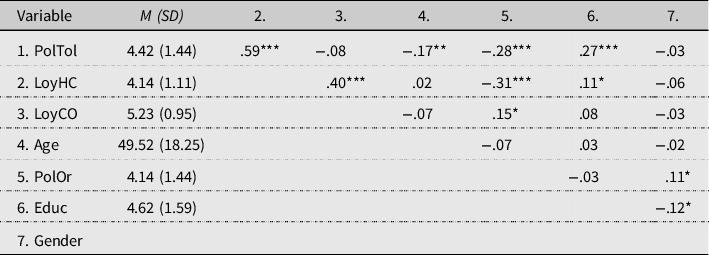
As shown in Table 1 and indicated in the latent means reported above, overall, participants perceived strong loyalty to the country of origin and significantly lower loyalty to the host country (Wald χ2(1) = 133.92, p < .001). Political tolerance was above the mid-point of the scale, Wald χ2(1) = 31.79, p < .001. Greater perceived loyalty to the host country was associated with significantly more political tolerance (r = .59, p < .001), and perceived loyalty to the country of origin was negatively but not significantly associated with political tolerance (r = −.08, p = .204). Perceived loyalty to the host country and perceived loyalty to the country of origin were negatively associated (r = −.40, p < .001).
Means (Standard Deviations) and Correlations between Latent and Control Variables

Note. PolTol represents political tolerance, LoyHC represents perceived loyalty to the host country, LoyCO represents perceived loyalty to the country of origin, PolOr represents political orientation, Educ represents Education, Gender coded 0 = female, 1 = male. *p < .05, **p < .01, ***p < .001.
Structural model
Hypothesis testing was conducted using mediation analysis with structural equation modeling. The model included experimentally manipulated perceived reason as the independent variable, perceived loyalty to the host country and to the country of origin as parallel mediators, and political tolerance as the dependent variable. Experimental conditions were orthogonally contrast coded such that emotional reason (coded .67) was first compared with instrumental reason and the control condition (both coded −.33; testing our hypothesis). Then, instrumental reason (coded .50) was compared with the control condition (coded −.50) to examine if there was a difference between the two (emotional reason coded 0), and this contrast was not significantly related to any of the measures. Therefore, below, we report the analysis with the first contrast, with the second one included as a control variable.Footnote 2
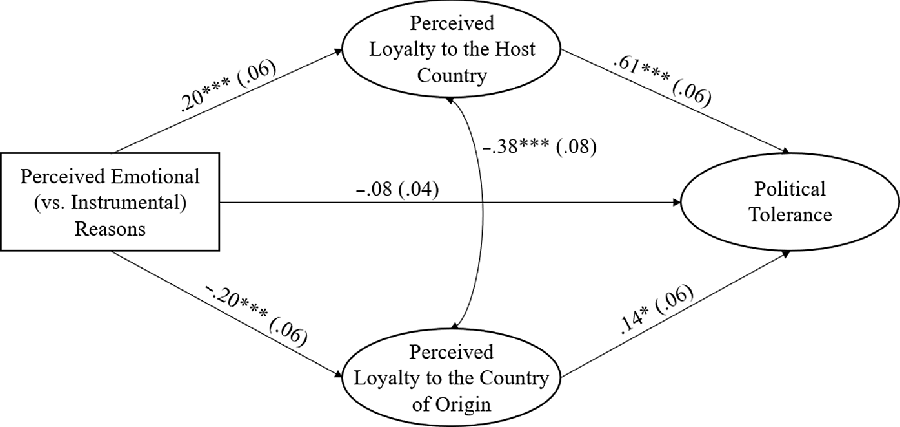
The error covariances reported for the measurement model above were included in this analysis. Indirect effects were computed with 5000 bootstraps and using 95% confidence intervals. Figure 1 presents the standardized path coefficients in the final mediation model including age, gender, education, and political orientation as control variables predicting the mediators and outcome measures (with full information maximum likelihood estimation applied for missing data on the political orientation measure).
Standardized path coefficients reflecting effect of perceived reasons for dual citizenship on political tolerance via perceived loyalty to the host country and to the country of origin.
Note. *p < .05, **p < .01, ***p < .001.

The structural model had an adequate fit to the data, χ2(77) = 230.13, RMSEA = .07, CFI = .94, SRMR = .05, and indicated that dual citizens expressing emotional reasons for naturalization were perceived as having greater loyalty to the host country, β = .20, SE = .06, p < .001, and weaker perceived loyalty to the country of origin, β = −.20, SE = .06, p < .001, in comparison to those expressing instrumental reasons for naturalization (and the control condition). Perceived loyalty to the host country, in turn, predicted greater political tolerance, β = .61, SE = .06, p < .001, as – unexpectedly – did perceived loyalty to the country of origin, β = .14, SE = .06, p = .013. The direct effect of emotional vs. instrumental reasons (with the control condition) on political tolerance was non-significant, β = −.08, SE = .04, p = .084.Footnote 3
Analysis of indirect effects showed that perceived loyalty to the host country mediated the effect of naturalization reasons on political tolerance (IE = .12, SE = .04, 95% CI [.05, .20]). Perceived loyalty to the country of origin also mediated the effect of reasons on political tolerance (IE = −.03, SE = .01, 95% CI [−.06, −.00]), in the opposite direction. These results remained consistent when control variables were excluded.
However, since perceived loyalty to the host country and to the country of origin were strongly correlated, and because the bivariate relationship between perceived loyalty to the country of origin and political tolerance was descriptively negative and non-significant, it is likely that the positive relationship between perceived loyalty to the country of origin and political tolerance in the structural model was a statistical artifact. Indeed, when removing the correlation between the mediators in Figure 1, the effect of perceived loyalty to the country of origin on political tolerance became non-significant, β = .08, SE = .05, p = .139, as did the indirect effect (IE = −.02, SE = .01, 95% CI [−.04, .01]).Footnote 4
Perceiving immigrants’ emotional rather than instrumental reasons for naturalization therefore led to greater perceived loyalty to the host country which was associated with greater political tolerance. While perceiving instrumental rather than emotional reasons for second citizenship led to stronger perceived loyalty to the country of origin, we cannot conclude that this form of loyalty had any association with political tolerance.
Discussion
A few decades ago, it was common to consider an intrinsic link between citizenship and loyalty to a national community. However, continuing immigration has increased dual nationalities worldwide, which has raised public and political concerns about multiple loyalties and political incorporation of newcomers in the host country (Harpaz Reference Harpaz2019). In this experimental study, we investigated whether immigrants’ (disclosed) emotional versus instrumental reasons for acquiring a second citizenship influence how the public perceives dual citizens’ loyalties to the host country and country of origin, and whether these perceptions, in turn, predict political tolerance of such individuals. We found that the expressed reasons for naturalization did indeed matter, with emotional motivations for dual citizenship leading to higher perceived host country loyalty and lower country of origin loyalty, compared to instrumental reasons. Thus, the native respondents seem to have a communitarian view in which naturalizing immigrants are expected to have a high degree of attachment to the host society and truly want to become “one of us.” Further, the perceived loyalties were similar when instrumental reasons or no reasons (control condition) were presented in the experimental manipulation. This suggests that it is commonly assumed that immigrants want to acquire second citizenship mainly for strategic-instrumental reasons (Harpaz and Mateos Reference Harpaz and Mateos2019; Vink et al. Reference Vink, Smeets and Mennes2019). Additionally, higher perceived host country loyalty was associated with higher political tolerance of immigrants with a dual citizenship, whereas country of origin loyalty was not clearly related to political tolerance. Furthermore, both forms of loyalty were negatively associated with each other suggesting that the public tends to think more in terms of divided loyalties than multiple loyalties. However, we did not directly ask about dual loyalty perceptions, and asking separate questions about host country loyalty and country of origin loyalty might have prompted the idea of contrasting loyalties. Future work should examine this distinction more systematically.
Future research should also examine the generalizability of these findings in other political contexts, with a focus on other immigrant-origin groups, too. Countries differ in various ways and the historical, legal, and cultural context in which citizenship evolves might influence how national belonging is understood and how reasons for acquiring a second citizenship are evaluated. For example, immigrants who disclose an instrumental strategy or rather express emotional reasons might be perceived differently in settler societies such as the US and Canada compared to non-settler societies such as the Netherlands and Germany (Ditlmann et al. Reference Ditlmann, Purdie-Vaughns and Eibach2011).
Furthermore, different immigrant-origin groups can be perceived differently in Dutch society (or other societies). We focused on the numerically largest group of immigrants from Turkey in relation to whom concerns are frequently raised about their political segregation in the Netherlands (Hindriks et al. Reference Hindriks, Verkuyten and Coenders2015) and about transnational political influences of the Turkish government (Verkuyten Reference Verkuyten2018). There are similar concerns in, for example, Germany, Belgium, and Finland in relation to Turkish and Russian immigrants (Jasinskaja-Lahti et al. Reference Jasinskaja-Lahti, Renvik, Van der Noll, Eskelinen, Rohmann and Verkuyten2020), but the loyalties of immigrants from ex-colonial or western societies might be perceived and evaluated differently. This is something for future research to explore.
In conclusion, citizenship is a major determinant of people’s rights and a force of justice, equality, and national cohesion. Turning immigrants into fellow citizens can promote their socio-political integration (Hainmueller et al. Reference Hainmueller, Hangartner and Pietrantuono2015), but it can also raise suspicions about divided loyalties with the related questions of political trust and tolerance. These suspicions appear to be especially likely if the reasons for naturalization are considered to be more strategic-instrumental rather than emotional. This is an important finding in light of the political and public debates about dual loyalty and why immigrants would want to naturalize (Faist et al. Reference Faist, Gerdes and Rieple2004; Harpaz and Mateos Reference Harpaz and Mateos2019; Kusow and DeLisi Reference Kusow and DeLisi2016). To politically and socially recognize naturalizing immigrants as loyal members of the national community, the public seems to expect an emotional attachment to the nation rather than an instrumental orientation which has become a more prominent reason (Joppke Reference Joppke2019). Thus, although immigrants who acquire a second citizenship for allegedly instrumental reasons are legal co-nationals, they can be perceived as second-class citizens (Jasinskaja-Lahti et al. Reference Jasinskaja-Lahti, Renvik, Van der Noll, Eskelinen, Rohmann and Verkuyten2020) and can also themselves start to feel that way (Politi, Chipeaux et al. Reference Politi, Roblain, Gale, Licata and Staerklé2020). Recognition of full citizenship and the related political tolerance can be considered as something that should be “earned” by demonstrating national attachment, loyalty, and pride (Conover et al. Reference Conover, Searing and Crewe2004; Politi, Roblain et al. Reference Politi, Roblain, Gale, Licata and Staerklé2020). Instrumental reasons for a second citizenship do not seem to demonstrate immigrants’ readiness to be loyal to the host country and might fuel suspicions which give further incentives to populist politics, as illustrated by the quote opening this paper.
Supplementary material
To view supplementary material for this article, please visit https://doi.org/10.1017/XPS.2022.17
Data availability
The data, code, and any additional materials required to replicate all analyses in this article are available at the Journal of Experimental Political Science Dataverse within the Harvard Dataverse Network, at: doi.org/10.7910/DVN/BA20LQ.
Financial Support
Support for this research was provided by the European Research Council Advanced Grant under the European Union’s Horizon 2020 research and innovation program (grant agreement No 740788).
Conflicts of interest
There are no conflicts of interest.
Ethics statement
This research was approved by the Ethics Committee of the Faculty of Social and Behavioural Sciences at Utrecht University: protocol number 21-0151.
The research adheres to APSA’s Principles and Guidance for Human Subjects Research See Supplemental appendix, “Ethics Statement”.


 Open access

