

Introduction
Napoleon Bonaparte’s prediction about China has come to fruition,Footnote 1 a seismic shift in global dynamics promoting discussions about the implications of China for the liberal international order (LIO). The dominant discourse revolves around the question of whether this ‘risen China’ will dismantle or operate within the LIO.Footnote 2 This debate has become narrower still as a geopolitical zero-sum contest. IR scholars have examined the mechanisms that facilitated China’s rise, exploring various actors’ roles. Many critics of China’s rise argue that its integration was ‘the worst strategic blunder’,Footnote 3 enabled by US liberal elites’ ‘strategic naivety’.Footnote 4 We argue that Ford and other liberal elites played a long game – a war of position – to gradually shift Chinese elites’ ideas, institutions, and approaches to the world, away from revolutionary Marxism–Leninism towards integration into the liberal order. Complementarily, Chinese elites had agency and closely monitored and shaped Ford’s influence.Footnote 5 Ford was neither co-opted by nor controlled Chinese elites but occupied a liminal ambiguous space in a complex, if authoritarian, system.Footnote 6 Ford is adept at negotiating reform-oriented engagement within a variety of regimes, including hostile right-wing American administrations and ‘anti-American’ foreign states.
For realists, an anarchical international system compels China to pursue survival and strive for regional hegemony.Footnote 7 Offensive realists expect revisionist state elites to challenge the dominant power, viewing its ascent as an outcome of strategic decisions made by national elites, within the context of systemic pressures. The Chinese moral realist IR scholar embedded in Ford’s extensive elite networks, Yan Xuetong, emphasises that state leadership is the crucial explanatory factor for understanding a rising power’s ascent.Footnote 8
For liberals, China’s ascent was possible through selective integration and socialisation into the US-led LIO,Footnote 9 because if Russia and China could be made ‘“more like us” they would be less likely to mount revisionist challenges’.Footnote 10 China leveraged the LIO to promote its ‘development into a global superpower’,Footnote 11 even as China’s own economic modernisation was fundamental.Footnote 12 Ikenberry argues that the result of China’s integration and socialisation would be a win for both China and the United States.Footnote 13
These perspectives, while valuable, exhibit three primary shortcomings. First, they are imbued with internalist views suggesting world politics can be explained by a society’s domestic characteristics alone.Footnote 14 Hence, China’s rise was possible due to elites’ ‘policy choices’, overlooking how external actors and structures shaped, enabled, and conditioned policy choices. Although realists highlight the international system’s anarchical nature as shaping state policy, their perspectives do not transcend internalist narratives.
Secondly, mainstream literature is entrenched in state-centric thinking.Footnote 15 State-centric realism and neoliberalism fail to offer a comprehensive explanation of the evolution of Sino–US relations. The state-centric paradigm creates a division between domestic and international politics, hindering the examination of reciprocal relations between these two spheres, impeding a holistic study of politics.Footnote 16 Thirdly, mainstream literature often presents a linear understanding of China’s rise, portraying Chinese elites as passive actors merely responding to the pressures of international anarchy or socialisation dynamics of the LIO. We also challenge the binary approach that labels China as either for or against the LIO, as reality reflects far greater complexity.Footnote 17
We investigate a neglected aspect of China’s rise: how American NGOs supported a new generation of China specialists who prepared for a new era in its relations with China and ‘transferred’ knowledge of world politics to China. These NGOs – particularly the Ford Foundation – helped normalise Sino–US relations and significantly influenced IR studies in China. We briefly show how Ford built academic Chinese studies in the US and helped forge a new policy consensus around engaging China from the 1960s. We then show the extensive range of Ford’s elite knowledge network-building activities in China that were influential institutionally and ideationally, in terms of the diplomatic and policy environment, and in pluralising and liberalising aspects of Chinese academia. We examine the formation of Sino–US elite knowledge networks, facilitating transnational agendas through involvement in US foreign policy towards China and the training of international affairs experts. As a result of US foundations’ entrepreneurial network-building, American-style IR became the hegemonic discipline in many countries, including China, marginalising the English School, for example.Footnote 18
In this article, inspired by Gramsci’s ideas on hegemony, historic blocs, and war of position, we offer an original internationally informed, archive research–based examination of the impact of American foundations on both China’s rise and the growth of IR. Ford, while aiming to promote peace and socialise Chinese elites into the ‘American order’, inadvertently played a role in empowering Chinese IR scholars and elites, providing them a new understanding of world politics amid evolving geopolitical dynamics.Footnote 19 Clearly, there are macro and micro factors influencing the development of Chinese IR, including debates among prominent scholars competing for status. Nevertheless, at least ten of the top twenty-five Chinese IR theorists were funded by Ford and worked in closely linked institutions, including Wang Yizhou, Wang Jisi, Yan Xuetong, Ni Shixiong, Shen Dingli, Chu Shulong, Yang Jiemian, Zhang Yunling, and Zhou Fangyin.Footnote 20 Yan Xuetong, for example, developed a strong critique of US loss of moral authority through policies of double standards in foreign affairs in the context of the LIO.Footnote 21
This enabled Chinese scholars to develop intellectual tools, new concepts, and transnational networks, the groundwork for both integrating into and questioning the LIO. While American foundations initially sought to strengthen ties and socialise Chinese elites, they unintentionally created the basis of challenges to the LIO. Between 2002 and 2009, over 85 per cent of all Ford grants (which totalled over $440 m) to China went to state-linked institutions, strengthening the Chinese state.Footnote 22 Ford neither co-opted Chinese elites nor was it co-opted by them; it was a delicately negotiated relationship between a liberal foreign actor and a centralised party-state.Footnote 23
This article unfolds across four sections. First, we explain our theoretical approach, drawing on Gramsci’s concepts while differentiating them from an epistemic community-building approach. We use a Gramscian approach to study American foundations, highlighting their intended, unintended, and complexifying outcomes. Second, we explicate our Gramscian lens by exploring the rise of Ford-funded Chinese studies programmes in the US; third, we analyse Ford’s hegemonic activities, focusing on its consequential impact on IR. We conclude by summarising our findings and discussing their implications, bringing out the longer-term contested hegemonic transition quality of Sino–US relations, as well as its less clear-cut short- and medium-term conflictual–competitive–cooperative complexities.
Gramsci, transnational elite knowledge networks, and Sino–US relations
Elite knowledge networks are ‘flows of people, ideas and funding around a complex of knowledge, political, corporate, governmental and other institutions – … the principal power technology … [for] elite hegemony’.Footnote 24 We propose an international-informed Gramscian framework to analyse Ford’s role in global politics, understand how Sino–US elite knowledge networks are formed, and explore Ford’s unintended and complex impacts.
Our framework emphasises the political agency of recipient elite groups comprising an elite knowledge network, underscoring the historicity of power relations in a specific socio-economic and geopolitical context. We illustrate how knowledge networks go beyond being mere conduits for the transfer of hegemonic ideas and norms from more advanced to less developed states, instead forming a nexus enabling complex development. This process involves substitution, ultimately facilitating the appropriation of the required grammar for LIO navigation, giving rise to contingent conditions fuelling challenges from within.
Rosenberg clarifies the complexities of international interactions by emphasising ‘the … multiple and interactive quality of social reality … different things going on, at different speeds, in different but … happening in parallel … to produce hybrid effects and non-linear outcomes’.Footnote 25
Consequently, international, state, and geopolitical dynamics generate challenges to dominant orders, enabling simultaneous integration and contestation. Hence, substitution processesFootnote 26 are unpredictable. Neither American foundations nor Chinese elites could foresee the complex long-term effects of their interactions. The controversies in China and at Ford after the repression at Tiananmen Square highlight this complexity.Footnote 27 China’s elites welcomed foreign foundations and ideas knowing they carried the risk of jeopardising their state from within, but viewed them as necessary to compete on the world stage, while keeping them within manageable bounds.Footnote 28
Chinese intellectuals involved with American foundations adopted and adapted previously unavailable external knowledge to align with the geopolitical requirements of a ‘catching up’ state.
To explicate the processes of hegemony inherent in collaborative knowledge production, we turn to Gramsci’s work on hegemony and how organisations like Ford – as a microcosm of the US foreign policy establishment, with its state–corporate revolving door character – facilitate inter-ruling-elite transnational relations.Footnote 29 Ford, with a massive endowment rooted in profits originating with the Ford Motor Company and the global economy, was and is a core component of the national security state with close links with the CIA, state department, and the presidency. As a ‘parastatist’ organisation, it shares global mentalities driven by exceptionalist beliefs, alongside the American state and other corporate foundations, to remake the world in America’s image.Footnote 30
Transnational elite network construction embeds asymmetric power relations with network-effectiveness in spreading knowledge dependent on vertical social relations. This is particularly relevant when considering the development of twentieth-century American foundations, because they played a central role in ‘building and embedding American hegemony’.Footnote 31 Hegemony may be understood as
processes by which a group, class or state – through a combination of persuasion and coercion – is able to attain ‘buy in’ from other groups, classes or states for its own objectives, values and interests. In order to establish hegemony, the hegemonic power or group normally culturally, intellectually, financially, or militarily penetrates the target group or society/state, thereby providing significant impetus in socialising elements in the target group.Footnote 32
American foundations collaborated with China to establish hegemonic relations,Footnote 33 fostering networks to disseminate US influence through non-state and state-licensed actors alike. These elite actors, semi-independently of the government, served as inter-state intermediaries. They hoped the ‘molecular advance’Footnote 34 of American IR would pluralise Chinese IR academics (gradually) towards liberalism, paving the way for cooperative transnational relations, especially to shift local academics away from ‘nationalist and procommunist strategies’.Footnote 35
Gramscian hegemony theory helps to understand the international dynamics shaping the development of Sino–US elite networks and the development of IR, and how these dynamics paved the way for contradictory, unintended, and intended but complex hybrid effects.
Of course, it would be possible to use other approaches to understand Ford’s roles in China, such as Haass’s ‘epistemic community’ approach.Footnote 36 This approach overlaps with Gramscian theory: it sees knowledge as a tool for policy influence; to shape societal outcomes; and as a group dynamic involving collective efforts via expert networks. But epistemic community approaches operate within pluralistic, liberal theoretical frameworks and are often funded by powerful corporate interests or governments, yet claim to be technocratic and above ideology. They accept the legitimacy of existing institutions and seek to influence them through problem-solving expertise oriented towards incremental change. Gramsci conversely grounds knowledge as a product of class relations, as part ideological struggles. The role of intellectuals is bound up with class power – whether of a traditional ruling class or a rising class. Gramscian intellectuals view knowledge as an arena for preserving, reforming, or overthrowing hegemony, to reshape the social order, frequently via paradigmatic change. Epistemic communities aim at pragmatic solutions on an incremental basis based on technical expertise. Given Ford’s character, its corporate and state networks’ focus on modernising China towards a liberal system away from a statist economy, and its record of international hegemonic projects for liberal reform, a Gramscian approach yields greater advantages in comprehending the political–ideological character of Ford’s projects to transform China from a revolutionary state to one integrated in the US-led order.Footnote 37
Gramscian theory might be summarised into several claims against which we compare evidence: first, that hegemonic processes begin at home, by Ford engaging in funding knowledge of China (history, economy, government, political elites, culture) via university Chinese studies programmes. It promoted interest in China among foreign policy think tanks and specific China-focused groupings aiming to build elite Sino–US linkages. This is a process of building knowledge for use to influence both official government policies and attentive and elite opinion, a consensus around a new approach at home as the basis of changing US relations on the ground. Secondly, and relatedly, Ford may be expected to create transnational elite knowledge networks – a transnational historic bloc including government, think tanks, business, universities, and military – to integrate Chinese elites into the global order. Thirdly, we would expect Ford-funded scholars and institutions to diffuse broadly liberal ideas to align Chinese elites with American ways of thinking about economy, politics, and knowledge production. Finally, and again relatedly, we would expect Ford to wage a war of position, subtly to reshape Chinese scholars’ thinking and institutions to align with US liberal elites. In combination, these programmes shaped theoretical and methodological approaches to IR in China, trained scholars for policy advisory roles as well as unofficial and semi-official diplomacy, and influenced and legitimised state policy. Ford may rightly claim to have helped integrate revolutionary China into the US-led international system, including managing tensions in an era of geopolitical competition.
The following sections provide empirical evidence based on Ford’s previously unresearched archival records. Ford’s archives include grant files on specific programmes and detailed summary reports on the aims, content, and results of grant programmes. These are based on still more detailed external and internal referees’ reports, correspondence between programme officers, Ford correspondence with funded researchers, and regular grantee reports. In addition, the empirical sections of the article have used a range of other sources, including Ford’s annual reports detailing the levels of funding for their entire programme, their overall global, regional, and country strategies, and the foundation’s values and effectively its subterranean ideology. Its records include reports by leading officers such as Peter Geithner, first head of Ford’s China office in Beijing (1988–90) and head of Asia programmes (1990–6). Other primary sources include reports from US–China bodies such as the National Committee on US–China Relations (NCUSCR). We have also used empirically rich secondary sources to supplement our research in primary sources. Hence, we provide an original account of Ford’s hegemonic project in Sino–US relations.
Now we examine Ford’s role in building a new consensus towards China as a precursor to ambitious plans to re-engineer Sino–US relations via a major, decades-long funding effort to build national and international elite knowledge networks. This included conferences, seminars, international organisations, academic programmes, scholar exchanges and visiting schemes, think tank research programmes, and professional societies. These programmes began in the 1950s and lasted well beyond China’s ‘opening up’ in 1978.
Ford Foundation and China, 1950–70s: Building elite consensus
From the 1950s, Ford funded NGOs such as the National Committee on US–China Relations (NCUSCR), Committee for Scholarly Communication with Mainland China (later Committee on Scholarly Communication with the PRC [CSCPRC]), Asia Society, Council on Foreign Relations (CFR), and US–China Business Council. Ford’s own close ties to American policymakers helped rebuild links with Chinese elites.Footnote 38
Ford played a significant role in improving US understanding of, and building capacity to culturally and diplomatically engage with, China in the 1960s and 1970s, funding China studies centres at American universities, and creating a climate of elite opinion favouring ‘normalisation’.
Ford’s IR work focused on the foreign policies and regional relations of developing countries and the broad political, social, and historical aspects of international affairs.Footnote 39 Because of its early investments, at the time of ‘normalisation’ Ford was in a strong position to support developments in China. Its support for IR studies created a rich elite network that advocated major policy reforms under the rubric of neoliberal international order, facilitating the appearance of cross-national interaction, knowledge generation, and multi-level Sino–US trust-building.
From 1952 to 1970, Ford invested approximately $30 million on China studies in and outside of the United States.Footnote 40 Ford’s work revolved around three main activities: development of university programmes and cultivation of academic–think tank–US government networks; promotion of intellectual work to influence policy and shape US attentive opinion on Sino–US relations; cultivation of resources enabling transnational networks with Chinese knowledge elites, thereby contributing to the development of the IR field.
A central Ford aim was the development of national elite knowledge networks specialising in regional expertise. These networks linked different dimensions of American political life, including academia, civil society, and government. According to the 1953 Ford Foundation Annual report, Ford supported 104 Asia and Middle East–focused scholars, ten studying China issues, including Albert Feuerwerker and Allen Whiting.Footnote 41 From 1955, Ford funded programmes at Stanford, Chicago, Columbia, and Harvard for research on China’s political and economic evolution. Berkeley’s Center for Chinese Studies (established in 1957), funded by Ford and California state, was directed by Robert Scalapino. In 1971, Scalapino, as NCUSCR president, accommodated the US visit of the Chinese Ping Pong Teams. In December 1972, ten months after President Nixon’s China trip, he visited China and also provided briefings for several US presidents before they visited China.Footnote 42
In 1967, Ford donated a total of $5 million to Columbia, Cornell, Harvard, Berkeley, and Michigan for research to expand Western understanding of China and train specialists for teaching and government posts.Footnote 43
Ford also supported NGOs to develop China programmes. For example, the CFR launched a China studies programme (1962–6) with $900,000, steered by former CIA director Allen Dulles, CFR leaders John McCloy and Grayson Kirk, and China specialists Doak Barnett and Lucian Pye.Footnote 44 The first director was Robert Blum, a former CIA official and ex-president of the Asia Foundation. The members of the Steering Committee identified ten policy issues, harnessing the expertise of major scholars such as Abraham Halpern, Archbald Steele, and Alexander Eckstein.Footnote 45
Ford also promoted networks to affect Sino–US policy and shape US attentive opinion. For example, in 1959, the state department’s Richard Conlon,Footnote 46 preparing a report on US Asian policy for the US Senate, featured Scalapino’s argument against continuing efforts to isolate China, and for exploring possibilities for its greater participation in world affairs. Scalapino’s contribution strengthened support for normalisation and proved influential in adjusting official foreign policy.Footnote 47
From the mid-1950s to the mid-1960s, Ford granted CFR $100,000 to study US–Soviet relations, as well as a ten-year general grant of $1,500,000. As a result, from 1956 to 1962, forty books were published, two of which were on China. The first was Moscow–Peking Axis (1957) by Howard Boorman et al. The second was Communist China and Asia by Doak Barnett,Footnote 48 which adopted the ‘two Chinas’ policy (recognising the PRC’s legitimacy), altering the posture of unqualified hostility to China.
The CFR’s work eased Sino–US relations, an important factor in the Johnson administration’s adjustment of China policy. Former state department officials and Professor James Thomson (Harvard) believed that the research results of this project gave policymakers a clear message: Since China will continue to exist in one form or another, it is important not to isolate it, but to make it peaceful and rational, and shape Sino–US relations to be mutually acceptable to a country with a massive population and global significance. Influenced by the CFR, the US Senate adopted a posture of ‘containing but not isolating’ China.Footnote 49
Despite the break in relations in 1951, Ford trained a generation of China specialists for a new era in Sino–US relations.
Ford constructs transnational elite knowledge networks and, develops IR in China, integrating China into the LIO
Ford’s activities also cultivated transnational knowledge networks with Chinese elites, including the development of IR in China, particularly after the 1970s. Ford established a transnational IR scholars’ network and influenced the formation of an IR community that could embody liberal internationalist tendencies. Prior to Ford funding, IR in China was at best a minor field. As China ‘opened up’, modern IR developed rapidly.Footnote 50
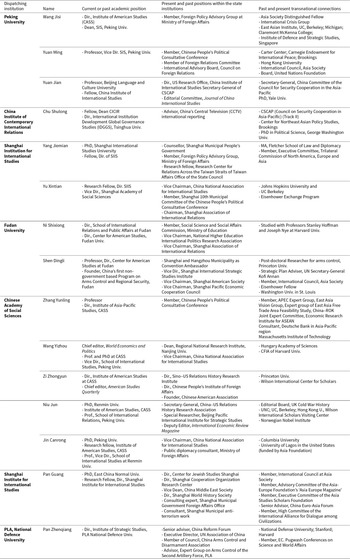
Table 1 shows the ‘Chinese academic–state–transnational nexus’. Ford-funded scholars became key figures in Chinese IR, well connected with state and transnational institutions,Footnote 51 facilitating the penetration of liberal internationalist thought into China, and from the latter back to the United States. This transnational network linked China and the United States via intra-state and ‘civil society’ channels, by-passing but conditioned by official inter-state relations.
Ford-funded Scholars: ‘Chinese academic–state–transnational nexus’.

In the early 1970s, Ford supported scholarly exchanges between China and the United States, with grants to CSCPRC and NCUSCR. In the early 1980s, Chinese IR specialists numbered no more than few hundred, and only Fudan University and Peking University trained IR students.Footnote 52 With China’s opening and joining international organisations, it was necessary to develop professionals to engage in theoretical, research, and policy work. China increasingly looked abroad for ideas for selective incorporation into its development strategy.Footnote 53
In response to requests from Chinese academics and government officials, Ford supported IR through Sino–US academic and professional exchanges from late 1978. Ford’s Asia and Pacific Program staff believed they would contribute to greater rationality of Chinese international policies and thus promote peace.Footnote 54
Ford staff met in Beijing and New York with officials from CASS. In late April 1979, a CASS delegation proposed focusing on industrial management, applied economics, international relations, and world politics. In the same year, Ford VP Marshall Robinson, as a member of the delegation led by the US Commerce Secretary, identified the IR field as one of the three areas in which it agreed to work with the Chinese (the other two were economics and law).
Ford targeted CASS because it contained the greatest concentration of policy-oriented social scientists. Ford and CASS jointly sponsored conferences on international affairs, bringing senior staff from CASS’s IR institutes to the United States and funding visits by American specialists to China.Footnote 55
Ford, alongside Rockefeller philanthropies, funded the Committee on International Relations Studies with the People’s Republic of China (CIRSPRC, established 1984), for IR studies in China to strengthen research, training, and policy analysis and Sino–US collaborations. CIRSPRC consisted of leading East Asian and IR specialists chaired initially by Scalapino, and subsequently by Harry Harding (George Washington University). CIRSPRC provided US fellowships for Chinese scholars, organised IR training programmes in China, supported international conferences and policy dialogues in both countries, and made IR research materials and Western scholarship available to Chinese scholars.
During its eight years (1984–92), CIRSPRC established formal relationships with four universities, two social science academies, and six government research institutions (as well as informal ties to several others)Footnote 56 and provided fellowships for 102 Chinese scholars, 39 (38 per cent) for doctoral degrees, 22 (21 per cent) for master’s degrees, and 41 (40 per cent) for shorter-term research visits.Footnote 57 The CIRSPRC programme over the eight-year period totalled about $4 million, of which Ford provided roughly half.Footnote 58 These scholars held senior administrative positions in their respective institutions. Ford support led to an era marked by an ‘opening to and importing’ Western IR theories, followed by a period of ‘absorption and innovation’ in the 1990s.Footnote 59
CIRSPRC also sponsored in-China teaching programmes and policy workshops to train young scholars, including at Peking University’s Institute of International Relations (IIR). IIR held a conference on international studies in China in June 1991 with partial support of Ford. Thirty-four scholars (seventeen Chinese, seventeen foreign) attended, including Scalapino, Harding, Waltz, Robert Gilpin, and Adam Roberts. As opportunities for Chinese to study abroad under official auspices began to decline after 1989, CIRSPRC supported more structured training programmes inside China, including summer workshops on the political economy of the Asia-Pacific region, and arms control.Footnote 60
From 1993, CIRSPRC expanded to provide support in other Asia-Pacific countries (renamed the Program for International Studies in Asia [PISA]). The fourth annual Renmin/PISA IR summer workshop was held in 1993, a programme entitled ‘IR Theory and Global Transformation’. Fifty-one participants from Chinese universities and institutes attended. Teaching was divided between the PISA team – Barry Hughes (Denver), Charles Kegley (South Carolina), and Steve Chan (Colorado); and the Renmin team – Liang Shoude (Peking), Feng Tejun (Renmin), Xi Renchang (CASS), and Shen Qurong and Song Baoxian (CICIR). Song Xinning (Renmin) was the Chinese team leader and co-organiser of the workshop.Footnote 61
Another key Ford-funded organisation was the National Committee on US–China Relations (NCUSCR) to which, from 1981 to 1994, Ford funnelled about $1,000,000.Footnote 62 Its members included Henry Kissinger, Robert McNamara, McGeorge Bundy, and Condoleezza Rice. NCUSCR organised many projects, including the Scholar Orientation Program (SOP) and the Binational Dialogue, with Ford’s support, to cultivate future experts, opinion leaders, and policymakers.
The Scholar Orientation Program (SOP), from summer 1980, brought together Chinese scholars and professionals studying in American universities for a 12–14-day series of lectures and seminars on American history, government, society, and economy. Meeting leaders in all branches of US government, business, professional, and university affairs was an integral part of the programme. Over the course of twenty-two years, SOP recruited 1,145 Chinese participants, many of whom remained involved in Committee activities.Footnote 63
Through the Committee’s efforts, such leaders informally discussed the most pressing questions.Footnote 64 In February 1968, Cecil Tomas, executive director of the Committee, and several other founding members briefed President Johnson on the situation in China and made suggestions on possible official measures. The Committee held its first national convention in March 1969, bringing together more than 2,000 participants to hear speakers on ‘the US and China: The Next Decade’. The clear thrust was toward increased openness to China.Footnote 65
Ford also supported study centres jointly founded by Chinese and US institutions, such as the Hopkins–Nanjing Center, focused mainly on Chinese and American studies. From 1986, numerous Chinese and foreign students were funded to study international political and economic issues at the Center every year. A significant part of the curriculum for Chinese students involved comparative and international politics, making the programme an important source of IR training.Footnote 66
Ford’s elite networks diffuse liberal ideas
Ford programmes profoundly shaped IR in China, building a scholarly community that provided the infrastructure for effective teaching, research, and career-building but also promoting the diffusion of liberal ideas, to align Chinese elites with American ways of thinking. The influence of those investments continues to this day because there was serious demand within China for new ways of thinking about its changing world role.
Ford brought Chinese scholars to the US to study IR, which led to Chinese IR being increasingly influenced by Western theories. Many IR publications were translated into Chinese. Early textbooks were published after visiting scholarships to the United States. American foundations also financed translations of IR theory works in the 1980s–1990s,Footnote 67 including works by Hans J. Morgenthau, Edward H. Carr, Henry Kissinger, Zbigniew Brzezinski, Samuel Huntington, Morton Kaplan, Robert Gilpin, and Kenneth Waltz. Works by Chinese scholars to translate Western IR texts began in 1981. By 1985, Chen Hanwen’s book (which sold over 100,000 copies) introduced concepts such as geopolitics as well as contentious conceptual and methodological debates in IR’s evolution. By the mid-1980s, the importation of US IR theories intensified, as did a desire among Chinese scholars to develop their own theories. Following a seminar on IR theory in Shanghai in 1987, the first such book – Chinese Perspectives in IR – was published in 1989.Footnote 68 This strongly indicates the unintended effects of Ford’s promotion of IR in China – it promoted Western IR but encouraged syntheses of Western and Chinese ideas.
The first collection of essays on contemporary American theories of IR was selected by Professor Ni Shixiong, freshly returned from Harvard.Footnote 69 Ni and Professor Jin Yingzhong published in 2001 Contemporary Western Theories of International Relations, which became the main IR textbook in China. In the mid-1990s, Wang Yizhou, a Ford-funded Harvard student, wrote Western International Politics: History and Theory. They both contributed to the popularity of Western IR theories in China and advocated the standardisation of China’s IR research in accordance with Western IR paradigms. Wang Jisi spent several years studying in Western countries before working with Hu Jintao. Xia Yong, director of the State Bureau of Secrecy, studied at Harvard as a post-doctoral fellow for two years.Footnote 70
In the early 1990s, China saw a notable increase in textbooks and academic journals introducing IR theory. The journal World Economy and Politics, edited by Wang Yizhou, emphasises methodology, rational thinking, and theory. Professors Shen Dingli and Chu Shulong taught courses on regional security, arms control, and IR theory. The 1980s were an era of ‘opening to and importing’ Western IR theories, followed by a period of ‘absorption and innovation’ in the 1990s.Footnote 71
Zhao Xi shows how the syllabi of leading Chinese universities – Fudan, Nankai, and Zhejiang – were dominated by American IR. The US hegemon effectively ‘trains and exports scholars’ and ‘changes, or even defines, the relative value that smaller communities place on different publications, scholars, and universities’.Footnote 72 Zhao analysed three undergraduate syllabi across three leading universities, finding widespread evidence of gender bias, US-centrism and Euro-centrism. Analysing syllabi from 2009 to 2016, Zhao found 37 per cent of authors were US-based, 29 per cent China-based, and others were in Holland, the UK, Taiwan, and Germany (4 per cent each). A plurality of the authors on reading lists were US PhDs (43 per cent); only 17 per cent were China-trained.Footnote 73
Ford thus helped create a small but highly dynamic IR community. The process was boosted by the one million students China sent to study abroad between 1978 and 2006. McMahon and Zou also show that there were over forty IR programmes, mainly in the top Chinese universities. Of the students educated abroad, only around a quarter returned home.Footnote 74 The expansion of IR in China was more than matched by China’s general internationalisation – membership of over 260 international conventions and most major international organisations. IR development and expansion was ‘directly related to the government’s push to normalize relations with its neighbours, increasing the need for more policy-relevant research’. Hence, between 1995 and 1998, over 80 per cent of Chinese IR journal articles were on ‘current affairs’ and 18 per cent theoretical. The impact of Western IR in China increased rapidly in the 1990s and into the 2000s: between 1978 and 1990, just two such IR publications were translated into Chinese, growing to ten (1991–2000) and later seventy-four (2001–7). Hence, ‘democratic peace’ theory and ‘clash of civilisations’ thinking diffused within the Chinese IR community. Top universities such as Tsinghua became IR field-leaders, hosting the Chinese Journal of International Politics, published by Oxford University Press and part-funded by the MacArthur Foundation.
A key aspect of the infrastructure of an academic career and discipline is a professional association. In 1986, Rockefeller part-funded the formation of Chinese Scholars of Political Science and International Studies, a US-based society of mainly Chinese scholars. It built a critical mass of scholars, scholarly exchange, and networks and promotes knowledge production on China’s political system. It has over 1,000 members and is affiliated with the American Political Science Association and the International Studies Association. Now called the Association of Chinese Political Studies, it holds annual conferences, publishes research monographs and networks with scholars across the world and with other US-based, mainly Chinese associations such as the China Economist Society.Footnote 75
Returning Chinese scholars have and are playing leading roles in some of the most prestigious institutions – such as Peking’s School of International Studies, Fudan’s School of IR and Public Affairs, the Institute of World Economy and Politics, and Institute of American Studies, under CASS’s auspices.Footnote 76 A particularly important figure is Wang Jisi, widely known in Chinese policy-making circles and American think tanks. He has travelled extensively across the United States and spent time at the universities of California and Michigan, as well as at Oxford. He is known as a ‘pragmatic liberal internationalist’, valuing stable and productive Sino–US relations. ‘His ideas have played a pivotal role in steering academic discourse in China – specifically over its relationship with the United States, but also when it comes to deepening the country’s understanding of America.’Footnote 77 Another interesting example of US influence in the Chinese IR academy is demonstrated in an empirical article, ‘Chinese Education in Diplomacy’. In it, Xiao Xi argues for a more rational, value-free, and US style of research of diplomatic studies, but with Chinese characteristics. Critiquing the CCP as heavy-handedly setting IR agendas for state purposes – promoting ‘peaceful rise’ and ‘peaceful development’ – Xi appears to take at face value American claims to objectivity in policy studies. And while critical of ‘Western-centrism’ in China’s diplomacy programmes, the solution appears to lie, to Xi, in the direction of greater US influence.Footnote 78 Similarly, Yan Xuetong, a Ford grantee, was another prominent IR scholar who argued that the production of IR theory had to be scientific.Footnote 79 Yan claimed that the ‘basic characteristics of science are objectivity, verifiability and openness’,Footnote 80 the main pillars of theory-building.
The above constitutes large-scale US efforts led by non-state actors such as Ford, in concert with the US state, with considerable demand in China for Western, especially American, social-scientific thinking. This resulted in a transformed theoretical, methodological, empirical, and policy-oriented IR community in China. American IR was hegemonic for the first several decades after 1978. In effect, the ‘de-Marxification’ of the party reflected a similar process in Chinese IR’s detachment from Mao’s Marxism and greater embrace of Western theories. China’s ‘contender’ state position and desire to integrate into the US-led LIO compelled the re-theorisation of IR away from Chinese versions of Marxism and class struggle, towards harmony, peaceful rise, development, and competition.Footnote 81 Ford effectively promoted a more policy-oriented, empirical IR that later combined with Confucianism and other traditional Chinese thought to construct a culturally nationalist approach to world affairs, which emphasises not only selectively learning Western culture to catch up to and exceed the West but also China’s national culture. In some ways, this planted the roots for a liminal liberal internationalism with Chinese characteristics that infused some of the attempts to build an ‘IR with Chinese characteristics’ and later on the Chinese School of IR.
Liang Shoude, at Peking University, called for an IR theory with ‘Chinese characteristics’. He wanted IR in China to achieve the unity of universality and particularity, commonness and individuality, form and content.Footnote 82
In the twenty-first century, Qin Yaqing placed the ‘relationality’ of Chinese cultural thought in the ontology of international society, replacing individual rationality with relational rationality to depict the behaviour pattern of international actors, and defined the interaction of international actors in shaping relations as a process, which made up for the static and individual-oriented bias of Western IR theory.Footnote 83 Yan Xuetong developed moral realism on the basis of analysing pre-Qin inter-state political thought, taking power and national reputation as enhancing state power and leadership. The combination of idealism and realism is realised at the normative level.Footnote 84
Ren Xiao et al. put forward Gongsheng theory, which holds that actors in international relations are heterogeneous and must be accepted, respected, and treated as equals so they can realise ‘coexistence’, laying the theoretical foundation for the inclusive coexistence of multiple cultures, the joint governance of global affairs, and the final construction of the global community of human destiny.Footnote 85
Overall, this subliminal liberal internationalism with Chinese characteristics, made possible through Ford’s influence, reflects Chinese reappropriation of liberal ideas. Since the mid-2000s, the original IR theories developed by Chinese IR scholars have advocated a broad degree of openness in the global political economy while simultaneously promoting approaches that safeguard the autonomy of the Chinese state.Footnote 86 Most Chinese IR theories address the strategic challenge of sustaining an open international system in a way that benefits China’s modernisation, but without triggering a direct conflict with the United States. Unfortunately, this intellectual process has not been well understood by external analysts, who believed, perhaps from a Eurocentric perspective, that a successful outcome would have been the wholesale acceptance of Anglo-American IR theory and its normative prescriptions. Viewed from a critical perspective that considers the agency of Chinese intellectuals, even though it was constrained by the normative structures of the Chinese state and the everyday restrictions on research, this ambiguous and elusive Chinese liberal internationalism may, in fact, have been the normative outlook that enabled an intra-elite Sino–American cooperation, which other forms of IR knowledge, such as Marxism, might not have promoted. Ultimately, despite the growing disenchantment of some Chinese ‘liberal internationalists’ towards the United States, this strand of thought may have slowed further erosion of Sino–American relations in the Trump era and sustained some of the transnational pillars of the post-1945 American order, which the Trump administration is actively seeking to dismantle or reshape.
Ford’s ‘war of position’ – transferring liberal internationalism from IR scholars to policymakers
Through a ‘war of position’ that promoted gradual change, Ford sowed the seeds for autonomous institutions capable of advancing liberal internationalist ideas and Sino–US cooperation. Ford influenced the environment of official and unofficial Sino–US relations through its non- and semi-official diplomatic initiatives. The initiatives included conferences between private Sino–US elites for deeper inter-societal relations, normalising diplomatic relations, and opening economic, strategic, and security dialogues. The main goal of this ‘war of position’ was to promote the ‘molecular advance’ of liberal internationalist and anti-Marxist ideas within Chinese institutions, and ensure they could be transferred into the policy-making sphere to shape Sino–US relations and integration into the LIO.
The strategy of gradual change and policy influence had two dimensions. Firstly, it connected US–China institutions and forums that organised Track II and 1.5 initiatives. For example, the National Committee’s US–China Dialogue, and off-the-record gatherings of both countries, was the first formal instance of Track II diplomacy. A series of binational conferences, co-hosted by the NCUSCR and the Chinese People’s Institute of Foreign Affairs (CPIFA), started in September 1984, continuing until 2002. Around thirty to forty top-level Sino–US leaders would meet for three days to discuss sensitive issues, establishing a foundation for greater understanding and communicationFootnote 87 that went ‘beyond the exchange of policy statements’.Footnote 88
An influential aspect of such activities included a 1993 National Committee policy report – ‘US–China Relations at a Crossroads’, a comprehensive analysis with a strategic vision and policy recommendations. It suggested the Clinton administration establish a comprehensive relationship with China, despite human rights concerns, and grant China most-favoured nation status. Such unofficial dialogues paved the way to more extensive dialogues.Footnote 89
Secondly, the strategy entailed funding IR think tanks, including the Institute for International Studies (Tsinghua), Center for American Studies (CAS, Fudan), CASS, China Institute of Contemporary International Relations, Shanghai Institute of International Studies, Institute of International and Strategic Studies at Peking, and China Institute of International Studies.Footnote 90
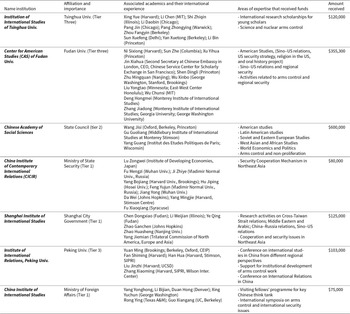
Table 2 shows that think tanks hold different levels of importance within the Chinese state. According to Glaser, the organisational status of think tanks occupies three concentric circles, identifying three types: Tier 1 think tanks are the ‘most influential’, closely connected to the military, Party, and government research institutions, with stronger relationships with policymakers, participating regularly in policy discussions. Tier 2 think tanks, while also connected to key institutions such as the State Council, Central Committee, and People’s Liberation Army, are less influential but provide ‘advice on a regular and frequent basis’. Tier 3 think tanks are marginally influential university research institutes, although some of their leaders or members have been involved in policy discussions.Footnote 91 Ford strategically funded think tanks with different degrees of proximity to the state, building elite knowledge networks connecting liberal international ideas with that state.
Ford-funded Chinese think tanks and research organisations (1988–2010).

University-affiliated think tanks operated a revolving door between IR specialists from government, CASS, and universities.Footnote 92 The IISS at Peking was established in 2013 by Wang Jisi. Wang, a ‘liberal thinker’ and a Ford grantee, was the director of the Institute of Strategic Studies of the Central Party School from 2001 to 2009 but also from 2008 to 2016 was a member of the Foreign Policy Advisory Committee of China’s Foreign Ministry.Footnote 93 Wang was embedded in Beijing’s foreign policy circles. He was ‘known as the brain behind Chinese President Hu Jintao’s foreign affairs decisions’.Footnote 94 As advisor to the Foreign Ministry and after the US’s announcement of the ‘Pivot to Asia’, Wang advocated a strategy of ‘Marching Westward’ through the ‘New Silk Road’. While Wang was aware of the strategic risks linked to this, it sought to ‘avoid conflicts with the United States and better achieve national interests’Footnote 95 or ‘rebalancing, without causing clashes between China’s land and sea power’.Footnote 96 After stepping down as SIS director, Wang worked through IISS to improve Sino–US person-to-person ties and advocated with American collaborators the necessity of their ‘full resumption’ after the Covid-19 pandemic.Footnote 97
The Institute of International Studies at Tsinghua, established in 1997, was headed by former Ambassador Professor Xue Mouhong, a long-term Ford grantee, and recruited well-known new faculty, such as Sun Zhe from Fudan, Song Xinning from Renmin, and Chu Shulong from CICIR. Yan Xuetong moved from CICIR to Tsinghua and became the director of the Institute, encouraging its researchers to conduct their research abroad. During 1999–2005, Ford provided support to nine PhD students of the Institute at Tsinghua for overseas training.Footnote 98 The Institute merged with the Institute of Contemporary International Relations under Sun Xufeng’s leadership.
Overseas research and training visits were influential in China. For instance, Li Bin spent two years at Princeton and MIT, focusing on science and nuclear arms control, and then transferred to the Institute at Tsinghua in 2000, thereafter establishing Tsinghua’s science and arms control programme, China’s first specialised training initiative. Li Bin organised the Ford-funded Tsinghua Arms Control Summer Symposia from 2002 to 2008, which prompted Tsinghua to conduct a special winter programme in 2008, training scholars from nearly thirty universities.Footnote 99 Many government agencies including the military and the nuclear defence industry train their officials in these programmes and have gradually established formal units devoted to nuclear arms control.
Ford’s support enlarged the pool of trained specialists in China on arms control and security issues and strengthened their capacity to help articulate China’s security interests and policies related to weapons of mass destruction; participate in international negotiations; develop training for younger scientists; and help Western governments and NGOs understand better China’s arms control actors and policies.Footnote 100
The Carnegie–Tsinghua Center, founded in 2010, and part of the Carnegie Endowment for International Peace’s Asia Program, has been a key institution in Beijing that promoted Track II and especially Track 1.5 dialogues, connecting Chinese and US IR communities with their respective states and policymakers. In 2010, Paul Haenle, a prominent US–China expert and former NSC China director (under Bush and Obama), became director, while Tsinghua IR professor Yan Xuetong was President of the Management Board (until 2020). This think tank aimed at ‘collaborative research and dialogue’Footnote 101 and fostered relations between scholars and experts with ‘relationships with policymakers, policy influence in their respective countries, or who may return to government in the future’.Footnote 102 According to Haenle, ‘the centre maintains positive relationships with key Chinese government agencies that shape decisions’.Footnote 103
In June 2015, the Center hosted a meeting between Sino–US experts to discuss President Xi Jinping’s US visit. US–Carnegie scholars and Chinese scholars ‘expressed what they hope the visit would achieve and possible obstacles and challenges’.Footnote 104 During recent years, despite rocky Sino–US relations, Ford has funded the centre on multiple occasions, including hosting ‘a track 1.5 Dialogue on U.S.–China relations and activities related to understanding China’s emerging role in the world from the perspective of other regions’.Footnote 105 In 2021, the Carnegie–Tsinghua Center received funds to ‘advance peace through analysis and development of fresh policy ideas and direct engagement and collaboration with decisionmakers in government, business, and civil society’.Footnote 106
The Ford-funded Center for American Studies (CAS, Fudan) became one of China’s most respected centres, established in 1985 by Professor Xie Xide (a leading nuclear physicist who returned to China from the United States). As shown in Table 2, CAS has been largely led by scholars who returned from the United States. For example, Ni Shixiong served as director from 2000 to 2006. The think tank formed a group of US-educated researchers on arms control and regional security. CAS hosted public addresses by former President George H. W. Bush and other leaders, and organised conferences on Sino–US relations. In August 1995, in the midst of a temporary chill in Sino–American relations, around forty Chinese scholars and researchers gathered at Fudan to examine key aspects of international security.
As the founder of arms control and nuclear non-proliferation studies at CAS, Shen Dingli (PhD in physics, 1988) completed two years of post-doctoral training in arms control at Princeton. Returning to Fudan in 1991, he offered graduate classes on nuclear arms issues. Shen was invited in 1991 to participate in an annual International Summer Symposium on Science and World Affairs organised by the Union of Concerned Scientists (UCS). Some of his papers were published by the Woodrow Wilson Center, Stockholm International Peace Research Institute, Pugwash Conferences on Science and World Affairs, and United Nations publication and journals in Germany, India, and Pakistan.
In the early 2000s, the China–US relationship continued to confront significant challenges. In this new context, Ford continued to support CAS research activities (2001–3). The new director, Professor Ni Shixiong, produced an edited book on current issues in the relationship, especially looking at Taiwan, TMD, and the impact of the new US administration. Professor Zhu Mingquan led the project on US security strategy.Footnote 107
The Center for American Studies (CAS, Fudan) also initiated a Ford-backed Sino–US Track II dialogue. Before President Jiang Zemin and Premier Zhu Rongji’s US visits, CAS and the US National Defense University launched a strategic dialogue in July 1997 in Shanghai and January 1999 in Washington, DC. Building on this, CAS and the Pacific Forum at Honolulu jointly organised a second-stage dialogue in May 1999 and April 2000. This habit of cooperation and dialogue paved the way to a more constructive approach when differences between the United States and China over National Missile Defense chilled relations. Following President Bush’s visit to Shanghai in October 2001 and before his anticipated trip to Beijing in February 2002, CAS and the Pacific Forum initiated a third-stage strategic dialogue. This dialogue’s constructive insights improved relations by identifying problems and exploring methods for dispute resolution.Footnote 108
CAS also played a crucial role in arms control and regional security research in China, establishing networks with the New York–based Program on International Cooperation. This collaboration supported the Program on Arms Control and Regional Security at Fudan in 1991, led by Shen Dingli. Ford funds were utilised for three international workshops, including discussions on a limited nuclear weapons-free zone in Northeast Asia with Georgia Tech’s Center for International Strategy, a roundtable on the foreign policy consequences of arms control with the National Committee on US–China Relations, and collaboration with Brookings for the continuation of the China–India–Pakistan–US dialogue.Footnote 109
In addition, prominent individuals played key roles. IR Professor Tang Shiping (Fudan) with Professor Peter Gries launched the Sino–American Security Dialogue (SASD, 2002–4) to mitigate ‘frustration with the adversarial and national identity-based discussions taking place between many of the older specialists in the course of other bilateral security dialogues’.Footnote 110 SASD created a forum for exchange among the younger generation of Sino–US security expertsFootnote 111 to promote a common security culture.
A Ford-supported government think tank, CASS, ran several area studies institutes – American, Latin American, Soviet and East European, West Asia and African Studies, Institute of World Economics and Politics. They received Ford support ($600,000) in the 1990s.Footnote 112 The Institute of American Studies, the most creative and active area centre, was led from 1993 to 2005 by Wang Jisi, who thought the social dimensions of Sino–US relations would dominate in the future. Ford awarded him $25,000 to gain a better appreciation of American politics and social development (1998–2000).
CICIR has been a major recipient of Ford support for IR through individual grants for overseas training. Many of its researchers studied political, economic, and social issues in various regions, including Liu Yueming (Middle East/African), Lu Zhongwei (Asia-Pacific security, Northeast Asian issues, world economy), Tao Jian (US and Europe), Wang Zaibang (world politics), Zhang Buren (Russian, Central Asia, and East Europe). Ford granted $80,000 to CICIR for a programme on security cooperation mechanisms in Northeast Asia in 2004. One of the important aspects of CICIR is that it ‘functions as the central government’s primary civilian intelligence organ and enjoys direct channels to members of the Politburo Standing Committee’.Footnote 113 In 2015, CICIR received a Ford Grant of $192,681 to ‘promote better understanding of risks and challenges in the Asia-Pacific community and build a trans-Pacific security framework to contribute to regional peace and common prosperity’.Footnote 114
CIIS has seen an increasing role in China’s foreign policy process, partly due to the appointment of former Ambassador Yang Chengxu as president in 1996, and new financial resources from Ford.Footnote 115 CIIS recruitment of graduates from top-ranked Chinese universities who were trained abroad built higher quality research teams. In 2009, CIIS received a $40,000 grant from Ford to host the Council for Security Cooperation in the Asia-Pacific’s Study Group on Multilateral Security Governance.Footnote 116
The Shanghai Institute of International Studies also collaborated with Harvard’s Kennedy School of Government to study Sino–US relations and promote semi-official dialogues. For example, in May 2000, Joseph Nye led a delegation, including China policy advisors for presidential candidates, to Shanghai and Beijing for discussions with scholars and officials. In September 2000, SIIS sent a delegation to the United States, led by Shi Yuequn and Yang Jiemian,Footnote 117 the younger brother of Foreign Minister Yang Jiechi. The visit provided crucial opportunities to engage with decision-making levels in US government institutions, enhancing SIIS fellows’ understanding of American policy towards China.
Conclusion
Drawing on Gramscian hegemony theory, we offer an internationally informed approach to holistically understand Ford’s significant impact on China’s rise and the development of IR. We move beyond internalism and methodological nationalism prevalent in liberalism and realism. By incorporating the interplay between domestic and international spheres as a causal and enabling factor, we provide insight into the evolution and transformation of Sino–American relations, transnational elite networks, and Chinese IR, complexifying Sino–US dynamics.
Ford’s activities between the late 1950s and late 1970s included $90 million to develop Chinese studies in the United States and domestic knowledge networks connecting Sino–US experts with foreign policy-making circles, the national security state, and media corporations.
Scholars, policymakers, and media experts who were socialised in these knowledge networks shared a technocratic understanding of global governance. Consequently, they saw Sino–US relations as a sphere completely separated from their populations. The relation was characterised by a positive-sum game within these transnational elites and a zero-sum game for their working peoples.
These transnational knowledge networks shaped several dimensions of Sino–American relations and the Chinese state, enabling the creation of a dynamic, outward-facing, pluralistic IR community. This community, trained in the West or exposed to these networks, included liberal internationalists and realists. While these new elite networks broadened the spectrum of debate of world politics in China by breaking taboos – the abandonment of concepts such as class struggle, revolution, and proletarian internationalism – they also contributed to narrowing debates about how IR knowledge should be produced. These scholars contributed to the gradual de-Marxification of IR knowledge. Unlike past Chinese intellectuals educated during the 1950s and 1960s in a system that promoted Marxist/Mao Zedong thought as analytical tools to understand world politics, this new IR community embraced a subliminal liberal internationalism and more rationalist approaches to world politics.
These networks also facilitated the development of non-official diplomatic channels and a policy environment fostering intra-elite Sino–US cooperation. They helped manage those relations in a new geopolitical context characterised by the expansion of neoliberal globalisation and elite interpenetration in Sino–US policy-making environments.
Lastly, transnational knowledge networks contributed to the emergence of new networks primarily situated on the Chinese side, gaining a degree of relative autonomy that, in turn, contributed to the expansion of a ‘quasi-civil society’ within China and its transnational expansion.Footnote 118 Alongside the creation of these networks, Chinese elites progressively engaged in transnational networks, including those historically dominated by liberal internationalists, such as the Trilateral Commission (TC). These networks traditionally revolved around the economic and political interests of the United States, Western Europe, and Japan. For instance, TC established the Asia-Pacific group in 2000, which China joined in 2009.Footnote 119 In recent years, despite growing geopolitical rivalry between the United States and China, the Asia-Pacific group, which includes nine Chinese members, advocates for maintaining engagement with China.Footnote 120 The Carnegie–Tsinghua Center also helped develop transnational knowledge networks and promoted liberal internationalism with Chinese characteristics. Despite Sino–US trade wars and growing inter-state conflict, in 2020, the centre received funding from Ford to host a Track 1.5 dialogue to smooth US–China relations. However, it is important to note that these transnational relations remain complex and have a ‘conflictual/cooperative nature’.Footnote 121
Although speculative, a counterfactual is valuable: what if Ford had not invested in IR in China? It would certainly have delayed its professionalisation and Western orientation; IR may have remained more Marxist–Leninist in character. China’s IR may have emphasised sovereignty and anti-hegemonism over global interdependence, resulting in fewer ‘pro-Western’ scholars, less open to transnational dialogues. Zhang shows, for example, that the English School of IR may well have been more significant in China had it not been for the network-building power of American foundations.Footnote 122
Without Ford’s investments across IR, economics, and law, resource constraints might have limited IR to elite Beijing/Shanghai institutions, with less emphasis on empirical, policy-relevant research. Other funders (World Bank, Soros Foundation) could have filled some gaps, but Ford’s scale and focus on elite networks was unique.
Without Ford, elite policymakers might have been less exposed to American models, leading to more cautious liberalisation. Civil society building via GONGOs (government organised non-governmental organisations) might have been weaker, resulting in less ‘managed’ pluralism and more top-down control.
Ford’s networks created ‘bridges’ between US and Chinese academics. Without this, personal and institutional links could have been sparser, exacerbating mistrust during events like the 1989 Tiananmen crisis. The lack of such networks might have amplified nationalist IR scholarship, prioritising confrontation over cooperation.
Ford’s work facilitated China’s ‘willing’ entry into the LIO from 1978. Without it, China’s global engagement might have been more adversarial earlier without the liberal tempering Ford provided, heightening US–China rivalry, delaying China’s WTO entry. However, state imperatives would likely have driven some opening, so LIO integration might have occurred, but with less US influence.
European foundations and bilateral aid from Japan/EU might have stepped in, introducing diverse norms. But without Ford’s US-centric push, Chinese IR could have leaned toward multipolar theories sooner, or towards more anti-Western approaches, complicating global stability.
Today, China’s IR discipline is robust and blends American/liberal and Chinese characteristics; Ford’s absence might have resulted in a more fragmented field, with uneven regional development and less policy impact. Geopolitically, US soft power in China could be diminished, contributing to today’s tensions – though structural factors like economic interdependence would persist. Overall, Ford’s absence might have delayed convergence: China integrates globally, but on more autonomous terms, potentially leading to an earlier hegemonic challenge.
These transnational elite networks also had unpredictable unintended consequences. Ford’s knowledge transfer activities laid the groundwork for some of the counter-hegemonic dynamics that question the LIO from within, for example scholar Yan Xuetong’s moral realist critiques of US hard power and loss of moral authority, most recently with regard to the Trump administration.Footnote 123 This insight qualifies some of the teleological and linear narratives concerning China’s trajectory within the LIO. In conclusion, as IR scholars grapple with comprehending the geopolitical impacts of rising powers and the LIO’s future, we assert that IR approaches lacking consideration of transnational dynamics, the agency of diverse political actors, and the historical context in which these relations unfold will struggle to understand the complexities shaping geopolitical shifts and transformations in the global political economy.
Acknowledgements
We are grateful to the Editors and the three anonymous reviewers for their valuable comments and constructive suggestions, which have significantly contributed to the improvement of this manuscript.

 Open access

