


In the last decades the fight to overcome obesity and its associated pathologies among the youngest in Western populations has become urgent. In more countries governments have begun specific actions directed to teach youngsters about a healthy lifestyle in which nutrition accounts for a key role. In this context the first step is to understand youngsters’ real level of knowledge about nutrition, although the positive relationship between nutritional knowledge and behaviour( Reference Wardle, Parmenter and Walzer 1 , Reference Johnson, Wardle and Griffith 2 ) in some cases has not resulted to be statistically significant( Reference Stafleu, Van Staveren and De Graaf 3 , Reference Contento, Randell and Basch 4 ). A possible explanation for this controversy can be found in: (i) the methodologies employed, which sometimes are not completely adequate for this kind of search; (ii) the statistical analysis; and (iii) the usage of investigations designed for a specific field, such as for lipids( Reference Wardle, Parmenter and Walzer 1 , Reference Stafleu, Van Staveren and De Graaf 3 , Reference Anderson, Umapathy and Palumbo 5 – Reference Steenhuis, Brug and Van Assema 10 ), and thus not fully appropriate for different kinds of investigation. Nutritional knowledge is not therefore a guarantee of a subsequent coherent action, but it is important that people, besides being free to act, are conscious of their choices.
However, this issue remains of interest and a valid tool to determine nutritional knowledge is needed when an action towards nutritional education must be taken, since to know exactly the lack of information can help to plan direct and precise interventions to solve the problem.
Among the different methodologies, Contento et al.( Reference Contento, Randell and Basch 4 ) identify the nutrition questionnaire as the best performing test to obtain information not only about nutrition-related knowledge, but also about school and life habits.
On this basis, the aim of the present study was to investigate, by means of a self-administered questionnaire, the real knowledge about food and nutrients of Italian children, pre-adolescents and adolescents belonging to two different age ranges, 9–11 years (GR1) and 12–16 years (GR2), in order to understand at which level it is better to plan to inform the youngest population how to eat safely.
An Italian version (QuesCA IT) of the QuesCA, a validated and published questionnaire developed by Kruseman et al.( Reference Kruseman, Berchtold and Truan 11 ), was used. The QuesCA started from the individuation of the major themes of interest in nutrition and it was validated and used with success. In particular, the QuesCA presents the following features: (i) it investigates practical knowledge and not just theoretical knowledge; (ii) the choice of items is accurate; (iii) it has a clear layout; (iv) it asks the population in the survey to define some concepts such as healthy nutrition by means of true/false answers and also to indicate the more balanced meal among a group, a difficult but very important question, to understand the level of knowledge; and (v) the age group analysed is of interest because includes children, pre-adolescents and adolescents.
The QuesCA IT is entirely similar to the original and includes thirty-one questions about the major aspects of nutrition, i.e. macronutrients, sweets and beverages, and others more inherent to the concepts of a healthy diet, such as breakfast, fast food and snacks, finishing with a self-assessment about nutritional knowledge. The QuesCA IT was distributed in the schools of Milan and Bergamo, two of the most populated and cosmopolitan towns in northern Italy, and thus representative of the north industrialized part of Italy.
Results obtained represent a useful snapshot of the concepts about nutrition and health among north Italian children, pre-adolescents and adolescents, and therefore could be considered a useful starting point for educational campaigns.
Experimental methods
Participants
Six hundred and twenty-three students coming from three Italian schools in the towns of Bergamo and Milan were recruited to participate to the project. The three schools recruited for the surveys were chosen due the possibility for students to attend the primary and secondary school in the same building. The total participants belonged to Primary, Secondary and Further Education (sixteen classrooms) in Milan and to Primary and Secondary Education (fourteen classrooms) in Bergamo.
The students surveyed were divided in two groups: aged 9–11 years (GR1) and aged 12–16 years (GR2). The choice of these two age ranges is based on the observation that children aged 9–11 years are more influenced by their family customs, while pre-adolescents and adolescents in the age range 12–16 years are more influenced by the media, their experiences shared on the World Wide Web and prefer to find information and help outside the family. Moreover, the present subdivision reflects intellectual maturity and the general level of knowledge of the groups is very similar to the one adopted in the work of Kruseman et al.( Reference Kruseman, Berchtold and Truan 11 ) for which the questionnaire was formulated and validated.
Before the beginning of the investigation, agreement to conduct the research was obtained from the school dean. The exclusion criteria for the study were: (i) poor comprehension of the Italian language, i.e. the inability to read and learn the questions; (ii) age not included between the indicated ranges; and (iii) the questionnaires not being fully completed due to a lack of time.
The good compliance of the present study is evident from the small number of participants( Reference Levy, Fein and Stephenson 9 ) who were excluded: three students on the basis of the first criterion of exclusion, four students on the basis of the second one and two students on the basis of the third criterion. The rate of exclusion was 1·5 %. The total number of questionnaires on which the actual results were calculated is 614.
The characteristics of the 614 participants are reported in Table 1.
Characteristics of the study population of north Italian children, pre-adolescents and adolescents (n 614), 2009

The QuesCA IT questionnaire
The QuesCA IT questionnaire was filled in by the students in their classrooms in 2009. A section at the top of the questionnaire was to be completed with the age and gender of the participant.
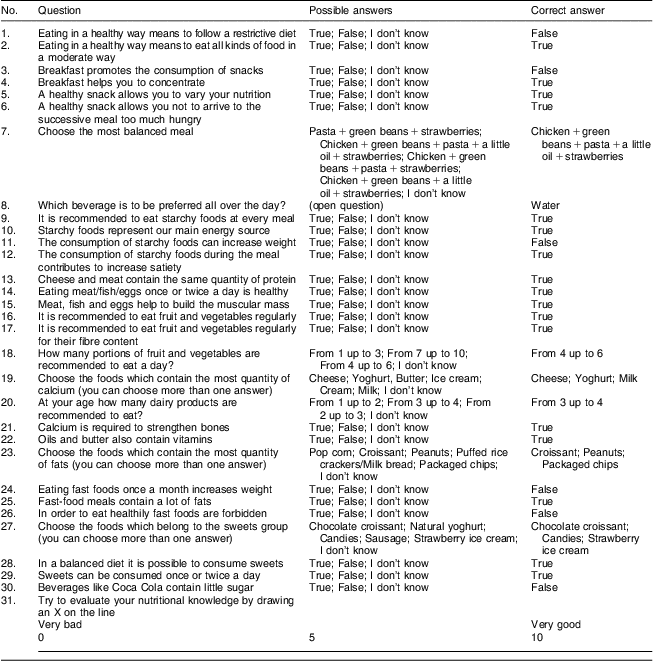
The QuesCA IT questionnaire comprised thirty-one questions, only two of which were open questions (questions 8, 31); the other twenty-nine questions can be categorized as follows: (i) those with a true/false answer (questions 1–6, 9–17, 21, 22, 24–26, 28–30); (ii) multiple-choice questions with one correct answer (questions 7, 18, 20); and (iii) multiple-choice questions with more than one correct answer question (questions 19, 23, 27). For each question the ‘I don't know’ answer was always present. The thirty-first question asked the students to evaluate their nutritional knowledge by tracing an X sign on a line. This line was successively divided into twenty major intervals corresponding to 10 values and then in other minor intervals corresponding to the half value. From the position of the X sign the corresponding value was thus calculated and the results obtained are presented in Table 6. The answers were considered sufficient if greater than or equal to the value of 6.
The thirty-one questions, all of the possible answers and the correct answer to each question are presented in Table 2. The questionnaires were completed anonymously, and evaluated for accuracy and completeness by the authors.
The condensed form of the nutritional knowledge questionnaire (QuesCA IT)
Translation, adaptation and pre-test
The questions in the QuesCA are clearly formulated and adopt a simple language, which allowed a simple translation. The Italian version, QuesCA IT, was submitted for consideration to a primary-school teacher to assess whether the language used was accessible to the same age group for which the QuesCA was designed and prepared. Later, a pre-test of the translated questionnaire was conducted among two bilingual Italian/French dietitians and a bilingual student in the last year of his study in Dietetics, in order to verify the correctness of the translation and its comprehensibility. Before the distribution of the questionnaire in the classrooms, a pilot experiment or a pre-test was performed within a group of ten young people aged 9–16 years which demonstrated the acceptance and feasibility of the survey. The questions of the Italian questionnaire and their order have been only marginally modified from QuesCA. In particular: (i) the options ‘rice’ and ‘salmon’ (question 7 of the QuesCA) were replaced by ‘pasta’ and ‘chicken’ because the latter are most often consumed in Italy; and (ii) ‘pain au chocolat’ (question 27 of the QuesCA), a sweet like a croissant filled with chocolate and typically consumed in Switzerland, was replaced with ‘chocolate croissant’. When present, the possibility of more than one correct answer was always indicated.
Distribution of the questionnaire and collection procedure
For the completion of the questionnaires the following rules were adopted: (i) experienced staff were present in the classroom from the distribution of questionnaires until their collection; (ii) neither the expert staff nor the teacher in the classroom could respond to any questions posed by the students; (iii) it was monitored that the students did not speak to each other and it was recommended to complete the questionnaire in all its parts, including the indication of age and gender; (iv) use of the ‘I don't know’ answer was clarified as the answer to choose in the absence of knowledge of the correct answer; (v) it was specified that the questionnaire was anonymous and would not affect the students’ school marks; and (vi) students had the possibility to write questions or comments directly on the questionnaire. The time necessary to complete the questionnaire was evaluated as about 15–20 min.
Statistical analysis
For the analysis of the answers the following procedure was adopted: a value of 1 was given to each correct answer, while to each incorrect or ‘I don't know’ answer a value of 0 was given. The questions were grouped on the basis of the different items of nutritional knowledge covered (Table 3) and then mean scores and standard deviations were calculated for each item and the whole questionnaire. Gender and age group differences in mean scores for each item and the whole questionnaire were analysed by the two-sample Wilcoxon test (two-sided; Tables 4 and 5) using the statistical software package IBM SPSS Version 20·0. Age group differences in the self-assessment of nutritional knowledge (Table 6) were analysed by the χ 2 test for non-parametric data using Microsoft® Excel 2003. P < 0·05 was considered as statistically significant. To evaluate the effect size, Cohen's d index for the standardized differences between two means was used( Reference Cohen 12 ). This coefficient can be converted to the r value, the effect size correlation, and vice versa.
The questions grouped on the basis of the different items covered

Mean scores and standard deviations for the eleven items and the whole questionnaire according to gender and age group: north Italian children, pre-adolescents and adolescents (n 614), 2009
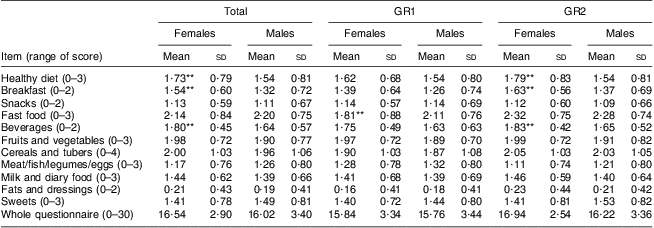
GR1, 9–11 years; GR2, 12–16 years.
Mean values were significantly different from those of males (considered in the total sample and separately by age group): **P < 0·01.
Comparison of mean scores and standard deviations of the eleven questionnaire items in females and males according to age group: north Italian children, pre-adolescents and adolescents (n 614), 2009
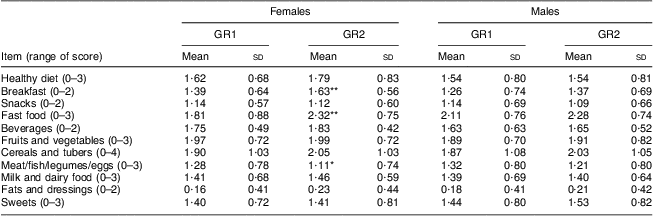
GR1, 9–11 years; GR2, 12–16 years.
Mean values were significantly different from those of the younger children: *P < 0·05, **P < 0·01.
Answers to question 31 (self-assessment of nutritional knowledge) according to age group: north Italian children, pre-adolescents and adolescents (n 614), 2009

GR1, 9–11 years; GR2, 12–16 years.
Proportions were significantly different from those of the younger children (χ 2 test): **P < 0·01.
Results
The data analysis highlighted that: (i) in GR1, 1·2 % of students gave <25 % of correct answers, 98·4 % of students gave 25–75 % of correct answers and only 0·4 % gave >75 % of correct answers, with scores in the range of 6–24 and corresponding mean score of 15·8 (sd 3·4, CI 0·4); (ii) in GR2, 0·5 % of students gave <25 % of correct answers, 98·1 % of students gave 25–75 % of correct answers and 1·4 % gave >75 % of correct answers, with scores in the range of 4–23 and corresponding mean score of 16·6 (sd 2·9, CI 0·3). This difference was not statistically significant (χ 2 test, P > 0·05, data not shown).
The thirty-one questions of the QuesCA IT were grouped into eleven items (see Table 3) on the basis of their meaning and the concepts dealt with. This allowed data to be presented in a concise and clear way.
Considering the whole population, statistically significant gender differences were found for the items ‘healthy diet’, ‘breakfast’ and ‘beverages’, with the females’ scores being higher than the males’ scores. Among the younger students of GR1, the only statistically significant gender difference was related to the question item ‘fast food’, for which there was a lower score in the female group. In the case of the older students in GR2, statistically significant gender differences were seen in relation to the items ‘healthy diet’, ‘breakfast’ and ‘beverages’. In all these cases, the mean scores were always higher in females than in males (all P < 0·01; see Table 4). Comparison between the answers given by females according to age group revealed that: (i) for question items ‘breakfast’ and ‘fast food’, GR2 had statistically significantly higher mean scores than GR1 (P < 0·01); and (ii) for the question item ‘meat/fish/legumes/eggs’, the mean score of GR1 was statistically significantly higher than that of GR2 (P < 0·05). On the contrary, the comparison between answers given by males according to age group evidenced no statistically significant differences (Table 5).
The answers to the final question are presented in Table 6. Eleven per cent of the GR1 population judged its nutritional knowledge insufficient or negative v. 24 % in the GR2 population (χ 2 test, P < 0·01); accordingly the majority of GR1 (89 %) was more positive about its nutritional knowledge compared with GR2 (76 %); χ 2 test, P < 0·01).
The effect size analysis revealed that the percentage of non-overlap was: (i) 0·0 (r = 0·0, Cohen's d = 0·006) between males and females belonging to GR1; (ii) 21·3 (r = 0·3, Cohen's d = 0·708) between males and females belonging to GR2; (iii) 33·0 (r = 0·5, Cohen's d = 1·153) between females of the two age groups; and (iv) 21·3 (r = 0·3, Cohen's d = 0·556) between males of the two age groups.
Discussion
The present work was undertaken to explore the real nutritional knowledge of an Italian population of children, pre-adolescents and adolescents through the completion of a validated questionnaire. The current investigation is different from other similar surveys since the investigated population is larger, including children (9–11 years old) and adolescents (12–16 years old), and because it takes account not only particular issues in nutrition science, such as the consumption of fruits and vegetables( Reference Sandvik, De Bourdeaudhuij and Due 13 ) and eating behaviours( Reference Triches and Giugliani 14 ) of for instance soft drinks and junk foods, but also how to choose the more balanced meal among many.
The importance of knowing what a ‘healthy diet’ means arises also from the need for young people to understand when nutrition advertisements in the media are safe or unhealthy.
From data obtained and presented herein, some considerations can be made. First of all, the item that accounts for the lowest score both in males and females is ‘fats and dressings’, followed by the items ‘snacks’, ‘meat/fish/legumes/eggs’, ‘milk and dairy foods’ and ‘sweets’. That the students had low scores for ‘fats and dressings’ and ‘meat/fish/legumes/eggs’ provides evidence that the exact role of the macronutrients protein and fat in a healthy diet is far from known and a lot of work must be done to improve this result. The item ‘snacks’ represents a hot issue for adolescents, since a part of them believes consuming snacks is wrong while the other part consumes junk food as snacks.
In the case of the ‘healthy diet’ item, the statistically significant differences found are probably due to the presence of a complex question (question 7) with a multiple-choice answer, since it assumes that the students have exact knowledge on all the nutrients and how to combine them for a balanced diet. Analogously, the items ‘breakfast’, ‘fast food’ and ‘beverages’, for which there are statistically significant differences between males and females, comprise questions about a healthy lifestyle and thus a healthy diet.
The mean scores as a whole were higher, although not statistically significantly so, for GR2 compared with GR1; a result showing that underlying nutritional knowledge, but possibly more general knowledge, increases with age. This is in agreement with results obtained by the HELENA (Healthy Lifestyle in Europe by Nutrition in Adolescence) study( Reference Sichert-Hellert, Beghin and De Henauw 15 ) and by the parallel study performed using the original Swiss QuesCA questionnaire( Reference Kruseman, Berchtold and Truan 11 ); thus it seems a general observation in the European child and adolescent population. Moreover, in the present study the answers by females almost always reached a higher value of correctness, a result again in agreement with the HELENA study( Reference Sichert-Hellert, Beghin and De Henauw 15 ). This is not surprising since it is a common opinion that girls have more interest in and care for their health and physical appearance than boys, a result that also confirms pre-existing studies( Reference Sandvik, De Bourdeaudhuij and Due 13 – Reference Godina-Zarfel and Elmadfa 19 ). This specific finding could be considered in order to plan interventions in the case of educational projects, so as to find more appealing forms to involve also boys. All of these differences were confirmed by the effect size analysis as moderately effective; thus the different sample sizes of the populations examined (GR1 v. GR2, females v. males) only marginally influenced the results obtained.
A last comment can be drawn from the self-assessment of nutritional knowledge, since the higher percentage of insufficient level in the GR2 population can be regarded as a higher degree of self-consciousness and of the lack of important information, another parameter to consider in planning an educational project.
A limitation of the present study can be found in the lack of any association between our data and other parameters such as information on pre-existing knowledge in nutrition coming from the school or the family, on anthropometric measures such as weight, height and level of physical activity, and without any correlation with socio-economic indices such as parents’ educational level and financial status; but it is due to a precise decision in our project. The lack of any planned nutritional education moment in Italian schools, except for some voluntary projects, has led to a self-informed young population, to this population – irrespective of their socio-economic or other information – and will have directed the future action of intervention in their heterogeneous classrooms. All of these data were collected before the Italian Government decided to introduce nutritional education as a teaching subject in primary and secondary schools, but in the same period of the HELENA study which is more distributed across Italy. The teaching of nutritional education could be the first and main action to do, since students’ knowledge on macronutrients and their role is low. The nutritional education should be performed in more than one way, not only during school time, but also at supermarkets for instance, in order to obtain a massive campaign of information.
The second action could be to find educational forms not too aggressive or boring, trying to explain the nutrition labelling on food packages for example, in order to make students aware of their choices. It would be more appropriate to try to use the language and the ‘way of life’ of the population in the survey. The results obtained herein, although relative to the two north Italian towns of Milan and Bergamo, and very similar to the ones obtained by the HELENA study, support the choice of the Italian Government to introduce nutritional education as a teaching subject and provide a base from which to plan interventions directed to young people.
Acknowledgements
Source of funding: This research received no specific grant from any funding agency in the public, commercial or not-for-profit sectors. Conflicts of interest: There are no conflicts of interest to declare. Ethics: Ethical approval was not required. Authors’ contributions: A.T. did all the work in the schools, prepared and filled the database with the students’ answers, helped compile the tables and contributed to writing the paper. A.Z. conducted the statistical analysis and compiled the tables. A.F. analysed the data, advised on data representation and wrote the paper. Acknowledgements: The authors thank Professor M. Kruseman for her teachings and above all for the possibility she gave to A.T. to join the QuesCA work group; Professor A.E. Pontiroli for his help in organizing the Italian work; J. Truan, L. Duboule and the Haute École de Santé de Genève, Filière Nutrition et Diététique, for collaboration at various levels; and the Italian schools for agreeing to participate to the survey.



