




1. Introduction
The interior of highly magnetised dense stars (e.g. white dwarfs, neutron stars and magnetars) exhibits distinct properties due to the existence of degenerate particles in the quantum regime at extremely low temperatures ( $T\lt T_F$
, where
$T\lt T_F$
, where $T_F$
is the Fermi temperature). The quantum effects become unavoidable and play a vital role in dense plasmas when the de Broglie wavelength of the plasma species is comparable to or larger than their interparticle separation, i.e.
$T_F$
is the Fermi temperature). The quantum effects become unavoidable and play a vital role in dense plasmas when the de Broglie wavelength of the plasma species is comparable to or larger than their interparticle separation, i.e. $\lambda _B\geqslant n_0^{-1/3}$
(where
$\lambda _B\geqslant n_0^{-1/3}$
(where $n_0$
is the average particle density) (Bonitz et al. Reference Bonitz, Filinov, Böning and Dufty2010). The aforementioned condition is satisfied in magnetars (
$n_0$
is the average particle density) (Bonitz et al. Reference Bonitz, Filinov, Böning and Dufty2010). The aforementioned condition is satisfied in magnetars ( $\lambda _B\simeq 9\times 10^{-13}$
m) and white dwarfs (
$\lambda _B\simeq 9\times 10^{-13}$
m) and white dwarfs ( $\lambda _B\simeq 3\times 10^{-10}$
m) in which the orders of de Broglie wavelengths are equivalent to the interparticle separations in these systems (Gómez & Kandus Reference Gómez and Kandus2018). The quantum mechanical behaviour of plasma particles is significant and has been notably studied in white dwarfs, neutron stars, pulsars and magnetars, giant planets and laser fusion experiments (Chabrier Reference Chabrier1993; Karpiuk et al. Reference Karpiuk, Nikołajuk, Gajda and Brewczyk2021). Quantum effects also play an unavoidable role in plasma screening for thermonuclear fusion in high-density laser experiments (Elsing, Pálffy & Wu Reference Elsing, Pálffy and Wu2022). In semiconductor plasmas, quantum effects are crucial in modifying instabilities, e.g. drift and modulation instabilities (Sharma et al. Reference Sharma, Turi, Ali and Deka2024). In past years, many fluid instabilities have been studied in quantum plasmas, such as filamentation instability (Bret Reference Bret2007), magnetorotational instability (Usman & Mushtaq Reference Usman and Mushtaq2021), oblique waveguide instability (Jamil et al. Reference Jamil, Ilyas, Rasheed, Ayesha, Asif and Shahid2020), electromagnetic instability (Khodadadi Azadboni Reference Khodadadi Azadboni2021) and temperature-anisotropy-driven Weibel instability (Haas Reference Haas2008). In addition, the Jeans instability is the fundamental mechanism in the formation of dense stars through gravitational collapse, which has been previously studied assuming the plasma pressure to be isotropic in nature (Shukla & Stenflo Reference Shukla and Stenflo2006).
$\lambda _B\simeq 3\times 10^{-10}$
m) in which the orders of de Broglie wavelengths are equivalent to the interparticle separations in these systems (Gómez & Kandus Reference Gómez and Kandus2018). The quantum mechanical behaviour of plasma particles is significant and has been notably studied in white dwarfs, neutron stars, pulsars and magnetars, giant planets and laser fusion experiments (Chabrier Reference Chabrier1993; Karpiuk et al. Reference Karpiuk, Nikołajuk, Gajda and Brewczyk2021). Quantum effects also play an unavoidable role in plasma screening for thermonuclear fusion in high-density laser experiments (Elsing, Pálffy & Wu Reference Elsing, Pálffy and Wu2022). In semiconductor plasmas, quantum effects are crucial in modifying instabilities, e.g. drift and modulation instabilities (Sharma et al. Reference Sharma, Turi, Ali and Deka2024). In past years, many fluid instabilities have been studied in quantum plasmas, such as filamentation instability (Bret Reference Bret2007), magnetorotational instability (Usman & Mushtaq Reference Usman and Mushtaq2021), oblique waveguide instability (Jamil et al. Reference Jamil, Ilyas, Rasheed, Ayesha, Asif and Shahid2020), electromagnetic instability (Khodadadi Azadboni Reference Khodadadi Azadboni2021) and temperature-anisotropy-driven Weibel instability (Haas Reference Haas2008). In addition, the Jeans instability is the fundamental mechanism in the formation of dense stars through gravitational collapse, which has been previously studied assuming the plasma pressure to be isotropic in nature (Shukla & Stenflo Reference Shukla and Stenflo2006).
In most quantum plasma systems, the spins of the constituent particles are randomly oriented; hence, the impact arising from spin-induced magnetisation can be safely ignored. Strong magnetic fields are present in dense stars, e.g. in white dwarfs ( $B\simeq 10^6{-}10^9$
G) and neutron stars (
$B\simeq 10^6{-}10^9$
G) and neutron stars ( $B\simeq 10^{12}$
G) (Wickramasinghe & Ferrario Reference Wickramasinghe and Ferrario2005). Further, in magnetars, there exists an ultra-strong magnetic field (
$B\simeq 10^{12}$
G) (Wickramasinghe & Ferrario Reference Wickramasinghe and Ferrario2005). Further, in magnetars, there exists an ultra-strong magnetic field ( $B\simeq 10^{14}{-}10^{15}$
G) that exceeds the quantum critical threshold,
$B\simeq 10^{14}{-}10^{15}$
G) that exceeds the quantum critical threshold, $B_{\text{cr}}=4.4\times 10^{13}$
G (Duncan & Thompson Reference Duncan and Thompson1992). These strong magnetic fields are mainly responsible for magnetisation and affect the particle dynamics in degenerate plasmas. Strong magnetic fields also cause Landau quantisation in magnetars, which produces axion (Maruyama et al. Reference Maruyama, Balantekin, Cheoun, Kajino and Mathews2018). These effects become significant in highly magnetised dense stars when the spin is aligned along the magnetic field (Brodin & Marklund Reference Brodin and Marklund2007a
). Spin magnetisation plays a crucial role via coupling to the Alfvénic speed by modifying the instability criteria and affecting the gravitational collapse in compact astrophysical objects (Usman, Mushtaq & Jan Reference Usman, Mushtaq and Jan2018). Spin forces are important even when their magnitudes are smaller than the usual
$B_{\text{cr}}=4.4\times 10^{13}$
G (Duncan & Thompson Reference Duncan and Thompson1992). These strong magnetic fields are mainly responsible for magnetisation and affect the particle dynamics in degenerate plasmas. Strong magnetic fields also cause Landau quantisation in magnetars, which produces axion (Maruyama et al. Reference Maruyama, Balantekin, Cheoun, Kajino and Mathews2018). These effects become significant in highly magnetised dense stars when the spin is aligned along the magnetic field (Brodin & Marklund Reference Brodin and Marklund2007a
). Spin magnetisation plays a crucial role via coupling to the Alfvénic speed by modifying the instability criteria and affecting the gravitational collapse in compact astrophysical objects (Usman, Mushtaq & Jan Reference Usman, Mushtaq and Jan2018). Spin forces are important even when their magnitudes are smaller than the usual $\boldsymbol{J}\times \boldsymbol{B}$
force, and this property is demonstrated by studying the one-dimensional nonlinear shear Alfvén waves (Brodin & Marklund Reference Brodin and Marklund2007b
). The propagation of the magnetosonic waves is affected by quantum corrections, such as the Bohm potential and the spin of the electron. The magnetohydrodynamics (MHD) formalism is used to analyse the normal modes in magnetised quantum plasmas with spin coupling, Fermi pressure and Hall effect (Gómez & Kandus Reference Gómez and Kandus2018). Furthermore, the effects of spin magnetisation in quantum plasmas have been investigated in the study of nonlinear magnetosonic waves (Mushtaq & Vladimirov Reference Mushtaq and Vladimirov2011), nonlinear Alfvén waves (Jan, Mushtaq & Ikram Reference Jan, Mushtaq and Ikram2018) and magnetorotational instability (Usman & Mushtaq Reference Usman and Mushtaq2021). The growth rate of Weibel instability in strongly coupled quantum plasmas decreases due to the quantum parameter and increases due to the temperature anisotropy parameter (Nejadtaghi et al. Reference Nejadtaghi, Mahdavi, Hassanpour, Khanzadeh and Tavassoli2024).
$\boldsymbol{J}\times \boldsymbol{B}$
force, and this property is demonstrated by studying the one-dimensional nonlinear shear Alfvén waves (Brodin & Marklund Reference Brodin and Marklund2007b
). The propagation of the magnetosonic waves is affected by quantum corrections, such as the Bohm potential and the spin of the electron. The magnetohydrodynamics (MHD) formalism is used to analyse the normal modes in magnetised quantum plasmas with spin coupling, Fermi pressure and Hall effect (Gómez & Kandus Reference Gómez and Kandus2018). Furthermore, the effects of spin magnetisation in quantum plasmas have been investigated in the study of nonlinear magnetosonic waves (Mushtaq & Vladimirov Reference Mushtaq and Vladimirov2011), nonlinear Alfvén waves (Jan, Mushtaq & Ikram Reference Jan, Mushtaq and Ikram2018) and magnetorotational instability (Usman & Mushtaq Reference Usman and Mushtaq2021). The growth rate of Weibel instability in strongly coupled quantum plasmas decreases due to the quantum parameter and increases due to the temperature anisotropy parameter (Nejadtaghi et al. Reference Nejadtaghi, Mahdavi, Hassanpour, Khanzadeh and Tavassoli2024).
Analytical techniques have been developed to model quantum plasmas and investigate waves and instabilities. These are the Wigner–Poisson, Schrödinger–Poisson and quantum magnetohydrodynamic (QMHD) models (Haas Reference Haas2005, Reference Haas2011). The QMHD model is most appropriate for studying the macroscopic transport properties of a quantum fluid involving global plasma parameters. The properties of dense white dwarfs and neutron stars provide insightful predictions regarding their unique characteristics. The behaviour of relativistic degenerate electrons and exchange-correlation effects is studied on the propagation of high-frequency surface waves in spin- $1/2$
quantum plasmas and it has been shown that due to exchange-correlation effects, the frequency spectrum of high-frequency surface waves is shifted down (Chen et al. Reference Chen, Li, Zha, Zhang and Xia2020). The ion-acoustic solitary waves in an electron–positron–ion quantum plasma in the presence of an external static magnetic field have been studied using the reductive perturbation method (El-Taibany et al. Reference El-Taibany, Karmakar, Beshara, El-Borie, Gwaily and Atteya2022). In the QMHD framework, dust magnetosonic waves are investigated in degenerate quantum plasmas, including spin and exchange-correlation effects (Maroof, Mushtaq & Qamar Reference Maroof, Mushtaq and Qamar2016). Rahim, Adnan & Qamar (Reference Rahim, Adnan and Qamar2019) used the QMHD model to analyse the properties of small-amplitude magnetosonic shock waves in a dissipative plasma, including spin-up and spin-down electrons. In addition, many interesting phenomena, such as unstable charge density waves (Han, Zhang & Dai Reference Han, Zhang and Dai2019) and nucleus-acoustic shock waves (Mamun, Sharmin & Tamanna Reference Mamun, Sharmin and Tamanna2021), show the importance of quantum effects in collective modes in low-temperature and highly dense plasmas. Recently, the dispersion properties of electron plasma waves in a nonlinear quantum plasma have been studied by applying the Volkov approach in the kinetic framework (Haas, Mendonça & Terças Reference Haas, Mendonça and Terças2023).
$1/2$
quantum plasmas and it has been shown that due to exchange-correlation effects, the frequency spectrum of high-frequency surface waves is shifted down (Chen et al. Reference Chen, Li, Zha, Zhang and Xia2020). The ion-acoustic solitary waves in an electron–positron–ion quantum plasma in the presence of an external static magnetic field have been studied using the reductive perturbation method (El-Taibany et al. Reference El-Taibany, Karmakar, Beshara, El-Borie, Gwaily and Atteya2022). In the QMHD framework, dust magnetosonic waves are investigated in degenerate quantum plasmas, including spin and exchange-correlation effects (Maroof, Mushtaq & Qamar Reference Maroof, Mushtaq and Qamar2016). Rahim, Adnan & Qamar (Reference Rahim, Adnan and Qamar2019) used the QMHD model to analyse the properties of small-amplitude magnetosonic shock waves in a dissipative plasma, including spin-up and spin-down electrons. In addition, many interesting phenomena, such as unstable charge density waves (Han, Zhang & Dai Reference Han, Zhang and Dai2019) and nucleus-acoustic shock waves (Mamun, Sharmin & Tamanna Reference Mamun, Sharmin and Tamanna2021), show the importance of quantum effects in collective modes in low-temperature and highly dense plasmas. Recently, the dispersion properties of electron plasma waves in a nonlinear quantum plasma have been studied by applying the Volkov approach in the kinetic framework (Haas, Mendonça & Terças Reference Haas, Mendonça and Terças2023).
Dense stars are formed due to the collapse of massive stars in which electron degeneracy pressure (in white dwarfs) and neutron degeneracy pressure (in neutron stars) support them against gravitational collapse (Leung Reference Leung1985). The magnetic field has a unique role in the gravitational collapse of dense stars. In past years, many researchers have extended the problems of Jeans (gravitational) instability of quantum plasmas considering various physical effects in the environment of dense stars. Shukla & Stenflo (Reference Shukla and Stenflo2006) have investigated the Jeans instabilities of self-gravitating astrophysical quantum dusty plasma assuming electrostatic perturbations. The QMHD model is used to analyse the Jeans instability in quantum plasmas considering the effects of finite Larmor radius corrections (Joshi et al. Reference Joshi, Patidar, Shrivastava and Pensia2018), neutrino beam and flavour oscillations (Prajapati Reference Prajapati2017; Hammad et al. Reference Hammad, Shahzad, Sajjad and Mahnaz2023) and Fermi temperature ratio (Ali & Mushtaq Reference Ali and Mushtaq2011). Lundin, Marklund & Brodin (Reference Lundin, Marklund and Brodin2008) have investigated the modified Jeans instability considering the spin magnetisation effect and found that it enhances the growth rate of the Jeans instability. However, the plasma pressure in dense highly magnetised astrophysical systems does not remain isotropic, and it becomes anisotropic in nature. Pressure-anisotropy-driven kinetic instabilities have recently been studied in magnetised low-density plasmas in the intracluster medium (Rappaz & Schober Reference Rappaz and Schober2024). We find that none of these authors (Lundin et al. Reference Lundin, Marklund and Brodin2008; Gómez & Kandus Reference Gómez and Kandus2018; Bhakta & Prajapati Reference Bhakta and Prajapati2018; Sangwan & Prajapati Reference Sangwan and Prajapati2023) have studied the role of intrinsic magnetisation, rotation, Ohmic diffusion and viscous dissipation in the Jeans instability in anisotropic quantum plasmas.
This paper analyses the influence of spin magnetisation, rotation, Ohmic diffusion and viscosity stress tensor on the Jeans instability in anisotropic quantum plasmas. The remaining part of the paper is organised as follows. In § 2, the anisotropic quantum fluid model is constructed using the Chew, Goldberger and Low (CGL) and QMHD fluid models for anisotropic quantum plasmas. In § 3, the dispersion relation of the modified Jeans instability is analytically derived by solving linearised perturbation equations and using the normal-mode method. In § 4, the general dispersion relation is analysed in the transverse and longitudinal modes to examine the role of spin magnetisation and other parameters. The applications of the analytical results for dense quantum plasmas in white dwarfs are discussed. Finally, the paper is summarised and concluded in § 5.
2. Anisotropic quantum fluid model
Let us discuss the gravitational collapse and Jeans instability in a highly dense, magnetised white dwarf consisting of pressure anisotropy ( $p_{\parallel } \ne p_{\perp }$
, where
$p_{\parallel } \ne p_{\perp }$
, where $p_{\parallel , \perp }$
are the pressure components parallel and perpendicular to the direction of the magnetic field) and viscosity tensor in finitely conducting quantum fluid. The plasma is embedded in the strong uniform magnetic field along the
$p_{\parallel , \perp }$
are the pressure components parallel and perpendicular to the direction of the magnetic field) and viscosity tensor in finitely conducting quantum fluid. The plasma is embedded in the strong uniform magnetic field along the $z$
axis, i.e.
$z$
axis, i.e. $\boldsymbol{B}(0, 0, B)$
. Non-magnetic white dwarfs are generally slow rotators, having periods varying from a few days to a few hours. However, there are some white dwarfs, e.g. EUVE J0317-853, which are highly magnetised and rapidly rotating (
$\boldsymbol{B}(0, 0, B)$
. Non-magnetic white dwarfs are generally slow rotators, having periods varying from a few days to a few hours. However, there are some white dwarfs, e.g. EUVE J0317-853, which are highly magnetised and rapidly rotating ( $r_p=700$
s) (Ferrario & Wickramasinghe Reference Ferrario and Wickramasinghe2005). Also, the plasma rotation on the surface of white dwarfs is less significant than the rigid rotation of these stars. Therefore, it is necessary to consider the rotation effects for such dense stars in the dynamical descriptions during the structure formation. It is assumed that the system is rotating along the
$r_p=700$
s) (Ferrario & Wickramasinghe Reference Ferrario and Wickramasinghe2005). Also, the plasma rotation on the surface of white dwarfs is less significant than the rigid rotation of these stars. Therefore, it is necessary to consider the rotation effects for such dense stars in the dynamical descriptions during the structure formation. It is assumed that the system is rotating along the $z$
axis with uniform rotational frequency
$z$
axis with uniform rotational frequency $\boldsymbol{\varOmega }(0,0,\varOmega )$
, which gives rise to the Coriolis force in the momentum transfer equation. Furthermore, the dynamics of plasma particles in white dwarfs may be relativistic or non-relativistic depending upon the size and mass of the star. In low-mass white dwarfs, ultra-relativistic degenerate electrons satisfy the equation of state
$\boldsymbol{\varOmega }(0,0,\varOmega )$
, which gives rise to the Coriolis force in the momentum transfer equation. Furthermore, the dynamics of plasma particles in white dwarfs may be relativistic or non-relativistic depending upon the size and mass of the star. In low-mass white dwarfs, ultra-relativistic degenerate electrons satisfy the equation of state $P\propto \rho ^{4/3}$
. On the other hand, non-relativistic degenerate electrons satisfy the equation of state
$P\propto \rho ^{4/3}$
. On the other hand, non-relativistic degenerate electrons satisfy the equation of state $P\propto \rho ^{5/3}$
. In the present work, we deal with anisotropic pressure plasmas; thus the usual CGL fluid equations are considered following the work of Shukla & Stenflo (Reference Shukla and Stenflo2008).
$P\propto \rho ^{5/3}$
. In the present work, we deal with anisotropic pressure plasmas; thus the usual CGL fluid equations are considered following the work of Shukla & Stenflo (Reference Shukla and Stenflo2008).
We also assume that the interior properties of the system consist of quantum plasmas with temperature ( $T$
) less than the Fermi temperature (
$T$
) less than the Fermi temperature ( $T_F$
) so that the quantum effects become significant in the system, i.e.
$T_F$
) so that the quantum effects become significant in the system, i.e.
 \begin{equation} T\lt T_F\equiv \frac {E_F}{k_B}=\frac {\hbar ^2}{2mk_B}(3\pi ^2)^{2/3}n_0^{2/3}, \end{equation}
where $E_F, k_B$
and
$E_F, k_B$
and $m$
are the Fermi energy, the Boltzmann constant and the mass of the particle, respectively.
$m$
are the Fermi energy, the Boltzmann constant and the mass of the particle, respectively.
The ratio $\xi =T_F/T$
signifies the behaviour of the system, and when
$\xi =T_F/T$
signifies the behaviour of the system, and when $\xi \geqslant 1$
the quantum effects dominate in the system (Manfredi, Hervieux & Hurst Reference Manfredi, Hervieux and Hurst2021). The Fermi temperature is directly proportional to the number density, suggesting a high value of the Fermi temperature inside white dwarfs due to the high values of number densities. The quantum coupling parameter, which is basically the ratio of interaction energy to the Fermi energy, i.e.
$\xi \geqslant 1$
the quantum effects dominate in the system (Manfredi, Hervieux & Hurst Reference Manfredi, Hervieux and Hurst2021). The Fermi temperature is directly proportional to the number density, suggesting a high value of the Fermi temperature inside white dwarfs due to the high values of number densities. The quantum coupling parameter, which is basically the ratio of interaction energy to the Fermi energy, i.e. $\Gamma _Q\sim 1/({n\lambda _F^3})^{2/3}\sim (\hbar \omega _p/E_F)^2$
(where
$\Gamma _Q\sim 1/({n\lambda _F^3})^{2/3}\sim (\hbar \omega _p/E_F)^2$
(where $\hbar \omega _p$
is the plasmon energy), is considered to be small in the collisionless regime (where collective and mean-field effects dominate). Plasmas with high densities are more collective because of Pauli’s exclusion principle.
$\hbar \omega _p$
is the plasmon energy), is considered to be small in the collisionless regime (where collective and mean-field effects dominate). Plasmas with high densities are more collective because of Pauli’s exclusion principle.
The quantum effects in the QMHD model appear through the Bohm potential term and intrinsic magnetisation effects. The quantum Bohm potential accounts for quantum effects like diffraction and quantum tunnelling, while the Fermi pressure represents the statistical pressures of the degenerate particles. In semiconductor physics, the Bohm potential is mainly responsible for tunnelling and differential resistance effects. The quantum Bohm force originates from interpreting a Fermi gas within the framework of hidden variables in quantum mechanics (Bohm Reference Bohm1952) which is given by
 \begin{equation} \boldsymbol{F_Q}=\frac {\hbar ^2}{2m_e}\boldsymbol{\nabla} \left (\frac {\nabla ^2\sqrt {n_e}}{\sqrt {n_e}}\right ), \end{equation}
where $m_e$
is the electron mass and
$m_e$
is the electron mass and $n_e$
is the electron number density.
$n_e$
is the electron number density.
The QMHD equations for dense magnetoplasma, including electron temperature anisotropy, are derived by Shukla & Stenflo (Reference Shukla and Stenflo2008) in the MHD limit. In previous works (Lundin et al. Reference Lundin, Marklund and Brodin2008; Modestov, Bychkov & Marklund Reference Modestov, Bychkov and Marklund2009), authors have separately studied the effects of quantum Bohm potential, spin magnetisation and self-gravitation using the QMHD fluid model of Haas (Reference Haas2005). The MHD instability and Jeans instability in viscous resistive quantum plasma are studied considering the spin magnetisation terms in the equation of motion (Bychkov, Modestov & Marklund Reference Bychkov, Modestov and Marklund2010; Sharma & Chhajlani Reference Sharma and Chhajlani2014). Gómez & Kandus (Reference Gómez and Kandus2018) have also formulated a two-fluid QMHD model considering spin–magnetic coupling irrespective of all other spin interactions. However, the theory of spin magnetisation in dense plasmas and QMHD equations is still a grey area of research owing to their limitations in real physical systems (Bonitz, Moldabekov & Ramazanov Reference Bonitz, Moldabekov and Ramazanov2019). We suggest the validity of this theory in the core of white dwarfs, where iron is present in abundance. The ferromagnetic properties of iron make the spin magnetisation effect important while studying the gravitational collapse of dense quantum plasmas in the core of white dwarfs.
The strong correlation between plasma constituents in dense stars originates from the Coulomb force, quantum degeneracy and magnetic confinement, enhanced by extreme density and magnetic fields. These conditions create a highly organised plasma state in which electrons and ions cannot behave independently, especially when external magnetic fields impose additional constraints on motion and interactions. Additionally, in the framework of the spin-magnetised quantum plasma, spin alignment along the magnetic field contributes to the magnetisation of the system, further enhancing inter-particle correlations. This spin-induced magnetisation modifies the collective behaviour of the plasma and alters the propagation of low-frequency modes such as those associated with Jeans and firehose instabilities.
Therefore, considering the strong correlations between plasma constituents due to the aforementioned effects, we write the single fluid equation of motion as (Haas Reference Haas2005; Brodin & Marklund Reference Brodin and Marklund2007a ; Lundin et al. Reference Lundin, Marklund and Brodin2008; Bychkov et al. Reference Bychkov, Modestov and Marklund2010)
 \begin{align} \rho \left (\frac {\partial }{\partial t}+\boldsymbol{V}\boldsymbol{\cdot} \boldsymbol{\nabla} \right )\boldsymbol{V} & = - \boldsymbol{\nabla} \boldsymbol{\cdot} \stackrel { \leftrightarrow }{\boldsymbol{P}} -\boldsymbol{\nabla} \boldsymbol{\cdot} \stackrel { \leftrightarrow }{\boldsymbol{\varPi }} -\rho \boldsymbol{\nabla} \phi _g +2\rho (\boldsymbol{V}\times \boldsymbol{\varOmega }) -\boldsymbol{\nabla} \left (\frac {B^2}{2\mu _0}-\boldsymbol{M}\boldsymbol{\cdot} \boldsymbol{B}\right )\nonumber\\&\quad +\boldsymbol{B}\boldsymbol{\cdot} \boldsymbol{\nabla} \left (\frac {\boldsymbol{B}}{\mu _0}-\boldsymbol{M}\right )+\frac {\hbar ^2 \rho }{2 m_e m_i} \boldsymbol{\nabla} \left (\frac {\nabla ^2 \sqrt {\rho }}{\sqrt {\rho }} \right ). \end{align}
The continuity equation is
 \begin{equation} \frac {\partial \rho }{\partial t} +\boldsymbol{\nabla} \boldsymbol{\cdot} (\rho \boldsymbol{V})=0, \end{equation}
where $\boldsymbol{V}, \stackrel { \leftrightarrow }{\boldsymbol{P}}, \boldsymbol{B}, \phi _g$
,
$\boldsymbol{V}, \stackrel { \leftrightarrow }{\boldsymbol{P}}, \boldsymbol{B}, \phi _g$
, $ \stackrel { \leftrightarrow } {\boldsymbol{\varPi }}, \rho$
and
$ \stackrel { \leftrightarrow } {\boldsymbol{\varPi }}, \rho$
and $\boldsymbol{M}$
are the fluid velocity, the pressure tensor, the magnetic field vector, the gravitational potential, the viscosity tensor, the quantum fluid density and the magnetisation due to electron spin, respectively.
$\boldsymbol{M}$
are the fluid velocity, the pressure tensor, the magnetic field vector, the gravitational potential, the viscosity tensor, the quantum fluid density and the magnetisation due to electron spin, respectively.
On the right-hand side of (2.3), many force terms appear that describe the dynamics of the considered plasma configuration. The inclusion of additional force terms in the basic QMHD model of Haas (Reference Haas2008) extensively describes the wave modes and instabilities in quantum plasmas, as many researchers have discussed (Lundin et al. Reference Lundin, Marklund and Brodin2008; Asenjo Reference Asenjo2012; Sharma & Chhajlani Reference Sharma and Chhajlani2013; Rahim et al. Reference Rahim, Adnan and Qamar2019). The first two terms, respectively, show the anisotropic pressure tensor and viscosity stress tensor. Since large masses are involved in white dwarfs, the self-gravitational force term becomes unavoidable and is included as the gradient of a scalar potential $\phi _g$
. The quantum effects are included in terms of Bohm potential as derived in the QMHD model (Haas Reference Haas2005) and spin magnetisation due to the interaction between the magnetic field
$\phi _g$
. The quantum effects are included in terms of Bohm potential as derived in the QMHD model (Haas Reference Haas2005) and spin magnetisation due to the interaction between the magnetic field $\boldsymbol{B}$
and magnetisation vector
$\boldsymbol{B}$
and magnetisation vector $\boldsymbol{M}$
(Brodin & Marklund Reference Brodin and Marklund2007a
; Modestov et al. Reference Modestov, Bychkov and Marklund2009). The fourth term represents the centrifugal force, which shows the rotation of the system.
$\boldsymbol{M}$
(Brodin & Marklund Reference Brodin and Marklund2007a
; Modestov et al. Reference Modestov, Bychkov and Marklund2009). The fourth term represents the centrifugal force, which shows the rotation of the system.
The dynamics is considered on a time scale larger than the inverse cyclotron frequency but shorter than the inverse spin transition frequency, so that the effects of spin-flip do not occur, which happens because of particle collisions and also due to the time variation of the magnetic field. The temporal variation of the magnetic field should be smaller than the inverse cyclotron frequency of the electron (Brodin, Marklund & Manfredi Reference Brodin, Marklund and Manfredi2008). In this case, the magnetisation vector is given by (Brodin & Marklund Reference Brodin and Marklund2007a ; Lundin et al. Reference Lundin, Marklund and Brodin2008)
 \begin{equation} \boldsymbol{M}=\frac {\mu _B \rho }{m_i}\tanh \left ({\frac {\mu _B B}{k_B T}}\right )\hat {\boldsymbol{B}}, \end{equation}
where $\mu _B$
is the Bohr magnetron and
$\mu _B$
is the Bohr magnetron and $m_i$
is the mass of ions. The factor
$m_i$
is the mass of ions. The factor $\tanh \left (\mu _B B/k_B T\right )$
appears by virtue of the fact that the spin vector is aligned parallel to the magnetic field and the system reaches the thermodynamic equilibrium state. Generally, the spin is randomly oriented for most plasmas, so the factor
$\tanh \left (\mu _B B/k_B T\right )$
appears by virtue of the fact that the spin vector is aligned parallel to the magnetic field and the system reaches the thermodynamic equilibrium state. Generally, the spin is randomly oriented for most plasmas, so the factor $\mu _B B/k_BT$
is very small, and the spin quantum effects are negligible. Meanwhile, the spin effects are significant in low-frequency wave motions for plasmas that are highly magnetised or have low temperatures (Marklund & Brodin Reference Marklund and Brodin2007).
$\mu _B B/k_BT$
is very small, and the spin quantum effects are negligible. Meanwhile, the spin effects are significant in low-frequency wave motions for plasmas that are highly magnetised or have low temperatures (Marklund & Brodin Reference Marklund and Brodin2007).
The magnetic field equations using the modified Ohm’s law are
 \begin{equation} \frac {\partial \boldsymbol{B}}{\partial t}= \boldsymbol\nabla \times (\boldsymbol{V}\times \boldsymbol{B})+\eta \nabla ^2\boldsymbol{B} \end{equation}
and
 \begin{equation} \boldsymbol\nabla \boldsymbol{\cdot} \boldsymbol{B}=0, \end{equation}
where $\eta =1/\mu _0 \sigma _0$
is the Ohmic diffusion coefficient and
$\eta =1/\mu _0 \sigma _0$
is the Ohmic diffusion coefficient and $\sigma _0$
is the electrical conductivity.
$\sigma _0$
is the electrical conductivity.
In dense stars, plasma confinement occurs due to the strong gravitational force balanced by the electron degeneracy pressure. There exists a pressure equilibrium between these forces that confines the plasma constituents inside these stars. Thus, we include the Poisson equation of gravitational potential as
 \begin{equation} \nabla ^2 \phi _g=4 \pi G \rho . \end{equation}
In anisotropic plasmas, the isotropic pressure is expressed by the pressure tensor
 \begin{equation} \stackrel {\leftrightarrow }{ \boldsymbol{P }} = p_{\perp }\stackrel { \leftrightarrow }{\boldsymbol{I}} + ( p_{\parallel } - p_{ \perp } )\hat {\boldsymbol{e}} \hat {\boldsymbol{e}}, \end{equation}
where $\stackrel { \leftrightarrow }{\boldsymbol{I}}$
is unit dyadic and
$\stackrel { \leftrightarrow }{\boldsymbol{I}}$
is unit dyadic and $\hat {\boldsymbol{e}}= \boldsymbol{B}/B$
is the normal vector along the direction of the magnetic field.
$\hat {\boldsymbol{e}}= \boldsymbol{B}/B$
is the normal vector along the direction of the magnetic field.
The CGL fluid theory applies to plasmas where collisions between particles can be neglected. These plasmas exhibit slow changes over time compared with the ion gyrating motion around a magnetic field and have spatial variations occurring over distances much greater than the ion gyration radius. The pressure components $p_{\perp }$
and
$p_{\perp }$
and $p_{\parallel }$
represent the adiabatic equations of state known as double-adiabatic or CGL equations which are given by
$p_{\parallel }$
represent the adiabatic equations of state known as double-adiabatic or CGL equations which are given by
 \begin{equation} \frac {{\rm d}}{{\rm d}t}\left (\frac {p_{\perp }}{\rho B}\right )=0 \qquad \text{and} \qquad \frac {{\rm d}}{{\rm d}t}\left (\frac {p_{\parallel }B^{2}}{\rho ^{3}}\right )=0. \end{equation}
The viscous dissipation in dense stars is an important mechanism. Binary white dwarfs come closer due to the loss of angular momentum by gravitational wave radiation and are heated internally to high temperatures due to viscous dissipation. The values of dynamical viscosity in dense stars have a wide range $\mu =10^{11}{-}10^{14}$
g cm
$\mu =10^{11}{-}10^{14}$
g cm $^{-1}$
s
$^{-1}$
s $^{-1}$
(Iben et al. Reference Iben, Tutukov and Fedorova1998). Also, the estimated viscosity parameter in the degenerate matter of density range
$^{-1}$
(Iben et al. Reference Iben, Tutukov and Fedorova1998). Also, the estimated viscosity parameter in the degenerate matter of density range $10^4{-}10^{10}$
g cm
$10^4{-}10^{10}$
g cm $^{-3}$
lies in the range
$^{-3}$
lies in the range $10^2{-}10^{10}$
g cm
$10^2{-}10^{10}$
g cm $^{-1}\,{\rm s}^{-1}$
(Durisen Reference Durisen1973). This high viscosity value suggests the possible role of turbulence (Zahn Reference Zahn1977), shear and magnetic viscosity, indicating that a weak magnetic field can enhance the viscosity (Sutantyo Reference Sutantyo1974). Therefore, one cannot ignore the contribution of the viscosity of dense stars in gravitational collapse.
$^{-1}\,{\rm s}^{-1}$
(Durisen Reference Durisen1973). This high viscosity value suggests the possible role of turbulence (Zahn Reference Zahn1977), shear and magnetic viscosity, indicating that a weak magnetic field can enhance the viscosity (Sutantyo Reference Sutantyo1974). Therefore, one cannot ignore the contribution of the viscosity of dense stars in gravitational collapse.
Thus, considering the above assumption and neglecting higher-order viscosity coefficients ( $\eta _{0} \gg \eta _{1}, \eta _{2}, \eta _{3}, \eta _{4}$
), the Braginskii viscous stress tensor can be written as (Braginskii Reference Braginskii1965)
$\eta _{0} \gg \eta _{1}, \eta _{2}, \eta _{3}, \eta _{4}$
), the Braginskii viscous stress tensor can be written as (Braginskii Reference Braginskii1965)
 \begin{equation} \varPi _{xx} =\varPi _{yy}= -\frac {\eta _{0}}{3}\left (\frac {\partial v_x}{\partial x}+\frac {\partial v_y}{\partial y}-2\frac {\partial v_z}{\partial z}\right ) \end{equation}
and
 \begin{equation} \varPi _{zz} = 2\frac {\eta _{0}}{3}\left (\frac {\partial v_x}{\partial x}+\frac {\partial v_y}{\partial y}-2\frac {\partial v_z}{\partial z}\right ). \end{equation}
Equations (2.3)–(2.8) represent the governing fluid equations for the considered configuration. In the model equations, the fluid pressure is considered classical to maintain the validity of the CGL fluid model. In the fluid theory, at the MHD scale, the collective wave modes and instabilities are described through the bulk plasma parameters such as classical pressure, fluid density and global fluid velocity. Thus, in most quantum plasma work, the fluid pressure is taken to be classical (Haas Reference Haas2005; Shukla & Stenflo Reference Shukla and Stenflo2008; Lundin et al. Reference Lundin, Marklund and Brodin2008; Asenjo Reference Asenjo2012), specifically in the present work, to adopt the CGL fluid equations in their usual form. The wave modes and instabilities in the degenerate quantum plasma can be studied with the help of analytical solutions of these equations. These equations are linearised and solved in the following section using normal-mode analysis to obtain the characteristic dispersion relations.
3. Perturbation equations and dispersion relation
Equations (2.3)–(2.8) are linearised, assuming that each quantity consists of equilibrium and perturbed parts. The equilibrium part of the physical quantity is independent of space–time variations. These physical quantities can be represented as $\rho = \rho _{0} +\rho _1, \phi _g=\phi _{0g}+ \phi _{1g}, p_{\parallel ,\perp }=p_{0\parallel ,0\perp }+p_{1\parallel ,1\perp }, \boldsymbol{V}=\boldsymbol{v}_0 (=0)+\boldsymbol{v}_1, \boldsymbol{M}=\boldsymbol{M}_0+\boldsymbol{M}_1, \stackrel { \leftrightarrow }{\boldsymbol{P}}=\stackrel { \leftrightarrow }{\boldsymbol{P}_0}+{\stackrel { \leftrightarrow }{\boldsymbol{P}_1}}, \stackrel { \leftrightarrow } {\boldsymbol{\varPi }}=\stackrel { \leftrightarrow } {\boldsymbol{\varPi }_0}+{\stackrel { \leftrightarrow } {\boldsymbol{\varPi }_1}}$
and
$\rho = \rho _{0} +\rho _1, \phi _g=\phi _{0g}+ \phi _{1g}, p_{\parallel ,\perp }=p_{0\parallel ,0\perp }+p_{1\parallel ,1\perp }, \boldsymbol{V}=\boldsymbol{v}_0 (=0)+\boldsymbol{v}_1, \boldsymbol{M}=\boldsymbol{M}_0+\boldsymbol{M}_1, \stackrel { \leftrightarrow }{\boldsymbol{P}}=\stackrel { \leftrightarrow }{\boldsymbol{P}_0}+{\stackrel { \leftrightarrow }{\boldsymbol{P}_1}}, \stackrel { \leftrightarrow } {\boldsymbol{\varPi }}=\stackrel { \leftrightarrow } {\boldsymbol{\varPi }_0}+{\stackrel { \leftrightarrow } {\boldsymbol{\varPi }_1}}$
and $ \boldsymbol{B}=\boldsymbol{B}_{0}+ \boldsymbol{B}_1$
. All the quantities with subscript ‘0’ represent the unperturbed states of physical quantities, such as the fluid velocity, pressure, density, spin-induced magnetisation, gravitational potential, viscosity tensor and magnetic field. The perturbations in these physical quantities can be expressed as
$ \boldsymbol{B}=\boldsymbol{B}_{0}+ \boldsymbol{B}_1$
. All the quantities with subscript ‘0’ represent the unperturbed states of physical quantities, such as the fluid velocity, pressure, density, spin-induced magnetisation, gravitational potential, viscosity tensor and magnetic field. The perturbations in these physical quantities can be expressed as $\rho _1$
,
$\rho _1$
, $\phi _{1g}$
,
$\phi _{1g}$
, $p_{1\parallel , 1\perp }$
,
$p_{1\parallel , 1\perp }$
, $\boldsymbol{v}_1 (v_x, v_y, v_z),$ $\boldsymbol{M}_1$
,
$\boldsymbol{M}_1$
, $\boldsymbol{P}_1$
,
$\boldsymbol{P}_1$
, $\stackrel {\leftrightarrow }{\boldsymbol{\varPi }_1}$
and
$\stackrel {\leftrightarrow }{\boldsymbol{\varPi }_1}$
and $\boldsymbol{B}_1 (B_{1x}, B_{1y}, B_{1z})$
, respectively. The magnitude of the perturbations is assumed to be small as compared with the magnitude of the unperturbed state, i.e.
$\boldsymbol{B}_1 (B_{1x}, B_{1y}, B_{1z})$
, respectively. The magnitude of the perturbations is assumed to be small as compared with the magnitude of the unperturbed state, i.e. $|A_1| \ll |A_0|$
.
$|A_1| \ll |A_0|$
.
Let us now write the perturbed form of the equation of motion (2.3) as
 \begin{align} \rho \frac {\partial \boldsymbol{v}_1}{\partial t} & = -\boldsymbol{\nabla} \boldsymbol{\cdot} \stackrel { \leftrightarrow } { \boldsymbol{P}_1 }-\boldsymbol{\nabla} \boldsymbol{\cdot} \stackrel {\leftrightarrow }{\boldsymbol{\varPi }_1}-\rho \boldsymbol{\nabla} \phi _{1g} +2\rho (\boldsymbol{v}_1\times \boldsymbol{\varOmega }) \nonumber\\&\quad-\boldsymbol{\nabla} \left (\frac {B_0 B_{1z}}{\mu _0}-M_0 B_{1z}- M_{1z}B_0\right ) +\boldsymbol{B}_0\boldsymbol{\nabla} \left (\frac {\boldsymbol{B}_1}{\mu _0}- M_1\right ) +\frac {\hbar ^2}{4 m_e m_i}\boldsymbol{\nabla} \nabla ^2 \rho _1. \end{align}
The perturbed form of the continuity equation (2.4) is
 \begin{equation} \frac {\partial \rho _1} { \partial t } +\rho \left ( \boldsymbol{\nabla } \boldsymbol{\cdot} \boldsymbol{v}_1 \right )=0. \end{equation}
The perturbed form of the magnetisation equation is
 \begin{equation} \boldsymbol{M}_1=M_0\left (\frac {\boldsymbol{B}_{1\perp }}{B_0}+\frac {\rho _1}{\rho }\hat {\boldsymbol{z}}\right ), \end{equation}
where $\boldsymbol{B}_{1\perp }=( B_{1x}, B_{1y},0)$
and
$\boldsymbol{B}_{1\perp }=( B_{1x}, B_{1y},0)$
and $M_0=(B_0/\mu _0)\chi /(1+\chi )$
. Here
$M_0=(B_0/\mu _0)\chi /(1+\chi )$
. Here $\chi$
is the magnetic susceptibility given by (Lundin et al. Reference Lundin, Marklund and Brodin2008)
$\chi$
is the magnetic susceptibility given by (Lundin et al. Reference Lundin, Marklund and Brodin2008)
 \begin{equation} \chi = \frac {\big(({B_0 \mu _B})/\big({m_i V_A^2}\big)\big)\tanh \left ({({\mu _B B})/({k_B T})}\right )}{1-\big(({B_0 \mu _B})/\big({m_i V_A^2}\big)\big)\tanh \left ({({\mu _B B})/({k_B T})}\right )}. \end{equation}
The perturbed form of magnetic induction equation (2.6) and the Gauss law of magnetism (2.7) are
 \begin{equation} \frac {\partial \boldsymbol{B}_1}{\partial t}= \boldsymbol{\nabla} \times (\boldsymbol{v}_1\times \boldsymbol{B}_0)+\eta \nabla ^2\boldsymbol{B}_1 \end{equation}
and
 \begin{equation} \boldsymbol{\nabla} \boldsymbol{\cdot} \boldsymbol{B}_1=0. \end{equation}
The perturbed form of the Poisson equation of self-gravitational potential (2.8) can be written as
 \begin{equation} \nabla ^2\phi _{1g}=4\pi G\rho _1. \end{equation}
The perturbed form of the pressure tensor equation (2.9) is
 \begin{equation} {\stackrel {\leftrightarrow }{\boldsymbol{P }_1}} = {p_{1\perp }}\stackrel {\leftrightarrow }{\boldsymbol{I}} + ( p_{1\parallel } - p_{1\perp })\hat {\boldsymbol{e}}\hat {\boldsymbol{e}} + (p_{\parallel } - p_{\perp })(\hat {\boldsymbol{e}}\hat {\boldsymbol{e}_1} + \hat {\boldsymbol{e}_1} \hat {\boldsymbol{e}}). \end{equation}
The perturbed form of the adiabatic equations of state (2.10) is
 \begin{equation} \frac { {p_{1\perp }}}{p_\perp }= \frac { \rho _1}{\rho } + \frac {{B}_1}{B} \qquad \text{and} \qquad \frac { {p_{1\parallel }}}{p_{1\parallel }}=\frac {3\rho _1}{\rho }-\frac {2{B}_1}{B}. \end{equation}
These perturbation equations are solved using normal-mode analysis to derive the dispersion relations and analyse waves and instabilities in various cases. We assume small perturbations in each perturbed quantity of the form of a sinusoidal function of space and time as
 \begin{equation} A_1(\boldsymbol{r},t)=A_1^{\prime} \text{exp}(i\boldsymbol{k} \boldsymbol{\cdot} \boldsymbol{r}-i\omega t), \end{equation}
where $A_1^{\prime}$
shows the amplitude of the perturbation and
$A_1^{\prime}$
shows the amplitude of the perturbation and $\omega$
is the perturbation frequency. The wavevector
$\omega$
is the perturbation frequency. The wavevector $\boldsymbol{k}$
is restricted to the
$\boldsymbol{k}$
is restricted to the $x{-}z$
plane such that
$x{-}z$
plane such that $\boldsymbol{k}=k_x \hat {\boldsymbol{x}}+k_z \hat {\boldsymbol{z}}$
, where
$\boldsymbol{k}=k_x \hat {\boldsymbol{x}}+k_z \hat {\boldsymbol{z}}$
, where $k_{x}$
and
$k_{x}$
and $k_{z}$
represent the wavenumbers along the
$k_{z}$
represent the wavenumbers along the $x$
and
$x$
and $z$
axes, respectively. The above perturbations give rise to space and time derivatives as
$z$
axes, respectively. The above perturbations give rise to space and time derivatives as ${\partial }/{\partial x}=ik_x$
,
${\partial }/{\partial x}=ik_x$
, ${\partial }/{\partial z}=ik_z$
,
${\partial }/{\partial z}=ik_z$
, ${\partial }/{\partial t}=-i\omega$
, respectively.
${\partial }/{\partial t}=-i\omega$
, respectively.
The $\hat {\boldsymbol{x}}, \hat {\boldsymbol{y}}$
and
$\hat {\boldsymbol{x}}, \hat {\boldsymbol{y}}$
and $\hat {\boldsymbol{z}}$
components of divergence of viscosity stress tensor
$\hat {\boldsymbol{z}}$
components of divergence of viscosity stress tensor $\stackrel {\leftrightarrow }{\boldsymbol{\varPi }_1}$
are given by
$\stackrel {\leftrightarrow }{\boldsymbol{\varPi }_1}$
are given by
 \begin{equation} \begin{aligned} {(\boldsymbol{\nabla} \boldsymbol{\cdot} \stackrel { \leftrightarrow } { \boldsymbol{\varPi }_1})}_x = \frac {\eta _{0}}{3}\big(k^{2}_x v_{x}-2k_x k_z v_{z}\big), \end{aligned} \end{equation}
 \begin{equation} \begin{aligned} &{(\boldsymbol{\nabla} \boldsymbol{\cdot} \stackrel { \leftrightarrow } { \boldsymbol{\varPi }_1})}_y = 0,\\ \end{aligned} \end{equation}
 \begin{equation} \begin{aligned} {(\boldsymbol{\nabla} \boldsymbol{\cdot} \stackrel { \leftrightarrow } { \boldsymbol{\varPi }_1})}_z = -\frac {2\eta _{0}}{3}\big(k_x k_z v_{x}-2k^{2}_z v_{z}\big). \end{aligned} \end{equation}
The $\hat {\boldsymbol{x}}, \hat {\boldsymbol{y}}$
and
$\hat {\boldsymbol{x}}, \hat {\boldsymbol{y}}$
and $\hat {\boldsymbol{z}}$
components of divergence of pressure tensor as stated in (3.8) can be written as
$\hat {\boldsymbol{z}}$
components of divergence of pressure tensor as stated in (3.8) can be written as
 \begin{equation} \begin{aligned} & ({\boldsymbol{\nabla} }\boldsymbol{\cdot} \stackrel {\leftrightarrow }{\boldsymbol{p}_1})_x =\frac {i}{\omega }\big(k_x^2v_x+k_xk_zv_z\big)p_{\perp }+\frac {v_x}{\omega _\eta }\big[k_x^2p_{\perp }-(p_{\parallel }-p_{\perp })k_z^2\big], \end{aligned} \end{equation}
 \begin{equation} \begin{aligned} ({\boldsymbol{\nabla} }\boldsymbol{\cdot} \stackrel {\leftrightarrow }{\boldsymbol{P}_1})_y =-k^{2}_{z}v_{y}\frac {(p_\parallel -p_\perp )}{\omega _{\eta }}, \end{aligned} \end{equation}
 \begin{equation} \begin{aligned} ({\boldsymbol{\nabla} }\boldsymbol{\cdot} \stackrel {\leftrightarrow }{\boldsymbol{p}_1})_z = \frac {3i}{\omega }\big(k_xk_zv_x+k_z^2v_z\big)p_{\parallel }-\frac {v_x}{\omega _\eta }\big[2k_xk_zp_{\parallel } +(p_{\parallel }-p_{\perp })k_xk_z\big]. \end{aligned} \end{equation}
Equation (3.1) is solved with the help of (3.2), (3.3), (3.5), (3.7), (3.11) and (3.12). Then after resolving the equation of motion, i.e. (3.1), in $\hat {\boldsymbol{x}}$
,
$\hat {\boldsymbol{x}}$
, $\hat {\boldsymbol{y}}$
and
$\hat {\boldsymbol{y}}$
and $\hat {\boldsymbol{z}}$
components which gives three equations in terms of
$\hat {\boldsymbol{z}}$
components which gives three equations in terms of $v_x$
,
$v_x$
, $v_y$
and
$v_y$
and $v_z$
. These equations are written in matrix form as
$v_z$
. These equations are written in matrix form as
 \begin{equation} \left [Q\right ]_{mn}\times \left [P\right ]_q=0, \end{equation}
where $m,n,q=1,2,3$
. Matrix
$m,n,q=1,2,3$
. Matrix $\left [P\right ]_q$
is a column matrix of order
$\left [P\right ]_q$
is a column matrix of order $3\times 1$
, whose elements are
$3\times 1$
, whose elements are $v_x, v_y$
and
$v_x, v_y$
and $v_z$
. Matrix
$v_z$
. Matrix $\left [Q\right ]_{mn}$
is a
$\left [Q\right ]_{mn}$
is a $3\times 3$
square matrix with the following matrix elements:
$3\times 3$
square matrix with the following matrix elements:
 \begin{align} Q_{11}& = \omega ^2-\frac {i\omega }{\omega _{\eta }}\left [\left (C_{s\parallel }^2-C_{s\perp }^2-\frac {V_A^2}{1+\chi }\right )k_z^2-\left ( C_{s\perp }^2+\frac {V_A^2}{1+\chi }\right )k_x^2\right ]\nonumber\\[4pt] &\quad-k_x^2\left (\varLambda ^2-\frac {\chi V_A^2}{1+\chi }\right )+\frac {i\omega \eta _0}{3\rho }k_x^2, \end{align}
 \begin{equation} \begin{aligned} Q_{12}=-2i\omega \varOmega , \end{aligned} \end{equation}
 \begin{equation} \begin{aligned} Q_{13}=-k_xk_z\left (\varLambda ^2-\frac {\chi V_A^2}{1+\chi }+\frac {2i\omega \eta _0}{3\rho }\right ),\quad \end{aligned} \end{equation}
 \begin{equation} \begin{aligned} Q_{21}=2i\varOmega \end{aligned} \end{equation}
 \begin{equation} \begin{aligned} Q_{22}=\omega -\frac {ik_z^2}{\omega _{\eta }}\left (C_{s\parallel }^2-C_{s\perp }^2-\frac {V_A^2}{1+\chi }\right ), \end{aligned} \end{equation}
 \begin{equation} \begin{aligned} Q_{23}=0, \end{aligned} \end{equation}
 \begin{equation} \begin{aligned} Q_{31}=-k_x k_z\left [\frac {i\omega }{\omega _{\eta }}\left (3C_{s\parallel }^2-C_{s\perp }^2+\frac {\chi V_A^2}{1+\chi }\right )- \frac {i\omega \eta _0}{3\rho }+T^2\right ] \end{aligned} \end{equation}
 \begin{equation} \begin{aligned} Q_{32}=0, \end{aligned} \end{equation}
 \begin{equation} \begin{aligned} Q_{33}=\omega ^2+\frac {i\omega 4\eta _0}{3\rho }k_z^2-k_z^2T^2, \end{aligned} \end{equation}
where $C_{s\parallel }=(p_{\parallel }/\rho )^{1/2}$
,
$C_{s\parallel }=(p_{\parallel }/\rho )^{1/2}$
, $C_{s\perp }=(p_{\perp }/\rho )^{1/2}$
and
$C_{s\perp }=(p_{\perp }/\rho )^{1/2}$
and $\omega _{\eta }=-i\omega +\eta k^2$
. The term
$\omega _{\eta }=-i\omega +\eta k^2$
. The term $V_A=B/(\mu _0 \rho )^{1/2}$
represents the Alfvén speed. The term
$V_A=B/(\mu _0 \rho )^{1/2}$
represents the Alfvén speed. The term $\mathcal{F}^2_h=[C^2_{s\parallel }-C^2_{s\perp }-{V^2_A}/{(1+\chi )}]$
represents the pressure-anisotropy-driven firehose mode. Also, the following substitutions are used:
$\mathcal{F}^2_h=[C^2_{s\parallel }-C^2_{s\perp }-{V^2_A}/{(1+\chi )}]$
represents the pressure-anisotropy-driven firehose mode. Also, the following substitutions are used:
 \begin{equation} \varLambda ^2=\left (\frac {\hbar ^2k^2}{4m_em_i}+C_{s\perp }^2-\frac {4\pi G\rho }{k^2}\right )\quad \text{and} \quad T^2=\left (\frac {\hbar ^2k^2}{4m_em_i}+3C_{s\parallel }^2-\frac {4\pi G\rho }{k^2}\right ). \end{equation}
The general dispersion relation is obtained by putting the determinant of the matrix det. $(Q)_{mn}=0$
, given as
$(Q)_{mn}=0$
, given as
 \begin{align} &\left [\omega ^2-\frac {i\omega }{\omega _{\eta }}\left \{\mathcal{F}^2_hk_z^2-\left ( C_{s\perp }^2+V_A^2\frac {1}{1+\chi }\right )k_x^2\right \}+i\omega \frac {\eta _0}{3\rho }k_x^2-\left ( \varLambda ^2-\frac {\chi V_A^2}{1+\chi }\right )k_x^2 \right ]\nonumber\\[5pt]&\qquad\times \left \{\left (\omega -\frac {i}{\omega _{\eta }}\mathcal{F}^2_h k_z^2 \right ) \left (\omega ^2+i\omega \frac {4\eta _0}{3\rho }k_z^2-T^2k_z^2\right )\right \}\nonumber\\[5pt]&\qquad -4 \varOmega ^2 \omega \left (\omega ^2+i\omega \frac {4\eta _0}{3\rho }k_z^2-T^2k_z^2\right )+\left \{k^2_x k^2_z\left (\varLambda ^2-\frac {\chi V_A^2}{1+\chi }+\frac {2i\omega \eta _0}{3\rho }\right )\right \}\nonumber\\[5pt]&\qquad\times \left [\left (\omega -\frac {ik_z^2}{\omega _{\eta }}\mathcal{F}_h^2\right ) \left \{-\frac {i\omega }{\omega _{\eta }}\left (3C_{s\parallel }^2-C_{s\perp }^2+\frac {\chi V_A^2}{1+\chi }\right )+ \frac {i\omega \eta _0}{3\rho }-T^2\right \}\right ]=0. \end{align}
Equation (3.16) represents the general dispersion relation of a self-gravitating anisotropic quantum plasma consisting of viscosity tensor, spin-induced magnetisation and finite electrical resistivity in CGL limits. The shear Alfvén mode is modified to firehose mode due to pressure anisotropy in the system. The firehose mode ( $\mathcal{F}_h^2$
) is modified due to the spin magnetisation effects
$\mathcal{F}_h^2$
) is modified due to the spin magnetisation effects $\chi$
. In the limit of weak magnetisation (
$\chi$
. In the limit of weak magnetisation ( $\chi \rightarrow 0$
), it gives the classical firehose instability
$\chi \rightarrow 0$
), it gives the classical firehose instability $C^2_{s\parallel }\gt C^2_{s\perp }+V^2_A$
. As magnetic susceptibility
$C^2_{s\parallel }\gt C^2_{s\perp }+V^2_A$
. As magnetic susceptibility $\chi$
increases, the Alfvén velocity-dependent term in
$\chi$
increases, the Alfvén velocity-dependent term in $\mathcal{F}_h^2$
decreases. Thus, the spin magnetisation helps to make the firehose modes more unstable. The dispersion relation is different from that of Lundin et al. (Reference Lundin, Marklund and Brodin2008) due to the consideration of pressure anisotropy, rotation, viscosity and finite electrical resistivity. The above dispersion relation in the limit
$\mathcal{F}_h^2$
decreases. Thus, the spin magnetisation helps to make the firehose modes more unstable. The dispersion relation is different from that of Lundin et al. (Reference Lundin, Marklund and Brodin2008) due to the consideration of pressure anisotropy, rotation, viscosity and finite electrical resistivity. The above dispersion relation in the limit $\eta =\eta _0=\varOmega =0$
and in the isotropic limit
$\eta =\eta _0=\varOmega =0$
and in the isotropic limit $C_{s\parallel }^2=C_{s\perp }^2=C_s^2$
reduces to the dispersion relation that is derived by Lundin et al. (Reference Lundin, Marklund and Brodin2008). However, there are some extra
$C_{s\parallel }^2=C_{s\perp }^2=C_s^2$
reduces to the dispersion relation that is derived by Lundin et al. (Reference Lundin, Marklund and Brodin2008). However, there are some extra $C_s$
terms in the above dispersion relation because we consider the plasma to be a CGL fluid. In the isotropic limit and considering the system to be non-rotating (
$C_s$
terms in the above dispersion relation because we consider the plasma to be a CGL fluid. In the isotropic limit and considering the system to be non-rotating ( $\varOmega =0$
), our dispersion relation becomes identical to the dispersion relation that is derived by Sharma & Chhajlani (Reference Sharma and Chhajlani2014). In the weak magnetisation limit, ignoring viscosity effects (
$\varOmega =0$
), our dispersion relation becomes identical to the dispersion relation that is derived by Sharma & Chhajlani (Reference Sharma and Chhajlani2014). In the weak magnetisation limit, ignoring viscosity effects ( $\chi \to 0, \eta _0=0$
), equation (3.16) reduces to the dispersion relation of Bhakta & Prajapati (Reference Bhakta and Prajapati2018). In the above dispersion relation, the Alfvén velocity term depends on magnetic susceptibility. Thus, the firehose instability criterion and growth rate of the instability will be significantly modified due to magnetisation effects. Since the medium is rotating as a whole, the terms containing
$\chi \to 0, \eta _0=0$
), equation (3.16) reduces to the dispersion relation of Bhakta & Prajapati (Reference Bhakta and Prajapati2018). In the above dispersion relation, the Alfvén velocity term depends on magnetic susceptibility. Thus, the firehose instability criterion and growth rate of the instability will be significantly modified due to magnetisation effects. Since the medium is rotating as a whole, the terms containing $\varOmega$
signify the presence of Coriolis force in the dispersion relation.
$\varOmega$
signify the presence of Coriolis force in the dispersion relation.
4. Results and discussion
The perturbed state of degenerate plasmas in the interior of dense stars excites low-frequency waves, instability and turbulence. The behaviour of quantum corrections to the properties of low-frequency CGL waves and instabilities in anisotropic plasmas exhibits different features depending upon the direction of propagation of wavevector $\boldsymbol{k}$
. It will be easy to analyse the dispersion properties of distinct propagation modes to visualise the effects of various considered parameters. The general dispersion relation (3.16) is discussed in the transverse (
$\boldsymbol{k}$
. It will be easy to analyse the dispersion properties of distinct propagation modes to visualise the effects of various considered parameters. The general dispersion relation (3.16) is discussed in the transverse ( $\boldsymbol{k}\perp \boldsymbol{B}$
) and longitudinal (
$\boldsymbol{k}\perp \boldsymbol{B}$
) and longitudinal ( $\boldsymbol{k}\parallel \boldsymbol{B}$
) propagation modes.
$\boldsymbol{k}\parallel \boldsymbol{B}$
) propagation modes.
4.1. Transverse propagation ( $\boldsymbol{k} \perp \boldsymbol{B}$
)
$\boldsymbol{k} \perp \boldsymbol{B}$
)

Let us discuss the dispersion properties of the system in the transverse mode by putting $k_x=k$
,
$k_x=k$
, $k_z=0$
in the dispersion relation. The simplified form of the dispersion relation (3.16) can be written as
$k_z=0$
in the dispersion relation. The simplified form of the dispersion relation (3.16) can be written as
 \begin{equation} \omega ^3\left \{\omega ^2+i\omega \frac {\eta _0k^2}{3\rho }+\frac {i\omega }{\omega _{\eta }}k^2\left (C_{s\perp }^2+\frac {V_A^2}{1+\chi }\right )-4\varOmega ^2-k^2\left (\varLambda ^2-\frac {\chi }{1+\chi }V_A^2\right )\right \}=0. \end{equation}
The first factor of the above equation gives $\omega =0$
, which suggests the non-propagating mode called the entropy mode. This is a universal mode in plasmas because the density gradient is the driving force of this mode (Rogers, Zhu & Francisquez Reference Rogers, Zhu and Francisquez2018). Another mode which consists of the effects of various considered parameters is obtained by putting
$\omega =0$
, which suggests the non-propagating mode called the entropy mode. This is a universal mode in plasmas because the density gradient is the driving force of this mode (Rogers, Zhu & Francisquez Reference Rogers, Zhu and Francisquez2018). Another mode which consists of the effects of various considered parameters is obtained by putting $\omega =i\sigma$
:
$\omega =i\sigma$
:
 \begin{equation} \begin{aligned} &\sigma ^3+ k^2\left (\eta +\frac {\eta _0}{3\rho }\right )\sigma ^2+\left (\varLambda ^2k^2+\bar {\chi }V_A^2k^2+\frac {\eta _0}{3\rho }\eta k^4+C_{s\perp }^2k^2 +4\varOmega ^2\right )\sigma \\[5pt]& +\eta k^2 \left (\varLambda ^2 k^2-\frac {\chi }{1+\chi }V_A^2 k^2+4\varOmega ^2\right )=0, \end{aligned} \end{equation}
where $\bar {\chi }=(1-\chi )/(1+\chi )$
.
$\bar {\chi }=(1-\chi )/(1+\chi )$
.
This shows a damped viscous Alfvén mode modified due to magnetisation, rotation and Ohmic dissipative effects. The viscous damping and frictional dissipation play a major role in the MHD wave dissipation in the solar atmosphere. The source of viscous damping is the momentum transfer during the thermal motion of particles, and the frictional dissipation is represented by the electrical resistivity (Gordon & Hollweg Reference Gordon and Hollweg1983; Khodachenko et al. Reference Khodachenko, Arber, Rucker and Hanslmeier2004). The Jeans instability and gravitational collapse described in the transverse mode are significantly affected by the consideration of magnetisation and rotation in quantum plasmas. In the quantum regime, these effects may give rise to new dissipative modes. In the absence of spin magnetisation and viscosity ( $\chi =\eta =0$
), we get the dispersion relation (24) of Bhakta & Prajapati (Reference Bhakta and Prajapati2018). Ignoring the role of pressure anisotropy for the isotropic quantum plasma and rotation (
$\chi =\eta =0$
), we get the dispersion relation (24) of Bhakta & Prajapati (Reference Bhakta and Prajapati2018). Ignoring the role of pressure anisotropy for the isotropic quantum plasma and rotation ( $\varOmega =0$
), this mode becomes identical to equation (22) of Sharma & Chhajlani (Reference Sharma and Chhajlani2014).
$\varOmega =0$
), this mode becomes identical to equation (22) of Sharma & Chhajlani (Reference Sharma and Chhajlani2014).
According to the Routh–Hurwitz criterion, the constant part decides the stability of the system. The necessary stability condition demands the constant part to be positive; otherwise, the system will be unstable. Hence, the condition of instability derived from (4.2) for the system is given by
 \begin{equation} k^2\left (\varLambda ^2-\frac {\chi }{1+\chi }V_A^2\right )+4\varOmega ^2\lt 0. \end{equation}
Therefore, the critical Jeans wavenumber is given by
 \begin{equation} k_{J_1}^2=\frac {2m_em_i}{\hbar ^2}\left (C_{s\perp }^2-\frac {\chi }{1+\chi }V_A^2\right ) \times \left \{\left (1+\frac {4\hbar ^2(\pi G\rho -\varOmega ^2)}{m_em_i\left (C_{s\perp }^2-({\chi }/({1+\chi }))V_A^2\right )^2}\right )^{1/2}-1\right \}. \end{equation}
The conditions (4.3) and (4.4) respectively show the modified Jeans instability criterion and expression of the critical Jeans wavenumber in anisotropic quantum plasmas. The presence of uniform rotation, quantum diffraction and magnetisation directly influences the Jeans instability criterion. For perturbation wavenumber $k\lt k_{J_1}$
, the system will be unstable, which means that for perturbation wavelength
$k\lt k_{J_1}$
, the system will be unstable, which means that for perturbation wavelength $\lambda \gt \lambda _{J_1}$
, the system will become gravitationally unstable. Interestingly, if the rotation exceeds a critical value
$\lambda \gt \lambda _{J_1}$
, the system will become gravitationally unstable. Interestingly, if the rotation exceeds a critical value $\varOmega _c=\sqrt {\pi G\rho }$
, the system will be entirely stable. This criterion is similar to that given by Tandon & Talwar (Reference Tandon and Talwar1963) for classical anisotropic plasmas. Thus, the threshold wavenumber that determines the Jeans instability has been modified significantly at the quantum scale. We calculate the critical rotational frequency of a white dwarf taking the mass density parameter
$\varOmega _c=\sqrt {\pi G\rho }$
, the system will be entirely stable. This criterion is similar to that given by Tandon & Talwar (Reference Tandon and Talwar1963) for classical anisotropic plasmas. Thus, the threshold wavenumber that determines the Jeans instability has been modified significantly at the quantum scale. We calculate the critical rotational frequency of a white dwarf taking the mass density parameter $\rho =3\times 10^9$
kg m
$\rho =3\times 10^9$
kg m $^{-3}$
(Shukla, Mendis & Krasheninnikov Reference Shukla, Mendis and Krasheninnikov2011) which is measured to be
$^{-3}$
(Shukla, Mendis & Krasheninnikov Reference Shukla, Mendis and Krasheninnikov2011) which is measured to be $\varOmega _c\approx 0.8$
s
$\varOmega _c\approx 0.8$
s $^{-1}$
. We have the fastest-rotating white dwarfs with a time period of approximately
$^{-1}$
. We have the fastest-rotating white dwarfs with a time period of approximately $r_p=25$
s (Pelisoli et al. Reference Pelisoli2021), giving a rotational frequency of about
$r_p=25$
s (Pelisoli et al. Reference Pelisoli2021), giving a rotational frequency of about $\varOmega =0.25$
s
$\varOmega =0.25$
s $^{-1}$
. The rotational velocity value of even the fastest-rotating white dwarf does not satisfy the condition of complete stability (
$^{-1}$
. The rotational velocity value of even the fastest-rotating white dwarf does not satisfy the condition of complete stability ( $\varOmega \gt \varOmega _c$
) due to rotation. This suggests that the Coriolis force alone does not predict the gravitational stability of white dwarfs.
$\varOmega \gt \varOmega _c$
) due to rotation. This suggests that the Coriolis force alone does not predict the gravitational stability of white dwarfs.
Along with this, we have an additional condition which determines the instability of the considered system. If the magnetised system is such that the condition $C_{s\perp }=\sqrt {\chi /(1+\chi )} V_A$
is satisfied, then the system will be a gravitationally stable system against all the perturbation wavenumbers. The effects of the magnetic field appear in the condition of instability because of the magnetisation in the plasma, making the equation more realistic. The instability criterion is unaffected due to the viscosity and resistivity effects, which confirms the results of previous works (Sharma & Chhajlani Reference Sharma and Chhajlani2014; Sangwan & Prajapati Reference Sangwan and Prajapati2023). The analytical results can be applied to understand the Jeans instability in quantum plasmas of magnetised dense white dwarfs. To measure the Jeans wavelength and Jeans mass, we take the plasma parameters in the interior of the white dwarf as shown in table 1. The calculated values of critical Jeans wavenumber
$C_{s\perp }=\sqrt {\chi /(1+\chi )} V_A$
is satisfied, then the system will be a gravitationally stable system against all the perturbation wavenumbers. The effects of the magnetic field appear in the condition of instability because of the magnetisation in the plasma, making the equation more realistic. The instability criterion is unaffected due to the viscosity and resistivity effects, which confirms the results of previous works (Sharma & Chhajlani Reference Sharma and Chhajlani2014; Sangwan & Prajapati Reference Sangwan and Prajapati2023). The analytical results can be applied to understand the Jeans instability in quantum plasmas of magnetised dense white dwarfs. To measure the Jeans wavelength and Jeans mass, we take the plasma parameters in the interior of the white dwarf as shown in table 1. The calculated values of critical Jeans wavenumber $k_{J_1}\simeq 3.76 \times 10^{-7}$
m
$k_{J_1}\simeq 3.76 \times 10^{-7}$
m $^{-1}$
and corresponding Jeans wavelength
$^{-1}$
and corresponding Jeans wavelength $\lambda _{J_1}\simeq 1.8\times 10^3$
km suggest that white dwarfs must have a radius larger than this value to be gravitationally unstable. Corresponding to the above Jeans length, the estimated Jeans mass is
$\lambda _{J_1}\simeq 1.8\times 10^3$
km suggest that white dwarfs must have a radius larger than this value to be gravitationally unstable. Corresponding to the above Jeans length, the estimated Jeans mass is $M_{J_1}=0.04 M_\odot$
, which is in the range of that of some known white dwarfs. The Jeans frequency for a white dwarf is
$M_{J_1}=0.04 M_\odot$
, which is in the range of that of some known white dwarfs. The Jeans frequency for a white dwarf is $\omega _j\simeq 1.6$
s
$\omega _j\simeq 1.6$
s $^{-1}$
, which shows that the time of collapse is very short.
$^{-1}$
, which shows that the time of collapse is very short.
Plasma parameters of magnetised degenerate white dwarfs (Lou Reference Lou1995; Lundin et al. Reference Lundin, Marklund and Brodin2008; Shukla et al. Reference Shukla, Mendis and Krasheninnikov2011; Pelisoli et al. Reference Pelisoli2021).

The magnetic susceptibility $\chi$
depends upon the magnetic field, density and temperature. A gradual change in these parameters will change
$\chi$
depends upon the magnetic field, density and temperature. A gradual change in these parameters will change $\chi$
and characterise plasmas to be unmagnetised (
$\chi$
and characterise plasmas to be unmagnetised ( $\chi =0$
), paramagnetic (
$\chi =0$
), paramagnetic ( $\chi \leqslant 1$
) and ferromagnetic (
$\chi \leqslant 1$
) and ferromagnetic ( $\chi \gg 1$
). The Jeans instability criterion and gravitational collapse will differ in these limiting cases. For unmagnetised plasmas (
$\chi \gg 1$
). The Jeans instability criterion and gravitational collapse will differ in these limiting cases. For unmagnetised plasmas ( $\chi , V_A=0$
), the Jeans wavenumber becomes independent of the magnetic field and dependent on
$\chi , V_A=0$
), the Jeans wavenumber becomes independent of the magnetic field and dependent on $C_{s\perp }$
on
$C_{s\perp }$
on $V_A$
as defined in expression (4.4) for the system to be gravitationally unstable. In the strong magnetisation limit (
$V_A$
as defined in expression (4.4) for the system to be gravitationally unstable. In the strong magnetisation limit ( $\chi \gg 1$
), the gravitational instability criterion (4.4) is satisfied provided that
$\chi \gg 1$
), the gravitational instability criterion (4.4) is satisfied provided that $C_{s\perp }\gt V_A$
, which holds well in the degenerate stellar interior (Lou Reference Lou1995). From criterion (4.4), it is clear that in the strong magnetisation limit (
$C_{s\perp }\gt V_A$
, which holds well in the degenerate stellar interior (Lou Reference Lou1995). From criterion (4.4), it is clear that in the strong magnetisation limit ( $\chi \gg 1)$
, the term
$\chi \gg 1)$
, the term $\chi /(1+\chi ) \rightarrow 1$
, and thus the Alfvén velocity term becomes independent of
$\chi /(1+\chi ) \rightarrow 1$
, and thus the Alfvén velocity term becomes independent of $\chi$
. In this case, an increase in the magnetic field (Alfvén velocity) will also increase
$\chi$
. In this case, an increase in the magnetic field (Alfvén velocity) will also increase $k_{J_1}$
, which will enhance the growth rate of instability. On the other hand, the effect of weak magnetisation (
$k_{J_1}$
, which will enhance the growth rate of instability. On the other hand, the effect of weak magnetisation ( $\chi \ll 1$
) reduces the value of the magnetic field, making
$\chi \ll 1$
) reduces the value of the magnetic field, making $k_{J_1}$
smaller and stabilising the growth rate of the instability. Such an effect of the magnetic field on the growth rates in both weak and strong magnetisation limits is observed later in figure 4.
$k_{J_1}$
smaller and stabilising the growth rate of the instability. Such an effect of the magnetic field on the growth rates in both weak and strong magnetisation limits is observed later in figure 4.
The dispersion relation (4.2) is discussed in limiting cases of interest to examine the influence of various physical parameters. Let us discuss it for the case of infinitely conducting quantum plasmas, i.e. $\eta =0$
, which gives
$\eta =0$
, which gives
 \begin{equation} \sigma ^2+\frac {\eta _0k^2}{3\rho }\sigma +\varLambda ^2k^2+\left (\frac {1-\chi }{1+\chi }\right )V_A^2k^2+C_{s\perp }^2k^2+4\varOmega ^2=0. \end{equation}
The condition of instability can be written from the constant term as
 \begin{equation} k^2\left \{\varLambda ^2+\left (\frac {1-\chi }{1+\chi }\right )V_A^2+C_{s\perp }^2\right \}+4\varOmega ^2\lt 0. \end{equation}
This condition is modified due to the effects of rotation and pressure anisotropy in CGL plasmas. In an isotropic quantum plasma neglecting rotation, the above instability condition becomes identical to the instability condition (18) of Lundin et al. (Reference Lundin, Marklund and Brodin2008). The modified expression of Jeans wavenumber is obtained as
 \begin{eqnarray} k_{J_2}^2=\frac {2m_em_i}{\hbar ^2}\big(2C_{s\perp }^2+\bar {\chi }V_A^2\big)\left \{\left (1+\frac {4\hbar ^2\big(\pi G\rho -\varOmega ^2\big)}{m_em_i\big(2C_{s\perp }^2+\bar {\chi }V_A^2\big)^2}\right )^{1/2}-1\right \}. \end{eqnarray}
The two distinct Jeans instability criteria (4.4) and (4.7) are obtained for resistive and non-resistive plasmas, respectively. In the case of resistive quantum plasmas ( $\eta \ne 0$
), without magnetisation effect (
$\eta \ne 0$
), without magnetisation effect ( $\chi =0$
), the effects of the magnetic field disappear from the instability criterion (4.4). On the other hand, in the non-resistive quantum plasma (
$\chi =0$
), the effects of the magnetic field disappear from the instability criterion (4.4). On the other hand, in the non-resistive quantum plasma ( $\eta =0$
), the effects of the magnetic field remain in the condition of Jeans instability even when
$\eta =0$
), the effects of the magnetic field remain in the condition of Jeans instability even when $\chi =0$
. Therefore, electrical resistivity determines the role of the magnetic field in the Jeans instability criterion for the considered system.
$\chi =0$
. Therefore, electrical resistivity determines the role of the magnetic field in the Jeans instability criterion for the considered system.
To study the growth rate of Jeans instability, we plot the normalised growth rate versus the normalised wavenumber and vary different parameters like quantum diffraction parameter, viscosity, magnetisation, etc., and study the impact of these quantities on the growth rate of Jeans instability. The dispersion relation (4.2) is normalised by dividing it by Jeans frequency $\omega _j\ (=\sqrt {4\pi G \rho })$
and written in dimensionless form as
$\omega _j\ (=\sqrt {4\pi G \rho })$
and written in dimensionless form as
 \begin{align} \sigma ^{*3} & + k^{*2}\left (\eta ^*+\frac {\eta _0^{*}}{3}\right )\sigma ^{*2}+\left (\frac {H^{*2}k^{*4}}{4}+2k^{*2}-1+\bar {\chi }V_A^{*2}k^{*2}+\frac {1}{3}\eta _0^*\eta ^*k^{*4}+4\varOmega ^{*2}\right )\sigma ^*\nonumber\\[3pt]& +\eta ^*k^{*2}\left (\frac {H^{*2}k^{*4}}{4}-\frac {\chi }{1+\chi }V_A^{*2}k^{*2}+k^{*2}-1+4\varOmega ^{*2}\right )=0. \end{align}
The dimensionless parameters used here are given as
 \begin{align} \sigma ^{*} & =\frac {\sigma }{\omega _j}, \quad k^*=\frac {kC_{s\perp }}{\omega _j}, \quad H^*=\frac {\hbar \omega _j}{\sqrt {m_im_e}C_{s\perp }^2}, \quad \eta ^*=\frac {\eta \omega _j}{C_{s\perp }^2},\nonumber\\[4pt] \eta _0^* & =\frac {\eta _0\omega _j}{\rho C_{s\perp }^2}, \quad \varOmega ^*=\frac {\varOmega }{\omega _j} \quad \text{and} \quad V_A^*=\frac {V_A}{C_{s\perp }}.\end{align}
The various subplots show the combined effects of viscosity and quantum diffraction parameters on the growth rate of Jeans instability (Re $\sigma ^*$
) versus the normalised wavenumber (
$\sigma ^*$
) versus the normalised wavenumber ( $k^*$
) in transverse mode. The constant values of other parameters are taken to be
$k^*$
) in transverse mode. The constant values of other parameters are taken to be $\eta ^*=4.0,\ \varOmega ^*=0.5,\ V_{A}^*=2.1$
and
$\eta ^*=4.0,\ \varOmega ^*=0.5,\ V_{A}^*=2.1$
and $\chi =3$
.
$\chi =3$
.

In figure 1, the effects of quantum correction and viscosity coefficient are illustrated on the growth rate of the Jeans instability versus wavenumber. Equation (4.8) gives three distinct roots, out of which real roots of $\sigma ^*$
give the unstable modes in a gravitating plasma called the growth rate of the Jeans instability. To calculate the roots, the constant values of the parameters are chosen to be
$\sigma ^*$
give the unstable modes in a gravitating plasma called the growth rate of the Jeans instability. To calculate the roots, the constant values of the parameters are chosen to be $\eta ^*=4.0,\ \varOmega ^*=0.5,\ V_{A}^*=2.1$
and
$\eta ^*=4.0,\ \varOmega ^*=0.5,\ V_{A}^*=2.1$
and $\chi =3$
. From the subplots, it is obvious that the growth rate of Jeans instability is decreased due to an increase in the viscosity parameter for all values of the quantum correction parameter (
$\chi =3$
. From the subplots, it is obvious that the growth rate of Jeans instability is decreased due to an increase in the viscosity parameter for all values of the quantum correction parameter ( $H^*$
). Further, the quantum correction parameter stabilises the unstable region by suppressing the growth rate of the instability. The instability region is reduced due to increased values of
$H^*$
). Further, the quantum correction parameter stabilises the unstable region by suppressing the growth rate of the instability. The instability region is reduced due to increased values of $H^*$
. For the considered wavenumber regime, the peak values of the growth rates also decrease due to an increase in the viscosity and quantum diffraction parameters. Thus, viscous dissipation and quantum effects significantly affect the gravitational collapse rate of dense stars. The quantum effects are most significant corresponding to the higher values of perturbation wavenumbers or the lower values of perturbation wavelengths. As the quantum diffraction parameter increases, the instability gets suppressed when we move towards larger values of
$H^*$
. For the considered wavenumber regime, the peak values of the growth rates also decrease due to an increase in the viscosity and quantum diffraction parameters. Thus, viscous dissipation and quantum effects significantly affect the gravitational collapse rate of dense stars. The quantum effects are most significant corresponding to the higher values of perturbation wavenumbers or the lower values of perturbation wavelengths. As the quantum diffraction parameter increases, the instability gets suppressed when we move towards larger values of $k^*$
.
$k^*$
.
In figure 2, the effects of uniform rotation along with electrical resistivity are shown on the growth rate of the Jeans instability. The growth rate is plotted with the normalised wavenumber by varying the rotation and resistivity parameters and keeping other normalised parameters $\eta _0^*=2.0,\ V_{A}^*=1.8,\ H^*=0.5$
and
$\eta _0^*=2.0,\ V_{A}^*=1.8,\ H^*=0.5$
and $ \chi =20$
to be fixed. The curves with
$ \chi =20$
to be fixed. The curves with $\eta ^*=0$
illustrate the growth rate for the non-resistive quantum plasmas. In this case, the growth rate falls rapidly with an increase in the wavenumber, which means that in such a case the system is more stable towards Jeans instability. The pulsation period of a star is a measure of its rotation. The fastest-rotating neutron star has a period of
$\eta ^*=0$
illustrate the growth rate for the non-resistive quantum plasmas. In this case, the growth rate falls rapidly with an increase in the wavenumber, which means that in such a case the system is more stable towards Jeans instability. The pulsation period of a star is a measure of its rotation. The fastest-rotating neutron star has a period of $r_p=5$
ms. The rotation provides the centrifugal force, which assists the internal pressure against the gravitational pressure. The same effect is noticeable from the curve, which shows that rotation in the system suppresses the growth rate of Jeans instability for both non-resistive and resistive plasmas. The suppression in the growth rate due to rotation is notably fast in the shorter-wavenumber regime. As we move towards large values of wavenumbers, the suppression in the growth rate becomes weak.
$r_p=5$
ms. The rotation provides the centrifugal force, which assists the internal pressure against the gravitational pressure. The same effect is noticeable from the curve, which shows that rotation in the system suppresses the growth rate of Jeans instability for both non-resistive and resistive plasmas. The suppression in the growth rate due to rotation is notably fast in the shorter-wavenumber regime. As we move towards large values of wavenumbers, the suppression in the growth rate becomes weak.
White dwarfs have a wide range of rotational periods from years to a few minutes, the rotational velocity tending to increase with increased magnetic field strength (Ferrario & Wickramasinghe Reference Ferrario and Wickramasinghe2005). The merger of two white dwarfs can enormously increase the rotational velocity. EUVE J0317-853, a result of merging two white dwarfs, is an example of a highly rotating white dwarf (Ferrario et al. Reference Ferrario, Vennes, Wickramasinghe, Bailey and Christian1997). The rotational effect provides extra stability to this white dwarf against gravitational collapse. The increase in the resistivity parameter has an almost negligible change in the growth rate of instability. The growth shows a similar pattern of instability region for all the resistivity parameter values except for $\eta ^*=0.0$
. Thus, highly rotating and non-resistive quantum plasmas lead to a more stable state against gravitational collapse.
$\eta ^*=0.0$
. Thus, highly rotating and non-resistive quantum plasmas lead to a more stable state against gravitational collapse.
The various subplots show the combined effects of rotation and resistivity for strong magnetisation ( $\chi =20$
) on the growth rate of Jeans instability (Re
$\chi =20$
) on the growth rate of Jeans instability (Re $\sigma ^*$
) versus the normalised wavenumber (
$\sigma ^*$
) versus the normalised wavenumber ( $k^*$
) in transverse mode. The constant values of other parameters are taken to be
$k^*$
) in transverse mode. The constant values of other parameters are taken to be $\eta _0^*=2.0,\ V_{A}^*=1.8$
and
$\eta _0^*=2.0,\ V_{A}^*=1.8$
and $H^*=0.5$
.
$H^*=0.5$
.

The various subplots show the combined effects of magnetisation and resistivity on the growth rate of Jeans instability (Re $\sigma ^*$
) versus the normalised wavenumber (
$\sigma ^*$
) versus the normalised wavenumber ( $k^*$
) in transverse mode. The constant values of other parameters are taken to be
$k^*$
) in transverse mode. The constant values of other parameters are taken to be $\eta _0^*=1.5,\ \varOmega ^*=0.5,\ V_{A}^*=4.0,\ H^*=1.0$
.
$\eta _0^*=1.5,\ \varOmega ^*=0.5,\ V_{A}^*=4.0,\ H^*=1.0$
.

The magnetisation in quantum plasmas is associated with the enhanced influence of magnetic fields on the behaviour of charged particles, incorporating quantum effects such as Landau quantisation. It is challenging to achieve and maintain a strong magnetic field experimentally. However, the present theoretical analysis can be used to discuss the Jeans instability and gravitational collapse in strongly magnetised white dwarfs. Graphically, the effects of magnetisation in non-resistive and resistive quantum plasmas on the growth rate of Jeans instability are illustrated in figure 3. The normalised growth rate is plotted for magnetic susceptibility parameter $\chi =0.5,\ 3.5,\ 6.5$
and
$\chi =0.5,\ 3.5,\ 6.5$
and $9.5$
taking electrical resistivity parameter
$9.5$
taking electrical resistivity parameter $\eta ^*=0.0,\ 2.0,\ 4.0$
and
$\eta ^*=0.0,\ 2.0,\ 4.0$
and $6.0$
. In the case of a non-resistive quantum plasma with a weak magnetisation effect (
$6.0$
. In the case of a non-resistive quantum plasma with a weak magnetisation effect ( $\eta ^*=0.0,\ \chi \rightarrow 0$
), the growth rate is completely suppressed, and the instability region has disappeared. The weakly magnetised system is found to be more stable towards Jeans instability. The magnetisation effect significantly enhances the growth rate of the instability in both resistive and non-resistive quantum plasmas. The strong magnetisation in a quantum plasma plays a crucial role in modifying wave propagation characteristics and Jeans instability. In figure 3, it is found that the resistivity parameter has an almost negligible change in the growth rate. In non-resistive quantum plasmas
$\eta ^*=0.0,\ \chi \rightarrow 0$
), the growth rate is completely suppressed, and the instability region has disappeared. The weakly magnetised system is found to be more stable towards Jeans instability. The magnetisation effect significantly enhances the growth rate of the instability in both resistive and non-resistive quantum plasmas. The strong magnetisation in a quantum plasma plays a crucial role in modifying wave propagation characteristics and Jeans instability. In figure 3, it is found that the resistivity parameter has an almost negligible change in the growth rate. In non-resistive quantum plasmas $\eta ^*=0.0$
(figure 3
a), the instability region is clearly distinguishable from the resistive case
$\eta ^*=0.0$
(figure 3
a), the instability region is clearly distinguishable from the resistive case $\eta ^*\ne 0$
(figure 3(b–d)). However, if we compare the growth rates among the subplots, figure 3(b–d), of resistive plasmas, we find that there is almost negligible change in the growth rates of instability.
$\eta ^*\ne 0$
(figure 3(b–d)). However, if we compare the growth rates among the subplots, figure 3(b–d), of resistive plasmas, we find that there is almost negligible change in the growth rates of instability.
The effects of the magnetic fields in terms of Alfvén velocity on the growth rate of Jeans instability in both weak and strong magnetisation limits are illustrated. The results are very interesting as we get both a stabilising and destabilising influence of magnetic fields on the growth rate of instability. Figure 4 is plotted for the growth rate of Jeans instability in the case of non-resistive quantum plasma ( $\eta ^*=0.0$
) and keeping various other normalised parameters as
$\eta ^*=0.0$
) and keeping various other normalised parameters as $\eta ^*_0=0.2,\ \varOmega ^*=0.02,\ H^*=0.01$
. In the weak magnetisation limit (
$\eta ^*_0=0.2,\ \varOmega ^*=0.02,\ H^*=0.01$
. In the weak magnetisation limit ( $\chi =0.5$
), the growth rate decreases as the Alfvén velocity increases. However, in the strong magnetisation limit (
$\chi =0.5$
), the growth rate decreases as the Alfvén velocity increases. However, in the strong magnetisation limit ( $\chi =3.0$
), we get the reverse effect of the Alfvén velocity on the growth rate, observing its destabilising effect. Since magnetisation itself has a destabilising effect (figure 3), the increase in the magnetic field (i.e. Alfvén velocity) aligns all spins in the same direction which enhances the growth rate of the Jeans instability. It is also evident from the dispersion relation (4.8) that the appearance of parameter
$\chi =3.0$
), we get the reverse effect of the Alfvén velocity on the growth rate, observing its destabilising effect. Since magnetisation itself has a destabilising effect (figure 3), the increase in the magnetic field (i.e. Alfvén velocity) aligns all spins in the same direction which enhances the growth rate of the Jeans instability. It is also evident from the dispersion relation (4.8) that the appearance of parameter $\bar {\chi }$
gives rise to both stabilising and destabilising influence of the Alfvén velocity. In the weak magnetisation limit,
$\bar {\chi }$
gives rise to both stabilising and destabilising influence of the Alfvén velocity. In the weak magnetisation limit, $\bar {\chi }$
remains positive. Thus, it shows the stabilising behaviour similar to rotation, quantum diffraction and viscosity parameters. But, in the strong magnetisation limit (
$\bar {\chi }$
remains positive. Thus, it shows the stabilising behaviour similar to rotation, quantum diffraction and viscosity parameters. But, in the strong magnetisation limit ( $\chi \gt 1$
),
$\chi \gt 1$
), $\bar {\chi }$
becomes negative, which turns the damped Alfvén mode into the growing modes supporting the growth of the Jeans instability.
$\bar {\chi }$
becomes negative, which turns the damped Alfvén mode into the growing modes supporting the growth of the Jeans instability.
Effects of magnetic field on the growth rate of Jeans instability in weak ( $\chi \lt 1$
) and strong (
$\chi \lt 1$
) and strong ( $\chi \gt 1$
) magnetisation limits keeping
$\chi \gt 1$
) magnetisation limits keeping $\eta ^*=0.0$
,
$\eta ^*=0.0$
, $\eta _0^*=0.2,\ \varOmega ^*=0.02$
and
$\eta _0^*=0.2,\ \varOmega ^*=0.02$
and $H^*= 0.01$
to be fixed.
$H^*= 0.01$
to be fixed.

4.2. Longitudinal propagation (
$\boldsymbol{k} \parallel \boldsymbol{B}$
)

In the transverse mode, the firehose instability is not observed in the dispersion relation of Jeans instability. To discuss the firehose instability and the role of pressure anisotropy, the general dispersion relation (3.16) must be discussed in different orientations. Let us simplify the dispersion relation (3.16) for the longitudinal propagation mode by putting $k_z=k$
and
$k_z=k$
and $k_x=0$
. In this way, we get
$k_x=0$
. In this way, we get
 \begin{equation} \omega \left (\omega ^2-k^2T^2+\frac {4i\eta _0\omega }{3\rho }k^2\right )\left \{\left (\omega -\frac {ik^2}{\omega _\eta }\mathcal{F}_h^2\right )^2-4\varOmega ^2\right \}=0. \end{equation}
The dispersion relation gives a non-propagating entropy mode corresponding to $\omega =0$
. The first factor of (4.10) can be simplified and written by putting
$\omega =0$
. The first factor of (4.10) can be simplified and written by putting $\omega =i\sigma$
as
$\omega =i\sigma$
as
 \begin{equation} \sigma ^2+\frac {4\eta _0}{3\rho }k^2 \sigma +k^2\left (\frac {\hbar ^2k^2}{4m_em_i}+3C_{s\parallel }^2-\frac {4\pi G\rho }{k^2}\right )=0. \end{equation}
This dispersion relation shows the influence of viscosity and quantum corrections on the Jeans instability in the longitudinal mode. No effects of spin magnetisation and Ohmic diffusivity were observed as seen in the transverse mode (see (4.1)). Thus, the dispersion characteristics and Jeans instability criterion will differ in the longitudinal and transverse modes. A comparison of the growth rates will show the influence of various parameters in these modes. The Jeans instability criterion can be derived using the Routh–Hurwitz method and given by
 \begin{equation} k_{J_3}^2=\frac {6C_{s\parallel }^2m_em_i}{\hbar ^2}\left \{\left (1+\frac {4\pi \hbar ^2G\rho }{9C_{s\parallel }^4m_em_i}\right )^{1/2}-1\right \}. \end{equation}
The system will be gravitationally unstable in the longitudinal mode for all perturbation wavenumbers $k\lt k_{J_3}$
. This instability criterion (4.12) is identical to the condition as derived by Sangwan & Prajapati (Reference Sangwan and Prajapati2023) putting polytropic index
$k\lt k_{J_3}$
. This instability criterion (4.12) is identical to the condition as derived by Sangwan & Prajapati (Reference Sangwan and Prajapati2023) putting polytropic index $\beta =3$
(for CGL plasmas) in that case. The expression shows that the quantum term affects the instability criteria, whereas it is unaffected due to the magnetisation in the plasmas.
$\beta =3$
(for CGL plasmas) in that case. The expression shows that the quantum term affects the instability criteria, whereas it is unaffected due to the magnetisation in the plasmas.
The growth rate of Jeans instability, which is mainly responsible for the structure formation in the universe, is calculated in the longitudinal mode of propagation by normalising (4.11). The normalised equation is given as
 \begin{equation} \sigma ^{*2}+\frac {4\hat {\eta }_0\hat {k}^2}{3}\sigma ^*+\left (\frac {\hat {H}^2\hat {k}^4}{4}+3\hat {k}^2-1\right )=0. \end{equation}
The various quantities are defined as
 \begin{equation} \sigma ^*=\frac {\sigma }{\omega _j}, \quad \hat {k}=\frac {kC_{s\parallel }}{\omega _j}, \quad \hat {H}=\frac {\hbar \omega _j}{\sqrt {m_im_e}C_{s\parallel }^2}, \quad \hat {\eta }_0=\frac {\eta _0\omega _j}{\rho C_{s\parallel }^2}. \end{equation}
The second factor of (4.10) can be simplified and written as
 \begin{align} \sigma ^4 & + 2\eta k^2\sigma ^3+\left \{\eta ^2k^4+4\varOmega ^2-2k^2\left (C^2_{s\parallel }-C^2_{s\perp }-\frac {V^2_A}{1+\chi }\right )\right \}\sigma ^2\nonumber\\[4pt]& +2\eta k^2\left \{4\varOmega ^2- k^2\left (C^2_{s\parallel }-C^2_{s\perp }-\frac {V^2_A}{1+\chi }\right )\right \}\sigma \nonumber\\[4pt]& +k^4\left \{4\varOmega ^2\eta ^2+\left (C^2_{s\parallel }-C^2_{s\perp }-\frac {V^2_A}{1+\chi }\right )^2\right \}=0. \end{align}
The above dispersion relation represents a fourth-order polynomial, including the effects of rotation, spin magnetisation, Ohmic diffusivity and pressure anisotropy, independent of self-gravitation and viscosity. Once the pressure anisotropy becomes sufficiently large, the firehose instability is triggered. In the absence of rotation ( $\varOmega =0$
) and resistivity (
$\varOmega =0$
) and resistivity ( $\eta =0$
), we get the fundamental firehose instability criterion (
$\eta =0$
), we get the fundamental firehose instability criterion ( $p_{\parallel }\gt p_{\perp }+B^2/2\mu _0$
). The pressure anisotropy turns the pure Alfvén mode into the unstable firehose mode. In the absence of magnetisation (
$p_{\parallel }\gt p_{\perp }+B^2/2\mu _0$
). The pressure anisotropy turns the pure Alfvén mode into the unstable firehose mode. In the absence of magnetisation ( $\chi =0$
), the dispersion relation (4.15) becomes identical to the dispersion relation (18) of Bhakta & Prajapati (Reference Bhakta and Prajapati2018) neglecting effects of Hall current in that case.
$\chi =0$
), the dispersion relation (4.15) becomes identical to the dispersion relation (18) of Bhakta & Prajapati (Reference Bhakta and Prajapati2018) neglecting effects of Hall current in that case.
The condition of firehose instability from (4.15) is written as
 \begin{equation} C_{s\parallel }^2\gt C_{s\perp }^2+\frac {V_A^2}{1+\chi }. \end{equation}
The fundamental firehose instability criterion is modified due to the effect of spin magnetisation. If this condition is satisfied, the system will be dynamically unstable and show the firehose instability. The parameters resistivity, rotation and quantum diffraction do not affect the firehose criteria, whereas spin magnetisation supports the firehose instability. Thus, a strongly magnetised system is dynamically more unstable towards the firehose instability.
To study the growth rate, we normalised the dispersion relation (4.15), dividing it by $C_{s\perp }^4k^4$
throughout. The growth rate is studied with respect to normalised Alfvén velocity by varying the anisotropy in the system. The normalised dispersion relation is given as
$C_{s\perp }^4k^4$
throughout. The growth rate is studied with respect to normalised Alfvén velocity by varying the anisotropy in the system. The normalised dispersion relation is given as
 \begin{align} \bar {\sigma }^{4} & + 2\bar {\eta }\bar {\sigma }^{3}+\left \{\bar {\eta }^{2}+4\bar {\varOmega }^{2}-2\left (\varLambda ^2-\frac {\bar {V}_{A}^{2}}{1+\chi }-1\right )\right \}\bar {\sigma }^{2}\nonumber\\[3pt]&+2 \bar {\eta } \left \{4 \bar {\varOmega }^{2}-\left (\varLambda ^2-\frac {\bar {V}_{A}^{2}}{1+\chi }-1\right )\right \}\bar {\sigma }+4\bar {\eta }^2\bar {\varOmega }^{2}\nonumber\\[3pt]& +\left (\varLambda ^2-\frac {\bar {V}_{A}^{2}}{1+\chi }-1\right )^2=0. \end{align}
The following dimensionless parameters are used here:
 \begin{equation} \bar {\sigma }=\frac {\sigma }{kC_{s\perp }}, \quad \bar {\eta }=\frac {\eta k}{C_{s\perp }}, \quad \bar {\varOmega }=\frac {\varOmega }{kC_{s\perp }}, \quad \bar {V}_{A}=\frac {V_A}{C_{s\perp }} \quad \text{and} \quad \varLambda =\frac {C_{s\parallel }}{C_{s\perp }}. \end{equation}
Influence of pressure anisotropy ( $\varLambda$
) on the growth rate of firehose instability in weak (
$\varLambda$
) on the growth rate of firehose instability in weak ( $\chi =0.5$
, solid lines) and strong (
$\chi =0.5$
, solid lines) and strong ( $\chi =2.5$
, dashed lines) magnetisation limits keeping
$\chi =2.5$
, dashed lines) magnetisation limits keeping $\bar {\eta }=0.1$
and
$\bar {\eta }=0.1$
and $\bar {\varOmega }=0.1$
fixed.
$\bar {\varOmega }=0.1$
fixed.

In white dwarfs, the degenerate plasma pressure is isotropic on average. In the presence of a magnetic field, the electron gas becomes anisotropic because the pressure and the behaviour of electrons depend on the direction relative to the magnetic field. The effect of the strong magnetic field in compact stars is the main reason for producing pressure anisotropy which causes the deformation of these dense stars (Terrero et al. Reference Terrero, Mederos, Pérez, Paret, Martínez and Angulo2019). In addition, the rotational effects in white dwarfs can also introduce anisotropy. The centrifugal force due to rotation causes a white dwarf to become oblate, leading to different pressure gradients in different directions. Let us study the impact of pressure anisotropy on the growth rate of firehose instability in dense magnetised quantum plasmas. In figure 5, the growth rate of firehose instability ( $\bar {\sigma }$
) is depicted versus the normalised Alfvén velocity (
$\bar {\sigma }$
) is depicted versus the normalised Alfvén velocity ( $\bar {V}_{A}$
) for various values of pressure anisotropy parameter
$\bar {V}_{A}$
) for various values of pressure anisotropy parameter $\varLambda =2.0,\ 4.0,\ 6.0$
, keeping the other normalised parameters fixed as
$\varLambda =2.0,\ 4.0,\ 6.0$
, keeping the other normalised parameters fixed as $\bar {\eta }=0.1,\ \bar {\varOmega }=0.1$
. The curves are plotted in both the strong magnetisation limit taking
$\bar {\eta }=0.1,\ \bar {\varOmega }=0.1$
. The curves are plotted in both the strong magnetisation limit taking $\chi =2.5$
(dashed curves) and the weak magnetisation limit with
$\chi =2.5$
(dashed curves) and the weak magnetisation limit with $\chi =0.5$
(solid lines). The curves show that as the pressure anisotropy of the system increases, the instability region becomes larger, showing that the highly anisotropic system is more favourable to the firehose instability. In the strong magnetisation case, the instability region is observed to be larger than in the weak magnetisation case. The peak value of the growth rate also increases due to increased pressure anisotropy. Thus, pressure anisotropy, together with spin magnetisation, destabilises the growth rate of firehose instability in dense quantum plasmas.
$\chi =0.5$
(solid lines). The curves show that as the pressure anisotropy of the system increases, the instability region becomes larger, showing that the highly anisotropic system is more favourable to the firehose instability. In the strong magnetisation case, the instability region is observed to be larger than in the weak magnetisation case. The peak value of the growth rate also increases due to increased pressure anisotropy. Thus, pressure anisotropy, together with spin magnetisation, destabilises the growth rate of firehose instability in dense quantum plasmas.
Influence of resistivity ( $\bar \eta$
) on the growth rate of firehose instability in weak (
$\bar \eta$
) on the growth rate of firehose instability in weak ( $\chi =0.5$
, solid lines) and strong (
$\chi =0.5$
, solid lines) and strong ( $\chi =1.5$
, dashed lines) magnetisation limits keeping
$\chi =1.5$
, dashed lines) magnetisation limits keeping $\bar {\varOmega }=0.1$
and
$\bar {\varOmega }=0.1$
and $\varLambda =6.0$
fixed.
$\varLambda =6.0$
fixed.

In figure 6 the normalised growth rate ( $\bar {\sigma }$
) versus the normalised Alfvén velocity (
$\bar {\sigma }$
) versus the normalised Alfvén velocity ( $\bar {V}_A$
) is plotted for various values of normalised resistivity
$\bar {V}_A$
) is plotted for various values of normalised resistivity $\bar {\eta }$
= 0.1, 0.2 and 0.3, keeping the normalised rotational velocity
$\bar {\eta }$
= 0.1, 0.2 and 0.3, keeping the normalised rotational velocity $\bar {\varOmega }=0.1$
and anisotropy
$\bar {\varOmega }=0.1$
and anisotropy $\varLambda =6.0$
to be constant. The curve is plotted for both strongly magnetised (dashed lines) and weakly magnetised (solid lines) systems. The growth rate of firehose instability decreases with an increase in the resistivity of the system for both strongly and weakly magnetised systems. The highly magnetised systems are less stable towards the firehose instability than weakly magnetised systems. The Alfvén velocity is higher in strongly magnetised plasmas for which the firehose instability growth rate is completely suppressed.
$\varLambda =6.0$
to be constant. The curve is plotted for both strongly magnetised (dashed lines) and weakly magnetised (solid lines) systems. The growth rate of firehose instability decreases with an increase in the resistivity of the system for both strongly and weakly magnetised systems. The highly magnetised systems are less stable towards the firehose instability than weakly magnetised systems. The Alfvén velocity is higher in strongly magnetised plasmas for which the firehose instability growth rate is completely suppressed.
Influence of rotation ( $\bar {\varOmega }$
) on the growth rate of firehose instability in weak (
$\bar {\varOmega }$
) on the growth rate of firehose instability in weak ( $\chi =0.5$
, solid lines) and strong (
$\chi =0.5$
, solid lines) and strong ( $\chi =2.5$
, dashed lines) magnetisation limits keeping
$\chi =2.5$
, dashed lines) magnetisation limits keeping $\bar {\eta }=0.15$
and
$\bar {\eta }=0.15$
and $\varLambda =6.0$
fixed.
$\varLambda =6.0$
fixed.

In figure 7, the firehose growth rate versus the normalised Alfvén velocity is plotted for various values of normalised rotational velocity $\bar {\varOmega }$
= 0.5, 1.0 and 1.5 keeping the normalised resistivity
$\bar {\varOmega }$
= 0.5, 1.0 and 1.5 keeping the normalised resistivity $\bar {\eta }=0.15$
and anisotropy
$\bar {\eta }=0.15$
and anisotropy $\varLambda =6.0$
to be constant. The growth rate of firehose instability is greater for systems having larger rotational velocity and high intrinsic magnetisation. The instability growth shows a large divergence in both strongly and weakly magnetised systems, suggesting that there is a cutoff Alfvén velocity at which growth rates increase sharply, making the system highly firehose unstable. The firehose instability region is extended towards higher values of the Alfvén velocity in a strong magnetisation limit. There are sudden spikes in the growth rate of firehose instability at some specific values of Alfvén velocity which points out the possibility of some resonance effects between the particles and Alfvén waves in the plasmas. The firehose instability is sensitive to the velocity distribution of particles. There are some values of Alfvén velocity over which certain populations of particles interact strongly with the wave modes associated with the firehose instability, leading to a sudden increase in the growth rate of instability. These specific Alfvén velocities can vary with the rotational velocity and also with the magnetisation in the system.
$\varLambda =6.0$
to be constant. The growth rate of firehose instability is greater for systems having larger rotational velocity and high intrinsic magnetisation. The instability growth shows a large divergence in both strongly and weakly magnetised systems, suggesting that there is a cutoff Alfvén velocity at which growth rates increase sharply, making the system highly firehose unstable. The firehose instability region is extended towards higher values of the Alfvén velocity in a strong magnetisation limit. There are sudden spikes in the growth rate of firehose instability at some specific values of Alfvén velocity which points out the possibility of some resonance effects between the particles and Alfvén waves in the plasmas. The firehose instability is sensitive to the velocity distribution of particles. There are some values of Alfvén velocity over which certain populations of particles interact strongly with the wave modes associated with the firehose instability, leading to a sudden increase in the growth rate of instability. These specific Alfvén velocities can vary with the rotational velocity and also with the magnetisation in the system.
The effects of quantum parameter with comparison of growth rates of Jeans instability in longitudinal mode (dotted lines) and transverse mode (solid lines) keeping the constant values $\hat {\eta _0}=\eta _0^{*}=2.0,\ \eta ^*=1.0$
,
$\hat {\eta _0}=\eta _0^{*}=2.0,\ \eta ^*=1.0$
, $V^*_{A}=4$
,
$V^*_{A}=4$
, $\varOmega ^*=0.02$
and
$\varOmega ^*=0.02$
and $\chi =0.5$
.
$\chi =0.5$
.

In figure 8, the effects of the quantum term on the growth rate of Jeans instability are compared in transverse mode (solid lines; using (4.8)) and longitudinal mode (dotted lines; using (4.13)). The normalised growth ( $\sigma ^*$
) rates versus the normalised wavenumber (
$\sigma ^*$
) rates versus the normalised wavenumber ( $k^*$
and
$k^*$
and $\hat {k}$
) are plotted by keeping other parameters
$\hat {k}$
) are plotted by keeping other parameters $\hat {\eta _0}=\eta _0^{*}=2.0,\ \eta ^*=1.0$
,
$\hat {\eta _0}=\eta _0^{*}=2.0,\ \eta ^*=1.0$
, $V^*_{A}=4$
,
$V^*_{A}=4$
, $\varOmega ^*=0.02$
and
$\varOmega ^*=0.02$
and $\chi =0.5$
to be fixed. In both modes, the growth rate is suppressed due to the quantum diffraction parameter. Since the quantum effects are important for small wavelengths, they effectively suppress the Jeans instability growth rate in both longitudinal and transverse modes for smaller wavelengths. In the longitudinal mode, the growth rate is completely suppressed, whereas in the transverse mode the instability growth rate seems to diverge for small
$\chi =0.5$
to be fixed. In both modes, the growth rate is suppressed due to the quantum diffraction parameter. Since the quantum effects are important for small wavelengths, they effectively suppress the Jeans instability growth rate in both longitudinal and transverse modes for smaller wavelengths. In the longitudinal mode, the growth rate is completely suppressed, whereas in the transverse mode the instability growth rate seems to diverge for small $H^*$
. The cutoff wavenumbers at which the growth rate becomes zero in the longitudinal mode are smaller than in the transverse mode. The region of instability is smaller for the transverse mode due to the presence of rotation, resistivity and magnetic field which reduces the instability region. In the transverse mode, the growth rate of instability is completely suppressed if the quantum term is large. Otherwise, the growth of the Jeans instability seems to diverge. Thus, the nature of instability completely depends upon the orientation of wave propagation and other physical parameters.
$H^*$
. The cutoff wavenumbers at which the growth rate becomes zero in the longitudinal mode are smaller than in the transverse mode. The region of instability is smaller for the transverse mode due to the presence of rotation, resistivity and magnetic field which reduces the instability region. In the transverse mode, the growth rate of instability is completely suppressed if the quantum term is large. Otherwise, the growth of the Jeans instability seems to diverge. Thus, the nature of instability completely depends upon the orientation of wave propagation and other physical parameters.
5. Conclusions
This paper investigates the pressure-anisotropy-driven firehose and gravitational instabilities in spin-magnetised dense quantum plasmas considering the effects of Ohmic diffusion and viscosity stress tensor. The general dispersion properties of waves and instabilities have been discussed in the longitudinal and transverse propagation modes. In the transverse mode, in addition to the entropy mode, the modified dispersion relation of the Jeans instability is obtained, which results in a significant change in the Jeans instability criterion and Jeans wavenumber. In non-resistive quantum plasmas, the Jeans instability criterion depends on the magnetic field, even when spin magnetisation is neglected. The growth rate of Jeans instability in non-resistive quantum plasmas is sensitive to spin magnetisation. In a weak magnetisation limit, the magnetic field suppresses the growth rate of instability, whereas in a strong magnetisation limit, it enhances the growth rate of Jeans instability. The quantum diffraction, viscosity and rotation parameters play a crucial role in reducing the growth rate, while spin magnetisation enhances the growth rate of the Jeans instability in anisotropic quantum plasmas. In resistive quantum plasmas, there is a trivial change in the growth rates due to an increase in the Ohmic diffusion coefficient. However, it gives an additional wave mode in the dispersion relation by modifying the instability criterion. The Jeans instability region is smaller in the transverse mode than in the longitudinal mode up to the cutoff wavenumbers, beyond which it is enhanced due to additional factors present in the dispersion relation.
In the longitudinal mode, the dispersion properties of Jeans instability remain independent of spin magnetisation and Ohmic diffusion effects. The firehose mode has been modified due to rotation, spin magnetisation and electrical resistivity. The spin magnetisation and pressure anisotropy have a destabilising influence on the growth rate of the firehose instability. In the case of strong magnetisation, the growth rate of the firehose instability is increased due to the Ohmic diffusion coefficient. The presence of rotation plays a crucial role in determining the stability of the plasma system. If the rotation exceeds a particular value $\varOmega _c=0.8$
s
$\varOmega _c=0.8$
s $^{-1}$
for a white dwarf, then it will be completely stable against the gravitational collapse due to inhomogeneities. For typical white dwarfs, the measured Jeans length
$^{-1}$
for a white dwarf, then it will be completely stable against the gravitational collapse due to inhomogeneities. For typical white dwarfs, the measured Jeans length $\lambda _{J_1}\simeq 1.8\times 10^3$
km and Jeans mass
$\lambda _{J_1}\simeq 1.8\times 10^3$
km and Jeans mass $M_{J_1}=0.04M_\odot$
point out the possibility of gravitational collapse. More specifically, these results can be applied to understand the gravitational collapse of the hottest known highly magnetised white dwarf RE J0317-853, which has effective temperature
$M_{J_1}=0.04M_\odot$
point out the possibility of gravitational collapse. More specifically, these results can be applied to understand the gravitational collapse of the hottest known highly magnetised white dwarf RE J0317-853, which has effective temperature $T=5\times 10^4$
K and magnetic field
$T=5\times 10^4$
K and magnetic field $B=340$
MG (Barstow et al. Reference Barstow, Jordan, O’Donoghue, Burleigh, Napiwotzki and Harrop-Allin1995). The strongly magnetised and rapidly rotating systems are more sensitive to firehose instability than weakly magnetised plasmas and slowly rotating systems. The quantum effects, viscosity and centrifugal forces due to rotation help to stabilise the plasma from further collapse due to gravitational instability. The growth of the firehose instability achieves its peak value at a cutoff value of the Alfvén velocity, after which it is completely turned off. The results are interpreted in white dwarfs by measuring the Jeans length, Jeans mass and Jeans frequency and showing the possibility of excitation of the low-frequency CGL waves, firehose instability and gravitational instability in anisotropic quantum plasmas.
$B=340$
MG (Barstow et al. Reference Barstow, Jordan, O’Donoghue, Burleigh, Napiwotzki and Harrop-Allin1995). The strongly magnetised and rapidly rotating systems are more sensitive to firehose instability than weakly magnetised plasmas and slowly rotating systems. The quantum effects, viscosity and centrifugal forces due to rotation help to stabilise the plasma from further collapse due to gravitational instability. The growth of the firehose instability achieves its peak value at a cutoff value of the Alfvén velocity, after which it is completely turned off. The results are interpreted in white dwarfs by measuring the Jeans length, Jeans mass and Jeans frequency and showing the possibility of excitation of the low-frequency CGL waves, firehose instability and gravitational instability in anisotropic quantum plasmas.
It is interesting to note that the density-dependent viscosity in non-Newtonian fluids has a significant impact on the transport properties of complex plasmas (Ivlev et al. Reference Ivlev, Steinberg, Kompaneets, Höfner, Sidorenko and Morfill2007; Banerjee et al. Reference Banerjee, Garai, Janaki and Chakrabarti2013). Thus, in future works, we will consider the role of non-Newtonian viscosity effects on the Jeans instability of isotropic magnetised quantum plasmas.
Acknowledgements
This work is supported by Anusandhan National Research Foundation (ANRF), New Delhi, under core research grant no. CRG/2022/000591. R.P.P. gratefully acknowledges the Inter-University Centre for Astronomy and Astrophysics (IUCAA), Pune, for awarding him a visiting associateship. V.K.S. and R.B. acknowledge the Council of Scientific & Industrial Research (CSIR), New Delhi, for awarding research fellowships. The authors thank the reviewers for providing many fruitful suggestions and constructive comments to improve the manuscript.
Editor Edward Thomas, Jr. thanks the referees for their advice in evaluating this article.
Declaration of interests
The authors have no conflicts to disclose.
Data availability statement
Data sharing is not applicable to this article as no new data were created or analysed in this study.


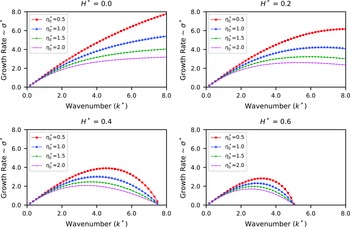


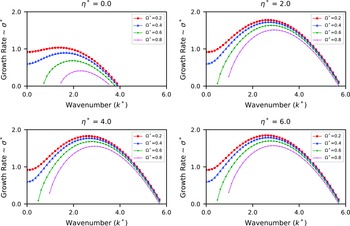


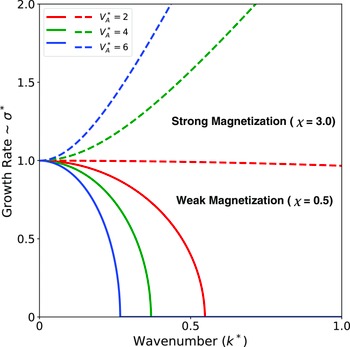


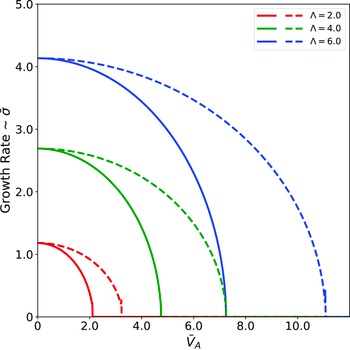


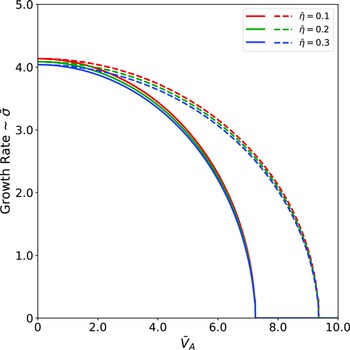


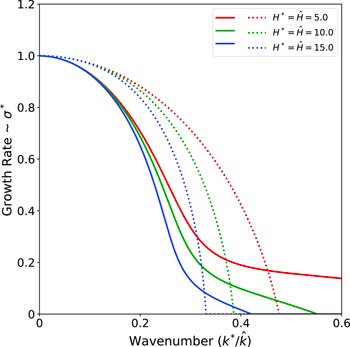


 Open access

