

Archival research, defined as “the locating, evaluating, and systematic interpretation and analysis of sources found in archives” (Lewis-Beck, Bryman, and Liao Reference Lewis-Beck, Bryman and Liao2004), is one of the oldest tools for conducting scholarly work. The growing number of projects to digitize archival material has brought renewed attention to it as a useful method to search for and uncover previously inaccessible original historical evidence toward proposing and testing theories in political science (Darnton Reference Darnton2018; Lee Reference Lee2022; Mahoney and Thelen Reference Mahoney and Thelen2015; Milligan Reference Milligan2022).Footnote 1 A prime example is the 2022 National Archives Catalog, which has made records, papers, artifacts, and exhibits from the Watergate affair available, thereby providing unprecedented access to students of American politics.Footnote 2 With the trend of digitalization set to continue (Kenely et al. Reference Kenely, Potter, West, Cobbin and Chang2016), a significant proportion of archival research soon will be digital. This prospect is recasting this hitherto niched method (Turner Reference Turner, Brown, Nordyke and Thies2022) as a useful qualitative tool for political science majors (Emmons and Moravcik Reference Emmons and Moravcsik2019; Shifrinson Reference Shifrinson, Huddleston, Jamieson and James2022). It also provides opportunities including increased accessibility, range, and detail, as well as challenges such as survival, transfer, digitization, reinforcement, and source biases (Kim Reference Kim2022) for which instructors must account. Overall, explicit training in qualitative methodologies merits a place in undergraduate methods courses (Sullivan and De Bruin Reference Sullivan and De Bruin2023), and digital archival research also should be a part of that toolkit. Moreover, if presented in a way that engages students, the exploration of benefits and limitations can be conveyed effectively.
LEARNING METHODS CAN BE FUN
Traditionally, methodology is viewed as a topic that is approached by the student population with some apprehension (Bernstein and Allen Reference Bernstein and Allen2013; Schleutker Reference Schleutker2022).Footnote 3 However, literature—both broadly (Bell Reference Bell2014; Bradbury and De Maio Reference Bradberry and De Maio2019; Freeman et al. Reference Freeman, Eddy, McDonough, Smith, Okoroafor, Jordt and Wenderoth2014; Hendrickson Reference Hendrickson2019; McCarthy and Anderson Reference McCarthy and Anderson2000) and particularly on methods (Adriaensen, Kerremans, and Slootmaeckers Reference Adriaensen, Kerremans and Slootmaeckers2015; Bernstein Reference Bernstein2021; Carranza and Shochet Reference Carranza Ko and Shochet2024; Jeram Reference Jeram2024)—suggests that active learning can attract students’ attention, stimulate their curiosity, and elicit their active commitment. Accordingly, this article argues that application of such pedagogical techniques to the teaching of methods, including digital archival research, can invigorate the topic, further inspire interest, and turn it into an enjoyable educational experience (Martinsson and Ricknell Reference Martinsson and Ricknell2024). Specifically, this study illustrates a collaborative effort between political science faculty and members of the campus library at the University of Toronto Mississauga in a pilot project to provide undergraduate students in an introductory methods course with an entertaining assignment designed to introduce them to digital archival research. Developed in late 2023, this assignment was offered in a second-year undergraduate political science methods survey course (POL244H) to 43 students in the first term of 2024. The primary goals were to facilitate the comprehension of archival creation; provide the contours of digital archival research; discuss issues of authenticity, accuracy, integrity, and accessibility of records; raise awareness of potential biases; and propose strategies for optimizing a focused research agenda—while making it a fun process for the class. The broader objectives, described in this article, were to demonstrate that the development of this type of exercise can assist educators by providing additional layers of knowledge to their students; helping them to develop research, critical-thinking, and interpersonal skills; offering an active learning mode that supports equity and inclusion in the classroom; and fostering a sense of community by making a learning task a fun activity for everyone.
AN ASSIGNMENT TO ENGAGE
Scheduled for the second “qualitative half” of the methods course, the digital archival research assignment was designed as an exciting and engaging learning activity for a course that, according to one student, already had its fair share of inferential statistics and regression analysis. To do so, the idea was to think “outside of the box” and design a task that could highlight digital archival research beyond a traditional political science topic while maintaining a Canadian connection. The result was the Falcon Lake Incident (FLI) digital archival investigation—an exercise that asked students to imagine themselves as rookie investigators to reexamine a “cold case” of a potential Unidentified Flying Object (UFO) using digitized archival records, including documents, reports, news items, photographs, and drawings. The case involved a notorious alleged UFO sighting incident that was documented in mid-1967, centered around the assertion of an individual that he came into contact with alien vessels near a lake in the Canadian province of Manitoba.Footnote 4 Furthermore, while inviting curiosity on its own merit, because this case unfolded amid the height of the space race between the two superpowers, Cold War themes indirectly also were related to concepts familiar to students of international relations.Footnote 5
The assignment’s learning objectives were crafted using The Guidelines for Primary Source Literacy,Footnote 6 a curricular document developed by a joint task force of archivists and rare book librarians (Association of College and Research Libraries 2018). The guidelines, which outline “the range of knowledge, skills, and abilities required to effectively use primary sources,”Footnote 7 are used in instructional collaborations between librarians and faculty members (Hauck and Robinson Reference Hauck and Robinson2018) and by academic librarians to create materials and activities for primary-source co-curricular workshops (Hervieux Reference Hervieux, Canuel and Crichton2021). Of the five learning objectives outlined, two guided the selection of archival materials and the creation of the assignment questions: #3: “Read, Understand, and Summarize” and #4: “Interpret, Analyze, and Evaluate.”Footnote 8
To meet these objectives, 253 pages of archival documents from the Library and Archives Canada (LAC) virtual exhibition were reviewed and 130 pages (i.e., 13 images and 117 text-based documents) were selected (Library and Archives Canada 2007).Footnote 9 These were organized and grouped into a 31-item curated digital archive, which was uploaded with an index to the course’s learning-management system (i.e., Canvas).Footnote 10 The FLI documents were preserved and presented by LAC in their original order; however, these case-file documents were arranged chronologically to enhance usability, facilitate a more straightforward analysis of the records, and allow students to follow the sequence of events more easily to understand the progression of the investigation. Additionally, the document index provided a clear overview of the contents, helping to quickly locate specific documents and comprehend their context within the broader narrative. For an appropriate scale, gaining a comprehensive view of the FLI UFO encounter was balanced with a manageable volume of materials for undergraduates, resulting in a carefully selected comprehensive yet concise set of LAC documents. Priority was given to documents that illustrated key historical, social, and cultural contexts and that highlighted a variety of document types and perspectives.
The assignment, which included seven questions—plus a bonus question—and was worth 10% of the final grade, required a maximum of 750 words and was shared with students on Canvas.Footnote 11 To successfully answer them, students had to explore the curated case file and look for specific clues while assessing each item. The questions covered the alleged UFO sighting and its political and cultural contextualization amid the Cold War. They were designed to introduce the main contours of archival research (e.g., identification and citation of primary and secondary sources); illustrate the existence of gaps, silences, and contradictions; and encourage contemplation of factors (e.g., biases such as power relations and archive silences) associated with the material and the original investigation. Whereas some questions had a single correct answer necessitating the extraction of specific information from a document, others required critical engagement with the materials to develop the students’ own interpretation and analysis based on the file’s evidence.
In addition to the regular lectures and syllabus readings on archival research, students were given two-pronged supplementary support based on Learning Objectives #2: “Find and Access” and #5: “Use and Incorporate” from the Guidelines for Primary Source Literacy (Association of College and Research Libraries 2018, 5–6). First, a 50-minute session was offered by a librarian during the course’s tutorials. This presentation was designed to illustrate an example of digital archival investigation conducted by an experienced archival researcher and to expand on related concepts and tips for effective research.Footnote 12 Second, a special archive demonstration was given by a library team member in the library’s reading room. The librarian presented a sample of artefacts and exhibits from the library’s archives,Footnote 13 explained how to conduct physical archival research, and provided a bonus question to students (who were attending with their individual “POL244 Special UFO Unit” badges printed for the occasion). Along with its learning value, this presentation was designed so that students would interact with one another and discuss the case, task, and method among themselves. After polling the class for availability, four visits were arranged within two weeks in March 2024, each accommodating up to 12 visitors. Following these presentations, students were given a week to complete the assignment that was due at the conclusion of the course.
APPRAISING LEARNING IMPACT
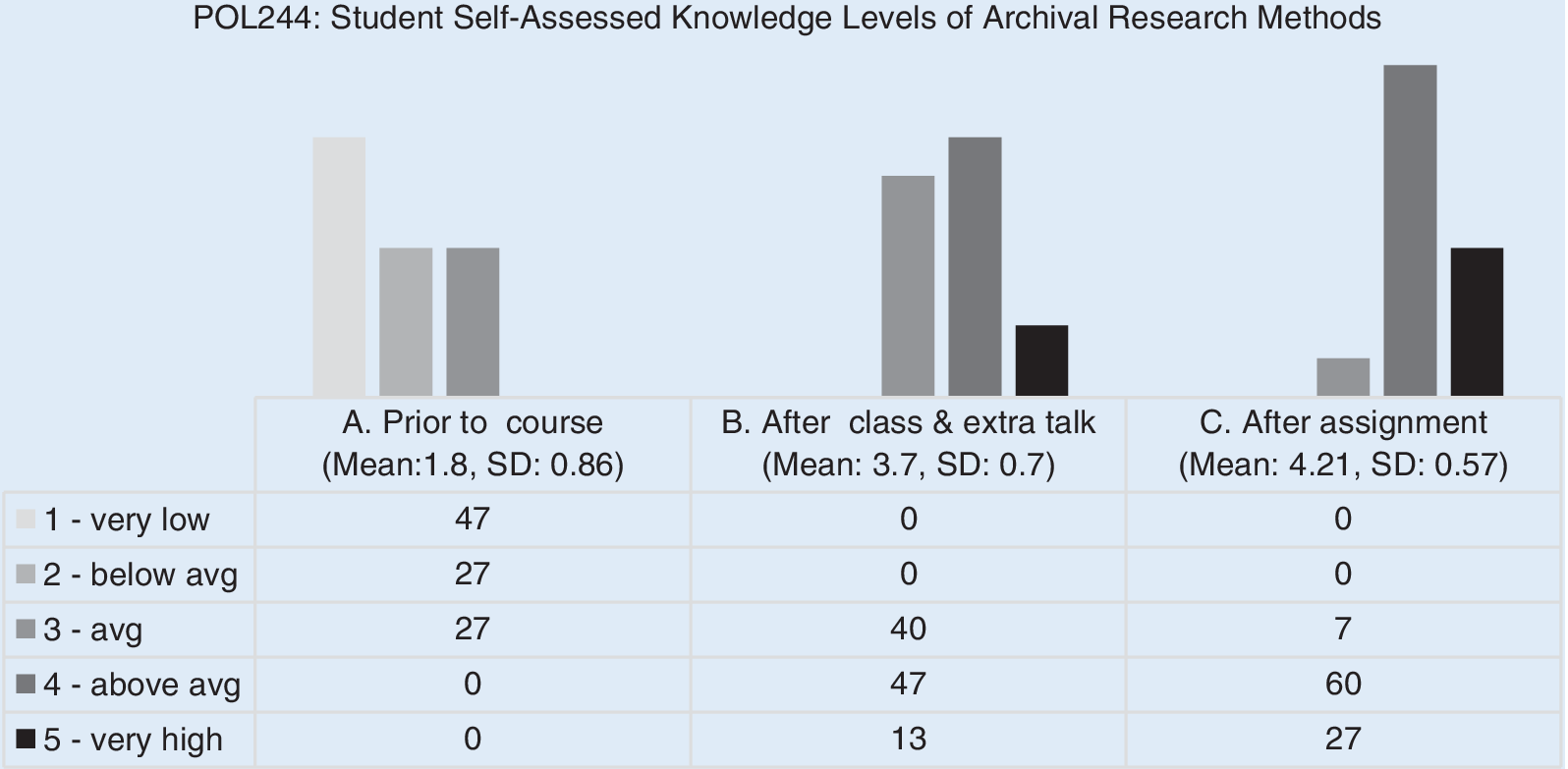
The assignment was completed by 40 students and the average grade was A-, which indicates a solid level of performance in the required tasks. In addition, 35—or almost nine of 10 of the original 40—elected to take part in the nonmandatory library sessions. To gain further insight into its potential impact, a single, brief, optional, Research Ethics Board–approved, self-assessed learning gains survey was administered at the end of the course and was completed by 37% of the class.Footnote 14 The survey consisted of eight closed questions and one open-ended question for comments. It asked students to assess their knowledge about archival research before taking the course and before and after the assignment using a scale ranging from 1 (very low) to 5 (very high). Their responses indicate a marked difference (figure 1): reflecting on their perceived knowledge of related material before taking the course (stage A), students reported mostly very low/no prior (47%), below average/rudimentary (27%), or average/basic knowledge (27%). Survey results show that after the related class and additional lecture on archival research (stage B), students’ perception of their knowledge improved, ranging from average/basic (40%), to above average/good (47%), to very high/very good working knowledge (13%). After completing the assignment and the library visit (stage C), these metrics increased even more—from 7% average, to 60% above average, to 27% very high self-perceived knowledge acquired on archival research. The higher means (i.e., from 1.8 for stage A, to 3.7 for stage B, to 4.21 for stage C) combined with progressively decreasing standard deviation values (i.e., 0.86, 0.70, and 0.57 for stages A, B, and C, respectively) also indicate a self-assessed overall improvement of the knowledge for most respondents (Kotsovilis and Valant Reference Kotsovilis and Valant2025).

Figure 1 Student Survey Results (Percentage of Responses) of Archival Research Perceived Knowledge Levels
Ranging from 1–very low to 5–very high, in three stages: (a) prior to the course, (b) after the related class and guest lecture, and (c) following the assignment and library visit. Of the 43 students, 40 submitted this assignment, 35 participated in the library visit, and 15 completed the survey.
Ultimately, of those completing this survey, 93% agreed (13%) or strongly agreed (80%) that the assignment was useful in illustrating archival research, and 80% agreed (33%) or strongly agreed (47%) that participating in the library visit was helpful. Individual comments also confirmed the data regarding the self-assessed learning gain. For example, one student wrote that they “learnt how to categorize my notes when reading the archives because of [the] assignment. There were connections I had to make between the items which required my notes to be well ordered. I learnt how to sift through the material, recognize whom it was addressed to, and who wrote it, and what time, and was able to create a timeline of records.” Another student commented that “the archival visit was extremely educational and knowledgeable but it was also quite simply really fun. Seeing all the old artifacts of books and games was really interesting.” Yet another stated that the assignment “was quite fun to do actually and was very unique in comparison to most political science assignments.”
DISCUSSION AND CONCLUSION
This assignment aspired to highlight digital archival research and illustrate how it can animate research while providing a different dimension and level of insight through an exercise that also could engage and entertain. Comparable perspectives to methods teaching have begun to emerge—for example, Sullivan and De Bruin (Reference Sullivan and De Bruin2023) proposed an archival research assignment not related to students’ own work. However, the novelty of this project’s approach includes three aspects: (1) the creation of a curated digital archive customized for the assignment; (2) the demonstration that this method can be applied to any research question; and (3) the broader presentation of the learning task to be pursued as an enjoyable activity that renders it more attractive. “I wish the library visit if anything was longer! Super fun” was one responder’s comment.
Overall, the feedback provided by students attests to the successful pedagogical approach that can assist learning while making it entertaining. Although this was a pilot project that will continue to evolve (e.g., scaled-up for a larger class), these initial results suggest that such exercises have several benefits. The assignment can complement and augment existing, more conventional methods-learning pedagogies. Equally important, it can introduce and/or improve multiple student skills, including technical-writing and interpersonal skills. In the FLI case, students were invited to become familiar and interact with a digital archive and explore its contents. They could do so at their own time, place, and pace, which ensured the assignment’s mindfulness of diversity, equity, and inclusion. The students also were required to effectively convey in writing the findings from their investigation. Furthermore, they were encouraged to discuss the case and the broader methodology’s usefulness with one another during their library visit, which also fostered mutual learning and community building.
Moreover, this exercise describes how diverse resources can be utilized and synergies created between different university units—especially libraries with expert staff members and fascinating material that also can support student learning. As archival research evolves in the digital era, campus libraries, their collections, and the archivists who manage them have an important role in complementing students’ learning about methods (Kenely et al. Reference Kenely, Potter, West, Cobbin and Chang2016)—and this potential can be harnessed. Finally, this assignment demonstrates that the learning and teaching of methods can be an inviting, enjoyable, and memorable educational experience.
In conclusion, this assignment was designed to contribute to students’ comprehension of the qualitative method of digital archival research in a creative, entertaining, and effective way. Although methodology courses are essential components of political science curricula, they often continue to be approached reluctantly by students (Bos and Schneider Reference Bos and Schneider2009). However, this does not need to be the case. As the FLI digital archival research exercise described herein proposes, innovative assignments and activities can make learning about methodologies appealing, engaging, and even fun.
As the FLI digital archival research exercise described herein proposes, innovative assignments and activities can make learning about methodologies appealing, engaging, and even fun.
SUPPLEMENTARY MATERIAL
To view supplementary material for this article, please visit http://doi.org/10.1017/S1049096525101571.
ACKNOWLEDGMENTS
The authors thank participating University of Toronto Mississauga librarians: Christopher Young, Catherine MacGregor, and Joanna Szurmak. We also thank Shamira Gelman, Sebastian Karcher, and Colin Elman for compiling this collection of articles, commenting on this study, and co-leading the 2023 APSA symposium “Teaching Qualitative Methods in Political Science,” where it was first presented. Thanks also to Kimberly Zagorski and Yasmine Yaris for their insightful comments on archival research during the symposium. Finally, we thank the two PS: Political Science & Politics anonymous reviewers for their constructive feedback and helpful suggestions and Constance Burt for her outstanding copyediting work.
DATA AVAILABILITY STATEMENT
Research documentation and data that support the findings of this study are openly available at the PS: Political Science & Politics Harvard Dataverse at https://doi.org/10.7910/DVN/O8P1NL.
CONFLICTS OF INTEREST
The authors declare that there are no ethical issues or conflicts of interest in this research.


 Open access

