


The biggest intelligence scandal in Danish history
In December 2021, the chief of the Danish Defence Intelligence Service (DDIS), Lars Findsen, was arrested in Copenhagen Airport after returning from a business trip. He was escorted by an armed special intervention unit (AKS) from the Danish National Security and Intelligence Service (DSIS) to a police station, where he was questioned and afterwards put in custody. This event made headlines – not only in Denmark, but also internationally.Footnote 1
Approximately a year before this arrest, in August 2020, the Danish Intelligence Oversight Board (TET) published a press release concerning the DDIS. Via a whistleblower, a former employee at DDIS, TET presented a harsh critique of some of the practices of DDIS. Most importantly, TET stated that there were ‘risks in the central part of DDIS’s intelligence gathering capabilities that unauthorised intelligence has been gathered on Danish citizens’.Footnote 2 Furthermore, TET characterised DDIS as having an ‘inappropriate culture of legality’ in which the service presumably withheld information from the oversight board and acted according to its own rules.Footnote 3 Based on this press release, three leading DDIS employees – including Findsen – were exempted from service that same week.Footnote 4 Based on this, the Danish government established a commission in December 2020 – headed by three leading judges – assigned with the task of investigating the claims of TET.
TET’s press release from August 2020 became a historic moment in Danish intelligence history. However, since it did not reveal many details, the media began to scrutinise what these fluffy but very serious allegations referred to. Media stories began to break in the following weeks, stating that the risk of ‘unauthorised intelligence gathering on Danish citizens’ probably referred to the so-called cable cooperation between DDIS and the National Security Agency (NSA) – understood as the Danish facilitation of the ‘US’s globe spanning electronic surveillance’.Footnote 5 This cooperation was first made public in the wake of Edward Snowden’s comprehensive leaks of various intelligence information in 2014, but they were never confirmed or denied officially by the intelligence services, public officials, or politicians.Footnote 6
In many media reports, the case concerning TET and Findsen was at an early stage phrased as ‘the biggest intelligence scandal in Danish history’.Footnote 7 Looking back on this from 2025, this can still be categorised as the biggest intelligence scandal in Danish history – but for different reasons than what was initially believed to be the case.
In this article, we will – via document analysis – investigate different stages of the DDIS case through the lenses of intelligence scandals and present some of the key approaches for portraying the case in national and international written news media. Drawing on sociologist Erving Goffman’s theoretical framework of dramaturgy, we will examine the potential performative role of the case on the backstage of the Danish intelligence community and the public images and as such the front stage performance of intelligence work in Denmark.Footnote 8 We will discuss which impression this case has left the public with; in which ways the case can impact the public understanding of intelligence; and what kind of public discussions the case has initiated – and, most importantly, the absence of such important public discussions. Our attention is drawn to the Danish case not only because it is unique in itself but also since research on intelligence scandals tends to be dominated by Anglo-Saxon contexts. Moreover, scandals emerging in Scandinavian high-trust societies may offer valuable insights into the broader literature on intelligence and, more specifically, intelligence scandals. These cases might challenge prevailing assumptions and contribute to a more nuanced understanding of how trust, transparency, and institutional accountability intersect with intelligence practices. And especially how a society characterised by a default high level of trust in intelligence practices might easily absorb intelligence scandals and criticism of intelligence communities by reconfirming the pre-existing trust-norm and hereby leave the intelligence community more or less unchanged.
Intelligence scandals
The scholarly literature on intelligence studies provides various understandings of intelligence scandals. Roughly two main approaches are referenced in the existing body of literature on intelligence conduct: first, a traditional perception of intelligence scandals where identified misconduct leads to reforms of the intelligence community. And, second, a more critical, sociological understanding of intelligence scandals as a test of collective societal norms where critique is often absorbed into the public discourse on intelligence.Footnote 9 The American intelligence pracademic and former member of the US Church committee, Lock Johnson, adheres to the first category of traditional intelligence scholars. In his book, America’s Secret Power: The CIA in a Democratic Society, he articulates intelligence scandals as tragic events entailing some kind of intelligence related misconduct, serving also as rare points of public insight into the otherwise secret machinery of the intelligence agencies.Footnote 10 Additionally, Johnson later gathers intelligence failures and intelligence scandals under the umbrella term ‘intelligence shock’, which refers to events that ‘set off a fire alarm’ and also often lead to changes in the set-up of accountability and control with intelligence practices to accommodate similar scandals in the future.Footnote 11 Whereas intelligence failures often refer to aspects pertaining to the intelligence process – for instance target-setting, information collection, analysis and/or dissemination (lack of warning)Footnote 12 – intelligence scandals refer to other types of intelligence-related (mis-)conduct, not necessarily referring to the intelligence machinery but rather to the intelligence organisation as such. Critical intelligence scholars, on the other hand, emphasise sociological approaches to everyday intelligence practices where intelligence actors are not considered rational and neutral but rather embedded in broader societal structures that determine their actions.Footnote 13 In contrast to traditional intelligence studies, critical intelligence studies consist of non-functionalistic mapping of practices in order to reveal, for example, hidden norms, values, practices, and structures.Footnote 14 From the perspective of critical intelligence scholars, scandals might not best be viewed as a path to some kind of rational reform of the intelligence environment. Rather, these scholars might emphasise the non-spectacular, everyday-ness of scandals and the acceptance of scandals being a normal part of every organisation and professional conduct.Footnote 15 Despite the ordinality of scandals according to this view, the occurrence of scandals presents a potential for change and a perfect moment for revealing knowledge about a pre-existing order and how or whether this order might be shifting as a result of the scandalous event.Footnote 16 In this sense, scandals might best signify a ‘test’ of whether existing societal norms are preserved or changed as a result of the scandalous events.Footnote 17
Despite positionality in the landscape of intelligence scholars, we argue that intelligence scandals include at least five central actors: 1) the intelligence community/agency, 2) the media, 3) the source of the specific story,Footnote 18 and more broadly 4) the public, including the political level of the specific society.Footnote 19 Hence, as stated by de Vries, ‘a scandal is not just “made” up by the media’; it needs involvement, reactions, and responses from the public in order to become a scandal.Footnote 20 Moreover, a recent definition of intelligence scandals includes as a minimum ‘a mediated event that discloses or sheds light on the covert, irregular, dysfunctional, illegal or at least dubious activity of an intelligence service for the wider public’.Footnote 21 The existence of some sort of dubious intelligence activity, which has been exposed to the public via media attention, is hereby considered as a minimum, necessary condition for defining an intelligence scandal. Thus, the media play an important role when understanding intelligence scandals, since the media version of the events and activities taking place in the otherwise secret world of intelligence is the primary source of information between the public and intelligence services.
In their definition, Prezelj and Ristevska define intelligence scandals as a ‘symptomatic type of political scandal’.Footnote 22 Intelligence scandals are inherently political since they play out in close relationship between intelligence agencies, the public – via the media – and the political environment where intelligence agencies are embedded. Along with Johnson, Prezelj and Ristevska furthermore argue that intelligence scandals entail a learning potential, stating that:
We should take the opportunity such scandals provide to learn mostly about mistakes, transgressions, modus operandi, covert operations and how to improve oversight. This theme is also relevant due to the performative role of intelligence scandals: the future of intelligence, oversight, and public perception will be determined by how we deal with today’s intelligence scandals.Footnote 23
We argue that intelligence scandals generally follow a certain dramaturgy. The media intelligence-related event faces the public and culminates in specific actions, where responsibility is assigned, and adjustments are made in order to accommodate the scandalous event. The actions might take place at the political level (often as intelligence reforms), at the intelligence community level (e.g., change of conduct), and at the public level (e.g., lack of public trust in intelligence).Footnote 24 Even though such actions in the wake of intelligence scandals might not affect the ‘rules of the game’ significantly, as highlighted by McCluskey and Aradau,Footnote 25 we propose a sketch of a common dramaturgy of intelligence scandals that includes four elements, as depicted in Figure 1.
The dramaturgy of intelligence scandals.

This dramaturgy serves as the structure for analysing intelligence scandals and can be applied independent of whether the study adheres to traditional or critical intelligence studies. This four-stepped dramaturgy will structure our analysis of the chronology or stages of the scandal. The analysis of the dramaturgy of the intelligence scandal enables an analysis of the scandal as potentially testing or preserving general societal norms. Therefore, along the sociological approach to intelligence scandalsFootnote 26 the sociological study of the ways in which this dramaturgy plays out in each specific case constitutes a great opportunity to study the scandal as a ‘test’ of the existing societal norms and provide an indication of whether these norms are preserved or changed as a result of the scandalous event, as suggested by de Blic and Lemieux.Footnote 27 In the specific Danish case, it will be interesting to reveal if the scandal changes commonly shared norms such as high trust in the intelligence authorities and whether it potentially affects the pre-existing perception and balance between openness and secrecy of the intelligence conduct. Hence the combination of the dramaturgical theory of Goffmann with the ‘testing’ potential of scandals as suggested by de Blic and Lemieux provides a unique and novel approach to the study of intelligence scandals as both a specific organisational and a broader sociological phenomenon.
Intelligence scandals as dramas
Intelligence work is by default a hidden performance and as such primarily a backstage activity in the dramaturgical phrasings of Goffman. What intelligence organisations present on the front stage to their audience, the media, and the public is carefully selected.
When the public, through the media, from time to time gets an unexpected sneak peek into what goes on backstage in the intelligence community, this reveals intelligence services’ failure to control their impression management and self-presentation. Manning points out that the police’s mandate and legitimacy are built on the myth that the police can control and influence crime levels. This myth forces them to instigate symbolic action and ceremonial rituals to meet the public’s expectations of being crime fighters.Footnote 28 This notion could potentially be transferred to the performance of intelligence services: the front stage performance of intelligence usually plays out as a drama, where the audience (the public) is assured that the actors (intelligence services, politicians, bureaucrats) perform not only according to the law but also in accordance with ethical considerations such as the privacy of its own citizens, that their activities are politically sanctioned, and most importantly that they are in control of potential societal threats. The drama of intelligence is therefore scripted in a way where the front stage performance has a leading message to the audience: that the intelligence service is legitimate, trustworthy, and accountable – a condition that is central to all intelligence services’ self-presentations.Footnote 29 However, when a scandal is revealed, the stage curtain, which separates the front stage and backstage, is removed, putting backstage performances to the front and allowing the audience to potentially see props, costumes, and rehearsals. This discloses too many spoilers and undermines what the play is trying to communicate and, as such, the overall performance. Goffman’s dramaturgical modelFootnote 30 is widely used in social studies to examine social interaction on a micro-sociological level, but scholars like Manning,Footnote 31 McCormick,Footnote 32 Shulman,Footnote 33 and SmithFootnote 34 apply Goffman’s theory in a larger organisational and societal setting. Goffman’s theatre metaphors give us illustrative instruments to understand the DDIS case as a demarcated incident and help us to deduce the complex social order of this in a way that hopefully will provide clearer images and increased understanding of the practices of the services and the interplay between the intelligence services and the civil society.Footnote 35 In this context, Goffman’s theory proves useful for exploring the DDIS scandal at both micro and macro levels. Although Goffman’s theatrical lens is rarely applied within intelligence or surveillance studies – with the notable exception of Eley and Rampton, who investigate everyday surveillance and ‘unfocused interaction’ in public spacesFootnote 36 – it offers a relevant and distinctive analytical framework. The theory provides a vocabulary and set of concepts that may initially appear overly dramatic when applied to intelligence work, which is typically conducted discreetly and in secrecy. In this sense, the covert nature of intelligence operations stands in stark contrast to the overt performance implied by Goffman’s dramaturgical approach. Despite the everydayness of scandals, the DDIS case is far from an ordinary occurrence and, in our view, it rightly deserves the designation of a drama. While Goffman’s theory offers a valuable framework for examining the sociology of the scandal and the performative role of the intelligence service, it does not fully account for the unique characteristics and institutional conditions that define intelligence agencies. These include their reliance on international cooperation, the necessity of incorporating geopolitical considerations, their complex legal infrastructure, institutional path dependencies, and the continuous risk and security assessments that shape every aspect of their operations.Footnote 37
Based on this, our central questions for this article are: What is the dramaturgy of the DDIS-intelligence scandal? How has it been portrayed in the media and what might the performative role of the scandal be with specific attention to the future relationship between the Danish intelligence service and the civil society? And how are the societal norms underpinning this relationship being tested?
Empirical material and methodological approach
We base our analysis on document analysisFootnote 38 primarily of media representations of the DDIS case through the theoretical lens of Goffman’s dramaturgical model and the framework on intelligence scandals as we presented earlier. A range of media stories have been written, TV documentaries have been broadcasted, and podcast series have been published in Danish media since the by now famous press release from TET on DDIS in August 2020.Footnote 39 Additionally, several books have already been published on the case – including an interview-book with Findsen himself.Footnote 40 We build our analysis on selected examples of media coverage from August 2020 to December 2023. To identify the empirical material, we conducted searches in the Danish media database Infomedia, using the advanced search keywords ‘Skandale’ (scandal), ‘Forsvarets Efterretningstjeneste’ (DDIS), and ‘Findsen’ in the given time period. This search provided 263 written articles in national Danish newspapers. A majority of the articles present similar content, as various media outlets and newspapers often cite the same sources – typically press releases from the authorities or statements from Findsen and/or his legal representation. Our initial review of the material therefore focused on identifying original sources and excluding articles that merely repeated these citations. Only a limited number of media outlets engaged in independent investigative journalism regarding the case. Our main sources thus consist of articles published by Danish Radio (DR), Politiken, Børsen, Information, Berlingske, Kristlig Dagblad, Morgenavisen Jyllandsposten, Ekstra Bladet, 24syv, and Weekendavisen.
Not all media outlets have the resources or editorial priorities to investigate a case such as the Findsen affair. Moreover, the case is somewhat exceptional since the outlets were not merely neutral, ‘objective’ observers of the case; some became central actors and therefore parties as specific journalists were involved and even mentioned by name in the claims against Findsen. Journalists who allegedly had contact with Findsen during the period of police surveillance also covered the case for their respective outlets, drawing on their unique knowledge and insights. While this involvement might of course influence the coverage, we have no indications that these journalists have acted based on personal agendas, nor do we have reason to question the credibility of their journalistic work. After identifying the original sources, we conducted qualitative, inductive coding through an iterative process combining elements of both content analysis and thematic analysis of the remaining articles.
Content analysis is the process of organising information into categories related to the central research question, whereas thematic analysis involves careful, more focused re-reading and review of the data to uncover themes pertinent to a phenomenon.Footnote 42 In this analysis we have primarily been interested in the specific content and message of the articles and the angle and as such position of the stories in different phases of the case. Before presenting this analysis in more detail, we have provided a brief chronological overview of the case (Table 1). The case is complex and ever evolving even at the time of writing. It entails much more than merely the parts concerning DDIS and Findsen, as it also includes a criminal case against the former Minister of Defence, Claus Hjort Frederiksen, and a case concerning the former informant for the intelligence services, Ahmed Samsam.Footnote 43 In this article, we will focus specifically on the case regarding Findsen and leave out the other exempted employees at DDIS and the Frederiksen and Samsam cases.
Chronological overview of central steps of the DDIS caseFootnote 41.

Analysis: A multi-staged intelligence drama
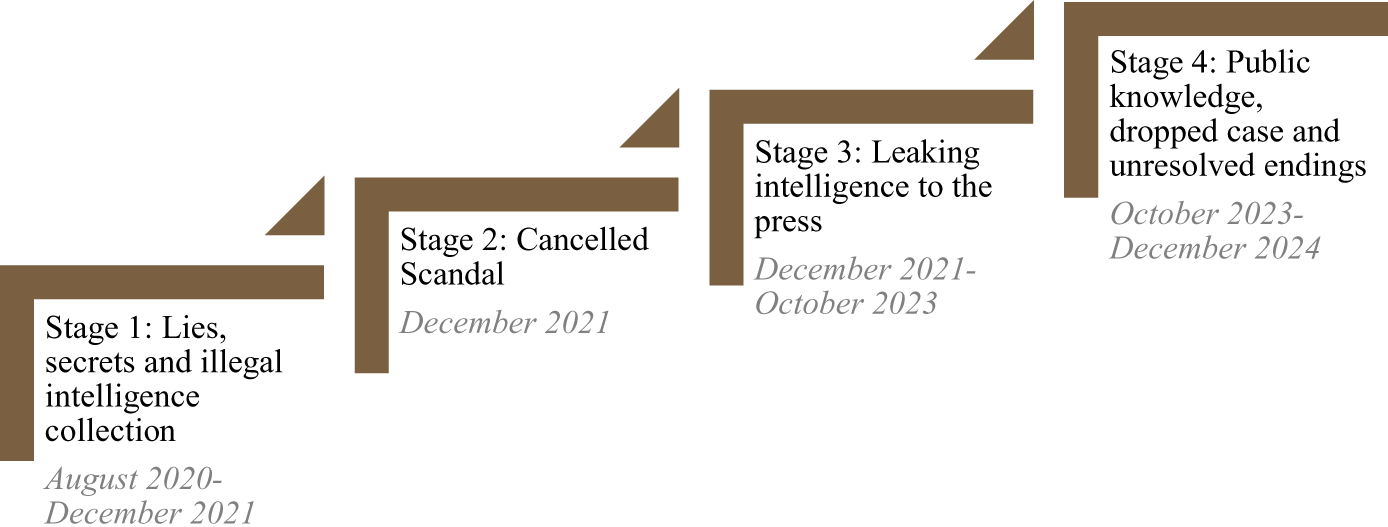
In our analysis of the empirical material, we have identified four ways in which the case has been articulated as an intelligence scandal in Danish media, which will be presented in the following sections following each of the four stages of the DDIS case as illustrated in Figure 2.
Overview of the four stages of the DDIS case.

Stage one: ‘Lies, secrets, and illegal intelligence collection’Footnote 44
As stated in the introduction, the press release from TET suggests that DDIS has carried out several activities that could be categorised as dubious, such as the risk of unauthorised intelligence gathering on Danish citizens, an inappropriate culture of legality, the unwillingness of DDIS to cooperate with the oversight board (TET) and more.Footnote 45 We refer to the first year of the case as stage one and delimit it to the period beginning with the publication of the press release in August 2020 through the publication of the DDIS commission report in December 2021 – as described in the introduction. In this stage of the case, the media stories first and foremost address the elements of the press release. When articulating the case as an intelligence scandal in the media, at the centre of the discussions is the claim concerning potential illegal intelligence collection activities, put forward in the press release. Such stories were followed up by discussions on the relationship between NSA and DDIS and the role, mandate, and responsibility of the oversight board, framed for example as the question concerning ‘who is watching the watchmen’,Footnote 46 and whether Denmark has a satisfactory set-up when it comes to intelligence oversight. As such, the media coverage at this stage is overall dominated by criticism towards DDIS and specifically Findsen as the person responsible for these suggested dubious activities.
Interestingly, TET was solely instrumental in this revelation, and they apparently had support at the political level to go public with their concerns. The case was for example not disclosed as a result of investigative journalism. The press release came as a shock to both the intelligence community and those reporters and professionals with intelligence as a subject matter. Therefore, in Goffman’s terms, we can say that the intelligence service’s ritual performance was disrupted directly by the oversight committee, but also indirectly by its political employer and otherwise friendly cooperators and acting team. The political actors lacked in this sense the dramaturgical discipline and dramaturgical loyalty needed to display support for their co-actors, leading them to spoil an otherwise successful performance. As such, the political representatives, for example the Minister of Defence, stepped off the front stage where the drama of intelligence was playing, leaving it empty as Findsen had already been removed from the stage due to his exemption from service. The media coverage showed that as a performing team, the intelligence service and the government not only failed to perform their common play but also left the stage curtains drawn so parts of the backstage were revealed.
Stage two: ‘Cancelled scandal’Footnote 47
Moving into stage two, which only includes December 2021, the claims of TET became increasingly forgotten in the public discourse and the critique of DDIS faded out after the commission report in December 2021 refuted TET’s claims.Footnote 48 The commission report stated that none of the exempted DDIS employees could be held responsible, and the commission furthermore found that there was no reason to criticise DDIS concerning the claims made by TET.Footnote 49 However, the commission report and the mission of the commission were not revealed to the public due to the sensitivity and secrecy of the case material, and only the general mission and the general conclusions were published.Footnote 50 Most interestingly, the conclusion of the report was formulated in the following way ‘there is no basis for the public authorities to seek accountability/take legal action, also not in the case of Lars Findsen’.Footnote 51 The conclusion of the commission report led thereby to media stories stating that the intelligence scandal was cancelled.
Despite the general and opaque nature of the conclusions of the DDIS commission, and despite a few critical remarks in the media concerning the secret nature of the mission and the conclusions of the commission, the general media discourse of the case at this point was that TET had been wrong in its claims and that DDIS did nothing that would count as dubious. Hence, the intelligence scandal was framed by leading and central commentators as a non-case.Footnote 52 Thus, it seemed as if there was no need to talk about dubious intelligence activities or any intelligence scandal at this point. On the other hand, TET as a newly established intelligence oversight board was harshly criticised for its lack of both judgement and insight into the context and practices of intelligence,Footnote 53 and the dominating media narrative at this stage was that TET was to blame for using a sledgehammer to crack a nut – and thereby DDIS was suddenly off the hook.
Using Goffman’s metaphors to understand this stage, we can say that a separate performance was as such going on at another scene playing the drama of intelligence oversight. Like the drama of intelligence, this drama was also disrupted since the trustworthiness of the primary actors (TET) and their overall message were both undermined by the commission. This is not to say that the roleplaying was disturbed or altered – the commission was given the role of overseeing the overseers (TET), and this was scripted and recognised by all actors. But since TET suddenly appeared on the front stage of the drama of intelligence, undermining DDIS’s performance, the commission now appeared on TET’s front stage, where they critisised their performance portraying them almost as the village fool.
Stage 3: Leaking intelligence to the press?Footnote 54
Moving into stage three of the case, from December 2021 to October 2023, the case progressed into a full-on focus on Findsen. Ironically, only a few days after the release of the commission report, Findsen was arrested at Copenhagen Airport. He was taken into custody in December 2021 based on criminal charges (Straffelovens § 109, stk. 1, § 152, stk. 2,), and he faced serious accusations of treason under a criminal code that had not been used for decades – a code that could result in up to twelve years of imprisonment.Footnote 55 During his police interview, Findsen furthermore learned that his home had been surveilled by the national intelligence and security service, and that they had also wiretapped his phone communications and installed eavesdropping equipment in both his main and his summer house for a period of 15–16 months while he was exempted from service.Footnote 56
After nearly three months in custody Findsen was released in February 2022, but in September 2022, he was formally charged with leaking highly classified information to the press, including a different and less serious criminal code (§ 109, stk. 1, and/or § 152, stk. 2).Footnote 57 Now the case turned from one concerning the dubious behaviour and intelligence activities of DDIS as an organisation to one concerned with the potential dubious behaviour of specific individuals – understood as Findsen’s (and other employees’) potential leaks of ‘highly sensitive information’ to the media (and potentially, at this stage, also to foreign actors). Hence, at this point the public did not know the specifics of the charges against Findsen.Footnote 58
Thus, the case shifted from concerning the specific culture and activities of the entire intelligence organisation to a question of dubious management and poor judgement on the part of the chief of DDIS – but not in connection with the original accusations. Now, the close relationship between Finsen and the press, which he deliberately had practiced for years, was articulated as the core of the case, and Findsen’s clear ambition to ‘open DDIS up’ to the public was allegedly backfiring.Footnote 59 DDIS as an organisation was off the hook at this point, and the media was not concerned about discussing the press release’s initial claims or the critique put forward by the oversight board (TET) concerning the culture and practices of DDIS. Accordingly, this case was viewed as solved.
Instead, when Findsen was released from custody in February 2022, several stories in the press began to articulate the case as a political intelligence scandal, hence framing the case as being less focused on the actions of DDIS and Findsen and more and more preoccupied with the potential political pressure, as well as the politicisation of the case by leading politicians – including the Minister of Defence, Trine Bramsen.Footnote 60 This public discourse intensified as details from confidential meetings between DSIS and representatives from the Danish parliament began to leak.Footnote 61 Politicians were beginning to ask questions about relevance as they learned that the director of DSIS, Finn Borch Andersen, had shared intimate details concerning Findsen when he was briefing the political level on the case.Footnote 62 These details included Findsen’s sexual preferences and specific situations where he had stolen bicycles from a recycling container.Footnote 63 DSIS argued that only central details were relevant in order to draw a full picture of the central character of the case,Footnote 64 whereas others judged it as hopelessly irrelevant and an attempt to conduct a ‘character assassination’ of Findsen.Footnote 65
Seen through a performative lens, this stage characterises a shift in focus from the dramas playing out on the front stage towards what happens backstage. Speculation began to flow within the intelligence community as to why these dramas were even performed in front of audiences in the first place and, increasingly, questions were raised regarding what went on backstage and who was involved. Therefore, at this stage the audience was bewildered and unsure of who had been cast as hero, villain, or fool,Footnote 66 since the roles seemed to shift rapidly. In public, a specific discussion was emerging: is it in the public’s interest to view all dramas, or should some performances regarding intelligence solely play out on the backstage? An otherwise well-rehearsed and well-played drama of intelligence was disrupted with the severe consequence that the intelligence service lost its ability to manage its impression of legitimacy, trustworthiness, and accountability. As mentioned above, the team of actors obviously lacked dramaturgical loyalty and dramaturgical discipline, which brought the performance into chaos. Moreover, or perhaps as a consequence, neither the public nor the media carried out their role as a tactful audience to support the maintenance of the show. On the contrary, the audience can be seen as having left the theatre, withdrawing from the performance in a loud manner, without any fidelity towards the performers left behind.
Stage four: Public knowledge, dropped case, and unresolved endings
The case was not remotely over when Findsen was released from custody. Findsen had to appear in court in the spring of 2023, where the charges concerning the alleged leaks of highly classified information to the press (and to his elderly mother) were to be decided. We refer to this as moving into stage four of the case, taking place from October 2023 and into December 2024. Due to the secret and sensitive nature of the case, the prosecution had requested the court case be processed in secret behind closed doors, with no public insight. Findsen (and former Minister of Defence Frederiksen), however, voiced their objection to the prosecution’s decision to the Danish supreme court. Hereby, the focus of the case was again altered as it now turned into a case addressing the question of whether the information Findsen leaked was in fact ‘highly classified’ and sufficiently secret in nature and questions were asked regarding whether Findsen (and others) were given fair and due process.Footnote 67 Therefore, the focus in the media discourse also shifted to question whether there had in fact been anything dubious about the interaction between Findsen and the media in the case. If the leaked information was not sufficiently secret and sensitive, the case could proceed with open doors and then the dubiousness of the case would disintegrate.
In October 2023 the supreme court decided in favour of Findsen, determining that the case could proceed with partly open doors.Footnote 68 The court’s decision was interesting since in its verdict and argumentation it revealed parts of the otherwise secret indictment of Findsen. The following quote especially attracted a lot of attention: ‘The existence of the cable cooperation (…) must at this stage be regarded as public knowledge’.Footnote 69 This was the first time that the public learned – from a governmental source with official insight into the indictment and knowledge about the legal case – that it was in fact the cooperation between NSA and DDIS that was at the core of the case.
A few weeks after this decision, the prosecution declared that the case against Findsen (and Minister Frederiksen) had been dropped with reference to the unavoidable risk of disclosing secret information in the process of the trial due to the supreme court’s decision.Footnote 70 The prosecution simply did not agree with the supreme court in their assessment that parts of the case could proceed as open and that the core of the case concerning the cable cooperation between NSA and DDIS was public knowledge.
Nevertheless, the conclusion of the supreme court regarding the non-secret nature of alleged leaked information to the media concerning the cable cooperation served as both a culmination of a long and ever-evolving case and an anticlimax. No doubt Findsen, as the implicated person, was relieved at not having to go through a court case and risk being convicted, but the case was never formally or legally finalised.
At this time, we have no clarity regarding DDIS’s potential dubious activities; the initial case might therefore no longer be categorised as an intelligence scandal, and the case considered ended (for now) in discussions on the nature of secrets and sensitive information.Footnote 71
However, as we have argued, stages two, three, and four indicate that there is perhaps a much bigger scandal lurking beneath the surface, namely the central questions regarding the political element of the case. In the aftermath, a new commission has been tasked to scrutinise, for example, the potential politicisation (‘usaglige hensyn’) of the case against both Findsen and Minister Frederiksen.Footnote 72 However, this commission will also conduct a secret inquiry where only chosen conclusions will be shared publicly, and it will work until at least April 2026. Moreover, a number of relevant and coherent incidents and conditions will not be investigated by the new commission, such as the arrest of other DSIS employees and the potential connection to the Ahmed Samsam case.Footnote 73
Returning to Goffman and the world of dramaturgy, the last stage of the DDI -case can be observed as an illustration of the theatre of the absurd in the sense that the case has evolved into absurdity devoid of any purpose or performative potential.Footnote 74 If it indeed turns out that the case process against Findsen (and Minister Frederiksen) has been interfered with or affected by political and/or personal interest stemming from people in positions of power, then this would be not only shocking but also bizarre and thus absurd. At this point, the Danish drama of intelligence has undergone a complete collapse. The team of actors on the front stage perform chaotic scenes, and both Findsen and Minister Frederiksen are constantly breaking the fourth wall, addressing the audience directly to explain what is going on. Diderot’s concept of the fourth wall refers to the invisible, imaginary wall between the stage and the audience that demarcates the illusion of the play. The audience are voyeurs, and the actors pretend that the audience does not exist. This illusion of the play as reality is fundamental to any convincing drama to capture the audience’s emotional engagement in the tableau.Footnote 75 The crash of illusion in the DDIS case underlines the absurdity of the drama and surface ridiculousness; however, it also stresses the core element of theatre of the absurd, namely the struggle of humanity to find purpose and control of their fate, leaving a feeling of hopelessness, bewilderment, and anxiety.Footnote 76 The drama of intelligence has now become a more existential drama, and Findsen himself has on several occasions described ‘the Kafkaesque nature’ of the case.Footnote 77
Concluding discussion: The anticlimax and the (non-)performative role of the DDIS scandal
Recall the definition of intelligence scandals presented at the beginning of this article, where intelligence scandals potentially have a ‘performative role’ since ‘the future of intelligence (…) and the public perception will be determined by how we deal with today’s intelligence scandals’.Footnote 78 Our analysis has presented a dramaturgy in four stages of this particular case, where the drama of intelligence plays out in various scenes with different actors. As we have argued in connection with stages three and four, the case is now more and more discussed as a political scandal involving the intelligence services – which now only plays a supporting role in the story.Footnote 79 Now, the arrow points to the political level and the governmental officials as the central actors, who allegedly handled the case problematically.Footnote 80 However, the case is likely to be more or less forgotten when the new commission provides the results of its secret investigation in a few years’ time. We also base this prediction on the condition that the case is still growing in scope and complexity, which usually impacts both the media’s and the general public’s interest in and knowledge about such cases. Accordingly, the case will in time probably be discussed primarily in the intelligence community, amongst legal experts and scholars.
In the course of the scandal, the case has additionally been articulated as gambling with the trustworthy and highly esteemed status of the Danish intelligence services in the view of the public, friends, and allies.Footnote 81 Despite frequent references to the case as a potential threat to future international intelligence cooperation, Danish Prime Minster Mette Frederiksen called for calm after a visit to former President Joe Biden and the former CIA director at the White House in 2023, where the Americans had only positive things to say about the intelligence cooperation between Denmark and the United States.Footnote 82
Clearly, the case illustrates that intelligence services are not isolated islands in the bureaucratic landscape or in the political machinery. On the contrary, they are inherent parts of the collective, governmental power apparatus.Footnote 83 Simon Willmetts has argued convincingly for a ‘cultural turn’ in intelligence studies.Footnote 84 According to Willmetts, intelligence might best be viewed ‘within the wider socio-cultural domain’, with intelligence activities ‘enmeshed in a complex ecosystem of political, social and cultural phenomena’.Footnote 85 Consequently, the societal context of the intelligence scandal might help explain the specific dramaturgy of the Danish intelligence scandal.
When comparing the case to our proposal of a general dramaturgy of intelligence scandals entailing 1) revelation of dubious intelligence activities, 2) assigning responsibility, 3) actions made on various levels, and 4) change of conduct, we would argue that there are two main storylines in the Danish intelligence scandal. As such, we propose that stages one and two constitute storyline 1, whereas stages three and four constitute storyline 2.
Storyline 1, starting with stage one, entails the revelation via press release of potential dubious intelligence activities, and the analysis above reflects the conflicting and dominant media perceptions entailed in the case. When it comes to assigning responsibility in the case, the picture is still muddy. The law concerning DDIS is currently being revised and the final outcome is still unknown.Footnote 86 However, the most recent political initiative suggests that the mandate and the role of the intelligence oversight set-up will undergo some changes in the near future, where the mandate of the external oversight board (TET) will become broader – entailing, for example, the possibility to oversee ‘operations’ and not simply ‘personal information’.Footnote 87 This is articulated politically as a strengthening of the oversight board. However, at the same time, the members of the board will be changed into politically appointed members and the board will only be able to communicate with the public if this is approved by the Ministry of Justice.
When viewing this reform of the intelligence community as a result of the scandal, it is also quite evident that TET is being framed as the responsible party in the case and therefore the one in need of change. Stage two of the scandal ended with the cancellation of the scandal in the media coverage based on the secret commission report, which was not debated further. In light of the sketched dramaturgy of intelligence scandals, the political action of this case is constituted by a step, which primarily moves the oversight board closer to the political power and enables political control of what the oversight board communicates to the public. Hereby, storyline 1 establishes TET as the responsible actor and the actor in need of legislative changes and change of conduct via more political oversight with the intelligence services. Interestingly, the scandal results in a reform which does not aim at changing the allegedly dubious conduct of the intelligence services, but rather a reform that will change the oversight into a set-up where the intelligence community will be able to continue business (more or less) as usual. The focus of the reform appears to be the avoidance of similar intelligence scandals in the future amongst other by limiting public insight – rather than creating the opportunity to address and publicly discuss the allegedly ‘dubious intelligence activities’ and enable political change. In this sense the criticism entailed in the scandal is absorbed by growing complexity of the case and the fact that the case is increasingly considered political rather than intelligence related.
Stage 3 and 4 of the case constitute a separate storyline 2, where responsibility for the scandal is unsettled and might continue to be so. In this part of the case, it has turned into a blaming and shaming game, where the questions are concerned with whether Findsen did in fact do something dubious when engaging with the media, or whether the political level overreacted in their handling of the case. Due to the dropped case against Findsen, this part will remain unsettled despite the secret commission report due in April 2026 looking into the potential problematic political handling of the case by leading politicians.
Returning to the general dramaturgy of intelligence sandals, this part of the scandal is characterised by absence of closure – responsibility will not be placed and there will most likely be no explicit actions or change of conduct. De Vries has addressed the phenomenon: ‘intelligence revelations without scandals’, referring to publicly published details of intelligence related, dubious activities without any public respond or outcry.Footnote 88 The DDIS case also entails absence, albeit a different type of absence. This case forms a new category of intelligence scandals, which might best be phrased as intelligence scandals without closure. Interestingly, the absence of closure and of explicit actions in the wake of the scandal might lead to an increasing level of secrecy in the Danish intelligence community. Hence, despite the anti-climactic dramaturgy of this scandal, the aftermath of the scandal might indicate an increase in the level and culture of secrecy in the intelligence community. Some media stories already claim that the case has led to an increased level of secrecy and carefulness when it comes to interacting with civil society and the public from the perspective of the intelligence community.Footnote 89 Additionally, the case against Findsen was dropped with reference to the risk of revealing secrets, and the oversight board will most likely also become more secret and step closer to political power, as described above.
Thus, from the perspective of the public the case does not appear to serve any performative role vis-à-vis the public, since the parts of the case that could have had potential for envisioning a new future relationship between the public and the intelligence services are unsettled and hereby lacking closure and kept in secrecy. All four stages of the case raise central questions concerning, for example, how open or closed intelligence service should be in democratic societies, what should be considered secret versus public knowledge, what the relationship between the intelligence services and the media should be, and how we should perceive the close intelligence cooperation between Denmark and its allies. Such questions have drowned in the person-focused naming and shaming game of the scandal as a result of the strong focus on Findsen. We – as the public – are still left with a democratically immature dialogue on the role of intelligence services in twenty-first-century Denmark.
The case further indicates a general tendency stated by critical intelligence scholars that intelligence scandals will not affect the ‘rules of the game’ significantly,Footnote 90 since the criticisms raised in intelligence scandals are easily absorbed, complicated, or diffused. Returning to the notion of the scandal as a test of societal norms,Footnote 91 the case might also reveal interesting context-specific findings about the Danish intelligence environment. The extreme secrecy of intelligence practices in Denmark – which will allegedly be further amplified by this case, as argued above – is interesting if we think about the contextual, cultural elements, and the broad societal characteristics of Denmark.Footnote 92 Denmark is famous for being a high-trust society with a high level of equality and social cohesion and a low level of corruption – what one would assume to be a flourishing climate for democratic dialogue on, for example, intelligence matters.Footnote 93 And so, why would such a society be characterised by a very high (and even increasing) degree of secrecy when it comes to intelligence practices?
Is it because of immaturity and maybe even resistance when it comes to publicly discussing intelligence matters with the Danish public (media, citizens)? Davidsen-Nielsen argues that there is a general perception in Scandinavian countries that personal security is closely related to national security – and therefore we do not separate or critically question either.Footnote 94 If so, the test entailed by the scandal of Danish societal norms when it comes to high trust in intelligence services might be viewed as a preservation of the high-trust norm but a specific version of that trust. Hence, the expressed norm seems to be a convenience-based ‘blind trust’ attitude when it comes to intelligence matters where we trust in authorities simply because trust is needed.Footnote 95 Furthermore, as argued by Ingesson, the high-trust and small state status of Scandinavian countries might amplify a perceived need to be extra secret and closed in order to be regarded as trusted allies.Footnote 96 However, this default trust in intelligence authorities might explain the lack of critical, public discussions on intelligence matters in Denmark – what could be regarded as a laissez-fair attitude or an immature and uncritical public dialogue on intelligence matters.Footnote 97 Therefore, the dramaturgy of the Danish case and the prevailing nature of the testing potential of the scandal might also reflect a core Danish approach to intelligence scandals. In countries such as the UK and Germany, where critical approaches to intelligence have been more common due to cultural and historical events and tragedies, a similar dramaturgy of an intelligence scandal seems inconceivable.
Hence by viewing this intelligence scandal as a test of societal norms, the existing norms concerning the balance of secrecy and openness and a default high trust in intelligence services seem to be preserved. Nothing in the mediation of the case signifies changes in the current, dominant public perception of the intelligence services. The case has moved into the field of political scandals, and perceptions of the political elite governing the intelligence services might be affected by the case. If we return to Goffman’s terminology, the play about intelligence in Denmark, which is performed on the front stage by actors from the intelligence community, the political level, and the oversight board, potentially leaves the audience with the impression of watching a play – and not a very realistic one. The disclosure of backstage activities behind the stage curtains; the lack of teamwork and common mission amongst central intelligence actors, politicians, and bureaucrats; and the willingness of certain actors to break the dramaturgical discipline by disrupting other actors’ performances underline the chilling realism that this indeed is a performance of a play. As Goffman warns: ‘members of the team must not exploit their presence in the front region in order to stage their own show (…) nor must they use their performance time as an occasion to denounce their team’.Footnote 98 The audience has now witnessed the collapse of an otherwise trustworthy performance of the drama of intelligence, revealing a disloyal team performance. This affects the audience’s perception of the play and their role as uncritical viewers who accept the premises of the drama and the actors’ performances as genuine. Every play needs a loyal audience, and up until the DDIS scandal, the audience has been spectators at a performance supporting the notion of legitimate, accountable intelligence services being in control of risks. Due to the framing of the oversight board and Findsen as the responsible and dubious actors, respectively, we have argued that the high-trust norms of Danish society will most likely prevail. However, the future will show how the play of intelligence will be scripted and dramatised and how the actors will try to manage the impression of legitimacy and accountability, or if the audience will leave the show at intermission and eventually require informed or reasoned trust in intelligence rather than default, blind trust.
Acknowledgement
We are thankful for feedback and comments from participants at the panel “Public Images of intelligence Agencies” at ISA 2024 in San Francisco and for most valuable comments from the editor and reviewers at the European Journal of International Security.
Funding statement
The authors have not received any funding for this research.
Competing interests
The authors declare no conflicts of interest related to the research, analysis, or publication of this article. The study was conducted independently and without influence from any governmental, institutional, or media actors mentioned in the text. All interpretations and conclusions are solely those of the authors.
Kira Vrist Rønn is an associate professor and Head of Section at the Department of Political Science and Public Management at the University of Southern Denmark. Her research interests cover intelligence, policing, ethics, and national security. She is PI of the research project IntelHub, seeking to give voice to Scandinavian scholars in intelligence studies.
Nadja Kirchhoff Hestehave is an associate professor in police science at the Norwegian Police University College. She completed her doctoral thesis in 2021, which was based on extensive ethnographic fieldwork in the Danish police. Her research focuses on how the police respond to organised crime and the proactive investigations that unfold within the police. Her current research involves miscarriages of justice and investigation ethics and police corruption and misconduct.



 Open access

