


Introduction
During the last decades, the academic literature has pointed out an increasing use of direct democracy mechanisms such as state-wide and local referendums or citizen initiatives (Butler and Ranney, Reference Butler and Ranney1994; Gallagher and Uleri, Reference Gallagher and Vincenzo Uleri1996; Qvortrup, Reference Qvortrup2014; Ruth et al., Reference Ruth, Welp and Whitehead2017). Political parties have adapted to this trend by introducing direct democratic processes within their organizations. The seminal studies by Scarrow and other colleagues already pointed out in the early 2000s the growing relevance of various democratic innovations based on the formal empowerment of members (or even citizens) (Katz, Reference Katz2001; Scarrow et al., Reference Scarrow, Webb, Farrell, Dalton and Wattenberg2002). So far, the media and academic attention have been focused mainly on the introduction of party primaries (Hazan and Rahat, Reference Hazan and Rahat2010; Cross and Katz, Reference Cross and Katz2013; Pilet and Cross, Reference Pilet and Cross2015; Sandri and Seddone, Reference Sandri and Seddone2015). Another branch of the literature on party organization has also highlighted other empowerment mechanisms, such as the democratization of policy formation (Gauja, Reference Gauja2013; Scarrow et al., Reference Scarrow, Webb and Poguntke2022) or other intra-party deliberative processes (Gherghina et al., Reference Gherghina, Soare and Jacquet2020).
However, the literature has partly neglected the study of intra-party consultations (but see Gherghina, Reference Gherghina2024). We broadly define this concept as those democratic processes that political parties implement through deliberative or direct procedures to ascertain the opinion of the party on the ground on specific issues. While there has been an increasing focus on deliberative intra-party consultations (Gherghina, Reference Gherghina2024), less attention has been devoted to direct voting intra-party consultations, also known as intra-party referendums. That is, decision-making processes through which party members directly vote on a proposal or an issue they are formally called to take a stance on (Wauters, Reference Wauters2010; Wolkenstein, Reference Wolkenstein2016). So far, intra-party referendums have predominantly been utilized as experimental tools, either in response to internal party crises (Lioy et al., Reference Lioy, Del Valle and Gottlieb2019; Musella, Reference Musella2023) or in the context of the several digital innovations developed by new and mainstream parties (Gerbaudo, Reference Gerbaudo2019; Barberà et al., Reference Barberà, Sandri, Correa and Rodríguez-Teruel2021; Scarrow et al., Reference Scarrow, Webb and Poguntke2022). Since intra-party referendums are meant to empower party members, understanding internal participation is indeed one of the most relevant phenomena to address. That said, research on this emerging strand has focused chiefly on internal regulations (Thuermer, Reference Thuermer2019; Deseriis and Vittori, Reference Deseriis and Vittori2019; Vittori, Reference Vittori2020; Vodová and Voda, Reference Vodová and Voda2020; Gerbaudo, Reference Gerbaudo2021; Kamenova, Reference Kamenova2021), and there is little evidence on the main factors shaping participation in such processes (for an exception, see Wauters, Reference Wauters2010).
This paper aims to explore the key determinants of turnout in direct intra-party referendums within the so-called digital parties. This party family is relatively new in the European context but has introduced several organizational innovations that mainstream parties have since adopted. One of these innovations is the further development of the concept of multi-speed membership (Scarrow, Reference Scarrow2015), a framework describing the different forms of affiliation that parties offer to their supporters. Digital parties have adapted and expanded this model by lowering participation barriers through digital membership, enabling individuals to engage in party decision-making at minimal cost. Their advanced digital infrastructure has facilitated the widespread use of online internal ballots, making the analysis of turnout in these processes both timely and relevant. While there is an extensive literature on party membership explaining who participates and, in a few cases, what motivates intra-party participation within political parties at the individual level (e.g., Whiteley et al., Reference Whiteley, Seyd, Richardson and Bissell1994; Whiteley and Seyd, Reference Whiteley and Seyd2002; Bale et al., Reference Bale, Webb and Poletti2020), we still do not know whether there are exogenous conditions that promote or allow such participation. Hence, the relevance of the meso-level is crucial because the dynamics of involvement can shed light on the behaviour of members and the strategies of party elites to mobilize their own members. Using theoretical insights from electoral participation literature (Geys, Reference Geys2006; Hazan and Rahat, Reference Hazan and Rahat2010; Wauters, Reference Wauters2015; Cancela and Geys, Reference Cancela and Geys2016) – including country referendums and party primaries – we show that turnout can be meaningfully explained by meso-level factors with some (important) caveats; mainly concerning the transparency of political parties and the impact of multi-speed membership in some of them.
Our analysis focuses on three digital European parties, which are ideologically diverse, but have intensively used intra-party referendums through digital platforms: the Czech Pirate Party (CPP) (Czech Republic), Five Stars Movement (Italy) and Podemos (Spain). Using a dataset of 407 cases of internal referendums over a time span of more than ten years, our analyses show that more extended voting periods and the more relevant the saliency of the proposal, the higher the turnout, while the competitiveness of the proposal does not affect turnout.
The paper begins with a discussion on the main determinants of turnout. Then, the methodological section discusses the content of the database, the operationalization of the main independent and dependent variables and the explanation of the statistical model. Next, we present a descriptive general overview of the key features of internal party referendums in all three parties and their link to different participation levels. The following section is focused on discussing the results of the statistical model. The paper ends with a discussion on the main findings, some conclusions, and future implications.
Meso-level drivers of turnout in intra-party referendums
Explaining turnout in intra-party referendums is an underexplored issue in the scholarly literature. Seminal research on the topic points out that, despite initial enthusiasm, participation in such initiatives tends to diminish over time (Deseriis and Vittori, Reference Deseriis and Vittori2019; Vittori, Reference Vittori2020; Gerbaudo, Reference Gerbaudo2021). Other scholars have also shown that turnout might be heavily influenced by the limitations for rank-and-file members to initiate such processes, generally called by the party leadership (Lioy et al., Reference Lioy, Del Valle and Gottlieb2019). Finally, others have highlighted the impact of individual-level factors such as idealism, sharing the points of view of the party, beliefs on the ability to make an impact on the policy of the party, or having participated in previous internal elections (Wauters, Reference Wauters2010). That said, to the best of our knowledge, the main factors shaping turnout in intra-party referendums at the meso-level have not been adequately addressed: we refer to meso-level drivers as the variables related to the specificities of intra-party referendums. That is why in this section we will bridge our research question with the existing literature on turnout in elections, referendums and party primaries. We focus on meso-level drivers of participation for three main reasons: the first two are related to the feasibility of studying other drivers, and the third is the specific importance of meso-level drivers.
First, due to the small number of parties that consistently use intra-party referendums in Western Europe, the use of macro-level variables, such as variables related to the specificity of the party system, different traditions of political participation, or turnout in elections, would be unfeasible, as we would miss variation. Second, micro-level determinants are equally challenging to identify: unlike turnout in elections or referendums, which can be measured through recall questions in surveys, participation in intra-party referendums is more difficult to explain because measuring participation would require asking the party to conduct a study shortly after a consultation and prior to other consultations that the party might launch (see Wauters, Reference Wauters2010; Wuttke et al., Reference Wuttke, Jungherr and Schoen2019).Footnote 1
We acknowledge that participation within political parties is a different kind of participation than in elections (to take just two examples, different individual motivations and a very different and more heterogeneous population). At the same time, in our understanding, meso-level determinants are the ones that make participation in elections more similar to participation in intra-party referendums. Thus, the third reason why meso-level determinants are relevant is that expectations can be meaningfully constructed by drawing on the turnout literature.
Our starting point is the meta-analysis of turnout determinants carried out by Cancela and Geys (Reference Cancela and Geys2016). The authors identify thirteen different variables, six of which are related to the socio-economic context in which elections take place, three of which are related to political determinants, and four of which are related to institutional determinants. Socio-economic variables (such as income inequality) are challenging to translate into the study of intra-party consultations, as they relate to the characteristics of the reference population (e.g., citizens of the country and, in our case, members of the party). Among the political variables, competitiveness is the most tested. At the same time, the second most important is political fragmentation (primarily operationalized as the number of effective parties and the presence of multiple candidates). In this case, however, Cancela and Geys find that fragmentation has little independent effect on turnout. The third is related to campaign spending and cannot be adequately tested here. We therefore include competitiveness (and fragmentationFootnote 2 ) among the political variables.
Competitiveness, generally conceptualized as the ex-post margin of victory between parties or candidates, is one of the classic drivers identified by the literature on turnout in elections (Geys, Reference Geys2006, Cancela and Geys, Reference Cancela and Geys2016). According to several authors (Blais, Reference Blais2000; Clarke et al., Reference Clarke, Sanders, Stewart and Whiteley2004; Franklin Reference Franklin1996, Reference Franklin2004; Eichhorn and Linhart, Reference Eichhorn and Linhart2021; Vowles et al., Reference Vowles, Katz and Stevens2017, yet see Stockemer Reference Stockemer2017; Kostelka and Blais, Reference Kostelka and Blais2021), in closely contested elections, there is a heightened incentive for voters to express their opinions, and likewise, political parties are more motivated to mobilize voters. We do not insist on why competitiveness is essential and what the potential problems are in operationalizing it (Blais, Reference Blais2006); we limit our discussion to the importance of competitiveness in increasing voter turnout. The literature on party primaries also points out that more competitive elections to select candidates or party leaders might tend to produce higher turnout, while the lack of competitiveness discourages members’ participation (Hazan and Rahat, Reference Hazan and Rahat2010; Wauters, Reference Wauters2015; Villaplana et al., Reference Villaplana, Megías and Barberà2025).
Competitiveness is also a significant explanatory variable for turnout in national (Aguiar-Conraria and Magalhães, Reference Aguiar-Conraria and Magalhães2010; Simon and Tatalovich, Reference Simon and Tatalovich2022) and local (Søberg and Tangerås, Reference Søberg and Tangerås2007) referenda. In that specific case, the meaning of competitiveness in referenda is indeed slightly different from that in elections. It refers to the ex-post margin of victory between the items of a specific question that is addressed to the citizenry. However, this finding is of particular relevance for our analysis, because some intra-party referendums are framed as a decision on specific issues. Overall, we have good reasons to believe that this trend holds for internal party consultations as well. When members anticipate a predominant position vis-à-vis other stances, they should be less incentivized to participate. Drawing on these studies, we expect that:
H1: Higher competitiveness increases turnout in intra-party referendums.
The literature on both electoral participation and turnout in referendums has argued that the topic under discussion matters for citizens. The main underpinning of the second-order election theory, for example, is that contrary to national elections citizens perceive European elections differently, i.e., as a test for the national government, which is frequently punished in the European elections, and as a less relevant competition, in which turnout is lower (Reif and Schmitt, Reference Reif and Schmitt1980; Söderlund et al., Reference Söderlund, Wass and Blais2011; Lefevere and Van Aelst, Reference Lefevere and Van Aelst2014). It would not be feasible to test the effect of a second-order election in intra-party voting. Still, we can test the proposition that members of political parties distinguish between the issues at stake.
Likewise, Goldberg and Sciarini (Reference Goldberg and Sciarini2023) highlight that the type of topic discussed in a referendum should theoretically motivate the participation of citizens. Also, Gendzwill (Reference Gendzwill2021) applies the second-order election theory to referendums at the national and local levels, finding a positive relationship between the nature of the matter and turnout. When it comes to direct intra-party referendums, lacking individual-level data about what motivates members to participate, we can inductively hypothesize that the topic of discussion matters for citizens. In particular, our theoretical argument builds upon Müller and Strøm’s intuition about party goals, which are conceptualized as simultaneously pursuing votes, office, and policy (Reference Müller and Strøm1999). While securing votes is the primary electoral objective, parties in multiparty systems often rely on coalition agreements to translate electoral success into government participation. Voting to join a coalition can be considered the most consequential decision parties can make in and after elections, as their choice is likely to affect their electoral results and, consequently, the strength of the party leadership (Harmel and Janda, Reference Harmel and Janda1994). In this context, alliances become a strategic necessity for achieving office and for securing policy objectives. Therefore, participation in coalition governments for political parties is crucial for their own immediate future. That is why such a direct consultation inherently brings higher stakes than, for example, deciding on a specific issue to be included in a party manifesto, in which members vote on points in party manifestos where the selection of the problems and the direction of the policy is generally predetermined by the party elites (see Vittori, Reference Vittori2023). As summarized by Goldberg and Sciarini (Reference Goldberg and Sciarini2023: 29), “the question of Switzerland’s relationship to the European Union should be more important to citizens than some minor change in a tax regulation for firms.” Moreover, we expect higher participation in referendums about alliances pursued by political parties for the intrinsic value that this consultation might have for party members. Participation in such consultations signals to voters that their engagement can influence not just the electoral outcome or the electoral program, but also the subsequent composition of government. This, in turn, raises the stakes of electoral participation, providing an additional mobilizing incentive. In this context, consultations over alliances may strengthen partisan identification by creating a sense of shared responsibility over strategic choices, further contributing to higher turnout. Because of this, we have reasons to expect that:
H2: Direct intra-party referendums on government participation increase electoral turnout.
Another strand of the literature has focused on the impact of procedural aspects on turnout (Geys, Reference Geys2006). Among other factors, one that has attracted scholarly interest is related to registration requirements (see Cancela and Geys, Reference Cancela and Geys2016). That said, a variable based on pure registration requirements (e.g., “automatic registration”) does not show much variation between parties. Usually, either delegates, members or party sympathizers are eligible to vote. However, comparing these three types in terms of turnout is problematic because the reference population changes significantly, making comparisons difficult. Parties may adopt other procedures to encourage or discourage participation, making it easier or harder for members to vote by extending or restricting the opening hours of polling stations, or by allowing people to vote online or offline. So, if by registration requirements we mean whether voting is made easier or more complicated, then we can find a proxy during voting.
The literature has stressed that random factors, such as weather, can negatively influence ballots (Gomez et al., Reference Gomez, Hansford and Krause2007; Persson et al., Reference Persson, Sundell and Öhrvall2014) or distance from the ballot stations (Dyck and Gimpel, Reference Dyck and Gimpel2005), or by other individual factors not related to the willingness of the individual to cast a vote, such as health issues (Rapeli et al., Reference Rapeli, Mattila and Papageorgiou2020, Reference Rapeli, Papageorgiou and Mattila2021). That is why allowing voting through other means is believed to increase turnout (Highton, Reference Highton1997; Blais et al., Reference Blais, Daoust, Dassonneville and Péloquin-Skulski2019). Regardless of the impact of the different ways through which election days can be extended (Gronke et al., Reference Gronke, Galanes-Rosenbaum and Miller2007), empirical evidence has shown a positive effect of early voting on turnout (Kaplan and Yaun, Reference Kaplan and Yuan2020). In addition, it has also pointed out how mail voting prior to the election days not only impacts turnout in elections but also increases turnout in low-stimulus elections such as local or primary elections (Karp and Banducci, Reference Karp and Banducci2000). These findings suggest that extending the voting days in an election contributes to higher turnout.
H3: A higher number of voting days increases voter turnout in intra-party referendums.
Voting fatigue was left out of Cancela and Geys’ meta-analysis. We believe this is an essential addition to our analysis, as the literature has shown that the frequency of voting has a negative impact on voter turnout (Franklin, Reference Franklin2001). Specifically, shorter electoral cycles, particularly when interspersed with referenda or sub-national elections, tend to dampen participation (Franklin, Reference Franklin2001; Rallings et al., Reference Rallings, Thrasher and Borisyuk2003; Schakel and Dandoy, Reference Schakel and Dandoy2014; Garmann, Reference Garmann2017; Kostelka and Blais, Reference Kostelka and Blais2021; Nonnemacher, Reference Nonnemacher2021). Conversely, reducing electoral fatigue increases participation: the availability of different electoral instruments (e.g., multi-stage elections and referendums) may lead citizens to perceive voting as an inflated democratic process, thus reducing the importance of participation. This is the so-called participation paradox, whereby the proliferation of forms of involvement leads to greater inequality in participation, as only the more motivated and skilled citizens participate. At the same time, less advantaged sectors are constantly demobilized (Kern and Hooghe, Reference Kern and Hooghe2018). The fatigue of voting has also been descriptively observed for internal party consultations: the overall turnout across years has decreased in parties that have adopted those instruments. While party members should be more acquainted with participation, and even in contexts of strong plebiscitary dynamics, repeated internal consultations tend to depress overall participation (Bickerton and Invernizzi-Accetti, Reference Bickerton and Invernizzi-Accetti2018; Deseriis and Vittori, Reference Deseriis and Vittori2019; Kamenova, Reference Kamenova2021; Meloni and García Lupato, Reference Meloni and Lupato2022; Vittori, Reference Vittori2023). Therefore, we believe that electoral fatigue should be another meso-level factor to include in our analysis. From these findings, we derive our fourth hypothesis:
H4: Turnout decreases with increased election frequency.
Data and methods
The cases we selected – the Czech Pirate Party (CPP, Czech Republic), the Five Stars Movement (M5S, Italy) and Podemos (Spain) – are all new, non-mainstream and highly digitalized parties. We chose these parties for several main reasons. Firstly, both the M5S and Podemos share a very inclusive definition of party members that is close to some forms of multi-speed membership (Scarrow, Reference Scarrow2015), and to what the comparative literature understands as sympathizers, e.g., affiliated individuals registered in a party census but without any membership fee attached (Vittori, Reference Vittori2020). For M5S, until 2017, members only needed to register as users of the party’s Lex platform. Since 2017, members have had to upload a valid ID card to M5S’s new digital platform called Rousseau to be certified as voters (Vittori, Reference Vittori2020). This limitation, however, did not substantially change the number of registered members within M5S. The party membership figures declined from 2015 and reached their lowest peak in 2018, while since, they have continuously grown, reaching a new high peak by 2022 (Vittori, Reference Vittori2023: 164). Podemos also followed a similar path. Members initially registered on the party website by providing a phone number and an ID number. That changed by 2017 when members needed to upload a valid ID card to the platform to vote. After Podemos’ third assembly (2020), Podemos changed the membership structure and, since late 2020, participation in most of the party’s internal processes was also required, and for the first time, to pay a small monthly fee. This had organizational implications, with a relevant decrease in the number of party members (Meloni and García Lupato, Reference Meloni and Lupato2022). Finally, the CPP has always required the payment of a regular fee from their party members, which indeed constitutes a difference from both the M5S and Podemos (at least till 2020, when they slowly introduced a paying fee).
Secondly, their intra-party referendums were conducted using a similar tool, i.e., a digital platform from which members could vote. In this way, members in all parties were exposed to similar – or at least comparable – procedures. If they had used other ways of consulting members, this would have led to problems of comparability, as turnout might have depended on the instrument used by the party to allow members to vote. Thus, from a procedural point of view, the three parties are similar.
Thirdly, we selected these parties based on their status: despite their origins as challenger parties, the three have recently been in government as part of a coalition. In the case of the CPP, they have been in office since 2021. Since member mobilization might depend on the parties’ status in government or opposition – there might be increased mobilization when in opposition, while when in government the party elite might decide to focus on government activities rather than party activities – we believe that the fact that the parties have spent part of their existence in government and part in opposition would further strengthen the comparability of our case.
Fourthly, all three parties are also comparable from an ideological point of view. Podemos has consolidated itself in the Spanish political system as a new radical left party. At the same time, at the beginning, it tried to present itself as a party whose ideology was beyond the left-right category. The M5S only recently adopted a more progressive platform, while initially considering the left-right distinction obsolete. This position was similar to that of the CPP, which nevertheless adopted a socially progressive platform (Malý, Reference Malý2024). The literature has shown that left-wing militants and party members tend to mobilize more than right-wing parties (Kostelka and Rovny, Reference Kostelka and Rovny2019); for this reason, while acknowledging that the selection partly limits the external validity of our findings beyond left-wing parties (see Conclusions), we believe that these three cases are comparable to each other. Furthermore, the three of them might be considered grassroots-driven parties, which may suggest that their members are more prone to embrace direct democracy (Guglielmo, Reference Guglielmo2025), unlike other more elitist and/or personalistic parties.
Finally, from an empirical point of view, these three parties have consistently organized intra-party referendums over time: this is another essential selection criterion, as having parties with considerable differences in the organization of intra-party consultations would have been problematic for testing our hypotheses, namely H4 on voter fatigue. Despite these procedural and status-related similarities, we acknowledge a main difference that we take into account in our analyses: how members are enrolled within the parties.
This paper relies on the original database of intra-party referendums.Footnote 3 The dataset has, so far, information from the M5S, Podemos and the CPP from 2013 to 2023, hence covering a time span of more than ten years. The units of observation are all direct votes by the party membership (eventually also open to sympathizers or the citizenry) on different proposals or issues such as government agreements, electoral alliances, organizational affairs, party manifestos or public policies. In our dataset, an internal referendum occurs every time a political party allows its members to vote on a proposal or issue. This means that, if on the same ballot, a party launches a series of questions on different topics, or asks members to vote on the same proposal. Still, with other questions, each topic or question will be counted as a separate internal consultation and associated with a unique ID. Our dataset considers party referendums as all direct votes on the ratification of candidates who do not concur with a public official elected position and the coronations. Regarding the latter, coronations (Kenig, Reference Kenig2009) are slightly different from other One Member One Vote (OMOV) processes typical of the party primaries, i.e., preliminary elections organized by political parties to select their candidates for an upcoming general election. As for the former, we include consultations that select other figures other than party candidates. For example, in the case of the Five Star Movement (M5S), some consultations involved members selecting individuals for public appointments, such as representatives to the Board of Italian Public Television (RAI), which the party later supported in parliamentary votes. We are aware that this operationalization for a direct intra-party consultation might be borderline, in terms of conceptual stretching; therefore, we run a robustness test where we remove these types of consultations from the analyses (see Table 3A in the online Appendix). The results are robust.
This dataset has been compiled using official party channels. While there are no official (State) records of intra-party consultations in Italy, Spain, or the Czech Republic, parties generally provide official information about such events on their websites (and social media). The information from our dataset typically comes from political parties’ websites and political parties’ press releases, seldom from journalistic reports of each process.Footnote 4 Our focus is on state-wide internal referendums: this means that local and regional level ballots are not included in the dataset. We focus on the national level to strengthen the comparison between the three parties. The Czech Republic does not have a regional level with self-government, and even between Italy and Spain, the relevance of the regional level might differ substantially. The relevance and activity of the regional level are also substantially different between Podemos and the M5S.
The total number of intra-party referendums coded among the three parties is 407, 22 of which are held by Podemos, 282 by M5S and 103 by CPP. For each intra-party referendum, the dataset provides essential contextual information, in particular, the date of the process, the party organizing it and the wording of the consultation, plus the variables of interest for our research, such as the turnout, the votes for the winning option and for all other proposals, the type of consultation, the total number of alternatives and the voting days. All these variables are explained below.
To calculate turnout in intra-party referendums, we reported both the number of voters and the membership of the party. Based on this information, we calculate turnout as the number of people who actually voted divided by the eligible voting population, based on the census. It is worth pointing out that its estimation raises some methodological difficulties. The first one has to do with the configuration of the selectorate, i.e., who is entitled to vote in intra-party referendums. As previously stated, all three parties have maintained different notions of party membership, and this has also changed a bit over time. The main challenge linked to this first problem is that turnout might present variations depending on how each party regulates the composition of its selectorate. This issue is controlled for in the statistical models (see below).
An additional problem has to do with the transparency of political parties. Complete information on the results of intra-party consultations is not always provided by political parties’ press releases or party websites. Podemos, M5S and CPP were admittedly transparent in communicating their results most of the time, but in some cases, not all the information we are interested in was communicated. One case in point is the overall census. Some of the missing information was completed by looking at different sources, such as media coverage of the events. If this is the case, we keep a copy of the evidence of the source from where the data were retrieved (see footnote 1). Furthermore, another layer of complexity is imputing the number of people entitled to vote when this figure is not provided by the party nor by the media. Luckily, these cases are not common. In those cases, we use it as a proxy for the census from the closest internal referendum in time. Overall, however, the number of members entitled to vote remains relatively stable over time (see Vittori, Reference Vittori2023, for Podemos and M5S), and the changes that might have occurred from one consultation where the census is available to the next where the census is not available are not major. Thus, imputing the census does not concern the overall structure of the data.
To find the meso-level determinants of turnout, we rely on a statistical model, where the estimated turnout for each internal referendum represents our dependent variable. This is a numerical variable ranging from 0 to 100. Our models include four groups of independent variables, which are related to the hypotheses (Competition, Topic, Duration, Fatigue) and which we have elaborated in the theoretical framework, plus some additional controls. The descriptive statistics of the variables used in the model are provided in the online Appendix, Table 1A and Table 2A.
To test our first hypothesis, we rely on the variable that we labelled margin of victory, which is a numerical variable ranging (theoretically) from 0 to 100, where zero means that two options had the same amount of votes and 100 means that one option got 100% of the vote, while the other got 0%. This variable represents how close the top two topics were to each other in terms of votes. This variable has been obtained by subtracting the winning option from the second most voted option. Therefore, higher values correspond to lower levels of competitiveness as the gap between the most voted and the second most voted is higher.
To measure the turnout based on the type of consultation turnout (H2), we rely on a categorical variable with four different levels. The reference category is “Coalition”: we opt to use this as a reference category because it indicates the most relevant strategic choice that parties make, as we detailed in our hypothesis. We use this type of internal consultation as a reference category for which we expect the highest stakes and thus the highest turnout. We compare this category to (a) internal consultations on policies, e.g., consultations in which members voted on an issue for the party manifesto or for an issue of a specific policy issue that the party wants the member to decide upon; (b) organization issues, i.e., issues that related to the organization of the party (e.g., party Statute, changes in the rules of the party, decision on the use of public funding etc.) and (c) the candidates, with the caveat we have detailed in the presentation of the dataset about this type of referendum.
To test our third hypothesis, we included a variable indicating the number of days each consultation remained open. To test our fourth hypothesis regarding voting frequency, we use a lagged variable measured at t–1, representing the number of consultations that took place in the 365 days preceding the consultation at time t. In this case, to count the voter fatigue, we do not treat each intra-party referendum independently: to count the voter fatigue, intra-party referendums held on the same day are treated as a single event, so that multiple questions or referenda launched together are treated as one consultation episode. This avoids inflating the count of consultations on those dates and accounts for the possibility that simultaneous consultations may benefit from shared visibility and mobilization efforts. This variable is a numerical variable ranging from 0 to the maximum number of consultations held in the prior 365 days, excluding the consultation at t itself.
To model our analyses, we rely on multivariate ordinary least square regressions, with fixed effects at the party level, which allow us to control heterogeneity related to the three different contexts in which internal referendums take place. The basic idea is that, by sweeping out all variation between parties, we have controlled it through party-level heterogeneity, e.g., different recruitment procedures.
We estimate a different model for each hypothesis. Each model includes the primary independent variable, the party-level fixed effects, in order to leave our party-related heterogeneity (e.g., related to membership) and, when present, the control variables – see below. Finally, we add a complete model with all main independent variables included.
We include other control variables in our models. First, all models include a variable indicating whether the party was in government (reference category) or in opposition at the time of the consultation. Second, we include a dummy variable capturing whether the party had a loose type of membership (as was the case for Podemos and M5S for a period, as discussed in the case descriptions) (reference category) or a more restricted form of membership. A loose type of membership means that members need only to register on the party website without any ID check, while a restricted type requires the upload of a valid ID or the payment of a membership fee. In model 1 (Competitiveness), which tests H1 on the effect of competitiveness on turnout, we include a control variable measuring the fragmentation of the proposal. In this respect, and following rational choice theory, higher cognitive costs associated with voting should discourage participation (Geys, Reference Geys2006), as party members may find it too difficult to understand a question with several alternatives compared to, for example, a consultation where there is a binary (e.g., yes or no) alternative. In addition, a higher number of other options is likely to have a (positive) effect on overall competitiveness, as the margin should be lower with more alternatives available. In the third model (Structure), we include a numerical variable “Length of the campaign” to assess whether, in line with the literature (Cancela and Geys, Reference Cancela and Geys2016), the days available for campaigning beyond the voting days for each internal consultation increase turnout. In the fourth model, we include a variable “Year” that controls for the year in which the consultation took place: this is because we want to control for external shocks that could have affected both the frequency of voting and turnout (e.g., the pandemic in 2020–2021).
Intra-party referendums and turnout in Podemos, the five star movement and the Czech Pirate Party
In this section, we show the main features of the internal consultations held by the CPP, the Five Star Movement (M5S) and Podemos, which lead us to a better understanding of the models to be conducted in the next section. Firstly, as we can observe in Table 1, M5S held its first consultation in 2013, Podemos in 2014 and CPP only since 2017.Footnote 5 Compared to M5S and the CPP, Podemos had launched fewer referenda (at the national level): while the party held 20 processes between 2014 and 2019, once they joined the government in 2020, they almost froze the consultations. Only three more referendums were called between 2020 and 2023, being 22 in the total. The peak number of Podemos’ consultations per year at the national level was in 2016 and 2018, while more consultations (12), which were not included in the dataset, were launched at the regional level in 2015. The CPP case was more consistent with the organization of the internal referenda. Overall, CPP held a total of 103 referendums in seven years. The CPP’s trend is relatively stable over time, and the peak year was 2021 when the party organized 23 processes. Then, M5S is the most active of the three parties, summing a total of 282 cases in a time span of eleven years. This is significant because of the 112 instances held by this party, it was in 2017, when M5S launched a series of referendums to allow members to vote on the central issues of the party’s manifesto.
Number of direct intra-party referendums at the national level per party per year

Figure 1 shows the average turnout for each party. Podemos is the party with the most wavering trend, with average turnout rates per year fluctuating from 54.7% to 10.5% between 2014 and 2015, but also from 21.6% to 46.9% between 2018 and 2019. M5S experienced a clear downward trend from 40.5% in 2013 to 12.4% in 2023, marking a minimum in 2020 with 11.6% turnout level. On the other hand, CPP has again a more stable trend: in fact, it is the only party with an overall increasing trend, starting with an average turnout of 21.7% in 2017 and of around 30% in 2023. The lower variations of turnout might be consistent with the fact that this is the only party with a fee-paying membership (see above).
Average yearly turnout in intra-party referendums by party.

Thirdly, we might also observe essential differences depending on the topic of the referendum (Table 2): coalition-related referendums have the highest turnout (33.4%), almost 10 percentage points ahead of organization-related referendums (24.5%), while candidates-related and policy-related referendums have the lowest turnout, 19.4% and 17.2% respectively.
Turnout according to the topic of the processes

Here the total number of those consultations sums 406, because there is one consultation held by Podemos, for which there are no turnout data.
Explaining turnout in intra-party referendums
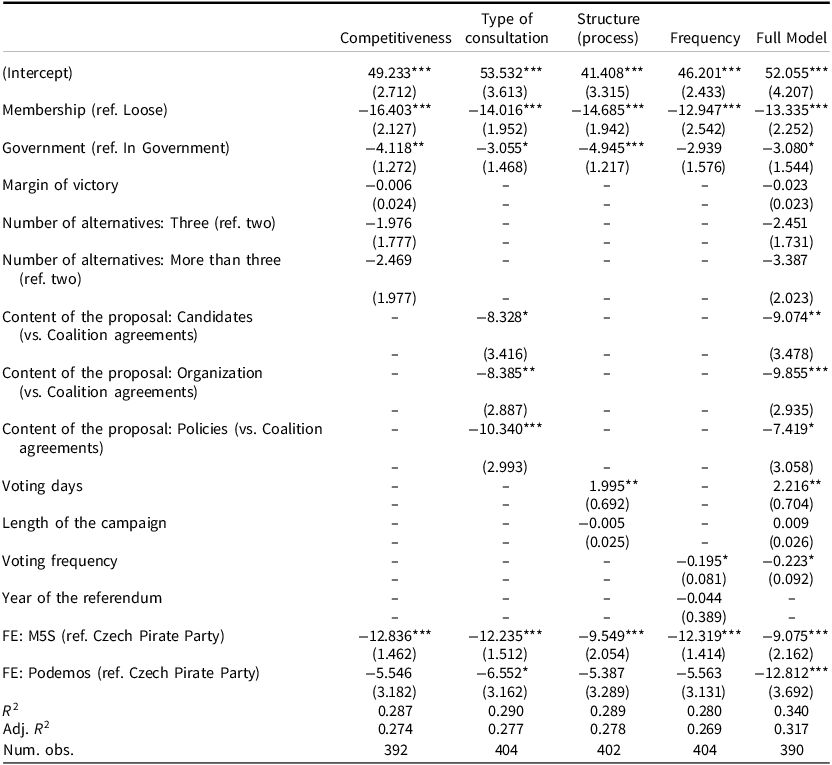
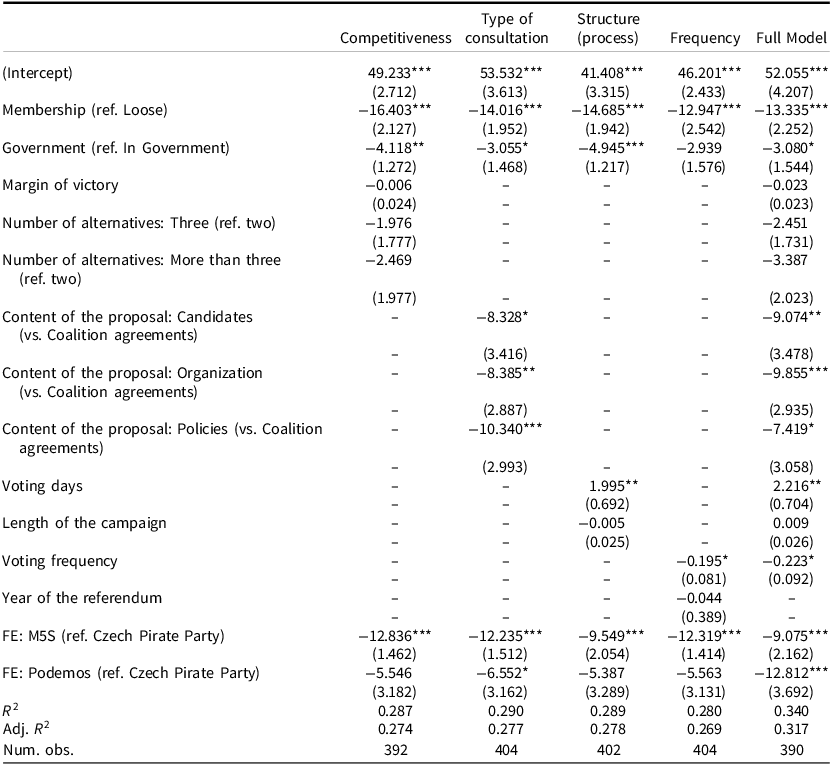
Table 3 outlines the findings of our model. The first column shows the effect of competitiveness on turnout, the second is the impact of the stakes, the third is the structure of the consultation (e.g., the voting days and the length of the campaign), and the fourth is the voting frequency. Finally, the fifth model is a complete model specification with all variables included at the same time.
Multivariate ordinary least square regressions with fixed-effects at party level
***p < 0.001; **p < 0.01; *p < 0.05.
In model 1, the margin of victory variable is negative with low explanatory power and, equally important, not significant. Therefore, competitiveness operationalized as the margin of victory does not impact the turnout. In turn, the number of alternatives does negatively affect turnout. As the number of other options increases, turnout decreases, with a more pronounced effect when there are more than three alternatives. Compared to cases where there are only two alternatives, turnout decreases significantly when there are both “three” or “more than three” alternatives. Such results, however, are neither significant in the first model nor in the whole model. Our first hypothesis cannot be confirmed: competitiveness does not positively impact turnout, and even the number of alternatives has the same impact when other factors are controlled for.
The second model indicates that the type of consultation matters, thus confirming our second hypothesis. Compared to a critical decision, such as voting for a coalition agreement, our reference categories, all other options – candidates, organization and policies – have a much lower predicted turnout, ranging from −8% to around −10%. The significance of the effects and their explanatory power are similar in the second and in the whole model.
As for our third hypothesis related to the voting days, our variable of interest is positive and significant, thus lending support to our hypothesis. Overall, the more extended voting periods contribute to increased participation. Such an effect is also consistent in the complete model: a day increase in the voting days is associated with an increase of more than 2% in the turnout. On the other hand, the number of days of the campaign does not show any significant effect.
The fourth model focuses on our last hypothesis about voting frequency. A higher voting frequency is indeed related to a significant decrease in turnout, both in the baseline model and in the complete model. Still, this effect is negligible (ß = −0.223, p < 0.05 in the full model), compared to both the issues at stake and the voting days.
Finally, the control variables included in the model provide interesting results. A loose type of membership is associated with a lower turnout. This suggests that, as previously stated, the kind of party membership plays an important role. Within our database, CPP is the only one that has provided a fee-based membership since its foundation. This has indeed implications for turnout. Becoming a member of a party implies some degree of engagement. This engagement deepens when the affiliate or sympathizer pays to be a part of the organization, reinforcing the bonds of belonging and suggesting a greater commitment on their part, in this case, represented by the payment of membership fees. Equally important, when in government, turnout tends to decrease, showing that members are more likely to mobilize when they are in opposition.
Discussion and conclusion
This paper aimed to point out the relevance of some meso-level drivers of turnout in the under-researched field of intra-party referendums. Building on the literature on electoral participation, country referendums, and party primaries, we identified four hypotheses, related to competitiveness (H1), topic (H2), duration of the process (H3) and voting frequency (H4).
To test these four hypotheses, the paper has relied on the new dataset of 407 intra-party referendums. The results show that participation in intra-party referendums generally follows a similar, but not identical, pattern to other elections: for example, contrary to the literature, competitiveness does not affect participation, but fragmentation does. Members participate more when they are presented with few alternatives, while referendums that require a more demanding cognitive effort, such as one on the programmes of M5S and Podemos (Vittori, Reference Vittori2023), are much less appealing and interesting for party members. Unlike party primaries, where competitiveness has a positive effect on turnout (Villaplana et al., Reference Villaplana, Megías and Barberà2025), evidence from referendums suggests that participation in these processes may be driven more by a logic of expressing preferences than by competition among factions. In a context of highly personalized party politics (Rahat and Kenig, Reference Rahat and Kenig2018), members will probably be more predisposed to assume the costs of participation in contested primaries rather than other voting processes that do not imply the selection of leaders or candidates, especially when they are not simple binary options.
Partly related to this finding, our results show that the content of the referendum is indeed very relevant for promoting internal participation: stakes are essential in mobilizing members, particularly when it comes to deciding whether the party has to access power. It is somewhat surprising that organizational issues are much less critical than coalition agreements in the eyes of members: party organization represents the structure of the party, and the role of members is shaped by how parties are organized. However, the lack of interest could be explained by the fact that even in challenger parties such as the ones we have considered here, power-seeking issues are more important than party organization.
In the same vein, our analysis confirms that some process factors (H3), such as the number of election days, have only a small impact on turnout: not all members can be mobilized to vote in just a few days. Ordinary members cannot devote much time to party activities, and it may take a while to reach less committed members who do not follow daily party activities. In some cases, such as several M5S referendums, members are given very few days, and usually only one, to vote. This short notice limits the possibility of mobilizing members, especially when the consultations take place on working days. Our models also confirm that there is a small effect related to voter fatigue (H4), as higher voting frequency leads to lower turnout in both the fourth and the complete model; however, this effect is negligible. Contrary to the substantial impact of voter fatigue among ordinary citizens, this effect suggests that party members only partially feel this fatigue, as we would have expected this variable to have a more substantial impact on turnout, primarily when other variables are not controlled for. Party members are, by definition, more engaged and interested in politics, and therefore more willing to express their vote and be mobilized by their own parties.
The results of our paper have both theoretical and practical implications to be considered. At a theoretical level, the paper lays the first foundations to develop further a proper theoretical framework explaining the relevance of meso-level factors on turnout rates in intra-party referenda. In this regard, our contribution points to the importance of the content of the proposal and party features (e.g., membership conception) as key explanatory drivers. In particular, the relevance of intra-party referendums on coalition agreements would suggest that party members care more about institutional issues than other internal and organizational decisions (e.g., logos, manifestos, etc.). This is particularly striking due to the fact that all parties included in this paper are new and, while all have been in government, are not generally considered mainstream parties. On a more practical note, our findings provide key hints that could be very useful in facilitating grassroots participation in intra-party referendums from other political parties. In this regard, intra-party referendums that address strategic and politically salient issues – such as electoral alliances or government coalition agreements – may also foster more meaningful and empowering forms of participation among party members, incentivizing them to overcome plebiscitary trends. However, as Gerbaudo (Reference Gerbaudo2021) notes, the usability and sophistication of the digital platforms employed by parties play a crucial role in facilitating (or hindering) a better quality of participation. Overall, parties may benefit from proposing easy-to-reply consultations, with a binary yes or no option, as a higher complexity of the questions seems to be detrimental to turnout. Thus, intra-party referendums may be subject to a trade-off between achieving high turnout and fostering meaningful participation, as is the case with other participatory processes (Rolfe, Reference Rolfe2012). Finally, to allow enough voting days to cast the ballot is crucial to increase participation: members might not have the time to vote on a specific day for whatever reason.
Future research should consider the extent to which our results can be extended to other parties and political systems. Indeed, the peculiarities (newness, tech-savvy and protest nature) of our case studies might limit the external validity of our findings to other cases. Moreover, other variables such as factionalism and political fragmentation might help clarify whether turnout increases when a party is internally divided. Unfortunately, in one of the three cases (M5S), factionalism was explicitly prohibited in the first versions of the Statutes. Since no formal factions are recognized within the party, it is difficult to assess the role of factionalism in boosting turnout, but further research might indeed help to better understand the role of factionalism. That said, we hope that the introduction of similar instruments among mainstream parties will stimulate other scholars to replicate our analysis in a larger set of parties in order to corroborate or disconfirm our results. Our educated guess is that their turnout patterns will be closer to the ones of the CPP due to the similarities in their mass-party conception of the membership.
Data availability statement
The dataset as well as the replication materials are available here: https://doi.org/10.17605/OSF.IO/ZXS5W.
Funding statement
FRV acknowledges the Spanish Government and the University of Murcia for a Margarita Salas grant (UM6488), funded by NextGenerationEU. OBA acknowledges the University of Valencia grant UV-INV_AE-2631662, the Spanish Government and University of Valencia grant RC21-012 funded by NextGenerationEU. DV acknowledges the Valencian Regional Government grant CIAPOS/2023/050.
Competing interests
The authors hereby declare that the present research was conducted in the absence of any commercial or financial relationships of such a nature as to constitute, or to be construed as constituting, a potential conflict of interest.




 Open access

