


Background
Bifacial hitting and cutting tools (axes, adzes, chisels) are prominent among Neolithic stone toolkits. They represent technological strategies developed during periods of fundamental change in human lifestyles, including the aggregation of large communities (Watkins Reference Watkins2023), the creation of built environments and stable settlements, and the domestication of plants and animals (Shennan Reference Shennan2018). In Central Europe, hitting and cutting tools are among the most common stone tool type in Neolithic assemblages, playing a pivotal role in the initial Neolithic occupation of the region, where woodworking for house construction was central.
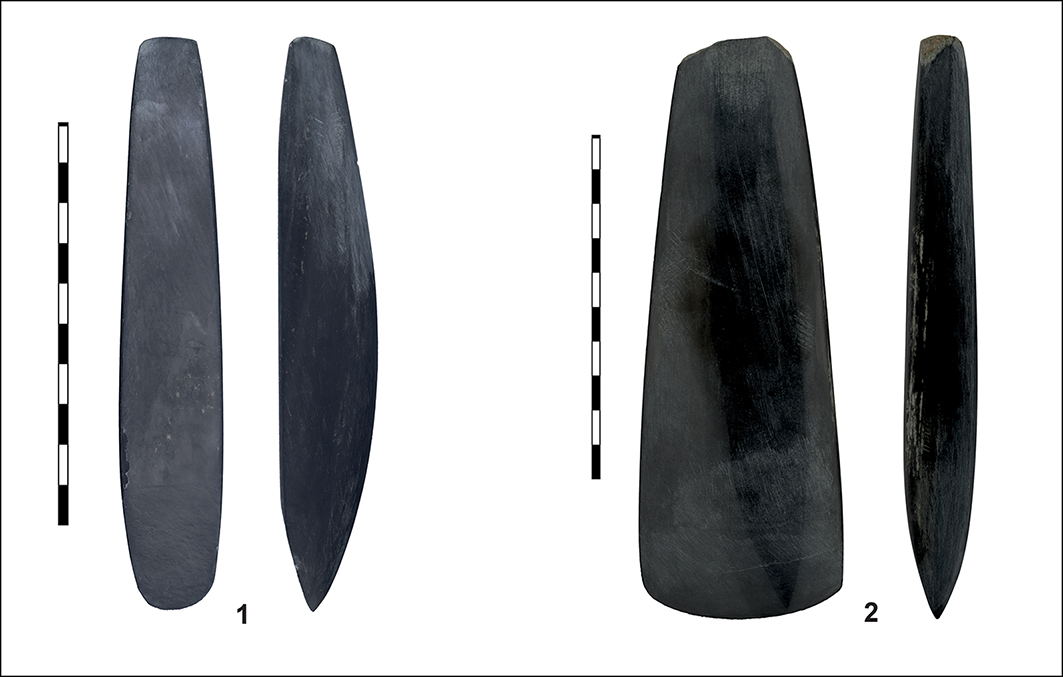
In the Early Neolithic (Linearbandkeramik (LBK); 5600/5500–4900 BCE), two primary types of tools appear: the shoe-last celt and the flat adze (Figure 1). Despite standardised production across a wide area, our understanding of the technical choices behind the design and everyday use of these tools remains limited. Bifacial hitting and cutting tools are dynamic, shape-transforming tools, subject to continuous morphological change throughout their use-life (Schiffer Reference Schiffer1987). Nevertheless, conventional typological approaches in Central Europe have relied on static classification systems based on numerical ratios between dimensional parameters—such as length, width and thickness—which are typically assumed to be stable (e.g. the thickness-to-width ratios of Ramminger Reference Ramminger2007). Previous investigations have combined typological analyses with provenance studies (e.g. Ramminger Reference Ramminger2007) to delineate temporally and regionally distinct production types and to map tool distribution patterns across Europe. However, such taxonomic studies often rely on subjective morphological criteria (Schauer Reference Schauer2018) and selective documentation, such as contour drawings. In addition, use-wear traces on tool surfaces (Masclans et al. Reference Masclans, Hamon, Jeunesse and Bickle2021) have been employed to infer function or to assess tool suitability for specific tasks (Elburg et al. Reference Elburg, Hein, Probst and Walter2015), but these analyses typically involve small datasets and qualitative assessments. Both research paradigms face interpretive constraints stemming from heterogeneity in data quality, variability in archaeological training and expertise, and the subjectivity inherent in perceptual shape analysis—factors that can lead to biased feature selection or overfitting of interpretations. Consequently, key challenges persist in developing comprehensive analytical approaches that meet current scientific standards of quantification, transparency and reproducibility (Marreiros et al. Reference Marreiros, Calandra, Gneisinger, Paixão, Pedergnana and Schunk2020).
Main types of adzes from the Neolithic LBK: 1) the shoe-last celt; 2) the flat adze. Each scale is 100mm (©WEAR; figure by Laura Dietrich).

Figure 1 Long description
The image displays two distinct types of adzes from the Neolithic Linearbandkeramik (LBK) culture. The first type, labeled as 1, is the shoe-last celt, characterized by its elongated, tapering shape. The second type, labeled as 2, is the flat adze, which has a broader and flatter profile. Each adze is shown from multiple angles to highlight its shape and design. A measurement scale of 100 millimeters is included beside each adze for size reference.
To address these limitations, Project WEAR is developing an integrated methodological framework combining controlled experimental archaeology with computational modelling of use-induced morphological transformations. Its objectives are to quantitatively characterise and statistically explain variability in tool design and function, reconstruct the complete morphological and functional life histories of axes, adzes and chisels, and establish a reference dataset of ‘wear states’ representing possible preservation conditions of tools recovered from archaeological contexts.
Methods
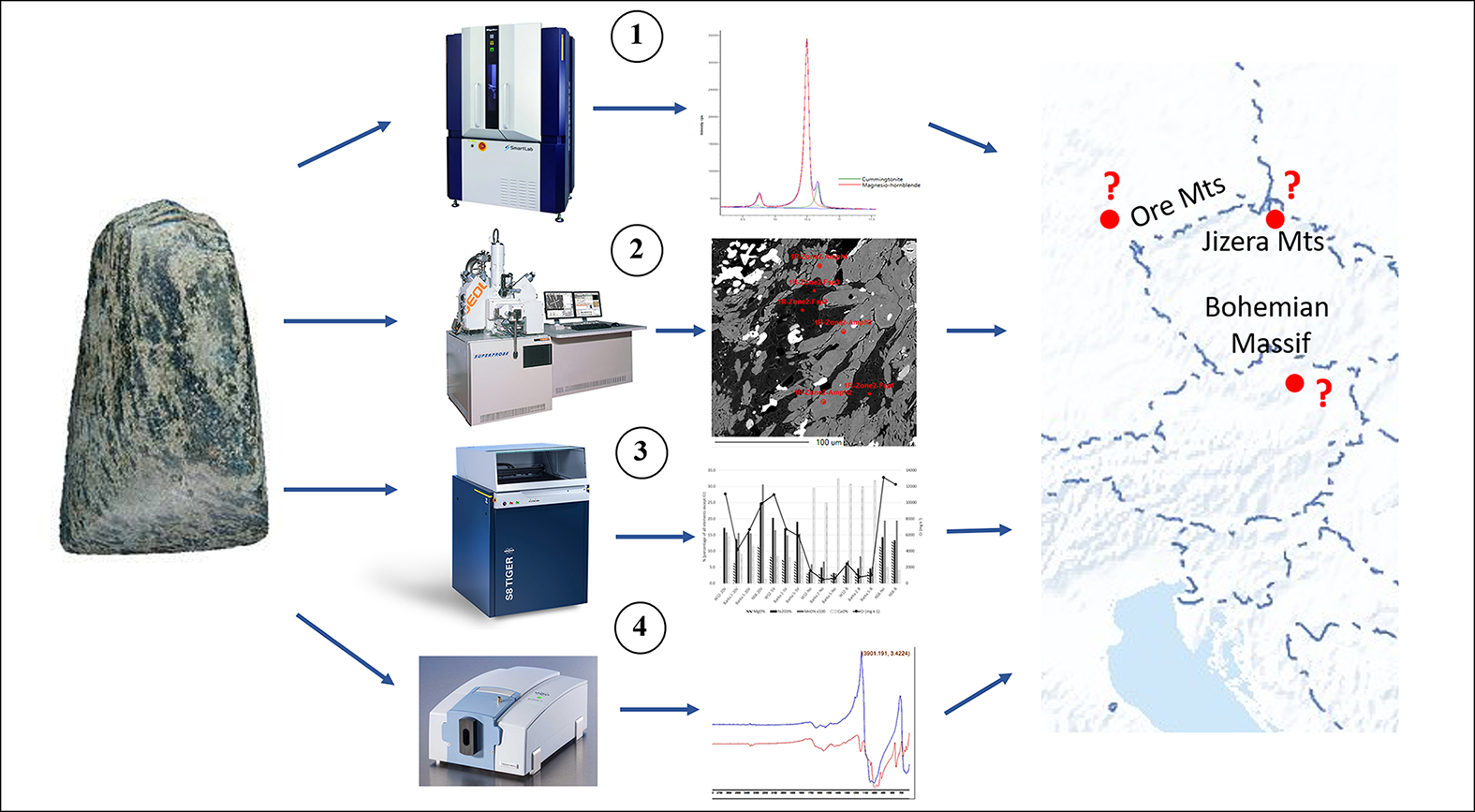
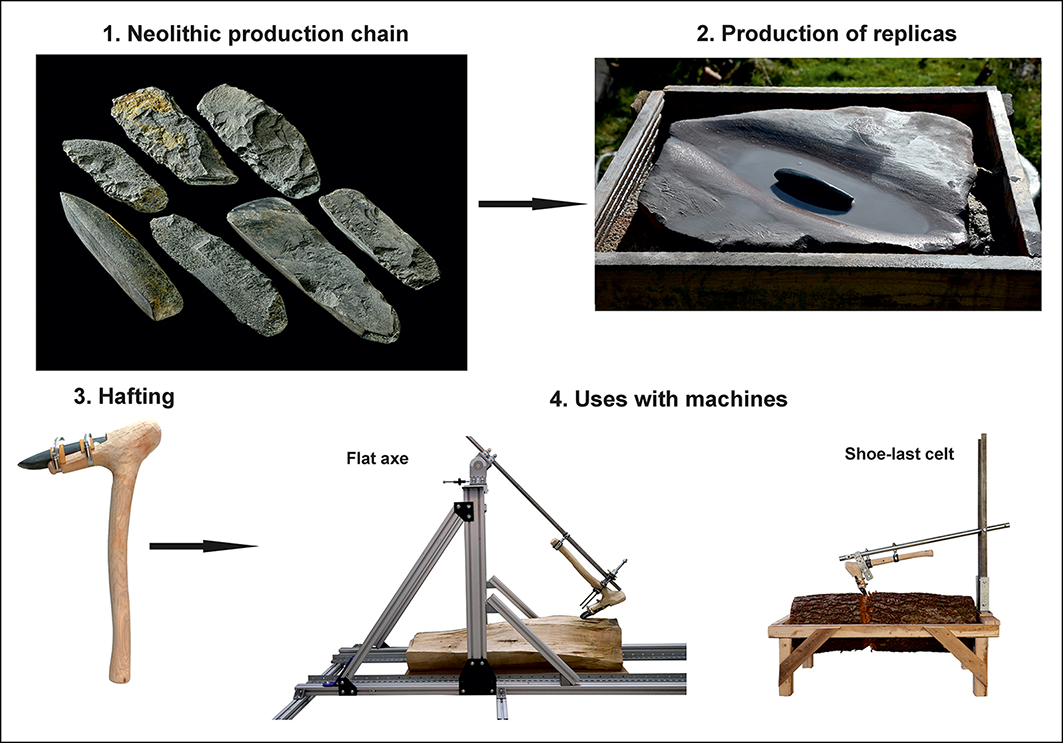
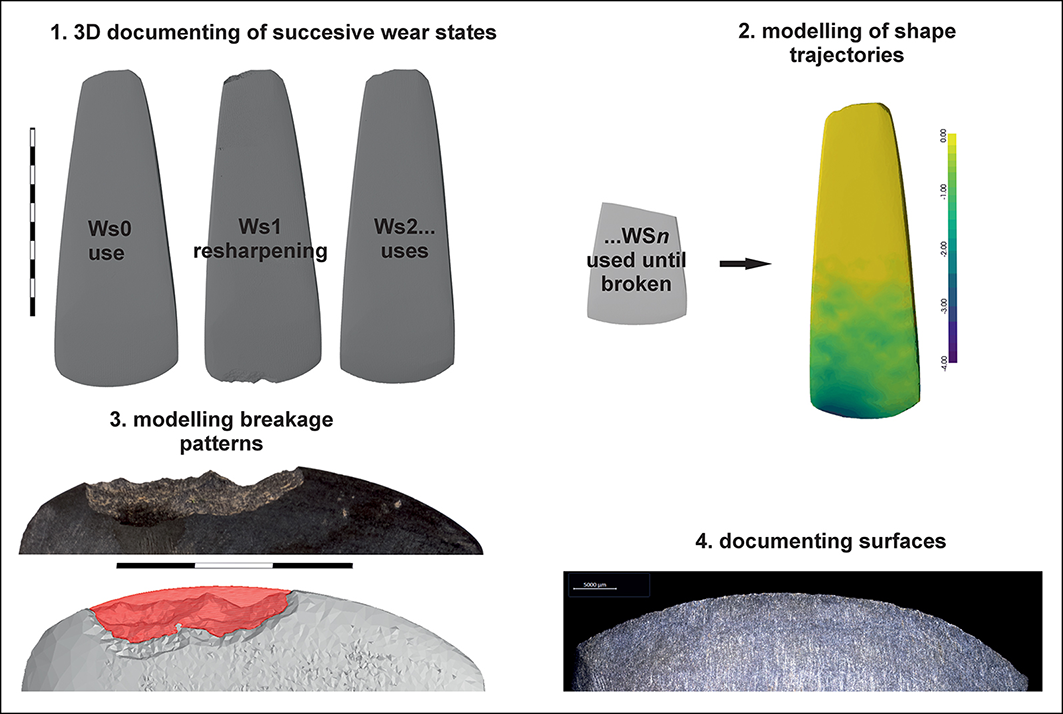
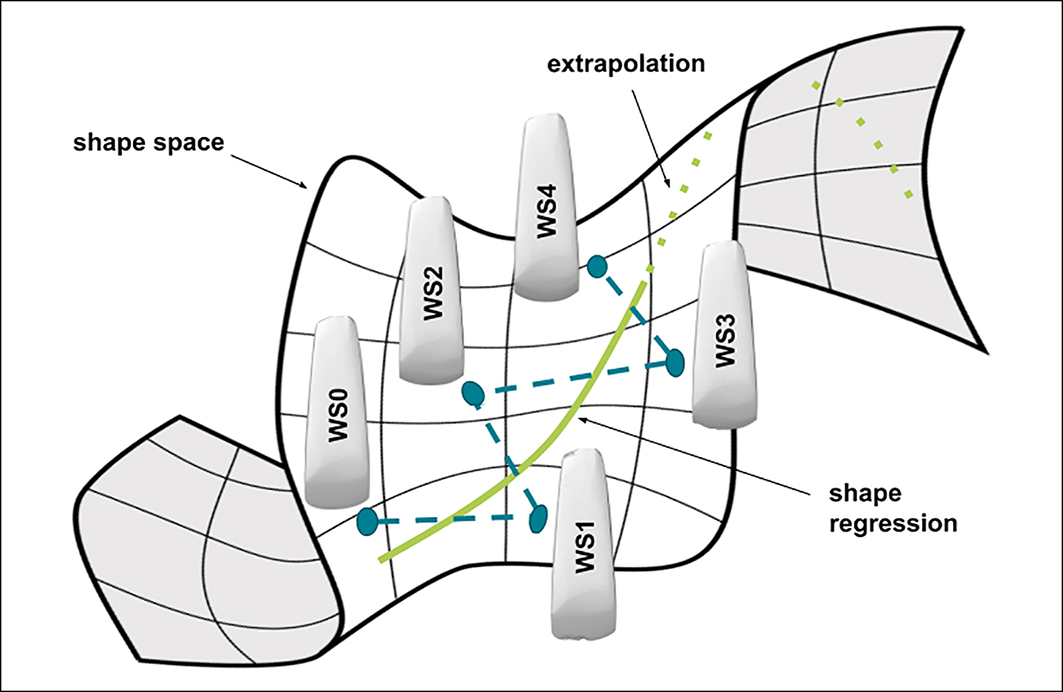
Central to our approach is the use of small, empirically grounded datasets comprising representative tool ‘types’, which serve as reference anchors for the generation of larger, synthetic datasets. The open access datasets (available from the Wear Project Community; https://zenodo.org/communities/wear/) are developed within a framework of large-scale experimentation, guided by principles from synthetic engineering and constrained by biological and material parameters, and encompass detailed information regarding the properties of raw materials as well as the characteristics of tools and their uses, as inferred from experimental replication and not limited to the archaeological contextual evidence. The workflow includes the systematic selection of raw material variables (Figure 2), tool replication and long-term experimentation of use (Figure 3), and structured three-dimensional shape documentation at fixed intervals (Figure 4, no. 1). This latter task includes mathematical modelling of shape transformations (Figure 4, no. 2) and the identification of wear and deformation patterns (Figure 4, nos. 3 & 4) that will permit the detection of signatures of original artefact use by leveraging synthetic data. The raw material variability is evaluated through stress tests (i.e. uniaxial compression, triaxial and tensile tests). Biological variability (e.g. motion, duration of work or intensity of the pressure) is controlled using machines (Figure 3, no. 4), while human participants serve as a comparative control group. The documentation includes protocols, 3D modelling in sequenced wear states and the computing of shape trajectories. For raw material characterisation and provenance determination, we analyse the mineralogical and geochemical properties of the original tools using x-ray diffraction, electron beam microprobe analysis, x-ray fluorescence analysis and Fourier transform infrared spectroscopy (Figure 2). The shape trajectories capturing the wear progression are estimated from the experimental series using a regression approach (Figure 5). To account for the non-linearity in shape changes, we regress a geodesic parametric model (Hanik et al. Reference Hanik, Nava-Yazdani and von Tycowicz2024) against tool surfaces represented in size-and-shape space. Geometric group tests allow us to identify systematic differences in the distributions of shape trajectories between machines/robots and human experimental executors.
Analytical protocol for the characterisation and provenance determination of raw materials for Neolithic stone bifaces: 1) x-ray diffraction (XRD) identifies crystalline phases, determines amphibole unit-cell parameters and traces compositional changes; 2) electron probe microanalysis (EPMA) provides in situ major and minor element data, revealing zoning and compositional variations; 3) x-ray fluorescence (XRF) determines bulk major and trace element compositions; 4) fourier-transform infrared spectroscopy (FTIR) identifies structural differences that may support provenance analysis (©WEAR; figure by Iris Schmidt & Michael Brandl).

Figure 2 Long description
The image illustrates the analytical protocol for characterizing and determining the provenance of raw materials for Neolithic stone bifaces. It features a step-by-step process starting with a rock sample. The first step involves x-ray diffraction (XRD) to identify crystalline phases and determine amphibole unit-cell parameters, tracing compositional changes. The second step uses electron probe microanalysis (EPMA) to provide in situ major and minor element data, revealing zoning and compositional variations. The third step employs x-ray fluorescence (XRF) to determine bulk major and trace element compositions. The final step utilizes fourier-transform infrared spectroscopy (FTIR) to identify structural differences that may support provenance analysis. The image includes graphical representations of each analytical tool and their respective outputs, along with a map indicating potential regions of interest.
Analytical protocol for the experimentation (image 1: © LDA Sachsen-Anhalt, Juraj Lipták; images 2 & 3: © Wulf Hein; image 4: © WEAR, designed by Walter Gneisinger and Lohengrin Baunack, figures by Lohengrin Baunack).

Figure 3 Long description
The image illustrates the Neolithic production chain, starting with the Neolithic production chain of tools, followed by the production of replicas from a large stone. It then shows the hafting process where a stone tool is attached to a wooden handle. Finally, it depicts the use of these tools with machines, including a flat axe and a shoe-last celt used in mechanical setups.
Analytical protocol for the documentation (©WEAR; 1 & 3 by Laura Dietrich; 4 by Marina Eguíluz Valentini; 2 by Christoph von Tycowicz).

Figure 4 Long description
The diagram presents a four-step analytical protocol for documenting the wear and use of tools. The first step involves 3D documenting of successive wear states, showing three stages labeled Ws0 use, Ws1 resharpening, and Ws2 uses. The second step models shape trajectories, depicted by a color-coded tool with a gradient scale. The third step models breakage patterns, illustrated by a broken tool and a 3D model highlighting the breakage area in red. The fourth step documents surfaces, shown by a close-up image of a tool surface. The diagram emphasizes the dynamic nature of tool morphology throughout their use-life.
Representation of form trajectories in form spaces (© WEAR; figure by Julius Mayer, Christoph von Tycowicz, Laura Dietrich and Lohengrin Baunack).

Figure 5 Long description
The scatter plot represents the relationship between different shapes labeled as WS0, WS1, WS2, WS3, and WS4 in a shape space. The x-axis and y-axis represent the dimensions of the shape space, with values that are estimated. The plot includes several data points, each marked with a blue dot, and shows a green regression line indicating the shape regression trend. Additionally, there are dashed blue lines extending from some data points, representing extrapolation. The plot demonstrates how shapes transform and evolve over time within this space. All values are approximated.
Results
Our data, derived from experimental replication and shape trajectory analysis, indicate that size and other wear parameters change concurrently—though at disproportionate rates—during successive episodes of use and resharpening of the tools (Figure 4, nos. 1, 2; Figures 5 & 6). As such, metric ratios should not be treated as fixed or invariant. This is particularly relevant given that archaeological measurements are generally taken at arbitrary stages of tool wear and preservation. Consequently, each archaeologically recovered artefact assigned to a typological cluster represents a distinct point (or ‘wear state’) along a continuum of morphological transformation, shaped by its individual history of use, maintenance and depositional context.
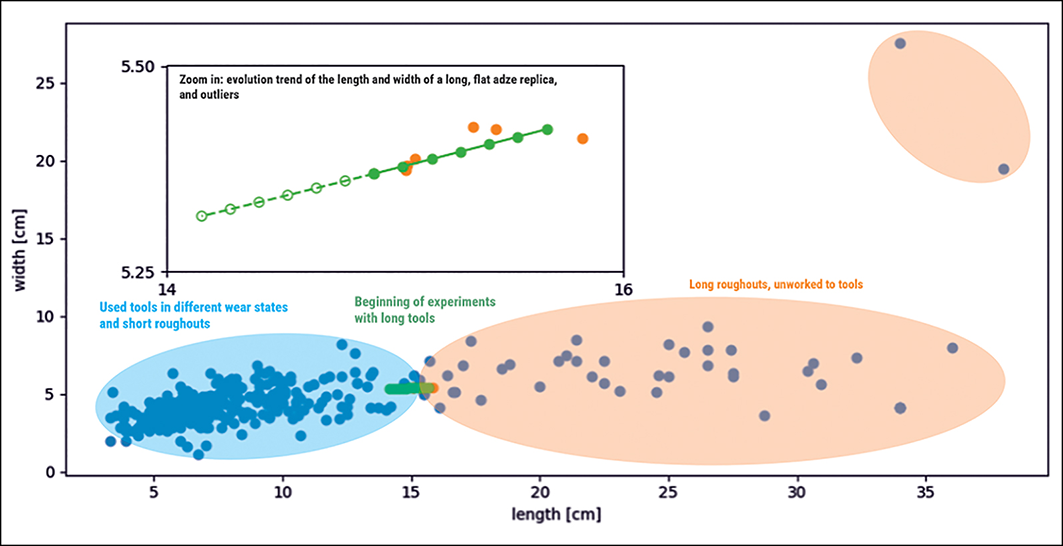
Plot of the lengths and widths of 336 complete preserved flat adzes from Central Europe and of experimental wear states (© WEAR; figure by Julius Mayer and Laura Dietrich).

Figure 6 Long description
A scatter plot displays the lengths and widths of 336 complete preserved flat adzes from Central Europe and experimental wear states. The x-axis represents length in centimeters, ranging from approximately 5 to 35 centimeters. The y-axis represents width in centimeters, ranging from approximately 0 to 25 centimeters. The plot includes several clusters of data points, with two main groups: one in the lower left and another in the upper right. The lower left cluster, colored in blue, represents used tools in different wear states and short roughouts. The upper right cluster, colored in orange, represents long roughouts and unworked tools. A smaller cluster in the middle, colored in green, marks the beginning of experiments with long tools. An inset zooms in on the evolution trend of the length and width of a long, flat adze replica, showing a gradual increase in both dimensions. All values are approximated.
In the case of the flat adzes—our focus here—a scatter plot (Figure 6; supplementary table on https://zenodo.org/communities/wear/records) of the length and width of 336 preforms (orange) and finished or used tools (blue) from settlements, cemeteries and hoards of the LBK reveals a continuous distribution within a single cluster, with sample density decreasing as length increases. The preforms are among the longest examples, suggesting long use-lives and indicating that the observed variability in design and ‘types’ in archaeological contexts is more plausibly explained by intensity of use and task variation rather than by stylistic or technological choices.
The integration of synthetic data—encompassing metrics such as working time, characteristic breakage patterns (Figure 4, no. 3) and task-specific wear—enables identification of original tool function and transformation across long-duration use processes by quantitatively fitting replica size and wear profiles to the archaeological record. The variation in the shapes of the analysed flat adzes is likely the result of a single ‘prototype’ design, probably considered highly efficient for carpentry work.
Acknowledgements
We are grateful to the State Office for Heritage Management and Archaeology Saxony-Anhalt and the State Office for Heritage Management Baden-Württemberg for allowing us to study their collections and to the Institute for Informatics Halle and the Labor TraceR Monrepos Leiza for providing the equipment for the documentation.
Funding statement
This project is funded by the German Research Foundation (509009439) and the Austrian Science Fund (10.55776/I6289).
Online supplementary material (OSM)
To view supplementary material for this article, please visit the Zenodo data repository at https://zenodo.org/communities/wear/records
Author Contributions: using CRediT categories
Laura Dietrich: Conceptualization-Lead, Formal analysis-Lead, Funding acquisition-Lead, Investigation-Lead, Methodology-Lead, Project administration-Lead, Resources-Equal, Supervision-Lead, Validation-Lead, Visualization-Equal, Writing - original draft-Lead, Writing - review & editing-Lead. Christoph von Tycowicz: Conceptualization-Equal, Data curation-Equal, Formal analysis-Equal, Funding acquisition-Equal, Investigation-Equal, Methodology-Equal, Project administration-Equal, Software-Lead, Supervision-Equal, Validation-Equal, Visualization-Equal, Writing - original draft-Equal, Writing - review & editing-Equal. Michael Brandl: Conceptualization-Equal, Data curation-Equal, Formal analysis-Equal, Funding acquisition-Equal, Investigation-Equal, Methodology-Equal, Project administration-Equal, Supervision-Equal, Writing - review & editing-Equal. Julius Mayer: Formal analysis-Supporting, Investigation-Supporting, Methodology-Supporting, Software-Supporting, Writing - original draft-Supporting, Writing - review & editing-Supporting. Lohengrin Baunack: Data curation-Supporting, Formal analysis-Supporting, Investigation-Supporting, Writing - original draft-Supporting, Writing - review & editing-Supporting. Iris Schmidt: Formal analysis-Supporting, Investigation-Supporting, Methodology-Supporting, Validation-Supporting. Wulf Hein: Data curation-Supporting, Resources-Supporting. Marina Eguíluz Valentini: Data curation-Supporting, Investigation-Supporting, Writing - review & editing-Supporting. Simone Meinecke: Investigation-Supporting, Writing - review & editing-Supporting.


 Open access

