

We are living in a golden age for public administration (PA) research. In recent years, PA studies have applied rigorous research designs in a diverse set of country cases to tackle important questions on discrimination, administrative burdens, performance, and motivation. Goncalves and Mello (Reference Goncalves and Mello2021) find that 42% of Florida Highway Patrol officers practice racial discrimination in making speeding ticket discounting decisions. Leaver et al. (Reference Leaver, Ozier, Serneels and Zeitlin2021) use a field experiment in Rwanda to show that teachers assigned a pay-for-performance scheme tend to improve student learning more. Drawing on a natural experiment in the recertification process for the Supplemental Nutrition Assistance Program in the United States, Homonoff and Somerville (Reference Homonoff and Somerville2021) show how late assignments to recertification interviews add layers of administrative burden that cut rightful recipients off from the program.
These three pieces of research have one thing in common: they are all published in top journals in the discipline of economics—and not in journals of the subfield of PA. This is surprising because these articles’ research questions and topics speak directly to ongoing debates in journals in the field of PA on representative bureaucracy (Pandey et al. Reference Pandey, Smith, Pandey and Ojelabi2023), administrative burdens (Herd and Moynihan Reference Herd and Moynihan2019), and public service motivation (Ritz, Brewer, and Neumann Reference Ritz, Brewer and Neumann2016).
PA’s relationship with political science has fluctuated over time (Henry Reference Henry1975). One of the founding fathers of PA, Frank J. Goodnow (Reference Goodnow1904) was the first president of the American Political Science Association and placed PA at the core of political science in his first presidential address. In the mid-twentieth century, PA was later characterized as a child of political science—alas, “in some respects a strange and unnatural child” (Martin Reference Martin1952, 660). Over subsequent decades, especially in the United States, PA’s role as a subfield was increasingly questioned, contributing to a widening divide that arguably weakened both fields (Frederickson Reference Frederickson1999; Meier Reference Meier2007; Wilson Reference Wilson1994). However, in other parts of the world, particularly in Northern Europe, PA remains a thriving part of political science departments. Even in the United States, policy makers are showing a newfound interest in PA, which highlights how PA gives political science a connection to praxis (Hertel-Fernandez Reference Hertel-Fernandez2025). There are good reasons for political science to care about the fate of PA, and debates about the connection between the two disciplines persist (Peters et al. Reference Peters, Pierre, Sørensen and Torfing2022).
We join this debate by identifying the dispersion and insularity of contemporary PA research. We define the research examples mentioned earlier as PA research outside PA journals. In this article, we focus on PA research published in economics journals, referring to it as “PA in Econ.” Economics has shaped recent trends in PA research within PA journals in two ways: through a theoretical focus on microlevel behavioral aspects of PA (Grimmelikhuijsen et al. Reference Grimmelikhuijsen, Jilke, Olsen and Tummers2017; Moynihan Reference Moynihan2018) and a methodological focus on causal inference using survey, field, and quasi-experiments (James, Jilke, and Van Ryzin Reference James, Jilke and Van Ryzin2017). We ask these research questions: What is the extent and content of PA research in economics, and how is this research different in citations, rigor, cases, and relevance from PA in PA journals? Our analysis outlines five stylized facts about research on PA beyond PA journals. These stylized facts are supported by bibliometric analyses, hand coding of published research, and an expert survey among scholars in PA. We argue that the most aspirational way forward for PA is to live up to its founding identity as an interdisciplinary field and to aim to integrate PA research across disciplines.
We argue that the most aspirational way forward for PA is to live up to its founding identity as an interdisciplinary field and to aim to integrate PA research across disciplines.
BEYOND A JOURNAL-CENTRIC FIELD
There is broad agreement that PA should be defined by its material object. Bouckaert and Jann (Reference Bouckaert, Jann, Bouckaert and Jann2020, 34) note that “PA is not a (traditional) discipline and should not strive to become one. It is a research platform or research field, a community of interest combining and using different disciplines and methods.” Along the same lines, Pollitt (Reference Pollitt2010, 292) notes, “What unifies public administration is its subject—the state, the public sector, and the public realm—not its aims, theories, or methods.” What, then, should the material object of PA research be? Raadschelders (Reference Raadschelders2011, 19) argues that “the material object of the study of public administration is the internal structure and functioning of government and its interactions with society at large,” and Denhardt, Denhardt, and Blanc (Reference Denhardt, Denhardt and Blanc2013, 1) describe PA as centered on “the management of public programs.”
We take these definitions at face value and aim to identify and analyze research in PA that, by all meaningful definitions, is similar to research inside the journals of PA but is published outside the journals of the PA field. Our use of inside and outside captures a tension between a journal-centric definition of an academic field (inside) and an object-oriented definition of the research being published (outside): PA inside PA is defined as research published in recognized PA journals. PA outside PA, in contrast, denotes research that in substance would fit any scholarly definition of PA research but is published in journals outside PA.
METHODS
Our analysis of PA in Econ is based on bibliometric analysis coupled with hand coding and supported by a survey among PA scholars (Olsen, Bendtsen, and van Leeuwen Reference Olsen, Bendtsen and van Leeuwen2025). For the bibliometric analysis of economics journals, we searched the Web of Science using a set of keywords in a selection of top journals in economics (see appendix A). To maximize coverage, we used intentionally broad keywords that captured a lot of research not characterized as PA. We chose this strategy to find the highest number of articles; later, we hand coded the articles to filter out irrelevant ones. We relied on recent bibliometric evidence showing that 9 economics journals are consistently ranked among the top 10 journals of the field across five different metrics (Ham et al. Reference Ham, Wright and Ye2021). Among these nine journals, we chose five that we expected to contain the largest share of research potentially qualifying as PA in Econ: American Economic Review, Quarterly Journal of Economics, Journal of Political Economy, American Economic Journal: Economic Policy, and American Economic Journal: Applied Economics.
Using our keyword string, we identified 408 articles published since 2010. Supplementing these articles with relevant Journal of Economic Literature (JEL) codes yielded a total of 1,022 articles (see appendix A). We hand coded all articles to determine whether they meaningfully addressed a research question that fits any of the mainstream definitions of PA listed in the previous theory section. Hand coding of results from JEL code and keyword searches, based on common definitions of PA, yielded 138 articles since 2010 in the five top journals in economics (see appendixes B and C).
As a comparison benchmark for our sample of economics journals, we retrieved published work from the same time frame—2010 to 2023—in the Journal of Public Administration Research and Theory and Public Administration Review. We chose these two journals as our PA benchmark because bibliometric analyses show that they are the most quantitatively oriented journals in PA among the top outlets (Groeneveld et al. Reference Groeneveld, Tummers, Bronkhorst, Ashikali and Van Thiel2015). We only included quantitative articles because they provide a direct comparison with the economics papers, all of which have a descriptive or causal quantitative focus. For the two PA journals, we used keyword searches of statistical language and hand coding to exclude papers that were not empirically and quantitatively focused (see appendix A for keywords).
The hand coding yielded a comparison sample of 593 articles since 2010 (see appendix D). Using the DOIs from the hand-coded articles, we retrieved their references and citations using the SCOPUS API and opencitations.net. This provided data on all studies cited by each article (references) and all studies citing each article (citations). We hand coded both groups of articles to categorize them by their causal identification strategy and the country in which the data were generated. Identification strategies were coded as using either observational/cross-sectional variation or experimental variation. In addition to coding the individual countries studied, we also grouped countries using the Henrich, Heine, and Norenzayan (Reference Henrich, Heine and Norenzayan2010) terminology of WEIRD countries: countries that are Western, educated, industrialized, r ich, and democratic.
Finally, we conducted a survey among PA scholars who have published within the past 15 years in these top PA journals: Journal of Public Administration Research and Theory, Public Administration Review, Public Management Review, and Public Administration. Using web-scraping techniques, we identified 2,309 authors with at least one email address and at least one publication in one of the four journals. Although the response rate was low (7%), we obtained 87 responses from individuals who self-identified as quantitatively oriented PA scholars (see appendix E for details and ethics).
The survey respondents were asked to rate the articles’ quality of research as represented by five article abstracts. Each participant assessed 5 of 25 randomly drawn PA in Econ articles and 25 randomly drawn quantitative PA in PA articles, yielding 392 abstract ratings. The number does not add up to 435 (87 × 5) because we excluded articles that respondents indicated they already knew; we did not impute the few missing values. The abstracts were rated on eight key measures, previously validated by Soderberg et al. (Reference Soderberg, Errington, Schiavone, Bottesini, Thorn, Vazire, Esterling and Nosek2021) as capturing different quality characteristics. Overall, the distributions are centered at the higher end of each dimension, highlighting that the sample of respondents viewed articles from top journals in PA and economics as higher than above-average quality (see appendix E).
ANALYSIS
PA in Econ Is a Large Body of Research
Our first task was to identify and quantify PA in Econ. The keyword search followed by hand coding reveals that about 2% of the total production in the five targeted journals can be defined as PA in Econ. All the examples of articles cited in the introduction are results of the keyword search and hand coding. These examples offer face-value evidence that our search string and hand coding capture research on PA in Econ that fits most definitions of PA research and that, in terms of topics, is difficult to distinguish from PA research published in PA journals.
Although 2% may not sound like much, it quickly becomes a very sizable amount of research, because these journals are published with higher frequency and economics is a much larger field than PA. The total number of published articles in economics is about 8.5 times larger than the total number in PA. In other words, PA in Econ is a small portion of a very large discipline. Furthermore, PA in Econ is focused almost exclusively on causal inference with quantitative data and often experimental manipulation. PA research is often more methodologically diverse than PA in Econ: only about half of PA in PA in the top journals is quantitative research (Groeneveld et al. Reference Groeneveld, Tummers, Bronkhorst, Ashikali and Van Thiel2015). Thus, a moderate estimate would be that, over the past decade, PA in Econ constituted a research output similar in magnitude to quantitatively oriented PA inside PA journals.
PA in Econ and PA in PA Are Decoupled
The fact that there is a substantial amount of PA research in economics could, in principle, be seen as an export success story. The expectation would then be a strong citation pattern between PA in Econ and PA in PA. However, the 138 articles from PA in Econ make just 11 citations (in total) to the two top PA journals we study. For comparison, we rely on our data on quantitative PA research from the top journals, as outlined in the Methods section. In the PA in PA articles, there are a total of 351 citations of articles from the five economics journals. Those Econ articles, however, cite only 25 of the 138 identified PA in Econ articles. Most of the references to economics are to seminal research on generic concepts such as prosocial behavior, but not to PA in Econ specifically.
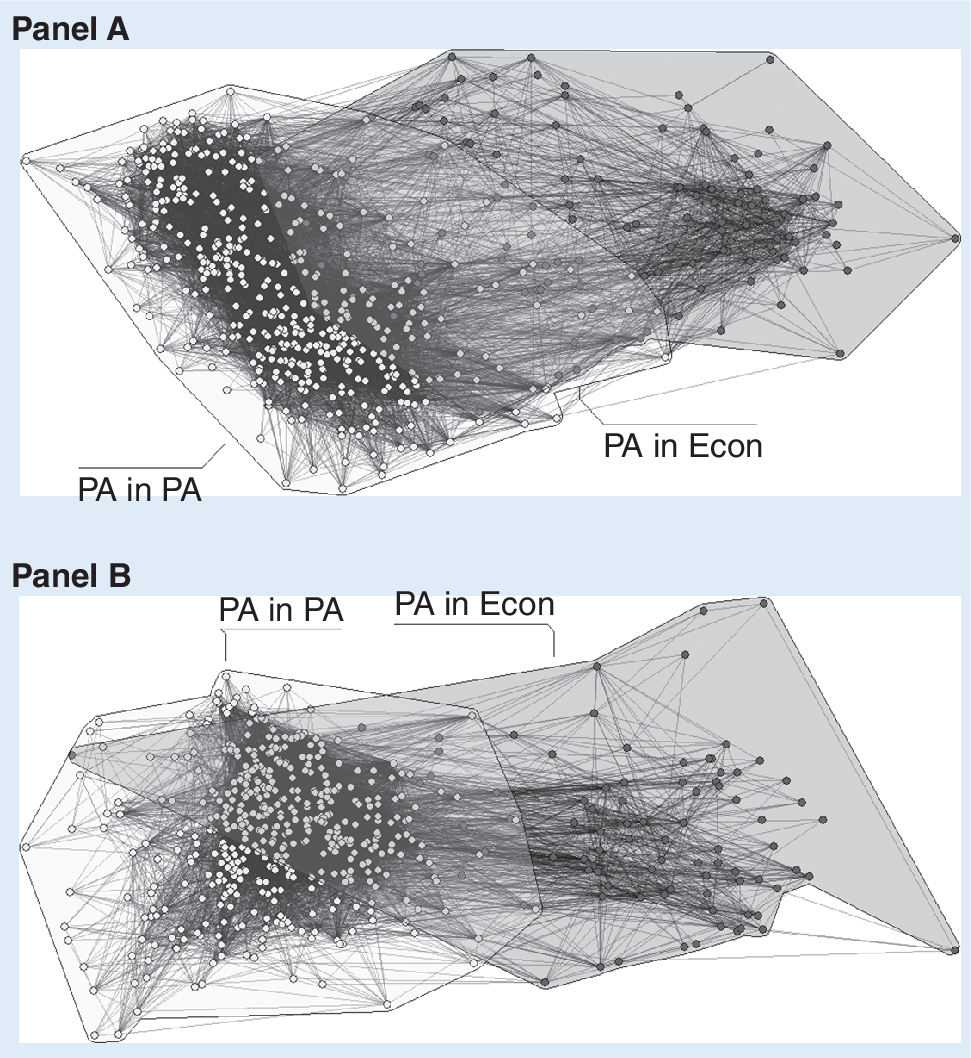
Furthermore, in figure 1, we look at bibliographic coupling, examining whether two articles share citations, and co-citation clustering, examining whether two articles are both cited by the same articles. For both networks, 95% of the ties are between articles within either PA in PA or PA in Econ. Looking at the odds ratio, the odds for within-group ties are 9.8 times greater than between groups in the bibliographic coupling network and 8.9 times greater in the co-citation network (see robustness checks in appendix G).
Bibliographic Coupling and Co-citations in Public Administration Research.
Note: (A) Bibliographic coupling and (B) co-citation between PA in Econ and PA in PA.

Figure 1 Long description
A two-panel network visualization.
Panel A, located at the top, displays bibliographic coupling. On the left, a dense cluster of white nodes is labeled P A in P A. On the right, a more dispersed cluster of dark grey nodes is labeled P A in Econ. The two clusters are enclosed in shaded polygons that overlap significantly in the center, where a high density of interconnecting lines indicates shared references between the two fields.
Panel B, located at the bottom, displays co-citation. The P A in P A cluster on the left is extremely dense and concentrated, while the P A in Econ cluster on the right is more spread out with fewer nodes. The shaded polygons for each group show a smaller area of overlap compared to Panel A, with the P A in P A cluster appearing more isolated and tightly knit, while the P A in Econ cluster extends further to the right with sparse connections.
Our analysis cannot show why PA in Econ does not cite PA in PA. It is well documented that economics is more reluctant to cite outside its own discipline than other social sciences (Aistleitner, Kapeller, and Steinerberger Reference Aistleitner, Kapeller and Steinerberger2019; Angrist et al. Reference Angrist, Azoulay, Ellison, Hill and Lu2020). PA in PA may simply fall into the same trap, with more serious implications for building a cumulative science because PA in PA and PA in Econ are not just vaguely relevant but also essentially study the same part of the world. This is not the first evidence of detachment in PA. Wright (Reference Wright2011) showed how PA has a very weak co-citation pattern with neighboring fields of law, management, and political science. We contribute by adding an extra layer: the lack of citations also holds true for research in other fields that, by all reasonable definitions, is PA research.
PA in Econ Is More Diverse than PA in PA
Scholars have pointed to the lack of diversity in the field of PA, with an overemphasis on studies from North America and (Northern) Europe (Hou et al. Reference Hou, Ni, Poocharoen, Yang and Zhao2011). In a review of theories used across a broader selection of 21 PA journals in the past decade, Hattke and Vogel (Reference Hattke and Vogel2023) found that, by studying in-text references to countries, about 80% of published work in PA focuses on Europe or North America.
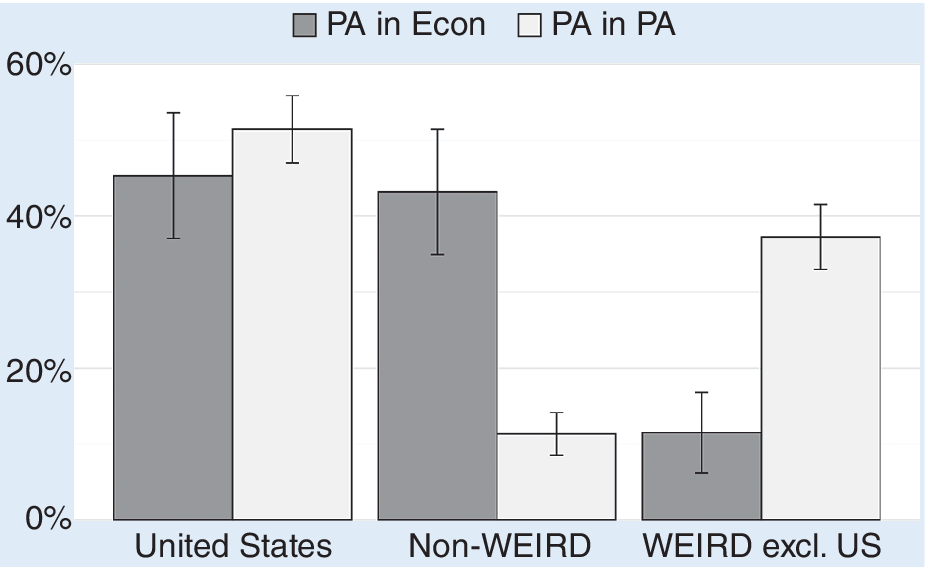
Our hand coding of the cases studied in PA in PA largely confirms these findings. Our data from PA in Econ allow us to observe the case selection for PA research outside the PA field. Figure 2 shows that both PA in PA and PA in Econ are about equally focused on the United States. However, PA in PA and PA in Econ study non-WEIRD countries to very different degrees: countries in the Global South account for 42% of the cases studied in PA in Econ but only 12% in PA in PA.
Geographical Distribution of Public Administration Research
Note: Percent of cases studied in each field with 95% confidence intervals (CIs). Econ (n=138), PA (n=593). WEIRD countries are Western, educated, industrialized, rich, and democratic (Henrich et al. Reference Henrich, Heine and Norenzayan2010).

Figure 2 Long description
A vertical bar chart with a y-axis labeled from 0 percent to 60 percent in increments of 20. The legend at the top identifies dark gray bars as P A in Econ and light gray bars as P A in P A.
From left to right, the x-axis categories show:
* United States: P A in Econ is approximately 45 percent and P A in P A is approximately 52 percent. Both have moderate confidence interval whiskers.
* Non-W E I R D: P A in Econ is approximately 43 percent with a wide confidence interval, while P A in P A is significantly lower at approximately 12 percent with a narrow confidence interval.
* W E I R D excl. U S: P A in Econ is approximately 12 percent with a narrow confidence interval, while P A in P A is approximately 38 percent with a moderate confidence interval.
All bars include vertical error bars representing 95 percent confidence intervals.
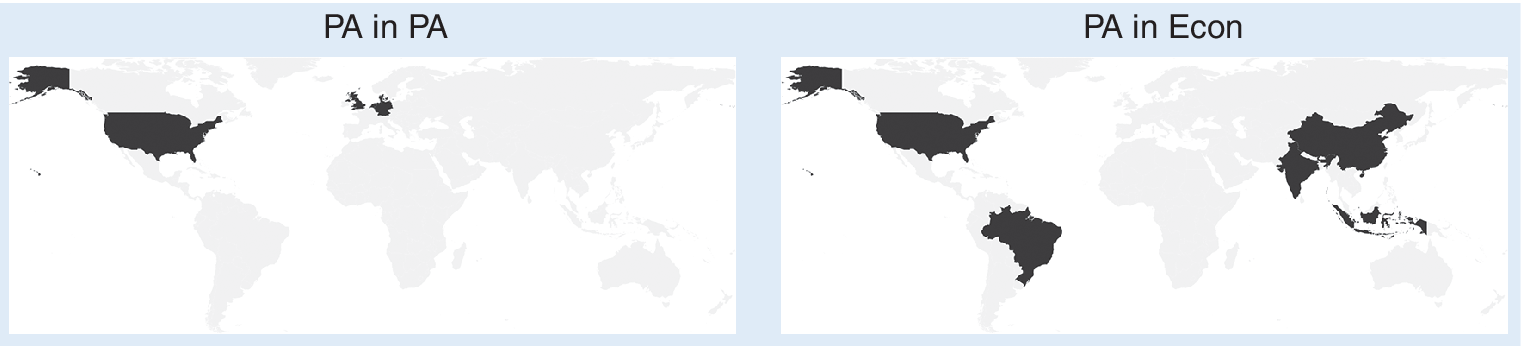
Figure 3 presents world maps for the five most-studied cases in PA in PA and PA in Econ. Whereas PA in PA represents the world as the United States and Northern Europe, PA in Econ provides a fuller map, covering more of the world’s regions and most populous countries represented. In PA in PA, Denmark is the second most-studied country; in PA in Econ, the second most-studied country after the United States is India. These results correspond with the criticism that PA in PA journals is a science for the developed world but not for the developing world (Hou et al. Reference Hou, Ni, Poocharoen, Yang and Zhao2011). However, by extending the PA field to PA in Econ, we observe a much more diverse selection of cases from across the globe.
Whereas PA in PA represents the world as the United States and Northern Europe, PA in Econ provides a fuller map, covering more of the world’s regions and most populous countries represented.
World Maps of Public Administration Research
Note: Five most studied cases. Left: PA in PA journals (United States, Denmark, Germany, United Kingdom, and the Netherlands). Right: PA in Econ (United States, India, China, Brazil, and Indonesia).

PA in Econ Is More Causally Rigorous
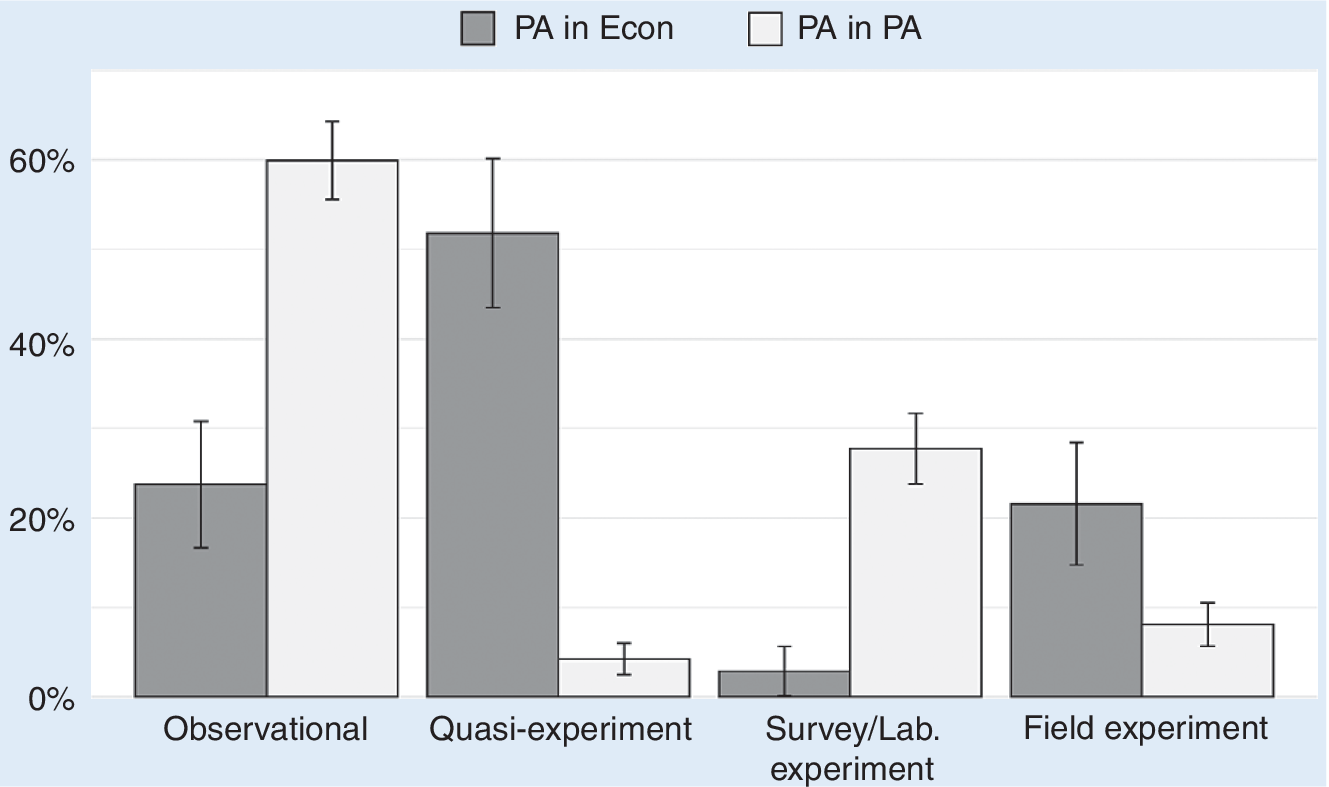
Using the aforementioned articles, we hand coded the identification methods, as presented in figure 4. Around 60% of quantitative articles within PA in PA use observational data without an explicit identification strategy. Less than 25% of PA in Econ fall into the same category. PA in Econ has a high frequency of quasi-experimental articles that rely on observational data with explicit causal identification strategies. Looking at the use of explicit experiments, PA in Econ relies much more on field experiments, whereas PA in PA mainly relies on survey or lab experiments. This difference does not reflect fundamental methodological disagreement about the hierarchy of research designs suitable for causal inference. For many years, there have been calls within PA to rely more on field experimental evidence to better understand the external validity and scalability of theories tested in surveys and labs (James et al. Reference James, Jilke and Van Ryzin2017).
Research Designs in Public Administration Research
Note: Percent in each category with 95%-CIs. PA in Econ (n = 138), PA in PA (n = 593).

Figure 4 Long description
The y-axis represents percentages from 0 percent to 60 percent in increments of 20 percent. The x-axis lists four research design categories. A legend at the top identifies dark gray bars as P A in Econ and light gray bars as P A in P A. Each bar includes a vertical error bar representing 95 percent confidence intervals.
* Observational: P A in Econ is approximately 24 percent. P A in P A is significantly higher at 60 percent.
* Quasi-experiment: P A in Econ is approximately 52 percent. P A in P A is very low at approximately 4 percent.
* Survey or Lab. experiment: P A in Econ is nearly 0 percent. P A in P A is approximately 28 percent.
* Field experiment: P A in Econ is approximately 22 percent. P A in P A is approximately 8 percent.
The difference in the size of the fields, as noted in the opening section of the analysis, is worth bearing in mind when comparing methodological rigor. We must be mindful that we are comparing a small selection of research from the very large discipline of economics, which is published in journals with very low acceptance rates, to research published in journals from the much smaller subfield of PA. Future research could explore the rigor of PA in Econ that appears in less prestigious economics journals.
PA in Econ Is Equally Relevant as PA in PA
The examples in the introduction illustrate that PA in Econ covers problem areas that have been dominant in the past decade of PA research. The question is how PA scholars evaluate the relevance of this research from outside the field. Our survey among PA scholars who have published in top PA journals was designed to answer this question. Although abstracts obviously contain limited information, evaluating research quality based only on them is the standard approach for screening papers for selective PA conferences such as the Public Management Research Association Conference and the European Group for Public Administration Conference.
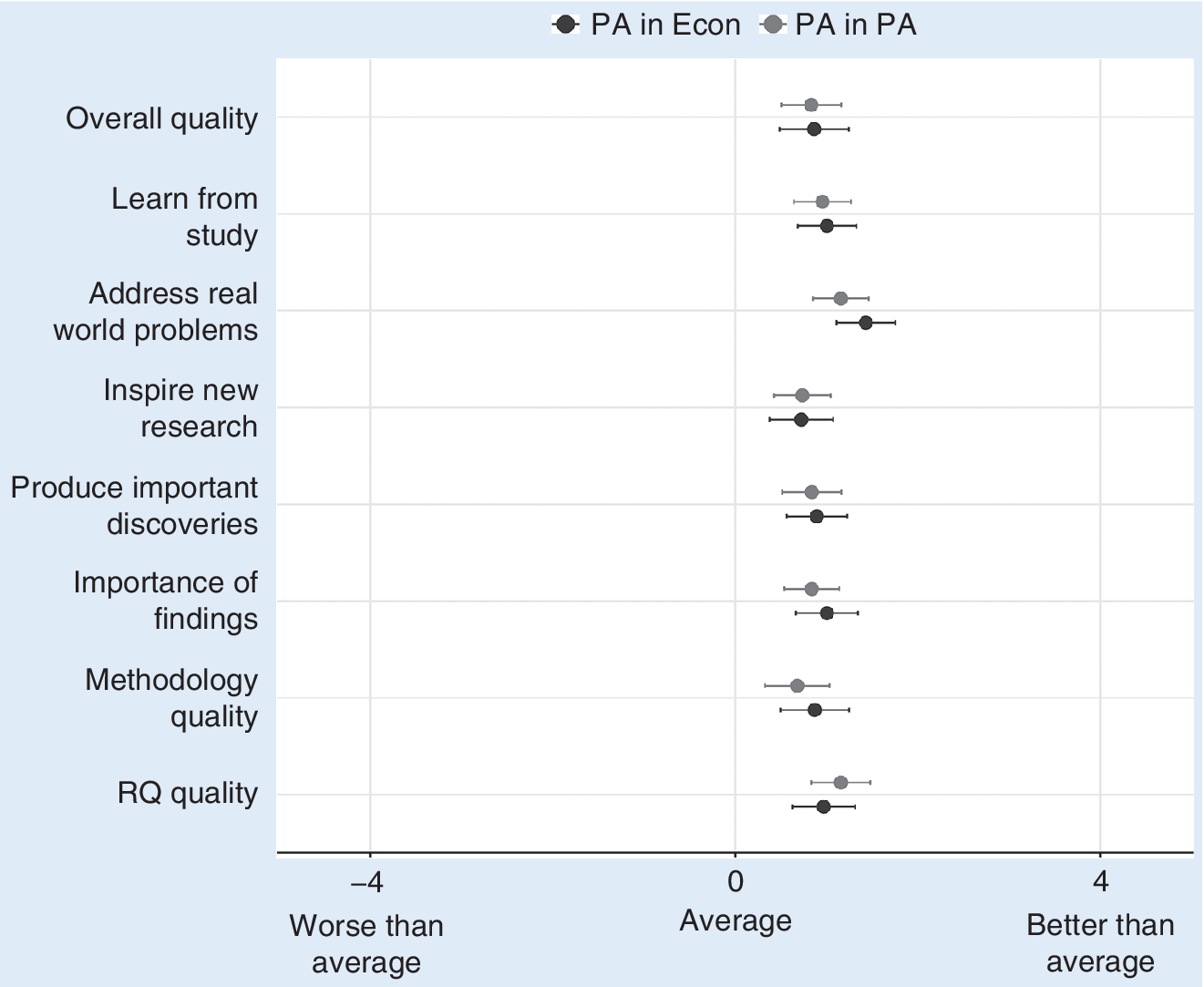
The results in figure 5 show that PA scholars rate PA in Econ and PA in PA similarly on all measures. Research in both groups is perceived as equally strong in addressing real-world problems, inspiring new research, producing important discoveries, and in overall quality, research questions, and methodology. The last characteristic is worth noting, given that our hand coding found PA in Econ to use stronger causal designs; however, this difference was not reflected in PA scholars’ subjective assessment of methodological quality. A clear limitation here is that differences in theoretical quality are harder to assess from abstracts alone. We leave it to future research to evaluate the use of theory in the two fields and the extent of theoretical accumulation within PA.
Research Quality of Public Administration Research
Note: Means with 95%-CIs from robust standard errors clustered at the subject level. PA scholars (n = 87), ratings (n = 392).

Figure 5 Long description
A dot plot with a horizontal x-axis ranging from negative 4 (Worse than average) to 0 (Average) to 4 (Better than average). The y-axis lists eight categories from top to bottom: Overall quality, Learn from study, Address real world problems, Inspire new research, Produce important discoveries, Importance of findings, Methodology quality, and R Q quality.
A legend at the top identifies two groups: P A in Econ (dark grey circles) and P A in P A (light grey circles). Each data point includes horizontal error bars representing 95% confidence intervals.
Key data trends:
* All mean ratings for both groups are positive, situated between 0 and 2.
* Address real world problems shows the highest ratings for both groups, with P A in Econ scoring slightly higher than P A in P A.
* Methodology quality shows the largest gap between groups, with P A in Econ rated higher than P A in P A.
* Inspire new research shows the lowest mean ratings for both groups, though still above the average of 0.
* R Q quality and Overall quality show closely aligned ratings for both groups near the 1.0 mark.
DISCUSSION
How can the field of PA respond to these findings? Two trajectories with varying degrees of ambition can be outlined. We call the first one “managed stagnation as WEIRD PA.” As noted, the top journals in PA are dominated by cases from the United States and Northern Europe, because most submissions stem from these regions. One way forward could be to declare independence from the rest of the world and officially reframe PA inside PA as “PA for WEIRD societies.” WEIRD PA could have a good run for some decades and provide a meaningful community of scholars focused on mature welfare states. However, it would represent a managed decline of the field and as the Global South rises, the PA field could face a relevance crisis by failing to contribute to research on that part of the world.
It is therefore worth ending with a more aspirational scenario that we call “PA as the Big Integrator.” If actual PA research is scattered across many fields, as we have shown in the case of economics, then someone needs to take a bird’s-eye view of the research to make the totality of the scientific effort more cumulative. PA could meaningfully serve as the Big Integrator, and its dedicated reviews and meta-studies can bridge PA’s state of the art with neighboring disciplines. Ideally, integration of research is a two-way street among neighboring fields and disciplines. However, the very insular citation patterns in economics (Aistleitner et al. Reference Aistleitner, Kapeller and Steinerberger2019; Angrist et al. Reference Angrist, Azoulay, Ellison, Hill and Lu2020) are difficult to change from within PA. Still, recent proactive attempts have been made to integrate research on administrative burdens into economics to connect research traditions centered on the burdens that citizens experience in their interactions with the state (Herd and Moynihan Reference Herd and Moynihan2025). This seems to be a way forward for PA: altruistically citing neighboring disciplines while proactively inserting ourselves into their research frontiers (Barfort et al. Reference Barfort, Harmon, Hjorth and Olsen2019).
CONCLUSION
Our core argument is that quantitative PA research must come to terms with the fact that substantively similar research, with more diverse cases and better designs for causal inference, is being produced in large quantities outside the field of PA. PA in Econ could easily have been published in PA journals, and similar arguments apply to other disciplines (Olsen Reference Olsen, Bouckaert, Hondeghem, Steen and Van de Walle2025). We strongly encourage others to conduct similar analyses in sociology, anthropology, or management science.
The questions asked by PA outside PA are not fundamentally different from those asked on the inside. Thus, by moving away from a journal-centric view of the field, we are not advocating for a change in substantive focus. Nor do our findings indicate that the rest of the world is ignoring PA’s subject area or giving it too little funding, attention, or care.
In fact, current attempts to delegitimize and destabilize consolidated bureaucracies underscore the practical relevance of the PA field. The world needs PA as a subject area, and we live in a golden age of causally oriented PA research with high policy relevance, yet a substantial portion of it is being published outside the PA field. The PA (sub)field’s identity moving forward needs to be that of the great integrator of progress along the scientific frontier of PA research across all disciplines.
The world needs PA as a subject area, and we live in a golden age of causally oriented PA research with high policy relevance, yet a substantial portion of it is being published outside the PA field.
SUPPLEMENTARY MATERIAL
To view supplementary material for this article, please visit http://doi.org/10.1017/S1049096526101942.
ACKNOWLEDGMENTS
The authors would like to thank Martin Bisgaard, Peter Dahler-Larsen, Hanne Foss Hansen, Benedikte Grundtvig Huber, Martin Vinæs Larsen, Mikkel Meinert, Felicia Michelsen, Donald Moynihan, Lene Holm Pedersen, Rune Slothuus, and Anders Woller for useful input on this article. This work was supported by the Independent Research Fund Denmark for the project “The Behavioral Citizen as a Layman Public Administration Scientist” (ID: 8046-00034A).
DATA AVAILABILITY STATEMENT
Research documentation and data that support the findings of this study are openly available at the Harvard Dataverse at https://dataverse.harvard.edu/dataset.xhtml?persistentId=doi:10.7910/DVN/RWYL6T.
CONFLICTS OF INTEREST
The authors declare no ethical issues or conflicts of interest in this research.


 Open access

