


Introduction
In the last decade researchers have repeatedly stressed the need to optimize decision-making processes and prioritize investment in biodiversity conservation (Balmford et al., Reference Balmford, Gaston, Blyth, James and Kapos2003; Stewart & Possingham, Reference Stewart and Possingham2005; Murdoch et al., Reference Murdoch, Polasky, Wilson, Possingham, Kareiva and Shaw2007). The management of biological invasions requires the development of decision tools that help managers prioritize actions most efficiently, for example by considering bio-economic costs and benefits (De Wit et al., Reference De Wit, Crookes and Van Wilgen2001; Perrings, Reference Perrings2001; Pimentel, Reference Pimentel2002; Born et al., Reference Born, Rauschmayer and Bräuer2005; Buhle et al., Reference Buhle, Margolis and Ruesink2005; Hayes et al., Reference Hayes, Cannon, Neil and Inglis2005; Olaussen & Skonhoft, Reference Olaussen and Skonhoft2008). This is a complex process involving a range of disciplines (e.g. ecology, sociology, engineering, politics) and that needs to consider the economic resources and human skills available. The need for decision tools to manage biological invasions is justified by the current global scenario, which is characterized by (1) the continuous increase in the number of invasive species, mainly due to globalization, increased mobility, and destruction of natural habitats, (2) the environmental, social and economic consequences of biological invasions (Munda, Reference Munda2004; Naidoo et al., Reference Naidoo, Balmford, Ferraro, Polasky, Ricketts and Rouget2006), and (3) the limited economic and human resources in the public institutions responsible for nature conservation or management.
There is thus a demand for simple tools that guide managers and politicians to optimize their investments based on objective and measurable criteria. Particularly helpful decision tools include cost-benefit or multi-criteria analyses (e.g. Tillman, Reference Tillman2000; Gamper et al., Reference Gamper, Thöni and Weck-Hannemann2006; Gamper & Turcanu, Reference Gamper and Turcanu2007). In simple terms, cost-benefit analyses compare estimated costs of one or more management actions against estimated benefits. Such analyses typically first develop cost-benefit models, which are then parameterized with data or estimates for a single non-native species and geographical area. Costs and benefits are measured in monetary values. Multi-criteria analyses do not necessarily consider monetary values and can consider other quantitative or qualitative measures of inputs (costs) and outputs (benefits) of management actions. Such analyses consider concerns about multiple conflicting criteria for a decision-making process (Gamper et al., Reference Gamper, Thöni and Weck-Hannemann2006). It is beyond the scope of this paper to compare cost-benefit with multi-criteria analyses in detail (see Gamper et al., Reference Gamper, Thöni and Weck-Hannemann2006 and Gamper & Turcanu, Reference Gamper and Turcanu2007 and references therein). It is clear, however, that both tools are more helpful for decision makers than more limited approaches such as analyses that focus only on the potential risks caused by invaders. It is also clear that analyses considering multiple invasive species simultaneously are more helpful than approaches limited to only a single invader, as ecosystems are typically invaded by more than one species (Carrasco et al., Reference Carrasco, Mumford, MacLeod, Knight and Baker2010).
Here we analyse the availability of practical, readily usable and integrated decision tools to manage biological invasions. We performed a literature search to analyse the availability of cost-benefit and multi-criteria analyses, and investigated how frequently published studies consider multiple invasive species simultaneously. We also investigated potential biases of existing studies regarding their focal geographical areas, habitats and non-native species. Finally, we analyse which of the factors that can be helpful for decision-making processes were considered in the available studies.
Methods
We searched the ISI Web of Science in January 2011 to obtain a sample of relevant publications on decision-making tools for managing biological invasions. We used a combination of search terms related to biological invasion (aliens, invasive species, invader) and terms related to management and efficiency (management, cost, efficiency, benefit, tool, protocol, allocation, prioritization, priority, software, bio-economics). We did not limit the search to papers published during a fixed period. We assumed that papers published in peer-reviewed journals are accessible to managers and technicians with scientific skills, either as abstracts, from institutional subscriptions, or by requests to authors. We also considered that a search of international peer-reviewed journals should give more reliable results than a literature search that also included other types of publications (the Web of Science is one of the largest and most widely used databases within the technical and scientific community working on biodiversity conservation).
For all papers returned by the search we checked if they were within the scope of our analysis and if they were original research papers (either empirical or theoretical) rather than review articles; the latter were excluded to avoid double-counting as they might refer to original articles already included in our analysis. We identified 43 relevant original research papers. Other papers that are relevant but were not returned by the literature search (e.g. Hobbs & Humphries, Reference Hobbs and Humphries1995; Goodwin et al., Reference Goodwin, McAllister and Fahrig1999; Sobrino et al., Reference Sobrino, Sanz-Elorza, Dana and González-Moreno2002; Leung et al., Reference Leung, Lodge, Finnoff, Shogren, Lewis and Lamberti2002; Gassó et al., Reference Gassó, Basnou and Vilà2009a,Reference Gassó, Sol, Pino, Dana, Lloret and Sanz-Elorzab; Liu et al., Reference Liu, Hurley, Lowell, Siddique, Diggle and Cook2011) were excluded from our analysis, as we aimed for an approach that can be repeated by other researchers. It was not our goal to compile an exhaustive list of all relevant publications but rather to analyse a relevant sample.
We categorized the 43 studies into one or more of the following six categories, which represent different types of decision-making tools for managing biological invasions (further information on most of these approaches can be found in Clout & Williams, Reference Clout and Williams2009): (1) cost-benefit and multi-criteria analyses (theoretical cost-benefit models that were not sufficiently parameterized for actual non-native species and regions were not included), (2) studies of quarantine or border inspection, (3) risk analyses (i.e. studies assessing the risk of invasion, or potential impact of invasion, by one or more non-native species not yet present in the focal habitat), (4) studies of eradication, containment or control (i.e. studies focusing on tools to manage non-native species that are already present in the focal habitat), (5) internet applications and other software decision-making tools for managing biological invasions, and (6) studies of other tools (i.e. studies not matching any of the other five categories).
For each study we noted the geographical focus (using a continental scale), focal habitat(s) (terrestrial, freshwater, marine), taxonomic group(s) of focal non-native species (plants, vertebrates, invertebrates, microorganisms), and the number of focal non-native species. This information was not applicable for some theoretical studies. We also noted which of the following five factors (often considered as key for decision-making tools to manage biological invasions; Clout & Williams, Reference Clout and Williams2009) each study considered: (1) the features of the non-native species (e.g. its biological traits as predictors of its invasiveness, its propagule pressure, its competitive abilities or its impacts), (2) habitat features (e.g. climate, geography or chemistry; studies predicting the risk of invasion based on species distribution models fall into this category; see Jeschke & Strayer, Reference Jeschke and Strayer2008), (3) predicted or expected effects (outputs) of management action(s) (e.g. the socio-economic benefits of reducing invader impacts but also the negative consequences of management action), (4) the efforts (inputs) required to perform management action(s) (e.g. monetary costs), and (5) the legal, social, technical or scientific difficulties that may hamper management action(s) (e.g. regulations or administrative procedures, land ownership issues, social perception of charismatic invasive species, or lack of scientific/technical data).
Results
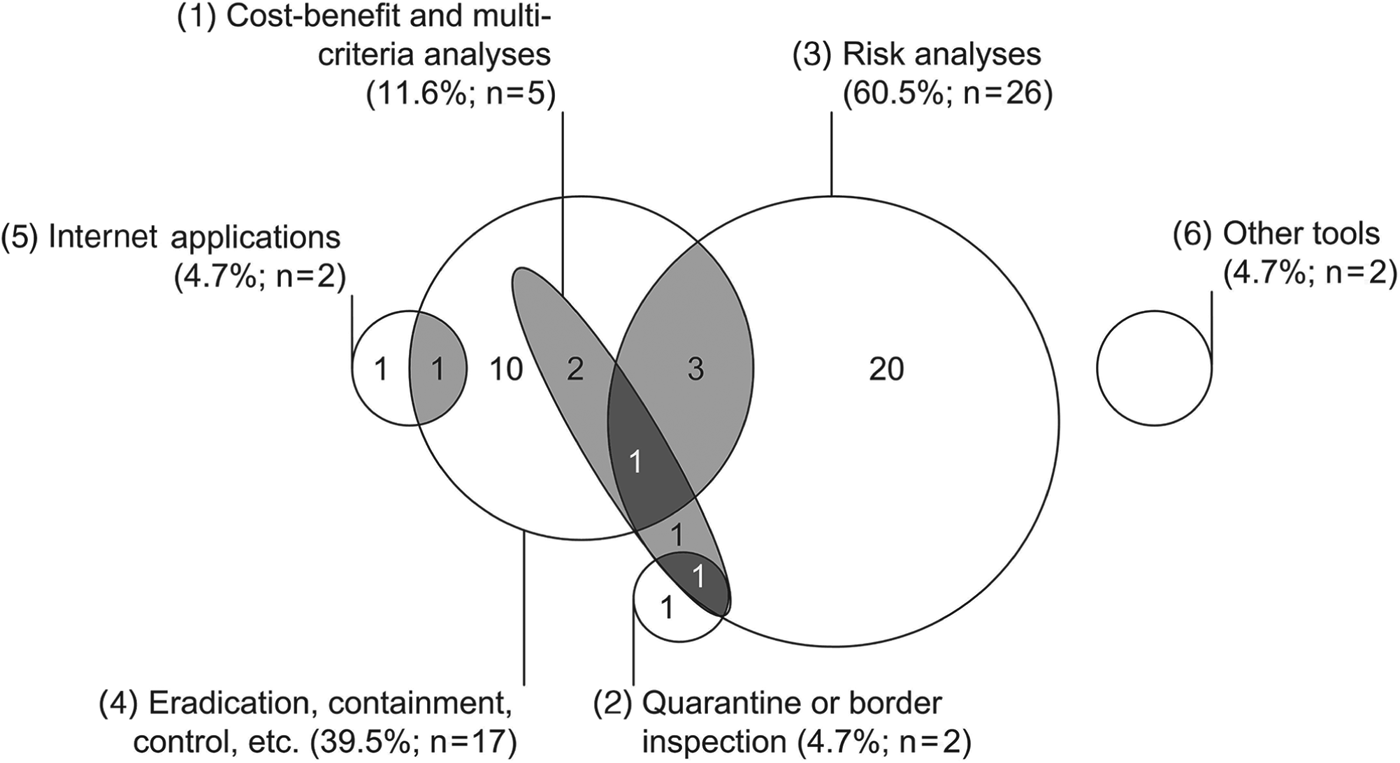
The majority of studies on decision-making tools for biological invasions focus on risk analysis (Fig. 1). Some studies fall into multiple categories. For example, because cost-benefit and multi-criteria frameworks consider costs and benefits of management actions, they often include a risk analysis in their framework to assess benefits of management actions; three of the five cost-benefit and multi-criteria analyses were also categorized as risk analyses.
Venn diagram illustrating the number and percentage of a total of 43 studies using six decision tools (see text for further details) for managing biological invasions. The percentages sum to > 100% because some studies fall into multiple categories. The literature sources are (1) cost-benefit and multi-criteria analyses (Keller et al., Reference Keller, Frang and Lodge2008; Ameden et al., Reference Ameden, Boxall, Cash and Vickers2009; Roura-Pascual et al., Reference Roura-Pascual, Richardson, Krug, Brown, Chapman and Forsyth2009; Carrasco et al., Reference Carrasco, Mumford, MacLeod, Knight and Baker2010; Liu et al., Reference Liu, Proctor and Cook2010); (2) quarantine or border inspection (Ameden et al., Reference Ameden, Boxall, Cash and Vickers2009; Moore et al., Reference Moore, Rout, Hauser, Moro, Jones, Wilcox and Possingham2010); (3) risk analyses (Cook et al., Reference Cook, Thomas, Cunningham, Anderson and De Barro2007; Leung & Mandrak, Reference Leung and Mandrak2007; Burns, Reference Burns2008; Evangelista et al., Reference Evangelista, Kumar, Stohlgren, Jarnevich, Crall, Norman and Barnett2008; Keller et al., Reference Keller, Frang and Lodge2008; López-Darias et al., Reference López-Darias, Lobo and Gouat2008; Ameden et al., Reference Ameden, Boxall, Cash and Vickers2009; Copp et al., Reference Copp, Vilizzi, Mumford, Fenwick, Godard and Gozlan2009; Dawson et al., Reference Dawson, Burslem and Hulme2009; Drake & Bossenbroek, Reference Drake and Bossenbroek2009; Reino et al., Reference Reino, Moya-Laraño and Heitor2009; Vall-Ilosera & Sol, Reference Vall-Ilosera and Sol2009; Yemshanov et al., Reference Yemshanov, McKenney, de Groot, Haugen, Sidders and Joss2009; Acosta et al., Reference Acosta, Wu and Forrest2010; Andreu & Vilà, Reference Andreu and Vilà2010; Carrasco et al., Reference Carrasco, Mumford, MacLeod, Knight and Baker2010; Crosti et al., Reference Crosti, Cascone and Cipollaro2010; Fuentes et al., Reference Fuentes, Ugarte, Kühn and Klotz2010; Miller et al., Reference Miller, Allen, Landis and Merchant2010; Muturi et al., Reference Muturi, Mohren and Kimani2010; Paini et al., Reference Paini, Worner, Cook, De Barro and Thomas2010; Smolik et al., Reference Smolik, Dullinger, Essl, Kleinbauer, Leitner and Peterseil2010; Strubbe et al., Reference Strubbe, Matthysen and Graham2010; Thum & Lennon, Reference Thum and Lennon2010; Tricarico et al., Reference Tricarico, Vilizzi, Gherardi and Copp2010; Wu et al., Reference Wu, Bartell, Orr, Ragland and Anderson2010); (4) eradication, containment and control (Cacho et al., Reference Cacho, Wise, Hester and Sinden2008; Firn et al., Reference Firn, Rout, Possingham and Buckley2008; Olson & Roy, Reference Olson and Roy2008; Sebert-Cuvillier et al., Reference Sebert-Cuvillier, Simon-Goyheneche, Paccaut, Chabrerie, Goubet and Decocq2008; Hauser & McCarthy, Reference Hauser and McCarthy2009; Marvin et al., Reference Marvin, Bradley and Wilcove2009; Roura-Pascual et al., Reference Roura-Pascual, Richardson, Krug, Brown, Chapman and Forsyth2009; Rout et al., Reference Rout, Thompson and McCarthy2009; Burgman et al., Reference Burgman, Wintle, Thompson, Moilanen, Runge and Ben-Haim2010; Carrasco et al., Reference Carrasco, Mumford, MacLeod, Knight and Baker2010; Christy et al., Reference Christy, Adams, Rodda, Savidge and Tyrrell2010; Fuentes et al., Reference Fuentes, Ugarte, Kühn and Klotz2010; Liu et al., Reference Liu, Proctor and Cook2010; Muturi et al., Reference Muturi, Mohren and Kimani2010; Sanchirico et al., Reference Sanchirico, Albers, Fischer and Coleman2010; Sandham et al., Reference Sandham, Carroll and Retief2010; Strubbe et al., Reference Strubbe, Matthysen and Graham2010); (5) Internet applications (Marvin et al., Reference Marvin, Bradley and Wilcove2009; Xia et al., Reference Xia, Guru and VanKirk2009); (6) other tools (Kataria, Reference Kataria2007; Makowski & Mittinty, Reference Makowski and Mittinty2010).
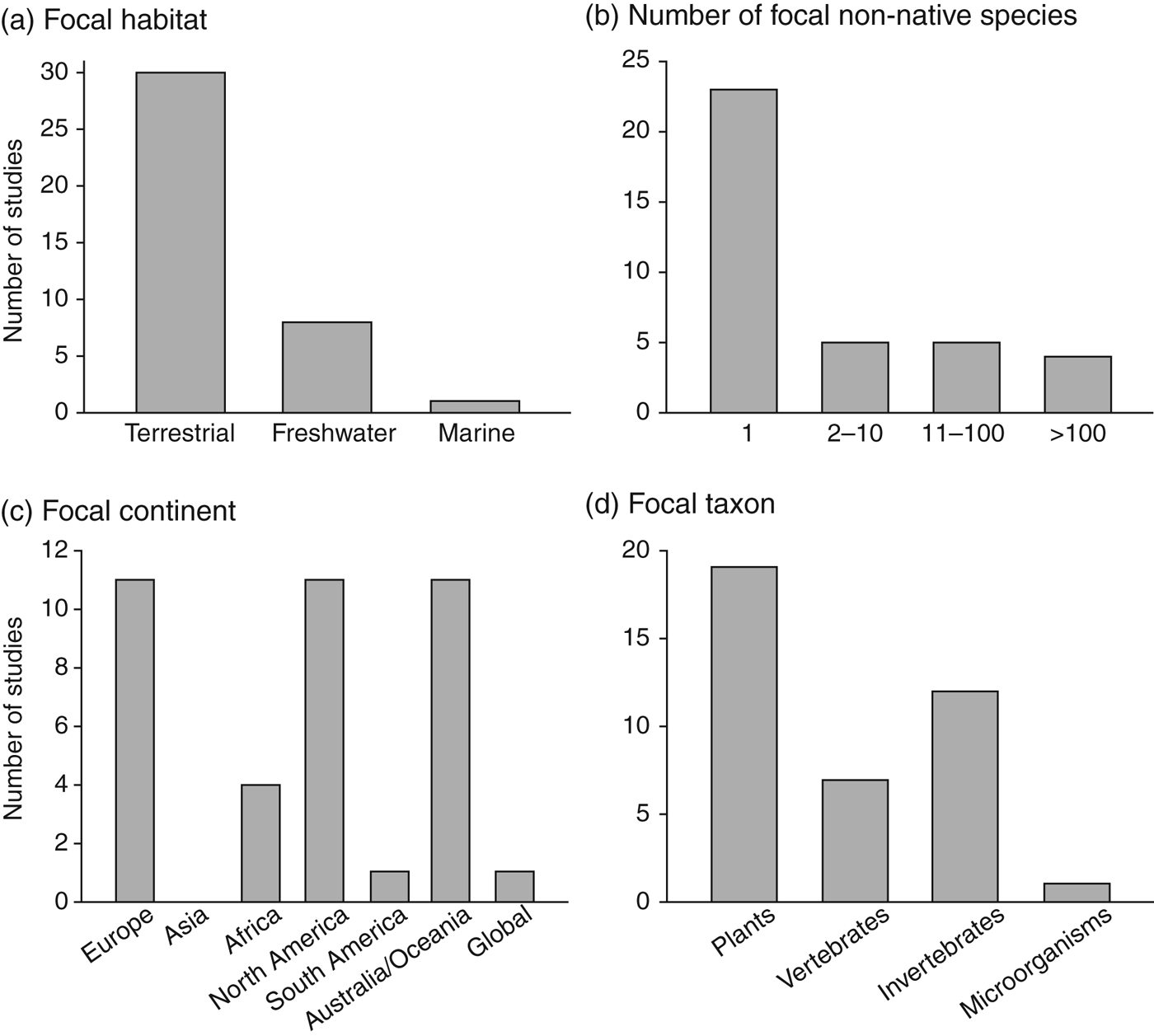
We detected biases in the geographical, habitat and invasive species foci (Fig. 2). Of the 39 studies that could be assigned a geographical focus (the other four studies were theoretical), the majority were in Europe, North America or Australia/Oceania. Only a few studies had other focal continents, and none were located in Asia. Most studies focused on invasive species in terrestrial habitats, a few focused on freshwater habitats, and there was only one study on marine habitats (Acosta et al., Reference Acosta, Wu and Forrest2010). With respect to taxonomic groups, most studies investigated plants, followed by invertebrates and vertebrates, and only one focused on microorganisms (Carrasco et al., Reference Carrasco, Mumford, MacLeod, Knight and Baker2010, analysed three non-native species, including one microorganism). Finally, the majority (67.6%) of studies only investigated a single non-native species, and few looked simultaneously at multiple non-native species. Thus, a typical study on management tools for invasive species focuses on a single terrestrial plant species that is potentially invading, or has already invaded, Europe, North America or Australia.
Differences among studies in terms of (a) focal habitat, (b) number of focal non-native species, (c) geographical focus (on a continental scale), and (d) taxonomic group of focal non-native species. The studies are those listed in Fig. 1 but some theoretical studies could not be assigned to categories, which is why the number of studies does not sum to 43.
Our results also show large differences in the factors considered in each study (Table 1). Features of the focal habitat (e.g. climate, geography or chemistry) and biological traits of the focal non-native species were the main factors considered. Only two studies (Roura-Pascual et al., Reference Roura-Pascual, Richardson, Krug, Brown, Chapman and Forsyth2009; Liu et al., Reference Liu, Proctor and Cook2010) considered legal, social, technical or scientific difficulties that could hamper or delay management actions, 10 considered inputs required to perform management actions, and 11 considered the predicted or expected effects of management actions. Considering only the 23 studies on risk analysis that were not also classified as cost-benefit or multi-criteria analyses, none of them considered predicted effects, inputs required or difficulties related to management actions. By their nature, risk analyses typically include species-ranking approaches (e.g. weed risk assessments) or predictions of which regions are more likely to be invaded (e.g. based on climate matching) but specific management actions, with their inherent difficulties, costs and effects, are rarely considered. Of the 26 risk analyses, five (19.2%) focused only on features of the focal non-native species, 10 (38.5%) focused only on features of the focal habitat, and 11 (42.3%) focused on features of both non-native species and habitats.
Specific factors considered by the 43 studies analysed, with the percentage (and number) of studies considering each factor (a blank cell indicates that no study of this category considered this factor).

* These three studies are cost-benefit or multi-criteria analyses that include risk analysis
Despite the need for effective tools to optimize the management of biological invasions, there are few comprehensive cost-benefit or multi-criteria analyses available. We identified five such analyses in our sample of studies (Keller et al., Reference Keller, Frang and Lodge2008; Ameden et al., Reference Ameden, Boxall, Cash and Vickers2009; Roura-Pascual et al., Reference Roura-Pascual, Richardson, Krug, Brown, Chapman and Forsyth2009; Carrasco et al., Reference Carrasco, Mumford, MacLeod, Knight and Baker2010; Liu et al., Reference Liu, Proctor and Cook2010). The complexity of these analyses is reflected by their coverage of the key factors for decision-making tools (Table 1). Each of the five analyses included at least three factors but only one analysis (Roura-Pascual et al., Reference Roura-Pascual, Richardson, Krug, Brown, Chapman and Forsyth2009) included all five factors (i.e. features of the non-native species, features of the habitat, predicted effects, inputs required, and difficulties of management actions). Using the South African fynbos as an example, Roura-Pascual et al. (Reference Roura-Pascual, Richardson, Krug, Brown, Chapman and Forsyth2009) offer a procedure for complex decision-making for plant invasion management. They employed the Analytic Hierarchy Process to prioritize management actions based on both species and stand attributes, while considering that environmental and management contexts (funding availability and permanence, management and institutional capacity, social or landowners’ motivations) may also influence the final implementation.
Discussion
Current procedures used in decision making
Our analysis has revealed biases in current decision-making procedures for the management of biological invasions. Most published studies focus on certain decision-making tools such as risk analysis but largely ignore others. In particular, comprehensive cost-benefit or multi-criteria analyses are currently rare in the literature. This lack of a comprehensive methodology is mirrored by a lack in simultaneous consideration of multiple invasive species. We concur with Carrasco et al. (Reference Carrasco, Mumford, MacLeod, Knight and Baker2010) that ‘it is necessary to develop more comprehensive models that integrate the management of multiple NIS [non-indigenous species]’ (p. 1304). Carrasco et al. did not base their criticism on quantitative evidence but our analysis now provides this evidence. The biases we found are not particularly surprising as they largely reflect general biases in research on biological invasions (Pyšek et al., Reference Pyšek, Richardson, Pergl, Jarošík, Sixtová and Weber2008; Jeschke et al., Reference Jeschke, Gómez Aparicio, Haider, Heger, Lortie, Pyšek and Strayer2012). They are nonetheless critical because, for example, not a single study included in our analysis focused on the largest continent, Asia. Africa and South America are both under represented in studies, which is not only problematic for the continents themselves but also for other continents, because invasive species established on one continent are likely to spread to others.
The majority of studies on decision tools for managing biological invasions are risk analyses. Because of a number of advantages (e.g. ease of use, possibility of calibration and adaptation), the combination of questions on scenarios and numerical score ratings has been used repeatedly in the design of biological risk analyses (e.g. Pheloung et al., Reference Pheloung, Williams and Halloy1999; Copp et al., Reference Copp, Vilizzi, Mumford, Fenwick, Godard and Gozlan2009; Gassó et al., Reference Gassó, Basnou and Vilà2009a; Tricarico et al., Reference Tricarico, Vilizzi, Gherardi and Copp2010). This methodological approach has proven useful for guiding management prioritization (Roura-Pascual et al., Reference Roura-Pascual, Richardson, Krug, Brown, Chapman and Forsyth2009). It requires environmental managers or stakeholders to choose from pre-defined ordered categories that are then translated to a set of ordered scores; e.g. high-risk invaders are those with a high resulting score (e.g. Copp et al., Reference Copp, Vilizzi, Mumford, Fenwick, Godard and Gozlan2009; Tricarico et al., Reference Tricarico, Vilizzi, Gherardi and Copp2010).
The general approach (not specifically directed at biological invasions) proposed by Joseph et al. (Reference Joseph, Maloney and Possingham2009) may be helpful for the design of improved decision-making tools, specifically when different management options need to be compared. Joseph et al. (Reference Joseph, Maloney and Possingham2009) analysed how to optimize resources invested in the management of threatened taxa. By using score ranks and weights they developed a procedure that takes into account not only ecological aspects but also those related to the management of threatened species. Their analysis is based on the Noah's Ark framework, an approach to conservation that considers costs and benefits of management actions for threatened species, thereby also estimating the value of these species (Metrick & Weitzman, Reference Metrick and Weitzman1998; Hartmann & Steel, Reference Hartmann and Steel2006). Joseph et al. (Reference Joseph, Maloney and Possingham2009) extended this framework by including the likelihood that management actions will succeed and thus developed a project prioritization protocol to optimize resource allocation among management projects in New Zealand. The protocol takes advantage of accessible information and previous experience, which is important because environmental managers generally have to rely on qualitative, scattered information (Ramsey & Norbury, Reference Ramsey and Norbury2009; Dana et al., Reference Dana, García-de-Lomas, González and Ortega2011). In fact, comprehensive biological and ecosystem data are rarely available for many species, lessening the opportunity for using most published studies for management (e.g. Cacho et al., Reference Cacho, Wise, Hester and Sinden2008; Dana et al., Reference Dana, López-Santiago, García-de-Lomas, García-Ocaña, Gámez and Ortega2010). The use of semi-quantitative systems for prioritization has also included multidisciplinary aspects related to either biological conservation (e.g. Lahdelma et al., Reference Lahdelma, Salminen and Hokkanen2000; Ramsey & Norbury, Reference Ramsey and Norbury2009; Roura-Pascual et al., Reference Roura-Pascual, Richardson, Krug, Brown, Chapman and Forsyth2009; Liu et al., Reference Liu, Proctor and Cook2010; Miller et al., Reference Miller, Allen, Landis and Merchant2010) or resource planning and use (Munda, Reference Munda1995; Bender & Simonovic, Reference Bender and Simonovic2000; Mazari-Hiriart et al., Reference Mazari-Hiriart, Cruz-Bello, Bojorquez-tapia, Juarez-Marusich, Alcantar-Lopez, Marin and Soto-Galera2006; Srdjevic & Medeiros, Reference Srdjevic and Medeiros2008; Wang et al., Reference Wang, Luo and Hua2008).
Costs and benefits of managing biological invasions: biases and opportunities
Risk analyses and knowledge about characteristics of invasive species (invader traits) and potentially invaded habitats are essential for designing decision tools but they are not sufficient. Our results revealed that most published studies on the topic lack several factors that may be key for integrated decision-making processes. Besides biological and ecological complexities the management of biological invasions will benefit if variables that influence the feasibility of management actions and the probability that they succeed are considered more regularly. These variables may include the estimated time needed for management action, the resources required and the duration of available resources (economic, time, human resources), interactions with stakeholders (conflicts or synergies) and legal or political opportunities or constraints (Finnoff et al., Reference Finnoff, Shogren, Leung and Lodge2005; Drechsler & Wätzold, Reference Drechsler and Wätzold2007; Clout & Williams, Reference Clout and Williams2009; Hulme et al., Reference Hulme, Pyšek, Nentwig and Vilà2009; Joseph et al., Reference Joseph, Maloney and Possingham2009; Wainger et al., Reference Wainger, King, Mack, Price and Maslin2010; Epanchin-Niell & Hastings, Reference Epanchin-Niell and Hastings2010; Dana et al., Reference Dana, García-de-Lomas, González and Ortega2011). Managers and scientists should be aware of funding availabilities, technical constraints, political or institutional opportunities, and even widespread reluctance to consider preventative measures against biological invasions (Andreu et al., Reference Andreu, Vilà and Hulme2009). We also recommend that tools for prioritizing management actions more often apply a multi-criteria framework that includes biological, ecological, and monetary factors as well as variables related to feasibility and predicted efficiency (Munda et al., Reference Munda, Nijkamp and Rietveld1995; Gamper et al., Reference Gamper, Thöni and Weck-Hannemann2006; Gamper & Turcanu, Reference Gamper and Turcanu2007; Joseph et al., Reference Joseph, Maloney and Possingham2009; Roura-Pascual et al., Reference Roura-Pascual, Richardson, Krug, Brown, Chapman and Forsyth2009). Without the help of analytical tools management decisions will continue to be heavily subjective and based on insufficient information (Liu et al., Reference Liu, Proctor and Cook2010).
One reason for the current lack of comprehensive decision-making tools may be insufficient communication between managers, politicians and scientists (Andreu et al., Reference Andreu, Vilà and Hulme2009), which in turn is partly caused by difficulties in finding common ground. It would thus be useful to create effective and dynamic communication platforms for these sectors (Hulme, Reference Hulme2011).
Conclusions
Although studies published in the peer-reviewed scientific literature have recognized the need to improve management of biological invasions, more effort is required to develop integrated decision tools. Immediate consequences of the lack of such tools include a potentially biased selection of management actions, a lower success of actions taken, or inefficiency in the use of public resources (Finnof et al., Reference Finnoff, Shogren, Leung and Lodge2007; Andreu et al., Reference Andreu, Vilà and Hulme2009). Despite the advancements achieved, the practical use of existing decision tools has often been limited, as they typically ignore economic, social, technical, institutional or political factors related to conservation and management practices. We call for more attention to these factors when developing decision-making tools for biological invasions.
Acknowledgements
We appreciate comments and constructive criticisms from Shyama Pagad and two anonymous referees. JMJ acknowledges financial support from the Deutsche Forschungsgemeinschaft (DFG; JE 288/4-1).
Biographical sketches
Elías D. Dana is interested in all facets of ecology, conservation biology and biodiversity management. He aims to understand how humans influence natural and managed systems, and tries to develop the knowledge required to help reduce the environmental impacts of humans. Jonathan M. Jeschke's research interests focus on biological invasions, predator–prey interactions and other topics in both basic and applied ecology. Juan García-de-Lomas is interested in conservation biology, with a special focus on the management of invasive species.



