





Introduction
Rice (Oryza sativa L.) farmers in sub-Saharan Africa (SSA) are confronted with a variety of weed species that undermine crop yields and the long-term sustainability of rice production. As the region strives to win the war on weeds, the adoption of sustainable management strategies has become more critical than ever. Rice is a vital staple food in SSA, contributing significantly to food security and economic stability.
Despite a rapid increase in rice consumption from population growth, urbanization, and changing dietary preferences, production struggles to keep pace (Noort et al. Reference Noort, Renzetti, Linderhof, du Rand, Marx-Pienaar, de Kock and Taylor2022; Saito et al. Reference Saito, Senthilkumar, Dossou-Yovo, Ali, Johnson, Mujawamariya and Rodenburg2023). Yields in SSA remain significantly below the global average (1 ha) according to Giller et al. (Reference Giller, Delaune, Silva, van Wijk, Hammond, Descheemaeker, van de Ven, Schut, Taulya, Chikowo and Andersson2021), and the region continues to depend heavily on rice imports to meet demand (Arouna et al. Reference Arouna, Fatognon, Saito and Futakuchi2021; Dixon et al. Reference Dixon, Garrity, Boffa, Williams, Amede, Auricht, Lott and Mburathi2020). While initiatives like the Coalition for African Rice Development (CARD) are working to boost productivity, persistent challenges such as climate change, limited access to quality seeds, and inadequate infrastructure remain (Brearley and Kramer Reference Brearley and Kramer2020; Fleming Reference Fleming2019). Among these, weed infestation stands out as a major constraint, particularly for smallholder farmers who lack effective and affordable control options (Kaur et al. Reference Kaur, Kaur and Chauhan2018; Shekhawat et al. Reference Shekhawat, Rathore and Chauhan2020). The growing complexity of weed management is further compounded by herbicide resistance and the spread of weedy rice (Oryza sativa f. spontanea Roshev.) (Huang Reference Huang2024; Rao and Matsumoto Reference Rao and Matsumoto2017).
Sustainable, integrated weed management (IWM) is now essential for improving rice yields while protecting the environment. Practices such as crop rotation, conservation tillage, organic amendments, and reduced reliance on chemical herbicides are fundamental to this approach (Hussain et al. Reference Hussain, Abideen, Danish, Asghar and Iqbal2021; Sims et al. Reference Sims, Corsi, Gbehounou, Kienzle, Taguchi and Friedrich2018). For the millions of smallholder farmers in SSA, these strategies offer a path to resilience, productivity, and ecological balance (Morton Reference Morton2007; Shackleton et al. Reference Shackleton, Ziervogel, Sallu, Gill and Tschakert2015).
The objectives of this review are to: (1) assess the current status of weed management in rice production in SSA; (2) explore innovative and sustainable strategies for effective weed control; and (3) provide recommendations for research and policy interventions to foster a resilient and sustainable rice production in the region. To address these objectives, the paper first reviews existing weed management practices and highlights the major challenges and gaps across SSA. It then explores a range of promising traditional, chemical, and biological approaches that could enhance weed control. Finally, the review synthesizes the key findings to propose targeted research priorities and policy actions that align practical solutions with long-term goals for resilient and sustainable rice production.
Weed Ecology and Impact
Weed ecology and its impact on rice production in SSA are critical areas of study due to the significant challenges weeds pose to agricultural productivity and the limited data on the topics. Understanding the types of weeds and their effects on rice yield and quality is essential for developing effective management strategies.
Types of Weeds Affecting Rice Production
Weeds in rice fields across SSA represent a complex ecological challenge shaped by diverse agroecological zones and farming practices. Rather than being random occurrences, their distribution reflects ecological adaptation: annuals, perennials, and parasitic species each exploit specific niches that undermine rice productivity in distinct ways (Le Bourgeois et al. Reference Le Bourgeois, Grard, Marnotte and Rodenburg2011). Annual weeds such as barnyardgrass [Echinochloa crus-galli (L.) P. Beauv.] thrive in lowland systems where flooding favors rapid germination and prolific seed production, enabling them to dominate fields within a single season (Baltazar and De Datta Reference Baltazar and De Datta2023; Opena et al. Reference Opena, Pratley, Lemerle, Wu and McCormick2021). In contrast, perennial species like spear grass [Imperata cylindrica (L.) P. Beauv.] persist in upland areas, their extensive rhizomes allowing regeneration even after mechanical removal, thereby creating long-term management burdens (Benjamin et al. Reference Benjamin, Idowu, Babalola, Oziegbe, Oyedokun, Akinyemi and Adebayo2024; Rusdy Reference Rusdy2020). Parasitic weeds, witchweed (Striga spp.), cut across both upland and lowland ecologies, siphoning nutrients directly from rice roots and causing severe stunting and yield loss (Asio Reference Asio2018; Kumar and Kaur Reference Kumar and Kaur2024; Rodenburg and Bastiaans Reference Rodenburg and Bastiaans2025).
Beyond life-cycle categories, weed ecology in SSA rice systems is strongly mediated by soil fertility, water regimes, and cultivation practices (Rodenburg et al. Reference Rodenburg, Meinke and Johnson2011; Rodenburg and Johnson Reference Rodenburg and Johnson2009). Flooded paddies favor E. crus-galli, while drought-prone uplands sustain I. cylindrica. Nutrient-poor soils exacerbate Striga infestations, highlighting the link between resource scarcity and parasitic weed pressure (Koele et al. Reference Koele, Kuyper and Bindraban2014). Other problematic species, such as wild rice (Oryza longistaminata A. Chev. & Roehr.) and red rice or weedy rice, illustrate how weeds can mimic or compete directly with cultivated rice, blurring the boundary between crop and competitor (Roma-Burgos et al. Reference Roma-Burgos, San Sudo, Olsen, Werle and Song2021; Shrestha et al. Reference Shrestha, Pokhrel, Paudel, Poudel, Shabbir and Adkins2019).
Taken together, these ecological dynamics underscore that weed problems in SSA rice systems are not uniform but context dependent, requiring management strategies tailored to specific environments. Effective control therefore hinges on integrating ecological knowledge into practice—combining cultural, mechanical, and chemical approaches in ways that reflect the adaptive strategies of weeds themselves. Such synthesis moves beyond species lists to highlight the ecological logic of weed persistence, providing a foundation for designing resilient and sustainable management interventions.
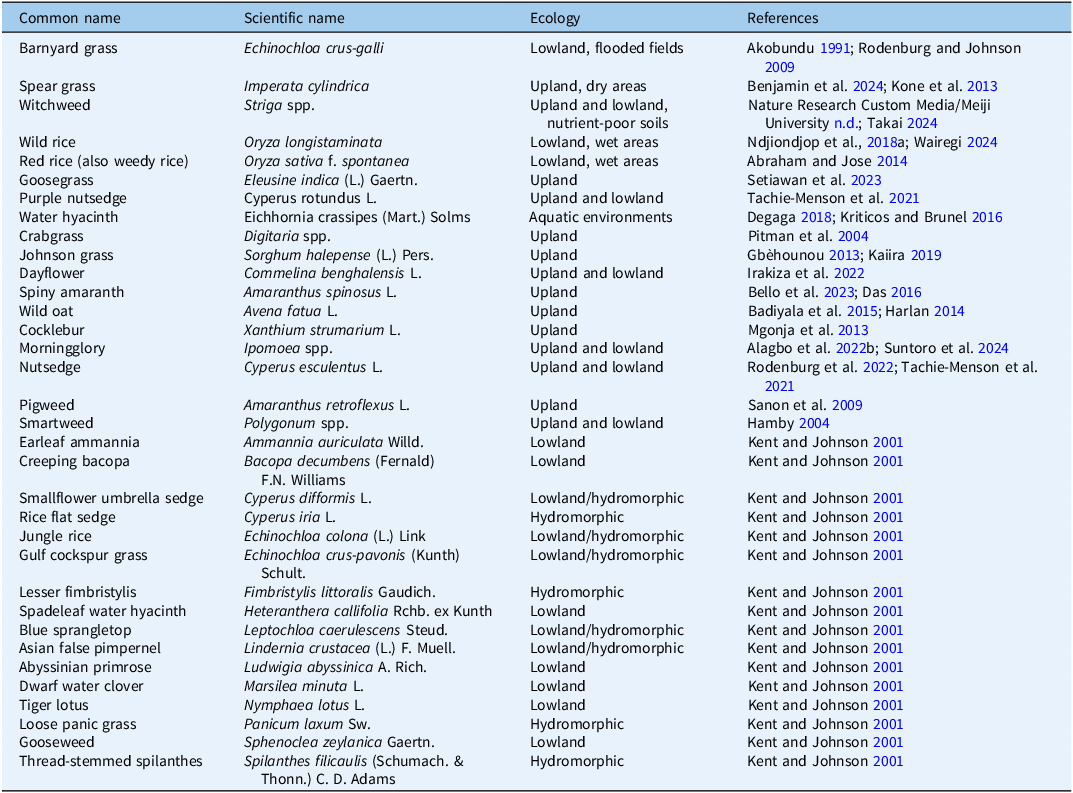
Table 1 highlights the ecological characteristics of common weed species found in rice fields across SSA.
Ecological characteristics of common weed species in sub-Saharan Africa (SSA) rice fields.

Table 1 Long description
The table has 33 rows and 4 columns. The columns are labeled Common name, Scientific name, Ecology, and References. The table lists various weed species along with their scientific names, ecological preferences, and references. Row 1: Barnyard grass, Echinochloa crus-galli, Lowland, flooded fields, Akobundu 1991; Rodenburg and Johnson 2009. Row 2: Spear grass, Imperata cylindrica, Upland, dry areas, Benjamin et al. 2024; Kone et al. 2013. Row 3: Witchweed, Striga spp., Upland and lowland, nutrient-poor soils, Nature Research Custom Media/Meiji University n.d.; Takai 2024. Row 4: Wild rice, Oryza longistaminata, Lowland, wet areas, Ndjiondjop et al., 2018a; Wairegi 2024. Row 5: Red rice (also weedy rice), Oryza sativa f. spontanea, Lowland, wet areas, Abraham and Jose 2014. Row 6: Goosegrass, Eleusine indica (L.) Gaertn., Upland, Setiawan et al. 2023. Row 7: Purple nutsedge, Cyperus rotundus L., Upland and lowland, Tachie-Menson et al. 2021. Row 8: Water hyacinth, Eichhornia crassipes (Mart.) Solms, Aquatic environments, Degaga 2018; Kriticos and Brunel 2016. Row 9: Crabgrass, Digitaria spp., Upland, Pitman et al. 2004. Row 10: Johnson grass, Sorghum halepense (L.) Pers., Upland, Gbehounou 2013; Kaiira 2019. Row 11: Dayflower, Commelina benghalensis L., Upland and lowland, Irakiza et al. 2022. Row 12: Spiny amaranth, Amaranthus spinosus L., Upland, Bello et al. 2023; Das 2016. Row 13: Wild oat, Avena fatua L., Upland, Badiyala et al. 2015; Harlan 2014. Row 14: Cocklebur, Xanthium strumarium L., Upland, Mgona et al. 2013. Row 15: Morningglory, Ipomoea spp., Upland and lowland, Alagbo et al. 2022b; Suntoro et al. 2024. Row 16: Nutsedge, Cyperus esculentus L., Upland and lowland, Rodenburg et al. 2022; Tachie-Menson et al. 2021. Row 17: Pigweed, Amaranthus retroflexus L., Upland, Sanon et al. 2009. Row 18: Smartweed, Polygonum spp., Upland and lowland, Hamby 2004. Row 19: Earleaf ammannia, Ammannia auriculata Willd., Lowland, Kent and Johnson 2001. Row 20: Creeping bacopa, Bacopa decumbens (Fernald) F.N. Williams, Lowland, Kent and Johnson 2001. Row 21: Smallflower umbrella sedge, Cyperus difformis L., Lowland/hydromorphic, Kent and Johnson 2001. Row 22: Rice flat sedge, Cyperus iria L., Hydromorphic, Kent and Johnson 2001. Row 23: Jungle rice, Echinochloa colona (L.) Link, Lowland/hydromorphic, Kent and Johnson 2001. Row 24: Gulf cockspur grass, Echinochloa crus-pavonis (Kunth) Schult., Lowland/hydromorphic, Kent and Johnson 2001. Row 25: Lesser fimbristylis, Fimbristylis littoralis Gaudich., Hydromorphic, Kent and Johnson 2001. Row 26: Spadeleaf water hyacinth, Heteranthera callifolia Rchb. ex Kunth, Lowland, Kent and Johnson 2001. Row 27: Blue sprangletop, Leptochloa caerulescens Steud., Lowland/hydromorphic, Kent and Johnson 2001. Row 28: Asian false pimpernel, Lindernia crustacea (L.) F. Muell., Lowland/hydromorphic, Kent and Johnson 2001. Row 29: Abyssinian primrose, Ludwigia abyssinica A. Rich., Lowland, Kent and Johnson 2001. Row 30: Dwarf water clover, Marsilea minuta L., Lowland, Kent and Johnson 2001. Row 31: Tiger lotus, Nymphaea lotus L., Lowland, Kent and Johnson 2001. Row 32: Loose panic grass, Panicum laxum Sw., Hydromorphic, Kent and Johnson 2001. Row 33: Gooseweed, Sphenoclea zeylanica Gaertn., Lowland, Kent and Johnson 2001. Row 34: Thread-stemmed spilanthes, Spilanthes filicaulis (Schumach. & Thonn.) C. D. Adams, Hydromorphic, Kent and Johnson 2001.
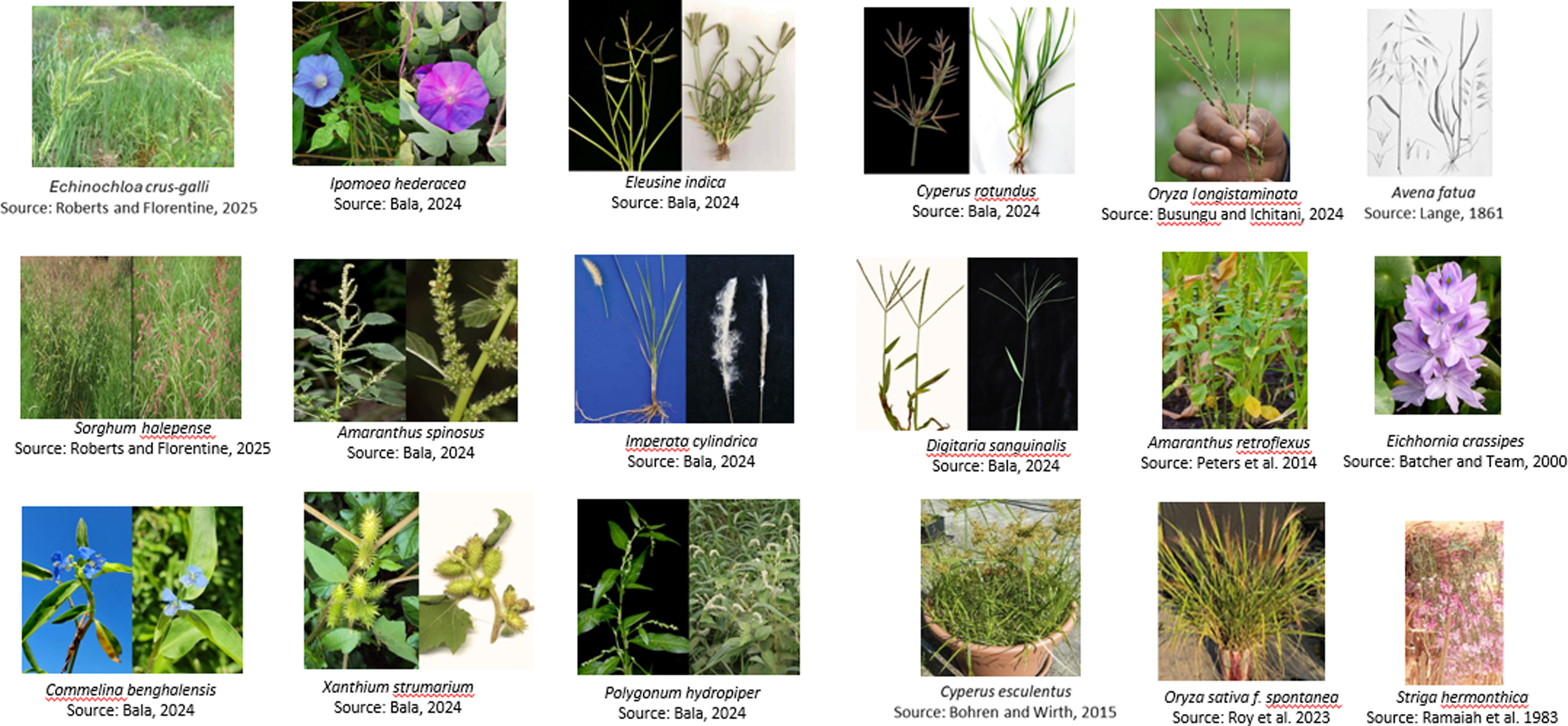
Figure 1 presents common weed species found in SSA that pose significant challenges to rice cultivation in the region. Each image is clearly labeled to facilitate accurate identification by rice farmers and researchers.
Weeds affecting rice production in sub-Saharan Africa (SSA).
Sources: Bala (2024); Batcher and Team GIS (Reference Batcher2000); Bohren and Wirth (Reference Bohren and Wirth2015); Busungu and Ichitani (Reference Busungu and Ichitani2024); Lange (Reference Lange1861); Peters et al. (Reference Peters and Breitsameter2014); Ramaiah et al. (Reference Ramaiah, Parker, Rao and Musselman1983); Roberts and Florentine (Reference Roberts and Florentine2025); Roy et al. (Reference Roy, Singh and Sarkar2023).

Impact of Weeds on Rice Yield and Quality
Weeds significantly affect production in SSA, reducing rice yield, quality, and farmer incomes. By competing for light, water, and nutrients, they directly suppress crop growth. Under high weed pressure—such as infestations exceeding 100 to 150 plants m−2 or more than 60% ground cover—yield losses can reach up to 50% (Atera et al. Reference Atera, Onyango, Azuma, Asanuma and Itoh2011; Dass et al. Reference Dass, Shekhawat, Choudhary, Sepat, Rathore, Mahajan and Chauhan2017; Ogwuike et al. Reference Ogwuike, Rodenburg, Diagne, Agboh-Noameshie and Amovin-Assagba2014; Reynolds et al. Reference Reynolds, Waddington, Anderson, Chew, True and Cullen2015). These losses translate into food insecurity and economic vulnerability for smallholder farmers who depend on rice as a staple and cash crop.
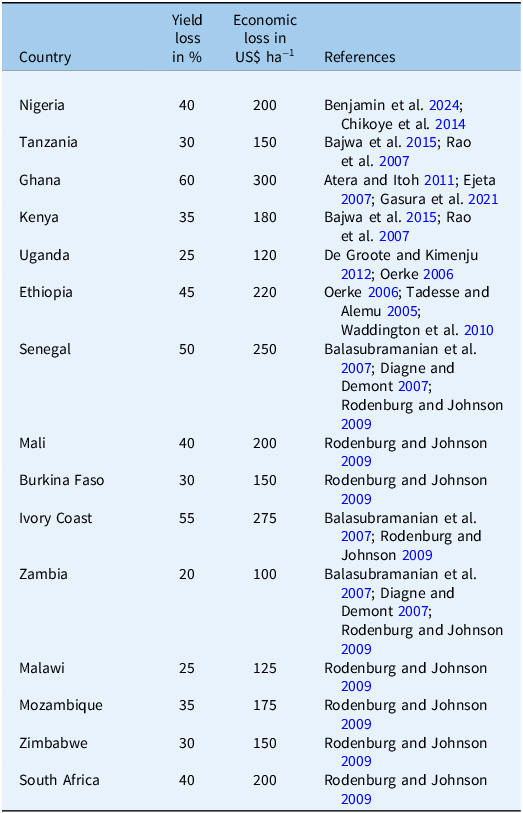
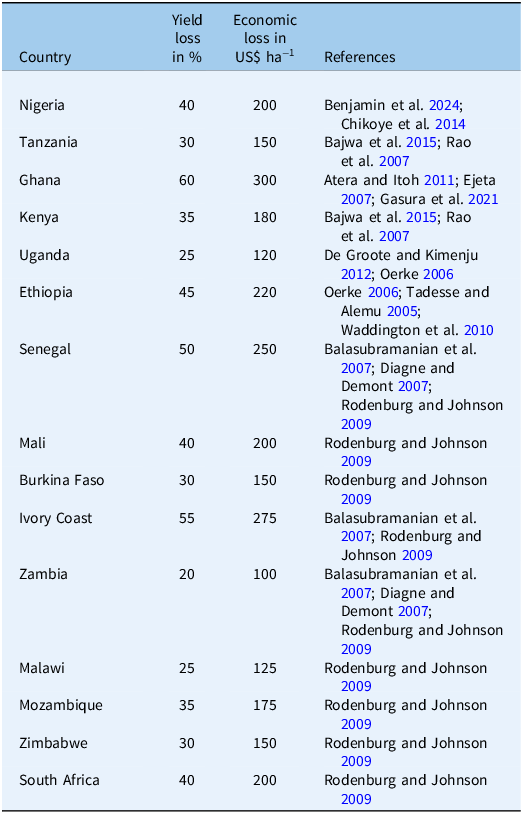
The impact of weeds extends beyond yield reduction. They serve as reservoirs for pests and diseases, lowering grain quality and marketability (Chauhan Reference Chauhan2012; Scavo and Mauromicale Reference Scavo and Mauromicale2020). Contamination from weed seeds and plant fragments further diminishes rice value, constraining access to premium markets (Dass et al. Reference Dass, Shekhawat, Choudhary, Sepat, Rathore, Mahajan and Chauhan2017). Case studies across SSA illustrate the scale of the problem: I. cylindrica in Nigeria reduces yields by up to 40%, costing farmers about US$200 ha−1; E. crus-galli in Tanzania causes losses of 30%, or US$150 ha−1; and Striga spp. in Ghana can devastate crops with yield declines exceeding 60%, equating to US$300 ha−1 (Atera and Itoh Reference Atera and Itoh2011; Bajwa et al. Reference Bajwa, Chauhan and Mahajan2015; Benjamin et al. Reference Benjamin, Idowu, Babalola, Oziegbe, Oyedokun, Akinyemi and Adebayo2024; Chikoye et al. Reference Chikoye, Ekeleme, Lum and Udensi2014; Ejeta Reference Ejeta2007; Gasura et al. Reference Gasura, Nyakurwa and Mallu2021; Rao et al. Reference Rao, Johnson, Sivaprasad, Ladha and Mortimer2007).
Together, these examples highlight weeds as systemic ecological and economic threats. Addressing them requires integrated strategies that safeguard yields, improve grain quality, and reduce financial risks for smallholder farmers.
Table 2 gives some impact of weed infestation on rice yield and economic losses in SSA.
Impact of weed infestation on rice yield and economic losses in sub-Saharan Africa (SSA).
Methods for Weed Control
Mechanical Methods for Weed Control
Mechanical methods for weed control have been increasingly adopted in SSA as part of sustainable rice production strategies (Rodenburg and Johnson Reference Rodenburg and Johnson2009). These methods include the use of rotary weeders, hand weeders, and mechanical tillers, which help manage weed populations without relying on chemical herbicides (Kumar et al. Reference Kumar, Tewari, Mehta, Chethan, Chandel, Pareek and Nare2022; Pannacci et al. Reference Pannacci, Lattanzi and Tei2017).
Advantages
The advantages of mechanical weed control include reduced chemical usage, which is beneficial for the environment and human health, and the ability to manage weeds in an organic farming context (Merfield Reference Merfield, Chandran, Unni, Thomas and Meena2023; Monteiro and Santos Reference Monteiro and Santos2022). Additionally, mechanical methods can be labor-saving; for example, the use of rotary weeders in Tanzania has significantly reduced labor requirements and improved weed control efficiency (Johnson et al. Reference Johnson, Rodenburg, Tanaka, Senthilkumar, Ahouanton, Dieng and Saito2019; Senthilkumar et al. Reference Senthilkumar, Tesha, Mghase and Rodenburg2018). Rotary weeders reduce the need for hand weeding by allowing one person to cover larger areas quickly. Their rotating blades uproot weeds efficiently between crop rows, saving labor time while improving consistency of weed control. These methods also contribute to soil health by incorporating organic matter back into the soil (Brevik Reference Brevik and Verheye2010).
Disadvantages
However, there are disadvantages to mechanical weed control. The initial cost of equipment can be high, and there is a need for regular maintenance (Mohler et al. Reference Mohler, Liebman, Staver and Mohler2001). Mechanical methods can also lead to soil compaction if not used properly, which can negatively affect crop growth (Batey Reference Batey2009). When fuel is used, mechanical weed control can lead to greenhouse gas emissions and compromise the environment (Don et al. Reference Don, Osborne, Hastings, Skiba, Carter, Drewer and Zenone2012). Despite these challenges, countries like Tanzania and Nigeria have successfully implemented mechanical weed control methods, demonstrating their potential for broader adoption in SSA (Baiyegunhi and Hassan Reference Baiyegunhi and Hassan2025; Basch et al. Reference Basch, Teixeira and Duiker2020). However, tillage-based mechanical weed control can accelerate soil erosion, degrade structure, and reduce fertility, posing long-term sustainability challenges for rice systems in fragile SSA agroecologies (Giller et al. Reference Giller, Witter, Corbeels and Tittonell2009; Tully et al. Reference Tully, Sullivan, Weil and Sanchez2015).
Traditional Weed Control Methods
Traditional weed control methods have been employed for centuries to manage unwanted vegetation in agricultural fields, gardens, and natural areas (Monaco et al. Reference Monaco, Weller and Ashton2002). These methods are often preferred for their environmental friendliness, cost-effectiveness, and ability to maintain soil health. We will explore the primary traditional weed control methods: manual weeding, cultural practices, and the limitations of these traditional methods. Each section delves into the specifics of these approaches, providing case studies from various countries to illustrate their application and effectiveness.
Manual Weeding
Manual weeding is one of the oldest and most common methods of weed control. It involves physically removing weeds by hand or with the aid of simple tools such as hoes, trowels, and knives (Sundaram Reference Sundaram2013). This method is labor-intensive but highly effective for small-scale farming and gardening (Bavaskar Reference Bavaskar2024). Manual weeding allows for precise removal of weeds without disturbing the crops or soil structure significantly (Gupta et al. Reference Gupta, Balas and Bambhaniya2024).
One effective example comes from West Africa, where farmers in Nigeria and Ghana have successfully integrated manual weeding with mechanical push weeders. This hybrid approach allows farmers to remove weeds within rice rows manually while using mechanical weeders between rows, significantly reducing labor intensity. Studies have shown that this method effectively controls Echinochloa spp. and Cyperus rotundus L. (nutgrass), two of the most problematic weeds in rice fields (Rodenburg and Johnson Reference Rodenburg and Johnson2009). In East Africa, upland rice farmers in Kenya and Tanzania have adopted early-stage hand weeding, targeting weeds at the 2- to 3-leaf stage. This strategy prevents weed establishment while preserving soil moisture, allowing rice seedlings to develop strong root systems before weed pressure intensifies. Another notable success is seen in Madagascar, where farmers practicing the System of Rice Intensification (SRI) have transformed manual weeding into an opportunity for soil enrichment. Instead of discarding weeds, they incorporate them into the soil using mechanical weeders, enhancing organic matter and microbial activity. This approach has led to increased rice yields and improved soil health (Barison and Uphoff Reference Barison and Uphoff2011).
Cultural Practices
Cultural practices involve modifying the farming environment to suppress weed growth and promote healthy crop development (Nichols et al. Reference Nichols, Verhulst, Cox and Govaerts2015). These practices include crop rotation, intercropping, use of cover crops, and selecting weed-tolerant crop varieties (Nagargade et al. Reference Nagargade, Singh and Tyagi2018).
Crop rotation is a proven cultural practice for sustainable rice production in SSA, offering both weed suppression and soil fertility benefits. In Nigeria and Ghana, rice is often rotated with short-cycle legumes such as cowpea [Vigna unguiculata (L.) Walp.], soybean [Glycine max (L.) Merr.], groundnut (Arachis hypogea L.), and sometimes mucuna [Mucuna pruriens (L.) DC.] and pigeon pea [Cajanus cajan (L.) Millsp.]. These crops provide rapid canopy cover and biological fixation, both of which contribute to reduced weed pressure and improved soil health (Ajeigbe et al. Reference Ajeigbe, Mohammed, Adeosun and Ihedioha2010; Obiri Reference Obiri2003). Evidence from on-farm experiments indicates that annual rotations, where rice is immediately followed by a legume in the next season, are most effective in reducing weed seedbanks. Rotations with legumes have been shown to reduce the abundance of problematic grass weeds such as E. crus-galli and smallflower umbrella sedge (Cyperus difformis L.) by 30% to 60%, depending on species and site conditions (Rodenburg and Johnson Reference Rodenburg and Johnson2009). More recent findings by Rodenburg and Saito (Reference Rodenburg and Saito2022) confirm yield increases of 15% to 25% in rice following legume rotations, underscoring crop diversification as a practical pathway to improved productivity and resilience in SSA rice systems. Another effective method is water management, particularly in irrigated rice systems. Many farmers in Madagascar and Senegal practice continuous flooding, which inhibits the germination of grass and broadleaf weeds. Studies have shown that maintaining a 2- to 5-cm water level in rice fields minimizes weed emergence and lowers weed pressure. This technique is particularly effective against Echinochloa spp. and Cyperus spp. in SSA rice fields (Rao et al. Reference Rao, Johnson, Sivaprasad, Ladha and Mortimer2007; Rodenburg and Johnson Reference Rodenburg and Johnson2009). Land preparation and stale seedbed techniques have also proven successful in reducing weed infestations. In Tanzania and Uganda, farmers use repeated tillage at 10-d intervals before planting rice to kill newly emerging weeds and deplete the weed seedbank. This method, combined with proper field leveling, ensures uniform water distribution and prevents weed establishment (Balasubramanian et al. Reference Balasubramanian, Sie, Hijmans and Otsuka2007). Additionally, competitive rice varieties with early seedling vigor and high tillering capacity have been introduced to suppress weed growth naturally (Rao et al. Reference Rao, Johnson, Sivaprasad, Ladha and Mortimer2007). In West Africa, farmers have adopted NERICA® (New Rice for Africa) varieties, which outcompete weeds by forming dense canopies early in the growing season. This approach reduces the need for manual weeding and enhances overall crop resilience (Atera et al. Reference Atera, Onyango, Azuma, Asanuma and Itoh2011; Balasubramanian et al. Reference Balasubramanian, Sie, Hijmans and Otsuka2007).
Cover crops are increasingly recognized as a sustainable practice in rice-based systems of SSA, particularly for weed suppression and soil fertility enhancement. Leguminous cover crops such as mucuna and sunn hemp (Crotalaria juncea L.) are used during fallow periods to reduce weed seedbanks and improve nitrogen availability. Studies in Nigeria and Benin show that integrating cover crops into rice rotations can reduce weed biomass by 40% to 60% and increase subsequent rice yields by 20% to 25% compared to continuous rice cultivation (Saito et al. Reference Saito, Senthilkumar, Dossou-Yovo, Ali, Johnson, Mujawamariya and Rodenburg2023). Economic assessments highlight that farmers adopting cover crops save up to 30% on herbicide costs and achieve net income gains of US$150 to US$200 ha−1 annually (Saito et al. Reference Saito, Senthilkumar, Dossou-Yovo, Ali, Johnson, Mujawamariya and Rodenburg2023). Beyond yield and income, cover crops contribute to long-term soil health, increasing organic matter and resilience against climate variability. Thus, cover cropping represents a cost-effective and ecologically sound pathway to improve rice productivity and farmer livelihoods in SSA.
Intercropping rice with legumes and vegetables is another cultural practice that enhances productivity and resource-use efficiency in SSA. Systems such as rice–cowpea or rice–soybean intercrops are common in Nigeria, Ghana, and Tanzania, where they provide both weed suppression and diversified income streams. Meta-analyses of African intercropping trials report yield advantages of 15% to 30% for rice compared with monocropping, largely due to reduced weed competition and improved nitrogen cycling (Himmelstein et al. Reference Himmelstein, Ares, Gallagher and Myers2017). Farmers also benefit economically: intercropping increases gross margins by 20% to 35%, with household food security strengthened through diversified harvests (Himmelstein et al. Reference Himmelstein, Ares, Gallagher and Myers2017). In Ghana, rice–cowpea intercropping reduced weeding labor by 25%, freeing time for other farm activities. Ecologically, intercropping enhances biodiversity, stabilizes yields under variable rainfall, and reduces pest outbreaks. These quantified benefits demonstrate that intercropping is not only agronomically viable but also economically advantageous, making it a key strategy for resilient rice systems in SSA.
Furthermore, the use of rice varieties has proven to be an effective strategy for weed control in sustainable rice production in SSA (Rodenburg and Saito Reference Rodenburg and Saito2022). By cultivating various rice accessions with competitive abilities and resistance to local weed species, farmers can reduce weed pressure and improve crop yields (Rahman et al. Reference Rahman, Islam, Arefin, Rahman and Anwar2017; Ramesh et al. Reference Ramesh, Matloob, Aslam, Florentine and Chauhan2017a and Reference Ramesh, Rao and Chauhan2017b). For instance, the introduction of improved rice varieties such as NERICA® (New Rice for Africa) has not only suppressed weeds through vigorous early growth and canopy closure but also delivered yield gains of 15% to 20% compared with traditional landraces, with adoption across 16 SSA countries contributing to regional rice self-sufficiency and poverty reduction (CGIAR Research Program on Rice 2017). Economic assessments indicate that NERICA® adoption generated significant household income increases, with millions lifted out of food insecurity (AfricaRice, https://www.africarice.org/impact). Similarly, traditional African rice (Oryza glaberrima Steud.) types such as CG20 remain highly competitive in inland valleys, reducing weeding labor requirements and stabilizing yields under resource-constrained conditions (Mahajan et al. Reference Mahajan, Chauhan, Kumar, Chauhan and Mahajan2014; Moukoumbi et al. Reference Moukoumbi, Sie, Vodouhe, Bonou, Toulou and Ahanchede2011). Thus, the deployment of weed-suppressive rice cultivars provides quantifiable agronomic benefits, reinforcing the resilience and sustainability of rice-farming systems in the region (Moukoumbi et al. Reference Moukoumbi, Sie, Vodouhe, Bonou, Toulou and Ahanchede2011).
Resistance to weeds in rice cultivation is primarily mediated through genetic mechanisms involving quantitative trait loci (QTL) and specific resistance genes. These genetic factors influence key traits such as allelopathy, herbicide resistance, and competitive ability (Khanh et al. Reference Khanh, Xuan and Chung2007; Patni et al. Reference Patni, Chandra, Mishra, Guru, Vitalini and Iriti2018). Allelopathic rice varieties produce secondary metabolites that inhibit weed growth, reducing competition for nutrients and space (Belz Reference Belz2007). Meanwhile, herbicide-resistant rice lines harbor genes such as ALS (acetolactate synthase), which confer resistance to imidazolinone herbicides, allowing selective weed suppression without harming the crop (MI Hussain et al. Reference Hussain, Abideen, Danish, Asghar and Iqbal2021; Yean et al. Reference Yean, Dilipkumar, Rahman and Song2021). Additionally, QTLs linked to early vigor, root architecture, and canopy development enhance rice’s ability to outcompete weeds for light and nutrients (Huber et al. Reference Huber, Julkowska, Snoek, van Veen, Toulotte, Kumar and Pierik2024; Nocito et al. Reference Nocito, Murugaiyan, Ali, Pandey, Casal, De Asis and Dimaano2025). Advances in marker-assisted selection (MAS) and genome-wide association studies (GWAS) have facilitated the identification and integration of these resistance loci into elite cultivars, improving weed control in sustainable rice production systems (Iwasa et al. Reference Iwasa, Chigira, Nomura, Adachi, Asami, Nakamura and Ookawa2023). Understanding these genetic mechanisms allows breeders to develop rice varieties with enhanced resilience against weed interference, reducing reliance on chemical herbicides (Ofosu et al. Reference Ofosu, Agyemang, Márton, Pásztor, Taller and Kazinczi2023).
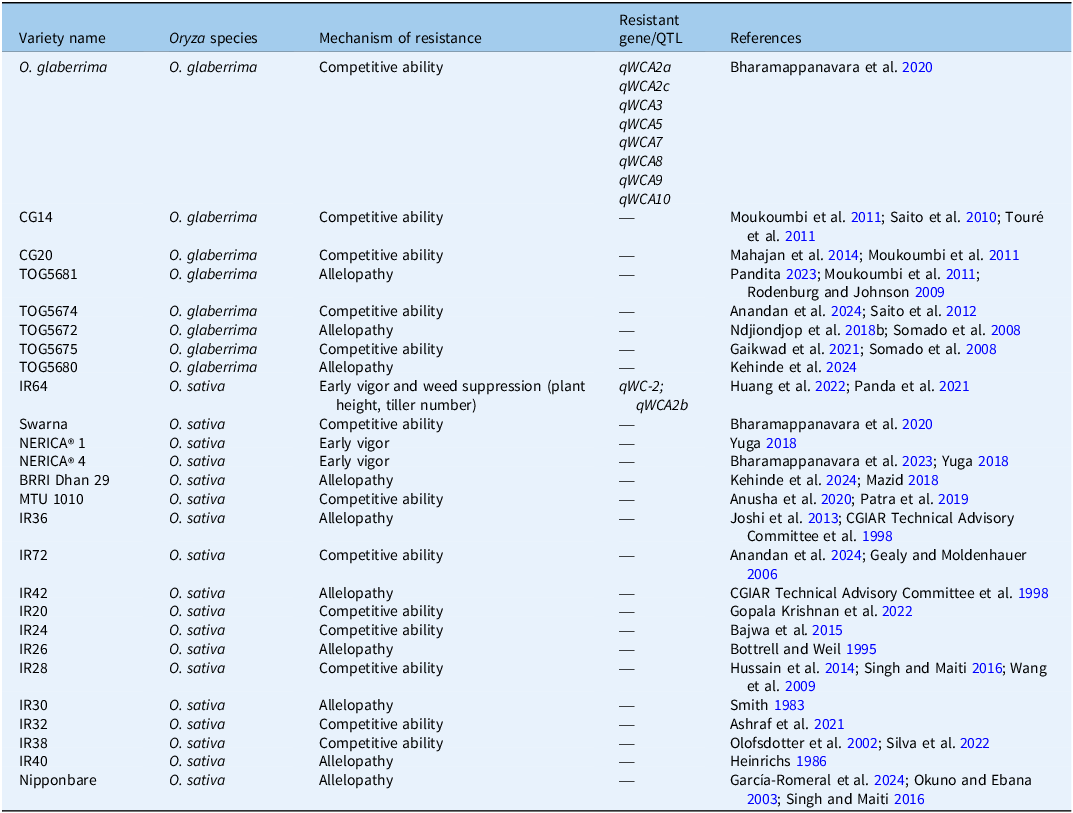
Table 3 presents a few weed-tolerant rice varieties, their ecologies, mechanisms of resistance, identified resistant genes or QTLs, and references.
Resistance mechanisms and genetic markers in rice varieties for weed control in sub-Saharan Africa (SSA).
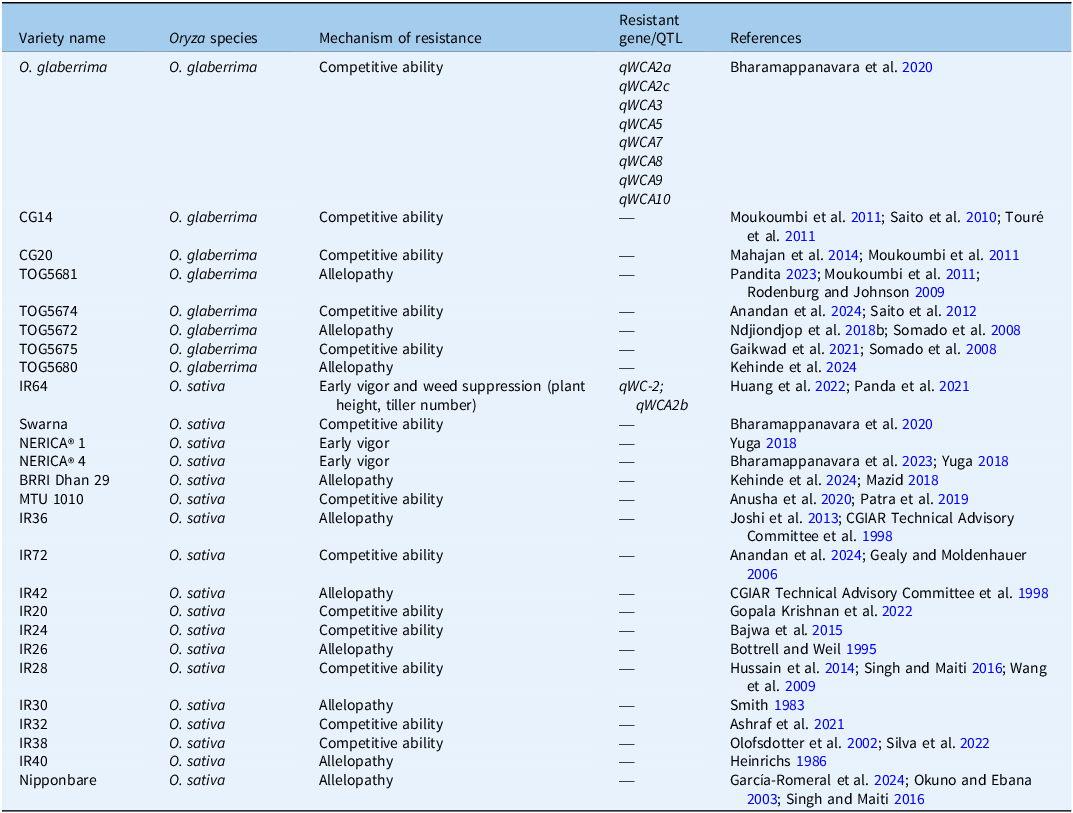
Table 3 Long description
The table has six columns: Variety name, Oryza species, Mechanism of resistance, Resistant gene/QTL, and References. It lists various rice varieties along with their species, mechanisms of resistance, identified resistant genes or QTLs, and references. The table includes 30 rows of data. Row 1: Oryza glaberrima, O. glaberrima, Competitive ability, qWCA2a qWCA2c qWCA3 qWCA5 qWCA7 qWCA8 qWCA9 qWCA10, Bharamappanavara et al. 2020. Row 2: CG14, O. glaberrima, Competitive ability, -, Moukoumbi et al. 2011; Saito et al. 2010; Touré et al. 2011. Row 3: CG20, O. glaberrima, Competitive ability, -, Mahajan et al. 2014; Moukoumbi et al. 2011. Row 4: TOG5681, O. glaberrima, Allelopathy, -, Pandita 2023; Moukoumbi et al. 2011; Rodenburg and Johnson 2009. Row 5: TOG5674, O. glaberrima, Competitive ability, -, Anandan et al. 2024; Saito et al. 2012. Row 6: TOG5672, O. glaberrima, Allelopathy, -, Ndjiondjop et al. 2018b; Somado et al. 2008. Row 7: TOG5675, O. glaberrima, Competitive ability, -, Gaikwad et al. 2021; Somado et al. 2008. Row 8: TOG5680, O. glaberrima, Allelopathy, -, Kehinde et al. 2024. Row 9: IR64, O. sativa, Early vigor and weed suppression (plant height, tiller number), qWC-2; qWCA2b, Huang et al. 2022; Panda et al. 2021. Row 10: Swarna, O. sativa, Competitive ability, -, Bharamappanavara et al. 2020. Row 11: NERICA 1, O. sativa, Early vigor, -, Yuga 2018. Row 12: NERICA 4, O. sativa, Early vigor, -, Bharamappanavara et al. 2023; Yuga 2018. Row 13: BRRI Dhan 29, O. sativa, Allelopathy, -, Kehinde et al. 2024; Mazid 2018. Row 14: MTU 1010, O. sativa, Competitive ability, -, Anusha et al. 2020; Patra et al. 2019. Row 15: IR36, O. sativa, Allelopathy, -, Joshi et al. 2013; CGIAR Technical Advisory Committee et al. 1998. Row 16: IR72, O. sativa, Competitive ability, -, Anandan et al. 2024; Gealy and Moldenhauer 2006. Row 17: IR42, O. sativa, Allelopathy, -, CGIAR Technical Advisory Committee et al. 1998. Row 18: IR20, O. sativa, Competitive ability, -, Gopala Krishnan et al. 2022. Row 19: IR24, O. sativa, Competitive ability, -, Bajaj et al. 2015. Row 20: IR26, O. sativa, Allelopathy, -, Bottrell and Weil 1995. Row 21: IR28, O. sativa, Competitive ability, -, Hussain et al. 2014; Singh and Maiti 2016; Wang et al. 2009. Row 22: IR30, O. sativa, Allelopathy, -, Smith 1983. Row 23: IR32, O. sativa, Competitive ability, -, Ashraf et al. 2021. Row 24: IR38, O. sativa, Competitive ability, -, Olofsdotter et al. 2002; Silva et al. 2022. Row 25: IR40, O. sativa, Allelopathy, -, Heinrichs 1986. Row 26: Nipponbare, O. sativa, Allelopathy, -, Garcia-Romeral et al. 2024; Okuno and Ebana 2003; Singh and Maiti 2016.
Limitations of Traditional Methods
Despite their benefits, traditional weed control methods have several limitations (Woyessa Reference Woyessa2022). Manual weeding is labor-intensive and time-consuming, making it impractical for large-scale farming (Bavaskar Reference Bavaskar2024). Cultural practices require a deep understanding of crop ecology and may not be effective against all weed species (Bastiaans et al. Reference Bastiaans, Paolini and Baumann2018). Additionally, these practices often do not provide immediate results, which can be a drawback for farmers who need quick solutions (Shaner Reference Shaner2019). Water management through flooding is limited by poor irrigation infrastructure and erratic rainfall, reducing effectiveness against adapted weeds (Rodenburg and Johnson Reference Rodenburg and Johnson2009). Crop rotation is restricted by small landholdings and reliance on staple crops, limiting diversification (Alagbo et al. Reference Alagbo, Akinyemiju and Chauhan2022a, Reference Alagbo, Akinyemiju and Chauhan2022b). Mulching is rarely feasible, as residues are used for livestock feed (Ogwuike et al. Reference Ogwuike, Rodenburg, Diagne, Agboh-Noameshie and Amovin-Assagba2014). Moreover, delayed planting and shallow tillage often stimulate weed germination, undermining rice competitiveness (N’cho et al. Reference N’cho, Mourits, Rodenburg and Lansink2019).
In Nigeria, the labor-intensive nature of manual weeding has led to a decline in its practice as farmers shift toward mechanized methods (Steiner and Twomlow Reference Steiner and Twomlow2003). In Kenya, the adoption of cultural practices is sometimes hindered by a lack of knowledge and financial resources among smallholder farmers (Gianessi Reference Gianessi2014). In Ethiopia, farmers face challenges in controlling weeds without synthetic herbicides, leading to higher labor costs (Borbale et al. Reference Borbale, Pohekar, Nistane, Nichit, Yesankar and Kaware2021). In Ghana, the effectiveness of cultural practices such as cover crops in weed control can be limited by climatic conditions and soil fertility. These challenges highlight a fundamental issue: farmers who lack the knowledge and resources to adopt relatively simple cultural practices are even less able to implement capital-intensive or technically demanding alternatives such as mechanization, precision tools, or biological control. Therefore, rather than proposing these advanced options as immediate solutions, this review emphasizes that their viability depends on targeted investments, strengthened extension systems, and enabling policies. Without such support, smallholder farmers will continue to rely primarily on low-cost cultural methods, even when these are insufficient for effective weed control.
Chemical Weed Control: Benefits and Drawbacks
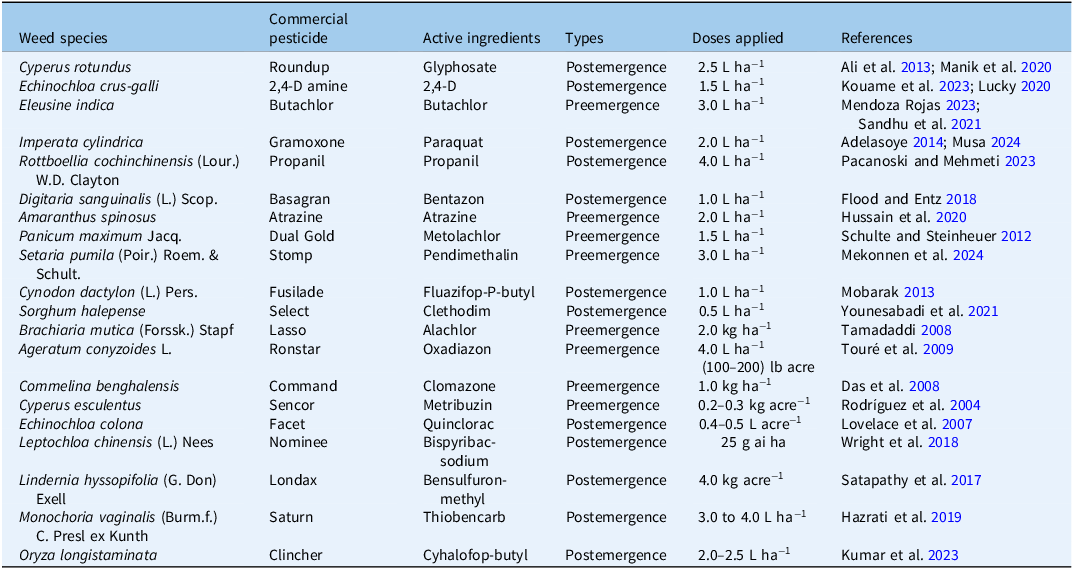
Chemical weed control mainly includes the use of herbicides, which despite the benefits provided has several drawbacks. Table 4 summarizes 20 common weed species with their effective herbicides, corresponding chemical commercial names, active ingredients, and recommended doses.
Commercial herbicides and their application rates for weed species in sub-Saharan Africa (SSA) rice fields.

Benefits of Chemical Weed Control in SSA Rice Systems
Chemical weed control offers significant advantages for rice production in SSA, particularly in addressing labor shortages and large-scale weed infestations. Herbicides such as glyphosate, 2,4-D, and butachlor provide efficient, cost-effective solutions that reduce the need for intensive manual weeding. Preemergence herbicides like butachlor form a protective soil barrier against annual grasses and broadleaf weeds, while postemergence herbicides such as glyphosate and 2,4-D directly target actively growing weeds, ensuring timely suppression. These practices have been shown to improve yields and productivity across the region; for example, glyphosate use in Nigeria has significantly reduced weed competition and boosted rice yields (Alagbo et al. Reference Alagbo, Akinyemiju and Chauhan2022a; Aster et al. Reference Aster, Osunde and Ngome2019; Rodenburg et al. Reference Rodenburg, Johnson, Dieng, Senthilkumar, Vandamme, Akakpo and Saito2019), while 2,4-D adoption in Ghana has enhanced control of broadleaf weeds, contributing to higher crop output (Chepkoech Reference Chepkoech2021; Obiri et al. Reference Obiri, Obeng, Oduro, Apetorgbor, Peprah, Duah-Gyamfi and Mensah2021). By increasing efficiency and reducing labor costs, herbicides play a critical role in IWM strategies across irrigated and rainfed rice systems.
Drawbacks of Chemical Weed Control in SSA Rice Systems
Despite these benefits, chemical weed control presents notable challenges related to sustainability, environmental safety, and human health. Overreliance on herbicides has led to the emergence of resistant weed species, as seen in Tanzania, where continuous glyphosate use resulted in resistant strains of purple nutsedge (Cyperus rotundus L.) (Lee and Thierfelder Reference Lee and Thierfelder2017). Misuse and improper application also pose risks to soil fertility and crop performance; in Uganda, butachlor misuse has contributed to soil degradation and declining rice yields (Isaasi (Reference Isaasi2011). Environmental concerns are widespread, with glyphosate residues in Kenyan water bodies harming aquatic ecosystems (Yarkwan Reference Yarkwan2023) and 2,4-D use in Ethiopia linked to soil contamination and reduced microbial health (Afata et al. Reference Afata, Mekonen, Sogn, Pandey, Janka and Tucho2024; Debebe et al. Reference Debebe, Alemayehu, Worku, Bae and Lennartz2023). Human health risks are equally pressing, as exposure to herbicides without protective equipment has caused skin irritation, respiratory problems, and poisoning among farmers in Malawi and Zambia (Heumesser and Kray Reference Heumesser and Kray2019; Moyo et al. Reference Moyo, Jeebhay, Baatjies, Dadabhai and Adams2023). These drawbacks point out the need for IWM approaches that combine chemical, mechanical, and cultural practices, while promoting safe handling and responsible herbicide use to mitigate long-term risks.
Biological Weed Control
Biological Control Agents’ Quality
Biological weed control offers an environmentally friendly alternative that relies on natural enemies such as insects, pathogens, and grazing animals to suppress weed growth (Abbas et al. Reference Abbas, Zahir, Naveed and Kremer2018). The effectiveness of this approach depends on the quality of the agents, which is determined by their host specificity, ability to establish and persist in the environment, and minimal impact on non-target organisms (Lahlali et al. Reference Lahlali, Ezrari, Radouane, Kenfaoui, Esmaeel, El Hamss and Barka2022). Successful examples include the weevil Rhinocyllus conicus against musk thistle (Carduus nutans L.) (Kok et al. Reference Kok, McAvoy and Mays1984; Westwood et al. Reference Westwood, Charudattan, Duke, Fennimore, Marrone, Slaughter and Zollinger2018), the fungal pathogen Puccinia chondrillina against skeleton weed (Chondrilla juncea L.) (Hasan Reference Hasan, Mukerji and Garg2023), and the release of Cyrtobagous salviniae weevils to control the invasive aquatic weed giant salvinia (Salvinia molesta Mitchell) (Motitsoe et al. Reference Motitsoe, Coetzee, Hill and Hill2020). Similarly, classical biological control, such as the introduction of Neochetina eichhorniae weevils for water hyacinth [Eichhornia crassipes (Mart.) Solms], has provided long-term suppression in African contexts (Njoka Reference Njoka2004). The success of these agents is strongly influenced by application methods—whether inundative releases for rapid suppression or classical introductions for sustained control—as well as environmental conditions such as climate, soil type, and interactions with other organisms (Harms et al. Reference Harms, Cronin, Diaz and Winston2020; Wagner and Mitschunas Reference Wagner and Mitschunas2008a). Careful selection, monitoring, and management are therefore essential to ensure effectiveness and minimize unintended consequences (Morin et al. Reference Morin, Reid, Sims-Chilton, Buckley, Dhileepan, Hastwell and Raghu2009).
Several successful examples of biological weed control highlight the potential of this approach. In Uganda, the release of C. salviniae weevils has helped manage the spread of S. molesta in lakes and rivers (Coetzee and Hill Reference Coetzee and Hill2020). In Tanzania, the introduction of the weevil R. conicus has successfully controlled C. nutans infestations (Westwood et al. Reference Westwood, Charudattan, Duke, Fennimore, Marrone, Slaughter and Zollinger2018). In Nigeria and Tanzania, the use of the beetle Zygogramma bicolorata has been effective in reducing the spread of parthenium weed (Parthenium hysterophorus L.) (Kanagwa et al. Reference Kanagwa, Kilewa and Treydte2020; Zachariades et al. Reference Zachariades, Uyi, Hill, Mersie and Molo2022). Finally, in Ethiopia, the release of the moth Cactoblastis cactorum has helped control the invasive cactus pricklypear [Opuntia stricta (Haw.) Haw.] (Zimmermann et al. Reference Zimmermann, Moran, Hoffmann, Rangaswamy Muniappan, Reddy and Raman2009). These examples demonstrate the effectiveness of biological control agents in managing weed populations and highlight the importance of selecting high-quality agents for successful weed management.
Disadvantages of Biological Weed Control Methods
Biological weed control methods, while environmentally friendly and sustainable, have several disadvantages (Hasan et al. Reference Hasan, Ahmad-Hamdani, Rosli and Hamdan2021). One major drawback is the slower response time compared to chemical herbicides (Davis and Frisvold Reference Davis and Frisvold2017). Biological agents, such as insects or pathogens, often take longer to establish and reduce weed populations, which can be problematic for farmers needing immediate results (Abbas et al. Reference Abbas, Zahir, Naveed and Kremer2018). Additionally, the effectiveness of biological control can be highly dependent on environmental conditions (Harms et al. Reference Harms, Cronin, Diaz and Winston2020). Factors such as temperature, humidity, and the presence of natural enemies can influence the success of biological agents (Harms et al. Reference Harms, Knight, Pratt, Reddy, Mukherjee, Gong and Diaz2021). For example, fungal pathogens such as P. chondrillina require moderate temperatures and high humidity for spore germination and host infection; low humidity or excessive heat reduces viability and infection rates (Harms Reference Harms2020; Wagner and Mitschunas Reference Wagner and Mitschunas2008b). Similarly, vinegar and clove oil biocontrol treatments show reduced weed mortality under low humidity and high temperatures (Brainard et al. Reference Brainard, Curran, Bellinder, Ngouajio, Vangessel, Haar, Lanini and Masiunas2013). Another inconvenience is the high initial cost associated with the acquisition and release of biological control agents (Sheppard et al. Reference Sheppard, Hill, DeClerck-Floate, McClay, Olckers, Quimby and Zimmermann2003). This can be a significant barrier for smallholder farmers (Ramadhani et al. Reference Ramadhani, Nassary, Rwehumbiza, Massawe and Nchimbi-Msolla2024). Furthermore, biological control methods require specialized knowledge and careful planning to implement successfully (Westwood et al. Reference Westwood, Charudattan, Duke, Fennimore, Marrone, Slaughter and Zollinger2018). Farmers need to understand the biology and ecology of both the weeds and the control agents, which can be complex and time-consuming (Ghosheh Reference Ghosheh2005). Finally, there is a risk of non-target effects, where the introduced biological agents may affect non-target plant species or beneficial organisms, potentially disrupting local ecosystems (Myers and Cory Reference Myers, Cory, Vilà and Hulme2017). Despite these challenges, biological weed control remains a valuable tool in IWM, particularly when combined with other sustainable practices (Harker and O’Donovan Reference Harker and O’Donovan2013).
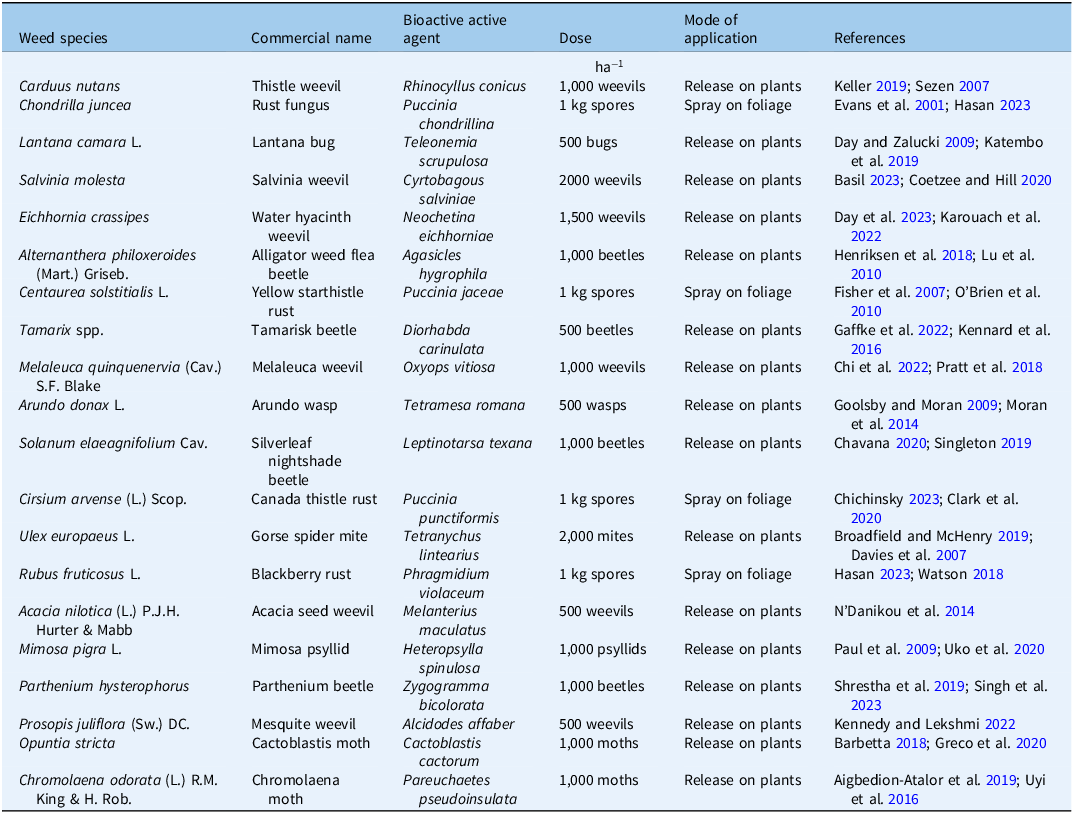
Table 5 shows some biopesticides and biological agents used to protect crops from weeds.
Comparison of Traditional, Chemical, and Biological Weed Controls
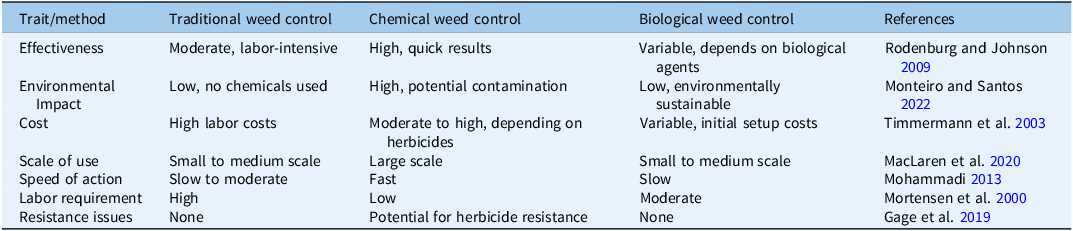
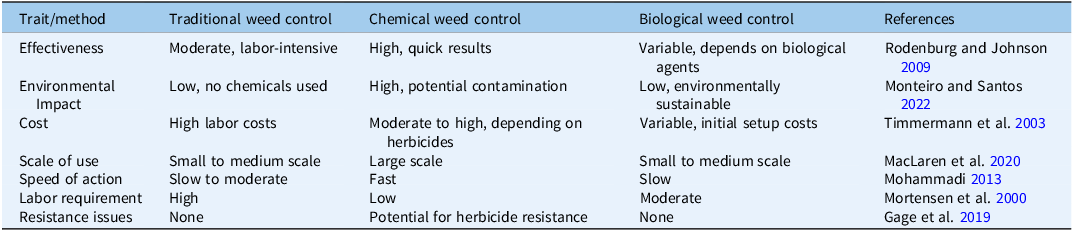
Table 6 summarizes the common traits and differences of these three weed control methods. Understanding these methods allows farmers and gardeners to choose the most appropriate weed control strategy based on their specific needs and circumstances. Each method has its place in IWM, contributing to sustainable and effective weed control practices.
Biopesticide application for weed management in sub-Saharan Africa (SSA) rice fields.
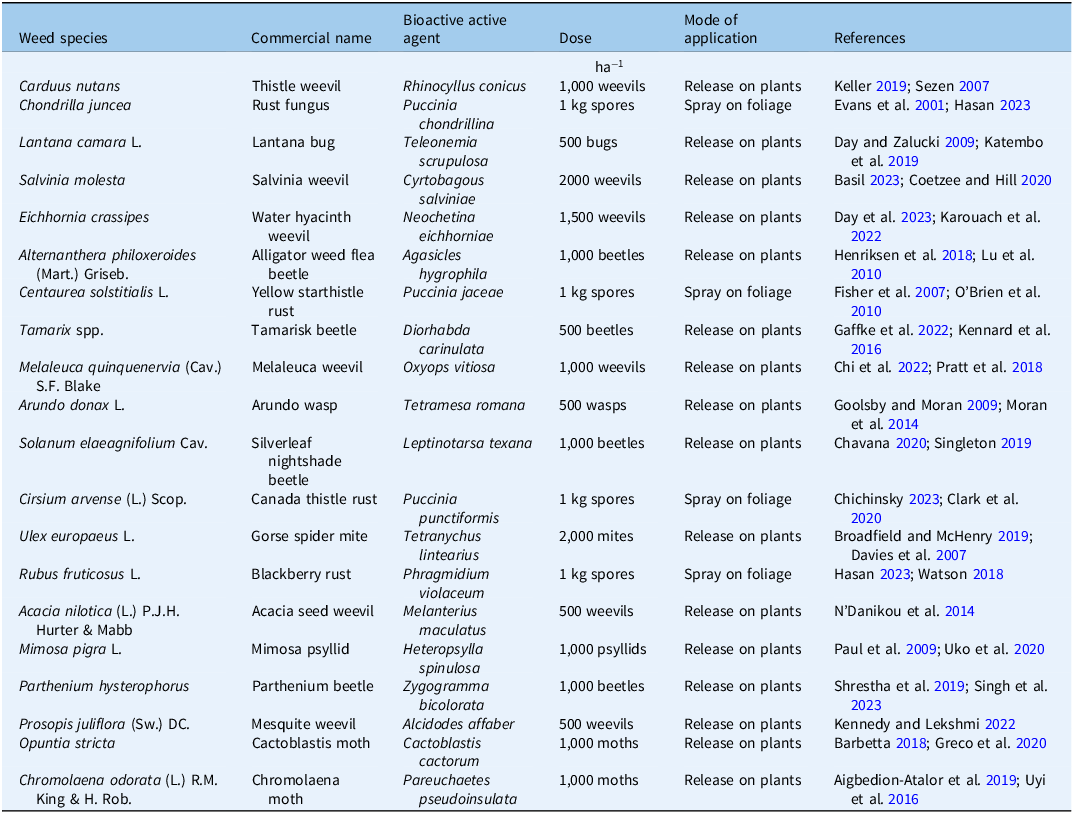
Table 5 Long description
The table has 19 rows and 6 columns. The columns are labeled Weed species, Commercial name, Bioactive active agent, Dose, Mode of application, and References. Row 1: Weed species, Carduus nutans; Commercial name, Thistle weevil; Bioactive active agent, Rhinocyllus conicus; Dose, 1,000 weevils; Mode of application, Release on plants; References, Keller 2019; Sezen 2007. Row 2: Weed species, Chondrilla juncea; Commercial name, Rust fungus; Bioactive active agent, Puccinia chondrillina; Dose, 1 kg spores; Mode of application, Spray on foliage; References, Evans et al. 2001; Hasan 2023. Row 3: Weed species, Lantana camara L.; Commercial name, Lantana bug; Bioactive active agent, Teleonemia scapulosa; Dose, 500 bugs; Mode of application, Release on plants; References, Day and Zalucki 2009; Katembo et al. 2019. Row 4: Weed species, Salvinia molesta; Commercial name, Salvinia weevil; Bioactive active agent, Cytobagous salviniae; Dose, 2000 weevils; Mode of application, Release on plants; References, Basil 2023; Coetzee and Hill 2020. Row 5: Weed species, Eichhornia crassipes; Commercial name, Water hyacinth weevil; Bioactive active agent, Neochetina eichhorniae; Dose, 1,500 weevils; Mode of application, Release on plants; References, Day et al. 2023; Karouach et al. 2022. Row 6: Weed species, Alternanthera philoxeroides (Mart.) Griseb.; Commercial name, Alligator weed flea beetle; Bioactive active agent, Agasicles hygrophila; Dose, 1,000 beetles; Mode of application, Release on plants; References, Henriksen et al. 2018; Lu et al. 2010. Row 7: Weed species, Centaurea solstitialis L.; Commercial name, Yellow starthistle rust; Bioactive active agent, Puccinia jaceae; Dose, 1 kg spores; Mode of application, Spray on foliage; References, Fisher et al. 2007; O'Brien et al. 2010. Row 8: Weed species, Tamarix spp.; Commercial name, Tamarisk beetle; Bioactive active agent, Diorhabda carinulata; Dose, 500 beetles; Mode of application, Release on plants; References, Gaffke et al. 2022; Kennard et al. 2016. Row 9: Weed species, Melaleuca quinquenervia (Cav.) S.F. Blake; Commercial name, Melaleuca weevil; Bioactive active agent, Oxyops vitiosa; Dose, 1,000 weevils; Mode of application, Release on plants; References, Chi et al. 2022; Pratt et al. 2018. Row 10: Weed species, Arundo donax L.; Commercial name, Arundo wasp; Bioactive active agent, Tetramesa romana; Dose, 500 wasps; Mode of application, Release on plants; References, Goolsby and Moran 2009; Moran et al. 2014. Row 11: Weed species, Solanum elaeagnifolium Cav.; Commercial name, Silverleaf nightshade beetle; Bioactive active agent, Leptinotarsa texana; Dose, 1,000 beetles; Mode of application, Release on plants; References, Chavana 2020; Singleton 2019. Row 12: Weed species, Cirsum arvense (L.) Scop.; Commercial name, Canada thistle rust; Bioactive active agent, Puccinia punctiformis; Dose, 1 kg spores; Mode of application, Spray on foliage; References, Chichinsky 2023; Clark et al. 2020. Row 13: Weed species, Ulex europaeus L.; Commercial name, Gorse spider mite; Bioactive active agent, Tetranychus lintearius; Dose, 2,000 mites; Mode of application, Release on plants; References, Broadfield and McHenry 2019; Davies et al. 2007. Row 14: Weed species, Rubus fruticosus L.; Commercial name, Blackberry rust; Bioactive active agent, Phragmidium violaceum; Dose, 1 kg spores; Mode of application, Spray on foliage; References, Hasan 2023; Watson 2018. Row 15: Weed species, Acacia nilotica (L.) P.J.H. Hurter & Mabb; Commercial name, Acacia seed weevil; Bioactive active agent, Melanterius maculatus; Dose, 500 weevils; Mode of application, Release on plants; References, N'Danikou et al. 2014. Row 16: Weed species, Mimosa pigra L.; Commercial name, Mimosa psyllid; Bioactive active agent, Heteropsylla spinulosa; Dose, 1,000 psyllids; Mode of application, Release on plants; References, Paul et al. 2009; Uko et al. 2020. Row 17: Weed species, Parthenium hysterophorus; Commercial name, Parthenium beetle; Bioactive active agent, Zygogramma bicolorata; Dose, 1,000 beetles; Mode of application, Release on plants; References, Shrestha et al. 2019; Singh et al. 2023. Row 18: Weed species, Prosopis juliflora (Sw.) DC.; Commercial name, Mesquite weevil; Bioactive active agent, Alcidodes affaber; Dose, 500 weevils; Mode of application, Release on plants; References, Kennedy and Lekshmi 2022. Row 19: Weed species, Opuntia stricta; Commercial name, Cactoblastis moth; Bioactive active agent, Cactoblastis cactorum; Dose, 1,000 moths; Mode of application, Release on plants; References, Barbetta 2018; Greco et al. 2020. Row 20: Weed species, Chromolaena odorata (L.) R.M. King & H. Rob.; Commercial name, Chromolaena moth; Bioactive active agent, Pareuchaetes pseudoinsulata; Dose, 1,000 moths; Mode of application, Release on plants; References, Aigbedion-Atalor et al. 2019; Uyi et al. 2016.
Comparison of weed control methods in sub-Saharan Africa (SSA) rice production.
IWM
IWM is a comprehensive approach to controlling weeds by integrating two or more weed management strategies to optimize effectiveness while minimizing economic, health, and environmental risks (Monteiro and Santos Reference Monteiro and Santos2022). IWM combines cultural, mechanical, biological, and chemical methods to manage weed populations sustainably (Scavo and Mauromicale Reference Scavo and Mauromicale2020). This approach is crucial in addressing the limitations of relying solely on chemical herbicides or cultural weed control practices, which can lead to herbicide resistance, environmental contamination, and limited performance (Korres et al. Reference Korres, Travlos and Gitsopoulos2023).
IWM Strategies
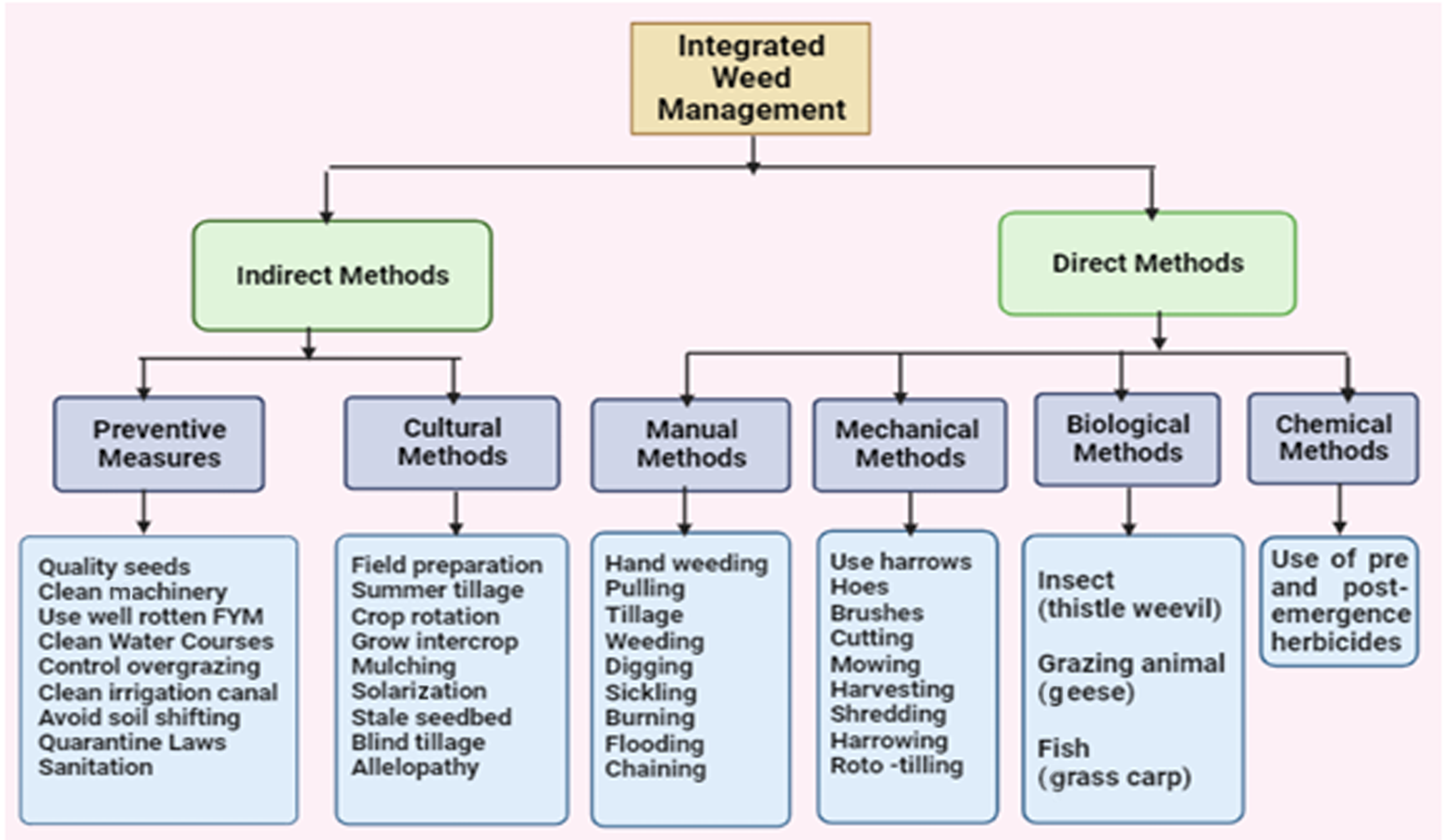
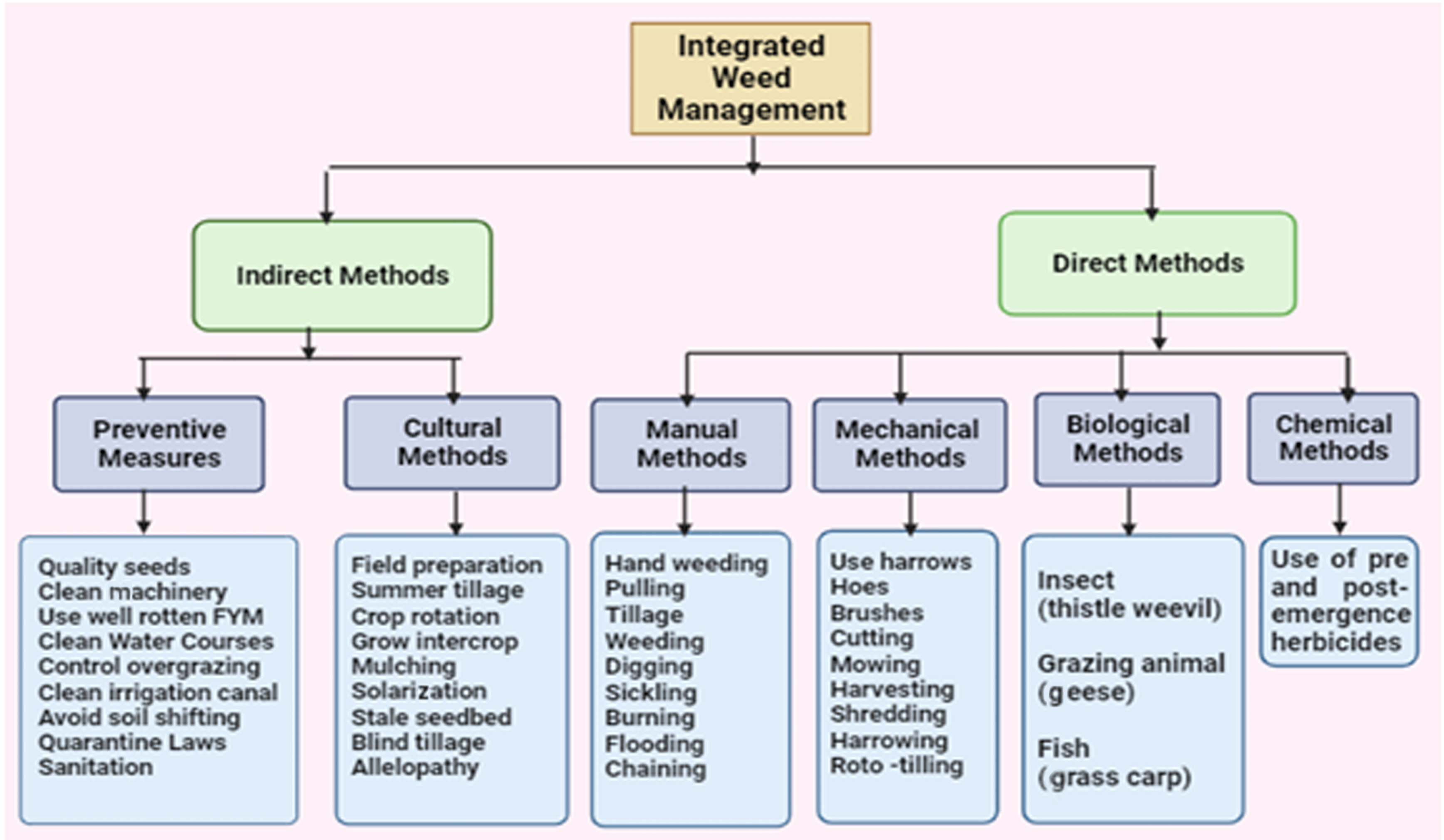
IWM strategies provide essential frameworks for effective weed control, with notable models proposed by Coleman et al. (Reference Coleman, Kristiansen, Sindel and Fyfe2024), A Kaur et al. (Reference Kaur, Singh, Menon and Kumari2024, and Nayak et al. (Reference Nayak, Tiwari, Parte, Chouhan, Kumar, Verma and Pandey2024). Kaur et al. (Reference Kaur, Kumar, Ali, Kumar, Ezing, Bana and Singh2024) emphasize the integration of conventional and nonconventional methods, highlighting diverse cropping systems, cultivar selection, soil and field management, direct control, monitoring, and the adoption of emerging technologies such as precision agriculture, genomics, and robotics. Figure 2 presents a model of IWM strategies.
Integrated weed management (IWM) strategies.
Source: A Kaur et al. (Reference Kaur, Singh, Menon and Kumari2024).
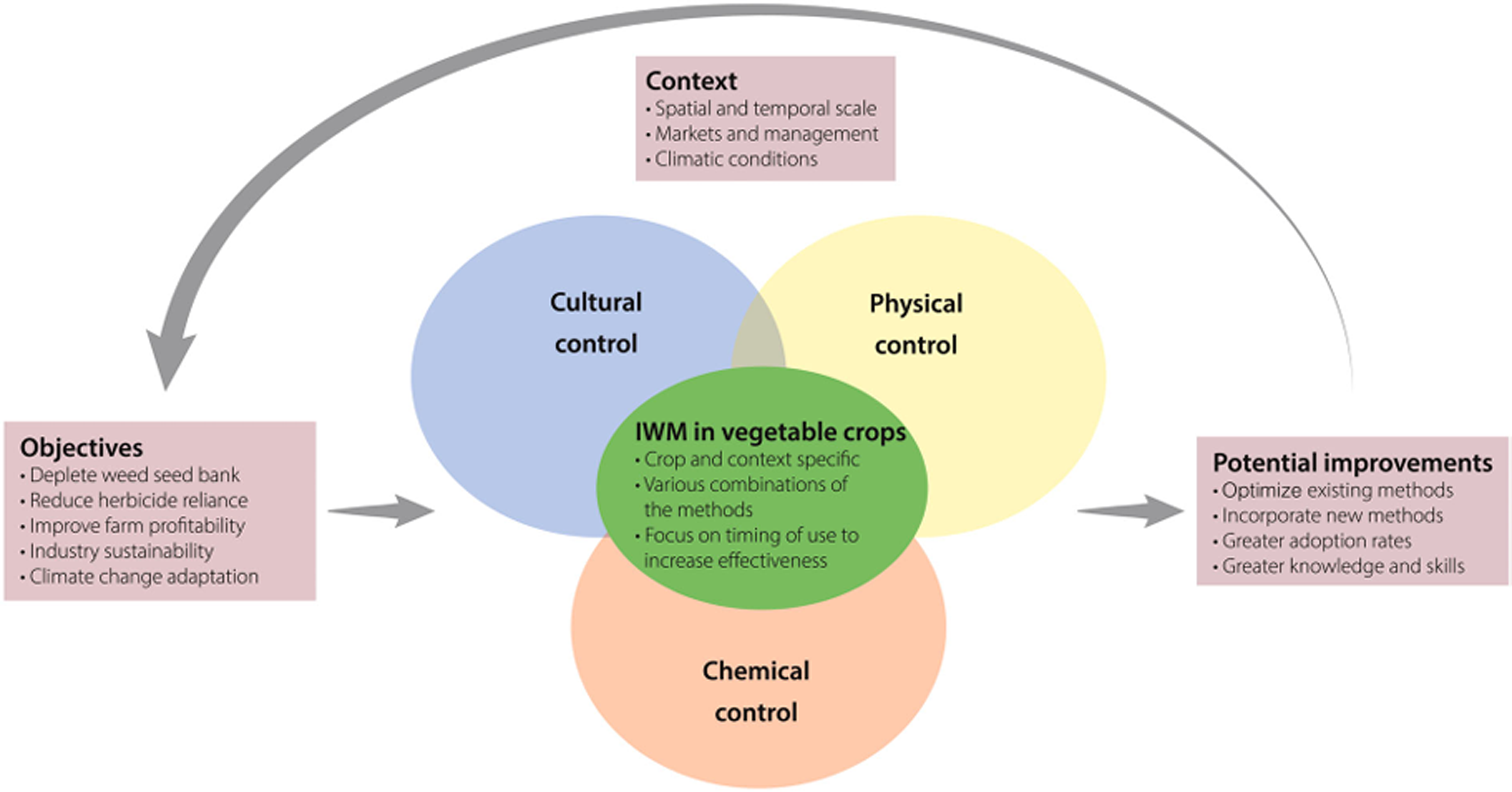
Coleman et al. (Reference Coleman, Kristiansen, Sindel and Fyfe2024) focus on ecological and economic dimensions, integrating biological, cultural, physical, and chemical tools while promoting interdisciplinary research and modern technologies to reduce dependence on herbicides and enhance sustainability. Figure 3 shows a model that imphasized on the ecological and economic aspects of IWM in the vegetable production system.
Conceptual diagram of integrated weed management (IWM) in vegetable production systems.
Source: Coleman et al. (Reference Coleman, Kristiansen, Sindel and Fyfe2024).

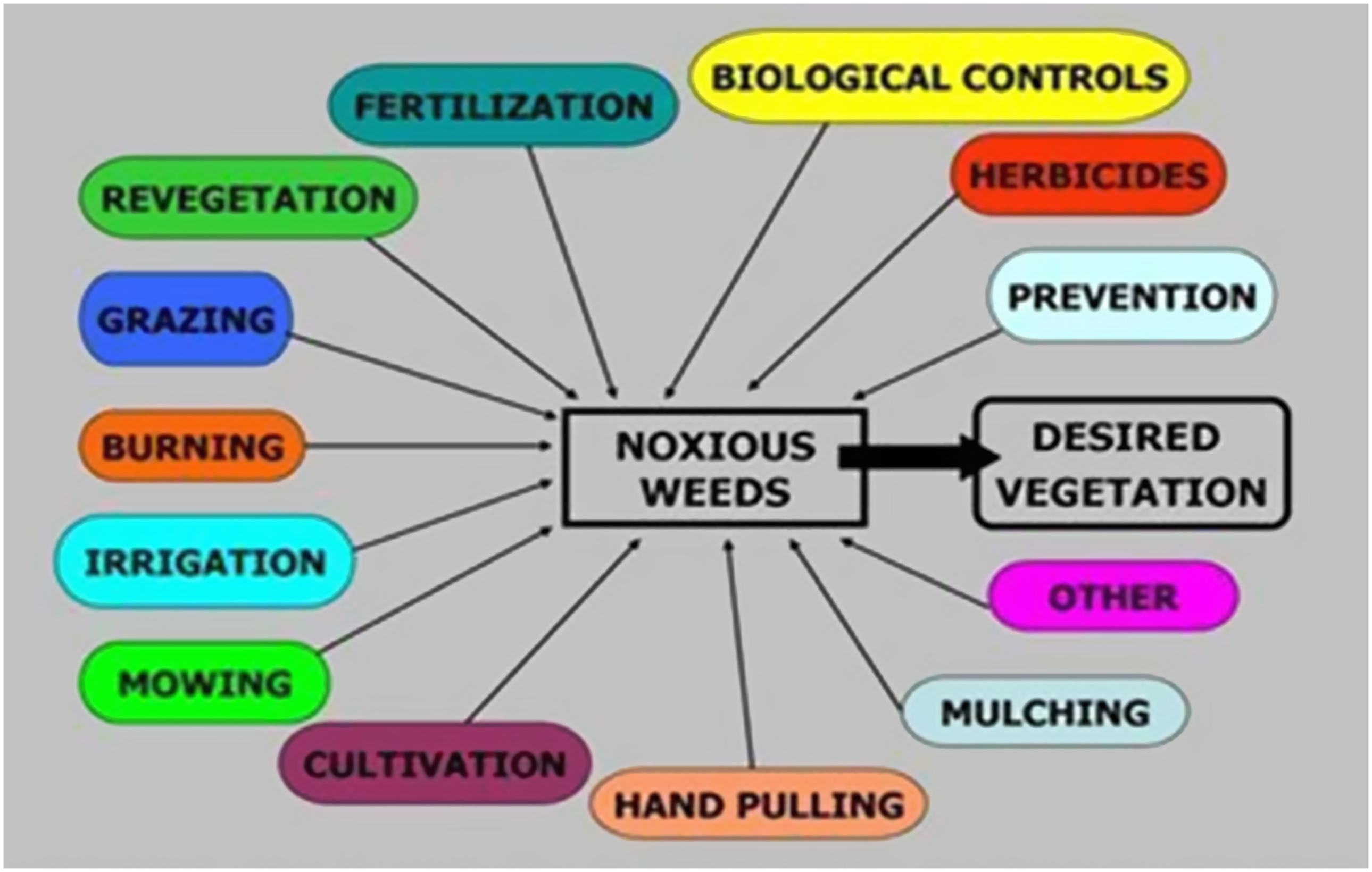
Nayak et al. (Reference Nayak, Tiwari, Parte, Chouhan, Kumar, Verma and Pandey2024) expand traditional IWM frameworks by incorporating management, business, and sustainability considerations, stressing the importance of research, outreach, and communication tools to ensure economic viability, environmental safety, and social acceptability. Collectively, these models demonstrate the need for integrated, technologically advanced, and socially responsive approaches to sustainable weed management. Figure 4 provides an overview of all elements of the IWM.
Introduction to integrated weed management (IWM).
Source: Nayak et al. (Reference Nayak, Tiwari, Parte, Chouhan, Kumar, Verma and Pandey2024).

Case Studies and Success Stories
Nigeria’s Integrated Rice Management
Combining mechanical weeding, improved rice varieties, and judicious herbicide use has enhanced rice production and reduced weed pressure (Ogunkunle Reference Ogunkunle2016; Zenna et al. Reference Zenna, Senthilkumar, Sie, Chauhan, Jabran and Mahajan2017).
IWM in Irrigated Rice Fields of Middle Awash, Ethiopia
A study conducted at the Werer Agricultural Research Center demonstrated that integrating pre-irrigation with two-hand weeding significantly improved weed control efficiency, reducing yield loss by 88% and thereby enhancing rice productivity while minimizing dependence on herbicides (Taye et al. Reference Taye, Hemba and Alemu2024).
Biological and Cultural Weed Control in West African Rice Systems
Research highlights the effectiveness of combining biological control methods with cultural practices such as stale seedbeds and mechanical weeding to suppress weed growth in rice fields (Ismail and Abdullah Reference Ismail and Abdullah2020). This strategy has improved yields and reduced environmental impact.
Herbicide Rotation and Agroecological Approaches in East Africa
Farmers in East Africa have successfully implemented herbicide rotation alongside agroecological techniques such as mulching and intercropping to manage weeds in rice paddies (Mahajan et al. Reference Mahajan, Chauhan, Kumar, Chauhan and Mahajan2014). This approach had led to more sustainable rice production.
Participatory Weed Management in Smallholder Rice Farms
A participatory action research project in SSA has helped farmers adopt IWM strategies, including conservation tillage and manual weeding, leading to improved soil fertility and weed suppression (Ismail and Abdullah Reference Ismail and Abdullah2020).
Integrated Weed Control in Direct-Seeded Rice Systems
Direct-seeded rice is gaining popularity due to labor shortages, but weed competition remains a challenge. Studies show that combining pre-irrigation, selective herbicide application, and manual weeding significantly enhances weed control and boosts rice yields (Taye et al. Reference Taye, Hemba and Alemu2024).
Precision Agriculture and Technology
The introduction of precision agriculture and technology in weed management has significantly improved efficiency while addressing challenges such as environmental pollution and cost-effectiveness. By leveraging AI-driven analytics, unmanned aerial vehicle (UAV)-based weed mapping, and site-specific herbicide application, farmers can precisely target weed infestations, reducing excessive chemical usage and minimizing soil and water contamination (Upadhyay et al. Reference Upadhyay, Zhang, Koparan, Rai, Howatt, Bajwa and Sun2024). Technologies like autonomous weeding robots and smart sprayers optimize resource allocation, ensuring herbicides are applied only where needed, cutting costs and preventing herbicide resistance (Meesaragandla et al. Reference Meesaragandla, Jagtap, Khatri, Madan and Vadduri2024; Perez-Ruiz et al. Reference Perez-Ruiz, Martínez-Guanter, Upadhyaya, Petropoulos and Srivastava2021). Automated weeding robots, like those developed by Blue River Technology (a John Deere company, https://www.bluerivertechnology.com ), use machine learning algorithms to distinguish between crops and weeds, applying herbicides only where needed (Sfiligoj and Heacox Reference Sfiligoj and Heacox2016). Rice production has benefited from precision weed management strategies in the U.S. region where it is applied.
Precision agriculture has been successfully implemented in Nigeria, where farmers use GPS-guided tractors to manage weed infestations more efficiently (Abdullahi Reference Abdullahi2020; Manu et al. Reference Manu, McDanel, Brummel, Avornyo and Lawler2024). In South Africa, the use of drones for precision spraying has led to significant reductions in herbicide use and improved crop yields (Blaker Reference Blaker2021; Buitendag Reference Buitendag2024). Additionally, variable-rate spraying using UAVs has emerged as a key method for rice weed control, reducing excessive spraying and environmental harm (Guo et al. Reference Guo, Cai, Bai, Xu and Yu2024). These advancements contribute to more sustainable, cost-efficient, and eco-friendly farming systems.
Therefore, precision agriculture offers promise for weed management in SSA rice systems, but its adoption among smallholders is constrained by socioeconomic and infrastructural barriers. High capital costs and limited access to credit make technologies such as UAVs and autonomous robots unaffordable, while fragmented landholdings reduce economies of scale. Inadequate rural infrastructure—poor electricity, weak broadband, and limited GNSS coverage—further restricts deployment. Skills gaps and weak extension services hinder farmers’ ability to interpret digital data, and regulatory constraints on UAV use add complexity (Aroba and Rudolph Reference Aroba and Rudolph2024; Ofori and El-Gayar Reference Ofori and El-Gayar2021).
Policy, Research, Extension Services, and the Private Sector
Government policies, extension services, the private sector, and collaboration with research institutions all play crucial roles in enhancing weed management practices and ensuring sustainable agricultural development.
Role of Government Policies in Weed Management
Government policies are pivotal in shaping weed management strategies (Westwood et al. Reference Westwood, Charudattan, Duke, Fennimore, Marrone, Slaughter and Zollinger2018). Policies that promote sustainable agricultural practices, provide subsidies for eco-friendly weed control methods, and support research and development are essential (Ononogbo et al. Reference Ononogbo, Ohwofadjeke, Chukwu, Nwawuike, Obinduka, Nwosu and Eze2024). For instance, policies that encourage the use of IWM techniques can help reduce reliance on chemical herbicides, thereby minimizing environmental impact and promoting biodiversity (Scavo and Mauromicale Reference Scavo and Mauromicale2020). Several policies in SSA provide incentives for IWM to promote sustainable agriculture and reduce reliance on chemical herbicides. Governments in this region have implemented various policies to support sustainable agriculture, such as the Comprehensive Africa Agriculture Development Program (CAADP), which aims to improve agricultural productivity and sustainability (Kimenyi et al. Reference Kimenyi, Routman, Westbury, Omiti and Akande2013). Agroecology and conservation agriculture policies in countries like Kenya and Ethiopia support cover cropping, mulching, and intercropping, which are essential components of IWM (Kumar and Nedunchezhiyan Reference Kumar and Nedunchezhiyan2021; Otieno Reference Otieno2023). National agricultural extension programs also promote integrated pest and weed management strategies, offering farmers training and financial support for crop rotation and manual weeding (Bèye and Wopereis Reference Bèye and Wopereis2014). Research and development grants fund studies on alternative weed control methods, such as herbicide-resistant crops and precision agriculture, to enhance IWM adoption (MacLaren Reference MacLaren2018). Some policies also focus on land tenure security, allowing farmers to invest in long-term sustainable weed management without fear of losing their land (Gandure et al. Reference Gandure, Walker and Botha2013; Olumba et al. Reference Olumba, Garrod and Areal2024). Additionally, regulatory frameworks that facilitate the registration and use of biological control agents can enhance the adoption of sustainable weed management practices (Baker et al. Reference Baker, Green and Loker2020).
Extension Services and Farmer Education
Extension services are critical tools in disseminating knowledge and technologies to farmers (Ugwoezuonu and Obodoechi Reference Ugwoezuonu and Obodoechi2024). Effective extension services provide farmers with the necessary information on sustainable weed management practices, including the use of cover crops, crop rotation, and precision agriculture technologies (Askarzadeh et al. Reference Askarzadeh, Jones, Sahraei, Abdalla and Nafchi2024). Farmer education programs, workshops, and field demonstrations help farmers understand the benefits of these practices and how to implement them effectively (Lukuyu et al. Reference Lukuyu, Place, Franzel and Kiptot2012). In SSA, initiatives like the African Forum for Agricultural Advisory Services (AFAAS) have been instrumental in enhancing the capacity of extension services to deliver relevant and timely information to farmers (Lamboll et al. Reference Lamboll, Nelson, Gebreyes, Kambewa, Chinsinga, Karbo and Martin2021). Additionally, digital tools and mobile applications are increasingly being used to provide farmers with real-time advice and support, further improving the reach and effectiveness of extension services (Mapiye et al. (Reference Mapiye, Makombe, Molotsi, Dzama and Mapiye2023). Providing education and resources to farmers on the benefits and implementation of traditional methods can also improve their effectiveness and adoption (Chauhan et al. Reference Chauhan, Matloob, Mahajan, Aslam, Florentine and Jha2017; Ervin and Frisvold Reference Ervin and Frisvold2016).
Collaboration with Research Institutions
Collaboration between governments, extension services, and research institutions is vital for developing and implementing effective weed management strategies (Ervin and Frisvold Reference Ervin and Frisvold2016; Westwood et al. Reference Westwood, Charudattan, Duke, Fennimore, Marrone, Slaughter and Zollinger2018). Research institutions play a key role in conducting studies on weed biology, ecology, and control methods, providing the scientific basis for sustainable weed management practices (Chauhan et al. Reference Chauhan, Matloob, Mahajan, Aslam, Florentine and Jha2017). Partnerships with institutions like the International Institute of Tropical Agriculture (IITA) and the Africa Rice Center (WARDA) have led to the development of innovative weed management technologies tailored to the specific needs of SSA farmers (Rodenburg and Saito Reference Rodenburg and Saito2022; Tollens et al. Reference Tollens, Menete, Sachdeva, Courtois, Ncube and Hasegawa2007). For example, IITA’s Sustainable Weed Management Technologies for Cassava Systems project has successfully introduced relevant weed control methods that are both effective and environmentally sustainable (Andam et al. Reference Andam, Agbara, Nwagboso, Spielman, Olanrewaju, Amailo and de Brauw2024).
Private Sector
The private sector plays a crucial role in advancing weed management strategies and ensuring sustainable agricultural development in rice production across SSA (Balasubramanian et al. Reference Balasubramanian, Sie, Hijmans and Otsuka2007). Given the persistent challenges of weed infestations, labor shortages, and limited access to effective control technologies, private enterprises drive innovation, investment, and knowledge dissemination (Philip et al. Reference Philip, Jayeoba, Ndripaya and Fatunbi2018). Through collaborations with research institutions and agricultural organizations, private companies facilitate the development of herbicide-resistant rice varieties, IWM solutions, and precision agriculture technologies tailored to local conditions (Rodenburg and Johnson Reference Rodenburg and Johnson2009). Agrochemical firms contribute by improving the accessibility of environmentally friendly herbicides, promoting safe application techniques, and investing in farmer education programs (Ogwuike et al. Reference Ogwuike, Rodenburg, Diagne, Agboh-Noameshie and Amovin-Assagba2014). Additionally, agribusiness investments in extension services and supply-chain logistics help bridge gaps in smallholder farmer access to timely weed management resources, fostering resilience against yield losses (Sanusi et al. Reference Sanusi, Mayokun, Sunmonu, Yerima, Mobolaji and Olaoye2025). Digital platforms and data-driven advisory tools further empower farmers with real-time weed control recommendations, enhancing productivity while mitigating environmental impacts (Rodenburg and Johnson Reference Rodenburg and Johnson2009). However, sustained progress requires transparent policies and collaborative frameworks that align private sector initiatives with national agricultural strategies, ensuring equitable distribution of resources and long-term viability (Diao et al. Reference Diao, Kennedy, Cossar, Badiane, Cossar, Dorosh, Ecker, Hagos, Headay, Mabiso, Makombe, Malek and Schmidt2013). Strengthening public–private partnerships can accelerate the adoption of climate-smart weed management practices, securing food production and economic stability for rice-growing communities in SSA (Ogwuike et al. Reference Ogwuike, Rodenburg, Diagne, Agboh-Noameshie and Amovin-Assagba2014).
Conclusion and Future Directions
Winning the war on weeds is fundamental to achieving sustainable rice production and food security in SSA. IWM stands out as the most effective approach, combining biological, cultural, mechanical, and chemical strategies to address the diverse weed challenges faced by rice farmers in the region. By minimizing overreliance on herbicides, IWM reduces the risks of resistance development and environmental degradation while fostering long-term soil health and maximizing crop yields. However, the adoption of such practices remains limited by systemic barriers, including knowledge gaps, accessibility of technologies, and resource constraints among smallholder farmers. Government support, strengthening advisory systems, including robust extension services, and strong collaboration with research institutions and the private sector are critical for scaling up sustainable weed management across SSA.
Future efforts should prioritize the development of locally tailored, cost-effective weed control methods suitable for smallholder conditions. Detailed studies on the biology and ecology of dominant weed species will underpin the development of targeted control strategies. Emerging technologies such as precision agriculture and innovative biological control agents hold significant promise and warrant further exploration and adaptation to local contexts. Understanding the socioeconomic impacts of various weed management options will be essential for designing interventions that are both effective and farmer friendly. To accelerate progress, a multipronged strategy is needed. Policy makers should enact supportive frameworks and incentives for IWM adoption, while extension services must be strengthened to bridge gaps in farmer knowledge and technology transfer. Partnerships with the private sector can drive investment in the development, distribution, and accessibility of IWM tools and foster public–private partnerships to amplify impact. Successful models, such as the use of precision farming techniques in Nigeria, provide scalable examples that can inspire broader implementation across the region. By embracing integrated, innovative, and inclusive weed management strategies, SSA can make significant strides toward better-quality rice production, food security, and improved farmer livelihoods.
Acknowledgments
The authors express their profound gratitude to the AfricaRice Center (AfricaRice) for sponsoring this paper, highlighting the center’s essential efforts to disseminate knowledge and scientific innovations for reducing weeds in rice and improving global food security.
Funding
This research received no specific grant from any funding agency, commercial, or not-for-profit sectors.
Competing interests
The authors declare no conflicts of interest.

 Open access

