





At a rally in the summer of 1935, Wilhelm Karl Ernst Münzer, the Nazi Party district leader of Osnabrück, denied reports of escalating violence against Jews. He erroneously told the 25,000 people gathered there that ‘nothing has happened to any Jew’ and said that the actions carried out by Nazi agents actually targeted non-Jewish Germans instead. Those actions were necessary, he said, for ‘the education of the German human being, who for decades has been contaminated by Jewish poison and is now to be freed from this poison by radical treatment’.Footnote 1 As an example of such radical but necessary treatment, Münzer invoked the practice of photographing customers who entered Jewish-owned stores and publicly displaying their pictures. Münzer argued that this had to be done to warn them and all other non-Jewish Germans ‘that they have not yet recognised the great German mission’.Footnote 2 That mission, the transformation of German society into an exclusionary and racist one, could only be achieved, Münzer implied, if non-Jewish Germans were prepared to turn on each other as well as against Jews.
In 1933, Nazi officials began bullying Germans into severing ties with Jewish friends and neighbours to hasten the isolation of Jews from German public life. They used photography to achieve both goals, not just to harass and humiliate Jews, but to monitor and shame non-Jewish Germans as well. The practice of photographic denunciation, in which Nazi leaders and functionaries took and displayed pictures of non-Jewish Germans shopping at Jewish-owned businesses, helped destroy the remaining bonds between non-Jewish and Jewish Germans.Footnote 3 Enacted from 1933–8 in Germany and beyond German borders during the Second World War, photographic denunciation successfully turned non-Jewish Germans against their Jewish neighbours and colleagues, a key precursor to the ability of the Nazi regime to perpetrate the Holocaust.Footnote 4
Europe's long history of public shaming helped make photographic denunciation as effective as it became in Nazi Germany. From printing the names and addresses of residents who failed to pay their taxes in newspapers to parading wrongdoers through town with signs around their necks describing the crime they had committed, Europeans experienced and witnessed all kinds of public shaming practices throughout the early and late modern period.Footnote 5 The pillory, a wooden structure in which offenders were imprisoned and exposed to public abuse, was a particularly common shaming method. One north German woman was sentenced to the pillory in 1778, for example, for having defamed the character of a local councillor.Footnote 6 The Nazis revived these practices to create symbolic pillories of their own that would help forge a new consensus over who did and did not belong in German society. Photographing customers who entered Jewish-owned businesses was one way of building that consensus.
The Nazis were not the first to photograph customers for antisemitic purposes. Two earlier accounts of the practice date from the beginning of the twentieth century in the Czech lands. At Christmas-time in 1908 in the town of Kolin near Prague, for example, members of a women's association organised a ‘shop watch’ and took photographs of Christian shoppers who entered Jewish-owned businesses. Another ‘shop watch’ took place just before Christmas the following year in the town of Cheb, then part of the German-speaking Egerland region.Footnote 7
The 1 April 1933 blockade of Jewish-owned businesses and firms gave the Nazis their first public opportunity after Hitler came to power to introduce the practice.Footnote 8 During the blockade, Nazi stormtroopers beat and murdered Jews, defaced Jewish-owned property and posted antisemitic signs such as ‘Don't Buy from Jews’ and ‘The Jews Are Our Misfortune’ to businesses, residences and offices.Footnote 9 SA men also stood menacingly near the entrances and taunted those who ignored them and went inside anyway. As historians have already noted, their threats failed to persuade many non-Jewish Germans to take their business elsewhere.Footnote 10
Photographing customers would prove to be a more intimidating method than taunts or threats alone. Many SA men had cameras with them as they stood in front of Jewish-owned businesses and photographed those who entered the premises. Karl Weiler, for example, saw the SA men who stood outside his father's law firm take pictures of everyone who went inside.Footnote 11 Nazi agents also labelled some businesses with placards that read ‘Jewish business! Whoever shops here will be photographed!’Footnote 12 Occasionally, SA men threatened customers with the prospect of recording them on film as well, as indicated by an April 1933 photograph showing SA troopers setting up a movie camera outside a Jewish-owned business.Footnote 13 The easy reproducibility and accessibility of still photographs, however, made it the preferred medium for these actions.
The images made by SA photographers then appeared in Der Stürmer. Julius Streicher's grotesque tabloid had been peddling antisemitic caricatures, conspiracy theories and smear campaigns against local Jews in German economic, cultural and political life since it first emerged in 1923. The photographs of customers entering Jewish-owned shops appeared in a column called ‘They Bought from Jews’, which featured snapshots of people shopping in cities or towns throughout Germany. The pictures also appeared in Der Stürmer's ‘pillory’ boxes, which ensured that such images would be visible even to those who did not subscribe to the publication.Footnote 14 The boxes held the latest issues of Der Stürmer as well as antisemitic slogans such as ‘the Jews are our misfortune’ and ‘whoever buys from Jews is a traitor to the Fatherland’.Footnote 15 Additional accounts indicate that they also projected images before films at cinemas and posted them on bulletin boards and other public areas in town squares.Footnote 16
Taking and displaying pictures of customers shopping at Jewish-owned businesses advanced the Nazi dispossession of German Jews.Footnote 17 The antisemitic legislation that began to take effect in 1933 deprived Jews of their citizenship, livelihood and property to hasten their social isolation, impoverishment and, until 1941, their departure from Germany. Accomplishing this required either the active compliance or passive indifference of enough non-Jewish Germans. And if non-Jewish Germans failed to voluntarily alter their behaviour towards Jews in line with Nazi policy, the Nazis tirelessly shamed and bullied them until they did. Photographing them helped accomplish this.Footnote 18 Ultimately, the willingness of former customers and colleagues to stop going to Jewish-owned businesses or firms directly helped to facilitate their ruin.
The threat of public identification through photographs prompted even those Germans who had initially displayed courageous opposition to the Nazis to alter their behaviour towards Jews. Civil servant and Hitler Youth member Walter Sanders, for instance, recalled that, in Krefeld-Ürdigen during the April blockade, there were signs placed out front warning shoppers not to buy from Jews. ‘We did so anyway’, Sanders recalled. When asked about the SA photographing customers, however, Sanders replied that if it was known that SA men with their cameras would be there, ‘then nobody would shop at Jewish stores’.Footnote 19 And while the practice aspired to expose both men and women, it disproportionately singled out women, for they were more likely to do the shopping. Hannelore Schöttgen, for example, remembered accompanying her mother on the day of the April blockade into the centre of town to shop for groceries. After the pair encountered SA men blocking the entrance to Jewish-owned markets, her mother told her that they would shop there anyway. Two SA men took pictures of her mother after they left the market, however, and the pictures were shown at the cinema that evening.Footnote 20 The images of Hannelore's mother appeared with captions that read, ‘this lady shows no shame, she still buys her provisions in Jewish-run stores’.Footnote 21 That night she received a call from her husband's boss, who told her that pictures of her had been displayed during the film and warned her that ‘the wife of a German educator does not buy in Jewish shops’.Footnote 22 From then on, she sent Hannelore to do the shopping, mistaken in her belief that SA men would not photograph children. Her case was not an isolated one, for Nazi agents frequently used photographs of women customers to threaten them with the loss of their husbands’ jobs if they continued shopping there.Footnote 23 In other cases, women who had purchased goods from Jewish-owned shops came back to return them later following similar photograph-based harassment.Footnote 24
Jewish Germans themselves noticed the extent to which the practice had altered the behaviour of their neighbours. Jürgen Bassfreund, for example, remembered seeing people who entered a Jewish-owned butcher shop in Cologne being photographed. According to Bassfreund, the practice ended that shop's business. ‘It was all done by the party, you know?’, he recalled. ‘Photograph the people going in that store to make sure that no German would buy in that store. And this guy lost his business because he had an extremely busy store, and he had good merchandise, good meats, and everything.’Footnote 25 Raffael Miberlin, who lived with his family in Germany near the French border, shared this view. ‘To make their threats effective’, he recounted, ‘they brought in people with cameras to take pictures of the people who still dared enter. They shouted out that these photos would be published in Streicher's newspaper . . . of course, the flow slowed to a trickle at once.’Footnote 26
That photographic denunciation did alter the behaviour of non-Jewish Germans testifies to the power of photography as a tool of social control.Footnote 27 To be caught on camera shopping at a Jewish-owned business was to provide visual evidence for civilians and state authorities alike of having broken the rules of membership in the Nazi racial community (Volksgemeinschaft). Publicly displayed photographs opened violators to potential retaliation and ostracism not just from those who already knew them but from total strangers as well, risks that the very act of being photographed facilitated too.
The chaotic inaccuracy of photographic denunciation also contributed to its efficacy. The Nazi regime's pseudoscientific reliance on appearances to distinguish non-Jewish from Jewish Germans ensured that SA men as well as civilians regularly mistook Jews for ‘Aryan’ Germans, a confusion that only helped the Nazis sow fear and terrorise Jews even more. Mrs. M. Chown, for example, recalled that she made her ‘debut as an Aryan’ during the 1 April blockade. That morning, she went to a Jewish-owned department store and was photographed exiting the building as the crowd outside shouted at her for being a ‘Judenknecht’ (Jew slave). ‘When I answered back “Why shouldn't I, I'm Jewish too”’, she remembered, ‘they weren't listening, and quite a considerable brawl developed when several gentlemen intervened to clear a path for me.’ The next day her picture appeared in a Der Stürmer box.Footnote 28 Raffael Mibberlin, too, remembered how the crowd outside a Jewish-owned shop mistook his wife, who was Jewish, for a non-Jewish German and attacked her for it. ‘By the time she left the store’, he recounted,
a huge crowd had assembled in the back alley, and they greeted my wife with catcalls, spat on her, tore off her hat, and started attacking her physically. She cried out, ‘what do you want from me, I'm a Jew’ [but] they didn't believe her at first because of her appearance, then they shouted, that's a lie, she just wants to slink away like a coward.Footnote 29
Such accusations of cowardice could not have been further from the truth, for the Jewish women involved in these incidents possessed remarkable bravery when they confronted their accusers. In another courageous display, Jürgen Bassfreund saw a woman reprimand the SA man who photographed her as she left a Jewish-owned butcher shop for having ‘wasted his film’ because she was Jewish.Footnote 30
Like the 1 April blockade itself, photographic denunciation continued after 1933. It remained a fixture for local Nazis as they instigated unofficial ‘boycotts’ of Jewish-owned businesses and firms throughout the 1930s, especially in the German provinces.Footnote 31 That contradicted official promises to halt antisemitic violence and disruptions to the German economy in response to domestic and international criticism.Footnote 32 Concerned that they were losing control over the violent outbursts against local Jewish businesspeople, even some within the Gestapo called for an end to the excessive individual actions. Aware of rising complaints of SA men taking pictures of customers, the Gestapo in Stettin, for instance, noted that ‘such impairment of the Jewish companies not only contradicts the repeated declarations of the Reich government . . . but also supplies new justification for the boycott against German goods carried out abroad’.Footnote 33 The Nazis had no intention, of course, of slowing their attacks on Jews. They merely wanted to control those attacks and how violent they became.
They also wanted to control the narratives that could be made about them. In autumn 1934, several Jewish businessmen reported customers being photographed in front of their stores to the local police and to the District Economic Advisor in the Königsberg branch of the Nazi Party. Not yet knowing how far the regime would go in attacking them, they hoped to secure some official intervention.Footnote 34 While the police initially intervened, the photographers returned after they left and kept taking pictures.Footnote 35 The Königsburg Nazis, moreover, replied that the photographs were necessary to disprove rumours that antisemitic blockades were still happening in Germany. ‘As you may know, rumours are still widely spread abroad today that boycotts of Jewish shops are still in effect’, they wrote, adding that ‘the turnover of Jewish shops has increased significantly this year, which is the best proof of the tolerance of the National Socialist government. The photographers just want to capture that fact through pictures.’Footnote 36 The exchange indicates that as the Nazis’ racist blockades continued throughout the mid-1930s, photographing customers may have had a propaganda function for local Nazis in addition to the twofold purpose of intimidating non-Jewish Germans and terrorising Jews. The same images used by Der Stürmer to condemn Jewish business people and their customers could in theory be used to prove that the Nazis allowed Germans to shop at Jewish businesses with only a few adjustments to the captions. Whether Nazi officials really did this remains to be seen. In any case, the idea may have just been an excuse to placate those who asked for official assistance in putting a stop to the practice.
Spontaneous ‘boycotts’ against Germany's Jews spiked during the summer of 1935. Historians have attributed the heightened antisemitic atmosphere that year to the dissatisfaction among Nazi Party members and district leaders with the progress made by the state in promulgating official legislation that would more radically address the so-called ‘Jewish question’. The September 1935 Nuremberg race laws would ultimately satisfy their demands for more severe discriminatory measures. Until then, however, Nazi enthusiasts took matters into their own hands, which is why photo denunciation cases also spiked that summer. SA man Erich Stackmann, for example, took such an initiative when he photographed non-Jewish shoppers in Lüneberg without informing his superiors. Stackmann later told police that he found it necessary to ‘publicly condemn those who still did business with Jews’ for, in doing so ‘they have excluded themselves from the Volksgemeinschaft'.Footnote 37
The Berlin Central Association of German Citizens of Jewish Faith (Central Verein deutscher Staatsbürger jüdischen Glaubens, CV) expressed alarm about the rise in photographic denunciation cases. Founded in 1893 in Berlin to combat rising antisemitism in Germany, the CV operated dozens of local branches nationwide that, after 1928, distributed anti-Nazi materials and increasingly reported on Nazi antisemitic activities.Footnote 38 The CV had been reporting on photographic denunciation since 1933. In July 1935, CV representatives noted in official reports and documents how successful the practice had become in identifying Jews in local communities and turning non-Jewish Germans against them.Footnote 39 In August, the CV noted ‘daily photographs’ being taken in front of a Jewish-owned shoe shop in Stallüponen by a local Nazi. The photographs then appeared in the local Der Stürmer display box. The CV went on to conclude that, as a direct result of this practice, ‘a large proportion of previous customers have stayed away’ from the shop and estimated a 40 per cent drop in sales that was ‘likely to increase’.Footnote 40
The CV asked Nazi officials to intervene. ‘We would like to draw the attention of the Reich and Prussian Minister of the Interior to a number of incidents’, the CV wrote to Reich Minister of the Interior Wilhelm Frick in July 1935. In addition to property destruction, the CV noted that, for weeks in approximately thirty localities in East Prussia, for example, ‘customers patronizing Jewish businesses are being photographed, and their pictures are being displayed publicly in newspaper display cases, sometimes with names and addresses provided’.Footnote 41 The fact that the display cases also included the addresses of those pictured indicates efforts to encourage Nazi enthusiasts to go to their homes and attack them.Footnote 42 Frick's fervent antisemitism and direct role in drafting the laws that removed Jews from economic and public life in Germany ensured that the CV never received a reply.
The CV was not alone in noticing the increasingly antisemitic atmosphere and concurrent increase in photographic denunciations. ‘Everywhere [the] sharpening of the non-Aryan regulations’, observed the Hamburg schoolteacher Luise Solmitz in her diary on 24 July, adding as well that ‘the Stürmer prints photographs of people buying in Jewish stores, etc. . . .’.Footnote 43 In one 29 June 1935 photograph, for example, a woman leaves a Jewish-owned business with her bicycle in Dinslaken, Germany (Fig. 1). In the same month a series of three photographs from Nordhausen, Germany, too, appeared in Der Stürmer that condemned a man, two women and a young girl pictured for shopping at Jewish-owned businesses. ‘This young woman also bought from Jews’, one caption reads before adding for good measure that ‘her husband works at the municipal theatre.’ ‘She was not ashamed to take her child to the Judenhaus’, reads another (Fig. 2). Others noted that more Der Stürmer boxes began to appear in town squares as well. Paul Hubitz, for example, the Mayor of Radeburg in Saxony, reported that he had given permission to the local Nazi Party to put up a large Der Stürmer display case near the town hall on 17 August 1935. Hubitz went on to describe in his report that local Nazis displayed pictures of Jewish businesses and their non-Jewish customers in the case. ‘In a small section of this case, the Party also put up for a time, without any special heading, like a corner of shame, photographs of the four Jewish shops’, Hubitz wrote. ‘It is also true that several times customers were photographed upon leaving one of the four Jewish shops and the photos were displayed in the aforementioned case.’Footnote 44 From Prague, the exiled German Social Democratic Party likewise expressed concern about the increase in photo denunciations. In the Saxon city of Emden, for example, the SPD noted in August 1935 how, ‘in front of the single large Jewish department store six SA men appeared selling copies of Der Stürmer. At least one of the Nazi leaders carried a camera to take pictures of people entering the store.’Footnote 45 Their reports also revealed that members of the SS now joined SA men in these actions, a consequence of Hitler's summer 1934 purge of the SA and elevation of Heinrich Himmler and his SS as the Nazi government's main paramilitary force. Reporting from the German Palatinate region, for instance, the SPD observed in August 1935 that ‘hardly a day passes in which a demonstration does not take place before the large department stores. SS and SA men stand watch, trying to prevent people from going into the Jewish stores. People are photographed, even sometimes mishandled.’Footnote 46
Nuremberg City Archives E 39/I Nr. 2026/4. Original caption: ‘This woman also buys from the Jew Salomon.’ Dinslaken, Germany, 29 Jun. 1935.

Der Stürmer, 25 Jun. 1935, S. 9.

The practice became so widespread in 1935 that individuals other than SS and SA men began to adopt it. Popular participation in photographic denunciation began during the April 1933 blockade but reached new heights during the summer of 1935.Footnote 47 Further accounts from that year indicate that members of the Hitler Youth and Reich Labour Service as well as ordinary civilians also took it upon themselves to photograph customers. The CV noted several incidents in which Hitler Youth members waited outside a Jewish-owned jewellery shop and photographed those who entered.Footnote 48 The CV further noted that ‘on market days, every Tuesday and Wednesday, activists with cameras appeared in front of the Jewish stores and photographed the customers. On 20 July, it was a whole group of adolescents taking pictures.’Footnote 49 Because there is no reference in the report to uniforms, it stands to reason that these ‘activists’ and ‘adolescents’ were ordinary civilians and not Nazi representatives.
That ordinary Germans began to adopt the practice was as much about Nazi plans for popular photography as it was about denouncers’ antisemitism and desire to mimic Nazi methods. The introduction of small frame cameras such as the Leica 1 had already made photography more accessible than ever to the public.Footnote 50 Beginning in 1933, Nazi authorities took this one step further when they promoted photography as an exclusive practice only open to non-Jewish Germans.Footnote 51 The regime prohibited Jews from practising professional and amateur photography, stole their studios and supply businesses, and redistributed the leftover equipment to non-Jewish Germans. Nazi officials and organisations offered non-Jewish Germans photography materials, classes and exhibitions at a discounted rate in partnership with film and camera retailers. The fact that some German civilians used their cameras to harass Jews and shame non-Jewish Germans testified to precisely the kind of involvement in popular photography that Nazi officials hoped for.
Photographic denunciation continued into the mid-1930s in part because a consensus had not yet been formed among non-Jewish Germans toward Jews. This lack of agreement compelled some to engage in acts of defiance when SA or SS men confronted them with cameras. As the SPD noted in the summer of 1935, the practice ‘had a deterrent effect on some people but others laugh and still go in’.Footnote 52 One such case, as the SPD observed in August 1935, was that of Adolf Schütz, a 60-year-old innkeeper from Ludwigshafen. Schütz had gone shopping in the Jewish-owned Rothschild department store across the street from his apartment. After he left the store, ‘a pack of young people’ surrounded him. An SA man was among them and he prepared to take Schütz's picture. Schütz derisively told him, ‘You can take a picture of me’, and the crowd attacked him, resulting in five calls to the police and Schütz's arrest and imprisonment.Footnote 53 Those, like Schütz, who refused to be shamed by SA men's cameras faced particular aggression from denouncers.
Another source of hostility for denouncers was those Germans who could be visibly connected to certain ideologies or identities that they believed to be incompatible with patronising Jewish-owned businesses. Individuals whose membership in the Nazi Party or Nazi organisations could be seen in their uniforms or other insignia, for example, provoked fury. Hermann Göring himself, for instance, was spotted as late as 1936 in the Jewish-owned Bernheiner carpet store in Munich, where he bought two rugs for 36,000 RM.Footnote 54 One Der Stürmer photograph from June 1935 shows a young man leaving a Jewish-owned clothing store in Dinslaken. According to the caption of the photograph, the man wore an SA belt buckle, which only incensed his denouncers further. ‘This man buys from the junk dealer Salomon’, the caption reads. ‘He is even wearing a SA belt buckle – we will get him!’Footnote 55 Denouncers also appear to have targeted those dressed in religious attire. In May 1935, for example, Der Stürmer published photographs of two nuns shopping together at the Rothschild Kaufhaus in Darmstadt. The most radical ideologues in the Nazi Party had long portrayed ‘true Christianity’ as a fight against Jews and attacked those leaders in the Catholic and Protestant religious community who expressed positions that challenged this. Clearly targeted because both women wore their habits while shopping, the captions relied on a centuries-old antisemitic trope when it accused the ‘two sisters’ of buying ‘from the descendants of the Christ killers’.Footnote 56
Photographic denunciation soon expanded to target non-Jewish Germans engaged in activities other than shopping. Denouncers began to monitor those who attended Jewish funerals, for instance. The CV noted that, in July 1935, three non-Jewish German women were photographed attending the funeral of a Jewish man in Saalfeld and that these images appeared in the town's Der Stürmer display box. The association also noted that the photographs were taken by ‘people in civilian clothes’, indicating that ordinary civilians had taken it upon themselves to assist the Nazis in their surveillance of non-Jewish Germans.Footnote 57 Monitoring Jewish funerals continued into the late 1930s. In October 1937, for example, the mayor of Haigerloch observed that attendees at the funeral of Jewish merchant Wilhelm Bernheim were photographed and that it ‘cannot be ruled out that the photos are to be published in Der Stürmer’.Footnote 58 Denouncers also monitored birthday parties. When Gerta Pfeffer, who was Jewish, celebrated her birthday with colleagues from the factory where she worked, for example, some of those in attendance were Nazi Party members. ‘The next day’, she remembered, ‘there was a scandal. The Nazi chairman in our town wanted to publish some photos taken at my birthday party in Der Stürmer. I was more frightened than ever.’Footnote 59
Photographic denunciation continued as the Nazi regime maintained its antisemitic excesses throughout 1936 and 1937.Footnote 60 In December 1936, for instance, police reported customers being photographed in Cham, Bavaria.Footnote 61 Also, in March 1937, the CV received a letter from Christburg in East Prussia noting that ‘there are now always SS people in uniform standing with cameras in front of our two Jewish businesses and impeding entry’.Footnote 62 A report by the Jewish Central Information Office from 11 August 1937 detailed violent anti-Jewish blockades taking place in German Upper Silesia and the photo denunciations that accompanied them:
From day to day the boycott grew more and more perceptible. Especially on market days Jewish businesses were annoyed by Stürmer sellers stationed there and the customers prevented from entering Jewish shops. Photographs were taken, [and] the threat of taking a film of the customers was used. The sales in all Jewish shops fell by 70%.Footnote 63
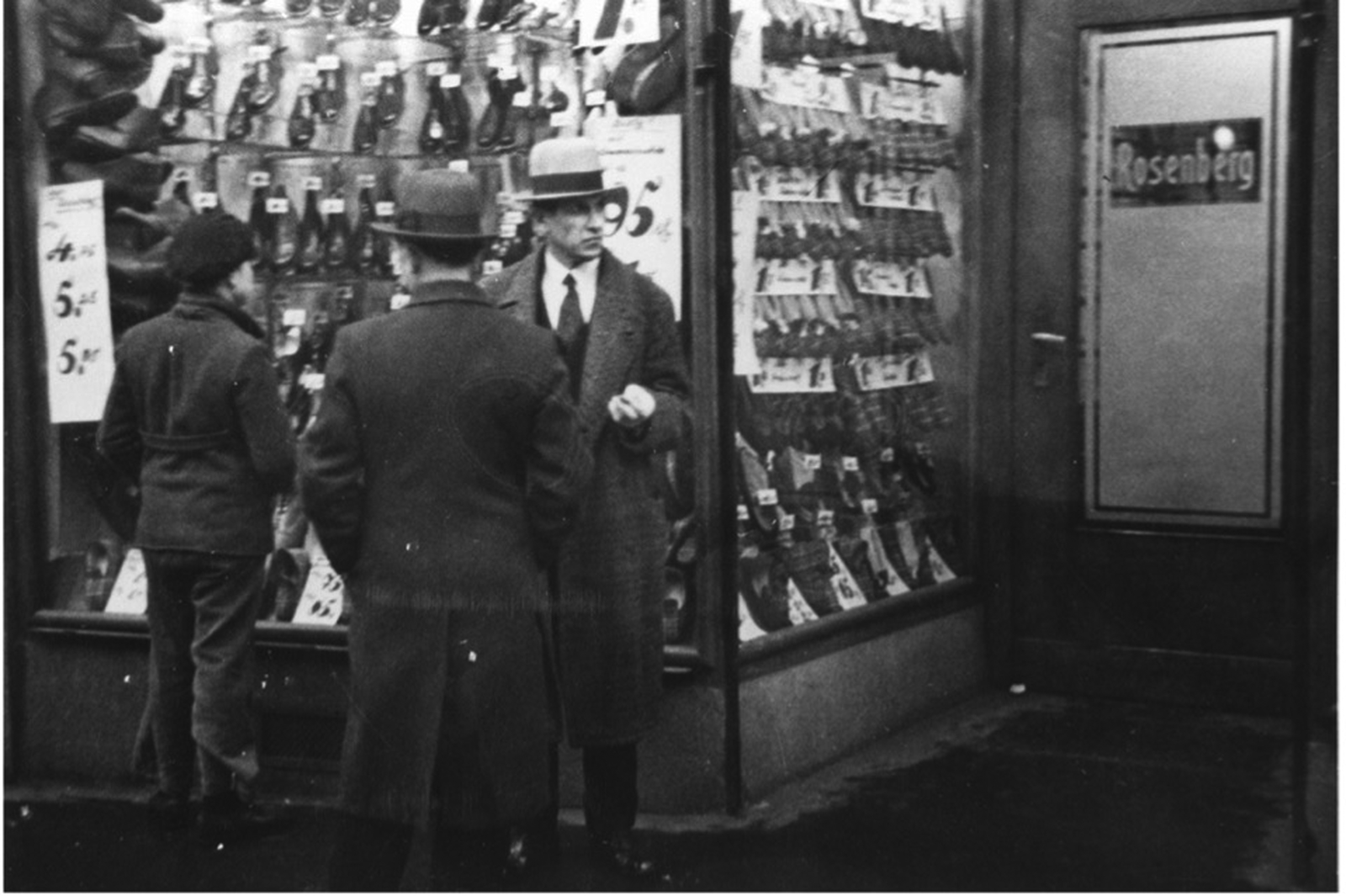
One December 1937 photograph from the Der Stürmer archive shows a man (Fig. 3) leaving a Jewish-owned shoe store in Dortmund, the caption condemning him for having done his Christmas shopping there.
Nuremberg City Archives E39/I Nr. 2026/11. Original caption: ‘This German comrade just went shopping at a Jewish store and now stands in front of it.’ Dortmund, Germany, 22 December 1937.
The March 1938 annexation of Austria renewed calls for additional antisemitic blockades in Germany. In one May 1938 incident in the town of Hanau, the district office noted that it had been possible to ‘keep customers away from almost all shops’ with the notable exception of a woman who continued to shop at a Jewish-owned business despite these warnings. Outside the shop, she declared that she had always shopped there and would always shop there. The woman was photographed and then attacked by a large crowd that formed around her. In the end, she had to be escorted back to her apartment by several civilians while others threw rotten eggs at her.Footnote 64 Der Stürmer maintained its attacks on customers in print and in its display cases. Featured in its August 1938 issue were ‘women and men from Chemnitz [who] fight over Jewish Junk’. The column displayed three photographs of men and women leaving Jewish-owned businesses that had just been forcibly liquidated, narrated by the caption ‘if you are photographed leaving the Judenladen, you are of course embarrassed’.Footnote 65
Only at the end of 1938 would photographic denunciation subside in Germany. The violence and destruction of the nationwide 9–10 November Kristallnacht pogroms, coupled with the forced closure of all remaining Jewish businesses under the 12 November Decree for the Exclusion of Jews from German Economic Life, sealed the removal of German Jews from public and economic life.Footnote 66 Photography was no longer needed to pressure non-Jewish Germans to stop shopping at Jewish-owned businesses, for there were very few Jewish-owned businesses left.
But photographic denunciation continued beyond Germany's borders. The Nazis soon shifted their attention to ‘Aryan’ Germans living abroad whom they believed needed to be ‘educated’ in line with Nazi antisemitism. Securing loyalty from the German population in Asia, for example, took on renewed significance after Hitler's armed forces invaded the Soviet Union in June 1941. Germans living in Shanghai, China, for instance, became subject to such measures in the fall of 1941. According to Nazi records, a substantial number of non-Jewish German nationals lived in Shanghai.Footnote 67 Moreover, between 1933 and 1938 the city had become a popular haven for German and Austrian Jews who fled Nazi persecution.Footnote 68
Nazi officials initiated antisemitic ‘boycott’ actions in Shanghai that autumn. On 8 November 1941, local Nazi Party leaders circulated a memo ordering the blockade of 270 businesses in Shanghai they condemned as ‘Jewish’ or ‘Soviet’, many of which belonged to German and Austrian Jews who were trying to reestablish themselves there. The announcement then declared that ‘anyone violating the order to boycott Jewish shops would be photographed and a report of his action, together with the picture, would be sent to Berlin and placed in a file for future consideration'.Footnote 69 The notice did not specify whether the picture would be published in Der Stürmer or some other Nazi publication. Nor did it say if the corresponding file would be passed to the Gestapo or the Nazi Auslands-Organisation, the main agency tasked with educating all ‘Aryan’ Germans living abroad in accordance with the ideology, goals and programmes of the Nazi Party. Perhaps that ambiguity was precisely the point. The uncertainty would only increase apprehension and fear about where such images would appear, for what purposes, and who would see them. Even in late 1941, Nazi Party officials still relied on photographic denunciation to coerce non-Jewish Germans into abandoning their Jewish neighbours.
But the notice also reveals how much the Nazis’ blockade procedure had changed since April 1933. It noted how ‘responsible circles viewed the development with considerable apprehension, because it is certain to engender racial hatred and may lead to violence, especially if or when the local Nazis decide to take the next step and paste labels on the shops or attempt to picket them’.Footnote 70 The acknowledgement that ‘pasting labels or picketing the shops’ would be the next step indicates that photographic denunciation had supplanted both methods, once used in tandem after the Nazi takeover. For Shanghai's Nazis, there was no need to stand menacingly in front of Jewish-owned stores beside pernicious signs. Instead, they went straight to photographing customers. It was a shift that, on one hand, testified to the significance and efficiency of photographic denunciation in terrorising Jews and convincing non-Jews to abandon them in Germany after 1933. On the other hand, it also indicated that, like the war and genocide that were already well underway by November 1941, this project knew no geographical limits.


 Open access

