


The artificial unity which is the work of the Confederation
has not solved the problem of the races.
—André Siegfried, The Race Question in Canada (1907)Introduction
André Siegfried has been described as the “Tocqueville of Canada” for his seminal work, The Race Question in Canada (Underhill, 1966). Originally published in 1907, The Race Question in Canada is strictly about White settlers in North America—Siegfried's analysis focuses on the conflict between English-Protestants and French-Catholics and identifies the threat that American settlers posed to British superiority in North America. Contemporary Canadian scholarship has thoroughly analyzed how Canadian settlers’ linguistic and religious identities shape political behaviour and attitudes (for example, Johnston, Reference Johnston1985, Reference Johnston and Wearing1991; Blais, Reference Blais2005). Many studies have considered the relationship between Canadians’ sense of national identity and social solidarity (Johnston et al., Reference Johnston, Banting, Kymlicka and Soroka2010) or support for policies related to immigration and multiculturalism (Berry, Reference Berry2006). However, far less research has considered how Whites’ racial identities shape political behaviour and attitudes in Canada. Who identifies as White in Canada? How does White identity—Whites’ awareness of and identification with their racial ingroup—compare to outgroup-oriented racial attitudes in shaping Canadian politics?
We answer these questions using data collected as part of the Canadian Election Studies (CES) 2019 (Stephenson et al., Reference Stephenson, Harell, Rubenson and Loewen2020). We review existing research on the role of intergroup attitudes and group-based identification for political outcomes in the United States and Canada, as well as the growing literature on White identity in the United States (Jardina, Reference Jardina2019, Reference Jardina2020; Berry et al., Reference Berry, Ebner and Cornelius2021; Petrow et al., Reference Petrow, Transue and Vercellotti2018; Sides et al., Reference Sides, Tesler and Vavreck2018; Croll, Reference Croll2007). For the comparison between White identity and Whites’ negative outgroup attitudes, we refer to the American literature on how anti-Black attitudes shape policy preferences and political behaviour (Gilens, Reference Gilens1995, Reference Gilens1996; DeSante, Reference DeSante2013) as well as the burgeoning Canadian literature on how anti-Indigenous attitudes shape politics (Harell et al., Reference Harell, Soroka and Ladner2014, Reference Harell, Soroka and Iyengar2016; Beauvais, Reference Beauvais2020, Reference Beauvais2021).
Since there is almost no empirical research on the politics of Canadian White identity, we first offer a descriptive look at the socio-demographic profile of White Canadians who identify most strongly with their White ingroup and compare this to the socio-demographics of Canadians who express negative outgroup (anti-Indigenous) attitudes. We then clarify the association between racial attitudes—both White identity and anti-Indigenous attitudes—on policy preferences and political behaviour in Canada. Our findings indicate that in Canada, as in the United States, White identity increases support for policies that are often perceived as mostly benefiting Whites (for example, Canada/Quebec Pension Plans). By contrast and also in line with US findings, negative outgroup evaluations reduce support for policies that are perceived as mostly benefiting racialized and Indigenous peoples (for example, welfare). Indigenous resentment, but not White identity, is associated with the belief that more should be done to support Canadian culture.
With respect to vote choice in 2019, Indigenous resentment significantly and substantively increases the likelihood of voting Conservative in Canada outside of Quebec. The association between White identity and voting Conservative is also present but is not as strong as the relationship between Indigenous resentment and voting Conservative. This follows the same patterns as in the United States, where Jardina (Reference Jardina2020) shows that racial resentment is a stronger and more consistent predictor of voting Republican than White identity. In Quebec, White identity increases the likelihood of casting a ballot for the Bloc Québécois (BQ), while outgroup attitudes do not significantly explain vote choice among Quebec voters. In sum, our research shows that the study of White identity offers additional insights into how racial identities shape political opinions and behaviour in Quebec and the rest of Canada.
Literature
The political consequences of racial attitudes have received greater attention in the American literature, which has largely focused on White Americans’ attitudes toward outgroups, particularly anti-Black attitudes (see Tarman and Sears, Reference Trueheart2005, for a review). However, recent political events in the United States have brought about a deeper interest in White ingroup identification as a mobilizing force in politics. This new scholarship on the role of White ingroup identification (Jardina, Reference Jardina2019, Reference Jardina2020; Berry et al., Reference Berry, Ebner and Cornelius2021; Petrow et al., Reference Petrow, Transue and Vercellotti2018; Sides et al., Reference Sides, Tesler and Vavreck2018; Croll, Reference Croll2007) highlights how many Americans see the world through the lens of White identity. Between 30 to 40 per cent of Americans indicate that being White is “very” or “extremely” important to their identity (Jardina, Reference Jardina2019: 62). According to Jardina (Reference Jardina2019), White identity is a form of ingroup favouritism held by the dominant group in society. It becomes more salient at times of real or perceived threat or crisis, when the dominant group's status is seriously challenged. White people's ingroup attachments and prejudice toward people of colour and Indigenous peoples are often correlated. However, in the United States, White identity is a distinct concept related to a “desire to protect the in-group and its interests as a force independent of out-group prejudice” (Jardina, Reference Jardina2020).
American survey data suggests that White ingroup attitudes—but not negative outgroup attitudes—explain support for spending on policies that are perceived to benefit the White ingroup, such as Social Security (Jardina, Reference Jardina2019). On the other hand, controlling for racial resentment, White identity is not significantly related to policies perceived as helping Black Americans, such as welfare spending. White identity also helps to explain support for Republican candidates even when controlling for anti-Black attitudes, although outgroup attitudes do tend to be a stronger and more consistent predictor of Republican voting (Jardina, Reference Jardina2020). Mutz (Reference Mutz2018) finds that status threat—the perception that the dominant status of Whites is being jeopardized—largely explains vote switching from President Barack Obama to Donald Trump in the 2016 presidential election. Similarly, Sides et al. (Reference Sides, Tesler and Vavreck2018) show that White voters who identified most strongly with their racial ingroup and felt their dominant status was threatened were most likely to support the candidacy of President Trump.
Other studies show that, among Whites, perceptions of linked fate—the feeling that what happens to one's fellow group members matters to oneself—are comparable to other racial and ethnic groups in the United States, and feelings of linked fate among White Americans mobilize political participation (Berry et al., Reference Berry, Ebner and Cornelius2021). Stronger feelings of linked fate among White Americans predict higher levels of voter registration and turnout, protesting, volunteering for candidates and donating money to campaigns. Linked fate also increases the preference for co-racial candidates among White Americans (Schildkraut, Reference Schildkraut2017).
Although identification with a White ingroup and negative attitudes toward racialized outgroups are correlated, both White ingroup and outgroup attitudes are independent drivers of political attitudes and behaviours with different consequences (Petrow et al., Reference Petrow, Transue and Vercellotti2018). A great deal of research considers White Americans’ attitudes toward outgroups, particularly symbolic racism directed toward Black Americans (see Tarman and Sears, Reference Tarman and Sears2005, for a review). Symbolic racism, often operationalized as racial resentment toward Black Americans, refers to the combination of anti-Black affect and the belief that Black Americans violate cherished values related to industry and self-sufficiency. American research shows that anti-Black attitudes held by Whites are a strong predictor of opposition toward spending on programs that are seen as disproportionately benefiting people of colour, such as welfare and other targeted programs (Gilens, Reference Gilens1995, Reference Gilens1996; DeSante, Reference DeSante2013). Despite previous concerns that the racial resentment measure overlaps with liberal/conservative ideology—that the scale reflects “principled conservatism” instead of racial prejudice (Sniderman and Tetlock, Reference Sniderman and Tetlock1986)—recent scholarship clearly shows that racial resentment is a strong predictor of White opposition to redistribution even after correcting for the overlap between racial resentment and liberal/conservative ideology (Enders, Reference Enders2019). Racial resentment also shapes political behaviour. Even controlling for partisanship and ideology, anti-Black resentment is a strong and consistent predictor of White Americans’ vote choice (Jardina, Reference Jardina2020). Time-series analyses show that American electoral politics are becoming increasingly racialized (Enders and Scott, Reference Enders and Scott2019).
What does Canadian research have to say about the consequences of White identity and other racial attitudes? Compared to US scholarship, Canadian political science has paid less attention to the role of race in politics. This is not to say that the political consequences of social group memberships have been ignored. On the contrary, the role of cultural differences is considered to be among the defining features of Canadian politics. For instance, although Canadians tend to be relatively secular, religion—specifically Catholicism—is one of the strongest and most consistent predictors of vote choice (Blais, Reference Blais2005; Johnston, Reference Johnston1985; Bélanger and Eagles, Reference Bélanger and Eagles2006). Although it is not fully understood why Catholics tend to vote consistently Liberal (Blais, Reference Blais2005), the fact that the relationship between Catholicism and voting Liberal is conditioned by the religious composition of ridings suggests that the politicization of religion has a social basis (Johnston, Reference Johnston1985; Bélanger and Eagles, Reference Bélanger and Eagles2006).
With respect to White Canadians’ attitudes toward racialized outgroups, there is a growing interest in the political consequences of racism (Johnson and Emonoto, Reference Johnson and Enomoto2007) and anti-Indigenous attitudes in Canada (Harell et al., Reference Harell, Soroka and Ladner2014, Reference Harell, Soroka and Iyengar2016; Beauvais, Reference Beauvais2020, Reference Berry, Ebner and Cornelius2021). Indigenous peoples constitute 4.9 per cent of Canada's population (Statistics Canada, Reference Canada2017) and play a significant role in the Canadian racial hierarchy. In Canada's early history, colonial administrators motivated by White racism explicitly tried to eliminate Indigenous peoples through genocide and forced assimilation. P. G. Anderson, Canada's Indian Affairs Superintendent, expressed a clear belief in White racial superiority when he explained the concept of residential schools to the General Council of Indian Chiefs and Principle Men, stating that “your children shall be sent to schools, where they will forget their Indian habits and be instructed in all the necessary arts of civilized life, and become one with your White brethren” (quoted in Baldwin, Reference Baldwin1846: 7). In the spring and summer of 2021, the remains of 215 children were found in unmarked graves at the Kamloops Indian Residential School in British Columbia, 751 unmarked graves were found at the Marieval Indian Residential School in Saskatchewan, and an additional 160 unmarked graves were identified at the Kuper Island Residential School in British Columbia. As searches around former residential schools continue, more unmarked and undocumented burial sites will be discovered. These atrocities reflect the intensity of White settlers’ desire to eliminate Indigenous peoples from colonized territories and are a terrible testament to the perceived threat that Indigenous peoples presented to settler society and Canadian political development.
These divisions continue to dominate Canadian identity politics today. As Soroka et al. (Reference Soroka, Johnston and Banting2006: 586) explain: “On the field of identity, the fundamental divisions are not ‘new’ Canadians versus ‘old’ ones but within the ranks of the old,” as both Indigenous peoples and the French Quebecois have a weaker sense of pride and belonging in Canada as compared to British-identified and Northern European–identified settlers. Today, Indigenous peoples face higher levels of prejudice and discrimination than other groups in Canada. In fact, in a comparison of racial attitudes in Canada, the United States and the United Kingdom, Canadian Indigenous peoples faced the highest level of overt racism of all groups in any of the three countries (Harell et al., Reference Harell, Soroka and Iyengar2016). Racial discrimination in public sectors such as schools, the criminal justice system and in the health care system is the reality in Canadian society. Research confirms that Indigenous peoples (especially First Nations) are noticeably less likely than other racial groups to see race relations as good or having improved over time in Canada (Environics Institute, Reference Institute2020).
The legacy of settler-colonialism, prejudice and discrimination manifest themselves in ongoing systemic inequalities. White settlers are far more likely to be empowered in higher ranking, prestigious occupations (Johnson and Howsam, Reference Johnson and Howsam2020). Relative to settlers, Indigenous peoples are more likely to experience underemployment (Mitrou et al., Reference Mitrou, Cooke, Lawrence, Povah, Mobilia, Guimond and Zubrick2014), economic marginalization (Kubik et al., Reference Kubik, Bourassa and Hampton2009; Mitrou et al., Reference Mitrou, Cooke, Lawrence, Povah, Mobilia, Guimond and Zubrick2014) and housing scarcity (Belanger et al., Reference Belanger, Weasel Head and Awosoga2012, Reference Belanger, Awosoga and Head2013). Indigenous peoples are also incarcerated at higher rates than any other group (Chartrand, Reference Chartrand2019; Department of Justice, 2019) and are more likely to be victims of police killings (Marcoux and Nicholson, Reference Marcoux and Nicholson2017). As a result of systemic racism and the legacy of settler-colonialism, Indigenous peoples suffer a number of negative health and social consequences, including a greater risk of suicide (Pollock et al., Reference Pollock, Healey, Jong, Valcour and Mulay2018) and experiencing violence (Nielsen and Robyn, Reference Nielsen and Robyn2003). While these stark inequalities speak to the extreme cleavages in Canadian society with regard to Indigenous communities, we aim to turn away from the angle of many studies that frame settler-colonial and racial inequalities in terms of the “perceived deficits” of disempowered peoples, searching for problems within Indigenous communities (Walter and Andersen, Reference Walter and Andersen2013). Instead of looking for failings within Indigenous communities, we turn our attention to consider how White settlers’ racial identities and attitudes reinforce social inequalities.
In terms of comparing relations of inequality across national contexts, Indigenous peoples’ relative disempowerment in Canada is more similar to the disempowerment of Black Americans in the United States than any other group. The way that legacies of inequality continue to shape social hierarchies in Canada and the United States has important implications for political attitudes and behaviour. Similar to the way White Americans’ anti-Black attitudes predict opposition to welfare (Gilens, Reference Gilens1995, Reference Gilens1996; DeSante, Reference DeSante2013), White Canadians’ anti-Indigenous attitudes predict opposition to welfare (Harell et al., Reference Harell, Soroka and Ladner2014; Beauvais, Reference Beauvais2020, Reference Berry, Ebner and Cornelius2021). Comparative experimental research also shows that Canadians are less willing to redistribute when target group members are Indigenous (Harell et al., Reference Harell, Soroka and Iyengar2016). In fact, Canadian opposition to helping an Indigenous person is greater than American opposition to helping a Black person (Harell et al., Reference Harell, Soroka and Iyengar2016).
As in the United States, negative outgroup attitudes vary systematically by correlates such as region, gender and partisanship. In Canada, Indigenous resentment is higher in the West, among men, and among Conservative Party supporters (Beauvais, Reference Beauvais2020). There is also some research suggesting that the Quebecois hold more negative views of non-Whites (Berry and Kalin, Reference Berry and Kalin1995; Bilodeau et al., Reference Bilodeau, Turgeon and Karakoç2012), although these accounts have been disputed (Dufresne et al., Reference Dufresne, Kilibarda, Blais and Bibeau2019). However, thus far no existing Canadian research considers how Indigenous resentment impacts vote choice.
Furthermore, very little research has been conducted on the political role of White identity in Canada, as most work on group-based identity focuses on cultural or national questions. In the blossoming field of social solidarity, diversity and support for redistribution, group identity is captured exclusively through Canadians’ national, rather than racial, identities (for example, Banting and Kymlicka, Reference Banting and Kymlicka2006; Banting, Reference Banting2010; Johnston et al., Reference Johnston, Banting, Kymlicka and Soroka2010). For instance, research shows that White Canadians who identify more strongly with Canada express more support for healthcare spending (Johnston et al., Reference Johnston, Banting, Kymlicka and Soroka2010). Perceptions of national identity also shape attitudes toward immigrants in Canada (Esses et al., Reference Esses, Wagner, Wolf, Preiser and Wilbur2006).
While the Canadian focus on the role of religion, language and the national question is understandable, it is important to contextualize the historical conflict between French-speaking Catholics and English-speaking Protestants in the critical race and Whiteness studies literature. Scholars in these areas have documented the distinct ways that historically racialized groups—including Italian, Irish, Jewish and French Canadian peoples—became part of a White ingroup over time (Allen, Reference Allen1994; Baum, Reference Baum2006; Brodkin, Reference Brodkin1998; Ignatiev, Reference Ignatiev2009; Matthew, Reference Matthew1998; Scott, Reference Scott2016). In nineteenth-century Canada, English settlers thought of French Canadians in racial terms (Scott, Reference Scott2016). When Henri Bourassa debated English-speaking representatives in Parliament, he was derided for speaking French and told to “speak White.” Lord Durham's Report on the Affairs of British North America describes the situation in Canada as “a struggle, not of principles, but of races.”
As Scott (Reference Scott2016) notes, although the usage of the word race has changed over time, the concept of race, and the perceived inferiority of the French race, was central to arguments for French Canadian assimilation. Durham and other elites depicted French Canadians using the stereotypes usually applied to derogate Black people and other racialized groups, depicting French Canadians as lazy, backward, and unevolved. These frames were common in nineteenth-century popular and scientific discourses. Motivated by biological racism, anthropologists drew analogies between “primitive races” and “man-like apes” who had a purportedly “limited innate ability to invent civilization” (Barkan, Reference Barkan1992: 41). Canadian political cartoons from the nineteenth century often depicted French Canadians as primates—a powerful symbolic depiction of the “supposedly primitive and unruly French Catholic minority” (Scott, Reference Scott2016: 1289). As Scott (Reference Scott2016) explains, depictions of French Canadians in political cartoons bore a striking resemblance to depictions of Irish and other racialized groups from that era.
Like other historically “non-White” settlers from Europe such as Irish, Italian and Jewish settlers, the Quebecois have now been “redefined as a singular Euro-American white population” (Scott, Reference Scott2016: 1289). However, Whiteness—and the struggle over who is “really” White—played an important role in Quebec's Quiet Revolution and sovereigntist movement. For instance, Pierre Vallières’ manifesto N*gres blancs d'Amérique alludes to the racial hierarchies that empower Whites by subordinating people of colour and simultaneously promotes the recognition of the French Quebecois as being White. This does not represent a paradox, as some have argued (for example, Scott, Reference Scott2016). Rather, Vallières’s description of the “n*gres blancs” represents a recognition and implicit acceptance of racial hierarchies, as well as an entitlement claim: that the French Quebecois belong among the maîtres (masters). The discursive link between Quebecois identity and Whiteness has also been made by other leaders of the sovereigntist movement, including Jacques Parizeau, who said in a concession speech after the 1995 referendum that sovereignty was defeated by “money and ethnic votes,” and by Lucien Bouchard, who described the Quebecois as a “White race” while lamenting the low birth rate among Quebecois women.Footnote 1 We are not suggesting that these were the only or even the most dominant views in Quebec's sovereigntist movement. Rather, we highlight how discourses linking both Quebecois national identity and the entitlement to collective self-determination to Whiteness have existed within the movement.
With respect to the study of Whiteness in Canada, aside from Scott's (Reference Scott2016) “How French Canadians Became White Folks,” most of the existing research has focused on the rural aspects of Whiteness in Canada, hypothesizing that White identity is constructed in opposition to the cosmopolitanism of the urban context (O'Connell, Reference O'Connell2010; Cairns, Reference Cairns2013). However, thus far these propositions have not been tested with survey data asking Canadians about their identification with the White ingroup. To date, no quantitative Canadian scholarship has considered the political consequences of White ingroup attitudes. Who identifies as White in Canada? Finally, how do ingroup and outgroup attitudes impact Canadian politics differently?
We hypothesize that stronger identification with the White ingroup will be linked to defending the interests of White people, leading to increased support for government spending on social programs that have historically benefited Whites. A second set of policies constitutes social safety nets for seniors. A media analysis shows that US social programs designed to help older Americans—Social Security and Medicare—are depicted in the media as serving White Americans (Clawson and Jett, Reference Clawson and Jett2019). Clawson and Jett (Reference Clawson and Jett2019: 210) suggest that “just as welfare for the poor is ‘race coded’ through its linkage with blacks [Black Americans], Social Security and Medicare are ‘race coded’ through their association with whites [White Americans], and therefore draw upon a deep reservoir of support.” This intuition is supported by research showing that higher White identity is associated with greater support for Social Security in the United States (Jardina, Reference Jardina2020). In Canada, there is good reason to believe that social policies designed to benefit seniors are similarly race-coded. Eligibility requirements disproportionately exclude Indigenous peoples and settlers of colour from policies designed to help the elderly, and as a result, Canadian seniors who are eligible to receive pension and Old Age Security (OAS) benefits are disproportionately White (Gyimah et al., Reference Gyimah, White, Maxim, White, Maxim and Beavon2004; Curtis et al., Reference Curtis, Dong, Lightman and Parbst2017). Specifically, Indigenous peoples and settlers of colour are more likely to be underemployed or work in the informal economy, and so are less likely to meet eligibility requirements. The majority of immigrants arriving in Canada are people of colour, and many immigrants are never eligible for OAS. This is because immigrants must wait 10 years to become eligible for the minimum OAS benefit, and they face an additional 40-year residency requirement for the full benefit (Curtis et al., Reference Curtis, Dong, Lightman and Parbst2017; Government of Canada, 2021). Indigenous peoples whose earnings were tax exempt were initially excluded from contributing to Canada and Quebec Pension Plans (C/QPP) altogether (until 1987) (Gyimah et al., Reference Gyimah, White, Maxim, White, Maxim and Beavon2004). Even among those who are eligible for C/QPP and OAS, there is lower uptake among people of colour and Indigenous peoples. Between the period of 1996 and 2011, OAS access among White Canadians was 93 per cent. It was significantly lower among settlers of colour, ranging between 74 per cent (South Asian Canadians) and 84 per cent (Black Canadians) (Curtis et al., Reference Curtis, Dong, Lightman and Parbst2017). While this study of OAS take-up did not include Indigenous peoples, another study using data from 1996 shows that only 47 per cent of Indigenous peoples aged 65 and older received income from C/QPP (compared to 85 per cent of settlers), and 85 per cent of Indigenous peoples received OAS (compared to 94 per cent of settlers). To our knowledge, there have not been any media analyses or surveys designed to directly gauge the extent to which Canadians associate programs such as C/QPP or OAS with Whiteness. However, existing political behaviour research suggests these programs might be race-coded. Specifically, Harell et al. (Reference Harell, Soroka and Iyengar2013) find that White Canadians allocate more generous low-income supplements to White seniors, relative to Indigenous seniors or seniors of colour.
With respect to outgroup attitudes, we draw on existing American and Canadian scholarship (Harell et al., Reference Harell, Soroka and Ladner2014, Reference Harell, Soroka and Iyengar2016; Beauvais, Reference Beauvais2020, Reference Beauvais2021) to hypothesize that negative outgroup evaluations decrease support for welfare, which is often perceived as disproportionately benefiting people of colour in the United States and Indigenous peoples in Canada. We also expect that Indigenous resentment negatively shapes any support for minorities vis-à-vis support for Canadian culture. With respect to vote choice, we expect that both stronger identification with the White ingroup and negative outgroup attitudes will increase voting for right-of-centre parties and decrease voting for the New Democratic Party (NDP) led by Jagmeet Singh—the only candidate of colour leading a major Canadian political party. We will also explore the relationship between racial attitudes and electoral support for the BQ, to understand whether racial attitudes are associated with voting for Quebec's federal sovereigntist party.
In our present work, we focus primarily on how White identity shapes Canadian attitudes and behaviour. While existing scholarship considers the association between attitudes toward Indigenous peoples and welfare spending in Canada (Harell et al., Reference Harell, Soroka and Ladner2014, Reference Harell, Soroka and Iyengar2016; Beauvais, Reference Beauvais2020, Reference Beauvais2021), none of the existing scholarship considers the association between White identity and policy preferences. However, it is still important for us to consider negative outgroup evaluations in our analysis of White identity politics. First, as we will show, ingroup and outgroup attitudes are associated; as such, it is important to account for negative outgroup evaluations to discern the independent association between White identity and political attitudes. Furthermore, with respect to political behaviour, ours is the first analysis to consider how either White identity or anti-Indigenous attitudes are associated with vote choice.
Methods
Data was collected as part of the CES 2019 through the Qualtrics online platform (Stephenson et al., Reference Stephenson, Harell, Rubenson and Loewen2020). A sample of White Canadian citizens (stratified by region and balanced by age and gender within each region) was recruited from the Qualtrics online sample to complete the White identity module of the CES (n = 872) between October 18 and October 19, 2019.Footnote 2 All respondents were Canadian citizens aged 18 or older who indicated that they were White/of European descent.
To answer the question “Who identifies as White in Canada?,” we offer a descriptive look at the relationship between White identity, Indigenous resentment and socio-demographic attributes. This descriptive work will be useful to scholars interested in developing and exploring new hypotheses about the interplay between White identity, social attributes and political behaviour in Canada. To answer the question “What are the political consequences of racial attitudes in Canada?,” we first model ordinary least squares (OLS) regressions estimating the association between racial attitudes and support for three separate policy outcomes—pension spending, welfare spending and protection for Canadian culture—controlling for socio-demographic and political attributes. We analyze the impact of racial attitudes on policy preferences for Canada as a whole, controlling for region. Our measures of attitudinal dispositions (White identity and Indigenous resentment) are standardized. Using standardized variables allows us to interpret the coefficients as indicating how much an outcome variable will change for every one standard deviation increase in White identity or Indigenous resentment. Rescaling the variables so that they are measured on the same scale allows us to more directly compare the magnitude of the association between the response variables and White Canadians’ ingroup and outgroup attitudes. Although it is important not to blindly standardize all variables, “psychological scales and attitudinal measures” represent an instance where standardization can improve interpretation (King, Reference King1986: 673).Footnote 3
We then model multinomial logistic (ML) regressions to estimate the association between racial attitudes and vote choice. We present separate analyses of vote choice in Quebec and the rest of Canada (ROC), as voters face different political choices in these regions. All of our regressions include the CES survey weights for “non-visible minorities,” which are based on population data for non-visible minorities from the 2016 Canadian census.Footnote 4
Outcomes
We measure support for policy preferences with three variables: the first item asks how much respondents thought the government should spend on pensions (a lot less, somewhat less, the same, somewhat more, or a lot more). Respondents outside Quebec were asked how much the government should spend on Canada Pension Plans, and respondents in Quebec were asked how much the government should spend on Quebec Pension Plans. The second item asks how much respondents thought the government should spend on welfare (a lot less, somewhat less, the same, somewhat more, or a lot more). For the two spending preference items, higher values indicate support for more government spending. The third item asks respondents: “Some people say that we should do more to help minorities keep their culture. Others say that the priority should be on Canadian culture. What should the federal government do?” (focus more on helping minorities keep their culture, keep the balance as it is now, or focus more on helping Canadian culture). As a robustness check, we also treated the outcomes as categorical variables and estimated ordered logistic models (the results are substantively identical; see Table S10).
We measure vote choice using a variable that asked a question regarding the 2019 elections: “Which party do you think you will vote for?” The initial response options for all respondents included: Liberal Party, Conservative Party, NDP, Green Party, People's Party, or another party; respondents in Quebec were additionally allowed to select the BQ. In our analysis, we use a four-category measure of vote choice in Canada outside of Quebec (Liberal, Conservative, NDP, or Other party) and a five-category measure of vote choice in Quebec (Liberal, Conservative, NDP, BQ, or Other party). The number of respondents who indicated they would vote for the smaller parties was insufficient to include them as separate outcome categories in our multinomial regressions (that is, data sparsity prevents the algorithm from converging).
Independent Variables
Racial attitudes: White identity and Indigenous resentment
Following Jardina (Reference Jardina2019), we created a summated rating scale of White identity from the following three Likert-type items: (1) “How important is being white to your identity?” (extremely important to not important at all); (2) “White people in this country have a lot to be proud of” (strongly agree to strongly disagree); and (3) “Whites in this country have a lot in common with one another” (strongly agree to strongly disagree).Footnote 5 Variable distributions for each item are presented in Table S2. Replicating American research (Jardina, Reference Jardina2019), our reliability analysis reveals that the three-item measure of White identity is reliable and that the reliability of the scale would decrease if any of the items were dropped (Table S3). The results of a scree plot confirm that the items constitute a unidimensional measure (Figure S5).
Comparable research on outgroup racial attitudes in the United States uses a measure of racial resentment toward Black Americans. As we explained in our review of the literature, in the Canadian context it is more appropriate to account for anti-Indigenous attitudes. Using the available items on the CES, we construct a scale tapping into Indigenous resentment. Congruent with comparable Canadian scholarship (Beauvais, Reference Beauvais2020, Reference Beauvais2021), our scale measuring Indigenous resentment is reliable (Table S4) and unidimensional (Figure S6).
To ensure our measures of ingroup attachment and outgroup attitudes are directly comparable, we converted the raw White identity and Indigenous resentment scale scores to standard scores (to have a mean of 0 and standard deviation of 1).Footnote 6 The distributions of White identity and Indigenous resentment are presented in Figure 1, and we use the standardized scales in our regression analyses. Comparing the two scales, we can see that a larger number of respondents’ scores fall closer to the mean of the White identity scale (fewer respondents’ scores fall in the tails of the distribution of White identity) as compared to the distribution of Indigenous resentment. This suggests that among White Canadians, outgroup attitudes may be more salient or polarizing than ingroup attachments.
Distribution of White Identity and Indigenous Resentment in Canada

To lend further credence to the intuition that White ingroup attitudes might be less salient in Canada, we compare responses to the first item used in the White identity scale, “How important is being White to your identity?” in Canada and the United States. This item was asked on both our CES 2019 module and the American National Election Studies (ANES) 2016. As Figure 2 shows, roughly 40 per cent of Canadians indicate that being White is “Not at all important” to their identity, while less than 30 per cent of Americans say the same.
Importance of Being White to One's Identity in Canada and the United States

Covariates
In order to estimate the independent association between White identity and Indigenous resentment on support for government policies and vote choice, we control for party identification and socio-demographic controls. Party identification is a five-category variable indicating whether respondents normally think of themselves as supporters of the NDP, Liberals, Greens, BQ, Conservatives, People's Party, or another party/no party identification. We use the modal category, Liberal Party identifiers, as the reference category in our regressions. With respect to socio-demographic controls, gender is a dummy variable indicating if a respondent self-identified as a man (man = 1).Footnote 7 Generation is a categorical variable, and education is measured using a dummy variable indicating whether the respondent completed a four-year university (bachelor's) degree (university = 1) or more. Income is a categorical variable that divides respondents into five roughly equal categories. We use the modal income ($30,000–$50,000) as the reference category in our models. We operationalize region using a five-category variable: the Pacific (British Columbia), the West (Alberta, Saskatchewan or Manitoba), Ontario, Quebec, and the Atlantic (New Brunswick, Nova Scotia, Newfoundland and Labrador, and Prince Edward Island).Footnote 8 We treat Ontario, the most populous region, as the reference category in our regressions. Finally, we used respondents’ postal codes to create a dummy variable indicating whether a respondent lived in a rural area (rural = 1). The CES 2019 includes respondents’ forward sortation area (FSA), or the first three values of their area code, and the second digit of the FSA indicates whether a person lives in an urban or rural area.Footnote 9 As a robustness check, we also estimate the regression models controlling for additional variables (religion, language, ideology, employment, economic judgments, and feelings toward immigrants) and present the results in the supplementary material.Footnote 10
Results
Who identifies as White in Canada?
Like their counterparts south of the border, the level of White identity in Canada is positively—although not overwhelmingly—correlated with negative attitudes toward a salient outgroup, which in our analysis is Indigenous peoples (r =0.24) (see the correlation matrix in Figure S1). This correlation is comparable but slightly higher than the one in the United States, which ranges between 0.13 and 0.23 (Jardina, Reference Jardina2019: 79). White identity is only very weakly negatively correlated with economic indicators such as income and is essentially uncorrelated with gender and unemployment, similar to the US case. The correlation between White identity and living in a rural area (r =0.01) is weak: weaker than the correlation between Indigenous resentment and living in a rural area (r= 0.09). Because a correlation matrix cannot meaningfully illustrate the relationship between racial attitudes and unordered factor variables (such as region, religion, and party identification), we also plotted the bivariate relationships between these features.
Plotting racial attitudes across Canada's regions reveals some notable patterns. Recall that the White identity and Indigenous resentment scales are standardized to have a mean of zero. This means that a positive score on either scale represents levels of White identity or Indigenous resentment that are higher than the sample average, and a negative score indicates the opposite. As Figure 3 shows, levels of White ingroup identification and Indigenous resentment vary in distinct ways across Canada. On average, residents of Quebec express higher attachment to Whiteness than Canadians elsewhere. The distribution of Indigenous resentment across regions does not quite follow the same pattern. White Canadians living west of Ontario tend to express the highest levels of Indigenous resentment, although residents of Quebec still express higher levels of Indigenous resentment than Ontarians or Atlantic Canadians, on average.
Violin Plots and Boxplots Showing the Distribution of White Settlers’ White Identity and Indigenous Resentment by Region
Note: The horizontal line in the centre of the boxplot indicates the median, and the diamond indicates the mean score for each group. The White identity and Indigenous resentment scales are standardized to have a mean of zero, meaning that a positive score is higher than the sample average and a negative score is lower than the sample average.

With respect to religion, respondents who identify with one of Canada's “Founding” European peoples’ religions—Catholicism or Protestantism—express a greater investment in Whiteness. Both Catholics and Protestants express higher White identity than Whites who identify as agnostic/atheist (Figure 4). Figure 4 also shows that Catholics express higher levels of White identity than Protestants, which is probably due to the fact that White identity is higher in Quebec, where the majority of Catholics reside. On average, Catholics and Protestants are indistinguishable in terms of their evaluations of Indigenous peoples but express more negative attitudes toward Indigenous peoples than do Canadians who are not religious or who practice a minority religion.
Violin Plots and Boxplots Showing the Distribution of White Settlers’ White Identity and Indigenous Resentment by Religion
Note: The horizontal line in the centre of the boxplot indicates the median, and the diamond indicates the mean score for each group. The White identity and Indigenous resentment scales are standardized to have a mean of zero, meaning that a positive score is higher than the sample average and a negative score is lower than the sample average.

With respect to partisanship, People's Party identifiers unsurprisingly express the highest levels of White identity—although note there is a small number of People's Party partisans in the sample (Figure 5). What is perhaps most interesting is that people who normally think of themselves as identifying with the BQ express similarly high levels of White identity as People's Party or Conservative Party identifiers. With respect to BQ identifiers, this seems to be more of an ingroup, rather than outgroup, phenomenon—as BQ partisans express significantly lower levels of Indigenous resentment than Conservative partisans. However, BQ identifiers do express higher levels of Indigenous resentment than other left-of-centre voters. Congruent with existing research (Beauvais, Reference Beauvais2020), we find that Conservative partisans express the highest levels of Indigenous resentment. Non-sovereigntist left party identifiers—and especially partisans of the more “postmaterialist” Green Party—are the least invested in Whiteness and express the lowest levels of Indigenous resentment. The results here are similar to trends in the United States, where Democrats and liberals express lower levels of White identity compared to Republicans and conservatives (Jardina, Reference Jardina2020).
Violin Plots and Boxplots Showing the Distribution of White Settlers’ White Identity and Indigenous Resentment by Party Identification
Note: The horizontal line in the centre of the boxplot indicates the median, and the diamond indicates the mean score for each group. The White identity and Indigenous resentment scales are standardized to have a mean of zero, meaning that a positive score is higher than the sample average and a negative score is lower than the sample average.

Policy spending
Having sketched some of the contours of White identity and Indigenous resentment in Canada, we turn our attention to the political consequences of White identity and Indigenous resentment. Regressing attitudes toward pension spending on White identity and Indigenous resentment while controlling for a host of confounding variables, we find that, as in the United States, White identity has a small but significant association with support for policies that disproportionately benefit Whites (Canada/Quebec Pension Plans) (Table 1; for the full results, see Table S6). A one standard deviation increase in White identity increases support for pension spending by 0.10 points (SE: 0.03). Attitudes toward Indigenous peoples are not significantly related to Whites’ preferences for a policy that disproportionately benefits their racial ingroup.
OLS Models Predicting Support for Policy Spending

Note: Controlling for partisanship, gender, generation, income, education, region and rural residence.
*p < .05; **p < .01; ***p < .001
With respect to preferences for government spending on welfare, we found that, as hypothesized, Indigenous resentment substantively and significantly reduces support for welfare spending. A one standard deviation increase in Indigenous resentment decreases support for welfare spending by 0.33 points (SE: 0.04). Controlling for Indigenous resentment, we also identified a small, positive association between White identity and support for welfare spending.Footnote 11
With respect to preferences for government protections for Canadian culture, we found no association between White identity and endorsing the belief that the government should do more for Canadian culture (as opposed to supporting minority cultures) after controlling for Indigenous resentment. However, Indigenous resentment is significantly associated with this attitude. A one standard deviation increase in Indigenous resentment is associated with a 0.44 point increase (SE: 0.04) in endorsing the belief that the government should do more for Canadian culture.
Vote choice
Vote choice in Canada outside Quebec
In Canada outside of Quebec, our sample shows that White ingroup identification is associated with a significantly higher likelihood that a respondent says they will vote Conservative, relative to the Liberal party (Table 2). When shifting to outgroup attitudes, we also find strong evidence that Whites’ resentful attitudes toward a salient outgroup—Indigenous peoples—is associated with a significantly and dramatically higher likelihood of voting Conservative relative to any other party (see Table 2).
Multinomial Model Predicting Vote Choice (Canada outside Quebec)

* p < .05; ** p< .01; ***p < .001
Contrary to American research showing that White identity reduced electoral support for President Obama, America's first Black presidential candidate, we find no evidence that White ingroup identification significantly reduced support for the NDP under the leadership of Jagmeet Singh, the first candidate of colour to lead a Canadian federal political party, relative to the Conservatives (Table 2) or any other party (contact authors for tables). However, Indigenous resentment does significantly and substantively reduce the likelihood of voting for the NDP relative to the Conservatives.
Vote choice in Quebec
In Quebec, we find that White identity is significantly associated with voting for the BQ, even controlling for partisanship and other potential confounders. Treating BQ vote choice as a reference category in our regression shows that White identity significantly increases the likelihood of voting BQ relative to any other party (Table 3; see Table S8 for the full regression table).
Multinomial Model Predicting Vote Choice (in Quebec)
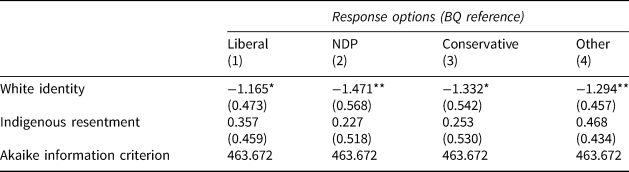
* p < .05; **p < .01; ***p < .001
Discussion
Although there is a growing interest in how racial attitudes and identities impact politics, Canadian scholars have paid far less attention to the political consequences of racial identities and racism compared to scholars south of the border. This may be because there is a conventional understanding in Canadian scholarship that one of the defining differences between the United States and Canada is that “the formative ethnic divide in the United States centres on race . . . while in Canada the main fault line has historically been between English and French, more recently between Quebec and the rest of Canada” (Citrin et al., Reference Citrin, Johnston and Wright2012: 535). Drawing on this intuition, a great deal of the empirically oriented Canadian scholarship on intergroup relations has focused on distinctions between “old” versus “new” Canadians, and particularly on the identities of and conflicts between White settlers of French-speaking, Catholic heritage in Quebec and White settlers of English-speaking, Protestant heritage in the rest of Canada (and occasionally, Indigenous peoples) (for example, Soroka et al., Reference Soroka, Johnston and Banting2006). Existing research on intergroup relations has provided great insight into the nature of the Canadian polity. However, when studying the legacy of European imperialism and colonialism, it is important to keep in mind the central role that belief systems about racial hierarchies played in European imperial conflicts and settler colonization.
In Canada's early history, colonial administrators motivated by White racism explicitly tried to eliminate Indigenous peoples, through genocide and forced assimilation. Furthermore, although the usage of the word race has changed over time, the concept of race, and the perceived inferiority of the French race, was central to arguments made by Lord Durham and others who advocated in favour of French Canadian assimilation (Scott, Reference Scott2016). The French Quebecois and Indigenous peoples have always fought against their political and economic subordination, against the devaluation of their identity, and to preserve their languages and cultures. However, anti-imperial discourses in Quebec have not always been framed in terms of breaking down hierarchies to empower all people in collective decision making about issues that affect them, regardless of social group membership. At times, voices championing Quebecois empowerment and Quebec sovereignty have made the discursive link between Quebecois identity, self-determination and Whiteness, making an entitlement claim that reinforces social and racial hierarchies. Our analysis reveals that this continues to matter for politics today, as White identity increases the likelihood a voter in Quebec casts their ballot for the BQ.
Of course, as in any analysis of social identities, we need to be aware that the meaning of racial identities is context dependent. Over the last few decades, changing norms mean citizens of many Western democracies disavow White supremacy and reject the inherent belief in immutable racial hierarchies. That said, we are also witnessing an era of general mobilization of racial conflict, White status threat and White mobilization across North America. Our analysis represents a snapshot of racial attitudes at a single point in time (just prior to the 2019 federal election). Future scholars should endeavour to analyze over-time developments of White identity and Indigenous resentment, to clarify how changing demographics and political discourses shape racial identities and attitudes.
Despite its limitations, our present work helps to fill the existing gap on how racial identity shapes contemporary politics in Canada. We find that Canada's “Founding” White settlers—Protestants and Catholics—are more invested in Whiteness and express greater Indigenous resentment than White Canadians who do not practice these religions. This finding was not confirmed in the United States, where religion is not as strongly associated with White identity (Jardina, Reference Jardina2019: 106). With respect to region, White identity is highest in Quebec. The regional distribution of anti-Indigenous attitudes follow a slightly different pattern: although Indigenous resentment is higher in Quebec than in Ontario or Atlantic Canada, Indigenous resentment is highest west of Ontario, particularly in the prairies, where the proportion of settlers is lower. Contrary to some theoretical accounts of the construction of Whiteness in Canada (O'Connell, Reference O'Connell2010; Cairns, Reference Cairns2013), the correlation between White identity and residing in a rural area is low, once more confirming results from the United States. With respect to differences across party identifiers, White voters who normally think of themselves as Conservatives, People's Party or BQ express the highest levels of identification with their White ingroup. Right-party identifiers tend to hold the most negative views of Indigenous peoples.
With respect to the political consequences of White racial identification and anti-Indigenous attitudes, we find that, as in the United States (Jardina, Reference Jardina2019), White identity significantly increases support for policies that disproportionately benefit Whites (Canada/Quebec Pension Plans). This is the first confirmation in Canada that White identity has political consequences. Congruent with both the American (Gilens, Reference Gilens1995, Reference Gilens1996; DeSante, Reference DeSante2013) and Canadian (Harell et al., Reference Harell, Soroka and Ladner2014; Harell et al., Reference Harell, Soroka and Iyengar2016; Beauvais, Reference Beauvais2020, Reference Beauvais2021) scholarship, we find that Indigenous resentment significantly reduces support for welfare spending. Indeed, the fact that we replicate how Indigenous resentment undermines support for welfare policies strengthens our novel findings regarding the powerful association between Indigenous resentment and vote choice, while still breaking completely new ground for Canadian politics with the comparison of the consequences of ingroup attitudes and outgroup attitudes.
In our sample, we also find that—after controlling for Indigenous resentment and partisanship—the independent association between White ingroup attachment and attitudes toward welfare spending is positive.Footnote 12 That is to say, after accounting for anti-Indigenous attitudes and partisanship, stronger ingroup attitudes (attachment to the White community) may motivate support for welfare spending—a result that corresponds to findings showing that stronger community attachments (for example, to a national community) can motivate support for social spending in Canada (Johnston et al., Reference Johnston, Banting, Kymlicka and Soroka2010). However, we did not predict this association in our pre-registration and encourage future scholarship to replicate this finding. We also find that White identity is not significantly associated with support for Canadian culture, although Indigenous resentment is.
The results are more mixed for vote choice. In Canada outside of Quebec, we find that White identity increases the likelihood of voting Conservative relative to the Liberals, but not any other party. This result confirms evidence from the United States that White identity is not as strong and reliable a predictor of right-party vote choice compared with negative outgroup attitudes (Jardina, Reference Jardina2020). In Canada, Indigenous resentment is a strong and consistent predictor of voting Conservative. In contrast, in Quebec, identification with the White ingroup is associated with a higher likelihood of voting for the BQ relative to other parties, while Indigenous resentment is not predictive of vote choice in the province. To our knowledge, this is the first time that the relationship between White identity, Indigenous resentment and vote choice in Canada has been examined.
Conclusion
Canadian scholars have thoroughly analyzed how settlers’ linguistic and religious cleavages have shaped Canadian policy preferences and political behaviours (for example, Johnston, Reference Johnston1985, Reference Johnston and Wearing1991; Blais, Reference Blais2005). Our work builds on this tradition by clarifying how White Canadians’ racial identities shape Canadian politics using data collected as part of the CES 2019. Our descriptive look at the contours of White identification in Canada will be useful to scholars interested in developing and exploring new hypotheses about the interplay between White identity, social attributes and political behaviour in Canada. Our regression analyses show that White identity and Indigenous resentment are associated with policy preferences and voter behaviour in important ways.
Our study suffers certain limitations. Most notably, our sample includes only White respondents. Future studies should endeavour to include—and even oversample—settlers of colour and Indigenous peoples, to clarify how different racial and Indigenous ingroup identities and outgroup attitudes shape political attitudes and behaviour in comparison to each other. It would also be interesting to oversample White immigrant Canadians, to clarify whether immigration status impacts identification with the White ingroup. Future studies should also aim to include variables tapping into different group identities, including both White identities and “Canadian” identity more broadly. Research shows that Americans who prioritize a more general “American” identity over the more restrictive “Caucasian” identity are more open to policies that help Black Americans (Smith and Tyler, Reference Smith and Tyler1996). Distinguishing between White Canadians who identify strongly with Canada and disavow Whiteness from White Canadians who simply identify strongly with both Canada and Whiteness might offer even more nuanced insight into the relationship between identity and support for redistribution in Canada. Future scholarship might also endeavour to oversample residents of Quebec and Alberta, to gain further insight into the relationship between White identity and support for regional separatist parties or attitudes.
Canadian society remains deeply divided by racial inequalities. For instance, White people are far more likely to be empowered in governance, including in university governance (Johnson and Howsam, Reference Johnson and Howsam2020). Indigenous and racialized peoples are more likely to live in poverty and, on average, experience lower market returns from the Canadian labour market, earning notably less than their White settler counterparts (Department of Justice, 2015). Indigenous peoples and settlers of colour are also dramatically overrepresented in the criminal justice system (Department of Justice, 2019), and Indigenous and Black peoples are far more likely to be victims of police killings (Marcoux and Nicholson, Reference Marcoux and Nicholson2017). A great deal of existing quantitative research frames settler-colonial and racial inequalities in terms of the “perceived deficits” of disempowered peoples (Walter and Andersen, Reference Walter and Andersen2013), searching for problems within Indigenous communities or communities of colour. Part of our contribution is to turn the focus away from perceived deficits within Indigenous and racialized communities and to be more attentive to White settlers’ racial identities and attitudes. Our analysis provides an important step toward understanding how White identity and Indigenous resentment shape Canadian political attitudes and behaviour. Examining how the racial attitudes of White Canadians—Canada's most empowered social group members—shape attitudes toward redistribution and which parties they vote for is essential toward understanding how the interplay between identities, attitudes, policies and institutions can reinforce racial hierarchies.
Acknowledgments
The authors would like to thank the Inter-university Centre for the Study of Democratic Citizenship at the Université de Montréal for financial support, the Consortium on Electoral Democracy for including the survey items on White identity and settlers' Indigenous resentment on the Canadian Election Study 2019, the Tuesday seminar at the Chair of Electoral Democracy at the Université de Montréal, the Political Behaviour Lab at McGill University and the participants at the Canadian Political Science Association Conference 2021 (and others) for their comments. This publication draws on research supported by the Social Sciences and Humanities Research Council.
Supplementary Material
To view supplementary material for this article, please visit https://doi.org/10.1017/S0008423921000986.


 Open access

