

Introduction
The decline of trade union density across much of the capitalist world has sparked an ongoing debate about why this has occurred and whether union renewal is possible. Contributing to this discussion, Visser (Reference Visser2024, 645) has argued that the underlying causes of de-unionisation are instability of work, erosion of the standard employment relation, depletion of the union norm, and weaker institutional underpinnings. We argue that an important additional factor that needs to be considered is the diminished value of unions’ ability to function as stabilisers of the macroeconomy by harmonising wages and total factor productivity growth, viz., the measure of output produced relative to inputs used. In support of our proposition, we present a historical case study that chronicles the contributions of US scientific management scholars and practitioners to the development of the notion that macroeconomic performance can be managed and improved through market manipulation.
Our narrative centres on the contribution of the Taylor Society. This was an epistemic community of scholars and management practitioners, established by Frederick Winslow Taylor’s inner circle in 1911, which sought to develop and disseminate management as a science. Kelly (Reference Kelly2020) has observed the Society was a broad church that included conservatives, liberals, and socialists, Haber (Reference Haber1964) described it as a body of progressives committed to promoting efficiency, social uplift, and the containment of the power of corporate monopolists, while Davenport (Reference Davenport2023) posits that while most members were not Left Wing, the organisation had a progressive core.
We focus on the Society for multiple reasons. First, Barber (Reference Barber1985, 4) argues that although interwar US economists played a role in shaping the doctrine of macroeconomic management, ‘much of its content was contributed by the practical men in business and government’. Second, because the Taylor Society was the leading American epistemic management community through the interwar years, and contra orthodoxy, Elton Mayo and the Human Relations school did not become influential until the onset of the Cold War. Third, the Society was the leading body that mobilised Barber’s ‘practical men’ to support F.D. Roosevelt’s New Deal (Nyland and Bruce Reference Nyland and Bruce2025). Fourth, the decline in trade union density has been far less pronounced in nations that institutionalised a variant of the democratic corporatist agenda advocated by Taylor and his acolytes. Fifth, the return to favour of knowledge-intensive reindustrialisation in the Organisation for Economic Co-operation and Development (OECD) states justifies exploration of the possibility that trade union renewal might be assisted by engaging the participatory agenda advocated by the scientific managers.
We begin our analysis by reviewing the literature that has debated the decline of trade union density in the OECD states, studies of long waves of productivity growth, and work deliberating the contribution of the interwar Taylorists to trade union representation. Next, we present our narrative in stages. First, we complement research contesting the claim that the scientific managers’ outreach to the trade unions began only after Taylor’s death by sketching his evolving stance on unions and wage determination. Second, we document how Taylor Society members extended their mentor’s contribution by exploring the wages-productivity nexus. Third, we show that the Taylorists helped unions serve as stabilisers of the macroeconomy, thereby addressing a gap left unaddressed by J.M. Keynes’s approach to demand management. Fourth, we contrast how unions fared in nations that institutionalised the Taylorists’ democratic corporatist agenda rather than the adversarial pluralist programme imposed on US unions, and we cautiously conclude that union numbers and influence might be bolstered by engaging the Taylorists’ participatory agenda.
Literature review
Union decline and renewal
Focusing on the US experience, Milkman (Reference Milkman2020) argues that two factors constitute the core of the literature seeking to explain the decline in trade union density. First, employers have weakened unions’ ability to perform their multiple functions by outsourcing and adopting labour-saving technologies that reduced the manufacturing workforce that had driven the labour upsurge during the New Deal era. The second factor is that government officials and courts have weakened the union powers established by the 1935 National Labor Relations Act. Visser (Reference Visser2024), by contrast, has confronted how the decline might be reversed by posing four scenarios: marginalisation, dualism, substitution, and revitalisation. The contributions of both scholars, however, are problematic for neither addresses the decline in the significance of unions’ capacity to stabilise the macroeconomy by harmonising productivity growth and consumption. This function was deemed of major importance during the years of high productivity growth that ended in the 1970s. However, with the end of the productivity wave, the topic came to be seen as of marginal importance, as illustrated by Freeman and Medoff’s (Reference Freeman and Medoff1984) influential What Do Unions Do?, which devoted only two pages to unions’ influence on macroeconomic issues.
Productivity waves
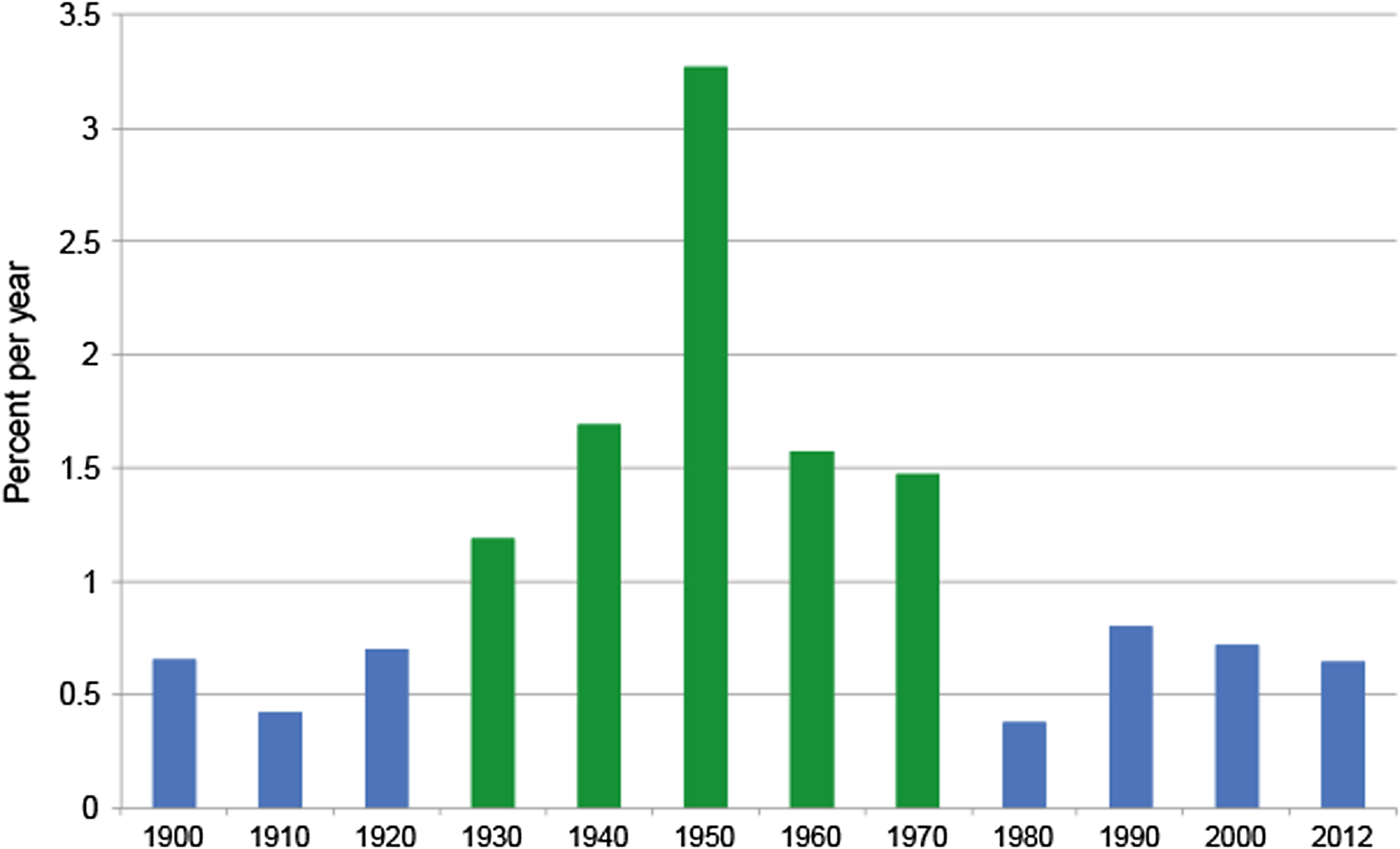
The claim that high-income capitalist nations have experienced successive prolonged periods of amplified and dampened productivity growth is not contentious and nor is the fact that the rate of productivity growth is running well below its long-term average (Bergeaud et al Reference Bergeaud, Cette and Lecat2016) – see Figure 1 below for the US. What is contested is why these waves occur, why the great post-war wave ended, and why unions have been unable to sustain their share of the subsequent reduced productivity growth. Marxists generally argue that expansive waves ensued when the contingencies that counteract the tendency for the rate of profit to fall have a strong and synchronous effect. These factors may include significant improvements in management methods that enhance productivity without altering the magnitude of the invested capital (Basu et al Reference Basu, Huato, Jauregui and Wasner2025; Basu et al Reference Basu, Huato, Jauregui and Wasner2025; Kellner Reference Kellner2024; Marx Reference Marx1959, 165). Liberals, by contrast, are inclined to accord less attention to the profit rate and, rather, point to a combination of variables that are held to be explanatory (Goldin et al Reference Goldin, Koutroumpis, Lafond and Winkler2024, 196).
US Total Factor Productivity. Source: Gordon (Reference Gordon2016).
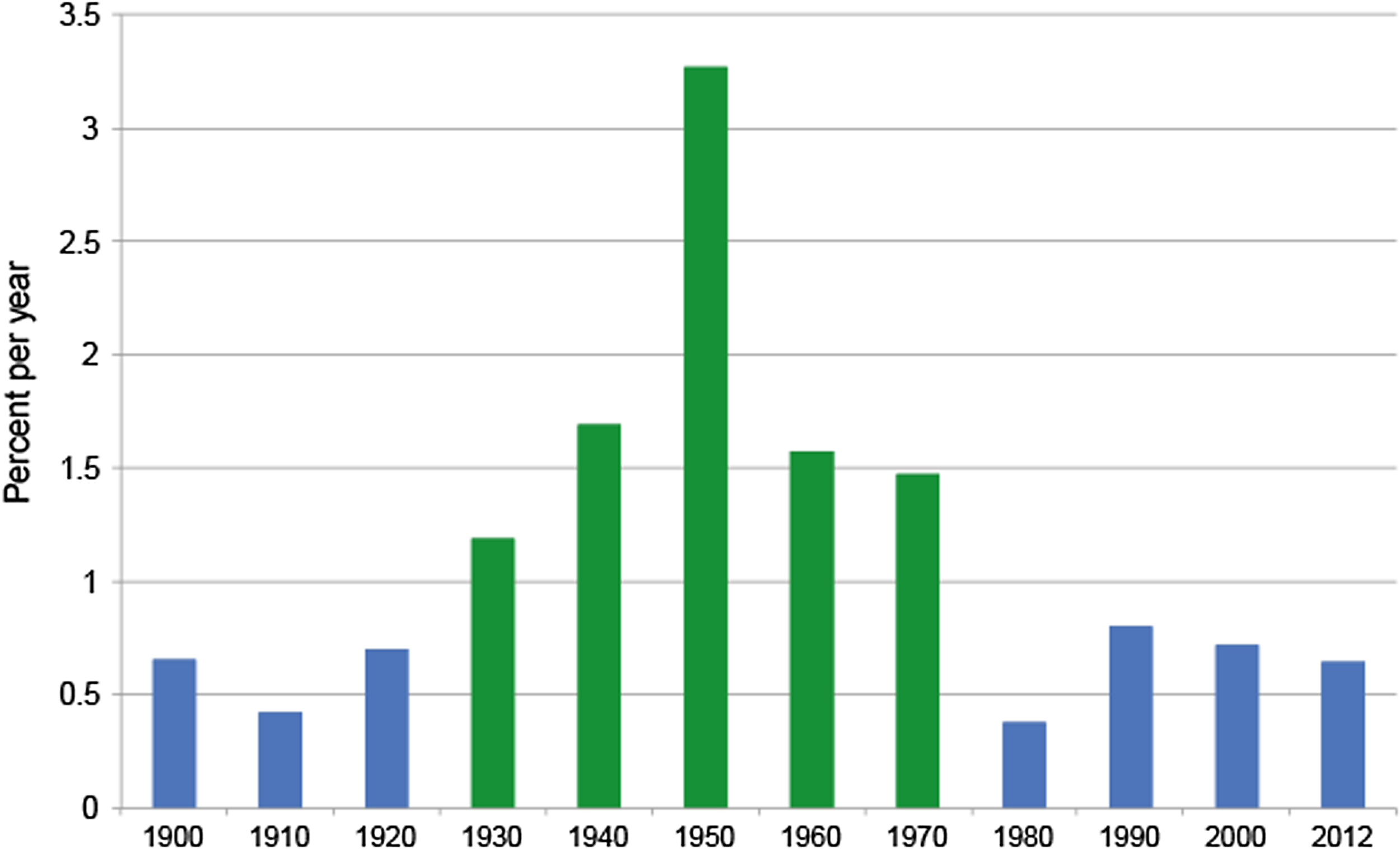
Marxists and liberals alike agree that, starting in the 1970s, governments and employers began establishing new laws and practices that curtailed workers’ bargaining power. As a consequence, wage earners’ share of the US GDP declined from 51% to 43% between 1970 and 2022. Both schools of thought accept, moreover, that long waves are caused by exogenous factors that may or may not be repeated. Within both traditions, however, a minority have been drawn to the findings of economist Nikolai Kondratiev, who held that waves of 50–60 years are endogenous, and consequently capitalism will inevitably recover from any sustained downturn. But with the passage of time and the failure of a new ‘Great Wave’ to emerge, even the limited number of scholars who have embraced Kondratiev’s deterministic version of wave theory has diminished. Kelly (Reference Kelly2018), who located the inevitability of new waves at the heart of his ‘rethinking of industrial relations’, for example, has conceded that the extant evidence has rendered the value of the theory at best an open question.
The contingencies that initiated and sustained the US long wave are also a topic of contention. Shackleton (Reference Shackleton2013) argues four clusters of innovation – electricity generation, internal-combustion engines, chemicals, and telecommunications – were critical, while Mokyr (Reference Mokyr1998) accepts a key contributor was the institutionalisation of technologies that enhanced the management of production and distribution. The latter’s perspective is accorded merit by Bloom et al (Reference Bloom, Sadun and Van Reenen2017, 2) who constructed a formal model of ‘Management as a Technology’ and found ‘differences in management practices account for about 30% of total factor productivity differences both between countries and within countries across firms.’ Also notable is the work of Dumenil and Levy (Reference Dumenil and Levy1993) who, after modelling for a range of independent variables that might explain the long productivity wave, concluded primary importance should be accorded the rise and subsequent exhaustion of the impetus to growth induced by:
[T]he empowerment of the banks that financed the newly incorporated enterprises, and the delegation of management to salaried managerial personnel who, supported by subordinate clerical and technical staff, accelerated the systemization of private and state organizations this being a process that colloquially came to be known as ‘Taylorism’ (Dumenil and Levy Reference Dumenil and Levy1993, 312–313).
Taylorism and trade unions
In the 1950s, two monographs documented the close working relationship that was forged between the scientific management and trade union movements during the interwar years (McKelvey Reference McKelvey1952; Nadworny Reference Nadworny1955). Over the following four decades, these works were augmented by labour historians who evinced that the Taylor Society actively supported unions, theorised the character of the firms that embraced the Taylorists’ mutual-gains agenda, and charged commentators who insist the scientific managers were hostile to unionism had commonly conflated Taylorism and Fordism (Nelson Reference Nelson1980). These works were largely ignored by management and industrial relations scholars, with the orthodoxy being exemplified by Johansson (Reference Johansson1986, 473) who observed:
Taylorist principles were incompatible with those of a normal union. They attacked every form of normal union activity, negotiations, wages expressing solidarity and equality, the efforts of the unions to secure employment for their members and more broadly, every act that prevented the employer from taking as much out of a single worker as he could.
In 1989 and 1998, Nyland contributed to the debate by arguing that a key element in the collaboration forged by the interwar scientific management movement and organised labour was the Taylorists’ support for reduced working hours and the institutionalisation of collaborative workplaces. He continued in Nyland et al (Reference Nyland, Bruce and Burns2014) documenting how Taylor’s acolytes worked to institutionalise the latter’s mutual-gains agenda in collaboration with the International Labour Organization, and, in 2018, Schachter joined the discussion with an insightful study of interwar labour representatives’ input to Taylor Society meetings (Schachter Reference Schachter2018).
In 2020, Kelly took the discourse in a new direction by artfully coining the term ‘Red Taylorism’ in her biography of Walter Polakov. The latter was a Marxist engineer, Taylor Society member, and an official of the Miners’ Union. Following Kelly’s lead, Davenport (Reference Davenport2023) underscored that Taylor became supportive of union participation in management processes and urged socialist labour militants and scholars to engage with these ideas. Responding to this call, Nyland (Reference Nyland2024) theorised why American socialists’ early response to scientific management was written from the history of organisation studies, while Mirsafian (Reference Mirsafian2023) documented how trade unions in post-WWII Sweden successfully pressured employers and the state to embrace the Taylorists’ mutual-gains and codetermination agenda. In 2025, Nyland further expanded the focus of the debate by reviewing the contribution feminist members of the Taylor Society made to the promotion of gender equity and trade unionism (Nyland Reference Nylandin press). Finally, Nyland and Bruce (Reference Nyland and Bruce2025) contested the long-held charge that the scientific managers’ outreach to organised labour began only after Taylor’s death and documented how the Taylor Society aided F.D. Roosevelt’s New Deal administration strengthen union influence.
In this paper, we build on these contributions by demonstrating Taylor’s efforts to identify non-adversarial alternatives to wage bargaining; by explaining why members of the Taylor Society came to accept the need for strong unions to ensure wage rates could keep pace with national productivity and consumption growth, and by arguing that, through this shift, scientific managers aided a revival of trade union density and influence that persisted for decades and may offer lessons for trade union renewal today.
Method
Our contribution is an intellectual history, by which is meant a study of the evolution of ideas and of the people who construct, write, and promote the diffusion of these viewpoints. It considers how thought and intellectual traditions evolve over time and situates these processes within their political-economic, cultural, and historical context. Specifically, our study explains how the ideas and practices of Taylor Society members evolved as the relationship between wages, profit, productivity, and union density changed throughout the first half of the twentieth century. This exploration is needed, not least we argue, because scientific managers have been vilified in both the orthodox and heterodox management and labour relations literature. Consequently, current pro-union scholars and activists are unaware of the valuable lessons that might be garnered from how pioneering scientific managers aided the revitalisation of organised labour through the interwar years.
Our contextual and interpretive method accords particular attention to Taylor’s ideas and to debates presented in the Bulletin of the Taylor Society. When interpreting texts, care is taken to clarify what scholars and practitioners were responding to, the problems they aimed to solve, and how their ideas were understood in their own time. The last step is critical when undertaking historical research, given the risk that scholars will engage in ‘historical presentism’, by which is meant interpreting past events and individuals through the lens of present-day values, beliefs, and standards.
Presentism is a particularly pronounced risk when discussing the scientific management movement, as the current orthodoxy is inclined to equate Taylorism with little more than deskilling and the mechanistic monitoring of labour. The orthodoxy, moreover, is unaware or else dismisses the Taylorists’ efforts to combat the power of corporate monopolists. This is despite the literature that has demonstrated the extent to which the Taylorists were a significant element within the progressive movement that arose in the late nineteenth century to promote industrial efficiency, social uplift, human welfare, and the threat to democracy posed by the rise of the great corporations (Haber Reference Haber1964; Layton Reference Layton1971; Wren and Bedeian Reference Wren and Bedeian2009, 273–276).
We have chosen to underscore productivity waves while being aware that an equally valid argument could be constructed by focusing on changes to the rate of profit. We do so because the empirical evidence for how profit rates have changed over time is less robust than the evidence that productivity growth began rising markedly from the 1920s, declined from the 1970s, and has not returned to the rate experienced during the post-WWII boom years (Basu et al Reference Basu, Huato, Jauregui and Wasner2025).
To contextualise our argument, we describe the social, economic, and political conditions in which the scientific management movement arose and evolved. Notably, we explain how Frederick Taylor’s ideas changed in response to difficulties he experienced when striving to convince trade union leaders that scientific management could be good for their organisations, and when his ideas relating to wage determination and participatory management were subjected to scholarly critique. Subsequently, we trace how Taylor’s acolytes addressed these twin issues and explain how and why their ideas and practices evolved in response to changes in the US political economy.
We draw on the personal papers of Taylor and his collaborators and accord particular attention to the Bulletin of the Taylor Society (BTS), deeming the latter to be a primary source, given that many papers were presented at Society meetings together with audience responses. Thus, they are arguably equivalent to meeting ‘minutes’ affording unique insights into the ‘institutional setting’ in which members and collaborators debated both theory and practice. The Bulletin is available in many libraries, allowing our citations to be checked and evaluated for accuracy. Moreover, scholars who wish to consult the journal can utilise the electronic listing of Bulletin articles and discussions Nyland has deposited with the Frederick Winslow Taylor Collection at the Stevens Institute of Technology in Hoboken, New Jersey.
Wage determination
Taylor and collective bargaining
Taylor believed harmonious employment relations could be institutionalised by applying scientific analysis to production and distribution processes in ways that would generate substantial benefits for both employers and workers. His understanding of the capacity of science to generate mutual gains, however, was greater than what unions and some of his inner circle, were willing to accept. The concern experienced by the latter was exemplified by C.B. Thompson of the Harvard Business School, who criticised the limited role Taylor was willing to accord collective wage bargaining. That this form of barter was necessary, Thompson initially argued in a 1913 paper, he titled ‘The Relation of Scientific Management to the Wage Problem’, in which he challenged Taylor’s claim that his wage system was scientific.
Scientific management does not today attempt to establish what is a fair day’s wage. Scientific management takes the prevailing rate of wages in the community and then proceeds to add to that a bonus in proportion to the achievement secured in excess of the ordinary achievement in that community. This process, however, leaves the basic rate to be determined as before; that is, by the ordinary daily bargaining in the market [hence] Under scientific management or any other system, the workmen must depend upon their combined power to enforce a minimum wage (Thompson Reference Thompson1913, 640, 641).
Taylor applauded Thompson’s paper, challenging only his charge that he was anti-union. In reply, Thompson conceded most of the problems Taylor believed could be resolved by engaging the scientific method were best confronted in this manner, but insisted this was not true of the base wage.
In the main I think we agree as to what should be included … except that as I understand it, you believe the basic wage on which a bonus is figured to as subject to scientific determination as the proportion of the bonus itself. On this I am not at present able to agree with you until I see some evidence of its having been done or some means by which it may be done. (Thompson to Taylor Reference Taylor1914—Stevens’ Institute).
By contesting the claim that Taylor’s wage-setting system was ‘scientific’, Thompson tested his oft-repeated assertion that if it could be shown collective bargaining was ‘needed, we should not hesitate to have it’ (Taylor to Hathaway – Taylor Papers, April 17, 1914). However, Taylor remained resolute in his determination to identify a non-adversarial system of wage setting. This arguably helps explain his reply, when subsequently he was asked by a Federal Industrial Relations Commissioner to explain how unionists and employers might resolve situations where they arrive at different conclusions after systematically and honestly analysing employment issues. Thus confronted, he advised that such situations should be resolved by according the courts an expanded role in identifying, developing, and institutionalising the laws governing the employment relationship.
I should welcome a tribunal, if one could be made, to which you would refer these things … I would indeed. I look forward to the day when the United States Government will furnish a tribunal of that sort. Nothing could be better in this world, to develop these laws and make them national laws (Taylor to the Industrial Relations Commission 1916, 806).
Taylor’s discomfit was subsequently amplified when the jurist Felix Frankfurter told him that unions were bound to remain hostile to scientific management so long as employers alone hired and controlled the technicians who supposedly set wages scientifically (Nyland and Bruce Reference Nyland and Bruce2025). In reply, Taylor opined that this problem could be overcome by having scientific management technicians appointed jointly by the union and employer. While this solution was arguably technocratic, it was a radical proposition for the time and indeed would be accepted by very few current employers.
In 1914, Taylor publicly amplified his solution by calling on unions to educate their members in ways that would enable them to effectively participate in the management of their workplaces:
If the unions will take up the education of their members, it will be a step in the right direction. They will have to take this step before we can cooperate with them. Instead of preparing for war they must try to promote working conditions which render possible higher wages. The unions have done an immense amount of good. Unions have made better working conditions. They have stopped great injustices in the trades and for that they deserve commendation. Because a man points out that they are doing a few things that are wrong it does not mean that he does not tolerate anything that they are doing (Taylor Reference Taylor1914, 3).
Taylor was aware that even workers who believed his claims of sympathy towards organised labour remained wary of his ideas. Notably, they feared that employers would gain enhanced power if they were able to increase their understanding of the labour process. Consequently, in 1915, he advised his friend and collaborator Morris Cooke that he had concluded discourse was insufficient, and that the scientific management and labour movements could be reconciled only if the technicians showed, rather than simply told, union leaders management science could be ‘good’ for their organisations (Taylor to Cooke – Taylor Papers 1915). This was a task taken up by Taylor’s acolytes following his sudden death some six weeks later.
Wages and productivity growth
Taylor was made a member of the Taylor Society in perpetuity on his death, with the position being immediately abolished so another could never share it. Concomitantly, Society members and fellow travellers began operationalising his advice that management theorists and practitioners needed to go beyond discourse and show their agenda could be ‘good’ for unions. This effort took multiple forms. An early initiative was actioned by Frankfurter, who took up the base wage problem. Expanding on Taylor’s advice that courts could help ameliorate the hostility commonly associated with collective bargaining, he invited Henry Bourne Higgins, the President of the Australian Commonwealth Court of Conciliation and Arbitration, to submit a contribution to the Harvard Law Review. This publication, titled ‘A New Province for Law and Order: Industrial Peace Through Minimum Wage and Arbitration’, detailed how Higgins’ Court set the base wage by empirically determining the facts pertaining to the cost of living in a ‘civilised community’ (Higgins Reference Higgins1915). Charged by this revelation, in 1916, Henry Rogers Seager, the Secretary of the Shipbuilding Labor Adjustment Board and a Taylor Society member, mandated that henceforth employers and unions would be required to provide robust factual evidence when assisting the Board in arbitrating on wages.
At the commemoration of Taylor’s untimely demise, Justice Louis Brandeis (Reference Brandeis1915) urged the scientific managers to engage Taylor’s advice that they show and not merely tell unions that scientific management could be good for them. Expanding, he added that they should ensure that this was done before introducing workplace reforms. Brandeis was respected by Society members, not least because he had actively supported Taylor’s efforts to combat the influence of engineers who subordinated their professional ethics in the service of corporate power (Layton Reference Layton1971; Nyland 2025). Responding to his call, members initiated a debate on the respective roles of the manager, the social scientist, and the worker in the governance of organisations (Person Reference Person1917). This debate quickly morphed into a discussion of who should speak for the worker, with members divided over whether independent or company unions were preferred and how negotiations should be conducted.
Engaging the wage question, Ordway Tead and Robert Valentine (Reference Tead and Valentine1917) argued that irrespective of whether bargaining is undertaken by employers and employees alone or involves an external arbitrator, it must not be presumed that base rates equal standard rates in the district or are some percentage more than such rate. To embrace this assumption, is, they charged, ‘to throw away the case so far as any claim to scientific division of earnings goes’ (Tead and Valentine Reference Tead and Valentine1917, 247–248). Rather, a scientific approach requires that the interested parties ‘thrash matters out’ with all financial and technical facts fully before them, meaning firms must ‘open their books’ and provide workers with knowledge of the true costs of production, distribution, and many other issues characteristically deemed confidential.
With US entry into WWI, the Taylorists’ capacity to show scientific management could be good for unions was enhanced when Frankfurter was appointed the Chair of the War Labour Policies Board. Capitalising on this opportunity, he subsequently assigned Morris Cooke to a managerial position that enabled him to abolish child labour, institutionalise the eight-hour day, and establish joint-production committees in organisations providing the needs of war (McKelvey Reference McKelvey1952; Nadworny Reference Nadworny1955; Nyland 2025). This effort greatly impressed Samuel Gompers, the President of the American Federation of Labor (AFL), who, at war’s end, employed Cooke as his technical advisor when attending the first meeting of the International Labour Organization. Together, the two men subsequently edited an edition of the Annals of the American Academy of Political and Social Science that explored the management functions that organised labour might undertake if union leaders accepted they had to share responsibility for enterprise efficiency.
The Gompers-Cooke text stressed the need for cooperation between the ‘scientists of industry and the representatives of organized workers [and insisted] where the pursuit of profits makes for waste rather than for the conservation of human and mechanical energy readjustments are inevitable and may be radical’ (Cooke 1920, VII–VIII). Concomitantly, the Society initiated a series of studies designed to show scientific management could be good for unions by providing organised labour with technical knowledge that aided their efforts to reduce working hours and demonstrate that poor management and not worker militancy was the single greatest source of waste in industry (McKelvey Reference McKelvey1952; Nadworny Reference Nadworny1955; Nyland Reference Nyland1989).
Contra Braverman’s (Reference Braverman1974) charge that the Taylorists wished to have workplace knowledge monopolised by the employer, the Taylor Society assisted the American Federation of Labor establish management research and education centres. Informing the governance of these institutions was the conviction that if unionists were to be active participants in management, they had to have access to the knowledge required to undertake this function. The Taylorists’ understanding was captured by Cooke when he advised Sidney Hillman, the socialist President of the Amalgamated Clothing Workers’ Union, that he believed:
Even those of the extreme left who look forward to the time when our present organization is to be completely upset … can cooperate in the plan [for industrial democracy] and if the foregoing is even measurably true, then every labor organization should have an agency or a division specializing on production and labor’s participation in it (Cooke Papers: Cooke to Hillman 1920).
The budding collaboration between organised labour and scientific managers was tested, however, when the 1920–1921 Depression led employers to argue wages should be cut because prices had fallen and launched an assault on organised labour that devastated union numbers.
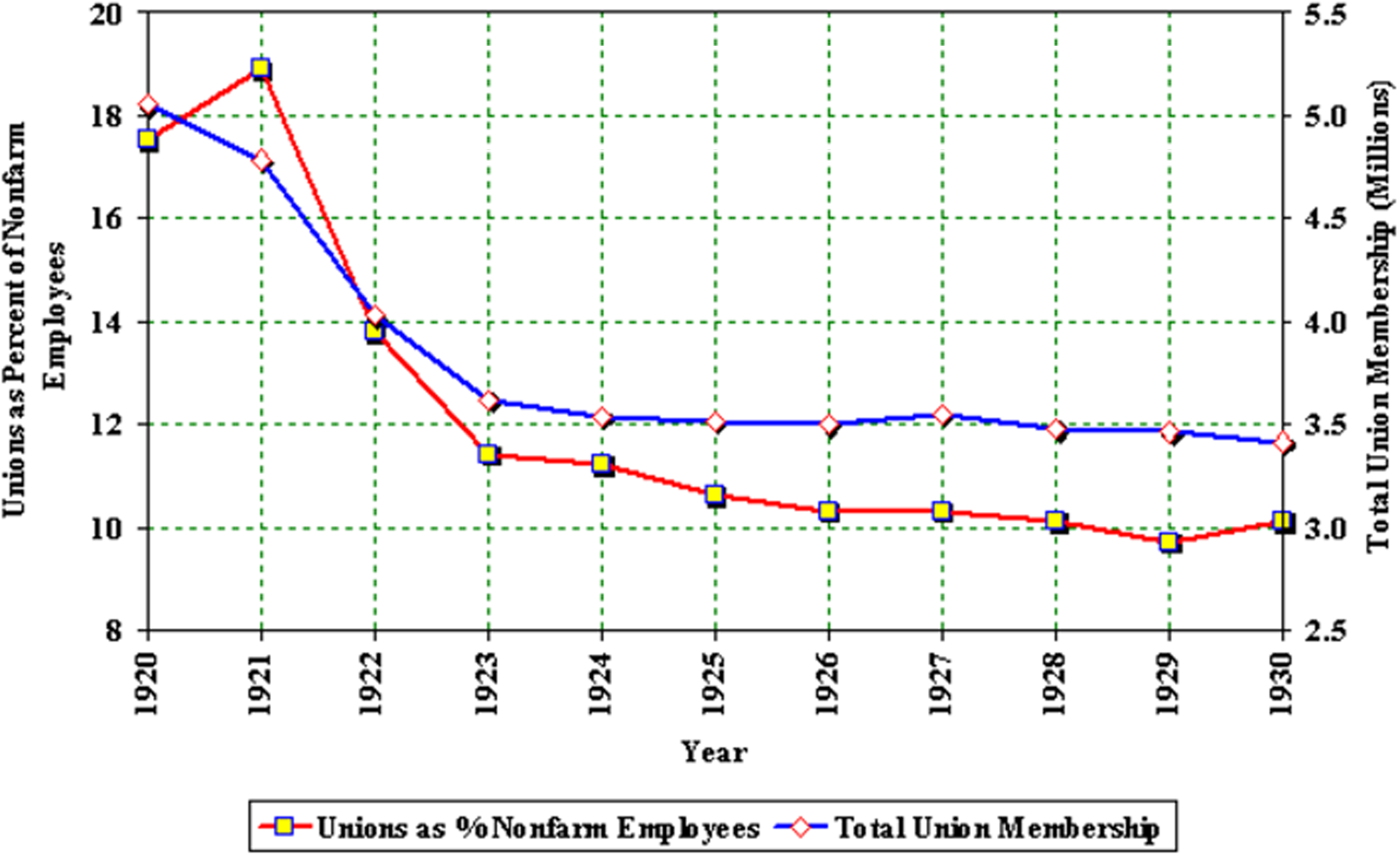
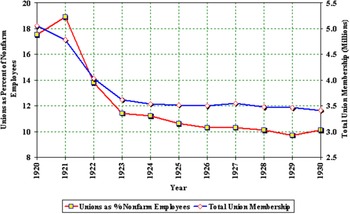
With the collapse in union density (see Figure 2 below), the AFL and Taylor Society sought to promote union renewal by showing firms how unions that embraced management science could generate gains for both employers and workers. Their promotion of the mutual-gains message, however, was not well received by employers. Seeking to render their case more scientific, the Taylorists urged the federal government to construct an index of national labour productivity that would assist wage-earners to gain their ‘proper share’ of productivity growth. In 1926, the Department of Labour took up this proposal and began publishing a series of articles that revealed the US was undergoing what it deemed was nothing less than a Second Industrial Revolution. Indeed, ‘perhaps the most remarkable advance in productive efficiency in the history of the modern industrial system’ (cited by Tugwell Reference Tugwell1927, 3).
Historical Statistics of the United States (1976), Series D-940 and Series D-7. Source: US Bureau of the Census (1976).
Responding to the Department’s finding, Rexford Tugwell argued that the increase in industrial efficiency was due primarily to improved management technologies; further the Marxist economist Jurgen Kuczynski, who was chief statistician for the AFL, evinced that wages growth was not matching the rate of productivity increase, and hence, the wage share of the national income was declining (Linder Reference Linder1994). Concerned at Kuczynski’s finding, the Taylor Society invited the new AFL President to join a debate on how employers’ capacity to ‘hog’ the benefits of productivity growth could be countervailed (Green Reference Green1928). The industrialist Henry Williams (1928, 12) captured the essence of the debate when he lamented that, despite advances in macroeconomic stabilisation theory and statistical analysis, two contingencies made it extremely difficult to convince employers that it was necessary to address the fact that workers’ income was lagging behind technological advances. First, property owners and their administrators overwhelmingly believed that if wages were raised, their own earnings were bound to be reduced even if the community’s consuming capacity was increased. Second, trade unions lacked the bargaining power required to compel employer and government stakeholders to accord workers a commensurate share of the benefits made possible by increased productivity (Williams Reference Williams1928, 11).
The Taylor Society debated the issues underscored by Williams at its 1928 conference, with Morris Cooke opening the discussion by arguing that a truly scientific approach to wage management and union renewal required that workers have the capacity to countervail employer power to a degree sufficient to render collective bargaining meaningful:
The interests of society, including those of the workers, suggest some measure of collective bargaining in industry to the end that the weaker side may be represented in negotiations as to hours, wages, status and working conditions. Collective bargaining implies the organization of the workers on a basis extensive enough—say nation-wide—as to make this bargaining power effective (Cooke Reference Cooke1929, 2).
Expanding, Cooke insisted, effective wage bargaining requires independent, national trade unions that can fund the training union members needed to participate effectively in the management process and to demonstrate to employers that management science could generate substantial mutual gains. More specifically, he called on the membership to consider:
how we can give the grouped (or organized, unionized—call them what you will) a functional place in the industrial process. How can the group find a work essential to an ordered industry which it can do as well as, probably better, than it can otherwise be done (Cooke Reference Cooke1929, 6).
As the US plummeted into the Great Depression, it became clear that President Hoover would not use state power to ensure that wage and productivity growth were harmonised. Consequently, Society members became convinced that the function unions could and must undertake was to act as managers of aggregate demand. In arriving at this position, the Society undertook an ongoing debate which at times was acrimonious. This was not least because some contributors charged that the scientific managers were in part to blame for the crisis. For in working to increase productivity, the scientific managers had not adequately addressed what might occur if society’s capacity to generate output was not matched by its capacity to consume. The charge was well articulated by Tugwell, who was soon after appointed one of President FD Roosevelt’s four-man Brains Trust (Tugwell Reference Tugwell1932, 86, Reference Tugwell1968).
If we had been watching, describing, analyzing industry as we should, we must have known that the greatest economic event of the nineteenth century occurred when Frederick W. Taylor first held a stopwatch on the movements of a group of shovelers in the plant of the Midvale Steel Company. And we must have understood, when Shop Management was published in 1903 that, perhaps a generation later, the world could be overwhelmed with goods. … Instead of that, writing and teaching went on undisturbed, the subject matter becoming more and more traditional. Perhaps most ironical of all, in view of the coming surplus, was all the emphasis on laws of diminishing returns and the limited number of the seats at nature’s table. The forces which were to make the future went unnoticed.
Accepting this criticism, Mary van Kleeck, a Marxist and the first woman to join the Taylor Society, urged its members to accept that the Depression was due to workers’ lack of adequate consuming power and that the scientific managers had to address this problem:
Technology has … so increased possibilities in economic life that men’s conception of the end to be attained through economic processes must be enlarged if the further development of economic capacity is to be realized. In other words, we have made enormous gains in production, but we have not yet learned to balance production through buying power, that is, through distribution (Van Kleeck Reference van Kleeck and Fledderus1931, 569).
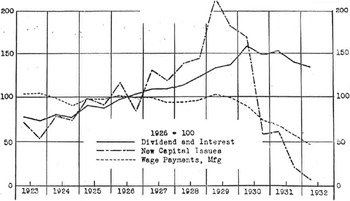
Taylor Society members subsequently debated the underconsumption charge and by 1933, the leadership was willing to publish Figure 3 below (Welch Reference Welch1933, 13).
Indexes of Capital Returns, Capital Expansion and Labor Returns United States. Source: Welch (Reference Welch1933).
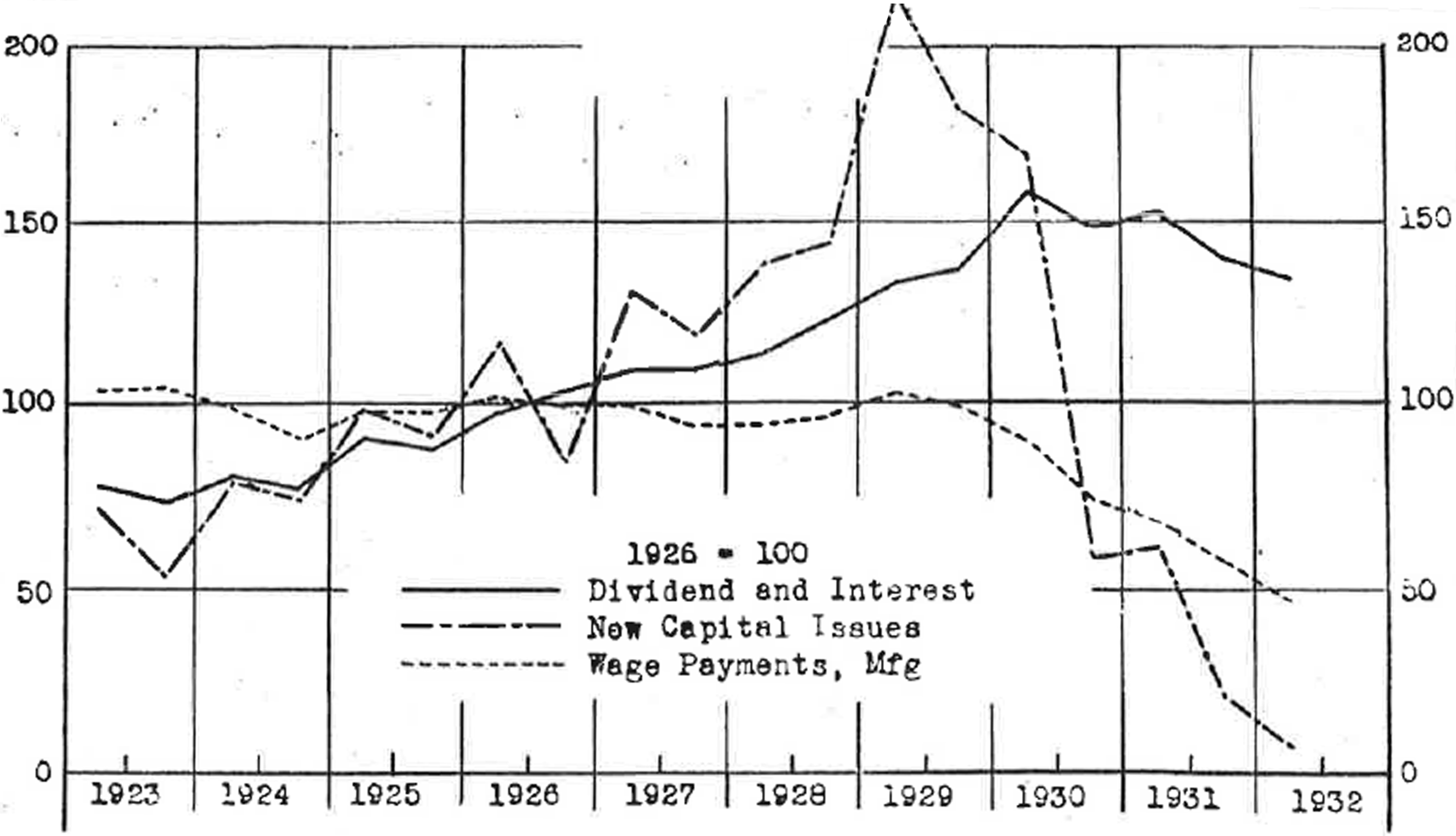
Welch’s contribution was a forerunner to the great body of literature that has analysed the cause, course, and consequences of the 1930s Depression. This literature has been dominated by political scientists and economists with both traditions being inclined to overstate the significance of their respective discipline, and/or the stream of thought within their field with which they align. Irrespective of their orientation, however, few contributors have considered the role that management and organisation researchers, and more specifically the Taylor Society, made to deliberating strategies for dealing with the Depression. Significant exceptions to the latter observation exist, but they are rare, being limited to Friedlander’s (Reference Friedlander1987) The Origins of the Welfare State: The Keynesian Elite and the Second New Deal, Fraser’s (Reference Fraser, Fraser and Gerstle1989) The Labor Question, and Pabon’s (Reference Pabon1992) Regulating Capitalism: The Taylor Society and Political Economy in the Interwar Period.
The omission of any substantial discussion of the contribution that management scholars and practitioners made to constructing and governing the New Deal, moreover, has attracted little attention from contemporary researchers in management and organisation studies. This is despite the fact that through the Depression years, US firms experienced what Field (Reference Field2011) describes as a ‘Great Leap Forward’ in productivity growth by diffusing innovations in technology and infrastructure that had been developed in the 1920s. Why management scholars have not addressed this issue has been discussed by Foster, Mills and Weatherbee (Reference Foster, Mills and Weatherbee2014), who posit the omission is because organisation studies has been captured by corporate interests which believe Roosevelt’s New Deal assault on business power was reprehensible and not an agenda that could be allowed to be repeated, and so, preferably not researched or taught in business schools.
Foster et al. (Reference Foster, Mills and Weatherbee2014) contribution is valuable but is diminished by the lack of attention they accord what they term ‘verifiable facts’ that have been judged through a process of ‘reasonable inferences’. Consequently, they posit that the problems and challenges of the Depression years were ‘perceived by management scholars to be separated from management; they were affairs of government, albeit a government whose growing role in regulating industry was neither welcome nor willingly acknowledged.’ This charge suggests these scholars were unaware of the historical literature that has documented the theoretical contribution made by Taylor Society members who left their universities and firms, and worked to show that the New Deal administration could enhance the power and well-being of the dispossessed.
That Taylor Society members played a substantial role in the New Deal was initially evinced by Friedlander (Reference Friedlander1987). Drawing on the Society’s 1936 membership list, he showed that a substantial number of practitioner and academic members joined Roosevelt’s administration. They did so, not merely as consultants or providers of executive education, but as senior managers of key agencies of the regulatory state the federal government was constructing to contain the power of corporate monopolies. By so doing, he was able to show that a three-stage hierarchy existed within the state: this being the executive, the secondary leadership, and one or more Frankfurter lawyers and several Taylor Society technocrats. Also noteworthy is that the Taylorists’ presence was subsequently expanded to include notable Society members such as Marshall Dimock (Reference Dimock1939), who was appointed Francis Perkins’ Assistant Secretary of Labour in 1938 (while concomitantly President of the Washington chapter of the Taylor Society), and Raymond Zimmerman who became Administrative Assistant to President Truman (while concurrently National President of the Taylor Society).
Once ensconced within the New Deal administration, Taylor Society members worked to harmonise production and consumption. They did so, not least by assisting the crafting of labour and social security legislation that enhanced workers’ ability to unionise and limited employers’ freedom to engage whatever labour management regime they preferred. Notably, Barenberg (Reference Barenberg1993) observes, Society members made a significant contribution to drafting Robert Wagner’s 1935 National Labor Relations Act, at the heart of which was Wagner’s conviction that:
As costs decrease and profits increase it is absolutely essential that the level of wages should be increased. The mass of the consumers are to have the necessary purchasing power to keep industry going … It is essential to have collective bargaining, preferably through industry-wide agreement between organized labor and organized management. In no other way will the wage structure of the country be maintained at a proper level (Jacobs Reference Jacobs2005, 147).
In Pabon’s (Reference Pabon1992) pioneering study of the Taylor Society, he characterised the demand management aspect of the scientific managers’ agenda as ‘proto-Keynesians’. This depiction has some validity in that Keynes did come to concede the Taylorists’ conviction that labour markets do not necessarily clear if left to themselves. However, what Pabon misses is that the Taylorists were not Keynesians in the sense of focusing on government expenditure to stabilise the economy. Rather, as Jacobs (Reference Jacobs2005) underscores, they tended to be ‘fiscal conservatives’ who emphasised the impact of social, political, and legal institutions on economic outcomes. Notably, they sought to increase the capacity of labour market institutions including trade unions, to keep demand and supply in equilibrium.
Keynes, it is true, did accept that unions could function as managers of aggregate demand. However, he preferred that this task be undertaken by the state because he believed unions could only equilibrate production and consumption ‘by a series of gradual, irregular changes, justifiable on no criterion of social justice or economic expedience, and probably completed only after wasteful and disastrous struggles, where those in the weakest bargaining position will suffer relatively to the rest’ (Keynes Reference Keynes2018, 236). Moreover, Keynes failed to address the possibility that unions might be compelled to become primary managers of market stabilisation should the state not undertake this function. Disastrously, this possibility was rendered manifest in 1937 when President Roosevelt surrendered to demands that he balance the national budget and reduced state expenditure, and so saw unemployment leap from 11% to 20% over the following year.
As an aside, it is interesting to note that John Kenneth Galbraith (Reference Galbraith1981) advises that Keynes’ work had a dramatic impact on his understanding of economics. Nonetheless, Galbraith also reports that when the General Theory appeared, he was living in the home of a one-time president of the Taylor Society, and that his host’s circle viewed Keynes’ contribution as a confirmation of economic principles they had long been helping US policymakers to institutionalise.
As part of their effort to show that management science could be ‘good’ for unions, Society members also helped build the Congress of Industrial Organisations (CIO). Exemplifying this effort, in 1940, Morris Cooke authored a monograph jointly with Phillip Murray, the President of the United Steelworkers’ Union, which called on US employers and unions to ‘tap labor’s brain’ by embracing management codetermination (Cooke and Murray Reference Cooke and Murray1940, 121). Following this development, influential trade union officials joined the Taylor Society, including Clinton Golden (Reference Golden and Ruttenberg1942) of the steelworkers’ union, who, in 1942, published a joint monograph with Harold Ruttenberg titled The Dynamics of Industrial Democracy, which was explicit in denying employers a unilateral right to set rather than negotiate wage rates.
The Taylorist-union effort was further expanded through WWII with the scientific managers assisting the state, employers, and trade unions establish participatory production management structures in some 3500 enterprises (Lever and Goodell Reference Lever and Goodell1948). This was done under the watchful eye of Harry S. Truman’s Senate Special Committee to Investigate the National Defence Programme. Through the war years, Truman resisted employer complaints that unions were encroaching on property owners ‘Right to Manage’. Moreover, he called on the Taylor Society to assist the eventual transition to peace, and in 1944, he welcomed the Society’s decision to make the theme of its annual conference ‘Management Factors for Full Employment’ (Truman Reference Truman1944, Reference Truman1945).
The full-employment conference centred on the relationship between productivity, wages, profits, and participatory management. Discussion was led by academics and trade union officials. Lloyd G. Reynolds (Reference Reynolds1946) of Yale opened the debate with a contribution that stressed that both workers and employers should share responsibility for ensuring that wages and productivity growth are closely linked. Optimistically, he expanded that there was growing acceptance that it was necessary to share responsibility for balancing wages and productivity, and that this would eventually lead unions and corporations to forge a wage system that could support full employment. By contrast, Wharton’s Balderston (Reference Balderston1946) focused on the cost of production, and so argued that firms could provide wage increases that were not inflationary if senior management directed increased attention to capacity utilisation. This perspective was echoed by Solomon Barkin (Reference Barkin1946) of the Textile Workers of America, who argued wages should be raised to increase effective demand, which in turn, would enable firms to absorb wage rises by increasing their capacity utilisation. Finally, Clinton Golden (Reference Golden1946) argued the path to increased prosperity for all was codetermination with workers, unions, and enterprise managers participating in production committees and sharing knowledge and responsibility for all aspects of management.
Reynolds identified General Motors (GM) and the United Automobile Workers (UAW) as the agents that might establish how employer monopsony and union monopoly power could be balanced in a full-employment, high-wage, and profit economy. This advice reflected his awareness that GM and the UAW were in the midst of a major industrial dispute that centred on wages, and more importantly, on the so-called ‘prerogatives of management’. In brief, the union demanded a wage rise, a guarantee there would be no subsequent rise in prices that would undermine the wage increase, and an ‘opening of the books’ of the company to enable both parties to become aware of production costs, investment plans, the impact of wage increases on profits, and so on.
The Taylor Society made clear its sympathy for the UAW’s agenda. The strike itself lasted for 113 days and involved 300,000 workers. But with the assistance of other corporations, GM swept away the notion that its pricing policy and production-technical decision-making were subjects for bargaining or arbitration. Consequently, the union and its scientific management supporters’ hope that the dispute would entail a debate amongst actors, all of whom would have access to scientific knowledge relating to costs, pricing, and the like, was thwarted, and the strikers starved back to work. As Harris (Reference Harris1982, 150) has observed
The sovereign power of corporate management to make investment and pricing policy —“the very heart of management judgement and discretion in private industry”—was protected absolutely … basic management rights were not negotiable. The scope of collective bargaining [was to be] narrowly confined to wages, hours, and working conditions, and even there the corporation’s power to take the initiative in instituting change was adequately broad.
Harris’ (Reference Harris1982) reporting is accurate, though he appears unaware of the extent to which the scientific managers strove to assist the UAW to limit the ability of GM to set wages by providing the union with data they hoped would turn the management of wage determination into a scientific endeavour. In 1951, the transition to the post-war order was confirmed when the AFL adopted what it termed ‘A New Wage Policy to Prevent Crisis’. This accepted the employers’ offer to tie wage growth to increases in ‘efficient production’ so long as all issues relating to management beyond wages and conditions of employment were conceded to be the prerogative of the employer.
A taylorist renewal?
With the US labour movement’s campaign for participatory management defeated, organised labour was compelled to retreat, and in 1953, the unions formally abandoned their support for the Taylorists’ co-determination agenda. Nonetheless, the post-war productivity wave, the high rate of corporate profitability, and workers’ enhanced capacity to organise made possible by the New Deal reforms, meant unions did not experience the devastation that had beset them after WWI. Rather, they were able to embrace John R. Commons’ conviction that unions should perceive the employer as their adversary and use their organisation and market power to demand increased wages and benefits as productivity rose.
Thus, was forged an employer-union-government compact that generated mutual gains for as long as the conjunction of contingencies that made the great productivity wave possible was sustained. The dramatic 1970s slowdown in productivity growth, however, revealed that this conjunction was becoming exhausted. It also revealed that Commons’ adversarial bargaining agenda was unsuited to a low productivity growth environment in which property-owners needed to increase their share of what growth that did occur, in order to realise a rate of profit sufficient to warrant remaining in business. Thus motivated, those same owners viewed unions as adversaries who limited their ability to realise this goal and who therefore needed to be done away with.
The consequent assault on US unions has driven private sector density to a level lower than in 1928 when Morris Cooke had advised that given few employers were willing to accept unions could be good for their firms, it was necessary to identify a functional place for organised labour that was ‘essential to an ordered industry which it can do as well as, probably better, than it can otherwise be done’ (Cooke Reference Cooke1929, 6).
In the high productivity era, this function became market stabilisation, and with the end of the long productivity wave, unions, employers, and theorists have struggled to find an alternative functional place that can serve as an effective substitute.
One possibility that it has been suggested can fulfil this role is the changing nature of the labour process brought about by the ‘Fourth Industrial Revolution’ (4IR). The 2025 World Economic Forum Future of Jobs Report advises that across the five years from 2025 to 2030, the 4IR is expected to generate a net increase of 78 million jobs. Technology-related roles will be the fastest growing in percentage terms, net upskilling will be significant, and just over half of employers (52%) anticipate allocating a greater share of their revenue to workers in order to align wages with workers’ productivity and performance and to compete for talent and skills (Zahidi Reference Zahidi2025). These developments are likely to favour trade union’s ability to organise. This is the more so given a significant body of research has found unions potentially can help organisations innovate and institutionalise knowledge-intensive work practices (Ilyina et al Reference Ilyina, Pazarbasioglu and Ruta2024; Young-Hyman et al Reference Young-Hyman, Magne and Kruse2023). So far, however, this potential has not become manifest in the US union density statistics. This is unsurprising, for while algorithmic efficiencies may generate jobs suited to unionisation, they can also exert an insidious squeeze on employees’ ability to organise. In brief, the increasing use of surveillance and algorithmic control in modern workplaces may both expand and constrict workers’ ability to resist exploitative labour practices, and at this stage, the net effect on union density remains unclear.
We suggest that a more promising possibility worth exploring lies in the fact that the collapse of trade union density seen in the United States has not been replicated in the Nordic countries. Why this is the case has been the subject of much debate, at the heart of which is the Nordic ‘social partners’ preference for consensual rather than adversarial bargaining, and acceptance that unions should accept that they have a responsibility to assist the management of enterprises.
How the Nordic model initially arose has been the subject of much debate. Swenson (Reference Swenson2003), in Capitalists Against Markets, evinced that one explanatory factor that has received inadequate attention is the fact that many of the labour and welfare policies that came to be associated with the Nordic model were first introduced in the US by New Dealers, and only later were institutionalised in Sweden.
Swenson (Reference Swenson2003) is aware that the Taylor Society moved to the left in the 1920s, that Society members actively supported the New Deal, and that Swedish employers bitterly opposed ‘progressive Taylorism’. Expanding, he notes that employers denounced the fact that training institutions were teaching this ‘false doctrine’ both to unionists and to their foremen. By contrast, Mirsafian (Reference Mirsafian2023), who has explored the origin of the Nordic model, embraces the orthodox understanding of Taylorism and is unaware of the alliance forged between the Taylor Society and the US trade union movement. Consequently, he argues that militant Swedish unions imposed an indigenous form of ‘humanised’ Taylorism on their employers.
Mirsafian’s (Reference Mirsafian2023) contribution is important not least for highlighting that the institutionalisation of the Taylorists’ participatory agenda had to be imposed on Nordic employers, who, if left to themselves, would have institutionalised unitarist management regimes or at best embraced John Commons’ adversarial pluralism. By revealing the Taylorist origins of the Nordic model, Mirsafian has indicated how US unions might have fared, in a low productivity growth era, had they been successful in their post-war effort to pressure employers and the state to institutionalise the scientific managers’ consensual and participatory agenda.
Importantly, Mirsafian (Reference Mirsafian2023) has also shown what Taylorism might still make possible. Numerous nations have sought to import variants of the Nordic model. Full transplantation is rare and has proven exceptionally difficult. But while originating in Sweden, the model has spread to all the Nordic states, and so diffusion is not impossible. Ironically, some advocates have sought to import the model because they have viewed it as an alternative to Taylorism. Given we live at a time when industry policy is in vogue and so many other strategies have proven ineffective in halting de-unionisation, it may be time for theorists and practitioners to revisit the Nordic experience with Taylorism. This suggestion will appear naïve to many commentators, but perhaps less so if we remain mindful of what foundational scientific management scholars and practitioners managed to achieve in the New Deal years.
Conclusion
We have contributed to the discourse on the enduring decline in trade union density that has occurred in the US by enquiring if the ebbing of the 1925–1975 US productivity wave helps explain the decline. We began by discussing the functions of trade unions and long waves of productivity growth. This examination led us to conclude that the importance of trade unions’ ability to function as harmonisers of production and consumption waned dramatically once the US transitioned to a relatively low productivity growth era. In this environment, robust unions came to be perceived by employers and governments as a serious cause of inflation and inefficiency. As a result, employer monopsony power increased, enabling employers and the government to launch a severe attack on trade union influence, leading to a sharp decline in union density.
We presented a historical narrative that traces how progressive theorists and business activists within and around the Taylor Society contributed to the development and institutionalisation of a system of aggregate demand management that helped to both increase union density and curtail the power of employers to unilaterally set wages. In the process of explicating how scientific management theorists and practitioners contributed to the building of a system of demand management, we noted that Keynes appreciated that both trade unions and the state could fulfil this function. This insight has gone unexplored not only by the researchers who have studied Keynes’ ideas, but also by scholars who have sought to explain the collapse in union density. Also accorded inattention is the fact that when Keynes advised that policymakers should rely on the state rather than unions to equilibrate consumption and production, he neglected to discuss the possibility that organised labour might have to function as the primary manager of aggregate demand should the state choose not to take on this role. By contrast, both Robert Wagner and his Taylorist supporters recognised this possibility and worked to assist the trade union movement to gain the needed capacity.
Our contribution supports the conclusion that the debate on union renewal must address the consequences of the declining role of organised labour in stabilising the macroeconomy. Analysts who address how the labour movement might be revitalised tend to focus on micro deficiencies within unions, prioritising the need to modernise administrative practices, re-engineer union organising techniques, democratise collective action repertoires, and how to bridge the gap between labour market insiders and outsiders. These micro issues need to remain part of the renewal discourse. However, this focus implicitly places excessive blame on union officials for the decline in union density, and distracts from the need to explain the contingencies that have generated a far more hostile environment for unions than was the norm during the era of high productivity growth. Unions face an uphill battle without changes to labour law and policy that extend collective bargaining across employers, and the renewal debate needs to confront how this goal can be won sans a major and sustained revival in the macroeconomy.
Finally, we noted that the decimation of trade union density that has occurred in far too many nations has not occurred in the Nordic world. In this domain, unions, employers, and the state rejected Commons’ adversarial collective bargaining and embraced variants of the consensual bargaining agenda advocated by the scientific managers. This leads us to conclude that it is possible that, given the current revived support for high technology manufacturing, union renewal may be aided by turning once again to the agenda pioneered by Taylor.
Chris Nyland is a Professor at Monash University with a long-term interest in the history and evolution of management and economic ideas. His research interests include globalisation and human security, history of the scientific management movement, and business regulation.
Kyle Bruce is an Associate Professor and Director of Research at Wentworth Institute of Higher Education. His research interests include management, business, labour, and marketing history, and the history of management and economic thought.

 Open access

