




1. Introduction: the co-design framework
In the 1970s, designers began to observe people and behaviors more carefully, increasingly asking users to participate in the design process. From being passive, users have turned into ‘expert actors’, that is, active subjects holding a knowledge based on experience (Rizzo Reference Rizzo2009, p. 8). The approach to the design of products and services responding to the current needs of involving users in the design process, defined by the ISO in the 1990s user-centered design,Footnote 1 has evolved in recent decades: it has expanded its applications and objectives, it has become the subject of experimental research, it has developed new technologies and evaluation techniques and, above all, it has increasingly involved the user and introduced new design paradigms, up to the formulation of co-design oriented processes. As Rizzo (Reference Rizzo2009, p. 68) recognizes in the book Strategie di co-design:
The transition from user-centered design to experience-based design, up to co-design, is characterized by a change in the role that the major players in the processes undergo: the designer and the user.
That is, if the UCD imagines a qualitative approach through focus groups, observations, interviews and the users’ passive participation in the design process, thus becoming an object of study, in co-design the users become co-creators, members of the design teamwork. Co-design promotes the need to include people in the process of designing and generating the idea, making sure that the user is the main responsible for innovations, and that he expresses various forms of creativity in relation to the type of project, to his level of experience, to the skills and, last but not least, to the tools made available by the designer/researcher (Fischer Reference Fischer2002; Sanders Reference Sanders2006; Sanders & Stappers Reference Sanders and Stappers2008; Manzini Reference Manzini2015). Co-design is by its very nature a dynamic field, it adapts to different contexts, sectors, modes of expression, users and technologies and provides the most useful and necessary tools to generate democratic processes of user-driven innovation (Von Hippel Reference Von Hippel2005; Leadbeater Reference Leadbeater2008).
In recent years, co-creation and collaboration to create and deliver new products and services have seen a further upgrade, and a new type of active involvement of users – who from co-designers have become independent designers albeit not experts – has appeared. The condition of democratization of design tools (Von Hippel Reference Von Hippel2005; Bassi Reference Bassi2017) has been the premise for new relationships between the actors involved and for a new design paradigm, defined by Manzini (Reference Manzini2015) as ‘diffuse design’. In the next paragraph, the phenomenon of diffuse design will be critically analyzed, and the open design and open production approaches will be investigated, with particular attention to the sector of visual communication and the production of motion design artifacts. Motion design, indeed, has proven in recent years to be a dynamic design field of application more open to spontaneous, not disciplined but legitimized performances due to an ease of access and mastery of shared contents, open platforms, technical tools and user-friendly technologies (Liang et al. Reference Liang, Sit, Chang and Zhang2016). Furthermore, motion design allows an effective logic of customization and hybridization of languages and codes of representation.
In the second part of the article, a didactic experiment conducted by the authors will be presented. A class of design students was requested to analyze existing motion graphic online open platforms to identify criticisms in terms of the user interface, platform navigability and tools and contents that users can access and manage. The didactic experiment encouraged students to rethink a collaborative design experience between expert designers and non-expert designers who use the platform to create the final outcome.
2. Beyond co-design paradigm
The concepts of diffuse design, open design and open project are – as Bassi (Reference Bassi2017) recognizes in the book ‘Design Contemporaneo’ – a truth of contemporaneity and characterize scenarios in which it is easier to access and use tools and technologies. The production and creation of artifacts of all kinds, experienced even by creators–executors who are far from the skills of the designer, are now legitimized. The traditional top-down paradigm has been challenged by the co-design bottom-up approach (Manzini Reference Manzini2015, p. 85) and finds new solutions in the diffuse design realm, in which the final outcome stems from an ‘asynchronous’ peer-to-peer collaboration that engages designers and no-designers in sharing skills and knowledge in an open production process. This convergence of skills, which Bassi (Reference Bassi2017, p. 111) summarizes in the term ‘encoded knowledge’, describes a research approach also applied in the professional field and encourages multidisciplinary collaboration.
2.1. Diffuse design and expert design
In the diffuse design scenario, expert and non-expert designers interact in a different way than in the co-design approach. Manzini (Reference Manzini2015) provided a new definition of co-design and described it as ‘a social conversation in which different actors interact […] in different times’ (p. 51). Manzini addressed here an important feature of the open design paradigm, that is a non-finish process in which expert designers prepare a design model and a library of tools, and become the trigger of the process, using their knowledge to support and enhance focused and clear-cut design initiatives to be conducted and completed by non-expert designers in different timing.
The expert designer performs a new role and acts as the external agent by creating and facilitating conditions for non-expert designs to manage and mastery tools, strategies and methods. The expert designer’s critical and practical sense and creativity serves to stimulate and facilitate human ability to design, considering it a natural talent that may evolve into a professional skill and discipline (see Manzini Reference Manzini2015).Footnote 2 As a consequence, diffuse design paradigm changes the responsibility of the designer, who, according to Sanders and Stappers (Reference Sanders and Stappers2008, p. 14),stated in the article ‘Co-creation and the new landscapes of design’:
[…] need(s) to learn how to: lead people who are on the ‘doing’ level of creativity, guide those who are at the ‘adapting’ level, provide scaffolds that support and serve peoples’ need for creative expression at the ‘making’ level, and offer a clean slate for those at the ‘creating’ level.
Therefore, in the diffuse design perspective, the expert designer must know how to prepare generative design tools that are able to adapt to the abilities, inclinations and objectives of the co-designers who, on the other hand, must be able to explore the possibilities of these generative tools to concretize their ideas.
As for the non-expert designer, on the other hand, project and production opportunities allowed by the open access and ease mastering of digital tools require the acquisition of specific knowledge and the ability to follow rules for project control. This control, indeed, is possible in the presence of the understanding and planning of strategies, processes, scenarios, needs and possible solutions and is the result of study, experiences and capability.
The diffusion of the internet and social media in recent years has allowed a qualitative and quantitative improvement of experiments conducted by smaller production units that have created new production and consumption networks by taking advantage of technological open production platforms. However, in the perspective of an ‘emerging design culture’ (Manzini Reference Manzini2015), motivation, interests, activities and solution aiming at social innovation and sustainable development concern not only the meaning of design as a discipline of making, with its compositional rules, tools and practical methods but also the sphere of artistic initiatives, cultural traditions and behaviors. From this perspective, diffuse design becomes the bearer of transformations of meanings that often convey strong ideological and political motives (Seyfang & Smith Reference Seyfang and Smith2007). According to Manzini (Reference Manzini2015), indeed, ‘discussion cannot be limited to technical ground; it must also concern the realm of meaning; the meaning of the various solutions in question’ (p. 44). In simple terms, diffuse designers should have the ability to design or at least imagine specific contents, strategies and venues to promote, exhibit, present and arouse debate around them, playing an active role in the cultural system (Meroni Reference Meroni2007; Landry Reference Landry2008).
This recent paradigm has been recognized, at least at a theoretical level, as essential in the fields of product and service design (see Manzini Reference Manzini2015; Bassi Reference Bassi2017), in which the productive and collective dynamics of the project–production–consumption–disposal process relating to products and services have developed verification tools to test the effectiveness of the consolidated coexistence between strategy and execution (Zurlo Reference Zurlo2012) in a process of ‘asynchronous’ open collaboration between expert and not expert designers.
2.2. Visual communication and open production platforms
The spread and ‘democratization’ of tools for creating graphics, animation and motion design projects is experiencing a particularly flourishing moment today, thanks to the quantity and the performativity – on a technical and aesthetic levels – of platforms capable of managing graphic, photographic and dynamic contents even for those who are not familiar with the design discipline (Curtis Reference Curtis2014; Desai Reference Desai2014). This evolving scenario concerns both technical, content and aesthetic issues, but we need to distinguish the new process-oriented open approach from the self-marginalized individual actions and define a systemic operation based on well-defined strategies, values and objectives.
The spontaneous and semi-structured use of data management platforms and visual syntagms widespread in the visual communication design paradigms is placed in the third phase of ‘evolution of computer graphic data management’ according to a chronological matrix (Open Production Model) proposed by a team of researchers from Bournemouth University in 2016 (Figure 1).Footnote 3
Evolution of animation data management. Source: Liang et al. (Reference Liang, Sit, Chang and Zhang2016) ‘Computer animation data management: Review of evolution phases and emerging issues’.
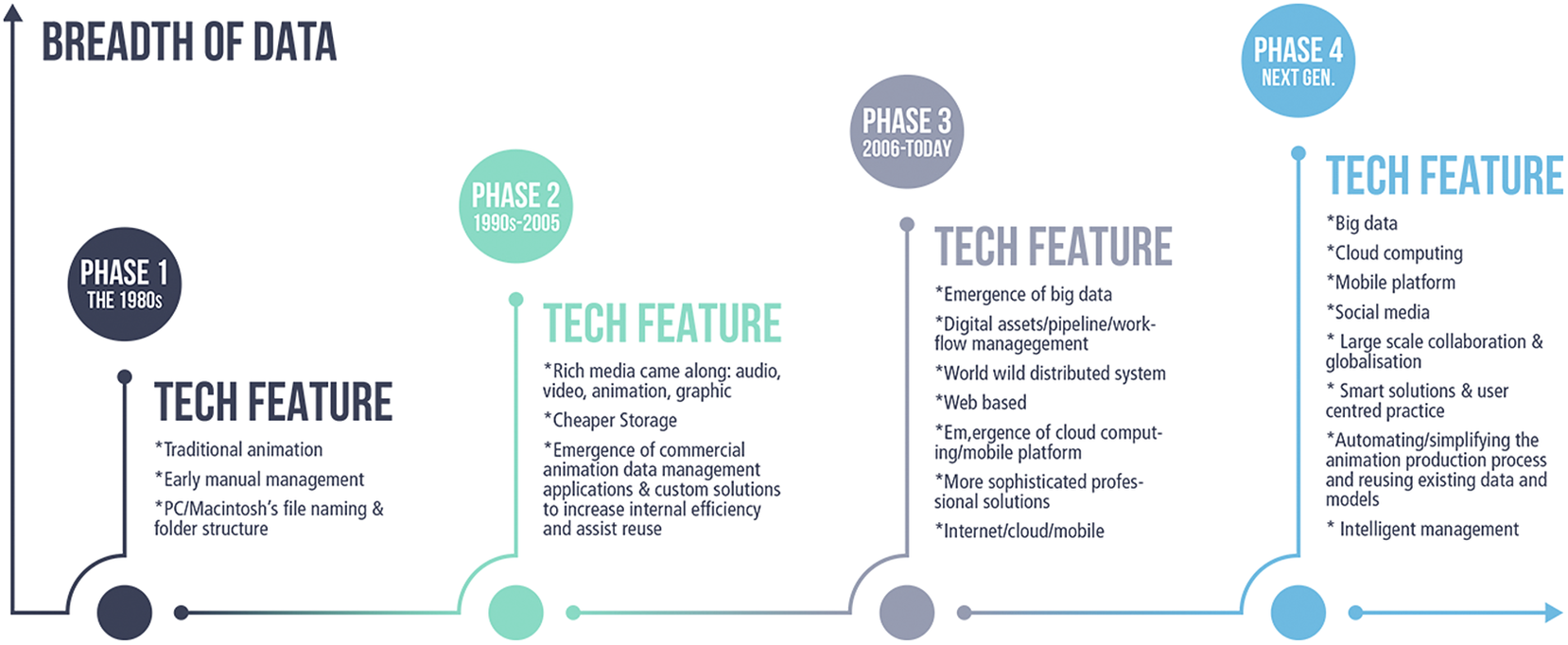
By taking its cue from the concepts of knowledge sharing, global collaboration (Cummings Reference Cummings2004) and the Design Open Production Communities (OPC) model (Ziaie Reference Ziaie2014), the diachronic classification proposed by Liang identifies in recent years a model of open production in which we are witnessing a maturation of graphic design software (2D and 3D), the spread of mobile platforms and apps for the management and creation of content, the global and unstoppable spread of social networks and the circulation of data. On the production level, the ‘traditional’ production is replaced by an increasingly performing mobile-based production in which contents and work tools travel online. As far as users are concerned, the figure of the prosumer is legitimized, capable not only of suggesting contents but of creating new ones by interacting with a community that participates in the optimization of the use of tools and data management (Liang et al. Reference Liang, Sit, Chang and Zhang2016, p. 1093). The construction of this matrix takes place in continuity and systematizes a reasoning that the literature on the subject has developed in the last 10 years to identify the characteristics of the new dimension of widespread collaboration and creativity. Already in the early years of the new millennium, the technology and margins of interactivity of web 2.0 had allowed an easier generation, organization and sharing of valuable content (George & Scerri Reference George and Scerri2007), and the development of new ideas to ‘facilitate the potential creativity, knowledge and stamina of a vast crowd’ (Ziaie Reference Ziaie2014, p. 1). From a social inquiry perspective, scholars such as Hargadon & Bechky (Reference Hargadon and Bechky2006) and Preece & Shneiderman (Reference Preece and Shneiderman2009) have defined this attitude as technology-mediated social participation (TMSP).
The design dimension of this evolving scenario in the field of motion design concerns both technical, content and aesthetic issues. OPCs software platforms have to ‘provide the highest abstraction layer consisting of the necessary tools and structures for a community to achieve its goals’ (Ziaie Reference Ziaie2014, p. 6), a substantial pool of contents and tools (Siersdorfer, San Pedro & Sanderson Reference Siersdorfer, San Pedro and Sanderson2009; Konstan & Riedl Reference Konstan and Riedl2012), has to hold a user-oriented interface, be usable, accessible, aesthetically valuable and customizable, and to effectively target whether community or standalone user, according to gender, age, social status, etc. (Olsson Reference Olsson2009; Ziaie Reference Ziaie2014).
To date, the Open Production Online Platforms are used to create graphics and animation outputs with different objectives, from adv, to entertainment, to social awareness, to information (Liang et al. Reference Liang, Sit, Chang and Zhang2016). These platforms are currently tools capable of conveying a dynamic, versatile, shared, multi-platform and cross-media dimension of the design of graphic, static or animated content and interactive interfaces. The list of these tools is long and constantly evolving, impossible to systematize in an exhaustive way due to a large number of platforms, whose management has different degrees of complexity and is easily adaptable to the expertise of the reference target, to the type of project and the relevance and tone of the content to be conveyed. The types of platforms that can be used online range from free full-featured vector graphic design apps (such as Gravid Designer, Vecteezy, Inkscape), cross-platform image editors (such as Gimp, Pixlr, Crello), online design and publishing tools (such as Canva, Crello), visualization tools to help visualize data, including pie charts, bar graphs, column tables and word clouds (such as infogram), professional free and open source painting program (such as Krita, Photopea), to the free online animation and motion graphics platforms (such as Animaker, Pawtoon, Vyond, Animatron), and to professional free online animation software (such as Blender, zBrush).
3. Animated video maker platforms: an educational experiment
As seen in the previous paragraphs, platforms for creating static, dynamic and animated content are a consolidated reality in the panorama of communication design tools for non-designers. Communication today is dynamic and the need to explain concepts through moving graphics, texts and illustrations is a need that is now felt not only by professionals in the field of communication, but by a large number of people who use video to communicate messages of various kinds, promote their business or present their products/services (Shaw Reference Shaw2016). Video is a more captivating tool than a static image to capture the attention of the viewer or client and the seductive, versatile and dynamic language of motion design makes the message clearer and more incisive. Making computer animations has become easier and easier over the past 20 years, thanks to progressively more powerful and affordable technologies (Jenett Reference Jenett2014). However, it remained an activity intended for designers or computer graphics professionals; the fact that – thanks to these recent platforms – a non-professional in communication design is able to produce animated video artifacts at various levels is something that would have been unthinkable until a few years ago.
The motion design course for third-year students of the Bachelor degree in Design of the G. D’Annunzio University of Chieti Pescara aims to introduce students to animated communication through theoretical lessons on the history and techniques of animation and motion graphics, on the methods and processes of the production process of an animated artifact and a series of workshops that have the task of introducing students to the use of digital tools used for 2D and 3D animation. The students – who prior to this teaching trained only in static graphics – with this course are approaching working on the timeline for the first time. Over the years, the theme of the course has changed several times, always focusing on current issues and often connected to professional practice.
For the 2021/2022 academic year, the theme of the course concerned the creation of an online animation maker tool, a very interesting topic both for its relevance and ever-increasing diffusion and for the project work characterized by a double complexity. The students were asked to carry out a double project: on the one hand, the project of the platform tools (graphics, backgrounds, characters and tools) that consists in the real motion design artifacts; on the other, the project of the platform for creating animated videos online. Above all, the challenge for the students consisted in the creation of a platform that would be used by newbies in the sector, people who have nothing to do with design or subjects related to communication.
Starting from these premises, in the initial phases of concept development and assets production the hardest parameter that student was expected to work with and define lay on the identification of the target. The developed project works, indeed, had to consider two kinds of stakeholder:
-
(i) on the one hand, the categories expected to use the platform and to produce the videos. From school teachers to personal trainers, from psychotherapists to cooks, students had to consider the technical skills of the addressed stakeholder to build easily navigable online platforms and easy to access and use video production tools;
-
(ii) on the other hand, students had to define with precision and accuracy the viewers of the produced animated videos. In simple terms, who are these animated videos made for? Students, athletes, travelers, web enthusiasts, children with specific needs or particular cognitive abilities, just to name a few chosen categories. By virtue of this awareness, students were expected to design and delineate characters, props and backgrounds on an aesthetic, morphological, chromatic and thematic level.
4. Motion design course syllabus
The course was structured in 12 lessons during which theoretical lessons alternated with workshop activities. Students were indoctrinated on the taxonomy of motion design, the production phases of an animated artifact, the techniques and history of hand and digital animation (cell animation, motion graphics, 2D digital animation, claymation, cut-out, stop-motion, 3D digital animation), and the principles of animation. At the same time, they attended practical lessons that included the basic explanation of software such as Adobe After Effects, Adobe Character Animator and Autodesk Maya.
The students’ tasks were divided into two main phases which coincided with a first mid-term delivery and then with the end-of-course exam: a first phase of analysis aimed at defining the brand strategy and the brand identity and a second phase the full platform simulation with all the animated elements. Compared to the issues addressed in previous workshops in which the final project work was an animated audiovisual artifact, this year the students measured themselves with a multiplicity of elements to be designed and the complexity of integrating them all into a single captivating, intuitive and functional platform. It was an important challenge for the students who found themselves having to deal with video for the first time and all the difficulties involved in governing an animation project and who at the same time measured themselves with users, marketing analysis, specific themes and interface prototyping. The work of a designer is to design products and services that will also be used by non-designers but in this case the very specialized issue has made everything much more complex and has introduced a considerable number of variables to be taken into consideration in the project.
4.1. Methodology
Generally, during the workshop, students go through the pre-production, production and post-production phases to get from the initial concept to the final outcome of the animated video (Maselli & Panadisi Reference Maselli and Panadisi2021). The co-creation platforms’ production process, given the complexity of the theme, was articulated in a different way.
In a first phase, the project was defined by analyzing the positioning and the brand strategy of the new platform: the students were asked to carry out a SWOT (Strengths Weaknesses Opportunities Threats) analysis and an assessment of the competitors to evaluate the risks and possibilities of introducing their work in the market. Afterward, they studied the brand design identity by identifying the target audience; they hypothesized the style of the tools, the backgrounds and the characters, the brand identity through the creation of the logo and the digital strategy. Finally, they worked on the design of the interface for the first draft of the platform: they were not involved in the code writing project, but only on the aesthetic and functional part through usability simulations. This first phase ended with a presentation to the class by each group and a review and an evaluation by the teachers. It was very interesting to note how the students turned to platforms with specific themes, despite the fact that at the moment there are only generic platforms on the market, many of which are related to inclusion or new social media trends. Some groups have hypothesized a platform to be used by influencers and/or bloggers, hybrid figures who certainly deal with communication, but who do not have the IT know-how to create high-level content for their blogs and social pages; there have been proposals for food and travel bloggers who, through specific platforms, could have created an appropriate content for their blogs and social pages.
The second phase involved the creation of the dynamic tools to be included within the platform: students were asked to create and animate a minimum number of backgrounds, transitions, props, characters and behaviors. In this phase, the definition of the style of the illustrations to be animated also influenced the style of the platform which was designed and modeled also according to the content it was going to host. This phase ended with the end-of-course exam in which the students presented all the work done during the laboratory: the initial analysis, the exercises with the software carried out during the workshops, the simulation of the platform through a specific usability software and the creation of a promo teaser designed to launch the brand on the market.
During the course, there were many interesting elements and novelties proposed by the students: for example, some groups used the 3D representation to create environments, tools and characters; others proposed specific themed platforms designed for a specific category of professionals; many introduced the possibility to upload a footage video shot by the user and to share the final video directly on social media.
The production of the promotional teaser of the platform required students to investigate and retrace the phases of the motion design production process identified by Austin Shaw.Footnote 4 With the aim of communication and promotion, the videos tend to present the functionalities and objectives of the platform itself in a didactic way. In the pre-production phase, the students have well defined objectives, main topics, style and animation technique (which took up the aesthetic characteristics of the platform contents) and the assets (same props, characters and backgrounds created and animated for the platforms). The effort required in the pre-production phase therefore involved the drafting of a script and a storyboard and a design board. Similarly simplified the production and post-production work, during which the greatest efforts consisted in staging time managing and compositing of previously animated elements.
4.2. Outputs’ analysis parameters
The platforms designed by the students range from different topics, targets and codes of representation, from abstract to figurative (Maselli & Mouri Reference Maselli and Mouri2021), from themes of social relevance to themes of daily calibration, from specific targets to generalist platforms. The use of open co-creation platforms to convey socially relevant content and reach specific targets has proved to be the most used strategy to propose an improvement of the same with respect to the panorama of existing platforms, often achieving unexpected results. The use of social issues, in particular, is part of a design action that sees animation, motion design, interface design and the experience of using the same valid information and communication tools, assuming, when appropriately designed, also a therapeutic validity. On the other hand, the re-design of the platform architecture was a theme strongly felt by the students, who in the SWOT analysis phase indicated the difficulties in navigating and managing the tools of the existing platforms as critical issues to be solved in the design phase.
The two main axes along which the students’ experimentation moved were, therefore, related to the topics addressed and technical progress (Figure 2). The first parameter thus defined required an in-depth market analysis relating to the applicability and versatility of the platform and the pedagogical, informative, communicative, narrative and socially useful power of the audiovisual tool and was addressed by the students in various ways:
-
(i) identifying a thematic specificity of the platform and a precise target of stakeholders. The specific contents for the creation of themed animated videos ranged, as mentioned, from food themes to travel experiences;
-
(ii) using the platform as a social innovation tool to convey, in the face of due theoretical insights and design measures, themes and objectives of universal relevance such as learning sign language and support for therapies for children with special learning needs and behavioral approaches;
-
(iii) designing in a collaborative and open project perspective where the design of audiovisual outputs is accompanied by that of platforms open to additions and extensions.
Students’ motion design video maker projects classified according to two parameters: 1) platforms’ technical and/or functional innovation; 2) definition of the itarget, ranging between generalist (versatile platform for creating animated videos addressing different contents) and specific (for the creation of themed animated videos).
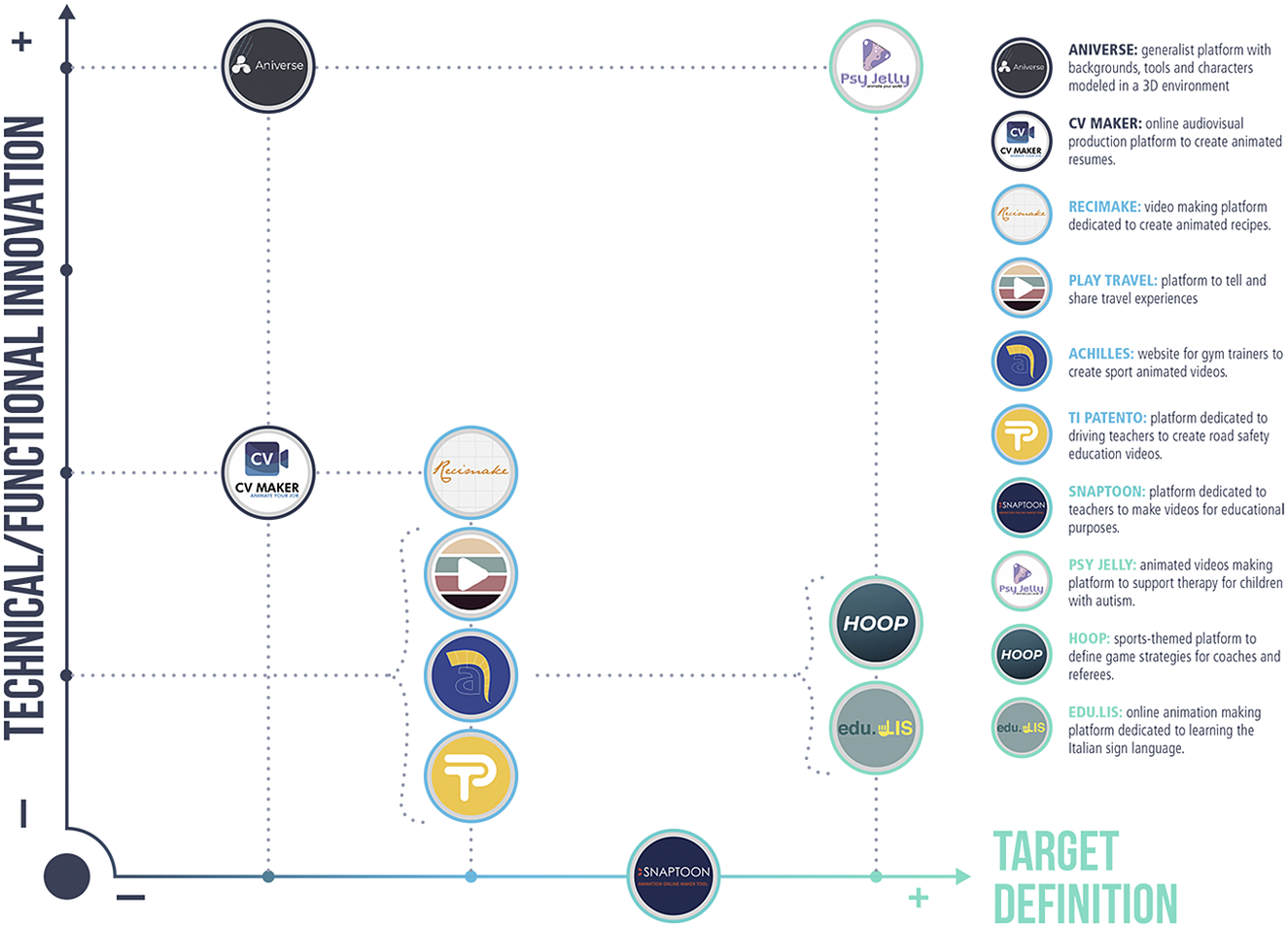
As mentioned, another upgrade from the state-of-the-art involved aspects of technical innovation. The three axes that can be detected in this case concern: a review of the navigability paths of the platform, a maximum simplification of the design of the interfaces with a view to accessibility, greater attention to the graphic quality of both specialized platforms (where the study of visual syntagms is was also conveyed by the theme and the target), and by generalist platforms, experimenting, for example, with the design of platforms that provided backgrounds, props and three-dimensional characters.
4.3. Outputs’ description and analysis
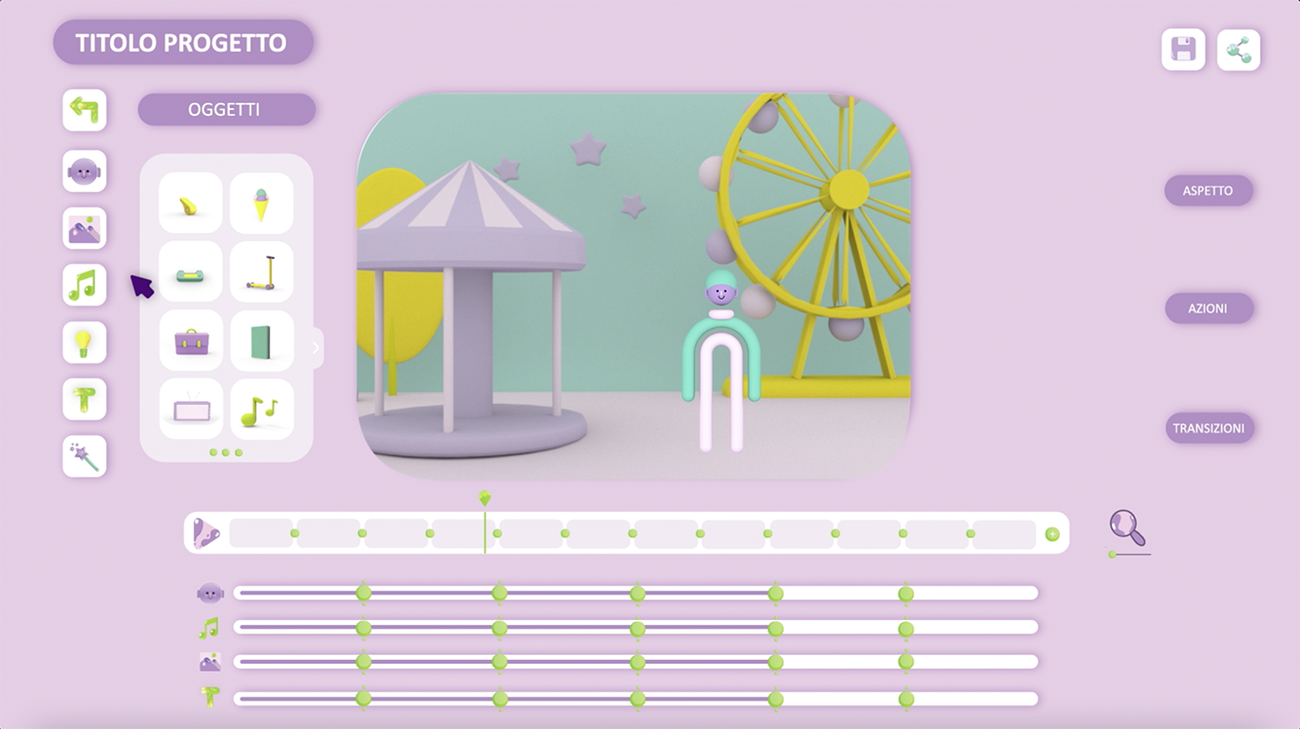
In this section, some examples of works produced by students, selected on the basis of the degree of innovation with respect to some previously defined parameters, will briefly be illustrated. The use of open production platforms to convey actions of denunciation, indoctrination or education in a perspective of social validity and integration, as anticipated, has given rise to some very interesting results. One of the groups chose the theme of autism in children and designed a kid friendly platform, PSY JELLY (Figure 3), to be used by psychotherapists to produce animated videos to support therapeutic paths for children with autism or Asperger’s, but above all by children both from a playful and didactic point of view to easily learn some behaviors. In addition to the study necessary to set up the work consistently, the interesting effort was to choose a graphic design designed for autistic children with certain shapes and colors as well as a simple and understandable interface even for the smaller ones. Pastel colors with a specific level of saturation, absence of anatomical details, use of easily recognizable geometric shapes and a library of actions set in carefully prepared contexts with a limited margin for customization.
Students’ project. PSY JELLY is a thematic platform on the topic of autism designed for children and psychoterapists.
EDU.LIS is an online animation making platform dedicated to learning the Italian sign language used by people suffering from deafness. The topic is strictly connected to the issues of social inclusion and is designed to bring people who are not personally involved into the world of sign language, but may need it to broaden their communication possibilities. An interesting morphological choice in the representation of the characters was to draw deliberately large and disproportionate hands precisely to keep the viewer’s focus centered on the upper limbs. For the complexity of the topic and the technical difficulty of animating hand gestures, the students experimented with the alphabet and some words or small phrases of common language.
Other socially relevant projects that are worth mentioning for the project objectives, regardless of the graphic and structural characteristics of the platforms, are as follows: SNAPTOON, a platform dedicated to teachers to make videos for educational purposes; PLAY TRAVEL, a platform to tell and share travel experiences with a playful but also informative value.
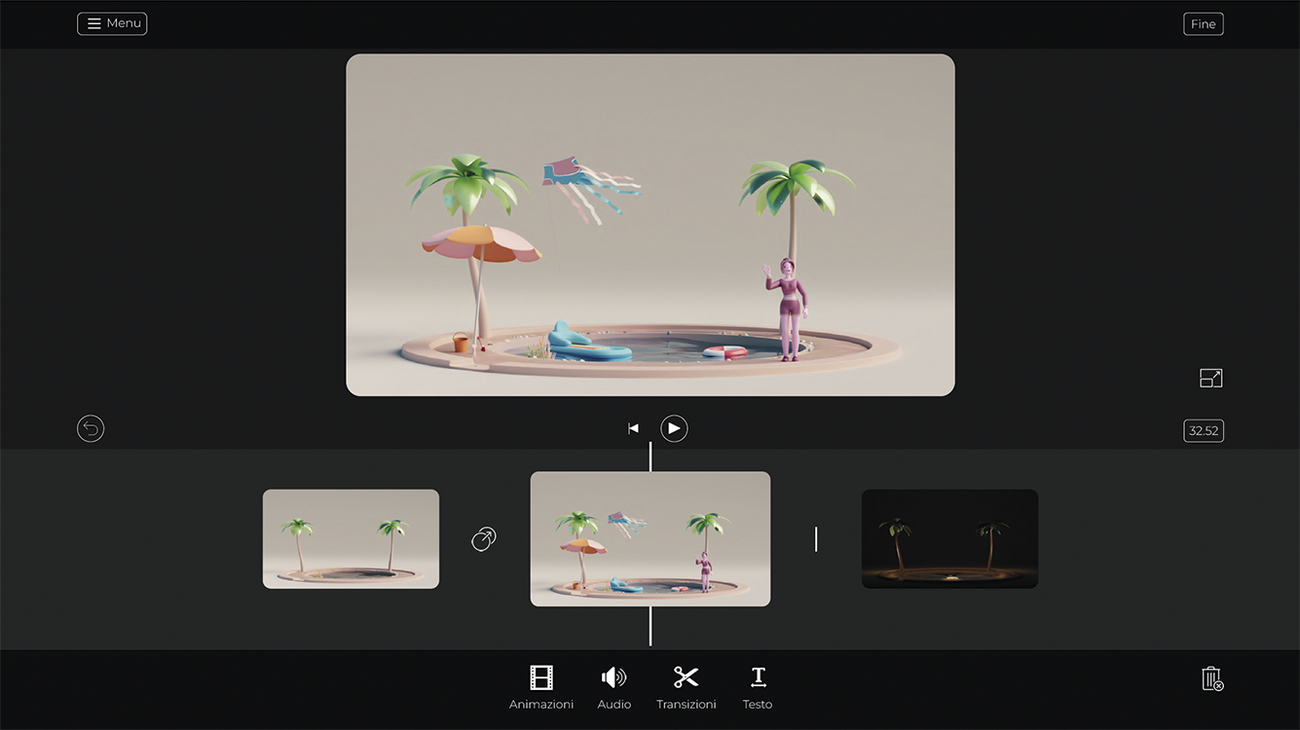
Remaining in a 3D workspace, another group hypothesized the generalist ANIVERSE platform with backgrounds, tools and characters modeled in a three-dimensional environment (Figure 4). The platform has a structured design process with few margins of variation marked in two stages of production and pre-production and programmatically defines the consultation of the library and selection of the items. This type of platform, innovative in the use of depth, has imposed a reasoning in relation to some difficulties related to the compositingFootnote 5 of the various elements. To overcome some difficulties, some interesting design choices were made such as creating the background environments on circular bases: this was a winning choice both on the aesthetic side as it is very captivating, and on the functional one, since simply rotating 360 it has a first simple but pleasant animation.
Students’ project. ANIVERSE is a generalist platform: its peculiarity is that backgrounds, tools and characters are modeled in a three-dimensional environment.
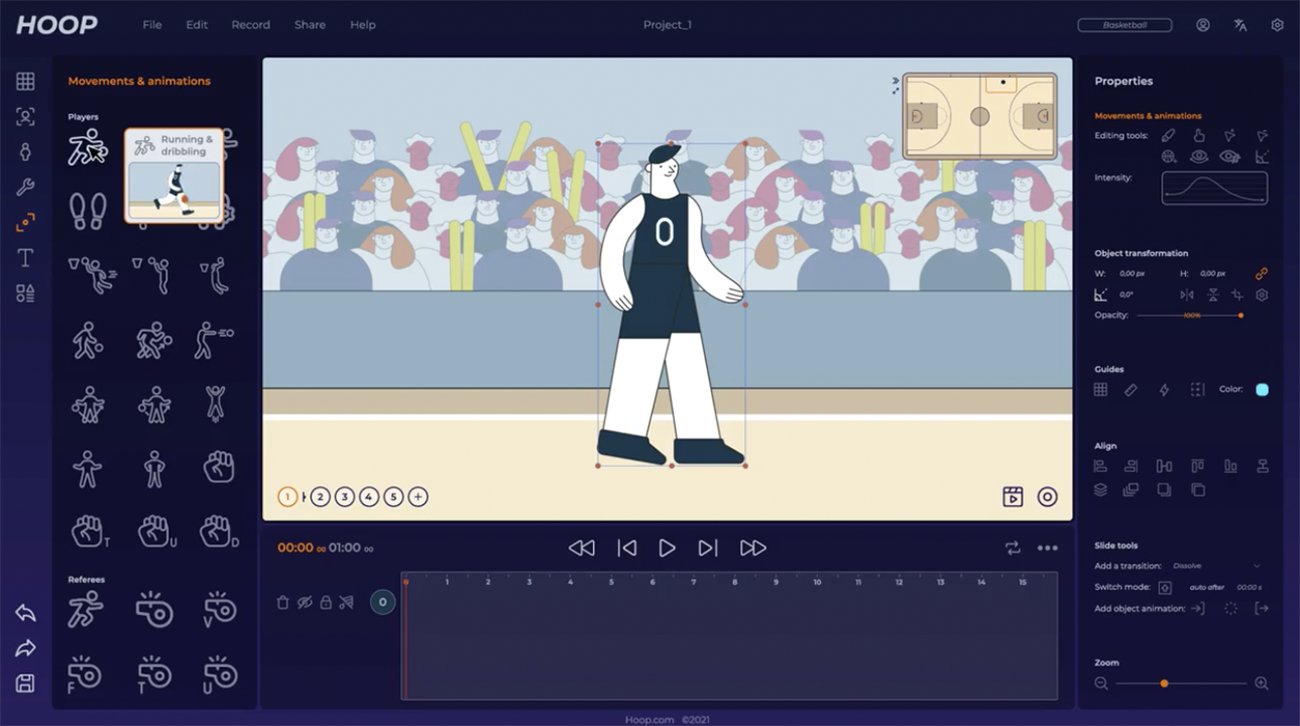
Another interesting choice aimed at a specific target was made by groups that created sports-themed platforms. With the HOOP project, a group of students identified a criticality in the definition of game strategies for coaches and referees. This difficulty was solved by proposing a strategy for producing video material. The HOOP platform (Figure 5) therefore gives coaches and referees the opportunity to create explanatory videos, tactics and custom training videos for some team movement sports. In this case, the user is very specific; however, it is interesting that it can be used for more than one sport (the students have assumed volleyball, basketball and soccer) and by several figures (coaches and referees).
Students’ project. HOOP is a platform designed for coaches and referees to help them represent play patterns, training and tactics.
All projects produced during the course have unique and interesting features and especially the above-described ones have been judged as worthy to be developed and tested in a beta version. A general thought and critical discussion concerns the widely common realm of thematic experimentation that students freely decided to address by focusing on socially engaging issues and by proposing ideas that combine ethics, aesthetics and technology, as mentioned in the projects’ selection-criteria matrix. The technical aspects were arguably the ones that needed to be deeply explored: the platforms EDU.LIS and PSY JELLY, among the more engaging from a social utility perspective, lack software-related qualities and can be significantly updated in terms of graphic consistency. The 3D generalist platform ANIVERSE shows a more advanced awareness and knowledge about the mastering of virtual production software and animation workflow but misses an actual feasibility concerning some technical choices. The sport strategy platform HOOP needs to be consciously placed on the market and deeply investigated to actually understand if it is really capable of replacing the approaches currently used by coaches and referees. Despite the improvements that each project can make and the specific topics addressed by students, the co-design and open production approach challenged students in considering two different stakeholders and work for two consistent, dialoguing but different projects: the platform and the video making tools, revealing that the design of these projects was a promising experiment to carry out. Besides, students showed a clear interest in continuing to work on the beta version of their platform proposals and they produced a teaser to make the project compelling in a marketing scenario, not excluding the possibility of taking it out of the university to offer it to potential stakeholders and investors. The didactic experiment confirmed a few aspects of contemporary motion design and animation scenario related to the main dimensions of experimentation carried out by young designers, thrilled by engaging projects that deal with social inclusion themes and by experimenting with technology (Yoon & Malecki Reference Yoon and Malecki2009; Hooks Reference Hooks2016; Mitchell Reference Mitchell2017). Besides, the didactic experiment highlights the need to re-define the role of designers and users, the required skills and the production processes.
5. Conclusions
The explored didactic experience dealt with issues beyond the spread of online visual design platforms and revealed technology and social innovations as the main objectives worth pushing experimental approaches and learning new tools and technologies. The democratization in creating graphic and multimedia artifacts, indeed, can be read from different perspectives. In conclusion of this analysis, we would like to discuss the effects on the design field produced by creative possibilities in making the user as the agent in control of the process and the design outcome. As for every historical and cultural breakthrough, even the democratization of the communication design process has recently aroused some doubts and concerns, mostly about the new role of visual designers in a production context in which everybody is allowed to contribute to the design process. In other areas of design, criteria to distinguish a planned and proper design project from a spontaneous and naive creation have been identified by formulating hypotheses for a well-structured and unequivocal identity of the 21st-century designer, able to master technological, economic and cultural factors, a sort of ‘toolbox’ (Bassi Reference Bassi2017). This idea seems to fail to evaluate both the effectiveness of the obtained results and the impact originated from them (Gosling Reference Gosling2017). In the recent years, the human-centered design approach has changed the focus of design process in a systemic perspective, requiring constant and conscious attention to the context, during all phases of the process – from the concept to the consumption – through ‘ongoing feedback and evaluation of the consequences of design action across the lifespan of messages, products, environments, and services that have been designed’ (American Institute of Graphic Artists 2017). If the designer’s action, in this specific case of the communication design field, is based on a continuous, dynamic and conscious analysis of the context and on the careful use of evaluation tools, the definition of a toolbox that distinguishes a visual communication product from a visual communication project, as it was done in the case of product and service design, constitutes a partial goal, not cast in the production–distribution–reception–consumption process of the visual message itself. The elaboration of a dogmatic recipe made of skills, phases and key concepts seems incomplete with respect to the idea that, by mixing the scenario-users-messages equation, a plurality of different but equally worthy paths can be formulated.
More than redefine the role of design and clarify the tools kept in its toolbox, therefore, we suggest recovering the characteristics of the design itself and seeking in its truest nature the origins of the relationship between process and product. Carl Steinitz in the article Design is a Verb; Design is a Noun (Steinitz Reference Steinitz1995) recognized the multidisciplinary nature of design that draws approaches, methods, tools and content from other fields, from social sciences, to art history, cultural studies, psychology, and not least, linguistics. Steinitz’s thoughts, taken up here and applied to communication design, indicated two requirements of the design process. He wrote: ‘it is useful for us, as designers, to distinguish the questions we ask in designing, and […] it is useful to us to consider whether our answers are truly directed to the shaping of our social environment’ (200). To ask questions and to suggest solutions are two complementary and integrated moments, according to Steinitz, in the designer’s approach to the project and to society itself, and find legitimacy in the double syntactic value of the word design. Steinitz again distinguishes ‘a dual framework for thinking about strategies of “design” and for organizing and eventually integrating its two meanings: Design as a verb; Design as a noun’ (Steinitz Reference Steinitz1995, p. 188) and specifies that ‘for design as a verb [we mean a process] for the asking of questions, and for design as a noun, [a process] for choosing among answers’ (Steinitz Reference Steinitz1995, p. 189).
Carubin (Reference Carubin, Stone and Wahlin2018) in the book ‘The Theory and Practice of Motion Design’ investigates the not-univocal definitions of design applied to moving images and identifies an analogous distinction to solve taxonomic issues. In the scenario of decennial taxonomic confusion of the discipline – motion design or motion graphics –, Carubin sees in the use of the definition motion design a clear reference to the process rather than to the design outcome, implied by the definition motion graphics: ‘While motion graphics – writes Carubin (Reference Carubin, Stone and Wahlin2018, p. 27) – implies noun or artifact, motion design addresses more the process or verb’. The challenge, therefore, is neither to provide instruments nor to define what is design and what designer has to be able to do, but to develop a conscious, dynamic and thoughtful approach to the process by interrogating social and cultural context (the verb) and, in the end, providing solutions (the noun). The distinction is clear and from a pedagogical perspective – asSteinitz (Reference Steinitz1995, p. 189) argues – ‘The dual framework for design as a verb and design as a noun […] are at the core of design education’.
Design education becomes the only viable tool for new approaches to be acknowledged, analyzed, understood, tested and validated and for the aforementioned differences to be taken into account. Interdisciplinary, experiential, interactive and intercultural training paths that prepare to face the complexity of contemporaneity (American Institute of Graphic Artists 2017; De Greef et al. Reference De Greef, Post, Vink and Wenting2017; Klaassen Reference Klaassen2018; Self et al. Reference Self, Evans, Jun and Southee2019) have been taken as a preferential strategy to learn the design process and to place the product, message or service in real and dynamic scenarios. As Gosling (Reference Gosling2017) writes in a commentary on AIGA’s Design 2025 report: ‘design students of the present and future need to be able to […] evaluate their work in terms of its potential social, cultural, technological, economic and environmental impact. […] designers now more than ever need to justify their research and outcomes, and be aware of potential issues around representation, interpretation, and dissemination of products and images’.
By applying to the design field, the idea expressed by Umberto Eco in an interview from 2003 [6], we can claim that the complexity of approaches and requirements that design education prefigures does not give concrete answers but develops the ability to find such answers following verifiable processes and implementing strategies with awareness. To teach design – to paraphrase the words of the landscape designer Steinitz (Reference Steinitz1995) – means to make aware of the complexity and variety of issues that designers face in order to identify criticality, respond to needs and, only in the end, provide solutions. Design education is the keystone to consciously design and distinguish an effective message, product, service in a scenario of shared tools and technologies.
The complementarity of the two moments/functions/lexical meanings described by Steinitz excludes any hypothesis of opposition. And finally, we can ask ourselves whether today, in the presence of quick technological innovations and the flexibility of the design – as both discipline, practice and theoretical field of research – there may be other ‘syntactic’ functions and meanings that further problematize its identity and value.
Acknowledgments
This article shows the result of a common discussion and elaboration work, but the writing of paragraphs can be attributed to: Vincenzo Maselli (Introduction: the co-design framework; beyond co-design paradigm; conclusions) and Giulia Panadisi (Animated video maker platforms: an educational experiment; Motion design course syllabus).


 Open access

