




Introduction
The adoption and development of crop-storage features, notably silos, among early agricultural populations are linked to profound changes in social and economic organisation and in demographic and settlement patterns (e.g. Halstead Reference Halstead, Halstead and O'Shea1989, Reference Halstead2014; Bogaard Reference Bogaard2017). Archaeological research, however, has so far only examined the variation in storage features in specific geographic locations or periods, and hence limited our ability to understand long-term trends on a broader spatial scale.
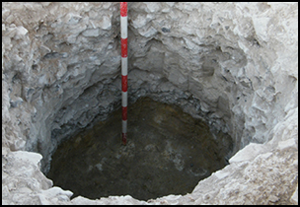
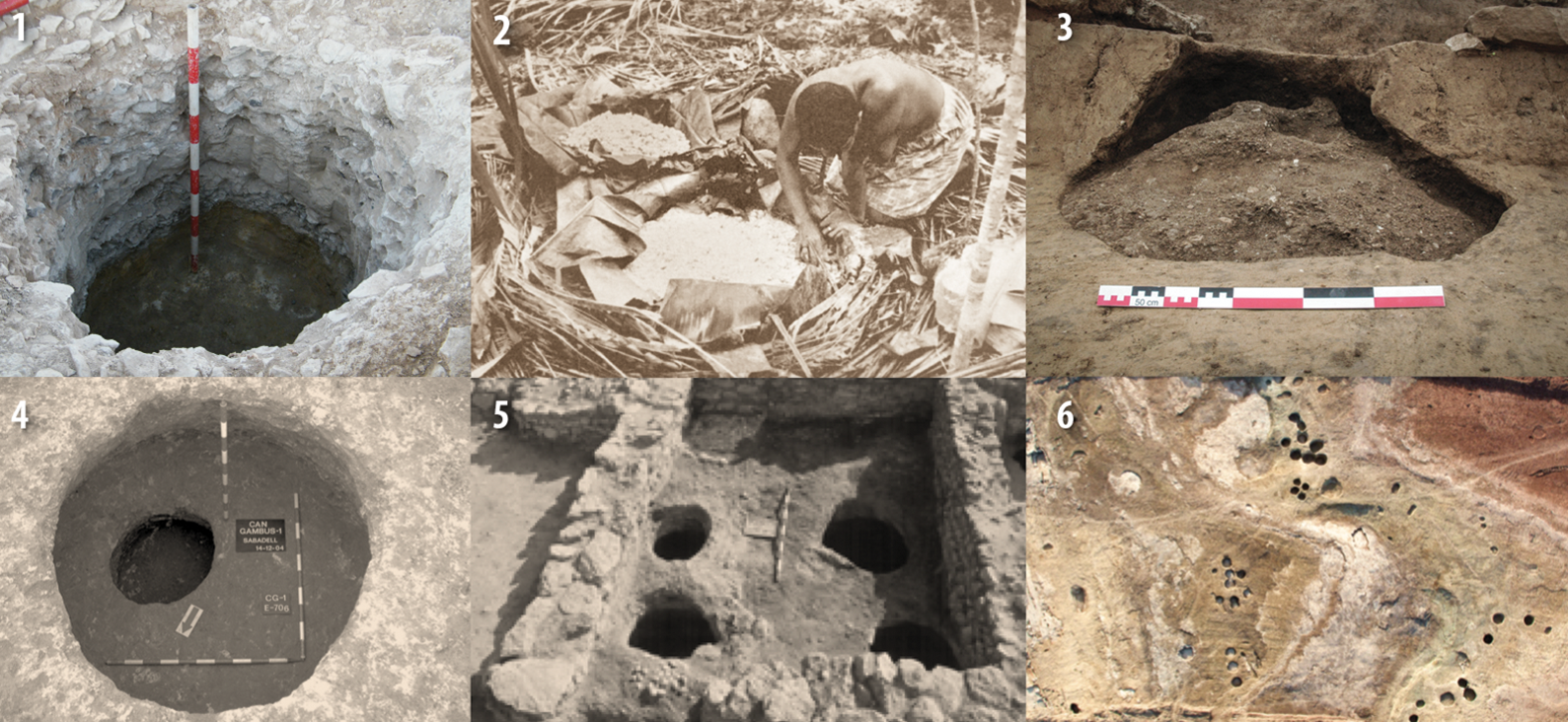
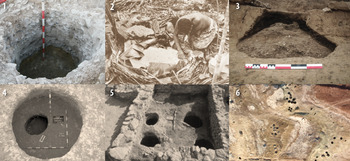
Crop-storage techniques include the use of containers, such as amphorae or sacks, and structures, such as granaries (e.g. Gransar Reference Gransar2001). This article focuses on the specific category of pits or underground silos, which are designed to control atmospheric conditions (Figure 1). These features are by far the most common type of storage technology attested archaeologically in the Mediterranean area (Sigaut Reference Sigaut1988; Frere-Sautot Reference Frere-Sautot2006), and they are the only features that allow for large-scale quantitative analyses of volumetric capacity, informed by consideration of silo shape, to provide insight into the cultural, technological and economic organisation of agricultural societies.
Storage silos: 1) experimental silo from Els Estinclells, Verdú, Lleida (Camp d'Experimentació Protohistòrica, CEP); 2) ethnographic silo from Tikopia, Melanesia, Oceania (Kirch Reference Kirch1980: 46, fig. 5); 3) cross-section of an archaeological silo from Els Vilars, Arbeca, Lleida (Grup d'Investigació Prehistòrica, GIP-UdL); 4) silo and pit excavated below its base at Can Gambús, Sabadell, Barcelona (Roig & Coll Reference Roig and Coll2005); 5) assemblage of four silos in a dwelling at L'Era del Castell, El Catllar, Tarragona (Molera et al. Reference Molera, Ollé, Otiña, Vergès and Zaragoza2000: 12, fig. 4); 6) example of a ‘silo field’ at La Rosella, Tàrrega, Lleida (Escala et al. Reference Escala, Moya, Tartera and Vidal2011).
Underground silos are generally considered to have functioned as containers for storing plant products, particularly cereals (e.g. Sigaut Reference Sigaut1978), and they are most often characterised by their shape and volume. Traditionally, their morphology is determined by a combination of factors (e.g. Reynolds Reference Reynolds1988; Prats Reference Prats2017), and has been linked to their underlying geology and the product intended for storage (Sigaut Reference Sigaut1978; Villes Reference Villes, Gast and Sigaut1981). Several interpretations explaining variability in silo volume have been advanced. Smaller storage pits, for example, may have been used by a family or household, while larger silos are linked to collective use (e.g. Vaquer Reference Vaquer, Guilaine, Vaquer and Rancoule1989: 83). Ethnographic studies suggest that volume may relate to the type of product being stored, or to the yield of a particular harvest (e.g. Alonso et al. Reference Alonso, Cantero, López, Jornet, Montes, Prats, Valenzuela, Fernández, Mujika, Arrizabalaga and García2017: 47; Arranz et al. Reference Arranz, Ibáñez, Zapata, Fernández, Mujika, Arrizabalaga and García2017: 73). Thus, the literature tends to identify a direct relationship between silo capacity and the production of adjacent fields. Other scholars emphasise the symbolic nature of new techniques within prehistoric societies (Bradley Reference Bradley2005). In this perspective, the shape and volume of a silo potentially reflect social norms transmitted from generation to generation. The construction of a storage pit is therefore neither a random act, nor is it always designed to maximise efficiency. Ethnographic studies ascribe the digging of silos to both men (Murdock Reference Murdock1967) and women (Alonso Reference Alonso, Delgado and Picazo2016: 33), suggesting that the latter play a crucial role in fashioning storage structures associated with domestic structures, while men construct the larger pits that exceed the needs of individual households (i.e. for the community).
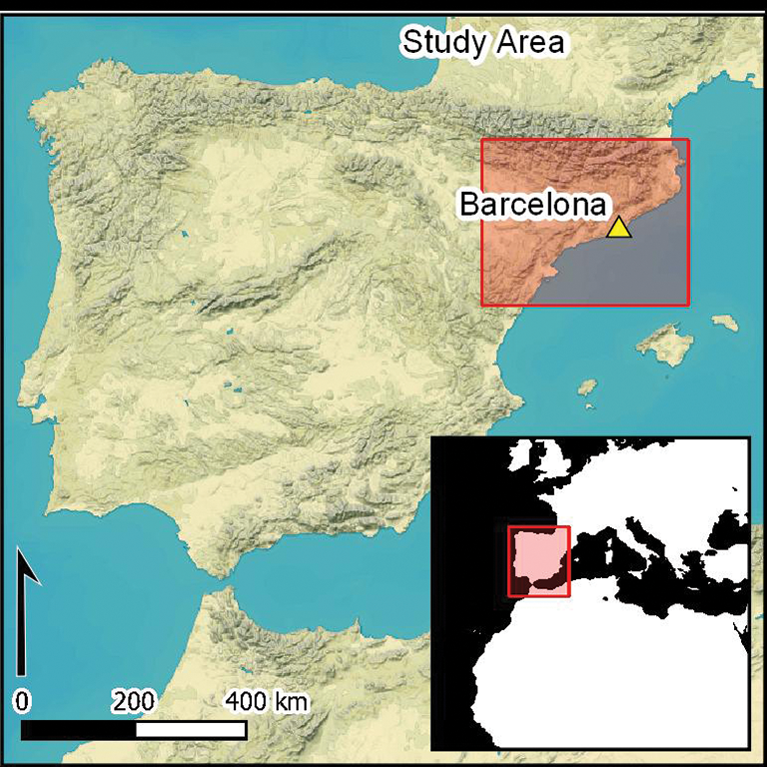
In this article, we demonstrate that an evaluation of the shape and capacity of underground storage features offers important insights into socio-economic change. Our study area comprises the north-eastern Iberian Peninsula (Catalonia and Andorra), and the chronological framework ranges from the earliest agricultural communities of the Neolithic (c. 5600 BC) to the emergence of urban societies in the Iberian period (or Second Iron Age), in the sixth to second centuries BC (Ruiz & Molinos Reference Ruiz and Molinos1998; Bonet-Rosado & Mata-Parreño Reference Bonet-Rosado, Mata-Parreño, Knapp and van Dommelen2015; Sanmartí Reference Sanmartí, Knapp and van Dommelen2015), and to the expansion of the Roman Empire (c. 50 BC). This long time span allows us to evaluate the evolution of storage techniques at a domestic scale, as well as across periods of major change. These include successive episodes of agricultural extensification (the process of decreasing farming input relative to land area) that were the prerequisite for urban development in the Mediterranean and the introduction of technological innovations, such as ploughing and metalworking. Despite the extended period under consideration, we believe that these different agrarian societies can be compared on the basis of storage capacity, as each was based on a predominantly self-sufficient economic model.
Theoretical model: storage and socio-economic context
Several approaches can be used to assess the average annual production capacity of a household unit (defined as a unit of economic and social cooperation; see online supplementary material (OSM)), that is, the quantity of grain necessary to maintain a family for a year. Ethnographic research suggests this to be between 1000 and 3000 litres of grain (e.g. Clark & Haswell Reference Clark and Haswell1966: 49; Kramer Reference Kramer1982; Halstead Reference Halstead2014: 162), allowing a margin for possible losses, including those incurred during processing. Archaeological work at the Neolithic site of Çatalhöyük in central Anatolia indicates an average storage capacity of approximately 1000 litres (Bogaard et al. 2009: 661), a value similar to that observed in the Iberian Peninsula for more recent periods (Alonso Reference Alonso1999: 231; Pérez Reference Pérez2013: 141).
Household production, however, varies by socio-economic context, as households respond to changing circumstances. In general, large households represent an adaptation to situations in which production among members is diversified, and the quantity of resources is highly variable over time. By contrast, small households often practise a form of production that is uniform among its members; there is no pooling of products; or it is not shared because production between individuals is so diverse that pooling would only benefit some household members (Wilk & Rathje Reference Wilk and Rathje1982: 622–24). Vaquer's research (1989: 83) suggests that domestic silos in Iron Age southern France contain less than 3000 litres, while larger examples represent collective reserves.
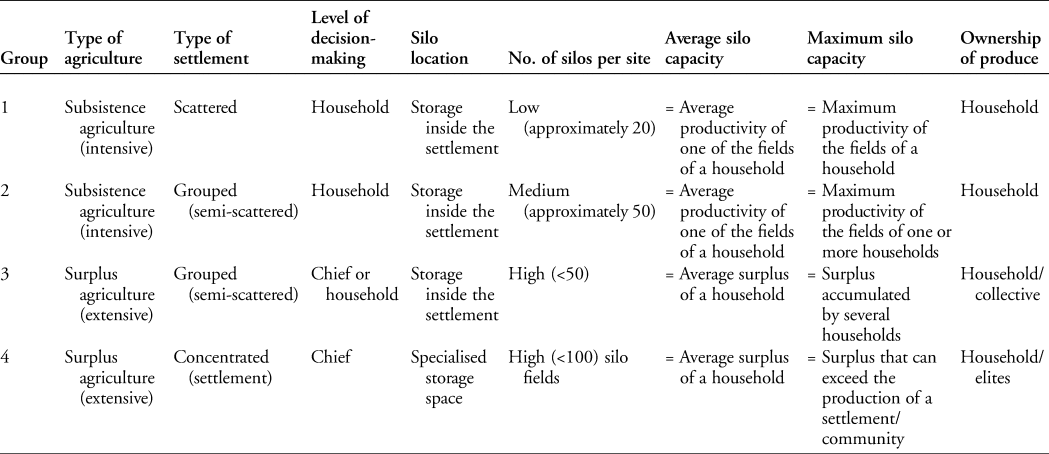
The clear variation in household units and production across different socio-economic contexts reinforces the need for robust parameters to interpret storage capacity. To address this, we focus on average and maximum silo capacities, the aim being to identify significant changes in the household production of grain over time in north-eastern Iberia (Table 1).
Theoretical scheme indicating the capacity of silos by type of socio-economic organisation based on the archaeological evidence in the study area (Prats 2017).
Storage features and methods
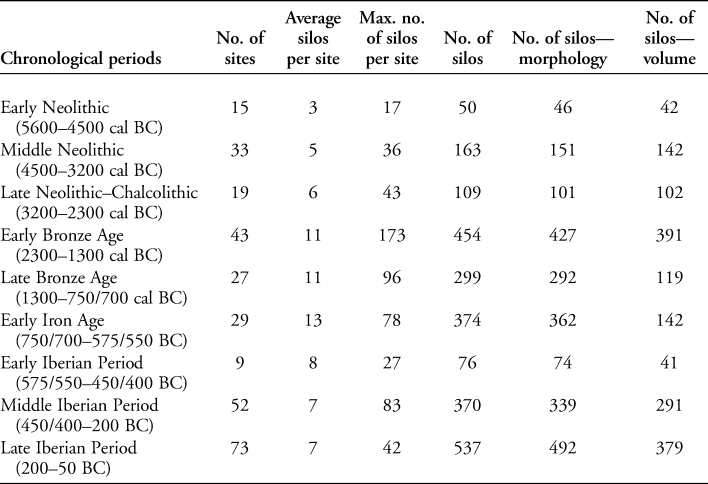
The current study is based on a corpus of 2500 storage features from 300 sites (Prats Reference Prats2017). These include 300 silos from Neolithic sites, 750 from Bronze Age sites and more than 1300 from Iron Age and Iberian period sites (Table 2). All were recorded following previously published identification criteria, including an index of the upper diameter and preserved depth of the silos (e.g. Carozza et al. Reference Carozza, Georjon and Vignaud2005).
Absolute totals of sites and silos per period, and number of silos used in the morphological and volumetric study, including their average size and maximum number per site.
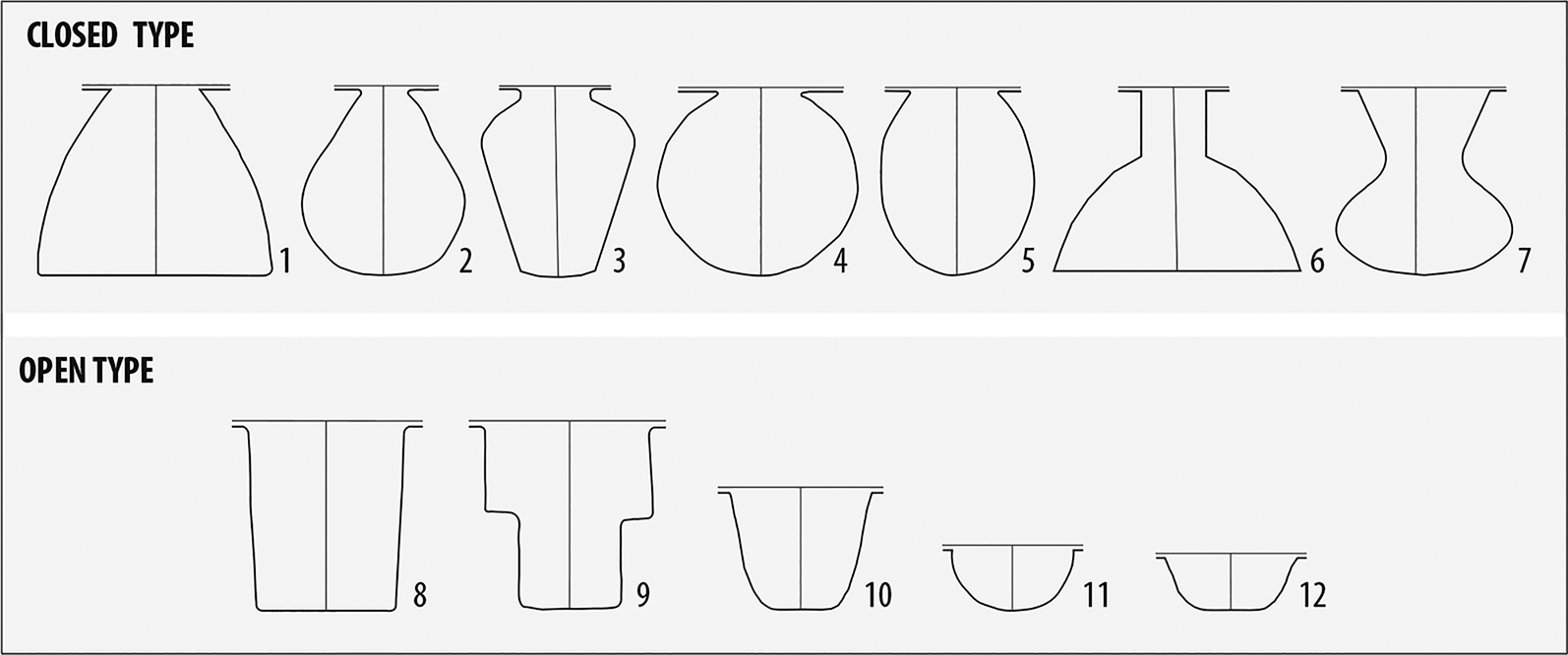
The typological classification of underground silos is based on their profile in section, and is divided into two major categories (Reynolds Reference Reynolds1988: 85): a) closed or converging; b) open or cylindrical. These categories can be further separated into subtypes (Figure 2). To simplify the current study, we do not take into account subtypes represented by fewer than 50 structures, reducing silo diversity to six morphological types: bell-shaped, cylindrical, spherical, ellipsoidal, hemispherical and divergent bell-shaped (Prats Reference Prats2013: 103).
Morphological types and subtypes of silos. Closed types: 1) bell-shaped; 2) biconcave; 3) bottle; 4) spherical; 5) ellipsoidal; 6) funnel; 7) biconical. Open types: 8) cylindrical; 9) bicylindrical; 10) divergent bell-shaped; 11) hemispherical; 12) trapezoidal (figure by G. Prats).
The volumetric capacity of a silo is given by its shape and calculated by geometric formulae (e.g. Prats Reference Prats2017: 122–23). Inevitably, however, the storage pits’ actual capacities are underestimated, as most silos do not have an exact geometric shape and their walls (especially around the silos’ openings) suffer from erosion (Bogaard et al. Reference Bogaard2009: 661). It must also be noted that only features exceeding a depth of 0.35m were considered to represent storage pits (following Beeching et al. Reference Beeching, Brochier, Rimbault, Vital, Beeching, Thirault and Vital2010: 148).
Results
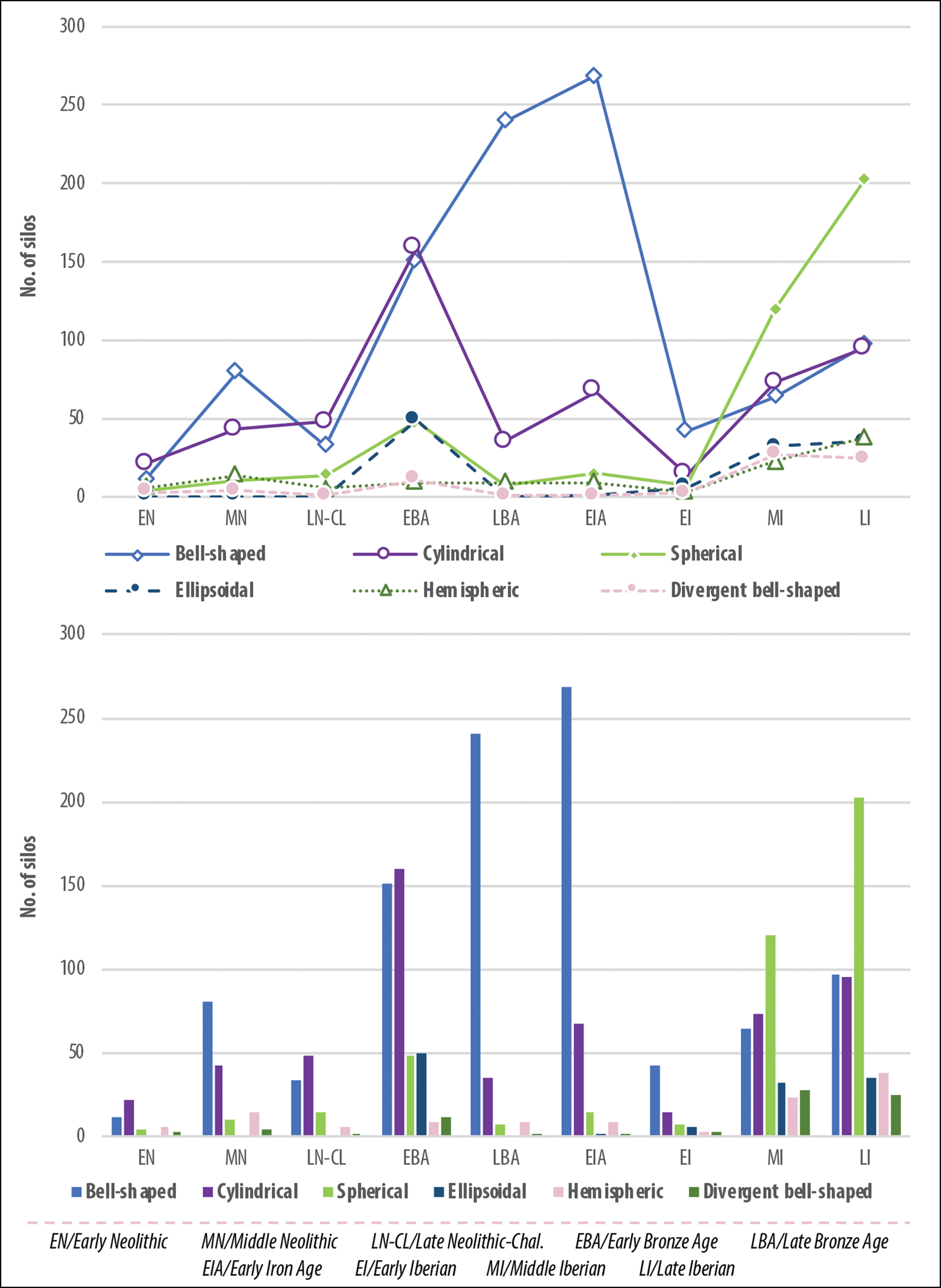
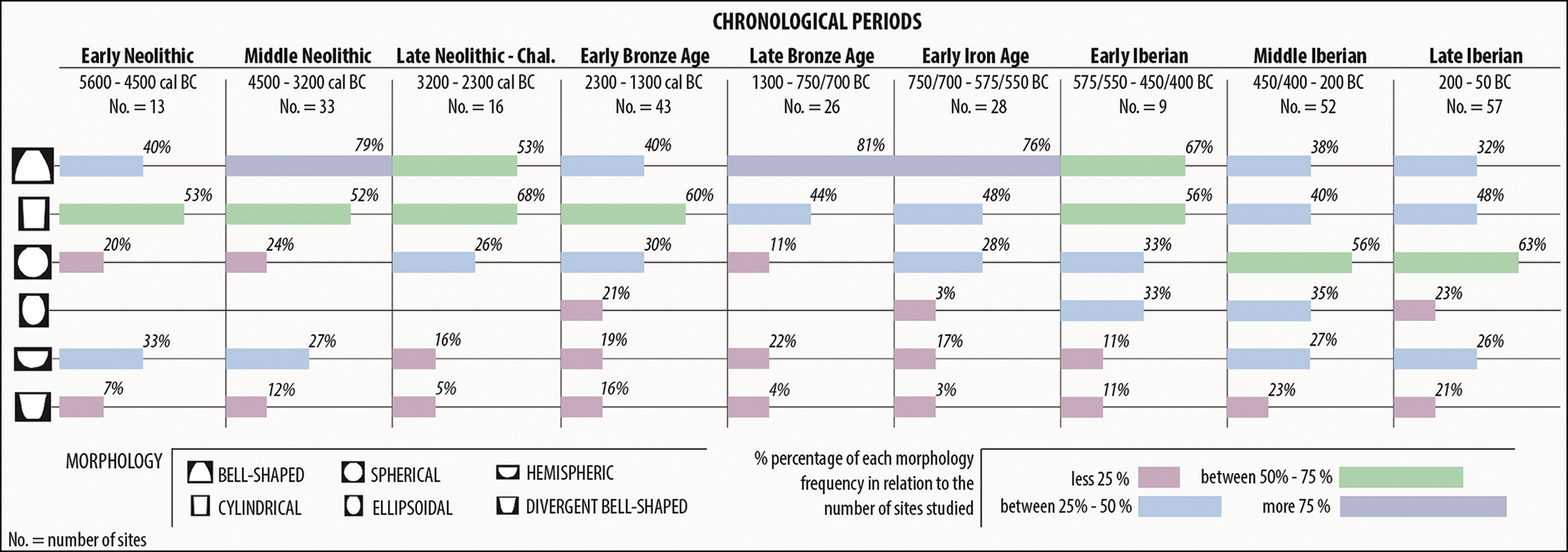
The number of storage pits varies by period. Overall, we observe an increase in the mean and median capacity values of storage pits over time (r2 = 0.90 for the mean and 0.97 for the median) (Figure 4). The average and total numbers of silos per site in the Early Neolithic (5600–4500 cal BC) is relatively low (Table 2). This period is dominated by cylindrical silos (Figure 3 & Table S1 in OSM) with an average capacity of 575 litres (Figure 4), and maximum volumes of almost 2000 litres. Both the number of features (Table 2), comprising mainly bell-shaped pits (Figure 3), and their average capacity (almost 800 litres) increase (Figure 4) during the Middle Neolithic (4500–3200 cal BC).
Line chart illustrating changes in silo shape by period (figure by G. Prats).
Graph showing the medians and averages, and minimum and maximum values of silos by period (figure by G. Prats).

While there are fewer sites documented for the Late Neolithic and Chalcolithic periods (3200–2300 cal BC), those recorded have higher numbers of silos, with higher maximum volumes (of up to approximately 4000 litres) (Figure 4). The Early Bronze Age (2300–1300 cal BC) saw the introduction of ellipsoidal silos to complement the characteristic bell-shaped and cylindrical examples. The average and maximum number of storage pits per site increases (Table 2), with average capacity over 1000 litres (Figure 4) and maximum capacity exceeding 7000 litres. The Late Bronze Age (1300–750/700 cal BC) sees a decrease in the number of settlements and silos, but the average number of the latter per site remains stable (Table 2), and the average volume increases remarkably (to 2063 litres) compared with earlier periods (Figure 4).
The average number of silos per settlement in the Early Iron Age (750/700–575/550 BC) increases in comparison to the previous periods (Table 2). Moreover, at this time, bell-shaped silos were the most prevalent morphology (Table S1 in the OSM), with an average volume of 2251 litres (Figure 5) and a maximum capacity exceeding 7000 litres (Figure 4). The onset of the Iberian period (Early Iberian; 575/550–450/400 BC) coincides with a reduction in both the number of sites with storage pits and a marked decrease in the number of such features per site (see Table 2). Unlike those of the previous period, cylindrical and spherical silos have the highest average volumes (3310 and 3772 litres, respectively), initiating a trend that remains stable throughout the Iberian period (Figure 5). There is also a general rise in average capacity to 2529 litres (Figure 4).
Average capacity (in litres) by silo type and period (figure by G. Prats).
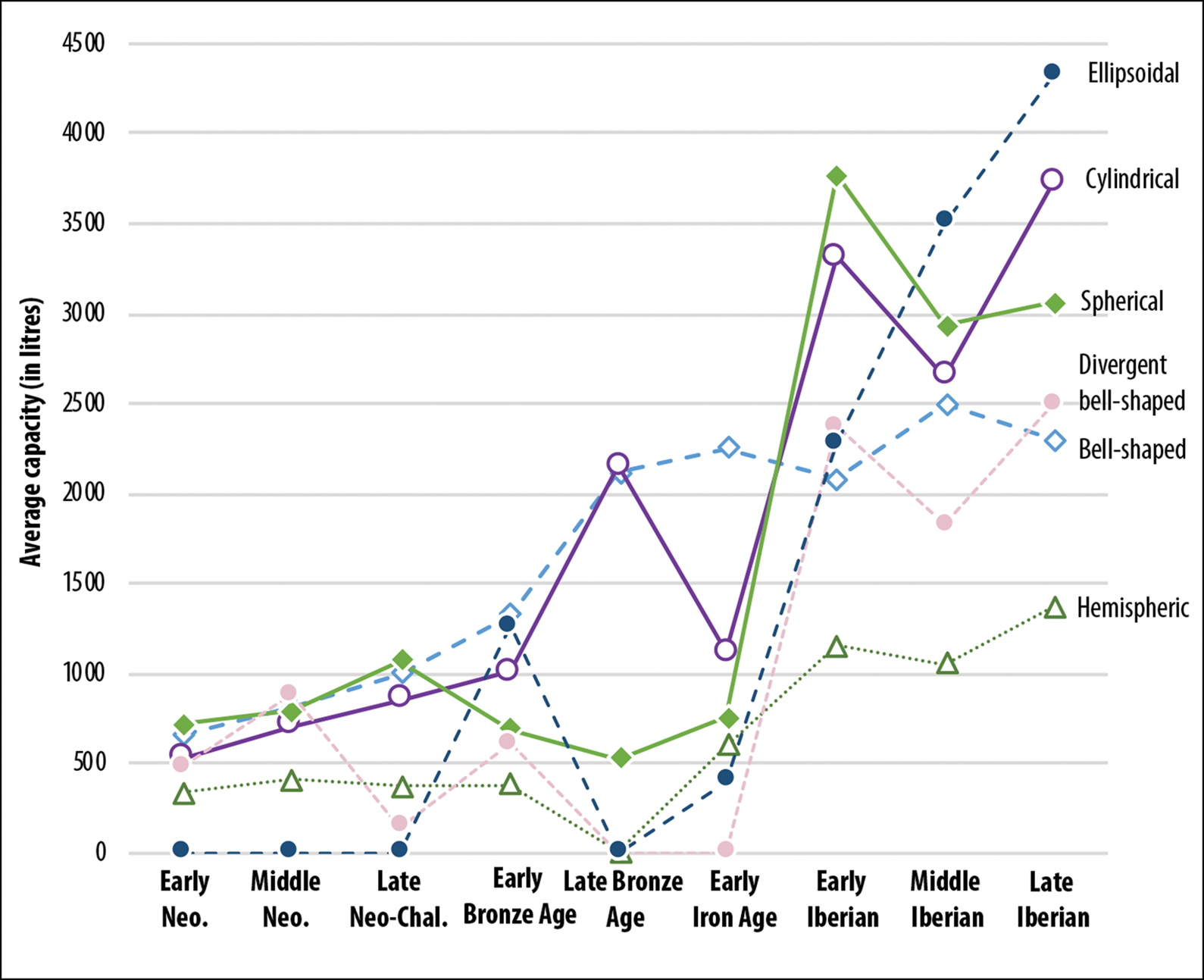
The Middle Iberian period (450/400–200 BC) is characterised by a proliferation of settlements with silos and an increase in the number of storage pits per site (Table 2), with a maximum of 83 silos per site and an average volume of 2769 litres (Figure 4). Their maximum capacity increases greatly, with one exceptional example containing 61 034 litres. This is also one of the periods with the greatest variety in silo types (Figure 3), the spherical variant being the most commonly encountered (Figures 3 & 6). Finally, the Late Iberian phase (200–50 BC) is marked by an increasing number of settlements with silos (Table 2) and an increase in domestic production evidenced by an average silo capacity of 3080 litres, a value surpassing that of the previous phases (Figure 4). While spherical silos now clearly dominate (n = 203; Table S1 in the OSM), ellipsoidal pits contain the highest average volume (4325 litres) for this period (Figure 5).
Diagram showing the various silo types with regard to the number of sites (figure by G. Prats).
Discussion
The modest volumes (<600 litres) observed for the Early Neolithic period suggest small, domestic and self-sufficient agricultural units scattered throughout north-eastern Iberia. The cultivation of a variety of cereals, such as naked wheat (Triticum aestivum/durum), barley (Hordeum vulgare) and hulled wheat (Triticum monococcum/dicoccum) (Antolín Reference Antolín2016), implies that the domestic units possessed several small storage features, each destined to contain a specific crop, suggesting, as noted by some authors, production on a small scale (Antolín Reference Antolín2016; Terradas et al. Reference Terrades, Piqué, Palomo, Antolín, López, Revelles, Buxó, García-Puchol and Salazar-García2017). Nonetheless, the maximum volumetric value (up to approximately 2000 litres) indicates either a capacity to generate a certain amount of surplus, a considerable variability in annual productivity or the existence of larger or cooperative household units.
The Middle Neolithic increase in the number of features and their capacity may indicate the presence of larger settlements. The higher average and maximum capacity values suggest a greater crop yield, due either to more intensive fertilisation or irrigation, or to improved climatic conditions. Unfortunately, the dearth of weeds in the carpological record and lack of stable isotope analyses of crop remains prevent us from testing these hypotheses (Antolín Reference Antolín2016).
The current evidence indicates a decrease in settlement size during the Late Neolithic–Chalcolithic, and a tendency to reoccupy mountainous areas. This could be linked to a climatic change towards greater aridity in the study region at the outset of this period (Barceló Reference Barceló2008). This reduction in settlement size has even led specialists to question whether climatic change affected the ability of communities to generate surpluses (Soriano Reference Soriano2010: 144). The Late Neolithic decrease in agricultural productivity has been the subject of debate for other areas of Europe (e.g. Stevens & Fuller Reference Stevens and Fuller2012; Bishop Reference Bishop2015). Our findings from storage structures in north-eastern Iberia, however, led to an alternative interpretation. Although the number of silos and settlements containing them (Table 2) decreased, and sites with great concentrations of storage pits disappeared, the average number and maximum volume (up to approximately 4000 litres) of silos per site (Figure 4) increased slightly. This growth in volume could reflect collective use, or greater production capacity possibly linked to larger households and an increased availability of labour (Wilk & Rathje Reference Wilk and Rathje1982: 622).
The Early Bronze Age saw the appearance of large settlements (Alonso & López Reference Alonso and López2000) and major increases in the average and maximum number of silos per site (Table 2). This corresponds to a growth in the number of settlements occupied by a larger number of domestic units. Some scholars have proposed that this period coincided with innovations such as short-term (annual or biannual) fallow periods, the use of draught animals and ploughing (e.g. Alonso Reference Alonso1999: 288). It is also possible that high-status individuals were able to accumulate a surplus.
The silo phenomenon during the Late Bronze Age appears to follow a new trajectory (Prats Reference Pratsin press), in which each domestic unit increased its productivity thanks to the expansion of arable land (less labour, more land; Netting Reference Netting1993). This hypothesis is supported by zooarchaeological data that indicate a gradual change in the pattern of slaughter (of older cattle) resulting from the progressive specialisation of livestock as draught animals (Albizuri et al. Reference Albizuri, Alonso, Cachero, Valenzuela-Lamas, Padrós, Belarte and Sanmartí2011: 24) and agricultural extensification.
During the Early Iron Age, the previous increase in the number of silos at some sites gives way to the so-called phenomenon of ‘silo fields’ (large clusters of storage pits in a separate area of a settlement; see the OSM). The maximum storage capacity reached on some sites transcends the scale associated with the domestic domain and achieved a level compatible with the production of a surplus for exchange (Asensio et al. Reference Asensio, Francès and Pons2002). Moreover, bell-shaped silos are clearly dominant (Figure 6)—a widespread phenomenon also noted elsewhere in Europe (Cunliffe Reference Cunliffe1991; Croutsch et al. Reference Croutsch, Tegel, Nicolas, Pascutto, Leprovost, Billot, Gratuze, Logel and Putelat2011; Gašpar Reference Gašpar2013). This increase in capacity stems from a cereal-based agricultural system (already known in the Bronze Age), alongside a diversification in the types of millet (Alonso & Bouby Reference Alonso and Bouby2017) and the use of spring-sown and short-cycle crops.
The archaeological and archaeobotanical data available for the Early Iberian period are scarce (López et al. Reference López, Valenzuela-Lamas, Sanmartí, Valenzuela-Lamas, Padrós, Belarte and Sanmartí2011). It is possible that during this period the domestic nucleated unit evolved into a larger unit designed to increase productivity (Table S2 in the OSM). While cooperation between nuclear households cannot be discounted, this period is a pivotal moment in agricultural practice, which includes the introduction of iron farming tools, the potter's wheel and hand-driven rotary querns—all factors that altered both the volume and means of production (Alonso Reference Alonso1999).
The scenario changes once again in the Middle Iberian period, which, from its outset, is characterised by a very high density and concentration of rural settlements, combined with an extensive agricultural exploitation of the region (e.g. Sanmartí Reference Sanmartí, Knapp and van Dommelen2015). Some sites even contain large silo fields, usually extending beyond the settlement area, that are interpreted as spaces designated for the storage of agricultural and animal products. The extremely high maximum capacity values suggest that produce was reserved for commercial exchange within a complex hierarchical society (Asensio Reference Asensio2013). The observed increase in spherical, ellipsoidal and cylindrical pits may indicate that the need for greater storage capacity is linked to the silos’ changing shapes (Figures 5–6).
As for the Late Iberian period, some scholars consider that the Roman arrival could have reduced the ability of the local elites to concentrate and hoard cereal production (Burch & Sagrera Reference Burch and Sagrera2009: 82). This could explain the maximum capacity of 22 820 litres (Figure 4)—a smaller value than that of the previous phase.
Conclusion
This study reveals that foodstuff storage was an essential element in the socio-economic trajectory of prehistoric and protohistoric north-east Iberia, and that further research in other regions is required to deepen our understanding of this development and to test our theories concerning the diachronic fluctuations in silo type and storage capacity. Furthermore, our research clarifies that changes in silo morphology over time can be linked to both wide-ranging cultural phenomena and to technological requirements (i.e. the need to increase storage capacity).
Our results show that while the increase in average storage capacity is usually coupled with an increase in maximum values, smaller silos continued to be used. It is therefore plausible that there were no uniform exploitation strategies in any of the periods. This is especially true for the Late Bronze Age onwards, and thus equal access to subsistence resources and produce by all households cannot be assumed. As our study does not cover the full range of scenarios for the arrangement, typology and capacity of underground storage facilities, further research is necessary. For example, silo phenomena different from those observed in our study exist elsewhere, such as the thousands of Iron Age storage pits in Central Europe (Biel Reference Biel2015). Interpretation of the socio-economic implications of these requires further theoretical consideration.
This study also correlates variations in average and maximum silo volume with changes in agriculture and domestic unit productivity. The range of silos with average capacities below 1000 litres concurs with other archaeological evidence for small, self-sufficient households, presumably practising intensive small-scale farming. Storage pits with capacities of between 1000 and 3000 litres reflect, as attested by other indicators, more complex societies; these were possibly organised in larger household units or in cooperative structures, and practised extensive farming characterised by crop-rotation systems, the use of draught animals and the provision of specialised storage areas outside the settlements.
Our use of quantitative values to define storage capacity has been identified on the basis of the dataset available for north-eastern Iberia. Nevertheless, the results seem to be consistent with studies of nearby regions. An average capacity of 830 litres for the Neolithic period, for example, has been documented in eastern Iberia (Gómez et al. Reference Gómez2004). Gransar (Reference Gransar2001) proposes 4300 litres as the average capacity for Iron Age silos in France. The values in Late Iron Age (fifth to third centuries BC) Germany are lower, with average and maximum capacities of 3000 and 3500 litres, respectively (Biel Reference Biel2015). The significance of citing these values lies in the use of average values rather than the volumes of single features.
Our study identifies a dynamic, diachronic trend in maximum storage capacity, showing a dramatic increase from the Neolithic (with silos containing up to 2000 litres) to the Late Iron Age, when some silos contain up to 20 000, or even 60 000 or 80 000 litres (Asensio et al. Reference Asensio, Cela, Miró, Miró and Revilla2009). Although we are aware of possibly larger-capacity storage pits (of up to 10 000 litres; Pérez Reference Pérez2013) in the Neolithic in eastern Iberia, the high values we document in the Late Iron Age are remarkable in comparison with other regions. This emphasises the importance and impact of trade or exchange on the agricultural development of north-eastern Iberia. Similarly, Iron Age silos in Britain (400–100 BC) can contain up to 12 500 litres (Sharples Reference Sharples1991). In France, figures of 6000–14 000 litres of maximum capacity are cited for the Late Iron Age (Viand et al. Reference Viand, Ginette and Bardel2008; Levillayer et al. Reference Levillayer, Borvon and Hunot2013); silos of up to 8000 litres are documented around the first century BC, and up to 13 000 and 16 000 litres around the first century AD (Cayn et al. Reference Cayn, Kotarba, Pellecuer, Pomarèdes, Lopez and Trément2017).
We contend that measuring the volume and shape of the numerous storage pits excavated all over Europe can reveal patterns of exploitation of the landscape over the longue durée. In our region, that pattern includes diversified approaches to agricultural production over the last five millennia BC, and a general increase in storage capacity with dramatic leaps in the Early Bronze and Iron Ages reflecting increased social complexity. We hope that this study will serve to encourage future systematic analyses of storage features from other regions of Europe and beyond.
Acknowledgements
This study is based on the doctoral research of Georgina Prats (2017, University of Lleida), which was financed by grants FI-2011 and SGR2017-1714 from the Generalitat de Catalunya. The research is linked to two projects supported by the Spanish Ministry of Economy and Competitiveness: ‘Production, Consumption and Power in the Segre Valley and in the North-western Mediterranean During the 3rd to 1st Millennium BC’ (HAR2012-36877, PI: Emili Junyent) and ‘Farming and Food Practices, Settlements and Domestic Spaces: Relations and Evolution in the Plains of the Southern Pyrenees (3rd–1st millennium BC)’ (HAR2016-78277-R, PI: Natàlia Alonso). The writing of this article was funded by the Swiss National Science Foundation project ‘Small Seeds for Large Purposes: an Integrated Approach to Agricultural Change and Climate During the Neolithic in Western Europe’ (AgriChange) (PP00P1_170515, PI: Ferran Antolín). T.J. Anderson helped to translate the article into English.
Supplementary material
To view supplementary material for this article, please visit https://doi.org/10.15184/aqy.2019.153




 Open access

