

Introduction
A range of policy changes are influencing transitions from work to retirement, these focused on encouraging people to continue working into their sixties and seventies. The benefits of an extended working life have been linked to improvements in personal health as well as offering financial advantages for the individual and the economy (Department for Work and Pensions, 2017). This development has been accelerated by reforms in the case of the UK such as the abolition of the default retirement age, and the raising of state pension age for both genders to age sixty-six from December 2018, phased in until 2020, rising to sixty-seven by 2028. An independent review has recommended a further rise to sixty-eight by 2039 (Cridland, Reference Cridland2017).
Research on older workers and retirement is adjusting to an environment influenced by demographic change and technological developments such as automation in the workplace. Significant literature reviews have been undertaken (e.g. Field et al., Reference Field, Burke and Cooper2013); substantial information is also available about changing work-retirement transitions, drawing on data sets from Europe and the USA (e.g. Berkman et al., Reference Berkman, Boersch-Supan and Avendano2015). However, changes associated with different types of ‘work-endings’, and the ways these are managed, await detailed research. This task must acknowledge the complexity of the later stages of working life, notably the ‘. . .multilevel and interacting influences of society (macro-level), workplace and organisation (meso-level) and the individual (micro-level) on employment participation’ (Hasselhorn and Apt, Reference Hasselhorn and Apt2015: 20).
This article examines influences on older workers entering the ‘zone’ between the ending of work and the beginning of retirement. The article examines this issue though the medium of case studies of two contrasting organisations, with data collection including interviews with human resource and pensions managers, line managers, and individual employees. The article has four main sections: first, changes in policies affecting work and retirement are outlined. Second, the methods used in the research are reviewed along with the characteristics of the sample of respondents interviewed. Third, results are presented focusing on experiences within two employment settings, exploring the construction of age and the support given to ‘work-ending’. Fourth, findings are discussed in the context of policies to encourage later working and their implications for the management of transitions from work to retirement.
Changing work and retirement transitions
Understanding the factors that determine whether older workers remain in their current employment, take partial retirement, or retire completely, has emerged as an important area of investigation (Kojola and Moen, Reference Kojola and Moen2016). Research suggests an interplay between the state, organisations and individuals influencing transitions from work to retirement (Phillipson and Laczko, Reference Phillipson and Laczko1991; Vickerstaff, Reference Vickerstaff2006; Macnicol, Reference Macnicol2015), with three main periods identified in the literature: first, the emergence of retirement in the 1950s and 1960s; second, the expansion of early retirement in the 1970s and 1980s; third, the ‘individualization’ of retirement, along with pressures to extend working life, from the late-1990s and continuing.
The first phase occurred in the two decades following the ending of the Second World War. A key element concerned the way growing old was transformed by the institutions associated with the welfare state and mandatory retirement (Graebner, Reference Graebner1980). Both were instrumental in shaping the discourse around which old age was constructed during this period. The idea of ‘retirement’ was an essential part of the narrative driving the reconstruction of ageing, with Vickerstaff (Reference Vickerstaff, Twigg and Martin2015: 298) highlighting its role in creating a ‘predictable, age-patterned end to working life’.
However, the institution of retirement was de-stabilised by rising levels of unemployment and redundancies, beginning in the 1960s but accelerating through the 1970s and 1980s (Kohli et al., Reference Kohli, Rein and Guillemard1991). In 1971, 83 per cent of men sixty to sixty-four in the UK were in employment, compared with 19 per cent of those sixty-five plus; by 1981 the figures had declined to 69 per cent and 10 per cent; and by 1991 to 54 per cent and 10 per cent (Phillipson and Laczko, Reference Phillipson and Laczko1991; Phillipson, Reference Phillipson2013). These trends established a new phase in the relationship between work and retirement, with researchers drawing a distinction between ‘retirement’ on the one side and ‘early exit’ on the other: the former referring to entry into a publicly-provided old-age pension scheme; the latter, early withdrawal from paid employment supported through unemployment, disability or associated benefits. Guillemard and van Gunsteren (Reference Guillemard, van Gunsteren, Kohli, Rein and Guillemard1991: 383) argued that the consequence of these changes was a life course that was ‘. . . becoming variable, imprecise, and contingent, since chronological milestones [were] being torn up’.
The 1970s and 1980s brought significant changes in attitudes towards leaving work. The image of retirement was transformed, with a shift towards ‘viewing it as an eagerly anticipated escape from the routine of work to the discretion of leisure’ (Hardy, Reference Hardy, Settersten and Angel2011: 215). Arguments emerged suggesting that an extended period of retirement could lead to more expansive lifestyles, these reflected in the activities of the baby boom generation now entering their late fifties and sixties (Gilleard and Higgs, Reference Gilleard and Higgs2005).
Policies towards work and retirement changed once again during the 1990s. Concerns about the economic consequences of ageing populations and the associated costs of pensions and care services came to the fore (e.g. Organisation for Economic Cooperation and Development (OECD), 2006). On the one side came pressure on individuals to remain in some form of work for as long as possible; on the other side, a decline in the institutional supports associated with the welfare state. These developments were underpinned by, first, increases in state pension age; second, a reduction in options to retire ‘early’ on grounds of ill health; third, cut-backs in disability benefits. These factors increased the reliance of individuals on the market (and employment) for survival until older ages, with emphasis placed on the responsibility of individuals to manage their own retirement and to delay leaving work for as long as possible (Hofäcker et al., Reference Hofäcker, Hess and König2016; Lain, Reference Lain2016; Macnicol, Reference Macnicol2015; Ní Léime et al., Reference Ní Léime, Street, Vickerstaff, Krekula and Loretto2017).
Changing influences on retirement decisions
The periods identified produced variations in the balance of forces influencing work-ending. In the first – from the 1950s through to the end of the 1960s – the state was dominant, reflecting the role of mandatory retirement and welfare provision regulating the passage from paid employment through to retirement (Kohli and Rein, Reference Kohli, Rein, Kohli, Rein and Guillemard1991). Employers played an important, albeit secondary, role, illustrated by the growth (mostly for men) of defined benefit pension schemes (Hannah, Reference Hannah1986), in enabling continued employment (largely for men in their sixties), and in the development of pre-retirement education – an area of interest in the UK and USA in the 1950s and 1960s (Phillipson, Reference Phillipson1981).
During the 1970s and 1980s the state and employers played a more equal role shaping transitions from work. The state exercised influence in setting out the terms of the response to the challenge of finding employment for a (relatively) large cohort of younger workers. Early retirement came to be viewed as a ‘bloodless’ (Kohli and Rein, Reference Kohli, Rein, Kohli, Rein and Guillemard1991: 11) way of coping with structural unemployment in industries such as mining and steel. But employers were crucial in the development of measures to facilitate early retirement and other pathways from employment. As a result, much of the decision-making power in the 1980s about retirement rested neither with the state nor with individuals but shifted to the discretion of employers (Guillemard and van Gunsteren, Reference Guillemard, van Gunsteren, Kohli, Rein and Guillemard1991). Individuals had some control over whether to stay at work or leave employment, especially if supported by an occupational pension. But the decline in employment in many industrial countries suggests pressure to leave work, even if for some early retirement was an attractive prospect given the burden associated with many forms of employment (Sennett and Cobb, Reference Sennett and Cobb1977).
From the 1990s onwards, all three actors – the state, employers and individuals – became involved in shaping work-retirement transitions. The general context was one of governments encouraging people to work longer whilst shifting the burden of paying for a longer life onto the shoulders of individuals (Macnicol, Reference Macnicol2015). At the same time, moves to extend working life increased the influence of employers, for example in determining (late) career options; supporting flexible/partial retirement; and facilitating job redesign. For older workers, entering what Vickerstaff (Reference Vickerstaff2006: 509) defined as the ‘retirement zone’, the ability to control ‘work-ending’ was subject to variation according to class, gender, health, occupation, and related factors. Wang et al. (Reference Wang, Olson and Schultz2013: 7) suggest that some late career workers at least have ‘. . .increased freedom and choice and also have the resources to make personal choices and search for self-fulfilment’. However, organisational pressures associated with downsizing and technological change may limit career options, increasing the importance of supporting employees as they enter their fifties and sixties.
The present context facing older workers is unique in many respects: governments appear set on policies to encourage ‘fuller working lives’; employers are at early stage of adjusting to a relatively new demographic and labour market context; and older workers themselves are facing an ‘uncertain future’ in reconciling pressures associated with longer working, combined with job and pension insecurity (Foster, Reference Foster2015; Kojola and Moen, Reference Kojola and Moen2016; Moffatt and Heaven, Reference Moffatt and Heaven2017). Given these changes, the question of how workers experience the later phase of their working life takes on particular importance. In this article, this period is defined as one associated with different forms of ‘work-ending’, a phase suggesting a range of possibilities including: remaining at work; leaving the workplace; reducing hours; taking self-employment; or taking on full-time care responsibilities.
Despite radical changes affecting the late working life environment, there is limited knowledge about how these changes are being managed inside organisations. This article begins to address this issue by examining the following questions: first, how are ‘work-endings’ ‘managed’, given the ending of mandatory retirement? Second, how is ‘age’ and the idea of the ‘older worker’ constructed within the workplace? Third, what support is provided for older workers entering the ‘retirement zone’? The study draws upon interviews carried out in two contrasting case study organisations in the UK, details of which are summarised in the next section.
Methodology
This article draws on a sub-set of data from a wider UK Economic and Social Research Council (ESRC)-funded research project Uncertain Futures: Managing Late Career Transitions and Extended Working Lives. This research, which aims to contribute to knowledge about the range of factors that influence working in later life and to inform employer practices in supporting older workers, employed a mixed methods design including both quantitative and qualitative elements. The former comprises an analysis of the late-career transitions of older workers in England and the USA, utilising data from the English Longitudinal Study of Ageing (ELSA) and the Health and Retirement Study (HRS) (see van der Horst et al., Reference van der Horst, Lain, Vickerstaff, Clark and Baumberg Geiger2017). The latter takes the form of workplace case studies examining the organisational realities of extending working lives (EWL) policies and the management of end-of-work transitions.
Research strategy and methods
A case study research strategy was considered the optimal means of gaining a comprehensive understanding of work-endings within different organisational settings. This approach has two main advantages: first, it permits ‘a full and thorough knowledge of the particular’ that lends itself to ‘naturalistic generalization’ about a case or between similar cases (Stake, Reference Stake1978: 6–7) and, second, it offers the unique facility to encompass multiple data sources and methods in a process of triangulation and corroboration that produces more convincing and accurate conclusions (Yin, Reference Yin2009).
In this study, a variety of data collection methods were utilised: documentary evidence (notably workforce data and policy documents pertaining to older workers), focus groups and semi-structured interviews. Interviews were chosen as the substantive research method because of their facility to elicit rich, deep and compelling information and generate fresh insights into people's views and feelings about complex phenomena (Denscombe, Reference Denscombe2007). Face-to-face semi-structured interviews lasting on average forty-five to fifty minutes were conducted in a private environment within the workplace to ensure confidentiality. An interview schedule, informed by findings from the quantitative data analysis and initial focus groups, was devised for each type of participant (see below) to ensure continuity of data across multiple interviewers and cases. This schedule served as a point of departure for discussion, allowing researchers the flexibility to pursue topics of importance to participants as they arose. With participants’ consent, the interviews were digitally recorded and transcribed. Anonymised transcripts were uploaded to NVivo for coding.
Selection of cases and participants
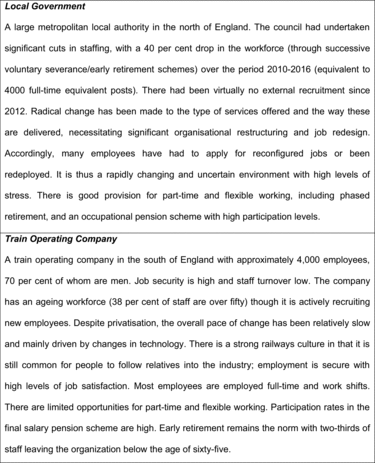
Cases were selected to reflect a variety of industry sectors, workforces and regions of the UK in order to compare the effects of different organisational environments, cultures and policy regimes on managerial practices relating to work-ending. This article utilises data from two organisational settings – a local authority and a train operating company – selected to provide contrasting environments for studying work and retirement transitions. In the former, there was high job insecurity, with pressure to reduce staffing given severe budget pressures arising from financial cuts from central government; in the latter, there were low levels of job insecurity and limited staff turnover in the context of an ageing workforce (see Figure 1 for profiles of the two organisations).
The case study organisations.

Unlike previous UK case studies on older workers, which have typically been limited to interviews with senior managers (e.g. McNair and Flynn, Reference McNair and Flynn2005; IFF Research, 2017), this study incorporates both an employer and employee perspective. Interviews were conducted with three types of participant: human resources/pensions managers (HR), line managers (LM), and older employees (EMP). This ‘triangulation’ was designed to capture the views of those who develop human HR policies and procedures, the managers responsible for implementation, and the employees on the receiving end.
Managers were selected purposively either because they were involved in the development of EWL policies or directly engaged in the management of late career transitions. Employees were drawn from volunteers aged fifty and over. A maximum variation sampling strategy (Patton, Reference Patton1990) was adopted to achieve as diverse a mix of participants – and experiences – across each case study organisation as possible and thus provide a measure of data triangulation (Yin, Reference Yin2009). A total of eighty-two interviews were undertaken in the two case studies: eleven HR managers, fifteen line managers and fifty-six employees. The majority of employees across both cases were employed full-time, had more than ten years’ service in the organisation, and were members of an occupational pension scheme. The research therefore examined the experiences of a relatively privileged group of employees working within established human resource management systems: an appropriate test bed for whether organisations are changing their practices with respect to older workers. It necessarily means, however, that the research did not capture the experiences of older workers in more precarious work environments. There are differences in work mode and occupational type between the two cases with employees in local government predominantly working in nine-to-five administrative roles whilst those in the train operating company, who were mainly drivers, conductors and maintenance staff, worked shifts. A demographic profile of participants is provided in Table 1. The research design and protocols received full ethical approval from the University of Kent, Faculty of Social Sciences Research Ethics Advisory Group on March 3rd 2014.
Participant profile

Coding and analysis
In the findings section, participants are identified by a code signifying their organisation (LG for local government and TR for the train operating company), participant type (HR, LM or EMP), gender (M or F) and interviewee number. For example, TR HR F03 refers to female HR manager number 3 from the train operating company. Unless otherwise stated, quotations are representative of commonly expressed views and themes.
A thematic analysis was undertaken using the constant comparison technique (Strauss and Corbin, Reference Strauss and Corbin1998), an iterative process in which insights from early data analysis are used to inform subsequent data collection. An initial coding frame was developed based on the project's research aims and empirical and theoretical interests. This was tested and refined via a pilot blind coding exercise of seven early transcripts and then reviewed and extended after each phase of data collection to incorporate inductive and/or case-specific codes. Each case study site was treated as an individual unit of analysis before being brought together to allow for a broader analysis across the cases. This included an interrogation of the data by socio-demographic and occupational characteristics to identify patterns and trends by for example age, gender and occupational type.
Findings
Managing work-ending
Both organisations presented challenges for workers and managers given uncertainties surrounding the transition from work to retirement. On the one side, employees could no longer be compelled to retire at a fixed date; on the other side, managers might want them either to retire (as early as possible in the local government case); or (as in the example of the train operating company) at least give indications to ensure effective succession planning. In the case of local government, the situation was complicated by pressures to reduce the workforce given reductions in funding from central government. As a result, national policies to encourage later working were at odds with the loss of secure employment within the organisation:
Employee: Where I work it's fine. Good people. . . reasonable place to work. . . but there is a black cloud. Before that black cloud came everyone was happy and maybe we have had it too easy but that black cloud has made it not the place it was.
Interviewer: And the black cloud comes from the general environment?
Employee: Cuts and the fact is for the first time ever you haven't got a job for life. You haven't got a secure place at work and anything could happen. (LG EMP M29)
I think when you're a local government officer it is true you are sort of cossetted or you have been. . . somebody with my length of service it was a job for life. I got the best job from all the people that left my class at school because I had a pension. I had a job for life and you don't get that anymore. (LG EMP F23)
But despite the shift from a ‘jobs for life’ culture, line managers identified constraints on advising people about options about remaining or leaving work:
I think a lot of managers are quite wary about talking to people about what they want to do. . . for the fear of being ageist or trying to push somebody out or something like that. . . when we were looking at changing policies there was a kind of well if I don't have this default retirement to prompt it. . . how do I raise the issue? You know. . . what if I am clumsy about it and the person gets upset. So. . . I think some people just avoid the issue. (LG HR F41)
We don't raise the [retirement] issue because I think it would. . . I'd feel that they would take. . . not exception to it but if someone was saying ‘Well what are you thinking of doing now? Are you thinking of retiring?’ I wouldn't have thought it would go down too well. (LG LM M47)
In the case of the train operating company, the ending of the default retirement age highlighted the need for new approaches to discuss the management of work-ending. The findings from the interviews with HR managers, however, suggest uncertainty about the information which should be provided, with employees still in some cases expecting to receive a package of information from HR, not realising the onus was on them to tell the organisation their plans for leaving work:
But actually there is an expectation from employees that are just sort of like: I should be getting this data, why haven't you contacted me? So there is confusion there. (TR HR M20)
Problems with workforce planning were seen as a key issue for managers in the train company:
Whereas before you could plan and you'd have twenty people retiring in 2015. I have no idea now who is actually going to go. (TR HR FO8)
Retirement amongst drivers and skilled engineers was also raised as a concern:
A driver may only give a month's notice and yet it takes eighteen months to recruit and train a driver. This uncertainty is scary. (TR LM M01)
Employees commented that they had not spoken with their manager about their plans for retirement. In the absence of direct conversations with employees, some managers recounted that they did their succession planning on the basis of information they gathered from ‘mess room conversations’ and ‘birthday celebrations’ where employees might mention how many more birthdays they had to go before retirement.
The construction of age
An important factor shaping conversations about future work plans concerned people's treatment as ‘older’ workers. Both organisations had what line managers regarded as robust anti-age discrimination policies. Local government was considered to have a strong commitment to equal opportunities and a ‘culture of non-discrimination’. Since the approach was to manage people equally there were no age-specific policies. The train operating company was also perceived as an organisation that gave equal opportunities to all employees regardless of age:
And we all get equal, it's equal opportunities. You know, be you male, female, old, young’. (TR EMP M14)
The company operated an age-blind recruitment process and several examples were found of employees who were hired and trained – or retrained – as drivers or conductors in their forties and fifties:
I would have been, yeah, in fact I was over fifty actually. I was a bit concerned about that but they said, “Don't worry about it,” and, you know, they're not. . . I've got to say there's a lot of things that are possibly not right about [the train operating company] but. . . they're absolutely not under any circumstances prejudiced against anyone in any way. . . It's. . . which is to be applauded, you know,. . . if I was getting for sixty they would have perhaps not been interested in me, but I mean they're. . . you've got to draw the line somewhere haven't you really I suppose, but no they're not at all prejudiced. (TR EMP M17)
There was believed to be no age bias in relation to training and development opportunities with examples cited of people in their fifties and sixties being funded to take courses:
Yeah, we're all treated the same. I would say that. It's all equal, there's no difference-, you know, between different age groups. We're all treated the same. We all get sent on the same training courses. (TR EMP M13)
Despite these positive assessments, reports of ageism did emerge from the interviews, notably though not exclusively, from experiences reported by women and illustrated by feelings that in certain situations preferences were expressed for younger as opposed to older workers. According to one local government employee:
I mean there are comments like. . . my manager made a comment when she said I think it was about one of the assistant directors who left recently who was in her early sixties. . . And she was really nice with loads of experience. My manager said: oh yes but when you get older you don't have as much energy. . . she wasn't as go-getting as she should have been which actually you are not allowed to say anymore. (LG EMP F04)
In some cases, people reported ‘covering up’ their age to avoid potential problems, or feeling ‘invisible’ within the workplace:
I try not to tell people my age. I am very careful about that because people can slot you into categories. . . I don't think they're [local government] ageist in one respect but you can't help how people feel and I think you know if people think you are younger. . . If people think you are about to go they take less notice of you. I think it's to my advantage not to tell people my age anyway and people probably do think I am much younger. . .. But I think people will think oh she'll start slowing down and she won't be able to do her job if they knew my age. (LG EMP F11).
Yeah you do become invisible, particularly for the younger generation and it can happen in the workplace. . .. You feel as if you are being observed. . . I wonder if she'll go [i.e. retire]. . . she's the right age. (LG EMP F18)
In the case of the train operating company, there was some evidence of internalised ageism. One female administrator commented that it was nice to be approached for advice as ‘the work mummy’ or voice of experience. However, this same respondent was worried about looking older than her younger and ‘prettier’ colleagues and being perceived to have reached an age where she should be retiring. She was also concerned about being seen to have health issues and had cancelled two operations partly out of concern about taking time off and the impact this might have on her job security.
In the case of local government, the pressure to reduce staff also produced an environment where age-related judgements and stereotypes surfaced. Although the pressure to downsize was carried out through voluntary rather than compulsory means, this still produced insecurities surrounding ‘informal’ messages about the benefits or otherwise of ‘age’ and ‘experience’. The view from HR managers was that no attempt was made to target a particular age group in the process of reducing staffing:
In 2013–14 we shed about 800 people, 45% were over fifty-five. . . They weren't pushed out. . . We actually did it on the basis of. . . people's skills. So we said: ‘You could be ninety-five but we need your skills. (LG HR M39).
On the other hand, this message could be interpreted differently within the workplace, as the following comments would suggest:
I have heard someone who I thought should have known better saying: Well you know they're fifty-five they'll be going soon’. That shocked me because not everyone can go at fifty-five; fifty-five is very young. And that was from quite a senior person; a senior male; and I was kind of. . . well I was just very shocked at that sort of attitude and felt worried about that obviously. . . you know. . . I am on the shelf because I am over fifty-five. So I was very concerned about that when I heard that in a conversation. (LG EMP F24)
I mean our last restructure was classic. I mean they're not meant to sit down and discuss who they think are going to get the jobs. . . so they had seventy people and fifty jobs. But we all think they did. I am absolutely certain. I know how the managers work. They will have slotted everyone in until there was fifty jobs and the people left over they would expect or assume would take early retirement because they're over fifty-five. But nobody in that meeting would say that out loud. (LG EMP FO2)
For others, there was a sense in which being ‘allowed’ to retire or to take severance itself raised issues about ‘self-worth’ and ‘value’ to the organisation:
It's open to everybody initially. You put in an application and then [they] look at you individually to see if they can do without you. So some people were in a position, especially the first time round [of voluntary early retirements/severance], of wanting to go but not being allowed to go. I think the second time round most of those people were allowed to go because they obviously weren't very committed to their job anymore! Having seen other people go. . .. So if you're like social workers, if you're in a job that's really important. . . you have to stay. But like they let me go, I'm quite sure, because I'm not essential. I don't feel essential always. (LG EMP F02)
Support in the retirement zone
An important finding from the interviews was that work cultures which had at one stage encouraged ‘preparation for retirement’ now appeared to have more restricted conversations with employees about life after work. In the case of local government, a range of policies were available which provided support to those with health issues, or those caring for a partner or relative, or wishing to reduce their hours of work. Flexible working – such as flexi-time and part-time working – was widely used; and special leave was available and highly valued by those with caring responsibilities:
Because while father was getting ill with dementia. . . this flexi-time kicked in. . . I haven't used it yet but I know if I were to go to my boss and say “my father's a bit ill” and my wife she suffers from arthritis. . . she's quite ill herself and if were to take her to an appointment this flexibility allows me all that. And that's why. . .because of that I respect my job even more and my employers even more’. (LG EMP M03)
And also they are quite good about. . . sometimes I have to take time off for my mum. . . sometimes it's a fight to get leave. . . it's quite a struggle to go through the procedure for special leave. I sometimes think it is. . . if you have children. . . it's always like ‘oh yes of course you have got to have it whereas my mum is a child in a way. Although she's not as bad. . . it's dementia. . . she still needs time when I have to be there. (LG EMP FO1)
An HR manager commented that the scope of the health and well-being programme had been widened in the context of an older workforce:
One of the things we noticed was a large number of absences [which could be] attributed to bereavement reaction and it was quite high. So it could be the older workforce where they've faced bereavement of a partner or parents. And we have done more proactive work around that and that's come down. . . that [absenteeism]. (LG HR 38)
In contrast, the train operating company did not have a culture of part-time and flexible working. The workforce is predominantly full-time apart from some ticket office and administrative staff, with a more traditional sense that male manual work is by definition full-time. Part-time working was deemed problematic for drivers because of the need to maintain competence. However, a female driver had been permitted to return from maternity leave on a part-time basis and a temporary rostering accommodation had been made for a driver with multiple sclerosis. Rostering issues were seen as the main barrier to flexible working:
Yeah, it's very difficult to be flexible on a railway where you've got timetables, trains have to run at a certain time, we get a lot of people in ticket offices asking for like mother hours, but our peak is six o'clock in the morning so we just can't do it. (TR HR F04)
The traditional cliff edge ‘all or nothing’ approach to retirement remains the norm in the train operating company. There is no formal phased/flexible retirement scheme and so the only way to achieve a phased retirement was to individually negotiate a reduction in hours (for office-based staff) or move to a formal job share arrangement. The impetus for a job share would have to come from the individual employee or pairs of employees.
Work two weeks on two weeks off or something like that and job share with somebody, then they're not very good on that. . . they're not very accommodating on that and I said that as a nice option to take possibly, when you're ready for it, just work half the time and get, gradually ease into retirement, you know what I mean, not just going bang stop. (TR EMP M17)
Nevertheless, despite the potential demand from employees of all types, there are only around ten job shares in the organisation at present including two or three drivers and conductors. This bears out the widely held perception that it is difficult – or even impossible – to achieve in practice for conductors or drivers.
I've heard that it can be. . .the company are. . . I'm not sure they're over keen on it. (TR EMP M13)
There had previously been a type of phased retirement for drivers, referred to variously as ‘green cards’ or the ‘old boy's link’, whereby the most senior driver would get ‘cushier’ shifts in the lead up to their retirement. This practice had been abolished as it was thought to contravene equal opportunities, though one driver said it has been proposed to the union that it should be re-introduced as a mechanism to encourage older drivers to keep working longer.
Discussion
This article has illustrated some of the tensions in the period around what has been termed ‘work-ending’ with contrasting issues for the state, employers and individuals. The role of the state is now that of encouraging later working through the raising of state pension age. Facilitating longer working is then the responsibility of organisations in partnership with individual employees. The role of the employer – as reflected in many of the interviews for this research – is discretionary with responsibility for initiating change resting with the individual employee. Organisations appear to have retreated from the management of work-ending, creating uncertainty with limited support for employees making decisions about staying on or leaving employment.
Several research and policy issues arise from the findings reported in this study. First, the question of leaving or continuing working is for many charged with insecurity. Individuals may be unsure of their rights within the workplace: one UK survey (carried out in 2016) found that 25 per cent of people approaching retirement remained unaware that since 2011 age could no longer be used as grounds for retirement (Chartered Institute of Personnel and Development (CIPD), 2017). Managers, as this study suggests, may be unwilling to initiate discussions about future work intentions for fear of accusations of ageism (see also Ní Léime et al., Reference Ní Léime, Street, Vickerstaff, Krekula and Loretto2017). This finding was highlighted in a survey for the Department for Work and Pensions that found that: ‘Employers believed that is not their responsibility to raise the issue of retirement with their employees. They did not want to be suggesting retirement or implying that individuals were no longer capable of doing their job’ (DWP, 2017: 43).
Second, if raising issues about retirement is viewed as potentially ‘discriminatory’ (DWP, 2017), responsibility is placed upon individuals to initiate discussions about their future intentions. The absence of clear guidelines may suit those who have planned an appropriate form of work-ending. This group fits one approach to retirement decision-making which suggests that it is ‘. . .dominated by rationality and analytical thinking since people have time to decide. They can even inform themselves about the consequences of their decision and usually have the most relevant information available’ (Hofäcker et al., Reference Hofäcker, Hess, Naumann and Torp2015: 207). However, an alternative view would suggest that many groups find planning for retirement difficult – notably those on low incomes, those with caring responsibilities, and those in poor health. Groups such as these may be especially disadvantaged by a lack of transparency about the range of options around work ending and the transitions associated with this period.
Third, the research raises issues about the negative way in which ‘age’ may be treated and constructed as a category inside organisations. Evidence from the European Social Survey confirms the extent to which people fifty and over worry that employers will express a preference for younger as opposed to older employees (Abrams et al., Reference Abrams, Russel, Vauclair and Swift2011). However, a more general question concerns the way in which organisations ignore processes that allow age-based discrimination to flourish. This may be an unintended consequence of environments where ‘age-specific’ activities would be viewed as contravening policies and commitments to equal opportunities. However, the reality may be that age-stereotypes surface in situations where there is pressure to reduce the size of the workforce, or in contexts of technological change. Again, policies which emphasise individual responsibility for work careers may reduce the degree to which people are protected against age discrimination in the workplace. Comments from some of the female respondents in our sample confirms the pressures facing older women in particular, vulnerable to what Street (Reference Street, Ní Léime, Street, Vickerstaff, Krekula and Loretto2017: 21) refers to as ‘the double disadvantage of the intersection between ageism and sexism’, with women often viewed as ‘socially older’ than their male counterparts (Street, Reference Street, Ní Léime, Street, Vickerstaff, Krekula and Loretto2017).
Fourth, building on this last finding, although a strong research tradition has been built around the concept of ‘older workers’, organisations may themselves be reluctant – for the reasons identified in this article – to use this term. This point was brought out in a study for the DWP (IFF Research, 2017), which reported that: ‘The research found few examples of policies or practices targeted specifically at older workers. Employers stressed that existing procedures could accommodate needs arising from health concerns, caring responsibilities, phased retirement or a wish to work less. However, employers reported limited experiences of offering flexible working arrangements to older workers. Requests were more common for employees with childcare responsibilities’. The argument for avoiding the term ‘older worker’ arises from research indicating that the moment someone becomes categorised by their age they are potential targets for prejudice and discrimination (van der Heijden et al., Reference van der Heijden, Schalk and van Veldhoven2008). Against this, failure to monitor the take-up and suitability of flexible working arrangements may leave older workers vulnerable during periods of change both during their own lives and that of the organisation.
Further research is needed to examine the issues raised in this article, drawing on a wider range of organisations and industries. These issues are assuming added urgency given the extent to which technological change may intensify insecurity within the workplace (Avent, Reference Avent2017). Extended working life is presented as widening options but it leaves unresolved for many older workers their role and status within employment. Understanding the complex ways in which ‘age’ is constructed and managed within the workplace should become a major topic of interest in social policy research on the changing transitions from work to retirement.
Acknowledgements
This research was part of the Uncertain Futures: Managing Late Career Transitions and Extended Working Life project funded by the ESRC [Ref. ES/L002949/1]. The need to protect anonymity means that we cannot name the case study organisations from which we collected data, but we would like to express our gratitude to their staff for enabling, and participating in, our research. We are grateful to the help provided by members of the research consortium including Ben Baumberg-Geiger, Amanda Burns, Mariska van der Horst and Sue Shepherd (University of Kent); Charlotte Clark and Amanda Lahy (formerly of Queen Mary University of London); Joanne Crawford (Institute of Occupational Medicine); David Lain (formerly of the University of Brighton now the University of Newcastle); Wendy Loretto (University of Edinburgh); and David Wainwright and Andrew Weyman (University of Bath). The authors of this article are also grateful for the helpful comments provided by the referees for this article.


 Open access

