


Introduction
The Carthaginian general Hamilcar Barca and his sons landed on the Iberian Peninsula in 237 BCE to reassert political, economic and military control over much of the region (Polybius, Historia 2.6; Balasch Recort Reference Balasch Recort2001). According to the Carthaginian leadership, the aim of this campaign was to pay the war indemnity imposed by Rome on Carthage following the First Punic War (264–241 BCE). Expansion of Barcid power led to the foundation, in 228 or 227 BCE, of a new military base on the Mediterranean coast: Qart Hadasht—‘the new city’—established by Hamilcar’s son-in-law, Hasdrubal. The choice of location for this city was far from haphazard; situated within the naturally sheltered Cartagena Bay, it covers a land area of 40ha flanked by five hills and connected to the mainland by an isthmus. To the north, it was bounded by a marshy area known as El Almarjal, while to the west and south, the waters of the bay enclosed the urban settlement (Ramallo Asensio Reference Ramallo Asensio2011; García-León et al. Reference García-León, Ros Sala, García Martín, Torres Picazo, Cerezo and Ramallo Asensio2017). These defensive advantages were complemented by significant economic potential linked to the extraction and exploitation of argentiferous galena and lead—activities that had been ongoing in the coastal mountain ranges east and west of the bay since the early first millennium BCE (Manteca et al. Reference Manteca2017).
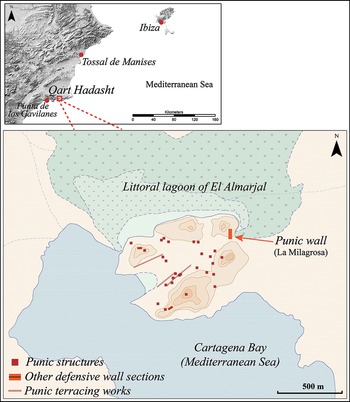
To enhance security, a solid defensive wall was constructed. In some sections, this wall incorporated Hellenistic models and techniques to underscore the city’s role as a ‘new capital’. This is evident in the section discovered in 1987 at the site known as La Milagrosa (Marín Baño Reference Marín Baño1997), which protected access to the city via the isthmus and followed the design of a casemate or chambered wall (Figure 1). The structure stood just over 10m tall and followed the optimal 2:1 height-to-width ratio described by Philo of Byzantium (Santagati Reference Santagati2021). Its outer face was built using large, regularly placed sandstone blocks extracted from quarries situated to the north-west of the city (Ramallo Asensio & Martín Camino Reference Ramallo Asensio, Martín Camino, Bellón, Ruiz, Molinos, Rueda and Gómez2015).
Location of Qart Hadasht in the south-eastern Iberian Peninsula (above; Digital Terrain Model: OpenStreetMap) and palaeotopographical reconstruction of the city (below), showing the location of archaeological features dating to the Punic period (figure by authors).

Little attention has been paid to the other principal materials that constituted half of the fortification: mudbricks and earthen mortars. Aside from a few references to dimensions, earthen architecture has largely been overlooked—a situation that reflects a broader trend within the study of first-millennium BCE Mediterranean archaeology. This neglect is especially pronounced in the Western and Central Mediterranean, where such materials are poorly preserved and their potential remains underappreciated. In contrast, earthen building materials have a longer tradition of study in the Eastern Mediterranean and the Near East (Rosen Reference Rosen1986; Nodarou et al. Reference Nodarou, Frederick and Hein2008; Homsher Reference Homsher2012; Love Reference Love2012; Lorenzon Reference Lorenzon2023).
In this study, we present the results of the geoarchaeological analysis of earthen building materials (hereafter EBM) used in the construction of the Punic Rampart of Qart Hadasht, consider potential source locations and reflect on the implications of our findings for understanding environmental interactions and the organisation of labour chains during the third century BCE. The application of physicochemical and mineralogical analytical techniques provides a crucial means of gaining a deeper understanding of these materials, including the selected raw materials, their processing and the specific know-how associated with each type of material. Although these methods have been applied successfully at other Pre- and Protohistoric sites (e.g. Nodarou et al. Reference Nodarou, Frederick and Hein2008; Cammas Reference Cammas2018; Devolder & Lorenzon Reference Devolder and Lorenzon2019), they remain essential for addressing ‘inverse problems’ (Buxeda i Garrigós & Madrid i Fernández Reference Buxeda i Garrigós, Madrid i Fernández and Hunt2017), in which architectural remains are analysed to investigate the decisions and purposes underlying their conception and use. The results obtained are therefore examined in conjunction with archaeological and landscape data to better understand the complexity of the foundation process of the Punic city of Qart Hadasht.
The Carthaginian wall of Qart Hadasht
When Titus Livius recounts the Roman assault on Qart Hadasht in 209 BCE, he emphasises the height and strength of its walls, stating that “neither the troops, nor the missiles, nor anything else was a better defence than the walls themselves” (History of Rome 26.45.2; Villar Vidal Reference Villar Vidal2001). Archaeological findings have since confirmed this literary account, with three sections of the defensive enclosure identified to date. The most monumental of these—corresponding to the literary descriptions and serving as the focus of our case study in La Milagrosa—is located on the slope of Cerro de San José. This section protected the access route via the isthmus and is the source of the samples analysed in this study.
Two additional, less-substantial stretches of wall have also been identified on the hills of La Concepción and El Molinete (Ruiz Vaderas et al. Reference Ruiz Valderas, Murcia, Ramallo Asensio and Guillermo2013). Such heterogeneity in defensive systems was not unusual in Punic cities. According to Appian of Alexandria, writing in the second century CE (Historia Romana 95; Sancho Roya Reference Sancho Roya1980), Carthage in its later phase had a ‘triple wall’ closing off the isthmus, while steeper areas were protected only by a single wall. At the ports of Lilybaeum and Olbia, fortifications were concentrated in sectors less protected by the natural terrain (Montanero Reference Montanero2020).
The preserved La Milagrosa section of the wall extends for 30m and consists of two parallel walls joined at regular intervals by transverse ties made of opus africanum or checkerboard masonry (Ramallo Asensio & Martín Camino Reference Ramallo Asensio, Martín Camino, Bellón, Ruiz, Molinos, Rueda and Gómez2015). This configuration forms an internal system of 5.2m-wide spaces traditionally referred to as casemates, arranged in groups of three. Charred wooden beams and flooring indicate that a second storey ran above these compartments (Ramallo Asensio & Martín Camino Reference Ramallo Asensio, Martín Camino, Bellón, Ruiz, Molinos, Rueda and Gómez2015).
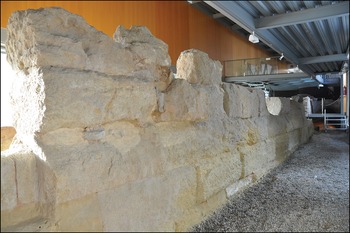
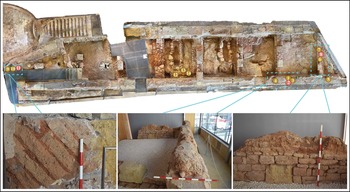
The construction of the wall involved levelling the terrain by cutting into the rocky substrate to create foundation trenches for both the outer and inner walls (Ramallo Asensio & Martín Camino Reference Ramallo Asensio, Martín Camino, Bellón, Ruiz, Molinos, Rueda and Gómez2015). The outer facing was built with carefully worked, bevelled sandstone blocks of varying sizes (Figure 2). The inner wall, also resting on a foundation of two rows of stone blocks, was completed with mudbricks of a regular module of 0.52m long, 0.2m wide and 0.08–0.09m thick (Figure 3). The external face of the outer wall was coated in a white render, traces of which are still preserved. This technique has also been identified in the fortifications of Kerkouane (Fantar Reference Fantar1987) and Carthage (Rakob Reference Rakob1985), and has been proposed for other defensive structures in Sicily and Sardinia (De Socio Reference De Socio1983; Rakob Reference Rakob1986).
Elevation of sandstone blocks forming the outer face of the Punic Rampart of Cartagena, La Milagrosa section (image by authors).

Locations of the sampled materials (MP-1 to MP-14) and detail of the various EBM remains in situ (orthophotograph by José Gabriel Gómez Carrasco; inset images by authors).

The use of mudbricks in the upper parts of walls is well attested across the Punic Mediterranean, with notable examples at Mozia and Kerkouane (Fantar Reference Fantar1987). It was also common in Greek fortifications in southern Italy and Sicily, where mudbricks were placed atop stone socles, as observed at Gela (Galdieri Reference Galdieri and Ingoglia2019) and Himera (Vassallo Reference Vasallo, Vaggioli and Michelini2006). This architectural concept has likewise been identified at other sites on the Iberian Peninsula, including Tossal de Manises (Olcina Doménech Reference Olcina Doménech2024), Castillo de Doña Blanca (Ruiz Mata Reference Ruiz Mata2022) and Carteia (Bendala Galán & Blánquez Pérez Reference Bendala Galán and Blánquez Pérez2002–2003).
Materials and methods
Fourteen EBM samples were obtained from various parts of the rampart, including sections still preserved in situ as well as areas where collapse had occurred. Eleven samples consist of mudbrick and three of mud mortar, sourced from both the inner enclosure wall and the transverse wall ties (Figure 3). In terms of dimensions, the mudbricks correspond to the module described above, while the sampled mortars range in thickness from 20–30mm. Following petrographic analysis, five geological samples—MP-So1, So2, So3, So4 and So5—showing compositions similar to the mudbricks were collected from different areas around Cartagena.
The chemical composition of the 19 samples was analysed using a wavelength dispersive x-ray fluorescence spectrometer (Bruker S4 Pioneer) operating in vacuum mode. Sample preparation involved homogenising the materials with a mixer mill, followed by the production of pressed beads using 8g of sample and 2g of wax. Spectral data were evaluated using SPECTRAplus software (EVA 1.7, Bruker-AXS and Socabim, 2006), and volatile components were measured via elemental carbon, hydrogen and nitrogen (CHN) analysis (LECO 628). Major, minor and trace elements, together with CHN values, totalled between 99.9% and 100.1% (see online supplementary material (OSM) Table S1).
X-ray diffraction (XRD) was employed to characterise the mineralogical composition of selected EBM samples using a Bruker D8 ADVANCE powder diffractometer with a θ–θ goniometer. The acquisition time was set at two seconds per step, with measurements taken over a range of 5°–70° 2Θ. Petrographic analysis of thin sections was conducted using a Leica DM2000 polarising microscope fitted with a Flexacam C3 camera, at magnifications ranging from ×5 to ×40.
Results
Chemical and mineralogical characterisation
X-ray fluorescence (XRF) analysis was used to determine the chemical composition of the samples, with a total of 24 compounds (see Table S1) retained for statistical modelling (after Aitchison Reference Aitchison1986; Buxeda i Garrigós Reference Buxeda i Garrigós and López Varela2018) treatment: magnesium oxide (MgO), aluminium oxide (Al2O3), silicon dioxide (SiO2), phosphorous pentoxide (P2O5), sulphur trioxide (SO3), potassium oxide (K2O), calcium oxide (CaO), titanium dioxide (TiO2), vanadium pentoxide (V2O5), chromium oxide (Cr2O3), manganese oxide (MnO), iron oxide (Fe2O3), cobalt oxide (CoO), nickel oxide (NiO), copper oxide (CuO), zinc oxide (ZnO), gallium oxide (Ga2O3), arsenic trioxide (As2O3), rubidium oxide (Rb2O), strontium oxide (SrO), yttrium oxide (Y2O3), zirconium dioxide (ZrO2), niobium oxide (Nb2O5) and barium oxide (BaO). Several chemical components were excluded owing to analytical imprecision caused by low concentrations (e.g. Cl, ThO2) or by post-depositional contamination (e.g. Pb, Na2O3).
The geological sample MP-So5 was also excluded, due to disproportionate levels of CoO and ZnO. This sample was taken from the Cabezo de la Viuda, a hill where a small basaltic outcrop has been identified (Ramallo Asensio & Arana Castillo Reference Ramallo Asensio and Arana Castillo1987). The installation of several fertiliser factories in the surrounding area during the twentieth century accounts for the contamination of these soils and explains the sample’s divergence from the EBM group.
The compositional variation matrix was calculated to assess the homogeneity of the dataset and to identify which elements contributed most and least to variability (Buxeda i Garrigós & Kilikoglou Reference Buxeda i Garrigós, Kilikoglou and Zelst2003). The resulting value, 1.19, indicates a polygenic group in which SO3, ZnO and CoO have the greatest variability (vt/τ.i < 0.3), while BaO and SiO2 contribute the least (Figure 4a).
Statistical analyses based on the chemical results, considering 24 chemical elements: a) compositional evenness plot for the 18 samples analysed; b) dendrogram of 18 samples following hierarchical cluster analysis; c) scatterplots of various element concentrations, including sample QTH-So5 (figure by authors).

A second statistical approach involved hierarchical cluster analysis (HCA) of the 14 EBM and four geological samples, based on squared Euclidean distance and the group average method, following a centred log-ratio (clr) transformation of the chemical data. The resulting dendrogram (Figure 4b) presents a complex structure in which several groupings, as well as one isolated sample, can be distinguished.
The largest cluster, designated QTH-A, includes 10 of the mudbrick samples from the Punic Rampart. The sole exception is MP-3, which appears as an outlier due to its elevated SO3 and CoO content. These peaks—likely associated with post-depositional contamination—also explain the over-representation of these two elements in the compositional variation matrix (Figure 4a). It is clear, however, that the mudbrick composition is highly homogeneous and clearly distinct from that of the mud mortars.
Cluster QTH-B comprises the mud mortars, specifically MP-2, MP-8 and MP-11. These samples display significantly different compositions from those in QTH-A, with lower concentrations of MgO, SiO2, P2O5, TiO2, MnO and ZrO2. These results contrast with a higher presence of volatile materials, particularly increased water (H2O) content, as revealed by CHN analysis. Another difference that reinforces this distinction is the presence of halite—rock salt, NaCl—in QTH-B, identified through XRD results (Figure 5). The presence of this mineral supports the hypothesis that seawater may have been used in preparing the mortar.
XRD diffractograms with identified crystalline phases representative of the chemical clusters (figure by authors).

The soil samples appear to form two subgroups—So1 and So3; So2 and So4—in line with the petrographic analysis. While these constitute an independent branch of the dendrogram, their relative proximity in the HCA and the scatterplots may suggest a degree of compatibility. However, the chemical results alone are insufficient to confirm this hypothesis without further analysis.
Petrographic analysis
The thin-section analysis allowed the identification of two main petrographic fabrics—MP-1, including most mudbricks and two geological soils, and MP-2, the mud mortars—alongside one loner mudbrick and the remaining soils (Figure 6). The descriptions follow the guidelines of Whitbread (Reference Whitbread1995) and Quinn (Reference Quinn2013).
Representative microphotographs of the identified petrofabrics, under cross-polarised light: a) MP-3; b) MP-6; c) geological sample QTH-So2; d) MP-10; e) MP-3 with basalt and mud mortar; f) lava in MP-14; g) remains of vegetal temper, MP-10; h) mud mortar, MP-11; i) mud mortar, MP-3; j) outlier, MP-12; k) MP14; l) geological sample QTH-So1 (figure by authors).

Fabric MP-1: mafic igneous rocks (n = 9, coarse-fine-void ratio 25:70:5, samples MP-3, 6, 7, 9, 10, 13, 14, QTH-So2, QTH-So4). The groundmass exhibits a well-packed structure with a homogeneous brown colour. The aplastic inclusions follow a poorly sorted structure and reach a size between medium silt (< approx. 0.02mm) and granules (> approx. 2.72mm). These comprise few basalt and volcaniclastic rocks, quartzite, carbonate mudstone and quartz, very few clay pellets and shells, rare mica schist, calcite and muscovite, and very rare plagioclase and anisotropic minerals. Concerning the igneous rocks, MP-3 presents trachyte crystals and MP-14 some lava fragments. Voids present a structure of meso- to macro-sized vughs and channels linked to microfractures. Vegetal temper was identified only in MP-10, where remnants of plant material are still preserved.
Fabric MP-2: mudstone, sandstone and metamorphic rocks (n = 4, c.f.v. 40:50:10, samples MP-2, 3, 8, 11). The groundmass presents a homogeneous reddish-orange colour with a well-packed structure where the aplastic inclusions reach a size between medium silt (< approx. 0.17mm) and small pebbles (> approx. 4.80mm). They are very poorly sorted and represented by frequent carbonate mudstone, sandstone and quartzite, few slate, polycrystalline and monocrystalline quartz, mica schist and very few muscovite. Voids are mainly micro channels linked to microfractures, and some vughs and vesicles not related to vegetal temper. MP-3 is also included in this group because it presents the mud mortar pasted to the mudbrick.
Loner MP-12: shells and metamorphic rocks (c.f.v. 30:67:3). This sample reveals a homogeneous, compact, greyish-brown groundmass with aplastic inclusions very poorly structured and ranging from medium silt (< approx. 0.17mm) to small pebbles (> approx. 5.92mm). It consists mainly of common shells and dolomite, frequent quartzite and carbonate mudstone. Other minerals are slate, phyllite, micaschist, angular polycrystalline and monocrystalline quartz, clay pellets and rare serpentine. The presence of voids is irregular, classified as microvesicles and channels linked to microfractures.
Soils QTH-So1 and QTH-So3: argillaceous soil with carbonates and shells (c.f.v. 20:65:15). The groundmass presents a homogeneous yellowish-brown tone and fibrous pattern, with inclusions ranging between very fine sand (< approx. 0.06mm) and very coarse sand (> approx. 1.12mm). Aplastic inclusions are made of frequent calcite and dolomite, few angular quartz and muscovite, very few shell fragments and mudstone.
Discussion
The geoarchaeological approach implemented in this study reveals a strong correlation between the different analytical techniques and yields a striking result: the mudbricks and mud mortars used in the construction of the Punic Rampart of Cartagena exhibit distinct geochemical signatures that are, in turn, highly homogeneous within each type of earthen building material. This divergence is particularly significant because it not only enables the investigation of environmental interactions and catchment areas but also provides valuable insight into the sociopolitical and organisational dynamics that underpinned the rapid construction of the defensive enclosure.
Provenance and transport of building materials
The sampled mud mortars derive from three different wall segments (Figure 3). Chemical analysis reveals highly similar geochemical signatures across these samples, while petrographic analysis shows a composition rich in metamorphic rocks—particularly schists and purplish slates. These inclusions are especially relevant, as they are characteristic of the hills surrounding the Punic Rampart, specifically the San José and Despeñaperros hills (Ramallo Asensio & Arana Castillo Reference Ramallo Asensio and Arana Castillo1987). This evidence allows us to confidently place the preparation of these mortars close to the construction site. Such a strategy would have been opportunistic, as earthen mortars needed to be applied while fresh and plastic; the presence of sandstone fragments and clay lumps is also consistent with a local mixing phase.
In this context, the detection of halite peaks in two of the earthen mortars provides evidence for the use of seawater, or saltwater from El Almarjal lagoon (Manteca et al. Reference Manteca2017), in mortar preparation. Although the use of saltwater in earthen mortars may cause internal fracturing due to salt crystallisation over the medium to long term (Pietruszczak et al. Reference Pietruszczak, Przecherski and Stryszewska2022; Monasterio-Guillot et al. Reference Monasterio-Guillot, Crespo-Lopez, Gonzalez-Perez and Marin-Troya2024), it remains a plausible choice for water in a semi-arid region where fresh water was a scarce resource. In other Mediterranean regions, such as Crete, the use of seagrasses as a binder has been detected (Lorenzon Reference Lorenzon2021). Although no clear data have been identified elsewhere on the use of salt water for the manufacture of mudbricks, reconstruction of the ancient topography around Qart Hadasht, with the isthmus close to the Punic Rampart bordered to the south by the Mediterranean Sea and to the north by the expansive brackish marshland of El Almarjal (Torres et al. Reference Torres2018), supports the easy and opportunistic access to and use of salt water for construction purposes.
While the mud mortars point to sourcing near the construction site, the results for the mudbricks suggest a different scenario. The dendrogram produced by the HCA displays a high degree of homogeneity, disrupted only by the displacement of sample MP-3 due to its unusually high SO3 value (Table S2). This may have been caused by prior anthropogenic activity on the selected land, or by a post-depositional process associated with the filling of the structure (Bintliff & Degryse Reference Bintliff and Degryse2022). The otherwise internal consistency of this group is further confirmed by petrographic analysis, which classifies seven of the samples under the MP-1 fabric type, together with soil samples QTH-So2 and QTH-So4. This cluster is characterised by the presence of volcanic inclusions, particularly basalt—a lithology extremely rare in the southern Iberian Peninsula, where metamorphic and sedimentary formations predominate. Only sample MP-12 is classified as an outlier due to the absence of volcanic rocks; however, its inclusions of shells, carbonates and other metamorphic elements suggests that it may still be associated with the rest of the mudbricks.
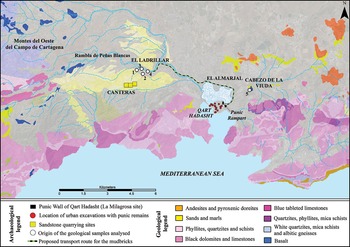
As the region is predominantly metamorphic (Ramallo Asensio & Arana Castillo Reference Ramallo Asensio and Arana Castillo1987), the identification of basalt led to targeted geological sampling around the Rambla de Peñas Blancas and the Cabezo de la Viuda, the only geologically compatible zones within a 50km radius (Figure 7). Although other issues are apparent with sample QTH-So5, the presence of carbonates and shells further excludes this sample as a candidate, leaving the Rambla de Peñas Blancas as the only plausible production zone for the analysed mudbricks of the Punic Rampart. This hypothesis is confirmed petrographically by the match between the mudbrick samples and samples QTH-So2 and QTH-So4.
Geological map of the area around Cartagena showing the proposed origin and transportation route for the mudbricks (prepared by the authors using the Spanish Geological and Mining Institute Digital Terrain Model, Sheet 977 – Cartagena).

However, the manufacture of building materials in this area was likely not exclusive to the Punic period. An examination of eighteenth- and nineteenth-century cartographic and historical maps reveals that the area was referred to as El Ladrillar, ‘the brickmaking area’—and even today as Cuesta de los Ladrilleros—a toponym clearly linked to brick production. In our view, this name may preserve the memory of land use that dates back at least to the third century BCE.
Identifying this area of extraction and production allows us to estimate transport distances of the manufactured mudbricks, as well as to analyse the exploitation of the hinterland of Qart Hadasht during the Barcid period. The El Ladrillar area lies approximately 5km in a straight line from the Punic Rampart; however, this distance would have increased to 7–8km when accounting for the need to circumvent the El Almarjal lagoon and cross the isthmus to reach the construction site (Figure 7). Such a distance would have required considerable investments of time and energy and represents a unique case for EBM, which were typically manufactured either on site or within a 1–2km radius (Rosen Reference Rosen1986; Lorenzon Reference Lorenzon2023).
We argue that the mudbrick production area was located at this distance for several reasons: first, the quality of the soil, which remained in use for brickmaking until at least the nineteenth century; second, the availability of water from the rambla itself or nearby springs for mixture preparation and mudbrick manufacture; and third, its location just north of the sandstone quarries that supplied the blocks for the Punic Wall (Figures 7 & 8). These quarries were characterised by an abundance of suitable stone, ease of extraction and practicality for transport (Ramallo Asensio & Arana Castillo Reference Ramallo Asensio and Arana Castillo1987)—a logistical pattern that appears to have been identical to that used for the mudbricks.
Drone image of the sandstone quarries north-west of Cartagena, with the El Ladrillar area marked in red (photograph by Clemente López Sánchez).

The co-ordinated and organised exploitation of this western sector of the immediate hinterland since the early days of the Carthaginian settlement reflects a detailed knowledge of its close landscape and the implementation of a centralised and structured system of exploitation. This system was capable of managing and directing the extraction and production of raw materials, their transport to the city and the construction of the defensive wall. The investment in materials and labour, and the rapid completion of a wall of such scale, would have been impossible without a politically co-ordinated plan involving the mobilisation of both skilled and unskilled labour (Bessac & Leriche Reference Bessac and Leriche1992)—an achievement made possible through the firm control exercised by the Barcid leadership.
Work strategies within a political construct
The combination of stone and mudbrick documented in the Punic Wall of Qart Hadasht forms part of an architectural tradition rooted in the Eastern Mediterranean, adopted by the Punic world from the sixth century BCE onwards. This tradition is evident at sites such as Carthage itself (Rakob Reference Rakob and Vegas2002), Kerkouane (Gharbi Reference Gharbi, Guizani, Ghodhbane and Gakinier2019), Mozia (Nigro Reference Nigro2020) and Castillo de Doña Blanca (Ruiz Mata Reference Ruiz Mata2022), and continued into the third century BCE in contexts linked to the First and Second Punic Wars, including Soluntum (currently under excavation), Tossal de Manises (Olcina Doménech Reference Olcina Doménech2024) and Cartagena.
The construction of these monumental defensive systems can be understood as the result of a political will capable of supervising labour, directing the workforce and controlling the territories where raw materials were sourced (Montanero Reference Montanero2020). However, geoarchaeological approaches such as that adopted here enable us to detect traces of that centralised structure within the earthen building materials themselves.
In the case of Qart Hadasht, the homogeneity observed in the mudbrick composition—both in terms of manufacturing recipe and dimensions (0.52 × 0.08 × 0.20m)—is noteworthy. It reflects a set of highly specific and clearly directed construction strategies and knowledge. Although geoarchaeological data for the Phoenician-Punic culture remain limited, these results contrast with evidence from other Mediterranean Iron Age sites, where mudbrick fortifications were constructed using materials of varied provenance (Emery & Morgenstein Reference Emery and Morgenstein2007; Cutillas-Victoria et al. Reference Cutillas-Victoria, Lorenzon and Brotons2023), or where segmented construction by different artisan groups has been proposed, as in the Cypriot city of Palaepaphos (Lorenzon & Iacovou Reference Lorenzon and Iacovou2019). By contrast, the data from Qart Hadasht’s Punic Wall align more closely with sites such as Ashdod-Yam, a settlement founded ex novo on the Israeli coast in the eighth/seventh century BCE, where complete uniformity in the materials used for both fortification and housing has been documented (Lorenzon et al. Reference Lorenzon, Cutillas-Victoria, Itkin and Fantalkin2023).
Another point emerging from the results is the limited processing of the sediment. The total absence of pedogenesis in the inclusions suggests minimal mixture preparation, while the isolated or very low-frequency presence of vegetal temper indicates a low-complexity production process. These features suggest that the mudbricks at Qart Hadasht were manufactured rapidly following a relatively unsophisticated recipe, making possible the incorporation of skilled or unskilled workforces in the manufacturing stage.
Thus, the main objective appears to have been the rapid and standardised production of materials that were nevertheless sufficiently robust for transport and structural use. The lack of binding agents would have been compensated—at least in terms of preserving the construction—by the application of a plaster coating over the surface of the wall. Remains of this white plaster layer are still visible in some areas of the outer face (Figure 9), where it would have served to protect the structure from the elements, enhance its appearance and better absorb the impact of projectiles (Alcázar Reference Alcázar2014).
Detail of the mud mortar applied between the sandstone blocks, with remnants of the plaster layer (photograph by authors).

Conclusions
The geoarchaeological analysis of the earthen building materials used in the Punic Wall of Cartagena has yielded new data identifying homogeneous compositions associated with the production of both mudbricks and mud mortars. The analysis further provides direct evidence for the use of seawater in mortar mixing and identifies the manufacture zone of the mudbricks. Recognising this distance between the source area and the construction site represents a genuine innovation in the study of EBM during the later prehistory and protohistory of the Mediterranean. It implies a medium- or even long-distance supply strategy, which is unusual in the context of earthen architecture, where sourcing areas are typically located close to the construction site (Goldberg et al. Reference Goldberg1979; Rosen Reference Rosen1986; Lorenzon et al. Reference Lorenzon, Cutillas-Victoria, Itkin and Fantalkin2023). These findings highlight the importance of studying architectural materials that have traditionally been undervalued, as they can yield crucial data for understanding more complex historical and archaeological dynamics.
The strategies and recipes identified in this study correspond to a period of intense political and economic activity associated with the foundation of the new Barcid capital in Iberia and the construction of its defensive system. This context explains the implementation of a productive infrastructure capable of supplying and transporting both stone and mudbricks from the north-west of the city to the building site. The success of this system, and the large-scale mobilisation of resources and labour it entailed, could have been achieved only under the tight political control of the Barcid leadership—who ultimately oversaw the development of a foundation that came to symbolise Carthaginian power in the region, and which flourished until its fall to Rome in 209 BCE.
Acknowledgements
The authors express their gratitude to Alberto Alcolea and Vicente Muñoz of the Polytechnic University of Cartagena who performed the XRF, CHN and XRD analyses.
Funding statement
This work is part of the research projects ‘Geoarchaeological analysis of defensive earthen architecture in the Iberian Southeast during the 1st millennium BC’ supported by Fundación PALARQ and ‘Producir y abastecer a la nueva capital púnica del Mediterráneo Occidental: contextualización y caracterización arqueométrica de los materiales cerámicos de la Qart Hadasht de Iberia’ (21954/PI/22) funded by Fundación Séneca – Region of Murcia Agency of Science and Technology.
Online supplementary material (OSM)
To view supplementary material for this article, please visit https://doi.org/10.15184/aqy.2025.10276 and select the supplementary materials tab.
Author contributions: CRediT Taxonomy
Benjamín Cutillas-Victoria: Conceptualization-Lead, Formal analysis-Lead, Funding acquisition-Equal, Investigation-Lead, Methodology-Lead, Software-Equal, Writing - original draft-Lead, Writing - review editing-Equal. Sebastián F. Ramallo Asensio: Funding acquisition-Lead, Investigation-Equal, Project administration-Lead, Supervision-Equal, Writing - original draft-Supporting, Writing - review editing-Equal. Miguel Martín Camino: Data curation-Equal, Formal analysis-Equal, Investigation-Equal, Resources-Equal, Writing - original draft-Supporting, Writing - review editing-Equal.




 Open access

