

The social roles that dogs (Canis lupus familiaris) served in ancient Central Andean societies were highly variable, reflecting the geographic and cultural diversity of Peru, Bolivia, Chile, and northern Argentina. We know the diverse roles of dogs from the recovery of archaeological remains of whole and partial dogs from a range of time periods beginning at least 7,000 years ago through the Inca period (e.g., Brothwell et al. Reference Brothwell, Malaga and Burleigh1979; Málaga Reference Málaga and Matos1977; Manin et al. Reference Manin, Debruyne, Lin, Lebrasseur, Dimopoulos, González Venanzi and Charlton2025; Mendoza España Reference Mendoza and Velia2022; Miller Reference Miller2003; Vásquez Sánchez et al. Reference Sánchez, Víctor, Tham and Pérez2009) as well as from the analysis of dog imagery and descriptions of dogs in ethnohistorical accounts (e.g., Mendoza España and Valadez Reference Mendoza, Velia and Valadez2003). Furthermore, the excellent preservation of many mummified dogs, particularly in Peruvian and Chilean coastal sites, has provided details on coat color, the intentional inclusion of perishable materials with dogs, and burial practices (e.g., Allison et al. Reference Allison, Focacci and Santoro1982; González Venanzi et al. Reference González Venanzi, Prevosti, González, Cantarutti, López Mendoza and Prates2022; Pozzi-Escot et al. Reference Pozzi-Escot, Rivera, Costaneira and Quiroga2012; Venegas Gutiérrez Reference Gutiérrez and Elena2019). In addition to osteological remains, researchers can also discern size and breed variability from depictions of dogs on polychrome ceramics or zoomorphic ceramic vessels (e.g., Donnan Reference Donnan1976; Jackson Reference Jackson2008; Vásquez Sánchez et al. Reference Sánchez, Víctor, Tham and Pérez2009).
For ancient Andean populations, companion animals that did not serve economic roles, such as facilitating hunting, herding, or providing protection, might be considered luxury animals that provided pleasure or were status symbols. Complete dog skeletons and fragmentary dog remains occur in a variety of burial and domestic contexts through time (e.g., Apesteguía and Álvarez Reference Apesteguía and Álvarez2023; Flannery and Glew Reference Flannery, Glew and Marcus2016; Mendoza España Reference Mendoza and Velia2014, Reference Mendoza, Velia, Apesteguía and Álvarez2023a; Stahl Reference Stahl2012; Vásquez Sánchez et al. Reference Sánchez, Víctor, Tham and Pérez2009; Wing Reference Wing, Redford and Eisenberg1989).
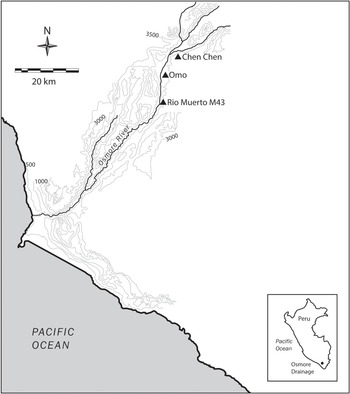
Here we examine the place of the dog in ancient Andean Tiwanaku society, an Andean Middle Horizon expansive state (AD 600–1000) that had a homeland in highland Bolivia, and which colonized parts of modern Peru and Chile. Tiwanaku was an agropastoral society that relied on domesticated camelids (llamas and alpacas) for subsistence, transport, and ritual (Goldstein Reference Goldstein2005; Janusek Reference Janusek2008; Vallières Reference Vallières2012; Webster and Janusek Reference Webster, Janusek and Kolata2003). We document dog remains from Tiwanaku sites in the Moquegua Valley of southern Peru (Figure 1). Our analysis includes discussion of two naturally mummified young dogs that Tiwanaku inhabitants intentionally buried in domestic household compounds at the sites of Rio Muerto and Omo. We document the burial contexts of these juvenile dogs and provide morphological and morphometric values on the more complete dog from Rio Muerto, as well as isotopic analyses of the bones, teeth, and hair of both dog mummies. Strontium (87Sr/86Sr) isotope analysis allows us to infer potential regions of animal provenance, and the results of stable isotope ratio analysis of carbon (δ13C) and nitrogen (δ15N) allow us to characterize both dogs’ diets. Using these analyses, we take a life history approach (following Hill Reference Hill2013) to these cases and consider the roles canines played in Tiwanaku domestic life. We also describe fragmentary dog remains found in domestic, cemetery, and temple contexts from other Tiwanaku sites in the valley. These partial dog skeletons further indicate that dogs were a part of the social, and possibly, the ritual and symbolic life of the Tiwanaku.
Location of the Rio Muerto site in the Moquegua Valley, southern Peru.

Our life history approach asks whether the Tiwanaku considered dogs to be nonhuman persons. In late nineteenth-century anthropological classifications of religion and ritual practice, scholars defined as “animist” those societies that considered animals, plants, and other materials to be animated or as having a soul (Tylor Reference Tylor1871) and deemed them primitive. Since the 1990s there has been an academic resurgence in the study of animism in Indigenous societies as part of the so-called ontological turn following the writings of Descola (Reference Descola and Kuper1992), Ingold (Reference Ingold, Seppälä, Vanhala and Weintraub1998), and Viveiros de Castro (Reference Viveiros de Castro1998), among others. Before the renewed interest in animism and relational ontologies, Andean scholars had long recognized that the cosmovision of Indigenous Andean peoples considered many things deemed inanimate by Western worldview—material objects, textiles, mountains, rocks, water sources, human mummies, and animals—to be living or vital matter that could communicate and interact (positively or negatively) with living peoples (e.g., Allen Reference Allen1998; Bray Reference Bray2009; Dean Reference Dean2010; Salomon Reference Salomon1998). The topic of material and geographic vitality remains an important concept in Andean studies (e.g., Kosiba et al. Reference Kosiba, Janusek and Cummins2020; Scafiddi et al. Reference Scaffidi, Gordon and Knudson2025; Swensen Reference Swenson2015). However, in a critical assessment, Wilkinson (Reference Wilkinson2017) eloquently articulates the semantic and interpretive challenges that Western researchers face when studying the realities of other peoples. Following this critique, we are not proposing that Tiwanaku people’s interactions with dogs constituted the practice of animism or an animistic belief system. The archaeological evidence does not allow us to know if the Tiwanaku (or any Andean) peoples believed that dogs, living or deceased, were sentient beings that communicated with humans in a distinctly Andean metaphysical reality. Instead, we use archaeological evidence to argue that dogs were a part of Tiwanaku social life in nonutilitarian roles, and not exclusively as status items. We show that Tiwanaku dog burials demonstrate respect and empathy after death. We posit that living dogs provided Tiwanaku peoples with aesthetic and humanistic values not easily discernible in the archaeological record that may have included companionship, pleasure, joy, emotional attachment, and a sense of loss following death. These attributes may have conferred nonhuman status or some other non-Western concept of vitality upon dogs living among the Tiwanaku.
Our study sheds light on the importance of dogs in both Tiwanaku culture and ancient Andean society in general. And this research is relevant to cross-cultural comparisons regarding the social life and death of dogs that lived elsewhere across the globe (e.g., Bethke and Burtt Reference Bethke and Burtt2020; Granado et al. Reference Granado, Susat, Gerling, Schernig-Mráz, Schlumbaum, Deschler-Erb and Krause-Kyora2023; Losey et al. Reference Losey, Bazaliiskii, Garvie-Lok, Germonpré, Leonard, Allen, Katzenberg and Sablin2011; Morey Reference Morey2006; Perri Reference Perri, Rowley-Conwy, Serjeantson and Halstead2017).
Dogs in Andean Society
Dogs arrived in domesticated form to South America ∼7,000 years ago (Larson et al. Reference Larson, Karlsson, Perri, Webster, Ho, Peters and Stahl2012; Manin et al. Reference Manin, Debruyne, Lin, Lebrasseur, Dimopoulos, González Venanzi and Charlton2025; Prates et al. Reference Prates, Prevosti and Berón2010; Silva Rochefort and Root-Bernstein Reference Silva Rochefort and Root-Bernstein2021:9895). Compared to North America, the distribution of Canis lupus familiaris in South America was later in time, fewer in number, and more genetically homogenous (Manin et al. Reference Manin, Debruyne, Lin, Lebrasseur, Dimopoulos, González Venanzi and Charlton2025:6; Prates et al. Reference Prates, Prevosti and Berón2010:273). Andean dogs became increasingly varied in many geographic regions (Cornejo et al. Reference Cornejo, Pozzi-Escot, Bernuy, Angulo and Miguel Tokuda2012; Pozzi-Escot et al. Reference Pozzi-Escot, Rivera, Costaneira and Quiroga2012; Vásquez Sánchez et al. Reference Sánchez, Víctor, Tham and Pérez2009; Venegas Gutiérrez Reference Gutiérrez and Elena2019). Interestingly, in some regions of Chile and northern Argentina, dog morphotypes were highly conservative with little change through time (see González Venanzi et al. Reference González Venanzi, Prevosti, González, Cantarutti, López Mendoza and Prates2022, Reference Venanzi, Lucio and Rogan Benavides2024).
The greatest known quantity and diversity of dogs are associated with settled agricultural populations (Manin et al. Reference Manin, Debruyne, Lin, Lebrasseur, Dimopoulos, González Venanzi and Charlton2025; Prates et al. Reference Prates, Prevosti and Berón2010). Dog burials are frequently found in Peru (Eaton Reference Eaton1916; Goepfert Reference Goepfert2012; Miller Reference Miller2003; Niño Reference Niño2022; Schwartz Reference Schwartz1997; Vásquez Sánchez et al. Reference Sánchez, Víctor, Tham and Pérez2009; van Asch et al. Reference Van Asch, Zhang, Oskarsson, Klütsch, Amorim and Savolainen2013), but as a percentage of total domestic animal remains, their numbers are few. In the Moche and Chicama valleys of northern Peru, the Moche (200 BC–AD 800) showed an affinity for dogs (Goepfert Reference Goepfert2012). Dog remains, primarily crania and mandibles, are present in some Moche tombs, and post-cranial dog remains occur in domestic contexts, including elements that may have been food refuse (Goepfert Reference Goepfert2012:110). Complete dog burials documented in elaborate elite funerary contexts at Sipán and the Huaca del Sol may represent companion animals that attendants killed to accompany high Mochica lords in the afterlife (Alva and Donna Reference Alva and Donnan1993; Goepfert Reference Goepfert2012:110).
In the Central Andes, much information on dogs is from coastal societies dating to the Late Intermediate period (LIP; AD 1000–1450). Flannery and Glew (Reference Flannery, Glew and Marcus2016) identified two varieties of dogs in the LIP occupation at Cerro Azul in the Cañete Valley. The larger variety, roughly 75% the size of a golden retriever with brown and tan fur, may have served as a guard dog. Five of these large dogs were buried in the higher-status compound of the site, suggesting people interred them to guard deceased elites in the afterlife (Flannery and Glew Reference Flannery, Glew and Marcus2016:318). Excavations also recovered partial remains of a second dog variety, roughly the size of a cocker spaniel, in domestic areas. Flannery and Glew (Reference Flannery, Glew and Marcus2016:318) state that there is no evidence of people consuming dogs at Cerro Azul.
A similar role for dogs as companion animals occurs in the LIP in far southern Peru. Coast and coastal valley sites near Ilo contain mummified dogs dating to the LIP Chiribaya culture (AD 900–1350; Lozada et al. Reference Lozada, Buikstra, Rakita, Wheeler, Marcus and Williams2009). The cemeteries include at least 43 naturally mummified dogs of uniform size and coat color buried in individual pits, of which 30 were interred with llama wool blankets and accompanied by food for the afterlife (Atwood Reference Atwood2007). The pastor Chiribaya has an intermediate nose, long beige hair, and ears reminiscent of a golden retriever (Collyns Reference Collyns2006; Vásquez Sánchez et al. Reference Sánchez, Víctor, Tham and Pérez2009:25). One interpretation is that Chiribaya dogs helped herd camelids (Lozada et al. Reference Lozada, Buikstra, Rakita, Wheeler, Marcus and Williams2009); however, that role is disputed (see Mendoza España Reference Mendoza, Velia, Apesteguía and Álvarez2023a). These well-cared for and carefully interred dogs convey the sense of attachment that Chiribaya peoples felt toward them.
Elsewhere in the Central Andes, excavators found the remains of six dogs in tombs at the Inca site of Machu Picchu (Eaton Reference Eaton1916; Miller Reference Miller2003; Wing Reference Wing, Redford and Eisenberg1989). Dog burials are primarily associated with older adult women (Miller Reference Miller2003:16). None of the canid bones have evidence of butchering, and four of the six skeletons are complete (Miller Reference Miller2003:16). These mid-sized dogs were probably companion animals with close relationships to their high-status female owners that warranted their inclusion in the women’s burial contexts.
Indications that people consumed dogs as food are highly variable across the Andes. Rowe (Reference Rowe1946:219) argued that the Inca did not eat dogs nor did they use them for hunting or sacrifices, and that dogs were pets and village scavengers. More recent excavations at Moche sites included the recovery of some butchered dog remains that may have been food (see Goepfert Reference Goepfert2012). Our review of dogs in the Central Andean archaeological record lends greater support for Rowe’s statement that dogs were generally not food animals from both Inca and pre-Inca finds, even though there is archaeological evidence that dogs were food in some parts of Peru, Chile, and Argentina (see González Venanzi et al. Reference González Venanzi, Prevosti, González, Cantarutti, López Mendoza and Prates2022; Schwartz Reference Schwartz1997; Vásquez Sánchez et al. Reference Sánchez, Víctor, Tham and Pérez2009).
Andean people may have offered dogs as ritual or dedicatory sacrifices (e.g., Goepfert Reference Goepfert2012; Mendoza España Reference Mendoza and Velia2014, Reference Mendoza and Velia2022; Pozzi-Escot et al. Reference Pozzi-Escot, Rivera, Costaneira and Quiroga2012; Vallières Reference Vallières2012). However, people more commonly sacrificed humans, camelids, and guinea pigs (see Guaman Poma Reference Guaman Poma de Ayala, Murra, Adorno and Biblioteca1980 [1615]) to huacas—powerful landscape entities. Although dogs were not common dedicatory offerings, dogs did serve as companion burials, particularly for elites. While companion burials might be interpreted as a form of sacrifice, they are distinct because of the highly personal association of the companion animal with its individual human owner, rather than a sacred location (apu or huaca) or event. This tendency suggests that a close familial relationship between dogs and humans was the norm, at least in some LIP and Inca contexts. We explore the time depth of this relationship with examples from the Middle Horizon Tiwanaku settlement in Moquegua, Peru.
Dogs and Foxes of Tiwanaku
We examine dogs in the Tiwanaku culture of the Bolivian Altiplano and surrounding regions of Peru and Chile. Although canid bones are rare in middens at the Tiwanaku capital, Vallières (Reference Vallières2012:193–195, 199) reports that people kept domestic dogs at the Mollo Kontu sector of Tiwanaku, where they likely could have removed and dispersed faunal bones outside of Tiwanaku middens. There are only two known canid elements with cut marks, although it was not conclusive whether people consumed dogs (or possibly foxes; Vallières Reference Vallières2012:260). The presence and phylogeny of an ancient dog have been confirmed at the Tiwanaku site of Achocalla, dating to AD 676–860, although molecular analysis proved that other putative archaeological dogs were either intrusive modern dogs or Andean fox (Popović et al. Reference Popović, España, Ziółkowski, Weglenski and Baca2020).
Archaeologists have also ascribed Tiwanaku dog burials to sacrificial or dedicatory offerings. Researchers discovered a dog cranium in the Kalasasaya Temple in Tiwanaku III and IV tombs at Lukurmata (Bermann Reference Bermann1994). An articulated carnivore burial was found blocking the egress of a major drainage tunnel of the Akapana pyramid (Manzanilla Reference Manzanilla1992:83; Manzanilla and Woodard Reference Manzanilla and Woodard1990:136; Mendoza España Reference Mendoza and Velia2022:93). Kolata (Reference Kolata and Kolata2003:193) identifies this offering as a dedicatory offering of a dog, suggesting it marks the closure of the drainage system in the middle of the tenth century AD.
Researchers have interpreted the burial of a five-month-old dog at the Mollo Kontu elite residential sector of the Tiwanaku-type site as a sacrifice accompanying an offering of humans for the closure of a ceremonial structure. Someone dispatched the dog with a blow to the head, and, notably, “arranged post rigor mortis in a sleeping position, as attested by the presence of cutmarks on its paws” (Mendoza España Reference Mendoza and Velia2014, Reference Mendoza and Velia2022:92; Vallières Reference Vallières2012:151). An additional dog cranium offering was reported in the Kalasasaya precinct at Tiwanaku (Mendoza España Reference Mendoza and Velia2022:94).
Andean foxes complicate the discussion of canids for Tiwanaku because their postcranial remains are difficult to distinguish from dogs and because foxes are known to be present in highland assemblages (Popovic et al. Reference Popović, España, Ziółkowski, Weglenski and Baca2020). Mendoza España (Reference Mendoza and Velia2019) identified three fox crania in Bolivian Altiplano sites (a Formative Wankarani site, Chuquiña; a Tiwanaku site in urban La Paz; and in a burial chamber at the Putuni temple at Tiwanaku in association with three humans). Mendoza España (Reference Mendoza and Velia2019) also noted canid imagery she believed to represent foxes in Tiwanaku bronze miniatures from the Akapana (Manzanilla Reference Manzanilla1992:59) and from an unprovenienced collection and on a snuff tablet from the Niño Korin cave site. The ritual use of foxes by Tiwanaku peoples living in the Lípez highlands of southwest Bolivia is indicated by the recovery of a leather pouch made from the stitched-together snouts of three Andean foxes (Albarracin-Jordan et al. Reference Albarracin-Jordan, Capriles and Miller2014). The fox-snout pouch was within a ritual bundle along with a variety of ritual paraphernalia and psychoactive substances (Albarracin-Jordan et al. Reference Albarracin-Jordan, Capriles and Miller2014).
If these finds are all foxes, foxes might occupy a different niche than dogs in the bestiary of Tiwanaku and its predecessors (Mendoza España Reference Mendoza and Velia2019, Reference Mendoza, Velia, Apesteguía and Álvarez2023a). Both the fox burials and the canid-image objects seem associated with spiritual themes, restricted ritual practices, and highly elite contexts, possibly suggesting that foxes were a medium for shamanic transformation, along with Tiwanaku’s more commonly represented felines and raptorial birds (Mendoza España Reference Mendoza and Velia2019).
Iconographically, Tiwanaku artwork does not contain many indisputable images of dogs (e.g., Orellana Halkyer et al. Reference Orellana, Nancy, Navarro, Mendoza and Rothhammer2014). Zoomorphic plainware figurines from the Ch’iji Jawira sector of the Tiwanaku-type site may be dogs (Rivera Casanovas Reference Rivera Casanovas and Kolata2003:310), but the figurines are relatively crude and may be foxes. In contrast, imagery of the Moche culture of northern Peru contains many depictions of dogs and foxes in association with richly garbed individuals who may represent gods or leaders masquerading as gods, both in formal ritual events and probable ritual deer hunts (see Alaica Reference Alaica2018; Donnan Reference Donnan1976; Vásquez Sánchez et al. Reference Sánchez, Víctor, Tham and Pérez2009). This iconographic comparison to Moche may be biased, as the Tiwanaku more stylized iconography makes it difficult to identify or scale zoomorphic images.
A unique Tiwanaku ceramic vessel, kero MRT 2664 in the Museo Regional de Tiwanaku, portrays elite human figures, identified as the “Arquero” by Trigo Rodríguez (Reference Trigo Rodríguez2019). Each arquero has a bow and arrows in one hand and a staff or other object in the other hand (Trigo Rodríguez Reference Trigo Rodríguez2019:127). Each arquero is flanked by two small white quadrupeds that are possibly dogs (Ibarra Grasso and Querejazu Reference Ibarra, Edgar and Lewis1986:216; Janusek Reference Janusek and Kolata2003:81; Mendoza España Reference Mendoza and Velia2004:182–183; Trigo Rodríguez Reference Trigo Rodríguez2019:125). If the animals are dogs, they are medium-sized and short-haired with slightly pointed ears. This appears to be the only depiction of the arquero with animals that may been hunting dogs. Since MRT 2664 would be a unique occurrence of dogs with the arquero, an alternate interpretation is the depiction of camelids (Trigo Rodríguez Reference Trigo Rodríguez2019:125). Foxes are also a possibility considering the downturned tail and Mendoza España’s (Reference Mendoza and Velia2019) identification of foxes associated with ritual contexts and iconography.
The Moquegua Tiwanaku Sites and Dog Mummy Excavations
Multiple large Tiwanaku settlements occupied the Moquegua Valley between AD 600 and 1000, with a total provincial population of 10,000 to 20,000 (Goldstein Reference Goldstein2005). The Tiwanaku colonists originated from their homeland capital high in the Bolivian Altiplano near Lake Titicaca. The expansion of Tiwanaku colonies began in the Altiplano, then west to lowland valleys in present-day Moquegua, Arequipa, and Tacna, Peru. Along the Osmore drainage and the Moquegua Valley, Tiwanaku established a series of large agropastoral villages to exploit temperate zone crops that did not grown in the Altiplano. Additionally, at the site of Omo (M10), there is a large sunken court temple, the only one outside of the Altiplano heartland (Goldstein Reference Goldstein2005:111–180; Goldstein and Sitek Reference Goldstein and Sitek2018; Janusek Reference Janusek2008). Researchers conducted large-scale excavations at the sites of Chen Chen, Omo, and Rio Muerto.
Rio Muerto (M43) is a multicomponent Tiwanaku site complex (900 m asl) near the southern end of the middle Moquegua Valley (see Figure 1). This village settlement consists of a large sector of domestic occupations (M43F) and cemeteries M43A–C. Household excavations at M43 recovered excellently preserved organic remains due to the hyper-arid conditions of the valley (Goldstein Reference Goldstein2005). Domestic sector M43F has deep, dense, and well-preserved stratified midden and floor deposits. Valley residential Tiwanaku compounds generally consisted of cane structures with a core of roofed rooms and adjacent unroofed space.
The Rio Muerto dog burial, M43F Feature 13, was excavated in 1998 in test unit 2, near the northwest border of the M43F domestic area. The feature was associated with a domestic compound but was likely located in an exterior unroofed space. Feature 13 is a bell-shaped pit (43 cm in diameter at the rim, 46 cm deep, and approximately 60 cm in diameter at the base) that excavators believe the site’s inhabitants dug expressly for the dog burial (Figure 2). The upper layers of the pit fill were Tiwanaku midden material. This upper fill may pertain to the immediate fill of the burial or the subsequent infilling.
Pit feature with partially excavated naturally mummified dog burial at the Rio Muerto site. (Color online)

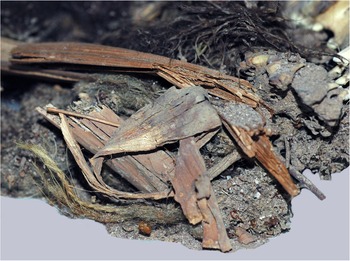
The Rio Muerto dog burial was at the base of the pit, lying on a bed of woven vegetable mat material (junco). Remnants of woven vegetable twine may have originally kept the dog’s remains bundled (Figures 3 and 4). The dog was buried in a sleeping position on its left side, oriented northeast–southwest, with the snout to the northwest. Dark brown and white fur preserved in the hyper-arid setting confirms that the animal is a domestic dog and not a fox. Given the preparation of the pit and the careful placement of the dog and mat directly on the pit floor, we believe this indicates the careful, intentional burial of a companion animal in the domestic space as opposed to the simple discard of an animal carcass. Furthermore, the dog was buried soon after death, as evidenced by the completeness of the body and the minimal presence of bug pupae, suggesting its human owners sought to prevent destruction by avian or mammalian scavengers. An AMS radiocarbon date from a sample of the dog’s hair dates to ∼880 AD (1230 ± 30 BP Conventional Age; Supplementary Material 1). This interment is the only known intentional dog burial, and the only dog remains thus far identified from Rio Muerto.
Juvenile female dog mummy from Rio Muerto after excavation and cleaning. (Color online)

Close-up of reed cane matting with twine on which Rio Muerto dog was interred. Shed exoskeletons of insect pupae are visible in the foreground. (Color online)

Elsewhere in the Moquegua Tiwanaku colony, the remains of a nearly complete puppy are present at the Tiwanaku site of Omo M10 (Table 1). The Omo Project recovered the majority of this dog’s skeleton from a 1987 2 × 4 m excavation in Structure 12, a cluster of storage features believed to correspond to an unroofed household space in the domestic area of the site. The site’s inhabitants deposited or buried this dog in a small pit, but they did not inter it on any prepared matting or other material, in contrast to the Rio Muerto dog mummy (Figure 5). Although the dog was not mummified intact, the hyper-arid conditions preserved two bones with dried tissue and small batches of dark brown fur, indicating the puppy’s coat color resembled the Rio Muerto dog.
Overview of Structure 12 at Omo M10 showing exterior domestic area and location of dog burial. Arrow points to pit with dog remains. Inset shows dog remains with hair and a maxilla fragment. (Color online)

Dog Remains from Tiwanaku Sites Other than Rio Muerto in the Moquegua Valley.

* Indicates cut or hacked element
Researchers also recovered isolated dog bones from other Tiwanaku contexts in Moquegua (see Table 1). Extensive excavations of the Omo M10A temple complex produced only five dog elements, all of which are cranial remains, and two of which may be from the same individual. The presence of dog crania and the absence of any post-cranial dog elements suggests that Tiwanaku peoples may have selectively included dog crania as offerings in the Omo temple. Post-cranial dog elements appear in domestic midden deposits but are rare relative to camelid remains and other species. Excavators found cranial and post-cranial remains of small- to medium-sized dogs in a domestic midden deposited over the Omo M10W cemetery after the cemetery was no longer in use (NISP = 12; MNI = 4; 3 adult; 1 juvenile). At the site of Chen Chen (M1), a large Tiwanaku village and cemetery, excavations recovered only one dog element, the anterior portion of the axis, in a domestic context.
Evidence of butchering or carcass processing is rare. Cut or hack marks are present on two dog elements from the Omo M10W midden, possibly indicating the removal of specific body parts or skinning, in contrast to butchering for use as food animals. The axis from Chen Chen was hacked posteriorly, possibly to remove the dog’s head. And one mandible from an adult, small- to medium-sized dog found in the Omo M10W cemetery midden has a cut mark on the condyle and the lateral side of the ramus. These marks may have resulted from skinning and/or removal of the mandible. None of the Tiwanaku cemeteries in Moquegua contain remains of dog body parts (e.g., dog paws, crania) such as is found at the Tiwanaku capital (see Mendoza España Reference Mendoza and Velia2014). Three canid bone elements from the Omo (M12) middens associated with domestic structures also contain cuts or hack marks; however, these elements could not be positively identified as dog remains and may be remains of foxes. The Moquegua Tiwanaku faunal assemblage, with an analyzed sample of over 41,000 identified specimens, does not have any empirical evidence that the occupants butchered dogs for use as food, and there is no evidence of cooking or consumption. Isolated dog remains also occur in other Moquegua Valley sites dating to the Middle Horizon (e.g., the Wari site of Cerro Baúl; deFrance Reference deFrance, Arbuckle and McCarty2014); however, no other intentional dog burials are known from either the middle valley or the sierra. And dog burials are not associated with the post-Tiwanaku Tumilaca sites in the valley, although researchers have recovered remains of both dogs and foxes in domestic contexts associated with the Tumilaca occupation in the coastal region of the Sama Valley south of the Osmore Valley (Mendoza España Reference Mendoza and Velia2023b).
The rarity of dog burials and dog remains in general at Tiwanaku sites would seem to separate the Tiwanaku tradition from the later local practices of including dogs as companion burials in high-status tombs, noted in local LIP Chiribaya (Lozada et al. Reference Lozada, Buikstra, Rakita, Wheeler, Marcus and Williams2009) and the Cerro Azul complex in Central Peru (Flannery and Glew Reference Flannery, Glew and Marcus2016). Nonetheless, the dog burials we report here from Rio Muerto and Omo show that Tiwanaku people buried dogs with care in domestic contexts, and, if not as widely recognized as symbols of status as in the LIP, they were important companions, social beings, or family pets. The absence of evidence that the Tiwanaku ate dogs supports an interpretation of symbiotic and sentimental attachment to these animals.
The Tiwanaku Dog Mummies: Osteology, Morphometrics, and Results of Isotopic Analysis
Osteology and Morphometrics
All the dog specimens included in this analysis are curated at the Contisuyo Museum in Moquegua, Peru. We completed all osteological analysis in the museum laboratory. The Ministerio de Cultura del Perú granted permission to export samples of bone, hair, and teeth for isotopic and genetic analysis and for radiocarbon dating.
We estimated the size of the Rio Muerto dog using long bone rates of fusion and dental eruption sequences to estimate age. An unfused distal tibia indicates that the dog was younger than 14 months (Sumner-Smith Reference Sumner‐Smith1966). In addition, the preliminary eruption of permanent teeth is evident (see Figure 3), which occurs between three and seven months (Silver Reference Silver, Brothwell and Higgs1963). Therefore, we estimate the dog is between six months and one year old. We determined the sex of the individual as female based on the absence of a sagittal crest (Shigehara et al. Reference Shigehara, Onodera, Etoh and Crockford1997).
Cranial measurements taken on accessible elements of crania based on Morey and Wiant (Reference Manzanilla1992:228) include maximum cranial width, lateral facial length, condylobasal length, and tooth row length (Table 2 and Figure 6). The dog, upon maturity, would have weighed about 30 pounds (13.6 kg), had a mesocephalic snout, and a dark brown and white coat of mid-length hair. This size is comparable to the smaller dog varieties at LIP Cerro Azul (Flannery and Glew Reference Flannery, Glew and Marcus2016).
Dog cranial measurements included in this study.

Cranial Measurements of Rio Muerto Mummified Dog.

To help determine if the dog had experienced any ante or perimortem trauma, a radiologist took two radiographs of the dog mummy (Figure 7). Subsequently, two radiologists with the University of Florida College of Veterinary Medicine examined the radiographs. They found no visible trauma or evidence of bone breakage; however, they noted that the superimposition of the hindlimb may be obscuring trauma. Both radiologists confirmed that the images show the immature, unfused state of the dog skeleton and the displacement of the limbs and spine because of the burial position.
Radiograph of mummified Rio Muerto dog, left lateral view.

The M10 Omo dog burial is also that of a young dog. Although cranial and post-cranial skeletal elements are present (see Table 1), the majority were porous and unfused. The individual was at least 28 days old, based on the presence of porous unfused humeral epiphyses (see Modina et al. Reference Modina, Veronesi, M. Moioli, Lodi, Bronzo and Di Giancamillo2017), but less than three months old as no elements had fused. Sex determination was not possible because the bones were too fragmentary. No evidence of trauma was visible.
Isotopic Analyses
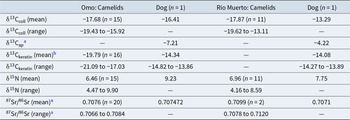
Isotopic analysis of skeletal and hair samples further informs the history of the Rio Muerto and Omo canid individuals. We reconstruct dietary patterns from stable isotope ratios of carbon (δ13C) and nitrogen (δ15N) derived from bone collagen and hair keratin, and we determine residential mobility from strontium isotopes (87Sr/86Sr) derived from tooth enamel (Table 3; Supplementary Material 2). Isotopic methods are reported in previous publications (Cucina et al. Reference Cucina, Thornton and Orega-Munoz2023; Thornton et al. Reference Thornton, Emery and Speller2016; Williams and Katzenberg Reference Williams and Katzenberg2012) and as Supplementary Material 3.
Summary Statistics for Isotopic Analyses of Archaeological Dogs and Camelids from Omo and Rio Muerto, Peru.

a δ13Cap and 87Sr/86Sr from tooth enamel
b δ13Ckeratin (mean) = average of two hair samples from same individual mummified dog
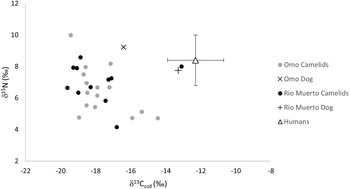
Based on bone collagen δ13C and δ15N, the Rio Muerto dog consumed an average lifetime diet broadly similar to contemporary humans residing at the sites of Omo and Rio Muerto (Somerville et al. Reference Somerville, Goldstein, Baitzel, Bruwelheide, Dahlstedt, Yzurdiaga, Raubenheimer, Knudson and Schoeninger2015), although the dog’s isotopic values are slightly lower than the human mean for both carbon and nitrogen (Figure 8). This indicates a terrestrial, omnivorous diet composed of both C3 and C4 foods. Botanical remains and artifacts recovered from Rio Muerto indicate that maize (Zea mays) was the primary C4 resource produced and consumed in this section of the Moquegua Valley (Somerville et al. Reference Somerville, Goldstein, Baitzel, Bruwelheide, Dahlstedt, Yzurdiaga, Raubenheimer, Knudson and Schoeninger2015). Both the dog and humans exhibit greater maize consumption than camelids recovered from the site, except for one camelid outlier that clusters with the dog and human samples (Figure 8). The dog’s omnivorous diet is supported by its δ15N, which is not a full trophic level (+2‰–4‰) above the site’s camelids. The Rio Muerto dog’s overlapping but slightly lower isotopic values in comparison to local humans could suggest consumption of human feces or hunted/scavenged wild game, as observed in free-ranging domestic dogs elsewhere (e.g., the Great Lakes region of North America; Hart Reference Hart2023).
Comparisons of δ13C and δ15N from archaeological dog, camelid and human bone collagen from Tiwanaku sites in the Moquegua Valley. Human values from Somerville et alia (Reference Somerville, Goldstein, Baitzel, Bruwelheide, Dahlstedt, Yzurdiaga, Raubenheimer, Knudson and Schoeninger2015).

Carbon stable isotope ratios were also analyzed for two hair samples obtained from the dog mummy (Table 3). When keratin δ13C is adjusted by +1.4‰ to make the values comparable to bone collagen (O’Connell et al. Reference O’Connell, Hedges, Healey and Simpson2001), the resulting δ13C is <1‰ higher than δ13Ccoll. Since hair records diet on a shorter temporal scale than bone collagen, the results suggest little dietary change throughout the dog’s life, including the last few weeks or months before death. This is further supported by δ13C in tooth enamel (Table 3; −4.4‰), which is typically ∼9‰ higher vs. bone collagen (DeSantis et al. Reference DeSantis, Feranec, Southon, Cerling, Harris, Binder and Cohen2022), and reflects early life diet when tooth enamel is forming.
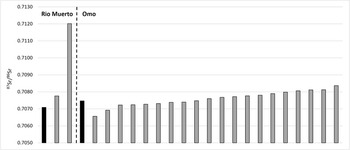
Strontium isotopes complement the dietary information and indicate that the Rio Muerto dog did not experience any significant translocations during life. The tooth we sampled (87Sr/86Sr = 0.7071) had similar values to additional tooth and bone samples from the same individual previously analyzed by Dahlstedt et alia (Reference Dahlstedt, Schach, Baitzel and Knudson2021; 87Sr/86Sr = 0.7071, 0.7069). Although we cannot completely rule out movement of the dog across isotopically identical regions, the individual’s homogenous values suggest that the individual was born and lived locally. The dog’s local origins and lack of residential mobility contrasts with the site’s camelids, which include individuals that were highly mobile, and/or which originated from distant locales including the Altiplano (Table 3; Figure 9). The Rio Muerto dog therefore did not accompany humans on prolonged or far-ranging trips during the time of tooth formation that would have resulted in more isotopic heterogeneity in its skeletal tissues.
87Sr/86Sr of archaeological dogs (black) and camelids (gray) from Rio Muerto and Omo, Peru. All 87Sr/86Sr values were measured in tooth enamel.

The mummified dog recovered from Omo M10 exhibits a slightly different life history from the Rio Muerto dog. In addition to dying at a younger age, the Omo dog’s bone δ13C suggests it fed at a higher trophic level and consumed fewer C4 resources (e.g., maize and amaranth) than the Rio Muerto dog, a diet that caused it to also diverge from local/regional human populations (Table 3; Figure 8). Higher δ13C in the dog’s fur indicates increasing consumption of C4 resources in the weeks leading up to death and transition to a diet similar to that of the Rio Muerto dog (Table 3). The Omo dog’s immature age means that a pre-weaning dietary signal could be recorded in its bone collagen. However, if the Omo dog’s mother was consuming a diet similar to that of the site’s humans or the Rio Muerto dog, the δ13Ccoll should be higher due to trophic level effects. We would expect similarly elevated δ13Ccoll if the higher δ13Ccoll and δ15N were due to starvation, although the effects of starvation on δ13C can be variable (Doi et al. Reference Doi, Akamatsu and González2017; Robertson et al. Reference Robertson, Yarrow, Rowland and Krigbaum2018). Instead, the lower δ13Ccoll suggests that the Omo mummified dog and/or its mother were consuming more meat and less maize and C4 plants, a pattern that changed shortly before death. This conclusion is supported by the similar offset in δ13C in tooth enamel seen between the Omo and Rio Muerto dogs (Table 3). Tooth enamel records early life diet, and the Omo dog is lower in comparison to the Rio Muerto individual. The combined dietary evidence suggests more feeding outside human residential areas on hunted or scavenged meat.
The observed dietary differences could be due to the nonlocal origins of the dog, but 87Sr/86Sr in enamel of the individual’s lower first molar falls within the local range for the middle and upper Osmore Valley (Figure 9; Dahlstedt et al. Reference Dahlstedt, Baitzel, Goldstein and Knudson2024; Knudson et al. Reference Knudson, Goldstein, Dahlstedt, Somerville and Schoeninger2014) and is very similar to three dog bones previously reported from the Omo cemetery midden (87Sr/86Sr = 0.7073–0.7077; Dahlstedt et al. Reference Dahlstedt, Schach, Baitzel and Knudson2021), as well as to local humans (Dahlstedt et al. Reference Dahlstedt, Baitzel, Goldstein and Knudson2024). Like the Rio Muerto dog, the Omo individual seems to have started and ended its life in the local area, indicating that its role in society was carried out within the local community.
Our sample of complete dogs from Tiwanaku contexts in southern Peru is small (n = 2), but the observed dietary diversity suggests variability in dog provisioning and life history. Although dogs and humans frequently overlap in terms of residential space and diet (Guiry Reference Guiry2012), one of the Peruvian dogs we sampled had carbon and nitrogen isotope values that diverged from local humans. The convergence of past human and dog diets in the Andes, therefore, cannot be assumed. However, the lack of mobility observed in our dogs, as well as in those reported by Dahlstedt et alia (Reference Dahlstedt, Schach, Baitzel and Knudson2021), means that they may serve as an appropriate taxon for generating baseline 87Sr/86Sr data for human mobility and migration studies. Camelids are ubiquitous in Andean zooarchaeological assemblages, but their movement and nonlocal acquisition (e.g., Barberena et al. Reference Barberena, Tessone, Cagnoni, Gasco, Durán, Winocur and Benítez2021; Dufour et al. Reference Dufour, Goepfert, Gutiérrez Léon, Chauchat, Franco Jordán and Vásquez2014; Szpak et al. Reference Szpak, Chicoine, Millaire, White, Parry and Longstaffe2016; Thornton et al. Reference Thornton, deFrance, Krigbaum and Williams2011) make them unreliable as sources of local baseline 87Sr/86Sr. Domestic guinea pigs are an alternative species, but they too may have been traded or transported, and their more herbivorous diets and constrained movement may make them less comparable to humans in terms of site-level dietary patterns.
Bone and tissue samples from both the Omo and the Rio Muerto dog mummies submitted for aDNA analysis contained too little DNA for genetic analysis (Manin et al. Reference Manin, Debruyne, Lin, Lebrasseur, Dimopoulos, González Venanzi and Charlton2025).
Discussion
The young mummified and intentionally buried dogs from Rio Muerto and Omo represent cultural practices reflecting Tiwanaku beliefs related to nonhuman animals. The intentionality with which people buried the dogs indicates empathy and respect for individual animals after death. Isotopic evidence indicates that both dogs consumed local foods over the course of their short lives and that they originated and lived exclusively in Moquegua. When they died, they were buried with care in domestic settings. Unfortunately, neither the context of the burials nor the mummified remains themselves allow us to differentiate whether either the Rio Muerto or the Omo dogs were solely pets/companion animals, sacrifices, or some combination of both. It is possible that the small dogs were sacrificial offerings, buried in the houses as a protecting spirit. However, the Moquegua dogs’ location is in an unroofed domestic space that differs from that of domestic camelid offerings, which tend to be found under foundations or doorways (Goldstein Reference Goldstein2005). Or it is possible that the dog owners died, and the puppies were killed after the death of the owner, akin to modern practices in highland Bolivia (see Mendoza España Reference Mendoza, Velia, Apesteguía and Álvarez2023a). Regardless of their roles in life, their burials were intentional and considerate.
The burial attention that people granted the young dogs shows human effort and planning. People buried the Rio Muerto puppy with great care, as evidenced by the bell-shaped pit dug for the purpose; they wrapped her not in a textile of great value, but in natural plant matting and twine. This individual may have been a young pet that met an unfortunate early demise. The presence of some bug pupae suggests that although people did not bury the dog immediately, they protected her from predation by other animals or other destructive forces. The context of the Omo dog burial and the state of the remains did not allow us to determine whether people buried the dog rapidly or not.
The isolated finds of dog remains in multiple Tiwanaku contexts are more difficult to interpret. The presence of dog crania in the Omo temple suggests a possible ritual or symbolic role of dog skulls. The other remains are possibly fragmentary remains of companion animals, nonhuman persons, and social beings. The Tiwanaku sites do not contain evidence that people consumed dogs. And the complex societies that followed Tiwanaku in various regions of Peru did not rear dogs for food; by the Middle Horizon dogs had social lives.
The locations of interments demonstrate that the dogs were associated with domestic village life, not with high-status individuals or contexts. At Rio Muerto, the dog burial pit in the domestic sector and away from the Rio Muerto cemeteries is intriguing, considering the dog burial practices that we have discussed from elsewhere in the Central Andes. For example, in the Late Intermediate and Inca periods, several Andean cultures included dogs as companion burials for high-status individuals, suggesting a more specified role as a status symbol as well as a guide and protector for the next world (see Flannery and Glew Reference Flannery, Glew and Marcus2016; Lozada et al. Reference Lozada, Buikstra, Rakita, Wheeler, Marcus and Williams2009; Miller Reference Miller2003). It seems this was not yet a common practice in Tiwanaku times.
The place of the dog in Andean cultures developed over time. The dog’s status changed as human societies became sedentary and stratified. As the various cultures of the Andes became more complex, with larger populations and multivariate social networks, so did the place of the dog. First, Andean dogs became more complex, with an increasing number of morphologies. Second, the relationship and human treatment of dogs changed over time within Andean complex societies. The Moquegua Tiwanaku dog burials seem to point to an intermediate point in this evolving complexity. People valued Tiwanaku dogs both as sacrifices who guarded sacred sites and also as close domestic companions worthy of a caring burial in the home. Later, dogs also became status symbols, interred to accompany elite human burials.
Conclusions
Our study of the individual life histories of two dog burials from the Tiwanaku colony in Moquegua, Peru, shows that village residents integrated dogs into domestic life. At Rio Muerto, a female dog died young, and the site’s inhabitants carefully buried her in a prepared pit in an exterior domestic context. Similarly, at Omo, the residents buried a young puppy in a domestic compound. This analysis sheds light on the aesthetic and humanistic value of dogs in both the Tiwanaku culture and ancient Andean society in general. These results are also relevant to cross-cultural comparisons regarding the social life and death of dogs that lived elsewhere in the Andes and beyond.
Even though the dogs of the royal burial at Sipán, the Tiwanaku sacrifices, and the tomb companions of Cañete, Chiribaya, and Machu Picchu point to important elite roles, little is known of the daily life of the dogs not interred with elite individuals. This study shows us that Tiwanaku village inhabitants also valued dogs in life and death. The Rio Muerto and Omo Tiwanaku dogs lived alongside their human companions as members of society and as probable nonhuman persons.
Acknowledgments
The Ministerio de Cultura del Perú granted permission for the export of the dog mummy tissues for dating and isotopic analyses (Resolución Directoral Nacional Nº 265-2012-DGPC-VMPCIC/MC). Elodie Huguet and Federico Vilaplana Grosso, University of Florida, College of Veterinary Medicine, provided their insights regarding the dog mummy radiograph. We also thank Jeff Vervoort (director, Radiogenic Isotope and Geochronology Lab), Dave Evans (Director, Stable Isotope Core), and Mike Lott (Manager, Stable Isotope Core) for their assistance with isotopic analyses conducted at Washington State University. At the University of Florida, Jason Curtis conducted the light isotope analysis, and George Kamenov facilitated the analysis of the radiogenic isotopes.
Funding Statement
The zooarchaeological and isotopic analyses were funded by the National Science Foundation (BCS-1152520).
Data Availability Statement
The isotopic data associated with this publication will be submitted to the open-access Neotoma paleoecology database (www.neotomadb.org). All data submitted to Neotoma are public domain and free to use for noncommercial purposes according to the database’s established data-use policy (http://www.neotomadb.org/index.php/data/category/use). Zooarchaeological data are available from deFrance.
Competing Interests
The authors declare none.
Supplementary Material
The supplementary material for this article can be found at https://doi.org/10.1017/laq.2026.10170
Supplementary Material 1. Isotopic Analysis Methods and Results (text).
Supplementary Material 2. Results of AMS Radiocarbon Date Obtained from the Rio Muerto Dog (table).
Supplementary Material 3. Full isotopic results for the Rio Muerto and Omo dogs (table).