

[The] Western archive is singularly complex. It contains within itself the resources of its own refutation. It is neither monolithic, nor the exclusive property of the West. Africa and its diaspora decisively contributed to its making and should legitimately make foundational claims on it.
Achille Mbembe, 2015Footnote 1
The ‘traces of my tears’
We start in 1904. A Congolese woman named Mokolo and living in the Congo Free State – now the Democratic Republic of Congo (DRC) – testifies before King Leopold II’s Commission of Inquiry. The Commission was established after the CRA, led by British journalist and politician E. D. Morel, requested an investigation be made into conditions in the Congo Free State under King Leopold II’s rule (1885–1908).Footnote 2 There, she explains her husband was brutally kicked in the head for refusing to bring in more baskets of rubber and later died from his injuries.Footnote 3 ‘You can still see the traces of my tears’, she says, closing her testimony. Although her words strikingly echo Sylvia Tamale’s claim that ‘the past is never dead; it is not even past’,Footnote 4 Mokolo’s description of the lasting effects of imperial violence is still stored in the African ArchivesFootnote 5 in Brussels, away from her descendants, and removed from African citizens and diasporas across the world. Because ‘no situation, concept or person can ever be fully understood without probing their histories’,Footnote 6 the inaccessibility of Mokolo’s testimony raises crucial questions about the place of the colonial archives in the study of the violence and politics of ‘global coloniality’.Footnote 7
How, then, can we engage with Mokolo’s tears and the colonial archives in which they rest, in order to unearth the alternative knowledges entrenched in displaced and subjugated histories? How do we locate and mobilise within the colonial archive what Mbembe calls the ‘resources of its own refutation’, and how can we bring these into conversation with current struggles for an anti-colonial future? These questions are particularly salient for those of us studying political violence and/in Global North/South relations.Footnote 8 Many across social sciences now concur that Western theorisations of Global South politics have contributed to depicting ‘the periphery as a projected “other”’Footnote 9 and reproduce sexist, racist, or capitalist domination.Footnote 10 At the centre of these issues sits the African continent,Footnote 11 long construed either as a ‘haven of misery’ (Afro-pessimism) or as ‘the future El Dorado of global capitalism’ (Afro-optimism), always relegating Africa as a place that ‘doesn’t yet exist’.Footnote 12 The DRC is emblematic of these trends.Footnote 13 Labelled ‘a paradigmatic case of state failure’,Footnote 14 the ‘rape capital of the world’,Footnote 15 and the ‘Heart of Darkness’,Footnote 16 it has become an exemplary case of Chinua Achebe’s ‘image of Africa’: ‘“the other world,” the antithesis of Europe and therefore of civilization, a place where a man’s vaunted intelligence and refinement are finally mocked by triumphant bestiality’.Footnote 17 Many scholars now openly refuse such portrayalsFootnote 18 and have generated extensive accounts of the modernity–coloniality nexus – ‘a gendered and racialized structure of management that operates by controlling the economy, authority, knowledge, and subjectivities’Footnote 19 of marginalised groups. Among them are researchers who have studied Congolese histories, politics, and intellectual praxis and engaged with (oral) history, memory, and colonial archives to demonstrate that much of the violence that Congolese citizens experience today is deeply entangled in a long history of archival, intellectual, and material dispossession.Footnote 20 Exploring how the colonial archives might challenge dominant narratives allows us to provide a fresh theoretical outlook on Congolese politics and the broader manifestations of structural violence in global politics, including processes of knowledge production.
Here, we engage with a growing literature on the concept of the archives and how they might undo the harms of hegemonic knowledges and the perpetuation of power hierachies in disciplinary fields like International Relations (IR).Footnote 21 More specifically, we offer a conceptual and empirical exploration of the ways in which the colonial archives can contribute to building anti-colonial knowledges and provide a ‘radical re-imagination of historical experiences’.Footnote 22 Many have shown interest in the use of archives both as a methodological device with the potential to disrupt dominant narratives and as an emancipatory tool for de- and anti-colonial struggles.Footnote 23 Historical IRFootnote 24 and the ‘archival turn’,Footnote 25 for instance, recognise that ‘the past comes back not just to haunt, but to structure and drive the contemporary operations of power’.Footnote 26 We draw on our research in the African Archives to extricate and confront two such (interrelated) narratives in the DRC: the widely vehiculated image of an inadequate ‘post-colonial African State’ and its corollary: widespread sexual violence in a context of armed conflict. To be sure, sexual violence, conflict, and government neglect are all different facets of the same systematic failure to protect Congolese lives, but the narrow focus of international actors, academics, and the media on those narratives only works to conceal the broader historical and structural conditions in which these unfold. The aim then is to recover the concrete ways the colonial archives can shift from their current place of erasure and containment to becoming the site of more inclusionary and alternative knowledges.Footnote 27 These might hold the potential to redress past crimes and to prevent future violence – an archive yet to come, taken out of its guarded walls, accessible to all, and mobilised as a critical device for (re)thinking violence.
This article now proceeds in three parts. The first section introduces our experience in the African Archives in Brussels to illustrate the politics underlying the production and containment of the archives, and the colonial structures in place that erase the subaltern histories of those who live(d) in places like the Congo. We borrow from a range of interdisciplinary works that aim to recast the notion of the archive, colonial or otherwise, as a pluralistic and ambivalent site of knowledge production and to resituate discussions on the exploratory and disruptive potential of the (colonial) archive within the field of social sciences.Footnote 28 The second part shows how the ambivalent disposition of the colonial archives can help us question the ‘image of Africa’ mentioned above. The point is to identify the ways in which the colonial archive can be leveraged to speak against itself in order to interrogate hegemonic discourses of state fragility and sexual violence.Footnote 29 Indeed, while it often seems ‘archival logics tend to subsume the violence of the colonial experience within narratives of state reason and progress’,Footnote 30 our work in the African Archives reveals instead a set of archival, racial, and sexual anxieties that still imbue current configurations of (political) violence in the DRC. To do this, we place archival documents in dialogue with fieldwork information we have gathered for over a decade in various parts of the DRC. When joined with archival textual and visual content, this material (ethnographic interviews, participatory photography, participant observation, etc.), work as commentaryFootnote 31 by Congolese citizens on their own historical trajectories.Footnote 32 The concluding section both ends and opens up our argument for ‘an archive yet to come’.Footnote 33 There, we move beyond mere ‘epistemic redress’ to imagine, along with other scholars, an anti-colonial archive outside of academia, one that can be seen as a broader ecology of subjectivities, objects, time, spaces, and potentialities for more truly transformative politics.Footnote 34 A ‘living archive’, which, if made more readily available to all, would sustain the anti-colonial struggles that will ‘allow people to engage with a different framework’ and ‘a different narrative’.Footnote 35
The ambivalent disposition of the colonial archive
The African Archives in Brussels are located at the Ministry of Foreign Affairs,Footnote 36 and visiting rights can only be obtained through formal registration. Until recently, taking photographs of documents was not allowed. Instead, one had to fill out a form listing all the documents one wished to be photocopied. Photocopying could only occur in the afternoon, so the form was submitted in the morning to a civil servant who would then return the hard copies later in the afternoon or on the next day. A single copy costs 0.25 Euros. When we asked where the information we needed might be found, the archivists opened a database on an ancient computer where obscure numbers and titles appeared. Puzzled by the antiquated procedure, and unable to decipher the system ourselves, the administrators eventually suggested files that could be useful. Because of the inaccessibility of the database, we were dependent on the civil servants’ inside knowledge of the archive system. The institution also did not have a functional website, which made it impossible for users to know what was there and, despite appearances of bureaucratic neatness and neutrality, there was no obvious rationality to accessing the archives. The overall experience made for a slow, costly, and highly mediated archival praxis.
The 2020 Special Parliamentary Commission on Belgium’s colonial past confirmed that access is restricted both in visiting the archives and in finding records.Footnote 37 The report further details how racial and colonial logics inform the process of accessing the archives and recounts the highly humiliating, discriminatory, and expensive process many Africans must endure to visit.Footnote 38 As such, the colonial archive is still a place of silencing, containment, and violation.Footnote 39 It is precisely because it presents opportunities for recognition and reparationFootnote 40 that access to and custody over colonial archival records have long been a profoundly political matter. For instance, the colonial state archives in Belgian Congo were always at the centre of political tension between the Ministry of Colonial Affairs in Brussels and the territorial administration and, at Independence in 1960, became a contentious subject between the newly established Congolese government and the former coloniser who endeavoured to repatriate all the archives to Belgium, in secrecy and with military assistance.Footnote 41 Similar disagreements erupted in the 1960s over the ‘Migrated Archives’ removed by the British from 37 former colonies, provoking bitter custodial and political disputes with the newly independent governments.Footnote 42 Managing the colonial archives is a thoroughly contentious task because they arrange ‘the organic stuff of empire … and the transactions of endless bureaucracies’ and are kept in places where they are ‘taken further out of context and colonial misinterpretations were assumed to be truth’.Footnote 43 Today, colonial archives across the world are still far removed from the places where they were first produced, and political debates continue on their future.Footnote 44 The archive is indeed more than a mere institution responsible for the preservation of historical documents. It is a regime of truth-making,Footnote 45 consisting of a range of practicesFootnote 46 that reassert reliance on ‘the imperial centre for interpretation and authorization’.Footnote 47
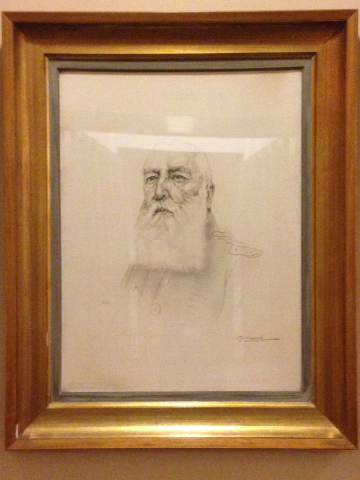
This reminds us of an arresting sight. Before entering the African Archives’ reading room, each visitor walks through a cloakroom where they are greeted by a portrait of King Leopold II (Figure 1). The private owner of the Congo Free State, he established an economic incentive system for rubber extraction that led to devastating brutality against Congolese people, causing an estimated 1 to 5 million deaths.Footnote 48 While the uncritical public display of the king’s figure normalises the immense suffering of millions of people, it reinforces the idea that the archives rarely feature – if at all – the voices of those who have first-hand experience of colonial violence. Keeping Leopold II as the guardian of the archives illustrates a racialised and exclusionary order: the archive is the privileged terrain of whiteness and higher social classes of intellectuals, researchers, and journalistsFootnote 49 and is still managed and controlled by the former colonial state.Footnote 50 The interpretation of archival records by primarily white, trained professionals produces specific ways of knowing that are often used to support military occupation, economic exploitation, and socio-political subjugation of the Global South,Footnote 51 while subaltern experiences remain silenced. In that sense, the African Archives constitute a Western archive rather than an ‘African’ one and are a foundational element of Mudimbe’s colonial library.Footnote 52 The latter refers to an intricate web of written and visual documentation assembled by European colonial administrators, missionaries, journalists, and scientists who fabricated, disseminated, and projected a specific ‘othering’ gaze onto the African continent via the archives’ ‘diverse narrations, and visceral, nervous assessments of conditions and beings’.Footnote 53
The portrait of King Leopold II upon entering the reading room. Source: African Archives, Brussels.
While a new generation of scholars now denounces the harmful politics of knowledge production and ‘their forms of extraction, expropriation, and erasure’,Footnote 54 much remains to be done to address and undo the ‘colonial library’. Evidently, the DRC is experiencing armed, state-sanctioned, and colonial violence, but the country also is subjected to a more insidious form of assault: the effects of epistemic violence whereby the sophisticated lived experiences, intellect, and political organisation of Congolese people are distorted via overly sensationalist accounts. The urgent nature of the DRC’s conflict tends to engender blind spots for research and policymaking in addressing the slow workings of historical violence, and within it, the promises and paradoxical (dis)position of the colonial archive in global politics. In particular, the construction of difference between colonial and contemporary processes of state and sexual violence should be (re)situated both within the broader, historical structures through which they emerged and within the daily experiences and practices of ordinary citizens.
Such framings are pervasive within policymaking too.Footnote 55 Speaking in front of the United Nations Security Council, former US Secretary of State John Kerry declared widespread sexual violence in the DRC was a stark reminder of what happens in the absence of good governance and appropriate rule of law, hereby disregarding the long history of colonialism while simultaneously mimicking colonial tropes of modernity, progress, and the rule of law.Footnote 56 Mathys notes that ‘researchers … predominantly focus on contemporary issues, or on events since the 1990s. In many – but not all – cases this leads to history being used as a backdrop in the introduction, rather than an analysis of how historical processes continue to have an impact today.’Footnote 57 The same could be said of scholarship and policies that look at urgent matters such as contemporary wartime rape and dynamics of state weakness but often gloss over the historical contingencies underlying these problems. Such colonial logics are also at work in other contexts, including Palestine, Iran, Afghanistan, and Egypt, which have been subjected to similar ahistorical, racialisedFootnote 58 and gendered accounts.Footnote 59
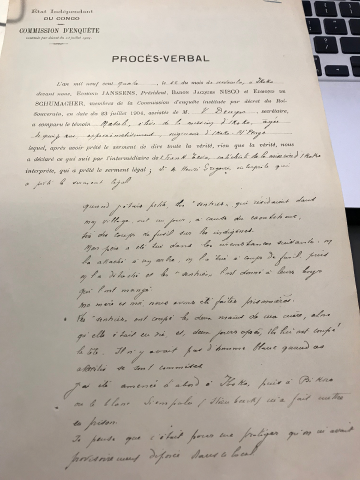
Yet the colonial archives possess the capacity to simultaneously replicate and undo the past, and therefore to deliver alternative, and potentially emancipatory, narratives for the present and the future (even though the epistemic violence of the colonial library can never be fully transcended).Footnote 60 Despite the violence they contain, the African Archives, paradoxically, also ‘are an important … source of individual and collective memory … They play an important role in supporting democracy; they make governments accountable to citizens.’Footnote 61 In more conceptual terms, the ambivalent disposition of the archive as both messy (misplaced boxes, torn pages, and obscure governance) and orderly (the seemingly neutral codification, elegant writing, formal institutional arrangements) works to conceals the ontological, epistemological, and daily violence inflicted upon colonised life hidden away in archival documents (Figure 2).Footnote 62 The order-messiness of the archives reflects the instability of colonial rule as a whole. As Gordon noted: ‘the archive reveals the incompleteness of hegemony: not only its own confusions and contradictions but the inability of colonialists to locate their practices completely in imperial rather than African terms’.Footnote 63
Graceful handwriting describes how a young girl’s mother was decapitated (1904). Source: African Archives, Brussels.
Moreover, Lobo-Guerrero argues that archives can be seen as sites from which to ‘wonder about realities and experiences of how others, under different times and circumstances have related to the world. … They provide the possibility of an experience of discovery … that will in turn allow access to alternative ways of knowing the world.’Footnote 64 We argue that such critical engagement can be extended and complemented with more systematic inquiries into the politics of colonial archives along with the transformational potential they hold as both promise (of redress and reparation) and menace (to established hegemonic orders and dominant narratives). Building on Arondekar’s scholarship on gendered, racialised, and sexualised subjectivities and the archives, Simões de Araújo and Roy position the archive as ‘vital for purposes of critique, transformation and imaginative world-making’.Footnote 65 They contend that engagement with the archives is not merely about restoring ‘lost voices’ to the historical record or finding ‘new’ archival sources. Rather than ‘making sexuality visible’, Arondekar argues, it is about ‘how sexuality is made visible and how this process discloses the very limits of that visibility’.Footnote 66
Inspired by Lawson’s call to ‘look to history in order to be wrong, to look for interpretations, surprises and contradictions which do not fit with prevailing theoretical explanations’,Footnote 67 the next section offers insights into how we mobilised the colonial archives to challenge dominant narratives on the ‘post-colonial state’ and sexual violence. Exposing the colonial anxieties that surround gender and sexuality in the Congo sheds light on how the archives textually record – or not – violence against Congolese men and women. This suggests, in turn, that silences about state and sexual violence in the archives are strategic, not an absence of representation, unveiling therefore the systemic uneasiness and insecurities of colonial regimes.
Anxieties and the ‘schizophrenic’ politics of global coloniality
Archival anxieties
In many ways, the Congo Free State was a ‘failed state’ in its own right. The early colonial state, and later on the Belgian Congo, suffered institutional and financial constraints that led to widespread violence against Congolese people, and resulted in greedy politics, hasty rule, and an embryonic but brutal administrative apparatus. As in other colonised territories, exploitative economies, government weakness, and daily violence marked colonial rule and continue to permeate contemporary power relations in both the Global North and South.Footnote 68 Based on a gendered and racialised social order, the colonial state’s primary goal was to secure enough financial capital to put Belgium, a small and recently established state, on the world mapFootnote 69 using forced labour and military occupations. Entrenched in the belief that ‘indigenous’ populations had to be civilised out of their ‘primitive ways of life’,Footnote 70 the colonial archives uncover a power dispositif developed around the idea of ‘material progress’Footnote 71 and bodily discipline – a ‘biopolitical state’ of some sorts,Footnote 72 which, under the guise of rationalised rule, exhibited in fact the characteristics of a jittery, ‘nervous state’.Footnote 73 Specifically, the colonial archives show the sophisticated workings of a set of deep-seated anxieties in the form of a relentless urge to control, regulate, and ultimately sabotage Congolese lives. Beyond the Congo, the colonial anxieties found in the archives gesture to the global logics of coloniality and connect to the question of bodies, gender, and sexualities – and, as such, to hierarchies of power. Following Hunt’s work, we contend that these anxieties not only imbued colonial rule but also prefigured future state formations that looked ‘towards the future … with nervousness and the imperative to prevent a catastrophe’.Footnote 74
Most importantly, it is in the archives themselves that nervousness looms large. The records that chronicle police/military operations as well as provincial government and territorial agents’ daily tasks vividly demonstrate how the ‘archives talk with a language of urgency: they denounce the disaster that’s about to happen. It is a panic-driven approach, which is aimed at preventing and stopping on a daily basis, in a manner that echoed paranoia.’Footnote 75 For instance, a 1930 report details several police operations in ‘dissident regions’ where some individuals had allegedly spread ‘subversive talks’ on ‘the departure of the Belgian colonials and their replacement’.Footnote 76 Similarly, many administrative documents from the 1950s express recurring dread over the ‘nocturnal commutes’ of both colonials and ‘indigenous Congolese’ across segregated urban areas.Footnote 77 With these examples in mind (more below), we construe colonial anxieties as the broader effect Footnote 78 of the diffuse and mundane governing techniques (which include mapping, counting, displacing, etc.) deployed by territorial agents, missionaries, and ordinary colonials. We thus build and expand on Hunt’s argument to show how, behind a facade of order and tranquillity, the so-called colonie-modèleFootnote 79 suffered from pervasive political, sexual, and racial anxieties which produced a type of violence that stretches far beyond formal colonial rule and heavily shapes present-day politics in the Congo.
European colonial anxieties are especially visible in the uneasy ways in which the archives both conceal violence through an order/disorder paradox (see above) and portray sexual violence inflicted on Congolese women. Scholars have long argued that questions of domesticity, sexuality, and gender in racialised terms are central to both colonial rule and its archives, where Black women are recorded as inferior to men, as victims of polygamy, and as highly sexualised, while Black men are fetishised as sexual savages or objects.Footnote 80 As a highly mediated space, the colonial archives (re)present the violence and paradoxes of a history narrated by and filtered through an agitated white male gaze. In this sense, the records of the Congo Free State and Belgian Congo show the archives always uncomfortably sit between governing what can be known about Congolese individuals and unveiling the racial and partriarchal logics of what indeed was – and still is – a ‘nervous state’.
One of the most striking examples of this is found within the record-keeping practices of Western agents in reporting widespread rape and sexual abuse against Congolese women in the Congo Free State. Following the CRA’s investigation request, the Commission of Inquiry produced a set of first-hand testimonies of Congolese people which were later stored in the African Archives (while the documents of the CRA are held in the Morel Archive at the London School of Economics). These testimonies were interpreted, translated, and, sometimes, staged by missionaries and commissioners.Footnote 81 Often, they were only quoted partially, especially when sexual violence was involved. Like in all colonial regimes, African testimonies were routinely dismissed as exaggerations, rumours, or plain lies. Noticeable is the huge discrepancy between male and female witnesses: 350 men – mainly colonial officials and Indigenous men – versus 20 women testified before the Commission. From the 20 women’s testimonies, two were given by the wives of the white missionaries Harris and Clark, and one by the adopted Congolese daughter of the Clarks (who, as daughter of white missionaries, was considered part of the civilising mission and therefore higher up the hierarchy).Footnote 82 These women provide extensive descriptions of the atrocities they witnessed. Their testimonies (multiple pages) are remarkably longer than the Congolese women’s testimonies (about half a page). Nowhere in the archive do we find an explanation of why so few women testified. This is not because they did not come forward, but rather because they were not summoned.Footnote 83 As Robert Burroughs explains:
Missionaries who effectively organised the presentation of evidence in the rubber territories were quite traditional in their views, supposing elite men to be the providers of the most valuable testimony. For this reason, the white mission chiefs gave the most extensive testimonies, which the subsequent statements by Africans and white women often just serve to affirm or supplement. Then there is also the selection process that took place at the sittings. Many missionaries claimed that many more Africans than those who spoke had attended the trials, so presumably the commission exercised some say in which testimonies it listened to.Footnote 84
In other words, even when drawing on first-hand testimony of Congolese people, European gender norms and technology of rule determined what was archived and what was not, which directly affects how women appear in the archives. Heeding those conditions that make certain narratives visible while foreclosing others indicates that both the presence and absence of Black women in the archives are neither objective nor natural. They are created. In filtering the testimonies through the gaze of white male witnesses (state officials, missionaries, and humanitarians of the time), the archive reflects the insecurities and anxieties of the colonial state. This practice is most revealing in the manner in which missionaries and critics of the Congo Free State’s regime thought the rapes of Black women ‘unprintable’ and ‘unfit for repetition’.Footnote 85 Indeed, certain types of evidence were enhanced and promoted, notably the mutilation (cutting off hands and feet) of local populations, while claims of sexual violence, as we shall see, were minimised. Here, the archives clearly seek to dismiss the extent of sexual violence, while altering and staging testimonies worked to silence acts of sexual violence rather than enhancing them.
Among the women’s testimonies, one Congolese woman named Mingo, wife of Ilua, speaks of sexual torture.Footnote 86 She tells the Commissioners she was making bricks in Mampoko when three sentries punished her by putting clay in her sexual parts. Another testimony by missionary Padfield confirms Mingo’s story. Interestingly, the CRA’s commentary and writings on the testimonies (kept in the Morel Archive of the London School of Economics, see above) silence the sexual violence and torture inflicted upon Congolese women, as opposed to the Commission of Inquiry’s testimonies (held at the African Archives). Even though Morel’s writings and pamphlets present harrowing and detailed accounts of the multiple forms of violence inflicted upon the local populations – women and children are flogged (with the chicotte), tortured, beaten, mutilated (cutting off hands or feet), abducted or taken as hostage, starved (often through taxation), stolen to be redistributed among soldiers, and burned – sexual violence and rape are rarely mentioned. Comparing the original record of Mingo’s testimony to Morel’s narration of it shows that Morel considered the sexual torture inflicted upon Mingo (and other women) ‘unprintable’. Morel edits Padfield’s testimony as follows:
The women at Mampoko had to tread the clay used for brickmaking, and on one occasion the sentries stripped the women, and in the presence of the White man in charge of the work … (What follows is unprintable).Footnote 87
Morel amends Padfield’s testimony again at a later point (Figure 3):
The town of Bokenyola has to send ten women on Sunday and forty on other days to work at the factory. On one occasion, when the forty women had been working all day, the white agent Lokoka had the women in the evening all lined up, ordered them to strip themselves naked, and then … (what follows is unprintable – E.D.M.)Footnote 88
Excerpt from a CRA document; the asterisk indicates Morel’s edits. Source: Morel Archive, LSE, London.
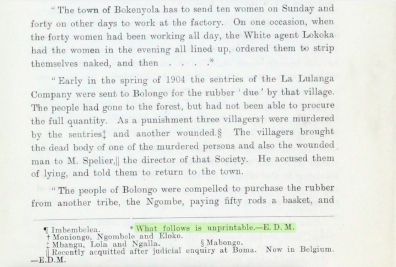
Reading the original record of Padfield’s testimony held at the African Archives, we know the white man, after ordering the women to take off their clothes, chose a woman to spend the night with. Morel had no problem outlining horrific non-sexual abuse but clearly considered the sexual nature of the violence as damaging to his and his readers’ social mores.Footnote 89 In both examples, the CRA silences the sexual component of the violence inflicted on Congolese women while the African Archives’ original records do not (even though they were still mediated and altered at times). Morel thus applies a lens of sexual difference: what the colonisers did was so repugnant it could not be articulated. In doing so, Morel not only distances himself and the British empire from these kinds of atrocities, but in a strategic move to silence what the ‘civilised’ have done, he also seeks to protect his liberal readers. What or who is thus being saved through the textual form of deletion and ellipsis is both Morel’s Western readership and the ‘good’ colonisers (like the British). Moreover, by conveying less about the actual sexual violence, he stimulates his readers to imagine what could be so horrible it is considered unprintable, replicating Said’s Orientalism’s ‘confusing amalgam of imperial vagueness and precise detail’.Footnote 90
Sexual anxieties and white masculinity
Colonial power rests on narratives of modernity which the archives’ records reflect in meticulous bookkeeping of the routinised tasks of colonial agents and statistical data related to labour camps, military posts, health facilities, schools, roads, and railways. These infrastructures project the image of progress, an essential feature of colonial rule, the destruction of Indigenous life, and the making of settler colonial futurity.Footnote 91 Indeed, ‘Scriveners created order from disorder with pen and ink purging the subterfuge and insurgency of the enslaved from their account books … Accountants transposed people into profits and losses in their ledgers as they whipped them into shape as numbers.’Footnote 92 But beneath the neat numbers lay the dread and paranoia of a state on edge. Where state sovereignty (colonial or otherwise) heavily relies on disciplining bodies and regulating the intimate lives of the colonised and the coloniser, creating and policing moral and physical sexual/racial boundaries becomes key in a context where state power is highly mystified, personified, and privatised. In this sense, the figure of the white male colonial agent exerting ‘respectable’ masculinity in family life and state affairs is central to the colonial enterprise.
By way of example, part of the job of territorial agents was to patrol remote areas where they spent much of their free time with (the very few) white, and sometimes, upper-class colonialists. There, they would share memories, a single malt, and mystical stories about bravery and adventure – male and pale – thus forming social bonds that allowed many to consolidate their power.Footnote 93 They glorified their status and persona as well as their own role in shaping Belgium’s colonising mission. They relied on their own inherent merit and discretionary power to influence or carry out policies as they saw fit. A colonial agent once wrote that white men were ‘treated like semi-gods’: each time they visited a village, ‘ritual dances’ and ‘friendly gatherings’ around large campfires were organised in their honour. Dancing around the fire, were ‘the beauties of the village … some of them little girls as young as seven years old, and other women in full efflorescence’, while ‘beaded with colourful and heavy pearls, their clothing moved along the movement of their elegant gait … dressed only by the shivering of their perfect bodies of African Dianas’.Footnote 94 Personified state power was even more obvious in the tyrannical behaviour of colonial agents and their sentries in the Congo Free State. The Inquiry’s testimonies by women reveal this.Footnote 95 For example, a Congolese woman called Boali speaks directly to rape. Because she refuses to yield to the sexual demands of a sentry, ‘he felled her with his gun and believing her to be dead, cut off her right foot to obtain possession of the ring which encircled her ankle’.Footnote 96 Interestingly, her testimony was changed in the reports of the CRA. Grant explains that to enlist the support of the British and American audience, CRA campaigners organised lantern slideshows which showed photographs of mutilated Congolese people.Footnote 97 The only account of sexual violence that was made public through the slideshows was the testimony of Boali (her name also appears as ‘Boaji’). Her picture was slide number 14 with the following caption ‘Boaji, mutilated for her constancy’. The accompanying story to the slide reads as follows:
Amongst the mutilated was a woman named Boaji, who was so treated because she wished to remain faithful to her husband. You must understand that when soldiers drive men into the forests for rubber, a sentry is left behind to ‘guard’ the women. The women are at his mercy.Footnote 98
However, Boali’s deposition does not mention she refused the sentry’s sexual demands because she wanted to remain faithful to her husband. She simply refused him, which is why the sentry assaulted her. Echoing colonial ideals of monogamy and the nuclear family, the CRA campaigners framed Boali’s story in a moral narrative emphasising not the assault but the faithfulness to her husband. Missionaries and humanitarians thus shaped colonial violence according to the norms and values of Western audiences who were needed to mobilise resources and support to end abuse. And while scriveners faithfully wrote down Boali’s deposition, anthropologist Vangroenweghe makes clear that during her testimony the Commissioners felt great unease, which might explain why Boali was the only female witness in the Baringa area.Footnote 99 Clearly, rape and sexual violence were considered ‘unsayable’ unless the rape was done by Black/brown men and involved white women, thus reinforcing the image of the Black man’s sexual savagery. At that point, sexual violence propaganda became a tool to legitimise the civilising mission and ‘restore’ moral order.Footnote 100 The fear of interracial rape also discloses considerable anxiety about European womanhood. As Sharpe argues: ‘[European] womanhood is an important cultural signifier for articulating a colonial hierarchy of race.’Footnote 101 Ideals of respectability and virtue were embodied in the idea of the white woman, while the rape of Black women clashed with the civilising mission. Exemplifying the extent of its own ambivalences, the colonial archive simultaneously neglects and dehumanises the suffering of Congolese women (and how this can be known), inadvertently disclosing the anxieties of a brutal colonial order.
The archival scripts further connect to the colonial state’s broader pathological obsession with regulating Black lives, aspirations, and politics. The sheer number of meetings, annual reports, and red tape dedicated to temporary permissions for ‘native men’ to circulate at night,Footnote 102 authorisations for Congolese people to set up dancing clubs in their own segregated neighbourhoods,Footnote 103 or dread over white women waitressing Congolese men in local barsFootnote 104 all attest to the anxieties of an unsettled state administration. Colonial agents employed a grammar of (dis)possession, sexual entitlement, and paternalism – they frequently wrote ‘our blacks’, ‘our Congo’, ‘my boys’, ‘my territory’ in the archives – that infantilised and over-sexualised both men and women, leading to neurotic fears and objectification of Congolese individuals. While rape and sexual predation exerted by white men against Congolese women were rampant, anxieties surrounding sexual promiscuity consistently preoccupied colonial rule. Nightlife, for example, was suspected of moral depravation and interracial intimate encounters. ‘Public drunkenness’ and ‘loud conversations’ prompted civil servants to implement ‘enhanced police action and heavy fines’, imprison inebriated Congolese people, revoke alcohol licences, or restrict opening hours of Congolese businesses.Footnote 105 Europeans who owned clubs in Black neighbourhoods went through lengthy administrative procedures and fell under close state scrutiny. Provoking administrative malaise, ‘the presence of European female managers was not advisable’ because ‘Black people under the influence of alcohol can utter, in indigenous language, inappropriate remarks. This [would] undermine the prestige of the white race.’Footnote 106
As part of a repressive and gendered (colonial) state, social, sexual, and intimate interactions crystallised colonial anxieties especially as Congolese communities increasingly ‘started to express their emancipation claims … in particular through entertainment in songs and bars. There, they would mock racial inequality and white privileges and explore ways to capture authority on the national scenes.’Footnote 107 The colonial archives, therefore, point to a dual and paradoxical dynamic of revealing and concealing the subaltern voices of empire, in a double act of invisibilising the former and protecting the latter.
Socio-political anxieties
The archival records, we have seen, give texture to obsessive concerns over rebellion and emancipation on the part of colonised people, leading to spatio-racial segregation, control of leisurely activities and labour relations, as well as surveillance and punishment.Footnote 108 Much as the apparent orderliness of the archive offers an illusion of certainty and reason, the colonial state upheld a controlled narrative of calm and discipline while also expressing alarm and using excessive violence towards Black communities along with ‘poor whites, people of mixed origins, and other interstitial groups’.Footnote 109 Colonial rule established a rigid racial and sex/gender binary through imposing a heteronormative Christian monogamous way of life that relegated women to the private/domestic sphere and criminalised polygamy.Footnote 110 Black communities fell so low on the colonial social ladder/hierachy that it was commonplace for a Congolese adult working as a servant to a European family to be scolded and ordered around by a six-year-old white child.Footnote 111
The creation of a class of évolués – ‘evolved’ Congolese – as part of Belgium’s civilisational project is a case in point (Figure 4). Recalling the gruesome realities of the évolués, a Congolese priest living in Kinshasa back in 2015 vividly explained:
The évolués were expected to emulate the European lifestyle. White state agents would come to their homes unannounced to check they were properly dressed, their children went to school, their kitchen was clean, and their houses were tidied. Their houses had to resemble Belgian ones. But then, they also had to cut ties with their extended family and friends who had stayed in the village. It was no longer possible to see our nephews, uncles, aunts, grand-parents, cousins … They became schizophrenic. … There was a separation inside Black people themselves.Footnote 112
The caption reads: ‘A contest of the most beautiful interior was organised in Bendalungwa neighborhood, in Leopoldville’s cité indigène. Here is a shot of the “home” of Mr. Mathieu Eboni who won the third prize.’ Source: African Archives, Phototèque, N° 32.62/53, Brussels.

The ‘schizophrenic’ politics of the colonial project produced deep societal fractures and turned everyday life into a dystopic reality for Congolese people. Race and gender became the organising social trope, and colonialism took shape around domesticity and the idea of the home.Footnote 113 As Independence drew closer, social and political anxieties over the civilised/uncivilised divide significantly heightened, as it became obvious that a growing number of educated Congolese people demanded equal rights. The civilising mission was simultaneously pursued and feared because, it ‘opened up a discourse on the question of whether more “civilizing” would make them into still better farmers, workers, or subjects – and hence a less distinctive category of being’.Footnote 114
Security tropes and pressing hygienist concerns were invoked to justify segregation. As a result, the colonial regime implemented a ‘colour bar’ in all major cities for fear of contamination and rebellion. Archival records put it this way: the colour bar was a ‘police measure[s] that do[es] not target one specific nationality, but rather those individuals from inferior civilizations, who may compromise the sanitary and security status of European quarters’.Footnote 115 Police would ask Congolese individuals working in the European quarters to display their ‘passport’ allowing them to cross the neutral zone, and to circulate between Black and white neighbourhoods. In a 2015 interview, a retired plant worker in Lubumbashi explained: ‘The neutral zone … was meant to protect white people. They were a minority: What if all Congolese suddenly rebelled? At least this gave them some kind of psychological comfort, to think the separation would protect them. They were frightened.’ In Kinshasa, physical boundaries were built such as railways and a several hundred-metre large ‘neutral zone’ that comprised a military camp, a zoological garden, a park, a cemetery, and a golf club. Colonial policies routinely portrayed Congolese quarters as housing ‘venereal diseases’, epidemics, and insecurity.Footnote 116 In a 2014 interview, a professor at the University of Kinshasa recalled: ‘White people wanted to retain the myth of white people. Psychologically, it was important to keep the prestige of the white people. … They would make it sound like it was for hygiene and security purposes. I think what it really was about, is that white people were scared of Black people.’
Even scarier than Congolese workers entering European neighbourhoods were Congolese people indulging in vagrancy and roaming open urban spaces. An evening curfew was strictly enforced and imposed on all Black neighbourhoods: ‘Papapa, papapa, papapa’ recounts a Congolese man, ‘before 8pm, we had to head home. It was the obligatory curfew. … At 9pm … the trumpet sounded again: pa-pa-pa-pa-pa-pa. That meant: tola-la, to-la-la: to sleep.’Footnote 117 Combined, curfews and segregation presented a host of logistical headaches for colonial agents, who often resorted to arbitrary measures. For instance, a train arriving at 10:30pm every Friday in Lubumbashi was the focus of much police activity: the ‘two to three hundred natives’ it carried ‘were legally forbidden from circulating between 10 pm and 4:30am’ due to curfew. As a result, the police sought to lock Congolese travellers in the train station until 4:30am, for they dreaded the uncontrolled ‘dispersal of those hundreds of’ colonised bodies ‘across the city and in all directions’.Footnote 118 Train stations, like other public spaces, gathered ‘undesirable’ individuals, including single men brought to town through rural exodus, unaccompanied children, or worse, ‘unmarried women’, whom the administration was quick to repress.Footnote 119 Unmarried women were fined for prostitution, men who had left their villages were sent back (i.e. refoulement) only to return as anonymous workers within the informal economy, children were pestered by police officers and accused of ‘vagrancy’.Footnote 120 Because they were threats to the hierarchised model of society, which placed the white male on top and women and children at the bottom, Congolese citizens were harassed, fined, punished, or locked up. Here, the colonial archive displays the ‘resources of its own refutation’ by documenting the contours of an irrational state, which, under the guise of moral and material improvement, exhibited institutional fragilities and political anxieties. The archives unveil a genealogy of contemporary discourses of progress and development, bringing into sharp focus the many forms of violence the DRC still experiences today.
Post-colonial anxieties
Our work in the archives sheds light on the ‘ever present-ness of the past’Footnote 121 that informs processes of state and sexual violence. This enables us to question evolutionist perspectives that view political formations in Africa as inherently violent because of its failure to replicate the Western/liberal state.Footnote 122 Indeed, concepts such as good governance, state failure, collapse, fragility all fuel and reproduce the idea that whatever atrocities may be ravaging the Congo – from blood minerals to wartime rape and rampant poverty – is both the result and cause of state weakness and can be ‘fixed’ via improved state ‘capacity’. Our archival research further uncovers a racialised and sexualised colonial gaze that endures in discourses and responses to sexual violence in the DRC. Feminist IR and other scholarship has critiqued representations of sexual violence inflicted on Congolese women as harmful, limiting, reductive, and reproducing colonial tropes of sexual excess and savagery.Footnote 123 A clear need exists to understand sexual violence in non-Western countries beyond tropes of barbarity and difference. This would mean, among other things, to contextualise it within an enduring colonial history.Footnote 124 The global knowledge regime of wartime rape builds on a long-standing colonial archival imaginary of framing sexual practices in Africa as different, deviant, and pathological, and thus in need of civilisation. This obscures Congolese women’s everyday experiences of violence. Such ahistorical/prescriptive accounts circulating within academia and policy circles suggest structural events (like pre/colonial history) hold no significant weight on the perpetuation of violence in the DRC and ‘strip African societies of any actual internal dynamics other than the ability to disintegrate’.Footnote 125
Instead, archival research into the routinised tasks and record-keeping practices of colonial officials shows that African statehoods are more the effect of pervasive colonial anxieties than the failed product of a carefully crafted, Weberian legal-rational apparatus. For example, in a world where colonial archives would be openly accessible by all, crucial information would be available to show how the gendered and socio-racial hierarchical power and bodily control that characterised colonial rule still saturate contemporary configurations of state formation in places like the DRC. This would reveal that the predatory, privatised, and corrupt governance modes detailed in the state weakness literature were never the exclusive purview of the post-colonial state. The patronage and clientelist systems found within the Congolese state do not result either from the failed imitation of the modern state or pre-colonial ‘traditions’ but mirror the European-instituted personified state power of its old colonial self, which often led to governance incongruity and improvisation, crippled state institutions, and arbitrary rule aimed at controlling and punishing ordinary citizens.Footnote 126 Present-day state–society relations in the DRC, and in many other former colonies and settler colonial contexts, still feature high levels of surveillance,Footnote 127 police abuse, sexual violence, exploitation, and a lack of state accountability. Much like under colonial rule, the post-colonial Congolese state operates in part via a grammar of control and inferiority that makes ordinary citizens visible only as menace to the state. During interviews, countless state agents have repeatedly portrayed their own constituents as ‘uncivic’, ‘uncivilised’, ‘anarchist’, and ‘disobedient’ – and often act in the form of punishment, retention, imprisonment, and bodily abuse.Footnote 128
Fieldwork additionally provides empirical renditions of the functionings of global coloniality: it suggests that interactions between street-level bureaucrats and ordinary citizens manifest partly in a nostalgic desire for a social order reminiscent of colonial times. It was often noticed among our Congolese interlocutors that ‘the Belgians sent Congolese children to school’, ‘healthcare was free’, ‘paychecks were regular’, ‘housing was guaranteed’, and ‘food rations provided’. Neglected by their hierarchy, civil servants often resort to nostalgia – ‘the judgment that the past was somehow preferable to the present, and the longing for a home in which there is no longing for any other timespace’Footnote 129 – conjuring the image of a long-gone colonie modèle: a far more desirable place than having to live with the very real consequences of armed conflict, poverty, and infrastructural scarcity. While nostalgic narrations allow to make sense of and denounce the DRC’s dire political and socio-economic situation, this also risks reactivating and relegitimising the colonial project. This shows the colonial state continues to exist – or to hide in plain sight – through the subtle workings of today’s discursive practices in the DRC, reproducing a structural violence that does not result from failure to replicate the ‘international state form’Footnote 130 but rather from the persistent global imperative to do so.
At the same time, any attempt at governing ‘differently’, via solidarity networks, kinship, or informal arrangements etc., is almost invariably described as illegitimate, predatory, or inadequate, relegating alternative forms of social and political relationships to oblivion. Similarly, during fieldwork, women survivors repeatedly pointed out that rape and sexual violence is still the main frame through which their experiences are viewed and understood. This was especially the case between 2008 and 2014, when global attention to sexual violence in the DRC peaked. Because of this, women’s agency to represent and speak for themselves is limited and invisibilised. One respondent from Goma (2012) stated: ‘A Congolese woman is now seen as a rape victim. This downgrades immensely her status and value in society. This is tragic.’Footnote 131 The ‘sexual violence filter’ obscures the multiplicities of violence that women and men endure, such as poverty, insecurity, daily harassment, and other gendered harms. Yet, while the persistence of the archive’s white male gaze is rendered evident both in the continuing erasure of Black women’s experiences and in the ‘oversayability’ of sexual trauma today,Footnote 132 a different history can still be produced from what the archive offers.Footnote 133 Cultivating a conceptual approach attentive to the historical disfigurement and violent (re)production of women as always already violated or silenced is a first step. Looking for moments when Congolese women or men do represent themselves is the next. And this is where the archive has tremendous potential. The first-hand accounts we do have, though rare, are ‘snapshot’ moments of humanity that obliterate all forms of objectivity, and it is to those we should turn to resist the enduring racialised sexism and dispossession Black people still face today around the world.
The long road towards an anti-colonial archive
We began this article in 1904; we end it in 2024. Clearly, the work of disrupting the colonial archive to build more radically anti-colonial narratives has only started. As we explored the possibilities contained within the colonial archives to unsettle the ‘toxic imperial debris’Footnote 134 that has long informed hegemonic thinking on the ‘post-colonial African state’ and sexual violence in conflict settings like the DRC, we are reminded that ‘all archives … are part of international knowledge’.Footnote 135 Bringing the archives into dialogical relation to both ethnographic fieldwork and contemporary theorisations in social sciences points to the limitations of such theorisations ‘for the understanding and configuration of an international architecture that is truly democratic and global’.Footnote 136 In this sense, what we set out to achieve in this text was to assess how, as an essential part of ‘the cultural archive of the West’,Footnote 137 the colonial archive can both be a powerful tool of domination and, conversely, be the key to becoming something else.
In this concluding section, we further reflect on what an archive-yet-to-come could possibly look like. This is essential for the DRC and for all former colonies and settler colonial contexts. In relation to Palestine, Lila Abu-Lughod asks what archives should look like for people without a state, whose knowledges and memories are being annihilated and who live under brutal settler colonial occupation. In this paper, we took up her call to think hard about the ‘conditions of archiving and to attend closely to the ways archives are and could be used’.Footnote 138 Critically engaging with the archive is not merely about questioning its power and knowledge production, it is also about heeding and using its emancipatory potential precisely because it contains the possibilities for its own undoing. Since ‘archival objects and those who work with them are always in the process of transforming each other’,Footnote 139 when colonial archives are made accessible to African citizens and diasporas, new avenues for thinking about and responding to global and historical violence may emerge.
The events surrounding Belgium’s Parliamentary Commission tasked with shedding light on its colonial past, and the report and recommendations that emerged from it, are telling in this respect. When in 2020 the Belgian Parliament announced that a commission would be established to examine the country’s colonial past, chairperson of the Commission Wouter Devriendt expressed hope that ‘the recommendations could be deployed in many fields: decolonisation of the public space, cultural heritage, fight against racism and xenophobia, academic research, education, and diplomatic and development cooperation relations’.Footnote 140 It would also be an opportunity to reflect on the need for reparations and formal apologies. After two-and-a-half years and 300 hearings resulting in a 700-page long parliamentary report (containing 128 recommendations), the commission was dissolved after it failed to agree on recommendations specifically with regard to issuing formal apologies because this would open the way to reparations, which the majority of political parties consider unacceptable.Footnote 141 The parliament then argued it could not publish the report of a commission that did not exist anymore. To this day, the report is still accessible on the parliament’s website but is difficult to find: clearly, nervousness and anxieties still characterise the contemporary politics of addressing both colonial history and imperial violence.
The work of the inquiry is not lost however.Footnote 142 It has shown colonial (and other) archives can be mobilised to provide justice and restore dignity.Footnote 143 The report explicitly worked to locate and confront the ‘colonial durabilities’ of our times,Footnote 144 making clear recommendations for an apology, as well as the establishment of a remembrance day, the erection of a monument to the victims of ‘human zoos’, the creation of a knowledge centre, the granting of scholarships, the declassification of archives, and the development of a national action plan against racism (among many others). Had this process reached completion, it may have been the beginnings of an anti-colonial archive, working against a ‘dismemberment’ that occurs through the theft of history, and towards a ‘re-membering’, that is ‘to recover history’.Footnote 145 This ‘living archive’, heterogeneous, complex, inclusive, collaborative, community-based, would thus be accessible to, and perhaps transformed by, Congolese people and diaspora communities.Footnote 146
Examples of participatory and dynamic archiving practices abound across the world, in the classroomFootnote 147 or through public engagement.Footnote 148 Scholars and activists have established a collective ‘Manifesto for feminist archiving calling for an active relationship with the archive’,Footnote 149 while others have written extensively about thinking through ‘the messy, embodied, illegitimate archive’ of our own bodies so we can imagine a ‘body archive’ as ‘an attunement, a hopeful gathering, an act of love against the foreclosures of reason’.Footnote 150 This evidences the profound need for academic work to move to a place of post-critique, an explicit endeavour to prevent ‘the devaluing of criticality’ especially as we reach an ‘extremely dangerous moment’ of ‘anti-criticality and anti-intellectualism’ across the globe.Footnote 151 This means working ‘towards the arduous task of injecting critique/criticality with greater public-political resonance’,Footnote 152 outside of university walls, libraries, and the archive as institution, and via sustaining and expanding a pluralistic and accessible anti-colonial archive. Returning to Mokolo finally, instead of ‘being the tomb of the trace’Footnote 153 of her tears, the colonial archives can become a far more dynamic project of collective and collaborative emancipatory politics. The ‘traces of Mokolo’s tears’ – in both palpable and symbolic terms – are a foundational part of a possible anti-colonial archive, one ‘of radical transnational (and global) histories’Footnote 154 that holds the future promises of long overdue freedom, redress, and justice.
Acknowledgements
We are grateful to the journal’s editors and anonymous reviewers for their generous and engaged readings of earlier versions of the article. Their critical insights have helped to clarify and significantly improve this paper. We would like to thank Jonathan Austin, Gillian Mathys, Robert Burroughs, Alice Baroni, and Michele Sollai for their valuable comments and encouragements throughout the writing process. The usual disclaimers apply, and all remaining gaps and weaknesses remain the sole responsibility of the authors. While author names are ordered alphabetically, they have both contributed equally to the production of this article.
Funding Statement
Harry Frank Guggenheim Foundation Distinguished Scholar Award
Swiss National Science Foundation PZ00P1_201869


 Open access

