




Introduction
The family is globally recognised as a fundamental element in shaping children’s cultural belonging (Al Dwakat et al., Reference Al Dwakat, Al Dwaikat and Alolabi2023), serving as the first influential institution where children acquire social norms, values and a sense of social integration (Grotevant & Cooper, Reference Grotevant and Cooper2023). Within the same scope, families play a vital role in fostering the transmission of culture and values from one generation to another (Arnett, Reference Arnett2022). Children and adolescents mirror the ethical and moral principles of their parents when the family relationship is characterised by open communication and mutual appreciation (Barni et al., Reference Barni, Alfieri, Marta and Rosnati2021). Recently, the globalised world has witnessed substantial shifts, eroding the ability of families to fulfil their educational, cultural and moral roles. While globalisation facilitates cross-cultural connections, it also introduces challenges that affect the essence of the family’s functions and responsibilities (Meca et al., Reference Meca, Allison, Ayers, Cruz and Bornstein2022). Globalisation introduces issues in terms of the process of preserving the cultural identity and moral values, as younger generations find themselves conflicted between culturally rooted family values and the diverse ideologies, perspectives and beliefs portrayed in online content (Grotevant & Cooper, Reference Grotevant and Cooper2023). Globalisation represents a significant challenge in terms of the shifting social media utilisation, leading to reduced family-based guidance and in-person interactions and thus eroding family practices (Coyne et al., Reference Coyne, Rogers, Zurcher, Stockdale and Booth2022).
Despite the widespread investigations into globalisation’s impact on the family and its cultural and moral value sustaining role, a paucity of primary research exists on how families can mitigate and regulate these impacts and thus preserve their cultural identity and moral values. Consequently, this current study explores the family’s role the preservation of culture and the globalisation-based challenges, seeking to develop fundamental strategies that can help to facilitate family-based cultural and moral values that are sustainable.
The research problem
In this modern and globalised epoch, Al Dwakat et al. Reference Al Dwakat, Al Dwaikat and Alolabi(2023) and Vertel et al. Reference Vertel, Korolenko, Shapovalova and Bereziuk(2024), amongst other, have confirmed the increasing challenges facing families in terms of cultural identity and moral value preservation.
Recently, transformations arising as a result of distraction from the increasingly globalised social media and a reduction in parental guidance have started to erode the family’s critical position in the lives of children (Vertel et al., Reference Vertel, Korolenko, Shapovalova and Bereziuk2024). Furthermore, social media usage was revealed by Jinjiri and Adetomi (Reference Jinjiri and Adetomi2024) to negatively impact family-based in-person interactions in terms of the quality, resulting in screen time replacing family interactions and, consequently, increased individualism. Within the same context, although adherence to family guidance leads to enhanced belonging to the cultural and moral values of early childhood, there is a growing gap in adolescence where young people are more exposed to the globalised cultural and moral norms. This gap is set to undermine the cultural and moral authority of families (Meca et al., Reference Meca, Allison, Ayers, Cruz and Bornstein2022).
Despite the growing research efforts on the role of family in guiding children in early childhood and adolescence in the context of cultural and moral values, a gap remains in the field research in terms of shedding light on how families can mitigate the impacts of globalisation and its influences on cultural identity and moral values within the family structure (Jinjiri & Adetomi, Reference Jinjiri and Adetomi2024). Accordingly, this study intends to fill this identified gap through conducting field research aimed at providing a better exploration of the families’ role in preserving values and cultural identity and highlighting the challenges that globalisation poses, as well as proposing a set of strategies to enable families to continue to serve as a secured source of cultural identity and moral values.
Research objectives
-
• To investigate the role of the family in preserving cultural identity and moral values across generations.
-
• To highlight the challenges that globalisation poses to cultural identity and moral values.
-
• To propose strategies that promote the sustainability of moral and cultural values within the family structure.
The importance of the research
Recently, the role of family as a foundational component of society has been challenged due to the impact of globalisation on societies worldwide. This study focuses on how families can remain the foundation of national identity and core values, despite the influences of modernity and globalisation.
The importance of this research lies in the profound exploration of families’ potential to serve as moral and ethical guides for upcoming generations. Furthermore, what makes this research unique is its combined field-based approach and conceptual framework, as the study adopts quantitative and qualitative instruments to explore how families navigate these challenges, presenting practical experiences and interpretation. This study thus contributes to the existing body of research by providing a field-based study that proposes a set of strategies that can help families maintain their guiding role in values and culture preservation. Moreover, in the context of a globalised world, the research offers considerable value through providing an interdisciplinary framework that can fortify sustainability from a cultural and heritage perspective.
Literature review
This study is anchored by a values-based theoretical framework that views family as the foundation for sustainable progress. This framework informs the research design, data interpretation and discussion by positioning family-based values and its direct link to environmental ethics and how they can be passed down through generations (Grotevant & Cooper, Reference Grotevant and Cooper2023). Theoretical alignment is sustained throughout the analysis to maintain coherence between the study’s conceptual foundations, methodology and results.
Several recent studies have underscored the family’s dynamic significance in terms of the preservation of the environmental education and cultural values, with this being particularly pertinent for communities of minorities and immigrants. For instance, in order to reinforce their cultural identity, Gültekin and Yıldız (Reference Gültekin and Yıldız2020) reported that Europe-based Turkish families utilise cuisine, language and religious rites, adapting these customs to the new settings whilst maintaining a cohesive notion of identity. Therefore, even in diasporic contexts, families have the ability to adapt to the prevailing cultural norms whilst preserving their core values (Gültekin & Yıldız, Reference Gültekin and Yıldız2020).
In terms of the generational inheritance of cultural identity and moral principles, family represents a vital institution. With the present era characterised by digitalisation, globalisation and unprecedented social developments, there has been renewed interest in exploring those mechanisms that enable families to maintain cultural continuity whilst allowing adaptation to the emerging challenges (Chen, Reference Chen2020; Walsh et al., Reference Walsh, Bohanek and McAdams2021). Chen (Reference Chen2020) and Walsh et al. Reference Walsh, Bohanek and McAdams(2021) concurred that rather than being passive recipients of inherited traditions, families actively participate in establishing and shaping the value system.
According to Coyne et al. Reference Coyne, Rogers, Zurcher, Stockdale and Booth(2022), researchers have more recently focused their lens on the formation of morals in the home, revealing that principled behaviours and perceptions have a close relationship with parent–child interaction quality, especially in the digital era. Social media usage, typically characterised by a lack of control or limitations on the engagement, has the potential to damage relationships and undermine family-based emotional and moral communication. In terms of supporting young people’s development of accountability, empathy and ethical cognisance, these findings shine important light on the essential nature of communication that is morally laden and persistent (Coyne et al., Reference Coyne, Rogers, Zurcher, Stockdale and Booth2022).
The cultural resilience framework has become pertinent, whereby through the reliance on community ties, stories and religious rituals, families that are culturally resilient can resist external influences through their flexibility and consistency (Ungar & Theron, Reference Ungar and Theron2020). Moreover, culturally resilient families have the ability to maintain their cultural and moral codes while adapting to the modern world’s realities and circumstances (Encyclopaedia Britannica, Reference Britannica2023). In order to reinforce their daily interactional identity, such families utilise intergenerational communication and symbolic traditions on a frequent basis (Coyne et al., Reference Coyne, Rogers, Zurcher, Stockdale and Booth2022).
Coyne et al. Reference Coyne, Rogers, Zurcher, Stockdale and Booth(2022) indicated globalisation’s potential to present both challenges and opportunities for value transmission within the family. On the one hand, the consumer culture, educational systems and globalised media offer value systems that both conflict and feature the potential for prevailing conventions to be challenged. On the other hand, globalisation’s enhanced accessibility to educational resources, information and religious discourse can facilitate the revival of family traditions. For example, East Asian families create successful hybrid value transmission models through the integration of educational activities and a globalised lifestyle within cultural frameworks that are regionally established (Chen, Reference Chen2020). This process is similar to the localised adaptation of global impacts, or globalisation, as described by Robertson (Reference Robertson, Featherstone, Lash and Robertson1995).
The term globalisation refers to the growing social, political, cultural and economic connection and connectivity of nations (Encyclopaedia Britannica, Reference Britannica2023). Companies or other entities develop international agency or start conducting business abroad through the globalisation process. According to Encyclopaedia Britannica (Reference Britannica2023), this highlights how international activities are becoming more expansive and integrated.
Globalisation is furthermore referred to as the increasing economic, cultural and population interdependence of the world’s economies, resulting from cross-border commerce in commodities and services and technology, as well as investment, people and information flows. These ideas include the structural and economic facets of globalisation. In addition to its effects on the economy, globalisation also modifies social connections and cultural manifestations (Peterson Institute for International Economics, 2021).
It is notable that through media, travel and migration, families are being exposed to a wider range of sometimes contradictory cultural standards, which can lead to conflicts between embracing global influences and upholding conservative local beliefs (Walsh et al., Reference Walsh, Bohanek and McAdams2021). As a result, any debate of globalisation needs to look beyond economic metrics and take into account its profound effects on cultural identity, social institutions and family values.
Another significant factor affecting family interactions in the modern world is digital technology. Families can employ technology as a tool for cultural engagement and ethical education, even while digital platforms expose children to a wide range of beliefs and behaviours (Coyne et al., Reference Coyne, Rogers, Zurcher, Stockdale and Booth2022). It has been demonstrated that parental participation in their children’s digital activities, through co-viewing, content selection and facilitated discussion, significantly reduces the external effects and strengthens family values (Coyne et al., Reference Coyne, Rogers, Zurcher, Stockdale and Booth2022). For example, some families utilise age-appropriate and entertaining digital religious information to help their children learn about faith-based moral principles.
Rituals and storytelling have also been recognised as powerful tools in the preservation of cultural and moral identity. Rituals such as family meals, holiday celebrations and religious practices help build continuity, reinforce social norms and create emotionally significant shared experiences. These traditions not only improve the intergenerational ties but also operate as vital platforms for the dissemination of moral principles and family values (Walsh et al., Reference Walsh, Bohanek and McAdams2021).
Families, despite their timeless significance, are not isolated entities. A broader range of institutional, social and economic factors impacts their ability to transmit and preserve values, such as peer pressure, media, religious organisations, educational systems and policy frameworks. Therefore, scholarship (e.g., Chen, Reference Chen2020; Ungar & Theron, Reference Ungar and Theron2020) is increasingly arguing for an approach that is both multifaceted and contextualised in order to better understand the family’s role in cultural and moral sustainability, where interdisciplinary methods incorporating educational, psychological, sociological and religious perspectives are becoming vital.
The recent COVID-19 pandemic also enhanced the family’s value-shaping capacity, while introducing inherent challenges. For example, families were compelled to spend greater periods of time together due to lockdowns and distance learning, leading many to revive historical customs such as religious observances in the home, moral conversations and storytelling. Based on the preliminary data reported by Walsh et al. Reference Walsh, Bohanek and McAdams(2021), such experiences led to the reconsideration of cultural resilience’s and purposeful value transmission’s significance during crises for some families.
To conclude, it has been revealed by recent investigations that the family continues to be central to cultural identity’s and moral principles’ formation and dissemination, regardless of the need to navigate circumstances of greater complexity and variety. In a rapidly shifting world, it is thus possible for the cultural legacy to be maintained by families through the encouragement of candid intergenerational communication, engagement with novel technologies and the adaptation of customs (Chen, Reference Chen2020).
This study seeks to further investigate this expanding research domain through field research in the UAE higher education community in order to illuminate families’ means of actively preserving their children’s cultural and moral development via traditional and creative strategies.
Methodology
In order to attain a broad range of perspectives, this study employed the explanatory sequential mixed-methods approach, with quantitative and qualitative methods utilised to facilitate the data collection and analysis (Creswell & Creswell, Reference Creswell and Creswell2022). The approach comprised three stages: (i) the collection of quantitative data; (ii) the collection of qualitative data after the quantitative data analysis was complete, thus informing the qualitative method’s design (Creswell & Creswell, Reference Creswell and Creswell2022); and (iii) the triangulation of the collected quantitative and qualitative data with the reviewed literature, as illustrated in Figure 1.
The stages of the explanatory sequential mixed method approach.

The instruments, population, ethics, validity and reliability
The study distributed a questionnaire to families in the UAE higher education community, with the sample selected via the simple random technique, whereby according to Cohen et al. Reference Cohen, Manion and Morrison(2007) there is an equal potential to participate for all subjects within the target population. The second study instrument comprised semi-structured interviews conducted with families selected according to their experience and disposition to participate. Purposive sampling was utilised for the interview sample, with the participants selected according to their knowledge of the study domain (Cohen et al., Reference Cohen, Manion and Morrison2007). Quantitative data were analysed using SPSS, applying descriptive statistics and relevant inferential tests. Qualitative data were coded and thematically analysed, using manual coding approach, following a methodical process of initial coding, category development and theme refinement to ensure rigorous analysis. A total of 208 students and instructors participated in the questionnaire and 13 of them participated in the semi-structured interviews to allow in-depth investigation. This blend secured both extensiveness and analytical depth reliable with mixed-methods research tools. The quantitative sample size (n = 208) and the qualitative samples (n−13) were considered adequate for descriptive, inferential statistical and thematic analysis within the selected study responders, as all students in other sections in other universities are taking the same modules and having the same variety of students nationalities.
In terms of ethics, the primary consideration in this research was ensuring confidentiality. Therefore, the completed questionnaires, interview recordings and researcher notes were all treated with great care to ensure that the participants’ privacy and confidentiality were maintained at all times. Moreover, all quotations and identifiers presented in the paper have been anonymised (Bdier, Reference Bdier2019).
A high degree of reliability was ensured due to the precise and repeated phraseology employed for the questionnaires and interview questions, deployed by the same researcher (Ghazali & Sufean, Reference Ghazali and Sufean2016). Meanwhile, the research validity was promoted through utilising the explanatory sequential mixed-methods approach that included questionnaires and semi-structured interviews to ensure a range of instruments were used (Johnson & Onwuegbuzie, Reference Johnson and Onwuegbuzie2004).
Data analysis
The demographic analysis as shown in Figure 2 (N = 205) indicates balanced gender participation, with 97 participants from males, making 47.3% and 108 participants from females, making 52.7%.
Demographic distribution of participants.

Additionally, 80% of participants are aged between 25–35 years, which refers that the findings of this study are representing early career adults.
For participants’ level of education, majority of them hold bachelor’s degree (62.9%), indicating that most responses represent young age perception.
The role of families in preserving the cultural identity and moral values
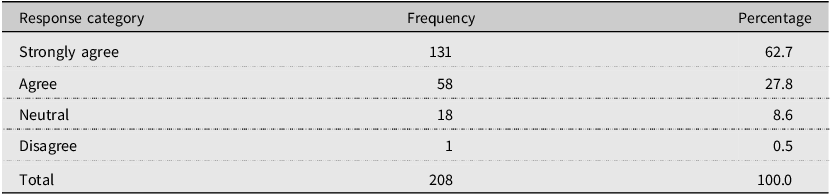
The quantitative data in Table 1 confirmed the vital role of families in preserving the cultural identity and moral values within the UAE higher education community. Ninety-two percent (92%) of the respondents valued the role of family as the foundation of society and the primary source of transmitting cultural and moral values from one generation to the next. Within the same context, the respondents were asked about the methods of transmitting values within their households, where the results revealed multifaceted approaches. Direct discussion and dialogue with children was the most frequent method, selected by around 85% of the participants. This indicates that the families highly value open and direct communication and engagement with children for the preserving of cultural traditions, reasoning and social expectations. This finding suggests that the families prioritise open communication and consider verbal engagement as crucial for explaining moral reasoning, social expectations and cultural traditions.
Participants responses regarding the role of families in preserving culture

Following this, 75% of the respondents indicated that being a role model is an important means of transmitting and preserving values and morals. This affirms the ethical standard of learning by example, where parents adhere to ethical principles, respect for traditions and daily routines as an implicit approach that represents an impactful form of education. Additionally, 70% of the respondents indicated that religious education is one of the primary approaches that has emerged as a key mechanism for preserving morals values. This reflects the capacity of a faith-oriented environment for fostering a moral and spiritual foundation instilled in early life.
Another approach to preserving the cultural identity and moral values chosen by the participants was sharing the family’s history through a storytelling approach, as cited by of the participants 66%. This supports the intergenerational preservation of identity and culture. Within the same context, 61% of the participants reinforced the role of a sense of belonging, while 54% highlighted the hybrid approach of modernity and traditional values education. The adopted means and approaches chosen by the participants indicate that the families in the community of the UAE higher education are not passive observers of change, but rather are actively sustaining their values and moral systems, thus serving as a leading influence in shaping, transmitting and preserving the cultural identity and moral values, blending history with modernity to operate actively within a rapidly changing socio-cultural context.
The responses from the interviews echoed the results of the questionnaires, reemphasising the primary role of families in the preservation of morals and values. The parents reaffirmed their role in teaching and embedding values through real-life experiences. For example, Participant 1 reported, “I sit with my child every evening, asking him about what he achieved or learned, and also I try to embed and discuss the importance of values such as honesty, respect, faith, and being proud of our culture.” This sheds light on the daily use of dialogue and its importance for moral grounding. Furthermore, several parents referred to modelling as a core element, such as, “My son learns more from what I do than what I say. In general, children must see us doing the same as what we say” (Participant 2). This confirms the power of modelling to provide examples to children and was confirmed by 75% of those who participated in the questionnaire.
Religious practices were also reinforced, with Participant 5 explaining that “Religious studies is not only about worship but is about when we reflect on the right and wrong, and how to deal, treat, and spread peace and moral values.” Furthermore, storytelling was highlighted by most parents, stressing its importance in the process of transmitting and preserving values: “I always tell stories to my students about how we lived in the past, valuing what we believe and how we survived our culture and moral values” (Participant 6).
Overall, the participants’ responses in the interviews echoed and affirmed the results of the questionnaires, in terms of utilising intentional strategies related to their students’ and children’s realities.
perceived challenges to cultural identity.

The challenges to the cultural identity and moral values posed by globalisation
The data obtained from the questionnaire and interviews, as shown in Figure 3, revealed a strong consensus among the participants regarding the destabilising effects of globalisation on the family-oriented cultural and moral framework. For the quantitative analysis, when the participants were asked about the challenges facing their role in preserving the cultural identity and moral values, 59% identified social media as a significant concern, threatening families’ authority over their children. Further analysis revealed the attitudinal challenges attributed to globalisation as cited by 58.5% of the respondents, representing a distancing from the families’ cultural environment. According to the participants, this leads to more individualism and less dialogue-based interaction within the family structure. Within the same context, 58% of the responses cited international education and its influences on the familial cultural identity. Moreover, 47% of the responses reported that the weakened family cohesion component is connected to and impacted by globalisation. In general, the quantitative findings of this study highlighted the multidimensional decline of family values, revealing that globalisation is not recognised as a singular adverse influence, but rather an overlapping mechanism that influences children’s values, priorities and cultural identity, as well as their connection to the traditional family structure.
For the qualitative analysis, the semi-structured interviews provided rich data that echoed the quantitative findings. The participants shared their concerns regarding globalised social media as a significant challenge facing parental influence. In this regard, Participant 4 stated, “My children spend a lot of time listening to YouTube and other platforms on social media; they prefer to stay alone with their devices rather than staying with family. I can see that they watch videos from different countries and cultures.”
Also, the participants identified the theme of the educational environment and its impacts on children. Participant 13 said, “my child is surrounded by socio-cultural festivals and traditions that do not match our traditions and cultures. For example, he is more excited about Halloween rather than Ramadan Eid.” This statement echoes the quantitative finding related to international education weakening the cultural identity and alignment with the family structure at home. Additionally, the participants highlighted language preference as one of the main concerns related to international education and globalisation; for example: “My students prefer using English over Arabic, they form their thoughts in English, then they translate them into Arabic. This preference is due to international education, where English is the dominant language and is the first language of students” (Participant 8).
Furthermore, the majority of the participants agreed that there is a considerable shift related to globalisation, where children face distractions on a daily basis, drawing them away from the cultural identity and values that characterise their community.
Overall, these themes and reflections generated from the interviews align with the data obtained from the quantitative analysis. Both data sources concur that globalisation functions as a form of soft power, reshaping cultural identity and moral values in the targeted community. Accordingly, the participants expressed an urgent need to reconnect their children with their inherited culture and values.
Strategies for sustaining cultural and moral values within the family structure
The results obtained from the questionnaire revealed high-level efforts among families in terms of applying a variety of strategies to preserve the cultural identity and moral values amid globalisation, summarised as follows:
-
• Family awareness discussion: This strategy was selected by 81.6% of the participants, who indicated that open and structured dialogue continues to serve as the cornerstone of values preservation.
-
• Active involvement in traditional, religious and cultural events: This strategy was chosen by 56.5% of the participants, reflecting the significance of experiential learning and religious practices in strengthening values and cultural identity among children.
-
• Reinforcing moral and national belonging: This strategy was selected by 53.1% of the participants, who believed that the approach might help families in nurturing cultural pride and alignment with their heritage, native language and inherited values.
-
• Regulation of digital content: This strategy was selected by 50.2% of the respondents, shedding light on the substantial vulnerability of engaging with online content and the growing concern about unfiltered media.
For the qualitative analysis, the obtained data underpinned and provided a deeper understanding of how families might apply these strategies in their daily lives. Participant 12 stated, “We discuss our values and cultural issues in our family gatherings. This is how we remain connected and grounded to our cultural identity.” This excerpt underpins the strategy of dialogue and discussion in preserving the cultural identity and moral values within a family structure. Within the same context, Participant 10 shared that “We have regular storytelling gatherings where elders tell children meaningful stories, blending our history with entertainment, making children engaged and proud of our heritage and culture.”
The participants also highlighted the importance of online content regulation; for example: “We usually watch TV shows that are related to our values and culture. We also restrict our children’s screen content, making sure that the content is relevant and portrays our values” (Participant 9). Furthermore, several respondents emphasised the importance of involvement in traditional and religious events, such as Participant 12: “Our children need to see our traditional, religious and cultural events regularly, so they gain insightful thoughts about our history and heritage.” The participants also considered that language preservation is connected to their cultural identity. In this regard, Participant 13, who sends her children to an international school, stated, “We always tell family members to watch Arabic media and speak only Arabic at home, aiming at keeping Arabic the dominant and first language of [our] children.”
Overall, these statistics and themes reveal that the cultural identity and moral values preservation are a collective responsibility and a process involving home practices, community validation and collaboration with institutions. Furthermore, the findings reveal that the targeted families are adaptive and strategic, combining modern awareness with traditional tools to preserve and sustain cultural and moral values, in collaboration with institutions and communities, thus affirming that the cultural identity and moral values are a cross-generational responsibility.
Discussion and conclusion
Key findings
The key findings of this study reveal that the structure of the family in the UAE higher education community remains central to preserving the cultural identity and moral values, with around 90% of the respondents considering the family as the cornerstone of values and cultural preservation.
One of the primary findings revealed that families within the targeted community adopt deliberate strategies to communicate and uphold their values and cultural identity. The results obtained from the quantitative data revealed that open dialogue, parental examples represented in storytelling, regulating and monitoring social media content and traditional and religious practices are the most widely used strategies for value and cultural conveyance. Moreover, the findings revealed that globalisation, through social media, poses substantial challenges, as highlighted by 59% of the respondents, indicating its role in eroding children’s connection to their cultural and heritage roots.
The themes obtained from the qualitative data echo these findings, with the key finding from the semi-structured interviews highlighting the significant concern of globalised education and exposure to online content that undermines children’s traditional norms. Further insights were identified by families related to the adaptive strategies that parents can use to preserve their values and cultural identity. The families recognised religious practices, digital monitoring and storytelling as a primary driver for mitigating globalisation effects and preserving their values and culture. Moreover, while the findings identified that such strategies were perceived as supportive for identity preservation, the families still called for reinforced government regulation to mitigate the adverse implications and challenges of globalisation.
Discussion
The findings of this study align with the reviewed literature, underscoring the role of families in preserving their values and culture (Al Dwakat et al., Reference Al Dwakat, Al Dwaikat and Alolabi2023; Grotevant & Cooper, Reference Grotevant and Cooper2023). The strategies used by parents to convey their values, through direct dialogue, religious practices and media monitoring, are consistent with Chen’s (Reference Chen2020) viewpoint, whereby families might normalise and mitigate the effects of globalisation through localised traditions. Moreover, the effects of social media, cited by 40% of the respondents as one of the main challenges, echo Coyne et al. Reference Coyne, Rogers, Zurcher, Stockdale and Booth(2022) concerns regarding the disconnect between digital content and family cohesion.
It is worth noting that this study contributes to the broader body of literature by shedding light on religious practices and their role in protecting family values and cultural identity. Furthermore, the cooperation between families and institutions suggested by the participants is echoed by Vertel et al. Reference Vertel, Korolenko, Shapovalova and Bereziuk(2024) findings, where collaborative efforts between institutions and families might mitigate the effects of globalisation and thus calls for profound policy leading to more systemic interventions.
Conclusion
The study clearly fits cultural identity and moral value transmission within the framework of environmental and sustainability education. By examining how family is a key player in fostering cultural values and how it has a positive influence on adapting the environmental ethics. This alignment contributes to the development of families’ and students’ attitude toward the environment preservation and sustainable societies.
Families in the community of the UAE higher education manifest resilience through the implementation of adaptive strategies, combining modernity with tradition to sustain their values and cultural identity. However, the extensive influence of globalisation necessitates a comprehensive approach, whereby cultural identity and social media regulation should be prioritised. This study thus urges decision-makers to integrate families and consider them as active agents of the cultural identity and moral values preservation in this globalised world.
Limitations
This study perceives some limitations that should be taken into consideration. First, the sample was taken from a single UAE higher educational institute, which might limit generalisability. Second, self-reported data may result in some biases, hence, the results should be thoughtfully looked at and are not generalisable. Moreover, due to the high proportion of participants holding a bachelor’s degree (63%), a bias in the sampling technique might exist. Despite these limitations, the study paves the path and encourages other institutions to further research and broadly examines the role of the family in transmitting cultural values and preparing the future generations to embrace the environmental ethics and sustainable practices.
Future research
Future research might explore differences in the perspectives of various generations and evaluate the adopted policies regarding familial values and cultures across diverse regions. Further research could be conducted to explore the role of religious institutions in helping families examine how community centres, mosques and religious educators support or strengthen family efforts to uphold moral principles and cultural identity in the face of the challenges brought about by globalisation. Future studies could also explore how globalised schooling affects students’ cultural and moral alignment with their families and communities.
Acknowledgements
The authors would like to extend their sincere appreciation to the Research Centre at Ajman University for providing the opportunity to participate in the Family Conference and for supporting the publication of this research. Their dedication to fostering scholarly research and academic collaboration has been greatly valued.
Ethical statement
This study was conducted in accordance with established ethical standards for educational research and the guidelines of Ajman University. Informed consent was obtained from all participants, and confidentiality and anonymity were strictly maintained.
Financial support
This research received no specific grant from any funding agency, commercial, or not-for-profit sectors.
Author Biographies
Yousef Alhaj Bakkar is a bilingual lecturer at Ajman University specialising in Islamic jurisprudence and its principles. He earned his Ph.D. from the University of Malaya in 2021 and holds a master’s degree in Islamic Studies from the University of Gloucestershire in the UK. Since 2018, he has served as a lecturer at the College of Humanities and Sciences at Ajman University. Dr Bakkar has published numerous peer-reviewed research papers and participated in international conferences on jurisprudential reasoning and intellectual security.
Alaaeddin Alahmad is a lecturer at the College of General Education, with over 15 years of experience in the academic field. He holds a Ph.D. in Arabic Language and Literature from the University of Malaya, as well as a Ph.D. in Education from the British University in Dubai. He has held various teaching positions in universities in the UAE, including Ras Al Khaimah Medical and Health Sciences University, Ajman University, University of Fujairah. Dr Alahmad has published peer-reviewed research on learning Arabic Education.
Abdullah Abdullatif is an assisting professor of international law and outer space law at the College of Law at Umm Al Quwain University. He holds a PhD from Aberystwyth University in the United Kingdom. He previously worked as a lecturer at Aberystwyth University and as a guest lecturer at the University of Amsterdam. He has published peer-reviewed research on international law and outer space law.




 Open access

