Chronic obstructive pulmonary disease (COPD) is one of the most prevalent public health problems worldwide(Reference Vestbo, Hurd and Agustí1). The WHO has forecast that COPD will become the third leading cause of disease-related deaths globally by 2030(Reference Vogelmeier, Criner and Martinez2). Smoking is a significant risk factor for COPD, but past evidence suggests that other risk factors, such as environmental exposures, are also important(Reference Wang, Xie and Hu3). As individuals age, people become more vulnerable to environmental factors that can cause a decline in lung function(Reference Reyfman, Washko and Dransfield4). A study shows that the occurrence and frequency of COPD are still on the rise(Reference Yuan, Wang and Yan5). Serious public health issues pose a significant clinical and economic burden worldwide(Reference Dobric, De Luca and Spencer6).
Oxidative stress plays a critical role in airway inflammation, tissue damage and the overall progression of the disease(Reference Checa and Aran7). Studies have shown that dietary antioxidants can effectively reduce oxidative stress and inflammation(Reference Iddir, Brito and Dingeo8). For example, Kodama et al. posited that oxidative stress induced by deficiencies in antioxidant nutrients, such as lycopene and carotenoids, may be the aetiological factor in some COPD patients in Japan(Reference Kodama, Kishimoto and Muramatsu9). Furthermore, additional research has demonstrated that antioxidants can mitigate the symptoms and inflammatory responses observed in patients with COPD(Reference Lazzara, Pinto and Di Vincenzo10). The composite dietary antioxidant index (CDAI) is an estimate of an individual’s overall pro-oxidant and antioxidant exposure status. It is based on the intake of several dietary antioxidants(Reference Wright, Mayne and Stolzenberg-Solomon11). The CDAI aims to assess the combined effects of dietary antioxidants on human health. Previous studies have demonstrated that individuals with high CDAI scores have a lower risk of developing multiple types of cancer(Reference Yu, Paragomi and Wang12,Reference Vahid, Rahmani and Khodabakhshi13) . Although the relationship between CDAI and COPD has been investigated through the analysis of inflammatory mediators, the causal relationship between these factors has not been evaluated in prior studies(Reference Liu, Li and Chen14). Our study provides new evidence for a causal association between the two conditions using genetic variants as instrumental variables. Moreover, the current studies have only explored the relationship between a single variable and COPD or between CDAI and other diseases, and fewer studies have explored the relationship between CDAI and COPD.
Mendelian randomisation (MR) is a widely used analytical method for assessing associations between exposures and outcomes. MR exploits the genetic variation associated with exposure to assess the causal effect of exposure on outcomes while controlling for confounding variables(Reference Davey Smith and Hemani15). There are no studies that have used MR analyses to explore whether there is a causal relationship between CDAI and COPD. Therefore, in order to explore the association between the CDAI and COPD in adults, this study first conducted an observational study of a US population from the National Health and Nutrition Examination Survey (NHANES) database. MR analysis using genome-wide association studies (GWAS) data was then performed to explore the causal relationship between CDAI and COPD. Findings from this study will inform our understanding of the role of antioxidants in COPD prevention.
Methods
Ethical considerations
This study did not require additional ethical approval or informed consent as it was based on published summary-level data from NHANES. It is important to note that NHANES obtained ethical approval for all data collection in its original studies.
Study overview
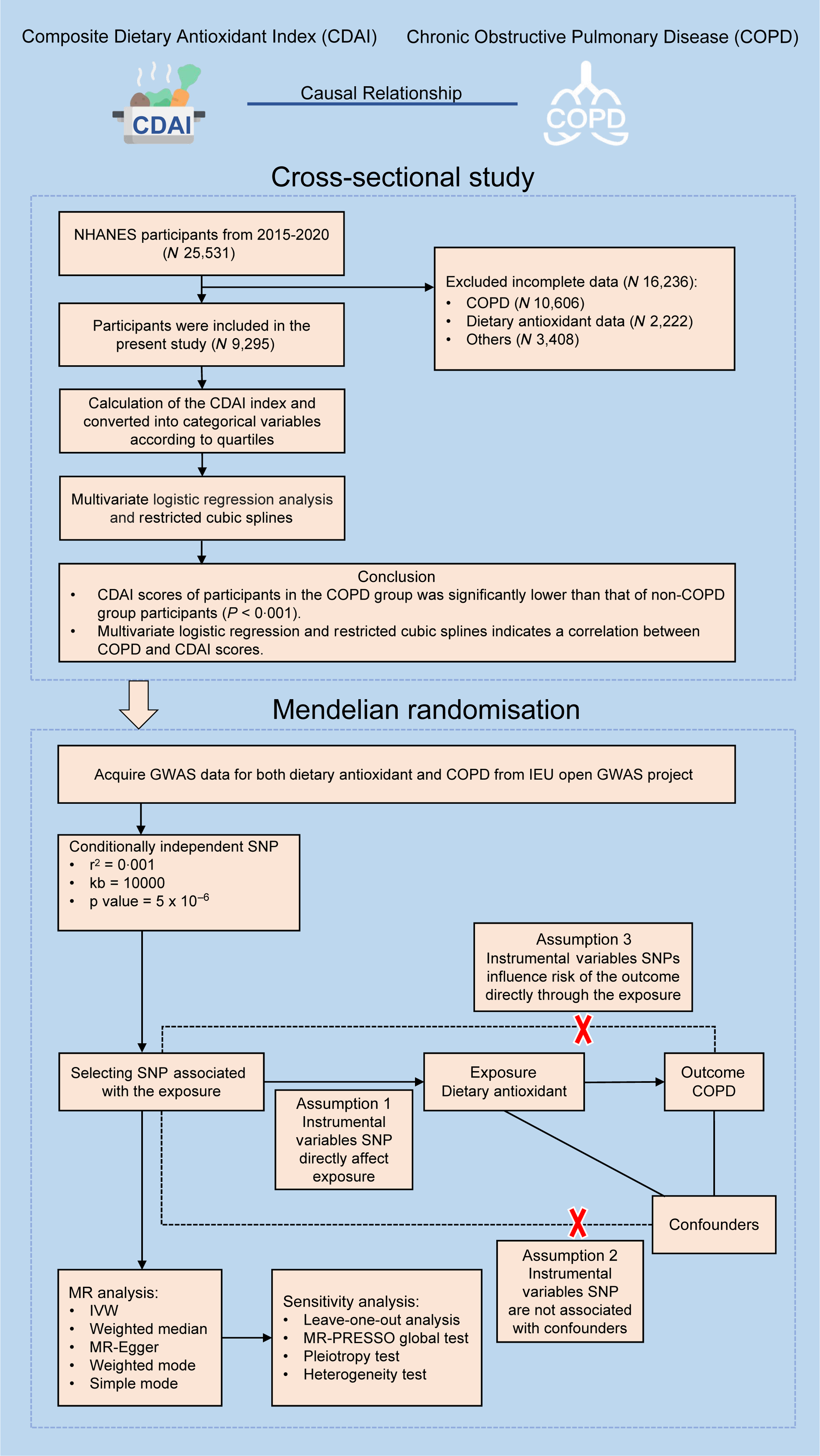
Weighted logistic regression analyses were used to investigate the relationship between CDAI and COPD. Additionally, restricted cubic splines (RCS) analyses were applied to explore the relationship between CDAI as a continuous variable and the occurrence of COPD. The causality between CDAI and COPD was assessed using a two-sample MR. The study design of this study is shown in Fig. 1. The CDAI was calculated based on the intake of six dietary antioxidants. Weighted multivariate logistic analyses were performed using the calculated CDAI data to determine the association between CDAI and COPD. GWAS summary statistics were retrieved, and the antecedent single-nucleotide polymorphisms (SNP) associated with each element in the CDAI were extracted as genetic instrumental variables. MR summary statistics derived from GWAS were used to assess the causal effects of genetically determined elements in the CDAI and COPD.
Study design overview of the NHANES cross-sectional study and MR analysis. The dashed line indicates the path that contradicts the hypothesis. NHANES, National Health and Nutrition Examination Survey; CDAI, composite dietary antioxidant index; COPD, chronic obstructive pulmonary disease; GWAS, genome-wide association studies; IVW, inverse-variance weighted; SNP, single-nucleotide polymorphism.

A cross-sectional study using NHANES data
We used publicly available NHANES data from 25 531 participants recruited between 2015 and March 2020. A total of 16 236 patients were excluded from the study due to the presence of missing data on COPD (n 10 606), dietary antioxidants (n 2222) and other covariates (n 3408). The final cohort comprised 9295 participants. Of these, 634 were diagnosed with COPD and ranged in age from 20 to 80 years. Racial distribution was as follows: 4·7 % Mexican American, 59·8 % Non-Hispanic White, 19·2 % Non-Hispanic Black and 16·2 % other races. Weighted logistic regression analyses with RCS analyses were performed to explore the relationship between CDAI and COPD, using the inclusion of 9295 participants who completed the NHANES measurements.
The NHANES database provided the results of the questionnaire ‘Has a doctor or other health professional ever told you that you have COPD?’ as an outcome variable. The main exposure variable was CDAI. Data on dietary antioxidant intake as well as covariates were obtained through standardsed questionnaires and face-to-face recall interviews. Interviews were conducted by trained interviewers in English or Spanish, following established NHANES methodology. The first interview took place in mobile testing centres, while a second dietary recall was conducted by telephone within 3–10 d. Detailed methods and measurement tools used to assist respondents in estimating portion sizes are documented in NHANES methodology(Reference Feskanich, Sielaff and Chong16). In order to assess the joint index of dietary antioxidant intake, the edition of the CDAI used by Maugeri et al. was employed(Reference Maugeri, Hruskova and Jakubik17):
 $${\rm CDAI} =\sum\limits_{i = 1}^{n = 6} {{{{\bf{Individual}}\;{\bf{Intake}} - {\bf{Mean}}} \over {{\bf{SD}}}}} $$
The CDAI comprises six dietary antioxidants: vitamin A, vitamin C, vitamin E, Zn, Se and carotenoids. The estimates for dietary antioxidants do not include antioxidants obtained from dietary supplements, medications or ordinary drinking water. We standardised the same six dietary vitamins by subtracting the global mean and dividing by the global standard deviation.
Based on the findings of the literature review, a number of potential covariates associated with both CDAI and COPD were identified(Reference Wang, Huang and Zhu18). The following potential covariates based on prior knowledge of factors associated with CDAI and COPD were assessed: sex, age (20–39, 40–59 and 60–80 years), race/ethnicity (Mexican American, Non-Hispanic White, Non-Hispanic Black and Others), education level (less than high school, high school or equivalent, and more than high school) and poverty impact ratio (PIR) (low: <1·85 and high: ≥1·85). Additionally, the following variables were considered: smoking status (never, former or current), BMI (kg/m2), waist circumference, co-morbidities (diabetes, hypertension and asthma), history of cancer and biochemical parameters (alanine aminotransferase, aspartate aminotransferase, creatinine, uric acid, cholesterol and TAG)(Reference Wen, Wei and Giri19).
Genetic instrument selection
Genetic instruments in the form of SNP were selected for use in genome-wide MR analyses. The aim was to classify natural random genetic variation during conception to provide an unbiased estimate of the effect of exposure on outcomes. The selection of genetic instruments was based on three basic assumptions (Fig. 1). Instrumental SNP were selected on the basis of the three hypotheses of the MR analysis: linkage disequilibrium (r 2 < 0·001) and kb > 10 000, and high correlation (P < 5 × 10⁻⁶) with exposure in the genome(Reference Purcell, Neale and Todd-Brown20). Genetic instruments for vitamin A, vitamin C, vitamin E, Zn, Se and carotenoid antioxidants in the CDAI were obtained from the GWAS database, which comprises a total of 418 165 participants. To proxy carotenoids in the human circulation, we used GWAS data on circulating carotenoids, as they are predominantly in this form(Reference Chen, Liu and Zhang21). Finally, thirty-three SNP related to vitamin A, twelve SNP related to vitamin C, eleven SNP related to vitamin E, eight SNP related to Zn, six SNP related to Se and sixteen SNP related to carotenoids were selected for MR analysis.
Mendelian randomisation analysis and sensitivity analysis
The primary analyses utilised the inverse-variance weighted (IVW) method to assess the causal effect between exposures and outcomes, which was determined to be the most accurate method for estimating causality when the data showed no directional pleiotropy (P > 0·05 for the MR-Egger intercept)(Reference Burgess, Butterworth and Thompson22). Sensitivity analysis was used to confirm the robustness of the results. For exposures and outcomes with P < 0·05 in IVW analyses, we used the ‘MR-PRESSO’ package to remove potentially pleiotropic IV (outliers) and perform analysis of significant outcomes(Reference Verbanck, Chen and Neale23).
Statistical analysis
Categorical variables were described using numerical values and percentages, and comparisons between groups were conducted using χ 2 tests. Continuous variables were described as the mean ± standard deviation if the distribution was normal and as the median and interquartile range if the distribution was skewed. To examine the association between CDAI and COPD, we used multivariable logistic regression for modelling to estimate the ratio and the corresponding 95 % CI. The model consisted of three categories: crude model (unadjusted for covariates), model A (adjusted for age, sex and race/ethnicity) and model B (adjusted for all covariates, including age, sex, race/ethnicity, poverty:income ratio, education level, BMI, waist circumference, smoking status, hypertension, diabetes, asthma, cancer or malignancy, alanine aminotransferase, aspartate aminotransferase, creatinine, uric acid, cholesterol and TAG). To corroborate the findings derived from the continuous variables in the unadjusted and multivariable-adjusted models, we calculated P-values for trends. In light of the intricate probabilistic clustering design of NHANES, the application of weights was deemed essential in the statistical analyses of this study.
In order to investigate the possibility of a non-linear relationship between CDAI and COPD, RCS model was employed. RCS is a flexible non-linear regression method that allows fitting different segments of the curve in different intervals while maintaining the smoothness and continuity of the overall curve by introducing multiple spline functions at different quantile points (nodes) of the independent variable(Reference Desquilbet and Mariotti24). By evaluating the non-linear relationship, we were able to gain a more comprehensive understanding of the relationship between CDAI and COPD, thereby improving the explanatory power of the results and the reliability of the study.
The statistical analyses were performed using R version 4.3.1 and the R packages ‘nhanesA’, ‘TwoSampleMR’ and ‘MRPRESSO’, taking into account the complex sample design.
Data availability
NHANES data and test methods for covariates can be accessed at https://www.cdc.gov/nchs/nhanes/index.htm. GWAS data can be accessed at https://gwas.mrcieu.ac.uk/. The GWAS data for elements in COPD and CDAI were obtained from the Integrative Epidemiology Unit (IEU) database (Table S1).
Results
NHANES population characteristics
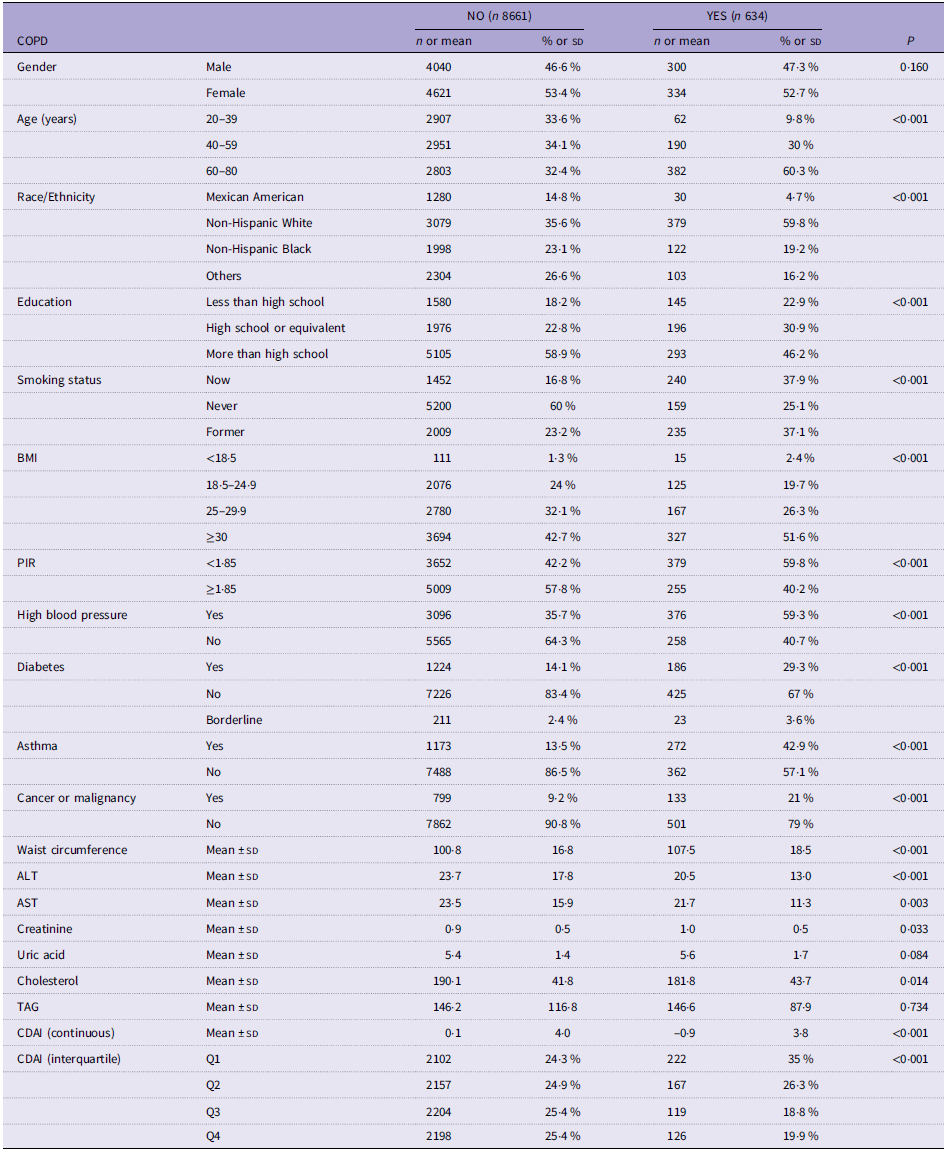
Baseline population characteristics with weighted estimates are shown in Table 1. CDAI levels in the COPD group were categorised into four groups by quartile. Older adults were more likely to be diagnosed with COPD and had lower levels of education, smoking, a higher BMI, a lower PIR and a higher prevalence of hypertension.
Participant characteristics in the NHANES cross-sectional study

NHANES, National Health and Nutrition Examination Survey; COPD, Chronic obstructive pulmonary disease; PIR, poverty impact ratio; ALT, alanine aminotransferase; AST, aspartate aminotransferase; CDAI, composite dietary antioxidant index.
Continuous variables are expressed as mean ± standard deviation (sd), and categorical variables are expressed as n (%). A χ 2 test was used for categorical variables, and a one-way ANOVA was used for continuous variables. P < 0.05 was set as the threshold of statistical significance. CDAI quartile range: quartile 1 (–8.90, –2.96); quartile 2 (–2.96, –0.483); quartile 3 (–0.483, 2.59); quartile 4 (2.59, 16.33).
Relationship between composite dietary antioxidant index and chronic obstructive pulmonary disease
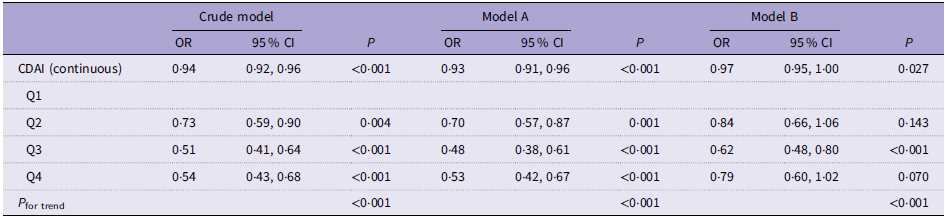
Three models were constructed using weighted logistic regression (Table 2) to investigate the association between CDAI and COPD. In the crude model, no covariate adjustment was made, and continuous CDAI levels were observed to be negatively associated with incident COPD, with an OR of 0·94 (0·92–0·96) associated with an increase in CDAI per standard deviation. When the CDAI levels were divided into quartiles, the OR for COPD was found to be 0·73 (0·59–0·90), 0·51 (0·41–0·64) and 0·54 (0·43–0·68), with CDAI levels in Q2, Q3 and Q4 relative to the CDAI levels in Q1. In model A, which included adjustments for age, sex and race, higher levels of CDAI were associated with a reduced risk of COPD, and similarly, the OR for COPD with CDAI levels in Q2, Q3 and Q4 were 0·70 (0·57–0·87), 0·48 (0·38–0·61) and 0·53 (0·42–0·67), respectively, when compared with CDAI levels in Q1. In addition, a similar trend (higher risk of COPD in the low-CDAI population) was observed after adjusting for all covariates (model B).
Multiple linear regression analysis on the association between CDAI and COPD

CDAI, composite dietary antioxidant index; COPD, chronic obstructive pulmonary disease; PIR, poverty impact ratio; ALT, alanine aminotransferase; AST, aspartate aminotransferase.
Crude model: no covariates were adjusted. Model A: age, sex and race were adjusted. Model B: adjusted for all covariates (age, sex, race, education, PIR, BMI, smoking status, high blood pressure, diabetes, asthma, cancer or malignancy, waist circumference, ALT, AST, creatinine, uric acid, cholesterol and TAG).
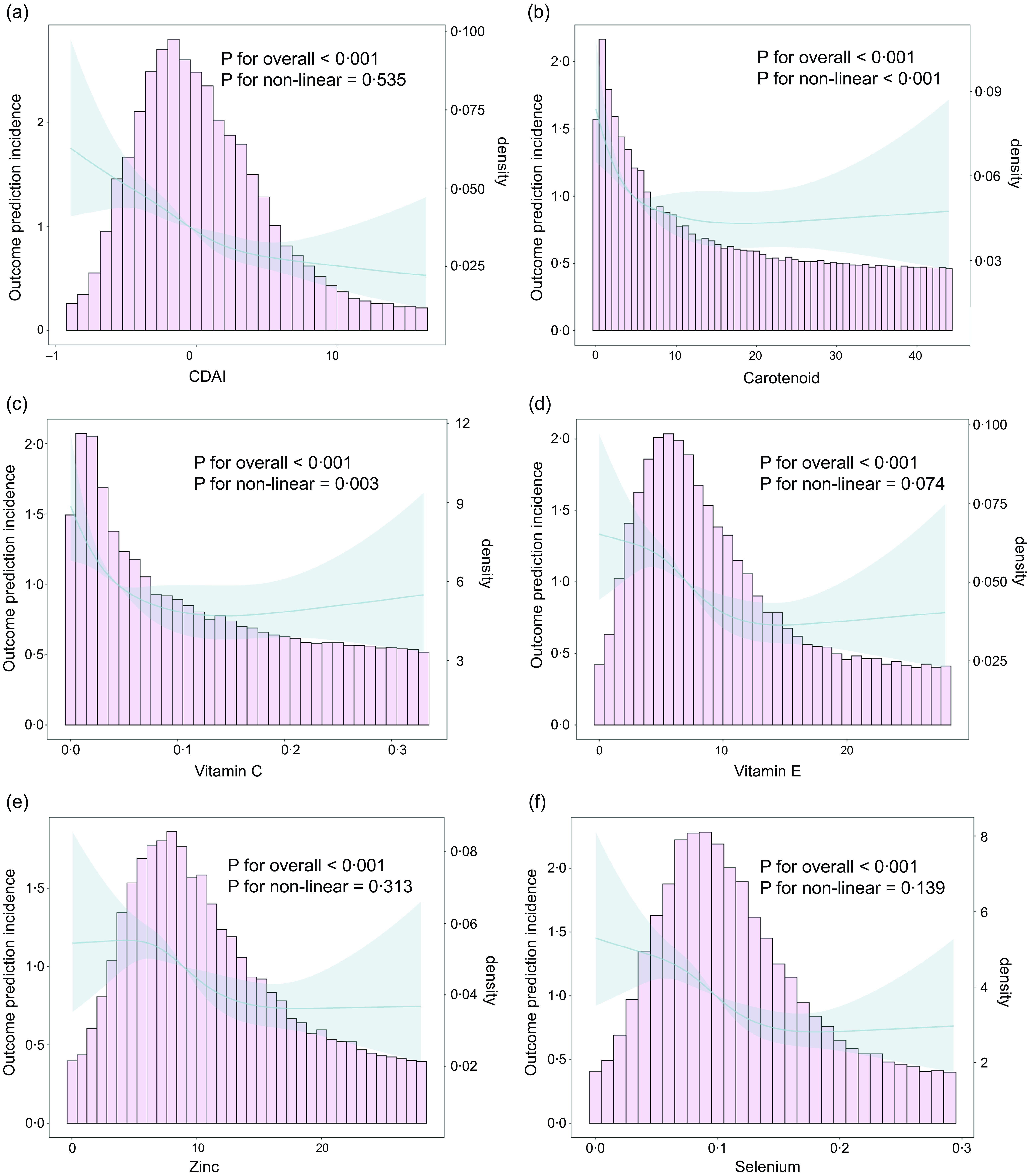
We used RCS to investigate further whether there was a non-linear relationship between CDAI and antioxidants in CDAI and the occurrence of COPD (Fig. 2). The results showed a non-linear correlation between carotenoids (P < 0·001) and vitamin C (P = 0·003) and the occurrence of COPD. Additionally, the occurrence of COPD was linearly associated with CDAI (p-non-linearity = 0·535), vitamin E (p-non-linearity = 0·074), Zn (p-non-linearity = 0·313) and Se (p-non-linearity = 0·139), with a P-value of less than 0·001.
RCS plot of the association between CDAI and antioxidants and COPD. The solid blue line represents the smooth curve fit between variables. The shaded bands represent the 95 % CI. RCS, restricted cubic spline; CDAI, composite dietary antioxidant index; COPD, chronic obstructive pulmonary disease.

A causal association between composite dietary antioxidant index and chronic obstructive pulmonary disease in Mendelian randomisation
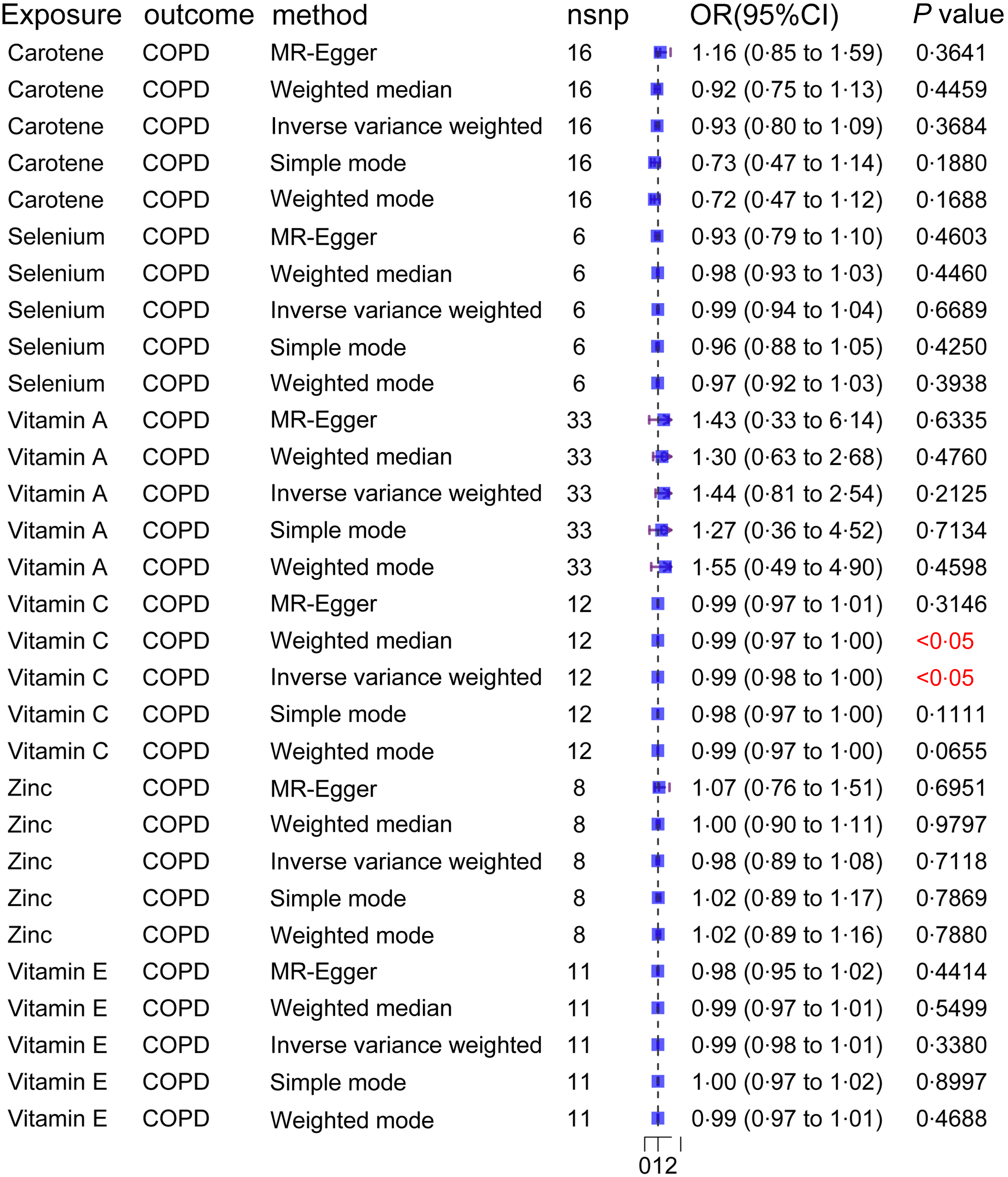
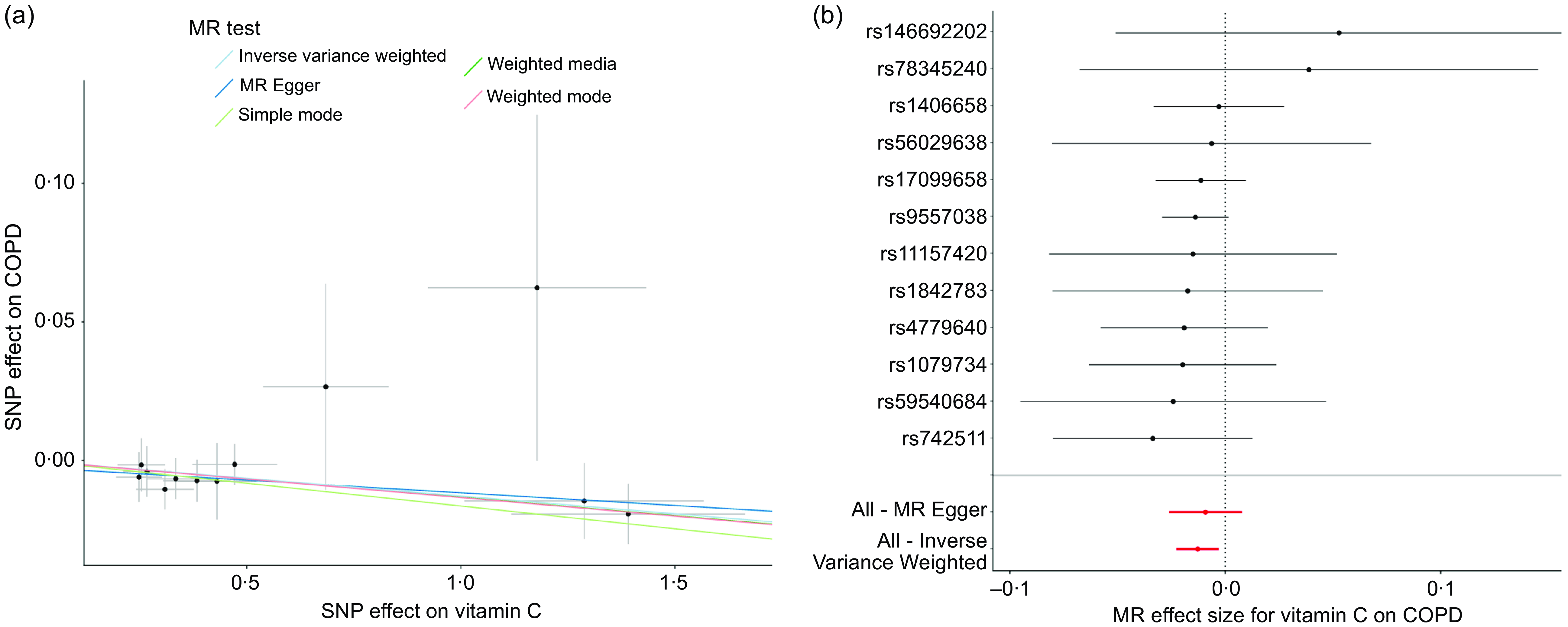
The IVW and the weighted median methods demonstrated a positive causal relationship specifically between vitamin C and COPD (OR = 0·99 (0·97–1·00); 0·99 (0·98–1·00), P < 0·05). No such causal link was identified between other antioxidants and COPD (Fig. 3). We screened twelve SNP closely related to vitamin C (Table S2). Figure 4(a) shows that as the effect of SNP on vitamin C decreases, the effect of SNP on COPD also decreases. In Fig. 4(b), the effect size for each SNP is displayed, indicating that increased vitamin C intake reduces the risk of developing COPD.
Forest plot of the MR study investigating the effect of antioxidants on COPD. The exposure is antioxidants and the outcome is COPD, red bold font represents causality, with the exposure having a protective effect on the outcome, whereas black represents the absence of a causal relationship between the exposure and the outcome. MR, Mendelian randomization; COPD, chronic obstructive pulmonary disease.

MR analyses of the effects of vitamin C on COPD. (a): Scatter plot of vitamin C on COPD. Each point in the scatterplot represents a genetic variant, which shows us the association of each genetic variant (SNP) with antioxidants and COPD. The dashed line represents the line segment fitted by the model, where the association of each genetic variant (SNP) with antioxidants directly predicts its association with COPD. (b): Forest plot of vitamin C on COPD. It shows the effect size and 95 % CI for each SNP. The graph shows the strength of the association between each SNP and the outcome and its uncertainty. MR, Mendelian randomization; COPD, chronic obstructive pulmonary disease; SNP, single-nucleotide polymorphism.

Sensitivity analysis
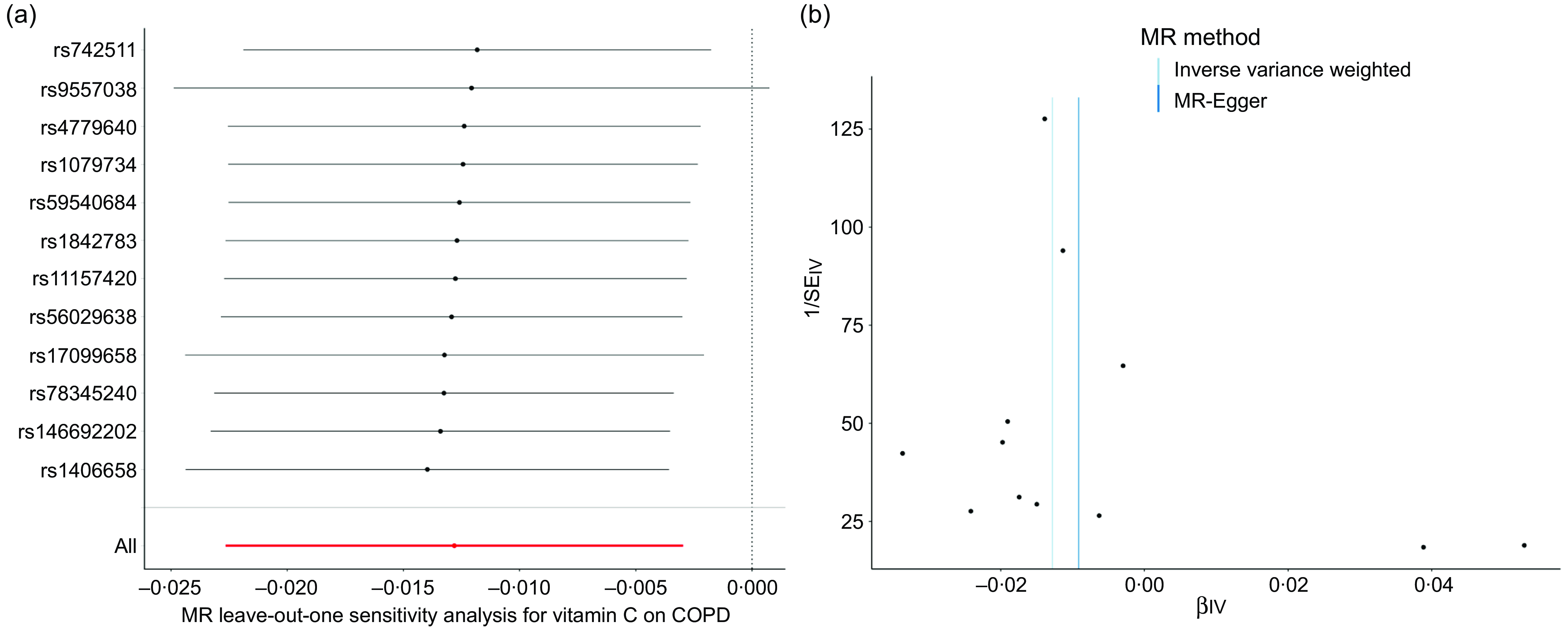
Leave-one-out analysis determines whether a particular SNP significantly alters the results by excluding SNP individually, as shown in Fig. 5(a). When SNP were excluded individually, their risk estimates remained consistent. The IVW method was used to assess heterogeneity and showed that there was no significant heterogeneity (P = 0·970). To further demonstrate the results of the analyses, we plotted a funnel plot (Fig. 5(b)). Additionally, the results of the MR-Egger regression demonstrated the absence of horizontal pleiotropy in our study (P = 0·614). Thus, the results of various MR methods consistently confirmed the existence of a causal relationship between vitamin C and COPD. Sensitivity analyses further confirmed the robustness and reliability of these findings.
Sensitivity analyses of the effects of vitamin C on COPD. (a): Leave-one-out analysis of the effects of vitamin C on COPD. The forest plot referred to by the leave-one-out method shows the MR estimation results after removing each individual SNP. Each time a SNP is removed, MR estimation is performed and the results and their CI are recorded in the plot. (b): Funnel plot of vitamin C on COPD. Funnel plots are used to check for the presence of heterogeneity in individual genetic variants, and when there is no heterogeneity, the funnel plots take on a symmetrical shape, implying that there is no systematic relationship between the study effects and their precision. COPD, chronic obstructive pulmonary disease; MR, Mendelian randomization; SNP, single-nucleotide polymorphism.

Discussion
This study explored the association between CDAI and COPD using the NHANES database and MR analysis. Additionally, we investigated the potential causal relationship between dietary antioxidant content and COPD. The results show a significant linear relationship between CDAI and COPD, though the magnitude of this association was relatively small, which suggests that while dietary antioxidants may have a role in COPD prevention, their effect might not be substantial at the individual level. Furthermore, in the IVW approach, we observe a causal relationship between genetically predicted vitamin C and COPD. IVW methods typically exhibit greater statistical power than other methods of MR and are therefore the preferred approach for identifying potentially significant results(Reference Du, Yang and Zhou25). Furthermore, sensitivity analyses were conducted to ensure the robustness of the IVW estimates. Overall, the findings suggest that dietary antioxidants may play a role in preventing COPD from occurring. This study is the first to assess the association between vitamin C and COPD using GWAS.
This study presents the first comprehensive investigation of the relationship between CDAI and COPD, based on data from a large observational study and MR analysis of large-scale genetic data. Previous studies on dietary interventions for COPD have focused on a single dietary nutrient(Reference Yan, Xu and Li26,Reference Liu, Su and Chen27) , and GWAS-based causality between CDAI and other chronic diseases(Reference Wang, Huang and Zhu18,Reference Chen, Liu and Zhang21) . The evidence for the relationship between CDAI and COPD is relatively limited. However, there is growing evidence supporting oxidative stress as an important driving mechanism in COPD(Reference Cazzola, Page and Wedzicha28,Reference Cha, Jang and Park29) . Oxidative stress in COPD is caused by both exogenous factors, such as smoking and air pollution, and endogenous factors, including reactive oxygen species production by activated lung inflammatory cells, particularly neutrophils and macrophages. Research has demonstrated that heightened oxidative stress is linked to a reduction in endogenous antioxidants, such as Nrf2-dependent antioxidants and GSH. Additionally, a low intake of dietary antioxidants may exacerbate the situation(Reference Barnes30). At this stage, causality is uncertain. This study provides evidence for a causal relationship between reduced dietary antioxidants and COPD occurrence.
The CDAI components, including vitamins A, C, E, Zn, Se and carotenoids, play key roles in combating oxidative stress. Vitamin A activates the Keap1/Nrf2/ARE pathway, enhancing antioxidant defences(Reference Blaner, Shmarakov and Traber31). Vitamin C stabilises mitochondrial membranes, reducing reactive oxygen species damage(Reference Kaźmierczak-Barańska, Boguszewska and Adamus-Grabicka32). Vitamin E (e.g. γ-tocopherol) inhibits lipid peroxidation(Reference Howard, McNeil and McNeil33), while Zn supports glutathione synthesis, crucial for cellular antioxidant capacity(Reference Marreiro, Cruz and Morais34). Se aids oxidative stress protection by maintaining antioxidant enzymes(Reference Fontagné-Dicharry, Godin and Liu35). Carotenoids, precursors to vitamin A, scavenge reactive oxygen species under normal conditions(Reference di Masi, Sessa and Cerrato36). While flavonoids, such as quercetin, also possess antioxidant properties by binding to Nrf2(Reference Zhang, Xu and Tang37), they were not included in CDAI, which may be a limitation of this study.
The study suggests that higher levels of antioxidants in humans may reduce the risk of developing COPD, which is consistent with previous observational studies. A population-based study has shown that serum vitamins and carotenoids have the potential to attenuate or slow the progression of COPD(Reference Zheng, Yu and Xia38). A recent study suggests that N-acetylcysteine, which has antioxidant properties, may be beneficial for other chronic inflammatory and fibro-forming respiratory diseases, including COPD, bronchial asthma, idiopathic pulmonary fibrosis or pneumoconiosis(Reference Mokra, Mokry and Barosova39). Furthermore, in an experimental mouse model, it was demonstrated that the intake of lycopene reduced lung damage caused by cigarette smoke(Reference de Carvalho, de Souza and Castro40).
In the present study, the relationship between specific antioxidants (carotenoids and vitamin C) and COPD exhibited a non-linear association. This non-linear relationship may be indicative of the disparate effects of various antioxidants on COPD at varying concentration levels. Our findings are consistent with those of previous studies, which have indicated that the effects of antioxidants are not linear(Reference Li, Song and Chen41,Reference Yan, Chen and Liu42) . This may be due to the fact that an excess or deficiency of antioxidants in the body impairs their normal antioxidant function, which in turn gives rise to disparate health outcomes(Reference Baxmann, De and Heilberg43,Reference Zeng, Liu and He44) . The potential mechanisms underlying this phenomenon may include factors such as the bioavailability of antioxidants, the interaction of antioxidants with other nutrients and individual differences(Reference Eggersdorfer and Wyss45). In conclusion, the observed non-linear results indicate the necessity of considering different doses and individual differences when evaluating the impact of antioxidants on COPD. Further investigation of these mechanisms is required to gain a more comprehensive understanding of the role of antioxidants in the prevention of COPD.
The public health and clinical implications of the study are important. As the population continues to age, COPD will continue to rise(Reference Vogelmeier, Criner and Martinez2). Reducing the harm caused by risk factors associated with COPD is considered more urgent than treating the condition itself(Reference Agustí, Melén and DeMeo46). Numerous studies are investigating novel approaches to reduce the heightened risk of COPD caused by smoking by enhancing dietary habits(Reference Marín-Hinojosa, Eraso and Sanchez-Lopez47). For example, recent epidemiology research has shown antioxidant-rich foods, especially fresh fruit and vegetables, to be beneficial for respiratory function and symptoms in chronic respiratory patients(Reference Seyedrezazadeh, Moghaddam and Ansarin48). Dried fruit intake has been demonstrated to decelerate the progression of COPD and asthma(Reference Lai, Li and Peng49). Therefore, early prevention and effective disease management measures are necessary for COPD based on the relationship between diet and the disease. In clinical practice, it is important to continuously search for innovative and efficient antioxidants as a new treatment strategy for this disease. However, it is important to note that, in order to ensure therapeutic efficacy, antioxidant therapies, particularly those based on redox-sensitive molecules, must be used with caution to avoid triggering pro-oxidant and inflammatory responses in the lungs(Reference Kirkham and Rahman50).
This study has several strengths. First, it has a large sample size. Second, it uses the aforementioned SNP as genetic instrumental variables. More importantly, we combined observational studies with MR analyses. However, it is important to note that causal inferences cannot be drawn from the NHANES study alone. MR analysis significantly reduces biases such as reverse causality and confounders to compensate for the shortcomings of observational studies. Additionally, the MR analysis employed large-scale GWAS data, providing sufficient statistical power to evaluate the correlation between dietary antioxidant levels and CDAI. However, it is important to point out some of the limitations of this study. First, it is a cross-sectional study, and bias is inevitable. Second, although we adjusted for some potential confounders during the study, we could not completely eliminate the effects of other potential confounders. Third, both COPD diagnosis and dietary antioxidant intake were based on self-reported data in NHANES. COPD information was obtained through self-reported medical history, while dietary antioxidant data were based on participants’ 24-h dietary recall prior to the interview. This reliance on self-reported data may introduce recall bias, potentially leading to inaccuracies in dietary intake estimates and misclassification of COPD status. Such biases could affect the accuracy of our assessment of the association between dietary antioxidants and COPD risk. At last, we acknowledge that the exclusion of a significant number of participants due to missing data on COPD, dietary antioxidants and other covariates could potentially introduce bias. The excluded participants might have different characteristics compared with those included in the final cohort. However, our analysis was based on the available data from the NHANES dataset, and the criteria for exclusion were uniformly applied to all participants.
Conclusion
The NHANES cross-sectional study and MR analyses suggest that dietary sources of antioxidants may offer some protection against COPD. Additionally, the MR analyses indicate a causal relationship between vitamin C and COPD. However, further research is necessary to fully comprehend the mechanisms by which antioxidants safeguard against COPD.
Supplementary material
For supplementary material/s referred to in this article, please visit https://doi.org/10.1017/S0007114524003349
Data availability
All data that support the findings of this study are publicly available from https://www.cdc.gov/nchs/nhanes/index.htm and https://gwas.mrcieu.ac.uk/, and further inquiries can be directed to the corresponding authors.
Acknowledgements
The contributions of the researchers and study participants are greatly appreciated.
All of the authors affirm that there were no competing interests in this study.
This study was not funded.
Z. X.: conceptualisation; Z. X. and H. W.: methodology; Z. X. and H. W.: data curation; Z. X. and H. W.: writing – original draft preparation; H. W. and Z. X.: writing – review and editing. All authors have read and agreed to the published version of the manuscript.