

In eastern North America, Indigenous peoples domesticated a suite of crops called the Eastern Agricultural Complex (EAC; Smith Reference Smith2006). The EAC includes both extant and extinct domesticates, including native squashes (Cucurbita pepo ssp. ovifera D. S. Decker); two spring-maturing grasses, little barley (Hordeum pusillum Nutt.) and maygrass (Phalaris caroliniana Walt.); two members of the sunflower family, sumpweed (Iva annua var. macrocarpa) and sunflower (Helianthus annuus L.); goosefoot (Chenopodium berlandieri ssp. jonesianum Smith and Funk); and erect knotweed (Polygonum erectum ssp. watsoniae N. G. Muell.) (Asch and Asch Reference Asch and Asch1977, Reference Asch, Asch and Ford1985; Crites Reference Crites1993; Decker Reference Decker1988; Fritz and Smith Reference Fritz and Smith1988; Heiser Reference Heiser2008; Hunter Reference Hunter1992; Mueller Reference Mueller2017a; Smith Reference Smith2014; Smith and Funk Reference Smith and Funk1985; Yarnell Reference Yarnell1972). This crop complex sustained Indigenous people in eastern North America from around 3900 BP to approximately 600 BP (Smith and Yarnell Reference Smith and Yarnell2009). Although the timing of its first appearance is hotly debated, maize (Zea mays) from Mesoamerica was widely grown in eastern North America by AD 900 (Emerson et al. Reference Emerson, Hedman, Simon, Fort and Witt2020; Hart et al. Reference Hart, Lovis and Anne Katzenberg2021; Simon et al. Reference Simon, Hedman and Emerson2021). Maize, beans (Phaseolus vulgaris), squash, and sunflowers gradually became the dominant crop complex in this region, and people slowly stopped relying on the other EAC crops, although some were still cultivated as late as the fifteenth century AD (Fritz and House Reference Fritz and House2022). The EAC crops, excluding squash and sunflower, fell out of cultivation around the time of European contact, so there are only a few enigmatic ethnohistorical accounts of EAC cultivation, and their domesticated forms are thought to be extinct (Asch and Asch Reference Asch and Asch1977). As a result, archaeologists rely on comparison between modern free-livingFootnote 1 plants and archaeobotanical specimens to recognize domesticated assemblages in the archaeological record. Given that paleoethnobotanical assemblages found in eastern North America rarely consist of entire plants, most of the phenotypic criteria used to recognize plant domestication in this region are aspects of seed or fruit morphology.
To build these arguments about domestication from fruit/seed phenotype, paleoethnobotanists often use criteria of the domestication syndrome first established by Harlan et alia (Reference Harlan, De Wet and Glen Price1973), who argued that the selective pressures associated with planting and saving of seeds result in specific adaptations, some of which can be recognized in seeds and fruits. In this article, we focus on the reduction in germination inhibitors in one EAC crop—goosefoot (C. berlandieri). One of the key traits that has been used to argue for an extinct domesticated species of goosefoot in eastern North America is the thickness and texture of the seed coat (hereafter, testa), which mechanically restricts germination (Smith and Funk Reference Smith and Funk1985). A loss or reduction of germination-inhibiting structures has been observed in many annual plants as they are domesticated. This phenomenon is thought to evolve in response to seed-saving and planting by ancient people, and by the relaxation of selective pressures associated with preexisting seed dispersal strategies (Spengler and Mueller Reference Spengler and Mueller2019). A reduction in germination inhibitors can be recognized by a thinning of the seed or fruit coat, or by a reduction in seed polymorphism in favor of seed types with less robust seed protections (Mueller Reference Mueller2017b). Recent observations of free-living populations of goosefoot (Halwas Reference Halwas2017) suggest that this phenotype is more plastic than previous researchers appreciated. These observations prompted the two experimental studies reported here. The results of these experiments suggest refinements to the interpretation of ancient goosefoot and additions to the narrative of how this species was domesticated in eastern North America.
More generally, this study investigates the role of developmental plasticity in domestication (Piperno Reference Piperno2017; Zeder Reference Zeder2018). Developmental plasticity is the ability of a single genotype to exhibit phenotypic variation in response to environmental conditions. Plasticity can allow plants to take advantage of human-mediated environments (Herman and Sultan Reference Herman and Sultan2011), and ancient farmers could have used these plastic responses to their own advantage during the domestication process (Mueller Reference Mueller2017b, Reference Mueller2017c). Developmental plasticity can also complicate how paleoethnobotanists categorize archaeobotanical remains as domesticated or wild, because many domestication syndrome traits are plastic, including the prevalence of germination inhibitors (Mueller Reference Mueller2017b) and seed size (Gremillion and Piperno Reference Gremillion and Piperno2009). As Gremillion (Reference Gremillion1993a:147) stated in her discussion of Chenopodium evolution under cultivation, “The rate and character of change in crop populations is the product of complex interactions between heritable traits and their phenotypic expression in particular environments.”
Here, we present our findings from two experiments. First, we used a common garden experiment to explore the effect of the growth environment on seed phenotype. A common garden experiment takes individuals from different populations and grows them in a single experimental space (de Villemereuil et al. Reference de Villemereuil, Gaggiotti, Mouterde and Till-Bottraud2016). Common garden experiments help us better understand if phenotypic differences observed between populations are developmental (plastic) or heritable (fixed). We collected seeds from wild populations of goosefoot in Illinois and Missouri and grew them in a common garden experiment to observe any phenotypic differences between two local populations, and between the parent populations and their cultivated offspring. Although we collected various kinds of phenotypic data, here we will focus on the proportion of thin-testa seeds (hereafter, “red morphs”) in a random subsample of the harvest (sample proportion). We also conducted a series of carbonization (experimental burning) experiments on goosefoot seeds to see if carbonization differentially affects thin- versus thick-testa seeds.
The Red Morph Problem Revisited
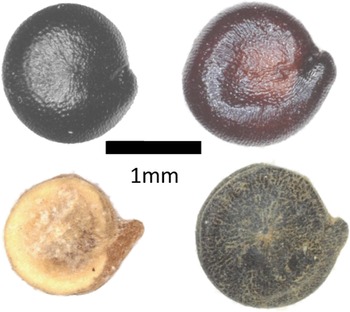
Each goosefoot plant produces a range of seed colors with varying testa thickness. The most prevalent are black and red, although it is possible to break down a harvest into more nuanced color categories. Lighter-colored seeds have a thinner testa (Halwas Reference Halwas2017; Smith Reference Smith1985:202) with a smoother surface texture, although the diagnostic alveolate (honeycomb) texture of C. berlandieri and its close relatives is still sometimes visible (Figure 1). Smith's (Reference Smith1985) measurements of testa thickness in modern, free-living populations have generally been used for comparison with archaeobotanical specimens. He found that the red morphs from the three populations he measured overlapped in testa thickness with domesticated archaeobotanical specimens (~5–30 μm), whereas black morphs had testas that measured 40–90 μm—much thicker than those of the archaeobotanical specimens he was studying. Smith went on to describe what he called “the red morph problem”:
Establishing the presence of a thin-testa domesticated variety of Chenopodium in archaeobotanical assemblages is obviously complicated by the ability of nondomesticated chenopod populations to produce small frequencies of red-morph fruits which are sometimes indistinguishable from the fruits produced by domesticated stands of Chenopodium [Smith Reference Smith1985:122–123].
However, the prevalence of red morphs in harvests from nondomesticated Chenopodium plants was thought to be very low under most circumstances.
Chenopodium berlandieri polymorphic seeds and domesticated landraces: (top left) black, thick-testa morph; (top right) red, thin-testa morph, seeds from modern population CB004 (see text for details). Pericarps have been removed. Note the characteristic alveolate (honeycomb) texture on both morphs. Bottom left: typical pale-domesticated-variety seed from an intact inflorescence at Holman rockshelter, Arkansas (see Fritz Reference Fritz1984; Wilson Reference Wilson1981). Bottom right: A typical C. berlandieri ssp. jonesianum seed from the Edens Bluff bag, Arkansas (Fritz Reference Fritz1986; Fritz and Smith Reference Fritz and Smith1988). (Color online)

This belief rests on limited observations of free-living goosefoot phenotypes by pioneering North American paleoethnobotanists in the 1970s and 1980s. Asch and Asch (Reference Asch and Asch1977) published their observations of C. bushianum (now considered a subspecies of C. berlandieri by the Flora of North America; Clemants and Mosyakin Reference Clemants and Mosyakin2003) populations in the lower Illinois River valley in late October. They collected seeds from a population located on mudflats, which were barely a meter tall (which is short for goosefoot plants in this season) and from a nearby stand of taller plants growing in partial shade on higher ground. Seeds from the mudflat population had “reddish brown, translucent seed coats,” whereas harvests from the higher-ground population consisted of mostly “black and opaque” seeds (Asch and Asch Reference Asch and Asch1977). Asch and Asch stated that the higher-ground plants had already senesced and dispersed most of their seeds by mid-November, and the mudflat plants were still green, suggesting that they were likely younger plants that emerged after spring floods receded. Asch and Asch later referred to these observations when they concluded that “the conditions under which the red morph predominates in the wild are unusual ones” (Asch and Asch Reference Asch and Asch1977:21)—since their 1977 publication, they had only found one other goosefoot population in which red morphs “comprised most of the seeds” (Asch and Asch Reference Asch, Asch and Ford1985:180). Building on their research, Smith (Reference Smith1985) collected seeds from four free-living populations. Smith (Reference Smith1985:122) found that red morphs will “represent only 1–3% of a population's fruit production” apart from rare situations that may encourage a higher production of red morphs.
Smith and Funk (Reference Smith and Funk1985) formally described an extinct domesticated subspecies, C. berlandieri ssp. jonesianum, on the basis of two characteristics of its seeds that differed from its closest modern relative, C. berlandieri: (1) dominance of seeds with a thin (<20 μm), smooth testa (seed coat); and (2) a truncate seed margin with prominent “beak” (see images in Gremillion Reference Gremillion1993a). This formal botanical designation was based on a type specimen from Ash Cave, Ohio, which is an assemblage of approximately 25,000 seeds, and it also characterizes an assemblage of approximately 50,000 seeds from Russell Cave, Alabama—both of which are approximately 2,000 years old (Smith Reference Smith1985; Smith and Funk Reference Smith and Funk1985). Older assemblages from the western front of the Appalachian Mountains in Kentucky, such as those from Cloudsplitter Rockshelter and Newt Kash Shelter, both of which were dated to about 3400 BP, also exhibit this seed phenotype (Gremillion Reference Gremillion1993a; Smith and Cowan Reference Smith and Cowan1987). C. berlandieri ssp. jonesianum also appears at Edens Bluff and White Bluff, Arkansas, both of which are approximately 2,000 years old (Fritz and Smith Reference Fritz and Smith1988). However, C. berlandieri ssp. jonesianum, in the strict sense, is only one of at least two domesticated phenotypes in the archaeological record of eastern North America. The other has been called a pale or naked variety because it entirely lacks an outer epiderm, giving it a translucent, golden-yellow appearance similar to quinoa. This phenotype has been recovered from several rockshelters in Arkansas dating between 1400 and 800 BP, and at the Riverton site, Illinois (Fritz Reference Fritz1986; Fritz and Smith Reference Fritz and Smith1988; Smith and Yarnell Reference Smith and Yarnell2009; Figure 1). Pale-seeded Chenopodium was also recovered from Terminal Late Archaic layers at Cold Oak Rockshelter, in Kentucky, and directly dated to 2600 BP (Gremillion Reference Gremillion1988). The assemblage of 540 uncarbonized pale-variety seeds recovered at Riverton is remarkable in that it is roughly 1,000 years older than other occurrences of pale-variety Chenopodium, pushing back the evolution of this domesticated form to approximately 3800 BP (Smith and Yarnell Reference Smith and Yarnell2009).
Most of the assemblages originally used to describe the two domesticated phenotypes discussed above and illustrated in Figure 1 come from large desiccated or mineralized assemblages in clear storage contexts. This makes them unlike the vast majority of archaeobotanical specimens in this region, which are carbonized (preserved via burning) and which come from a variety of contexts, rarely in concentrations large or homogenous enough to describe as a seed cache. Although a high proportion of thin, smooth testa seeds is only one-half of the domestication syndrome described for C. berlandieri ssp. jonesianum (Smith and Funk Reference Smith and Funk1985), in practice, it is a more useful criterion than aspects of seed margin shape, because the shape of the seed margin is frequently impossible to characterize in carbonized specimens. Moreover, until recently, testa thickness could only be measured with a scanning electron microscope. As a result, it is rarely undertaken—and then, only on a subset of all Chenopodium seeds recovered from a given site or context. Our own experience as analysts suggests that testa texture and estimated thickness are the most expedient and frequently preserved criteria to employ when categorizing fragmentary carbonized specimens as domesticated or wild for the purposes of standard archaeobotanical reporting. For example, Simon and Parker's masterful summary of hundreds of such reports sums up Late Woodland chenopod assemblages in this way: they are “morphologically mixed and contain both thick-testa wild forms and thin-testa domesticated seeds, as well as specimens that appear intermediate between the two” (Simon and Parker Reference Simon and Parker2006:228; emphasis added). Here, we can see how thin-testa and thick-testa seeds are generalized as domesticated and wild, respectively.
Halwas's (Reference Halwas2017) survey of modern free-living goosefoot populations suggests that it is not necessary to invoke domestication to explain the presence of thin-testa seeds in archaeobotanical assemblages. She found a range of seed polymorphism among free-living C. berlandieri populations. Thin-testa, light-colored seeds comprised up to 30% of the seed harvested from wild goosefoot populations in her survey (Halwas Reference Halwas2017:202). Halwas also conducted a common garden experiment with seeds from these wild populations and found that the common garden populations had lighter-colored seeds, thinner testas, and larger perisperm diameters, on average, compared to their free-living parent populations (Halwas Reference Halwas2017:203). But Smith's (Reference Smith1985) and Asch and Asch's (Reference Asch and Asch1977, Reference Asch, Asch and Ford1985) earlier observations have established the idea among a generation of researchers in eastern North America that red morphs are rare occurrences among modern free-living goosefoot populations. This key observation provided the basis for modern comparison and a way for archaeologists to theorize about past goosefoot populations. For example, Gremillion (Reference Gremillion1993b) used this idea to support her theory that ancient Chenopodium populations existed as a crop/weed complex where domesticated goosefoot and a companion Chenopodium weed evolve together in human-disturbed environments. Gremillion (Reference Gremillion1993b:506) argues that this crop/weed complex could explain the seed polymorphism and variation in morphological traits present in archaeological goosefoot, and she pointed out other instances of seed polymorphism from Chenopodium species in the Andean altiplano that are now well known as examples of crop/weed complexes (Bruno Reference Bruno, Zeder, Bradley, Emshwiller and Smith2006; Bruno and Whitehead Reference Bruno and Whitehead2003; Langlie et al. Reference Langlie, Hastorf, Bruno, Bermann, Bonzano and Condarco2011; Wilson Reference Wilson1990). An alternative explanation, based on Halwas's data, is that a polymorphic assemblage of seeds in the archaeological record could come from a single population of cultivated, but genetically wild, plants.
A preponderance of thin-testa seeds in ancient Chenopodium assemblages has been explained as evidence of domestication by archaeobotanists, but there are other ways to explain their presence on any given goosefoot plant or in the archaeological record. They may be a plastic response to the growth environment that serves as a bet-hedging strategy to deal with an unpredictable growth environment or a means of transgenerational signaling (Mueller Reference Mueller2017b, Reference Mueller2017c). A simpler explanation is that they are simply seeds harvested at an earlier stage of development, and that, given more time, they would have developed into thick-testa seeds. We investigate these possibilities using data from our common garden experiment.
Previous Carbonization Experiments with Chenopodium
Testa texture and thickness are not always observable in carbonized assemblages because Chenopodium seeds often rupture when burned (Wright Reference Wright2003). Fractured testa halves frequently disarticulate, leaving many Chenopodium assemblages so fragmentary that it has been necessary to use seed number estimate (SNE) methods similar to the minimum number of individuals (MNI) metric used in osteology and zooarchaeology (Lopinot Reference Lopinot1984). As Fritz and Smith (Reference Fritz and Smith1988:10) observed, “The task of recognizing [pale variety thin-testa seeds] once they have been carbonized . . . may require searching through hundreds or even thousands of specimens to find the few that survived relatively intact.” Smith spoke from experience: he sorted through an estimated 49,650 ruptured seeds in the carbonized Russell Cave assemblage to find a mere 581 unruptured C. berlandieri ssp. jonesianum specimens (Smith Reference Smith1992:101–102). Consequently, we also wanted to understand how carbonization might be biasing these assemblages in favor of one seed phenotype or another.
Carbonization protects seeds from the typical decomposition processes of organic materials over time and increases the likelihood that they will be preserved for hundreds or thousands of years. Differences in necessary conditions for carbonization may lead to preservation bias in the archaeological record (Märkle and Rösch Reference Märkle and Rösch2008; Mueller Reference Mueller2017d; Mueller et al. Reference Mueller, Goldstein, Odeny and Boivin2022; Wright Reference Wright2003, Reference Wright2008). In cases where seed polymorphism is reduced or eliminated during domestication, differences in carbonization requirements between seed morphs need to be understood in order to interpret carbonized assemblages. We undertook exploratory experiments to see if thin- and thick-testa morphs have different potentials to be well preserved via carbonization. Mueller's (Reference Mueller2017d) carbonization experiments with Polygonum erectum showed that seeds with more robust protections were more likely to be preserved. We expected the same would be true of Chenopodium: that the thin-testa morph would be systematically underrepresented in the archaeological record.
There are several general expectations for morphological change associated with carbonization: seeds may or may not pop, swell, or distort, leading to an increase or reduction in diameter or thickness. Due to these changes, seeds may or may not maintain enough of their qualitative morphology to be diagnostic. Consequently, specific circumstances need to be met in order to produce identifiable and fully carbonized Chenopodium specimens. Furthermore, to assess domestication status, seeds must be well preserved enough to observe the shape of the seed margin and/or the texture and thickness of the testa. However, previous studies have mainly focused on establishing how seed size changes with carbonization, not elucidating the conditions under which specimens will be well preserved. For example, Smith (Reference Smith1985) did not include specific information about duration, temperature, or oxidation, but he reported that carbonization resulted in an average reduction in maximum diameter of 5% (Reference Smith1985:66). Wright's (Reference Wright2003) carbonization experiment tested both dried and “fresh” (higher moisture content) goosefoot samples. She found that fresh, carbonized specimens proved too distorted to be measured, so only the dried specimens were measured, yielding shrinkage rates of 14% for length (diameter through the “beak”) and 8% for width (diameter perpendicular to length; Wright Reference Wright2003:581).
Wright (Reference Wright2003:581) also found an increase of about 14% in thickness (width of seed margin) and determined that overall goosefoot is more likely to swell due to carbonization than other small-starchy seeds that were tested. Perhaps this explains why so many ruptured Chenopodium seeds are found in the archaeological record. There have also been two carbonization experiments on quinoa (López et al. Reference López, Capparelli and Emil Nielsen2011; Nordstrom Reference Nordstrom1990), which generally replicated Smith's (Reference Smith1985) and Wright's (Reference Wright2003) observations that well-preserved, carbonized Chenopodium seeds undergo slight shrinkage in diameter and an increase in thickness. Although these previous experiments provided useful starting points for temperatures and durations to use, none of them assessed differential preservation between seed morphs during carbonization.
Materials and Methods
Garden Experiment
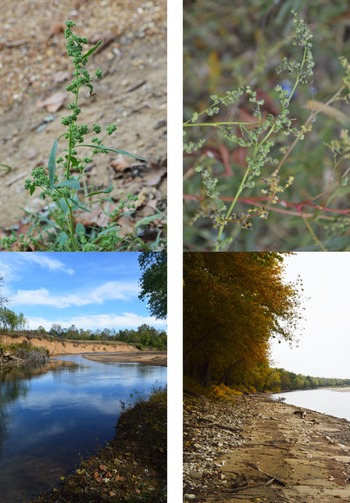
Seed for this experiment came from two populations of C. berlandieri harvested by Mueller in 2017. Seed lots were numbered by population and gathered from at least 10 plants, or all plants if the population was less than 10. CB002 was harvested on October 17 on the Big River, in Jefferson County, Missouri. CB004 was harvested on November 6 on the Mississippi River, in Madison County, Illinois. Both populations were diffuse stands of small to medium (0.25–1.50 m) plants growing in partial shade on sandy riverbanks. Plants in both populations were not senesced and still had flowers present when harvested (Figure 2).
Free-living parent populations: (left) CB002, (right) CB004. Note that parent population plants were not senesced when harvested. Compare with offspring in garden environment illustrated in Figure 3. (Photographs by Natalie G. Mueller.) (Color online)

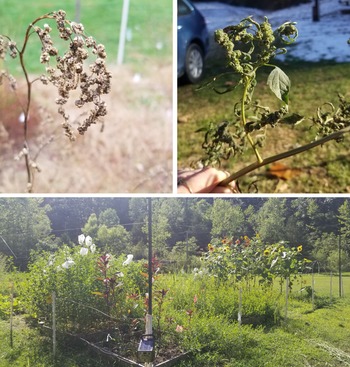
In the spring of 2019, a 1.5 mL random sample of seeds from each seed lot was cold stratified in distilled water for one month at 4°C (March 20–April 23, 2019) to begin the germination process. Next, seeds were lightly pressed into moist potting soil—one seed per cell in 72 cell trays—and placed on a mist bench in the greenhouse at Washington University under light for 12 hours/day. After approximately six weeks, on June 6, 2019, Williams transplanted 10 seedlings from each population into a raised bed at the Center for American Archaeology in Kampsville, Illinois (Figure 3). Ten plants (replicants) from each C. berlandieri population were planted at intervals of 16.5 cm in a raised bed measuring 1.2 m2, split into four quadrants to distribute plants from both populations evenly across the bed, and they were watered as needed for two weeks after transplanting. Soil in the raised beds was a mixture of commercial topsoil and compost. Plants were surrounded by an electric fence to prevent predation, and the bed was kept weeded so that there was no competition from other plants. Each plant was measured and scored for phenology on a weekly basis from June to October of 2019. Mueller harvested plants as they senesced, beginning on October 28, 2019. She considered plants with dry and brittle leaves and stems and with no remaining flowers to be senesced (Figure 3). On November 16, Mueller harvested all remaining plants, including those that were not yet senesced, because the first heavy snow was forecast. This procedure serendipitously resulted in a sample of five harvests from senesced plants and five harvests from not yet senesced plants from each population.
Experimental garden: (top left) an example of a fully senesced plant harvested on October 28; (top right) an example of a plant harvested before senescence on November 15; (bottom) a view of the garden environment in mid-August. The Chenopodium plants are on the left with the white isolation bags on their branches. (Photographs by Natalie G. Mueller.) (Color online)

Mueller harvested by cutting off the entire plant at ground surface, transported them back to the lab in individual labeled paper bags, and dried them for several days. After drying, Mueller hand-stripped the seeds, then weighed the dried and stripped plant (minus the roots) to provide a final overall measurement of plant size. The seeds, including abundant chaff, were thoroughly dried on custom drying racks for two weeks, then weighed and stored in paper bags at 0°C. In fall 2020, Belcher cleaned each sample by threshing and winnowing. Threshing is the process of removing seeds from other plant material, or chaff (e.g., leaves, flowers, stems). To thresh, each individual harvest was rubbed between gloved hands to release the seeds and pulverize the chaff. This step facilitates the subsequent separation of the seeds from chaff via winnowing. A custom vacuum winnower was used for this process (Mueller et al. Reference Mueller, White and Szilagyi2019). After cleaning the seeds, we recorded the mass (g) for each sample, then used a sample splitter to obtain a random subsample for sorting.
Testa thickness is correlated with seed color: lighter-colored seeds have thinner testas (Halwas Reference Halwas2017; Smith Reference Smith1985). Because we needed to characterize thousands of seeds, we sorted them by color (red vs. black) as an expedient proxy for testa thickness, which can only be directly measured after dissecting individual seeds. We determined a sample proportion of red morphs for each plant by sorting 300 seeds into red and black categories under low magnification (10×–40×, see Figure 1). We determined sample proportions for 20 experimental plants and two parent populations, for a total of 6,600 sorted seeds. We used t-tests to determine whether mean sample proportions were significantly different between populations or between plants that were harvested before versus after senescence. We also compared the sample proportions of experimental replicants to those of their parent populations.
Carbonization Experiment
We conducted exploratory experiments to determine the time and temperature conditions required to carbonize goosefoot seeds while maintaining their diagnostic morphological characteristics. Belcher sorted seeds from population CB002 by color, then placed them in the preheated Thermolyne muffle furnace under approximately 1 cm of sand in a small crucible. After the amount of time at temperature specified in Table 1, she assessed each seed for carbonization and preservation. Seeds that were fully carbonized with their seed margin intact were labeled “carbonized and well-preserved.” Seeds categorized as “carbonized and popped” were fully carbonized but had a ruptured seed margin (Figure 5). These would be impossible to assess for margin shape, and popping might also lead to the disarticulation and loss of the testa. Finally, each seed was carefully opened using a razor blade to assess whether the seeds were fully carbonized. A seed that is incompletely carbonized is less likely to be preserved in the archaeological record.
Summary of Carbonization Experiments.

Results
Growth Experiment
Our two free-living populations had sample proportions of 15% (CB002O) and 34% (CB004O) red morphs (see Supplemental Table 1), which much higher than the 1%–3% estimate used by archaeobotanists to characterize a typical wild assemblage (Smith Reference Smith1985) and similar to Halwas's (Reference Halwas2017:202) survey, where she found a maximum of 30% lighter-colored seeds in free-living populations. We found that the overall sample proportion of red morphs for our garden populations was even higher, at 50%. The two experimental populations did not have significantly different sample proportions (CB002O, n = 10, mean = 49%, std. dev. = 0.15; CB004O, n =10, mean = 50%, std. dev. = 0.09; t-test, p = 0.7828), but both had much higher mean sample proportions of red morphs than their parent populations. Statistical tests could not be performed to compare parent population to garden population, given that each parent population is a sample of one, but in both cases, the sample proportion of the free-living parent population was lower than the entire range of variation for the harvests from its offspring in the garden (Figure 4).
Distributions of sample proportions of red morphs in our study. Boxes show the interquartile range; the center line is the median.

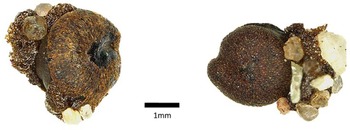
An example of a “popped” and carbonized seed from one of our carbonization experiments. Most of the seeds labeled “popped” broke into two pieces (two halves of the testa) and left the inner perisperm and embryo exposed. Granules of sand are attached to the exposed inner parts of the seed. (Color online)

Phenological stage seems to play a role in determining red morph proportion (Figure 4). Senesced plants, whether they were harvested late or early, produced relatively low thin-testa morph proportions (mean = 42%, std. dev. = 0.09) when compared to proportions from plants harvested during their final fruiting stage (mean = 57%, std. dev. = 0.10; t-test, p = 0.0025). This supports the hypothesis that red morphs are immature or juvenile seeds. Note that the two free-living parent populations produced fewer thin-testa morphs than their garden-grown offspring despite the fact that neither was senesced when the seeds were harvested (Figure 4). If all other things were equal, they should have had relatively high proportions of thin-testa morphs, like garden plants harvested before senescence, but this was not the case.
Carbonization Experiment
Contrary to our expectations, we found that thick-testa morphs are less likely to be completely carbonized and well preserved than thin-testa morphs (Table 1). The range for percentage of well-preserved, carbonized thin-testa morphs was 20%–100% across all experiments, whereas for thick-testa morphs it was 0%–80%. Thick-testa morphs are more likely to rupture when carbonized, making it less likely that they will be observable in carbonized archaeobotanical assemblages. No single experiment yielded a 100% carbonized, well-preserved sample of both morphs. For thin-testa morphs, treatments at temperatures 300°C–400°C yielded 90%–100% fully carbonized, well-preserved seeds. This range of treatments, capable of creating well-preserved assemblages of red morphs, cumulatively only preserved 0%–20% of black morphs. Black morphs were best preserved by a treatment of 10 minutes at 300°C, which was not sufficient to carbonize 80% of red morphs, suggesting that all carbonized assemblages are biased but not necessarily always in the same direction.
Discussion
This study adds new dimensions to the story of goosefoot domestication in eastern North America and has implications for how analysts interpret goosefoot assemblages, especially carbonized ones. The simplified narrative of goosefoot domestication generally agreed upon by archaeologists in eastern North America is that past peoples gathered the seeds of wild goosefoot either in their natural habitats or as an encouraged weed in cultivated fields (Anderson Reference Anderson1952; Asch and Asch Reference Asch and Asch1977; Mueller et al. Reference Mueller, Spengler, Glenn and Lama2021; Rindos Reference Rindos1984; Smith Reference Smith1992; Struever and Vickery Reference Struever and Vickery1973). Goosefoot was domesticated because of selective pressures exerted by human actions and relaxation of selective pressures that affect free-living populations, although domesticated populations were never completely isolated from wild and weedy ones (Asch and Asch Reference Asch and Asch1977; Gremillion Reference Gremillion1993a, Reference Gremillion1993b; Halwas Reference Halwas2017). The plant domestication process is often simplified as linear in the archaeological literature, with archetypal wild and domesticated seed morphs that have clear, identifiable traits. Any seeds that do not fit these criteria are the intermediate forms that represent a point somewhere between wild and domesticated. For our character of interest, it has long been clear that “there is no evidence that seed coat thickness was reduced in a gradual, linear fashion in the past” (Gremillion Reference Gremillion1993a:160). Even so, paleoethnobotanists assign labels such as “domesticated,” “cultivar,” “intermediate,” “weed,” and “wild” to seed types in carbonized or desiccated forms, seemingly as a shorthand or heuristic device (Asch and Asch Reference Asch and Asch1977; Fritz and Smith Reference Fritz and Smith1988; Gremillion Reference Gremillion1993b; Patton and Curran Reference Patton and Curran2016; Smith Reference Smith1984, Reference Smith1985; Smith and Yarnell Reference Smith and Yarnell2009).
Our results suggest that this kind of characterization is obscuring our understanding of Chenopodium domestication, because these plants are incredibly plastic and produce a spectrum of seed types. First, the idea that only 1%–3% of seeds harvested from free-living goosefoot will be red morphs must be laid to rest, along with the associated interpretations of individual seeds with thin testas as domesticated types. Our data demonstrate that nondomesticated plants can produce up to 77% red morphs when cultivated (Figure 4). No garden-grown plant produced less than 35% red morphs. Our small sample from free-living populations produced 15%–34% of this seed type (Figure 4). Unexpectedly, our carbonization experiments also showed that red morphs are likely to be overrepresented in carbonized assemblages compared to black morphs. This means that mixed, carbonized assemblages, even with a very high proportion of red morphs, cannot be interpreted as evidence of a domesticated subspecies. In addition, it is time to retire the “intermediate” or “weed” category from Chenopodium analyses (e.g., Fritz Reference Fritz1986:83; Gremillion Reference Gremillion1993b:499; Patton and Curran Reference Patton and Curran2016:143; Smith and Yarnell Reference Smith and Yarnell2009:6564). This category is based on two observations that appear to be invalid: (1) that thin-testa morphs are rare in harvests from nondomesticated plants and (2) that there is a clear break in testa measurements between thin-testa morphs (<20 μm) and thick-testa morphs (>40 μm). Although we did not measure testa thickness for this study, Halwas's (Reference Halwas2017:201) sample, which included all seed phenotypes, varied continuously between 25 μm and 47 μm.
We have used “free-living” rather than “wild” in this article in recognition of that fact that all Chenopodium on the landscape in eastern North America is weedy, both in the ecological sense and in the sense that is has been evolving in anthropogenic landscapes for thousands of years (Harlan and De Wet Reference Harlan and De Wet1965). It is impossible to know whether the free-living plants that we have studied and cultivated, or those analyzed by Asch and Asch (Reference Asch and Asch1977, Reference Asch, Asch and Ford1985), Smith (Reference Smith1992), Patton and Curran (Reference Patton and Curran2016), and Halwas (Reference Halwas2017) have the same evolutionary history. Part of the explanation for the divergent observations that researchers have made over the years (Asch and Asch Reference Asch, Asch and Ford1985; Halwas Reference Halwas2017; Patton and Curran Reference Patton and Curran2016; Smith Reference Smith1992) could be the remarkable plasticity of this species. But we may also be blindly sampling from a mix of feral descendants of domesticated plants, those whose ancestors were never cultivated, and members of both groups that have since hybridized with each other and other Chenopodium species, of which there are many. Only genetic analysis can begin to tease out these differences in lineage and their influence on phenotype.
We are emphatically not suggesting that there is no domesticated goosefoot in the archaeological record of eastern North America. Well-preserved (mostly uncarbonized) assemblages in the Ozarks, in Appalachia, and at Riverton do not look like any assemblage of seeds from modern populations of C. berlandieri that we have ever seen. Moreover, there appear to be multiple different landraces of domesticated goosefoot. Examples include the famous assemblage stored in a beautiful woven bag at Edens Bluff, Arkansas, which is made up of relatively uniform uncarbonized goosefoot seeds with thin, black, faintly honeycomb-pitted testas (Figure 1; Fritz Reference Fritz1986:85). The relative homogeneity of this assemblage is apparent even in comparison to other domesticated assemblages: it had the second-lowest coefficient of variation for seed diameter among the 18 assemblages that Gremillion (Reference Gremillion1993a) compared. This uniformity does not occur in modern free-living populations that we have seen or that others have reported. A later assemblage from nearby Holman Rockshelter is made up of seeds with smooth, golden testas, the so-called pale variety, entirely different from the Edens Bluff landrace (Fritz Reference Fritz1984; Wilson Reference Wilson1981; see Figure 1). This seed color is rare in modern populations, and no one has yet documented seeds from free-living plants that lack an outer epiderm. Consequently, although thin-testa goosefoot seeds are characteristic of this species’ domesticated forms, the presence of this phenotype alone in a mixed assemblage—especially a carbonized one—is not necessarily indicative of domestication or any evolutionary change in that direction. Rather, goosefoot produces polymorphic seeds under a variety of conditions, and it is the loss of this plasticity, evident in internally homogenous but unique assemblages like those at Edens Bluff and Holman, that is the true marker of domestication.
If variation in red morph proportion is not a reliable indicator of evolution toward a domesticated form, or of the presence of distinct weed populations, then what does it reflect? Our research shows that senesced goosefoot plants have more thick-testa seeds than plants that have not yet senesced (Figure 4). Consequently, a mixed assemblage with a high proportion of thin-testa morphs may be interpreted as a harvest taken before senescence, which is an agricultural practice with potential evolutionary effects. Over the course of many generations, such a harvesting practice could have selected for populations that matured simultaneously if the seeds of early senescing plants were disadvantaged in subsequent plantings by having a higher proportion of dormant seeds. Such a harvest strategy could also facilitate the switch from a preexisting seed dispersal strategy, likely endozoochory (dispersal in animal feces) in the case of goosefoot. By beating herbivores to the harvest, humans can insert themselves into the life cycle of annual plants as seed dispersers, relaxing selective pressures to maintain tough seeds that can survive digestion (Spengler and Mueller Reference Spengler and Mueller2019).
Our most significant result is that the garden environment caused the goosefoot plants in our experiment to produce more thin-testa morphs than their free-living parent populations. Red morph proportions in cultivated populations were universally higher than those of free-living parent populations, and Halwas's (Reference Halwas2017) study demonstrated the same phenomenon. These data suggest that something about cultivation or the garden environment triggers goosefoot plants from many different local populations to produce more red morphs. Follow-up experiments will be necessary to determine what it is about the garden environment that elicits this response from goosefoot. For now, we can say that goosefoot responds to cultivation in a way that would have been immediately beneficial to ancient farmers. It may have been partly this plasticity that encouraged people to deepen their relationship with this plant.
Conclusions
We used common garden and carbonization experiments to explore the determinates of goosefoot seed morphology in the archaeological record in order to better understand the domestication of this species. Our data demonstrate that nondomesticated goosefoot produces a much higher proportion of thin-testa red morphs (an average of 50% in our garden experiment, 15%–34% in free-living parent populations) than the previously accepted estimate of 1%–3% (Smith Reference Smith1985). Within the experiment, the proportion of red morphs is significantly higher in harvests taken from plants before senescence, supporting an interpretation of these seeds as differentially developed. However, this did not hold true when comparing free-living plants with their garden-grown offspring. Harvests from cultivated plants, whatever their phenological stage when harvested, contained more thin-testa morphs than those from their free-living parent populations, even though the latter were not senesced when harvested (Figure 4). This suggests that, overall, the garden growth environment is the best predictor of red morph prevalence, although more harvests of free-living plants could strengthen this conclusion.
Our observations do not support previous interpretations of phenotypically mixed Chenopodium assemblages as deriving from distinct domesticated versus wild/weedy populations (Gremillion Reference Gremillion1993b; Patton and Curran Reference Patton and Curran2016; Simon and Parker Reference Simon and Parker2006; Smith and Yarnell Reference Smith and Yarnell2009). Such assemblages could just as easily have come from a single population, or even a single plant. We also showed that thin-testa morphs are more likely to be preserved via carbonization than thick testa ones. Analysts should therefore exercise caution interpreting carbonized assemblages, given that red morphs are likely to be overrepresented wherever they occur. We suggest that mixed, carbonized assemblages of goosefoot, even with a very high proportion of red morphs, are better interpreted as harvests taken from free-living plants before they were completely senesced or from a cultivated population rather than as evidence for domestication per se. Yet by drawing on studies of well-preserved, desiccated assemblages, we can see that domesticated assemblages of goosefoot do occur, and that their hallmark is a loss of seed polymorphism.
Seed polymorphism in wild goosefoot is an example of a plastic trait that allows weedy plants to adapt swiftly to environmental variation (Herman and Sultan Reference Herman and Sultan2011; Mueller Reference Mueller2017b; Zeder Reference Zeder2018). Mueller and colleagues (Reference Mueller, Fritz, Patton, Carmody and Horton2017) have previously argued that plasticity could have been an important prerequisite for domestication if it allowed early cultivators to see immediate benefits from their interventions. For example, by harvesting free-living goosefoot before it was completely senesced or cultivating it in settings similar to our raised bed, ancient people would have obtained a harvest that was immediately both more palatable and more likely to germinate when planted—without any selection for domesticated traits. Genetic assimilation is the fixation of a plastic trait so that it occurs irrespective of environmental triggers. When human-constructed niches are predictable, stable, and maintained for many generations, they are suitable places for (1) the fixation of plastic traits that confer advantages within the constructed niche and (2) the loss of plasticity through genetic assimilation (Pigliucci et al. Reference Pigliucci, Murren and Schlichting2006). We can see this outcome in some of the best-preserved assemblages of ancient domesticated goosefoot (Figure 1), making this species one of a growing list where genetic assimilation must be considered as a potentially important part of the domestication process (Lorant et al. Reference Lorant, Pedersen, Holst, Hufford, Winter, Piperno and Ross-Ibarra2017; Matesanz and Milla Reference Matesanz and Milla2018; Ménard et al. Reference Ménard, McKey, Mühlen, Clair and Rowe2013; Mueller et al. Reference Mueller, Horton, Belcher and Kistler2023).
Acknowledgments
We would like to thank the participants in the 2019 NSF Research Experiences for Undergraduates program at Kampsville, Illinois, and the staff and affiliated faculty at the Center for American Archeology, especially Jason King and Jane Buikstra, for helping to collect data and facilitating the experiment. Michael Dyer and the staff at the Jeanette Goldfarb Plant Growth Facility at Washington University cared for the seedlings until we transplanted them. Abigail Cannon assisted with processing the harvests, and Roy Zhu photographed seeds for the carbonization experiment in the Experimental Ethnobotany Lab at Washington University. Kris Gremillion and Gayle Fritz offered valuable feedback on a draft of this manuscript. We are grateful to them and the many other researchers who have carefully and thoughtfully attended to goosefoot domestication in eastern North America over the years.
Funding Statement
The survey to collect seed from parent populations was funded by National Science Foundation Social and Behavioral Sciences Postdoctoral Research Allowance #1714462 (“Growing Lost Crops: Variation under Cultivation in the Eastern Agricultural Complex”), and the experiment was funded by National Science Foundation Research Experiences for Undergraduates #1460787 (“Long-Term Perspectives on Human-River Dynamics at the Confluence of the Illinois and Mississippi Rivers: Interdisciplinary Research for Students in Ecology and Archeology”).
Data Availability Statement
Primary dataset used is located in Supplemental Table 1.
Competing Interests
The authors declare none.
Supplemental Material
For supplemental material accompanying this article, visit https://doi.org/10.1017/aaq.2023.54.
Supplementary Table 1. Common Garden Experiment harvest data for both populations. This table lists the harvest dates from each plant in each population, as well as the proportion of red to black morphs from our morphological analysis.




 Open access

