




Introduction
Mills were central to early modern communities. Diets were primarily grain-based, and grain had to be ground to make dietary staples such as bread, oatmeal, and ale or beer. Meal – unsifted ground grain – and flour spoilt easily, so bakers, brewers, and householders had to grind small amounts of stored grain as and when required, providing the mill with a continuous stream of customers year-round.Footnote 1 Mills provided a vital service for a wide variety of people across the social spectrum, but they were also businesses with the ability to make significant profits. These two aspects of the milling industry were often at odds with one another and led to disputes between mill owners, millers, and the local inhabitants who were their customers. Despite the centrality of mills to everyday life and provisioning, we know very little about their social, economic, and political roles in the local community.
Mill historiography has largely been confined to the period pre-1550 and uses manorial records to examine the milling industry rather than the cultural, social, and economic role of mills within local societies.Footnote 2 It is difficult to find an equivalent source base for early modern milling, and mills are largely absent in the historiography.Footnote 3 Mills rarely appear in studies of individual communities that have shaped much of our understanding of local society and economics in this period.Footnote 4 When mills do feature, it is either a simple recognition of their existenceFootnote 5 or discussion is confined to rental value, land tenure, estate management, milling infrastructure, and changing technology. Such studies have primarily used estate surveys, leases, buildings, or financial accounts, along with some relevant litigation. Whilst offering an insight into mill management by owners or lords of the manor, these studies do not investigate the everyday politics of grain provisioning, and the voices of customers are absent.Footnote 6
Wider scholarship on the politics of grain marketing and provisioning has primarily focussed on scarcity and riot, with less attention paid to more everyday grain provisioning processes.Footnote 7 Mills occupy an awkward position in the wider grain trade. Milling was a vital part of grain provisioning but stood adjacent to the grain trade and market prior to the mid-eighteenth century, particularly in rural areas. Rural mills provided a local service to consumers in a community, including householders as well as bakers. In London and other large urban centres mills provided a wholesale trade to bakers for a largely bread-buying (rather than grain-buying) population at a much earlier date.Footnote 8 Mills were not implicated in debates over grain prices and supply prior to the mid-eighteenth century, evident from the rare appearance of mills as targets of food riots before 1740.Footnote 9 Grain at most mills prior to this was the consumers’ own grain, not a market supply being stored or hoarded for wholesale trade. The role of mills changed across the eighteenth century as they became integrated into the grain market, operating as wholesale concerns and significant players in national and international markets.Footnote 10 It was eighteenth-century merchant-millers who were the focus of E.P. Thompson’s argument of a transition from a moral to a market economy. He argued that prior to the eighteenth century, the market was regulated according to paternalistic values, traditional rights and customs, in which there was a transparent and direct trade between producer and consumer. Paternalism was defeated in the eighteenth century by a free-market perspective, with less government intervention and direction by supply and demand. In making this argument, Thompson dismissed earlier disputes at the ‘little country mill’ as concerned with ‘quaintly medieval customs’.Footnote 11 However, this article argues that such disputes complicate Thompson’s transition from a moral to a market economy.
The legal disputes examined in this article mainly concern a custom known as a ‘suit of mill’, whereby a manorial or demesne mill – part of the social, economic, and legal framework of the manor and paying an annual fee farm rent to the Crown – claimed to have customary rights that compelled manorial inhabitants to grind all the grain ‘grown, used and spent’ in their houses at that mill. In so doing, the manorial mill monopolised the multure, or toll, a percentage of the grain taken before grinding as payment, in the local area. Thus, it guaranteed custom and profits by eliminating competition. Suit of mill disputes arose from three scenarios: someone built a competing mill in the area, tenants and inhabitants carried their grain to other mills, usually outside the manor, or tenants and inhabitants used private horse or hand mills for their household or business. Failure to observe the custom could lead to prosecution and fines, but there were caveats. The manorial mill had to be sufficiently maintained and repaired to serve customers, and if due to lack of repair or excess demand customers could not be served within a specified time limit, usually between 24 and 48 hours, they were permitted to use a different mill.Footnote 12 Suit of mill was never introduced by statute law but was a temporally and geographically varied custom incorporated into various legal systems over time.Footnote 13
The importance of the suit of mills to the milling sector has been debated by historians. Marc Bloch and Pierre Dockes argued that the suit of mill was a pervasive tool of lordly oppression enforced through legal means, which was ‘nothing but a means of exploitation’, leaving ‘tenants always the losers’.Footnote 14 Subsequent work has questioned the extent and impact of the suit of mill in England. Holt argued it was only unfree tenants who were obliged to use the manorial mill and, therefore, the suit of mill was an important but not an essential element of milling.Footnote 15 However, Langdon has demonstrated that both free and unfree tenants were obliged to grind at manorial mills and that the suit of mill was ‘pervasive’, albeit with some ‘exceptions and complications’ in geographical spread and level of enforcement.Footnote 16 Langdon further estimated that, in the fourteenth century, manorial mills made up 40 per cent of the milling sector south of the Humber in England and a greater percentage in the north. The remaining 60 per cent was split three ways between tenant (or independent) mills, which had been leased out by lords but then slipped into hereditary tenure; borough mills owned by incorporated bodies, which came under urban rather than manorial authority; and domestic horse- or hand-mills owned privately and considered as movables.Footnote 17 The independent sector was thought to be overestimated, featured smaller mills, and included more non-agricultural mills than the manorial sector.Footnote 18 Whilst comprising the largest chunk of the milling sector, not all manorial mills maintained suit of mill custom. Mediaevalists have documented a decline in suits of mill litigation in manor courts following the mid-fourteenth-century Black Death, but the custom continued or was reinstated in many locations, and from the late sixteenth century, disputes were increasingly tried in the Court of Exchequer.Footnote 19 John Orbell found that whilst the suit of mill had disappeared in the South and East by 1780 and the Midlands by 1800, it continued longer in the West Country and the north of England. It is well documented that in certain northern manors, the custom was bought out by tenants in the nineteenth century for amounts over £10,000.Footnote 20 In the South and Midlands, the custom appears to have faded out gradually rather than being bought out but is far less well-documented or discussed.Footnote 21 For example, Bennett and Elton argued that whilst some mills still ‘theoretically’ held suit of mill in the eighteenth and nineteenth centuries, it had long been found ‘impracticable and undesirable to enforce’ the custom.Footnote 22 How and why this was the case are not discussed.
Whilst mediaevalists have documented a decline in suits of mill after the Black Death and later studies have demonstrated the longevity of suits of mill in certain areas, a lack of sources for early modern milling means that the enforcement and decline of suits of mill across the seventeenth and eighteenth centuries have not been studied. This article uses a case study to investigate the ways in which the suit of mill was enforced during the early modern period and provides an example of how transformations in the grain market and modes of provisioning, which are widely stated by historians to have occurred by the end of the eighteenth century, could be responsible for the suit of mill custom fading out.Footnote 23 It also highlights the utility of litigation, particularly suit of mill cases, for investigating the social, political, and economic history of early modern milling. Mill litigation used in this article was collected as part of a survey of Exchequer litigation between 1558 and 1815 which identified over 1200 pleadings relating to mills, just under 60% of which concerned suits of mill.Footnote 24 The Exchequer dealt with disputes over royal manors, lands, and issues affecting Crown revenue; hence, manorial mills fell under its remit.Footnote 25 Although skewed in favour of large manorial watermills, Exchequer cases comprise a significant source for the historian of early modern milling. Exchequer records are recognised as particularly useful sources for customary disputes, particularly depositions which provide more information on the broader context of disputes and include testimonies from a wide range of people.Footnote 26 For mill disputes, this includes not just manorial lords and millers but also the servants, tradesmen, yeomen, and families that made up the mill’s customer base.
To investigate the social life of a mill, this article uses a case study of disputes over a set of watermills in the South Devon market town of Bovey Tracey, situated on the river Bovey and at the edge of Dartmoor, over a period of approximately 150 years. Bovey Tracey was given borough status in the early thirteenth century and granted a market in 1219. The town was notable for its late mediaeval cloth industry and later for lignite and clay used for pottery. Arable and pasture farming was carried out on small farms and by landowners to provide food for the area, with other produce brought in from the pastoral lands of Dartmoor and the rich arable lands of the nearby South Hams and the Vale of Exeter.Footnote 27 Bovey Tracey’s watermills had existed on the same site since before the Domesday survey in 1086, were manorial, paid a fee farm rent, and, as four Exchequer decrees confirmed, were owed suit of mill by tenants and inhabitants of the parish, manor, and borough.Footnote 28 As a case study, it does not claim to represent practices and regulation across the entire milling industry. It focuses on watermills, which were dominant in manorial milling due to their revenue-raising capabilities.Footnote 29 Wind and horse mills could also be manorial but were not present in Bovey Tracey. The case study cannot account for challenges faced by mills in urban areas or the impact of milling on the poor, who were invoked in litigation as a rhetorical tool but never appeared as deponents.
Bovey Tracey was chosen because it reflects key issues that appeared across the litigation and is particularly well-documented. Fourteen Exchequer bills were entered between 1599 and 1722; thirteen concerned the suit of mill, and the other concerned a charitable endowment attached to Bovey Mills. Eight bills had surviving depositions, and four proceeded to a hearing and final decree, with the last decree in 1732. The spread of cases matches the spread of Exchequer mill litigation overall, with a peak in the early seventeenth century, a decline later in the century, and a sharp drop of cases in the eighteenth century.Footnote 30 Further records include litigation in the Courts of Star Chamber, Chancery, and Requests as well as the local borough court and manorial surveys. Bovey Tracey manor and parish records are not extant for this period. Manor courts did hear suits of mill cases, and Exchequer deponents recalled tenants and inhabitants having been previously ‘presented and amerced’ there for violations.Footnote 31 However, by the seventeenth century, manor courts heard less substantial and more quotidian concerns over milling that would not qualify for trial at the Exchequer.Footnote 32 Minor milling infringements were also tried at the assizes and quarter sessions.Footnote 33 Bovey Tracey quarter sessions records survive but are not catalogued, and a manual search would be too time-consuming.Footnote 34
Throughout the early modern period, owners of Bovey Mills, all also lords of the manor, encountered challenges to the suit of the mill from inhabitants and owners of rival mills. Litigation survived from the end of the sixteenth century, just as Thomas Southcott junior took over the manor from his father, Thomas senior, who died in 1600. During Southcott Junior’s tenure, Bovey Mills faced competition from rival watermills both within and outside the manor. Those within the manor were built in the late 1590s on the Pullabrook estate by John Skirdon, and those outside the manor were within a 5-mile radius, in Chudleigh, Kingsteignton, and Hennock and were independent mills, not subject to manorial authority. The same mills continued to plague the Everleigh family. Nicholas Everleigh was lord of the manor from 1609 until his death in 1618, and his brother Thomas managed the mills. These first 20 years witnessed the greatest density of litigation. Whilst scarcity was never mentioned or identified as a motivating factor in Bovey Tracey litigation,Footnote 35 historians have shown that the growing price of agricultural goods and inflation across the sixteenth and seventeenth centuries negatively impacted household economies and contributed to an increase in customary disputes. Inflation also impacted lords, who instituted ‘fiscal seigneurialism’, squeezing as much profit as possible from their resources to increase manorial revenue and coming into conflict with tenants as a result.Footnote 36 One resource that could be exploited was the manorial mill, which surveyor John Norden noted in 1607 could bring in significant profits.Footnote 37 Such fiscal concerns likely contributed to the volume of disputes in Bovey Tracey.
Disagreements over Bovey Mills quietened under the lordship of two philanthropists, Elizaeus Hele from 1618 and John Maynard from 1636, and an absentee lord, John Stawell, from 1658. Under Hele and Maynard, a charitable endowment of £50 per annum, used to establish and maintain the Blue Maid’s Hospital in Exeter, was attached to Bovey Mills on top of the fee farm. The management of the charitable endowment was the subject of dispute in the 1640s and 1660s.Footnote 38 Between the 1620s and 1680s, Pullabrook Mills decayed and were non-operational, and disputes concerning rival mills outside the manor were limited. In the later 1680s, under the lordship of William Stawell, Pullabrook Mills were ‘reedified and repaired’ by William Southmead and were once again the subject of dispute.Footnote 39 However, the resurrection of Pullabrook Mills was short-lived. In the 1690s, William Stawell purchased and demolished the mills and inserted a clause in the Pullabrook estate lease instructing the leaseholder ‘not to rebuild or use the same’.Footnote 40 Eighteenth-century challenges to the suit of mill were concentrated on hand mills, owned and operated by several tenants and inhabitants, and rival mills outside the manor selling pre-ground grain at Bovey Market. Bovey Mills survived into the twentieth century, but litigation ceased in the mid-eighteenth century, as discussed in the final section.
The day-to-day business of milling
The detailed nature of equity litigation, which examined the wider circumstances and background of a case, allows for an insight into the everyday operation of mills, which is not evident in the less detailed mediaeval manorial records. Suits of mill litigation particularly concern the mundane physical act of taking grain to be ground, what happened in the mill, costs of mill operation, who benefited from it, and the impact of mills on household economies. The following demonstrates how much information equity litigation can reveal about everyday milling practices and the milling business.
Mills were significant economic assets but costly to build and maintain. At the turn of the seventeenth century, a third mill was added to Bovey Mills at a cost of £100, and Pullabrook Mills were claimed to have cost Skirdon 100 marks (£66 13s 4d) to build.Footnote 41 Expense did not end at building, as machinery and watercourses had to be maintained and repaired, responsibility for which varied and was laid out in leases.Footnote 42 Without surviving accounts, exact costs cannot be analysed, but repair costs were estimated in litigation: in 1601 as £90 over the past three years and in 1613 as £30 in three years.Footnote 43 Manorial tenants were obliged to repair the weir and watercourse serving Bovey Mills, offsetting repair costs. Weirs were crucial for controlling and directing water to the waterwheel and costly to maintain.Footnote 44 Mill repairs could simply be a result of wear and tear, or they could be the result of deliberate acts of vandalism. In the early 1600s, it was claimed certain tenants, rebelling against the suit of mill, had ‘pulled upp the ground worke of certayne sluce hatches’ which directed water to Bovey Mills and prevented flooding.Footnote 45 Repairs needed to be carried out swiftly to retain customers and maintain profits, as well as skilfully, to maintain good quality grinding. Therefore, a variety of tradesmen were employed by mills, from millwrights and carpenters to blacksmiths and tanners, all of whom had the necessary hydraulic and mechanical knowledge.
Whilst costly to build and repair, mills generated significant profits. The Bovey Mills owners were lords of the manor and did not operate the mills themselves. They paid a fee-farm rent to the crown, which increased slightly from £4 6s 8d in the 1590s to £4 13s 4d in the eighteenth century but lost value in real terms due to inflation. Owners either hired a miller, who was paid wages, or sublet the mill to a miller, who paid an annual rent to the owner. Most lords sublet the mills, and the static fee farm rent lies in stark contrast with the commercial rent charged to the miller. In the 1590s, miller Henry Perry paid a variable rent: £40 per annum ‘yf corne were commonly solde above ffower shillings a Bushell’ and £38 per annum if sold for under 4s a bushel.Footnote 46 By the early 1600s, rent was £52 per annum.Footnote 47 In the 1660s and 1670s, rent was 48s a week or £124 per annum and rose to £150 in the 1680s, far exceeding the fee farm and £50 charitable endowment.Footnote 48 Therefore, whilst underlying costs remained stable, mill owners could increase the rent requested of a miller over time and as grain prices rose. Millers did not complain about rental value in litigation. In contrast, Bovey millers Alexander Surridge, Henry Perry, and William Trippe all stated they would pay more if inhabitants consistently performed suits of mill obligations.Footnote 49 However, if Pullabrook and other mills continued to withdraw custom, Bovey millers argued the mills would lose between 50s (£2 10s) and 20 marks (£13 6s 8d) a year in toll, and that a miller would be unable or unwilling to pay the rent.Footnote 50
Bovey Mills operated with hired millers for periods in the early-mid seventeenth century and the early eighteenth century. Unfortunately, there is no record of millers’ wages. In 1613, John Osburne had ‘the charge and keepeinge of the said customary mills’ under Nicholas Everleigh.Footnote 51 A 1615 manorial survey recorded that the mills were worth £60 per annum, which, minus millers’ wages, was profit for the owner.Footnote 52 In the 1630s, Elise Hele remembered his miller in his will, bequeathing ‘to Hannibal Corbyn my miller fforty shillings’.Footnote 53 In the 1720s, William Maunder was ‘retained by and Entred into the service of’ Christopher Bale as miller and millwright for a year and a half.Footnote 54 A 1722 manorial survey recorded the mills as worth £110 per annum, nearly a quarter of overall manorial income.Footnote 55 This is a significant increase from the fourteenth century, when it was estimated that mill revenue in south-west England made up on average 8 per cent of manorial revenue.Footnote 56
Millers were highly mobile, and Bovey Mills had a frequent turnover of operators. The litigation identifies thirteen Bovey millers, and for nine their tenancy period is given. Five millers were at the mills for under three years. Of the other four, Roger Derry worked there for at least four years; Henry Perry for six years; and the father-and-son team Thomas and Henry Clapp for twenty years. Longer tenancies were therefore the exception rather than the norm. Bovey millers often did not move far, transferring to mills in Chudleigh, Hennock, and Kingsteignton. In the 1690s, Henry Clapp revealed that millers obtained the tenancy of Bovey Mills via a ‘publick survey’, with multiple candidates attempting to outbid one another, suggesting there was always demand for the tenancy.Footnote 57
Competition for tenancy demonstrates the advantage of manorial mills over independent mills like Pullabrook, as the suit of the mill guaranteed custom and tolls that would meet rental values whilst also making a profit.Footnote 58 Pullabrook Mills were owner-occupied, had no monopoly, and were considerably less profitable. In 1689, Pullabrook Mills were claimed to have been worth between £18 and £20 but were now ‘of less yearly value’ due to the suit of mill enforcement at Bovey Mills, which deponents noted comparatively drew profits of between £100 and £120.Footnote 59 The discrepancy in profits demonstrates that the suit of the mill was worth defending at law.
Other mills in Bovey Tracey included hand mills for personal or business use. Hand mills featured in peasant uprisings against manorial mill monopolies, most famously in St Albans in the 1320s and 1330s.Footnote 60 Contrary to the arguments of Bloch and DockesFootnote 61 , hand mills remained important tools of household and business production, and in Exchequer litigation were primarily associated with the manufacture and trade of malt. These mills were small but could increase maltsters’ profits. In Bovey Tracey, John Force took ‘four pence per Bagg for Labour and mill or else two pence if they Grind themselves’. From 100 bags of malt, Force claimed toll worth 33s.Footnote 62 Profits were low in comparison to Bovey Mills but still generated conflict for withdrawing business.
In terms of operation, seventeenth-century Bovey millers claimed the mills operated daily for between 12 and 24 hours, ‘partely by nighte & partely by daye’, depending on demand. The 3 mills together could supposedly grind between 800 and 2,400 gallons of grain a week, which roughly equates to the average pre-1550 mill output calculated by John Langdon of between 64 and 160 gallons per mill per day, or 448 to 1,120 gallons a week. It was estimated by other deponents, particularly those who acted as parish officeholders, that inhabitants used 160 bushels (1,280 gallons) a week.Footnote 63 Weather could affect output, and seasonal impediments were raised by those opposed to Bovey Mills: in dry summers, the mills ‘wanted water’ to operate, whilst in winter ‘frozen’ mill streams inhibited operation.Footnote 64
Grain had to be transported to mills, usually in cloth sacks, and in Bovey Tracey, inhabitants transported it themselves. Many mills kept horses and servants known as loaders to fetch grain from and return ground meal to customers’ houses. However, loaders’ wages and the provision and care of horses increased costs, estimated by one Bovey miller as an extra £10 a year, so not all mills offered this service. Miller Henry Perry deposed that he had fetched grain only for bakers, ‘every Wednesday & Saturday’, in the 1590s. However, baker’s wife Wilmote Coshe deposed in 1602 that this service had ended.Footnote 65 Millers thereafter only loaded to and from ‘forren places’ outside the manor, a service Southcott claimed he was forced to provide due to competition for grist with Pullabrook Mills.Footnote 66 In contrast, rival mills outside the manor were frequently accused of sending loaders and horses into Bovey Tracey, and the 1691 decree explicitly forbade rival ‘Loaders or servants’ entering the ‘mannor Burrough or Parish’.Footnote 67 Some deponents stated that Bovey Mills’ lack of loaders was a key factor in their defection to rival mills. Loaders made milling more convenient for customers, as ‘their laboures then touching that matter ended’ at the point of handing over the grain.Footnote 68 Without a consistent loading service, there was significant footfall at Bovey Mills – bakers seemingly ground twice a week, and for other customers, the estimates of usage per week suggest once.
The regular need for ground grain for household and business provisioning meant that milling had significant implications for household subsistence. Speed was an important factor. Customers expected grain to be ground ‘in convenient time’, and delays were criticised. For example, in 1599, John Pinsent’s grain was detained for much longer than promised, ‘which corne he hath in the meane time needed for the provision of his house’.Footnote 69 Similarly, in the 1680s, Nicholas Sampson’s grain was ‘soe longe kept in the millers hands … that he was forced for the support of his family to Buy Bread’ instead.Footnote 70 Delays particularly affected bakers, who were often poorer members of the community and at the mercy of mills for their livelihood: baker Joseph Taylor argued he had not received his ground grain ‘in convenient time to supply his customers’.Footnote 71
More important, though, was the toll. Toll was the central concern of both millers, who sold it to pay rent and make a profit, and their customers, who sought the best yield for their money. Deponents in Bovey Tracey often reported that they had been ‘greatlye ympoverished by taking of Excessive Tolle’. The amount of toll taken varied geographically, and the rate is rarely referred to in documentation unless it was under dispute.Footnote 72 In Bovey Tracey, the amount of toll is not specifically referenced in earlier cases. In the 1680s, deponents gave figures that suggest the usual toll was one-sixteenth part of the customers’ grain but argued Bovey millers had been taking rates akin to one thirteenth part or more.Footnote 73 The rate of one sixteenth part corresponds to the normal rate of toll identified by Langdon earlier in the fourteenth century across southern England.Footnote 74 The economic impact of excessive toll is evident from baker Bartholomew Prowse’s deposition in the 1680s, in which he stated that Pullabrook Mills would grind his grain for ‘one pound on every Bushell lesse for toll’ and that over a year, the amount saved would be ‘sufficient to pay his howse Rent’.Footnote 75 Similarly, in the early 1600s, Wilmote Coshe complained her family had been ‘undon by the abuses’ suffered at Bovey Mills.Footnote 76 In the eighteenth century, a shortfall in capacity or delays in grinding were supplemented by hand mills and the local market where inhabitants could then buy meal or flour, whereas previously they had only been able to buy unground grain.Footnote 77
Equity litigation can therefore reveal a good deal of information about the everyday operation of mills, the services offered, and the economic implications for business owners and customers. The following section examines the social and political arguments made over mills at law, the motivations behind legal action, and what they can tell us about the place of mills within an early modern community.
Legal action over milling
Across the litigation, three groups with different motives can be identified: manorial lords and owners of Bovey Mills; rival mill owners and millers; and, most importantly, the customers, who appeared as deponents. As Langdon has argued, over time, the main objective of the suit of the mill for lords became to retain profits and eliminate competition.Footnote 78 For rival mill owners, their motivation in enacting or responding to litigation was to establish their businesses. Customers were somewhat caught in the middle, but their prime motivation was to reduce their grinding costs and improve services. Economic concerns were therefore central, and a suit of mill was a recognised legal avenue through which to express these grievances.
As was typical in customary disputes, litigants used the rhetoric of paternalism, moral obligation, and good lordship.Footnote 79 Manorial lords argued they had met their obligations to the inhabitants in repairing and improving the mills at their own great cost. Therefore, it was only right that inhabitants kept up their side of the obligation by grinding at the mills provided. Deponents supporting Southcott and Everleigh in the early 1600s emphasised the morality of their actions, stating that both lords had instructed their millers to ‘take lesse tole then was due of every mans corne & of the poorer sorte … noe tolle’ – the poor never appeared as witnesses to attest to this themselves.Footnote 80 The addition of the £50 charitable endowment added further force to paternalistic arguments. A 1661 Exchequer dispute concerned one of the charitable trustees refusing to seal the agreement to sell the mills to John Stawell, who argued that without the seal, no inhabitant could be bound to grind at the mills and profits would decrease, threatening the charitable payment.Footnote 81 In the 1720s, charity trustees answering Bale’s Exchequer bill claimed the endowment did ‘in a great measure if not all together depend upon a due performance of the Customs Suits and Services to the said mills’.Footnote 82 The mills were presented as part of a wider network of moral obligation, rather than for the lord’s economic self-interest.
Rival mill owners or millers, likewise, used the language of paternalism, arguing they were acting for the commons by providing alternate and better services. Rival mill owners were often members of the better sort with their own self-interested reasons for engaging in conflict and were accused of acting as ringleaders in the community to provoke disorder and organise opposition.Footnote 83 In the early 1600s, John Skirdon, owner of the rival Pullabrook Mills and a substantial copyholder, and his associates were described as ‘principall movers of the common sorte’ who had ‘incited & sturred uppe’ the people ‘to vex & trouble’ Southcott.Footnote 84 Skirdon described his motivation in building Pullabrook Mills as to aid inhabitants who had been subject to excessive tolls, and particularly the poor whose small amounts of grain had supposedly been thrown ‘out of the doore’ by the Bovey millers.Footnote 85 Subsequent rival mill owners and owners of hand mills all made similar arguments over ill usage, excessive tolls, and their own good service in the community. To what extent these individuals were concerned with the plight of the poor is debatable, but the argument provided moral justification for what might have been simply commercial interests.Footnote 86
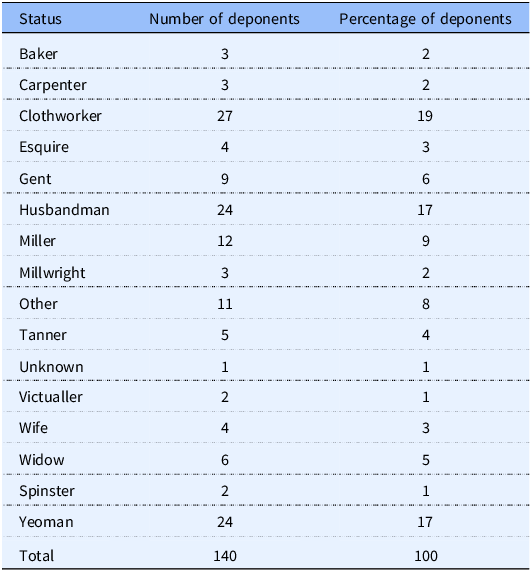
In contrast, the ‘commons’ or customers did not call for customary protection or request that the lord live up to paternalistic duties and obligations,Footnote 87 but openly advocated for their own economic self-interest and liberty. Complaints revolved around the ‘unreasonable’ or ‘excessive’ toll taken at Bovey Mills and the poor quality of the meal received. They argued that rather than being governed by custom and obligation, which provided neither just price nor good service, milling should be governed by market forces: grinding at the mill where the customer felt they were ‘best used’ in terms of quantity and quality of meal received. This argument was not successful at law but was continually restated over the period and was a rallying point for community action. Wider community views are evident when inhabitants served as plaintiffs and defendants but more so in the vast deposition material. Exchequer and Star Chamber depositions provide testimony from 140 individuals, some of whom deposed more than once, and Table 1 outlines their occupational status. Clothworkers made up the largest category, reflecting the primary industry of the area.Footnote 88 Yeomen and husbandmen, who grew grain on their own land, comprise the second largest categories. Eleven of the twelve millers who deposed were millers of Bovey Mills, whilst William Poole milled at Kingsteignton. Only twelve deponents were women, and all were described as either wives, widows, or spinsters. ‘Other’ includes a variety of tradesmen, including a merchant, a blacksmith, and a shoemaker. The percentages of each category do not vary significantly over time. The strength of feeling in Bovey Tracey over milling rights was significant, dividing these deponents and the community between those in favour of the customary mills and those opposed.
The occupational status of Bovey Tracey deponents in the Courts of Exchequer and Star Chamber.
The extent to which mill owners were prepared to fight to eliminate rival mills is evident in the numerous bills and counter-bills entered by Southcott and Skirdon in the early 1600s. Both men clearly had money to spend at law. In 1613, Southcott claimed lawsuits had cost him £500 and believed Skirdon had spent a similar amount. Footnote 89 Part of those legal costs were spent on related litigation in the Star Chamber, accusing one another of perjury and slander. Skirdon’s accusation of perjury was an attempt to overturn the Exchequer’s verdict in favour of Bovey Mills, while Southcott’s accusation that Skirdon slandered court officials was clearly intended to discredit him in ‘a multi-pronged campaign of litigation’.Footnote 90 In the end, Southcott came out on top. The Star Chamber litigation, concerned with slanderous words spoken in the community, provides further context to these cases and the many venues and avenues inhabitants used to complain that Southcott was curtailing their freedom to find the best service and causing economic damage.
In 1601, a group of Bovey Tracey inhabitants brought an Exchequer case against Southcott, protesting a 1599 decree in favour of Bovey Mills, which required all inhabitants to grind at Bovey Mills and only use rival mills if their grain remained unprocessed after 24 hours.Footnote 91 Star Chamber depositions reveal that, prior to entering the bill, the dispute was discussed in numerous alehouses; at Newton Abbott market; whilst ‘travelinge’ to Holcombe; and in other ‘publique places’.Footnote 92 Those protesting ‘assembled themselves togeyther at the howse of one Bartlett’ and formed a common purse ‘to overthrowe the said decree’. Sixty or so inhabitants appealed to another authority, assembling before Sir Thomas Ridgeway, the high sheriff of Devon, to complain of the ‘hardnes of the said decree’. During this assembly John Wills, an associate of Skirdon and ‘speaker for and in the behalf of the said multitude so assembled’, stated ‘that they were free borne but made bond slaves by the said decree’.Footnote 93 The term ‘bondslave’ reflects notions of tyranny and arbitrary power before such terms became attached to chattel slavery and, as a language of insult, evoked feelings of humiliation and emphasised imbalances in power relations.Footnote 94 The inhabitants’ Exchequer bill did not use the language of bondage but did refer to ‘liberty’. The ’hardnes’ of the decree refers to claims that since being compelled to use Bovey Mills, the millers had treated inhabitants even worse in the quantity and quality of their grain.Footnote 95 Whilst the millers were emboldened in their actions, inhabitants could no longer vote with their feet and grind elsewhere without fear of prosecution.
Southcott achieved legal success against the inhabitants. In the Exchequer hearing the lord treasurer declared the inhabitants’ petition ‘to be factious’ and ordered that the 1599 decree be upheld. Whilst this could suggest community action was ineffective, the hearing was not the end of the story, and inhabitants had other ways and means to inflict damage.Footnote 96 Southcott entered another Exchequer case against Skirdon in 1608, attempting to have Pullabrook Mills demolished, but it did not proceed beyond a bill and answer, as Southcott quit the mills, having ‘sold away his estate’ to Nicholas Everleigh. Southcott’s decision to sell was made despite legal victory and was a result of both economic and social pressure; he was ‘desirous to be free from the clamors’ of Skirdon and Bovey Tracey inhabitants.Footnote 97 A 1608 letter from Southcott to his attorney reveals that Skirdon was indebted by £300 to various creditors, so if further lawsuits were pursued, Southcott would have been unable to recover his costs. Skirdon’s financial problems began after the decree found in favour of Bovey Mills, when his supposed slander of court officials earned him an 8-week imprisonment in the Fleet, a fine, and 20 nobles (£6 13s 4d) in costs.Footnote 98 Further Court of Requests and Star Chamber litigation in 1619 for bond debts and perjury reveal that Skirdon compounded his debts in 1613, arranging a composition to repay his creditors.Footnote 99 Building Pullabrook Mills and mounting legal challenges ruined Skirdon’s credit, and he did not appear again in mill litigation after 1611. Whilst Southcott’s economic concerns were well founded, Skirdon’s loss of credit did not aid his situation but placed further pressure on Southcott. In his letter Southcott stated that Skirdon had a wife and 10 children to support and that many people who pitied Skirdon would ‘condemn’ Southcott ‘if I should not now give him over’.Footnote 100 Following Southcott’s sale of the manor and mills to Everleigh, the Southcott family’s influence in Bovey Tracey ended. Therefore, whilst a rival mill owner and the inhabitants’ collective action against Southcott failed in the first instance through formal legal channels, longer-term community pressure successfully damaged Southcott’s reputation and credibility as a mill owner.
The effectiveness of community action explains the reoccurrence of litigation over Bovey Mills in the following century and a half and reflects the customary nature of suit of mill, which depended on regular enforcement by the manorial lord to retain its place in popular memory – proof it had been practised ‘time whereof the memory of man is not to the contrary’.Footnote 101 In 1601 inhabitants argued suit of mill had not been enforced ‘untill now of late’ and was an invention of Thomas Southcott junior, a ‘greedy and covetous mynded man’.Footnote 102 Despite written decrees enforcing the custom, notions of its novelty continued to fuel collective action in Bovey Tracey. Following Southcott’s exit, the new manorial lord and mill owner, Nicholas Everleigh, took up the challenge of enforcing suit of mill. Everleigh clearly wanted to maximise revenues, and, as a legal decree had been issued enforcing suit of mill, the law was seemingly already on his side. However, Southcott’s actions in relinquishing ownership emboldened opponents to Bovey Mills. Depositions taken in 1613 reveal the ‘general speeche’ and ‘comon report’ amongst inhabitants that the decree was ‘of noe force’.Footnote 103 ‘Common speech’ was key to social and political stability in a community and, as a political weapon, held a very real threat of action and disorder.Footnote 104 Everleigh therefore embarked on further litigation to quell the threat, and successfully obtained another decree.Footnote 105
The suit of mill then lapsed under Everleigh’s three successors but was renewed with fresh arguments over popular memory, custom, and the existence of legal decrees in the 1680s. Deponents argued that in the intervening years, inhabitants had used rival mills, and foreign loaders had operated in Bovey Tracey ‘without molestation’.Footnote 106 In the 1720s, 80-year-old husbandman William Leaker recalled hearing a discussion between miller Thomas Jackson and mill owner Sir John Stawell in the 1660s about the lack of custom to Bovey Mills. To appease Jackson, Stawell prosecuted 40 or 50 inhabitants for violating the suit of mill. However, the ‘suit went Lett & was not proceeded on’. Clearly the impetus was not there, and it could be that this lapse by Stawell, an absentee manorial lord who ‘chiefly resided in London’, allowed the custom to slip even further. When Stawell’s son William reinstated the suit of mill in the 1680s, obtaining another Exchequer decree in 1691, it inspired further collective action from inhabitants.Footnote 107 Those opposed utilised an alternate jurisdiction, the borough court, where local inhabitants sat on the jury. Early in the 1700s, Christopher Bale senior, William Stawell’s successor, requested that the borough court try inhabitants for suit of mill non-compliance, but the jury of local inhabitants ‘refused to comply’. The borough court book recorded on 17 October 1706 that ‘As for the presenting of persons Grinding off from the mills we know noe such custome’. One of the presiding jurors in 1706 was Bartholomew Prowse, a baker who deposed in support of Southmead and Pullabrook Mills in 1689 and would have been aware of the 1691 decree.Footnote 108 Despite the decree, Prowse and others attempted to overthrow the Exchequer’s decision. Local hostility prompted another Exchequer case in 1722, in which inhabitants again denied the suit of mill custom and any decrees enforcing it. They argued they had ‘ordered searches to be made’ for the decrees and orders but were ‘informed by their Agent that no such are to be found’.Footnote 109
Lack of knowledge of litigation and decrees was countered by claims that decrees had been disseminated to the community across the period, primarily through the church and marketplace. Langdon has argued that, pre-1550, the mill was ‘one of the foci of the community’, providing ‘the opposite pole to the village church’, and John Walter has argued that church and marketplace were important venues for magistrates to disseminate dearth orders during famines and poor harvests throughout the early modern period.Footnote 110 The Bovey Mills litigation demonstrates the continued duality of church and mill post-1550 and posits both as important arenas for the communication of mill news. In 1611 deponents recalled that ‘in the parishe church’ Nicholas Everleigh ‘geve generall notice to the said parishioners … to observe the decree’ enforcing suit of mill.Footnote 111 As a suit of mill obligations were localised, the parish church was the perfect venue through which to reach the ears of all affected. In later Exchequer cases, it was reported that the town crier ‘publickly declared’ a warning that inhabitants not grinding at Bovey Mills would be sued and put up a written notice in the marketplace to the same effect.Footnote 112 As the market was a greater competitor for mills in later legal cases, the change in location was a strategic move by mill owners to target their chief adversaries. Knowledge of mill custom was therefore widely disseminated to the community, a strategy used to prevent litigation or at least provide a warning.
Throughout the period, manorial lords and mill owners employed other strategies to prevent litigation. Some of which were intended to appease customers. In 1602, miller Alexander Surridge and millwright Jeffrey Baker deposed that Southcott had provided weights and measures so customers ‘might at ther choise see whether they had their due in weight or measure or noe’ and could challenge the miller over excessive toll.Footnote 113 In the 1610s, deponents reported that Nicholas Everleigh ‘putt away out of his service some of his millers uppon complaynt’ by inhabitants of ill-usage – undoubtedly an attempt to appease inhabitants, quell community action, and prevent litigation. In the 1720s, deponents recalled Christopher Bale sending representatives to Thomas Stanbury’s house to ‘read some decrees to him’ so that Stanbury could see that they ‘were valid & foreceable & thereby prevent if possible … engageing in a Law suite … & save the cost & charge thereof’.Footnote 114
Other strategies were more coercive, namely the threat of litigation and its associated costs. Bovey Tracey inhabitants had witnessed Skirdon’s descent into indebtedness due to litigation, and Skirdon’s fate was echoed later in the seventeenth century by William Southmead, also owner and operator of Pullabrook Mills. In the 1690s, Southmead sold Pullabrook Mills to William Stawell, supposedly because he ‘was in want and necessitous for money’ due to legal costs and declining profitability after the 1691 decree found in favour of Bovey Mills.Footnote 115 To avoid costs, many cases were settled by informal arbitration.Footnote 116 In 1689, William Dudley deposed that before the 1680 case came to a hearing, the defendants ‘all submitted to the complainant and did agree & promise’ to grind at Bovey Mills henceforth. Similarly, in the 1660s, a miller called Mawry was served a subpoena for transporting grain to rival mills, but an agreement was reached outside of court.Footnote 117 For some, threats of legal action were enough to frighten them into subordination. For others, seemingly wealthier residents unafraid of legal costs, it did not deter them. For example, prior to the 1722 Exchequer case, Bale gave the defendants notice that ‘he would putt them into the Exchequer’ if they disobeyed and followed through on that threat.Footnote 118
So far, millers have been absent from the disputes. However, whilst mill-owners bore the brunt of litigation, it was millers, who appeared only as witnesses, not litigants, who interacted with customers, and it was their actions that prompted customer dissatisfaction and dispute. Historians have found that early modern millers did not generally acquire wealth; they were hired hands or tenants paying high rent and did not own the products they processed.Footnote 119 They could not, therefore, afford costly litigation. Millers also sat uneasily in the community. They were underlings of the manorial lord but also service providers to the community and relied on them for custom. Millers also operated the largest, noisiest, and most dangerous machinery of the day, which few knew how to operate. As a result, they were obvious targets for complaint, accused of exploiting the instruments of their craft for profit at the customer’s expense by adulterating, swapping, or stealing grain, and their reputations were cemented as thieves and cheats in popular literature.Footnote 120 The stereotypical view of millers was recognised in Bovey Tracey: in 1601 Hugh Surrage believed ‘yt to be a generall thinge & incident to all millers to be evell spoken of’, and in 1690 Charles Manne believed some people would make ‘complaynts’ even ‘though the miller dealt never soe honestly with them’.Footnote 121
Millers traded on their reputations and credit, assessed by customers on the quantity and quality of the ground grain received. To boost their reputation and encourage custom millers, they extended credit and engaged in sociable acts. In Bovey Tracey, rival mills, particularly Chudleigh Mills owned by James Eastchurch, were accused of lending money or giving gifts to Bovey Tracey inhabitants, particularly bakers, to procure their business. Deponents reported that Eastchurch and his friends had brought an ‘ale bydd’ to baker John Coshe’s house, spending upwards of 4s each on drink there so Coshe would ‘continewe his custome and sute to [Eastchurch’s] mills’. The strategy worked: a baker was reported as saying that because of Eastchurch’s ‘greate favor & frendshippe by lending of money & other friendshipps’ he could ‘not forsake him’ by grinding at mills other than Chudleigh. Whilst Bovey Miller Alexander Surridge criticised Eastchurch for this behaviour, he admitted to similar practices himself, lending money to baker William Priston ‘because he woulde have his sute to keep the same mills on worke’.Footnote 122 Credit and acts of mutual obligation were useful tools for millers who relied on reputation and word of mouth to gain and retain custom.
However, reputation was more easily lost than gained. In the early 1600s, Southcott’s millers had clearly lost credit. Deponents on behalf of Skirdon in a 1602 Star Chamber perjury case were asked ‘in what estimacion, creditt, or conversacion of lyfe or behayviour’ they ‘accompted’ the Bovey millers. Deponents replied that they were ‘accounted’, ‘knowen’, and ‘reputed’ to be ‘of lewde behaviour’, ‘malycous’, ‘seditious’, and ‘men of verye smale credytt’. Whilst these were standard responses in Star Chamber perjury litigation, particular millers were singled out for their actions.Footnote 123 In the early 1600s, Alexander Surridge was claimed to have ‘greatlye ympoverished’ inhabitants ‘by taking of Excessive Tolle’. The negative effect of litigation on his reputation and credit was such that he was ‘enfourced to give over the said customarie milles’.Footnote 124 Later in the 1680s, miller Roger Derry was at the heart of ill-usage complaints at Bovey Mills. Weaver Thomas Halle complained of the ‘spoilinge of [inhabitants’] corne & Greist in grindeing thereof’, and spinster and servant Susanna Sparke witnessed Derry attempting to ‘convey away privately out of the mill trough about two peck’ of malt as it was grinding. Derry was further accused of ‘secretly’ obtaining extra toll through ‘an hole’ in the side of the malt mill, manipulating machinery to cheat his customers.Footnote 125 Millers’ actions could therefore encourage or discourage suit of mill compliance and lead to litigation.
Change over time
The above picture suggests continuity across the period. However, there was a significant change in the eighteenth century and a decline in the viability of the suit of mills in Bovey Tracey that reflects wider changes in the milling industry. In the final Exchequer case of 1722, defendants and deponents claimed a suit of mill was no longer viable due to changes in land tenure. They argued there was ‘not Left one copyholder in the parish or burrough’ because most tenements had been ‘disfranchised and sold off … about Twelve years ago’ under the lordship of Christopher Bale senior, father of the complainant. As a result, tenants were ‘Enfranchised’, ‘the inheritance severed’ and ‘the custom such as there was was sunck and destroyed’. However, the suit of mill was not tied to land tenure but, as the Exchequer decrees stated, to all inhabitants as a matter of custom.Footnote 126 Therefore, the decline of mill litigation in Bovey Tracey was motivated by other factors.
One factor was the sale of meals in the market. Inhabitants had previously bought grain and then procured grinding services, but in the 1720s litigants and deponents argued that ‘ready ground’ grain was sold in Bovey Tracey’s ‘publick open & free markett’, which was both normal and legal.Footnote 127 Indeed, husbandman William Leaker had ‘frequented & used’ the market for the last 20 years to buy ‘meal’ to ‘supply his own occasions’.Footnote 128 The switch to buying meal rather than grain reflects a change in how mills operated, from a local grain-producing system to a mercantile system. The local system involved manorial mills grinding smaller amounts of grain for local producers or purchasers. The mercantile system incorporated longer-distance trade and the supply of larger urban markets and commercial bakeries. Whilst the mercantile system was predominantly focused on towns, the country miller also entered the market in the eighteenth century to buy grain wholesale and sell flour locally due to a declining number of local producers and fewer agricultural workers paid in kind.Footnote 129 This transition is hinted at in Bovey Tracey. In 1608, Southcott accused Skirdon of ‘regrating’ – buying a ‘great score of wheat Rye and Barley’, grinding it, and selling the meal to inhabitants for profit. In acting as a middleman Skirdon broke laws against regrating which had been enforced since the fourteenth century.Footnote 130 This occurred shortly after an order issued by the privy council for the suppression of regraters, especially millers who, it was argued, were making ‘inordinate gain’ thereby.Footnote 131 However, later in the seventeenth century Bovey miller Henry Clapp claimed to have been buying ‘Twenty or Thirty bushell of wheat weekely’, grinding it, and then selling it ‘to the poore people and inhabitants’.Footnote 132 Clapp did so openly, without being accused of malpractice. By the eighteenth century, ground grain was openly sold in markets, and millers acting as middlemen and grain dealers became common practice across the country.
The 1732 decree highlights how this affected milling practices. The decree concerned two customs: the suit of mill and the ban of foreign competition in the form of meal from rival mills, either delivered to inhabitants directly or sold in the marketplace. The decree concluded that the suit of mill was ‘Established’ and should be ‘observed and kept’. However, the second custom was declared ‘void’. Therefore, while the suit of mills was upheld in principle, foreign competition was permitted and effectively undermined the monopoly. With the advent of wholesaling and the sale of meal or flour, a successful mill business came to depend on good relations in the wholesale trade rather than with local producers and consumers. The suit of mill was then declared to have always been ‘a matter of Fawnt and respect to their Lord & not of right or Obligation’.Footnote 133 There was no further litigation over Bovey Mills after 1732. Therefore, unlike some areas, mostly in the north of England, where suits of mill freedom were purchased at great expenseFootnote 134 , the custom in Bovey Tracey faded out gradually as the market for grain developed. Bovey Mills survived on the same site until they burnt down in 1925 and were not rebuilt.Footnote 135 It can be assumed that from 1925 onwards Bovey Tracey was supplied with wholesale flour and bread from other large-scale industrial mills and bakeries.
Conclusion
Using a case study, this article has demonstrated that equity litigation can reveal significant information about the operation and business of mills in early modern society, as well as their social role in a community. Through litigation, it is possible to begin to recover the social history of early modern milling, albeit skewed in favour of better-documented manorial mills. Suits of mill disputes are particularly useful, as they provide the background and context of the disputes which reveal the everyday life of a mill, how its owners, operators, and customers interacted, the economics of mill ownership and operation, and the political relations governing their use. Grain was an essential element of early modern diets, and as such, the social, economic, and political lives of mills are integral to our understanding of provisioning in this period.
The case study of Bovey Tracey and the wider Exchequer suit of mill litigation it represents provides evidence of how the suit of mill was enforced post-1540 in areas with manorial watermills and how its enforcement could fade out across the later seventeenth and eighteenth centuries through changes in the grain market and modes of provisioning. Grain remained a dietary staple, but mills became less prominent in people’s lives as they began producing flour wholesale for markets, shops, and bakeries. The timeline in which this happened varied depending on location and the extent to which urbanisation and industrialisation took place, but the sequence of events was likely replicated in many communities across England which had a manorial mill where the suit of mill was claimed.Footnote 136
The case of Bovey Mills and the Exchequer litigation it more widely represents complicates E.P. Thompson’s moral free market argument. In a paternalistic market, it is argued that the lower sorts fought for customary protection, reminding lords of duties and obligations they owed to the people. However, in suit of mill disputes groups of tenants and inhabitants, with the support or instigation of rival mill owners, argued against customary protection and instead advocated for a market in milling whereby mills would compete for business by charging fair toll and conducting timely and quality service. Inhabitants advocated for their own economic self-interest and rejected custom as a tool of subordination and repression. This suggests that free market views were alive in grain provisioning debates prior to the eighteenth century, and the market could, in some cases, be seen as more moral than traditional customs.
Acknowledgements
Research for this article was supported by the AHRC as part of the project ‘The Politics of the English Grain Trade, 1315–1815’. I would like to thank Professor Mike Braddick and the project team for comments on the article as the research progressed.
Competing interests
The author(s) declare none.

 Open access

