


Introduction
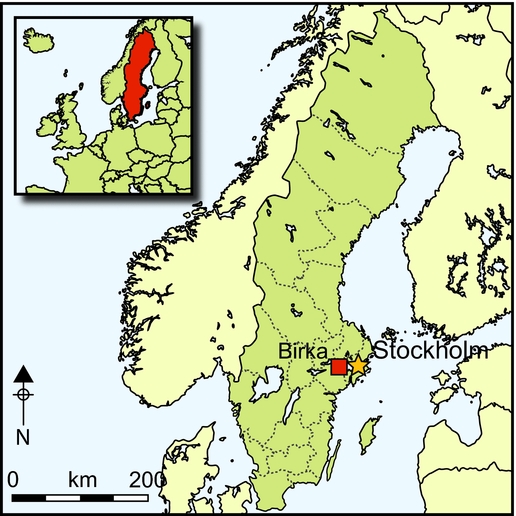
Birka in Lake Mälaren, in eastern Middle Sweden, is one of the very few Viking Age Scandinavian sites (AD 750–1050) to be recognised as proto-urban, or as a ‘Viking town’, in an otherwise mostly rural society (cf. Kalmring Reference Kalmring, Holmquist, Kalmring and Hedenstierna-Jonson2016). Accordingly, the site complex (along with the royal estate of Adelsö-Hovgården) has been a designated UNESCO World Heritage Site since 1993. In 2015, the project ‘Birka's Black Earth Harbour’ re-investigated one of the few excavated harbour facilities, and a small semi-plastic (halbplastisch) dragonhead was discovered embedded in the sediments. The artefact can be directly linked to a well-known casting mould retrieved by the Swedish History Museum at the end of the nineteenth century.
Here, we present this unique, recently discovered artefact, and provide a general cultural-historical background. The manufacturing technique and usage of the object are discussed, as well as its placement among the rare set of Viking Age dragonhead dress pins and their connection to full-size ships’ figureheads. Finally, a chronology for the dragonhead is suggested, and its social significance explored.
The Birka dragonhead
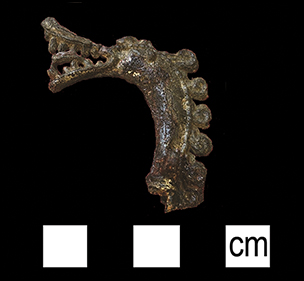
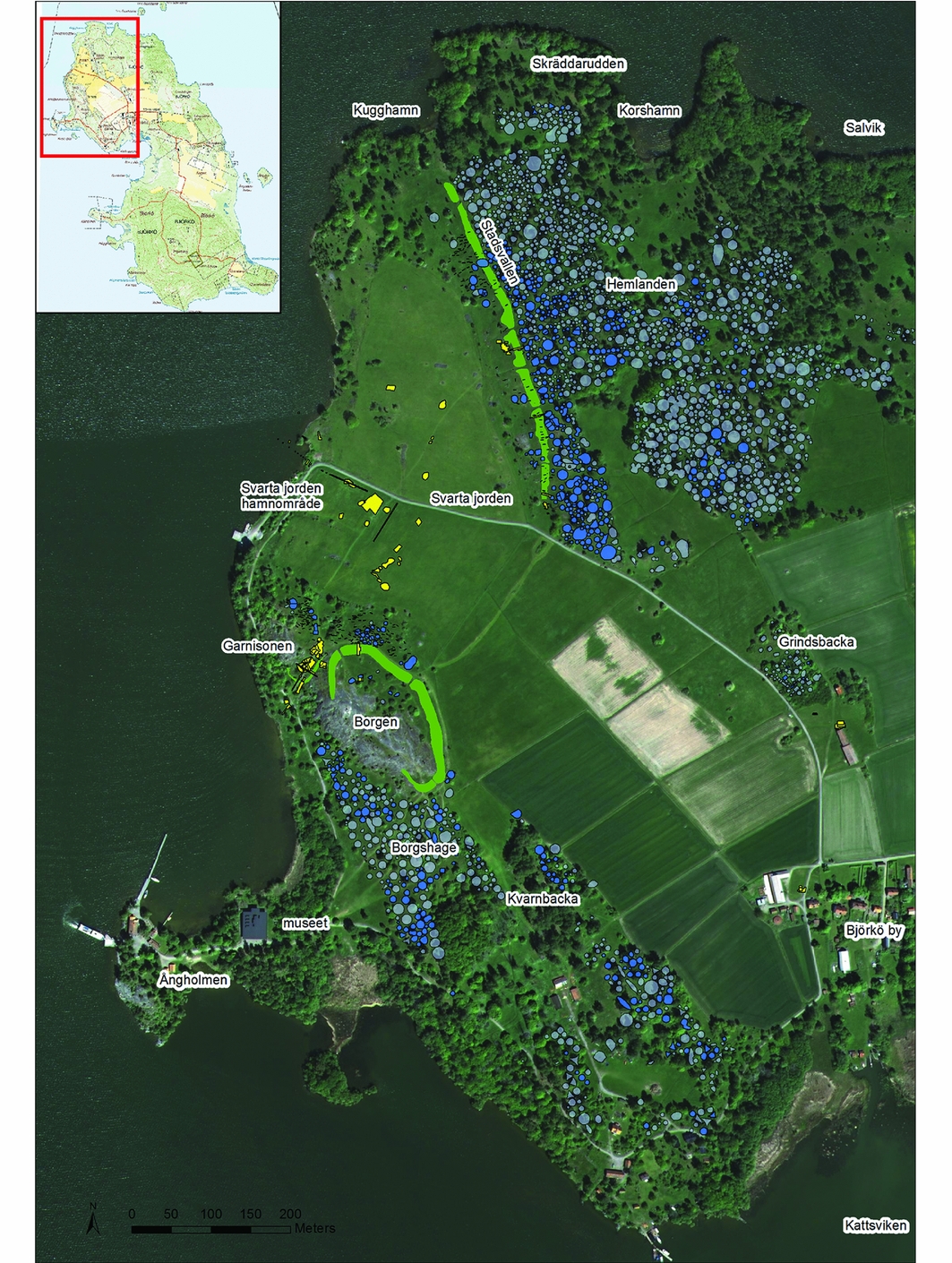
The 2015 and 2016 archaeological investigations of the former silted-up harbour basin in front of the ‘Black Earth’ settlement area (‘Svarta jordens hamnområde’; cf. Figure 1) focused on investigating the physical nature and chronological development of the harbour structures essential for a Viking Age long-distance trading centre (cf. Holmquist & Kalmring Reference Holmquist and Kalmring2015; Kalmring & Holmquist Reference Kalmring and Holmquist2015). The Birka dragonhead (Figure 2) was discovered here immediately adjacent to the jetty, the construction of which is re-dated by dendrochronology to AD 853/854 (Holmquist & Kalmring Reference Holmquist and Kalmring2015: 23; Kalmring & Holmquist Reference Kalmring and Holmquist2015: 61). When retrieved from the moist harbour sediments (grid square PQ 8 in cut L23/IV), the artefact was sealed almost completely by a compact layer of soil and iron corrosion. Although the throat and neck were encased in a large lump of corrosion, the dragon's curved neck was recognisable and thus revealed the identity of the object. The corrosion itself contributed to the preservation of the fragile artefact. The layers of corrosion and soil were carefully removed in the archaeological research laboratory. Following conservation, the artefact weighs 13.5g, is 45mm long, with a maximum breadth of 42mm at the snout, and a neck measuring 17mm in breadth. The double-sided dragonhead features a gaping mouth with sharp teeth and the rudiment of a truncated involute tongue, as well as a pearled rim around the neck with characteristic curled mane (with five surviving curls down its neck). The eyes, curls and pearled rim were cast in a raised relief. Towards the bottom of the throat there is a sideways-protruding loop (possibly for a cord) and a three-ribbed belt terminal. At its foot there is a small circular shaft filled with iron corrosion.
The Viking town of Birka on the island of Björkö. Marked out are the defensive works (green), the excavated (dark blue) and unexcavated graves (light blue) from the extensive burial grounds, as well as the recorded excavation trenches from archaeological surveys (yellow).
The Birka dragonhead discovered during the Birka's Black Earth Harbour excavations in 2015. Photograph by Lena Holmquist.
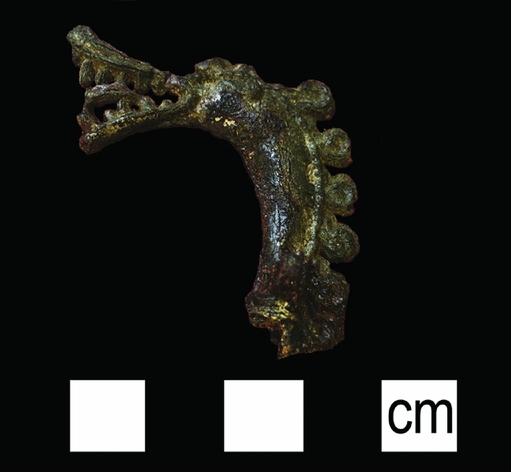
The dragonhead experienced damage in antiquity. For example, there is a fracture site for a putative horn and a fissure immediately in front of this, on the upper jaw. The first mane curl is missing, as is the tip of the tongue, which we assume was originally involuted. The artefact was cast from a tin-rich alloy, with a small quantity of added lead. The ‘Birka dragon’ had clearly been cast in a bipartite mould, as casting burrs are still noticeable on the artefact. The presence of corroded iron in the small circular shaft at the bottom of the dragonhead indicates that this piece of jewellery was once attached to an iron pin. This was very probably inserted into a specially prepared channel in the bipartite mould before the liquid tin was poured into the sprue and the dragonhead cast onto it.
The soapstone casting mould from 1887
The closest parallel to the newly discovered dragonhead most certainly derives from Birka itself and takes the form of a well-known casting mould (Figure 3). By 1887, one half of an originally two-piece soapstone casting mould was housed at the Swedish HistoryMuseum in Stockholm. According to the museum's main inventory (Huvudkatalog [1887], inv. no. 8139; cf. Specialkatalog, inv. no. 8139: 1–18; http://mis.historiska.se/mis/sok/invnr.asp?invnr=8139), the mould derived from the ‘Black Earth’ settlement area of Birka. In the inventory, the casting mould was listed simply as “two sides of a casting mould, broken apart”. The catalogue of the Iron Age collection (Järnålderskatalogen; see link above) describes the artefact—accompanied by an ink drawing—as “half a casting mould from soapstone, broken into two pieces, shiny-smooth on one side, rough on the other. One drilled hole in each upper corner. Greatest length 81mm, greatest breadth 66mm and 1.3mm thick”. Today, the mould is recorded in the unpublished ‘Sörlings katalog’ (cat. no. SHM 5208), which lists early Birka finds mostly originating from the Black Earth excavations in 1871–1873.
Soapstone casting mould for Birka dragonheads, as acquired by The Swedish History Museum in the late nineteenth century. This figure shows the artefact prior to conservation (after Arbman Reference Arbman1939: 123).
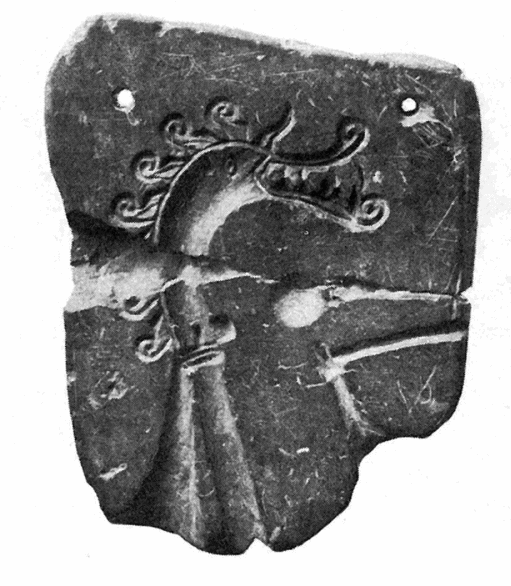
The casting mould shows a carved dragonhead measuring approximately 40 × 41mm, displaying a gaping mouth with sharp teeth and an involuted tongue, as well as a pointed horn on its forehead and the characteristic curly mane down its neck. Towards the bottom of the throat is a three-ribbed belt terminal adjacent to a protruding, forward-facing and almost square loop. The lower left corner of the mould clearly displays the tapering sprue leading to the lower neck of the dragonhead. As the sprue does not connect to the hollow of the pin, it can be assumed that a pin was inserted into the mould and that the dragonhead was cast onto it as a composite. Furthermore, it is noteworthy that soapstone is a soft material with a tendency to crack during the casting process. Thus, it was used for casting soft metals with a particularly low melting point, such as lead (cf. Pedersen Reference Pedersen2016: 92) or tin.
While generally described as a dragonhead (cf. Arbman Reference Arbman1939: 123), Ambrosiani suggested that it may actually depict a wolf's head “of the same type that tends to be included in the trinity of wolf, boar and eagle on certain Vendel-period shield handles and jewellery [authors’ translation]” (Ambrosiani & Erikson Reference Ambrosiani and Erikson1991: 44; Gräslund Reference Gräslund and Hårdh2003: 184–85). The lack of data concerning the mould's archaeological provenance means that it could only be loosely dated to the Viking period (Ambrosiani & Erikson Reference Ambrosiani and Erikson1991: 44). The depiction of the “dragon-like wolfshead” (cf. Ambrosiani & Erikson Reference Ambrosiani and Erikson1991: 55)—or plainly, ‘dragon’—was so distinct that it was chosen as the logo for Ambrosiani's ‘Excavations in the Black Earth 1990–1995’, and was adopted as the emblem for the subsequent Birka Studies publication series (Ambrosiani & Erikson Reference Ambrosiani and Erikson1991: 55, 85; Ambrosiani & Clarke Reference Ambrosiani and Clarke1992). Today, the iconic ‘Birka dragon’ is synonymous with the World Heritage site itself. Almost 130 years after the discovery of the mould, the cast counterpart was finally recovered from the Black Earth of Birka harbour. In contrast to the newly discovered dragonhead, however, the depiction on the mould shows seven curls. Thus, it cannot be the actual mould from which the dragonhead was cast.
Viking Age dragonhead dress pins
Small double-sided dragonheads such as the Birka dragon are known from a few particular sites around the Baltic, although in a slightly different style. In her synthesis, Gräslund (Reference Gräslund and Hårdh2003: 182, 187, Reference Gräslund, Andrén, Jennbert and Raudvere2006: 125) provides the following description:
A number of small bronze artefacts representing beast heads or dragon heads have been found in the Viking Age market places and central places around the Baltic. Their function is unclear; they are double-sided and have probably been attached to something in such a way that both sides were visible [. . .] Even if their function is unknown, their distribution in important centres of power and their rarity show that they are special, certainly not owned by everybody.
Two further dragonheads from Hedeby can be added to her compilation. The first was found during the excavations in 1968 (grid square 249, layer V), the second during a metal-detecting survey in 2004 (Anspach Reference Anspach and Carnap-Bornheim2010: 68–69, cat. no. 80, pl. 9: 77). Finally, a further specimen derives from Sorby on Gotland (Thumark-Nylén Reference Thunmark-Nylén2000: 756, Reference Thunmark-Nylén2006: 369, fig. III.40.10.1). All of the dragonheads seem to come from prominent nodal points around the Baltic, such as the Viking towns of Birka and Hedeby, central sites such as Uppåkra and trading places such as those on the island of Gotland, Ralswiek on Rügen or Rjurikovo Gorodišče (Gräslund Reference Gräslund and Hårdh2003: 182, with references therein). The only exception in this collection is the specimen from Slinkbacken in Uppland, which is probably linked to the wider area of Söderby, and thus to Old Uppsala itself (Figure 4).
Dragonhead dress pins of the ‘International’ Baltic type: 1–3) Hedeby; 4) Slinkbacken; 5–6) Birka; 7) Sorby; 8) Ralswiek; 9) Rjurikovo Gorodišče (after Gräslund Reference Gräslund and Hårdh2003: fig. 3, with additions).
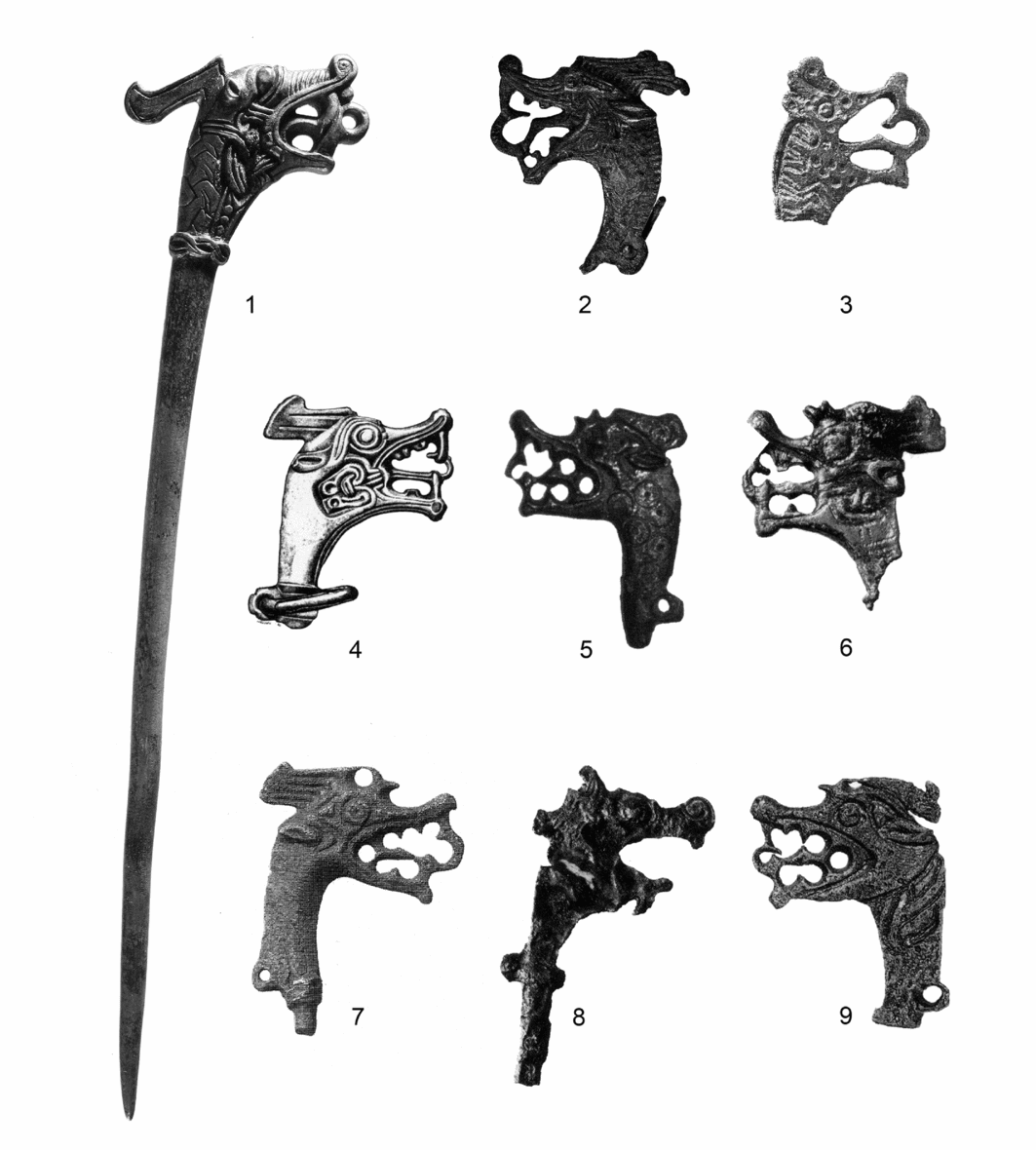
Although these small dragonheads and the Birka dragon share common features such as the gaping mouth, sharp teeth and curled tongue, the majority of the former exhibit a distinct pigtail instead of a curly mane. Gräslund (Reference Gräslund and Hårdh2003: 179, 186) recognises the Ringerike style (c. AD 990–1050; cf. Wilson Reference Wilson, Brink and Price2008: 333), but suggests that the dragonheads be dated to the end of the tenth century AD. By contrast, Anspach (Reference Anspach and Carnap-Bornheim2010: 68–69) observes elements of the Jelling and Mammen styles (c. AD 900–1100 and 950–1000, respectively; cf. Wilson Reference Wilson, Brink and Price2008: 329, 331) and therefore suggests a date of the second half of the tenth century AD. Obviously, this “International type” (Thunmark-Nylén Reference Thunmark-Nylén2006: 369)—or Baltic type—of dragonhead exhibits a stylistic development that should be associated with a wider chronological range. Even the assignment of the Uppåkra dragonhead to this Baltic group will need to be verified by future typological parallels.
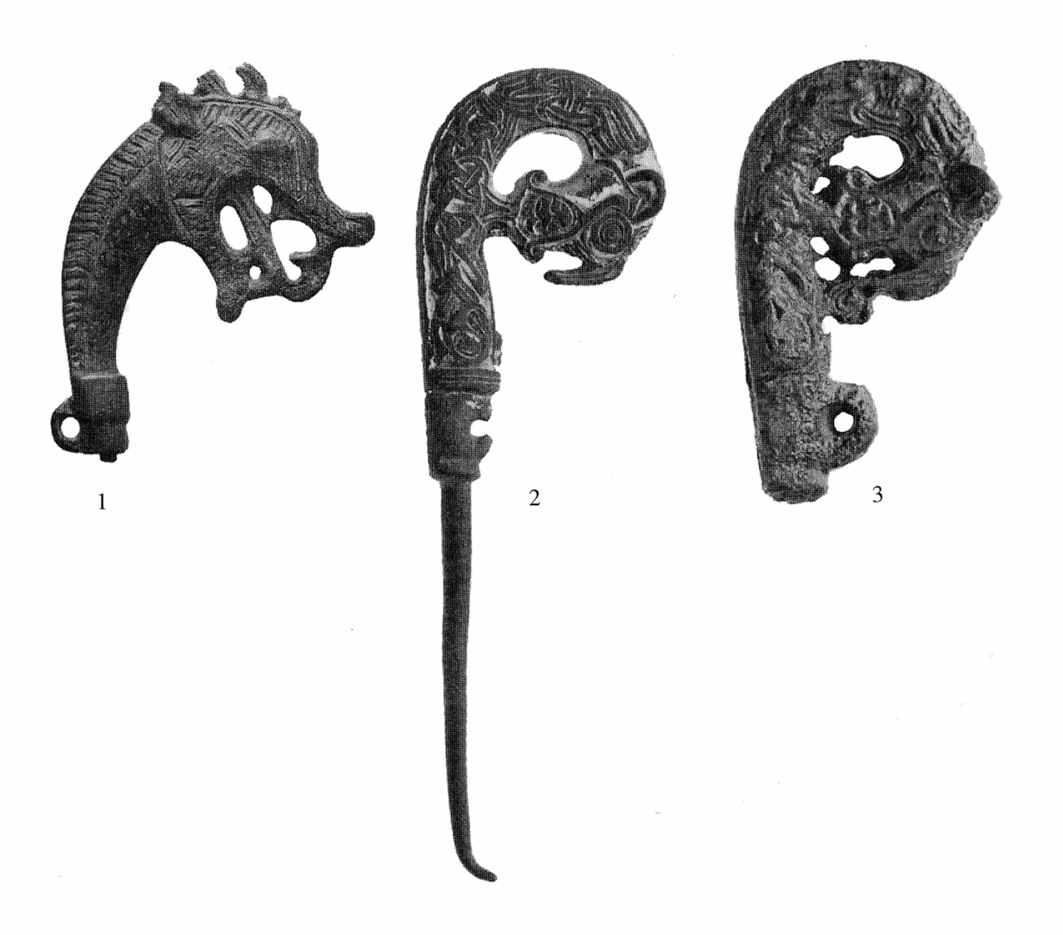
Another group with a distinct form comprises three specimens from Gotland, characterised by a heavily bent neck (Thunmark-Nylén Reference Thunmark-Nylén1998: pl. 288: 1–3, Reference Thunmark-Nylén2006: 369) (Figure 5). While the unprovenanced dragonhead seems to be an early prototype still featuring a strong affinity with the Baltic type, the two specimens from Sojvide and Krasse form a semicircle with their mouths bent down to the throat, probably representing fully developed Gotlandic dragonheads. As all of the Gotland dragonheads lack contextual data, they cannot be securely dated. The Birka dragon can, however, be attributed to neither the International nor the Gotlandic type—it represents a clear stylistic group of its own.
Dragonhead dress pins of the Gotlandic type: 1) Gotland, unknown provenance; 2) Sojvide; 3) Krasse (after Thunmark-Nylén Reference Thunmark-Nylén1998: pl. 288, 1–3).
The lack of contextual information for these finds precludes interpretation of their function. The majority derive from either settlements or harbours; to date, not a single specimen is from a burial context. Gräslund is therefore hesitant not to allot any specific function, and suggests that they may have been used as roof-ridges for small, house-shaped reliquaries, or as heads of dress pins (Gräslund Reference Gräslund and Hårdh2003: 187, Reference Hedeager Krag, Jeffreys and Haarer2006: 125). The latter function is more widely accepted (Jansson Reference Jansson and Purhonen1999: 52; Thunmark-Nylén Reference Thunmark-Nylén2006: 369), and can be supported by examples such as the dragonhead pin from Hedeby harbour, the Gotlandic-type dress pin from Sjonhem or the badly preserved specimen from Ralswiek in Germany. The use of the Birka dragonhead as a pin is proven by both the carving in the 1887 soapstone mould and the iron corrosion in the roundish hole at the base of the dragon's neck itself.
In terms of their broader symbolic value, a high societal significance has been generally ascribed (Gräslund Reference Gräslund and Hårdh2003: 187). Hedenstierna Jonson (Reference Hedenstierna Jonson2006: 59–60) went a step further in suggesting a connection between dragonhead dress pins and military standards of the dracones type. She states: “Used as dress pins, the dragon heads most likely signalled a special status and function, and viewed in the context of the dracones they were possibly the dress pin of the standard bearer” (Hedenstierna Jonson Reference Hedenstierna Jonson2006: 60). Her idea presents an interesting connection between the Old Norse accounts of the prominent position of the standard bearer in Viking longships and the appearance of such dress pins in harbour basins. This is the case for one specimen from Hedeby (Kalmring Reference Kalmring2010a: 433–34, map 44), and now also for two from Birka. The standard-bearer (merkismaðr) was stationed at the stem together with a few high-ranking forecastle-men (stafnbúar) (Falk Reference Falk1912: 84; Ellmers Reference Ellmers, Olsen, Madsen and Rieck1995: 237).
Ships’ figureheads
Apart from the dress pins, dragonheads are very much connected with Viking ships. The corpus of Old Norse literature tells of the ‘dragon ships’ (drekar), such as Norwegian king Olav Tryggvason's (AD 995–1000) famous longship, ‘The Long Dragon’ (Ormr hinn langa). According to Jesch (Reference Jesch2001: 128), the designation of these warships as drekar derives from the practice of placing carved dragonheads (drekahǫfuð) on the ships’ stem (stál), while the sternpost could become sculpted as a dragon's tail (sporðr). In Skaldic poetry the dragonheads are described in detail, mentioning the gaping dragon's mouth, its nose, throat and neck, and the “gleaming mane of the serpent” (orms glóar fax) (cf. Falk Reference Falk1912: 41; Jesch Reference Jesch2001: 127). The Icelandic ‘Book of the Settlements’ (Landnámabók) informs that the figureheads were removable and meant to be taken down when nearing land to avoid frightening away the land spirits (Hauksbók chpt. 268; Jónsson Reference Jónsson1892–Reference Jónsson1896: 96–97). Along with the mention of possible iron spikes, other figureheads are also referred to, including snakes, bulls and bison, and rare depictions of royals or idols of Norse gods (Falk Reference Falk1912: 32–33, 38–42; Jesch Reference Jesch2001: 127–28, 144–150).
Pictorial sources such as the Gotlandic picture-stones, graffiti from church walls or small finds, and even the Bayeux tapestry illustrate dragonheads on ship stems. In terms of actual finds of ships’ figureheads, however, the body of evidence is rather limited.
Two figureheads pre-date the Viking Age. Both were found associated with ship fragments (de Laet Reference de Laet1956). The Appels figurehead, excavated in c. 1934 and originally assigned to the Viking Age, has more recently been dated to the Late Roman Iron Age/Migration period (AD 400–615; Kidd Reference Kidd1988). Excavated between 1938 and 1940, the Mariekerke figurehead, according to Bruce-Mitford (Reference Bruce-Mitford1967) could be dated stylistically to the sub-Roman or Merovingian period. These two examples differ significantly in style to Viking-period dragonheads discussed above (Bruce-Mitford Reference Bruce-Mitford1967: 208, Reference Bruce-Mitford1970: 147). Stylistically, both figureheads from the British Museum have few similarities with the moulding of Viking-period dragonheads discussed above. The Mariekerke figurehead is described as having a “serpentine or dolphinesque appearance, rather than a dragonesque one in the Germanic tradition” (Bruce-Mitford Reference Bruce-Mitford1967: 208), while the ball-type Appels figurehead, despite the fact that it had previously been attributed to the Viking Age, “has none of the stylistic traits characteristic of Viking art, and seems restrained and primitive when compared with the representations known to us of figureheads of Viking ships” (Bruce-Mitford Reference Bruce-Mitford1970: 147).
Only a few documented figureheads are known from Viking Age vessels. The most famous example is the iconic figurehead from the Oseberg ship, dated to AD 820 (Bonde Reference Bonde1994), which ends in a spiral showing an involuted snake. The stem figurehead with a snake's head and eye was reconstructed from excavated fragments, while the aft spiral depicting the tail was recreated based on contemporaneous illustrative sources (Sjøvold Reference Sjøvold1957: 19–20). The cremation boat-burial from Île de Groix in southern Brittany yielded a circular iron fitting approximately 0.6m in diameter, with densely placed lanceolate spikes and ornamental concentric circles. When compared to depictions on Gotlandic picture-stones, this piece can be identified as a stylised dragon's tail from the aft (from which a counterpart dragonhead at the fore can be inferred). Chronologically, the burial can be placed in the second half of the tenth century AD (Müller-Wille Reference Müller-Wille and Schietzel1978: 68, fig. 7.12). A similar but smaller stern-mounting of Île de Groix-type was identified among the iron artefacts from the 1966–1969 settlement excavation at Hedeby in northern Germany (Westphalen Reference Westphalen2002: 132, pl. 46.5; cf. Kalmring Reference Kalmring2011: 305).
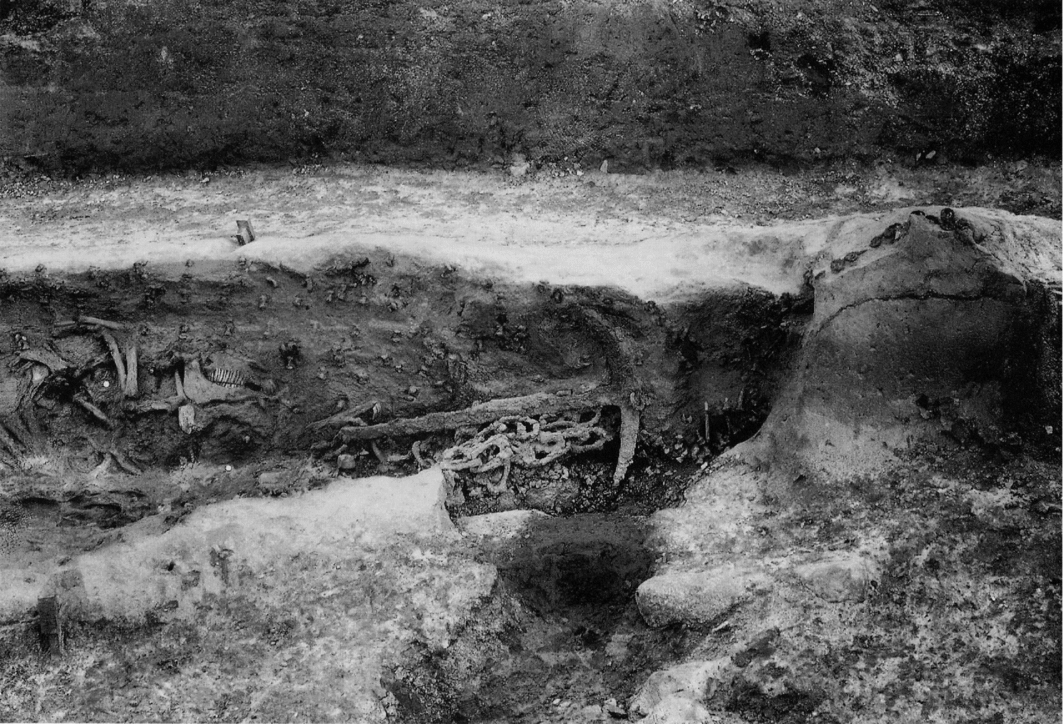
In the context of the Birka dragon, however, the figurehead from the Ladby boat is of the most interest. The vessel from Ladby on eastern Funen in Denmark came from the eponymous boat-grave and can be dated to c. AD 900 from its keel-laying (Sørensen Reference Sørensen2001: 100, 172). Although the wood has completely decayed, the surviving iron rivets provide a good estimate of the total dimensions of the ship—a slender 21.5m-long warship. Even though the burial, which can be attributed to a petty king, had been plundered in antiquity, the remaining grave goods reveal an involvement in super-regional networks. Some artefacts indicate relationships with the Continent and the Anglo-Irish area, while there is also a very distinct Swedish element with direct links to Birka and beyond towards Byzantium (Sørensen Reference Sørensen2001: 167–71; cf. Hedeager Krag Reference Hedeager Krag and Maik2004, Reference Gräslund, Andrén, Jennbert and Raudvere2006). A row of 10–11 iron spirals were all that remained of the Ladby ship figurehead. These formed an arched line in an elevated area of the vessel's fore stem (Figure 6). The spirals obviously belonged to some type of decoration on the prow, most probably mounted as ornamentation on a dragonhead (Sørensen Reference Sørensen2001: 237–39, fig. 11.1, 11.4). The similarity of the spirals to the curls incised on the Birka soapstone mould suggests that the wooden Ladby figurehead itself was modelled after the archetypal casting mould. An iron band with 9–10 lanceolate iron spikes, each 50–90mm in length, was found in the boat's aft. These were originally mounted on the stern and formed the spikes of the dragon's tail.
Ladby boat grave. Fore stem during excavation in 1934–1937. Note the iron curls of the decayed wooden figurehead on the right (after Sørensen Reference Sørensen2001: fig. 10.1).
Iron curls of full-size dragonheads
There are no known parallels for the Birka dragon dress pin, apart from the soapstone casting mould. Upon interrogation of the archaeological record for similar iron curls, however, Ladby presents a possible comparative group of examples (cf. Sørensen Reference Sørensen2001: 46). Three boat-graves from the famous burial ground at Valsgärde, close to Old Uppsala, contained such iron curls. Valsgärde 7 yielded two clusters of five iron curls at the stem and stern of the otherwise completely decayed wooden vessel. On each end of the ship, three curls had been merged into a trefoil-like central group, which was flanked by a single iron curl on both sides. Although the curls’ locations do not provide definite clues concerning their original fitting, “they might have belonged to stem adornments” and thus “could have been used as ornamentation of the stems themselves or of ‘dragonheads’, which could be mounted at the stems [authors’ translation]” (Arwidsson Reference Arwidsson1977: 98, pls 40, 43–45). Similar fittings were also found in the Valsgärde 5 (currently unpublished) and Valsgärde 6 burials, although their midship locations impeded any certain interpretation (Arwidsson Reference Arwidsson1942: 105, pls 41, 45). While the majority of the 15 Valsgärde boat-burials are of Viking Age origin, the three examples presented above date to the pre-Viking Vendel period, c. AD 550–750 (cf. Ljungkvist Reference Ljungkvist and Norr2008: tab. 6). A similar Vendel-period boat deposit was discovered at Ultuna near Old Uppsala (cf. Larsson Reference Larsson2007: 49, 63). Here, small clusters of iron curls were recorded amongst irregularly scattered boat rivets (Almgren Reference Almgren1904: 155, fig. 75, plan). From comparison with the Valsgärde and Ladby burials, it is suggested that the curls were once mounted on either the vessel's railing or stem (Karlsson Reference Karlsson2011: 17–18).
Smaller quantities of iron curls sometimes appear in otherwise rather ordinary cremation graves with no other connection to any boat-interment. Cremation 254 from the burial ground at Vi alvar on the island of Öland yielded, for example, one single, unambiguous iron curl (Holgersson & Schulze Reference Holgersson, Schulze, Hagberg, Sjernquist and Rasch2001: 105–111, 127). This cremation was attributed to a group of “high-status graves” from the burial ground, with a suggested Migration-period date (Holgersson & Schulze Reference Holgersson, Schulze, Hagberg, Sjernquist and Rasch2001: 109–10). The trefoil-like group of curls from Valsgärde 7 and possibly the “unusual belt hook with rolled terminals” (Beskow Sjöberg Reference Beskow Sjöberg, Hagberg, Sjernquist and Rasch1996: 257, fig. 241) from Norra Kvinneby on Öland—which was forged into a four-leaf clover—might actually belong to the group of stem adornments. If so, with regard to Norra Kvinneby, the suggested early dating of the associated stone cist inhumation burial ‘grave/feature 3’ to the pre-Roman Iron Age (Beskow Sjöberg Reference Beskow Sjöberg, Hagberg, Sjernquist and Rasch1996: 240) should probably be revised. Two cremation graves from Birka itself contained very distinct iron curls (Figure 7): grave Bj. 75 from burial ground Hemlanden 1B, which had been apparently plundered in antiquity (Hallström Reference Hallström1913: 64–65, fig. 56, pl. VIII; Arbman Reference Arbman1940/Reference Arbman1943: 30–31, fig. 75, pl. 280.1). Here, a single iron curl was discovered along with a Samanid dirham from AD 905/906 (Wiséhn Reference Wiséhn1999: 25), providing a terminus post quem for the interment. Grave Bj. 77b from burial ground Hemlanden 1E comprised an urn grave with a surrounding charcoal layer, beneath a mound (Hallström Reference Hallström1913: 65–66, fig. 57, pl. VIII; Arbman Reference Arbman1940/Reference Arbman1943: 31, fig. 23, pl. 280.2). Two iron curls were recovered from the charcoal layer, along with a variant of a P55 oval brooch type (Jansson Reference Jansson and Arwidsson1984: 47, 53, 57). Its presence suggests a female interment dating to the latter part of the ‘Younger Birka Stage’ (c. AD 85–975). The mound was shared with cremation burial Bj. 70 and with coffined inhumation grave Bj. 77a, although it was difficult to distinguish primary from secondary burials due to the lack of contextual information.
Birka. Cremation graves Bj. 75 and Bj. 77b with iron curls from full-size dragonheads. Grave inventories are not depicted fully (after Hallström Reference Hallström1913: pl. VIII).
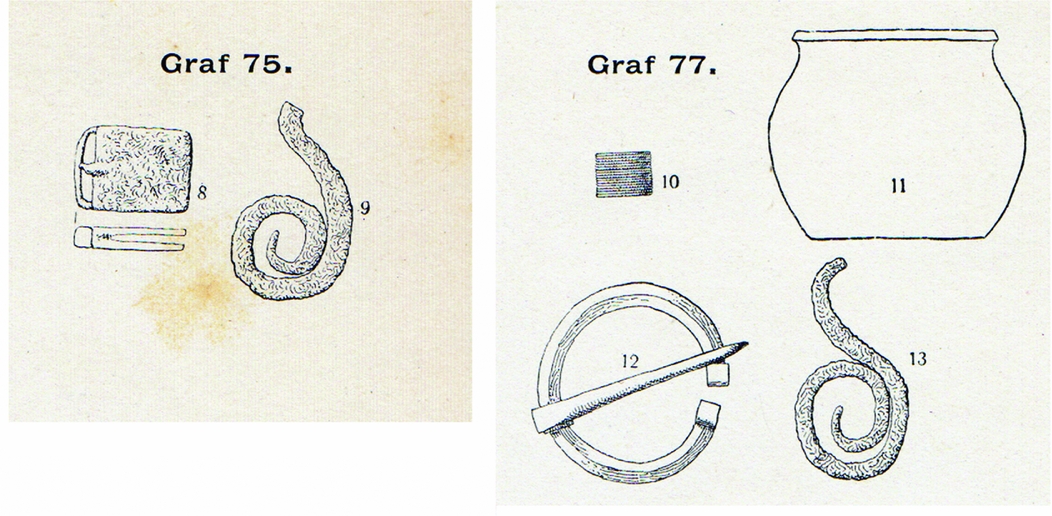
These graves with individual iron curls may represent a pars pro toto burial custom for deceased ship-owners, steersmen or crew members, whose vessels were in continuous use beyond their death. Unfortunately, this is almost impossible to prove. The association of the iron curls and oval brooch (the latter of which represents a typical of Viking Age female dress accoutrement) with the urn from Birka-grave Bj. 77b is not certain. If, however, these elements do indeed belong together, then the role women may have played in seafaring should also be considered.
Conclusions
The Birka dragonhead found in Black Earth Harbour in 2015 originally formed the head of a dress pin. This interpretation is supported by comparison with the better-preserved dragonhead dress pins from Hedeby, Ralswiek and Sojvide, the Birka soapstone casting mould featuring an incision for a pin, and last but not least supported by the hole at the base of the Birka dragonhead filled with corroded remnants of the original pin. The protruding loop at the base of the dragonhead was most probably reserved for a small ring, as demonstrated by examples from Slinkbacken and the 1968 find from Hedeby. Although the newly discovered dragonhead is highly comparable to the dragon from the casting mould, thus providing evidence for its production on site in Birka, minor differences preclude the possibility that the figurehead was produced using this exact mould.
The more common dragonheads of Baltic type are widespread throughout the major nodes of the Baltic Sea Viking-period long-distance trading network. The Birka dragon, when considered alongside the full-size dragonheads of the same type, seems to have an East Scandinavian distribution (Figure 8). To date, the only westerly exception is the Ladby boat grave, where the associated goods display a distinct Swedish element, with some direct links to Birka and beyond. Dating the Birka dragonhead is difficult due to the ambiguous context of the harbour sediments to the south of the jetty. The jetty structure itself may serve as a terminus post quem for the dragonhead, given that the artefact was discovered immediately adjacent, and may have been deposited in this area of the harbour after it was made more accessible by construction of the jetty. Recent dendrochronological dating of the jetty has placed its construction to the winter of AD 853/854. This could tentatively suggest a mid ninth-century date for the dragonhead. As the findspot was, however, only 3m from the former shoreline, the artefact could have been deposited prior to construction of the harbour facility.
Dragonhead dress pins, moulds and iron curls from ships’ figureheads. Note the East Scandinavian restraint of the Birka-dragon with Ladby as a western spike against the wide distribution of the ‘International’ Baltic type. The Gotlandic type forms a group of its own.
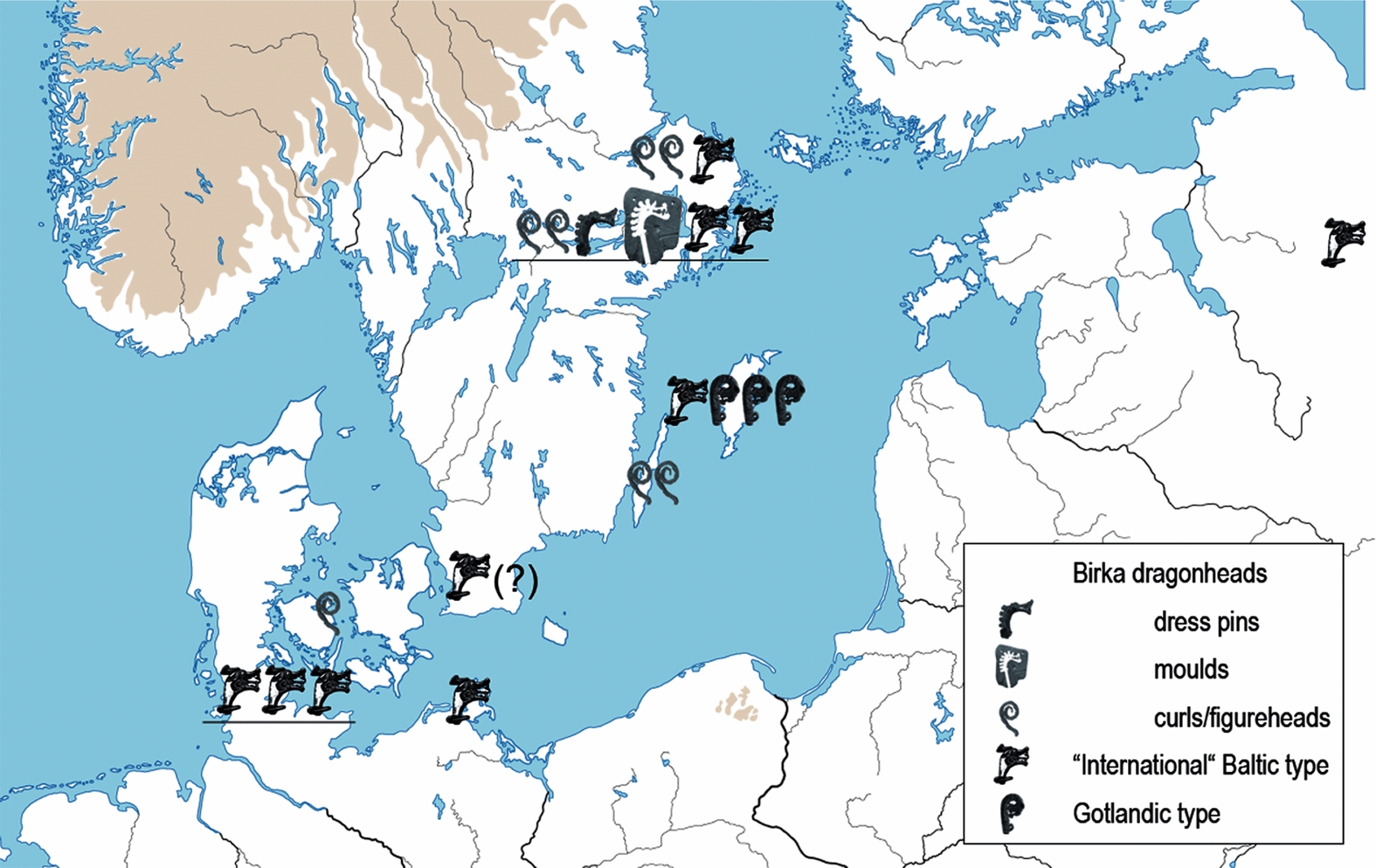
The iron curls on full-size Birka-type dragonheads suggest stylistic roots dating back to the Vendel period, while the Ladby ship (c. AD 900) seems to provide the latest example of this stylistic type. The dating of Birka grave Bj. 75 to c. AD 905/906 may support the Ladby chronology. The two other examples of Baltic-type dragonheads from Birka may indicate that the Birka dragon was replaced by the more ‘International’ Baltic type during the tenth century AD (the Garrison excavation, layer 12; Holmquist-Olausson & Kitzler Åhfeldt Reference Holmquist Olausson and Åhfeldt2002: 15–16 fig. 12; and the Black Earth Harbour 1970/1971 excavation, C2/C3-layer/layer II; Ambrosiani et al. Reference Ambrosiani, Danielsson, Kyhlberg and Werner1973: 20–32).
One remaining issue is the association of dragonhead dress pins with high-ranking individuals in Viking Age society, particularly given that there are, to date, no such finds from burial contexts. The vast majority of dragonhead dress pins are cast from bronze, rather than silver, and are not gilded. There are even a small group of dragonheads made from lead, including examples from Rjurikovo Gorodišče and the one from the 2004 metal-detecting survey in Hedeby. Lead is a by-product of smelting lead-based silver ore and also of the cupellation and refining of impure silver (Merkel Reference Merkel2016: 19–34). Adding approximately 15 per cent tin can almost halve the melting point of lead (Anspach Reference Anspach and Carnap-Bornheim2010: 19–21), although the artefacts from Kaupang and Hedeby were shown to be almost pure unalloyed lead (Pedersen Reference Pedersen, Eriksen, Pedersen, Rundberget, Axelsen and Berg2014: 180; Reference Pedersen2016: 92, tab. 4.3; Merkel Reference Merkel2016: 223, appendix H, fig. 1). Lead jewellery is often regarded as imitating more expensive antetypes made of bronze or precious metal, but even aspects such as the number of steps within the production workflow, the level of ornamentation and quality of execution should be taken into consideration. Thus, an equation of lead with “poor everyday jewellery” or even the low social status of its bearer should be approached with caution (Anspach Reference Anspach and Carnap-Bornheim2010: 76–81). The Birka dragon could also be attributed to the group formed by the Rjurikovo Gorodišče and Hedeby dragonheads, for it was cast from tin rather than lead. In comparison, the counterfeit ‘Abbāsīdic’ tin-dirhams from Hedeby harbour seem to be cast from alloys comprising 70–90 per cent tin and 30–10 per cent lead (Steuer et al. Reference Steuer, Stern, Goldenberg, Brandt, Müller-Wille and Radtke2002: 155–59; cf. Kalmring Reference Kalmring2010b: 283–48; Merkel Reference Merkel2016: 223–24). That the Birka dragon was cast from a tin-rich alloy may specifically link it to the mould, which was formed from soapstone rather than the heat-resistant, fired clay moulds preferred for copper alloys.
Unlike lead, which was easily accessible, tin had to be deliberately imported into Scandinavia from, for example, deposits in Cornwall or the Riesengebirge. Tin artefacts therefore appear to have been quite rare (Pedersen Reference Pedersen2016: 93). In contrast to lead, which tends to tarnish quickly, “tin is the base-metal most similar to the colour of silver” (Merkel Reference Merkel2016: 223). The questions as to why silver was not used to cast the Birka dragon and what this says about the social status of its bearer remain to be resolved.
Acknowledgements
We would like to thank Sven Isaksson for his kind support in conducting pXRF material analysis of the Birka dragonhead at the Archaeological Research Laboratory, Stockholm University. We are grateful to Volker Hilberg, Schleswig, for information on the find context of the Hedeby dragonhead from the 1968 excavation.



