





1. Introduction: Character introductions in monolingual and bilingual children
An important aspect of telling a story that is understandable for a listener is making clear who is part of the story and who performs which actions, i.e. introducing and referring back to story characters. Children’s ability to introduce characters in oral narratives has been investigated in a number of studies of monolingual children, and in the past few years, studies of bilinguals have also become more common. Such studies tend to investigate the relationship between character introduction and the referential system of the target language, and/or development with age. The effect of other factors such as language exposure and (general) language proficiency on children’s referential abilities in general, and the ability to introduce referents more specifically, has rarely been explored. The present study does just this, by studying 100 bilingual Turkish/Swedish-speaking children’s character introductions in their L2 Swedish narratives, in relation to age, expressive vocabulary skills, and language exposure measures.
Theoretical approaches to referentiality assume that proficient speakers construct a mental discourse model that keeps track of the accessibility of the discourse referents for the interlocutor (e.g. Chafe Reference Chafe and Li1976, Ariel Reference Ariel1990, Gundel, Hedberg & Zacharski Reference Gundel, Hedberg and Zacharski1993, Arnold Reference Arnold2008). Specifically, when a storyteller begins to tell a story to a naïve listener, s/he must establish a common ground, and unless the field of vision is shared and allows for pointing or joint eye gaze, s/he needs to introduce referents in a linguistically explicit way, using a form that marks the information (i.e. the referent) as new in the discourse. Learning how to introduce referents appropriately is therefore a complex task for the child. Mastery of appropriate referent introduction is in part related to cognitive development, where the child needs to be able to understand that the listener does not know everything the child knows (using Theory of Mind) and to take the listener’s knowledge into account in order to judge whether or not the referent is currently known to and/or identifiable for the listener. If the referent is new to the listener, i.e. if it needs to be introduced into the discourse, the child then needs to choose a linguistic form that signals newness in the specific language used. Being able to introduce referents appropriately in a language thus also requires knowledge of the language-specific means used for marking information that is new in the discourse, which can be morphological cues such as indefinite markers or syntactic ones such as word order. Children’s developmental trajectories have been described as introducing characters with a mix of referring expressions that also include inappropriate or ‘egocentric’ forms, such as pronouns and/or definite lexical forms (e.g. Maratsos Reference Maratsos1974, De Cat Reference De Cat2013), and later moving on to using more and more indefinite lexical forms that are appropriate for character introductions in decontextualised discourse (Wigglesworth Reference Wigglesworth1990, Hickmann et al. Reference Hickmann, Hendriks, Roland and Liang1996, Küntay Reference Küntay2002, Álvarez Reference Álvarez2003, Schneider & Hayward Reference Schneider and Hayward2010, Colozzo & Whitely Reference Colozzo and Whitely2014).
A fruitful approach in the study of character introduction has been to elicit fictional narratives from speakers of different ages in the form of monologues, using wordless picture books, picture sequences, or video clips. This way, comparable discourse samples can be collected. Reports concerning the age at which children are able to systematically introduce referents in this type of discourse using appropriate referring expressions (such as indefinite NPs) vary considerably: from age 2−4 in some studies (e.g. Emslie & Stevenson Reference Emslie and Stevenson1981, De Cat Reference De Cat2013), to around age 7 (Wong & Johnston Reference Wong and Johnston2004, Schneider & Hayward Reference Schneider and Hayward2010, Lindgren Reference Lindgren2018a), or not until age 9−10 according to others (Warden Reference Warden1976, Hickmann et al. Reference Hickmann, Hendriks, Roland and Liang1996, Serratrice Reference Serratrice2007). The reasons for these contradictory reports are manifold, and often related to differences in research methodology, as discussed in a recent First Language special issue on referentiality in elicited narratives (Gagarina & Bohnacker Reference Gagarina and Bohnacker2022). Variation can arise due to the use of different elicitation procedures, for instance, tasks administered with or without shared visual attention between child storyteller and adult listener/experimenter, as well as the use of stimulus materials with different story designs. For instance, Lindgren (Reference Lindgren2018a) administered two different picture-based narrative tasks to the same group of children. The elicitation procedures were highly similar and the number of story characters was kept constant across stimulus materials, but the pictures were very different. The children performed much better concerning character introductions on one material (MAIN; Gagarina et al. Reference Gagarina, Daleen Klop, Koula Tantele, Bohnacker and Walters2019) than on the other (ENNI; Schneider, Dubé & Hayward Reference Schneider, Dubé and Hayward2005). Non-congruent findings in the studies can also be related to differences in sample size, composition of groups and differences in the general understanding of the correctness/appropriateness of character introductions. The latter may lead to different ways of data treatment, where character introductions may be coded for categories, or scored in a binary manner (1 vs. 0 points for correct/appropriate vs. incorrect/inappropriate forms), or scored on a graded scale (e.g. Schneider & Hayward Reference Schneider and Hayward2010).
In addition, there may also be differences in the course and speed of acquisition of adequate referent introductions across languages. For instance, Küntay & Koçbaş (Reference Küntay, Koçbaş and Guo2009) investigated character introductions in Frog stories (Mayer Reference Mayer1969) in (monolingual) Turkish vs. English. The youngest Turkish children (3−4 years) hardly ever used indefinite NPs to introduce new characters, in contrast to age-matched English-speaking monolinguals, and the older Turkish-speaking age groups were also found to lag behind their English-speaking age peers. In another study, Aksu-Koç & Nicolopoulou (Reference Aksu-Koç and Nicolopoulou2015) compared 157 (monolingual) Greek-, English-, and Turkish-speaking 3-to-5-year-old children on the same narrative task and found that the Greek-speaking children were ahead of the others, as they introduced a substantial proportion of characters with (adultlike) indefinite NPs already by age 3, and around 50% by age 5, far more so than the age-matched English-speaking and Turkish-speaking children. Indeed, performance was poorest in Turkish, where even at age 5 hardly any characters were introduced with indefinite forms. This might indicate that the ability to introduce referents adequately develops earlier in some languages than others. Aksu-Koç & Nicolopoulou (Reference Aksu-Koç and Nicolopoulou2015) attributed their results to structural differences between the languages, and proposed that in languages with rich and transparent nominal inflectional systems that mark the information status of referents, adequate use of the different forms is acquired earlier. Hickmann et al. (Reference Hickmann, Hendriks, Roland and Liang1996) arrived at similar conclusions, having compared the referent introductions in Frog stories told by (monolingual) children speaking Mandarin Chinese (a language without a formal article system), and English, French, and German (languages with formal article systems). Again, the authors found very different degrees of mastery for the different language groups on the same task, with the Chinese-speaking children trailing behind.
Concerning the languages relevant for the present study (Turkish and Swedish), the referential skills of Turkish-speaking children before age 7 have been described as ‘fragile’ (Küntay Reference Küntay2002:98, Küntay & Koçbaş Reference Küntay, Koçbaş and Guo2009:91), since they introduce story characters in non-adult ways in fictional elicited narratives for extended periods of time. By contrast, Swedish-speaking children have been described as mastering character introductions comparatively early. For instance, a cross-sectional study that used the same stimuli as the present study found a significant development with age for 72 4-to-6-year-old monolinguals, where by age 6 the children used 90% fully appropriate referring expressions in the form of indefinite lexical NPs (Lindgren Reference Lindgren2018a). Two subsequent longitudinal studies using the same stimuli, where one investigated the use of referring expressions from age 4 to 7 (Vogels & Lindgren Reference Vogels and Lindgren2022) and the other used a score of referential appropriateness (for character introductions) for the same children from age 4 to 9 (Lindgren Reference Lindgren2022), found a similar development with age.
Bilingual children have sometimes been found to master appropriate character introduction in narratives at the same age as monolinguals (Álvarez Reference Álvarez2003 for Spanish/English; Lindgren, Reichardt & Bohnacker Reference Lindgren, Reichardt and Bohnacker2022 for German/Swedish; Serratrice Reference Serratrice2007 for Italian/English; Topaj Reference Topaj and Chini2010 for German in Russian/German bilinguals; Andreou et al. Reference Andreou, Knopp, Bongartz and Maria Tsimpli2015 for German in Greek/German bilinguals; Topaj Reference Topaj2020 for Russian in Russian/German bilinguals).Footnote 1 Other studies have reported bilingual children to lag behind monolingual age peers (Andreou et al. Reference Andreou, Knopp, Bongartz and Maria Tsimpli2015 for Greek in Greek/German bilinguals; Chen & Liang Reference Chen and Liang2013 for English; Jia & Paradis Reference Jia and Paradis2015 for Chinese, both in Chinese/English bilinguals). Some studies have also found that bilinguals develop faster than monolinguals (Aktan-Erciyes et al. Reference Aktan-Erciyes, Ünlütabak and Firdevs Zengin2021 for Turkish in Turkish/English bilinguals; Topaj Reference Topaj2020 for German in Russian/German bilinguals). In a study of potential L2 effects on the L1 Turkish, Aktan-Erciyes et al. (Reference Aktan-Erciyes, Ünlütabak and Firdevs Zengin2021) found that 5- and 7-year-olds, from homes where only Turkish was spoken but who had been exposed to English at preschool, used higher proportions of indefinite markers for character introductions in Turkish than monolingual age peers who had only heard Turkish at preschool. Aktan-Erciyes et al. suggested that early L2 exposure to an English-style referential system with overt indefinite articles may boost and speed up the otherwise drawn-out acquisition process of character introductions in L1 Turkish. In sum, bilingual children’s performance regarding character introductions may be influenced not only by age, but also by language combination and the referential system of the respective languages. The ability to introduce characters might also be influenced by background factors such as language exposure and language proficiency. The latter aspects have, however, not been researched extensively. A rare exception, Andreou et al. (Reference Andreou, Knopp, Bongartz and Maria Tsimpli2015) investigated character introductions in story retellings in both languages of Greek/German bilingual 8–12-year-olds and found that these were significantly affected by early literacy exposure and vocabulary knowledge. In Greek, Andreou et al. also found differences between bilinguals growing up in Germany and bilinguals growing up in Greece, where the former group, but not the latter, differed significantly from Greek monolinguals.Footnote 2
Character introductions in bilingual children involving Swedish have previously been investigated for two closely related languages, German and Swedish, in a doctoral thesis (Lindgren Reference Lindgren2018b) and a later publication based on the same dataset (Lindgren et al. Reference Lindgren, Reichardt and Bohnacker2022). Using the same stimuli as the present study, Lindgren and colleagues analysed character introductions in narratives in both languages from 40 bilingual German/Swedish children aged 4 and 6.Footnote 3 Whilst age was found to be a strong predictor of the bilingual children’s use of referring expressions, language exposure and language proficiency (as measured on a separate expressive vocabulary test) did not turn out to be significant predictors. By age 6, the German/Swedish bilingual children were using more than 80% fully appropriate referring expressions (indefinite NPs) and were thus performing similarly to their monolingual peers. Lindgren et al. (Reference Lindgren, Reichardt and Bohnacker2022) suggested that the German/Swedish bilinguals were ‘helped’ by having the same referential systems in both their languages. However, there was no comparison with bilinguals who speak languages that are not closely related and have different referential systems. Would such children, when tested on the same narrative stimuli materials, also show the same developmental trajectory as the monolingual Swedish and the bilingual German/Swedish children? And would background factors, such as language exposure and language proficiency, again not affect their acquisition of referring expressions for character introductions? This is what will be investigated in the present study, for 100 Turkish/Swedish bilinguals age 4 to 7. Their two languages, Turkish and Swedish, are not typologically related and employ different referential systems, as described in the next section.
2. The Swedish and Turkish referential systems from an acquisitional perspective
Swedish marks (in)definiteness and specificity of referents morphologically with freestanding and bound morphemes on nominal phrases. Turkish lacks a definite determiner but has an indefinite numeral that can be used to mark indefinite noun phrases (see below). Pronouns exist in both languages, though the Turkish pronominal system is less elaborate (for instance, pronouns are underspecified for gender) and much information conveyed through overt personal pronouns in Swedish is encoded via verbal inflections in Turkish (Turkish is a pro-drop language which allows for both subject and object ellipsis). An overview of the Swedish and Turkish forms of reference, with a comparison to English, is given in Table 1.
The Swedish and Turkish referential systems, with a comparison to English

In Swedish, the indefiniteness marker is a freestanding prenominal article marked for gender (en and ett for common and neuter gender respectively). The Swedish definiteness marker is a suffix, marked for gender (-en/-et). Definiteness suffixes have been found to be acquired earlier in Swedish than the indefinite article, though both types of morphological markers emerge crosslinguistically early in children’s spontaneous speech, around or even before age 2 (Bohnacker Reference Bohnacker1997, Bohnacker Reference Bohnacker, Josefsson, Platzack and Håkansson2003, Kupisch et al. Reference Kupisch, Anderssen, Bohnacker, Snape, Leow, Campos and Lardiere2009). The discourse-pragmatic rules for the use of the different forms in Swedish are similar to English: when there is no shared knowledge or joint visual attention between speaker and listener, a new referent is normally introduced with an indefinite NP (Teleman, Hellberg & Andersson Reference Teleman, Hellberg and Andersson1999:166ff), as illustrated in (1).

If a speaker were to use a definite form to introduce a character, this gives the listener enough lexical information to understand who the story is about. However, a definite form in Swedish signals (as in English) that the referent is uniquely identifiable in context (Gundel et al. Reference Gundel, Hedberg and Zacharski1993), i.e. visible to the speaker and listener or in another way already known to the listener. For a naïve listener, character introductions with a definite form (hunden ‘the dog’) would therefore in most cases be inappropriate. If a speaker were to introduce a character with a bare singular count noun (e.g. hund ‘dog’), this would also provide the listener with enough lexical information to understand who the character is, but such a form is ungrammatical in Swedish (*det var en gång _ hund). Such a bare noun might however be produced by a second language learner. If a pronoun is used to introduce a character, it is impossible for a naïve listener to know who the character is, unless there is shared visual attention and deixis. A pronoun not only indicates that the referent has been mentioned earlier in the discourse, but also that it is activated in the listener’s mind (Gundel et al. Reference Gundel, Hedberg and Zacharski1993). Pronouns (e.g. den ‘it’, den där ‘this one’) are thus clearly less felicitous for character introduction than any type of lexical NP.
In Turkish, referents are also introduced with a lexical NP; pronouns or null forms would not be acceptable for referent introduction. Turkish has a freestanding indefinite numeral (bir ‘one/a certain/a’) that can be used to mark indefinite lexical NPs to signal that a new referent is introduced. Reference grammars and a range of research publications describe bir as an optional marker of indefiniteness; see (2) (Erguvanlı Reference Erguvanlı1984, Dede Reference Dede, Isaac Slobin and Zimmer1986, Küntay Reference Küntay2002, Göksel & Kerslake Reference Göksel and Kerslake2005, Küntay & Koçbaş Reference Küntay, Koçbaş and Guo2009).Footnote 4

The optionality of indefiniteness marking in Turkish is controversial. NPs marked with bir are unambiguously indefinite (Göksel & Kerslake Reference Göksel and Kerslake2005:324). The absence of bir ‘leaves the indefinite status of the relevant noun unmarked, leaving it to the situational context, or the listener’s inferential system, or both, to fill in the information’ (Küntay Reference Küntay2002:82). It has been suggested that bare nouns in sentence-initial position generally signal definiteness, whilst they tend to signal indefiniteness in immediately preverbal position (Aksu-Koç & Nicolopoulou Reference Aksu-Koç and Nicolopoulou2015). In short utterances such as (2), though, sentence-initial and preverbal position coincide. According to an anonymous reviewer, bir is required in the context of introducing new information where the interlocutors do not share common ground, and the use of a bare lexical NP would not be pragmatically appropriate since a bare NP assumes that the hearer knows/sees who or what the referent is. This intuition is shared by several native speakers we have consulted, but not by all. Some also accept bare lexical NPs for character introduction, in line with the references cited above. Empirical studies of Turkish speakers telling a story from pictures in an experimental setting attest to high frequencies of bare NPs used for character introductions, especially when the NP is in sentence-initial position and fulfils the subject role (Küntay Reference Küntay2002, Küntay & Koçbaş Reference Küntay, Koçbaş and Guo2009), as in (2). This would suggest that both bare NPs and bir + N can be used for character introductions, making Turkish different from Swedish (where the indefinite specific marker is obligatory).
As described in Section 1, monolingual Swedish-speaking children and German/Swedish bilinguals have been found to generally introduce characters appropriately in narratives by age 6, with overtly marked indefinite lexical NPs (Lindgren Reference Lindgren2018a, Lindgren et al. Reference Lindgren, Reichardt and Bohnacker2022, Vogels & Lindgren Reference Vogels and Lindgren2022). By contrast, Turkish-speaking children have been said to master the appropriate use of referring expressions for character introduction later than children learning other languages. Studies have repeatedly found that (monolingual) Turkish-speaking children before age 7 rarely use bir + NP for character introductions in picture-based storytelling; instead, the children use bare NPs (Küntay Reference Küntay2002, Küntay & Koçbaş Reference Küntay, Koçbaş and Guo2009, Aksu-Koç & Nicolopoulou Reference Aksu-Koç and Nicolopoulou2015, Aktan-Erciyes et al. Reference Aktan-Erciyes, Ünlütabak and Firdevs Zengin2021). In those studies, the pervasive use of bare NPs has been described as divergent from adult use. However, the few studies that include Turkish-speaking adult controls (who tell the same story as the children) also document high proportions of bare NPs for character introduction (Küntay Reference Küntay2002, Küntay & Koçbaş Reference Küntay, Koçbaş and Guo2009), suggesting that both bare nouns and bir + N are acceptable here.
Considering the Swedish and Turkish referential systems and what is known about the way characters are linguistically introduced in the two languages, Turkish-speaking children who are learning Swedish may show an underuse of overtly marked indefinite lexical NPs.
3. Aim, research questions and predictions
The aim of the present study is to investigate character introductions in the (L2) Swedish narratives by Turkish/Swedish bilingual children aged 4−7. We combine a large-scale cross-sectional study with a smaller longitudinal one. The following research questions are asked.
-
Is there a development with age in the children’s use of Swedish referring expressions for introducing story characters? If so, can cross-sectional patterns be confirmed by longitudinal data for individual children?
-
How does the children’s language exposure (length of exposure to Swedish, daily language input, parental language use) and their language proficiency (as measured on an independent vocabulary task) influence their use of Swedish referring expressions?
-
What characterises particularly high- and low-performing children?
Based on the existing literature, we expect to find that the use of different types of Swedish referring expressions (pronouns, bare nouns, definite NPs, indefinite NPs) for character introduction will be linked to age. Specifically, we predict an age-related increase in referential appropriateness, and especially in the use of indefinite lexical NPs (i.e. appropriate forms). We expect this to be seen in both the cross-sectional data and the longitudinal data of individual children. The effect of language exposure and proficiency in Swedish on children’s character introduction performance is more difficult to predict, as few studies have investigated this issue. Our study is explorative in this regard; it is plausible, though, to expect measurable effects in a sample of 100 participants with varied exposure patterns and vocabulary skills. Moreover, the bilingual Turkish/Swedish children may be somewhat later in acquiring the systematic use of indefinite NPs for character introductions when compared to monolingual Swedish-speaking age peers or bilingual German/Swedish children (Lindgren Reference Lindgren2018a, Lindgren et al. Reference Lindgren, Reichardt and Bohnacker2022, Vogels & Lindgren Reference Vogels and Lindgren2022), since German and Swedish, but not Turkish and Swedish, have comparable referential systems.
4. Methods
4.1 Participants
A total of 100 4- to 7-year-old Turkish/Swedish bilingual children (Mage = 73.1 months, SD = 14.2, range 48−97 months) participated in the study. The children were all part of a larger research project led by the second author (Bohnacker Reference Bohnacker2013). Informed parental consent was obtained in writing, and families and children could terminate their participation at any time. We collected background information via a parental questionnaire, administered in Turkish or Swedish, depending on the parents’ preference. For all 100 children, questionnaire data were available. All children were exposed to Turkish in their homes and to Swedish at (pre)school, were growing up in urban areas of eastern central Sweden, and were able to speak Swedish well enough to complete the narrative task, meaning that they were able to follow the instructions by the experimenter and produce a verbal response in Swedish to the picture-based stimuli. None had received a diagnosis of language impairment or any neuropsychiatric disorder. An overview of the participants is given in Table 2, broken down by age group.
Participants

Note. *At the time of the Swedish testing, three children in the 7-year group had just turned 8 years.
The majority of children in the sample (67%) grew up in families with two Turkish-L1 parents who both spoke only or mostly Turkish to the child and to each other. Only 8% had a parent who was a native speaker of Swedish. 92% of the children had lived in Sweden from birth, whereas most parents were born in and had grown up in Turkey and migrated to Sweden as adults.Footnote 5 Exposure to Swedish started at different ages for individual children, including at birth (for simultaneous bilinguals). Most children (85%) had started to hear Swedish regularly before age 3;0. Nearly every child attended (pre)school for a major part of the day, as is typical in Sweden. On average, children had started preschool at 23 months, with a few late starts (60−72 months) in cases of recent relocation from Turkey.Footnote 6 All schools and preschools were run in Swedish, though we noticed during our data collection visits that some other children and/or a staff member also spoke Turkish. Most children lived in linguistically and culturally diverse urban areas. The children came from a wide variety of socioeconomic backgrounds, regarding parental occupations and education (from a few years of primary school to doctorates). Many parents had completed secondary education but did not have any tertiary education.
The parents estimated the proportion of daily language exposure of the child on a scale ranging from 95% Turkish/5% Swedish to 5% Turkish/95% Swedish, with the option of writing down their own distribution. According to this estimate, the daily input mean for the whole group was 44.4% Turkish (SD = 19.5, range 5−95, median = 40), and 55.6% Swedish (SD = 19.5, range 5−95, median = 60). The majority of children (68%) were reported to receive approximately equal amounts of Turkish and Swedish during the day (40:60, 50:50, 60:40). For 23 children (23%), parents reported daily input to be at least 80% Swedish; for eight children (8%), at least 80% Turkish input was reported. The few remaining children had other input distributions, including a third language (mostly Kurdish).
As part of a longitudinal follow-up, ten of the 4-year-olds (4 girls, Mage = 55.1 months, SD = 4.2, range 48–59 months) were seen again two years later, at age 6 (Mage = 77.1 months, SD = 4.3, range 70–81 months).
4.2 Materials and procedure
Oral narratives were elicited from the children in Swedish using the picture-based Cat and Dog stories from the Multilingual Assessment Instrument for Narratives (MAIN; Gagarina et al. Reference Gagarina, Daleen Klop, Koula Tantele, Bohnacker and Walters2019). Each story consists of six pictures and shows a story including three story characters (Cat: a cat, a butterfly, a boy; Dog: a dog, a mouse, a boy).Footnote 7 The stories were administered with the ‘telling mode’ procedure, i.e. story generation without a prior model provided by the experimenter, with non-shared visual attention (Gagarina et al. Reference Gagarina, Daleen Klop, Koula Tantele, Bohnacker and Walters2019). The child sits behind a table facing the experimenter and is presented with three envelopes, each containing an identical copy of one of the picture sequences in a fold-out strip. The child is told that the envelopes contain different stories and is asked to choose one, take out the pictures, unfold them and look at them but not let the experimenter see them. This previewing is done to familiarise the child with the story and reduce task demands during storytelling. When the child is ready, the pictures are folded up again, and the child is asked to tell the story from the pictures. Here, fold-out is used, such that first two, then four, and then all six pictures are visible to the child, but held away from the view of the experimenter. The experimenter acts as if the stories are unknown to her/him. This procedure minimises effects of shared knowledge, encourages verbalisation of referents instead of pointing or joint eye gaze, and ensures comparability of the elicited referring expressions. Around half the children in each age group received Cat (N = 52) and half received Dog (N = 48).Footnote 8
As an independent measure of vocabulary knowledge, the Swedish Cross-linguistic Lexical Task (CLT; Ringblom, Håkansson & Lindgren Reference Ringblom, Håkansson and Lindgren2014, Haman, Łuniewska & Pomiechowska Reference Haman, Łuniewska, Pomiechowska, Armon-Lotem, de Jong and Meir2015) was administered following standard procedure; here, we focus on expressive vocabulary, i.e. the production part of the CLT. This consisted of a picture-naming task with 30 nouns and 30 verbs. CLT items were elicited with standard prompts, e.g. What’s this? for nouns (e.g. a lion, a gate), What’s s/he doing? for action verbs (e.g. pouring (water), picking (apples)), What’s happening? for non-action verbs (e.g. snowing, melting).
MAIN and CLT data were also collected from all children in Turkish as part of the larger research project, and the order of the languages was counter-balanced within the age groups; half of the children were tested in Turkish first and the other half in Swedish first. The present study focuses on character introduction in the Swedish narratives.
Ten of the 4-year-olds were again tested two years later, at age 6, with the same MAIN story (Cat = 5, Dog = 5) and order of the languages (Turkish first = 8, Swedish first = 2). For one child, the data from the longitudinal follow-up was excluded from the analyses, since the child’s narration was disturbed when another adult accidentally entered the room.
4.3 Coding and analyses
The narratives were transcribed orthographically using the CHAT-format (MacWhinney Reference MacWhinney2000) by the authors and trained research assistants (native speakers of Swedish) and carefully checked. The first author coded and scored the narratives for character introductions (first mentions). The coding/scoring was checked by the second author, and disagreements (which were very rare) were discussed until consensus was reached.
For each of the three story characters (cat/dog, butterfly/mouse, boy), we identified its first mention in the narratives. Each character was coded as introduced or not, depending on whether any mention of it could be found in the narrative. All first mentions were coded for type of referring expression (indefinite NP, definite NP, bare noun, pronoun). Based on this coding, as a measure of the systematicity of the individual child’s use of indefinite NPs, we coded whether each child never (0 out of 3), sometimes (1–2 out of 3), or always (3 out of 3) produced indefinite NPs to introduce story characters. Subsequently, we used the system developed by Schneider & Hayward (Reference Schneider and Hayward2010) to award each referring expression 1–3 points according to its level of appropriateness. Indefinite NPs received 3 points, definite NPs and bare nouns received 2 points, and pronouns received 1 point. Characters that were not introduced were scored zero. The scores for the three characters were combined, yielding a total character introduction score (max = 9 points) for each child.
The following measures were included as independent variables (predictors) in the statistical analyses of the character introduction score for the cross-sectional data. The child’s chronological age was calculated in months (range: 48–97 months). As a measure of the child’s productive vocabulary, we used scores (max = 60) from the production parts of the Swedish CLT (Ringblom et al. Reference Ringblom, Håkansson and Lindgren2014). Three variables connected to the child’s language exposure were based on information from the parental questionnaire. The child’s length of exposure (LoE) to Swedish (range: 14–94 months) was calculated based on the reported age of onset and the child’s age. Based on the parents’ estimation of the daily language exposure of the child (on a scale ranging from 95% Turkish/5% Swedish to 5% Turkish/95% Swedish), the child’s estimated percentage of daily exposure to Swedish was measured on a scale from 0 to 100 (0 = 0% Swedish, 100 = 100% Swedish). The measure parental input consisted of a combined score (max = 10) for both parents based on a scale for each parent’s language use with the child ranging from 1 = almost only Turkish to 5 = almost only Swedish. When data from only one parent was available, the number for that parent was doubled. Parental education was used as a proxy for the child’s socioeconomic status (SES), which was included as a control variable in the analysis. The educational level of each parent was measured according to the United Nations ISCED (2011) 9-level classification of the highest educational level achieved, where 0 corresponds to three years of primary education and 8 to a doctoral degree. The two parents’ educational levels were then combined (max = 16). When data from only one parent was available, the level of that parent was doubled. Narrative length in total number of words (TNW) was calculated using the freq function in CLAN (MacWhinney Reference MacWhinney2000) and included as a control variable in the analysis. Table 3 gives an overview of the children’s results on these independent variables.
An overview of the independent variables

Note. All values have been rounded to two decimal points. *Data available for 99 children.
All statistical analyses were done in R.Footnote 9 We first report descriptive statistics for the number and proportion of characters introduced and the proportions of different types of referring expressions used by the four age groups in the cross-sectional study and by the children at the two time points of the longitudinal study. To investigate the effect of age on the children’s use of indefinite NPs, we carried out two statistical analyses, one for the cross-sectional and one for the longitudinal data, in the form of logit mixed effects models using the glmer-function of the package lme4 (Bates et al. Reference Bates, Mächler, Bolker and Walker2015). In the analysis of the cross-sectional data, the independent variable age group was Helmert-coded, meaning that one predictor compared the 4-year-olds with the three older groups, one compared the 5-year-olds with the two older groups, and the final predictor compared the 6-year-olds with the 7-year-olds. The independent variable in the longitudinal analyses was time of testing (T1, T2). Additionally, to investigate the systematicity of individual children’s use of indefinite NPs for the different age groups and time points, we analysed the proportion of children who never (0 out of 3), sometimes (1−2 out of 3), or always (3 out of 3) produced indefinite NPs to introduce story characters.
Next, we carried out separate (univariate) linear regression analyses to investigate the effect of each of the included factors (age, narrative length, vocabulary production, length of exposure, parental input, daily exposure, SES) on the character introduction score. Finally, those factors found to be statistically significant in their respective univariate analysis were included in our multivariate analysis, a linear regression analysis. To control for potential effects of the specific stimuli and/or of practice (i.e. of already having carried out a similar narrative task in the other language), story (Cat/Dog), and the language of the first testing (Swedish/Turkish) were included in the multivariate analyses.
The statistical analyses are complemented by a qualitative study that investigates the narratives and backgrounds of individual children, focusing on the youngest top performers and on children who scored particularly low on character introduction.
5. Results
5.1 Characters introduced
In Table 4, the results for the numbers and proportions of characters introduced are shown by age group. Generally, the majority of characters were introduced by all children, but there is an increase with age, with the 4-year-olds introducing 88.9% of the characters and the 7-year-olds 100%. The total number of referring expressions used to introduce characters by the 100 children is 287 (out of 300).
Number and proportion of character introduced, by age group

Note. % is N/(3 × number of children in the age group).
In the longitudinal sample, the nine children introduced all characters at T2 (age 6), producing a total of 27 first mentions, compared to 24 at T1 (age 4), thus showing a similar development in the ability to introduce all characters as in the cross-sectional sample.
5.2 Types of referring expressions
Figure 1 shows the percentage of different types of referring expressions used to introduce the story characters. Recall that proficient L1 Swedish speakers would introduce new story characters with indefinite NPs. In our participants, we see a higher percentage of such adultlike indefinite NPs in the older age groups, and a lower proportion of pronouns and bare nouns, compared to the younger groups. In fact, pronouns and bare nouns are completely absent from the production of the 7-year-olds. However, already at age 4, bare nouns and pronouns are relatively infrequent (10.9% and 12.5%, respectively). Indefinite NPs comprise only 31.3% of the character introductions at age 4, compared to 69.0% at age 7. In fact, the 4-year-olds show the opposite pattern compared to the 7-year-olds in terms of the percentage of indefinite NPs vs. other types of referring expressions, indicating that a substantial development takes place during these years. Another notable increase (+20.3%) in indefinite NPs occurs from age 4 (31.3%) to age 5 (51.6%). The 15% increase from age 5 to age 6 (66.2%) is also substantial, whereas the increase to age 7 is fairly small (2.8%). The logit mixed-effects model on the use of indefinite NPs in the cross-sectional data showed that the 4-year-olds were significantly less likely to use an indefinite NP compared to the older groups (B = −2.29, SE = 0.72, z = −3.17, p = .002). The difference between the 5-year-olds and the two older groups just failed to reach significance (B = −1.25, SE = 0.69, z = −1.81, p = .07). As expected from the small difference in their use of indefinite NPs, there was no significant difference between the 6-year-olds and the 7-year-olds (B = −0.28, SE = 0.74, z = −0.37, p = .71).
Types of referring expressions used to introduce story characters, by age group.

Turning now to the longitudinal sample, we see a similar development (Figure 2): the percentage of indefinite NPs more than doubles from T1 (25.0%) to T2 (51.9%). Pronouns, which are already infrequent at T1 (16.7%), are not produced at T2. At both time points, bare nouns are rare, with only one case at T1 (4.2%) and two cases at T2 (7.4%). The logit mixed-effects model of the use of indefinite NPs in the longitudinal data showed a significant effect of time point: indefinite NPs were significantly more likely to be produced at T2 than at T1 (B = 1.31, SE = 0.67, z = 1.97, p = .049).
Types of referring expressions used to introduce story characters, longitudinal study by time point (T1 N expressions = 24, T2 N expressions = 27).

The results from the cross-sectional study for the proportion of children who never (0/3), sometimes (1−2/3), or always (3/3) introduced story characters with an indefinite NP are shown per age group in Table 5. Again, there is a clear difference between the age groups; only 12.5% of the 4-year-olds (three children) introduce all three story characters with indefinite NPs, whilst 50% of the 7-year-olds (14 children) do so. For the 4-year-olds, the most common category is never an indefinite NP, which shifts to sometimes for the 5-year-olds. For 6- and 7-year-olds, always is the most common category. A similar development can be seen in the longitudinal sample, where five children never use indefinite NPs and four children sometimes use them at age 4 (T1), whereas at age 6 (T2), only one child never uses indefinite NPs, six children sometimes use them, and two children always use them.
How often do children in the different age groups introduce characters with an indefinite NP? Percentages, and number of children in parentheses

Note. Never = 0 out of 3, Sometimes = 1–2 out of 3, Always = 3 out of 3.
5.3 Character introduction score
Table 6 shows the results for the character introduction score by age group. There is a clear increase in the mean score, as well as a decrease in the SDs and ranges, showing higher performance and smaller individual variation in the older groups. The increase is fairly large (around 1 point on average) from age 4 to 5 as well as from age 5 to 6, with a smaller increase from age 6 to 7. Note the considerable overlap in the range of scores between children in the different age groups. For example, there are some 4-year-olds who receive the maximum score, whereas some 7-year-olds perform just slightly higher than the average 4-year-old. Age is thus clearly not the only factor playing a role for the ability to introduce characters appropriately.
Character introduction score (max = 9), by age group

The differences between the age groups in the character introduction score shown in Table 6 are similar to what is found in the longitudinal sample (Mage4 = 5.56, Mage6 = 7.56). Table 7 shows the scores for the individual children in the longitudinal sample at T1 (age 4) and T2 (age 6). All children either received the same score at T2 or increased their score from T1 to T2. The children who received the same score at both time points all had relatively high scores at T1. The largest increase is found for the children who scored very low at T1 (BiTur4-06: 2 points; BiTur4-14: 3 points). At age 6, there is still some variation between individual children, although the variation is substantially smaller than at age 4.
Character introduction scores at T1 (age 4) and T2 (age 6), longitudinal sample

5.4 The influence of background factors on the character introduction score
In this section, we first report the results from the univariate regression analyses, followed by the multivariate analysis. Figure 3 shows the relationships between the child’s age in months (A), narrative length (B), the child’s vocabulary production score (C), length of exposure to Swedish (D), estimated daily exposure (E), parental input (F), and SES (G) and the character introduction score, respectively. Not surprisingly, in light of the results for the age groups reported above, the child’s age (in months) has a significant effect on the character introduction score, explaining 26% of the variation in the score. Narrative length (TNW) also significantly affects the character introduction score, as did the child’s Swedish vocabulary production score, explaining 9.7% and 37% of the variation in the score, respectively. Length of exposure to Swedish (in months) was also found to have a significant effect on the character introduction score, explaining 15% of the variation. As length of exposure is closely connected to the child’s age, it remains to be seen whether this variable is still significant when included in a model together with age. Daily exposure, parental input, and SES were not found to significantly affect the character introduction score.
The character introduction score (max = 9) as a function of (A) age (months), (B) narrative length (TNW), (C) the vocabulary production score, (D) length of exposure to Swedish (months), (E) estimated daily exposure (%), (F) parental input, and (G) SES.

The results from the univariate analyses thus show that age, narrative length, vocabulary production, and length of exposure significantly affect the character introduction score. These variables were therefore included as predictors in the multivariate analysis (linear regression model), together with the story (Cat/Dog) and the language of the first testing (Test 1) as control variables. The result of the multivariate analysis is shown in Table 8. The model explains 39.4% of the variation in the character introduction score (F(6, 93) = 11.72, p < .001). The only significant predictors are age (p = .019) and the vocabulary production score (p < .001), which both have a significant positive effect on the character introduction score. Older children and children with a higher vocabulary production score (on a separate task) thus scored significantly higher on character introduction in narratives, i.e. introduced characters more appropriately. The standardised coefficients show that the vocabulary production score (0.491) affect the character introduction score more strongly than age (0.254). The control variables narrative length, story, and language of the first testing (Test 1) are not significant, showing that character introduction was not influenced by the length of the narrative and that performance was the same irrespective of whether the child told Cat or Dog and whether Swedish was tested first or second (i.e. there was no practice effect on the character introduction score). The VIF-values are all well below 5, indicating low levels of multicollinearity.
Multivariate analysis for the character introduction score

Note. * = p < .05, *** = p < .001. All values have been rounded to three decimal points. Coef = coefficient. Std coef = standardised coefficient. Narrative length = total number of words (TNW) in the narrative. Vocabulary = Swedish vocabulary production score (CLT). LoE Swe = length of exposure to Swedish. Story = Cat or Dog; the model shows the effect when the story is Dog. Test 1 = language of the first testing; the model shows the effect when the language of the first testing is Swedish.
Our multivariate model includes the factors that had proved significant in the first part of our analysis. Both age and expressive vocabulary contribute positively to the children’s character introductions. However, as shown by the adjusted R2 value, the model in Table 8 explains 39.4% of the variance, which indicates that other factors must also be at work concerning children’s character introductions in narratives. In what follows, we will explore this further with the help of qualitative analyses of the narratives of particularly high- vs. particularly low-performing children.
5.5 High- and low-performing children
Six of the 4-year-olds scored at ceiling (9p) or near ceiling (8p) for character introduction: BiTur4-03, BiTur4-05, BiTur-4-08, BiTur4-10, BiTur4-28, BiTur4-30. Two such narratives are shown in (3)−(4) with English translations below, and with the first mentions marked in bold.Footnote 10 The high-scoring 4-year-olds introduce characters with indefinite NPs (article + N, e.g. en katt ‘a cat’, en gubbe ‘a guy’), sometimes expanded with a prenominal adjective or a postnominal relative clause (en liten mus som hittade ett hål i trädet ‘a little mouse that found a hole in the tree’). Their character introductions are semantically informative, grammatical in form, and functionally appropriate in discourse. Occasionally, the third character (a boy) is introduced with a definite lexical phrase (pojken ‘the boy’, BiTur4-05), which is discourse-pragmatically inappropriate; in adult Swedish, an indefinite NP (en pojke ‘a boy’) would have been used.
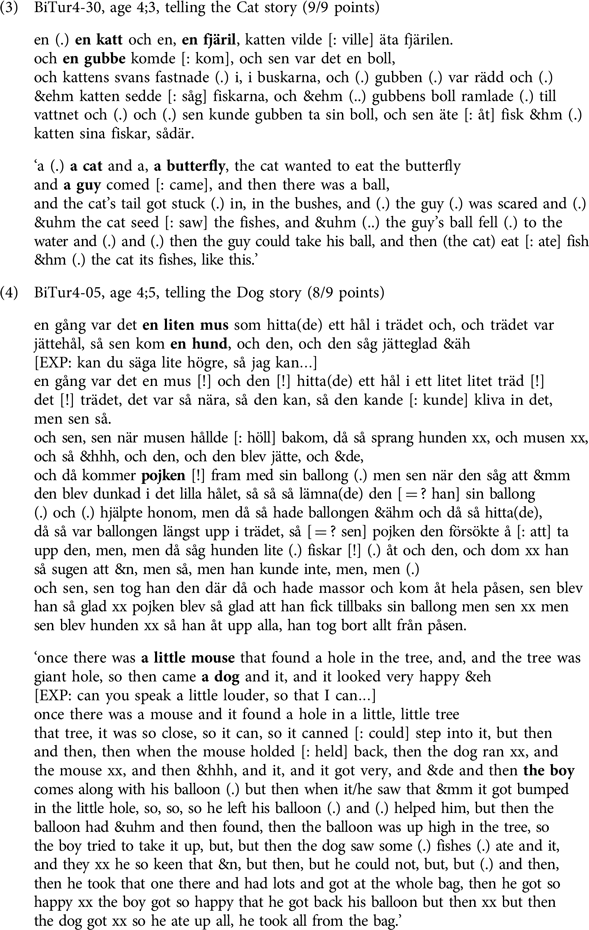
It is difficult to discern a common pattern in the background of the six high-performing 4-year-olds. Two of them, one from a high SES and one from a very low SES family, have a L1-Swedish-speaking parent and receive extensive Swedish input at home and also spend unusually many hours at preschool (45−48 h/week, BiTur4-03, BiTur4-05). With this much Swedish input, it is not surprising that these two children’s Swedish narrative skills are advanced for their age. The other four 4-year-old top performers (BiTur4-08, BiTur4-10, BiTur4-28, BiTur4-30) have a different family background altogether: they grew up with two Turkish-L1 parents or Turkish/Kurdish-L1 parents who both speak mainly Turkish to the child, and their SES is very low or middle-low. However, BiTur4-10 and BiTur4-30 are reported to be early talkers, and three of the children have started preschool early (BiTur4-10 from age 1;0, BiTur4-03 and BiTur4-28 from age 2). Concerning age, the high-performing youngsters are anywhere between 4;0 and 4;11 and do not cluster at the older end of their age group, even though a clear effect of age on character introduction performance was found for the entire sample (Section 5.4). When considering Swedish vocabulary production, none of the six children score extremely low; their scores range from low to high (20–47/60; Mage4 = 25.4). At the individual level, in order to perform tops for character introduction, a high CLT score is not a prerequisite, even though vocabulary production did turn out to be the strongest predictor of character introduction at group level (recall Section 5.4).
Concerning the top-scoring 4-year-olds’ narratives, the following can be noted. Their narratives vary from short (e.g. TNW = 42 for BiTur4-03 or TNW = 56 for BiTur4-30; see (3) above) to very long (e.g. TNW = 211 for BiTur4-05; see (4) above). It is thus possible to score at ceiling for character introduction with a short narrative. A few of the top-performing 4-year-olds employ standard fairytale opening phrases to introduce the first character (e.g. det var en gång en katt ‘there was once upon a time a cat’, en gång var det en liten mus ‘once upon a time there was a little mouse’), indicating familiarity with common fictional storytelling formats. However, other children who score at ceiling for character introduction do not use such phrases (see e.g. (3)). Some of the high-scoring 4-year-olds produce complex syntactic structures such as clefts and relative clauses to introduce characters (e.g. det är en katt som ser en fjäril ‘there is a cat that sees a butterfly’), which indicates a good command of morphosyntax (e.g. BiTur4-05). Yet other top-scoring 4-year-olds narrate with very simple utterances (e.g. BiTur4-30) and many non-targetlike inflections, so advanced syntactic skills cannot be a prerequisite for doing well on character introduction. What unites the high-performing 4-year-olds is that they all narrate a story in some sort of chronological order consisting of several events. These stories can be quite short and strictly sequential with clear introduction, reintroduction, and maintenance of referents.Footnote 11 However, the stories may also be longer and jump back and forth slightly in the chain of events (see (4)), so that reintroduction and maintenance of characters are not always communicated clearly to the listener, whilst the introduction of characters is clear.
Let us now move on to those 4-year-olds who score remarkably low on character introduction (BiTur4-06, BiTur4-14, BiTur4-14), only 2 or 3 points (recall that the age group mean is 5.83).Footnote 12 These low performers started preschool shortly before age 2, but otherwise have quite heterogeneous backgrounds, growing up in families with a wide range of SES (from very low to very high), with two L1-Turkish-speaking parents, two Kurdish/Turkish-speaking parents, or one L1-Turkish parent and one L1-Swedish parent. What unites the low-scoring 4-year-olds, however, is that they seem to be unable to narrate a sequence of events. Even when repeatedly prompted by the experimenter, these children struggle to comply (see (5) and (6)). They mention only one character in the form of labelling or picture description, with a simple nominal phrase hunden (‘the dog’) or en hund (‘a dog’), whereas other characters are not mentioned at all, resulting in a very low score. Alternatively, one or two characters are referred to but in a very vague manner, with a personal or deictic pronoun (e.g. den ‘it’, den där ‘that (one)’), which is lexically uninformative and discourse-pragmatically inappropriate as the listener cannot see the pictures. Verbal production by these children is minimal, with very few words (e.g. TNW = 19 for BiTur4-06, compared to the age group mean of 72.42 words). Utterances are very short and simple, often rudimentary, or consist of formulaic chunks; for instance, one child repeatedly says jag kan inte ‘I can’t’, inte kan ‘can’t’, another starts counting numbers. In sum, the MAIN productions of these low-performing 4-year-olds are not really narratives. Two examples are given in (5)−(6), with English translations. What also unites the low-scoring 4-year-olds is that they have very low Swedish CLT vocabulary production scores (8−16/60, cf. Mage4 = 25.4).Footnote 13 It is likely that these children’s Swedish language skills are so limited that they are unable to verbally convey story events and characters. It is also possible that these children do not fully understand what is happening in the story or do not interpret the picture sequence as a story. The very same 4-year-olds who perform lowest on character introduction are also the ones who score lowest on inferential story comprehension (i.e. 0, 1 or 2 points out of 10, cf. Mage4 = 5.9) (not reported here, see Bohnacker et al. Reference Bohnacker, Öztekin, Lindgren, Bohnacker and Gagarina2020b).Footnote 14

Let us now consider the low scorers amongst the older children, three 6-year-olds and two 7-year-olds (BiTur6-04, BiTur6-14, BiTur6-16, BiTur7-22, BiTur7-25), who score 4, 5, or 6 points. This is higher than the low-performing 4-year-olds (2 or 3 points), but still notably lower than their age group mean (8 points at age 7). Unlike the low-performing 4-year-olds discussed earlier, the older children do narrate sequences of events in chronological order and thus tell a (simple) story, and they do introduce characters with lexical NPs. However, their first mentions are non-targetlike, as they are either definite NPs (e.g. katten ‘the cat’) that are grammatical in form but discourse-pragmatically inappropriate, or bare singular nouns without an indefinite article (e.g. fjäril sovde ‘butterfly sleeped/slept’, BiTur6-04) which are ungrammatical in Swedish but could be due to crosslinguistic influence from Turkish, where new characters, at least according to some sources, can be introduced with a bare noun, as has also been documented by narrative corpus data (e.g. Küntay Reference Küntay2002). The older low-scoring children’s narratives are often short. Either the child omits one episode (and one character) of the story, which results in a lower score, or the child’s utterances are very simple, with non-targetlike lexicon and grammar. Two examples are provided in (7)−(8), with English translations below.

It is noteworthy that the older low-performing children never use pronouns for first mentions (whilst some of the younger low-performing children do); the older children are thus aware that characters need to be introduced lexically for a listener who cannot see the pictures. However, it is also striking that the older low-performing children do not produce a single instance of an indefinite NP. Instead, they either use bare nouns or a noun with a definite suffix. The group results reported in Section 5.2, where character introductions predominantly take the (targetlike) form of indefinite NPs by age 6 and 7, thus hide the fact that there are some older children who do not produce any indefinite articles.
These older low-performing children do not score extremely low on Swedish vocabulary production, but range from low to close to the mean (BiTur6-04: 25; BiTur6-14: 41; BiTur6-16: 26; cf. Mage6 = 39.8; BiTur7-22: 43; BiTur7-25: 42; cf. Mage7 = 42.1).Footnote 15 Concerning their backgrounds, all of the older low-performing children grow up in low-middle SES families with two Turkish-L1 parents who both speak Turkish to the child (just like the majority of children in our sample). However, what sets the older low performers apart is that they started Swedish preschool exceptionally late, at the age of 4 or 5 (i.e. much later than the sample mean of 23 months). It is thus plausible that the low performance of these older children may be due to relatively short exposure to Swedish, even though this did not turn out to be a significant predictor in the multivariate analysis for the entire sample.
To sum up, a more detailed look at high-performing and low-performing children suggests that the effects of age and expressive vocabulary scores on character introduction scores may be mediated at the individual level by other factors. In particular, there appears to be a qualitative difference between the low performers at age 4 and the low performers at age 6−7. Young low-performing children may use pronouns for character introduction (which older children never do), and their non-target or omitted character introductions go hand in hand with very limited Swedish language skills (as shown in their rudimentary utterances and extremely low vocabulary scores). By contrast, older low-performing children never use pronouns for character introductions but always lexical NPs, even though they do not mark these lexical NPs morphologically as indefinite. The lack of indefinite articles in the older low performers’ Swedish narratives, which indicates a delay in the acquisition of the Swedish referential system, may be linked to the referential system of Turkish as well as to the late and limited exposure to Swedish these children have received (due to exceptionally late preschool starts in this group).
6. Discussion and conclusion
The present study investigated character introductions in a larger cross-sectional sample of oral narratives by Turkish/Swedish bilinguals aged 4 to 7 (N = 100) and from age 4 to 6 in a smaller longitudinal sample (N = 10). We analysed the development with age (RQ1) and how language exposure and proficiency affect children’s use of referring expressions for character introduction, with a focus on referential appropriateness (RQ2). Finally, we carried out a qualitative analysis to find out what characterises particularly high- and low-performing children (RQ3). We expected to find an increase with age in referential appropriateness and especially concerning the use of indefinite NPs, effects of language proficiency and exposure, as well as a possible delay in the Turkish/Swedish bilinguals regarding the systematic use of overtly marked indefinite NPs for character introduction in Swedish, due to differences in the referential systems. Our predictions were partially borne out.
Concerning the answer to RQ1, the analysis showed a significant effect of age on the child’s referential appropriateness in the cross-sectional sample, as predicted. From age 4 to age 7, the children’s proportions of indefinite NPs increase from around 30% to almost 70%, with a corresponding decrease in the use of pronouns, bare nouns, and definite NPs. This pattern is largely replicated in the longitudinal study from age 4 to 6. With respect to a possible delay in the Turkish/Swedish bilinguals’ use of appropriate referring expressions to introduce story characters, comparisons with results from previous studies of Swedish-speaking children that used the same stimuli as the present study are illuminating. Figure 4 places our results next to results from German/Swedish bilinguals and Swedish monolinguals (Lindgren Reference Lindgren2018a, Lindgren Reference Lindgren2018b). This comparison makes it clear that there are similar patterns in all three groups: we see higher proportions of indefinite NPs and lower proportions of other types of expressions, especially pronouns and bare nouns in the older groups. We also see that the Turkish/Swedish group is behind in terms of proportions of indefinite NPs, but with respect to the use of pronouns and bare nouns, they show the same patterns as the other groups.
Types of referring expressions used for character introduction in MAIN Cat/Dog, comparison for cross-sectional data: German/Swedish bilinguals (Lindgren, Reference Lindgren2018b), Turkish/Swedish bilinguals (the present study), and Swedish monolinguals (Lindgren Reference Lindgren2018a, Lindgren Reference Lindgren2018b).

We also compared our longitudinal results with the results from Vogels & Lindgren (Reference Vogels and Lindgren2022), the only other longitudinal study of types of referring expressions used for character introductions in Swedish (Figure 5). Here, we also see similar developmental patterns, but again lower percentages of indefinite NPs in the Turkish/Swedish group than in the Swedish monolinguals.Footnote 16
Types of referring expressions used for character introduction in MAIN Cat/Dog, comparison for longitudinal data: Turkish/Swedish bilinguals (present study) and Swedish monolinguals (Vogels & Lindgren Reference Vogels and Lindgren2022).

So, what are the possible explanations for the slower rate of development in the Turkish/Swedish group? The protracted overuse of definite NPs (hunden ‘the dog’) instead of indefinite NPs (en hund ‘a dog’) for character introduction could indicate that the children narrate from their own viewpoint and do not sufficiently take into account the perspective of the listener (who cannot see the pictures as they can). However, such an ‘egocentric’ cognitive explanation (recall Section 1) clashes with the finding that the Turkish/Swedish children rarely introduce characters with pronouns, i.e. reduced, underinformative forms that are infelicitous in the absence of shared common ground.Footnote 17 The proportion of such pronouns is low (12.5% at age 4, 0% by age 6 in the longitudinal data, and 0% by age 7 in the cross-sectional data) and on a par with monolingual Swedish peers (11.4% at age 4, 1.4% at age 6). The underuse of indefinite NPs for character introductions in our sample is therefore unlikely to be linked to a lack of addressee-friendly perspective taking.
Under the influence of Turkish, we might also have seen some use of bare nouns (e.g. *det var hund ‘there was dog’, *hund ville fånga mus ‘dog wanted to catch mouse’) (recall Section 2). However, we found no evidence of such direct crosslinguistic influence: The proportions of bare nouns for character introduction are very low (0−10.9%) and similar to the proportions found in monolingual Swedish-speaking children (0−10%). By age 7, the Turkish/Swedish bilinguals do not produce any bare nouns, yet their proportion of indefinite NPs is lower than those of Swedish monolingual and German/Swedish bilingual 6-year-olds. Since German/Swedish bilinguals perform similarly to Swedish monolinguals, the lower performance of the Turkish/Swedish bilinguals is not an effect of bilingualism in itself. It is conceivable that our findings can be explained by the Turkish/Swedish bilinguals having to struggle more with the acquisition of the Swedish referential system, as it differs from the Turkish system. Recall that new referents such as character introductions are overtly marked for indefiniteness in Swedish, whereas there appears to be optionality with regard to such morphological marking of indefiniteness in Turkish (see Section 2).
However, we would like to offer another possible explanation, which is supported by our results with respect to the answer to RQ2, namely language proficiency. In our study, the child’s language proficiency (expressive vocabulary measured on an independent vocabulary task) significantly affected their ability to introduce characters appropriately, and this was an even stronger predictor than the child’s age. From previous studies (Lindgren Reference Lindgren2018b, Bohnacker et al. Reference Bohnacker, Rima Haddad, Öberg, Öztekin, Haapamäki, Forsman and Huldén2020a) investigating these children’s vocabulary, we know that the Turkish/Swedish group has lower language proficiency than Swedish monolinguals, and, since language skills do influence the ability to select discourse-appropriate referring expressions (see Andreou et al. Reference Andreou, Knopp, Bongartz and Maria Tsimpli2015), the lower results of the Turkish/Swedish bilinguals on referential appropriateness in our study are not surprising. The clear effect of Swedish expressive vocabulary on character introductions in the present study is in stark contrast to Lindgren et al.’s (Reference Lindgren, Reichardt and Bohnacker2022) results for German/Swedish bilinguals, where there was no measurable effect of expressive vocabulary on character introductions. There are a number of possible explanations for these diverging outcomes. First, they could be due to methodological differences between the two studies. Although the stimulus and elicitation procedure were the same, as was the measure of expressive vocabulary, the dependent variable was not: Lindgren et al. (Reference Lindgren, Reichardt and Bohnacker2022) investigated the use of indefinite NPs, whereas our dependent variable was Schneider & Hayward’s (Reference Schneider and Hayward2010) character introduction score, a measure of referential appropriateness that may be more sensitive to effects of language proficiency. Another explanation for the diverging results could be differences in sample sizes and/or ages (20 4-year-olds and 20 6-year-olds in Lindgren et al. vs. 100 4-to-7-year-olds in the present study). However, we also believe that a large part of the explanation lies in the range of vocabulary scores, which is much wider in the Turkish/Swedish group, especially regarding the minimum scores. The lack of an effect in the German/Swedish group may have been due to their overall high scores on expressive vocabulary, which is connected to the large number of words that are shared between these languages (see Lindgren & Bohnacker Reference Lindgren and Bohnacker2020). In neither group was there a measurable effect of language exposure on character introduction. However, not finding an effect of language exposure within our Turkish/Swedish-speaking group does not mean that exposure plays no role. Growing up with more than one language, our participants necessarily receive less input in Swedish than their monolingual peers and it is conceivable that this influences their character introductions. Our results with respect to the effect of language skills (vocabulary) are similar to those of Andreou et al. (Reference Andreou, Knopp, Bongartz and Maria Tsimpli2015) for Greek/German bilinguals, but Andreou and colleagues did find an effect of exposure, whilst we did not. This difference could be explained by the differences in the input measures used. Andreou et al. (Reference Andreou, Knopp, Bongartz and Maria Tsimpli2015) found an effect of early literacy input, a measure that is both more specific and more closely connected to the activity of storytelling than our more general language input measures. Additionally, Andreou et al. (Reference Andreou, Knopp, Bongartz and Maria Tsimpli2015) investigated story retelling, whereas our study used the storytelling method, and their participants were older than ours, 8–12-year-olds compared to 4–7-year-olds (they did not include age as a factor in their analysis). Andreou et al.’s participants also grew up in two different contexts, Germany and Greece, meaning that the differences in input patterns between individual children were likely larger than for our bilinguals, who all grew up in the same majority language context. The difference between our results and theirs may be due to one or several of these differences in participants and methodology.
In the present study, narrative length was included as a control variable but not found to have any significant effect on the character introduction score once the child’s age and language proficiency are taken into account. Even with a very short narrative, it is possible to score at ceiling for character introduction, as shown in our qualitative analysis of narratives by high-performing 4-year-olds. However, being able to express some basic narrative structure, such as a sequence of several events, seems to be linked to appropriate character introductions, providing an answer to our RQ3 about characteristics of high- and low-performing children. At age 4, difficulties with character introduction may also be linked to low performance on story comprehension, in addition to low language proficiency. By contrast, the older low-scoring children mainly show an inappropriate use of the definite article. This could be due to problems with assessing the listener’s informational needs in a situation which is demanding for them because of difficulties in expressing themselves (their narratives are often short, and they do not score high on the vocabulary task, pointing to relatively limited language proficiency). The problems regarding character introduction found in the older low performers could also be due to incomplete acquisition of the article system in Swedish.Footnote 18
In sum, the present study of character introductions in narratives by Turkish/Swedish-speaking children aged 4−7 has shown an overuse of definite markers and an underuse of indefinite marking in Swedish. Interestingly, there was next to no overuse of (Turkish-style) bare nouns for the group as a whole, and thus not much evidence for direct crosslinguistic influence from the children’s L1 in this domain. For a few, older, children with late and short exposure to Swedish, there were indications of a delayed development of the Swedish referential system, which may be linked to possible crosslinguistic influence from the L1 Turkish, as these children did not produce any indefinite articles in their Swedish narrations.
Despite the typological differences in the Turkish and Swedish referential systems, the overall patterns and developmental trajectories in the speech of Turkish/Swedish children were similar to those of other bilingual and (younger) monolingual Swedish-speaking children, albeit with some delay. We also found considerable variation between individual children, where some 4-year-olds performed at ceiling, whilst a few 7-year-olds did not. Our multivariate analysis showed that age and language proficiency (expressive vocabulary as measured on a separate test) were the factors that predicted referential appropriateness of character introductions particularly well. Length of exposure was not a significant predictor when other variables were controlled for, though our qualitative analysis suggests that older low-performing children may introduce characters inappropriately because they have not fully acquired the Swedish article system, which could be related to late and limited exposure (e.g. late preschool starts). Our statistical model explained 39.4% of the variation in the character introduction score; other factors thus play a role as well. Some such factors might be working memory and non-verbal IQ, as well as aspects of language exposure that we did not measure such as specific measures of the child’s familiarity with the (fictional) narrative genre and storytelling in the home or at (pre)school. Future studies could profitably include such measures, in order to gain an even fuller picture of factors influencing children’s acquisition of appropriate character introductions than the one offered by the present study. It is our hope that our study will be the starting point of such a line of research.
Acknowledgements
We want to thank the children, parents, preschools, and schools for participating in the study. We gratefully acknowledge research grants to the second author from the Swedish Research Council [VR 421-2013-1309] and the Bank of Sweden Tercentenary Foundation [P19-0644:1].
Competing interests
The author(s) declare no competing interests.


 Open access

