


Introduction
Lichens exist as inevitably challenging ‘things’ that cannot be adequately circumscribed by a singular concept. This tension can be frustrating, or even disorienting, but also productive. The nature of the lichen thallus is not unique in this respect, in that much of life exists as complex associations of multiple organisms, but in contrast to many ‘holobionts’, the multipartite complex nature of lichen symbioses is harder to ignore. Merely highlighting complexity may be engaging, but it can also become a barrier to consistent communication and scientific analysis. There is a growing body of work on the twinned concepts of individuality and organismality in philosophy of science (Lidgard & Nyhart Reference Lidgard and Nyhart2017) as well as efforts in lichenology to define ‘lichens’ (Hawksworth & Grube Reference Hawksworth and Grube2020; Allen & Lendemer Reference Allen and Lendemer2022; Sanders Reference Sanders2023). This literature can be dense and overwhelming.
It is important to clarify what our focus here is and conversely what we are not centring on. The discussion of individuality is not the same as the evaluation of organismality (Pradeu Reference Pradeu2016); for a discussion of lichen identity centring on organismality, see Goward (Reference Goward2009). The current interest in redefining lichens as ‘holobionts’ (e.g. Grube & Berg Reference Grube and Berg2009) or ‘ecosystems’ (Hawksworth & Grube Reference Hawksworth and Grube2020) is a separate, albeit interacting, topic of discussion. However, because these topics can sometimes be conflated, it is important to consider how different perspectives on lichen individuality may explicitly or implicitly shape other attempts to define them. Here, our emphasis is not on what lichens ‘are’ but rather on how we might determine what is ‘an individual lichen’ for research purposes.
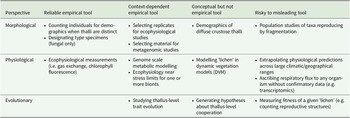
Since no perspective will be universally ‘best’, the focus should be on pragmatic considerations: for any given question or subdiscipline, does an approach reveal or disguise relevant critical characteristics of the lichen association? Furthermore, how well does the approach align with instrumental and observational scales and constraints? We consider four primary ways in which an approach might align with a particular question or field of study: 1) a valuable empirical tool for work (it facilitates work at the right scale without introducing serious errors); 2) a context-dependent valuable empirical tool (it can facilitate work but may introduce serious errors/gaps in some contexts); 3) a valuable conceptual tool (it may not be empirically practical but promotes novel conceptual understanding); 4) a risky to misleading tool for this use (Table 1).
Examples of different potential uses of each perspective on individuality. It is worth noting that the examples in the final category (‘Risky to misleading tool’) are meant as notes of caution, not prohibition, and include uses that one of us (DS) has themself applied.
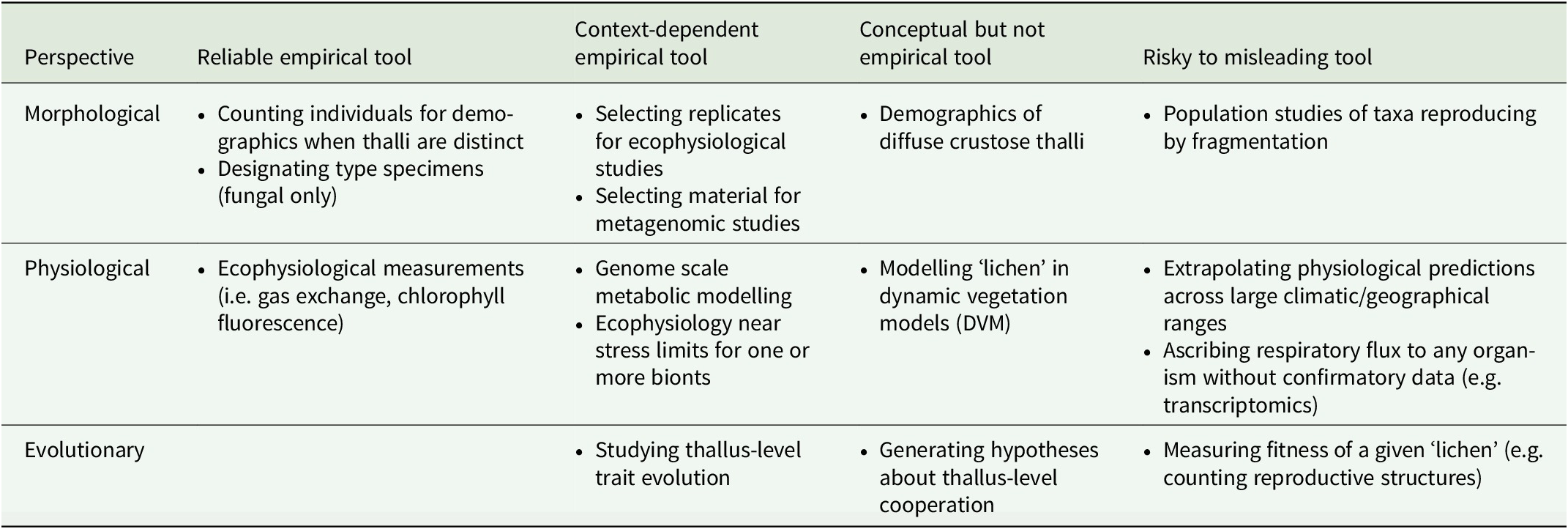
Table 1. Long description
The table has five columns. The header row lists Perspective, Reliable empirical tool, Context-dependent empirical tool, Conceptual but not empirical tool, and Risky to misleading tool. The first row, Morphological, has reliable tools such as counting individuals for demographics when thalli are distinct and designating type specimens for fungi. Context-dependent tools include selecting replicates for ecophysiological studies and material for metagenomic studies. Conceptual use is demographics of diffuse crustose thalli. Risky use is population studies of taxa reproducing by fragmentation. The second row, Physiological, lists ecophysiological measurements as reliable. Context-dependent tools are genome scale metabolic modelling and ecophysiology near stress limits for one or more bionts. Conceptual use is modelling lichen in dynamic vegetation models. Risky uses are extrapolating physiological predictions across large climatic or geographical ranges and ascribing respiratory flux to any organism without confirmatory data such as transcriptomics. The third row, Evolutionary, has no reliable tool listed. Context-dependent tool is studying thallus-level trait evolution. Conceptual use is generating hypotheses about thallus-level cooperation. Risky use is measuring fitness of a given lichen, for example by counting reproductive structures.
Philosophical discussions of individuality in biology explore how entities are defined, bounded and persist through time, shaping the ways scientists interpret organisms, collectives and symbiotic systems (Lidgard & Nyhart Reference Lidgard and Nyhart2017). While questions about individuality, thallus boundaries and phenotypic variation have been addressed to some extent in lichenology (Larson & Carey Reference Larson and Carey1986; Jahns Reference Jahns1988; Jahns & Ott Reference Jahns and Ott1997), lichen symbioses have been largely under-represented in the broader philosophical discussion of individuality. When they have been used to describe cases of potential biological individuality, the diverse manifestations of their biology have been unidimensionally represented by ‘classic’ lichen morphology (e.g. Queller & Strassmann Reference Queller and Strassmann2009; Catania et al. Reference Catania, Krohs, Chittò, Ferro, Ferro, Lepennetier, Görtz, Schreiber, Kurtz and Gadau2017).
While much rhetoric surrounding the individuality of multispecies consortia manifests in debates over whether or not some example is or is not an individual, that is not the purpose of this paper. Rather than being interested in whether lichen symbioses are or are not individuals, the goal is to emphasize why these different perspectives are relevant to our current research applications in lichenology, and how engagement with these ideas can challenge our current understanding of the symbiosis in constructive ways. In the following sections we introduce three perspectives of individuality that are relevant to the study of lichen symbioses: morphological, physiological and evolutionary individuality. These perspectives are not offered as competing definitions but rather as conceptual tools that highlight different aspects of the symbiosis, each with its own strengths, limitations and implications for research. By describing how each framework applies to lichen symbioses, we aim to clarify how individuality is realized in practice, and why these distinctions matter, not just for philosophical debates, but for empirical questions about the diversity, biology and evolution of this fascinating system.
Morphological Boundedness
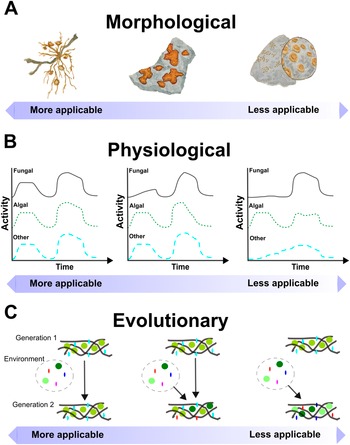
The morphological perspective (Fig. 1A) is perhaps the most accessible description of the lichen symbiosis, placing an emphasis on the physical structure of the lichen thallus as the bounds of what is considered an ‘individual’. This is a classic understanding of individuality, which highlights the spatial and temporal continuity and boundedness of the individual (Huxley Reference Huxley1912; Clarke Reference Clarke2010). This approach aligns well with our tendency to understand the world visually (a thallus is a unit that we can see), which makes it quite practical and easy to use. Many lichen thalli (especially macrolichen symbioses) have clear physical boundaries that can be used to determine where an individual starts and ends, although these boundaries can be much more blurred with mat-forming lichens or more loosely organized thalli such as the majority of basidiolichen symbioses (with the exception of some Dictyonemataceae).
Idealized images of three perspectives on the lichen ‘individual’, with each representing a spectrum in the practical applicability of the perspective. A, the morphological perspective is often easily applied to clearly delimited and separated thalli (left: e.g. Teloschistes chrysophthalmus), but more challenging in other cases such as when adjacent thalli intermingle without clear borders (middle: e.g. Squamulea subsoluta) and very difficult to apply when the edges of an individual are very diffuse or immersed in the substratum (right: e.g. Athallia holocarpa). B, the physiological perspective is most applicable when the component organisms are closely metabolically integrated (not shown) and synchronized in their activities (left). However, this physiological and/or temporal integration can be partial (middle) or strongly decoupled (right), greatly reducing the applicability of a physiological perspective to individuality. C, the evolutionary individual perspective is most applicable when all component organisms are directly inherited from a ‘parent’ thallus (left). However, when some (middle) or even all (right) of the component organisms are instead derived from the environment, then the applicability of the perspective is comparatively reduced. Watercolour images in part A by L. Liulevičius.
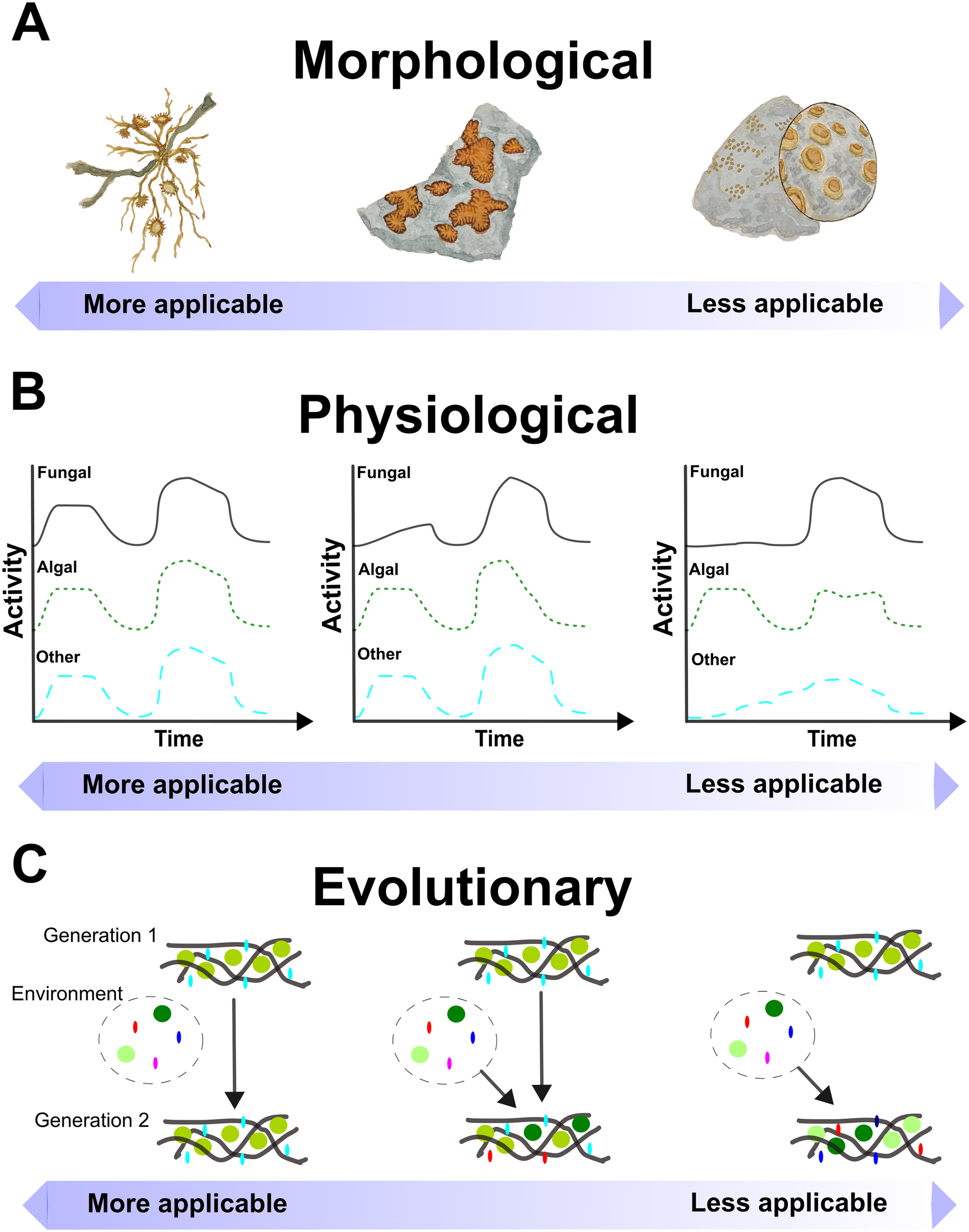
Figure 1. Long description
The schematic is organized into three horizontal panels labeled A, B, and C. Panel A, Morphological, shows three watercolor illustrations of lichen thalli. The leftmost thallus is clearly delimited, the middle shows intermixed thalli with less distinct borders, and the rightmost has diffuse or immersed edges. Below, a horizontal arrow labeled ‘More applicable’ on the left and ‘Less applicable’ on the right anchors the spectrum. Panel B, Physiological, contains three line graphs. Each graph has ‘Activity’ on the y-axis and ‘Time’ on the x-axis. Three lines are labeled Fungal (solid black), Algal (dotted green), and Other (dashed blue). The left graph shows synchronized peaks, the middle shows partial overlap, and the right shows decoupled activity. The same applicability arrow is below. Panel C, Evolutionary, presents three diagrams. Each shows two generations of lichen with colored circles representing component organisms. The left diagram has all components inherited from Generation 1, the middle has some inherited and some from the environment, and the right has all from the environment. The applicability arrow is repeated below. All panels progress left to right from more to less applicable for each perspective.
The morphological perspective is widely used, either explicitly in demographic and other ecological studies, or implicitly in how lichens are collected and handled. For example, the thallus provides the unit of choice for counting individuals in population studies or selecting individuals for transplant studies. Notably, this perspective is also implicit in the designation of specific thalli as taxonomic type specimens.
Powerful as it may be, the morphological perspective is not without some limitations and constraints. This may be most apparent when the boundaries of a thallus are more difficult to discern, such as in loosely integrated thalli or those completely immersed in their substratum. There may also be a need for some size-based considerations: larger thalli are often older and potentially more genetically diverse, both overall and spatially within the thallus (Dědková et al. Reference Dědková, Vančurová, Muggia and Steinová2025). Reproduction can also add complexity: asexual propagules notably create a mismatch between morphological individuality and genetic individuality, which is also a conceptual challenge for other clonal organisms.
The morphological perspective, in emphasizing the holistic identity of the thallus, can also obscure the importance of sub-thallus organizational scales. This has been the subject of a growing number of studies which emphasize the information that a morphological perspective may overlook. For example, any genetic and community changes within the thallus over time are likely to be overlooked, as is any within-thallus diversity (Allen & Lendemer Reference Allen and Lendemer2022; Spribille et al. Reference Spribille, Resl, Stanton and Tagirdzhanova2022). Recent studies have shown that this can in turn disguise considerable physiological and functional diversity (e.g. Casano et al. Reference Casano, del Campo, García-Breijo, Reig-Armiñana, Gasulla, del Hoyo, Guéra and Barreno2011; Tuovinen et al. Reference Tuovinen, Ekman, Thor, Vanderpool, Spribille and Johannesson2019). When these factors are likely to significantly impact the research objectives, a morphological perspective may be insufficient, or even misleading.
Despite these caveats, the morphological individual perspective is a powerful tool that remains appropriate and practical for many aspects of lichen research. Not every study needs to fully or even partially account for the importance of within-thallus scales. Even when within-thallus diversity may be important, given the need for destructive sampling and additional costs and delays imposed by genotyping (which, even as technology has become vastly less costly, can still be too much for many studies and research budgets), a whole thallus, morphological approach is often simply the most affordable and reasonable.
Physiological (Dis)integration
The physiological perspective (Fig. 1B) centres on metabolic processes, identifying a set of spatially and temporally integrated processes that can be bounded into an ‘individual’, regardless of the organismal identity which produces them (Jeuken Reference Jeuken1952; Santelices Reference Santelices1999; Pradeu Reference Pradeu2016; Bich Reference Bich2023). While this may sound abstract, this is in many ways a classic perspective on the lichen individual, centring on the physiological integration and interdependence of photobiont and mycobiont. This perspective is the one most commonly applied in lichen ecophysiology, which measures metabolic processes such as respiration, photosynthesis and nitrogen fixation at the thallus scale.
The physiological perspective informs the ongoing efforts to understand how lichens interact with their surrounding environments, be it through responses to climatic changes or their roles in biogeochemical cycles and ecosystem processes. In practice, this perspective is implicitly often closely connected to the morphological perspective in studies of whole-thallus physiology, using the morphological individual to stand in for an assumed physiological individual.
As with the morphological individual above, the physiological individual perspective can disguise considerable complexity. The component organisms of a lichen thallus are evolutionarily and physiologically diverse, and there is much about their interactions that can be overlooked when integration is assumed. Notably, the degree of coordination in the transfers of elements (C, N, etc.) and growth are still unclear (Spribille et al. Reference Spribille, Resl, Stanton and Tagirdzhanova2022). The thresholds for activation and tolerance of the different organisms can also diverge (Phinney et al. Reference Phinney, Solhaug and Gauslaa2019; Chrismas et al. Reference Chrismas, Tindall-Jones, Jenkins, Harley, Bird and Cunliffe2024; Meyer et al. Reference Meyer, Koch, McDonald and Stanton2024), making the degree of physiological integration highly variable over time. This instability of the physiological individual over space and time may be even greater if we consider the turnover of algal and microbial communities (Werth & Sork Reference Werth and Sork2014; Wedin et al. Reference Wedin, Maier, Fernandez-Brime, Cronholm, Westberg and Grube2015; Dal Grande et al. Reference Dal Grande, Rolshausen, Divakar, Crespo, Otte, Schleuning and Schmitt2018; Rolshausen et al. Reference Rolshausen, Dal Grande, Otte and Schmitt2023). Lastly, current iterations of the physiological perspective tend to overlook or exclude the microbial components whose physiological role is often still unknown (although this is rapidly changing; Grube & Berg Reference Grube and Berg2009; Erlacher et al. Reference Erlacher, Cernava, Cardinale, Soh, Sensen, Grube and Berg2015; Aschenbrenner et al. Reference Aschenbrenner, Cernava, Berg and Grube2016; Tagirdzhanova et al. Reference Tagirdzhanova, Saary, Cameron, Garber, Escandón, Goyette, Nogerius, Passo, Mayrhofer and Holien2023).
The physiological perspective on lichen individuals might seem hopelessly undermined by our growing understanding of within-thallus complexity. However, it remains useful and preferable in a number of use cases, especially when the associated limitations are kept in mind. Physiological perspectives are the best tool for integrating lichen physiology into larger-scale processes, as well as for predicting future impacts of climate change on lichen distribution and abundance. Furthermore, this perspective is capable of incorporating our growing understanding of the lichen microbial community and the potential for spatial and temporal change that it implies.
Partially Intertwining Evolution
Symbioses have long been understood to affect the evolution of both partners, and depending on how integrated they are, have in some instances been argued to be evolutionary individuals in their own right (Szathmáry & Smith Reference Szathmáry and Smith1995; Gilbert et al. Reference Gilbert, Sapp and Tauber2012; West et al. Reference West, Fisher, Gardner and Kiers2015). When a symbiosis is considered an evolutionary individual (Fig. 1C), the interaction is so functionally or reproductively integrated that natural selection is understood to primarily operate at the level of the consortium, rather than on the separate partners. In multispecies systems, evolutionary individuality is often associated with joint inheritance, whereby the same combination of symbionts is reliably passed on across generations, as seen in many endosymbioses (Estrela et al. Reference Estrela, Kerr and Morris2016; Queller & Strassmann Reference Queller and Strassmann2016). However, a looser understanding of evolutionary individuality may also emerge in cases where partners are not strictly co-inherited, but instead exhibit high partner fidelity across generations, alignment of fitness interests, or strong co-dependence (Roughgarden et al. Reference Roughgarden, Gilbert, Rosenberg, Zilber-Rosenberg and Lloyd2018). These alternative routes to evolutionary individuality complicate the classic criteria and make space for considering more ambiguous cases, such as lichen symbioses.
Some lichen symbioses naturally appear to fit the distinction of evolutionary individuality, as many symbioses are regenerated via vertical transmission whereby both symbionts, mycobiont and photobiont, are transmitted to future lichen generations. This joint inheritance means it is conceivable that heritable variation could occur at the level of the thallus, allowing the interaction itself to be a selected trait, perhaps even superseding the ‘interests’ of the separate bionts. However, this view hinges on the presence of heritable variation at the level of the entire symbiotic unit, which reliably contains more than just the ‘primary’ lichen-forming fungi and algae (i.e. additional fungi, algae, bacteria, etc.). Evidence of co-speciation among bionts is limited (Piercey-Normore & DePriest Reference Piercey‐Normore and DePriest2001; Stenroos et al. Reference Stenroos, Högnabba, Myllys, Hyvönen and Thell2006; Singh et al. Reference Singh, Dal Grande, Divakar, Otte, Crespo and Schmitt2017), with some indications of congruence between lichen-forming and lichenicolous fungi (Lawrey & Diederich Reference Lawrey and Diederich2003). However, even these associations show limited evidence of strict coevolution, with host-switching and uncoupled evolutionary histories being common (Werth et al. Reference Werth, Millanes, Wedin and Scheidegger2013; Millanes et al. Reference Millanes, Truong, Westberg, Diederich and Wedin2014). With relatively little known about how the entire symbiotic consortium is reformed across generations, it becomes difficult to conceive of the lichen symbiosis as an evolutionary individual in the strict sense (Mushegian & Ebert Reference Mushegian and Ebert2016).
Not all lichen symbioses are reproduced via vertical transmission, however, since thousands of examples of lichen symbiosis exist where the algal symbiont is horizontally transmitted and each lichen generation is assembled de novo from environmental algae. Despite this, there are understandings of evolution and selection that still emphasize the evolution of the interaction that can be applied to lichen symbioses. The Song and Singer metaphor popularized by Doolittle & Booth (Reference Doolittle and Booth2017) to conceptualize how the symbiotic ‘song’ (i.e. the interaction) between different ‘singers’ (i.e. symbionts or partners) descends with modification has been applied at least twice to the lichen symbiosis (Jenkins & Richards Reference Jenkins and Richards2019; Spribille et al. Reference Spribille, Resl, Stanton and Tagirdzhanova2022). Even though the singers may change, their song has high fidelity and is thus persistent enough to be under selection.
Explicitly naming the lichen symbiosis as a candidate evolutionary individual is not common (although see Goward (Reference Goward2009)), but it may be implicit in some of the ways in which lichens are spoken about or studied. When considering trait evolution or ecology, we often identify emergent properties of the thallus and try to understand their adaptive ‘role’. Thallus morphology, for example, is inherently emergent rather than being a trait of any specific biont, and yet it is routinely discussed as a trait adapted for optimal water uptake and solar absorption. It is also the scale at which selection by environment is occurring. If certain conditions ‘favour’ particular growth forms, the whole thallus is treated as an evolutionary individual.
Less obviously, the perspective of the symbiosis as an evolutionary individual manifests in lichen taxonomy. Dichotomous keys often emphasize different traits or emergent properties of the symbiosis as the basis of species distinctions: for example, the majority of morphological (e.g. growth form, cortex type, reproductive structures, etc.) and secondary chemical traits (e.g. depsidones, depsides, etc.) are rarely, if ever, expressed in pure cultures of any of the components (Brunauer et al. Reference Brunauer, Hager, Grube, Türk and Stocker-Wörgötter2007; Belosokhov & Spribille Reference Belosokhov and Spribille2025; Singh et al. Reference Singh, Dal Grande, Martin and Medema2025). While lichen taxonomy is based on the ‘primary’ fungal component, the divergence of fungal species causes new emergent properties of the symbiosis, which carries with it an implicit understanding of the evolution of the symbiosis itself (Spribille Reference Spribille2018).
While considering lichen symbioses, or any symbiosis for that matter, as an evolutionary individual is often imperfect, a major strength of this type of intellectual engagement is in how it forces contemplations of fitness, cooperation and levels of selection on the symbiotic system at multiple scales. This way of thinking can reveal tensions in the ‘interests’ of different components of the symbiotic relationship and create a strong grounding for developing hypotheses about symbiosis formation and maintenance across evolutionary timescales. As more organisms are reliably found within lichen symbioses (e.g. basidiomycetes, bacteria, etc.), this framing can help make sense of the contribution, importance and necessity of these additional symbiotic partners as we contend with this system as a potentially evolving network of interactions.
Despite arguments in favour of considering the lichen symbiosis an evolutionary individual, this perspective might be overly reductive and not representative of many examples of lichen symbioses. Although it spawns engagement on the evolution of the system, it can quickly turn into attempts to be deterministic about a primary unit of selection (Lewontin Reference Lewontin1970), often blurring the fact that there are tensions in selection on many levels at all times. This perspective may also unintentionally lead to adaptationist thinking, whereby any emergent property of symbiosis is seen as an adaptation of symbiosis, rather than a potential adaptation or trait of a particular symbiont. Many emergent properties may not be adaptations at the level of the symbiosis at all; they may equally represent by-products of selection on the individual bionts, co-opted traits, or developmental constraints (Gould & Lewontin Reference Gould and Lewontin1979).
Engaging with the lichen symbiosis as an evolutionary individual is a constructive way to generate hypotheses about co-adaptation, explore how integration shapes the symbiotic phenotype, and reassess trait evolution and inheritance at multiple scales of the symbiosis. It encourages the interrogation of how traits, such as desiccation tolerance or reproductive structures, are influenced by selection on the symbionts, the symbiosis or a combination thereof. It also provides a conceptual scaffold for comparative work with other intimate multispecies systems, such as coral reefs, insect-microbe endosymbioses, or plant-mycorrhizal systems. Ultimately, even when applied imperfectly, this framing promotes a more nuanced understanding of lichen symbioses as a system in which evolution operates at multiple, potentially overlapping, scales.
Individuals, Organisms and Ecosystems: Other Perspectives Beyond Individuality
A recurring theme throughout these perspectives has been the idea of scale. A complex system such as a lichen thallus can be deconstructed into component parts, and a regular challenge to usefully identifying individuals arises when the details of those component parts strongly influence the question being studied. This challenge is hardly unique to lichen symbioses but merits some attention. In our view, the existence of important information at other scales does not undermine the importance of any given level of organization (for example, intra-thalline genetic diversity does not automatically invalidate the thallus as an individual, although it may introduce complications). Furthermore, it is worth considering that an attribute of complex systems is their multiple decomposability (Wimsatt Reference Wimsatt2007); there are multiple ways of identifying component parts (e.g. organisms, metabolic sub-networks, tissue layers, etc.) that are all equally valid depending on the question being asked. What matters is whether the chosen delimitation of an individual is relevant to the purposes we have for it. This is perhaps most clearly illustrated in the consideration of evolutionary individuality and levels of selection.
The potential levels of selection in lichen symbioses emphasize how scale influences both our ideas about, and pragmatic choices surrounding, individuality. Lichen symbioses contain multiple scales of biological interaction, each with the potential to transmit genetic information across generations. Within the symbiosis, cells, genotypes, symbiont ‘populations’, or even emergent lichen thalli could be considered the scale at which heritable variation in fitness is transferred into future generations of lichen symbioses. While it may be simplest to assert that the thallus constitutes the unit of selection, especially under the influence of the holobiont (Zilber-Rosenberg & Rosenberg Reference Zilber-Rosenberg and Rosenberg2008; Bordenstein & Theis Reference Bordenstein and Theis2015; Roughgarden et al. Reference Roughgarden, Gilbert, Rosenberg, Zilber-Rosenberg and Lloyd2018), group (Wilson Reference Wilson1975; Wilson & Wilson Reference Wilson and Wilson2007) and multilevel (Okasha Reference Okasha2006) selection theories of evolution, the alignment of fitness interests across the plurality of partners, particularly when considering how the symbiosis reconstitutes itself across generations, challenges this perspective (Moran & Sloan Reference Moran and Sloan2015; Douglas & Werren Reference Douglas and Werren2016; Mushegian & Ebert Reference Mushegian and Ebert2016). This reveals the futility of seeking a singular, best circumscription of the evolutionary, or even morphological or physiological individual. Rather, lichen symbioses reveal a central message in debates over individuality: scale matters, and different biological processes or research questions lead to different scales at which evolutionary dynamics, morphological boundedness and physiological integration is most meaningful.
Ultimately, the choice of perspective and individuality concept will need to be guided by the goals and practical constraints of each research activity. What is the perspective that best fits my question? What are the practical definitions of individuality that are possible with my chosen techniques, and how well do they align with my preferred perspective? If the alignment between what is desired and what is possible is partial at best, how does this impact the interpretation of results? Similar considerations might be applied when assessing the work of others: a less-than-ideal approach may still be the best available given financial, logistical or time constraints (this has been true of our own work; see Table 1), provided due acknowledgement and caution is applied in the interpretation. As such, our aim is not to dictate specific use cases but rather to encourage critical yet considerate discussion of perspective choices.
Conclusions
These perspectives are not meant to be an exhaustive compilation but rather a summary of some of the primary approaches in the current literature. No single perspective on individuality is universally ‘best’, and in a number of use cases different perspectives may overlap considerably. What we hope to emphasize instead is that practical advances will occur when researchers are clear about their choices of perspective for their specific questions in a given study, and aware of the constraints that those perspectives might imply. We provide specific examples of more and less appropriate applications for each perspective in Table 1. In many cases, pragmatic considerations will also guide approaches, since financial, logistical or time constraints may force us to apply perspectives that, while flawed, are productive and better than nothing. Accepting a plurality of perspectives therefore also requires us to be willing to consider context, not only of the object of study, but also of the people and sites of the study, and to ask not ‘is this my definition of a lichen individual?’ but rather ‘is this a productive use in this specific case?’.
Author ORCID
Daniel Stanton, 0000-0002-6713-9328.
Competing Interests
The author(s) declare none.