




Introduction
In global economic history, slavery and labour coercion, as opposed to free-wage labour, have been the rule rather than the exception.Footnote 1 Consequently, we cannot understand the history of human economic activity without considering the economics of such a pervasive institution. When applied to labour, coercion is generally understood to encompass a wide range of contracts such as slavery, corvée labour, serfdom, and debt peonage. Yet, when the economic and social implications of these distinct contracts are viewed through the lens of economic history, little has been done to study them separately. Much of the existing literature has approached slavery solely as a system of labour extraction, failing to recognize its parallel role as a vehicle for capital investment. This conceptual conflation, which often reduces slavery to a simple labour arrangement indistinguishable from serfdom, dominates the theoretical literature in the form of two main frameworks: land–labour ratiosFootnote 2 and transaction-cost models such as labour–leisure choices.Footnote 3 Both fail to distinguish between slavery and other forms of labour coercion. We argue that this distinction is essential: slavery must be understood not only as a means of controlling labour but also as an institution that treated enslaved people as capital investments, a feature critical to explaining its economic persistence.
Earlier generations of scholars, such as Herman Jeremias Nieboer, sought to explain the emergence and persistence of slavery through formal models, particularly those based on factor endowments and cliometric analysis. The classic literature on slavery as an economic institution often starts with the premise that slavery aimed at production surpluses and was most likely to emerge in economies where land was abundant, labour was scarce, and there were no institutional barriers to agricultural expansion.Footnote 4 Under such conditions, individuals would opt for independent farming rather than wage labour, forcing landlords to offer higher wages or resort to coercion to secure labour. Evsey Domar later modified the argument into a trilemma: free land, free labour, and non-working landowners cannot coexist; only two can ever be true, negating the third. Under this framework, the profitability of using persons in bondage would decline as land became scarce and a surplus of wage labour emerged.Footnote 5 The Nieboer-Domar factor endowment approach has proven a powerful tool for explaining the emergence of slavery as an economic institution worldwide.Footnote 6 But it has also been criticized. Orlando Patterson labels it ‘vulgar economic determinism’ and argues that correlations between land–labour ratios and the presence of slavery are weak or inverse.Footnote 7 His argument is supported by neo-Malthusian analyses of the fall of European feudalismFootnote 8 and rational choice studies of settler colonialism.Footnote 9
A crucial and overlooked weakness of the factor endowment approach is that it cannot explain why slavery would emerge instead of other forms of labour coercion. Nieboer defines serfdom merely as the ‘mitigated form of slavery’,Footnote 10 and Domar studies ‘the causes of agricultural serfdom or slavery’, terms that he uses interchangeably.Footnote 11 In summary, the Nieboer-Domar hypothesis provides a theoretical foundation for the emergence of labour coercion generally, but not for slavery in particular. This issue recurs in the broader literature, where slavery remains difficult to distinguish from other coercive labour contracts.Footnote 12 Often, the distinction is glossed over with the claim that slavery simply represented the most extreme form of coercion.Footnote 13 Understanding slavery as one form among many coercive systems has major implications for theoretical and empirical work on profitability and productivity.Footnote 14 While this body of work has advanced our understanding of slavery’s economics, it fails to acknowledge that slavery fundamentally differs from other arrangements: it granted the enslaver full legal control over mobile property. Garnsey notes that ‘the slave owner’s rights over his slave property were total, covering the person and the slave’s labour’.Footnote 15 These ‘total rights’ allowed enslavers not only to extract labour but also to use persons under their control to access capital.
More recent literature on slavery as an economic institution has focused mainly on the eighteenth- and nineteenth-century Atlantic world, when the integration of North America and parts of Latin America into emerging industrial capitalism in Europe gave rise to a ‘second slavery’, in which enslavers developed a more capitalistic culture.Footnote 16 This work, particularly within the New History of Capitalism (NHC), emphasizes that slaveholding represented ownership of a financial asset that opened multiple avenues of exploitation beyond farm labour, and ultimately underpinned modern capitalism.Footnote 17 The work of scholars associated with the NHC diverges from traditional economic histories by integrating social, cultural, and political dimensions into analysing capitalism’s evolution. Scholars in this field have been particularly interested in the relationship between capitalism and various factors such as slavery, colonialism, and state policies, emphasizing how economic practices shaped these elements.Footnote 18
A significant emphasis within the NHC is placed on the integral role of slavery in the development of modern capitalism. Scholars in this field argue that the exploitation of enslaved people was not merely a peripheral aspect of economic growth but a foundational element that propelled the expansion of capitalist economies.Footnote 19 By examining plantation systems, particularly in the United States, researchers highlight how the wealth generated through such exploitation fuelled industrialization and financial systems in Europe and North America. The profits were reinvested into emerging industries, infrastructure, and banking institutions, linking capitalism’s rise directly to the commodification of African individuals. Within this framework, persons held in bondage were not only a source of labour but also critical capital assets that influenced economic practices and growth. They were treated as valuable property, akin to livestock or machinery. Enslavers leveraged their market value as collateral to secure credit and expand operations, purchase additional individuals, or diversify into other enterprises.
Moreover, this commodification created complex financial instruments and markets. Individuals were bought, sold, and traded with the same rigour as other capital forms. The market for human property was both local and transnational, connecting Atlantic world economies. Auctions and sales provided liquidity, and the financialization of these persons allowed their value to be leveraged in various ways, including through mortgages or insurance policies on their lives and labour. This financial integration underscores the essential role they played in the broader capitalist economy, demonstrating that the prosperity of many industries was deeply intertwined with their exploitation. The NHC thus proposes that slavery functioned simultaneously as a system of labour and as a critical foundation for capitalist growth.
Critics argue that the NHC has focused too narrowly on the Antebellum US South and has contributed little new insight into slavery’s wider economic role. A common critique is that NHC and ‘Second Slavery’ literature regard Anglo-American slavery as normative and assume that slavery as an institution operated similarly across the globe, a view also shared by the New Economic History of Slavery that emerged in the 1970s.Footnote 20 We agree with this limitation but contend that its emphasis on bonded individuals as both labour and capital providers deserves further exploration.
In this article, we extend the NHC’s focus on enslaved people as sources of capital by comparing their economic function in the US with two other cases: the Cape Colony and Brazil. Despite significant structural differences in factor endowments and integration into the Atlantic economy, such individuals in all three regions were exploited by enslavers as a means of securing labour and capital. While they could be used in various financial transactions, their most significant role was as collateral. We, therefore, call for a revision of theories that explain the rise and persistence of slavery as an economic institution, one that acknowledges how slavery significantly differed from other forms of labour coercion. This distinctiveness lay in the fact that enslaved people were not only exploited for their labour but were also treated as financial assets whose value could be leveraged for credit, collateral, and accumulation of capital.
Our analysis focuses on those moments where data allow us to examine the function of enslaved people as collateral in economic transactions. For Brazil and the Cape Colony, this means concentrating primarily on the final years of slaveholding; for the United States, our study spans a broader portion of the slaveholding era. The article proceeds with three case studies. Despite considerable differences between them, bonded individuals in each instance were used to access urgently needed capital. By reconceptualizing enslaved people as both labourers and financial assets, our analysis frames slavery as a dual-purpose economic system whose flexibility enhanced its endurance across diverse colonial contexts. This insight contributes to global history by demonstrating how slavery served as a structural mechanism for credit markets and capital formation beyond the United States.
Slavery in the United States: Collateralization and capital in a plantation economy
In 1619, an estimated twenty enslaved people disembarked at the British settlement of Jamestown, south of the Chesapeake Bay, an event that marked the beginning of more than two centuries of slavery in the United States. Slave trading intensified after 1650 when, between that year and 1820, almost 400,000 individuals were brought to North America (see Figure 1). Almost half of all captives entered through the port of Charleston, South Carolina, after which the overwhelming majority were sent to the southern states. Although the number of persons in bondage was initially low compared to the Caribbean or Brazil, this group experienced significant growth over time. Estimates suggest a natural increase rate of 25% per decade. This contrasts sharply with Brazil, where the same population consistently declined by about 20% per decade.Footnote 21 Some economic historians suggest this indicates material strength and sustainability in the US system,Footnote 22 while others attribute it to pre-bourgeois values and paternalistic relationships between enslavers and the bonded individuals under their control.Footnote 23
Population of enslaved people disembarked in the mainland United States, 1650–1820. Source: Slave Voyages Database (2009) (https://www.slavevoyages.org/).

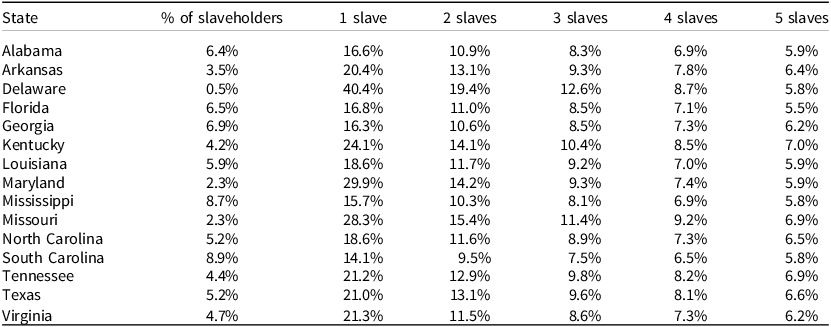
However, demographic growth did not result in a black-majority colonial population. Slaveholding patterns indicate that only about 8% of the population owned human property, with roughly 20% of owners possessing just a single individual. Fewer than half of all slaveholders in the South owned five or fewer. While certain areas, such as Louisiana’s cotton belt, did contain local majorities of persons in bondage, where planters secured a ‘near-monopoly of best soils’ and maintained relatively large plantations, these cases were exceptions and did not characterize North America’s broader agricultural or social landscape.Footnote 24 (See Table 1.)
Slaveholding patterns in the South per state, 1860

Source: Inter-university Consortium for Political and Social Research (2020) (https://www.icpsr.umich.edu/sites/icpsr/home).
During the period 1790–1860, an estimated 50% of all individuals in bondage in the United States worked in the cultivation of tobacco, rice, and indigo. Cotton did not emerge as a major southern crop until the early nineteenth century. After the invention of the cotton gin, a machine that separates cotton fibres from seeds and reduces production costs, cotton became a highly profitable business. While in the early nineteenth century cotton farms accounted for 11% of the coerced workforce, that figure had increased to 64% by 1850. At that time, indigo had ceased to be relevant in the southern agricultural economy, while tobacco remained the second largest employer of bonded individuals, followed by sugar and rice.Footnote 25
The overwhelming majority of studies on North American slavery interpret the system as a labour arrangement primarily confined to the agricultural economy, with particular emphasis on the nineteenth-century cotton boom.Footnote 26 This boom has received disproportionate attention. Robert Fogel and Stanley Engerman argue that its success was largely due to the efficiency of forced labour systems.Footnote 27 In their view, slavery enabled meticulous organization of production that, when applied to economies of scale, yielded significant productivity gains. This interpretation remains contested. Paul David and Peter Temin argue that Fogel and Engerman’s empirical approach does not clarify ‘precisely how much of the calculated “efficiency” differences in such cases is due to growing cotton, rather than to the managerial skills and methods of organisation adopted by planters and overseers, or to the sheer hard work extracted from slave labour’.Footnote 28 Two decades earlier, Wright had similarly argued that the southern slave economy should be viewed as one experiencing rapid growth under high external demand, but failing to develop the institutions or skills for sustained growth.Footnote 29 In short, Gavin Wright maintained that the success of the southern cotton economy can be fully explained by market conditions, not by labour arrangements.Footnote 30
Given that the average farmer owned very few individuals in bondage, it is necessary to question whether profitability truly stemmed from economies of scale, as Engerman claimed.Footnote 31 To understand both profitability and the system’s persistence, one must consider these individuals as more than just labourers. Farmers in the United States utilized them both physically, to cultivate the land, and financially, as collateral in mortgage contracts. Land clearing, drainage, irrigation, and fencing accounted for as much as 40% of gross investments.Footnote 32 Mortgaging agreements became a critical mechanism in the southern economy, and persons in bondage were the most valuable assets many farmers owned. In 1859 they represented 44% of total wealth in the cotton states, compared to 25% for real estate and less than 10% for physical capital.Footnote 33 Their high value and legal status as property made them a preferred form of collateral. Farm tools and land accumulation were often financed through credit secured by human property. Of the more than 8,000 mortgages taken out after the American War of Independence in Louisiana and Virginia, 41% involved human collateral, which represented 63% of total mortgage value. In Louisiana alone, such mortgages accounted for 47% of all contracts and more than 85% of total mortgage value.Footnote 34 Martin calls this underappreciated financial function ‘slavery’s invisible engine’.
The credit network extended well beyond local markets. North American planters maintained long-distance credit relationships that were, as Wright notes, ‘ultimately based on the asset value and liquid character of slave property’.Footnote 35 A crucial advantage of this system was the mobility of human property. While land values were fixed to local markets, bonded individuals could be relocated and sold wherever prices were more favourable.Footnote 36
Planters also benefited from flexible mortgage laws, or more accurately, from the absence of strict legal constraints.Footnote 37 Abuses were frequent, leading to repayment defaults and lengthy legal disputes that often ended with creditors seizing pledged individuals. Yet lenders had limited alternatives. The lack of other acceptable forms of collateral made them more likely to accept human assets, which ensured that this form of security remained central until the outbreak of the Civil War.Footnote 38 No comprehensive dataset exists for such mortgages across the South, and after the start of the war total collateralized values became even harder to trace. Martin observes that there were no widespread public debates about the economic consequences of emancipation or the elimination of this form of credit security, which allowed subsequent generations to ‘forget an important financial strategy that had not survived slavery’.Footnote 39
Some regional data do survive. Gonzalez and co-authors show that after emancipation, former slaveholders in Maryland and Delaware were less likely to start businesses due to losing access to viable collateral.Footnote 40 Kilbourne similarly reports that in East Feliciana parish the ‘debt structure imploded with emancipation, whether because a regular income stream from human property could no longer be assured or because most of the wealth underpinning the structure was gone’.Footnote 41
Accessing and cultivating new land required substantial capital investments amid high volatility. Farmers’ ability to obtain credit was essential, and the financial role of individuals held in bondage was amplified relative to other assets. Land was immobile; future production exposed lenders to volatile returns. Enslavers could, however, treat these individuals as mobile repositories of wealth and pursue sales wherever market conditions were most favourable. The absence of better alternatives, combined with the capital scarcity typical of frontier economies, led slaveholding to correlate strongly with debt. Enslavers were willing to pledge their human property to finance investments,Footnote 42 territorial expansion,Footnote 43 business ventures,Footnote 44 consumption,Footnote 45 and production.Footnote 46 Slavery solved two core problems created by land abundance: it provided both a labour force and collateral. Put simply, slavery remained profitable wherever there was a scarcity of either labour or productive capital. Although emancipation unfolded differently across the three societies examined in this article, credit markets in all three were disrupted in similar ways.
Slavery in the Cape Colony: Slaveholding and debt in a frontier economy
The colonization of the Cape began in 1652 with the arrival of Jan van Riebeeck on behalf of the Dutch East India Company (Vereenigde Oostindische Compagnie or VOC). His objective was to establish a refreshment station for ships travelling to and from Asia. The first settlers were mainly VOC employees tasked with building a fort and cultivating gardens for fruits and vegetables. Shortly after van Riebeeck’s arrival, European settlers encountered indigenous Khoesan, who were organized into large groups.Footnote 47 The Khoesan lived in smaller clan units known as kraals, practising nomadic pastoral farming for subsistence.Footnote 48
As international trade intensified and ship traffic increased, plans for territorial expansion followed. The VOC encouraged this by freeing some employees and granting large tracts of land to extend Dutch cultivation and colonial control. However, the land allocation process was disorganized. Colonists could claim ‘all the ground that they could bring under cultivation within three years, after which they would be able to sell, lease, or alienate their ground’.Footnote 49 A small group of early settlers moved beyond the Cape Peninsula to establish farms. As the settler population expanded, more colonists pushed inland, and the VOC was unable to manage the spread. Instead, it issued grazing licences that evolved into a loan-farm system.
According to Dye, the loan-farm system was characterized by ‘an identifiable landmark with vague boundaries because each specified farm centre had to be situated at least an hour’s walk from another farm’s centre’.Footnote 50 Settlers were responsible for defending their claims; the VOC, while mediating land disputes, did not station military forces to enforce property rights. Loan-farm tenure gave usufruct rights, allowing farmers to use but not own the land. In terms of wealth accumulation, however, loan farmers were not at a disadvantage compared to freeholders.Footnote 51 The expansion of agriculture at the Cape was accompanied by increased use of imported human property, as Figure 2 illustrates. Scholars have emphasized the essential role these individuals played in supporting the growth of European farming at the Cape.Footnote 52
Population of enslaved people and settlers, 1692–1793. Source: Nigel Worden, Slavery in Dutch South Africa (Cambridge University Press, 1985).

Slaveholding was widespread. By 1705, approximately 85% of farmers in Stellenbosch owned enslaved individuals.Footnote 53 Worden suggests that this pattern persisted for decades. However, scholars have questioned the profitability of smallholders. Du Plessis, using a hedonic price model, notes that slavery imposed heavy costs on small farmers and that their attempts to emulate wealthy planters by acquiring more bonded labourers were generally unsuccessful.Footnote 54 Worden, Fourie, and Green all echo the difficulty of understanding Cape slavery solely as an agricultural system.Footnote 55 Even VOC officials, such as Maurits Pasques de Chavonnes, governor of the Cape from 1714 to 1721, remarked that investments in enslaved people were ‘dead money’ that hindered colonial development.Footnote 56
Settlers also employed Khoesan labourers. Although data are limited, evidence suggests that indigenous labourers played a significant role in settler agriculture. Initially, the Khoesan were the primary labour source. Worden suggests their gradual replacement by imported bonded labour was due to the devastating 1713 smallpox epidemic and Khoesan migration.Footnote 57 Others argue that primitive accumulation processes actually increased the availability of indigenous labour over time.Footnote 58 Estimates by Fourie and Green suggest that Khoesan labourers comprised 35% of the total labour force in 1685, rising to almost 50% by 1773.Footnote 59 These figures are likely underestimated, as indigenous people worked not only in pastoral but also in arable farming.Footnote 60 Although formal enslavement of the Khoesan was prohibited, labour coercion was widespread, and historians generally agree that the Khoesan slipped into conditions ‘not far removed from that of serfs’.Footnote 61
A paradox emerges: why would settlers invest heavily in enslaved people when semi-coerced Khoesan labour was cheaper? Slavery persisted for nearly two centuries, suggesting that more than a small elite benefited. Scholars resolve this by arguing that Cape enslaved individuals served multiple functions, not merely agricultural labour. Most importantly, they acted as repositories of capital. Mortgages using human property as collateral are recorded as early as 1731, with a transaction involving Johannes Craa and the Dutch Reformed Church.Footnote 62 The practice became widespread. Shell notes that by the early nineteenth century, the enslaved were ‘the principal mortgageable asset of the colony’.Footnote 63
Swanepoel’s work shows that slaveholding was the primary determinant of debt accumulation even after controlling for production inputs.Footnote 64 Large landowners used debt mostly for investment rather than consumption.Footnote 65 Older settlers often regarded their human property as their bank.Footnote 66 Ekama, using a network analysis of 1810–39 mortgage records, demonstrates that most loans (84%) were provided by private creditors. Credit transactions spread geographically across the Cape, indicating that enslaved people’s mobility was a key advantage for lenders.Footnote 67 The ability to move human property across districts facilitated widespread credit access, even without economies of scale. Thus, slavery persisted at the Cape largely because it solved capital access problems in a land-abundant economy.
The consequences of emancipation in 1834 confirm this analysis. Although enslaved people were nominally freed, the so-called ‘apprenticeship’ system extended their forced labour for another six years. More importantly, Britain promised compensation. Initially, the Cape enslavers expected to receive a combined sum of £2,800,000. When only £1,247,000 was allocated, slaveholders suffered a significant shortfall.Footnote 68 Enslavers’ complaints focused on two issues: fear of losing labour and fear of losing capital. Dooling describes mass departures of formerly bonded individuals on emancipation day.Footnote 69 However, Worden notes that many remained in rural areas and worked as low-paid labourers.Footnote 70 Thus, labour shortages may have been short-lived.
Martins provides evidence that capital shortages were more consequential. He shows that 70% of the variation in grain output post-emancipation was explained by capital losses, compared to 20% in the wine industry.Footnote 71 Enslaved individuals had served as collateral. Their sudden legal emancipation crippled settlers’ ability to obtain loans. Many farmers were nearly insolvent.Footnote 72 Some enslavers negotiated extensions of their loans into the apprenticeship period.Footnote 73 Nonetheless, the collapse of the collateral system demonstrates that slavery at the Cape was not solely about extracting labour. It was about solving the dual problems of labour and capital in a land-rich, capital-poor economy.
Slavery in Brazil: Credit markets and the late persistence of slavery
The process of establishing a colonial society in Brazil was hindered by the inability of early settlers to obtain a reliable supply of labour. Portugal could not deliver a significant number of migrants given its population of no more than 1 million people by 1500.Footnote 74 Initially, indigenous labour was employed, but, by the 1540s, most of the indigenous population living on the coast had experienced a demographic decline due to contact with the Old World diseases.Footnote 75 From 1560 onward, the inability of the Portuguese to obtain labour led to the consolidation of slave trading across the Atlantic.
Brazil was the single largest recipient of enslaved people in the Americas. More than 4.5 million arrived on its coast between 1560 and 1860, though the overwhelming majority disembarked in the final third of that period. Of the total, 400,000 (9%) came between 1560–1660, 1.4 million (39%) between 1660–1760, and 2.9 million (60%) between 1760–1860.Footnote 76 Figure 3 displays this evolution over time. Initially, most were concentrated in the north-east during the sugar boom. After the development of coffee as an export crop, the system also took firm hold in the south-east.
Population of enslaved people disembarked in Brazil, 1550–1850. Source: Slave Voyages Database (2009) (https://www.slavevoyages.org/).

Ownership patterns varied considerably over time and between regions. While a plantation-dominated society has been the most common definition through which the Brazilian slave system has been analysed,Footnote 77 this understanding has been revised to incorporate more nuanced approaches. Luna and Klein suggest that the average number of enslaved people per enslaver varied widely. They use the state of São Paulo—the largest coffee-producing region in the country—to explore these patterns in detail. Agriculturalists near the state capital held, on average, six enslaved people per farm, whereas those further inland had larger landholdings and an average of sixteen.Footnote 78 Similar diversity was present in the Brazilian north-east, where Schwartz describes ‘the existence of large numbers of small and medium-sized holdings’ alongside the ‘broad distribution of slavery among the free population’.Footnote 79 Ultimately, slavery as an economic system suited a wide range of enslavers who were not necessarily plantation owners.
However, the growing accumulation of enslaved people failed to stimulate broader economic dynamism. The Brazilian economy of the sixteenth and seventeenth centuries was characterized by ‘an incipient social division of labour, by a precarious circulation of currency, excessive investments in the form of buildings and urban land, and a market with few economic options’.Footnote 80 Capital scarcity was also noted by Gadelha, who suggests that ‘the little monetisation that followed Brazil throughout the nineteenth century and the frequent commercial crises caused by the scarcity of money are clear indicators of the absence of capital in 300 years of colonial rule’.Footnote 81
The lack of liquidity was severe. In the late seventeenth century, 41% of all land acquisitions and other rural improvements associated with the sugar economy of Rio de Janeiro were made in kind—the sugar was used as a currency—or were only settled after the harvest period when Portugal purchased the sugar produced. Antônio Rodrigues Moreira, a captain of the Portuguese Navy stationed in Brazil, acquired land in 1689 from Domingos Luis Pousadas, a merchant investing in several activities in the city. The purchase was properly registered on a public deed of sale and, on the deed, it is possible to verify that Mr. Moreira owed ‘Mr. Domingos Luis Pousadas 118$770 [188,770 réis] stemming from the farm willingly acquired at his store, the value of which will correspond to the price of the sugar harvest of 1690 as appraised by the Portuguese fleet at the time of purchase’.Footnote 82
An economy with low liquidity and low accumulation rates can only promote investment through credit. Yet this, too, proved problematic in Brazil, as the lack of suitable assets for collateral and a collection of borrower-protective laws hindered access to loans. An example of the latter is found in the ‘Law of Mortgages’ of 1846, which ruled that ‘mortgages must be registered … where mortgaged assets are located’.Footnote 83 While registration promotes transparency, the ruling did not allow lenders to determine whether a property had already been foreclosed. In practice, the same property could be mortgaged repeatedly under separate contracts, provided each was properly registered. This created incentives for lenders to reject previously mortgaged property, limiting borrowers’ options.Footnote 84
As for collateral, few viable alternatives existed for borrowers in the agrarian Brazilian economy. Using future output introduced high uncertainty by exposing both parties to yearly production variations. Mortgages on land ‘appeared impracticable’ since land was abundant and inexpensive in frontier areas and, even in long-settled regions, ‘title to the land often remained vague, making the execution of mortgages problematical’.Footnote 85 In this scenario, mortgages secured against enslaved people emerged as a suitable option for Brazilian planters seeking credit. These individuals were often more valuable than entire plots of land. In the Brazilian Northeast, for example, a tarefa Footnote 86 of prime agricultural land was valued at 90$000 (90,000 réis), roughly a tenth of the price of a typical enslaved person.Footnote 87 However, exploiting them as collateral was limited, since legislation prevented foreclosures from alienating enslaved people from the farms where they remained, even when pledged, effectively making them an immovable asset.Footnote 88 In practice, enslaved people could still be used to secure loans, but creditors were not always willing to accept this form of collateral since individuals ‘could die, run away, or be sold without the creditor’s permission’.Footnote 89
Legislative changes were required for enslavers to fully exploit the financial opportunities associated with ownership. This was recognized as early as 1846, when Nabuco de Araújo, during his term as minister of justice (1853–57), drafted the project that reformed the existing ‘Law of Mortgages’ of 1846. Approved in 1864, it facilitated foreclosures involving enslaved people as collateral. It became possible to alienate them from the farms where they lived, allowing enslavers to more easily pledge persons as collateral to raise capital.Footnote 90 Nabuco de Araújo’s views were summarized by his son, Joaquim Nabuco, who noted that ‘the presumption of insolvency, the discredit and the misfortune … accompany a landowner who mortgages his goods. It’s very common to hear: He is lost because he mortgaged his goods. The inverse of this picture is what we should want.’Footnote 91
The new law of mortgages significantly influenced the Brazilian credit market. Banks, for example, extended credit on the security of enslaved people, especially Banco do Brasil, which used enslaved people as collateral when it established the country’s first mortgage portfolio as part of the 1866 agreement with the government. The bank took 25,000 contos’ worth of existing loansFootnote 92—the equivalent of £2.5 million—and converted these into chattel mortgages on enslaved people.Footnote 93
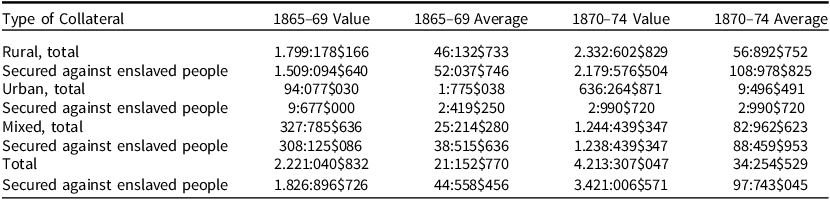
Planters fully exploited this flexibility. In the municipality of Campinas, one of the most important agricultural centres in Brazil at the time, the mortgage values between 1865 and 1869 reached more than 2.2 billion réis,Footnote 94 approximately £175,000.Footnote 95 The overwhelming majority of loans were secured against rural property, reflecting the strong participation of planters in the credit market. Most rural property, in turn, was secured by individuals held in bondage. During 1870–4, 93% of mortgage values on rural property used these individuals as collateral. For mixed properties, the proportion was even higher, as Table 2 indicates.
Mortgage credit in réis according to type of collateral in Campinas, 1865–1874

Source: Maria Alice Rosa Ribeiro and Maria Aparecida Alvim de Camargo Penteado, ‘Escravos Hipotecados, Campinas, 1865–1874’, Revista de História, no. 179 (2020): 1–39. The old Brazilian currency system went as follows: for amounts over a thousand réis, a currency sign ($) was inserted after the thousands digit, such as 100$000. For amounts over 1 million, a colon was inserted after the millions digit, as in 1:000$000. For amounts over 1 billion, full stop punctuation was used after the billions digit, as in 1.000:000$000.
On an individual level, it is possible to see a wide range of financial transactions involving enslaved people. Some of these included highly diversified sets of assets. Belarmino Rodrigues Pires, a coffee planter, pledged his farm alongside his ‘housing property, mill, monjolo [a hydraulic machine used to grind grains], enclosed pastures, some planted coffee and 22 enslaved people’,Footnote 96 to Antonio Paes de Barros, who in turn loaned Mr Pires the sum of 22:428$012 (22,428,012 réis), roughly £1,800. However, this operation can be considered small. Enslaved people also enabled enslavers to raise significant capital.
In 1866, for example, farmer Francisco VilelaFootnote 97 borrowed 524:861$573 (524,861,573 réis) from the Casa Comissária Teixeira Leite & Sobrinhos, a powerful coffee trading house. The repayment period was set for five years with an interest rate of 10% per year. As collateral, Vilela included the farm Santa Maria with its 800,000 coffee plants and 250 individuals held in bondage. The size of the mortgage is a testament to his wealth. The analysis of his estate in 1874 reveals total assets of 1.302:563$880 (1,302,563,880 réis), equivalent to more than £135,000 at 1874 values.Footnote 98 Most of this fortune was invested in 450 persons, representing roughly 50% of the total property value; his farms, 30%. The estate also included housing properties in both rural and urban areas of the country.
The offer of enslaved people as collateral improved the ability of enslavers to raise capital. However, the threat of insolvency and bankruptcy was real even among the wealthiest farmers. Francisco Vilela, despite his sizeable wealth, was insolvent by the time of his death. He had accrued debts worth more than 1.600:000$000 (1,600,000,000 réis) and had no cash reserves. The administration of Santa Maria farm passed to creditors, and the remaining land and individuals held in bondage were all sold to liquidate the debt inherited by his widow and children.Footnote 99 This case demonstrates how exposed Brazilian planters were to price fluctuations in international commodity markets. Lenders often provided credit on a short-term basis with repayment periods rarely exceeding ten years. Interest rates ranged from 6 to 8% in areas with commercial banks, but in some districts such as the Paraíba Valley—the heart of Brazilian coffee production in the nineteenth century—rates could reach 12% if loans were made between private citizens. Repayment difficulties restricted credit access due to elevated risk and information asymmetries.Footnote 100
Likewise in 1873, Banco do Brasil responded by increasing repayment periods, capping interest rates at 6%, and limiting maximum mortgage values to 120:000$000 per loan. These favourable terms attracted planters, prompting the bank to become the leading agricultural credit provider, as enslavers continued to offer land and persons as collateral in considerable numbers. That year alone, close to 800 individuals were pledged on mortgage loans through Banco do Brasil’s Campinas branch, demonstrating that Brazilian slavery remained strong even a decade after emancipation in the United States and nearly forty years since the abolition of slavery in the British Empire.
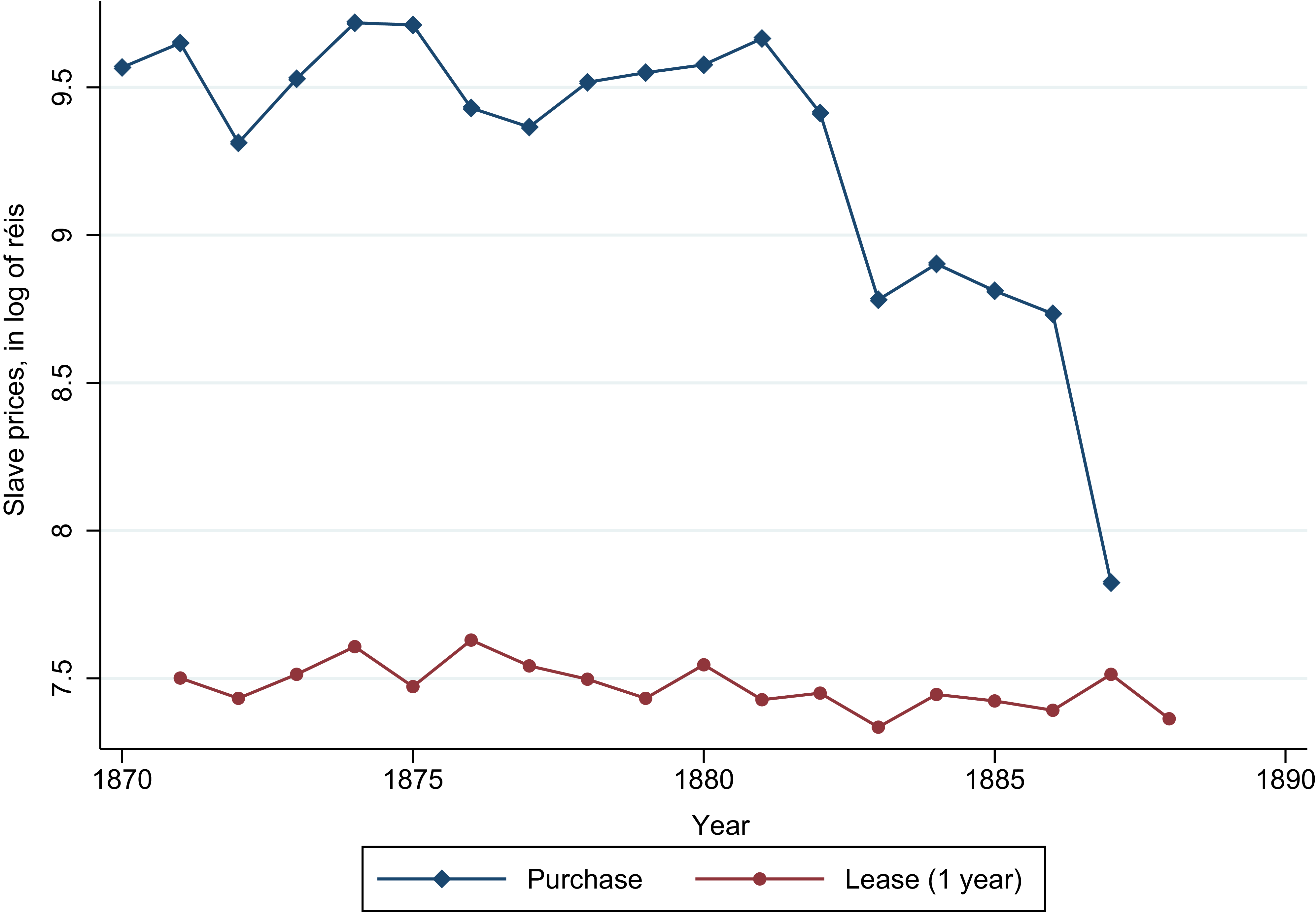
The Brazilian slave economy only showed signs of weakness in the 1880s, when prices for individuals held in bondage began to decline significantly, even though leasing costs remained relatively stable, as Figure 4 shows. Lower purchase prices reduced access to capital and ultimately weakened the profitability of the system as a whole. Although early historical narratives suggest that ‘the good sense, the self-restraint, and the humanity of the Brazilian people’ were pivotal elements for the decline of the slave system,Footnote 101 it is unlikely that enslaving elites, who were systematically overrepresented in the Brazilian legislative system, were motivated by altruism to relinquish their primary source of labour and capital.
Prices of enslaved people for purchase and lease in log of réis. Rio de Janeiro, 1870–88. Source: Pedro Carvalho de Mello, ‘Aspectos Econômicos Da Organização Do Trabalho Da Economia Cafeeira Do Rio de Janeiro, 1850–88’, Revista Brasileira de Economia 32, no. 1 (1978): 19–68.

The decline of slavery’s legitimacy in Brazil is intrinsically connected to the political strength gathered by the abolitionist movement across the more progressive urban centres. It enabled enslaved people to effectively resist planters’ orders through organized action, often involving orchestrated escapes from farms that deprived enslavers of labour and the ability to raise capital.Footnote 102 While efforts to recapture fugitives were promoted by the Brazilian government, officers frequently shirked responsibility, undermining enforcement. In October 1887, for example, army officers petitioned to be excused from pursuing individuals who had fled bondage.Footnote 103 The enslaved were effectively emancipated in 1888.
The uncertain environment leading up to emancipation prompted economic historians to reassess the profitability of the system during its final years. De Carvalho, for example, suggests that such individuals were still an investment with a rate of return equal to or superior to alternatives.Footnote 104 However, he later proposed that while returns remained positive in 1888, when the last persons held in bondage were freed, the opportunity costs made wage labour more attractive.Footnote 105 These analyses did not account for the ability of enslavers to raise capital or the alternative forms of collateral available once human property was abolished. Yet concerns about this transition were real, as evidenced by the fact that many individuals still stood as collateral for mortgage loans by 1888.Footnote 106
Enslavers demanded compensation from the government, claiming they were left with liabilities that could not be met without the benefits of bonded labour. Ruy Barbosa de Oliveira, the minister of finance, responded by ordering the destruction of all registration books of enslaved people held by the Ministry of Finance. His goal was to eliminate any documentation that could be used to pursue compensation claims, which he accomplished; without records, neither former enslavers nor the government could devise a compensation scheme. Although the freed still faced severe barriers to full integration into Brazilian society, renegotiation of debts secured against them under the Law of Mortgages of 1864 was not their concern. That law and its spillovers had enabled the capitalization of the Brazilian credit market to previously unseen levels and demonstrated the centrality of bondage in the formation of contemporary Brazilian society; a role that extended far beyond plantation labour alone.
Concluding remarks
In light of the debates surrounding the economics of coercion, Engerman noted that ‘more complicated models drawing upon social, political, and moral, in addition to economic, considerations are necessary before we can develop a more complete explanation of the rise and fall of slavery’.Footnote 107 Slavery is, undoubtedly, a multifaceted phenomenon not confined solely to the economic sphere. We argue, however, that understanding the interplay between slavery and broader economic systems must emphasize the relationship of ownership that existed between masters and individuals held in bondage, something that makes slavery a unique coercive contract. Its uniqueness is recognized in the ‘Second Slavery’ and NHC literature, in which scholars argue that these individuals were not only used as labour but also as collateral. The latter implies that they served as both labour and capital, a role insufficiently acknowledged in the theoretical literature on the rise, persistence, and fall of slavery. The recent literature has faced criticism for focusing mainly on the United States and treating American slaveholding as normative. In this article, we have contributed to the debate by comparing the economics of slavery in the United States with that in Brazil and the Cape Colony. Despite their markedly different agricultural and economic landscapes, we show that persons in bondage played an important financial role in all three cases. Slavery functioned as a system that imposed human property status, something fully exploited by enslavers beyond the boundaries of agricultural labour. These individuals became the financial instruments that allowed credit markets in colonial societies to develop. Their transformation into suitable financial assets was directly linked to the absence of better alternatives.
That slavery served as both labour and capital in all three cases has theoretical implications beyond comparative analysis. If we accept Engerman’s argument that profitability is key to determining slavery’s persistence,Footnote 108 then its endurance was not exclusively tied to agricultural labour or land–labour ratios. While servitude and indentured labour were coercive and frequently as violent as slavery, none of these arrangements allowed masters to treat their subjects as financial assets. This distinction explains why the profitability of slavery was not solely dependent on agricultural production.
It remains impossible to determine whether slavery would have ended earlier without its adaptation to meet enslavers’ capital demands. Yet there is no doubt that this transformation allowed an unprecedented level of exploitation of human property and contributed to the system’s overall profitability. A combination of land abundance and rising commodity demand required an adaptable labour and capital system, which slavery uniquely provided. Our findings call for further comparative studies to examine the economic determinants of slavery across different contexts. While this article has focused on the Atlantic world, slavery was a global institution, and future research should explore its financial and institutional logic across other world regions.Footnote 109 Such research can lead to important revisions of the theory of slavery as an economic institution, in which the role of bonded individuals as capital investments must be fully incorporated.
Acknowledgements
We would like to thank Leticia Arroyo Abad, Gareth Austin, Jeanne Cilliers, Johan Fourie, Ellen Hillbom, Sascha Klocke, and the participants of the African Economic History Seminar Series at the University of Cambridge and the Development Research Seminar Series at Lund University for their helpful feedback and suggestions. We also thank the three anonymous reviewers and the editors of the Journal of Global History for their comments and guidance. During the revision and editing process, the authors used OpenAI’s ChatGPT-4o (accessed via OpenAI platform, May 2025) for copy-editing assistance during the manuscript preparation.
Financial support
This article is part of the Cape of Good Hope panel project, first funded by Handelsbanken’s research foundation (P15-0159) and now funded by the Riksbanken Jubileumsfond (M20-0041).
Conflicting interests
The authors declare none.
Igor Martins is a Researcher in Economic History at Lund University and a former Postdoctoral Research Associate at the University of Cambridge. His research focuses on African and colonial economic history, labour and credit markets, and the long-term impacts of institutions. He has published in journals including Explorations in Economic History and European Review of Economic History, and has served as organizer of the World Economic History Congress 2025. He is a member of the African Economic History Network and the Swedish Economic History Association.
Erik Green is a Professor of Economic History at Lund University, Sweden, and Research Fellow in the Department of Economics at Stellenbosch University, South Africa. He is a co-founder of the International Research Network in African Economic History and served as its co-director from 2012 to 2019. He is currently the Principal Investigator of the Cape of Good Hope Panel Project and the Is Africa Growing Out of Poverty Project. He is the author of Creating the Cape Colony: The Political Economy of Settler Colonization (Bloomsbury Academic, 2022).




 Open access

