


Introduction
In April 2019, the U.S. Fish and Wildlife Service (USFWS) released its recovery plan (USFWS, 2018) for the jaguar Panthera onca after several decades of litigation and controversy about the status of, and the future for, this felid in the USA. The jaguar is listed as an endangered species in the USA (USFWS, 1972) and categorized as Near Threatened on the IUCN Red List (Quigley et al., Reference Quigley, Foster, Petracca, Payan, Salom and Harmsen2017). Here we contribute to these debates by documenting potential habitat for the jaguar in the central mountains of Arizona and New Mexico, an area not considered in the latest recovery plan, and explore the implications of this additional area for conservation of the species as a whole.
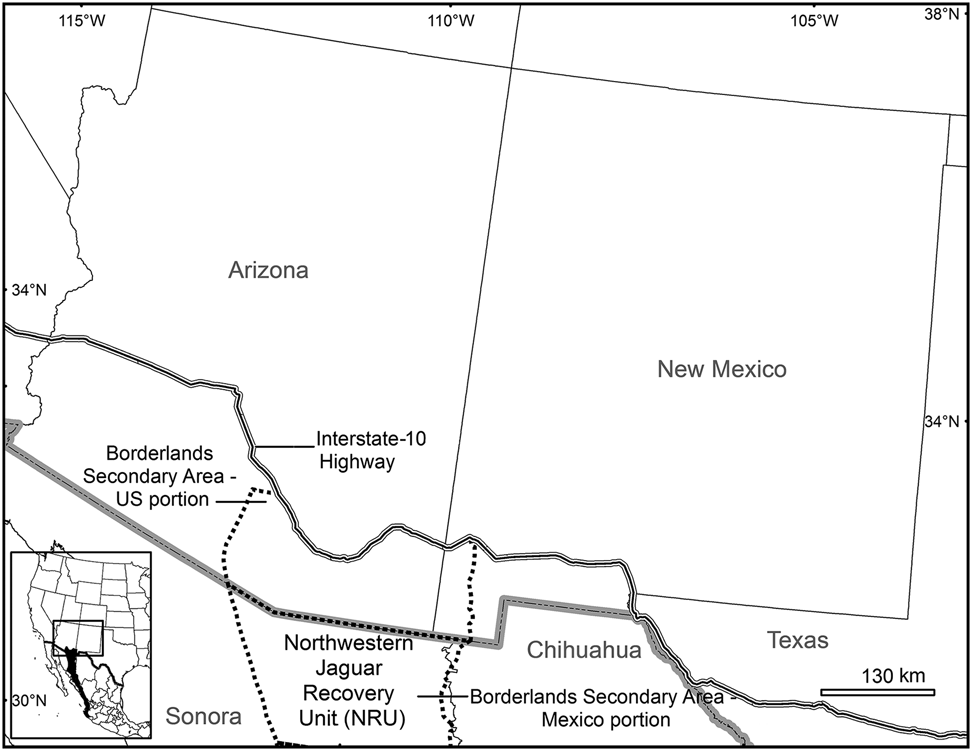
The USFWS jaguar recovery plan described two geographical units of jaguar conservation, and recovery criteria for each. The Pan-American Recovery Unit encompassed all the jaguar's range, from Argentina to the USA. The Northwestern Jaguar Recovery Unit delineated jaguar habitat in north-west Mexico and the south-west USA, extending from Colima State, along the western slope of the Sierra Madre Occidental Mountains, into the Sky Island mountain ranges of northern Sonora, south-eastern Arizona and south-western New Mexico. The USFWS drew the northern edge of both units at the Interstate-10, suggesting this highway represents the natural northern extent of jaguars in the Americas (Fig. 1). The northernmost recovery unit was further subdivided into core and secondary areas, including the Borderlands Secondary Area–U.S. Portion, which comprised parts of Arizona and New Mexico south of Interstate-10. Analysis within the recovery plan suggested that the potential carrying capacity in the USA (within the Borderlands Secondary Area–U.S. Portion) was only six jaguars and, therefore, the plan's recommended recovery actions focused primarily south of the USA–Mexico border (USFWS, 2018; also see Sanderson & Fisher, Reference Sanderson and Fisher2013).
Study area, with the Northwestern Recovery Unit for the jaguar Panthera onca and subsections delineated as described in USFWS (2018). The extent of the recovery unit in the USA and Mexico is shown on the inset map.
This conclusion is at odds with several other habitat studies covering areas north of Interstate-10. Numerous photographs, physical remains, and accounts of jaguars from the late 19th century to the 1960s (Brown & Lopez González, Reference Brown and Lopez González2001) demonstrate that the species formerly occurred north of the current highway (the highway dates from 1956). Ironically some of these historical jaguar records came from hunters working for the U.S. Bureau of Biological Survey and its successor organizations, as part of predator control efforts. Some of these government hunters placed jaguar skulls and skins in the U.S. National Museum (for example, Russell Culbreath's kill on the White Mountain Apache Indian Reservation in 1964; USNM 289015). Other accounts come from ranchers, trappers, hunters and tourists, including of jaguars killed near the Grand Canyon. These observations are cited in a long series of summary papers and books, published since the 1920s, and now available online (Sanderson & Fisher, Reference Sanderson and Fisher2011; USFWS & Wildlife Conservation Society, 2020).
Because jaguar observations are infrequent and difficult to confirm even when they do occur, and because jaguars have been extirpated from areas where prey and vegetative cover still remain, researchers have turned to various modelling approaches to estimate the geographical distribution of potential jaguar habitat in Arizona and New Mexico. There have been nine such previous efforts by academic researchers, government wildlife managers, and private conservation organizations, published before the USFWS (2018) recovery plan. Some of these models have been described in the peer-reviewed literature (e.g. Boydston & Lopez González, Reference Boydston and Lopez González2005; Hatten et al., Reference Hatten, Averill-Murray and van Pelt2005), whereas others have only been described in reports, despite their use in various legal, political and scientific contexts, including the recovery plan.
Here we conduct the first systematic review (sensu Pullin & Stewart, Reference Pullin and Stewart2006) of the existing modelling and assessment efforts, with a focus on areas north of Interstate-10 in Arizona and New Mexico (Fig. 1). Not all of these studies have been peer reviewed, so we provide sufficient information for the methods and results of each model or assessment to be evaluated and compared (Supplementary Material 1). We also present two northward extensions of the model used by the USFWS (2018) analysing this previously unconsidered area, and an update of a third model (Hatten et al., Reference Hatten, Averill-Murray and van Pelt2005), for a total of 12 treatments. We critically compare the methods and results. Through empirical examination of convergence among the models and assessments, we draw a boundary of a third potential recovery area, tentatively titled the Central Arizona/New Mexico Recovery Area.
Because legal definitions of range and status drive federal and state action on species conservation in the USA, we briefly summarize this history below.
History of jaguar conservation in the USA
The legal definition of jaguar range in the USA has been disputed for nearly 50 years. In 1972, jaguars were first added to the List of Foreign Species protected under the U.S. Endangered Species Conservation Act of 1969 (USFWS, 1972), with a note that the species was found in Central and South America. This listing ignored the numerous well-attested, historical observations of jaguars north of the border. In 1973, a new Endangered Species Act lead to a new consolidated List of Endangered and Threatened Wildlife, published in 1975 (USFWS, 1975). The new list included the jaguar with a note that its ‘normal, known distribution’ was ‘Central and South America’. Furthermore, the notice explicitly noted that listed species, such as the jaguar, were protected ‘wherever found’. In 1979, USFWS gave notice that ‘through an oversight’, populations of jaguars (and several other species) in the USA were not covered by the endangered classifications given to the species as a whole, but that this oversight would be rectified ‘as quickly as possible’ (USFWS, 1979). In 1980, USFWS proposed listing the jaguar as endangered in the USA, but the rule was never finalized (USFWS, 1980; USFWS, 1982).
In 1982, USFWS noted there was no resident or breeding population in the USA at the time, although ‘stragglers occasionally wander into New Mexico, Arizona, and Texas, where they are generally shot as unwanted predators’ (USFWS, 1982). In 1986, a rancher killed a jaguar in southern Arizona (Brown & Lopez González, Reference Brown and Lopez González2001). Two years later he and another man were convicted of illegal interstate sales and conspiracy for trying to sell the hide (and two others) in New Mexico (Associated Press, 1988).
In 1990, a recovery plan for Listed Cats of Texas and Arizona (with Emphasis on the Ocelot) noted in its introduction that ‘Felis (Panthera) onca have been documented as either transient or resident in Arizona and/or Texas’, but made no specific recommendations for jaguar conservation (USFWS, 1990). In 1994, a new proposal for listing the jaguar in the USA acknowledged that ‘A minimum of 64 jaguars have been killed in Arizona since 1900’ (USFWS, 1994). In 1996 two different jaguars were separately photographed by hunters in clearly arid habitats in south-east Arizona (Glenn, Reference Glenn1996; Childs, Reference Childs1998). These were the first photographs ever taken of live jaguars in the USA. After litigation initiated by the Center for Biological Diversity, in 1997 USFWS re-designated jaguars as endangered in the USA (USFWS, 1997). But the agency also determined that designating critical habitat was ‘not prudent’ because ‘publication of detailed critical habitat maps and descriptions in the Federal Register would likely make the species more vulnerable to prohibited activities’ (such as the killing in 1986).
Jaguars recurred north of the border, nonetheless. Camera traps recorded regular use of the rugged mountains of extreme south-eastern Arizona and adjacent south-western New Mexico (McCain & Childs, Reference McCain and Childs2008). In 2006, the USFWS determined that a recovery plan would not promote the conservation of the species, because, they argued, the USA provided such a small fraction of habitat to the species range-wide (USFWS, 2006). This argument was challenged in court, and overturned in 2009. Fuelling the disputes, a jaguar first observed in the late 1990s, Macho B, was captured, injured, and subsequently euthanized by Arizona state officials in 2009 (U.S. Department of the Interior, 2010). Rapid land development (Povilitis, Reference Povilitis2002) and the expansion of activity and infrastructure along the border to thwart illegal immigration (Peters, Reference Peters2017) added urgency to the protection of the jaguar.
Given these events, and in response to lawsuits from the Center for Biological Diversity and Defenders of Wildlife, in 2010, USFWS decided it was prudent to declare critical habitat for the jaguar within the USA and initiated a recovery planning process (USFWS, 2010). In 2014, USFWS designated 309,263 ha of critical jaguar habitat, in southern Arizona and south-western New Mexico (USFWS, 2014), although later a court ruling found the designation invalid (Bies, Reference Bies2020). A draft recovery plan was released for public comment in 2016 (USFWS, 2016). The recovery plan was finalized in 2018 (USFWS, 2018) and released to the public the following spring. After 48 years of controversy, the northern edge of jaguar range had legally moved 110 km from the international border to Interstate-10.
Methods
We followed the procedure for systematic reviews in ecology and conservation recommended by Pullin & Stewart (Reference Pullin and Stewart2006), taking care to be transparent, objective and comprehensive (O'Leary et al., Reference O'Leary, Kvist, Bayliss, Derroire, Healey and Hughes2016). Our focal question was: Do scientific models and assessments of potential habitat for the jaguar Panthera onca in Arizona and New Mexico indicate suitability in areas north of Interstate-10? If so, which areas (Fig. 1)? To answer this question, we developed a review protocol based on inclusion criteria. Studies to be reviewed must have: (1) examined at least some areas that fall within the modern boundaries of the States of Arizona and/or New Mexico, in the USA (spatial criteria), (2) employed objective habitat criteria in a model or assessment based on documented aspects of jaguar ecology (scientific criteria), and (3) been documented thoroughly enough that the methods and results can be peer-reviewed (reviewable criteria). By ‘model’ we mean a spatial model, computed in a GIS, using a systematic method. By ‘assessment’ we mean any other evaluation of jaguar status in this region that meets the criteria above.
To locate these studies we searched using the search terms (‘jaguar’ OR ‘Panthera onca’) AND (‘Arizona’ OR ‘New Mexico’ OR ‘United States’) in the Web of Science (Clarivate Analytics, Philadelphia, USA), JSTOR (Ithaka Harbors, New York, USA), science.gov (a search engine for U.S. Federal Government scientific publications), and examined the first 100 results of a search on Google Scholar (2019). We also reviewed all the materials cited in the USFWS (2018) recovery plan and posted online by USFWS Arizona Ecological Services (2019), Arizona Department of Game and Fish (2019), and New Mexico Department of Game and Fish (2019). Finally, we contacted individuals who had conducted habitat studies that met our criteria, based on our first round of review, and asked if they knew of any additional efforts to include in this study.
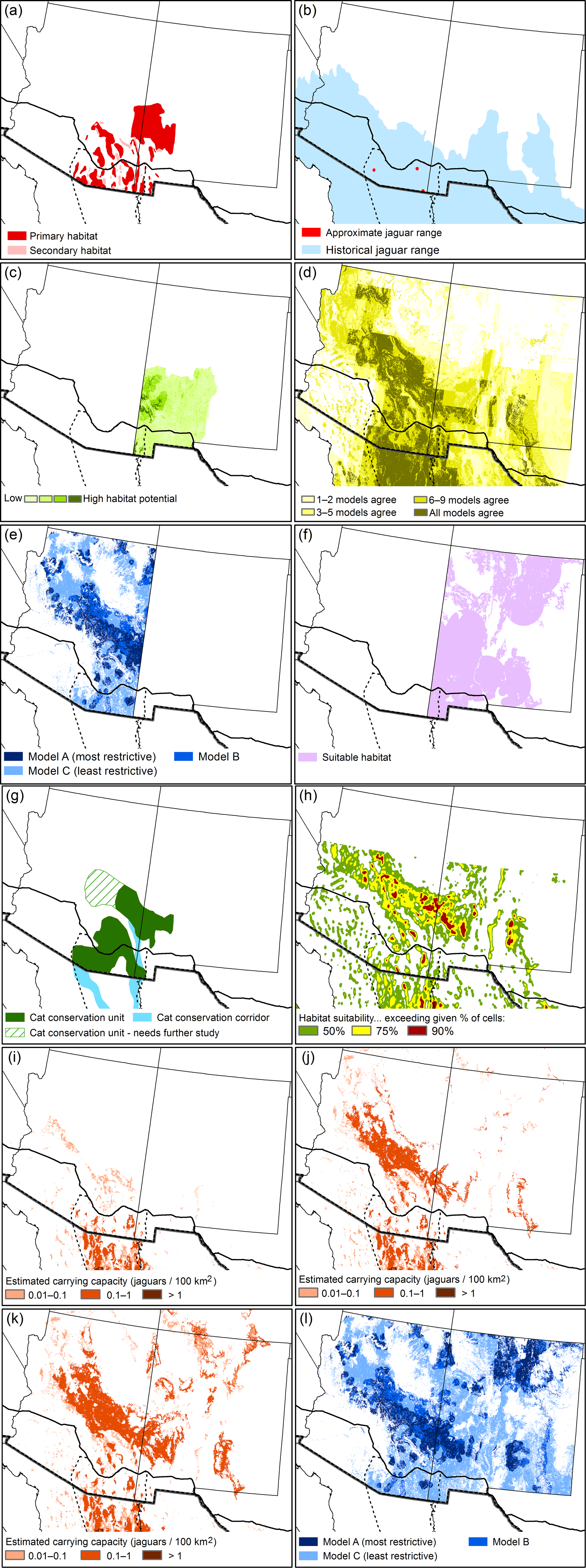
For each model or assessment that met the criteria (Fig. 2), we summarized the stated purpose of each analysis, the extent, the data inputs, a brief description of the modelling methods and results (Supplementary Material 1), and obtained the relevant GIS layers, if possible. For the Sierra Institute (2000) analysis, we georeferenced and digitized the model figure.
Comparison of jaguar habitat models for Arizona and New Mexico: (a) Sierra Institute (2000), (b) Sanderson et al. (Reference Sanderson, Redford, Chetkiewicz, Medellin and Rabinowitz2002b), (c) Menke & Hayes (Reference Menke and Hayes2003), (d) Boydston & Lopez González (Reference Boydston and Lopez González2005), (e) Hatten et al. (Reference Hatten, Averill-Murray and van Pelt2005), (f) Robinson et al. (Reference Robinson, Bradley and Boyd2006), (g) Grigione et al. (Reference Grigione, Menke, López-González, List, Banda and Carrera2009), (h) Theobald et al. (Reference Theobald, Landau, McClure and Dickson2017; note percentage thresholds defined by habitat values in Arizona and New Mexico), (i) USFWS (2018) (model 13), (j) model 14 (this study), (k) model 15 (this study), (l) Hatten (this study).
In a new analysis, we also extended the USFWS (2018) model to the area north of Interstate-10 as described below. Previously USFWS (2018) assessed the distribution of jaguar observations from all of the Northwestern Recovery Unit (Sanderson & Fisher, Reference Sanderson and Fisher2011) against putative habitat variables individually, and combined them with a simple, multivariate model. Input variables were reclassed to include areas with > 1 and ≤ 50% tree cover, intermediate, moderate and high ruggedness (defined in Riley et al., Reference Riley, DeGloria and Elliot1999), and within 10 km of a waterway (Hatten et al., Reference Hatten, Averill-Murray and van Pelt2005). Areas of high human influence (defined as a human influence index > 20; Sanderson et al., Reference Sanderson, Jaiteh, Levy, Redford, Wannebo and Woolmer2002a) and above 2,000 m elevation were excluded from the potential distribution. The technical sub-team of the USFWS recovery team assigned weights based on observed jaguar densities in different ecoregions (Olson et al., Reference Olson, Dinerstein, Wikramanayake, Burgess, Powell and Underwood2001), with highest weights provided to the subtropical, dry and moist forest ecoregions of Mexico. Lower weights were assigned to pine and pine–oak forest types, and lowest weights to desert ecoregions. Ecoregions lying entirely outside the pre-determined Northwestern Recovery Unit boundary (notably, Arizona Mountain Forests) were excluded. The habitat suitability model was translated to jaguar densities (jaguars/100 km2) by regressing densities in study areas against mean habitat values for those areas, with the y-intercept forced through zero (USFWS, 2018). Various iterations of this model were documented in Sanderson & Fisher (Reference Sanderson and Fisher2013); the final version used in the recovery plan was labelled ‘model 13’.
We extended the USFWS (2018) model over the rest of Arizona and New Mexico by assigning the Arizona Mountain Forest, Colorado Plateau Shrubland, and Colorado Rocky Mountain Forest ecoregions (Olson et al., Reference Olson, Dinerstein, Wikramanayake, Burgess, Powell and Underwood2001) the model weights 0.1, 0.01 and 0.1, respectively (model 14). Jaguar observations have been reported from all of these ecoregions historically (Brown & Lopez González, Reference Brown and Lopez González2001). We also computed a second extension, raising the elevation cut-off from 2,000 to 2,400 m (model 15). There is no known biological basis for a 2,000 m cut-off. Jaguars are known to use areas up to 2,800 m in Jalisco, Mexico (Nunez-Perez, pers. comm., cited in USFWS, 2018), and a jaguar was shot at an elevation of 2,850 m in the White Mountains of Arizona in 1963 (Brown & Lopez González, Reference Brown and Lopez González2001; Davis, Reference Davis2013). Conservatively, we set our limit at 2,400 m, the approximate upper limit of pine–oak forest assemblages in Arizona (Patton et al., Reference Patton, Hofstetter, Bailey and Benoit2014).
We also extended the Hatten et al. (Reference Hatten, Averill-Murray and van Pelt2005) model over the entirety of Arizona and New Mexico, with some substitutions of higher-quality GIS data, notably the NHDPlus (data model version 2.1) database (McKay et al., Reference McKay, Bondelid, Dewald, Johnston, Moore and Rea2012), the GAP/LANDFIRE National Terrestrial Ecosystems database (Homer et al., Reference Homer, Dewitz, Yang, Jin, Danielson and Coulston2015), and the 30-m National Elevation Dataset (Archuleta et al., Reference Archuleta, Constance, Arundel, Lowe, Mantey and Phillips2017). These improvements enabled the new model (Hatten, this study) to be expressed at 30 m resolution.
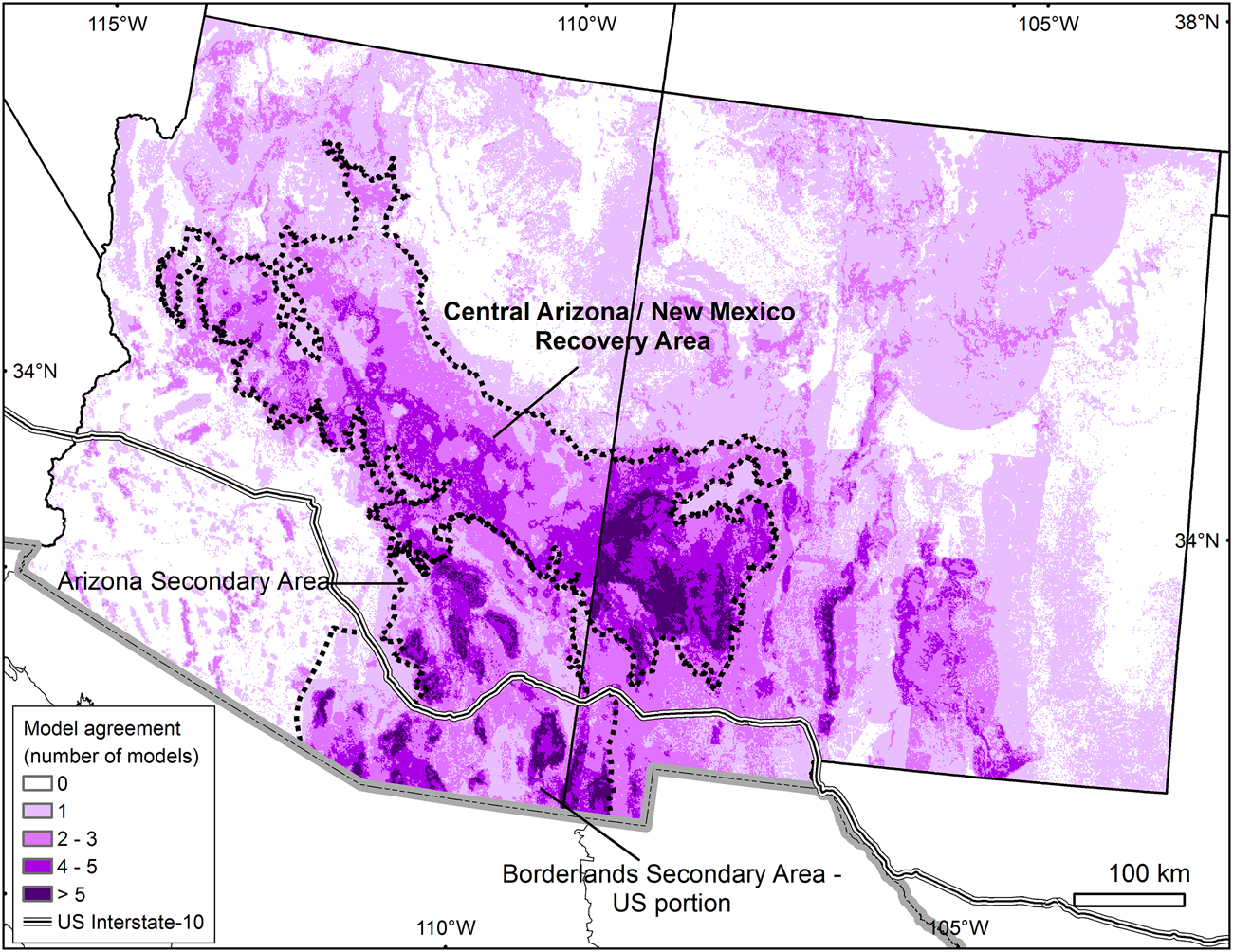
Finally, we overlaid the models to find areas of congruence by projecting to a common coordinate system and rescaling the data to 1 km2 resolution (Fig. 3) to highlight the area we term the Central Arizona/New Mexico Recovery Area. This research was conducted during April–December 2019.
Areas of convergence of potential jaguar habitat models in central Arizona and New Mexico beyond the northern edge of the Northwestern Jaguar Recovery Unit described in USFWS (2018).
Results
Literature review
We reviewed 469 documents identified through the literature search. Ultimately, nine papers or reports met the inclusion criteria: Sierra Institute (2000), Sanderson et al. (Reference Sanderson, Redford, Chetkiewicz, Medellin and Rabinowitz2002b), Menke & Hayes (Reference Menke and Hayes2003); Boydston & Lopez González (Reference Boydston and Lopez González2005), Hatten et al. (Reference Hatten, Averill-Murray and van Pelt2005), Robinson et al. (Reference Robinson, Bradley and Boyd2006), Grigione et al. (Reference Grigione, Menke, López-González, List, Banda and Carrera2009), Theobald et al. (Reference Theobald, Landau, McClure and Dickson2017) and USFWS (2018). We also identified some early or derivative reports (e.g. Hatten et al., Reference Hatten, Averill-Murray and van Pelt2002; Sanderson & Fisher, Reference Sanderson and Fisher2013; Bravo & Davis, Reference Bravo and Davis2017), but excluded them because they were largely duplicative of other studies (Hatten et al., Reference Hatten, Averill-Murray and van Pelt2005; USFWS, 2018; and Theobald et al., Reference Theobald, Landau, McClure and Dickson2017, respectively.)
Comparison of potential habitat models and assessments for the jaguar
Comparing models (see details in Supplementary Material 1), we documented 11 categories of information used to assess jaguar habitat potential (Table 1; Supplementary Table 1). All assessments used expert opinion to some extent, although two studies were driven almost entirely by expert consensus: Sanderson et al. (Reference Sanderson, Redford, Chetkiewicz, Medellin and Rabinowitz2002b) and Grigione et al. (Reference Grigione, Menke, López-González, List, Banda and Carrera2009). The range-wide assessment (Sanderson et al., Reference Sanderson, Redford, Chetkiewicz, Medellin and Rabinowitz2002b) was limited in Arizona and New Mexico by a historical distribution boundary from Seymour (Reference Seymour1989), which stopped at the northern edge of the Sonoran and Chihuahuan deserts. The study of Grigione et al. (Reference Grigione, Menke, López-González, List, Banda and Carrera2009) supplemented Sanderson et al. (Reference Sanderson, Redford, Chetkiewicz, Medellin and Rabinowitz2002b), using similar methods to collect observational data and redraw areas of knowledge and potential habitat for the jaguar farther north. These techniques have largely been supplanted by more quantitative spatial modelling techniques used in other models.
Comparison of data inputs to estimated jaguar Panthera onca habitat models and assessments, including the three new models in this study, covering some or all of Arizona and New Mexico. For additional details see Supplementary Material 1.

1 AZ, Arizona; NM, New Mexico; TX, Texas; SON, Sonora; CHI, Chihuahua; COA, Coahuila; NLE, Nuevo Leon; TAM, Tamaulipas; NRU, Northern Recovery Unit (USFWS, 2018).
2 Remotely sensed continuous cover.
Variable selection differed across the models. All 10 models/assessments considered jaguar observations of some kind; seven considered topographic variation or terrain ruggedness; seven considered presence of, or distance to, water; and seven included some measure of human disturbance. Six models included maps of ecosystems or land use/land cover. Four assessments used elevation thresholds. Only two models/assessments included explicit consideration of prey base (Sierra Institute, 2000; Menke & Hayes, Reference Menke and Hayes2003). The three most recent models (Theobald et al., Reference Theobald, Landau, McClure and Dickson2017; USFWS, 2018; this study) use remotely sensed measurements of vegetative cover. Only Boydston & Lopez González (Reference Boydston and Lopez González2005) used soil types and climate variables.
The treatment of variables varied in terms of grain and extent, both spatially and temporally. The spatial extents of models ranged from one or more parts of a state to encompassing multiple states in the USA and Mexico (Table 1). The spatial grain or resolution varied from 25 km2 (Boydston & Lopez González, Reference Boydston and Lopez González2005) to 30 m2 (Theobald et al., Reference Theobald, Landau, McClure and Dickson2017). Three were vector-based (Sierra Institute, 2000; Sanderson et al., Reference Sanderson, Redford, Chetkiewicz, Medellin and Rabinowitz2002b; Grigione et al., Reference Grigione, Menke, López-González, List, Banda and Carrera2009); all others were raster-based analyses. Although all models/assessments included jaguar observations, they varied considerably as to which observations were included. As noted above, USFWS (2018) only included ecoregions that overlapped the Northwestern Recovery Unit, thereby excluding from consideration many areas with older observations, including much of the area analysed here. Robinson et al. (Reference Robinson, Bradley and Boyd2006) detailed 18 observations from New Mexico, only one of which was used in the USFWS (2018) recovery plan (i.e. Glenn's, Reference Glenn1996, photograph from the Peloncillo Mountains). Hatten et al. (Reference Hatten, Averill-Murray and van Pelt2005) used 25 sighting records from Arizona for 1901–2001. Theobald et al. (Reference Theobald, Landau, McClure and Dickson2017) used only observations with reliable geographical coordinates for 1917–2017.
Modelling methods also varied. As noted above, the Sanderson et al. (Reference Sanderson, Redford, Chetkiewicz, Medellin and Rabinowitz2002b) and Grigione et al. (Reference Grigione, Menke, López-González, List, Banda and Carrera2009) assessments were largely expert-driven, drawing polygons on maps through consensual procedures. Of the spatial models, six were variants of overlays of relevant habitat variables, usually with some kind of weighting system, examining areas of spatial congruence of relevant variables, including Menke & Hayes (Reference Menke and Hayes2003), Hatten et al. (Reference Hatten, Averill-Murray and van Pelt2005), Robinson et al. (Reference Robinson, Bradley and Boyd2006), Theobald et al. (Reference Theobald, Landau, McClure and Dickson2017), USFWS (2018) and this study. Most of these six studies combined variables additively to generate a habitat index; Theobald et al. (Reference Theobald, Landau, McClure and Dickson2017) combined them multiplicatively. The Sierra Institute (2000) used overlay techniques, but the resulting map appears to have been hand-drawn. Boydston & Lopez González (Reference Boydston and Lopez González2005), in contrast, used the Genetic Algorithm for Rule Set Production software (Sachetti-Pereira, Reference Sachetti-Pereira2002).
For the spatial models, nearly all were expressed in unitless indices of jaguar habitat suitability on different scales. The primary exception was the model used by the USFWS Recovery Plan (USFWS, 2018; i.e. model 13) and its extensions in this paper (models 14 and 15), which were translated to estimates of potential jaguar density, based on regression analysis between the habitat index and density measurements. This translation enabled estimates of potential carrying capacity for jaguars in different polygonal areas, such as the subunits of the Northwestern Recovery Unit.
Areas of congruence
Despite these differences in variable selection, spatial and temporal extent, and model formulation, the results are remarkably consistent about the potential jaguar habitat north of the Interstate-10 highway in Arizona and New Mexico (Figs 2 & 3). The congruence is sufficient to draw a boundary around what we call the jaguar's Central Arizona/New Mexico Recovery Area. For convenience, we followed the boundaries of the Arizona/New Mexico Mountains Level III ecoregion of the U.S. Environmental Protection Agency (Omernik & Griffith, Reference Omernik and Griffith2014; see also Griffith et al., Reference Griffith, Omernik, Johnson and Turner2014), which in turn is similar to the Arizona/New Mexico Forests (Olson et al., Reference Olson, Dinerstein, Wikramanayake, Burgess, Powell and Underwood2001) and northern portions of the Madrean Evergreen Forest ecosystem (Brown, Reference Brown1994). We also delineated a connector area from to the USFWS (2018) Northwestern Recovery Unit called the Arizona Secondary Area.
We summarized potential habitat scores (i.e. habitat suitability values > 0) for each of the models and calculated the area of overlap between the models and the Central Arizona/New Mexico Recovery Area boundary in Table 2. All models found some habitat in this recovery area within their study extents, varying between 42 and 100% depending on model method and extent. The five models that covered > 90% of this area (Hatten, this study; Boydston & Lopez González, Reference Boydston and Lopez González2005; Theobald et al., Reference Theobald, Landau, McClure and Dickson2017; models 14 and 15, this study) suggested there is 35,700–80,665 km2 of potential jaguar habitat in this region, though of variable quality. Applying the jaguar density estimation methodology used in the jaguar recovery plan, we estimated the carrying capacity for adult jaguars to be 69–100 in the Central Arizona/New Mexico Recovery Area, and 90–151 adults in Arizona and New Mexico combined (Table 3).
Areas of and per cent overlap between potential jaguar habitat models and the Central Arizona/New Mexico Recovery Area. The recovery area is 82,442 km2.
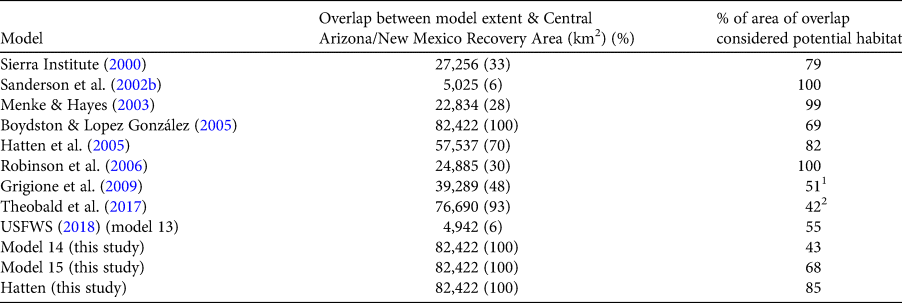
1 Another 15,258 km2 (20% of the recovery area) was designated for further study.
2 Only habitat values > 870 in arbitrary habitat index numbers, reflecting 50% habitat suitability (Theobald et al., Reference Theobald, Landau, McClure and Dickson2017).
Estimated potential carrying capacities (number) for adult jaguars in the USA.

Discussion
This systematic review finds that scientific models and assessments of potential habitat for the jaguar in Arizona and New Mexico indicate suitable areas north of Interstate-10 (Fig. 1). Our review of the 12 models/assessments previously conducted or reviewed here support existence of potential jaguar habitat in a region we have designated the Central Arizona/New Mexico Recovery Area (Table 2, Figs 2 & 3). No models contradicted this finding. Even the two studies that did not explicitly consider this region (Sanderson et al., Reference Sanderson, Redford, Chetkiewicz, Medellin and Rabinowitz2002b; USFWS, 2018; Fig. 2b,i, respectively) support the notion of habitat on the margins of their focal areas, which abut the Central Arizona/New Mexico Recovery Area. For those exceptions, there are corrections in later work. Grigione et al. (Reference Grigione, Menke, López-González, List, Banda and Carrera2009), using methods largely similar to Sanderson et al. (Reference Sanderson, Redford, Chetkiewicz, Medellin and Rabinowitz2002b), described a jaguar conservation unit on the Mogollon Rim (Fig. 2g). Extending the USFWS (2018) and Hatten et al. (Reference Hatten, Averill-Murray and van Pelt2005) models north, as we have done here, also suggests the potential for additional habitat in central Arizona and New Mexico (Fig. 2j,k,l).
Initial estimates of carrying capacity for models 14 and 15, using essentially the same model as the approved recovery plan (i.e. model 13), push the potential of a population in the USA from six animals in Arizona and New Mexico, which the USFWS considered non-viable, to 90–151 (Table 3), which may be viable. Other well-protected, relatively isolated jaguar populations have persisted for decades with comparable population sizes, such as in Corcovado, Costa Rica with 98 jaguars; Iguazú, Argentina with 99 jaguars; and, Serra da Capivara, Brazil with 132 jaguars (see review by Zanin et al., Reference Zanin, Palomares and Brito2015). An assessment using population viability analysis, employing the USFWS (2018) methods, is currently underway.
This difference in potential carrying capacity, from six to 90–151 animals, is critical information about the potential for jaguar conservation in the USA. If the jaguars observed south of Interstate-10 are only occasional, dispersing males, inhabiting marginal habitat (Rabinowitz, Reference Rabinowitz1999), then jaguar conservation in the USA should focus on Mexican populations and maintaining connectivity, as the USFWS (2018) recovery plan suggests. If, however, there is sufficient potential habitat north of the Northwestern Jaguar Recovery Unit, then comprehensive conservation efforts should also consider the recovery of a self-sustaining population within the USA, beginning with the recovery area identified here. The recovery plan foresees the necessity to revise the boundaries of the recovery unit in the future, noting: ‘While recent survey and monitoring efforts in south-central and southeastern Arizona and extreme south-western New Mexico have provided important data, as more information is gathered on the distribution and status of jaguars within the NRU [Northwestern Jaguar Recovery Unit] and adjacent areas, the boundaries of the NRU may need to be expanded or reconfigured’ (USFWS, 2018). Here we provide this information.
Novel approaches to jaguar conservation are needed because of the politics of the international border. New physical barriers and increased anti-immigration activity along this boundary (per U.S. Executive Order No. 13767, 2017) may further constrain natural dispersal to and from Mexico, isolating any potential jaguar population in the USA (Peters et al., Reference Peters, Ripple, Wolf, Moskwik, Carreón-Arroyo and Ceballos2018). In such a circumstance, species recovery would require establishment of a large population in the USA to ensure genetic viability and demographic sustainability. Conversely, if movements across the international boundary can be enhanced (Stoner et al., Reference Stoner, Hardy, Fisher and Sanderson2015), an American population might be part of a regional metapopulation structure, contributing to long-term viability. In either case bi-national collaboration will be essential (USFWS, 2018).
This systematic review highlights some important gaps in scientific knowledge about the jaguar in North America. The historical limits to the jaguar's natural range in the Americas are poorly understood, both on the contemporary northern and southern edges (e.g. Cuyckens et al., Reference Cuyckens, Perovic and Herrán2017). In what is now the USA, a number of intriguing, but difficult to interpret, historical observations exist from areas far beyond Arizona and New Mexico, including California, Texas, Louisiana, and other parts of the country (Sanderson & Fisher, Reference Sanderson and Fisher2011). Relatedly, we also do not understand how climate change will affect jaguar distributions in the future (Povilitis, Reference Povilitis2015). Culver & Hein (Reference Culver and Hein2016) speculated on the basis of mitochondrial DNA differences that perhaps northern jaguars are better adapted to hot, dry conditions. Since such conditions are expected to prevail in coming decades in the south-western USA (Garfin et al., Reference Garfin, Jardine, Merideth, Black and Leroy2013), future investigations of climate effects on jaguar distributions and carrying capacity may benefit conservation efforts. At present, only one of the habitat models reviewed (Boydston & Lopez González, Reference Boydston and Lopez González2005) included climatic variables.
The existing models are generally weak on prey availability, perhaps the most important determinant of jaguar habitat (although see Menke & Hayes, Reference Menke and Hayes2003). Along the international border, jaguars prey primarily on white-tailed deer Odocoileus virginianus, javelinas Tayassu tajacu and coati Nasua narica. Farther north, cervids may be more important to jaguar diets, including white-tailed deer, mule deer Odocoileus hemionus and perhaps elk Cervus elaphus. How prey influence distribution and carrying capacity in this area needs investigation.
Populations on the periphery of a species' range may be critical to the long-term conservation of species (Lesica & Allendorf, Reference Lesica and Allendorf1995), especially in a time of climate change (Gibson et al., Reference Gibson, Marel and Starzomski2009; Povilitis, Reference Povilitis2015). Such populations tend to be smaller, more isolated, and more genetically and ecologically divergent than central ones, which confers on them novel evolutionary potential and local ecological significance (Leppig & White, Reference Leppig and White2006). The recognition of additional potential habitat in the USA will, we hope, inform range-wide, as well as national, proposals for jaguar recovery (Jaguar 2030 High-Level Forum, 2018; USFWS, 2018).
The USFWS (2018) recovery plan adopted a conservative view with respect to the former distribution of jaguar habitat in the USA, despite more than 120 years of jaguar observations and nearly 2 decades of habitat models and assessments indicating the plausibility of a wider geographical distribution. This systematic review of these studies indicates that expanding consideration to areas north of the Interstate-10 highway suggests not only a stronghold of potential habitat in Arizona and New Mexico, but a new opportunity to restore the great cat of the Americas.
Acknowledgements
We acknowledge support for this study from the Volgenau Foundation, Carroll Petrie Foundation, and institutional support from Defenders of Wildlife and the Wildlife Conservation Society. We thank two anonymous reviewers and the U.S. Geological Survey for helpful suggestions. Any use of trade, firm or product names is for descriptive purposes only and does not imply endorsement by the U.S. Government.
Author contributions
Study design: BB, JPB, JRBM, CMB, RP, EWS; data contributions: CMB, JCB, KF, MMG, JRH, CALG, KM, PSM, MJR, RET, EWS; data analysis: KF, JRH, EWS; writing: all authors.
Conflicts of interest
None.
Ethical standards
This article abided by the Oryx guidelines on ethical standards.


 Open access

