





1. Introduction
1.1. Discourse particles and phasehood
Phases are derivational units for syntactic computations, ranging from numeration to Transfer. C is accepted to be a phase head, with the following set of properties (see Chomsky Reference Chomsky, Martin, Michaels and Uriagereka2000, Reference Chomsky and Kenstowicz2001, Reference Chomsky, Freidin, Otero and Zubizarreta2008, Reference Chomsky, Franco and Lorusso2020, Gallego Reference Gallego2010, Citko Reference Citko2014, among many others). First, CP demonstrates an ‘independence’/‘isolability’ property in that it forms a derivable unit at each interface. On the sound side, CP creates a phonologically isolable unit, and on the meaning side, CP represents a complete proposition with force. Independence/isolability property of phases is directly motivated by the Strong Minimalist Thesis (henceforth SMT), which is taken as a ‘perfect’ solution to the Legibility Condition. Second, phases are assumed to be endowed with a set of uninterpretable features, some of which can be inherited by the non-phasal head that this phase head selects (see Chomsky Reference Chomsky, Freidin, Otero and Zubizarreta2008). This feature inheritance hypothesis is motivated by the computational efficiency of the Faculty of Language. For instance, C is lexically endowed with uninterpretable features such as u[Q] and u[ϕ]; u[ϕ] can be inherited by T. The assumption that phase heads are the loci of uninterpretable features is based on the following considerations: on the one hand, the goal of syntax is to delete uninterpretable features to satisfy the Legibility Condition in view of the SMT, and on the other hand, both empirical and theoretical evidence suggest that Transfer to the interfaces occurs more than once during the derivation. Importantly, the timing of syntactic operations depends on the external merge of a phase head. Namely, merging a phase head signals the simultaneity of syntactic operations, such as Agree (feature valuation and feature deletion), Move and Transfer. Along this line, syntax should make a clear distinction between phasal heads and non-phasal heads when they are taken from the Lexicon for computation. An easy way to achieve this effect is to let all the uninterpretable features originate from phase heads so that syntax can tell whether a lexical item drawn from the Lexicon is a phase.Footnote 1 However, interpretability is related to the semantic side, and syntax is not supposed to recognize which feature is (un)interpretable. For this reason, Chomsky (Reference Chomsky, Martin, Michaels and Uriagereka2000) assumes a strict correspondence between interpretability and valueness: interpretable features come with a value, whereas uninterpretable features, having no value, can only acquire a value via Agree (i.e. feature valuation) during the derivation. Once an unvalued (uninterpretable) feature is valued, it is deleted, which is in accordance with SMT. In this way, syntax can make a distinction between an interpretable feature and an uninterpretable feature by only inspecting their values. Third, internal to narrow syntax, phase heads also possess an EPP or an Edge Feature (EF), which allows multiple specifiers to be projected. These specifiers can serve as potential escape hatches for constituents to be extracted. Thus, a long-distance syntactic movement is, in fact, a series of local movements via phase-edges.
In fact, C is shorthand for the region of the left periphery in the sense of Rizzi (Reference Rizzi and Haegeman1997) (see Chomsky Reference Chomsky, Freidin, Otero and Zubizarreta2008). According to the Split-CP hypothesis, CP, known as the left-periphery of the sentence, has a rich structure, containing different types of functional projections, such as ForceP, IntP and TopP in Italian (see Rizzi Reference Rizzi and Haegeman1997, Rizzi & Bocci Reference Rizzi, Bocci, Everaert and van Riemsdijk2017, among many others). Along this line, an inquiry arises as to whether all these functional projections split from CP can be qualified as phases. As in Italian, Chinese also has a rich structure in the peripheral domain, and the so-called Sentence-Final Particles (SFPs) with specific discourse functions have been argued to head different projections in the CP domain (see Paul Reference Paul2014, Pan Reference Pan2015, Reference Pan2019). Crucially, Pan (Reference Pan2022) shows that in Mandarin Chinese, all the peripheral projections split from CP are phases and that SFPs instantiated by heads of the projections are analyzed as phasal heads, exhibiting typical phasal properties. First, it has been observed that all the SFPs in Chinese can be used independently at the end of a sentence, giving rise to specific semantic interpretations or pragmatic functions, which substantiates that projections headed by SFPs demonstrate an independence/isolability property at interface levels. Second, SFPs in Chinese possess EPP/EF. Chinese is an SVO language, but some discourse particles demonstrate head-final properties. Chinese examples in (1) first show that each SFP can be used independently to create an isolable structure at both interfaces, and therefore, all the SFPs could be regarded as phasal heads. Furthermore, these SFPs do not function as probes as they do not agree with any particular goal in terms of any specific uninterpretable feature. In order to satisfy the EF associated with an SFP given its phase status, the complement of this SFP is raised to the specifier as a last resort. Therefore, comp-to-spec movement results in the final order of SFPs.Footnote
2 Under this view, head-finality is not taken as the result of the Headedness Parameter but as the result of the syntactic movement, namely, to satisfy EF.
(1)
a.
Sentential Aspect particle: le (change of state)Footnote
3
[S.AspP
[TP
Zhāngsān
qù
xuéxiào]
le
TP].
Zhangsan
go
school
le
‘Zhangsan went to school. (He is no longer here.)’
b.
Exclusive focus particle: -éryǐ
[
OnlyP
[TP
Zhāngsān
qù
hē
jiǔ]
éryǐ
TP].
Zhangsan
go
drink
alcohol
only
‘Zhangsan only went to drink alcohol. (Nothing serious!)’
c.
Yes-no question particle: ma
[ForceP
[TP
Mǎlì
hē
hóng
jiǔ]
ma
TP]?
Mary
drink
red
wine
Q
yes-no
‘Does Mary drink red wine?’
d.
Attitude particle: a (co-speaker’s attention-seeking particle)
[AttP
[TP
Zhāngsān
yě
hē
jiǔ]
a
TP]!
Zhangsan
also
drink
alcohol
a
‘Oh, look, Zhangsan also drinks alcohol!’
Certain discourse particles in other languages also exhibit phasal properties, crucially with respect to comp-to-spec movement to satisfy EF. For instance, the discourse particle
mo
in Venetian dialect expresses the confirmation of an order in an imperative or interrogative context, introducing the point of view of the speaker (see Munaro & Poletto Reference Munaro and Poletto2002, Munaro Reference Munaro, Di Sciullo and Hill2010).
(2)
a.
*Mo
parché
gnenlo?
mo
why
comes.he
(‘Why is he coming?’)
b.
Parchéi
mo
ti
gnenlo?
why
mo
comes.he
‘Why is he coming?’
c.
[Parché
gnenlo]i
mo
ti ?
why
comes.he
mo
‘Why is he coming?’
(2a) shows that mo cannot stand in the sentence-initial position. Either the wh-phrase parché ‘why’ is moved to Spec of mo , as in (2b), or the entire complement of mo , [ parché gnenlo ] ‘why he comes’, raises to Spec of mo , as in (2c). Setting aside the semantic and pragmatic differences between these sentences, the data suggest that the particle mo behaves as if it manifests an EF to be satisfied, showing that these discourse particles share a common syntactic property with the C-head, which is a phase.Footnote 4
Summing up, the properties of phase hinge on two major criteria in Pan (Reference Pan2022): an interface property (i.e. independence and isolability) on the one hand, and the syntax-internal property (i.e. projecting a specifier by EPP/EF) on the other. Chinese shows that all the functional projections split from CP satisfy both criteria. In this paper, we extend the discussion of phasehood to Korean, a language with rich discourse particles. Based on the interface independence property and the EF-based movement, we will investigate whether the discourse projections that host various particles in Korean can be qualified as phases.Footnote 5
1.2. Main proposals and the organization of the paper
First, we will establish the syntactic hierarchy of the functional projections headed by discourse particles in Korean. Then, we will focus on the phasehood and the derivation of the final order of the discourse projections. Substantiating that head-movement takes place in the narrow syntax, EF, which is exclusively associated with phase heads, will be relocated up to the highest discourse projection. If the EF is satisfied with the comp-to-spec movement, the correct word order can be derived for Korean. The paper proceeds as follows. Section 2 examines the basic syntactic and semantic properties of different types of discourse particles in Korean. Based on the co-occurrence of these particles, we will establish their hierarchical order. Section 3 discusses the syntactic mechanism needed for the derivation of sentences involving discourse particles in Korean. Section 4 demonstrates the derivation with details. Section 5 discusses the theoretical implications of our analysis and the syntactic distinctions between Chinese and Korean. We will also discuss how our analysis is compatible with two distinct views on phases: the rigid version of Chomsky (Reference Chomsky, Martin, Michaels and Uriagereka2000) and the dynamic and contextual version of Bošković (Reference Bošković2014). Section 6 concludes the paper.
2. Syntactic hierarchy of Korean discourse particles and their phasehood
Among many attempts to syntacticize various discourse particles (see Ross Reference Ross, Jacobs and Rosenbaum1970, Speas & Tenny Reference Speas, Tenny and Sciullo2003, Krifka Reference Krifka, Roeper and Speas2014, Reference Krifka, Hartmann and Wollstein2023, Frey & Meinunger Reference Frey, Meinunger, Molnár, Egerland and Winkler2019, a.o.), Miyagawa (Reference Miyagawa2022) assumes three major syntactic domains for the discourse projections: C-system, CommitP (Commitment Phrase) and SAP (Speech Act Phrase). The lowest is a C-system, which semantically corresponds to the proposition of an utterance and maps to a truth component. This domain subsumes Rizzi’s (Reference Rizzi and Haegeman1997) left-periphery, in which the particles encoding illocutionary force are generated. On top of that is a CommitP layer, which takes a C-system as its syntactic argument, adding the speaker’s public commitment to the proposition. SAP is the topmost projection, which encodes the speech act of an utterance and exhibits the relation between the discourse participants. In this section, we will examine the syntactic distributions of the Korean discourse particles on the one hand, and their embeddability and phasehood on the other.
2.1. C-system: Force particles
In the lowest C-system of Korean, five Sentence-Final Particles (SFPs) that encode illocutionary force are generated: declarative, interrogative, imperative, promissive and exhortative. Pak (Reference Pak2006) labels the latter three instances as ‘jussives’; the term represents the grammatical mood of commanding or exhorting. Examples in (3) are retrieved from Park (Reference Park2009). Note that Korean is an SOV language, and discourse particles are traditionally analyzed as bound morphemes attached to the verbal cluster.
(3)
a.
Hakkyo-ey
ka-ma.
school-to
go-prm
‘(I) promise to go to school.’
b.
Hakkyo-ey
ka-la.
school-to
go-imp
‘(You) go to school.’
c.
Hakkyo-ey
ka-ca.
school-to
go-exh
‘(Let us) go to school.’
In (3a–c), although the subjects of these sentences are not overtly manifested due to the pro-drop property of Korean, the specific interpretations of the subjects with respect to each jussive particle naturally arise. Pak et al. (Reference Pak, Portner, Zanuttini, Elfner and Walkow2008) argue that each jussive particle carries a relevant person feature, establishing an Agree relation with the null subject. Namely, the first-person feature, denoting the speaker (i.e. [person: 1]), lies in the promissive marker
-ma
, while the second-person feature, referring to the addressee (i.e. [person: 2]), is associated with the imperative marker
-la
. The exhortative marker
-ca
bears both the first and the second person features (i.e. [person: 1] ⨁ [person: 2]), rendering the subject to denote both the speaker and the addressee. The agreement between jussives and the subjects yields a proper semantic interpretation of the subjects. As for the syntactic position of jussive particles, we follow the point of view that all the illocutionary force particles are base-generated under the Force head (see Cinque Reference Cinque1999, Han & Lee Reference Han and Lee2007, Pan Reference Pan2019, Reference Pan2022, among many others), aligning with the general assumption of the Split-CP hypothesis. As all the clause-typing particles are base-generated under the same head, they are expected to show complementary distributions. For instance, the co-occurrence of jussive particles and the declarative particle
-ta
is generally banned, as shown in (4).
(4)
a.
*Hakkyo-ey
ka-la-ta.
school-to
go-imp-decl
(‘(You) go to school.’)
b.
*Hakkyo-ey
ka-ma-ta.
school-to
go-prm-decl
(‘(I) promise to go to school.’)
c.
*Hakkyo-ey
ka-ca-ta.
school-to
go-exh-decl
(‘(Let us) go to school.’)
2.2. Commitment domain
Above the C-system, there is a Commitment domain. CommitP takes a C-system as its argument by adding the speaker’s epistemic stance of the truth of a proposition (see Krifka Reference Krifka, Roeper and Speas2014, Miyagawa Reference Miyagawa2022). From the perspective of pragmatics, given that the speaker publicly manifests that the proposition is true, the speaker’s liability is naturally enhanced. As an instantiation, Miyagawa (Reference Miyagawa2022) posits the Japanese particle
-yo
under the Commit head. Consider the Japanese examples in (5a–b) in the assertive/imperative context. The particle
-yo
in (5b) emphasizes the truth of the proposition, and hence, (5b) carries a stronger illocutionary force than (5a), which lacks such a particle.
(5)
a.
Hanako-ga
ik-u.
Hanako-nom
go-prs
‘Hanako will go.’
b.
Hanako-ga
ik-u-yo.
Hanako-nom
go-prs-yo
‘Hanako will go!’
(6a, b) show that in Japanese, the particle
-yo
must syntactically occur above the interrogative Force particle
-ka
, which suggests that
-yo
is base-generated above ForceP (C-system) (see Saito Reference Saito and Shlonsky2015). Semantically, since
-yo
enhances the commitment to the truth of a proposition, it is thus expected that the sentence does not exhibit a true information-seeking question. This prediction is borne out. In (6b),
-yo
selects ForceP headed by the interrogative particle
-ka
, and the morphological sequence [
-ka-yo
] gives rise to a rhetorical question reading rather than a true information-seeking question reading (see Miyagawa Reference Miyagawa2022, Miyagawa & Hill Reference Miyagawa and Hill2025).
(6)
a.
*Dare-ga
soko-ni
ik-u-yo-ka!
who-nom
there-to
go-prs-yo-q
(‘Who will go there?’)
b.
Dare-ga
soko-ni
ik-u-ka-yo!
who-nom
there-to
go-prs-q-yo
‘Who will go there? = No one will go there!’
In fact, there are different types of commitment toward a proposition, one of which is evidentiality. Given that evidentiality particles either state a mere presence of the evidence or elucidate specific sources of the evidence, the speaker’s commitment to the proposition is reinforced by evidentiality. Importantly, evidentiality renders the truth condition intact, suggesting that the evidentiality particles should not belong to the C-system (Force). Miyagawa and Hill (Reference Miyagawa and Hill2025) confirm that the sentence in (5b) can be used in the context involving evidentiality.
Following this line of reasoning, we argue that at least three classes of particles in Korean can be posited in the Commitment domain: committal particle -ci , evidentiality particles -kwun , -ney , and hearsay particles -mye , -y . All these particles exhibit the speaker’s commitment to the given proposition by anchoring the proposition to some epistemic sources.
2.2.1. CommitP: committal particles
The closest counterpart to Japanese
-yo
is the committal particle
-ci
in Korean. In previous studies,
-ci
was analyzed to have ‘suppositive’ (see Sohn Reference Sohn1994) or ‘suspective’ meanings (see Martin Reference Martin1992). Lee (Reference Lee1993, Reference Lee1999) characterizes the particle into two tiers: ‘the speaker’s beliefs in the truth of the proposition’ and ‘the beliefs or expectations that the addressee will agree with him/her’. Therefore, the particle not only encodes the speaker’s strong beliefs toward the proposition but also implies that there is a common ground shared between the interlocutors, so that the proposition can be easily accommodated to be true. For instance, the sentence in (7) is expected to be used in a context where the discourse participants agree that the ending of the movie was great.
(7)
Yenghwa-ka
kyelmal-i
choyko-ci!
movie-nom
ending-nom
best-com
‘The ending of the movie is great!’
We agree with Lee (Reference Lee1993, Reference Lee1999) that -ci encodes the speaker’s strong beliefs; however, it is not the case that the core semantic property of -ci is to manifest the expectation that the addressee will always agree with the speaker. For instance, in (8b), -ci can still be used in the context where the speaker disaffirms the addressee’s statement; one would not expect the felicity of (8b) if -ci semantically encodes that the addressee will agree with the speaker. Therefore, the core semantic property of -ci is to express a strong belief of the speaker toward the proposition, on par with the Japanese commitment particle -yo.
(8)
a.
Ku
salam-un
mwulyey-ha.n-kes
kath-a.
that
person-top
rude-do.adn-nmlz
seem-decl
‘That person seems to be rude.’
b.
Ku
sanghwang-eyse-nun
mwulyey-ha.n
kes-i
ani-ci!
that
situation-in-top
rude-do.adn
nmlz-nom
neg-com
‘It is not rude in that situation!’
Furthermore, (9a–b) show that only [ta-ci] is a legitimate morphological sequence, which suggests that the Commit head hosting the particle -ci is generated above ForceP.
(9)
a.
Minswu-ka
nayil
colepha.n-ta
-
ci.
Minsoo-nom
tomorrow
graduate.prs-decl-com
‘(As we know) Minsoo is graduating tomorrow.’
b.
*Minswu-ka
nayil
colepha.n-ci
-
ta.
Minsoo-nom
tomorrow
graduate.prs-com-decl
Intended: ‘(As we know) Minsoo is graduating tomorrow.’
2.2.2. EvidP: evidentiality particles
Like evidentiality particles observed in other languages,
-kwun
and
-ney
in Korean do not alter the truth condition of the proposition; rather, they indicate that the truth of the proposition is supported by some evidence, which thereby enhances the speaker’s commitment to the proposition (see Strauss Reference Strauss2005, Park Reference Park2011, Jeong Reference Jeong2021 for the discussion of these particles). Interestingly, despite a difference in preference,
-kwun
and
-ney
are mostly interchangeable in many contexts, ranging from direct evidence (e.g. visual perception) to indirect evidence (e.g. inference), as shown in (10).Footnote
6
(10)
a.
Pi-ka
{o-ney
/
o-nun-?kwun}.
rain-nom
come-evd
come-prs-evd
‘(Upon watching the window outside) It is raining.’ [Direct evidence]
b.
Hoyuy-ka
kkuthn.ass-
{?ney
/
kwun}.
meeting-nom
finish.pst-
evd
evd
‘(By inferencing on the locked meeting room) Meeting is over.’ [Indirect evidence]
In addition, evidentiality particles are generated above Force particles, as instantiated by the morphological sequence [-ta-ney] and [-ta-nun-kwun] in (11).Footnote
7 Hence, we propose that the evidentiality particles
-kwun
and
-ney
in Korean head the projection EvidP in the Commitment domain.
(11)
a.
Minswu-ka
nayil
colepha.n-ta-ney.
Minsoo-nom
tomorrow
graduate.prs-decl-evd
‘(Someone said) Minsoo is graduating tomorrow.’
b.
Minswu-ka
nayil
colepha.n-ta-nun-kwun.
Minsoo-nom
tomorrow
graduate.prs-decl-adn-evd
‘(Someone said) Minsoo is graduating tomorrow.’
2.2.3. RepP: hearsay particles
Hearsay particles in Korean,
-mye
and
-y
, which are often analyzed as instances of the evidentiality particles, can fall into the Commitment domain (see Willett Reference Willett1988, Aikhenvald Reference Aikhenvald2004, among many others for discussions on hearsay particles in different languages). Hearsay particles are used in the context where the speaker repeats an utterance that has been previously asserted either by the hearer or by a third speaker, hence the term ‘hearsay’.Footnote
8 These particles also reinforce the commitment of the speaker as they introduce the sources of the utterance. Syntactically, -mye
and -y
take ForceP headed by various illocutionary force particles as complement, and scope over the proposition. For instance, take the sentence (12a) as a pivot (ForceP) denoting the utterance content. In (12b), the particle
-mye
attached to the pivot indicates that the speaker reiterates the utterance (pivot) that has been asserted by the addressee in the past speech event. Hence, the particle
-mye
is paraphrased as ‘you said…’. On the other hand, in (12c), when the particle
-y
is attached to the pivot, the utterance is understood to originate from a third speaker, and
-y
will be roughly paraphrased as ‘someone said…’. Thus, the illocutionary force of the pivot shifts to the hearsay assertion in (12b–c), allowing an overt performer of the illocutionary act to be present in the sentence, without resorting to a complex sentential structure (see Ceong Reference Ceong and Hracs2016 for a detailed discussion). In addition, as the morphological expositions show, the hearsay particles -mye
and -y
are generated higher than Force particles. As hearsay particles serve to report the previous utterances, we choose the term Reportative Phrase (RepP) as the label of the projection to host these particles.
(12)
a.
Minswu-ka
cip-ese
cemsim-ul
mek-ess-ta.
Minsoo-nom
home-at
lunch-acc
eat-pst-decl
‘Minsoo ate lunch at home.’
b.
Minswu-ka
cip-ese
cemsim-ul
mek-ess-ta-mye.
Minsoo-nom
home-at
lunch-acc
eat.pst-decl-hsy
‘(You said) Minsoo ate lunch at home.’
c.
Minswu-ka
cip-ese
cemsim-ul
mek-ess-ta-y.
Minsoo-nom
home-at
lunch-acc
eat-pst-decl-hsy
‘(Someone said) Minsoo ate lunch at home.’
An important difference between hearsay particles and Force particles is shown in (13–14). Force particles do not allow any additional argument. For instance, an additional argument, such as
ne-ka
‘you’ in (13), leads to the violation of the theta-criterion. By contrast, hearsay particles allow the overt manifestation of the performer of each illocution, such as
ne-ka
‘you’ in (14a) and
nwuka
‘someone’ in (14b). Importantly, in the pro-drop context, the performer of the utterance is still understood to be the second-person for -mye
and the third-person for -y
. Following Ceong (Reference Ceong and Hracs2016), we assume that hearsay particles bear an unvalued ϕ-feature that needs to be valued and deleted by the corresponding interpretable ϕ-feature associated with the performer generated at the specifier of RepP. Given that the Rep head with hearsay particles allows the performer of the illocution, we assume that hearsay particles bear an u[performative: __]. Consequently, u[performative: __] associated with
-mye
will be valued and deleted by i[performative: 2nd person] on the pronoun
ne-ka
‘you’ via Agree and likewise, u[performative: __] associated with
-y
will be valued by i[performative: 3rd person] on
nwuka
‘someone’.
(13)
*Ne-ka
Con-i
hakkyo-ey
ka.ss-ta.
you-nom
John-nom
school-to
go.pst-decl
Intended: (‘You said John went to school.’)
(14)
a.
Ne-ka
Con-i
hakkyo-ey
ka.ss-ta-mye.
you-nom
John-nom
school-to
go.pst-decl-hsy
‘You (said) John went to school.’
b.
Nwuka
Con-i
hakkyo-ey
ka.ss-ta-y.
someone
John-nom
school-to
go.pst-decl-hsy
‘Someone (said) John went to school.’
2.2.4. Interim summary
Although each particle exhibits a different way to anchor the proposition to some epistemic sources to express the commitment toward the proposition (i.e. the speaker’s beliefs, evidence and other people’s utterances), only a single anchoring is allowed for each proposition. Therefore, the particles inside the Commitment domain are expected to be in complementary distribution. Such an expectation is borne out, as shown in (15). The co-occurrence of the committal particle
-ci
and the evidentiality particle -kwun
in (15a) and the co-occurrence of
-ci
and the hearsay particle
-mye
are both illicit.
(15)
a.
*Con-i
hakkyo-ey
ka.ss-ta-ci
-
kwun.
John-nom
school-to
go.pst-decl-com-evd
(‘You said John went to school.’)
b.
*Con-i
hakkyo-ey
ka.ss-ta-ci
-
mye.
John-nom
school-to
go.pst-decl-com-hsy
(‘You said John went to school.’)
Therefore, we conclude that Korean committal -ci , evidential -kwun , -ney , and hearsay particles -y , -mye all fall into the Commitment domain and that they are all located above ForceP. Crucially, these particles do not alter the truth value of the proposition; rather, they merely add the speaker’s commitment to the truth of the underlying proposition.
2.3. Speech act domain
As the highest projections in the treetop, the Speech act phrases, saP and SAP, are posited, hosting the speaker and the hearer at their specifiers respectively (see Speas & Tenny Reference Speas, Tenny and Sciullo2003, Miyagawa Reference Miyagawa, Aelbrecht, Haegeman and Nye2012, Reference Miyagawa2022, Haegeman & Hill Reference Haegeman, Hill, Folli, Truswell and Sevdali2013, among many others). This superordinate shell-structure [saP > SAP] hosts various speech act particles in relation to discourse participants. Take the speech act particle
hai
in Romanian as an example. The pragmatic function of
hai
is to seek the attention of the addressee as an evaluative injunction. Haegeman and Hill (Reference Haegeman, Hill, Folli, Truswell and Sevdali2013) propose that the particle
hai
occupies the head position of SAP (i.e. the lower shell) with the vocative Dane at its specifier, as in (16a). In this configuration, Dane is the hearer, and the sentence serves to draw the attention of the addressee. In (16b), when the particle
hai
moves from the lower SA head to the higher sa head, deriving the ‘
hai
> Dane’ order, the same particle
hai
will have a speaker-oriented reading, such as enhanced mitigation, as opposed to (16a).
(16)
a.
(Vai)
Dane
hai[SA]
ca
nu
te
cred.
vai
Dan.voc
hai
that
not
you
believe.1sg
‘Ah, Dan, c’mon, I don’t believe you.’
b.
(Vai)
hai[sa]
Dane
ca
nu
te
cred.
vai
hai
Dan.voc
that
not
you
believe.1sg
‘Ah, c’mon, Dan, I don’t believe you.’
Turn to Korean. The particle -yo
expresses the speaker’s polite attitude toward the addressee, resulting from various factors such as social hierarchy. For instance, in the context in which the speaker is delivering the utterance to her teacher, omitting the particle -yo
yields pragmatic infelicity, as in (17).
(17)
Minswu-ka
cip-ey
ka.ss-e-#(yo)Footnote
9
Minsoo-nom
home-to
go.pst-decl-sa
‘(To teacher) Minsoo went home.’
Based on the observation of the speech act particles in Romanian and West Flemish, Haegeman and Hill (Reference Haegeman, Hill, Folli, Truswell and Sevdali2013) propose a list of the properties of speech act particles. Choi (Reference Choi2016) argues that -yo shares some of these properties, as sketched in (18).
-
(18)
-
a. -yo indicates the relationship between the discourse participants.
-
b. -yo outscopes sentential negation.
-
c. -yo interacts with the vocative in terms of the distribution.
-
d. The interaction between -yo and the vocative is conditioned by (18a).
-
(18a, c, d) clearly show that the particle -yo
is associated with the vocative/addressee DP. Along this line, the infelicity of the sentence in (19) is due to the pragmatic clash between the vocative particle -ya
and the speech act particle -yo
. Namely, when the addressee Inho is overtly realized, suffixed by the vocative particle -ya
, it expresses the speaker’s social superiority to the addressee. However, the speech act particle -yo
at the end of the sentence indicates the contrary, yielding an infelicitous sentence.
(19)
#Inho-ya,
Minswu-ka
cip-ey
Inho-voc [speaker>addressee],
Minsoo-nom
home-to
ka.ss-e-yo?
go.pst-decl-sa [addressee>speaker]
Intended: (Unexpected) ‘Inho, Minsoo went home!?’
Choi (Reference Choi2016) argues that -yo is base-generated as the SA (Speech Act) head, the lower shell of the speech act projections, while the addressee/vocative DP is externally merged at the Spec of SAP (see also Yim Reference Yim2016 for further discussion on -yo ). Importantly, the order [e -yo ] in (19) suggests that the speech act particle -yo is located higher than the declarative force particle -e , substantiating that SAP is generated higher than ForceP. In addition, data from language acquisition suggest that -yo is posited higher than the exhortative particle -ca , one of the instances of jussive particles, as shown in (20) (see Yim Reference Yim2012). Given that jussive particles are generated under the Force head, (20) also shows that SAP is generated higher than ForceP.
-
(20) Mek-ca-yo.
eat-exh-sa
‘Let’s eat.’
Furthermore, the SA particle -yo is located even higher than the particles in the CommitP domain, as shown in morphological sequences in (21). This demonstrates the hierarchical order of the three functional projections as: ForceP < CommitP/EvidP/RepP < SAP.Footnote
10
(21)
a.
Sensayngnim,
Minswu-ka
cip-ey
ka.ss-
ta
-
ci
-
yo.
teacher
Minsoo-nom
home-to
go.pst-decl-com-sa
‘Teacher, as you know, Minsoo went home.’
b.
Sensayngnim,
Minswu-ka
cip-ey
ka.ss-
ta
-
ney
-
yo.
teacher
Minsoo-nom
home-to
go.pst-decl-evd-sa
‘Teacher, Minsoo went home, (I heard).’
c.
Sensayngnim,
Minswu-ka
cip-ey
ka.ss-
ta
-
y
-
yo.
teacher
Minsoo-nom
home-to
go.pst-decl-hsy-sa
‘Teacher, (someone said) Minsoo went home!’
d.
Sensayngnim,
Minswu-ka
cip-ey
ka.ss-
ta
-
mye
-
yo.
teacher
Minsoo-nom
home-to
go.pst-decl-hsy-sa
‘Teacher, (you said) Minsoo went home!’
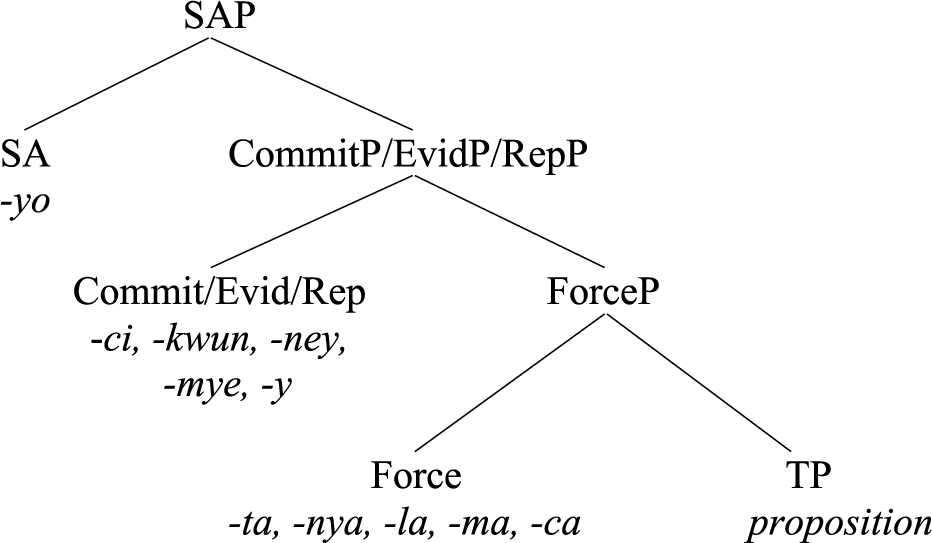
In conclusion, a full-fledged hierarchical structure of the Korean discourse projections examined in our paper is represented in (22).
(22)
2.4. Embeddability
In Korean, all the clause-typing particles under ForceP, which are positioned lower than the complementizer -ko
, can be embedded, as shown in (23).Footnote
11
(23)
Embedding of the Force Particles
a.
Con-un
Meylii-eykey
[e
hakkyo-ey
ka.ss-ta
-
ko]
mal-ha.yss-ta.
John-top
Mary-dat
school-to
go.pst-decl-comp
say-do.pst-decl
‘John told Mary that pro went to school.’
b.
Con-un
Meylii-eykey
[e
hakkyo-ey
ka.ss-nya
-
ko]
mal-ha.yss-ta.
John-top
Mary-dat
school-to
go.pst-intr-comp
say-do.pst-decl
‘John told Mary that pro went to school.’
c.
Con-un
Meylii-eykey
[e
i
hakkyo-ey
ka-la
-
ko]
mal-ha.yss-ta.
John-top
Mary-dat
school-to
go-imp-comp
say-do.pst-decl
‘John told Maryi that shei should go to school.’
d.
?Conj-un
Meyli-eykey
[e
j
hakkyo-ey
ka-ma
-
ko]
mal-ha.yss-ta.Footnote
12
John-top
Mary-dat
school-to
go-prm-comp
say-do.pst-decl
‘Johnj told Mary that hej would go to school.’
e.
Coni-un
Meylij-eykey
[e
i+j
hakkyo-ey
ka-ca
-
ko]
mal-ha.yss-ta.
John-top
Mary-dat
school-to
go-exh-comp
say-do.pst-decl
‘Johni told Maryj that theyi+j should go to school.’
As for the particles in CommitP and SAP, examples in (24) show that none of these particles are embeddable. This is expected as CommitP and SAP are discourse layers, which are closely related to the speech act of the utterance and the perspective of the speaker. A similar observation has been made for the Attitude particles in Mandarin Chinese, which also cannot be embedded. According to the Subjectivity Scale Constraint in Pan (Reference Pan2015, Reference Pan2019, Reference Pan2022), higher functional projections are more directly linked to the speaker’s opinion or attitude, and give rise to more subjective interpretations; therefore, it is less likely for these projections to be embedded. As a result, they are root phenomena.
(24)
Embedding of the Commitment and Speech Act Particles
a.
*Minswu-ka
[Jina-ka
cemsim-ul
sa.ss-ci-ko]
mal-ha.yss-ta.
Minsoo-nom
Jina-nom
lunch-acc
buy.pst-com-comp
say-do.pst-decl
(‘Minsoo said that Jina bought lunch.’)
b.
*Minswu-ka
[Jina-ka
cemsim-ul
sa.ss-kwun-ko]
mal-ha.yss-ta.
Minsoo-nom
Jina-nom
lunch-acc
buy.pst-evd-comp
say-do.pst-decl
(‘Minsoo said that (pro reported that) Jina bought lunch.’)
c.
*Minswu-ka
[Jina-ka
cemsim-ul
sa.ss-ney-ko]
mal-ha.yss-ta.
Minsoo-nom
Jina-nom
lunch-acc
buy.pst-evd-comp
say-do.pst-decl
(‘Minsoo said that (pro reported that) Jina bought lunch.’)
d.
*Minswu-ka
[Jina-ka
cemsim-ul
sa.ss-ta-y
-ko]
mal-ha.yss-ta.
Minsoo-nom
Jina-nom
lunch-acc
buy.pst-decl-hsy-comp
say-do.pst-decl
(‘Minsoo said that (pro reported that) Jina bought lunch.’)
e.
*Minswu-ka
[ne-ka
cemsim-ul
sa.ss-ta-mye
-ko]
mal-ha.yss-ta.
Minsoo-nom
you-nom
lunch-acc
buy.pst-decl-hsy-comp
say-do.pst-decl
(‘Minsoo said that (you reported that) you bought lunch.’)
f.
*Minswu-ka
[Jina-ka
cemsim-ul
sa.ss-e-yo-ko]
mal-ha.yss-ta.
Minsoo-nom
Jina-nom
lunch-acc
buy.pst-decl-sa-comp
say-do.pst-decl
(‘Minsoo said that (pro reported that) Jina bought lunch.’
2.5. Phasehood
This section examines the phasehood of each particle. As illocutionary force must be morpho-syntactically marked in Korean, the omission of the Force particle -
ta
results in ungrammaticality, as shown in (25). Importantly, sentences with Force particles can be used independently, which shows that the Force head in Korean exhibits isolability/independence at both the A-P interface and C-I interface, thus demonstrating a qualifying property for phase. This also aligns with Chomsky’s (Reference Chomsky, Martin, Michaels and Uriagereka2000) argument supporting CP as a phase in that CP includes Force.
(25)
Jina-ka
cemsim-ul
sa.ss-*(ta).
Jina-nom
lunch-acc
buy.pst-decl
‘Jina bought lunch.’
Furthermore, empirical evidence based on long-distance Negative Polarity Item (NPI) licensing in Korean suggests that Force head invokes Spell-Out and Transfer of the structure to the interfaces.Footnote
13 In Korean, a polarity item such as
amukesto
(i.e. ‘anything’) must form a local relationship with its licensor to ensure a proper semantic interpretation, which is traditionally referred to as ‘clausemate condition’ (see Choe Reference Choe1988, Kuno Reference Kuno and King1998, Sells Reference Sells2006). In the Minimalist Program, this locality condition can be reformulated in terms of the notion of phases as the following: the polarity item and its licensor, negation, must be within the same Spell-Out domain (see Kayabaşi & Özgen Reference Kayabaşi and Özgen2018 for a similar reasoning for Turkish). Consider the following pair in (26). Both sentences instantiate a long-distance dependency of the polarity item as the NPI is located in the object position inside the embedded clause, whereas its licensor is in the matrix clause. The difference is that (26a) has a full-fledged embedded clause, headed by the Force particle -ta
, while the embedded clause of (26b) is reduced, headed by the nominalizer -ki
.
(26)
a.
*Na-nun
[Chelswu-ka
amwukesto
hay.ss-ta-ko]
mit-ci
I-top
Chulsoo-nom
anything
do.pst-decl-comp
believe-com
anh-nun-ta.
neg-prs-decl
(‘I do not believe that Chulsoo did anything.’)
b.
Na-nun
[Chelswu-ka
amwukesto
ha-ki-lul]
pala-ci
I-top
Chulsoo-nom
anything
do-nmlz-acc
hope-com
*(anh)-nun-ta.
neg-prs-decl
‘I do not hope for Chulsoo to do anything.’
The contrast between (26a) and (26b) can be explained if the Force head -ta is treated as a phasal head. Adopt the weak version of the Phase Impenetrability Condition (see Chomsky Reference Chomsky and Kenstowicz2001).Footnote 14 In (26a), inside the embedded clause, by the point at which the phase head -ta is merged, the object NPI will be spelled out as part of the VP, which is the complement of the lower phasal head v. As a result, the negative licensor and the NPI end up being in different spell-out domains. By contrast, in (26b), as there is no Force phase head in the embedded clause, the transfer of the VP (including the object NPI) inside the embedded clause can be delayed until the phasal head v of the matrix clause is merged. Consequently, the negative licensor in the matrix clause and the object NPI in the embedded clause are in the same spell-out domain, and therefore, the phasemate condition is satisfied. The long-distance polarity licensing thus provides positive evidence showing that Force head invokes cyclic computation internal to syntax and that Force is a phase head.
Distinct from ForceP, CommitP and SAP are not qualified as phases. Start with hearsay particles in the Commitment domain. As shown in (27), hearsay particles under Rep head cannot directly take TP as their complement without the presence of the declarative Force particle -ta. Along this line, a Rep head itself does not show a true independence property at interface levels, and therefore, it cannot be qualified as a phase head.
(27)
a.
Jina-ka
cemsim-ul
sa.ss-*(ta)-y.
Jina-nom
lunch-acc
buy.pst-decl-hsy
‘(pro said) Jina bought lunch.’
b.
Jina-ka
cemsim-ul
sa.ss-*(ta)-mye.
Jina-nom
lunch-acc
buy.pst-decl-hsy
‘(You said) Jina bought lunch.’
However, other particles in the CommitP layer, such as committal -ci
and evidential -kwun
,
-ney
do not appear to require Force head to stand alone, as shown in (28).
(28)
a.
Ne
hakkyo-ey
ka-ci?
you
school-to
go-com
‘You are going to school, right?’
b.
Ne
hakkyo-ey
ka-ney?
you
school-to
go-evd
(Based on the evidence) ‘You are going to school.’
c.
Ne
hakkyo-ey
ka-nun-kwun?
you
school-to
go-prs-evd
(Based on the evidence) ‘You are going to school.’
There are two structural possibilities in (28). One is that ForceP is absent altogether, so the Commit head directly takes TP as its complement. The other is that ForceP is syntactically projected but with a phonologically null exponent. We argue for the latter option, substantiated by both empirical and theoretical evidence. One crucial piece of evidence is that committal particles and evidential particles can co-occur with the Force particle -ta , demonstrated by the sequences: [-ta-ci ], [-ta-ney ] and [-ta-nun-kwun ]. This substantiates two points. First, commitment particles, in principle, take ForceP as their complement, and second, -ci , -kwun and -ney cannot function as clause-typers. If these particles can incorporate the clause-typing functions, their co-occurrence with the declarative particle, -ta , will be left unexplained. In addition, recall that the Commit layer does not take part in forming a proposition of an utterance. Then, if Commit head directly takes a TP as complement without ForceP, this will result in an incomplete proposition, as the C-system is absent in this structure. For this reason, we assume that a null ForceP is still projected in (28). Along this line, akin to hearsay particles -mye and -y , the independence/isolability property of -ci , -kwun and -ney actually comes from ForceP, and therefore, the commitment particles do not stand alone on their own, failing to be qualified as phases.
Finally, (29) shows that the SA particle -yo cannot be used independently without the co-occurrence with the declarative force particle -e, and therefore, SAP does not show an independence property at interface levels and is not treated as a phase under our analysis.
(29)
Sensayngnim,
Minswu-ka
cip-ey
ka.ss-*(e)-yo!
teacher
Minsoo-nom
home-to
go.pst-decl-sa
‘Teacher, (pro said) Minsoo went home!’
2.6. Summary
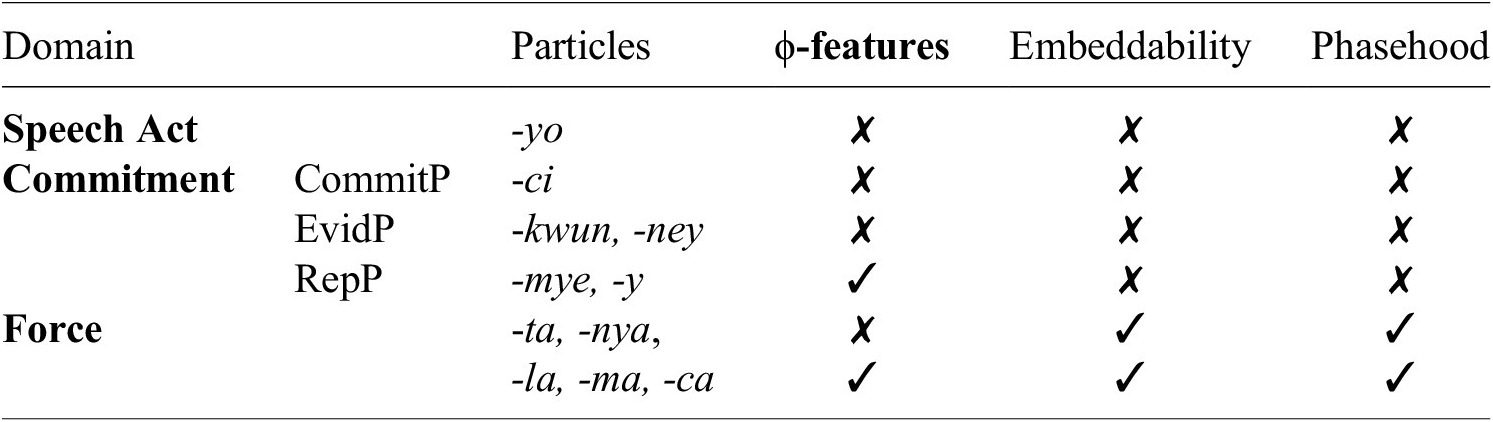
Discourse particles in Korean, ranging from force particles through commitment particles to speech act particles, head different functional projections. Based on the observation on the co-occurrence of these particles, we establish their hierarchical order as: ForceP < CommitmentP/EvidentialityP/ReportativeP < SpeechActP. Furthermore, we conclude that only ForceP is a phase, whereas CommitP and SAP are not. One important point is that RepP, which is in the commitment domain, is not a phase in our analysis but nevertheless has ϕ-features. This shows that non-phasal heads could possess uninterpretable features at narrow syntax, see Table 1.
Syntactic positions of the discourse particles and their phasehood

Table 1. Long description
The table consists of six columns: Domain, Sub-domain, Particles, phi-features, Embeddability, and Phasehood.
* The Speech Act domain includes the particle -yo. It is marked with an X for phi-features, Embeddability, and Phasehood.
* The Commitment domain is divided into three sub-domains:
* Commit P includes the particle -ci, marked with an X for all three properties.
* Evid P includes particles -kwun and -ney, marked with an X for all three properties.
* Rep P includes particles -mye and -y. It is marked with a checkmark for phi-features but an X for Embeddability and Phasehood.
* The Force domain is divided into two groups:
* Particles -ta and -nya are marked with an X for phi-features but checkmarks for Embeddability and Phasehood.
* Particles -la, -ma, and -ca are marked with checkmarks for all three properties: phi-features, Embeddability, and Phasehood.
3. Main assumptions
Before presenting the derivation, in this section, we will discuss some basic assumptions of our analysis: one concerns head-movement as a syntactic operation in Korean, and the other is about the Edge Feature associated with phase heads.
3.1. Head-movement as a syntactic operation in Korean
Voluminous work substantiates that head-movement is difficult to implement in the syntax proper, as it violates many well-motivated syntactic constraints. To list a few, first, it violates the Extension Condition (see Chomsky Reference Chomsky, Hale and Keyser1993), which states that syntactic movement always yields a bigger structure, blocking the potential anti-cyclic movement in syntax. Expectedly, this poses a serious problem for head-to-head adjunction, as the adjunction from the lower head to the upper one does not target the treetop, and hence, does not contribute to the growth of the tree. This can be evidenced by V-to-v, v-to-T and T-to-C movements in Korean. In addition, head-adjunction does not systematically have any semantic effects, unlike A or A'-movement (see Chomsky Reference Chomsky and Kenstowicz2001). Therefore, head-movement operation is assumed to fall under a different part of grammar: either as PF-movement or as a post-syntactic operation (i.e. morphological merger; see Matushansky Reference Matushansky2006, Vicente Reference Vicente2007, Harizanov & Gribanova Reference Harizanov and Gribanova2019, among many others).Footnote
15 Nonetheless, in Korean, there is empirical evidence to support that head-movement takes place in the narrow syntax (see Lee Reference Lee2008 for four pieces of evidence based on the dislocation of a VP/vP-constituent in Korean).Footnote
16 Examine the sentence in (30) (examples retrieved from Lee Reference Lee2008).
(30)
Conglo-eyse
Con-I
Mali-ka
chayk-ul
sa.ss-ta-ko
mal-ha.yss-ta.
Jongro-in
John-nom
Mary-nom
book-acc
buy.pst-decl-comp
say-do.pst-decl
‘In Jongro, John said that Mary bought a book.’
In (30), the adverbial phrase in Jongro can only modify the event of the main clause (i.e. the event of John’s saying something), rather than the event of the embedded clause (i.e. the event of Mary’s buying a book), which suggests that in Jongro is base-generated in the main clause. This naturally bars the possibility that in Jongro is first base-generated in the embedded clause and then undergoes movement to the sentence-initial position. However, in (31), both the adverbial phrase in Jongro and the object of the embedded clause book occur in the sentence-initial position preceding the subject of the matrix clause John, and in Jongro is immediately followed by book, and in this case, in Jongro, unambiguously modifies the event of the embedded clause ‘Mary bought that book’.
(31)
Conglo-eyse
chayk-ul
Con-i
Mali-ka
sa.ss-ta-ko
Jongro-in
book-acc
John-nom
Mary-nom
buy.pst-decl-comp
mal-ha.yss-ta.
say-do.pst-decl
‘John said that Mary bought that book in Jongro.’
Recall that the adverbial phrase in Jongro itself cannot be fronted alone. As a result, the possibility of scrambling the embedded object that book and the adverbial in Jongro separately is barred. Given the interpretation of the sentence, in Jongro can only modify the embedded VP buying that book, and therefore, in Jongro and that book must stay inside the same embedded VP. Naturally, a plausible analysis would allow the entire embedded VP as a chunk to undergo fronting to the sentence-initial position. Note that VP-fronting is generally assumed to take place at narrow syntax, targeting an A'-position. If head-movement is truly a post-syntactic operation, the embedded verb
sa
‘buy’ is expected to be fronted together with the adverbial and the object during the VP-fronting procedure in syntax. Then, to achieve the word order, the embedded verb
sa
‘buy’, now in the fronted VP located at the Spec of the matrix CP, will be somehow ‘lowered’ to its original position, and then be raised to the embedded T and C. It is hard to imagine that such a procedure is possible even under the scenario of post-syntactic operations. Therefore, a more reasonable derivation would allow head-movement to take place before the operations in the syntax proper, such as VP-fronting, and along this line, head-movement can be regarded as a syntactic operation. (32) shows the derivation of (31). The verb of the embedded clause V-buy will be first moved to join T and then to Force-ta and finally to join the complementizer -ko to form a complex head
sa.ss-ta-ko
. At a later stage, the VP, now only consisting of the adverbial in Jongro and the object book will be fronted together to the Spec of CP.
(32)
[CP
[VP
Conglo-eyse
chayk-ul
sa]i
[CP
[TP
Con-i
Jongro-in
book-acc
buy
John-nom
[CP
[TP
Mali-ka
ti
]
sa.ss-ta-ko]
mal]
mal-hay.ss-ta]].
Mary-nom
buy.pst-decl-comp
say
say-do.pst-decl
‘John said that Mary bought that book in Jongro.
Given that VP-fronting in Korean is a syntactic operation, head-movement, which takes place prior to the fronting, may well be a syntactic operation (see Lee Reference Lee2008, for a further discussion). Therefore, considering the logical ordering with respect to other syntactic operations, we propose that head-movement in Korean is a narrow syntactic operation. Importantly, this piece of evidence seems to suggest that head-movement can take place before all the syntactic operations in a general fashion, since in the Minimalist Program, all the syntactic operations such as Agree (feature valuation and feature deletion), Move and Transfer, happen at the phase level simultaneously. We will come back to this point in later sections.
3.2. Edge-feature in Korean
One of the arguments supporting the phasehood of discourse particles in Mandarin is that they appear to bear an EF, a feature that allows an A'-type of specifier to be projected (see Pan Reference Pan2022). In Chomsky’s system, EPP and EF are strictly distinguished. The phase head v* bears both an EPP and an EF: EPP is satisfied by the merging of an external argument (EA), and EF on v* allows for the creation of an additional landing site, which serves as an escape hatch for cyclic wh-movement. The highest phase head C also bears an EPP and an EF: EPP can be inherited by T to project an A-specifier hosting EA, and EF serves as the final landing site for wh-movement. In a simplified way, it seems that EPP allows a phase head to project an A-type of specifier (i.e. to create an argument structure), whereas EF projects an A'-type of specifier (i.e. to establish a scopal or discourse-related dependency). Korean is a head-final language (SOV), and discourse particles are suffixed to the verbal cluster; therefore, it is not clear whether Korean discourse particles project a specifier. Nevertheless, following the general idea that phase heads possess EPP/EF (see Chomsky Reference Chomsky, Martin, Michaels and Uriagereka2000, Reference Chomsky and Kenstowicz2001, Reference Chomsky, Freidin, Otero and Zubizarreta2008), and that the v* phase projects an EA by means of EPP, let us assume that the diagnosed phase head (i.e. Force) in Korean also bears an EF.
Korean is a consistent head-final language. It has been argued in Korean syntax that the subject is not surfaced at Spec TP but stays at Spec v*P (see J.-M. Yoon Reference Yoon1990, J. Yoon Reference Yoon1994 for empirical evidence and the relevant syntactic tests).Footnote
17 If we take the surface head-finality as pure externalization effects, then nothing special is needed to justify the consistent final-order of Korean, as it could be regulated by the Headedness Parameter. However, alternatively, if we assume that the externalized final order could result from syntactic operations in syntax for purely syntactic reasons, the derivation could proceed as follows in (33) (see Kayne Reference Kayne1994, Lee Reference Lee2007).Footnote
18 Below is the sample derivation.
(33)
Step 1:
Derive the v*P phase
{
v*P EA, {
v*P V-v*
[EPP], {VP V, IA}}}
Step 2:
Derive the CP phase
{CP C
[EF], {TP T, {
v*P EA, {
v*P V-v*
[EPP], {VP V, IA}}}}}
Step 3:
{CP V-v*-T-C
[EF], {TP V-v*-T, {
v*P EA, {
v*P V-v*
[EPP]
, {VP V, IA}}}}}
Step 4:
Transfer the complement of the lower phasal head v* (i.e. VP).
Step 5:
{CP {TP V-v*-T, {
v*P EA, {
v*P V-v*-[EPP], {VP V, IA}}}}, {CP V- v*-T-C
[EF], {
TP
V-v*-T, {
v*P
EA, {
v*P
V-v*
-[EPP]
, {
VP
V, IA}}}}}}
Step 6:
Final transfer.
Recall that in the previous section, we argued that head-movement takes place prior to other syntactic operations. Thus, at the lower phase level (i.e. v*P), in Step 1, V is moved to join v* via head-movement, v* agrees with IA, deleting the u[ϕ] on v* and uCase on IA, and EA is merged to satisfy the EPP on v*. Here, we adopt the weaker version of the Phase Impenetrability Condition (PIC2), according to which, there is no transfer at the v*P-level at this stage. Continuing with the higher CP phase level, in Steps 2–3, T and C are merged. Then, V-v* will be moved to join T, and V-v*-T will be moved to join C, to finally form V-v*-T-C. T agrees with EA, deleting the u[ϕ] on T and uCase on EA. In Korean, EA does not raise to the Spec of T. Given PIC2, the complement of the lower phase head (v*), i.e. VP, will be transferred (see Step 4). Suppose CP here is ForceP. As discussed in Section 2, ForceP is a phase in Korean, and hence, bears an EF. The empirical observation is that in Korean, there is no morphological reflex of valuing uninterpretable features on the Force head, and therefore, Force does not probe any particular goal.Footnote 19 As a result, adopting the algorithm suggested by Pan (Reference Pan2022), we contend that the EF is satisfied by the comp-to-spec movement. Along this line, in Step 5, the entire complement of C, TP, is raised to the Spec of C to satisfy the EF. At last, the entire structure is transferred. As a result, the externalized final order will be ‘EA > IA > V-v*-T-C’. Note that the head-movement of V-v* to T to C happens before the comp-to-spec movement to satisfy the EF on C. Recall that in Section 2, we argue that CommitP and SAP are not phases. However, as will be detailed in Section 4, both the Commit head and SA head can eventually get an EF from the lower phasal head Force as a consequence of the head-movement of Force to join Commit and then SA.
4. Detailed derivation
In this section, we will show detailed derivations. To briefly recapitulate the preliminaries, Chomsky (Reference Chomsky, Martin, Michaels and Uriagereka2000) defines phases as sub-arrays, which force the computation to be in a cyclic fashion in order to increase the computational efficiency. Each lexical sub-array only contains one phase head, and crucially, this phase head is the last lexical item to be merged in the given numeration. As a result, a phase head always heads the highest projection in a given sub-array. The reason why a phase head must be the last head to be merged in a given sub-array could be that the merging of a phase head signals the timing for syntactic operations, such as Agree (feature valuation, feature deletion), Move and Transfer (see Chomsky Reference Chomsky, Martin, Michaels and Uriagereka2000, Reference Chomsky and Kenstowicz2001, Reference Chomsky, Freidin, Otero and Zubizarreta2008 for the claim that all the syntactic operations happen simultaneously at the phase level).
Turn to Korean. In Section 2, we argue that ForceP is a phase, whereas CommitP and SAP are not. Importantly, both CommitP and SAP are hierarchically higher than ForceP, and there is no other phasal projection higher than these functional projections. Thus, the problem arises as to how the sub-arrays are established for the commitment and speech act particles. Logically, two options exist. One is to separate CommitP and SAP holistically from the ForceP phase domain, and in this way, CommitP and SAP will be in a sub-array distinct from ForceP. However, this option contradicts the original definition of phase; if CommitP and SAP are grouped within a separate sub-array, then this sub-array will not contain any phase head. An alternative option is to include both CommitP and SAP, and ForceP in the same sub-array; nevertheless, the problem is that the phase head Force will not be the last functional head to be merged. A natural consequence is that the merge of Force will not be able to signal the timing for syntactic operations, as the current sub-array has not been exhausted. For obvious reasons, the second option still preempts the first one. Given that ForceP, CommitP and SAP are all functional projections in the peripheral domain, it is not unreasonable to assume that all three should belong to the same sub-array. Along this line, even though Force is not at the topmost position, no problem arises in the formulation of the sub-array per se, and we can simply let the last functional head in a given sub-array be merged into the structure signal the timing for syntactic operations. In other words, it is the exhaustion of the current sub-array that will automatically signal the commencement of all the syntactic operations. Take the example (34), which includes Force, Commit and SA particles, to illustrate the derivation.
(34)
Minswu-ka
cip-ey
ka.n-ta
-
mye
-
yo.
Minsoo-nom
home-to
go.prs-decl-hsy-sa
‘(You said) Minsoo would go home!’
The sentence in (34) contains two sub-arrays: the lower v*P phase and the higher ForceP phase (we temporarily ignore the DP phase), as shown in (35).
(35)
a.
v*P phase: {DP-Minsoo, v*[EPP], V-ka, PP-cip-ey}
b.
ForceP phase: {SA-yo, DP-pro, Rep-mye, Force[EF]-ta, T-n}
(36) is the base-structure in both tree and bracketing notations. In the lower phase, V is moved to join v*, as shown in (36b). In the higher phase, when the phase head Force is merged into the structure, syntactic operations cannot start immediately, since the current sub-array has not been exhausted, as shown in (36c).
(36)
a.
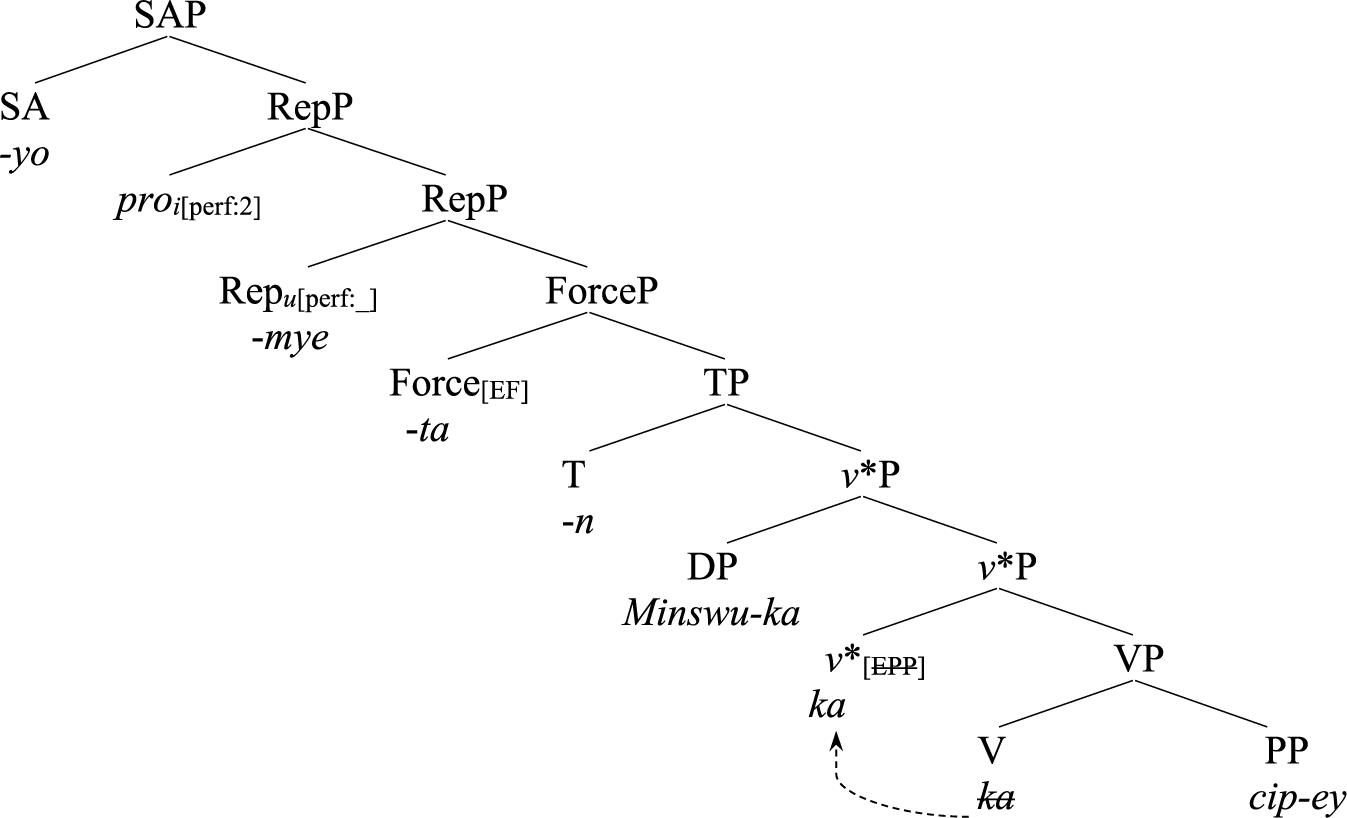
b.
{
v*P DP-Minsoo, {
v*P V-v*[EPP]-ka, {VP V-ka
, PP-cip-ey}}}
c.
{SAP SA-yo, {RepP DP-pro
i[perf:2], {RepP Rep-mye
u[perf:_], {ForceP Force[EF]-ta, {TP T-n, {
v*P DP-Minsoo, {
v*P V-v*[EPP]-ka, {VP V-ka
, PP-cip-ey}}}}}}}}
In the higher phase, by the time the last functional head (i.e. SA) in this sub-array is merged into the structure, syntactic operations start. Head-movement takes place first: V-v* moves to join T, to the Force head, then joins the Rep head, and ultimately forms the morphological sequence of [ka.n-ta-mye-yo] under the SA head. The structure after the head-movement is illustrated in (37a, b), and the path of the head-movement is in boldface in (37b). The EF on the Force head will be pied-piped up to the SA head by head-movement. Importantly, this passing of EF to higher functional heads is not an operation of feature copying or sharing; rather, it is simply a feature relocation via head-movement. EF is first generated on the Force head, and then, head-movement takes place prior to the satisfaction of EF, relocating the feature to the highest discourse projection. One crucial distinction is that, u[performative: __] that the Rep head bears is not subject to pied-piping. In other words, it is not relocated up to the SAP domain. We argue that this apparent ‘selective’ pied-piping is due to the property of each feature. The EF, which is endowed to Force head, is a feature for structure building (i.e. satisfied by projecting a specifier). As the EF does not take part in any local agreement, nor is it sensitive to the semantic domain, the feature is capable of pied-piping to the higher domain, and it is consequently satisfied by the higher non-phase heads projecting a specifier. By contrast, u[performative: __] is a feature that requires a local agreement with the performer at the Spec Rep position. Along this line, pro with i[performative: 2] merged at Spec RepP will value and delete u[performative: __] on the Rep head, as shown in (37a).
(37)
a.
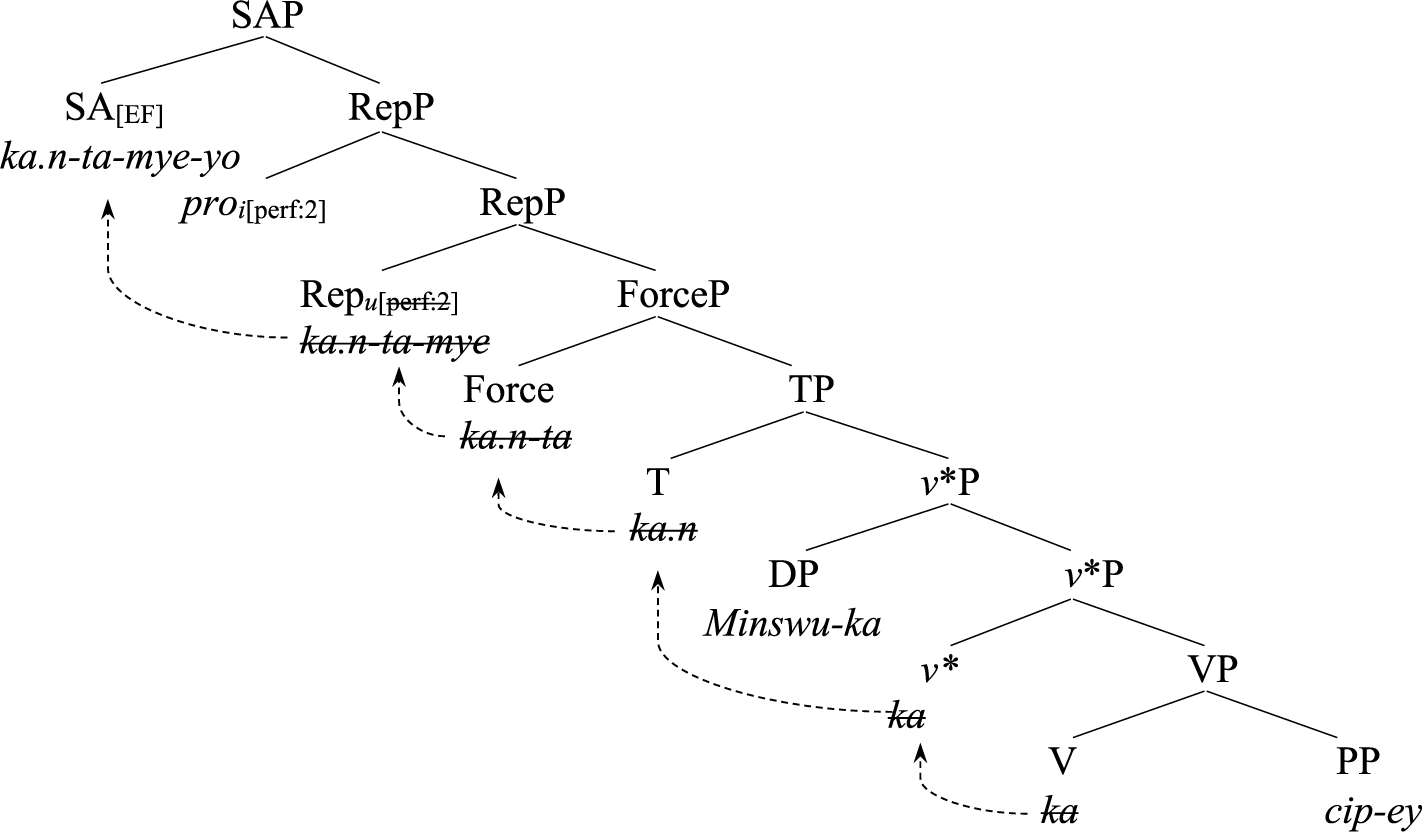
b.
{SAP V-v*-T-Force
[EF]
-Rep-SA-ka.n-ta-mye-yo
, {RepP DP-pro
i[perf:2], {RepP
V-v*-T-Force
[EF]
-Rep-ka.n-ta-mye
u[perf:2]
, {ForceP
V-v*-T-Force
[EF]
-ka.n-ta
, {TP
V-v*-T-ka.n
, {
v*P DP-Minsoo, {
v*P
V-v*-ka
, {VP
V-ka
, PP-cip-ey}}}}}}}}
Given that the EF is not satisfied by either the external or internal merge, the entire complement of the SA head, i.e. RepP (see the shadowed part in 38b), is raised to the Spec of SAP to satisfy the EF. As there are no uninterpretable features remaining in the structure, (38) yields a successful derivation in syntax and a correct word order at PF. Externalized constituents are boldfaced in (38b).
(38)
a.
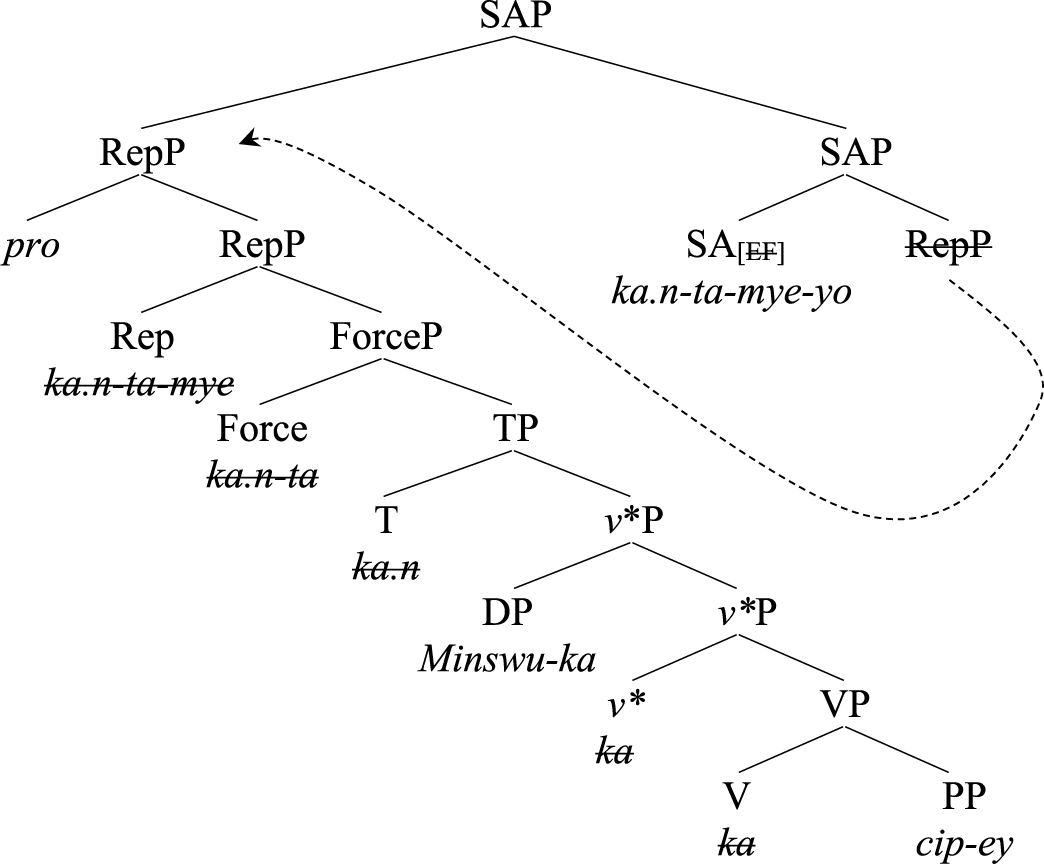
b.
{SAP {RepP DP-pro
i[perf:2]
, {RepP V-v*-T-Force
[EF]
-Rep-ka.n-ta-mye
u[perf:2]
, {ForceP V-v*-T-Force
[EF]-ka.n-ta
, {TP V-v*-T-ka.n
, {
v*P DP-Minsoo
, {
v*P V-v*-ka
, {VP V-ka
, PP-cip-ey
}}}}}}}, {SAP V-v*-T-Force
[EF]
-Rep-SA-ka.n-ta-mye-yo
, {
RepP
DP- pro
i[perf:2]
, {
RepP
V-v*-T-Force
[EF]
-Rep-ka.n-ta-mye, {
ForceP
V-v*-T-Force
[EF]
-ka.n-ta, {
TP
V-v*-T-ka.n, {
v*P
DP-Minsoo, {
v*P
V-v*-ka, {
VP
V-ka, PP-cip-ey}}}}}}}}}
A final question is why, in Korean, or more generally, in all languages with v*-to-T movement, v* does not give its EPP to T when v* is moved to T. One possibility is that even if v* has EPP, v* and T are in two separate sub-arrays, in that T belongs to the higher phase CP. The EPP on v* must be satisfied in the v*P phase; in other words, EPP on v* has already been satisfied even before T is merged. Only after T and C are merged, v* is moved to join T and C, and at that moment, the EPP on v* has already been satisfied.Footnote 20
5. Theoretical implications
5.1. In comparison to Chinese
A common property of discourse particles in Korean and in Chinese is that in both languages, the co-occurrence of the discourse particles from different layers is possible, as shown in (39): [
le éryǐ a
] for Mandarin and [
la-y-yo
] for Korean. The order among the three particles in each language is strict.
(39)
a.
Mandarin
Zhāngsān
qù
hē
jiǔ
le
éryǐ
a!
Zhangsan
go
drink
alcohol
le
only
a
‘Oh, come on, Zhangsan just only has gone to drink alcohol! (Nothing serious!)’
b.
Korean
Minswu-ka
cip-ey
ka-
la
-
y
-
yo!
Minsoo-nom
home-to
go-imp-hsy-sa
‘(pro said) Minsoo go home!’
As for the phasehood of the particles in Chinese, Pan (Reference Pan2022) argues that functional projections split from CP hosting SFPs are all phases in that SFPs exhibit an independence/isolability property at interface levels. Along this line, all of the three particles, le , éryǐ , and a, are all phasal heads as they can be used independently to form fully grammatical sentences. A sentence with each specific particle is not only phonologically isolable but also yields a new adequate semantic unit with a specific semantic interpretation or discourse function. Pan (Reference Pan2022) further assumes that all the SFPs in Chinese possess an EF, as they are all phasal heads. In particular, EFs for the projections such as S.AspP, OnlyP, ForceP, and AttP are satisfied by a comp-to-spec movement as a last resort. The complement of each particle will be raised systematically to its specifier to satisfy the EF, resulting in a systematic cyclic roll-up style of movement. Importantly, discourse particles in Chinese are not bound morphemes, which do not have to be attached to verbal elements to form a verbal cluster. Turning back to Korean, we argue that only Force head projects a phase, and hence, EF is restrictively endowed on the Force head only. In addition, we show that the syntactic head-movement takes place from the Force head to the Commit head and then to the SA head, which renders the EF to be relocated to the topmost projection. Importantly, this head-movement takes place prior to any other syntactic operations, so EF is pied-piped up to the topmost projection in the peripheral domain before being satisfied, which leads to a crucial difference between Korean and Chinese. While there are cyclic roll-up style movements (i.e. multiple comp-to-spec movements) in Chinese, the comp-to-spec movement only takes place once at the highest functional projection in Korean. As a result, although the surface final order for the discourse particles in the two languages in (39) appears to be similar, the derivational mechanisms are different for Korean and Chinese.
5.2. Phasehood and the highest phrase of an extended projection
Two diverging views exist on phases. In Chomsky’s (Reference Chomsky, Martin, Michaels and Uriagereka2000, Reference Chomsky and Kenstowicz2001) rigid model of phase, specific categories (C, v*) are phase heads, endowed with uninterpretable features as well as EPP/EF. Merging a phase head into a structure signals the timing for syntactic operations, such as Agree (feature valuation, feature deletion, etc.), Move and Transfer. Syntax can tell whether a lexical item is a phase head or not only by inspecting the value of its features: uninterpretable features are unvalued, thus lacking the value slot: u[F:__]. Uninterpretable features can be inherited by a non-phasal head. This system ensures computational efficiency. Alternatively, Bošković (Reference Bošković2014) argues for a contextual model of phases, in which the highest phrase of an extended projection is a phase. Thus, phasehood is dynamically determined by context. It is worthwhile noting that both views lead to the same result, which is that the highest phrase in an extended projection is always a phase bearing an EPP/EF. For instance, in Chomsky’s model, a phase head is always the last functional head in a given sub-array to be merged; therefore, the projection headed by this phasal head must be the highest phrase in a given extended projection. For Bošković, phase heads are not fixed categories, and phasehood is not associated with fixed categories but is contextually determined. Whatever phrase located in the highest position in an extended projection is a phase. For instance, in the nominal domain, an NP or QP without D can be a phase, as long as it is the highest projection in this given domain. Crucially, Bošković’s diagnosis of phasehood is based on the extraction test: whether a given phrase possesses an EPP/EF to project a specifier serving as an escape hatch for A'-movement.
In our analysis, Korean appears to share the views on both rigid and contextual models of phases. Complying with Chomsky’s rigid view, EF is restrictively endowed on the phasal head, i.e. Force. Importantly, although the highest functional projections in the C domain in Korean, SAP or CommitP, are not phases, they can still get an EPP/EF from the lower phase head, Force, via head-movement, which is, ultimately, in line with Bošković’s contextual model of phase. Importantly, in our analysis, the highest phrase in a syntactic domain always has EPP/EF. Note, however, that there is a crucial distinction between Bošković’s diagnosis of phasehood and our analysis. Bošković’s diagnosis of phasehood relies on the presence of an escape hatch for A'-extraction: if a given projection has EF to project an escape hatch, then this projection is considered a phase. However, in our analysis, the diagnosis of phasehood relies on whether a given functional projection in the CP domain can represent a fully grammatical independent sentence demonstrating interface properties. Therefore, the highest functional projection in the CP domain in Korean is not lexically a phase, but it can still obtain an EF from a lower phasal head via head-movement.
5.3. Language variation
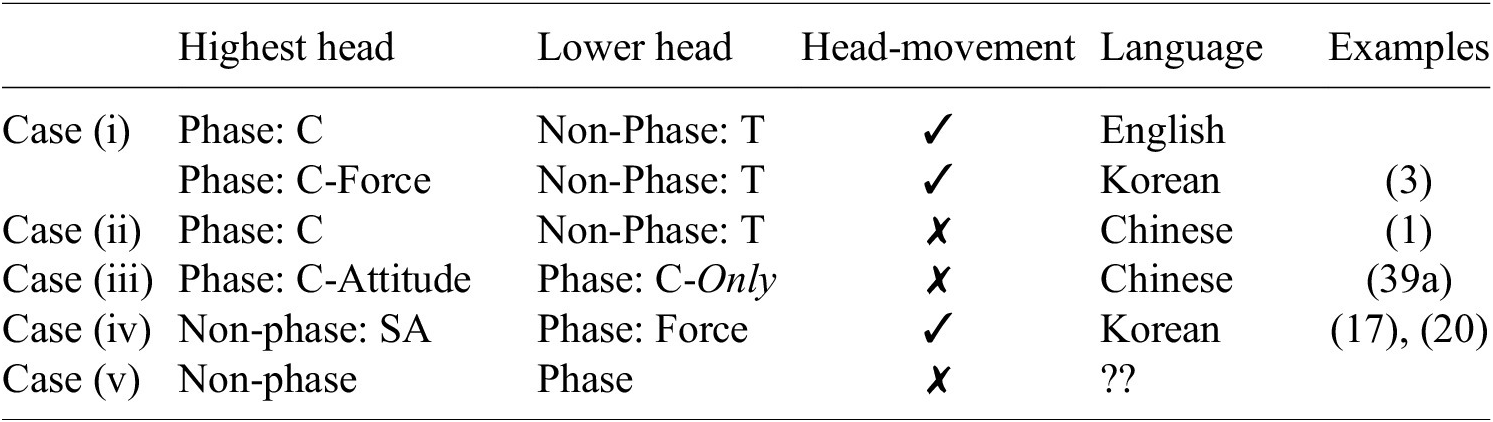
Suppose that a given lexical array contains at least two functional heads, a higher one and a lower one. Each of them could be a phasal head or a non-phasal head. A third condition lies in whether a given language exhibits head-movement. When these three conditions work together, different combinations could show up with very interesting typological patterns, as shown in Table 2. The list only shows some investigated cases and is not exhaustive.
CP domain in different languages

Table 2. Long description
The table consists of six columns and six rows of data categorized by Case.
* Case i: Highest head is Phase C. Lower head is Non-Phase T. Head-movement is present (check mark). Language is English.
* Case i (continued): Highest head is Phase C-Force. Lower head is Non-Phase T. Head-movement is present (check mark). Language is Korean. Example 3.
* Case ii: Highest head is Phase C. Lower head is Non-Phase T. Head-movement is absent (X mark). Language is Chinese. Example 1.
* Case iii: Highest head is Phase C-Attitude. Lower head is Phase C-Only. Head-movement is absent (X mark). Language is Chinese. Example 39 a.
* Case iv: Highest head is Non-phase S A. Lower head is Phase Force. Head-movement is present (check mark). Language is Korean. Examples 17 and 20.
* Case v: Highest head is Non-phase. Lower head is Phase. Head-movement is absent (X mark). Language is unknown (question marks).
In Case (i), the highest functional head in a given syntactic domain is a phasal head, such as C in English, and the lower head is not a phasal head, such as T in English. English exhibits head-movement. The Korean ‘TP < ForceP’ pattern also belongs to this category. The only difference between English and Korean is that in English, C agrees with a wh-phrase in terms of Q-feature, and the wh-phrase is moved to the Spec of C to satisfy its EF, whereas in Korean, the Force head does not agree with any specific goal, and therefore the entire complement of Force will raise to its specifier to satisfy the EF. In a similar scenario, if the language does not have T-to-C movement, this illustrates Case (ii), such as Chinese, among many other languages. Case (iii) illustrates languages in which both the higher projection and the lower projection in a given syntactic domain are phases, and there is no head-movement, such as the ‘OnlyP< AttitudeP’ pattern in Chinese. In languages described in Case (iv), the highest functional head is not a phasal head, but the lower one is a phasal head, and there is head-movement in this language. This illustrates the ‘ForceP < SAP’ pattern in Korean. Case (v) minimally differs from Case (iv) in that the given language does not exhibit head-movement, which requires further investigation.
6. Conclusion
Korean discourse particles are hosted by different peripheral functional projections with a fixed order. On the topmost layer lies SAP, where the speech act particle -yo is hosted, expressing the relations between interlocutors. The middle layer is the CommitP domain hosting the committal particle -ci , evidentiality particles -kwun and -ney , and hearsay particles -mye and -y , which (in)directly express the commitment to the truth of a proposition that the speaker has. The lowest layer is ForceP, hosting force-related particles such as -ta , -la and -ca , which is the only phase in the peripheral domain in that it not only shows independence at the interface levels but also triggers Spell-Out (see evidence based on the polarity licensing). By contrast, CommitP and SAP are not phases, as they cannot be used independently without the presence of the force particles. In Chomsky’s (Reference Chomsky, Freidin, Otero and Zubizarreta2008) analysis, all the uninterpretable features are assumed to originate from phasal heads only, motivated by the view related to computational efficiency. In the CommitP domain in Korean, the Rep head bears an u[performative] feature, which must be valued by the i[performative] feature of the performer argument at the Spec of RepP. Therefore, Korean data show that non-phasal heads actually bear uninterpretable features, contrary to English, the language that lacks rich projections in the periphery. We also proposed a derivational mechanism for the structures involving diverse discourse particles in Korean. Empirical evidence suggests that systematic head-movement in Korean takes place prior to other general syntactic operations. Accordingly, a phasal head moves to join a higher non-phasal head before the EF of this phasal head is satisfied. As a consequence, head-movement renders it possible for a higher non-phasal head (i.e. SA head) to gain the EF from a lower phase head. As a result, if we assume that the EF can be satisfied via comp-to-spec movement at the highest functional projection, the correct word order could be derived for Korean. This syntactic derivation is distinct from Chinese, where all the functional projections split from C have been argued to be phases, bearing an EF, and hence, a cyclic roll-up style of movements takes place at the edge of each peripheral projection (see Pan Reference Pan2022). The Split-CP domain in Korean also shows an interesting aspect in view of phase theory. Based on our analysis, Korean appears to support both the rigid and contextual models of phases. Complying with Chomsky’s rigid view, EF is restrictively associated with phase heads, e.g. the Force head in Korean. However, by means of head-movement, the EF of ForceP ends up being located at the highest functional projection in the extended CP domain (i.e. SAP), allowing this phrase to project an A'-type of specifier, which is, ultimately, in accordance with Bošković’s contextual model of phase.
Acknowledgments
This research was supported by the General Research Fund (GRF) of the Research Grants Council (RGC) of Hong Kong (Project No. 14608424), ‘Minimalist Derivation of Discourse Particles: A Comparative Survey’. Earlier versions of this paper were presented at the Department of Linguistics at Université Paris Cité in 2026. We are grateful to the audience for their questions and valuable comments, especially Caterina Donati. We also thank the anonymous reviewers and Adam Ledgeway for their insightful feedback on an earlier draft of this paper, as well as for their detailed suggestions, which greatly helped shape our analysis. All errors are our own.

 Open access

