





1. Introduction
For several decades psychologists, psycholinguists and linguists have engaged in characterizing the cognitive and linguistic characteristics of autistic children and adults.Footnote 1 According to the Diagnostic and Statistical Manual of Mental Disorders (DSM-5) of the American Psychiatric Association, autistic individuals have “[p]ersistent deficits in social communication and social interaction across multiple contexts” (American Psychiatric Association, 2013: 50). This characterization of autism relates to the immediately observable behaviour, that is, the pragmatics of communication. However, psychologists have gone beyond the observable behaviour to find its cognitive roots. As a cognitive characteristic of autism, some have postulated, especially, that autistic individuals lack an intuitive understanding of their own and other people’s minds (e.g. Baron-Cohen, Reference Baron-Cohen1995; Frith, Reference Frith2003). This cognitive characteristic has been used to explain the results of False Belief tasks, where autistic individuals have been shown to score differently than the general population (for an overview of this research, see Gernsbacher & Yergeau, Reference Gernsbacher and Yergeau2019).
False Belief tasks examine whether children grasp a discrepancy between a reality that they themselves know about and another individual’s – false – belief. If children manage such tests, they can be said to attribute mental states to others. Autistic children have been shown to pass these tests later than typically developing children, if at all (e.g. Happé, Reference Happé1995). However, the theory of “mindblindness” in autistic children and adults (Baron-Cohen, Reference Baron-Cohen1995) has been criticized on theoretical grounds (see, especially, Bowler, Reference Bowler2007; Hobson, Reference Hobson2002) and for weak empirical foundation. In a review of the relevant literature, Gernsbacher and Yergeau (Reference Gernsbacher and Yergeau2019) point out that autistic people are not unique in failing False Belief tasks, neither do autistic children and adults all fail the tests. Moreover, test results have been hard to replicate, and the results from different tests do not converge, which undermines the theory’s core construct validity.
Nevertheless the DSM-5 diagnostic criteria for autism spectrum disorder point to behavioural characteristics that can be expected to relate to autistic children’s and adults’ language, namely “social–emotional reciprocity,” “reduced sharing of interests, emotions, or affect,” and “difficulties adjusting behavior to suit various social contexts” (American Psychiatric Association, 2013: 50). Accepting the theory that autism is due to difficulties with “mind reading,” Kissine (Reference Kissine2021) makes a sharp distinction between vocabulary and morphosyntax on the one hand, and, on the other, the pragmatics of communication, which requires the speaker to adopt somebody else’s perspective. In approximately 70% of autistic individuals who reach functional language (Kissine, Reference Kissine2021), their communicative difficulties are only pragmatic and due to an “egocentric” perspective, he claims.
Functional-cognitive approaches to language (e.g. Dik, Reference Dik1997; Givón, Reference Givón1995; Harder, Reference Harder1996) abound in descriptions of linguistic phenomena that include perspective-taking, and thus presumably “mind reading,” at the level of coded linguistic categories that are part of morphosyntax and vocabulary and are not pragmatic. It is important to investigate to what extent autistic children and adults have difficulties with such linguistic elements. Traugott for instance points out that surely in English has a subjective epistemic meaning, but in contrast to no doubt, it also has an intersubjective meaning in that it may “seek agreement from the Addressee” (Traugott, Reference Traugott2012: 8): appropriate use of surely presupposes awareness of the addressee’s state of mind. Another example of how speakers take the addressee’s perspective into account is Harder’s (Reference Harder, Müller and Klinge2008) description of definite nominal expressions: a definite nominal like the elephant instructs addressees to identify a certain referent with elephant properties in the relevant context. For communication to be successful, speakers must have some notion of their addressees’ mental states to make sure the latter can identify the unique referent of the definite nominal.
In order to throw light on features that may contribute to autistic children’s “deficits in social communication and social interaction,” we have examined whether linguistically age-appropriate autistic children’s language use differs from that of typically developing children on subtle linguistic features defined in a cognitive-functional approach to language description. In a larger project, of which this study is a part, we have found such differences in language use between the same autistic children and typically developing children that contribute to this study. The autistic children with age-appropriate linguistic abilities scored significantly lower than typically developing children on a test of Danish dialogue particles (Engberg-Pedersen & Boeg Thomsen, Reference Engberg-Pedersen, Boeg Thomsen, Dancygier, Lu and Verhagen2016). Such particles are optional, monomorphemic and necessarily backgrounded, that is, they cannot be focused. Their meanings involve intersubjective configurations of shared knowledge, conflicting viewpoints or different balances in access to information (Davidsen-Nielsen, Reference Davidsen-Nielsen, Engberg-Pedersen, Fortescue, Harder, Heltoft and Jakobsen1996), that is, like surely and definiteness they require speakers to keep track of addressees’ knowledge states and viewpoints. In a different study of the children’s narratives based on a wordless picture book (Engberg-Pedersen & Vang Christensen, Reference Engberg-Pedersen and Vang Christensen2016), we found that the autistic children used fewer subordinate clauses about the characters’ mental states than their typically developing peers and preferred to talk about the characters’ mental states as reported speech, which can be imagined to be immediately perceptible, rather than as reports of thoughts or emotions. Moreover, they preferred direct speech to indirect speech. Grammatically, direct speech involves the expression of only one viewpoint in contrast to indirect speech, where both the narrator and the quoted character in the story are represented simultaneously (e.g. Köder & Maier, Reference Köder and Maier2016). Thus a quotation in the form of direct speech can be described as a semantically less complex way of representing another individual’s perspective than indirect speech. However, in a third study (Nielsen, Reference Nielsen2019), we found no significant difference between the autistic children and the typically developing children on their use of (in)definiteness in nominals used to introduce the characters in a narrative. Both groups seemed to associate definiteness with common ground status: they introduced new characters with indefinite expressions (a boy) or definite expressions anchored in an already introduced referent (his dog) about 90% of the time. However, no typically developing children but some autistic children used indefinite expressions to refer to characters already mentioned (see Schaeffer et al., Reference Schaeffer, van Witteloostuijn and Creemers2018: 104–105 for a similar finding). This could be interpreted as a difficulty with the meaning of the linguistic category of definiteness or a problem with linking individual pictures into a coherent narrative, that is, the narrative macrostructure.
In this study, we wish to focus on yet another linguistic feature in the same children’s language use, namely how they attribute intentionality to entities in the world. Intentionality attribution as it will be defined below is related to mental state attribution in the sense that intentionality attribution is necessary for attribution of mental states to others. We can only attribute mental states to entities that we see as sentient and – in our definition – intentional beings. Thus recognising other entities as intentional is more basic than attributing mental states to them. We investigate intentionality attribution through the verbs that the children use to describe the movements of geometric figures in videos when these movements cannot be classified as obvious types of actions. Specifically, we investigate whether the verbs the children use semantically attribute intentionality to the referents of the arguments.
We here use the term intentionality in the philosophical sense introduced by Brentano (Reference Brentano, Rancurello, Terell and McAlister2015) [1874]) and developed further by, for instance, Searle (Reference Searle1983) and Zahavi (Reference Zahavi2005). In phenomenology, the concept of intentionality has been used to argue that individuals experience the world directly as opposed to, for instance, viewing the world on a mental screen. Instead of seeing consciousness as something in and of itself, intentionality profiles the relation between consciousness and the rest of the world. Thus, intentionality is closely related to issues of subjecthood and consciousness. When we conceive of others as intentional, we conceive of them as sentient beings capable of having a subjective experience.
The sense of the word intentional used here is broader than its meaning in everyday language, where it is synonymous with deliberate. In everyday language we say that someone who moves through a room and picks up a glass of wine from a table has an intention, and we may describe the event as Ann went through the room to get a glass of wine. That is, we express linguistically an inference about Ann’s intention that builds on an observation of her overt behaviour. This type of inference can be described as attribution of intentionality: an observer relates events in the world involving Ann with her experience and, in this sense, we can be said to perceive Ann as an experiential, sentient being. But in the phenomenological tradition, the term intentional covers not only such purposeful actions but also experiences that are not volitional and purposeful such as blushing, hearing and knowing. That is, even unobservable experiences such as hearing and knowing are intentional in this sense. The essential point is that blushing, hearing and knowing are events of a kind that we only attribute to sentient, experiencing beings. If somebody bumps into someone or something whether deliberately or by accident, we expect them to have an experience of the bumping event and in that sense to be intentional. But if a branch is torn off a tree by a strong wind and bumps into a wall, we do not see the branch as having an experience. That is, our attribution of intentionality to entities does not depend on any specific event or the way we describe the event linguistically, but on our understanding of entities around us. In short, in contrast to the way we use intentional in everyday language, intentionality in the phenomenological sense does not only cover actions done on purpose, but is a characteristic of certain beings. The key is that the individual is an experiencing being (Zahavi, Reference Zahavi2005).
Even though attribution of intentionality does not depend on how we describe events, linguistic descriptions can reveal whether language users construe entities as intentional in the phenomenological sense. This is illustrated by the following examples:


Speakers may use example (1) to describe a situation where they see the subject referent experiencing a collision, no matter whether the event was done on purpose or by accident, because as a verb, walk requires a sentient subject referent. In contrast, it does not follow from fall in (2) that the speaker saw the subject referent as experiencing the event since fall may be used of all sorts of entities like apples or unconscious beings. Thus, in the sense of intentionality outlined above, (1) designates an intentional act, no matter whether the subject referent meant to walk into the speaker or not. Example (2) designates an event that does not necessarily involve an intentional entity because fall can take a subject argument about any kind of referent: apples and branches can fall, but they cannot walk.
Linguistic intentionality attributions are not determined by inherent features of entities; they are in the eye of the beholder. Thus, completely inanimate things such as artificial intelligence can be attributed intentionality in specific contexts, cf. expressions like chatbots hallucinate. This is one of the things this study adds to the study of autistic children’s narratives: recognition of intentionality is not about finding some essence of things, whether intentional or not, it is about how language users construe entities, and this construal operation is partly a social convention that language users need to tune into. They need to find out which things are regarded as intentional and which things are not, which may differ culturally: in one culture, heavy rainfall may be regarded as a result of thermodynamic processes, in another as a divine retribution.
Recognising some entities in the world as intentional in the above sense is more fundamental than attributing a mental state to them, but the former is an important step in adapting to intersubjective behaviour and coordinating one’s actions with others (Rochat, Reference Rochat2004; Tomasello, Reference Tomasello2008). Similarly, failing to recognise intentionality may cause breakdowns in social interaction. Indeed, as a response to accounts that view autism primarily as a deficit in representing other people’s mental states, Hobson (Reference Hobson1990) argued on theoretical grounds that autistic individuals’ difficulties with social communication and interaction are caused by their lower inclination to identify intentionality spontaneously. However, this idea has not received empirical attention, and research is needed to investigate it.
In this study, we focus on autistic children’s understanding of intentionality in the phenomenological sense through an analysis of how a group of autistic children described what happened in two short videos with moving geometric figures. In one of the videos, two triangles and a circle move in relation to a square in ways that can be construed as social interaction (Heider & Simmel, Reference Heider and Simmel1944); in the other video circles and squares move in ways that can be construed as planets in circulation and a rocket flying from one planet to another and back (Klin & Jones, Reference Klin and Jones2006). As for intentionality attribution, we wanted to examine how often the children use verbs, such as walk and tease, that construe the figures as intentional as opposed to verbs that describe mechanical events, such as fall and orbit. Furthermore, we wanted to assess the children’s abilities to form narratives at the macrostructural level by examining how many elements from a specially developed Relevance Index the children included in their accounts of each video (cf. Geelhand et al., Reference Geelhand, Papastamou, Deliens and Kissine2020). To score high on the Relevance Index, the children need to form an appropriate narrative that is both constituted by the interpretation of episodes that contribute to form the narrative in a bottom-up process of interpretation, and gives meaning to individual episodes in a top-down process of interpretation. Since the two videos afford two different kinds of interpretation, one with social interaction and one with mechanical events, the children need to form two different types of narrative frames at the macrostructural level, one involving intentional events, the other involving mechanical events.
Structural language difficulties are not part of the diagnostic criteria for autism, but autistic children vary greatly with respect to language abilities. Some autistic children are minimally verbal or non-verbal (Rose et al., Reference Rose, Trembath, Keen and Paynter2016), and a number of studies have shown that some autistic children have structural language difficulties resembling those found in developmental language disorder (Tager-Flusberg, Reference Tager-Flusberg2006; Tager-Flusberg & Joseph, Reference Tager-Flusberg and Joseph2003; Wittke et al., Reference Wittke, Mastergeorge, Ozonoff, Rogers and Naigles2017). This means that in order to make it more likely that any differences between the autistic and the typically developing children’s descriptions are due to differences in social abilities rather than structural language abilities, it is important to establish that the autistic participants do not have difficulties with structural language. That is why in this study, we compare a group of autistic children with age-appropriate language skills to a group of typically developing children. This will tell us whether differences in intentionality attribution and narrative macrostructure can be interpreted as related to social difficulties and not to linguistic skills.
To gauge the role of linguistic abilities for the task at hand, we also include a group of children with developmental language disorder (DLD), that is, children with a persistent language disorder of unknown aetiology (Bishop et al., Reference Bishop, Snowling and Thompson2017). The comparison between children with DLD and typical development will tell us whether any group differences are due to language abilities of other kinds than those related to social communication. Furthermore, we include measures of vocabulary, grammar and memory in the statistical analyses to control for potential effects of individual language skills and memory.
In the next section, we take a closer look at studies of the attribution of intentionality, including mental states, to geometric figures, and we discuss some of the shortcomings of these studies. In Section 3, we present our study, its purpose, and the predictions in more detail. Section 4 is an overview of the methods used and especially a discussion of the way we have measured the degree of intentionality attribution in the children’s accounts. The results of the analyses are presented in Section 5, which is followed, in Section 6, by a discussion of the results in relation to earlier studies and with respect to what they tell us about intentionality attribution and narrative structure in autism.
2. Earlier studies of attribution of intentionality and mental states
Several studies have investigated the attribution of intentionality and, particularly, mental states to others in different populations. For practical reasons, we will use the term for the more fundamental and prerequisite ability intentionality attribution to cover social attribution, mental state attribution, agency perception and the like. This is not to imply that these concepts are equivalent (on the contrary, cf. Section 1), but to allow for a coherent account of the previous studies.
A frequently employed method used to investigate intentionality attribution, which is also the one used in this study, was introduced by Heider and Simmel (Reference Heider and Simmel1944). They showed adults the animation involving two triangles, a circle and a rectangle and asked the adults to describe it. Despite the lack of cues to intentionality from the look of the entities, the adults readily described the movements of the figures as socially meaningful events like fighting and hiding, and some even told elaborate romantic stories. Several studies have made use of the same or similar ambiguous animations to study how they are interpreted by autisic people and neurotypicals.
Intentionality attribution is often measured as the number of mental events reported, that is, events where the speaker alludes to mental states. References to scenes of mocking, surprise or crying are usually counted as mental events. Comparing autistic to neurotypical people, some studies find that autistic participants are less likely to report mental events in Heider and Simmel-like animations (Castelli et al., Reference Castelli, Frith, Happé and Frith2002; Klin, Reference Klin2000; White et al., Reference White, Coniston, Rogers and Frith2011), while other studies find no group difference (Abell et al., Reference Abell, Happé and Frith2000; Bowler & Thommen, Reference Bowler and Thommen2000; Salter et al., Reference Salter, Seigal, Claxton, Lawrence and Skuse2008; Zwickel et al., Reference Zwickel, White, Coniston, Senju and Frith2011). Abell et al. (Reference Abell, Happé and Frith2000) and Castelli et al. (Reference Castelli, Frith, Happé and Frith2002) further report that the mental events reported by autistic participants do not fit the intended content of the animations as well as those reported by neurotypicals. This contrasts with Salter et al. (Reference Salter, Seigal, Claxton, Lawrence and Skuse2008), who find no significant difference between how appropriate the descriptions of mental events made by their two groups are.
Another aspect of narratives that has been used to measure intentionality attribution is the number of content elements that participants include, that is, the macrostructural narrative level. The idea is that people will make more elaborate descriptions of scenarios that they find meaningful and less elaborate descriptions of scenarios that seem pointless. Comparing the number of content elements in narratives, Klin (Reference Klin2000) and Klin and Jones (Reference Klin and Jones2006) find that autistic participants include fewer elements than neurotypicals.
A central feature of some of the studies outlined above is that they also ask participants to describe animations that do not invite intentionality attributions. For instance, Klin and Jones (Reference Klin and Jones2006) show their participants Heider and Simmel’s (Reference Heider and Simmel1944) original animation and one that is intended to display a physical scenario: a space rocket launches from a planet, lands on a moon and returns. Klin and Jones refer to the animations as the Social Attribution Task and the Physical Attribution Task, respectively. They compare how many content elements autistic and neurotypical participants include in their descriptions of the two animations and find a statistically significant interaction between group and animation type. The autistic and neurotypical participants include the same number of content elements in the Physical Attribution Task, but in the Social Attribution Task, the neurotypicals include far more elements than the autistic participants, who include the same number of elements in both tasks. The authors take their results to suggest that the autistic participants find the social animation less meaningful than the neurotypical participants do, but both groups are equally likely to attribute meaning to the physical animation.
In an eye-tracking study, Zwickel et al. (Reference Zwickel, White, Coniston, Senju and Frith2011) find that fixation patterns are comparable in autistic and neurotypical participants. In both groups, fixations reflect the social and physical behaviour in the animations in that participants spend more time looking at triangles in social scenarios where the triangles behave as agents, than at triangles in physical scenarios where their behaviour is determined by physical laws. Analogously, in a PET scan study, Castelli et al. (Reference Castelli, Frith, Happé and Frith2002) find the same amount of neural activation in an area of the occipital cortex, which processes visual input, in autistic and neurotypical participants who watch social and physical animations. Neural activity in this area is higher when participants watch social scenarios than physical scenarios. This suggests that the immediate visual input is processed in the same way in the two groups, and that both groups spontaneously discriminate between the animation types. Interestingly, Castelli et al. also find that, compared to neurotypicals, autistic participants have lower activation in regions of the brain concerned with mentalizing while watching the social animations. The authors take this to suggest that the autistic people noticed that the movements in the social animations are not random but that “this information failed to reach the multi-modal brain systems that are associated with mentalizing” (Castelli et al., Reference Castelli, Frith, Happé and Frith2002: 1846). Together, these non-linguistic findings suggest that autistic people do not have trouble detecting intentionality spontaneously and that the divergent verbal recounts made by autistic individuals that have been found in some of the linguistic studies may stem from difficulties with conveying their impressions of the videos.
It seems safe to say though that no clear picture of attribution skills emerges from the previous studies. A plausible reason for this is that they do not examine the exact same features, their participants differ, and several confounds apply to them. We will address these confounds in turn.
2.1. No control for length
Some studies compare autistic and neurotypical participants on measures that are sensitive to the length of the descriptions without controlling for length, consequently conflating measures. For instance, Klin (Reference Klin2000) concludes that autistic individuals struggle to “see” the social story in Heider and Simmel’s animation because their reports include fewer propositions of those that Klin considers central to the animation than the neurotypical participants. But at the same time, he finds that the autistic participants, on average, use half the number of propositions to describe the animation compared to neurotypical participants. Hence, the low number of “central” propositions could be due to the low number of propositions in general, and an alternative conclusion could be that the autistic participants find it difficult to convey the story in a narrative.
2.2. Floor effects in the number of reported mental events
Some studies compare the number of mental events reported by participants even when these events are reported so rarely that their variation is subject to floor effects, that is, the mean is less than one standard deviation from zero. Floor effects in the number of mental events occur in the results of Abell et al. (Reference Abell, Happé and Frith2000, cf. Table 2), Bowler and Thommen (Reference Bowler and Thommen2000, cf. Table 6) and Salter et al. (Reference Salter, Seigal, Claxton, Lawrence and Skuse2008, cf. Table 3). The frequent occurrence of floor effects suggests that Heider and Simmel-like animations are not ideal for eliciting descriptions of mental events. Nevertheless, we argue that a major advantage of using these ambiguous animations rather than, for instance, False Belief tasks is that participants’ speech can be evaluated in terms of overall intentionality attributions and not just explicit attributions of mental states.
2.3. Evaluation of content based on researchers’ expectations
Another shortcoming of the previous studies is that they evaluate the content and appropriateness of the video descriptions in terms of the researchers’ assumptions about what the animations show. However, we cannot be sure that researchers’ expectations match what language users do in experimental settings. A striking example of how researchers’ expectations can be out of tune with participants’ responses is provided by Klin and Jones (Reference Klin and Jones2006). In the descriptions of their space animation, they find a median of 0 on a content index for a group of neurotypical college students. That is, more than half of the students did not include a single element that the authors considered central.
2.4. Inadequately defined linguistic analyses
From a linguistic perspective, the previous studies analyse the verbal recounts somewhat impressionistically. Which expressions count as designating mental events is often stated loosely and only by means of examples. Abell et al. (Reference Abell, Happé and Frith2000: 14) give the following examples of what verbs they regard as attributing mental states: want, hide, trick, pretend and be naughty. Their procedure is followed by several of the studies reviewed above. However, it is not evident whether communication verbs such as argue and scold or activity verbs such as play and fool around would count as attributing mental states in their analysis. Furthermore, Abell et al. do not count expressions such as have a race or try to as mental state attributions, though it is not clear to us that these expressions involve less mental attribution than hide and want.
As we will make clear, we try to avoid these shortcomings in this study.
3. Predictions
We examine how autistic children (ASD), children with developmental language disorder (DLD) and typically developing children (TD) describe two short animations, one that invites intentionality attribution, and one that does not. We use the Social Attribution Task (SAT) and the Physical Attribution Task (PAT) (cf. Klin & Jones, Reference Klin and Jones2006) and compare the narratives of the three participant groups in terms of intentionality attributions and macrostructural narrative relevance. By narratives, we mean everything the children said in the elicitation situation concerning the animations, regardless of whether it constitutes a narrative in any traditional sense.
According to the diagnostic criteria of DSM-5 (American Psychiatric Association, 2013), autistic children have social difficulties that are not characteristic of children with DLD or typical development, and children with DLD have difficulties with structural language that are not characteristic of autism and typical development. However, there are overlaps between the populations. Some autistic people have structural language difficulties (Tager-Flusberg, Reference Tager-Flusberg2006; Wittke et al., Reference Wittke, Mastergeorge, Ozonoff, Rogers and Naigles2017), and some people with DLD have difficulties with social communication (Bishop, Reference Bishop, Bishop and Leonard2000). In order to avoid these potential confounds, we recruited autistic participants that were not clinically identified as having structural language difficulties, and participants with DLD that did not appear to have significant difficulties with social communication (see section below). Thus, a comparison of the three groups allows us to factor out how social and linguistic difficulties respectively affect verbal descriptions of scenarios with intentional participants and with non-intentional entities. To our knowledge this is the first study of intentionality attribution to include children with DLD.
To address the confounds of previous studies described in Section 2, we (i) measure intentionality attribution relative to the length of the narratives and (ii) try to avoid floor effects by using an intentionality measure of more frequently occurring linguistic features than reports of explicit mental events. Moreover, based on semantic and syntactic analyses of verbs, we (iii) provide a systematic and transparent procedure for analysing intentionality attributions in the children’s narratives. A major feat of the procedure is that it is explicit and thus allows for replication. Finally, to follow up on the analysis of intentionality, we (iv) evaluate the content of the children’s narratives on a Relevance Index based on adults’ narratives, that is, an index that measures the narratives’ macrostructure.
Based on the diagnostic characteristics of autism, and given that the autistic participants in our study do not have structural language difficulties, we predict that the autistic children will not have significantly different intentionality attribution scores in the two types of narratives, and that they will have lower intentionality attribution scores in SAT than the other two groups. By contrast, based on their social skills, the other two groups are predicted to have higher intentionality attribution scores in SAT than in PAT.
In terms of overall contents, we predict that, compared to the typically developing children, the autistic children and the children with DLD will include fewer elements from the Relevance Index in their narratives based on SAT, but for different reasons. The autistic children will struggle to report the relevant events because these events involve intentional beings, whereas the children with DLD will struggle because they have difficulties with forming linguistic reports in general. For the same reasons, we predict that, in PAT, only the children with DLD and not the autistic children will include fewer content elements than the typically developing children.
As for the narratives’ length, we do not have specific expectations.
4. Methods
4.1. Participants
Seventy-three Danish-speaking children aged 10;5–14;1 were asked to describe what happens in the two videos. Twenty-eight of the children are autistic, 12 have DLD, and 33 are typically developing. The parents of all the children gave informed, written consent that their children could participate in the study. Data were managed according to the University of Copenhagen’s code of conduct for research integrity at the time of data collection (2012–2013).
All participants were recruited from the greater Copenhagen area. All autistic children and all children with DLD were clinically identified before the study took place. The autistic children were recruited from special schools in which a clinical diagnosis on the autism spectrum is a criterion for admission. The children with DLD were recruited from language units and from the caseload of speech and language therapists. The children with DLD constitute a small group, mainly because the disorder had not received much attention in the Danish context at the time of the data collection, which made it difficult to recruit participants. The small group size means that any group effects pertaining to DLD must be interpreted with caution. The typically developing children were recruited from local schools.
4.2. Background variables
In order to characterise participants with respect to factors that are possibly relevant to performance in the elicitation task, the following data were collected:
Memory. Total raw scores of forward and backwards digit span from the Clinical Evaluation of Language Fundamentals-4 (CELF-4, Semel et al., Reference Semel, Wiig and Secord2003).
Nonverbal cognition. Raw scores on the Matrices subtest from the Wechsler Nonverbal Scale of Ability (WNV, Wechsler & Naglieri, Reference Wechsler and Naglieri2009).
Receptive vocabulary. Raw scores on the Danish version of the Peabody Picture Vocabulary Test (PPVT, Dunn & Dunn, Reference Dunn and Dunn1981; Danish version by Bremer Nielsen, Reference Bremer Nielsen2008).
Expressive vocabulary. Raw scores on a researcher-developed picture naming task for Danish (Gellert & Vang Christensen, Reference Gellert and Vang Christensen2012).
Receptive grammar. Number of correct items in the Danish version of the Test of Reception of Grammar-2 (TROG-2, Bishop, Reference Bishop2010).
Expressive grammar. Raw scores on a sentence repetition task for Danish (Vang Christensen et al., Reference Vang Christensen, Jensen and Nielsen2012).
A descriptive summary of these variables and of the participants’ chronological ages is given in Table 1. Shapiro–Wilk tests show that only the three non-linguistic measures (age, memory and nonverbal cognition) are normally distributed. We use parametric tests to compare groups on these measures and non-parametric tests for the four linguistic measures.
Summary of background variables with means, standard deviations and ranges
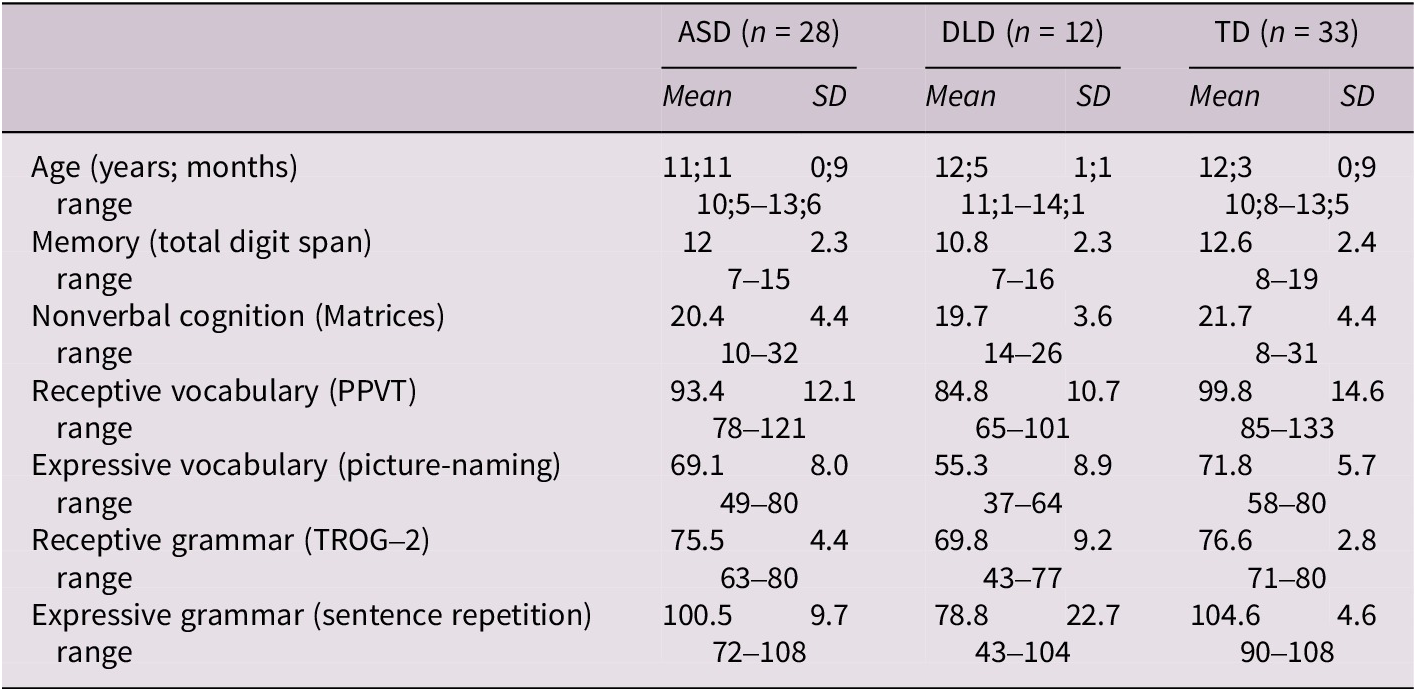
One-way ANOVAs show that the groups do not differ significantly on the non-linguistic measures, that is, age (F(2, 70) = 2.15, p = .12, η 2 = .06), memory (F(2, 70) = 2.66, p = .08, η 2 = .07) and nonverbal cognition (F(2, 70) = 1.34, p = .27, η 2 = .04). The groups differ significantly on all language measures according to Kruskal–Wallis tests (all p’s < .03). Follow-up comparisons using Dunn’s tests with Bonferroni correction show that the group differences are due to the children with DLD performing more poorly than the autistic and typically developing children. The ASD and TD groups do not differ significantly on the language measures (receptive vocabulary: p = .42; expressive vocabulary: p = .62; receptive grammar: p = 1.0; expressive grammar: p = .22). The children with DLD score significantly lower on all four language measures compared to the typically developing children (receptive vocabulary: p = .02; expressive vocabulary: p < .001; receptive grammar: p = .002; expressive grammar: p < .001). They differ significantly on three of the four measures compared to the autistic children (expressive vocabulary: p < .001; receptive grammar: p = .02; expressive grammar: p = .003). However, the children with DLD and the autistic children do not differ significantly on receptive vocabulary (p = .38). Importantly, the language profiles of the autistic children are generally different from the profiles of the participants with DLD, and the autistic children perform better than the children with DLD on the expressive language measures, which are the ones most relevant for the narrative task. Hence, we will describe the group of autistic participants as not having language difficulties.
We take these statistical comparisons to establish that potential differences between the three groups’ narratives can in large part be attributed to main characteristics associated with the diagnoses, that is, social communication difficulties of the autistic children and language difficulties of the children with DLD, rather than general nonverbal abilities or, with respect to the ASD and TD groups, general linguistic skills.
Four of the autistic children and three of the children with DLD did not participate in the Physical Attribution Task. Importantly, statistical comparisons yielded the same significant and non-significant differences on the background measures when applied to the subset of children participating in this task.
4.3. Stimuli
The stimuli consist of two animations: the Social Attribution Task (SAT) and the Physical Attribution Task (PAT). SAT (65 s) is the original Heider and Simmel (Reference Heider and Simmel1944) animation where figures move around on the screen in a suggestively social manner.Footnote 2 PAT (53 s) is the animation that Klin and Jones (Reference Klin and Jones2006) designed to show the journey of a space rocket.Footnote 3 Both animations only involve simple figures (triangles, circles, rectangles) with no overt cues to intentionality. Once PAT is seen as a rocket event it is of course intentional in the sense that rockets are launched by people, but the participants in the events (planets, a rocket) are not intentional in the phenomenological sense.
4.4. Elicitation
All the children were tested in a separate room at their schools with only the child and the experimenter present. The movies were presented to the child on a laptop, and their narratives were audio recorded. After having seen the whole movie twice, the child was asked to describe what happened in the movie, “as much as you remember.” When a child stopped, the experimenter asked, “Do you remember more?” This procedure was repeated until the child claimed not to remember more. This was done to give the child the opportunity to report as much content as possible. Next, the child was told that they would see the same movie again, but this time section-by-section. After having seen a section, the child was encouraged to recount as much as they remembered of that section. SAT was divided into six sections and PAT into five. The section-by-section recount was introduced to minimise the potential negative effects of memory load.
All autistic children were tested by one and the same experimenter (one of the authors), and all children with DLD were tested by a different experimenter (also one of the authors). The children with TD were tested by one of several trained students.
4.5. Coding
We analyse the children’s narratives with regard to intentionality attribution and to relevant content elements based on a Relevance Index.
4.5.1. Intentionality attribution
To examine whether entities are attributed intentionality in the narratives, we focused on the verbs. All narratives were divided into clauses. A clause was defined as an entity with one finite or nonfinite verb with its complements and adjuncts. Verbs that modify other verbs, such as auxiliaries, modal verbs, phrasal verbs and verbs like prøve ‘try’, were grouped with the verb they modified as constituting one clause. Exact verbatim repetitions were excluded from the analyses.
The analysis of intentionality attribution was based on a combined syntactic and semantic analysis. Each clause was rated on a scale from 0 to 2. A score of 0 was given to clauses where no participant is attributed intentionality. A score of 1 was given to clauses with one argument whose referent is attributed intentionality. And a score of 2 was given to clauses with transitive verbs that designate an interaction between intentional participants (such as den driller ham ‘it teases him’), and to clauses with a reciprocal verb and a single argument (such as de skændes ‘they quarrel’). In other words, the intentionality attribution measure indicates how many referents are attributed intentionality. The score associated with each verb is based on a semantic analysis, that is, the linguistic conventions of the grammatical contexts in which a given verb can be used and by the meanings it can have. Examples of the scores are given below.




In (4), the reflexive verb gemte sig ‘hid’ requires that the subject referent is intentional: when someone uses gemte sig about an entity that moves by itself, we understand them to attribute intentionality to the entity. In the same way, the transitive verb drille ‘tease’ in (5) designates a transitive, interactive event that requires two intentional participants, namely the referents of the agent and the patient arguments. Morphological reciprocals like slås ‘fight’ in (6) also designate interactions between two participants. No specifications regarding intentionality are made by the intransitive verb fløj af ‘flew off’ in (3): fløj af can be used of, for instance, a roof tile that blows off a roof in a storm. A list of the scores associated with each verb occurring in the data is provided in the Supplementary material.
The verb scores apply to the verbs used in the active voice. When verbs that yield a score of 1 or 2 occur in agentless passives, the score is subtracted by 1, reflecting the fact that an argument is missing. An example of this is given in (7), where the verb skubbe ‘push’ would have yielded a score of 1 if the agent had been expressed.

In many cases, the classification of verbs as yielding a score of 0, 1 or 2 was straightforward, but for some verbs, classification proved to be less obvious. One example is the verb gå ‘go, walk’. Danish gå has a very broad motion meaning comparable to English go, but gå may also convey a manner of movement in the same way as English walk. Thus, in contrast to go, gå cannot be used to describe the movement of things like snakes and non-sentient entities like liquids. Therefore we chose to score gå as specifying its subject referent as intentional.
In some cases, we ruled out certain possible interpretations of verbs that hardly fit the content of the animations. This allowed us to regard the subject referents of verbs like ødelægge ‘break (transitive)’, smadre ‘smash’ and skubbe ‘push’ as intentional despite the fact that these verbs among their meanings have a natural force meaning that does not require an intentional subject referent (cf. The glacier pushed sediments towards the coast). Importantly, the active forms of these verbs exclusively appeared in SAT narratives where force interpretations are extremely unlikely.
Since communication verbs like sige ‘say’, skælde ud ‘scold’ and diskutere ‘discuss’ designate interactions between intentional participants, they yield a score of 2, even when only one participant is mentioned (cf. she said yes with an implicit recipient of the communication). Another way of conveying a communication event implicitly involving a speaker and an addressee is by means of direct speech. Thus, clauses occurring as direct speech also yield a score of 2.
It is important to stress that our use of the phenomenological concept of intentionality allows the children to get a high intentionality score even when they do not explicitly attribute thoughts, beliefs and emotions to the figures. They can score just as high if they talk about behaviour such as hiding and throwing, which does not attribute explicit mental states to the participants but still requires that the speaker construes the participants as subjective experiencers.
Occasionally, verbal or adverbial modifications of the main verb entail an intentional construal of a referent that does not follow from the main verb. This is illustrated in (8) and (9).


In (8), the main verb komme forbi ‘pass’ does not require an intentional subject referent, but its modification by prøve ‘try’ clearly shows that the child construes the circle as intentional. Similarly, støde ind i ‘bump into’ in (9) can take unintentional subject referents, but because of the adverbial modification på en glad måde ‘in a happy way’ the subject referent must be understood as intentional. The clause in (9) gets a score of 2 because the event is reciprocal.
We do not include nominal phrases in the analysis of intentionality for two reasons. First, the children often used nominals ambiguously, such that the reference was not clear. For instance, they called a triangle a rectangle, or they referred to the same referent as it, he and she in the same narrative. Second, only a few children used nouns and pronouns that clearly designate intentional entities, such as the equivalents of mom, she and child to talk about the figures, and the choice of noun or pronoun appeared to be rather accidental. Thus, here we do not consider nominals a reliable cue to how children attribute intentionality.
For each child, there are two intentionality-attribution measures, one for each narrative type, SAT and PAT. Intentionality attribution scores were summed across the children’s first and second recount of each animation, the first recount after having seen the full version and the second after each section when the animations were divided into six parts. The sums were divided by the total number of clauses in the relevant condition. This gives us a length-sensitive measure of intentionality attribution.
4.5.2. Relevance index
In order to evaluate the content of the children’s narratives at the macrostructural level against a standard, we developed a Relevance Index for each of the two animations, based on adult narratives. Similar indices are used in other studies of narrative abilities (e.g. Geelhand et al., Reference Geelhand, Papastamou, Deliens and Kissine2020; Norbury et al., Reference Norbury, Gemmell and Paul2014). We asked 22 university students to recount the SAT and PAT to each other in pairs. One in each of the 11 pairs recounted SAT, and the other recounted PAT. The adults saw the video that they recounted on a screen that was not revealed to the other participant. They could watch the video as many times as they liked, also while narrating. During the narration, the experimenter left the room. The adults’ narratives were audio-recorded and transcribed.
Based on the transcriptions, two of the authors separately divided half of the narratives into episodes. The lists of episodes were compared, and the analysers agreed on what to count as an episode in each type of narrative. Then they both reanalysed the narratives according to the set of episodes. Cases of disagreement were again settled. For each animation, episodes that were reported by at least six of the eleven adults were included in a final Relevance Index. Coincidentally, the Relevance Indices for SAT and PAT both consist of thirteen elements. These lists of content elements are provided in the Supplementary material.
We scored the number of content elements from the Relevance Indices in each child’s first narrative of the full animation and in their second narrative of the section-by-section rendition separately. We also scored the number of new elements in the second narrative. This last measure was included to check if any of the groups benefited more than the others from describing the animations section by section rather than as a whole. Relevance scores were not length-sensitive since the relationship between the number of clauses and relevant content is not straightforward. Consider a narrative that is twice as long as another narrative, but both contain the same number of content elements from the Relevance Indices. A measure of relevance scores divided by length would mean that the longer story would be evaluated as half as relevant as the shorter story, which seems unjustified since part of storytelling can also be to include other events than the central ones.
4.6. Statistical analysis
To test group and task differences we first built multiple regression models with relevant control variables, and then we added group or task to see whether this variable significantly improved the model. We included two groups in each model because we were interested in pairwise comparisons and not, for instance, how the ASD group behaved compared to the DLD and TD groups combined. Control variables include memory (digit span) and in comparisons not involving the DLD group, the four language measures (expressive grammar (sentence repetition), receptive grammar (TROG-2), expressive vocabulary (PPVT) and receptive vocabulary (picture naming)) were also included. We did not include language measures in the models with children with DLD since language abilities are not independent of the disorder. Confidence intervals and standard errors of the beta values as well as p values for the independent variables are based on 1000 bootstrap samples because Shapiro–Wilk tests show that none of the predictor variables are normally distributed in all three groups. Furthermore, only two of the dependent variables are normally distributed in all three groups (intentionality score in SAT and length in PAT). We conducted the tests in SPSS. All models are summarized in the Supplementary material.
5. Results
5.1. Length
The mean number of clauses in the narratives of each group can be seen in Table 2. We conducted three regression models to check for group effects (ASD versus DLD, ASD versus TD, DLD versus TD) in the length of both SAT and PAT narratives, that is, a total of six models. The models describing the length of SAT and PAT narratives by the autistic and typically developing children are not significant when only the four languages measures (receptive and expressive vocabulary and grammar) and the measure of memory are included. Adding group (ASD or TD) to these models reveal that group independently predicted length beyond the background variables (SAT: b = 7.86, 95% CI [2.88, 13.23], β = .39, p = .02; PAT: b = 2.85, 95% CI [.31, 5.18], β = .31, p = .03). Group explained 14% more of the variance in length in SAT and 9% more in PAT, which were significant improvements. In both tasks, the autistic children’s narratives are shorter. None of the other four models describing length are significant. The lack of significant differences between the DLD and TD groups should be interpreted in the light of the small number of participants with DLD.
Mean number of clauses of the groups in SAT and PAT. Standard deviations are given in parentheses

5.2. Intentionality attribution
Table 3 shows the mean intentionality scores of the three groups in SAT and in PAT. The scores are the attribution scores per clause (i.e., total intentionality attributions of the first and the second recounts of the videos divided by the number of clauses).
Mean intentionality scores of the groups in SAT and PAT. Standard deviations are given in parentheses

We conducted six regression models to check for group effects in both tasks. None of the regression models for intentionality scores in SAT were significant. That is, despite the diagnostic characteristics, the autistic children did not differ from the other groups in terms of intentionality attribution in the social task. As expected for PAT, the models including autistic children were not significant, but unexpectedly, the model including the DLD and TD groups was significant when memory (i.e., digit span) was included, F(1, 40) = 7.52, p = .009. This model accounted for 16% of the variance in PAT intentionality scores. Furthermore, group (DLD or TD) independently predicted intentionality score beyond memory, b = −.09, 95% CI [−.17, −.01], β = −.37, p = .03. Adding group to the model explained 13% more of the variance than the model only including memory as a predictor. In this task, the children with DLD had higher intentionality scores than the typically developing children.
The unexpected high intentionality scores of the children with DLD in PAT should be interpreted with caution since only nine children with DLD contributed to this result. Nevertheless, it is worth noting that while five of the autistic and eight of the typically developing children did not use a single intentionality-attributing construction in their PAT narratives, all nine children with DLD used at least one such construction, and seven of the nine children scored above the mean in the other two groups. This suggests that it might be a genuine group difference despite the small sample size.
Also contrary to expectations, within group models of intentionality scores all improved significantly when task (SAT or PAT) was added. That is, in all three participant groups, not just in the DLD and TD groups, intentionality scores were significantly higher in SAT than PAT, even when we controlled for relevant background variables. Task accounted for 85%–95% of the variance in intentionality scores.
5.3. Relevance index
The mean number of content elements from the Relevance Index in the three groups’ narratives is given in Table 4. The total score is the sum of content elements in the first and the second narrative of each type, SAT and PAT.
Mean number of content elements from the Relevance Indices for each group in SAT and PAT. Standard deviations are given in parentheses
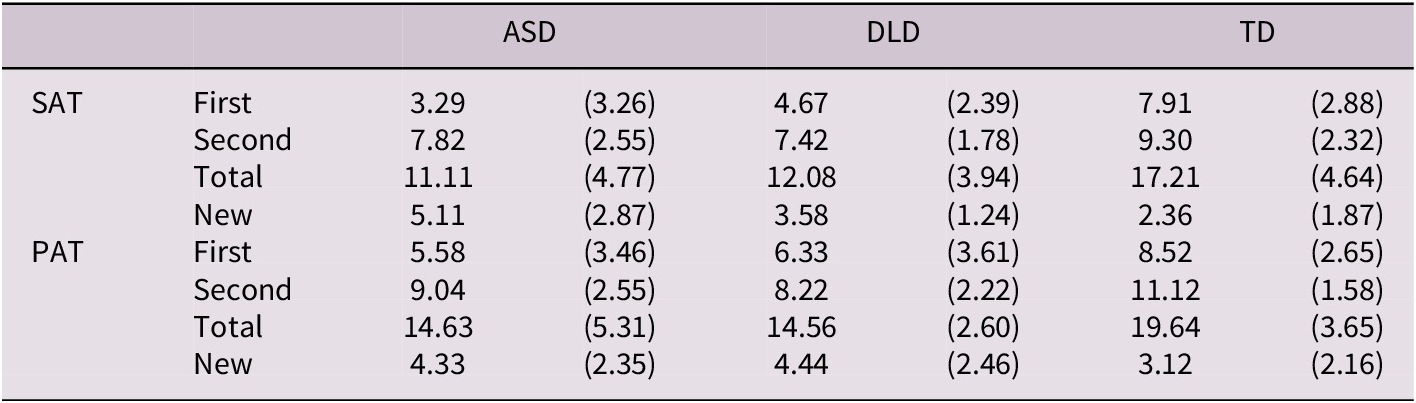
Again, we conducted six models to check for the effects of group on the total relevance scores in both SAT and PAT. In the four models describing the total relevance score of SAT and PAT, including the typically developing children, group was a significant predictor beyond control variables, and all four models were significant. In both SAT and PAT, the typically developing children included more relevant content elements than the autistic children and the children with DLD did. Group (TD or ASD/DLD) explained between 18% and 22% of the variance beyond background predictors in these models. The two models comparing the autistic children and the children with DLD were not significant.
Looking at first and second narratives separately confirms this picture in that we found the same significant and non-significant group effects with only two exceptions: The model for second SAT narratives by the ASD and TD groups and the model for the first PAT narrative by the DLD and TD groups did not improve significantly from adding group.
With regard to new elements in the second narratives, group independently predicted the number of new elements in the second SAT narratives by the autistic and typically developing children when memory and language measures were also included, b = 1.36, 95% CI [−2.08, −.74], β = −.50, p = .002. Adding group (ASD or TD) significantly explained 22% of the variance in the number of new elements when the other measures were controlled for. The autistic children included more new elements in their second SAT narratives than the typically developing children did. The other models describing new elements in the second narratives were not significant.
6. Discussion
In this study, we have investigated how autistic children without structural language difficulties, children with DLD with no known social difficulties and typically developing children describe a social and a physical animation involving the movement of geometric figures. We have analysed two main aspects of their narratives: intentionality attribution and relevant content elements. To additionally inform the study, we included a measure of narrative length.
As it will appear from the summaries in the discussion below, several of the differences we found are in line with our hypotheses, but two unexpected results stand out. 1. All three groups, and not just the DLD and TD groups, attributed intentionality to the geometric figures to the same extent in SAT narratives. 2. The only difference in intentionality scores across tasks is that the children with DLD attributed intentionality more readily in PAT than the typically developing children.
Importantly, the measures on which we have found an effect of group are not the same for the ASD and DLD groups. That is, the two groups described the videos in different ways. In the following, we will show how the properties of the children’s video descriptions can be explained by reference to the different main criteria of autism and DLD.
6.1. Intentionality attribution
As predicted, the children with DLD and the typically developing children had higher intentionality scores in SAT than in PAT. Contrary to expectations, the same was found for the autistic children. Furthermore, there was no effect of group in predicting intentionality scores in SAT. That is, the social difficulties associated with autism do not seem to lead to autistic children attributing intentionality less readily than other children, at least not in the case of autistic children without language difficulties. These findings contrast with the results of several previous studies (cf. Castelli et al., Reference Castelli, Frith, Happé and Frith2002; Klin, Reference Klin2000; White et al., Reference White, Coniston, Rogers and Frith2011) and we believe that part of the explanation for the different results should be found in the phenomenological concept of intentionality that we have employed for the semantic analysis. The previous studies focused on descriptions of mental states, thoughts and emotions, whereas our focus has been on whether speakers construe the entities in the animations as sentient beings. The use of verbs that require sentient participants, such as play and try to tells us that the speaker construes the participants as intentional in the phenomenological sense. That is why we have counted such verbs as attributing intentionality.
It should be noted that linguistic attribution of intentionality might look very different for the large part of the autistic population who has language difficulties (cf. Rose et al., Reference Rose, Trembath, Keen and Paynter2016; Tager-Flusberg, Reference Tager-Flusberg2006; Wittke et al., Reference Wittke, Mastergeorge, Ozonoff, Rogers and Naigles2017), but in those cases, it would be hard to determine whether different linguistic attribution of intentionality is an effect of social or linguistic difficulties.
Importantly, other studies report findings in line with our results. For instance, Zwickel et al. (Reference Zwickel, White, Coniston, Senju and Frith2011) found no difference between how many mental state expressions autistic and neurotypical participants used to describe animations with geometric figures. In their eye-tracking data, they also did not find differences between fixation patterns in the two groups, and Castelli et al. (Reference Castelli, Frith, Happé and Frith2002) found that lower order neural activation patterns associated with the processing of biological motion were comparable in autistic and neurotypical participants watching the same animations.
Considering the measures on which autistic and neurotypical participants have been found not to differ and the measures on which they do differ, one possible overarching account is this: the social difficulties associated with autism appear not to lead to difficulties with the identification of sentient beings and subjective perspectives as such; rather the social difficulties seem to pertain to more complex cognitive or linguistic aspects that require explicit recognition of mental states or the integration of perspectives (cf. Section 1). Thus, studies report no differences between autistic and neurotypical participants on measures of eye movements (Zwickel et al., Reference Zwickel, White, Coniston, Senju and Frith2011) and neural activation in lower order cognitive processes (Castelli et al., Reference Castelli, Frith, Happé and Frith2002) as well as on the use of definiteness, which only requires the speaker to implicitly recognise one perspective at a time (Nielsen, Reference Nielsen2019), and the use of verbs that attribute intentionality (present study). In contrast, differences between ASD and TD are reported for neural activation of higher order cognitive processes of mentalizing (Castelli et al., Reference Castelli, Frith, Happé and Frith2002) and explicit linguistic attribution of thoughts and emotions (e.g. Klin, Reference Klin2000). Engberg-Pedersen and Vang Christensen (Reference Engberg-Pedersen and Vang Christensen2016), who investigated the same autistic and typically developing children who participated in this study, have also argued that the two groups differ in how readily they use complement clauses with indirect speech to express mental states because indirect speech requires the speaker to integrate two perspectives (the narrator’s perspective and the quoted character’s perspective). Similarly, Engberg-Pedersen and Boeg Thomsen (Reference Engberg-Pedersen, Boeg Thomsen, Dancygier, Lu and Verhagen2016) found that the same autistic children had difficulties using dialogue particles in appropriate contexts; such particles also require the integrations of perspectives (the speaker’s and the addressee’s perspective).
Unexpectedly, in our study the children with DLD had significantly higher scores of intentionality attribution in their PAT narratives than the typically developing children. The diagnostic characteristics of DLD do not suggest that the children in this group should interpret the movements in PAT in unconventional ways, and we only have PAT narratives from nine children with DLD, so this finding must be treated with caution. Nevertheless, the statistical difference is quite clear: group explains 13% of the variance in this model and seven of the nine children score above the averages of the other two groups.
If we look at excerpts of narratives from two children with DLD, we see the contours of a plausible explanation.Footnote 4

In (10), the child’s use of skyde ‘shoot’ yields a score of 1. The same verb used in the passive voice would not have attributed intentionality to the rocket, but children with DLD have relatively poor syntactic abilities (e.g. de López et al., Reference de López, Kristine and Chondrogianni2014), which might lead to less frequent use of passives.
Another part of the explanation for the relatively high intentionality scores of the children with DLD’s PAT narratives has to do with lexical variation. Consider the three uses of gå ‘go, walk’ in the four clauses in (11).
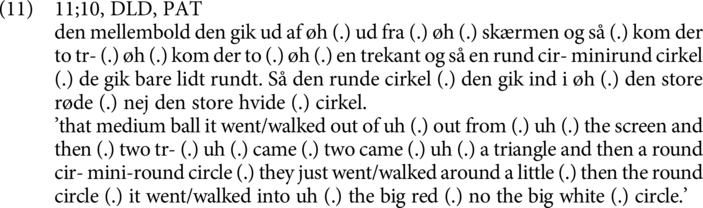
Each use of gå yields a score of 1. If instead of gå, the child had used verbs with more specific meanings such as forsvinde ‘disappear’ (from the screen), flyve ‘fly’ (about the rocket in space), and lande ‘land’ (on the large planet), the three clauses would have gotten scores of 0. More specific verbs, as well as the passive voice, were frequently used by the autistic and typically developing children to describe the same events in PAT. Because children with DLD’s speech is less varied lexically than the speech of typically developing children (Charest et al., Reference Charest, Skoczylas and Schneider2020), children with DLD can be expected to favour high-frequency words with more general meanings, which happen to be verbs typically used of human beings. By using the high-frequency verb gå ‘go, walk’, the children with DLD, possibly inadvertently, attributed the rocket with intentionality. Their high intentionality scores in PAT could thus be an effect of their language difficulties. The most frequent verbs and the active clause construction tend to attribute intentionality to subject arguments.
The relatively high intentionality scores in PAT by the children with DLD could be viewed as a consequence of our semantic analysis of some general verbs like gå ‘go, walk’. If we had analysed this and other general verbs as not attributing intentionality, the results might have been different. However, we think our analysis of gå is justified by the fact that the verb cannot conventionally be used to describe the floating around of geometric figures on a screen.
Linguistic features are often used as a measure of cognition. Yet we cannot know to what extent the linguistic and the cognitive attributions match. The claim of a close link between speech and thought is a challenge in cognitive linguistics in general; for instance, it has been argued that production and comprehension are sometimes dissociated (cf. Koç et al., Reference Koç, Ayhan and Alp2009).
In the case of the participants with DLD, it seems fair to say that some of their intentionality attributions in PAT reflect linguistic and not necessarily cognitive difficulties. Another explanation could be that the children are in some way taxed by the elicitation task, and that they do not tend to overuse intentionality-attributing expressions in their everyday. By contrast, the autistic children appear rather to have difficulties getting a grip on the events of the videos as narratives. The children do see the moving figures of the SAT animation as intentional, but they fail to integrate individual episodes into a coherent story as it appears from their low scores on the Relevance Index (see Section 6.2).
It would be worthwhile to investigate the intentionality attribution of younger autistic children with age-appropriate language skills to see if they also have age-appropriate intentionality scores in the way defined here.
6.2. Relevance indices
The autistic children and the children with DLD included fewer content elements than the TD children in both SAT and PAT. The fact that the children with DLD included fewer content elements than the TD children is in line with our expectations, and the difference is most likely due to language difficulties. For the autistic children, our prediction for SAT was correct: they had fewer relevant content elements than the TD children. However, contrary to expectations, they also had fewer content elements than the TD children in PAT. The differences we have found between the TD and ASD groups cannot be attributed to differences in linguistic abilities since language measures were used as covariates in the analyses. The different relevance scores in both SAT and PAT narratives by autistic and typically developing children contrast with Klin and Jones’ (Reference Klin and Jones2006) finding that autistic people include fewer elements than neurotypicals in SAT only. We have no explanation for this difference between the two studies except that the content analyses differ.
In light of the lack of significantly different intentionality scores of the ASD and TD groups, the relatively low relevance scores in the ASD group lend support to Castelli et al. (Reference Castelli, Frith, Happé and Frith2002) who argue that autistic people detect intentionality spontaneously, but that the integration of lower-order recognition of socially meaningful behaviour with higher-order cognitive processes associated with mentalizing is weak, which would make the construction of appropriate narrative frames hard. The explanation is illustrated in the following full SAT narrative from an autistic child. For convenience, the narrative is presented in the English translation only.
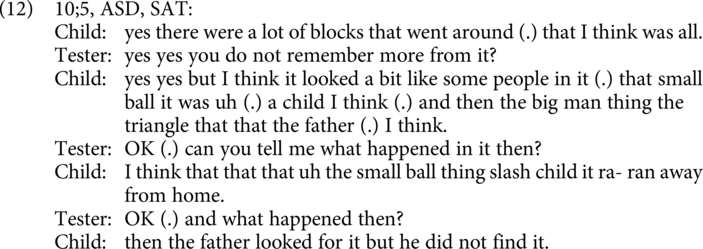
The child clearly attributes intentionality to the geometric figures. Nevertheless, he does not report many events in the animation. Initially, he tries to describe the entire animation in one sentence, consequently missing most of the events in the Relevance Index. Furthermore, when the child is prompted to elaborate, he describes a rather curious event, namely that ‘the small ball thing slash child ran away from home’. No other child reported such an event. Idiosyncratic interpretations were common among the autistic children and included, for instance, a report of a mother hitting a father after he kissed her. The autistic children also often said that the task was difficult.
The next example is a typical SAT narrative from a child with DLD:
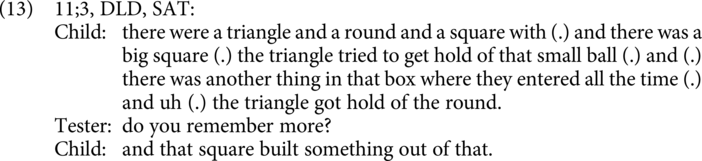
Overall, the child reports few events from the animation. In the last utterance, the child may have intended to convey the meaning ‘destroyed’ instead of ‘built’, that is, a related, yet opposite verb meaning. The sparse number of reported events and the use of an antonymic verb can be accounted for by the linguistic difficulties associated with DLD. Other studies of narrative abilities of children with DLD also report that at least some children with DLD include fewer elements in their narratives than typically developing peers (e.g. Blom & Boerma, Reference Blom and Boerma2016; Norbury et al., Reference Norbury, Gemmell and Paul2014).
The stories in (12) and (13) illustrate how the autistic children and the children with DLD struggle with forming narratives at the macrostructural level for different reasons. The children with DLD include few relevant content elements because they have difficulties formulating complex sentences and finding appropriate words. The autistic children struggle because they make idiosyncratic interpretations and find it difficult to tie event descriptions together into a story, that is, narrative macrostructure. The explanation that the autistic children struggle to form narratives in general, rather than certain types of narrative (social or physical), is corroborated by the fact that the autistic children told significantly shorter PAT as well as SAT narratives than the TD children. While the explanation concerning the children with DLD would also entail that the narratives of this group are significantly shorter than the narratives of the TD group, this was not what we found. However, this lack of a difference in length between DLD and TD can probably be ascribed to the facts that the DLD group is small and standard deviations on the length measure are high in both groups, which means that absolute differences between the groups have to be relatively large to reach significance.
Another reason why the autistic children included few content elements in both SAT and PAT could be that the narrative task is at odds with their ordinary interaction patterns. However, given that only the autistic children included significantly more new elements in the second narrative than the first narrative compared to the typically developing participants, they do seem to go along with the artificial setup, as the second narrative is arguably less natural than the first. Thus, it seems that the autistic children are motivated to describe the animations but have a hard time doing so.
The result that the autistic children included fewer relevant content elements in their narratives supports other findings that autistic people have difficulties with narrative macrostructure (see Geelhand et al., Reference Geelhand, Papastamou, Deliens and Kissine2020). Such results also reinforce the theory outlined in the previous section that autistic people have problems with higher-order cognitive processes such as integration of perspectives since narration often requires speakers to maintain more or less stable representations of several characters in narratives.
6.3. Conclusion
It is striking that the different designs of the Social Attribution Task and the Physical Attribution Task do not elicit expected differences in performance among the three groups. We used two main measures: intentionality score and relevance score, and there were especially two unexpected results. First, the autistic children had as high intentionality scores as the typically developing children on the social task when narrative length was taken into account. Second, the children with DLD had higher intentionality scores than the other groups on the Physical Attribution Task. We argued that the children with DLD’s unexpectedly frequent attributions of intentionality to the figures in this task were due to language difficulties. Specifically, they tend not to use the passive voice and to prefer high-frequency verbs, which have intentionality-attributing meanings.
Contrary to the assumption that autistic people have difficulties recognizing behaviour as social, the autistic children in this study did not appear to have trouble with intentionality perception and description, which is the first step in explicit attribution of mental states. Yet they do exhibit difficulties with constructing narratives based on the animations: 1. their narratives were significantly shorter than the narratives from the children with typical development, 2. they did not include as many relevant events, and 3. some demonstrated unconventional ways of interpreting or narrating the scenarios in the animations. We proposed that the social difficulties characteristic of autism according to DSM-5 do not pertain to the basic differentiation of sentient beings and non-sentient entities for autistic children with age-appropriate language.
Acknowledgements
We want to thank the children who participated in the study and their parents as well as the group of student assistants who helped with data collection and transcription. We would also like to thank two anonymous reviewers for their detailed and thoughtful comments, which have helped to improve the article. Of course, we are only to blame for all errors and shortcomings.
And somewhere it also needs be added that the study was funded by a grant: The work was completed with financial support from the Danish Council for Independent Research (grant no. 11-104420.
Supplementary material
The supplementary material for this article can be found at http://doi.org/10.1017/langcog.2025.10005.
Data availability statement
Transcriptions, spreadsheets used for analysis and SPSS syntax and output are available at OSF: https://doi.org/10.17605/OSF.IO/QC65H


 Open access

