


1. Introduction
The fashion industry is one of the biggest industries and is estimated to be worth 3 billion dollars (Reference Koay, Cheah and LomKoay et al., 2022) and employs more than 300 million people along the value chain (Reference Morlet, Opsomer, Herrmann, Balmond, Gillet and FuchsMorlet et al., 2017). Furthermore, clothing consumption has doubled in the last two decades (Reference Remy, Speelman and SwartzRemy et al., 2016) which is pushed by the fast fashion model’s rapidly following and quickly outdated trends, the extremely cheap clothing and the capitalization on the immediate gratification for the customers after making a purchase (Reference Joy, Sherry, Venkatesh, Wang and ChanJoy et al., 2012). Typically, clothing is only worn seven times, and 97% of it is sent out to be landfilled or incinerated (Reference Morlet, Opsomer, Herrmann, Balmond, Gillet and FuchsMorlet et al., 2017). Ellen McArthur’s model of a circular economy (CE) offers an alternative approach and is described as “a system that seeks to minimise the waste of materials and reduce waste production”. Here, after reducing new clothing purchases, reuse is emphasised as an important step in the CE, where products are utilized for their intended purpose as long as possible, ultimately reducing the demand for new products, and are only recycled when reuse is not effective anymore. (Circular Economy Systems Diagram, n.d.; Ekström & Salomonson, Reference Ekström and Salomonson2014; Reference Morley, Bartlett and McGillMorley et al., 2009).
1.1. Literature review
There are multiple approaches to reuse and therefore extend the lifetime of clothing such as proper maintenance (Reference GwiltGwilt, 2021; Reference Wiedemann, Biggs, Nguyen, Clarke, Laitala and KleppWiedemann et al., 2021), repair (Reference Niinimäki and DurraniNiinimäki & Durrani, 2020), and second-hand (Reference Herjanto, Scheller-Sampson and EricksonHerjanto et al., 2016). However, implementing these strategies is challenging. Despite a strong positive attitude towards sustainable fashion, consumers often prioritise price and style over sustainability during purchase. Consequently, it is difficult for sustainability to find its place in new (Reference Mandarić and HunjetMandarić et al., 2022) and second-hand clothing (SHC) sales, with only 5% of the total global trade of apparel being second-hand (Reference Farrant, Olsen and WangelFarrant et al., 2010). Negative perceptions of SHC, such as low quality, inferior and unhygienic clothing (Reference HurHur, 2020; Reference Wang, Fu and LiWang et al., 2022) further limits its adoption. Moreover, second-hand stores are often viewed as disorganized, with unpleasant smells and damaged clothing (Reference Sorensen and Johnson JorgensenSorensen & Johnson Jorgensen, 2019). More specifically, Sajjad et al. (Reference Sajjad, Khalid, Haiqa, Shazadi and Fatima2021) found that hygiene and quality perceptions are significant factors influencing consumers’ purchase decisions for SHC (Reference Sajjad, Khalid, Haiqa, Shazadi and FatimaSajjad et al., 2021). High perceived product-, information- and service-quality can positively shape experiences and attitudes towards SHC, increasing positive word-of-mouth. When these qualities are perceived as high, consumers find SHC more enjoyable, useful and environmentally beneficial. Additionally, high perceived service quality can lower concerns towards functionality, aesthetics and cleanliness (Reference Tymoshchuk, Lou and ChiTymoshchuk et al., 2024). Investigating this, Das et al. (Reference Das, Moons and Du Bois2024) examined the motivations and barriers that customers encounter when purchasing SHC in-store and how these can be influenced to create a more enjoyable experience. The researchers identify five key points (KP) in the customer journey for SHC shopping: Branding and Marketing (KP1), which focuses on building a positive brand image to attract consumers to SHC; Presentation of Clothing (KP2), which addresses initial customer impressions upon entering second-hand stores; Searching for Suitable Garments (KP3), aimed at making it easier for customers to find suitable items; Inspection of Garments (KP4), which facilitates quality and suitability assessment; and Price-Quality Relationship (KP5), focusing on the perceived monetary or emotional value of SHC. Together, these stages offer points for implementing design strategies to enhance the SHC shopping experience. In this study, they also found that positive emotions were evoked during the acquisition of high-quality clothing (KP 4-5) while negative emotions tend to dominate the initial stages (KP 1–4) (Reference Das, Moons and Du BoisDas et al., 2024). In his work ‘Emotional Design’, Norman (Reference Norman2005) also emphasizes the importance of the emotional side of design. He argues it’s more critical to a product’s success than its practical elements and differentiates three levels of emotional design: visceral (which focuses on the immediate, instinctive emotional reactions), behavioural (which emphasizes the usability and functionality of a product), and reflective (which deals with the deeper meanings, values, and personal associations that people attach to a product). At the visceral level, senses play an important role where initial impressions are based on a product’s sensory appeal (e.g. feel of a material, the scent of the store) and at the behavioural level, senses are crucial for assessing usability (e.g. weight of the fabric, itching of a sweater), but also indirectly influence the reflective level (Reference NormanNorman, 2005). Sensory aspects are also important in retail atmospherics and has been widely researched under the topic ‘Sensory marketing’ that aims to create immersive sensory experiences through sight, sound, touch, taste, and smell (Reference SchmittSchmitt, 1999). Failing to create a positive sensorial retail experience may demotivate customers to continue their journey. Reflecting this to SHC, unpleasant odours experienced by consumers in second-hand stores can enhance negative stereotypes about SHC being low-quality or unhygienic (Reference Kang and LeeKang & Lee, 2022).
1.2. Aim of the study
Therefore, this study takes inspiration from Norman’s Emotional Design framework and sensory marketing to enhance the SHC shopping experience and address consumer barriers related to quality and hygiene perceptions. While sensory influences on shopping experiences have been widely explored for new products (Cao & Duong, Reference Cao and Duong2021; De Groot, Reference De Groot2021; Doucé & Janssens, Reference Doucé and Janssens2013; Leenders et al., Reference Leenders, Smidts and Haji2019; Newman, Reference Newman and Adam2022) there is limited research on their role in the context of second-hand stores. Additionally, previous studies have identified negative perceptions of SHC related to quality and hygiene (Hur, Reference Hur2020; Wang et al., Reference Wang, Fu and Li2022; Sorensen & Johnson Jorgensen, Reference Sorensen and Johnson Jorgensen2019). However, there is a lack of research on how improving sensory experiences can alter these perceptions. Furthermore, while studies apply the Emotional Design Framework to product attachment and longevity (Reference BurcikovaBurcikova, 2021; Reference Stead, Goulev, Evans and MamdaniStead et al., 2004), its use in other circular economy contexts remains unexplored. By focusing on sensory aspects in SHC shopping, this study provides novel insights into how Norman’s Emotional Design framework can be extended from products to shopping environments. Additionally, elevating these elements can improve the overall customer experience and can elevate quality and hygiene perceptions to motivate more consumers to buy SHC.
2. Methodology
To address the research objectives, two studies were conducted. The first study aimed to develop a general understanding of how sensory experiences in second-hand stores influence consumer responses: intention to buy (ITB), willingness to pay (WTP) and perceptions of hygiene and quality. Building on this, the second study (study 2) further examined the impact of olfactory stimuli on the same consumer responses and perceptions of hygiene and quality. In both studies, the three levels of emotional design are assessed as is further detailed below.
2.1. Methodology of study 1
For study 1, an online survey (Qualtrics XM) was conducted to gather quantitative data and consisted of three parts. First, using a within-subject design, respondents had to evaluate three types of clothing presentation (mannequin, rail, bin) (Figure 1) on ITB (reflective level), hygiene and quality perception (reflective level) using 5-point Likert scales and on WTP (number, in Euro; reflective level). To maintain objectivity, respondents were asked to assume that they liked this garment. The second part measured survey items on second-hand store environment (behavioural level), preference of categorisation (behavioural level), the influence of sensory factors on experience (visceral level) and hygiene concern (reflective level) using 5-point Likert scales. The third section included descriptive questions on factors that might enhance respondents’ willingness to purchase SHC and their reasons for preferring SHC over new items (reflective level). The survey concluded with demographic questions covering gender, age, income, education level, and occupation.
Presentation of a jacket on a mannequin, on a rail, in a bin

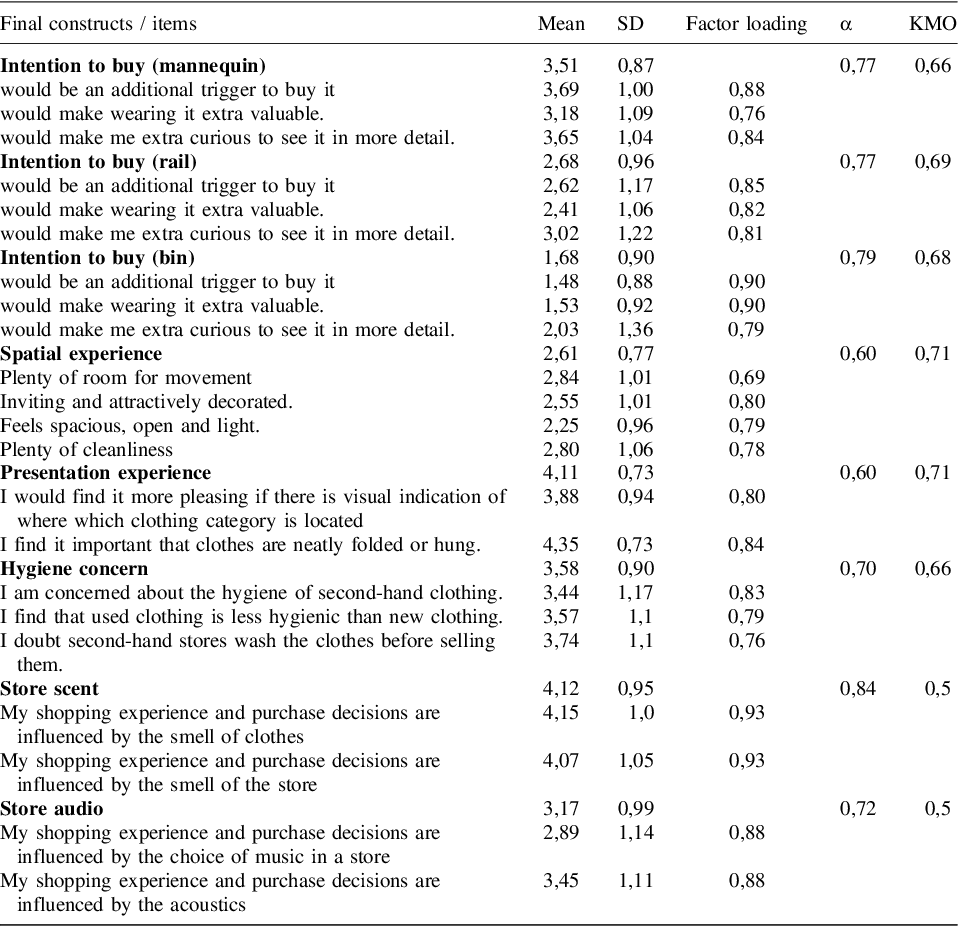
The survey was distributed through convenience sampling on social media platforms from November to December 2023. No prior experience with second-hand shopping was required for participation; the only criterion was a minimum age of 18. A total of 471 Flemish respondents took part in the study, and following a quality check and removal of incomplete questionnaires, data from 268 respondents were included in the analysis. The sample is predominantly female (75%), and primarily aged between 18-24 (42%) and 25-50 (40%). Employment status is diverse, with 40% full-time, 30% students, and 16% part-time. Most respondents (71%) are highly educated, holding a bachelor’s or master’s degree. Regarding income, 37% reported earnings above average, 19% around average and 18% below; 21% have no fixed income, and 5% declined to answer. For analysis of the data, IBM SPSS Statistics 29.0 was used. First, factor analysis was performed to reduce the variables in a set of coherent factors (see overview in Table 1) and second, repeated measures ANOVA and Bonferroni post hoc test were used to calculate the influence of presentation type on ITB, WTP, quality and hygiene perception. Lastly, regression analysis calculated the influence of spatial experience, presentation experience, store scent and store audio on hygiene concerns.
Factor analysis of study 1

2.2. Methodology study 2
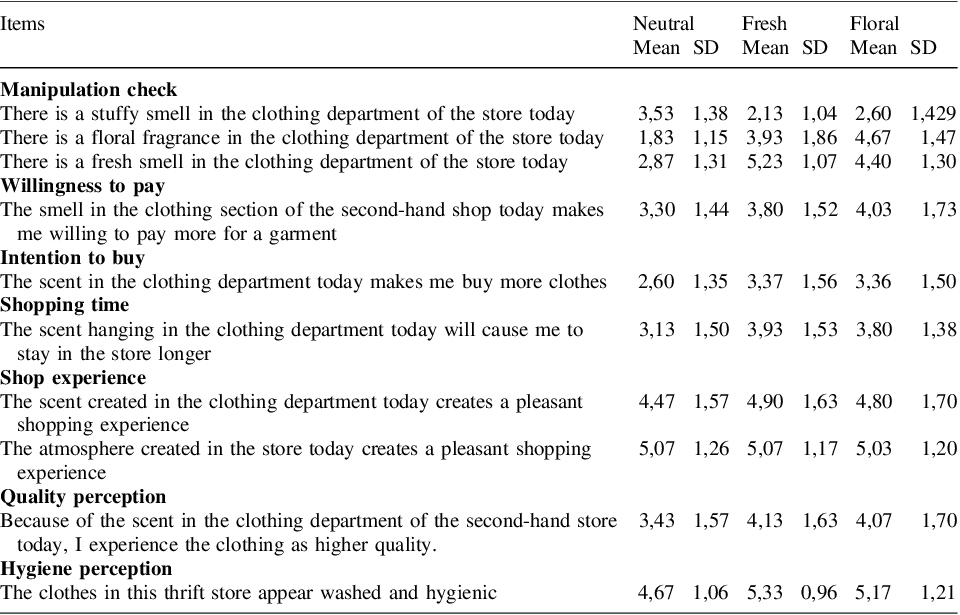
In study 2, the effects of olfactory stimuli were examined under three conditions: condition 0 (neutral, no added scent), condition 1 (fresh scent introduced), and condition 2 (floral scent introduced). These conditions were applied across three second-hand stores in Antwerp, with each condition tested at each location to minimize any location-based influence on the results. Ambient scent was created using sprayed fragrance and scent sticks throughout the textile department and a scented white T-shirt was displayed among the SHC for each condition (unscented in the neutral condition). Using a questionnaire for data collection, an independent researcher approached participants who had been in the store for a while and administered the survey. First, the respondents were asked to evaluate the (un)scented white T-shirt (ITB (reflective level), quality (reflective level), hygiene (reflective level); all 5-point Likert scale and WTP (reflective level) by indicating a number in Euro). Then, overall consumer responses to the store scent were measured (ITB (reflective level), WTP (reflective level), shopping experience (behavioural level), shopping time (behavioural level), hygiene perception (reflective level), quality perception (reflective level); all 7-point Likert scale)) The survey closed with a manipulation check (Visceral level, 7-point Likert scale) and demographic questions. Formulation of the questions can be found in Table 2. The olfactory manipulation was kept undisclosed to avoid bias and informed consent was obtained at the start of the survey and after disclosing the study’s true purpose. The study took place from April to May 2024. In preparation, the olfactory stimuli used in the study were determined through a pretest (n=15) based on previous research (Adams & Doucé, Reference Adams and Doucé2017; Reference Spangenberg, Crowley and HendersonSpangenberg et al., 1996) and verified with a manipulation check during the study. These tests identified ‘Fresh Cotton’ and ‘Wild Orchid’ as optimal scents for the fresh and floral conditions, respectively. One-sample t-tests confirmed that respondents recognized the fresh scent (p<.001, CI [4.90, 5.57]) and floral scent (p<.05, CI [4.21, 5.12]) significantly more than the neutral condition. In the neutral condition, respondents gave lower scores, indicating no perception of a stuffy smell. To examine consumer behaviour in second-hand stores in response to olfactory stimuli, the study targeted customers over 18 (18-23 (28%); 23-38 (30%); 39-53 (14%); 54-68 (16%; ) > 68% (12%). In total, 90 respondents participated in the study with a sample size of 30 respondents per condition spread over different locations (Reference Geuens and De PelsmackerGeuens & De Pelsmacker, 2017). Furthermore, 72% regularly visit second-had stores (2% daily, 26% weekly, 44% monthly) and 27% rarely visit second-hand stores (23% a few times a year, 5% rarely). Data was collected on paper, digitalised and analysed using IBM SPSS Statistics 29.0. Table 2 presents the descriptive results of study 2. Using one-way ANOVA and Bonferroni post hoc test, the effect of the different conditions on the various consumer responses was calculated.
Descriptives of the measured items

3. Results
3.1. Study 1
Figure 2 shows respondents’ preference for SHC over new clothing (left), with key motivations being price, unique finds, and sustainability. Factors that would increase willingness to buy more SHC (middle) include freshly scented, neatly hung, and washed clothing, as well as preselected high-quality items. On the right, the figure shows a clear preference for clothing categorisation by clothing type, followed by gender and size. Using repeated measures ANOVA and Bonferroni post hoc test, we examine the impact of presentation method (mannequin, rack, bin) on ITB, WTP, hygiene, and quality perceptions. Results indicate significant effects on ITB (F(2, 283)=252.46, p<.001), WTP (F(2, 278)=251, p<.001), hygiene (F(2, 281)=931, p<.001), and quality perception (F(2, 276)=970, p<.001). Clothing on mannequins received higher ITB (M = 3.50, SD = 0.87), WTP (M = 48.12, SD = 29.0), quality (M = 4.12, SD = 1.04), and hygiene (M = 4.22, SD = 0.77) ratings compared to racks and bins (all p < .001). Secondly, a regression analysis examines how store environment factors influence hygiene concerns. Both spatial (R² = 0.118; F(1, 283) = 37.84, p < .001) and presentation experiences (R² = 0.064; F(1, 283) = 19.38, p < .001) significantly impacted hygiene concerns, with spacious, well-lit stores reducing them (Beta = -0.343). In contrast, those emphasizing presentation showed higher hygiene concerns (Beta = 0.253). Finally, sensory aspects were analysed, revealing that store scent (R² = 0.128; F(1, 283) = 41.44, p < .001, Beta = 0.357) had a significant effect on hygiene concerns, while audio had no substantial effect (R² = 0.014; F(1, 283) = 3.98, p = .047). This suggests that customers sensitive to scent report higher hygiene concerns about SHC.
Descriptive results study 1

To conclude, study 1 highlights the significant impact of sensory influences in second-hand stores. Regarding visual presentation, clothing should be attractively presented on mannequins or neatly hung on rails as they increase hygiene and quality perception. Moreover, stores should be visually categorised by clothing type and size. Regarding scent, respondents indicated to have a greater willingness to purchase SHC if the clothing were freshly scented or washed. Additionally, hygiene concerns about SHC are higher for respondents who attach more importance to store and clothing scent. On the other hand, audio (acoustics, music) had no significant influence on hygiene concern. Lastly, stores experienced as spacious, attractive and clean reduce hygiene concerns.
3.2. Study 2
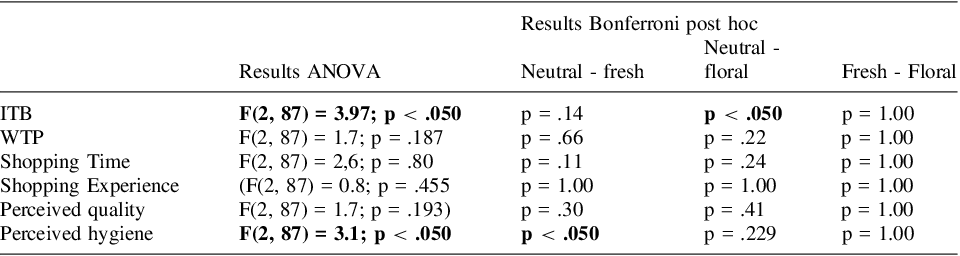
Building upon the results of study 1, study 2 specifically explores the effects of scents in second-hand stores. First, the results confirm the findings of study 1 showing the importance of scents for customers (M=5.14, SD=1.5; p<.001), who tend to avoid racks with a stuffy smell (M=4.53, SD=1.8, p<.05). Table 3 presents the results of the One-way ANOVA and Bonferroni post-hoc test, testing the influence of the olfactory stimuli on the dependents. Only in the floral condition, respondents indicated to have a higher ITB and in the fresh condition to have a higher hygiene perception. All other dependents are not influenced by the added olfactory stimuli.
Results influence of olfactory stimuli

Lastly, respondents rated the hygiene and quality of a white T-shirt across three scent conditions. The ANOVA revealed no significant differences in perceived quality among the conditions (F(2, 87=.88; p=.42), indicating that the olfactory stimuli did not affect quality perception. This lack of impact may stem from the T-shirts being new and in good condition, leading respondents to already view them as high quality. Consequently, if clothing is perceived as high-quality, adding a scent might not enhance this perception. In contrast, hygiene perception is significantly influenced by the fresh scent (F(2, 87=3,23; p<.05). Despite this, mean scores across all conditions indicated that T-shirts were generally perceived as hygienic (Mneutral=3.77; Mfresh=3.87; Mfloral=4.17).
In conclusion, study 2 builds on the findings of study 1 confirming and demonstrating the influence of scents in a second-hand retail environment. Specifically, an added fresh scent increases the hygiene perception of both the store and the clothing. Conversely, a floral scent only significantly increased the ITB.
4. Discussion
This study examines how second-hand store design can influence perceptions of quality and hygiene, encouraging greater SHC purchases. Insights from two studies were translated into actionable strategies based on Norman’s Emotional Design framework: visceral, behavioural, and reflective levels.
Visceral design strategies, such as fresh scents and attractive clothing displays, were found to enhance hygiene perception, ITB, WTP, and quality ratings. However, scent did not improve perceived quality or overall shopping experience, highlighting the limits of visceral strategies.
These findings emphasize the importance of integrating behavioural and reflective design to address broader concerns, demonstrating the value of a balanced approach within Norman’s model.
4.1. Visceral design
Visceral design taps into the in initial, immediate responses to a product. This level is determined by our senses as we look, feel, smell or hear things (Reference NormanNorman, 2005). Therefore, the design strategies presented below focus improving the first impression with a second-hand store in terms of store layout, clothing presentation and ambient scents to increase the hygiene and quality perception of SHC. We argue the following design strategies:
-
Store layout: Attractive, spacious, well-lit and open, layouts reduce hygiene concerns and encourages store visits. Natural lighting and ample space between aisles (Reference Cant and HeferCant & Hefer, 2013), and promotional signage (Reference SurjitSurjit, 2021) enhance appeal. However, no research has been done yet that links store layout with the quality perception of SHC.
-
Clothing presentation: Similar to new clothing (Reference Yoo and LennonYoo & Lennon, 2014), attractive presentation signals better quality and hygiene as it evokes positive emotions. Clothing on mannequins is perceived as highest in quality and hygiene, followed by rails, while bins should be avoided. Mannequins are ideal for (window) displays to inspire customers (Reference Anitha, Selvaraj, Das, Vijayakumar, Debnath, Stephen, Meghanathan, Sankaranarayanan, Thankachan, Gaol and ThankachanAnitha & Selvaraj, 2010), while rails work best for in-store presentation.
-
Freshness and cleanliness: A fresh scent evokes positive emotional responses, and creates a cleaner, more hygienic perception of both the store and the SHC, making clothes appear washed. Combined with neat rail presentation, it enhances attractiveness. Strategically implementing ambient scents effectively improves customer experience and sales (Doucé & Janssens, Reference Doucé and Janssens2013; Reference Newman and AdamNewman, 2022), a strategy that has already been widely implemented for first-hand sales (e.g. Abercrombie and Fitch and The North Face).
4.2. Behavioural design
In behavioural design, function is key, prioritizing user needs (Reference NormanNorman, 2005). This section focuses on strategies to enhance the ease of finding (high-quality) SHC and evaluating its hygiene.
-
Store organisation: Results show that clothing categorization by type and size is preferred over the typical practice of sorting by type and gender. This customized approach simplifies finding well-fitting SHC and reduces shopping-related frustrations (Reference Das, Moons and Du BoisDas et al., 2024; Reference LiuLiu, 2024). This contrasts with the conventional classification in first-hand retail stores based on gender and style.
-
Store layout: We found that well-organised, spacious second-hand stores facilitate browsing and reduce hygiene concerns. Visual cues like clear labelling, indication of materials, origin or care history aid navigation and help match consumers’ preferences (Reference Cant and HeferCant & Hefer, 2013).
-
Pre-selection of quality: Respondents indicated that pre-selecting high-quality SHC boost purchase intentions. While scent has limited impact on quality perception, visual merchandising, (e.g. labels highlighting quality control, durability, or craftsmanship) can build trust and enhance decision-making. However, further research is needed to confirm these strategies and identify the most effective ways to communicate quality.
4.3. Reflective design
Reflective design focusses on the message a product conveys and the emotions it evokes (Reference NormanNorman, 2005). A positive experience can inspire customers to share their experiences, encouraging others to explore SHC. Emotional connections to purchases also promote better care, repair or donation of clothing. We propose the following strategies:
-
Sustainability and uniqueness: This study found that consumers value SHC for its uniqueness and sustainability. Highlighting these aspects can evoke shoppers positive emotions like pride and foster stronger emotional bonds connections to purchases (Reference Das, Moons and Du BoisDas et al., 2024; Reference Wang, Fu and LiWang et al., 2022).
-
Long-term trust and reuse: This study found that clothing presentation significantly influences quality perception, while scent does not. Visual merchandising strategies (e.g. labelling, quality information) can build trust, enhancing perceptions of high-quality SHC. This positive reflection may promote lifetime-extending behaviours like repair and maintenance (Reference Aakko and NiinimäkiAakko & Niinimäki, 2022). However, future research is needed to evaluate this behaviour.
5. Limitations and future research
This study offers valuable insights into SHC quality and hygiene perception, but several limitations should be noted. First, the small sample size, particularly in study 2 (n=90), may affect generalisability. The limited number of participants might not fully represent the diverse consumer base, potentially introducing sampling bias. Future studies should aim for larger, more diverse samples to enhance the robustness and applicability of the results. Second, study 1 did not account for aesthetic appeal, as respondents were instructed to assume a positive opinion of the garments, which might not reflect real consumer preferences. Similarly, study 2 focused solely on the effect of scent in a retail setting, leaving other potential influences (e.g. time of visit, store layout) uncontrolled. Future research should validate these findings in a real retail environment to better understand the shopping experience and SHC perceptions. Additionally, there may be other biases present, such as response bias, where participants might have provided socially desirable answers rather than their true opinions. Addressing these biases in future studies will help in obtaining more accurate and reliable data. Furthermore, exploration on effective communication strategies and visual merchandising techniques (e.g. displays or labelling) is needed to enhance quality perception.
6. Conclusion
Research on sensory and emotional marketing in first-hand clothing is extensive, but less is known about its application to second-hand clothing (SHC). This study investigates how sensory elements—clothing presentation (mannequin, rail, bin), store layout, and scent—shape SHC shopping experiences and mitigate concerns about quality and hygiene. Two studies, guided by Norman’s (Reference Norman2005) Emotional Design framework yielded the following insights:
-
Store Layout and Organisation: Spacious, clean, and visually appealing layouts reduce hygiene concerns (visceral + behavioural). Organizing items by type and size enhances the search for well-fitting, quality SHC (behavioural).
-
Clothing Presentation and Quality Preselection: Mannequins evoke the highest perceptions of quality and hygiene, followed by rails, while bins should be avoided (visceral). Preselection of high-quality items and labels indicating quality control, durability, or craftsmanship boost consumer trust and willingness to buy (behavioural).
-
Scents: Floral ambient scents improve intention to buy, while fresh scents directly on clothing enhance hygiene perception, prolonging interaction with the items (reflective + behavioural).
-
Building Trust and Sustainability Awareness: Communicating quality through these strategies fosters long-term trust and raises awareness of sustainability (reflective).
This study underscores the limitations of visceral strategies in second-hand retail. While the findings align with strategies used in first-hand retail on a visceral level, integrating behavioural and reflective strategies is essential. These approaches address concerns—such as quality and hygiene—that are less prevalent in first-hand stores. Future research should explore the effects of visually appealing displays on perceived quality, optimal ways to communicate quality, and whether higher quality perceptions promote longer clothing lifespans.
Acknowledgements
This research project was funded by VLAIO for the REuse in Style Living Lab granted by the Flemish government of Belgium. Additionally, the authors thank de Kringwinkel Antwerpen, part of the REuse in Style Living Lab consortium for their involvement in the project. Moreover, we like to thank Victor Kusters, Lowie De Becker, Viktor Konings, Zack Kinnaer and Alexander Jaspers for their exceptional contribution and commitment to this research and for executing key aspects of study 1 and 2.



 Open access

