




Writing a valedictory editorial is a bittersweet process. Looking back at the last eight years during which I have been involved with Itinerario, I will miss the daily contacts with the rest of the editorial team, the authors and reviewers – as well as the wealth of research that has crossed my desk, written by authors from all over the globe, concerning events, processes and ideas also from all over the globe, and above all in subfields that I do not always have time to explore. However, knowing that the journal is in the excellent hands of Catia Antunes and Isaac Scarborough allows me to look back and to engage with the articles again, without having to look for a reviewer or having to correct a footnote, but instead able to enjoy them and in the process consider larger trends.
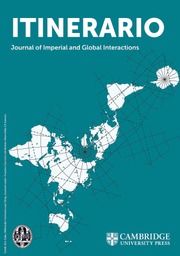
The Airocean world map that is Itinerario’s new front cover reflects the journal’s emphasis on interaction, while attending to all geographical spheres on equal terms. This is borne out through an investigation into the last 5 volumes of the journal. On the one hand, while we see a slight emphasis on articles based in Asia, those with a geographical focus on Africa and Latin America follow closely behind. On the other hand, what stands out most in the articles and special issues, as the subtitle of the journal befits, are the interactions that occur across geographical spheres, from early modern slavery to colonial tourism and everything in between.Footnote 1 The themes of these recent special issues led me to reflect further on the topics and (sub)fields that Itinerario articles have addressed. As is the case for other globally-oriented history journals, the diversity is what is most striking and which shows how the field of global history has come to maturity.Footnote 2 What unites the articles published by Itinerario in recent years are the imperial and global interactions they examine, from the early modern period to today, bringing different scales of mobilisation and of analysis into conversation.
The authors do so from many perspectives. One way of thinking about these different perspectives is through positionality. Where authors were born, raised or educated is obviously not something we record, but institutional affiliation is part of the metadata that we ask of every author, and this demonstrates a spread across the globe. This spread, of course, still reflects broader trends in global inequality and university funding, showing many affiliations with anglophone institutions in the Global North. The emphasis on the Global North anglosphere is however relative, as there is a continued spread across the European continent, with the Netherlands and Leiden as the journal’s institutional base still being well represented. Moreover, we see a substantial number of submissions by authors based at institutions in Asia, as well as an increase in articles by scholars based in Latin America. While there is certainly room for improvement, with more articles by authors based at institutions in Africa and Latin America in particular, the trend shows that the diversity of institutions where authors are based is increasing, that young and established scholars are equally represented, and that independent scholars remain part of the conversation as well.
Another way of thinking about a diversity of perspectives is through language: the languages the authors work in, the literatures they reference, and the sources they engage with: written in European languages, Mandarin, Japanese, Swahili, and Turkish, to name but a few large(r) languages, but also in Amharic, Sinhala, Pali – and Dutch. While linguistic diversity has always been the core of Itinerario, English is still the lingua franca of Itinerario and of global history, a means to bring sources, literatures, and discussions across languages into conversation. The diversity and range of languages from across the globe used by our authors, however, continues to testify to the importance of language skills and language learning for bringing a wide variety of perspectives into conversation and facilitating the practice of global history.
Diversity in perspectives can also emerge from diversity in the types of publications in Itinerario. Besides the stand-alone research article and special issues, the journal features, as do many other journals, roundtables and reviews essays. However, two types of publications are particularly dear to the journal’s community: the interviews with distinguished scholars, in which the latter look back at their own trajectory and that of the field; and the ‘From the Archives’ contributions, which, perhaps even more poignantly in an age of increasing archival digitization, introduce a wider audience to less well-known or less easily accessible archival collections.
As Itinerario embraces the many aspects of this diversity, the local, physical community in Leiden is also still there. It is complemented by a community of editors, authors and reviewers that meets online, at conferences, and still, at times, in archives. These encounters, this community, and the research they facilitate come under pressure as governments, universities and departments cut funding. We all know that doing global history requires funding, as well as passport privilege to travel, and many other things. Authoritarian rule not only funds less (global) history, participants in a conversation about convergences and inequalities, emphasized that under authoritarian rule dissenting historians prioritise different research agenda’s, agendas with more immediate and pressing stakes.Footnote 3 At the same time, this political pressure makes an examination of global interactions all the more pressing as well. Work done by colleagues who have faced these challenges for many years may also serve as inspiration for those who are newer to these pressures. Cooperation amongst researchers based at institutions spread across the globe is inspiring in this respect. While the journal world discusses the benefits and drawbacks of special issues, this is certainly one of its benefits: bringing researchers together, each with their own expertise to examine imperial and global interactions, but each, at the same time, also facing varying pressures and challenges that make such examinations unlikely. The small communities that special issues create can address these interactions from multiple perspectives.
The Itinerario community is embedded in larger networks that include that of other globally-minded journals. From collaborations and correspondences, to roundtables and quick (or long!) chats, it was clear that amongst the editors of these journals, there is a shared sense of responsibility to cherish the diversity that exists, that we aspire to strengthen it, and work with authors to bring as many perspectives to publication.Footnote 4 Changes in the journal landscape that have led many journals, including Itinerario, to become fully open access facilitate discussion between authors and readers globally. We are very grateful for the commitment of Cambridge University Press to ensure that there are no financial barriers for publishing in or reading the journal. However, as a result of generative AI the terms of knowledge production and distribution are changing profoundly, making the exchanges with other journals, the Press, our editors, authors and readers more necessary than ever.
In 2027 Itinerario will celebrate its fiftieth anniversary. At a gathering in Leiden, we will come together to celebrate the work that editors, managing editors, associate editors, book reviews editors, copy editors, authors and reviewers have put in over five decades and above all to celebrate the community that they created. Looking to the future, I hope that Itinerario’s pages will remain filled with articles that address imperial and global interactions, where global history is studied as subject matter, used as an approach or sensibility, and where working toward a truly global global history remains an aim that is never out of sight. The diversity and the community that have buttressed the journal in the past are a strength that will facilitate ever new questions from a wide range of perspectives in the future.

 Open access

