





Highlights
-
1. Chinese–English bilinguals activate L2 ambiguous translations of words in L1 reading.
-
2. L2 proficiency modulates the cross-language translation-related preview effect.
-
3. Lexical processing of a word in both languages appears before a word is fixated on.
1. Introduction
One theoretically important question in the field of bilingual research is whether bilinguals unconsciously and non-selectively activate both languages in a variety of contexts. Depending on the situation, one may need to use either or both languages. The current models of bilingual lexical access favor a bottom-up driven, nonselective view, that is, representations of words in both languages are activated in parallel early on. The suppression of nontarget representations happens in a later temporal stage (e.g., Dijkstra et al., Reference Dijkstra, Wahl, Buytenhuijs, Van Halem, Al-Jibouri, De Korte and Rekké2019; Dijkstra & Van Heuven, Reference Dijkstra and Van Heuven2002). Several studies of individual word identification have supported the simultaneous activation of representations in both languages. These findings came from studies examining cross-language orthographic and phonological processing, code switching, translation priming, etc. (e.g., Jared & Kroll, Reference Jared and Kroll2001; Litcofsky & Van Hell, Reference Litcofsky and Van Hell2017; Marian & Spivey, Reference Marian and Spivey2003). Some other studies, however, have suggested that bilingual activation can occur at the lexico-conceptual representation level (Jiang, Reference Jiang2002, Reference Jiang2004; Jouravlev & Jared, Reference Jouravlev and Jared2020; Kim & Kim, Reference Kim and Kim2018; Miwa et al., Reference Miwa, Dijkstra, Bolger and Baayen2014; Thierry & Wu, Reference Thierry and Wu2007). In general, the translation priming effect is stronger in the L1-L2 direction than in the L2-L1 direction (see Wen & van Heuven, Reference Wen and van Heuven2017 for a meta-analysis). In an English-only priming task, Thierry and Wu (Reference Thierry and Wu2007) found that Chinese–English bilingual readers benefited more from primes that shared a Chinese character with the target translations than from those that did not. This suggests that the first language (L1) is activated during word recognition in a pure second language (L2) context, even in the absence of any L1 visual cues. However, less is known about L2 activation in a pure L1 context.
Similar findings have also been reported during more natural sentence reading tasks using eye-tracking techniques (Libben & Titone, Reference Libben and Titone2009; Van Assche et al., Reference Van Assche, Drieghe, Duyck, Welvaert and Hartsuiker2011). For example, Friesen et al. (Reference Friesen, Whitford, Titone and Jared2020) tested English readers with varying degrees of French proficiency. They replaced English target words in sentences with French interlingual homophones (e.g., mot in French, meaning “word” and pronounced similarly to mow in English) in English sentences. Compared to a control condition (e.g., mois in French meaning “month”), they found that readers could use the shared phonology of the homophones to infer the correct English target word. Furthermore, the magnitude of the effect depended on factors such as word frequency and participants’ French proficiency. This finding aligns with the Bilingual Interactive Activation Plus (BIA+) model, which posits that in the early stage of word processing, cross-language meaning activation can occur in a nonselective manner. In contrast, other studies have reported evidence for partial selective activation, especially when the global context favors one language over the other (Hoversten & Traxler, Reference Hoversten and Traxler2016, Reference Hoversten and Traxler2020), suggesting that bilinguals can switch to a less bilingual or even a monolingual mode (Grosjean, Reference Grosjean1998, Reference Grosjean and Chapelle2013). Hoversten and Traxler (Reference Hoversten and Traxler2020, Experiment 1) investigated the degree and time course of language activation in bilinguals by presenting critical words overtly (i.e., foveally) during sentence reading. The critical words were either: (a) a word in the same language as the sentence (non-switch condition), (b) a translation equivalent in a different language (code switch condition), or (c) a pseudoword. The switching effect, but not the pseudoword effect, was significantly modulated by trial sequence, suggesting that activation of the nontarget language became more pronounced with increased exposure to overt language switches. This is an interesting study, as it demonstrates that bilinguals adjust their language control based on visual cues to determine which language to activate and to what extent. In other words, bilingual activation becomes more nonselective given adequate exposure to both languages. However, when the critical words were placed in the parafovea as preview words, Hoversten and Traxler’s Experiment 2 showed that the readers remained in a monolingual mode, as they were not consciously aware of the code-switching words in the parafovea (which will be elaborated upon in a later section). According to this view, a nontarget language will have only minimal activation if no language switch is required. Notably, studies on bilingualism typically involve presentation of words in different languages. Therefore, any observed L2 activation when L1 is the target language may be attributed to visual cues from L2 words. As such, it remains unclear whether readers can still unconsciously and non-selectively activate L2 in a pure L1 context.
1.1 Parafoveal preview benefits in monolingual readers
The gaze-contingent boundary paradigm (Rayner, Reference Rayner1975) is often used to study parafoveal processing. In this paradigm, there is an invisible boundary between the pre-target and the target word. A preview word is initially placed at the position of the target word. Once the reader’s gaze crosses this boundary, the target word replaces the preview word immediately. Because such a display change usually happens during a saccade, participants are generally unaware of the presence of the preview word. Preview benefit (PB) is defined as the amount of saving in fixation duration on the target word following previews identical/related to the target word over unrelated previews. Some studies have shown that, during L1 reading, readers extract low-level linguistic information of words parafoveally (e.g., orthography and phonology) across different scripts (Inhoff, Reference Inhoff1990; Inhoff & Tousman, Reference Inhoff and Tousman1990; Liu et al., Reference Liu, Inhoff, Ye and Wu2002; Pollatsek et al., Reference Pollatsek, Lesch, Morris and Rayner1992; Tsai et al., Reference Tsai, Lee, Tzeng, Hung and Yen2004). As well, there has been a long debate about the parafoveal processing of high-level information such as semantics, syntax and morphology, and evidence for such effects has traditionally been elusive (Inhoff, Reference Inhoff1982; Inhoff & Rayner, Reference Inhoff and Rayner1980; Rayner et al., Reference Rayner, Balota and Pollatsek1986). Later studies have demonstrated that semantic PBs can be obtained during Chinese reading (e.g., Tsai et al., Reference Tsai, Kliegl and Yan2012; Yan et al., Reference Yan, Richter, Shu and Kliegl2009, Reference Yan, Zhou, Shu and Kliegl2012). Such early access to semantics can be attributed to the logographic nature of the language, which allows a direct connection from orthography to semantics (Hoosain, Reference Hoosain1991; Yan & Kliegl, Reference Yan and Kliegl2023). This finding has inspired similar studies in German (Hohenstein et al., Reference Hohenstein, Laubrock and Kliegl2010; Hohenstein & Kliegl, Reference Hohenstein and Kliegl2014) and Korean (Kim et al., Reference Kim, Radach and Vorstius2012; Pan et al., Reference Pan, Wang, Mcbride, Cho and Yan2023; Yan et al., Reference Yan, Wang, Song and Kliegl2019). Arguably, both German and Korean scripts are highly transparent in orthography. Consequently, phonological information is presumably activated in an accelerated manner due to their regular orthography-to-phonology correspondence, which facilitates the activation of semantics. In contrast, parafoveal semantic PB in English is limited to strong semantic association (Schotter, Reference Schotter2013; Veldre & Andrews, Reference Veldre and Andrews2016).
1.2 Parafoveal semantic processing by bilingual readers
Experiments have also been conducted to investigate parafoveal processing with bilinguals. Using code-switch preview words, previous studies have shown cross-language phonological and orthographic PBs (see Altarriba et al., Reference Altarriba, Kambe, Pollatsek and Rayner2001; Jouravlev & Jared, Reference Jouravlev and Jared2018, for evidence from Spanish–English and Russian–English bilinguals, respectively). The exploration of cross-language parafoveal semantic processing began with the work of Altarriba et al. (Reference Altarriba, Kambe, Pollatsek and Rayner2001), with Spanish–English bilinguals. Parafoveal previews of translation words that were visually similar to the target words led to a PB. However, the effect was no greater than that of orthographic control previews, which were semantically unrelated to the target. Therefore, their results did not indicate any evidence for cross-language parafoveal semantic processing. Hoversten and Martin (Reference Hoversten and Martin2023) tested monolingual (L1 or L2) and bilingual semantic priming by manipulating the target language (English/Spanish), the preview language (English/Spanish) and the preview semantic relatedness. The bilingual readers extracted parafoveal semantic information within the same language during both L1 and L2 reading, but not across languages. The authors concluded that the need to comprehend sentences in one language impedes parafoveal semantic access in the task-irrelevant language. Similarly, Hoversten and Traxler (Reference Hoversten and Traxler2020, Experiment 2) presented the critical words parafoveally, causing the participants not to be consciously aware of them, and found no significant difference between the code-switch words and the pseudowords. This led to the conclusion that bilingual readers could remain in the target language mode and block parafoveal semantic activation in the nontarget language.
Jouravlev et al. (Reference Jouravlev, McPhedran, Hodgins, Jared and Benjamin2023) tested cross-language semantic PB among two groups of bilinguals. In Experiment 1, they tested how Russian–English bilinguals processed L2 English target words primed by L1 Russian preview words, during L2 sentence reading. Only cognate and interlingual homograph translation previews produced semantic PBs; noncognate translation previews did not. In Experiment 2, they tested L1 English target word processing following L2 French previews among English–French bilinguals. Similar to Experiment 1, they observed an early interlingual homograph translation PB, where an English target word (e.g., bread) was primed by a French preview word (e.g., pain, meaning bread in English), but not by the French preview word with a diacritic added (e.g., páin), as compared to the French unrelated control word bain. The authors concluded that for cross-language semantic PBs to occur, preview words must be real words in the target language. In another study, Wang et al. (Reference Wang, Yeon, Zhou, Shu and Yan2016) found that both cognate and semantically-related preview words in L1-Korean, independent of visual similarity to L2-Chinese target words, reduced fixation duration on the target words for Korean–Chinese bilingual readers when they read L2 Chinese sentences, therefore concluding a cross-language semantic PB. However, even though only one language was supported by the global context (i.e., the sentences) in these experiments, they all involved explicit presentations of preview words in the nontarget language. In addition, Wang et al. (Reference Wang, Yeon, Zhou, Shu and Yan2016) studied late bilinguals and parafoveal semantic processing of L1 preview words when reading L2 sentences. Stronger evidence that L2 representations are activated automatically and unconsciously in the parafovea when reading exclusively in L1 would come from a study in which all previews are in L1. Furthermore, the results of Jouravlev et al.’s (Reference Jouravlev, McPhedran, Hodgins, Jared and Benjamin2023) study suggest that semantic previews that appear to be in the same language as the sentence being read are likely to be most effective. However, a clever manipulation is needed to demonstrate cross-language activation with the same language previews.
Translation ambiguity occurs when a word has multiple meanings, each associated with a different translation in another language. Despite its impact on the linguistic processing of bilinguals, it is not clear whether the effect is inhibitory or facilitative in nature. On the one hand, Elston-Güttler et al. (Reference Elston-Güttler, Paulmann and Kotz2005) demonstrated that German–English bilinguals exhibited slower reaction times when responding to an L2 English target word preceded by an unrelated English prime word that shared an L1 translation (e.g., jaw – pine, both translated as Kiefer in German). These findings suggest the presence of lexical-level inhibitory connections between unrelated L2 words, formed through experience with shared L1 translations. Conversely, it has been argued that a shared translation is facilitative, as evidenced by studies demonstrating that L2 word pairs with the same L1 translation are perceived as more similar than those with distinct L1 translations (Jiang, Reference Jiang2002, Reference Jiang2004). Degani et al. (Reference Degani, Prior and Tokowicz2011) further showed an L2 on L1 translation ambiguity effect: English–Hebrew bilinguals rated two L1 English words as more similar if they shared a Hebrew translation. Further compelling evidence for such L2 on L1 effects remains to be established during natural sentence reading, where lexical processing occurs in a more unconscious manner.
The issue has been addressed by a recent study. Hao et al. (Reference Hao, Luo, Lin-Hong and Yan2024) investigated cross-language parafoveal semantic processing among late Chinese–Japanese bilinguals, who read L1-Chinese sentences with all preview and target words also in Chinese. Each target word was paired with three kinds of preview words: 1) an identical preview (e.g., 钓鱼, fish), 2) a translation-related preview (e.g., 零钱, change) which shared an L2-Japanese translation (e.g., 釣り) with the target and was otherwise unrelated to the target word in L1, and 3) a completely unrelated preview. This kind of manipulation has allowed researchers to study unconscious L2 activation in an exclusive L1-reading scenario. The translation-related previews led to PBs among Chinese–Japanese bilinguals but not among Chinese monolinguals, thus supporting the nonselective view (Dijkstra et al., Reference Dijkstra, Wahl, Buytenhuijs, Van Halem, Al-Jibouri, De Korte and Rekké2019; Dijkstra & Van Heuven, Reference Dijkstra and Van Heuven2002). These findings suggest that bilinguals simultaneously activate word representations of both languages at a very early, parafoveal stage of reading, even when the task does not require lexical activation of the other language. However, the participants completed a Japanese language proficiency test before the eye-tracking experiment, which may have activated their L2 representations. Two additional issues are particularly worth considering. First, Chinese, Japanese and Korean are strongly related languages. Whether the observed cross-language effects (Hao et al., Reference Hao, Luo, Lin-Hong and Yan2024; Wang et al., Reference Wang, Yeon, Zhou, Shu and Yan2016) are generalizable to other bilinguals remains to be established, preferably with languages with a greater linguistic distance, such as Chinese and English, which have no orthography in common (Chai & Bao, Reference Chai and Bao2023). Second, previous studies have shown that L2 proficiency could modulate the size of the cross-language activation effect (for a review, see Van Hell & Tanner, Reference Van Hell and Tanner2012). For example, Zhao et al. (Reference Zhao, Li, Liu, Fang, Shu, Carlson, Holscher and Shipley2011) found L1-L2 cross-language translation priming among participants with different L2 proficiency. However, L2-L1 translation priming was only observed among bilinguals with high L2 proficiency and who were immersed in an L2 environment. However, such an effect was not tested by Hao et al. (Reference Hao, Luo, Lin-Hong and Yan2024).
1.3 The present study
The current study aimed to further investigate L2 activation in a pure L1-reading context and establish the influence of L2 proficiency among Chinese–English bilinguals in Hong Kong. Both Chinese and English are official languages in Hong Kong. English is introduced formally from kindergarten, and about 25% of secondary schools are considered to be English-medium schools (Lee & Leung, Reference Lee and Leung2012). The use of a Chinese–English mixed code is highly common in Hong Kong, especially among the educated population (Li, Reference Li2008). Our predictions were straightforward. According to the selective view, translation-related previews should not lead to a PB in a pure L1-reading context. However, if the two languages are activated non-selectively, a translation-related preview (e.g., 政黨) activates its L2 translation (party, as a political group) automatically and unconsciously. The activation spreads back to L1 and triggers words that are related to the L2 translation, including the L1 target word (e.g., 派對, party, as a social gathering). In short, the L1 preview and target words are connected via their shared L2 translation, leading to a PB. As Chinese and English are two visually distinctive orthographies, this translation-related preview benefit cannot be attributed to any orthographic overlap. Moreover, due to increased form-to-concept links among high L2 proficiency readers, access to the L2 lexicon becomes more automatized and symmetrical as L1 lexicon; cross-language activation becomes easier among readers with higher L2 proficiency as compared to readers with low L2 proficiency (Van Hell & Tanner, Reference Van Hell and Tanner2012). We also expected an interaction between L2 proficiency and the translation-related PB, with larger and earlier PBs for readers with higher L2 proficiency.
2. Method
2.1. Participants
The data reported in this study were collected from a total of 185 participants. SeventyFootnote 1 university students (61 females), with an average age of 21.5 years (SD = 2.5), participated in the eye-tracking experiment. After the eye-tracking experiment, the participants filled in a questionnaire about their use of English and their scores for the Hong Kong Diploma of Secondary Education Examination (HKDSE) English language test. We adopted their HKDSE scores for English Language as an objective measurement of their English L2 proficiency. In order to be enrolled in local or overseas universities, the majority of students studying in secondary schools offering local curricula will complete the HKDSE in the final year of secondary education. The assessment of students’ achievements in different subjects in the HKDSE is based on a set of standards. The scores range from 1 to 5, with 5 being the highest. The participants in the present study had attained Level 3 (equivalent to a pass) or above in HKDSE English Language (N = 36 for Level 3, N = 29 for Level 4 and N = 5 for Level 5), this being the minimum requirement for entering undergraduate programs in publicly funded local universities. The participants began acquiring English when they were 3.4 years old (SD = 1.61). They reported that they used Chinese (M = 76.97% of the time) more often than English (M = 23.03% of the time). On a self-estimated 10-point proficiency scale, the participants reported their English proficiency for speaking (M = 6.43), listening (M = 6.71) and reading (M = 6.74). Four independent groups of 30, 10, 30 and 45 students were recruited for norming studies of semantic relatedness, target word translation, contextual predictability and plausibility of the critical words, respectively. These participants had also attained Level 3 or above in their HKDSE English Language examinations. All participants were university students with normal or corrected-to-normal vision and were native Chinese speakers. All experimental procedures were reviewed and approved by the Human Research Ethics Committee of The Education University of Hong Kong, and all participants provided their informed consent.
2.2. Design and materials
We designed three preview types (identical, translation-related and unrelated) and selected 96 triplets of critical two-character traditional Chinese words (Table 1 and Appendix 1). The mean frequency of the English translations of the target words is 72.53 per million words (SD = 78.22) based on SUBTLEX_US (Brysbaert & New, Reference Brysbaert and New2009). The identical preview condition provided a critical baseline to evaluate the readers’ visual processes. The translation-related previews in half of the item sets served as the targets in the other half. The translation-related previews and the target words were unrelated in Chinese but shared an English translation, as these English translations were always homographic words. The unrelated previews were chosen from the translation-related words from other item sets, so that the three conditions included identical word lists, naturally matching word-level properties such as word frequency and number of strokes. To ensure the validity of the design, first, we recruited 30 readers to evaluate the relatedness between the nonidentical previews and the target words on a 5-point Likert scale (1 = completely unrelated and 5 = highly related). The results showed that the translation-related and the unrelated previews were equally unrelated to the targets (t = 1.568, p = .120). In addition, 10 readers, who had approximately the same levels of L2 proficiency as the eye-tracking participants, were presented with the English translations of the target words and were asked to select their corresponding Chinese translation-equivalents in multiple-choice questions. As expected, the participants were able to identify the correct translations (M = 87.8%, SD = 10.5%).
Table 1. Word properties

Note. An example set of critical words. See the example sentence in Figure 1 in which the example words here were embedded. Means (and standard deviations in parentheses) of log-transformed word frequency (number of occurrences per million, Huang et al., Reference Huang, Chen, Chang and Hsu1995), number of strokes (count), relatedness rating (5-point scale), predictability (percentage) and plausibility (5-point scale) are shown.
The target words were embedded in sentence frames. The pre-target and target words, which were always two characters in length, were never among the first or last three words in the sentences. In order to minimize top-down processing, the sentence contexts up to the pre-target words were constructed to be non-predictive for the different previews. In the cloze test, each of the 30 participants was presented with the half-sentence frames up to the pre-target words and asked to complete the sentences. The predictability results are shown in Table 1. In addition, we conducted a plausibility rating using a 5-point Likert scale (1 = not plausible at all and 5 = highly plausible). The 45 participants were presented with sentence frames up to the target word position and were asked to rate how likely the sentences could end meaningfully. For each sentence frame, each participant saw only one preview condition. Different conditions of the same sentence frame were counterbalanced across participants. Plausibility did not differ significantly between the nonidentical conditions (t = 0.470, p = .639). The experimental conditions were counterbalanced across participants, and a different randomized order of sentence presentation was generated for each participant.
2.3. Apparatus
The participants’ eye movements were recorded with an Eyelink 1000 Desktop system (SR Research) running at a sampling rate of 1000 Hz. The Experiment Builder software was used for stimulus presentation and data collection. Each sentence was presented in a single horizontal line on a 24-inch ASUS VG248QE monitor (resolution: 1920–1080 pixels; frame rate: 144 Hz) using the Song font (font-size: 48 pixels). The participants were seated 70 cm from the monitor and were tested individually, with their heads positioned on a forehead and chin rest. Each character subtended approximately 1.0° of visual angle. All recordings and calibrations were done monocularly, based on the right eye, and viewing was binocular.
2.4. Procedure
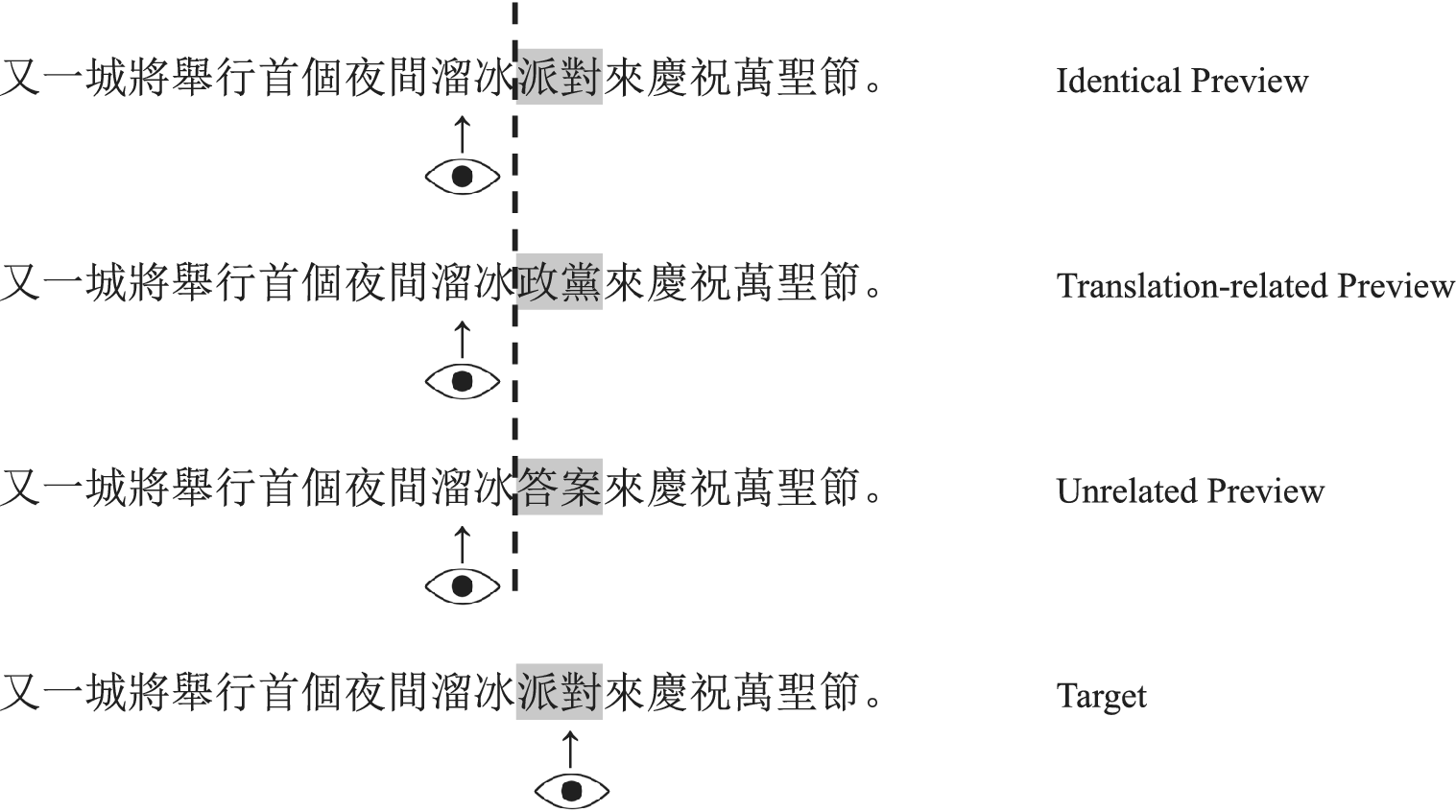
Before the experiment started, the participants’ gaze positions were calibrated with a 5-point grid (maximum errors < 0.5°). The tracking accuracy was checked prior to each sentence. The participant’s gaze on the initial fixation-point at the left of the screen initiated the presentation of the next sentence, with its first character occupying the fixation-point. Otherwise, if the eye-tracker did not detect the gaze around the fixation-point, an additional calibration was performed. The participants were instructed to read the sentences silently for comprehension, then to fixate on a point in the lower-right corner of the monitor, and finally to press a keyboard button to signal completion of a trial. The gaze-contingent display-change technique (Rayner, Reference Rayner1975) was adopted to manipulate the parafoveal preview (Figure 1). The participants received 12 practice trials before reading the experimental sentences. We randomly selected 26 experimental sentences, each to be followed by an easy yes–no comprehension question, to encourage the participants’ engagement with the reading task. The participants, on average, correctly answered 86.1% (SD = 7.9%) of the questions.

Figure 1. A set of example sentences with the target word primed by different types of previews. The preview and target words are highlighted with a gray background only for illustrative purposes and were presented normally during the experiment. Different previews are immediately replaced by the correct target word, once a reader’s gaze crosses an invisible vertical boundary located between the pre-target and target words (as indexed by the vertical dashed line). The target sentence translates as: Festival Walk is celebrating Halloween with its first night skate party.
2.5. Data analysis
Fixations were determined with an algorithm for saccade detection (Engbert & Kliegl, Reference Engbert and Kliegl2003). The data were screened in the following steps. First, 443 (6.6%) trials were removed either due to tracker errors or due to participants’ blinks, coughing or body movements during reading. Trials with the target words’ first-fixation durations (FFDs; duration of the first fixation on a word irrespective of the number of fixations) shorter than 60 ms or longer than 800 ms, or gaze durations (GDs; the cumulative duration of all fixations during the first-pass reading of the word) longer than 1000 ms were removed (N = 186, 3.9%). Additionally, using an a priori criterion (Briihl & Inhoff, Reference Briihl and Inhoff1995), trials (N = 152, 3.2%) with regressions from the pre-target or target words were discarded because they may have reflected incomplete lexical processing. Specific to the gaze-contingent boundary paradigm, trials (N = 425, 8.9%) in which display changes were triggered during fixations were excluded. These data-screening procedures and the data exclusion rate were comparable to those in previous similar experiments (e.g., Hao et al., Reference Hao, Luo, Lin-Hong and Yan2024). The general pattern of results did not depend on the choice of any particular criteria mentioned above. The remaining 4260 observations were largely distributed evenly across the conditions.
Estimates were based on linear mixed models (LMMs) for continuous fixation duration measures of FFD, GD and total reading time (TRT, sum of all fixations on a word, including regressive fixations), and on generalized linear mixed models (GLMMs) for categorical dependent variables (i.e., skipping and refixation probabilities) using the lme4 package (Version 1.1–37; Bates, Maechler, et al., Reference Bates, Maechler, Bolker and Walker2015b) in the R environment (version 4.4.1, R Core Team, 2024). We reported experimental effects in different fixation measures for an estimation of the time course. It is generally acknowledged that experimental effects observed in FFD occur at an earlier temporal stage compared to those that appear only in GD when the target word is re-fixated upon. Similarly, effects that are evident only in second-pass reading measures, such as TRT, indicate a later stage of processing (Inhoff, Reference Inhoff1984; Inhoff & Radach, Reference Inhoff, Radach and Underwood1998). We specified a sum-contrast for L2 proficiency and an orthogonal Helmert-contrast for preview type. Participant- and item-related variance components were included as random effects. We reported parsimonious LMMs for successful convergence (Bates, Kliegl, et al., Reference Bates, Kliegl, Vasishth and Baayen2015a; Matuschek et al., Reference Matuschek, Kliegl, Vasishth, Baayen and Bates2017). The final models are presented in Appendix 2. The first comparison of the Helmert-contrast was between the translation-related preview and the unrelated preview (i.e., translation-related PB), aiming to test whether unrelated words in L1 that shared an L2-translation could activate each other. The second comparison of the contrast was between the identical preview and an average of the two nonidentical conditions (i.e., identical PB), reflecting an effect of parafoveal processing efficiency. We reported p-values from the lmerTest package (Version 3.1–2; Kuznetsova et al., Reference Kuznetsova, Brockhoff and Christensen2017). We log-transformed the dependent variables of viewing duration measures in the LMMs, based on the recommendation of Kliegl et al. (Reference Kliegl, Masson and Richter2010).
3. Results
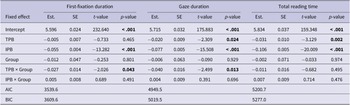
The readers processed the target words more briefly in the identical preview condition than in the nonidentical preview conditions, irrespective of their L2 proficiency, leading to significant main effects of identical PBs and nonsignificant interactions (Tables 2 and 3). The key questions we explored in the current study were whether words that are unrelated in L1 can be co-activated due to readers’ L2 experience, and whether the strength of such co-activation is modulated by their L2 proficiency. The analyses revealed significant main effects of translation-related PBs in GD and TRT (see Figure 2 and Table 3). In addition, significant interactions between L2 proficiency and the contrast of the translation-related and unrelated preview conditions in FFD and GD showed that the highly proficient L2 readers of English, whose HKDSE scores were equal to or above 4 (N = 34), demonstrated earlier translation-related PBs (FFD: b = −0.019, SE = 0.010, t = −1.96, p = 0.050; GD: b = −0.039, SE = 0.011, t = −3.47, p < 0.001; and TRT: b = −0.035, SE = 0.012, t = −3.033, p = 0.002). Table 2 shows that, for the highly proficient L2 readers, the translation-related PB developed gradually from 16 ms in FFD to 36 ms in GD, and remained stable until TRT (35 ms). In contrast, the average L2 readers of English (N = 36) failed to exhibit translation-related PB in FFD or GD (p-values > 0.1), with such an effect appearing only during second-pass reading in TRT (b = −0.028, SE = 0.012, t = −2.383, p = 0.017). Interestingly, the two groups showed PBs of similar magnitudes in TRT.
Table 2. Fixation properties
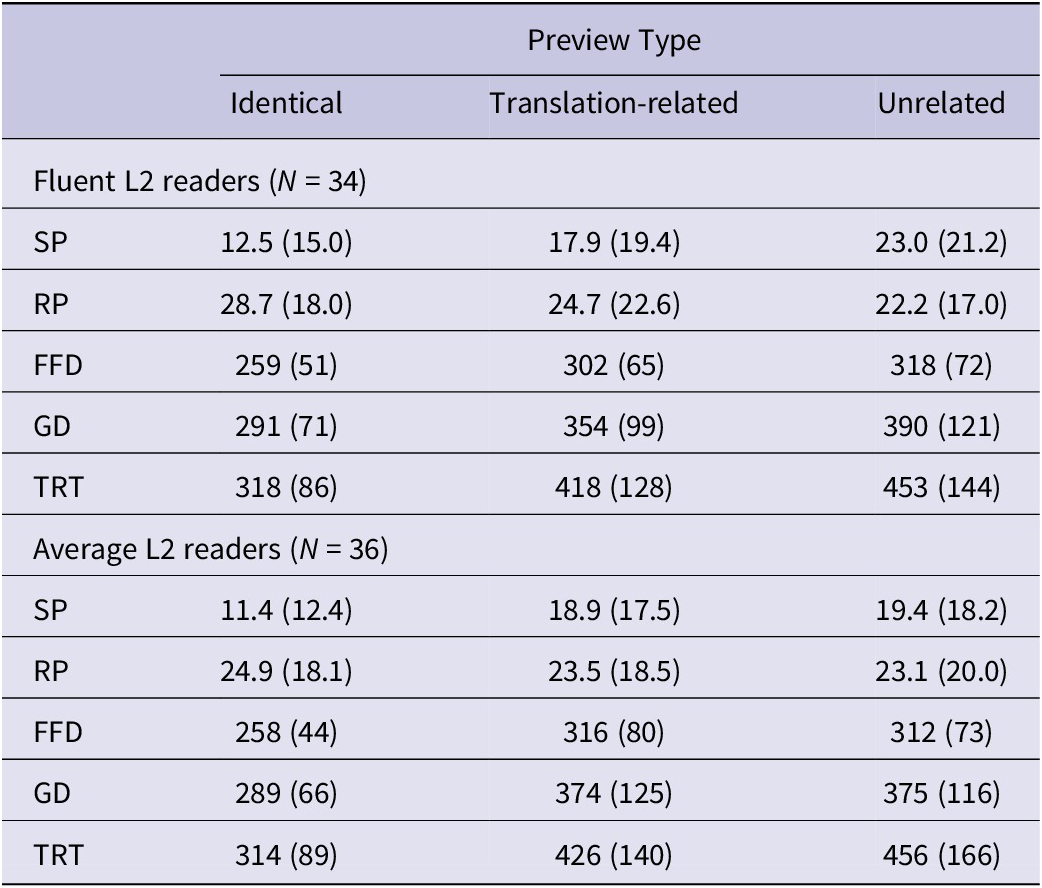
Note. Means (and standard deviations in parentheses) for skipping probability (SP) and refixation probability (RP) in percent, first-fixation duration (FFD), gaze duration (GD) and total reading time (TRT) in ms. Values were computed across participant means.
Table 3. Model outputs

Abbreviations: IPB = the identical preview versus an average of the two nonidentical previews and TPB = the translation-related preview versus the unrelated preview. AIC = Akaike Information Criterion value and BIC = Bayesian Information Criterion value.

Figure 2. Means and standard errors of experimental effects for first-fixation duration (FFD; left panel), gaze duration (GD; middle panel), and total reading time (TRT; right panel). Error bars indicate one standard error. Plots were generated with the remef package (version 0.6.10; Hohenstein & Kliegl, Reference Hohenstein and Kliegl2015) and the ggplot2 package (version 2.1.0; Wickham, Reference Wickham2016).
The readers skipped the target words more often (b = 0.073, SE = 0.023, z = 3.232, p = 0.001) and refixated on them less frequently (b = −0.241, SE = 0.032, z = −7.497, p < 0.001) when having identical preview words than when having nonidentical ones. In addition, they made slightly fewer refixations on the target words following the translation-related preview words than unrelated ones (b = −0.102, SE = 0.051, z = −2.025, p = 0.043). All other effects were nonsignificant in the GLMMs.
4. Discussion
The present study investigated the activation of L2 representations of parafoveal L1 words during monolingual L1 sentence reading, and the influence of L2 proficiency on this effect among Chinese–English bilingual readers. Our findings replicated the canonical identical preview benefit, confirming the reliability of our data. Moreover, the nonsignificant interactions between the identical PB and the participant group critically ensured that the observed translation effect was unlikely due to between-group differences in Chinese reading ability. Our results showed a translation-related PB in a pure L1 context, indicating that the bilinguals activated the L2 translations of the preview words, which in turn primed the L1 target words. Such cross-language activation is independent of any visual or linguistic overlap in L1 between the parafoveal preview and the target words. Importantly, we further demonstrated an interaction between L2 proficiency and translation-related PB, revealing an influence of L2 proficiency on the complex L1-L2-L1 sequential activation. Clearly, L2 proficiency modulates the time course of the translation-related preview effect: the highly proficient L2 readers showed earlier effects, whereas the effect among average readers did not emerge until the second-pass reading. Overall, our findings provide further evidence to contribute to the theoretical debates about bilingualism as well as eye movements during reading.
From the bilingual processing perspective, previous research has shown that readers can activate L1 translations when reading L2 words in an L2-exclusive context (Jiang, Reference Jiang2002; Miwa et al., Reference Miwa, Dijkstra, Bolger and Baayen2014; Thierry & Wu, Reference Thierry and Wu2007). These effects may possibly be due to the automatic activation of L1, given its high proficiency. The present study took a further step to investigate the activation of L2 representations in a pure L1 context. Our results have replicated the findings of Hao et al. (Reference Hao, Luo, Lin-Hong and Yan2024), with Chinese–Japanese late bilinguals, that words unrelated in L1 could be connected through L2 learning experience and provided more compelling evidence for the nonselective view (Dijkstra & Van Heuven, Reference Dijkstra and Van Heuven2002). Specifically, the bilingual co-activation at the lexico-conceptual level is repeatedly observed to be efficient, regardless of the typological distance of the two languages’ writing/phonological systems. When an L1 word is previewed, its lexical meaning is accessed and rapidly co-activates its L2 translation via the shared concept/meaning. Consequently, other information related to the L2 word, including its written form and alternative meanings, is triggered. The L2 representation, in turn, activates other L1 words that are related semantically to its alternative meanings, including the L1 target in our manipulation. In other words, high-level information from the parafovea could be extracted early on during reading, primarily relying on the convergence of cross-language concept/meaning representations, a pathway that is proposed in the Multilink Model (Dijkstra et al., Reference Dijkstra, Wahl, Buytenhuijs, Van Halem, Al-Jibouri, De Korte and Rekké2019) and is supported empirically (Hao et al., Reference Hao, Luo, Lin-Hong and Yan2024; Jouravlev & Jared, Reference Jouravlev and Jared2020). The results provide further evidence for Jouravlev et al.’s (Reference Jouravlev, McPhedran, Hodgins, Jared and Benjamin2023) claim that cross-language semantic PBs are more likely to be observed when the preview is a real word in the target language. Stimuli such as interlingual homographs and translation-ambiguous words allow the researcher to investigate cross-language influences without explicitly presenting words from two languages.
It should be noted that a few limitations in the Hao et al. (Reference Hao, Luo, Lin-Hong and Yan2024) study prevented them from making a solid conclusion. First, the participants completed a Japanese language proficiency test before the eye-tracking experiment, which may have increased the activation of the Japanese representations. In contrast, the participants in the current study completed the questionnaire about their English proficiency only after the eye-tracking experiment, aiming to minimize L2 activation caused by extraneous variables. As a consequence, our results have provided more compelling evidence for bilingual co-activation, free of a confound of possible L2 pre-activation prior to the eye-tracking experiment. In addition, the two orthographies involved in the current study, namely logographic Chinese and alphabetic English, have a long linguistic distance between them, preventing any overlap between L1 and L2 representations. This is a better manipulation than the two scripts investigated by Hao et al. (Reference Hao, Luo, Lin-Hong and Yan2024), because Japanese Kanji and Chinese are essentially the same writing system; hence, orthographic and/or phonological similarities between L1 and L2 representations may possibly have blurred the cross-language semantic effect. Overall, the translation-related PB observed in the present study makes a clear case for an implicit activation of L2, as the two orthographies we tested in the current study were visually and phonologically different.
Interestingly, the building of new connections between representations of naturally unrelated words through a different language is not limited to writing systems based on spoken languages. Previous research focusing on readers with hearing deficits, who were functionally bilingual readers of a writable language (e.g., English or Chinese) and a sign language (e.g., American Sign Language or Chinese Sign Language), has shown similar connections between writable words through their sign language translations. Pan et al. (Reference Pan, Shu, Wang and Yan2015) found that, during sentence reading, preview words that were unrelated in the written language but shared similar sign phonology with the target words could lead to interference. For instance, the Chinese words 钢琴 (piano) and 电脑 (computer) are unrelated in written Chinese but use nearly identical hand gestures for striking keyboards in the Chinese Sign Language. In this sense, these two written words are connected through a common sign language translation. Similarly, Thierfelder et al. (Reference Thierfelder, Wigglesworth and Tang2020) found that different overlaps of sign phonology parameters between the Chinese preview words and the target words lead to different effects (benefit or cost) on deaf Hong Kong readers’ parafoveal processing. Together, these findings suggest that human minds could adjust the connections of mental representations flexibly, given their language experience.
Previous research has also shown that language proficiency could affect co-activation of the two languages among bilinguals (Blumenfeld & Marian, Reference Blumenfeld and Marian2013; Van Hell & Dijkstra, Reference Van Hell and Dijkstra2002; Van Hell & Tanner, Reference Van Hell and Tanner2012). Our findings, that English proficiency modulated the time course of the translation-related PB, are in agreement with this viewpoint. Possibly, highly proficient L2 readers have developed a stronger connection between two unrelated L1 words through a shared L2 translation, resulting in earlier lexical activation in a priming scenario. In contrast, average L2 readers need a long time for the cross-language lexical activation to spread efficiently, leading to a delayed translation-related PB. Interestingly, in a late processing stage, the two groups showed similar PBs in TRT. The results suggest that it takes more time for average L2 readers to achieve bilingual co-activation; once activated, however, they can reach the same level of lexical activation as highly proficient L2 readers. The strength of connections between L1 and L2 words may also depend on the frequency of L2 words. Future studies are encouraged to explore whether the influence of L2 proficiency on cross-language semantic activation is more evident for infrequent words.
The current results are consistent with the proposal by Degani et al. (Reference Degani, Prior and Tokowicz2011) that “semantics are not solely determined by meaning learned through the L1, but rather are dynamic and may change as an individual acquires distinctions and shared translations in an L2” (p. 25). Comparison between the present study and the original one by Hao et al. (Reference Hao, Luo, Lin-Hong and Yan2024) indicates strikingly different developmental changes as readers become more proficient in their L2. The L2-Japanese readers who had learned their L2 for only four years on average already demonstrated an early cross-language PB in GD (Hao et al., Reference Hao, Luo, Lin-Hong and Yan2024). However, our average L2-English readers showed a somewhat delayed development of L2 activation with a late cross-language PB in TRT, although their official English learning had started at least from primary school. Considering the difference in linguistic distance between Chinese–English and Chinese–Japanese pairs, it is likely that a longer linguistic distance requires more L2 experience for successful nonselective activation of L2 representations. Another major difference between the present study and that of Hao et al. (Reference Hao, Luo, Lin-Hong and Yan2024) was the different natures of the samples. Hao et al. recruited a more homogeneous sample of university students majoring in Japanese, who had highly intensive L2 learning experiences. In this case, their participants achieved a relatively good language proficiency despite a short L2 learning period. However, our current sample consisted of students with different backgrounds. Although they started learning English early on, their active use of English varied across individuals. Additional studies are needed to better examine the relationship between language proficiency and bilingual co-activation.
From the perspective of eye movements in reading, semantic PB has been a hotly debated and controversial topic in recent decades, as it is theoretically relevant to parallel versus serial models of reading. Recently, there has been a growing body of evidence for semantic PB. However, most of the existing studies have explored only monolingual lexical activation. Cross-language PB is a more powerful test for parafoveal processing of information. So far, cross-language phonological and orthographic PBs have been found to be present among Spanish–English and Russian–English bilinguals (Altarriba et al., Reference Altarriba, Kambe, Pollatsek and Rayner2001; Jouravlev & Jared, Reference Jouravlev and Jared2018). In contrast, cross-language semantic PB has been found to have rather mixed results (Altarriba et al., Reference Altarriba, Kambe, Pollatsek and Rayner2001; Hoversten & Martin, Reference Hoversten and Martin2023; Jouravlev et al., Reference Jouravlev, McPhedran, Hodgins, Jared and Benjamin2023; Wang et al., Reference Wang, Yeon, Zhou, Shu and Yan2016). Findings from Hoversten and Martin (Reference Hoversten and Martin2023) echoed previous demonstrations of semantic PB during L1 (e.g., Hohenstein et al., Reference Hohenstein, Laubrock and Kliegl2010; Schotter, Reference Schotter2013; Yan et al., Reference Yan, Richter, Shu and Kliegl2009) and L2 reading (e.g., Xiao et al., Reference Xiao, Jia and Wang2023), but did not support cross-language parafoveal semantic processing. As such, these studies suggest that language selectivity during bilingual reading is influenced by top-down adjustment. Such top-down adjustment occurs, potentially, due to limited cognitive resources available during reading. That said, when parafoveal semantic activation is facilitated by certain linguistic characteristics of the tested language, it is more likely to observe cross-language semantic preview effects. Compared to alphabetic languages, the Chinese characters represent meanings instead of sounds, and Chinese words are typically short in length (e.g., Hoosain, Reference Hoosain1991; Yan & Kliegl, Reference Yan and Kliegl2023). These characteristics may contribute to the cross-language semantic PB among Korean–Chinese bilinguals (Wang et al., Reference Wang, Yeon, Zhou, Shu and Yan2016).
Different from the previous studies discussed above, the current study did not involve a bottom-up code-switching process triggered by visual input. Instead, we focused on L2 meaning access based on the convergence of bilingual semantic and conceptual representations. We investigated L2 activation despite its visual absence, specifically taking advantage of different meanings of L2 homographs. Along this line, we speculate that, given the limited cognitive resources for parafoveal processing, the mutual activation of languages via conceptual mediation (Dijkstra et al., Reference Dijkstra, Wahl, Buytenhuijs, Van Halem, Al-Jibouri, De Korte and Rekké2019) may be less cognitively consuming and more efficient compared with the cross-language activation triggered by the bottom-up process during sentence comprehension.
It should be noted that our Chinese–English bilingual participants were from Hong Kong, a society in which both L1 Chinese and L2 English are official languages. Code-switching between Chinese and English is common, and tends to be intra-sentential in Hong Kong bilinguals’ informal use of both written and oral language (for a review, see Li, Reference Li2000). Such special characteristics could potentially increase the likelihood of observing our findings. Future studies may further investigate whether the current findings could be generalized to other populations, such as readers who perform code switching between English and Chinese less frequently than those in the Hong Kong sample. Meanwhile, some practical implications can be inferred from our results. For instance, research has shown that the structure of the mental lexicon changes with age. Older adults tend to have a mental lexicon with less efficient network structures compared to young adults, which can affect processing speed and retrieval efficiency (Wulff et al., Reference Wulff, De Deyne, Jones and Mata2019). Our results suggest that L2 learning creates new networks within the L1 mental lexicon that show potential for positive impacts against cognitive aging, echoing earlier studies which have shown that bilingualism can enhance cognitive reserve, improve executive functions and even delay the onset of dementia (Bak et al., Reference Bak, Nissan, Allerhand and Deary2014).
Funding statement
This research was supported by the Fundo para o Desenvolvimento das Ciências e da Tecnologia (FDCT) grant from the Macao Science and Technology Development Fund (0044/2024/RIA1), by a Departmental Research Grant funded by the Department of Psychology at The Education University of Hong Kong, and by the Key Laboratory of Linguistics, Chinese Academy of Social Sciences (Project #2024SYZH001).
Data availability statement
Data and codes for data analysis are available at https://osf.io/pef2c/.
Competing interests
The authors declare no conflict of interests.
Appendix 1
Critical words used in the experiment

Appendix 2
Final models for fixation analysis.
First-fixation duration.
log(DV) ~ (translation-related PB + identical PB) × L2 proficiency group + (1 + translation-related PB + identical PB ||item) + (1|participant).
Gaze duration.
log(DV) ~ (translation-related PB + identical PB) × L2 proficiency group + (1 + translation-related PB + identical PB ||item) + (1|participant).
Total reading time.
log(DV) ~ (translation-related PB + identical PB) × L2 proficiency group + (1 + translation-related PB + identical PB + L2 proficiency group ||item) + (1|participant).



 Open access

