




Introduction
The Eastern Mediterranean represents an area of intense archaeological interest. It is also home to rich yet vulnerable marine biodiversity. Archaeological sites along the coast of the Eastern Mediterranean preserve a wealth of bioarchaeological remains that provide important data on past marine biodiversity and the human impact upon it. Such data can ultimately inform conservation management, establishing deep-time, diachronic baselines for human interactions with marine populations under different climatic, environmental and social conditions.
This article investigates zooarchaeological evidence from the Eastern Mediterranean to understand the nature and intensity of human-marine turtle interactions in the pre-modern past. Turtles are keystone species in marine ecosystems, making them a particularly useful barometer of biodiversity (Casale et al. Reference Casale2018), and thus occupy a crucial position in conservation efforts. To work towards a better understanding of diachronic human-turtle relations in different cultures and environments, we assess published zooarchaeological reports and analyse new data from five coastal settlements sites: Clazomenae on the Eastern Aegean coast, Kinet Höyük (henceforth Kinet) in south-eastern Turkey, Tell Fadous-Kfarabida (henceforth Fadous), Beirut (BEY006) and Tell el-Burak (henceforth Burak) in Lebanon (Figure 1). These sites all previously functioned as marine ports or fishing harbours (Perring et al. Reference Perring, Seeden, Williams and Sheehan1997; Ersoy & Koparal Reference Ersoy and Koparal2012; Gates Reference Gates2013; Genz et al. Reference Genz, Riehl, Çakırlar, Slim and Damick2016; Kamlah Reference Kamlah2016; see site descriptions in the online supplementary material (OSM)). To reconstruct spatio-temporal patterns in turtle exploitation and processing, we identify the turtle remains to species, estimate relative taxonomic abundance and the size of individual animals, and note sex, when possible.
Archaeological turtle remains and modern-day feeding and nesting areas in the Eastern Mediterranean (for site names, dates and references, see Table S1) (figure by F.J. Koolstra and F. Steenhuisen).

Today, the Eastern Mediterranean is home to three turtle species, with conservation statuses ranging from vulnerable to critically endangered (Casale et al. Reference Casale2018). Modern human-turtle interactions are limited to fisheries by-catch and environmental stewardship. Archaeological data allow us to reconstruct the scale and nature of past human predation on turtles, and to correlate chronological trends in such predation with changes in climate, coastal geomorphology and cultural developments. Ultimately we ask: what potential impacts could past human predation have had on turtle populations in the Eastern Mediterranean, and how could an improved understanding of this help in turtle conservation/management today? These types of questions—focusing on specific species—have not been previously addressed. Thus, this study also serves as a test-case to judge how useful such an investigation might be for understanding human-animal relationships in the long term.
Background
Biology and environment
Of the three turtle species that live in the Eastern Mediterranean, the green sea turtle (Chelonia mydas) and the loggerhead turtle (Caretta caretta) are fully marine species. The Nile soft-shelled turtle (Trionyx triunguis) is a freshwater species adapted to marine environments, inhabiting marine and estuarine waters and nesting on coastal beaches in the summer (Türkozan & Kaska Reference Türkozan, Kaska, Casale and Margaritoulis2010). All three species feed and nest along the southern Turkish, Cypriot and Levantine coasts, while green turtles and loggerheads enter the Aegean to feed (van Dijk et al. Reference van Dijk, Diagne, Luiselli, Baker, Türkozan and Taşkavak2017; Casale et al. Reference Casale2018). Marine turtles are rarely seen in the Northern Aegean and the Marmara Sea (Figure 1). Females of all species come ashore to nest, while males spend their entire lives in water (Poloczanska et al. Reference Poloczanska, Limpus, Hays and Sims2009). Juveniles stay in open water, whereas sub-adults move into coastal waters where they start mating at around 20 years of age (Heppell et al. Reference Heppell, Snover, Crowder, Lutz, Musick and Wyneken2003).
Carapace size can be used as a proxy for age and sexual maturity. Using standard measurements employed in turtle-conservation research (Wyneken Reference Wyneken2001), in the Mediterranean, nesting green turtles measure between 0.67 and 1.30m in straight carapace length (SCL) and between 0.71 and 1.34m in curved carapace length (CCL), and female loggerheads between 0.60 and 1.30m SCL, and between approximately 0.64 and 1.38m CCL (Bonin et al. Reference Bonin, Devaux and Dupré2007; Casale et al. Reference Casale2018; Sönmez Reference Sönmez2019). Although data for Trionyx are scarcer (van Dijk et al. Reference van Dijk, Diagne, Luiselli, Baker, Türkozan and Taşkavak2017), their maximum SCL can reach 1.08m (Taşkavak & Akçınar Reference Taşkavak and Akçinar2009). In observed green turtle populations, males are smaller than females (Godley et al. Reference Godley, Broderick, Frauenstein, Glen and Hays2002).
As turtles reach sexual maturity late, lay soft eggs on land and display nest-site fidelity, they are vulnerable to predation, changes in coastal geomorphology, fluctuations in sea surface temperatures and food availability (Casale et al. Reference Casale2018). These factors influence turtle size, sex distribution and population numbers (Poloczanska et al. Reference Poloczanska, Limpus, Hays and Sims2009; Pike Reference Pike2013).
Interactions with humans
Worldwide data show that turtles are exploited for meat and fat, and their bones and carapaces are used to create objects (Frazier Reference Frazier, Eckert and Abreu Grobois2001; Pearce Reference Pearce2005). Indigenous hunting techniques—particularly for male turtles at sea—include the use of harpoons, ropes with hooks, spears and bare hands (McNiven & Feldman Reference McNiven and Feldman2003; Smith et al. Reference Smith, Bliege Bird and Bird2003). Eggs are collected from beaches, as are nesting females (Smith et al. Reference Smith, Bliege Bird and Bird2003). In certain societies, such as Australia's Meriam group, both the capture and consumption of turtles are layered with social relations and symbolism (Smith & Bliege Bird Reference Smith and Bliege Bird2000). Among some Indigenous Australian groups, hunting is reserved for men, and involves magic and healing rituals (Smith & Bliege Bird Reference Smith and Bliege Bird2000; Fretey et al. Reference Fretey, Segniagbeto and Soumah2007), and consumption may be restricted to high-ranking individuals, and involve ceremonial redistribution of different body parts to specific group members—sometimes excluding females (Woodrom Rudrud Reference Woodrom Rudrud2010).
Although such human-turtle interactions have been recorded both ethnographically and historically worldwide, in the Mediterranean, turtles are almost absent in both textual and visual sources. The sparse surviving artistic and textual evidence indicates various types of human-turtle interactions (e.g. Fischer Reference Fischer1968; Parsons Reference Parsons, Kiple and Ornelas2008). Egyptian slate palettes, for example, mimic the Trionyx form (Fischer Reference Fischer1968), and marine turtles feature on Greek and Phoenician coins (Elayi et al. Reference Elayi, Elayi and Bour2007; Sheedy Reference Sheedy and Metcalf2012). Assyrian reliefs in Sargon II's palace in Khorsabad depict sea-going vessels amidst swimming turtles (Albenda Reference Albenda1983). Pliny the Elder (first century AD) describes how turtles were taken from the sea on the Phoenician (now Lebanese) coast, and their shells traded (Natural History 6.173 & 9.37; Rackham Reference Rackham1938). While turtle shells seem to have been traded in the wider region since the beginning of the first millennium BC (von den Driesch & Boessneck Reference von den Driesch, Boessneck and Bittel1981), worked remains are rare (e.g. Hesse et al. Reference Hesse, Ogilvy and Wapnish1975), possibly because the keratin covering Mediterranean turtle shells makes them ill-suited for fashioning into objects (Frazier Reference Frazier, Eckert and Abreu Grobois2001). Finally, Trionyx shells may have played a role in funerary rituals in Egypt (Fischer Reference Fischer1968; Horwitz Reference Horwitz2011).
Turtles also represent a potential food source, yet no surviving ancient texts describe such use in the Mediterranean. While turtles have red meat, they are accepted as fish during Christian Lent in some places, such as Mexico (Mancini & Koch Reference Mancini and Koch2009), although this has not been attested in the Mediterranean. Turtles are considered a taboo food in Jewish and (most) Muslim traditions. One remarkable exception is the contemporary sale of sea turtle meat and by-products in Alexandria's (Egypt) fish market. This apparently stems from an old tradition that involved the export of turtles from Syria (Boura et al. Reference Boura, Abdullah and Nada2016).
While there are many coastal archaeological sites along the Eastern Mediterranean, only a limited number have yielded turtle remains, and these remains have been few in number. Their absence in Upper Palaeolithic and Epipalaeolithic coastal caves, which have yielded both marine molluscs and fish bones, is noteworthy (Stiner Reference Stiner2009; Bosch et al. Reference Bosch, Wesselingh and Mannino2015). Although the zooarchaeological results from excavation of such sites in the region await full publication, the virtual absence of evidence for turtles—especially marine turtles—(e.g. Galili et al. Reference Galili, Lernau and Zohar2004) before c. 3000 BC is intriguing. This observation must, however, be approached with caution. Eastern Mediterranean beaches, which are vital for turtle reproduction, formed during the Late Holocene (Çiner Reference Çiner, Kuzucuoğlu, Çiner and Kazancı2019), and Late Pleistocene to Early Holocene human activity on the Mediterranean coast is therefore difficult to trace, as most coastal sites are now submerged (Galili et al. Reference Galili, Rosen, Evron, Hershkovitz, Eshed, Horwitz, Bailey, Jöns, Galanidou, Peeters and Mennenga2020).
The frequency of turtle remains in vertebrate assemblages remains generally low after 3000 BC, with notable exceptions described below. Such remains become more ubiquitous during the Bronze and Iron Ages, especially along the Levantine coast, although this may reflect a research bias towards the investigation of these periods in this area. For most Eastern Mediterranean sites, however, only the presence or simple counts of generic turtle remains are reported; species identification, specific body parts, taphonomy and relative abundance are not described (Figure 2). Carapace fragments are mentioned far more frequently than other elements. This may suggest the exploitation of turtles for their shells, rather than for their meat, or represent butchery methods involving the discard of the carapace after meat extraction. Turtle-shell exploitation may have involved scavenging of individuals washed up ashore, rather than turtles captured alive. It could also be that carapaces are easier to identify by non-specialists during excavation than other bones.
Distribution of turtle carapaces and other remains (for site names and body parts, see Table S1; figure by F.J. Koolstra, C. Çakırlar & F. Steenhuisen).

Archaeological turtle remains generally overlap with the present-day occurrence of marine turtles. Exceptional archaeological discoveries that fall outside current distributions of marine turtles in the Eastern Mediterranean, such as the turtles found in medieval Istanbul (Onar et al. Reference Onar, Pazvant, Alpak, Ince, Armutak and Kiziltan2013), indicate that humans may have sought to acquire turtles, turtle meat and turtle shells from distant places. Alternatively, these finds may indicate warmer climatic episodes during which turtles expanded their ranges farther north (Ak et al. Reference Ak, Polat, Küçük and Selen2016).
In summary, the published archaeological data give the impression of limited human-turtle interactions in the Eastern Mediterranean and offer little insight into the nature of the exploitation of these animals.
Materials and methods
We examined turtle remains from five coastal sites where zooarchaeological assemblages were available to us. Vertebrate remains were collected by hand or sorted using magnifiers from light soil samples floated though a 1mm mesh, or sorted from wet-sieved samples through 2mm mesh (for details, see the OSM). Minimum specimen weight is lower than 1g for all hand-collected assemblages, which frequently contained small specimens such as fish bones and urchin spines. Although the number of wet-sieved soil samples for each site were limited, the presence of tiny fragments in the hand-collected samples indicates that this method did not discriminate against turtles significantly.
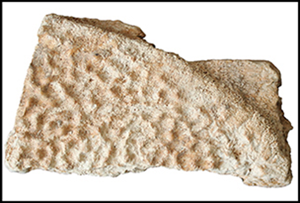
For each turtle specimen we recorded the archaeological context, skeletal element, weight, preservation and any butchery or gnaw marks. Despite fragmentation, turtle bones were easily distinguishable due to their specific morphology and structure. In Trionyx, the distinctively sculpted carapace is readily identifiable (Figure 3), and other elements also differ from fully marine turtles (Williston Reference Williston1925). To distinguish Chelonia and Caretta bones, which are almost identical in shape and size, we used differences in the skull and the lower jaw (dentary) (Wyneken Reference Wyneken2001), along with recently published criteria (Koolstra et al. Reference Koolstra, Küchelmann and Çakırlar2019), to identify fragmentary limb bones.
A) Trionyx triunguis carapace fragment from Fadous; B) Cheloniidae carapace from Clazomenae; C) complete Caretta caretta carapace from Fadous (scale bar = 0.25m) (figure by F.J. Koolstra, C. Çakırlar & H. Genz).

To estimate relative abundance per spatial and temporal unit (e.g. at medieval Kinet), we use %MNI (minimum number of individuals) to mitigate inter-taxonomic and inter-site preservation biases, along with %NISP (number of identified specimens), which is the most commonly reported unit in Eastern Mediterranean zooarchaeology (specific applications of NISP and MNI are detailed in the OSM). NISP and MNI are co-dependent, and MNI emphasises the numeric importance of rare species (Grayson Reference Grayson1984; Payne Reference Payne, Wilkie and Coulson1985). As the ribs, sternum and most of the vertebrae have evolved into and have been replaced by the shell (carapace and plastron) in turtles (Hirasawa et al. Reference Hirasawa, Nagashima and Kuratani2013), and the rest of the body consists of more or less the same number of bones as other common vertebrates, inter-taxonomic differences in the number of skeletal elements do not create a bias favouring turtles in %NISP. If %NISP overestimates the turtle abundance, this might be due to the high density of turtle bones, which are not hollow like mammal and bird bones.
To examine trends in body-part representation in the assemblages, we use specimen weight. The shell (the carapace and plastron) comprises around 75 per cent of the total weight of an intact marine turtle skeleton (Uerpmann & Uerpmann Reference Uerpmann, Uerpmann, Hojlund and Andersen1997). Using the humerus diameters (smallest breadth of shaft) and SCL of recent museum specimens (for the regression formulae used, see Table S7 & Figure S1), which correlate directly with each other (Zug et al. Reference Zug, Balazs, Wetherall, Parker and Murakawa2002), we established a regression to estimate animal size from fragmented archaeological humerii. Although sexual dimorphism in carapace length has been observed in breeding populations (Godley et al. Reference Godley, Broderick, Frauenstein, Glen and Hays2002), due to skeletal fragmentation, we used the sexually dimorphic claw I (pollex) to identify males in the archaeological record: claw I of the fore flipper is large and curved in males, but straight and small in females (Wyneken Reference Wyneken2001).
Results
Most of the analysed assemblages contained <0.5 per cent turtle remains by NISP (Tables S2–5). As expected, %MNI values are higher than %NISP values. At all five sites, turtle bones were recovered predominantly from refuse middens, which also yielded other animal bones and diverse artefact assemblages representing domestic, industrial and administrative activities. Turtles at two sites—Clazomenae and Beirut—were restricted to carapace remains. At Clazomenae, we found three turtle specimens among an assemblage of over 2000 animal bone fragments, which date to between the fourteenth and fourth centuries BC. In Beirut (300 BC–AD 1200), the analysis of >25 000 animal bone fragments identified five Cheloniidae carapace fragments, four from fifth-century AD deposits, and one from a first-century AD context. Burak yielded eight Trionyx carapace fragments, six turtle-limb fragments, five vertebrae and seven Cheloniidae carapace fragments. In total, turtle remains comprise around 0.5 per cent (NISP) of more than 5000 vertebrate remains from Burak and up to 50 per cent MNI per temporal unit. Wet-sieving experiments and light residue sorting at Clazomenae and Burak yielded no turtle remains. We currently have no data for wet-sieved remains from Beirut.
Results from Kinet and Fadous differ from Clazomenae, Beirut and Burak. At Kinet, turtle remains comprise less than 0.5 per cent of the NISP, and a slightly higher proportion of the MNI estimates in the Bronze Age, Persian to Hellenistic and medieval periods. For a brief period of around 100 years at the end of the eighth/beginning of the seventh centuries BC (Middle and Late Iron Ages), however, their proportions increase to 5.5 per cent NISP and up to 10.5 per cent in MNI estimates. Wet-sieved samples also contain turtle bones, but to much lower degrees. Most of the turtle remains identifiable to species at Kinet are green turtles, although loggerheads and Trionyx are also present.
At Early Bronze Age Fadous, turtle remains constitute approximately 3.5 per cent NISP and 10 per cent MNI. Morphological analysis suggests that these probably represent exclusively loggerheads (Koolstra et al. Reference Koolstra, Küchelmann and Çakırlar2019). A complete loggerhead carapace (0.60–0.65m SCL) was recovered from a rubble fill, with no associated evidence suggesting that it was a ritual context. The Middle Bronze Age turtle bones were found in the fill of graves (Genz et al. Reference Genz, El-Zaatari, Çakırlar, Badreshany, Riehl, van den Brink and Levy2010).
To contextualise these numbers: at Middle and Late Iron Age Kinet and Early Bronze Age Fadous, turtles are just as common as the typical Mediterranean domesticates, such as pigs and cattle (Genz et al. Reference Genz, Riehl, Çakırlar, Slim and Damick2016; Çakırlar et al. Reference Çakırlar, Bosman, Ikram, Çakırlar, Chahoud, Berthon and Pilaar Birch2018). As one might expect, the %NISP of turtle carapace and limb bone remains are high, as these are robust and survive better; when calculating the %MNI, however, the turtle remains are greater than the %NISP. Thus, it seems that more turtles were present at the sites than simple counts suggest. At both sites, turtle bones were fragmented by butchery, carnivore chewing, trampling and biodegradation (Figure 4). At Kinet, butchers used heavy chopping tools for disarticulation, as attested by marks on acromia, femora and humerii, which occurred when removing flippers; those on the distal ulna occurred when removing the extremities. No such evidence exists at Fadous.
A) Ulna from Fadous; B) Chelonia mydas humerus from Kinet (arrows indicate butchery marks); C) chewed Chelonia mydas humerus from Kinet (figure by F.J. Koolstra & C. Çakırlar).

At Kinet, carapace and plastron fragments constitute over 80 per cent of the weight of all turtle remains, while at Fadous, these remains constitute 70 per cent of the total weight of turtle remains. Limb bones are less well represented at both sites. The relative weight proportion of carapace and plastron fragments at Kinet is above 80 per cent (higher than expected), whereas at Fadous, these remains constitute a smaller proportion in comparison with a complete skeleton (Figure 5 & Table S6). Humerii are plentiful, while cranial elements and small distal flipper bones (phalanges) are few at both sites. This might be due to the robustness of the former, or that non-meaty body parts may have been processed and discarded elsewhere.
Turtle body-part representation by weight (for data, see Table S6; figure by C. Çakırlar & F.J. Koolstra).

We also identified large pollices (claw Is)—representing males—at Kinet (Figure 6). At all sites, the scarcity of other third phalanges prevents the calculation of the male:female ratios.
Male pollices (claw Is) from Kinet (figure by C. Çakırlar & F.J. Koolstra).

Estimated carapace lengths (SCLs) range between 0.63 and 0.86m for green turtles at Kinet (Figure 7 & Table S8), while estimated SCLs based on four loggerhead humerii range between 0.57 and 0.78m at Fadous (Table S9). If we accept modern recorded minimum carapace lengths (Casale et al. Reference Casale2018) as the cut-off for sexually mature individuals, one green turtle and one loggerhead from Kinet can be considered as sub-adults. The fairly even size distribution of estimated green turtle carapace lengths, combined with the presence of male pollices, indicate the presence of both males and females. Neither the loggerhead nor the green turtle individuals represented reach the present-day maximum carapace lengths reported for the Eastern Mediterranean (Casale et al. Reference Casale2018). This apparent size difference between modern and archaeological populations might be related to differences in the intensity of human exploitation, phylogenetics, environments or population numbers, and requires further research. The fact that we found no juveniles in the sieved or hand-collected samples suggests that the emphasis on large (adult?) animals is not a function of sampling bias.
Estimated straight carapace lengths (SLC) of Chelonia mydas at Kinet (figure by C. Çakırlar).

Discussion
It is challenging to interpret the variability in the resulting zooarchaeological trends for turtles in the Eastern Mediterranean. For the Palaeolithic and Neolithic, we may have to reserve judgement concerning whether the sparse evidence for turtles is representative of the larger picture; only further excavations can provide more information. Marine turtles can be easily captured on land and in the sea using rudimentary techniques, so a lack of appropriate technology is unlikely to explain the dearth of human-turtle interactions. Indeed, Eastern Mediterranean communities were navigating the open sea and fishing since at least the Pleistocene–Holocene transition (Knapp Reference Knapp2020). Perhaps these communities found turtles less appetising than other, more easily available food sources, or perhaps turtles were less abundant due to limited beaches for nesting.
An apparent increase in human-turtle interactions is evident on the Bronze Age Lebanese coast, and in the Iron Age all along the Levantine coast. We treat sites with only carapace evidence separately, as these could indicate the exploitation of shells, rather than meat, although if the body were consumed at the capture site and the shell taken home, only carapace remains would be found at settlement sites—a scenario that cannot be excluded. After the Iron Age, turtle remains once again become scarce in the zooarchaeological record.
In sites and phases where turtle remains are relatively abundant, both skull and limb elements are present, providing a more detailed record of the variety in human-turtle interactions. Such assemblages allow for species identification, size (hence, age) estimation and the identification of males (if present). From these data, inferences on capture and processing methods can be made. Although the absence of male pollices at Early Bronze Age Fadous, for example, precludes any inference about where the turtles were caught, body-part representation and butchery patterns demonstrate that the carcasses were carried, with their shells, to the settlement for processing. Turtle remains are relatively abundant in Early Bronze Age Lebanon (Chahoud & Vila (Reference Chahoud and Vila2011) report 7.5% NISP) and together with the evidence from Fadous, they might represent shared practices along the Lebanese coast.
At Kinet, where excavations uncovered evidence for activity between 3000 BC and AD 1400, turtles were hunted for approximately 100 years around the turn of the eighth to seventh centuries BC. This included the capture of male green turtles in coastal waters and perhaps also of females on the beach. The lack of juvenile bones at either Kinet or Fadous suggests that the occupants of these sites rarely, if at all, hunted turtles in the open sea, an environment that they seem to have seldom visited for marine exploitation (Genz et al. Reference Genz, Riehl, Çakırlar, Slim and Damick2016; Çakırlar et al. Reference Çakırlar, Bosman, Ikram, Çakırlar, Chahoud, Berthon and Pilaar Birch2018). Carcasses (including shells but perhaps not skulls) were brought to the settlements for processing and to be reduced in size to fit into cooking pots. The availability of iron tools at Iron Age Kinet may have enabled low-meat-bearing parts to be removed immediately upon capture, on the boat or on the beach—a practice known from traditional turtle fisheries in Oman and Australia (Meehan Reference Meehan, Allen, Golson and Jones1977; Hoch Reference Hoch and Taddei1979). There are no clear chop marks on lower limbs that show this, but such a practice can explain the small difference in body-part representation of turtles in Bronze Age Fadous and Iron Age Kinet, especially the lower proportions of skull fragments and phalanges.
Many factors can affect diachronic trends in quantities of turtle remains in the archaeological record. The local availability of turtles is influenced by climatic or geomorphological conditions affecting the suitability of breeding and nesting grounds and the availability of food. Cultural traditions, the skills and technology required to capture sea turtles, and the technology needed to dismember large turtle carcasses efficiently also contribute to this availability. An explanation for the sudden and brief spike in sea turtle hunting at Kinet could be multi-layered. It is unlikely that improved seafaring technology in the Iron Age suddenly allowed open-sea turtle hunting. An increased availability of more efficient metal tools, which facilitated the initial dismemberment of carcasses at sea, may have encouraged the Iron Age inhabitants of Kinet to capture large sea turtles more frequently. The over-representation of carapace and plastron fragments may also indicate other functions for these large, robust parts of the animal. Pliny the Elder (Natural History, 6.91 & 6.109; Rackham Reference Rackham1938), for example, describes turtle shells being used for many functions, including containers, shields and prestige items.
If a successful hunt was associated with status and power, social gains may have motivated the exploitation of turtles. The peak period of turtle remains at Kinet coincides with increased long-distance maritime interaction following Neo-Assyrian occupation of the region and the site (Hodos Reference Hodos2006; Lehmann Reference Lehmann, MacGinnis, Wicke and Greenfield2016). Exploiting turtles may have fit well with the seventh-millennium BC culinary culture of Kinet, which conspicuously involved fish consumption (Çakırlar et al. Reference Çakırlar, Ikram and Gates2016, Reference Çakırlar, Bosman, Ikram, Çakırlar, Chahoud, Berthon and Pilaar Birch2018). Alternatively, newcomers, unburdened by any culinary restrictions on turtles, may have experimented with a new resource in order to reduce the risk of food insecurity and improve their nutritional resilience. Finally, the drier climatic conditions of the seventh century BC (Sinha et al. Reference Sinha2019) may have encouraged marine turtle exploitation to mitigate against a reduction in other food sources.
The zooarchaeological record also has implications for our understanding of the past distribution of Mediterranean turtles. Notwithstanding the lack of zooarchaeological data from southern Turkey, the distribution of archaeological turtle remains largely overlaps with the distribution of present-day nesting sites (Casale et al. Reference Casale2018). Inter-site differences in species occurrence may reflect local availability in the past. Turtle species tend to segregate between nesting beaches (Casale et al. Reference Casale2018), and this is mirrored by the almost mutually exclusive predominance of green turtles at Kinet and loggerheads at Fadous. Although turtles do not nest close to Kinet and Fadous today due to human activity, beaches suitable for nesting may have formed adjacent to Kinet in the first millennium BC, and near Fadous in the third millennium BC; geomorphological studies, however, are yet to identify these beaches (Beach & Luzzadder-Beach Reference Beach and Luzzadder-Beach2008). Future work should investigate whether inter-site differences in species representation is as pronounced elsewhere in the Eastern Mediterranean as at Fadous and Kinet. The overall archaeological scarcity of Trionyx is noteworthy. The absence of this species (as well as riverine faunal remains) at Fadous could be explained by the absence of a nearby perennial river (Genz et al. Reference Genz, Riehl, Çakırlar, Slim and Damick2016). While Trionyx may not have been nesting near Fadous, today, the species is also caught in fully marine waters (Oruç Reference Oruç2001).
Finally, despite the unevenness of the evidence, it is tempting to question whether and how interactions affected past turtle populations in the Eastern Mediterranean. Continued, intensive turtle exploitation, focusing on large, adult individuals and nesting females, can have a devastating impact on turtle populations, causing rapid depletions with a long recovery time (Carr Reference Carr1967). Elsewhere, diachronic decreases in archaeological turtle-bone frequencies have been interpreted as population depletion resulting from hunting pressures (Allen Reference Allen2007; Smith et al. Reference Smith, Kennett, Wake and Voorhies2007). The Mediterranean record, however, does not suggest such trends. Estimated size ranges of green turtles at Kinet and loggerheads at Fadous show that adults—some of them males—were exploited almost exclusively. If individual turtle size in the Middle Holocene Mediterranean reached present-day maxima, our samples do not include them. If this is the case, the green turtle sample size from Kinet suggests that the largest individuals were not caught. Did active hunting avoid the largest individuals? Had the largest individuals already been exploited? More research on representative samples could potentially answer these questions.
Conclusions
Archaeological marine turtle remains have the potential to help illuminate where, when and how human-turtle interactions occurred, and assess diachronic fluctuations in interaction intensity. Although the general scarcity of published data on marine turtle remains seems to rule out a deep history of intensive and continuous direct exploitation as a factor contributing to the present-day vulnerability of Mediterranean turtle populations, wider bioarchaeological sampling will be critical to test this hypothesis. In addition to non-destructive zooarchaeological methods, relatively new destructive methods, such as species identification by mass spectrometry and palaeogenetics (Harvey et al. Reference Harvey, Lefebvre, Defrance, Toftgaard, Drosou, Kitchener and Buckley2019), will offer new insights into human-turtle interactions in the past, enhancing the dataset. For now, we hope our research demonstrates that pre-industrial marine turtle populations in the Eastern Mediterranean were affected by human interaction, and their changing presence in the zooarchaeological record reflects, to some degree, human-turtle interaction, helping to track human impact on biodiversity in the Eastern Mediterranean.
Acknowledgements
We thank Hans-Peter and Margarethe Uerpmann, Bea DeCupere, Annelise Folie, Olivier Pauwels, Meghan Truckey, Alison Wynn, Simon Davis, Angelos Hadjikoumis, Oğuz Türkozan, Figen Sevil Kilimci, Sarah Kansa, Jwana Chahoud, Rianne Breider, Francesca Slim, Youri van den Hurk, Willemien de Kock, David Reese and Christian Küchelmann for their help during this research. We owe special thanks to the directors of the excavations that yielded our five primary assemblages: Yaşar Ersoy and Marie-Henriette Gates, Hermann Genz, Helga Seeden, Hèlene Sader and Jens Kamlah. Excavation permits were granted by the Turkish Ministry of Culture and the Lebanese Antiquities Authority. The manuscript has benefited greatly from the constructive comments of the two anonymous reviewers.
Funding statement
The University of Groningen, the Marine Conservation Institute and the American Research Institute in Turkey funded the research.
Supplementary material
To view supplementary material for this article, please visit https://doi.org/10.15184/aqy.2020.95


 Open access

