




Crossref Citations

This article has been cited by the following publications. This list is generated based on data provided by Crossref.
Shrimpton, Roger
and
Blaney, Sonia
2018.
The issue of nutrition training in health professions.
Public Health Nutrition,
Vol. 21,
Issue. 13,
p.
2526.
Crowley, Jennifer
Ball, Lauren
and
Hiddink, Gerrit Jan
2019.
Nutrition in medical education: a systematic review.
The Lancet Planetary Health,
Vol. 3,
Issue. 9,
p.
e379.
Crowley, Jennifer
Ball, Lauren
and
Wall, Clare
2020.
How does self-perceived nutrition competence change over time during medical training? A prospective longitudinal observational study of New Zealand medical students.
BMJ Nutrition, Prevention & Health,
Vol. 3,
Issue. 2,
p.
270.
Hodge, Allison
2020.
Opportunities for nutrition in primary care.
Public Health Nutrition,
Vol. 23,
Issue. 1,
p.
1.
Katz, Nathan J.
Neary, Emma
Tang, Natasha
Braund, Heather
Cofie, Nicholas
and
Zevin, Boris
2021.
Undergraduate medical education interventions aimed at managing patients with obesity: A systematic review of educational effectiveness.
Obesity Reviews,
Vol. 22,
Issue. 10,
Gotouda, Hiroya
Osawa, Seiko
Okamoto, Yasuhiro
Matsune, Kensuke
Kono, Tetsuro
Okada, Hiroyuki
and
Ito, Takanori
2021.
The Survey Concerning the Promotion of Food and Nutrition Education among Dental Students: Part Two in Reference to Awareness and Interest for Dental Education.
International Journal of Oral-Medical Sciences,
Vol. 19,
Issue. 4,
p.
213.
Van den Broucke, Evelyne
Deleenheer, Barbara
Meulemans, Ann
Vanderstappen, Julie
Pauwels, Nelle
Cosaert, Katrien
Spriet, Isabel
Van Veer, Hans
Vangoitsenhoven, Roman
Sabino, João
Declercq, Peter
Vanuytsel, Tim
and
Quintens, Charlotte
2022.
Offering Guidance and Learning to Prescribers to Initiate Parenteral Nutrition using a Validated Electronic Decision TREE (OLIVE TREE).
Journal of Medical Systems,
Vol. 46,
Issue. 8,
Patel, Priya
and
Kassam, Shireen
2022.
Evaluating nutrition education interventions for medical students: A rapid review.
Journal of Human Nutrition and Dietetics,
Vol. 35,
Issue. 5,
p.
861.
Cardenas, Diana
Díaz, Gustavo
Cadavid, Jessika
Lipovestky, Fernando
Canicoba, Marisa
Sánchez, Paola
Álvarez, Ludwig
Duarte, Yan
Reyes, José Guillermo Gutiérrez
de Noyola, Gilda Miranda
Maza, Claudia
Porbén, Sergio Santana
Bermúdez, Charles Elleri
García, Yawelida
Calvo, Isabel
and
Arenas, Humberto
2022.
Nutrition in medical education in Latin America: Results of a cross‐sectional survey.
Journal of Parenteral and Enteral Nutrition,
Vol. 46,
Issue. 1,
p.
229.
Cardenas, Diana
Díaz, Gustavo
Fuchs‐Tarlovsky, Vanessa
Cristina Gonzalez, Maria
Carrasco, Fernando
Cano, Angélica María Pérez
Bermúdez, Charles
Maza, Claudia
Ferraresi, Eduardo
Lipovestky, Fernando
Villafana, Haydee
Arenas‐Márquez, Humberto
Calvo, Isabel
Cordova, Ludwig Roberto Alvarez
Canicoba, Marisa
Sánchez, Paola
Santana, Sergio
Tihista, Serrana
Adrianza de Baptista, Gertrudis M.
Garcia, Yawelida
and
Correia, Maria Isabel Toulson Davisson
2022.
Nutrition competencies for undergraduate medical education: Results of an international interdisciplinary consensus.
Journal of Parenteral and Enteral Nutrition,
Vol. 46,
Issue. 3,
p.
635.
Jones, Glenys
Macaninch, Elaine
Mellor, Duane
Spiro, Ayela
Martyn, Kathy
Butler, Thomas
Johnson, Alice
and
Moore, J Bernadette
2022.
Putting nutrition education on the table: development of a curriculum to meet future doctors’ needs.
BMJ Nutrition, Prevention & Health,
Vol. 5,
Issue. 2,
p.
208.
Kayes, Lucy
Mullan, Karen R.
and
Woodside, Jayne V.
2022.
A review of current knowledge about the importance of iodine among women of child-bearing age and healthcare professionals.
Journal of Nutritional Science,
Vol. 11,
Issue. ,
Wilson, Neil
and
Turner, Sam
2023.
Targeting malnutrition in patients with COPD in the community.
British Journal of Nursing,
Vol. 32,
Issue. 21,
p.
S6.
Jones, Glenys
Craigie, Angela M
Zaremba, Suzanne M M
Jaffee, Ally
and
Mellor, Duane D
2023.
Teaching medical students about nutrition: from basic principles to practical strategies.
Frontline Gastroenterology,
Vol. 14,
Issue. 5,
p.
422.
Jones, Glenys
Macaninch, Elaine
Mellor, Duane D.
Spiro, Ayela
Martyn, Kathy
Butler, Thomas
Johnson, Alice
and
Moore, J. Bernadette
2023.
Putting nutrition education on the table: development of a curriculum to meet future doctors’ needs.
British Journal of Nutrition,
Vol. 129,
Issue. 6,
p.
1000.
Meulenbroeks, Deidre
Jonkers, Daisy
Scheepers, Hubertina
and
Gubbels, Jessica
2024.
Obstetric healthcare experiences and information needs of Dutch women in relation to their vegan diet during pregnancy.
Preventive Medicine Reports,
Vol. 48,
Issue. ,
p.
102916.
Lee, Kyu-Lim
and
Sung, Jun-Young
2025.
Impact of sports nutrition education on awareness and knowledge among physical education majors and workers.
Journal of the International Society of Sports Nutrition,
Vol. 22,
Issue. 1,
Higgs, Suzanne
Aarts, Kristien
Adan, Roger A H
Buitelaar, Jan K
Cirulli, Francesca
Cryan, John F
Dickson, Suzanne L
Korosi, Aniko
van der Beek, Eline M
and
Dye, Louise
2025.
Policy Actions Required to Improve Nutrition for Brain Health.
Nutrition Reviews,
Vol. 83,
Issue. 3,
p.
586.
Elhag, Wahiba
and
El Ansari, Walid
2025.
The Landscape of Obesity Education Worldwide — Are We Doing Enough? Scoping Review of Content of Obesity Educational Interventions in Medical Schools and Residency Programs.
Obesity Surgery,
Vol. 35,
Issue. 4,
p.
1201.
Shiach, Amanda
Thomson, Abigail C
and
Samuels, Fiona
2026.
Persistent gaps in nutrition education in UK medical schools: a triangulated review of curricula, student perception and the evidence base.
BMJ Nutrition, Prevention & Health,
p.
bmjnph-2025-001479.
This commentary responds to a gap in knowledge that UK medical students have about nutrition as they enter the foundation programme and suggests ways to improve it. Nutrition and diet is a key contributor to the growing trend of obesity in children and contributes to a lifelong disease burden associated with the metabolic effects( Reference Hill and Peters 1 , Reference Gardner, Hosking and Metcalf 2 ). Diet-related factors are a major risk factor for CVD in adults, which is a significant cause of morbidity alongside cancer in European countries( Reference Townsend, Wilson and Bhatnagar 3 ). Healthy nutrition is a manageable risk factor; patients listen to doctors’ advice and subsequently may improve their diets( Reference Rudolf 4 ). Doctors in Europe are fortunate to work within multidisciplinary specialist teams to improve the nutritional health of both healthy and sick individuals, including dietitians and nurses. According to the Academy of Medical Royal Colleges (UK), doctors in the early stages of their training should know about nutrition in normal growth and health, public health aspects of nutrition and the relationship between nutrition and disease( 5 ). In practice, nutrition education lags behind and students are not confident in managing and preventing poor nutrition. Here, we outline current best practice in undergraduate education about nutrition, where medical schools fall behind, and discuss a nutrition curriculum in our medical school that incorporates active health promotion outreach into a local school.
Undergraduate education about nutrition in the UK and beyond
In 2013 the intercollegiate group on nutrition of the Academy of Medical Royal Colleges (UK) published a curriculum of undergraduate competencies in nutrition, stating that new doctors should be able to understand how nutrition influences health and disease, how disease compromises nutrition, and be safe and competent in recognising and managing nutrition and hydration for both under- and overnutrition( 5 ). Moreover, the General Medical Council states that all medical students are expected to ‘discuss the role of nutrition in health’( 6 ). Suggested competencies as argued by the Academy of Medical Royal Colleges are described in Box 1. A recent European-wide survey found that UK medical schools teach an average of 22 h of nutrition throughout the medical curriculum, slightly lower than the European average but higher than the US average( Reference Chung, Buul and Wilms 7 ).
UK undergraduate curriculum in nutrition, Academy of Medical Royal Colleges UK, 2011( 5 )
All newly qualified doctors should be able to:1. Understand how nutrition, diet and physical activity influence health and disease; 2. Understand how disease and its management can compromise nutritional health; 3. Recognise nutritional risk and assess nutritional state; and 4. Be safe and competent to advise on and, under supervision, manage nutrition, hydration and physical activity in health and disease.
Local experience in Peninsula Medical School
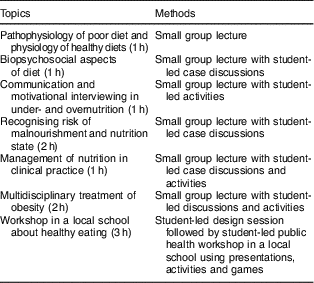
Before our intervention, our medical school (Peninsula Medical School) taught about 20 h of nutrition within a spiral curriculum predominantly within biomedical sciences. The curriculum focused on physiology and pathophysiology within problem-based learning biomedical sciences, and there was less focus on clinical and public health aspects such as metabolic status, management of under- and overnutrition, or health promotion. We found that final-year medical students and first-year doctors were not confident in clinical and public health aspects of nutrition on a 7-item survey (mean confidence=2·89/5, 95 % CI 2·64, 3·15) and were least confident in managing parentally fed patients and hydration. We implemented a 6-week elective course for fifteen medical students including 8 h of teaching and practicals in nutrition, with a focus on paediatrics, culminating in a 3 h student-led outreach event for sixty pupils in a local school. This curriculum was designed to bridge the gap between physiology and clinical practice, focusing on healthy diets and mechanisms of nutrition-based pathophysiology, motivational interviewing techniques to improve healthy eating, clinical management of malnourishment, and public health aspects of nutrition and obesity (see Table 1). The course utilised a variety of approaches, including traditional small group lectures, workshops with student activities driving the learning, and practicals where students designed a public health intervention. Doctors, dietitians and clinical psychologists led the teaching. Subsequently students led a healthy eating workshop in a local school. Following the course students felt more confident about nutrition (paired improvement=0·84, P=0·049) and had an improvement on a multiple-choice question about nutrition from 4·5 to 9 out of 10 (Wilcoxon signed rank W<0·001). In a focus group, students felt that the curriculum was relevant to their future work and felt more confident about managing in practice. We are rolling out elements of this course for foundation doctors and future medical students.
Case study of a clinical course in nutrition for final-year medical students
Conclusions and priorities for education and research
Nutrition education in our medical school was focused largely in preclinical science and did not support students to become competent in managing and preventing the disease burden associated with poor nutrition prior to the establishment of our course. Students and foundation doctors were unconfident, although this improved with 11 h of teaching and practicals on nutrition, clinical management, and public health and health promotion. We would like to build on this course by making it available to a wider number of students, offering a longer elective, and to build on wider social factors affecting nutrition, including the connection between food systems and environmental health, and public health policy in the food industry. We believe that enabling students to understand the individual and social determinants of food and diet will enable our cohort to better understand, prevent and treat the health consequences of malnutrition and obesity. More widely, we hope that our students will become advocates for a healthy food system. Our impact is limited, however, by the small scale and self-elected nature of the current intervention. We believe that our local experience is similar to that of other centres and encourage medical educators to broaden the scope of their curriculum to include clinical and public health components of nutrition. We believe expansion of current teaching in health professionals is necessary to meet the large burden of nutrition-related disease. This will support doctors to meet the General Medical Council’s expectations and equip future health professionals with the skills to manage poor nutrition and promote healthy eating in the patient population.
Acknowledgements
Acknowledgements: The authors thank Professor Majeed and Dr Waters for their help in the project. Financial support: This work was done as part of educational responsibilities by the lead author in his paid full-time position in a teaching hospital in the National Health Service, UK. The authors declare no financial support for this research. Conflict of interest: The authors declare no conflicts of interest. Authorship: J.B. established the teaching programme, envisaged and co-wrote the article and analysed the data. M.W. taught on the teaching programme and co-wrote the article. Ethics of human subject participation: This intervention and evaluation was performed as part of routine educational activities. Our faculty routinely evaluates educational activities and, as such, ethics was not sought.