





School closures and transitions to remote learning during the onset of the COVID-19 pandemic dramatically changed adolescents’ social ecologies. In 2020, U.S. schools began to close due to public health concerns on March 12; a mere 13 days later, all public school buildings in the United States were closed for the first time in history. Afterward, more than half of the nation’s schools did not return for learning during the 2019–2020 school year, and by early May, various forms of remote learning (i.e., self-guided packets; asynchronous and synchronous online learning; hybrid learning) dominated the U.S. educational landscape. Not only did the COVID-19 pandemic bring about an unprecedented nationwide shift in how youth attended school, but it also created an atypical developmental circumstance whereby adolescents were spending more time with family than friends due to public health measures, especially during the early months of the pandemic (Bülow et al., Reference Bülow, Keijsers, Boele, van Roekel and Denissen2021; Gadassi Polack et al., Reference Gadassi Polack, Sened, Aubé, Zhang, Joormann and Kober2021).
It is important to consider the interactions between shifting educational settings and social ecologies at the onset of the COVID-19 pandemic because of the potential impact on youth’s mental health. Cross-sectional studies have shown high levels of negative affect and stress among adolescent learners during the pandemic’s onset, and prospective studies have indicated increases in negative affect (Branje & Morris, Reference Branje and Morris2021; Deng et al., Reference Deng, Gadassi Polack, Creighton, Kober and Joormann2021) and decreases in positive affect from pre- to peri-pandemic conditions (Romm et al., Reference Romm, Park, Hughes and Gentzler2021). Some have connected this emotional shift with disruptions in in-person learning, school-based health services, and peer social supports; however, little is known about how extended transitions to remote learning may affect adolescents’ psychological well-being over time. Furthermore, youth from historically marginalized and socioeconomically disadvantaged backgrounds may have confronted COVID-adapted schooling with more vulnerabilities, fewer resources, and less protection against increasing threats to well-being. Unfortunately, the participant samples of existing studies lack racial and socioeconomic heterogeneity, thus precluding researchers’ ability to examine risk and resilience in different groups of students reliably.
The COVID-19 pandemic may have opened pandora’s box for the use of remote learning in school’s post-disaster crisis responses. To understand how remote learning was linked to the psychological well-being of adolescents at the onset of the COVID-19 pandemic, we leveraged multiple waves of daily-diary data from a national sample (i.e., 2 waves pre-pandemic; 2 waves pandemic onset) to investigate (a) the within-person effect of pandemic-onset remote learning on adolescents’ daily psychological well-being (i.e., negative and positive affect, stress), (b) whether these effects differed by level of economic advantage (i.e., low- vs. high-SES) or among Black vs. White youth, and (c) the promotive and protective effects of daily parent and peer social support.
Theoretical and empirical foundation
Adolescent risk and resilience during the onset of COVID-19
Resilience refers to the dynamic capacity of an individual to adapt successfully when their functioning, survival, or development are at risk (Masten, Reference Masten2021). According to resilience system theory, interactions within ecological systems (e.g., social networks, school environments) support or undermine adolescents’ development in times of disaster (Masten & Motti-Stefanidi, Reference Masten and Motti-Stefanidi2020). In other words, adolescents’ risk and resilience are highly contextualized and situated within a complicated network of interpersonal relationships and ecological vulnerabilities (Masten, Reference Masten2014; Prime et al., Reference Prime, Wade and Browne2020), including those related to social identities (e.g., race) and positions (e.g., economic vulnerability). Social support is considered one of the most effective protective factors against maladaptive development in the face of adversity (American Psychiatric Association, 2013). As such, the ability to use social networks in ways that reduce the impact of adverse events or conditions on psychological well-being is an indicator of resilience among adolescents.
During the onset of the COVID-19 pandemic, adolescents’ resilience was essential for maintaining positive developmental trajectories in the wake of disrupted school routines and restricted social interactions. Because peer interactions are heavily couched within the school environment (Masten, Reference Masten2014; Wang et al., Reference Wang, Degol and Henry2019), the spring 2020 transition into remote learning alongside the closure of community spaces where youth typically congregate drastically limited adolescents’ access to in-person peer support. These social restrictions placed adolescents at risk for experiencing heightened loneliness, mental health difficulties (e.g., anxiety, depression), and stress (Wang et al., Reference Wang, Scanlon, Hua, Zhang, Belmont and Del Toro2022). Although some adolescents were able to seek out and receive social support from peers within virtual environments (e.g., social media, online gaming platforms), it is unclear whether distanced social support has the same salutary effects as in-person social support on adolescents’ psychological well-being.
Not only did the onset of the COVID-19 pandemic thrust adolescents into a mandated period of social withdrawal from peers, but it also contributed to a developmentally atypical increase in the amount of time spent in the home environment. When youth perceive high levels of support from their parents, they tend to experience better psychological outcomes (Kolak et al., Reference Kolak, Van Wade and Ross2018; Silva et al., Reference Silva, Ford and Miller2020), even in the face of adversity (Wang et al., Reference Wang, Del Toro, Scanlon, Schall, Zhang, Belmont, Voltin and Plevniak2021). However, adolescents typically spend more time with peers than with parents as they explore their identities and exercise their autonomy (Lam et al., Reference Lam, Mchale and Crouter2012, Reference Lam, Mchale and Crouter2014), and parent-adolescent relationships tend to be marked with conflict tied to youth’s burgeoning independence (Smetana & Rote, Reference Smetana and Rote2019). During the pandemic, the increased threats to adolescents’ autonomy and relatedness posed by remote learning may have introduced additional conflict into the parent-adolescent dynamic. In the absence of in-person school-based interpersonal support, the role of parents may have had a stronger influence on youth’s psychological well-being during the pandemic’s onset.
Finally, the onset of COVID-19 exacerbated pre-pandemic disparities related to racial and economic privilege. In the U.S., youth from low-income backgrounds contended with increased food insecurity and a lack of broadband internet access with which to access their education, while youth from minoritized backgrounds contended with increased racialized tensions and violence against Black and Asian Americans that permeated in-person and online spaces. As such, the psychological well-being of youth from minoritized and economically marginalized backgrounds may have been disproportionately affected by disruptions in school- and community-based educational resources, social supports, and health services during the pandemic’s onset, posing additional risks to these adolescents’ ability to cope with a multisystemic disaster.
Pandemic-onset remote learning and adolescent psychological well-being
Although the adoption of remote learning in spring of 2020 allowed youth to continue their education safely, many have raised questions about the extent to which this school crisis response may have influenced adolescents’ psychological well-being (Kaffenberger, Reference Kaffenberger2021; Van Lancker & Parolin, Reference Van Lancker and Parolin2020). The social isolation that accompanied the pandemic’s onset may have made the sudden transition to remote learning especially difficult for adolescents, as this age group relies on interpersonal exchanges as a forum to foster relatedness with others (Saarni et al., Reference Saarni, Campos, Camras, Witherington, Eisenberg, Damon and Lerner2007; Zimmer-Gembeck & Skinner, Reference Zimmer-Gembeck and Skinner2016). Regardless of the specific pedagogical nuances, remote learning drastically changed the delivery of school lessons and reduced youth’s in-person interactions with classmates and school-based adults. Studies have shown that when youth were unable to obtain adequate support during pandemic-era remote learning, they tended to experience heightened stress (Kwaning et al., Reference Kwaning, Ullah, Biely, Jackson, Dosanjh, Galvez, Arellano and Dudovitz2023) and learning difficulties (Samji et al., Reference Samji, Wu, Ladak, Vossen, Stewart, Dove, Long and Snell2022).
In general, adolescents have reported COVID-specific stressors related to disrupted school environments, remaining engaged in remote learning, and not being able to see friends in person. Multiple studies have identified isolation from friends as the primary pandemic-related stressor among teenagers (Styck et al., Reference Styck, Malecki, Ogg and Demaray2021; van Loon et al., Reference van Loon, Creemers, Vogelaar, Miers, Saab, Westenberg and Asscher2021), and these stressors have in turn been linked to elevated levels of depression and anxiety (Demaray et al., Reference Demaray, Ogg, Malecki and Styck2020). In fact, most available research on adolescents’ pandemic-era psychological well-being has indicated that youth experienced more negative affect (Branje & Morris, Reference Branje and Morris2021; Deng et al., Reference Deng, Gadassi Polack, Creighton, Kober and Joormann2021), loneliness (Janssens et al., Reference Janssens, Achterhof, Lafit, Bamps, Hagemann, Hiekkaranta, Hermans, Lecei, Myin-Germeys and Kirtley2021), and mental health issues (e.g., depression, anxiety; Barendse et al., Reference Barendse, Flannery, Cavanagh, Aristizabal, Becker, Berger, Breaux, Campione-Barr, Church, Crone, Dahl, Dennis-Tiwary, Dvorsky, Dziura, van de Groep, Ho, Killoren, Langberg and Larguinho2023; Magson et al., Reference Magson, Freeman, Rapee, Richardson, Oar and Fardouly2021; Viner et al., Reference Viner, Russell, Saulle, Croker, Stansfield, Packer, Nicholls, Goddings, Bonell, Hudson, Hope, Ward, Schwalbe, Morgan and Minozzi2022) during (vs before) the pandemic’s onset. It is less clear, though, how the pandemic may have influenced youth’s positive emotional experiences. While some have found decreases in adolescent’s positive affect during the early months of the pandemic (Romm et al., Reference Romm, Park, Hughes and Gentzler2021), others have found no differences between adolescents’ pre- and peri-pandemic levels of positive affect (Deng et al., Reference Deng, Gadassi Polack, Creighton, Kober and Joormann2021).
Pandemic-onset remote learning and vulnerable populations
Certain groups of youth – namely, youth from minority or low-income backgrounds – may have been at a higher risk for poor psychological well-being during pandemic-onset learning arrangements due to societal inequities related to racial and economic privilege. For example, the COVID-19 pandemic was especially devastating to Black communities, with hospitalizations and mortality being 2.0 and 1.6 times higher, respectively, among Black (vs White) individuals in the U.S. (CDC, 2023). Due to residential segregation, youth of color tend to live in areas where there is a dearth of health resources for families (Wright & Merritt, Reference Wright and Merritt2020). Because Black youth were likely to be simultaneously contending with the threat of increased susceptibility to the virus on top of less access to community health resources, it is likely that they had decreases in psychological well-being during the pandemic’s onset.
It is equally as likely, though, that Black youth experienced fewer mental health issues during the pandemic’s onset due to the shift to remote learning. Black youth commonly experience institutional and interpersonal racial biases within U.S. schools; hence, the transition to remote learning at the pandemic’s onset may have provided a reprieve from racial microaggressions or discriminatory school discipline policies associated with adverse effects on Black adolescents’ psychological well-being. The reprieve from school-based racial tensions may have been particularly important for Black youth during the pandemic’s onset due to the co-occurring worldwide racial uprising in the wake of the George Floyd tragedy. As research on this topic is scarce, it is unclear how observed associations between remote learning and psychological well-being might vary among Black and White students.
Youth from low-income or impoverished families were also at risk for declines in mental health during pandemic-onset remote learning. In many economically disadvantaged communities, families rely on schools for subsidized meals and health services. COVID-related school disruption in the U.S. highlighted preexisting issues with income inequality (Van Lancker & Parolin, Reference Van Lancker and Parolin2020). When schools closed, immediate efforts were made to ensure that free school lunches and essential services continued. Even though educators acted quickly to meet these youth’s basic needs, remote learning during the pandemic’s onset likely exacerbated stress among low-income youth due to limited access to adequate technology (e.g., hardware, internet) and trained educators with the pedagogical skills to help with schoolwork. As such, school closures may have magnified loneliness for these adolescents while simultaneously making it harder to learn, therefore creating the potential for increased stress and negative affect among low-income students at the pandemic’s onset.
In sum, youth from low-income backgrounds and youth of color may have confronted the COVID-19 onset with more vulnerabilities and less protection against increasing threats to well-being during a multisystemic disaster. It is imperative to understand how these adolescents differentially respond to socially isolative public health measures when it comes to their psychological well-being. This information will inform future efforts to support youth’s well-being during multisystemic disasters, especially in the wake of catastrophe (e.g., natural disaster, school shooting requiring extended school closures).
Parent and peer social supports as predictors and moderators
Parent and peer social support are well-established protective factors against mental health difficulties (American Psychiatric Association, 2013) and have been associated with resilience in the face of adversity (Masten, Reference Masten2014, Reference Masten2021). To better support youth during future school responses that require impromptu, extended transitions to remote learning, we investigate the roles of parent and peer social supports in adolescents’ psychological well-being outcomes during the period of pandemic-onset remote learning.
Parent support
Adolescents with high-quality parent relationships prior to the pandemic’s onset experienced lower levels of anxiety, depression, and stress during the early months of the pandemic (Coulombe & Yates, Reference Coulombe and Yates2022; Kiss et al., Reference Kiss, Alzueta, Yuksel, Pohl, de Zambotti, Műller-Oehring, Prouty, Durley, Pelham, McCabe, Gonzalez, Brown, Wade, Marshall, Sowell, Breslin, Lisdahl, Dick and Sheth2022; Viner et al., Reference Viner, Russell, Saulle, Croker, Stansfield, Packer, Nicholls, Goddings, Bonell, Hudson, Hope, Ward, Schwalbe, Morgan and Minozzi2022). During the period of remote learning and social restrictions at the pandemic’s onset, parent support was associated with less negative affect and stress (Campione-Barr et al., Reference Campione-Barr, Rote, Killoren and Rose2021). While the benefits of parental support for adolescents’ psychological well-being have been well-documented in the available literature, less is known about how levels of parent support varied between pre- and peri-pandemic conditions. Several studies have indicated that there were no changes in average levels of parental support prior to and during the pandemic’s onset (Gadassi Polack et al., Reference Gadassi Polack, Sened, Aubé, Zhang, Joormann and Kober2021; Viner et al., Reference Viner, Russell, Saulle, Croker, Stansfield, Packer, Nicholls, Goddings, Bonell, Hudson, Hope, Ward, Schwalbe, Morgan and Minozzi2022), while other researchers have demonstrated increased conflict (Magson et al., Reference Magson, Freeman, Rapee, Richardson, Oar and Fardouly2021) or even improved family cohesion (Rogers et al., Reference Rogers, Ha and Ockey2021).
Not only has parent support been firmly established as a promotive factor of adolescents’ psychological well-being, but it has also been identified as a protective factor against maladaptive psychological outcomes during times of stress (Harrist et al., Reference Harrist, Henry, Liu, Morris, Fiese, Celano, Deater-Deckard, Jouriles and Whisman2019; Masten & Palmer, Reference Masten, Palmer and Bornstein2019). For instance, family emotional support has been shown to buffer against the effect of stress on youth (Kolak et al., Reference Kolak, Van Wade and Ross2018; McMahon et al., Reference McMahon, Creaven and Gallagher2020), and prosocial relationships with parents have been linked to adaptive outcomes in the face of adversity (Pfefferbaum et al., Reference Pfefferbaum, Noffsinger, Wind and Allen2014, Reference Pfefferbaum, Nitiéma, Jacobs, Noffsinger, Wind and Allen2016). These findings have been replicated in pandemic-era research, with parental support operating as a moderator in the negative relation between COVID-related stressors (e.g., disrupted learning environments) and youth’s psychological well-being such that these effects were weakened (Wang et al., Reference Wang, Del Toro, Scanlon, Schall, Zhang, Belmont, Voltin and Plevniak2021, Reference Wang, Henry, Scanlon, Del Toro and Voltin2022). In addition, parent support has been shown to affect the trajectory of youth’s psychological well-being at the pandemic’s onset by buffering against increases in depression (Gadassi Polack et al., Reference Gadassi Polack, Sened, Aubé, Zhang, Joormann and Kober2021) and loneliness (Janssens et al., Reference Janssens, Achterhof, Lafit, Bamps, Hagemann, Hiekkaranta, Hermans, Lecei, Myin-Germeys and Kirtley2021).
Peer support
Youth who receive peer social support tend to experience fewer depressive symptoms and lower negative affect during times of stress (McMahon et al., Reference McMahon, Creaven and Gallagher2020), including during the COVID-19 pandemic (Campione-Barr et al., Reference Campione-Barr, Rote, Killoren and Rose2021; Kiss et al., Reference Kiss, Alzueta, Yuksel, Pohl, de Zambotti, Műller-Oehring, Prouty, Durley, Pelham, McCabe, Gonzalez, Brown, Wade, Marshall, Sowell, Breslin, Lisdahl, Dick and Sheth2022; Liu et al., Reference Liu, Davis, Palma, Sandman and Glynn2022). Indeed, adolescents who maintained high levels of peer support during the period of pandemic-onset remote learning tended to experience smaller increases in depression and anxiety; however, COVID-19’s increasingly restrictive public health mandates and school closures were correlated with a dwindling sense of peer support among some adolescents (Rogers et al., Reference Rogers, Ha and Ockey2021). For other adolescents, there was a decrease in the number of negative peer interactions and an increase in positive peer interactions (Gadassi Polack et al., Reference Gadassi Polack, Sened, Aubé, Zhang, Joormann and Kober2021). Others noted no change in the number of peer interactions or time spent with peers from before to during the pandemic’s onset (Viner et al., Reference Viner, Russell, Saulle, Croker, Stansfield, Packer, Nicholls, Goddings, Bonell, Hudson, Hope, Ward, Schwalbe, Morgan and Minozzi2022). These findings indicate that youth varied significantly in their ability to access peer social support during the early months of the COVID-19 pandemic.
As the in-person learning environment is an inherently social context (Wang & Hofkens, Reference Wang and Hofkens2020), pandemic-onset remote learning in conjunction with public health restrictions may have made accessing peer support networks difficult. It should be no surprise, then, that researchers have documented an increase in adolescents’ peri-pandemic social media use as a means of remaining connected to their peer networks (Drouin et al., Reference Drouin, McDaniel, Pater and Toscos2020; Magis-Weinberg et al., Reference Magis-Weinberg, Gys, Berger, Domoff and Dahl2021; Maheux et al., Reference Maheux, Nesi, Galla, Roberts and Choukas-Bradley2021). Youth who found ways to stay socially connected during pandemic-era remote learning experienced protective effects against declines in psychological well-being. For instance, youth who were able to socially interact with peers online experienced a protective effect against inclining trajectories of loneliness (Espinoza & Hernandez, Reference Espinoza and Hernandez2022) and depression (Liu et al., Reference Liu, Davis, Palma, Sandman and Glynn2022).
Methodological limitations of existing pandemic research
While correlational studies have been helpful in understanding youth’s psychological adjustment during the pandemic’s onset, they lack pre-pandemic data and/or multiple data points to model change in youth’s psychological adjustment between in-person learning and pandemic-onset remote learning. Prospective designs have indicated that youth experienced declines in emotional well-being during the pandemic (Bernasco et al., Reference Bernasco, Nelemans, Graaff and Branje2021; Campione-Barr et al., Reference Campione-Barr, Rote, Killoren and Rose2021; Duckworth et al., Reference Duckworth, Kautz, Defnet, Satlof-Bedrick, Talamas, Lira and Steinberg2021), but these designs tend to only include one wave of data as a covariate to control for pre-pandemic circumstances. Because of the rapidly changing social and educational settings throughout the pandemic, multi-wave intensive longitudinal designs are essential for capturing the impact of pandemic-onset remote learning on adolescents’ well-being in an ecologically valid manner.
There have been mixed findings regarding youth’s trajectories of psychological well-being in studies with more rigorous longitudinal designs. Notably, different patterns have been observed in longitudinal versus cross-sectional or prospective designs. For instance, instead of declining positive affect and increasing stress (as seen in many cross-sectional or prospective designs), studies using intensive longitudinal designs have found steady levels of positive affect (Deng et al., Reference Deng, Gadassi Polack, Creighton, Kober and Joormann2021) and stress (Janssen et al., Reference Janssens, Achterhof, Lafit, Bamps, Hagemann, Hiekkaranta, Hermans, Lecei, Myin-Germeys and Kirtley2021). Janssens et al.’s (Reference Janssens, Achterhof, Lafit, Bamps, Hagemann, Hiekkaranta, Hermans, Lecei, Myin-Germeys and Kirtley2021) study also indicated that negative affect – specifically, irritability and loneliness – were buffered by parent-child relationship quality. These findings were echoed within Bülow et al.’s (Reference Bülow, Keijsers, Boele, van Roekel and Denissen2021) and Kiss et al.’s (Reference Kiss, Alzueta, Yuksel, Pohl, de Zambotti, Műller-Oehring, Prouty, Durley, Pelham, McCabe, Gonzalez, Brown, Wade, Marshall, Sowell, Breslin, Lisdahl, Dick and Sheth2022) work. Interestingly, these designs have also failed to take advantage of the opportunity to examine whether trajectories of affect and stress were substantially different during pre-pandemic and pandemic-onset conditions. More research is needed to build a consensus concerning youth’s emotional well-being during the pandemic’s onset, and more specifically, during pandemic-onset remote learning.
Among studies with multiple data points prior to and during the pandemic’s onset (e.g., Bülow et al., Reference Bülow, Keijsers, Boele, van Roekel and Denissen2021; Deng et al., Reference Deng, Gadassi Polack, Creighton, Kober and Joormann2021; Janssens et al., Reference Janssens, Achterhof, Lafit, Bamps, Hagemann, Hiekkaranta, Hermans, Lecei, Myin-Germeys and Kirtley2021), few have commented on whether the shift in adolescents’ social ecologies was significant enough to affect youth’s mental health trajectories. Even rigorous longitudinal designs have been hindered methodologically by small, homogeneous convenience samples. More specifically, samples used within pandemic-era studies of adolescent development have largely consisted of White, economically advantaged youth from urban or suburban areas. While age and gender have been the focus of a number of published articles, little is known about whether and how race and economic status impacted youth’s ability to adapt to the unexpected shifts in social ecologies during the pandemic’s onset.
Finally, few studies have focused directly on the influence of pandemic-onset remote learning versus the pandemic more generally. In fact, the majority of this literature review hinges upon more generalized literature discussing pre- and peri-pandemic differences in youth’s affect and stress due to a lack of literature addressing the influence of pandemic-onset remote learning on youth’s well-being. For those in charge of school crisis management plans, it remains unknown as to whether remote learning meets youth’s psychological needs during times of crisis. It is especially concerning that remote learning has become a commonplace response following school crisis events. While respite from the school environment may be intended to support students’ physical and psychological safety, the social isolation inherent to remote learning – and especially asynchronous, independent remote learning – may actually be a threat to youth’s ability to cope during crises. Our study aims to advance the body of literature on schools’ crisis responses and students’ psychological well-being by examining the influence of pandemic-onset remote learning on youth’s daily affect and stress in a large sample of racially, economically, and geographically diverse U.S. adolescents with multiple waves of pre- and pandemic-onset longitudinal data. These data will allow us to make recommendations regarding the use of remote learning during extended periods of school crisis.
The current study
The COVID-19 pandemic created a unique natural experiment whereby researchers could examine the effects of a multisystemic disaster on youth’s day-to-day functioning. To date, there has been a distinctive lack of rigorous longitudinal research on U.S. adolescents’ psychological functioning over time during the pandemic’s onset, and few researchers have investigated whether these patterns differed significantly between pre-pandemic in-person learning environments and pandemic-onset remote learning. The extant body of research also has methodological limitations, as multi-wave daily-diary studies examining youth’s pre- and peri-pandemic well-being are scarce.
To address these gaps, this study provides empirical evidence to inform future responses to adolescents’ psychosocial needs during remote learning when used as an adaptive school response during a multisystemic crisis. The use of intensive daily-diary data allows for a deeper investigation into adolescents’ everyday experiences by assessing their affect, stress, and adjustment as they unfold in real time (Bolger & Laurenceau, Reference Bolger and Laurenceau2013). In doing so, we address a critical gap in COVID-19 research by disentangling the real-time impact of pandemic-onset remote learning on youth development and identifying critical risk and protective factors for adolescents experiencing multiple stressors. Our research questions are as follows:
-
1. How did remote learning predict within-person changes in adolescents’ positive affect, negative affect, and overall stress during the pandemic’s onset? Did the impact of remote learning vary by SES or race?
-
2. Did parent and peer social support predict within-person changes in adolescents’ psychological well-being and moderate the impact of pandemic-onset remote learning on adolescents’ psychological well-being over time?
Methods
Data came from a nationwide U.S. sample of 744 adolescents (42% Black, 36% White, and 22% Other ethnic/racial minority; 41% boys; 72% qualified for free/reduced-priced lunch; M age = 14.60, SD age = 1.71, age-range = 12–17 years). Among adolescents in the Other ethnic/racial minoritized category, 56% identified as bi-/multi-racial; 21% identified as Latinx; 15% identified as Asian or Asian American; 6% self-identified as “Other;” and 2% identified as American Indian or Alaskan Native. A research company used stratified random sampling during the recruitment process to obtain a national, geographically diverse sample of adolescent participants (i.e., middle- and high-school-aged youth), with an intentional oversampling of non-White participants (35% Black, 35% White, 30% Other race) to ensure sufficient power for identifying racial disparities in health and academic achievement.
In fall 2019, participants were invited to engage in a multi-wave daily-diary study investigating U.S. adolescents’ school experiences, family circumstances, and well-being. In spring 2020, we adjusted the study’s focus to better capture adolescents’ stress, coping, and adjustment during the COVID-19 pandemic. Because of our interest in how public health mandates and school closures affected adolescent well-being, eligibility required that participants live in an area where government-mandated school and businesses closures were in effect.
To increase the sample size and buffer against attrition, we again relied on a participant recruitment service – the same company as used to obtain our pre-pandemic samples – to recruit new participants at each wave. The sample recruited after the onset of the pandemic (i.e., Burst 3–4) did not differ from the sample recruited before the pandemic (i.e., Burst 1–2) regarding sociodemographic characteristics. When compared to the pre-pandemic recruitment group, our pandemic-onset recruitment group included more participants from the Northeast (42%) and South (25%) regions [vs Midwest (18%) and West (15%)]. We attribute this difference to the regional manner in which COVID-19 restrictions spread throughout the U.S., especially at the onset of the pandemic.
Procedure
All consented adolescents and their primary caregivers provided demographic information and completed baseline measures. Using their internet-capable devices, adolescents completed a 5-10 minute survey each day of the data collection period between 5 p.m. and 12 a.m. In total, 64 daily diaries were collected over four bursts (i.e., waves) in 2019 and 2020: Burst 1 (i.e., 21 days; October 28–November 17, 2019), Burst 2 (i.e., 14 days; March 2–15, 2020), Burst 3 (i.e., 14 days; April 8–21, 2020), and Burst 4 (i.e., 15 days; May 18–June 1, 2020). Adolescents received $40 for their participation in each burst. During Bursts 1 and 2, the primary aim was to understand how environmental and psychosocial stressors contribute to adolescents’ daily well-being and school adjustment. When nationwide school closures occurred following the Burst-2 assessment, the principal investigators pivoted the mission of the study for Bursts 3 and 4 to capture COVID-19 related stressors and their links with adolescents’ daily well-being and school adjustment in the context of pandemic-related school closures and stay-at-home orders. All materials and procedures were reviewed and approved by the authors’ University Institutional Review Board.
Measures
Daily psychological well-being
Psychological well-being was assessed each day using adolescents’ self-reported positive affect, negative affect, and overall stress. Positive and negative affect were assessed using the Positive and Negative Affect Scale for Children (PANAS-C), a well-validated psychological measure (Laurent et al., Reference Laurent, Catanzaro, Rudolph, Joiner, Potter, Lambert, Osborne and Gathright1999) with a 5-point Likert scale (1 = not at all, 5 = extremely). Scales for positive (2 items; e.g., Today, how often did you feel cheerful?; r = .77, R Change = .99) and negative (4 items; e.g., Today, how often did you feel depressed or sad?; r = .83, R Change = .98) affect demonstrated acceptable internal consistency. A mean score was created for both positive and negative affect indices within each day and coded such that higher values indicated better and worse mental health symptoms, respectively. We measured stress using a single Likert scale item (i.e., Overall, how stressful was your day?; 1 = not at all, 4 = very). This item has been used in previously published daily-diary studies with adolescent samples (e.g., Wang et al., Reference Wang, Del Toro, Scanlon, Schall, Zhang, Belmont, Voltin and Plevniak2021; Zeiders, Reference Zeiders2017).
Daily social support
We measured the extent to which adolescents experienced daily social support from parents and peers using items from the Network of Relationships Inventory (Furman & Buhrmester, Reference Furman and Buhrmester2009). Responses were measured on a 5-point scale (1 = not at all, 5 = a lot) and focused on two agents of social support. One item asked about social support from parents (i.e., Today, I felt supported by my parent(s) or family.), and one item asked about social support from peers (i.e., Today, I felt supported by a friend.). Parents and peers provide distinct sources of social support during adolescence (Lam et al., Reference Lam, Mchale and Crouter2012, Reference Lam, Mchale and Crouter2014); hence, we treated parent and peer social support as two distinguishable constructs in our analysis (i.e., each item was assessed as an observed versus a combined or latent score).
Daily learning modality
Each day, adolescents responded to whether they attended school (i.e., Did you go to school today? 0 = no, 1 = yes). A “yes” response during the two pre-pandemic bursts indicated that youth attended school in-person that day; a “yes” response during the two pandemic-onset bursts indicated that youth attended remote learning (i.e., all students attended school in-person during Bursts 1 and 2; all students attended school remotely during Bursts 3 and 4 due to nationwide school closures). To compare outcomes between in-person vs. remote learning, we created a categorical variable such that 0 = pre-pandemic in-person learning and 1 = pandemic-onset remote learning.
Covariates
All analyses accounted for sociodemographic covariates. Specifically, we included the numerical day of reporting (range: 0–63), prior day psychological well-being outcome, and time spent online (one-item; i.e., How much time over the last 24 hours did you spend using social media?; 1 = less than one hour, 11 = ten or more hours) as time-level covariates. The following adolescent-level covariates were also collected from youth, school, and parent reports: parent- and school-recorded eligibility for free/reduced-priced lunch (as a proxy for socioeconomic status; 0 = ineligible, 1 = eligible); adolescents’ self-reported ethnic-racial identification, age (range = 12–17 years), gender (0 = girl, 1 = boy) and overall health (i.e., Overall, how would you rate your health?; 1 = poor, 5 = excellent); state-recorded state-level COVID-19 infection rates; and students’ school-recorded grade point averages (i.e., GPAs). We also included parent-reported employment status (0 = employed, 1 = lost job due to pandemic), family COVID-19 status (0 = no family member with COVID, 1 = at least one family member tested positive for COVID), and proportion of time spent on remote learning across the four bursts (range = 0–1; 0 = 0%, 1 = 100%).
Missing data
Among the 744 participants, 270 adolescents (36%) were recruited at Burst 1; 304 (41%) were recruited at Burst 2; 83 (11%) were recruited at Burst 3; and 87 (12%) were recruited at Burst 4. On average, participants completed 2 bursts (M = 1.98, SD = 0.97); however, once enrolling in the study, 436 (59%) completed all possible bursts; 108 (14%) missed one burst; 124 (17%) missed two bursts; and 76 (10%) missed three bursts. Once enrolling in the study, 207 adolescents (28%) completed all daily diaries; 158 (21%) missed 1–3 diaries; 43 (6%) missed 4-6 diaries; 30 (4%) missing 7–9 diaries; and the remaining 513 (41%) missed 10 or more diaries. Although it was common for participants to miss daily diaries across the entire data collection period, the average number of missing diaries per student within each burst was low. For instance, the mean average of completed diaries was 19 (SD = 3.91; maximum = 21) at Burst 1, 13 (SD = 2.24; maximum = 14) at Burst 2, 13 (SD = 2.22; maximum = 14) at Burst 3, and 14 (SD = 1.99; maximum = 15) at Burst 4.
Nonetheless, we assessed the degree to which our data were characterized as missing at random. After accounting for the timing of adolescents’ initial participation, semi-partial correlations indicated that adolescents with a higher daily-diary completion rate were more likely to be White (than non-White; r = .10, p < .01) and female (than male; r = −.10, p < .01), but there were no significant relations between the number of diaries completed and adolescents’ age (r = −.02, p = .55) or eligibility for free/reduced-priced lunch (r = .00, p = .96). After accounting for demographic covariates and the timing of adolescents’ initial participation, semi-partial correlations indicated no significant relations between adolescents’ diary completion rate and their positive affect (r = .06, p = .14), negative affect (r = −.06, p = .11), overall stress (r = −.04, p = .34), social support (parents: r = .02, p = .55; peers: r = −.02, p = .62), or learning modality (r = .06, p = .09). These patterns indicate our missing data were missing at random, thus enabling us to use full-information maximum likelihood estimation to retain all 744 adolescents in the study.
Analytic plan
All analyses were conducted in Mplus v. 8.9 (Muthén & Muthén, Reference Muthén and Muthén2017). With 64 daily diaries across four bursts nested in 744 adolescents, we generated Intraclass Correlation Coefficients (ICCs) to justify our multilevel approach. ICCs suggested that substantial variation was explained by day- and person-level variation, with variation at the wave/burst-level being negligible (i.e., less than 2%). Based on these ICCs, we fitted two-level models with daily observations as the Level-1 unit and adolescents as the Level-2 units. In total, we generated six multilevel models to answer our research questions. To reduce the influence of autocorrelations among daily observations, we adjusted for lagged outcomes in all models. To enhance meaningful interpretations of coefficients, we person-mean centered Level-1 predictors and centered Level-2 predictors. Zero-order bivariate correlations among key Level-1 study constructs are included in Table 1.
Zero−order bivariate correlations among key study constructs

SD = standard deviation.
*p < .05.
**p < .01.
For our first research question, we fitted a multilevel model (Model 1) with a random intercept and a random slope of Day, Learning Modality (i.e., remote learning vs. in-person learning), and their interaction as predictors at Level 1. In doing so, we were able to examine the degree to which each adolescent’s outcome changed over time and how this change rate differed between remote and in-person learning. Model 2 allowed the coefficients of these Level-1 predictors to vary across adolescents and regressed the three random slopes on our key Level-2 predictors (i.e., ethnicity/race and free/reduced-priced lunch). This approach allowed us to examine the extent to which these coefficients diverged among different racial or socioeconomic groups.
For our second research question, we fitted Models 3, 4, 5, and 6. In Models 3 and 4, we tested the within- and between-person main effects of social support from peers and parents and the degree to which social support moderated the effects of Day, Learning Modality, and their interaction within a person. In doing so, we included interactions among person-mean centered social support, Day, and Learning Modality at Level 1 and the main effects of person-mean social support at Level 2. Models 5 and 6 allowed the Level-1 effects of Day, Learning Modality, and their interaction on each outcome to vary across adolescents and regressed these three random slopes on person-mean centered social support.
Results
Differences in affect and stress during pandemic-onset remote learning
Within-person findings
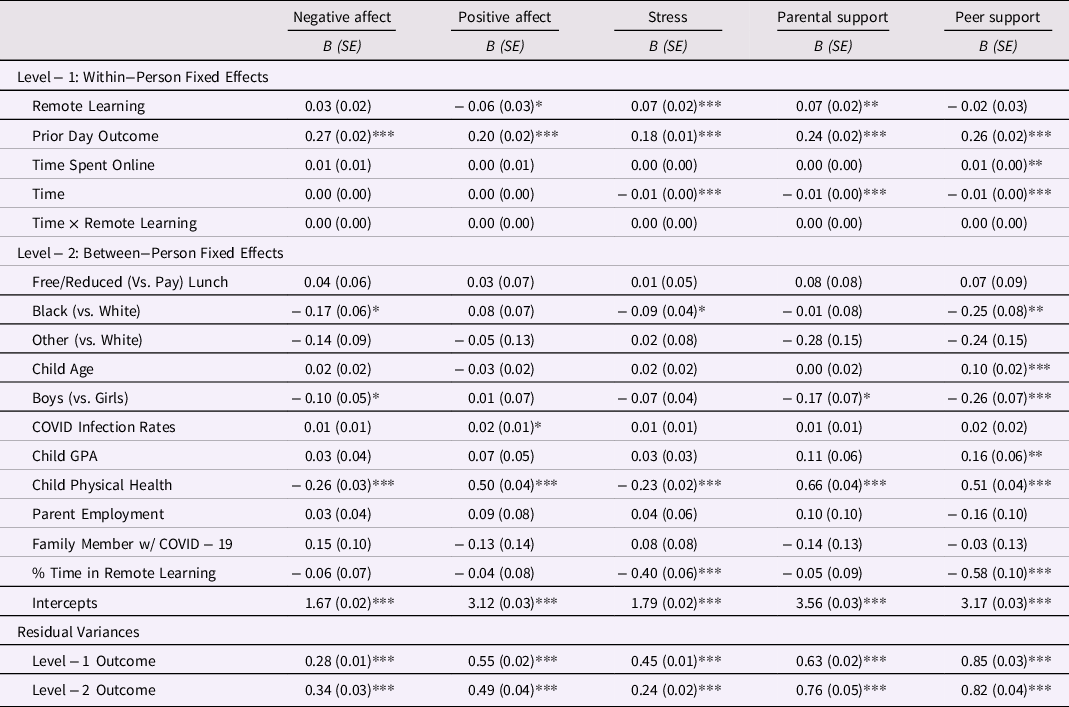
Within-person findings of mixed models examining predictors of psychological well-being outcomes are displayed in Table 2. Across the entire data set (i.e., all Bursts 1-4), the average daily change rates for negative (B = .00, SE = .00, p = ns) and positive affect (B = .00, SE = .00, p = ns) were not significant, while the average daily change rate for stress was significant and negative (B = −.01, SE = .00, p < .001).
Mixed models examining predictors of psychological well−being outcomes
*p < .05.
**p < .01.
***p < .001.
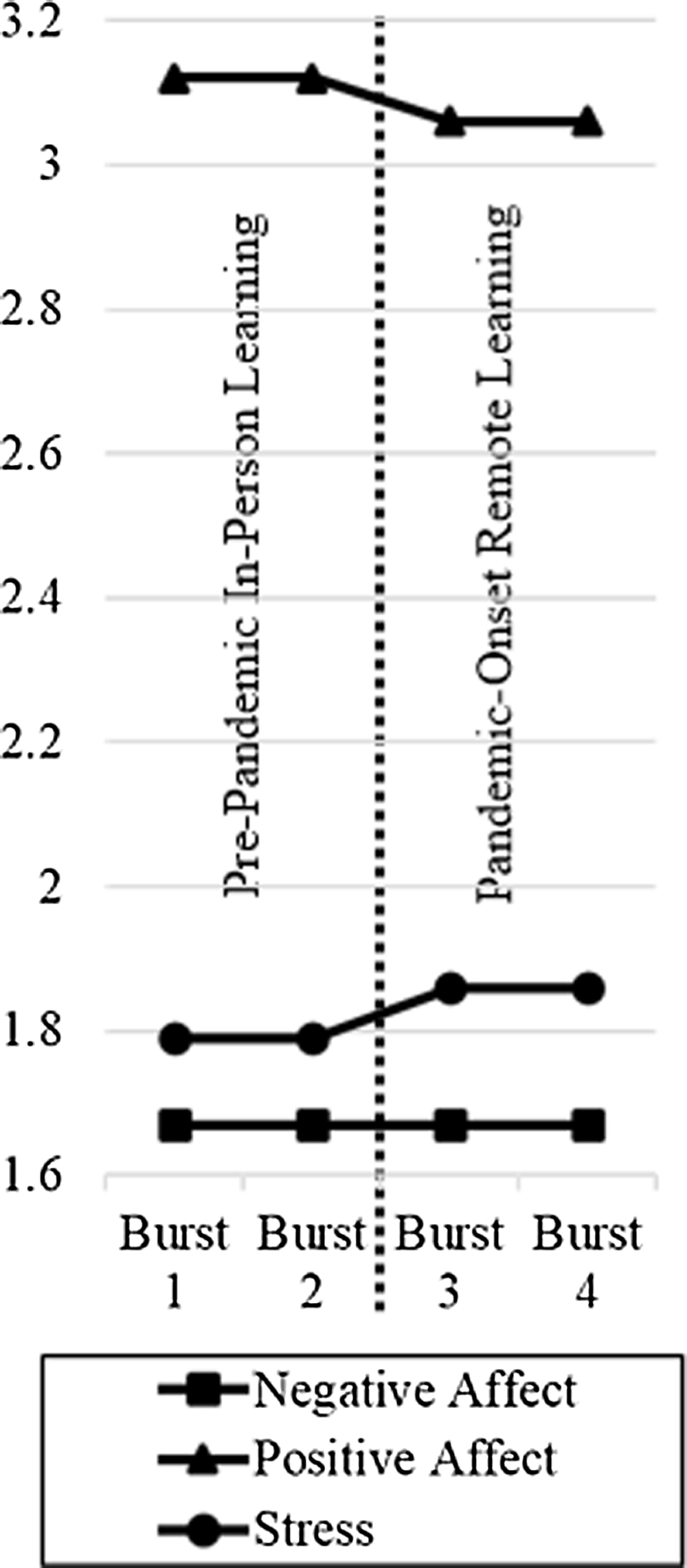
On days when youth attended pandemic-onset remote learning (Bursts 3-4), adolescents reported lower daily positive affect (B = −.06, SE = .03 p < .05) and higher daily stress (B = .07, SE = .02, p < .001), as relative to their own average during pre-pandemic in-person learning (Bursts 1-2). Average daily negative affect was no different on days when youth attended remote vs. in-person learning (B = .03, SE = .02, p = ns). See Figure 1 for a graphical representation of data patterns across Bursts 1-4.
Data patterns across bursts 1–4. This figure represents the trajectory of negative affect, positive affect, and stress across data collection bursts 1–4. Change over time during in-person learning was not significantly different than change over time during remote learning; however, students reported significantly lower positive affect and higher stress during remote learning.
Between-person findings
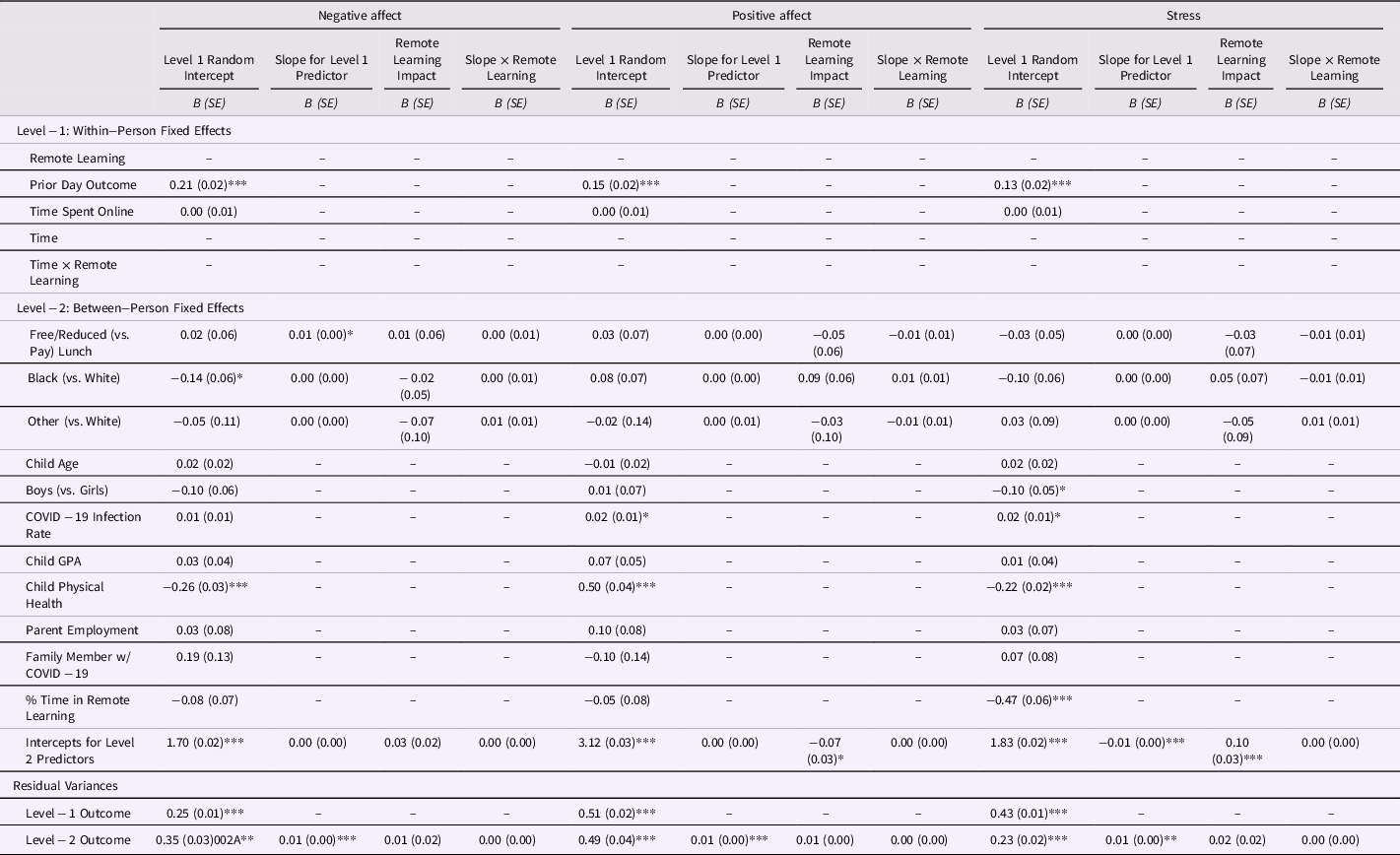
Table 3 presents between-person differences in the effect of remote learning on daily outcomes and change rates by race and SES. The effect of remote learning on affect and stress was not significantly different among Black vs. White youth (negative affect: B = −.02, SE = .05, p = ns; positive affect: B = .09, SE = .06, p = ns; stress: B = .05, SE = .07, p = ns). Average daily change rates were not significantly different between Black and White youth during remote (vs. in-person) learning (negative affect: B = .00, SE = .01, p = ns; positive affect: B = .01, SE = .01, p = ns; stress: B = −.01, SE = .01, p = ns).
Mixed models examining predictors of psychological well−being outcome’s latent intercept, slope, within−person impact of remote learning, and the interaction between the slope and the within−person impact of remote learning
*p < .05.
**p < .01.
***p < .001.
The effect of remote learning on affect and stress was not significantly different among low- vs. high-income youth (negative affect: B = .01, SE = .06, p = ns; positive affect: B = −.05, SE = .06, p = ns; stress: B = −.03, SE = .07, p = ns). Moreover, average daily change rates were not significantly different between low- and high-income youth during remote (vs. in-person) learning (negative affect: B = .00, SE = .01, p = ns; positive affect: B = −.01, SE = .01, p = ns; stress: B = −.01, SE = .01, p = ns). Although we did not find SES differences in the effect of remote learning on youth’s psychological well-being, the overall average daily change rate for negative affect was significant among low (but not high) SES youth (B = .01, SE = .00, p < .05). That is, youth from low-income backgrounds experienced a significant, positive average daily change rate for negative affect over time, but the trajectory of negative affect was not significant among youth from high-income backgrounds.
Peer and parent social support
Social support during remote vs. in-person learning
Table 2 presents mixed models examining the influence of time and learning condition on parent and peer social support. On days when a student attended pandemic-onset remote learning (i.e., Bursts 3-4), they experienced higher parent support (B = .07, SE = .02, p < .01), as compared to their average daily level of parent support during pre-pandemic in-person learning (i.e., Bursts 1–2). Levels of peer social support were not significantly different on days when youth attended remote (vs in-person) learning (B = −.02, SE = .03, p = ns).
Effects of parent social support on psychological well-being over time
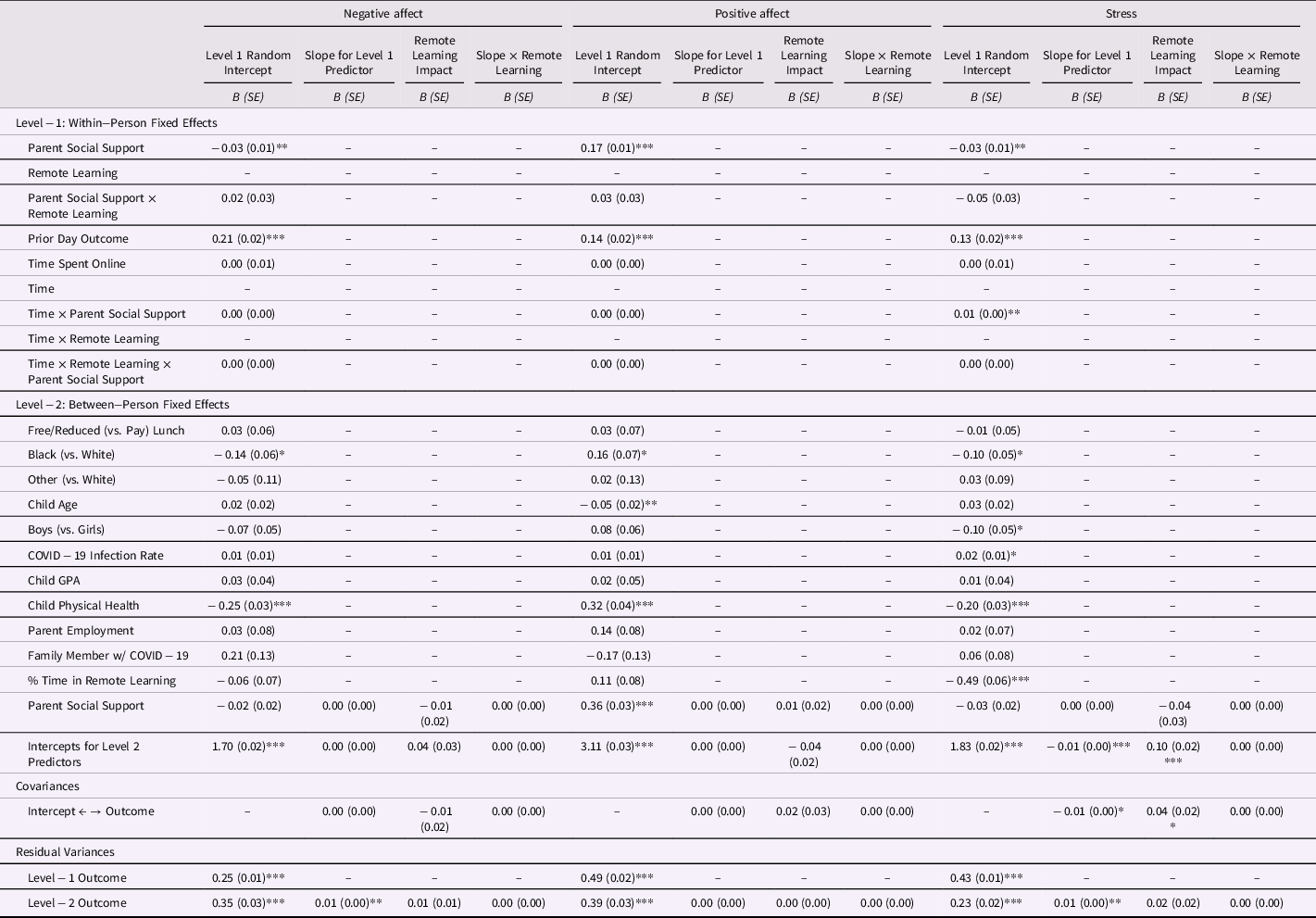
Table 4 presents findings from mixed models examining parent social support as a predictor of psychological well-being outcomes. The within-person effect of parent social support was significant for negative affect (B = −.03, SE = .01, p < .01), positive affect (B = .17, SE = .01, p < .001), and stress (B = −.03, SE = .01, p < .01). In other words, students experienced lower negative affect, higher positive affect, and less stress on days when they reported more parental support. The within-person effect of parent social support was not significantly different during remote (vs. in-person) learning for any outcome (negative affect: B = .02, SE = .03, p = ns; positive affect: B = .03, SE = .03, p = ns; stress: B = −.05, SE = .03, p = ns).
Mixed models examining parent social support as a predictor of psychological well−being outcome’s latent intercept, slope, within−person impact of remote learning, and the interaction between the slope and the within−person impact of remote learning
*p < .05.
**p < .01.
***p < .001.
We also examined the moderating effect of parent support on the average daily change rate. The interaction between time and parent support was not significant for negative (B = 0.00, SE = 0.00, p = ns) or positive (B = 0.00, SE = 0.00, p = ns) affect, but it was significant for stress: The influence of parent support on stress became stronger over time (B = 0.01, SE = 0.00, p < .01). The three-way interaction between time, parent support, and remote learning was not significant for any outcome (negative affect: B = 0.00, SE = 0.00, p = ns; positive affect: B = 0.00, SE = 0.00, p = ns; stress: B = 0.00, SE = 0.00, p = ns).
Effects of peer social support on psychological well-being over time
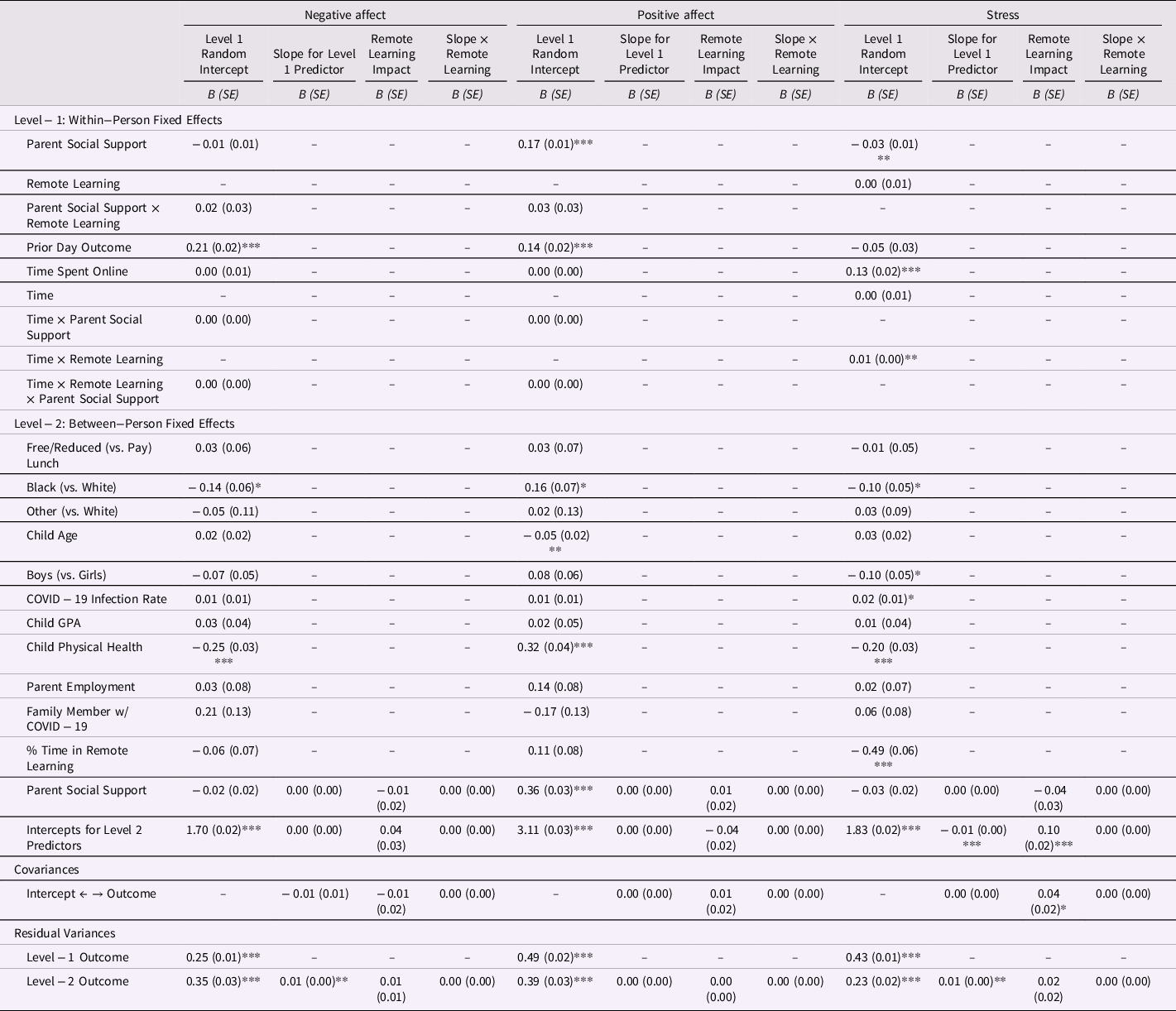
Table 5 presents findings from mixed models examining peer social support as a predictor of mental health outcomes. The within-person effect of peer support was significant for positive affect (i.e., on days when youth experienced higher peer support, they also experienced higher positive affect; B = 0.17, SE = 0.01, p < .001), but daily peer support did not share significant associations with daily negative affect (B = −0.01, SE = 0.01, p = ns) or stress (B = 0.00, SE = 0.01, p = ns). The within-person effect of daily peer social support was not significantly different during remote (vs. in-person) learning for any outcome (negative affect: B = 0.02, SE = 0.03, p = ns; positive affect: B = 0.03, SE = 0.03, p = ns; stress: B = −0.05, SE = 0.03, p = ns).
Mixed models examining peer social support as a predictor of psychological well−being outcome’s latent intercept, slope, within−person impact of remote learning, and the interaction between the slope and the within−person impact of remote learning
*p < .05.
**p < .01.
***p < .001.
We also examined the moderating effect of peer support on the average daily change rate. The interaction between time and peer support was not significant for negative (B = 0.00, SE = 0.00, p = ns) or positive (B = 0.00, SE = 0.00, p = ns) affect, but it was significant for stress: The influence of peer support on stress became stronger over time (B = 0.01, SE = 0.00, p < .01). The three-way interaction between time, peer support, and remote learning was not significant for negative (B = 0.00, SE = 0.00, p = ns), positive affect (B = 0.00, SE = 0.00, p = ns), or stress (B = 0.00, SE = 0.00, p = ns).
Discussion
While studies have examined adolescents’ risk and resilience at the onset of the COVID-19 pandemic, few researchers have attended to the nuanced daily patterns in youth’s psychological well-being or examined the effect of remote learning as a school crisis response on youth’s psychological well-being. By attending to the daily patterns in data collected before and during the pandemic’s onset, we were able to investigate whether trajectories of negative affect, positive affect, and stress were significantly different during pandemic-onset remote learning (vs. pre-pandemic learning conditions). Our data indicate that although adolescents experienced higher daily stress and lower daily positive affect during pandemic-onset remote learning, we did not observe trajectories indicative of declining psychological well-being among a national, racially and economically diverse sample of U.S. adolescents between April 8 and June 1, 2020. That is, daily positive affect levels were lower on days with remote (vs in-person) learning, but they did not continue decreasing over the course of the pandemic’s onset. Similarly, daily stress was higher on days with remote (vs. in-person) learning, but stress did not continue increasing over the course of the pandemic’s onset. These findings have distinct ramifications for youth’s post-pandemic resilience and school crisis contingency planning.
Indicators of risk and resilience during pandemic-onset remote learning
Patterns of positive affect and stress
Compared to their own averages, adolescents reported significantly higher levels of stress and lower levels of positive affect on days when they attended pandemic-onset remote learning compared to days when they attended pre-pandemic in-person learning. While our data do not allow for a more nuanced understanding of the specific components of remote learning that contributed to lower daily positive affect and higher stress, scholars have shown that adolescents faced novel daily stressors – including learning challenges and social isolation (Demaray et al., Reference Demaray, Ogg, Malecki and Styck2020; Styck et al., Reference Styck, Malecki, Ogg and Demaray2021) – during remote learning that likely detracted from their daily psychological well-being. This pattern suggests that the observed drop in positive affect and rise in stress was sudden and likely attributable to the rapid contextual shifts (e.g., transitions to remote learning) in social contexts that reduced opportunities for adolescents to meet their psychological needs for autonomy and relatedness.
Although we did not see youth’s psychological well-being continue to worsen during the data collection period (between April 8 and June 1), remote learning may have still posed threats to youth’s long-term mental health trajectories. When youth experience lower levels of positive affect and higher levels of stress during extended periods of adversity, they tend to have more difficulty recovering from those events (Forbes et al., Reference Forbes, Fitzpatrick, Magson and Rapee2019; Young et al., Reference Young, Sandman and Craske2019). It may be the case, then, that the extended period of low positive affect and high stress experienced during pandemic-onset remote learning contributed to later increases in negative affect as the pandemic progressed. Future research is needed to determine whether the rate at which adolescent’s positive affect and stress rebounded after returning to in-person learning was associated with youth’s psychological well-being during pandemic-onset remote learning.
Patterns in negative affect
Contrary to our hypothesis, adolescents’ average daily negative affect during pandemic-onset remote learning was not significantly different from that reported during in-person learning conditions. This finding stands in opposition to a number of empirical studies showing higher and/or increasing negative affect during the pandemic’s onset (e.g., Barendse et al., Reference Barendse, Flannery, Cavanagh, Aristizabal, Becker, Berger, Breaux, Campione-Barr, Church, Crone, Dahl, Dennis-Tiwary, Dvorsky, Dziura, van de Groep, Ho, Killoren, Langberg and Larguinho2023; Branje & Morris, Reference Branje and Morris2021; Deng et al., Reference Deng, Gadassi Polack, Creighton, Kober and Joormann2021; Janssens et al., Reference Janssens, Achterhof, Lafit, Bamps, Hagemann, Hiekkaranta, Hermans, Lecei, Myin-Germeys and Kirtley2021; Magson et al., Reference Magson, Freeman, Rapee, Richardson, Oar and Fardouly2021; Viner et al., Reference Viner, Russell, Saulle, Croker, Stansfield, Packer, Nicholls, Goddings, Bonell, Hudson, Hope, Ward, Schwalbe, Morgan and Minozzi2022); however, these studies examined pandemic effects more generally, while we isolated the unique effect of pandemic-onset remote learning. We are not aware of any studies that rigorously examined differences between pre-pandemic in-person learning and remote learning at the pandemic’s onset (i.e., spring 2020). As a proxy, we can look to prospective (e.g., Duckworth et al., Reference Duckworth, Kautz, Defnet, Satlof-Bedrick, Talamas, Lira and Steinberg2021) and daily-diary studies (McKellar & Wang, Reference McKellar and Wang2023) examining the effects of pandemic-adjusted learning environments on adolescents’ psychosocial well-being during fall 2020 (Sep to Dec 2020). Youth attending remote learning during fall 2020 reported lower social, emotional, and academic well-being than reported during pre-pandemic in-person learning (Duckworth et al., Reference Duckworth, Kautz, Defnet, Satlof-Bedrick, Talamas, Lira and Steinberg2021), and students tended to report lower levels of engagement and social connectedness on days when they attended remote learning vs. days when they attended in-person learning modalities (McKellar & Wang, Reference McKellar and Wang2023). Each of these indicators of socioemotional and academic well-being tends to share negative connotations for youth’s psychological health and affective state.
Considering that each indicator suggests that remote learning may pose a risk to youth’s mental health, why was higher negative affect not observed in pandemic-onset remote learning? To answer this question, we must try to understand the COVID-19 pandemic through the eyes of adolescents. Due to still developing neurobiology and cognitive skills linked to understanding long-term consequences and complex social problems (Dahl et al., Reference Dahl, Allen, Wilbrecht and Suleiman2018), it may be the case that the full gravity of the COVID-19 pandemic had not yet reified for youth in spring 2020. In addition, the timing of the pandemic’s onset and school closures in the U.S coincided with standard spring breaks in school schedules. The pandemic’s timing was such that many students’ designated spring breaks transitioned directly into pandemic-onset remote learning without ever returning to the in-person learning environment during the 2019–2020 school year. It could be the case that youth became more aware of COVID-19’s severity or grew increasingly weary with remote learning tactics as pandemic circumstances continued. Nonetheless, our data indicate that this increase was not observable in a large, nationally representative sample of U.S. adolescents between April 8 and June 1, 2020.
Pandemic-onset remote learning among vulnerable groups
One of this study’s strengths is its focus on minoritized and marginalized youth, as there is a dearth of literature examining the impact of the pandemic’s onset and remote learning across individuals from heterogeneous racial and economic backgrounds. Regarding racial differences, we did not observe any significant differences in the effect of remote learning among Black vs. White students. Arguably, Black students contended with a higher threat of COVID-19 infection and death in their communities (CDC, 2023) and may have had limited access to community health resources, especially in the wake of school closures (Wright & Merritt, Reference Wright and Merritt2020). It may have been the case that race-based differences in COVID-19 health risks were not yet prominently recognized by Black youth during early stages of the pandemic.
Even if these risks were identified, Black families tend to prepare children to cope with stressors associated with racial inequity via ethnic-racial socialization processes (Hughes et al., Reference Hughes, Rodriguez, Smith, Johnson, Stevenson and Spicer2006). As such, Black youth may have been generally more prepared to cope with pandemic-related stressors, especially those connected with societal injustices and racial privilege. Indeed, recent work has shown how these processes can help youth contend with school-based racialized threats to well-being and academic success (for review, see Wang et al., Reference Wang, Smith, Miller-Cotto and Huguley2020). It is likely the case that Black youth were able to use these socialized practices when contending with racially disproportionate risks during the pandemic’s onset. Future work should examine how family ethnic-racial socialization factors may have influenced minoritized youth’s ability to cope with racial stressors during the COVID-19 pandemic.
As predicted, signs of chronic marginalization – namely, a significant inclining trajectory of negative affect over time – were evident among youth from economically disadvantaged households; however, this inclining trajectory of negative affect did not become steeper during pandemic-onset remote (vs. pre-pandemic in-person) learning conditions. One possible explanation for this finding may lie in the expediency at which pandemic-era financial aid was made available to schools and families. In March 2020, the Coronavirus Aid, Relief, and Economic Security (CARES) Act was passed, and economic impact payments were distributed to families and schools starting in April 2020. It may have been the case that this support was able to buffer against any negative affect arising from the rapidly shifting social and financial landscape during the pandemic’s onset (Wang et al., Reference Wang, Scanlon, Del Toro and Schallin press).
Moreover, schools were quick to use CARES funding to ensure that students had the technological resources to engage in remote learning and used innovative community-based approaches to meeting student needs. For instance, schools would position Wi-Fi-enabled school buses in low-income communities to act as internet hot spots so that students could participate in remote learning. These buses also frequently acted as a hub where low-income students could continue to receive free school lunches, despite the suspension of in-person schooling. Interventionists may find value in examining the numerous ways that schools expedited assistance to students from low-income backgrounds as a case study for responding to these students’ needs during times of crisis. It is also worth noting that these disparities related to food security and equitable access to broadband internet are not isolated solely to crisis situations. Administrators should examine whether solutions borne from necessity to address equity issues during the COVID-19 pandemic (e.g., universal free school lunches; the Emergency Broadband Benefit) are feasible supports during periods of non-crisis.
Parent and peer support as resilience mechanisms
On days when youth had more peer support (as relative to their own average), they experienced more positive affect, but on days when youth experienced higher parent support (as relative to their own average), they had lower negative affect, lower stress, and higher positive affect. These findings are in line with existing literature establishing social supports as a prominent coping asset associated with youth’s psychological well-being (e.g., Campione-Barr et al, Reference Campione-Barr, Rote, Killoren and Rose2021; Coulombe & Yates, Reference Coulombe and Yates2022; Kiss et al., Reference Kiss, Alzueta, Yuksel, Pohl, de Zambotti, Műller-Oehring, Prouty, Durley, Pelham, McCabe, Gonzalez, Brown, Wade, Marshall, Sowell, Breslin, Lisdahl, Dick and Sheth2022; Viner et al., Reference Viner, Russell, Saulle, Croker, Stansfield, Packer, Nicholls, Goddings, Bonell, Hudson, Hope, Ward, Schwalbe, Morgan and Minozzi2022). It is interesting that parent support helped youth downregulate daily negative affect and stress and upregulate daily positive affect while peer support was only associated with the upregulation of positive affect. According to research examining differential effects of parent and peer support on adolescents’ overall psychological well-being, parent (vs. peer) support may present more benefits for students’ psychological well-being during adolescence (Helsen et al., Reference Helsen, Vollebergh and Meeus2000; Stice et al., Reference Stice, Ragan and Randall2004). Even though youth tend to become closer with their peer group as they enter adolescence (Lam et al., Reference Lam, Mchale and Crouter2012, Reference Lam, Mchale and Crouter2014), it is possible that they may withhold certain vulnerabilities from their peers – such as mental health problems characterized by heightened negative affect and dysfunctional stress levels – in attempts to avoid negative stereotypes or "fit in" with a peer group (Telesia et al., Reference Telesia, Kaushik and Kyriakopoulos2020). Peer support, then, may be used as a distraction from stressors that helps youth increase their positive emotional experience, but it appears to do little for alleviating negative affect and stress. Future research should seek to better understand whether, which, and under what circumstances youth tend to benefit from parent vs. peer support.
Social support during pandemic-onset remote learning
On days when youth participated in pandemic-onset remote learning, they experienced higher levels of parent social support. Adolescents were largely homebound during the pandemic’s onset due to the closure of non-essential business in conjunction with transitions to remote learning, thus creating a developmentally atypical social ecology whereby adolescents spent more time with parents than same-aged peers (Bülow et al., Reference Bülow, Keijsers, Boele, van Roekel and Denissen2021; Gadassi Polack et al., Reference Gadassi Polack, Sened, Aubé, Zhang, Joormann and Kober2021). In the current study, this increased time around parents seems to have supported adolescent well-being during pandemic-onset remote learning.
We also expected that with school and community spaces being closed to support social distancing efforts, youth may have had difficulty accessing their peer networks. Indeed, scholars have shown that adolescents tended to experience fewer interactions with peers at the pandemic’s onset (Rogers et al., Reference Rogers, Ha and Ockey2021). However, youth participating in the current study did not experience significantly different levels of peer support during in-person vs. remote learning. It was likely the case that youth turned to virtual spaces to remain connected to their peers, a premise that has been supported by several pandemic-era studies (Drouin et al., Reference Drouin, McDaniel, Pater and Toscos2020; Kerekes et al., Reference Kerekes, Bador, Sfendla, Belaatar, Mzadi, Jovic, Damjanovic, Erlandsson, Nguyen, Nguyen, Ulberg, Kuch-Cecconi, Meszaros, Stevanovic, Senhaji, Ahlström and Zouini2021; Munasinghe et al., Reference Munasinghe, Sperandei, Freebairn, Conroy, Jani, Marjanovic and Page2020). According to our study, adolescents’ peer support was positively predicted by time spent online (B = .01, SE = .00, p < .01; see Table 2), but a recent review found that this time online was associated with both positive and negative mental health outcomes (Marciano et al., Reference Marciano, Ostroumova, Shulz and Camerini2022). Future work should examine these relations more closely to understand how youth’s online activity affected their psychological well-being during the pandemic’s onset.
We did not see the anticipated moderating effect of parent or peer social support on the link between remote learning and youth’s positive affect and stress (i.e., the social support × remote learning interactions were not significant). Social support has been well-established as a protective factor for youth’s psychological well-being during periods of adversity (American Psychiatric Association [APA], 2013; Harrist et al., Reference Harrist, Henry, Liu, Morris, Fiese, Celano, Deater-Deckard, Jouriles and Whisman2019; Masten & Palmer, Reference Masten, Palmer and Bornstein2019); however, our findings seem to align more with compensatory models in the resilience literature whereby a bipolar variable – such as social support – has a main effect on youth’s adaptive functioning (Masten, Reference Masten2014). It may have been the case that youth’s social supports stepped up to compensate for deleterious effects of remote learning during the pandemic’s onset. As extant literature has indicated declining mental health among youth over the course of the pandemic, adolescents may not have been adequately equipped to help their peers contend with shared educational stressors during pandemic-onset remote learning, and parents may have been too busy contending with the chaos of school closures and disrupted family routines amidst a rapidly worsening disaster to provide support strong enough to have an impact on youth’s extended well-being trajectories. More research is needed to understand how the quality of parent and peer social support and its effect on psychological outcomes may have changed as the pandemic progressed.
The lack of moderating effects may also be associated with the rapidly changing circumstances at the pandemic’s onset. Indeed, the role of variability within longitudinal studies of youth’s peri-pandemic psychological well-being has been highlighted in McMahon et al.’s (Reference McMahon, Villaume and Adam2023) recent systematic review. In the early pandemic, many families encountered new challenges each day, thereby creating a wild variability in environmental circumstances that may have made detecting linear patterns in affect and stress difficult. Hence, it is possible that this variability obfuscated our ability to detect the unique effects of remote learning. Alternatively, the ability to detect moderator effects requires that individuals or time periods have distinctly different threat levels. Considering students’ ubiquitous reports of elevated stress and decreased positive affect, our inability to detect a moderator effect may be due to the lack of heterogeneity in our outcomes from one day to the next.
Although more research is needed to understand the nuances in parent and peer social support, it may be prudent for researchers to examine the role of teacher support in mitigating the effects of disaster-initiated remote learning on their students’ mental health, especially considering that teacher connectedness appears to exert a strong influence on youth’s academic (McKellar & Wang, Reference McKellar and Wang2023) and psychological (Duckworth et al., Reference Duckworth, Kautz, Defnet, Satlof-Bedrick, Talamas, Lira and Steinberg2021) well-being during remote learning. Teachers are – in theory – better suited to provide educational support to students due to their pedagogical training and experience in helping youth overcome learning challenges. Indeed, adolescents have reported that pandemic-era remote learning was more difficult due to limited interactions with teachers, classmates, and other school-based social and educational supports (Esposito et al, Reference Esposito, Giannitto, Squarcia, Neglia, Argentiero, Minichetti, Cotugno and Principi2021; Styck et al., Reference Styck, Malecki, Ogg and Demaray2021), and teacher connectedness has been shown to moderate the impact of pandemic-era school adjustments on students’ academic engagement in fall 2020 (McKellar & Wang, Reference McKellar and Wang2023). Additional work is needed to understand which and how social supports are essential for youth during periods of remote learning.
Implications for the use of remote learning as a school crisis response
The use of remote learning during the COVID-19 pandemic changed the landscape for schools’ emergency contingency planning, as remote learning is now being implemented for short- and long-term emergencies ranging from inclement weather to recovery efforts following school or community violence. Educators have made this integration without evidence for how remote learning may impact youth’s psychological well-being when used over extended periods of time during a cascading, multisystemic disaster. Considering that youth (and adults) are at their most vulnerable during crisis scenarios, it is critically important that we understand the implications of remote learning when used as an emergency response to extended school closures. Remote learning did indeed pose risks to youth’s immediate psychological well-being via higher stress and lower positive affect, and these effects were universal across race and SES groups, at least at the onset of the pandemic.
In the future, those working with adolescents should recognize the potential for a drastic rise in stress should they face a similar disaster scenario that restricts access to the in-person learning environment. Moreover, school crisis response teams should be aware of the risk for decreased positive affect and increased stress during remote learning when used as a part of contingency planning. For educators, mental health professionals, and youth workers, it may be wise to proactively incorporate socioemotional learning (SEL) opportunities structured around stress reduction into youth’s daily activities – including classroom activities during remote learning when used as a school crisis response – to better prepare them for unpredicted stressors. Stress management activities may also be essential during periods of remote learning when it is used as an option for youth who experience extended periods of isolation from the in-person learning environment due to personal circumstances (e.g., chronic illness). One such response may take the form of daily surveys or “check-ins” that allow youth to track their stress, affect, and coping mechanisms over time. Should educators embed such practices within their remote learning lessons, they may be able to keep a better pulse on their students’ psychological well-being in the absence of face-to-face interactions, thus allowing for timely psychosocial intervention for students displaying concerning levels of positive affect or stress.
Based on our social support findings, parents (vs. peers) may have been a more available social support to contend with day-to-day mental health struggles. Administrators in charge of school crisis responses should be cognizant of the role that parents have in supporting their child’s psychological well-being during periods of school closures requiring remote learning. One such way that schools can help parents support their child’s well-being during periods of crisis-related remote learning is through clear, frequent, and timely communication (Kerr & King, Reference Kerr and King2018). If remote learning is a part of a schools’ crisis response planning, then administrators may also want to consider a proactive approach that orients parents to the school’s remote learning platform so that they can (a) help their child navigate the platform and (b) use the platform to monitor their child’s educational progress during remote learning.
In addition, schools should attempt to foster opportunities for youth to interact with peers virtually as a means of upregulating positive affect during periods of adversity. For instance, it may be wise to proactively integrate recreational or social opportunities (e.g., online games) into remote learning activities so that youth have the option to seek out and receive peer support in virtual educational spaces. Considering that isolation from classmates during pandemic-era remote learning has been associated with lower levels of psychosocial functioning (Duckworth et al., Reference Duckworth, Kautz, Defnet, Satlof-Bedrick, Talamas, Lira and Steinberg2021; McKellar & Wang, Reference McKellar and Wang2023), the integration of social supports into remote learning may be a way to support adolescents’ academic and socioemotional functioning, especially when these learning modalities are used as a part of school crisis contingency planning.
Limitations
While this study uses an economically, racially, and geographically diverse sample and a rigorous, repeated measures design to assess adolescents’ affect, stress, and social supports during pre-pandemic in-person learning and pandemic-onset remote learning, results should be interpreted with the following limitations in mind. First, our within-person comparisons offer strong support for our findings, but findings are not causal and should not be interpreted as such. Although the investigation of adolescents’ psychological well-being during remote learning when used as a disaster contingency may not be testable through randomized controlled trials, future studies may consider using propensity matching approaches to identify the causal effects of disaster-related remote learning on youth’s daily adjustment.
It is also important to note that the provision of remote learning during the pandemic’s onset should not be equated with traditional virtual schooling. Virtual learning programs involve meticulously crafted curricula that thoughtfully integrate opportunities for prosocial collaboration. Remote learning instituted during the pandemic’s onset has been described by some as a “panic response” whereby teachers used their best judgement and on-hand resources to rapidly adapt in-person curricula to some type of home-schooling format (e.g., synchronous or asynchronous virtual learning; take-home packets) so that students could complete their required educational hours for the 2019–2020 school year (Lee, Reference Lee2021). To be clear, the findings presented here apply specifically to the effects of remote learning as an extended crisis response rather than pre-planned periods of remote learning or full-time enrollment in cyberschool. Furthermore, our results are limited to understanding the effects of remote learning during the pandemic’s onset (as opposed to more structured remote learning during the 2020–2021 school year). It is critical that researchers continue to document adolescents’ trajectory of psychological well-being beyond the COVID-19 onset to fully understand the potential long-term impact of remote learning on youth’s adjustment as pandemic conditions continued into the 2020–2021 school year.
There were also limitations pertaining to the shortened, repeated self-report measures used during our data collection. Our abbreviated assessments may have masked nuances in certain affective states and restricted our ability to investigate specific stressors; however, these methodological decisions were in line with best practices in daily-diary research aimed at reducing participant burden and fatigue (Bolger & Laurenceau, Reference Bolger and Laurenceau2013). In addition, extremely small daily change rates can be a manifestation of participant fatigue in daily-diary studies involving large time spans (Bolger & Laurenceau, Reference Bolger and Laurenceau2013). We attempted to reduce the potential for this issue by giving participants breaks between daily-diary bursts, but it is still possible that adolescents became fatigued over time, possibly explaining some of the small-but-significant daily change rates observed in this study.
While our approach allowed us to speak to youth’s more general affective state during pandemic-onset remote learning, future studies should use more nuanced measures and multi-informant approaches to tease out granular differences in psychological well-being. Finally, future studies may want to include youth’s level of perceived social isolation as a covariate to investigate the interplay between social support and social isolation during periods of school closures.
Conclusion
Remote learning at the onset of the COVID-19 pandemic presented an unprecedented risk factor for youth’s psychological well-being due to its disruption of daily school routines, educational opportunities, and social interactions. Our findings present initial evidence that U.S. adolescents universally experienced higher daily stress and lower daily positive affect during pandemic-onset remote learning (vs pre-pandemic in-person learning). Although we did not see evidence of declining trajectories of psychological adjustment over time, conditions in which youth experience lower positive affect alongside higher stress are concerning for youth’s post-pandemic mental health recovery, as sustained levels of high stress and low positive affect are linked to an increased risk for depression, anxiety, and post-traumatic stress over time (Forbes et al., Reference Forbes, Fitzpatrick, Magson and Rapee2019; Young et al., Reference Young, Sandman and Craske2019). Parents, educators, mental health professionals, and others who interact with youth should be aware of the sustained effects of pandemic-onset remote learning on adolescents’ daily positive affect and stress, with the understanding that youth were universally put at risk for future mental health issues by the changes in social settings and interpersonal interactions experienced during the early months of the COVID-19 pandemic.
This study also shed light on the role of social support in adolescents’ well-being during remote learning. Although we did not find a significant moderating effect of social support on the impact of remote learning on adolescents’ well-being, higher levels of parent support were associated with lower negative affect, lower stress, and higher positive affect, while more peer support was linked to increased positive affect. These findings suggest that parents and peers can provide valuable support to adolescents during remote learning, and we suggest integrating SEL opportunities and virtual social interactions into remote learning activities to help promote students’ psychological well-being.
Data availability statement
The datasets generated and/or analyzed during the current study are not publicly available, but they are available from the corresponding author on reasonable request.
Author contribution
Scanlon and Del Toro made equal intellectual contribution to the manuscript; hence, they share second authorship.
Funding statement
National Science Foundation # 1920766 and 1561382; Institute of Education Sciences #R305A220236. The opinions expressed are those of the authors and do not represent the views of the National Science Foundation, the Institute of Education Sciences, or the U.S. Department of Education. Funding sources had no such involvement in the collection, analysis, or interpretation of data; in the writing of the report; and in the decision to submit the article for publication.
Competing interests
None.


 Open access

