


Introduction
The prevalence of atrial fibrillation (AF) is 2% in the general population and increases significantly with age. Reference Zoni-Berisso, Lercari, Carazza and Domenicucci1–Reference Misayaka, Barnes, Gersh, Cha, Bailey and Abhayaratna3 A quarter of all the strokes are caused by AF. Atrial fibrillation is associated with more than a fivefold increased risk of stroke. Reference Wolf, Dawber, Thomas and Kannel4,Reference Mahajan, Perera and Elliott5 The risk of stroke in patients with AF can significantly be reduced with anticoagulant treatment. Reference Birman-Deych, Radford, Nilasena and Gage6,Reference Verheugt and Granger7 Warfarin and direct oral anticoagulants (DOACs) are the main choices for anticoagulation. Warfarin is recommended in patients with valvular AF. In nonvalvular AF, however, DOACs are preferred as they do not require regular monitoring and blood work. Reference Gómez-Outes, Terleira-Fernández, Calvo-Rojas, Suárez-Gea and Vargas-Castrillón8
Interruptions in anticoagulation are frequent for a variety of medical and surgical reasons and may occur in 15% of patients annually. Reference Flaker, Theriot, Binder, Dobesh, Cuker and Doherty9 Adherence to perioperative management guidelines for anticoagulation interruption is useful to avoid the increased risk for postoperative bleeding or embolic events including embolic stroke. Reference Douketis, Spyropoulos and Spencer10 These guidelines consider the half-lives of the drugs, the renal function of the patient, and the bleeding risk associated with the type of surgery or procedures. Reference Douketis, Spyropoulos and Spencer10,Reference Roldán, Marín and Manzano-Fernández11
There are only a few studies that have reviewed adherence to anticoagulation but have rarely looked specifically at high-risk patients, especially those with a prior history of stroke. Reference Wamala, Scott and Caney12,Reference Jiang, Suen, Ho, Ching, Chan and Mak13 In the ROCKET AF study, temporary interruptions of anticoagulants were frequent, and this was associated with an increased risk of stroke and bleeding. Reference Sherwood, Douketis and Patel14 There is, however, limited data on the adherence to perioperative anticoagulation guidelines for invasive procedures and the risk of embolic complications in patients with AF and prior stroke, and this requires further study.
We studied adherence to the Thrombosis Canada Perioperative guidelines for the interruption of anticoagulation in high-risk patients with AF presenting to stroke clinic with a presumed diagnosis of stroke or transient ischemic attack (TIA) and assessed the risk of recurrent stroke when the recommended guidelines were not followed.
Methods
The study was approved by the research ethics board at the University of Alberta (Pro00058908). The patients referred to the Stroke Prevention Clinic (SPC) at the University of Alberta Hospital, Canada were approached for participation in this study if they had a known diagnosis of AF and a history of ischemic stroke/TIA. Participants provided informed consent at the time of enrollment.
Patient Survey
Patients who were referred to the stroke clinic and were on anticoagulation medication for their AF were sent a mail to ask them to participate in a survey. After consent, the data were collected prospectively from the patients using a survey case record form created specifically for the study. The collected data included demographic variables, vascular risk factors, CHADSVASc score, types of clinical events (stroke or TIA), type of anticoagulant used, type of surgical and invasive procedure, duration of the anticoagulation interruption, and reasons for the interruptions. The survey was conducted from 2016 to 2019. At the time of enrollment, all patients were on anticoagulants for secondary prevention.
Collection of Data and Patient Charts
After the survey was complete, responses were collected and manually inputted and organized into an excel document. After inputting this data, missing information in one of the areas was later filled in with follow-up phone calls. Patient self-reported information along with verification using online medical records were used to verify the date and length of discontinuation of anticoagulation. Patients who had to interrupt their anticoagulation due to an invasive procedure or surgery were then analyzed to see if they suffered a stroke within 30 days of their procedure/surgery. In addition to looking at patients who interrupted their anticoagulation due to surgery or invasive procedures, we also looked at patients who interrupted their anticoagulation due to other reasons such as bleeding, patient preference, and doctor’s preference. Only the surgeries and interruptions at the time of the survey were assessed, not subsequent interruptions after. This is a cross-sectional study with patients called after to fill in information that was missed during the survey.
Thrombosis Canada Guidelines
The Thrombosis Canada Guidelines (2017–2018) for the interruption of anticoagulation before surgery or invasive procedure and the safe resumption of those anticoagulants after the procedure were used as a reference standard in our study. 15 We used these guidelines to assess if adherence was followed for minor and major surgeries. Briefly, it is recommended that DOAC’s not be interrupted for low-bleed risk procedures. There is, however, an option to interrupt DOACs the day of/or 4–6 hours postoperatively for low-bleed risk procedures. For moderate bleed risk procedures, interruptions for 48 hours (a day before and after the procedure) are recommended. Similarly, the recommendation for high-risk procedures for the interruption of DOACs is 5 days (2 days before the procedure and 2–3 days after). For Warfarin, the guidelines recommend stopping 5 days before surgery and resume after when the patient is at homeostasis and can drink fluids. 15 Most major procedures require warfarin interruption but minor procedures (e.g., dental or cataract surgery) do not.
We then looked to see if the patient’s anticoagulation discontinuation time deviated from the recommended guidelines. We classified appropriate adherence as those who followed the guidelines for discontinuing and reinitiating anticoagulation treatment. Nonadherence was classified when the anticoagulation interruption or reinitiation did not adhere to the perioperative guidelines.
Because our study spanned from 2016 to 2019, we looked to see if there were any changes in the guidelines. There was a minimal change in the guidelines from 2016 to 2019, a change of one day added postoperatively in the high-risk procedures during the 2019 guidelines when compared to the latter years. We took this change in guidelines into consideration and observed that the addition of the one-day postoperative delay did not change our results.
Statistical Methods
Statistical analysis was done through Microsoft Excel. From the main group of 509 patients, we created a subgroup of patients who had their anticoagulation treatment discontinued for multiple reasons. Microsoft Excel was used to calculate the baseline characteristics, means, percentages, and standard deviations of these two groups. Both groups’ characteristics were compared to see if any differences were found.
Results
Baseline Characteristics
A total of 532 patients were approached, and 23 individuals declined to be involved in this study. A total of 509 patients were enrolled in this study from the Stroke Prevention Clinic (SPC) at the University of Alberta hospital between January 2016 and December 2019. As part of our inclusion criteria, all patients had a diagnosis of AF and a history of a TIA or previous stroke. Baseline characteristics are detailed in Table 1. The mean age was 73 ± 10.3 years, and 185 (36.5%) were female. The average CHADSVASc score for the population was 4.77 ± 1.59. Most patients were treated with DOACs (Rivaroxaban [33.2%], Apixaban [20.3%], and Dabigatran [15.4%]). The most common vascular risk factors were hypertension (76.1%) and dyslipidemia (64.4%). Anticoagulation was interrupted in 150 (29.47%) patients. The subgroup was a fair representation of the study population, and no significant differences were found in their baseline characteristics.
Baseline characteristics

This table shows the baseline characteristics of the patients enrolled in this study. The baseline characteristics include the age, gender CHADSVASc score, the type of anticoagulant taken, co-morbidities, and the type of stroke suffered. This table also compares the total patients in the study with the subcategory of patients that had their anticoagulation medication temporally interrupted due to reasons such as surgical or invasive procedures, bleeding events, patient preference, and doctor preference.
* Prior MI, Peripheral artery disease, Aortic plaque.
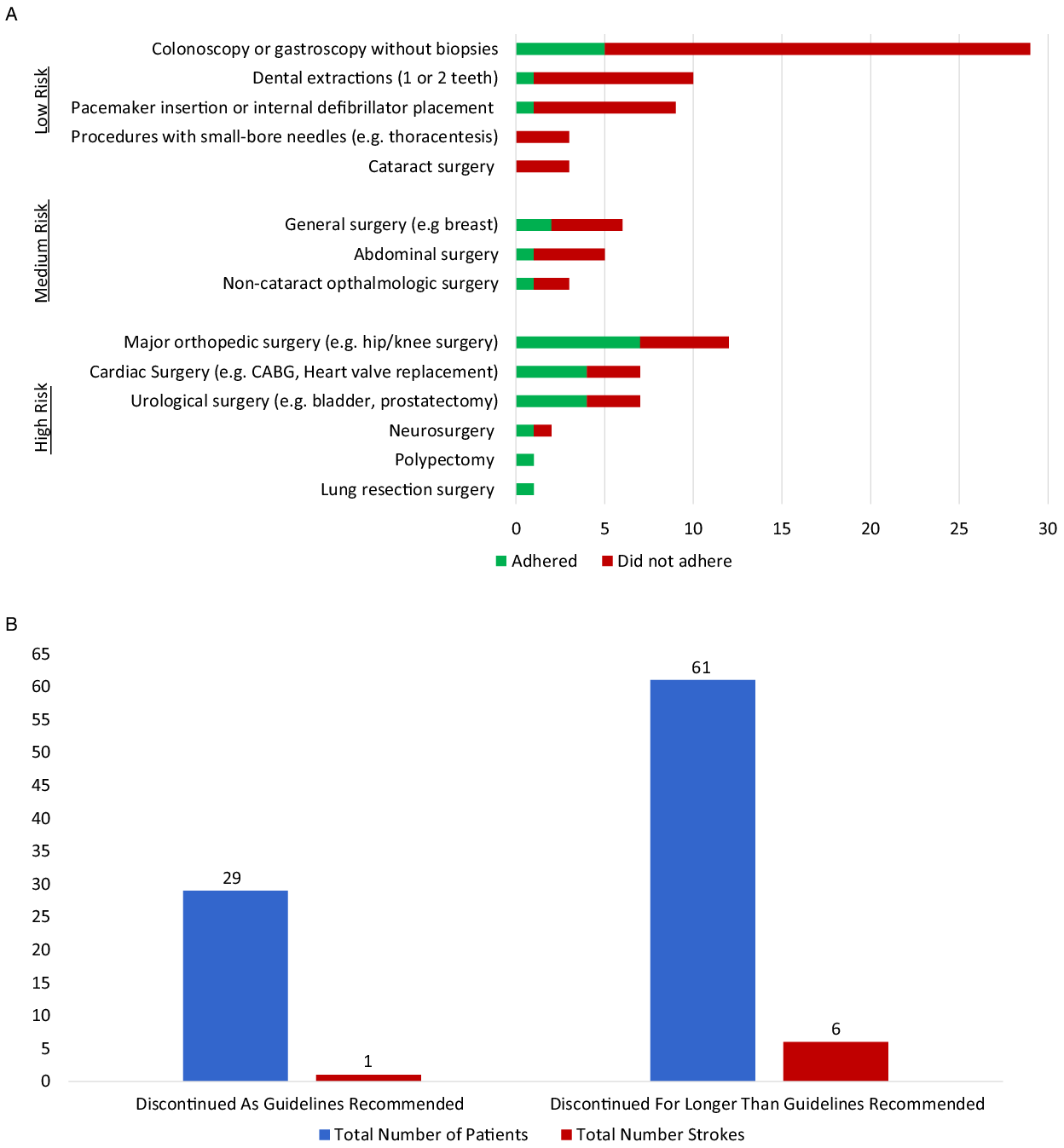
Interruption of anticoagulation treatment included invasive and surgical procedures, bleeding, patient preference, and doctor preference as shown in Figure 1. The patients were separated into two main groups; patients who continued their anticoagulation treatment (n = 359) and those who had anticoagulation interruptions and/or discontinuations (n = 150). The patient data were incomplete in 16 subjects, and they were excluded from the analysis. Among the 150 patients, medications were interrupted due to surgeries or invasive operations in 98 patients and other reasons (for example, anticoagulation-related bleeding, patient preferences, or doctor preferences) in 36 patients. The bleed risk category for the surgical and invasive procedures of the 98 patients according to the Thrombosis Canadian Guidelines is shown in Figure 2a. The majority of patients underwent low-bleed risk procedures (55.1%) including colonoscopies, gastroscopy, or teeth extractions. This was followed by high-risk procedures (34.7%) and then medium-bleed risk procedures (10.2%). Figure 1 shows that adherence to guidelines was evident in only 29/98 patients (29.5%). In 69/98 patients (70.4%), the interruption/reintroduction of medications did not adhere to the guidelines. In these 69 patients, the anticoagulant medications were restarted later than the recommended period in 61 (62.2%) patients, and the medication was restarted earlier than recommended by guidelines in 8 (8.1%) patients.
This figure is a flow chart of the patients enrolled in this study. A total of 509 patients were enrolled with 150 of those patients temporarily interrupting their anticoagulation treatment. Of these 150 patients, 16 patient data were not conclusive, 36 patients discontinued for non-operation reasons and 98 patients interrupted their anticoagulation treatment due to surgical or invasive procedures. Of these 98 patients who had their anticoagulation interrupted, 29 (29.6%) patients adhered to the perioperative guidelines while 69 (70.4%) did not adhere to the guidelines.

(A): Categorizes the surgical and invasive procedures depending on the bleed risk of the operation. From the figure, it can be seen that the low-bleeding risk group shows the greatest nonadherence with 47/54 patients not adhering to the guidelines, followed by the medium-bleed risk group that showed nonadherence in 10/14 patients, and finally the high-bleed risk group where 12/30 patients did not adhere to the guidelines. The majority of the low-bleed risk procedures included colonoscopies and gastroscopies, followed by dental extractions. (B): Shows that the number of patients who adhered to the perioperative guidelines while undergoing a surgical or invasive procedure is 29, and the number of patients who did not adhere to guidelines by interrupting their anticoagulation treatment longer than what was recommended by the guidelines was 61. The risk of a stroke 30 days postoperatively in patients who adhered to guidelines was 1/29 or 3.4%, and the number of patients who suffered a stroke in the group that interrupted their anticoagulation treatment for longer than what the guidelines recommended was 6/61 or 9.8%.
Risk Category of Procedures and Adherence Rates
We evaluated the adherence rates in the low-bleeding risk, medium-bleeding risk, and high-bleeding risk procedures which are shown in Figure 2a. In the low-bleeding risk group, 47/54 (87%) patients did not adhere to the perioperative guidelines. Analyzing patients who underwent surgical procedures with medium-bleeding risk, 10/14 (71.4%) of the patients did not adhere to the guidelines. Greater adherence was shown in the patients undergoing high-bleeding risk operations as only 12/30 (40%) of patients did not adhere to the perioperative guidelines. From the three groups, the greatest nonadherence was shown in the low-bleeding risk group with the majority of patients undergoing colonoscopies or gastroscopies.
There were 7 of 98 patients who suffered a stroke when their anticoagulants were temporarily interrupted (three underwent a low-bleeding risk procedure, two underwent a medium risk procedure and two underwent a high-bleed risk procedure). The details of the individual patient information are shown in supplemental table 1.
Stroke Risk
Figure 2b shows that during the 30-days postprocedure time, 6 of 61 (9.8%) patients in the group that did not adhere to guidelines by discontinuing their anticoagulants for longer than what was recommended suffered a stroke. This compares to only 1 of 29 (3.4%) patients in whom the interruption of anticoagulation adhered to recommended guidelines. There were no strokes or hemorrhages in the group in whom the medication was reinitiated earlier than what was recommended.
Characterization of Patients Who Had a Stroke or TIA
The age range of the patients with ischemic stroke was between 55 and 84 years (female: 2, male 5). The stroke or TIAs were in cortical distribution suggestive of an embolic event in all patients. Investigations showed no evidence of carotid disease in any patients on vascular imaging. The anticoagulants discontinued were DOACs in five patients and warfarin in two patients. The details of the individual patient information are shown in supplemental table 1.
Interruption for Other Reasons
Thirty-six patients interrupted/discontinued their anticoagulation due to nonsurgical-related reasons, including suspected anticoagulation-related bleeding, patient preference, and doctor’s preference (deemed to be high risk for bleeding). Here, the anticoagulation interruption was defined as interrupting for nonprocedural reasons, even if this was missing one dose. Anticoagulation was interrupted in 19/36 (53%) of the patients due to suspected anticoagulation-related bleeding complications, including brain hemorrhage (8/19 or 42.1%), hematoma (3/19 or 15.8%), bleeding from an injury or surgical site (3/19 or 15.8%), hematuria (2/19 or 10.5%), and gastrointestinal bleeding (3/19 or 15.8%). Medications were interrupted due to personal preference in 9/36 (25%) of patients. The medications were interrupted in 5/36 (14%) due to physician preference, reasons included the physician being reluctant to restart the anticoagulants due to side effects. The remaining 3/36 (8%) interrupted due to forgetting to take medication and drug interactions. During follow-up, ischemic stroke was evident in 5/19 patients in the group with a previous history of bleeding and in 4/14 patients who stopped due to personal or doctor preference. The details of the individual patient information are shown in supplemental tables 2 and 3.
Discussion
Our study showed that out of 509 patients who had AF and a prior stroke,150 discontinued their anticoagulation treatment. Of those 150 patients, 98 were discontinued due to surgical and invasive procedures. When checking for adherence to the Thrombosis Canada guidelines in these 98 patients, only 29 patients adhered to the guidelines while 69 did not. The 30-day postoperative stroke rate was 1/29 in patients who adhered to guidelines and 6/61 in patients who discontinued anticoagulation for longer than what was recommended. The greatest nonadherence was seen in low-bleeding risk groups.
Atrial fibrillation is an important preventable cause of stroke. Regular and long-term anticoagulation is highly effective in the prevention of stroke in patients with AF. The introduction of the newer DOACs has made long-term anticoagulation easier to administer. Reference Gómez-Outes, Terleira-Fernández, Calvo-Rojas, Suárez-Gea and Vargas-Castrillón8 The majority of patients with nonvalvular AF are elderly who very frequently require interruption of anticoagulation for medical or surgical procedures. Reference Flaker, Theriot, Binder, Dobesh, Cuker and Doherty9 Interruption and reinitiation of anticoagulation, if not done as is recommended in the guidelines may increase the risk of systemic embolism and stroke.
To our knowledge, this is the first study to specifically evaluate the risk of stroke in patients with AF and previous history of TIA or stroke. Although the number of patients is small in the study, the trends observed are worrisome. We observed that 70.4% of patients who were undergoing a surgical procedure did not adhere to the recommendations of the Canadian guidelines. The majority of patients had longer interruptions of their anticoagulants than what was recommended by the guidelines. We also observed that the suboptimal adherence to the guidelines was especially high in the group of patients in whom the procedures were deemed "low risk of bleeding" according to the guidelines. The risk of stroke was significantly higher in patients in whom the reinitiating of anticoagulants was delayed beyond the guideline’s recommendations. Another observation was that patients often stopped anticoagulants for bleeding (in most instances not serious), and personal or physician recommended reasons exposing the patients to an increased risk of stroke.
In the ROCKET AF trial, the rate of discontinuation of anticoagulants was studied. Reference Sherwood, Douketis and Patel14 Temporary interruptions were common and documented in 4692/14236 (33%) of patients, with the total number of interruptions being 7555. Frequent reasons for interruption included surgical/invasive procedures (2997/7555 or 39.7%), adverse nonbleeding event (1874/7555 or 24.8%), subject error (1366/7555 or 18.1%), adverse bleeding events (995/7555 or 13.2%), logistic difficulty (499/7555 or 5.9%), and site error (48/7555 or 0.6%). Among the temporary interruptions for surgical reasons, the common conditions included colonoscopies and gastrointestinal endoscopic procedures. The 30-day stroke or systemic embolism rates during the at-risk period (1–30 days after resumption) were 0.30% for rivaroxaban-treated and 0.41% for warfarin-treated participants.
In another study, Wamala et al. evaluated the perioperative adherence in patients taking DOAC, who had to interrupt the medication due to a surgical procedure. While most patients included in the analysis had AF (75.3% of the patients), only a small fraction had suffered a previous stroke or TIA (18.7% of patients). Reference Wamala, Scott and Caney12 Similar to our study, the adherence to anticoagulation interruption was low with the perioperative guidelines (59/150 or 40% did not adhere). Anticoagulation was stopped in patients who underwent high- and low-bleed risk procedures, but nonadherence (59/150) was shown only in the low-bleeding risk group.
A polypectomy study by Jiang et al. looked at the adherence of anticoagulation interruption in patients undergoing colonoscopies and polypectomy procedures. Atrial fibrillation was present in 22.1% of patients and only 15.8% of patients had a history of a prior stroke. Reference Jiang, Suen, Ho, Ching, Chan and Mak13 Also, the majority of antithrombotic medication used in this study was aspirin alone (439/602 or 72.4%), with only 24% using DOACs or warfarin. This study found that of the 97 cases on DOACs, only 5.2% of clinicians fully adhered to the guidelines. Nonadherence to recommendations was associated with an increased risk of the development of serious cardiovascular events. Nonadherence for low-bleed risk procedures like colonoscopies was high in the study. In an interesting survey of 945 specialists in the US, the options to interrupt DOAC in patients with low-bleeding risk were evaluated. In more than 50% of the cases, specialists chose to interrupt anticoagulants in patients with low-bleeding risk procedures. Reference Flaker, Theriot, Binder, Dobesh, Cuker and Doherty9
There are limitations to our study. While the data were collected prospectively, the analysis is retrospective, and we may have missed events in some patients. This is, however, unlikely as such events would have been reported to our stroke prevention clinic in the event of a new stroke. We realize that the number of patients who suffered a stroke is small. We however feel that despite the small numbers, the high rates of nonadherence to guideline recommendations, especially in patients with minor or low-risk procedures is worrisome and requires attention. Another limitation was that not all patient’s medical charts were looked at for possible procedural complications. Patient’s charts were reviewed for possible procedural complications only in patients who had a stroke while discontinuing their anticoagulation, in none of these charts was the delay in anticoagulation reinitiation because of intraoperative complication or side effect.
Conclusion
There is limited data on adherence to recommended guidelines for temporarily interrupting anticoagulation treatment for surgical or medical procedures in high-risk anticoagulated AF patients with a history of TIA or stroke. We review our experience in AF patients with a history of TIA or stroke and show that interruption of anticoagulation treatment is common in AF patients. We also show that temporary interruption of anticoagulation is very frequently delayed following the surgery/procedure, and this may result in an increased risk of stroke. Increased emphasis is required for following guidelines to reduce the risk of recurrent stroke. We also show that anticoagulants are frequently discontinued due to other reasons such as bleeding, patient, or physician preference, and this also increases the risk of recurrent stroke.
Acknowledgments
We would like to acknowledge Dr Kurshid Khan, Dr Brian Buck, Dr Glen Jickling, and Dr Thomas Jeerakathil for meeting with the patients in the study and providing detailed medical records on these patients.
Disclosures
AS has received an unrestricted grant from Pfizer to study anticoagulation compliance in stroke patients. None of the authors have any conflict of interest to declare and have nothing to disclose.
Statement of Authorship
MS, AS, AB, and NS contributed to the conception and design of the study. MS drafted the manuscript, and MS, AS, AB, and NS revised the manuscript critically for important intellectual content. MS conducted all data analyses and extraction with the input of AS and NS. FA helped with collection/acquisition of patient data and completion of CRFs.
Supplementary Material
To view supplementary material for this article, please visit https://doi.org/10.1017/cjn.2022.25.


 Open access

