

This article forecasts the German Federal Election of 2025. We used our previous forecasting models to provide national-level forecasts for party-vote shares and district-level outcomes for candidate votes. We show that the combination of both models allowed us to calculate forecasts for both coalition majorities in Parliament and “vacant districts” under recent electoral reforms.
When Chancellor Olaf Scholz (Social Democratic Party [SPD]) dismissed his finance minister on the evening of November 6, 2024—a day when Germans woke up to global headlines about the election of Donald J. Trump as President of the United States—it became clear that the “traffic-light” coalition of Scholz’s center-left SPD, the left-leaning Green Party (Grüne), and the pro-business Free Democratic Party (FDP) had reached its end. Although Germany has long been known for its stable coalition governments, this alliance—which had governed since Angela Merkel (Christian Democratic/Christian Social Union [CDU/CSU]) left in 2021—was notable for being the first three-party coalition at the federal level since the late 1950s (Faas and Klingelhöfer Reference Faas and Klingelhöfer2022). The coalition’s progressive vision for Germany, aimed at bridging diverse political ideologies, ultimately fell apart due to irreconcilable differences over budgetary policies.
Germany is preparing for early elections on February 23, 2025, almost seven months ahead of schedule. This will be only the second early elections since reunification, highlighting its rarity within the German political calendar. Early elections amplify uncertainty in German politics and reflect broader challenges, including an increasingly fragmented political landscape and increasing support for fringe parties, such as the far-right Alternative for Germany (AfD). They also complicate forecasting because models cannot easily account for an accelerated campaign and the early dissolution of Parliament. These factors could produce dynamics that depart sharply from patterns observed in regular election cycles.
In the context of early elections, the performance of forecasting models for German Federal Elections remains uncertain. The last two elections have witnessed a rise in diverse models (Stegmaier Reference Stegmaier2022), most aiming to predict party-vote shares (i.e., Zweitstimmen). These include models that integrate structural predictors (Jérôme, Jérôme-Speziari, and Lewis-Beck Reference Jérôme, Jérôme-Speziari and Lewis-Beck2017; Kayser and Leininger Reference Kayser and Leininger2017; Kayser, Leininger, and Vlasenko Reference Kayser, Leininger and Vlasenko2022; Norpoth and Gschwend Reference Norpoth and Gschwend2017); poll-based models (Bauer et al. Reference Bauer, Klima, Gauß, Kümpel, Bender and Küchenhoff2022; Selb et al. Reference Selb, Chen, Körtner and Bosch2023); hybrid approaches combining structural data and polls (Gschwend et al. Reference Gschwend, Müller, Munzert, Neunhoeffer and Stoetzer2022; Munzert Reference Munzert2017; Selb and Munzert Reference Selb and Munzert2016; Stoetzer et al. Reference Stoetzer, Neunhoeffer, Gschwend, Munzert and Sternberg2019); citizen-forecasting methods (Murr and Lewis-Beck Reference Murr and Lewis-Beck2022); and approaches that average results of different forecasting methods to predict party-vote shares (Graefe Reference Graefe2017, Reference Graefe2019, Reference Graefe2022). Uniquely, our model predicts not only party-vote shares but also candidate-vote shares (i.e., Erststimmen) and winners of electoral districts (Gschwend et al. Reference Gschwend, Müller, Munzert, Neunhoeffer and Stoetzer2022; Neunhoeffer et al. Reference Neunhoeffer, Gschwend, Munzert and Stoetzer2020).
Uniquely, our model predicts not only party-vote shares but also candidate-vote shares (i.e., Erststimmen) and winners of electoral districts.
Predicting candidate-vote shares is especially relevant for the upcoming elections for two reasons. First, translating votes into parliamentary seats is essential for determining which coalition can form a majority government. The German electoral system departs from “pure” proportional representation, requiring parties either to secure at least 5% of party votes or to win a plurality of candidate votes in at least three districts to gain seats proportional to their national party-vote share.
Second, the traffic-light coalition’s electoral reform has changed the rules. Previously, parties could retain any “overhang” seats—that is, district-level wins that exceeded a party’s proportional entitlement (i.e., Überhangmandate)—resulting in compensatory seats (i.e., Ausgleichsmandate) for other parties and inflating the Bundestag. As a consequence, the Bundestag has become the world’s largest democratically elected parliament.
Since the reform (Behnke Reference Behnke2022), the number of seats has been capped at 630, which increases the importance of candidate-vote distribution. The abolition of overhang and compensatory seats means that winning a plurality of candidate votes in a district no longer guarantees a parliamentary seat. Instead, seat allocation depends solely on a party’s party-vote share. Within each state, a party’s district-level winners are prioritized; however, if a party’s district wins exceed its allocated seats, only those candidates with the highest candidate-vote shares retain their seat. All other districts with plurality winners from that party become vacant.Footnote 1 Conversely, if a party wins fewer districts than available seats, the remaining seats are filled from the state party list. This reform could deny some district winners a seat in Parliament, thereby increasing public scrutiny and complicating our work as election forecasters. Nevertheless, we are prepared to take on this challenge.
Our analysis proceeds in three steps. First, we present national-level forecasts for party-vote shares. To achieve this, we reran our previously successful dynamic Bayesian forecasting model (Stoetzer et al. Reference Stoetzer, Neunhoeffer, Gschwend, Munzert and Sternberg2019) for multiparty elections, which integrated predictions from a fundamentals-based model as priors on Election Day while also incorporating polling data throughout the campaign. Rather than simply a point prediction, our model produces a distribution of predicted values for each party’s vote share through simulation. Although we were the first to model simultaneously more than two parties, this approach builds on earlier models of US presidential elections (Erikson and Wlezien Reference Erikson and Wlezien2013; Linzer Reference Linzer2013). They integrated fundamentals-based models with polling data into so-called synthetic models. These models also have been applied to forecasting party-vote shares in national elections in the United Kingdom, France, Germany, and Ireland (Lewis-Beck and Dassonneville Reference Lewis-Beck and Dassonneville2015a, Reference Lewis-Beck and Dassonneville2015b).
Second, we used the simulations from the first step to generate distributions of district-level forecasts for the 2025 Bundestag election, focusing on candidate-vote shares and identifying likely plurality winners across the 299 districts. To achieve this, we adopted the same strategy that was proven successful in previous Bundestag elections (Gschwend et al. Reference Gschwend, Müller, Munzert, Neunhoeffer and Stoetzer2022; Neunhoeffer et al. Reference Neunhoeffer, Gschwend, Munzert and Stoetzer2020). Our two-stage modeling approach is similar to strategies that were used for forecasting US congressional elections as early as 2006 (Bafumi, Erikson, and Wlezien Reference Bafumi, Erikson and Wlezien2006, Reference Bafumi, Erikson and Wlezien2018) and later applied to predicting seat distributions in the 2010 British general election (Fisher et al. Reference Fisher, Ford, Jennings, Pickup and Wlezien2011). Unlike those previous approaches, we used a proportional-swing assumption to estimate district-level party-vote shares and incorporated a richer parameterization in our model for predicting candidate-vote shares.
Third, by forecasting both national party-vote and candidate-vote shares to determine district-level winners, we analyzed two key outcomes: (1) the likelihood that various coalition options can secure a parliamentary majority; and (2) the implications of recent electoral reforms, including the prediction of vacant districts—that is, electoral districts where the plurality winner does not qualify for a parliamentary seat. Together, these predictions provide a comprehensive perspective on the election results and their broader implications for Germany’s political future.
FORECAST OF PARTY-VOTE SHARES
This section summarizes the key components of the Zweitstimme model and presents our forecast of party-vote shares for the 2025 Bundestag election.
The Zweitstimme Model for Forecasting Party-Vote Shares
To forecast national party-vote shares in the upcoming election, we used the Zweitstimme model, a dynamic Bayesian forecasting model designed for multiparty elections. For a detailed description of the model, we referred to its applications in the 2017 and 2021 German Federal Elections (Gschwend et al. Reference Gschwend, Müller, Munzert, Neunhoeffer and Stoetzer2022; Munzert et al. Reference Munzert, Stoetzer, Gschwend, Neunhoeffer and Sternberg2017; Stoetzer et al. Reference Stoetzer, Neunhoeffer, Gschwend, Munzert and Sternberg2019).
For this symposium, we summarize the key attributes of the model. As a synthetic forecasting model, it integrates two main components: a fundamentals-based model and a dynamic poll-based model. The fundamentals-based component uses Dirichlet regressions to predict simultaneously the vote shares of seven parties and a residual category (“Other”) using three covariates: long-term party attachment (previous election results), short-term campaign dynamics (average vote intention in polls 230 to 200 days before Election Day), and an institutional factor capturing support for the incumbent government (i.e., a dummy variable for the chancellor’s party).Footnote 2 The fundamentals-based model was estimated using data from all postwar German Federal Elections.Footnote 3
The poll-based component models public-opinion polls as a multinomial process, adjusting for latent party support and polling-house effects while also accounting for the dynamic evolution of party support among voters over time.Footnote 4 The two components were integrated using a backward random walk approach, in which forecasts from the fundamentals-based model serve as priors for the dynamic poll-based model on Election Day. Both components were estimated jointly using Markov Chain Monte Carlo methods. To characterize the forecasted party-vote share distributions, we included 10,000 samples from the posterior distribution, simulating possible election outcomes (Erfort et al. Reference Erfort, Stoetzer, Gschwend, Koch, Munzert and Rajski2025).
Current Forecast
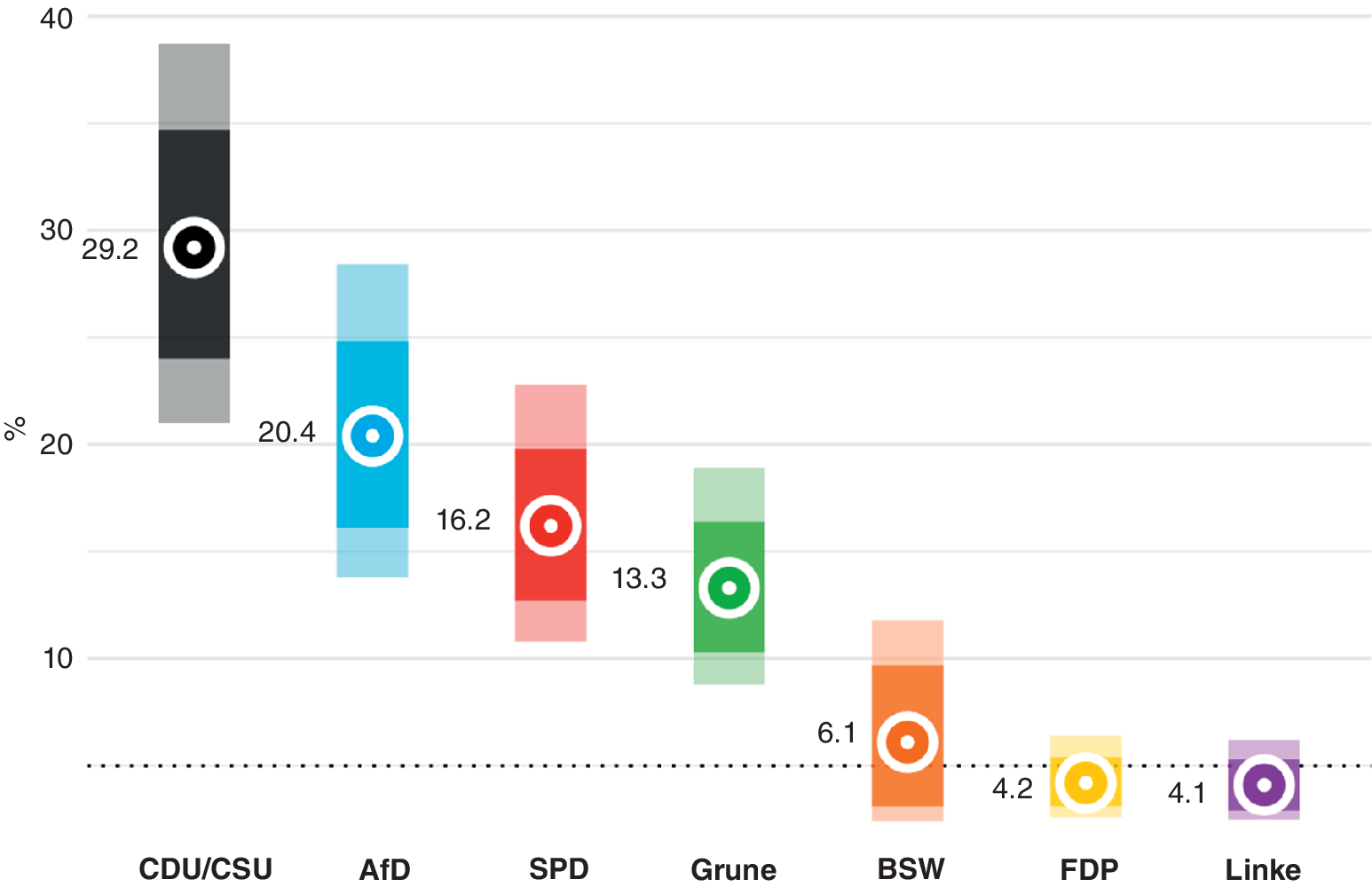
National party-vote share distributions are shown in figure 1. The current forecast as of January 30, 2025, indicates a clear winning margin for the CDU/CSU, with a projected vote share of 29.2% and a 5/6 probability that this value will fall within the credibility interval ranging from 24.0% to 34.7%. The SPD, the current chancellor’s party, is expected to lose significant support with an expected vote share of 16.2% and a credibility interval ranging from 12.7% to 19.8%. The far-right populist AfD is predicted to come in second, achieving strong support with 20.4% of the vote within a 5/6 credibility interval ranging from 16.1% to 24.8%. This result would mark the AfD’s strongest national performance to date. The Green Party is projected to experience a slight decline, with a projected vote share of 13.3% and a 5/6 credible interval ranging from 10.3% to 16.4%.
Forecast for the Party-Vote Shares (as of January 30, 2025)
Bars indicate 83% and 95% credible intervals.

Three parties are close to the electoral threshold. After strong showings in three state elections, the newly formed Sahra Wagenknecht Alliance (BSW) is expected to clear the 5% hurdle with a projected vote share of 6.1%. However, this forecast comes with considerable uncertainty, reflected in a 5/6 credible interval ranging from 3.1% to 9.7%.
The pro-business FDP is forecasted to be closest to the margin with 4.2% and a credibility interval ranging from 3.1% to 5.4%, and there is high probability that the FDP will fail to secure parliamentary representation after its role in the previous coalition. Meanwhile, the Left Party (i.e., Linke), a left-wing party, is expected to struggle, with a projected vote share of 4.1% and the upper limit of the credibility interval at 5.3%, placing it on the edge of the 5% hurdle. However, the Left Party nevertheless could enter Parliament by winning three districts. Assessing this chance requires a forecasting model for candidate-vote shares at the district level, which is discussed in the next section.
As a dynamic model, these forecasts are subject to change. This forecast represents a snapshot taken 23 days before Election Day. From previous applications and evaluations in past elections (Stoetzer et al. Reference Stoetzer, Neunhoeffer, Gschwend, Munzert and Sternberg2019), we know that the root mean squared error (RMSE) for the model’s expected support approximately 32 days before the election is about 2.9. During the final month, the RMSE improves to 1.8, underscoring the importance of dynamic shifts in voter preferences during the final weeks for producing accurate forecasts.
FORECAST OF CANDIDATE-VOTE SHARES
This section summarizes how we adapted our Zweitstimme model predictions of the 2025 election to forecast candidate-vote shares at the electoral-district level.
The Zweitstimme Model to Forecast Candidate-Vote Shares
Under the German electoral system, parties with less than 5% of the party-vote share nevertheless can gain seats in Parliament if they have at least three plurality winners among their candidates. The distribution of candidate-vote shares in each electoral district determines the likelihood of winning a seat, regardless of a candidate’s position on the state party list. Predicting candidate-vote share also is crucial for assessing the likelihood that plurality winners may not gain a seat in Parliament if their party fails to achieve sufficient party-vote support. Addressing this scenario is another forecasting aim of our contribution to this symposium.
Our approach extends the Zweitstimme model to forecast candidate-vote shares first described for the 2017 election (Neunhoeffer et al. Reference Neunhoeffer, Gschwend, Munzert and Stoetzer2020) and applied again in 2021 (Gschwend et al. Reference Gschwend, Müller, Munzert, Neunhoeffer and Stoetzer2022). For a detailed description of the model and methodology, we refer readers to these relevant articles and their supplementary material.
For this symposium, we summarize our approach. We began by building on the eight national-level party-vote distributions that we previously generated based on 10,000 simulations from our Zweitstimme forecasts. Using a proportional-swing assumption, we then derived the corresponding eight distributions of party-vote shares for each electoral district.
For example, if the CDU/CSU is projected to increase its national-vote share from 24.2% to 29.7% compared to the previous election, this proportional swing is applied to all simulated values of the predicted CDU/CSU vote-share distribution at the national level. This adjustment allowed us to derive values for the predicted CDU/CSU vote-share distributions in each district for 2025. In the Potsdam I electoral district, for instance, where the CDU received 20.2% of the vote in 2021, we project given the proportional-swing adjustment an increase to 24.8% in 2025.
Following this procedure for each value of the predicted party-vote distribution at the electoral-district level generates the respective values for the first covariate in our model to candidate-vote shares at the district level in 2025.
Each covariate varied across 299 districts and eight local-party candidates (including a residual “Other” candidate representing all other candidates). The original model incorporated additional predictors beyond district-level party-vote shares, including covariates representing candidate characteristics (e.g., previous candidate-vote shares and gender) and district characteristics (e.g., number of candidates and incumbent status). We originally implemented two regression approaches—a linear model and a neural network—that were trained on data from past elections.
For forecasting, we generated model predictions based on the respective predictor values. Given that the value of the first covariate is a distribution of values rather than a single value, we could propagate the inherent uncertainty in national party-vote shares to candidate-vote forecasts.
Implementing the same model early in the election cycle presented challenges due to incomplete candidate information for 2025. As of this writing, candidate lists are not yet published. To address this, we developed a streamlined linear-regression framework using only four covariates: (1) the predicted party-vote share for each candidate (assuming proportional swing); (2) the party’s previous candidate-vote share; (3) whether the party won the district in the last election; and (4) whether the party previously fielded a candidate there. (Regression estimates are listed in online appendix table B.2.) Using this simplified approach, we simulated candidate-vote shares for 2025 by drawing from the Zweitstimme model’s party-vote-share distribution, which enabled district-level forecasts across all 299 electoral districts.
To build intuition about the performance of our forecasts, we examined the historical accuracy of similar models. Thirty-six days before Election Day, this approach correctly predicted approximately 90% of districts in the 2009–2017 elections (Neunhoeffer et al. Reference Neunhoeffer, Gschwend, Munzert and Stoetzer2020). In 2021, 18 days before Election Day, accuracy declined to approximately 80%, primarily due to unexpected AfD district wins.Footnote 5
Current Forecast
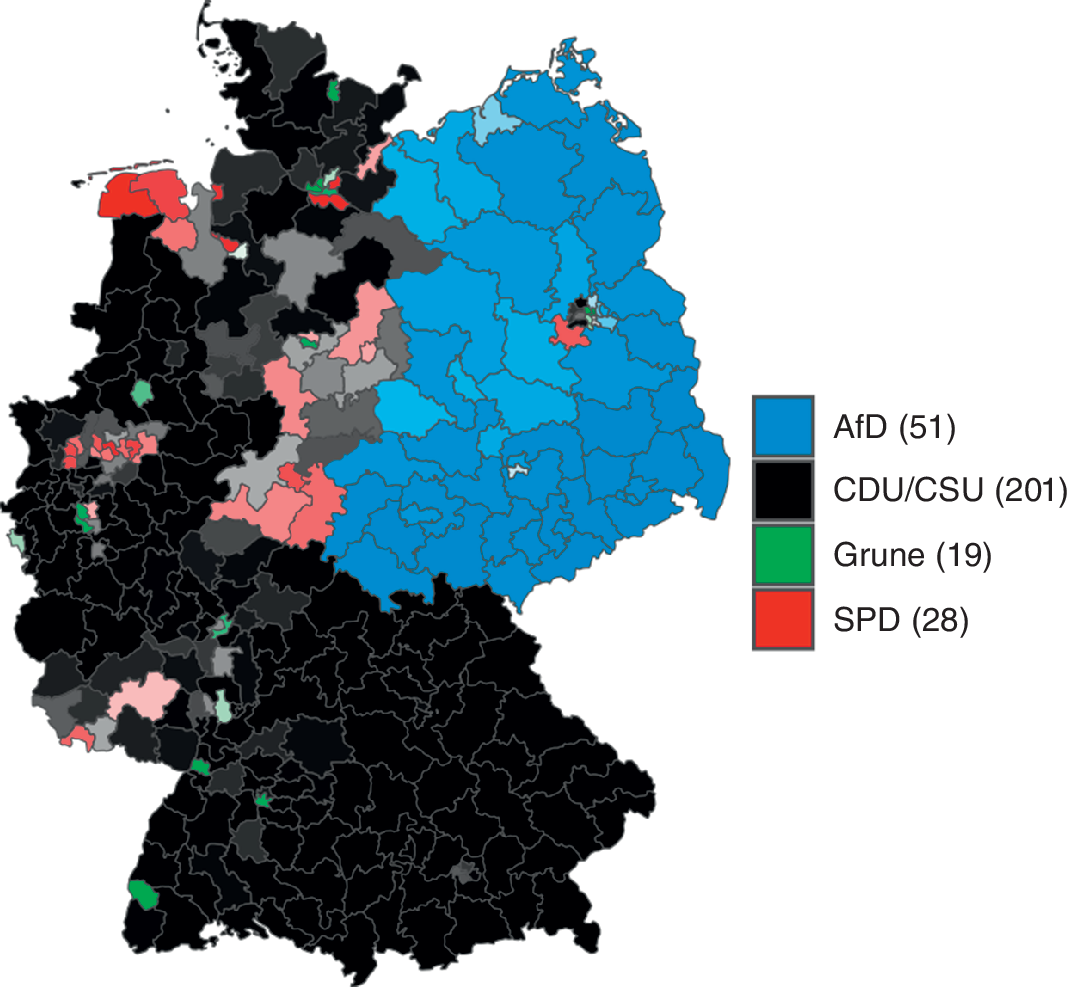
The candidate-vote forecasts for all 299 electoral districts are presented in figure 2. All predicted district wins are listed in online appendix table B.3. The current projections indicate a strong performance by the CDU/CSU, which is forecasted to secure a significant share of direct wins across most regions. Specifically, the CDU/CSU is forecasted to win 201 districts outright. The AfD also is expected to perform well, particularly in East Germany, where it is projected to win 51 districts. If realized, this would mark the AfD’s strongest performance in district wins to date.
Forecast for the Plurality Winners at the District Level (as of January 30, 2025)
Numbers of predicted wins per party are in parentheses.

The SPD is forecasted to suffer substantial losses compared to the previous election, with an expected total of 28 districts won. The Green Party is projected to secure fewer wins, primarily in urban areas, with an expected total of 19 districts. The Left Party is forecasted to struggle significantly in securing any district wins, which could jeopardize its parliamentary representation in the next Bundestag.
It is important to acknowledge the role of dynamics in shaping these district-level forecasts. Because the model relies on party-vote forecasts at the national level, it is prone to similar uncertainties. Additionally, our candidate-vote forecasts rely on the assumption of a proportional swing. The current forecast, taken 23 days prior to Election Day, represents a preliminary snapshot and is expected to evolve as the election date approaches.
IMPLICATIONS OF OUR CURRENT FORECASTS
This section combines our current predictions of party-vote and candidate-vote shares to forecast important quantities of interest—namely, the number of seats potential governmental coalitions could rely on as well as which electoral district might be vacant (i.e., where the plurality winner does not qualify for a seat in Parliament.
Coalition Majorities
Using a novel approach, we calculated probabilities for coalition majorities while also accounting for the rule that exempts parties winning at least three districts from the 5% threshold. Both conditions are particularly relevant for the Left Party—a scenario that substantially would affect the distribution of parliamentary seats. To model the election law as accurately as possible, we combined candidate-vote and party-vote forecasts. We predicted only a 13% chance that the Left Party would enter Parliament.Footnote 6
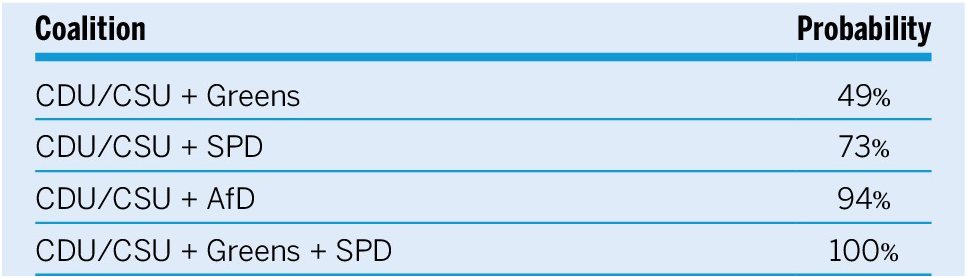
Using 10,000 draws from the forecast distribution, we first identified parties that would win at least three districts in the district forecast. Next, we calculated parliamentary majorities based on these parties and those surpassing the threshold, using the party-vote forecast. By aggregating the draws and analyzing coalition majorities across cases, we derived probabilities of obtaining a majority for various coalition outcomes. Table 1 summarizes the probabilities for the most-likely majority coalition scenarios.
Coalition Majority Probabilities

Although a coalition between the CDU/CSU and the AfD is highly likely to secure a majority of seats in the next Bundestag—a probability of approximately 94%—credible alternatives remain that exclude the AfD from the new government. The so-called Kenya Coalition (i.e., CDU/CSU, SPD, and the Green Party) is virtually guaranteed to achieve a majority of seats. However, German parties typically prefer minimum-winning coalitions. If a two-party coalition excluding the AfD secures a majority of seats—currently the case with a CDU/CSU and SPD coalition, which has a 73% likelihood—these parties are expected to initiate coalition negotiations following the election.
Vacant Districts
For the first time in German election law, winning a district by a plurality of candidate votes does not guarantee a seat in Parliament, potentially causing vacant districts. To estimate probabilities for these vacancies, we combined results from our models predicting party-vote and candidate-vote shares. Using 10,000 draws from the Zweitstimme model to forecast party-vote shares, we calculated seat distributions under the new election law.
First, we excluded parties that receive less than 5% of the vote and fail to win at least three districts in a given draw. Second, we allocated the 630 Bundestag seats to parties, assuming state-level voter turnout matches that of the previous election in 2021.
Third, these party-level seats were distributed to state-level party-vote shares based on the proportional-swing assumption inferred from our candidate-vote-share model. The proportional swing accounts for variation in electoral support for each party in different electoral districts.
Fourth, we identified vacant districts by ranking district winners according to their candidate-vote shares. Districts where the winners ranked below the total number of seats allocated to their party within the respective state were considered vacant. The probability of vacancy for each district was determined as the proportion of draws in which the district was predicted to be vacant.
Online appendix table C.4A lists the predicted vacancies. The majority of districts expected to be vacant, particularly those with high probabilities, are from the CDU and CSU. Additionally, we identified several potentially vacant districts for the AfD in East Germany. The SPD also appears multiple times toward the bottom of table C.4A, indicating lower probabilities that their district winners will not gain a seat in Parliament. It is important to note that these probabilities also depend on the likelihood of a party winning the district. Furthermore, some districts appear multiple times for different parties; in these cases, the probabilities should be totaled to assess the overall likelihood of the district being left vacant, regardless of the party.
CONCLUSION
If our predictions hold, the outcome will be a combination of the familiar and the unexpected. The return of the CDU to the chancellorship would mark a reversion to the norm—after all, five of the nine chancellors of the Federal Republic of Germany hailed from the CDU/CSU, which historically has dominated the role for longer periods than any other party. However, Olaf Scholz would be the first chancellor since Kurt Georg Kiesinger in 1969 to be unseated after only one term. The most profound disruption, however, would be caused by the meteoric rise of the far-right AfD—particularly in East Germany, where it could paint the electoral map blue. This surge would coincide with the marginalization of the once-strong Left Party in the region and the potential exit of the FDP from Parliament altogether.
That said, some caution is warranted. The Zweitstimme model leans heavily on polling data, among other sources, and does not account for late-stage campaign dynamics. This limitation was evident in our last forecast published in this journal, in which we significantly overestimated the CDU/CSU and failed to predict the late surge of the SPD. Future research could explore dynamic poll models that account for polling momentum. One possible strategy is to incorporate local trends of latent support into a poll-based latent-space model.
The current predictions incorporate polling data available as of January 30, 2025. As Election Day approaches, updates—including those based on finalized district-level candidate lists—and our final forecasts will be published continuously on our website, Zweitstimme.org.
SUPPLEMENTARY MATERIAL
To view supplementary material for this article, please visit http://doi.org/10.1017/S1049096525000150.
ACKNOWLEDGMENT
We thank Marcel Neunhoeffer for helpful comments and support.
DATA AVAILABILITY STATEMENT
The editors have granted an exception to the data policy for this manuscript. In this case, replication code and data are available to reproduce its figures and tables, but there are substantively small differences between the replication and the printed results. This exception was granted because the authors affirmed that these differences are attributable to randomness in the sampling procedure that generates draws from Bayesian posterior distributions and do not change the conclusions of the manuscript. To address this, the authors have provided the model output and the specific draws used in the replication data at the PS: Political Science & Politics Harvard Dataverse at https://doi.org/10.7910/DVN/KPFYDD.
CONFLICTS OF INTEREST
The authors declare that there are no ethical issues or conflicts of interest in this research.


 Open access

