





Introduction
Sweetpotato is an economically important crop in North Carolina and other states, generating more than US$676 million in 2023 (USDA-NASS 2023). Of the more than 51,000 ha of sweetpotato harvested in the United States in 2023, more than 31,000 ha were harvested in North Carolina (USDA-NASS 2023). Sweetpotato is also produced in other states, including Arkansas, California, Florida, Louisiana, and Mississippi (USDA-NASS 2023).
Sweetpotato is vulnerable to competition from a variety of weeds due in part to its low canopy height; in particular, Palmer amaranth (Amaranthus palmeri S. Watson) interference has been shown to reduce yield by as much as 86% (Barkley et al. Reference Barkley, Chaudhari, Jennings, Schultheis, Meyers and Monks2016; Basinger et al. Reference Basinger, Jennings, Monks, Jordan, Everman, Hestir, Waldschmidt, Smith and Brownie2019; Meyers et al. Reference Meyers, Jennings, Schultheis and Monks2010a; Moore et al. Reference Moore, Jennings, Monks, Jordan, Leon and Boyette2021; Smith et al. Reference Smith, Jennings, Monks, Chaudhari, Schultheis and Reberg-Horton2020). Weeds such as Palmer amaranth can also act as hosts for pests, such as nematodes (Ward et al. Reference Ward, Webster and Steckel2013). Furthermore, herbicides registered for control of broadleaf weeds that grow with sweetpotato are limited (Kemble et al. Reference Kemble, Bertucci, Bilbo, Jennings, Meadows, Melanson, Rodrigues, Walgenbach and Wszelaki2024).
Flumioxazin is an important component of sweetpotato weed management programs in North Carolina. Flumioxazin is applied preplant to more than 90% of conventional sweetpotato hectarage in North Carolina (KM Jennings, personal communication). It is classified by the Herbicide Resistance Action Committee and Weed Science Society of America as a Group 14 herbicide (herbicides in this group inhibit protoporphyrinogen oxidase). Chemical management of weeds in sweetpotato relies extensively on flumioxazin, which is one of only two Group 14 herbicides available for residual weed control in sweetpotato (Kemble et al. Reference Kemble, Bertucci, Bilbo, Jennings, Meadows, Melanson, Rodrigues, Walgenbach and Wszelaki2024). With the increasing prevalence of herbicide resistance in the United States and globally (Heap Reference Heap2026), it is important to maintain diversity in herbicide weed management options because few herbicides are registered for residual weed control in sweetpotato. As of 2025, herbicide resistance to Group 14 herbicides has been documented in several weed populations in North Carolina. Resistance to fomesafen, the other Group 14 herbicide registered for pretransplant use in sweetpotato production in North Carolina, has been documented in common ragweed (Ambrosia artemisiifolia L.), common waterhemp [Amaranthus tuberculatus (Moq.) J.D. Sauer], redroot pigweed (Amaranthus retroflexus L.), and Palmer amaranth. Flumioxazin resistance has been documented in Italian ryegrass [Lolium perenne ssp. multiflorum (Lam.) Husnot] (Heap Reference Heap2026). As herbicide-resistant weed populations become more widespread in North Carolina, preserving the diversity of chemical management options is critically important. The removal of flumioxazin from weed management practices would have a substantial negative effect on the diversity of herbicide options in sweetpotato production. Despite the critical importance of flumioxazin in sweetpotato production, some growers have expressed concerns about sweetpotato yield and quality when flumioxazin is used. While prior research indicates that sweetpotato tolerance to herbicides can vary widely among cultivars (Harrison and Dukes Reference Harrison and Dukes1996; Harrison and Jackson Reference Harrison and Jackson2011; Motsenbocker and Monaco Reference Motsenbocker and Monaco1993), the Covington and Beauregard sweetpotato cultivars have exhibited relative tolerance to pretransplant applications of flumioxazin at labeled use rates (Blankenship et al. Reference Blankenship, Jennings, Monks, Meyers, Jordan, Schultheis, Suchoff, Moore and Ippolito2024; Kelly et al. Reference Kelly, Shankle and Miller2006; Meyers et al. Reference Meyers, Jennings, Schultheis and Monks2010b).
One concern growers have with flumioxazin is whether a heavy rain before or after the herbicide is applied can result in decreased sweetpotato yield. Rain after application can affect the herbicide’s efficacy and crop safety (Abukari et al. Reference Abukari, Shankle and Reddy2015; Walker and Roberts Reference Walker and Roberts1975). However, at least 6.35 mm of rain is necessary to activate flumioxazin and achieve acceptable residual weed control (Valent 2024). Therefore, our studies aimed to determine whether the timing of simulated rain, in relation to the preplant flumioxazin rate, influences sweetpotato crop safety, yield, and quality.
Materials and Methods
Studies were conducted at the Horticultural Crops Research Station in Clinton, North Carolina, in 2021 (35.024°N, 78.279°W), and 2022 (35.023°N, 78.279°W). Soils at the study sites were an Orangeberg loamy sand (fine-loamy, kaolinitic, thermic Typic Kandiudults), with 0.5% organic matter, pH 6.9, at the 2021 experimental site; and a Norfolk loamy sand (fine-loamy, kaolinitic, thermic Typic Kandiudults), with 0.6% organic matter, pH 6.9, at the 2022 experimental site. On July 14, 2021, and June 9, 2022, nonrooted Covington sweetpotato cuttings were transplanted into weed-free, bedded rows using a commercial mechanical transplanter (Checchi and Magli, Lehi, UT) with an in-row spacing of 30 cm and a between-row spacing of 1.07 m. Plots were planted in three rows, each 1 m wide by 6.1 m long; the first and third rows were nontreated borders, whereas the second row was used for data collection. Plots were arranged in a randomized complete block design with four replications. All plots were maintained weed free with between-row cultivation and hand removal of weeds as needed.
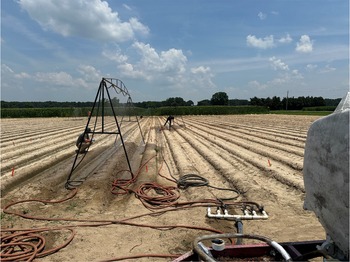
Treatments were arranged as a three-by-three full factorial. The first factor was flumioxazin rate: no flumioxazin, and flumioxazin (Valor SX; Valent U.S.A. applied at two rates, 107 g ai ha−1 and 214 g ai ha−1. The second factor was irrigation application timing relative to herbicide application: no irrigation, irrigation before herbicide application, and irrigation after herbicide application. Irrigation treatments consisted of 1.9 cm of simulated rain applied over approximately 10 min via custom irrigation units to the data (center) row of each plot. All herbicide and irrigation treatment combinations were applied on the same day. Custom irrigation units were constructed using two metal A-frames connected by a 6.07-m horizontal metal bar, with a hose fitted with three evenly spaced FullJet 1/2HH-30WSQ nozzles (Spraying Systems Co., Glendale Heights IL) attached along the bar spaced 170 cm apart (Figure 1). All herbicide and irrigation treatment combinations were fully applied 24 h before sweetpotato plants were transplanted.
Rain simulators used to apply irrigation treatments.

Figure 1 Long description
A landscape photo of a field with rows of planted sweetpotatoes under a clear blue sky with scattered clouds. The field is prepared with irrigation equipment, including a metal frame structure and multiple hoses laid out on the ground. The equipment is used to apply irrigation treatments to the sweetpotato plants. In the background, there are green fields and trees, indicating a rural agricultural setting.
Data collection included visual estimates of foliar sweetpotato injury, assessed on a scale of 0% (no visual foliar injury) to 100% (crop death) at 1, 2, 4, and 8 wk after transplanting (Frans et al. Reference Frans, Talbert, Marx, Crowley and Camper1986). Sweetpotato storage roots were harvested 110 d after transplanting with a commercial chain harvester, hand-sorted into jumbo (≥8.9 cm diam), No. 1 (≥4.4 cm but <8.9 cm), and canner (≥2.5 cm but <4.4 cm) (USDA-AMS 2005) grades, and weighed. Marketable yield was calculated as the sum of jumbo and No. 1 grades. Total yield was calculated as the sum of canner, No. 1, and jumbo grades. No. 1 sweetpotato storage root dimensions were measured with a high-throughput optical grader (Exeter Engineering, Exeter, CA) to quantify the effects of treatment on storage root shape. Average length-width ratio (LWR) was calculated as the length divided by the diameter for each individual No. 1 root and then averaged with other roots from the same plot. LWR has previously been used as a metric for quantifying herbicide injury in sweetpotato (Blankenship et al. Reference Blankenship, Jennings, Monks, Meyers, Jordan, Schultheis, Suchoff, Moore and Ippolito2024; Meyers et al. Reference Meyers, Jennings, Schultheis and Monks2010b); a larger LWR value indicates a longer and thinner sweetpotato root, whereas a smaller LWR value indicates a shorter and more spherical sweetpotato root.
Residuals were plotted and visually examined to ensure homogeneity of variance. ANOVA was performed with SAS software (v9.4; SAS Institute Inc, Cary, NC) using the MIXED procedure. Least squared means were separated using a Tukey HSD test at α ≤ 0.05. Herbicide, irrigation timing, and year were treated as fixed effects, while replication nested within year was treated as a random effect. LWR data required a square root transformation to meet the assumptions of ANOVA; data were back-transformed for presentation.
Results and Discussion
Crop Injury
No visual foliar injury from herbicide or irrigation timing was observed throughout the duration of this study. This lack of injury is consistent with our previous observations (Blankenship et al. Reference Blankenship, Jennings, Monks, Meyers, Jordan, Schultheis, Suchoff, Moore and Ippolito2024).
Sweetpotato Yield
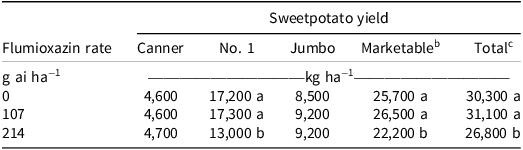
The main effect of flumioxazin rate was significant for No. 1 and marketable sweetpotato yield, and for total yield (P < 0.0001, P = 0.0013, and P = 0.0010, respectively), and resulted in a yield reduction compared with the no-flumioxazin and the higher rate treatments. Yields of No. 1 and marketable sweetpotato were reduced by 25% and 14%, respectively, and total yield was reduced by 11% when the 214 g ha−1 rate of flumioxazin was applied to the crop. Flumioxazin applied at 107 g ha−1 (1× the label rate) did not affect yield (Table 1). These results support the conclusions of previous studies and provide no evidence that flumioxazin causes a reduction in sweetpotato yield when applied at rates recommended on the product label. We did, however, observe a yield reduction, compared with the nontreated check, when flumioxazin was applied at 214 g ha−1 (Table 1); this reduction was not detected and thus not reported in previous research (Blankenship et al. Reference Blankenship, Jennings, Monks, Meyers, Jordan, Schultheis, Suchoff, Moore and Ippolito2024). Both the current study and the one conducted by Blankenship et al. (Reference Blankenship, Jennings, Monks, Meyers, Jordan, Schultheis, Suchoff, Moore and Ippolito2024) were conducted at essentially the same location in North Carolina, with similar planting dates in 2021 and 2022. Sweetpotato slips were sourced from the same location, and soil types and weather conditions were similar in both years. Production practices, including fertility and equipment, were identical in both studies. That a yield reduction was observed at the 2× rate of flumioxazin in these studies and not those reported by Blankenship et al. (Reference Blankenship, Jennings, Monks, Meyers, Jordan, Schultheis, Suchoff, Moore and Ippolito2024), even with extremely similar environmental conditions, indicates that possible causes of yield reductions were not captured as part of either study. Future research should evaluate additional parameters that were not captured by our studies, such as time between harvest of sweetpotato slips and transplanting, time allowed for slip regrowth between cutting sweetpotato slips from slip beds, slip node count and length, and generation of sweetpotato slips relative to initial propagation. However, despite these differences observed when the 2× rate of flumioxazin was used, no yield reduction was observed in either set of studies at the 1× rate.
Main effect of flumioxazin rate on sweetpotato storage root yield pooled across irrigation treatments in Clinton, North Carolina, in 2021 and 2022. a

Table 1 Long description
The table presents data on sweetpotato yield under different rates of flumioxazin application. It includes four columns: Flumioxazin rate in grams per hectare, yield for canner sweetpotatoes in kilograms per hectare, yield for No. 1 sweetpotatoes in kilograms per hectare, yield for jumbo sweetpotatoes in kilograms per hectare, marketable yield in kilograms per hectare, and total yield in kilograms per hectare. The table has three rows corresponding to flumioxazin rates of 0, 107, and 214 grams per hectare. For the 0 rate, yields are 4600 kilograms per hectare for canner, 17200 kilograms per hectare for No. 1, 8500 kilograms per hectare for jumbo, 25700 kilograms per hectare for marketable, and 30300 kilograms per hectare for total. For the 107 rate, yields are 4600 kilograms per hectare for canner, 17300 kilograms per hectare for No. 1, 9200 kilograms per hectare for jumbo, 26500 kilograms per hectare for marketable, and 31100 kilograms per hectare for total. For the 214 rate, yields are 4700 kilograms per hectare for canner, 13000 kilograms per hectare for No. 1, 9200 kilograms per hectare for jumbo, 22200 kilograms per hectare for marketable, and 26800 kilograms per hectare for total. The data indicates a significant reduction in yield for No. 1 and marketable sweetpotatoes, and total yield when the highest rate of flumioxazin is applied.
a Least square means were separated via a Tukey HSD test at α = 0.05. Means with different letters within each column are significantly different. Rate treatments are pooled across irrigation timings; no significant differences were observed for canner and marketable yields.
b Marketable yield is the sum of No. 1 and jumbo grades.
c Total yield is the sum of canner, No. 1, and jumbo grades.
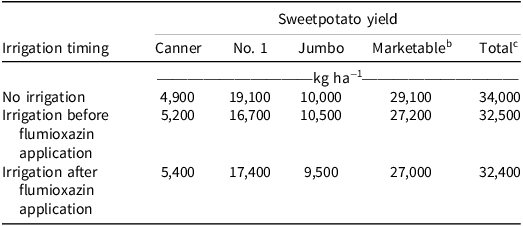
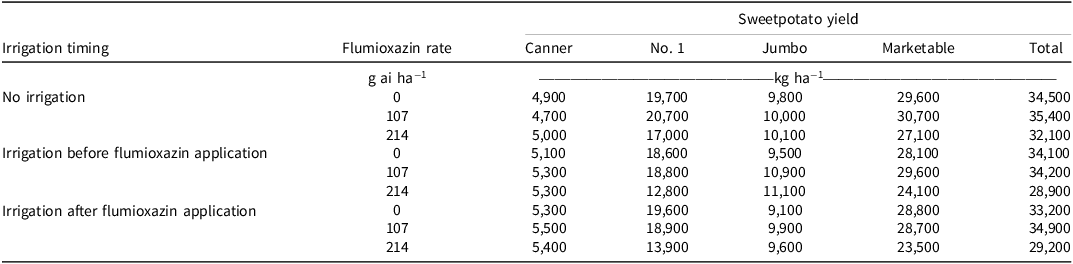
Irrigation timing relative to flumioxazin application did not have any significant effect on any sweetpotato yield metric (Table 2). Furthermore, no interaction between irrigation timing and flumioxazin rate was observed (Table 3). Thus, there is no evidence to support the hypothesis that irrigation or rain before or after flumioxazin application prior to sweetpotato transplanting affects sweetpotato yield or quality.
Main effect of irrigation timing relative to flumioxazin application on sweetpotato storage root yield. a

Table 2 Long description
The table presents data on sweetpotato yield metrics under different irrigation timings relative to flumioxazin application. It includes four rows and five columns. The columns are labeled as Irrigation timing, Sweetpotato yield, Canner, No. 1, Jumbo, Marketable, and Total. The rows detail the yield in kilograms per hectare for different irrigation scenarios: No irrigation, Irrigation before flumioxazin application, and Irrigation after flumioxazin application. The yield metrics are categorized into Canner, No. 1, Jumbo, Marketable, and Total. Notable data points include the highest total yield of 34,000 kilograms per hectare with no irrigation and the lowest total yield of 32,400 kilograms per hectare with irrigation after flumioxazin application. The table indicates that irrigation timing does not significantly affect sweetpotato yield.
a No significant treatment effects or interactions were present. Least square means with different letters within each column are significantly different according to the Tukey HSD test at α = 0.05. Irrigation treatments are pooled across herbicide treatments; no significant differences were detected.
b Marketable yield is the sum of No. 1 and jumbo grades.
c Total yield is the sum of canner, No. 1, and jumbo grades.
Effect of flumioxazin rate and irrigation timing relative to flumioxazin application on sweetpotato yield and quality. a

Table 3 Long description
The table presents data on the effect of flumioxazin rate and irrigation timing on sweetpotato yield and quality. It includes three columns for flumioxazin rate in grams per hectare, and four columns for sweetpotato yield in kilograms per hectare, categorized as Canner, No. 1, Jumbo, Marketable, and Total. The table has nine rows, each representing different combinations of irrigation timing and flumioxazin rates. Notable trends include variations in yield across different irrigation timings and flumioxazin rates, with no significant effect observed on any sweetpotato yield metric. The data suggests that irrigation timing relative to flumioxazin application does not affect sweetpotato yield or quality.
a No significant treatment effects or interactions were observed. Least square means were separated via a Tukey HSD test at α = 0.05. Means with different letters within each column are significantly different.
Sweetpotato Storage Root Shape
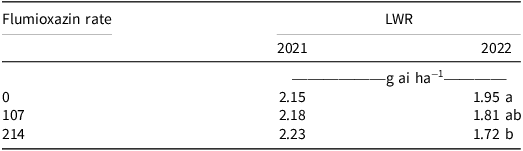
Average LWR data required a square root transformation to meet the assumptions of ANOVA. An interaction was observed between herbicide and year (P = 0.0021) for LWR. In 2021, herbicide rate had no effect on LWR (P = 0.3763); however, in 2022, herbicide rate affected LWR (P = 0.0014). In 2022, compared with the no-herbicide treatment, the LWR for No. 1 sweetpotato was smaller when the 214 g ha−1 rate of flumioxazin was applied, which resulted in rounder sweetpotato roots (Table 4). Irrigation had no effect on storage root shape, nor did it have any interactions with other treatments. Although the LWR of No. 1 sweetpotato was smaller in 2022 when flumioxazin was applied at 214 g ha−1 (2× the label rate), the 1× rate listed on the product label did not lead to a reduction in LWR compared with that of the nontreated check. All treatments exhibited lower LWR in 2022 than in 2021 (Table 2). The reason for the difference in response is not clear. Similar to our previously reported results (Blankenship et al. Reference Blankenship, Jennings, Monks, Meyers, Jordan, Schultheis, Suchoff, Moore and Ippolito2024), root shape effects due to herbicide treatments were different from year to year; however, flumioxazin applied at the 2× rate did not result in a reduced root shape compared with nontreated plants in the 2021 trials. Like the trend we observed in sweetpotato yield, flumioxazin applied at 214 g ha−1 resulted in a reduction in LWR compared with nontreated sweetpotato in 2022, contrasted with results from previous research. Though this effect on sweetpotato root shape was observed in only one year, future research may examine other parameters of sweetpotato production such as sweetpotato slip node count and length, time between harvest of sweetpotato slips and transplanting, and length of harvest interval on sweetpotato slip beds as possible factors in this observed variability. These results support the current pattern of using flumioxazin to control weeds in sweetpotato (Valent 2024) and do not suggest that flumioxazin has adverse effects when used according to label instructions.

a Abbreviation: LWR, length-to-width ratio.
b Least square means were separated via a Tukey HSD test at α = 0.05. Means with different letters within each column are significantly different. Rate treatments are pooled across irrigation timings. No significant effects were observed in 2021.
Furthermore, the main effect of flumioxazin rate on various metrics of sweetpotato yield (No. 1 yield, total yield, marketable yield) caused no observable differences between the 1× label rate (107 g ha−1) and the nontreated check and further supports the safety of flumioxazin as an integral part of weed management in sweetpotato. The main effect of flumioxazin at the labeled rate also did not reduce No. 1 sweetpotato LWR compared with the nontreated check. The results of these studies are consistent with previous research (Blankenship et al. Reference Blankenship, Jennings, Monks, Meyers, Jordan, Schultheis, Suchoff, Moore and Ippolito2024; Meyers et al. Reference Meyers, Jennings, Schultheis and Monks2010b) and show no evidence of a detrimental yield or shape effect resulting from flumioxazin when applied at recommended rates with or without simulated rain prior to transplanting. While this research is representative of sweetpotato production in North Carolina, it represents only 2 site-years at a single location. Other sweetpotato production areas where cultivars and production practices are different may not necessarily be captured by these studies. The results of these studies also highlight the importance of using appropriate application equipment and techniques to ensure that the registered rate is not exceeded, as crop injury can occur under certain conditions where a higher rate is applied.
Practical Implications
Flumioxazin is critically important to weed management efforts in sweetpotato production in North Carolina. These studies were conducted in response to grower concerns regarding the safety to sweetpotato of applying flumioxazin either before anticipated rain or after rain or irrigation. The results of these studies indicate that rain in the amounts tested here relative to flumioxazin application is not likely to affect sweetpotato yield or quality. The results of these studies also concur with those of previous research and indicate that flumioxazin is safe when applied at registered label rates, although its use at higher than recommended rates can result in sweetpotato injury.
Acknowledgments
We thank Patrick Chang, Chitra, Rebecca Cooper, Rebecca Middleton, Andrew Ippolito, Helen Nocito, and additional staff at the Horticultural Crops Research Station for their help with these studies.
Funding
Funding for this research was provided by the North Carolina SweetPotato Commission. Funding was also provided by U.S. Department of Agriculture–National Institute of Food and Agriculture grant 2019-51300-30247. Any opinions, findings, conclusions, or recommendations expressed in this publication are those of the authors and do not necessarily reflect the view of the U.S. Department of Agriculture.
Competing Interests
The authors declare they have no competing interests.

 Open access

