


Introduction
Various lines of evidence from across the Americas suggest that ‘estólica’ (also referred to as átlatls, propulsors, spear-throwers, throwing-sticks or dart-throwers) formed part of the hunting repertoire of the earliest human inhabitants (i.e. Hutchings & Brüchert Reference Hutchings and Brüchert1997). This technology was most likely introduced from Eurasia, where the oldest spear-throwers date back to around 25 000 BP (Cattelain Reference Cattelain and Delage2018). Evidence of spear-throwers from the Americas is scarce; made from wood, bone or antler, these artefacts rarely survive and examples are mostly found as part of funerary contexts, offerings or iconographic representations. However, ethnohistorical literature from the South American Andes indicates the frequent use of this device by Indigenous populations in ‘colonial times’ (Métraux Reference Métraux and Steward1963), to the point that some authors have argued that the term ‘estólica’ originated in the region and had no western antecedents (e.g. Carrión Reference Carrión1997). The origins, development and diffusion of spear-thrower technology and its technical and morphological variants across the Andes are the subject of ongoing debate. Yet, much of this discussion has been based on iconographic studies, with less attention given to the artefacts themselves (Capitan Reference Capitan1910; Vignati Reference Vignati1936; Métraux Reference Métraux and Steward1963; Ravines Reference Ravines1990; Donnan Reference Donnan and Berrin1997; Lau Reference Lau2004; Whittaker Reference Whittaker2006; Chamussy Reference Chamussy2012).
In the South-Central Andes, complete artefacts, primarily recovered from funerary contexts, largely date to agro-ceramic periods (c. 3000 cal BP onward), though there is some evidence from pre-ceramic periods (before c. 3000 cal BP). These objects were used to define types and morphological classes to organise the artefacts spatially and temporally from a culture-historical and diffusionist perspective (Uhle Reference Uhle1907, Reference Uhle1909; Casanova Reference Casanova1944; Núñez Reference Núñez1963; Munizaga Reference Munizaga1964; Fernández Distel Reference Fernández Distel1977; Bittman & Munizaga Reference Bittmann and Munizaga1984; Rivera & Zlatar Reference Rivera and Zlatar1985). Iconographic depictions of spear-throwers are also found on a variety of material supports, usually associated with icons of prestigious individuals (Chamussy Reference Chamussy2012; Critchley Reference Critchley2018).
In recent years, studies have focused on trying to define the presence and frequency of these artefacts through morphological analyses of the lithic projectile points that made up the darts the spear-throwers propelled and of the posterior hooks of the devices, which are identifiable in incomplete specimens (Owen Reference Owen1998; Aschero & Martínez Reference Aschero and Martínez2001; de Souza Reference de Souza2006, Reference de Souza and Hubert2011; Castro & Marsh Reference Castro and Marsh2022; Chen et al. Reference Chen2022; Castro et al. Reference Castro2024; de Souza et al. Reference de Souza2024; Flores-Blanco et al. Reference Flores-Blanco2024; Marsh et al. Reference Marsh2024; Cuellar et al. Reference Cuellar2025). Yet these efforts devote little attention to the technology, morphology and design of spear-throwers as complete artefacts. Indirect, context-based dates for some spear-throwers suggest that this technology could date back as far as 6000 years in the Andes (Cuellar et al. Reference Cuellar2025) but direct dates corroborating these assertions are lacking.
In this article, we present the analysis of a series of wooden spear-throwers recovered from Caleta Huelén 42, a Late Archaic period (6500–4000 cal BP) archaeological settlement from the Atacama Desert coast. These spear-throwers were described and classified in 1985 (Rivera & Zlatar Reference Rivera and Zlatar1985) and have not been re-examined since. In 2025, we undertook a new study, successfully locating nine of the 12 previously documented specimens in the original collection. Here, we provide their characterisation in technological, morphological and design terms, as well as the first direct radiocarbon dates derived from two of the artefacts. These provide the first direct dates for spear-throwers in the entire Andes region, and the oldest dates yet known for this technology in the Andes.
Caleta Huelén 42 and the Late Archaic period of the Atacama Desert coast
The Atacama Desert is one of the most arid and inhospitable places on the planet. As the only river that flows into the sea along almost 800km of coastline between Pisagua and Chañaral (Figure 1), the Loa River estuary provides unparalleled environmental richness and has a deep history of human occupation (Spahni Reference Spahni1967; Núñez, L. Reference Núñez1971; Núñez & Santoro Reference Núñez and Santoro2011). The geographical landscape is marked by the Pacific Ocean to the west, a narrow series of slightly sloping marine terraces (less than 2km in length) and a mega cliff that reaches 1500m above sea level in places (Figure 2), forming the coastal mountain range that separates the coastal strip from the interior desert.
The location of Caleta Huelén 42 and general plan of the site (figure by authors).

Photograph of the Loa River mouth in northern Chile: to the left is the Pacific Ocean, in the centre is the coastal terrace and to the right is the high cliff of the coastal mountain range (photograph by authors).

The Caleta Huelén 42 site (21°25′30″S, 70°03′09″W) is located on this coastal terrace, 900m inland from the shoreline and only 100m from the riverbed (Figure 1). The site was first excavated in the early 1970s, though the results were only partially published, and described as an incipient marine hunter-gatherer village of the Late Archaic period (c. 6000–4000 cal BP) (Núñez, L. Reference Núñez1971; Núñez, P. Reference Núñez1974; Núñez et al. Reference Núñez1974; Zlatar Reference Zlatar1983, Reference Zlatar1989). The settlement comprises over 100 semi-subterranean subcircular structures, constructed with stone slabs set over a dense shell midden of domestic refuse (Figure 1), with complex stratigraphy reaching a depth of almost 1.5m in places. These middens consist mainly of marine food remains, including mollusc shells and bones from fish, birds and marine and terrestrial mammals, as well as waste related to the production of stone, wood, shell and plant artefacts.
Within these structures, and beneath the habitation floors, human burials were interred in stratified layers and separated by sealing deposits (Figure 3), some graves containing as many as 18 individuals. The tombs contain rich funerary goods consisting of fishing and marine hunting artefacts, textiles, turbans, pipes, ornaments, necklaces and other objects of high social value (Núñez et al. Reference Núñez1974; Núñez & Santoro Reference Núñez and Santoro2011). The site reflects a period of high social complexity among marine hunter-gatherers involved in macro-regional networks for the exchange of goods, products and information. Interpretations cast the site as a base camp for groups with low residential mobility and high logistical mobility along the coast and inland (sensu Ballester & Gallardo Reference Ballester and Gallardo2011). Pottery and intrusive tombs in the upper strata indicate that the site continued to be used in later periods (Núñez Reference Núñez1974).
Structures at Caleta Huelén 42: A–C) photographs of some structures; D) plan drawing of structure 2; E & F) profile drawing of the excavation of structure 1 (figure by authors; images D & E modified from Núñez, P. 1971a).

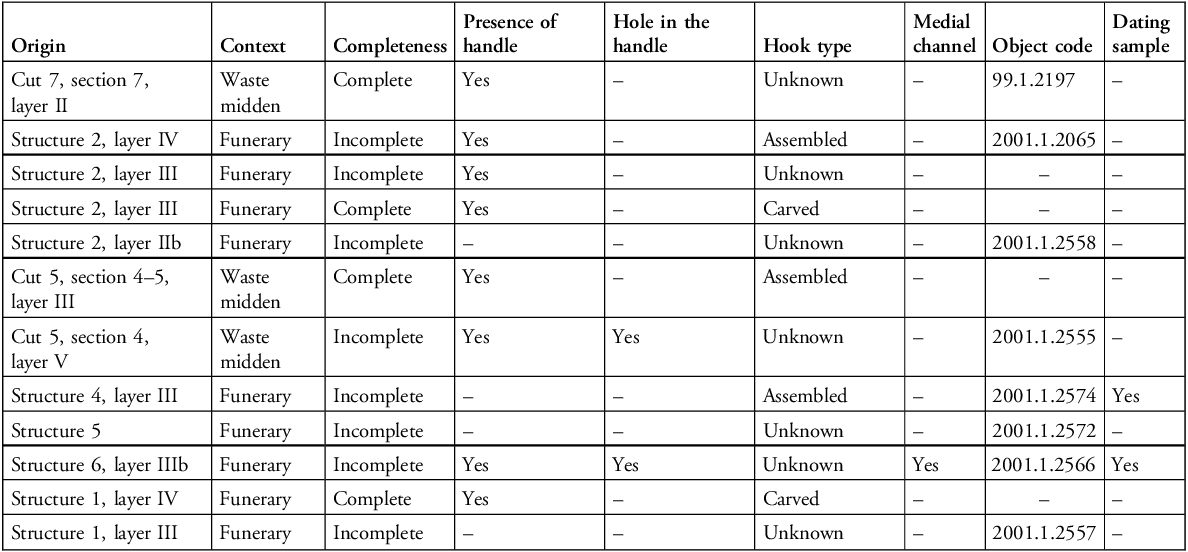
Composite devices related to fishing and hunting, such as harpoon shafts and detachable heads, jigging hooks and fishing lines, weights and fishhooks, are common finds in the site. The reported assemblage also includes 12 spear-throwers, three of which were recovered from the domestic midden (units 7 & 5) and the remaining nine from funerary contexts inside stone-built structures 1, 2, 4, 5 and 6 (Figure 1 & Table 1). In addition, four probable spear-thrower hooks were identified. Two of the three specimens recovered from the domestic midden were complete, suggesting that they may have been carefully and deliberately deposited rather than simply discarded at the end of their use-lives. The uniqueness and rarity of these objects led us to study them again 50 years after their discovery.
Context and technological features of the analysed spear-throwers from Caleta Huelén 42.

Material and methods
During a review of the archaeological collection from Caleta Huelén 42—now stored at the University of Antofagasta, northern Chile (Ballester Reference Ballester2023)—only nine of the 12 spear-throwers originally recovered from the site could be located and no darts were identified in the collection. Each artefact was assessed based on its dimensions, technical attributes, assemblages and constituent parts, and documented with photography and technical drawings.
Samples of wood from the fractured sections of two spear-throwers (N°2001.1.2574 and N°2001.1.2566) were sent for radiocarbon dating. The results were corrected for isotopic fractionation and then calibrated using OxCal v.4.4.4 (Bronk Ramsey Reference Bronk Ramsey2021) with the SHCal20 atmospheric curve (Hogg et al. Reference Hogg2020).
The unpublished notebooks, field notes, drawings, sketches and photographs from the excavations conducted between 1971 and 1973 were also studied in detail. The unpublished field records (Núñez, P. Reference Núñez1971a & Reference Núñezb, Reference Núñez1972, Reference Núñez1973; Zlatar Reference Zlatar1975) provided complementary information to the brief monographic publications available on the site (Núñez Reference Núñez1974; Núñez et al. Reference Núñez1974; Zlatar Reference Zlatar1983, Reference Zlatar1989). Documents were digitised, transcribed and systematised in databases for subsequent processing.
Results
Spear-thrower design, morphology and technical attributes
The nine spear-throwers are made of wood (Figure 4) and some comprise several parts and different materials. Species identification of the wood is pending. The unpublished field notebooks indicate that four specimens were complete when recovered but only one of the artefacts identified in the museum collection is complete; the others are fragmented to some degree or have missing parts (Table 2), which inhibits direct comparisons in dimensions and material characteristics. Metric analyses do, however, suggest some size variability within the set (see online supplementary material (OSM) Table S1).
The spear-throwers and their contexts from Caleta Huelén 42 analysed in this article: A) cut 7, section 7, layer II (N°99.1.2197); B) cut 5, section 4, layer V (N°2001.1.2555); C) structure 2, layer IV (N°2001.1.2565); D) structure 5 (N°2001.1.2572); E) structure 4, layer III (N°2001.1.2574); F) unknown context (N°2001.1.2573); G) structure 6, layer IIIb (N°2001.1.2566); H) structure 2, layer IIb (N°2001.1.2558); I) structure 1, layer III (N°2001.1.2557) (figure by authors).

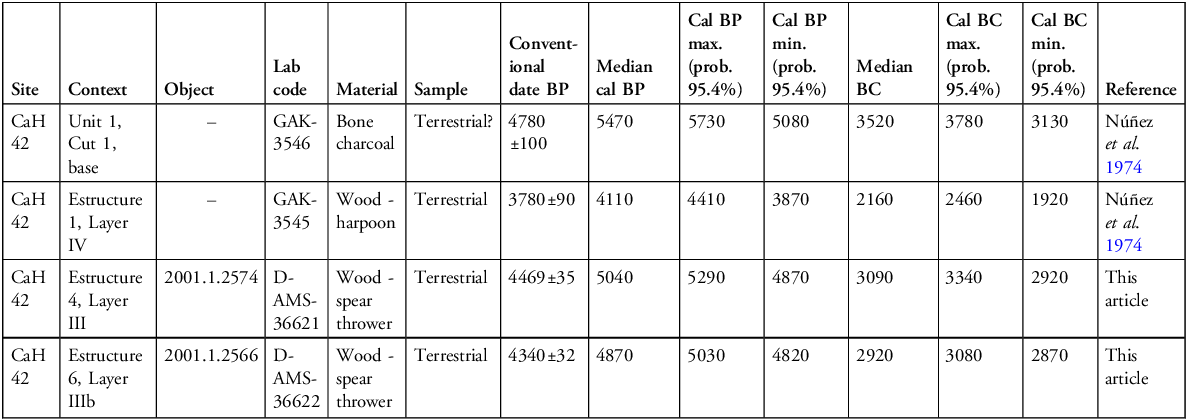
Radiocarbon dating of the Caleta Huelén 42 site and spear-throwers.

Dates calibrated using the SHCal20 calibration curve (Hogg et al. Reference Hogg2020).
In terms of components and raw materials, some specimens include leather and sinew bindings on the handles (Figure 4G), a detachable bone hook (Figure 4A) and red pigments applied to their surfaces. In all cases, the body of the spear-thrower was carved from a single block of dense hardwood, without bark but with some still bearing knots. The main traces of manufacture are located at the ends, and all have undergone scraping or polishing to produce smooth and homogeneous surfaces.
Seven of the nine specimens (Figure 4A–G) are characterised by a formal handle at the proximal end, a flattened and widened central body and a small distal projection, sometimes featuring a longitudinal groove on one of its faces (probably to fit the dart), which likely originally had a bone hook inserted at the end (Figure 4C & E). The medial (body) section varies in shape: some examples are rectangular with parallel sides (Figure 4A–C), while others are more trapezoidal with converging sides (Figure 4E). Bodies vary in width from 39–22mm and in thickness from 12.79–5.3mm (Table S1). Most are fractured at one or both ends, preventing identification of their full length and individual components. The most complete artefact (N°99.1.2197) measures 280mm in length (Table S1). It preserves a defined and well-formed handle (Figure 4A) and retains the articulated bone hook at the distal end, fastened with a leather or sinew foreshaft loop. Although broken at the point where it would connect to the dart, the hook has a remaining length of 21.6mm (Table S1).
Two specimens display a small perforation in the flat body near the handle (Figure 4B & G), slightly offset to one side, probably used to attach a cord or handle for gripping the artefact. One of these (N°2001.1.2566; Figure 4G) shows a possible longitudinal groove along its body, though the piece is fractured. The same artefact presents a clear leather cover on the handle; a technological feature that is absent in the rest of the collection.
Two other items in the museum collection are labelled as ‘estolicas’ but differ markedly from the rest in terms of their shape and design. Both appear to be incomplete and fractured, one in the middle (Figure 4H) and the other at the ends (Figure 4I). Perpendicular protrusions, like ears or handles, are moulded from the same block of wood as the body; however, due to their fragmentary state, it is difficult to determine the function of these features.
Chronology
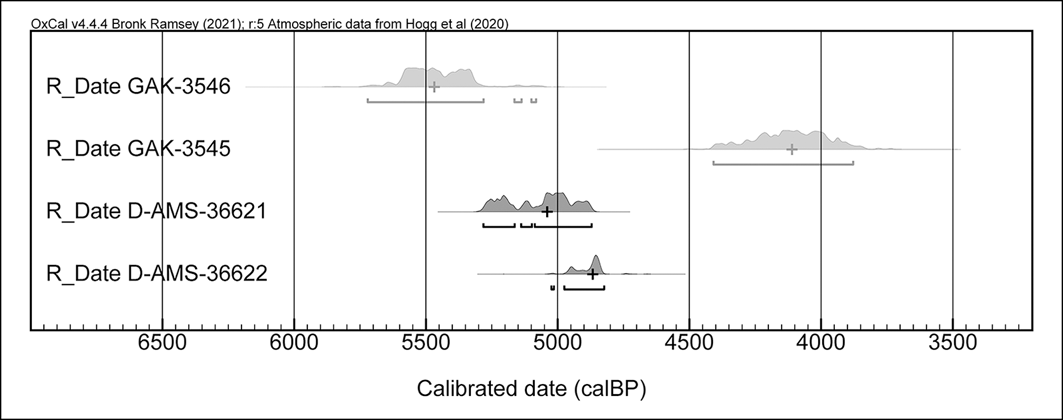
Samples taken from the wooden bodies of the spear-throwers from funerary contexts in structures 6 and 4 (Figure 1, Table 1) yielded radiocarbon dates of around 5000 cal BP, which correspond closely with dates previously obtained from the base of the midden deposit (Figure 5, Table 2). One of these former radiocarbon dates (4110 cal BP) (Table 2) was obtained from a wooden harpoon head deposited as part of the grave goods from layer IV of structure 1 (Table 1). This context also included a spear-thrower, though this specimen could not be located within the museum collection.
Calibrated radiocarbon dates for Caleta Huelén 42 and the spear-throwers studied (figure by authors).

Discussion
The assemblage of spear-throwers from Caleta Huelén 42 exhibits a remarkable homogeneity in terms of design, technology and morphology. Although some specimens are noticeably smaller than others—which led the site excavators to describe them as ‘miniature estólicas’—their overall design and functioning technology remain consistent. The frequency of spear-throwers at the site is unusually high and their deposition as grave goods, representing one of the earliest examples of collective funerary expressions on the coast of the Antofagasta region (Ballester et al. Reference Ballester and Gallardo2017); their presence as offerings within a ritual context likely contributed to this condition. Even considering only the three spear-throwers recovered from domestic refuse, the number remains remarkable for a single Late Archaic period site. It is possible that they served as offerings without funerary associations like other sites in the region (de Souza Reference de Souza2006, Reference de Souza and Hubert2011; Núñez et al. Reference Núñez2006; de Souza et al. Reference de Souza2017).
Despite the time that has passed since they were excavated and the handling inherent to collection practices, the objects are generally well preserved. Their wooden construction underscores the significance of this raw material and its working among littoral groups, something that is also emphasised in relation to other coastal technical objects, such as harpoons for marine hunting (Ballester Reference Ballester2018, Reference Ballester and Quiroz2021, Reference Ballester2023; Grimberg et al. Reference Grimberg2022). This wood was likely sourced from further inland, beyond the coastal cliffs, for the specific purpose of crafting hunting tools (Bittmann Reference Bittmann and Masuda1986; Grimberg et al. Reference Grimberg2022; Ballester Reference Ballester2023). The good state of preservation has further enabled the recognition that these were composite devices, made up of different parts or sections, such as handles with bindings of leather or sinew, bone hooks and pigment coverings, consistent with the wider coastal technological tradition, which was based on an economy of assemblage (Ballester Reference Ballester and Quiroz2021, Reference Ballester2023, Reference Ballester2024a, Reference Ballester2024b).
Previous classification of the spear-throwers (Rivera & Zlatar Reference Rivera and Zlatar1985) identified seven as the planiform type (Figure 4A–G) and two as the rod with handle type (Figure 4H & I). The planiform type can be divided into two subtypes, A1 and A2, depending on the presence or absence of a small perforation located in the flat body of the spear-thrower near the handle and slightly offset to one side. Two of the spear-throwers from Caleta Huelén 42 can be attributed to subtype A1 due to the presence of this hole (Figure 4B & G), which is a technical element that has been recognised in other specimens from the coast of northern Chile (Uhle Reference Uhle1922; Bird Reference Bird1943; Núñez Reference Núñez1963; Bittmann & Munizaga Reference Bittmann and Munizaga1984) and probably served to attach a cord or handle for gripping the artefact (Rivera & Zlatar Reference Rivera and Zlatar1985). The classification of the two remaining items (Figure 4H & I) as rod with handle type is questionable, as they do not resemble any other known examples of Andean spear-thrower. Furthermore, both were excavated in a fragmentary state, making it difficult to reconstruct their original shape and complete form. In fact, according to the field notes, at the time of discovery, they were not even recognised as spear-throwers but simply listed as wooden objects with no functional attribution (Núñez, P. Reference Núñez1971a).
Under a more recent classification of Andean spear-throwers, which also includes coastal items (Cuellar et al. Reference Cuellar2025), the first seven artefacts (Figure 4A–G) could be attributed to type 3, due to the spatula shape of their bodies, their distinctive handles and the hole for the cord. The possible presence of a longitudinal groove in the body of one of these specimens and its leather-covered handle are also suggestive of types 2 and 4 (Cuellar et al. Reference Cuellar2025); an exact classification is difficult due to the fragmentary state and poor preservation of the piece. None of the types proposed in this most recent classificatory system resemble the pieces previously identified as the rod with handle type. This reinforces our assertion that these artefacts are likely not spear-throwers per se, though their actual function remains unknown.
Across the Circumpunian Andes, documented spear-throwers reveal a striking diversity of designs and styles, each tied to specific regions and time periods (Uhle Reference Uhle1907, Reference Uhle1909, Reference Uhle1922; Vignati Reference Vignati1936; Bird Reference Bird1943; Casanova Reference Casanova1944; Núñez Reference Núñez1963; Munizaga Reference Munizaga1964; Gambier & Saccero Reference Gambier and Sacchero1969; Focacci & Erices Reference Focacci and Erices1971; Dauelsberg Reference Dauelsberg1974; Rivera Reference Rivera1975; Fernández Distel Reference Fernández Distel1977; Bittmann & Munizaga Reference Bittmann and Munizaga1984; Rivera & Zlatar Reference Rivera and Zlatar1985; Standen Reference Standen2003; de Souza Reference de Souza2006, Reference de Souza and Hubert2011; Cuellar et al. Reference Cuellar2025). To date, the spear-throwers from Caleta Huelén 42 are some of the earliest directly dated examples for the entire Andean region, evidencing the use of these objects as far back as 5000 years BP. In terms of design and technology, the Caleta Huelén 42 spear-throwers most closely resemble those described from the Arica coast (Figure 6A–C) (Uhle Reference Uhle1922; Bird Reference Bird1943; Munizaga Reference Munizaga1964)—and particularly those from Morro de Arica—with features such as a spatulate body, a defined handle and a perforation for its attachment. The longitudinal channel on one of the faces is likewise characteristic of the Arica spear-throwers. The same features are also found in the spear-thrower recovered from Patillos 2, on the Iquique coast, part of the Anker Nielsen collection (Figure 6D). Other coastal specimens, including those from Alto Ramírez, El Laucho and Caleta Huelén 43, are distinguished by the presence of a crosspiece on the handle (Figure 6E), a feature absent in all the artefacts studied here and seemingly a later development typical of the Coastal Formative period (2500–1200 cal BP). Spear-throwers’ hooks have also been documented in coastal contexts, as at the Caleta Bandurrias site in Taltal, contemporaneous with Caleta Huelén 42.
Similar spear-throwers from the Circumpunean Andes: A) Arica (without measurements) (Uhle Archive of the Ibero-Amerikanisches Instituto of Berlin); B) Quiani, Arica (without measurements) (Bird Reference Bird1943: fig. 20.m–l); C) Morro de Arica (465mm long) (Munizaga Reference Munizaga1964: fig. 1); D) Patillos, Iquique (517mm long) (Bittmann & Munizaga Reference Bittmann and Munizaga1984: fig. 5a–b); E) Azapa 70, Arica (820mm long) (Rivera Reference Rivera1975: 24–25); F) Doncellas River, Jujuy (570mm long) (Casanova Reference Casanova1944: fig. 1); G) Alero Confluencia rock art, Salado River (Gallardo Reference Gallardo2009: fig. 6).

Beyond the coastal sphere, perhaps the closest parallel is the object recovered from a funerary context in a small cave on the Doncellas River, Puna de Jujuy, north-western Argentina (Casanova Reference Casanova1944; Scheinsohn Reference Scheinsohn2016). This wooden spear-thrower is 570mm long and has a spatulate and slightly curved body (30mm wide), a formal handle with a perforation and, at the distal end, a protuberance to which a bone hook was attached with sinew (Figure 6F). What differentiates it from the specimens studied here is that its obverse surface is fully decorated, with carved geometric motifs and what appears to be a snake. Yet the similarities are striking given the distance between the mouths of the Loa Rand Doncellas rivers (some 500km in a straight line), and the documentation of other spear-throwers with considerably different characteristics in the area between the two regions. This includes the bone spear-throwers from Tulan 109 (de Souza Reference de Souza2006, Reference de Souza and Hubert2011; Núñez et al. Reference Núñez2006) and Chiuchiu 273A-1 (Pollard Reference Pollard1970), which are strikingly similar to one another and presumably contemporary, but vastly different from the Caleta Huelén 42 specimens in terms of design, technology, size and choice of raw materials.
Pending further research, we might tentatively hypothesise that spear-throwers were used by coastal groups for hunting terrestrial animals, especially camelids, rather than for marine hunting, for which they employed direct harpoon techniques (Ballester Reference Ballester2018, Reference Ballester2023). Integrating the new dates presented here, this terrestrial hunting technology appears to have been in use along the coast during the Archaic period (at least from 5000 cal BP, and possibly earlier) and throughout the Coastal Formative period (up to 1200 cal BP). By the second half of the fifth century AD, spear-throwers were gradually replaced by bows and arrows, as attested in funerary contexts and rock art (Ballester Reference Ballester2016, Reference Ballester and Bouché2020, Reference Ballester2023), though it cannot be ruled out that both hunting technologies may have operated simultaneously for a while, as in other regions of the Andes (Owen Reference Owen1998; Critchley Reference Critchley2018). This possible transition appears to have occurred later around the coast than it did in hunter-gatherer groups of the interior Atacama Desert, based on analyses of lithic projectile points (de Souza Reference de Souza2006, Reference de Souza and Hubert2011; de Souza et al. Reference de Souza2024).
Archaeological evidence for the use of darts and spear-throwers by inland groups for the capture of camelids, including iconographic representations of hunts (Figure 6G), helps inform our hypothesis for the similar use of these objects on the coast. Camelid remains are common on the coast, and the animals were likely hunted not only for their meat but also for raw materials used in the production of technical objects, in particular harpoons and fishhooks (e.g. Ballester Reference Ballester2016, Reference Ballester and Bouché2020, Reference Ballester2023, Reference Ballester2024b; Bravo & Ballester Reference Bravo, Ballester and Blasco2025). The possibility that spear-throwers were not solely hunting tools but also weapons used in inter-personal violence cannot be ruled out; nor can the potential for apparent ‘miniatures’ to simply be smaller devices for younger individuals. Further research is undoubtedly needed.
Across the Atacama Desert diverse types of spear-throwers, distinguished by their technical characteristics, design, morphology and raw materials, were used in geographically and chronologically distinct zones. The wooden spear-throwers studied here seem to belong to an early coastal tradition, typical of the Late Archaic period. Their similarity to the Doncellas River specimen may relate to chronology, as both date to the same period, but together they indicate long-distance intercommunity relations between coastal and interior groups, which intensified during the Late Archaic period (e.g. Yacobaccio Reference Yacobaccio2006; de Souza et al. Reference de Souza2010; Ballester & Gallardo Reference Ballester and Gallardo2011). The presence of both inland and coastal objects in funerary contexts or in symbolic offerings unrelated to death—many of them repaired and well maintained—is indicative of the high social value that land-hunting activities and their devices had for all these groups. In this respect, we propose that the spear-throwers discussed here form part of a long-standing tradition of terrestrial hunting devices that evolved over time and assumed regionally specific expressions, a technological trajectory that demands further research.
Conclusion
Re-examination of the Caleta Huelén 42 spear-throwers and their designation as the earliest directly dated examples currently known for the Andes reopens debate surrounding this distinctive hunting technology. Our study demonstrates that these devices were in use along the littoral of the Atacama Desert in northern Chile from at least 5000 cal BP as part of a tradition widely established along the coast and shared with inland groups. This dart-throwing technical device, embedded within a long technological trajectory of transformations and regionally specific solutions among Andean communities, may well be considerably older than the dates presented here and further research is undoubtedly needed.
Our research highlights the potential of re-examining collections and unpublished archives in offering new insights without the need to re-excavate sites, while simultaneously contributing to the preservation of vital artefacts. The importance of analysing complete technical objects (spear-throwers and darts), rather than focusing exclusively on the most abundant archaeological components (lithic projectile points or bone hooks), is also underscored as these latter ought to be regarded as complementary rather than mutually exclusive lines of investigation. Taken together, these efforts contribute to a more nuanced understanding of ancient hunting techniques and technologies in the Andes, considering both their specificity and diversity.
Acknowledgements
Universidad de Antofagasta, Julio Cruz and Marcela Sepúlveda.
Funding statement
Agencia Nacional de Investigación y Desarrollo, Fondo Nacional de Desarrollo Científico y Tecnológico (grant numbers 1250389 & 1190263).
Online supplementary material (OSM)
To view supplementary material for this article, please visit https://doi.org/10.15184/aqy.2026.10398 and select the supplementary materials tab.





 Open access

