




Introduction
A recent paper by Osmanov (Reference Osmanov2025) investigates the possibility of panspermia originating from Earth. It has been shown that turbulent motion caused by extraterrestrial micrometeorites entering the atmosphere can involve local dust particles, which may subsequently escape the Solar System and potentially reach up to 105 stellar systems.
In general, the idea of life being transported to Earth from deep space is not new; it was first considered in the early 20th century by Arrhenius (Reference Arrhenius1908), who argued that solar radiation could propel small cosmic dust particles across vast interstellar distances. The problem has been studied in detail in the context of survival under extraterrestrial conditions (Secker et al., Reference Secker, Lepock and Wesson1994; Wesson, Reference Wesson2010). A study by Wickramasinghe (Reference Wickramasinghe2010) argues that life on Earth may have an extraterrestrial origin.
Our recent work (Osmanov, Reference Osmanov2025) is based on the results published by Berera (Reference Berera2017) whose study focuses on the dynamics of space dust interactions with atmospheric flow during high-velocity collisions. During these collisions, the local dust particles originating from the Earth might acquire velocities exceeding the Earth’s escape velocity. Consequently, bacteria-bearing dust particles may be transported to distant planetary systems.
Life on Earth originated at least 3.55 billion years ago (de Duve, Reference de Duve1995), which implies that for approximately that long, Earth has been shedding life-bearing particles into surrounding space. Hence, if favorable conditions exist elsewhere in the Solar System and can be accessed by dust particles, the transport of life from Earth appears plausible and may have been occurring over the course of several billion years.
It is now well established that a huge amount of liquid water is localized beneath the icy surfaces of Europa (Carr, Reference Carr, Belton, Chapman, Davies, Geissler, Greenberg, McEwen, Tufts, Greeley, Sullivan, Head, Pappalardo, Klaasen, Johnson, Kaufman, Senske, Moore, Neukum, Schubert, Burns, Thomas and Veverka1998) and Enceladus (Less et al., Reference Less, Stevenson, Parisi, Hemingway, Jacobson, Lunine, Nimmo, Armstrong, Asmar, Ducci and Tortora2014), making the existence of life there a highly plausible possibility. Therefore, in this paper, we investigate the possibility of dust particles reaching Jupiter’s moon Europa and, consequently, the potential transport of bacteria to its surface.
The organization of the paper is the following: after outlining the mathematical model of dust particles’ dynamics in Section Discussion and results, we obtain major results and in Section Conclusion we summarize them.
Discussion and results
In this section we consider dynamics of dust grains propelled from Earth reaching the nearby zone of the Jupiter’s moon Europa. It is well known that dust particles with sizes of the order of 10−4 cm can contain bacteria packed within this size (Portillo et al., Reference Portillo, Leff, Lauber and Fierer2013). It is clear that, for bacteria to survive, the temperature of dust particles during their motion must not significantly exceed T ≃ 300 K. Then, following an estimate presented by Osmanov (Reference Osmanov2025) the maximum velocity, υ m , corresponds to a regime, when a drag power, Dρ a πr 2 υ m 3 and the black body emission power 4πr 2 σT 4 are of the same orders of magnitude $ v_m\simeq \left ( {4\sigma T^4}\over{\rho _a D}\right )^{1/3},$
where D represents a drag coefficient, σ is the Stefan-Boltzmann constant, and ρ a represents the atmospheric mass density. Following (Brekke, Reference Brekke2013; Havens et al., Reference Havens, Koll and LaGow1952; Picone et al., Reference Picone, Hedin, Drob and Aikin2000) we consider Earth parameters as ρ a ≃ (1.2×10⁻³ g/cm 3)exp(−H/7.04 km), where H is the altitude measured in km. By substituting the parameters at an altitude 150 km with D ≃ 1 we obtain a velocity υ m ≃ 14 km/s, which exceeds the escape velocity υ esc ≃ 11.2 km/s. This suggests that the dust particles can overcome Earth’s gravitational pull and potentially travel to other worlds. from energy conservation law one can show that at a distance of a several Earth radii, the velocity relative to Earth becomes υ 2 rel ≃ υ 2 m − υ 2 esc ≃ 8.4 km/s.
In the previous paper we have studied in detail the dynamics of dust particles propelled from the high altitudes of Earth.
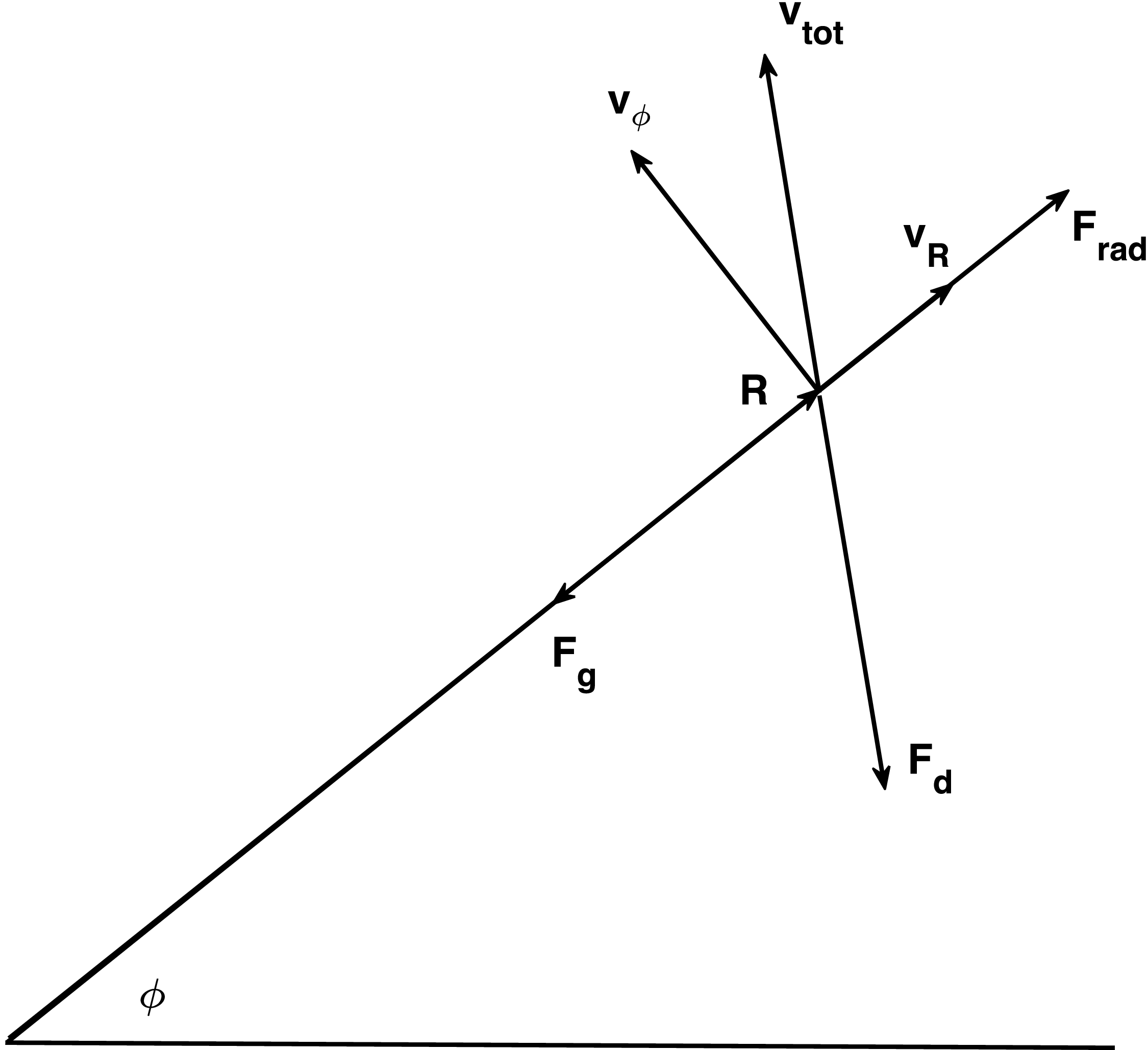
In Figure 1 in polar coordinates we represent the schematic picture of velocity components and forces acting on the dust particles. Here $F_{rad}\simeq {{Lr^2}\over{4R^2c}}$
is the solar radiation force (Carroll and Ostlie, Reference Carroll and Ostlie2010), L ≃ 3.83 × 1033
erg/s represents solar luminosity r denotes the radius of a spherical dust grain, c is the speed of light, F
g
= GMm/R
2 denotes the gravitational force, G is the gravitational constant, M ≃ 2 × 1033
g represents the solar mass, m is the dust particles’ mass, R indicates its radial coordinate, F
d
≈ Dρπr
2
υ
2 is the drag force caused by the ambient, υ indicates the total speed of the grain, ρ
0 ≃ 2m
p
n
0 and n
0 ≃ 1 cm−3 are the mass density and the number density of a medium, and m
p
represents the proton’s mass.
$F_{rad}\simeq {{Lr^2}\over{4R^2c}}$
is the solar radiation force (Carroll and Ostlie, Reference Carroll and Ostlie2010), L ≃ 3.83 × 1033
erg/s represents solar luminosity r denotes the radius of a spherical dust grain, c is the speed of light, F
g
= GMm/R
2 denotes the gravitational force, G is the gravitational constant, M ≃ 2 × 1033
g represents the solar mass, m is the dust particles’ mass, R indicates its radial coordinate, F
d
≈ Dρπr
2
υ
2 is the drag force caused by the ambient, υ indicates the total speed of the grain, ρ
0 ≃ 2m
p
n
0 and n
0 ≃ 1 cm−3 are the mass density and the number density of a medium, and m
p
represents the proton’s mass.
The schematic picture of the components of the total velocity and forces acting on the dust particle from (Osmanov, Reference Osmanov2025 ).

Osmanov (Reference Osmanov2025) has found that dynamics of dust grains can be described by the following set of equations $\ddot \phi \simeq - 2\dot \phi {{\dot R} \over R} - {{3D{\rho _0}} \over {4\rho r}}\dot \phi {\left( {{{\dot R}^2} + {R^2}{{\dot \phi }^2}} \right)^{1/2}},$ $\eqalign{ \ddot R \simeq& \; R{{\dot \phi }^2} - {{3D{\rho _0}} \over {4\rho r}}\dot R{\left( {{{\dot R}^2} + {R^2}{{\dot \phi }^2}} \right)^{1/2}} + \cr \quad\quad\quad & + {1 \over {{R^2}}}\left( {{{3L} \over {16\pi c\rho r}} - GM} \right), \cr}$
where ρ denotes the mass density of the dust.
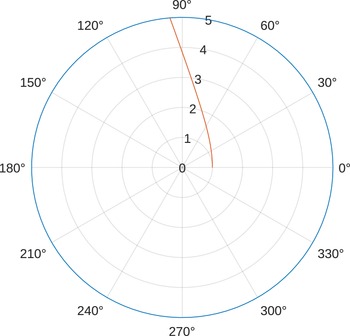
In Figure 2 we show a trajectory of the dust particles (red) moving towards the Jupiter’s orbit (blue). The set of parameters is: M ≃ 2 × 1033 g, L ≃ 3.83 × 1033 erg/s, D = 1, ρ = 2 g/cm3, n 0 = 1 cm−3 R(0) ≃ 1 AU, Ṙ(0) ≃ 0 km/s, and υ φ ≃ 38.3 km/s. We set an initial velocity equal to 38.3 km/s where it has been taken into account that the velocity of a dust grains relative to Earth has the same direction as the Earth’s velocity relative to Sun (angle, α, between υ tot and υ φ (see Figure 1) equals zero).
Here we represent a trajectory of a dust particle (red), reaching the Jupiter’s orbit (blue). The set of parameters is: M ≃ 2 × 1033 g, L ≃ 3.83 × 1033 erg/s, D = 1, ρ = 2 g/cm 3, n0 = 1 cm −3 R(0) ≃ 1 AU, Ṙ(0) ≃ 0 km/s, and υφ ≃ 38.3 km/s.

By numerically solving Equations (2, 3) across the full range of initial values of α = 0° to 360°, one obtains the average relative velocity of dust grains with respect to Jupiter as approximately u rel ≃ 20.1 km/s. The impact of a dust particle on Europa’s surface results in maximum destruction when the angle of incidence – defined as the angle between the particle’s velocity vector and the surface – is 90°. On the other hand, it is empirically evident that T(θ) ≃ T(π/2)sin3/2 θ (Pierazzo and Melosh, Reference Picone, Hedin, Drob and Aikin2000). After estimating T(π/2) ≃ υ 2 rel /(2c v ), where c v ≃ 1100 J/(kgK) is a specific heat of the dust material, and by assuming T(θ) ≡ T 0 ≃ 300 K, one can straightforwardly derive a critical value of the incident angle, when the particle with bacteria inside will survive $ \theta \simeq \left ( {{2c_vT_0}\over{\upsilon _{rel}^2}}\right )^{2/3}\simeq 0.015\;rad\simeq 1^0,$
Therefore, out of the entire range of possible impact angles, only a very narrow fraction – approximately f 1 = 1/360 ≃ 2.8 × 10⁻³ – would allow for the potential survival of bacteria. These dust particles will melt Europa’s ice surface and become embedded within it.
As discussed by Berera (Reference Berera2017); Osmanov (Reference Osmanov2025), the flux density of dust particles leaving Earth is ${{\cal F}_{{0}}}$
≃ 1 cm−2s−1, therefore, the total flux of particles is given by F ≃ 4πR
⊕
2
${{\cal F}_{{0}}}$
≃ 1 cm−2s−1, therefore, the total flux of particles is given by F ≃ 4πR
⊕
2 ${{\cal F}_{{0}}}$
≃ 5 × 10¹⁸ s−1, where R
⊕ ≃ 6400 km is the radius of Earth.
${{\cal F}_{{0}}}$
≃ 5 × 10¹⁸ s−1, where R
⊕ ≃ 6400 km is the radius of Earth.
Numerical analysis shows that the dust grains reach the Jupiter’s orbit only for the following intervals of angles α = 0° − 130° α = 230° − 360°. Therefore, the corresponding fraction equals f 2 ≃ 260/360 ≃ 0.72.
Another factor must be taken into account. For a particle to enter Jupiter’s zone, it must be there at the correct moment. As numerical analysis shows, particle’s angular position φ (see Figure 1) on the Jupiter’s orbit lies within the interval 83° − 135°, (for the case shown in Figure 2, φ ≃ 95°) which implies a probability of approximately f 3 = (135−83)/360 ≃ 0.15 for arriving at the right time.
On average, dust particles are ejected isotropically from Earth in all directions. We now turn to estimating a maximum theoretical fraction of particles reaching a Jupiter zone. For the corresponding Hill’s radius (scale of the gravitational influence), one writes R H = r J (M J /(3M ⊙))1/3 ≃ 0.36 AU (Carroll and Ostlie, Reference Carroll and Ostlie2010), where M J ≃ 2 × 1030 g is Jupiter’s mass and r J ≃ 5 AU is its orbital radius. Then, one can be approximate the fraction as follows: f 4 ≃ R H 2/(4r 2 av ) ≃ 1.4 × 10⁻³. On the other hand, recent Numerical simulations have found that 0.015% (f 5 = 1.5 × 10⁻⁴) of particles entering the Jupiter’s gravitation zone, can fall onto the Europa’s surface.
Therefore, the total flux of dust grains on the Europa’s surface with potentially survived bacteria inside is given by

It should be noted that bacteria contained within dust particles that land on the surface undergo deactivation over a timescale of approximately 10000 years (Pavlov et al., Reference Pavlov, Cheptsov, Tsurkov, Lomasov, Frolov and Vasiliev2019). On the surface of Europa there are active zones – Chaos terrains, covering approximately 20% − 40% of the total surface (Schmidt et al., Reference Schmidt, Blankenship, Patterson and Schenk2011). On the other hand, based on detailed observations, it is estimated that the surface ice undergoes fracturing for approximately 103 − 105 years (Greenberg et al., Reference Greenberg, Geissler, Hoppa and Tufts2002). This provides a non-negligible probability that dust particles containing microbial life may reach the subsurface water before being deactivated by radiation.
Recent studies show that the age of Europa’s icy surface is at least 30 − 80 Myr (Vance and Brown, Reference Vance and Brown2005). Therefore, the total number of particles during the mentioned period is of the order of (3−8) × 1023, which strongly suggests the likelihood of life being present in the subsurface ocean of Europa if the biological and biochemical conditions are compatible with Earth-originating life, which would require a new series of investigations to determine.
Conclusion
In the present paper, we have considered the dynamics of dust-grain particles propelled from Earth to Europa. For this purpose, we estimate the total flux of dust particles leaving Earth. Considering oblique impacts, we have shown that the maximum inclination angle at which dust grains can survive is of the order of 1∘. Taking into account this result, along with several important factors that reduce the flux of dust grains that impact the surface of Europe, we have found that the total flux is of the order of 3.2 × 10⁸ s−1. This implies that during 30 − 80 Myr (age of the Europa’s subsurface ocean) the total number of survived particles after impact is (3−8) × 1023.
We also discussed the possibility that such particles may reach the subsurface ocean through surface fracturing processes, which occur every 103–104 years. This renders the existence of life on Europa highly plausible.
Acknowledgments
The research was supported by the Shota Rustaveli National Science Foundation grant (FR-24-1751).

 Open access

