Introduction
Two threatened freshwater-dependent cetaceans, the Ganges River dolphin or shushuk Platanista gangetica gangetica and Irrawaddy dolphin or Iraboti Orcaella brevirostris, occur in waterways of the Sundarbans mangrove forest, Bangladesh. The Ganges River dolphin is an obligate freshwater species that ranges far upstream in the Ganges–Brahmaputra–Meghna rivers of Nepal, India and Bangladesh and in the comparatively much smaller Karnaphuli–Sangu rivers of southern Bangladesh. The Irrawaddy dolphin occurs in some of Asia’s largest rivers (Mekong, Ayeyarwady and Mahakam) and in coastal waters of the Indo-Pacific affected by freshwater inputs (Smith & Jefferson, Reference Smith and Jefferson2002; Smith et al., Reference Smith, Shore, Lopez, Smith, Shore and Lopez2007). The Ganges River and Irrawaddy dolphins are categorized as Endangered and Vulnerable, respectively, on the IUCN Red List (IUCN, 2009). Both species are threatened in the Sundarbans by incidental killing in gill nets, destruction of fish-spawning habitat through mangrove deforestation, pollution from large human population centres, the enormous bycatch of fish fingerlings and crustacean larvae in mosquito nets, and saline encroachment and excessive sedimentation from declining freshwater supplies and sea-level rise (Reeves et al., Reference Reeves, Smith, Crespo and Notarbartolo Di Sciara2003; Smith et al., Reference Smith, Braulik, Strindberg, Ahmed and Mansur2006, 2009).
The only comprehensive cetacean survey of the Sundarbans mangrove forest in Bangladesh was conducted in March 2002 along 1,510 km of waterways. The survey used double concurrent counts from independent observer teams to generate abundance estimates of 225 Ganges River dolphins (CV = 12.6%) and 451 Irrawaddy dolphins (CV = 9.6%; Smith et al., Reference Smith, Braulik, Strindberg, Ahmed and Mansur2006). This survey inspired us and the captains of three nature tourism vessels operated by The Guide Tours Ltd in the eastern Sundarbans of Bangladesh to initiate a cetacean monitoring programme. Here we use sightings data recorded during nature tourism cruises from April 2002 to March 2005 to identify hotspots of abundance and investigate channel-type preferences of freshwater-dependent cetaceans.
Study area
The eastern Sundarbans is defined by the Bay of Bengal in the south, Mongla Port in the north, Baleswar River in the east and Passur River in the west. It includes the Sundarbans East Sanctuary covering c. 31,000 ha of which part was designated as a UNESCO World Heritage Site in 1997 because of its unique and diverse biological character. Major freshwater inputs to the eastern Sundarbans come from the Baleswar and Passur rivers that fan out into a complex network of estuarine waterways ranging from a few metres to a few kilometres wide and increase in salinity from north-east to south-west (Hussain & Karim, Reference Hussain, Karim, Hussain and Acharya1994).
Methods
Sighting network and channel mapping
During nature tourism cruises conducted between 25 March 2002 and 31 March 2005 the captains and crew of the vessels M. V. Aboshar (length 35 m, beam 8 m, height of bridge above waterline 5 m and engines 265 hp × 2), M. V. Chhuti (length 25 m, beam 6.5 m, height of bridge above waterline 4.2 m and engine 265 hp) and M. L. Bonbibi (length 21 m, beam 6 m, height of bridge above waterline 4.5 m and engine 265 hp) recorded observations of cetaceans on a standardized data sheet, in Bengali.
Sightings were opportunistic and no assumption was made that all dolphins present were recorded. However, sighting biases (Smith & Reeves, Reference Smith, Reeves, Reeves, Smith and Kasuya2000) were assumed to be consistent. The data sheet included entry fields for the date, time, species identity, group size, number of calves and geographical location taken with a global positioning system (GPS). Calves were defined as animals < 1 m long. Group sizes were estimated according to the best estimate of dolphins visible within the channel reach (Smith et al., Reference Smith, Braulik, Strindberg, Ahmed and Mansur2006). The captains and crew were familiar with both cetacean species and received training in the use of the GPS, defining groups and calves and in completing the data sheets.
Data were periodically compiled, quality-checked and entered into a spreadsheet. Routes from the vessel logs were overlaid on a digitized map derived from 1:50,000 SPOT satellite imagery and divided into channel segments covering 5 linear km using the geographical information system ArcView v. 3.3 (ESRI, Redlands, USA). Each 5-km segment was then assigned a unique identification number and all sightings were matched to the segment number according to the location where they occurred.
Scoring system for identifying hotspots
Hotspots were identified according to a scoring system applied to segments surveyed on at least three occasions during three seasons: dry (December–March), monsoon (June–September) and post-monsoon (October–November). Insufficient data were available to include the pre-monsoon season (April–May). The top six scoring segments were emphasized in the analysis because this number was judged to be the maximum that could be realistically prioritized for focal conservation attention (e.g. establishing no-fishing zones or gear regulations), given the limits of available resources.
The scoring system used a suite of weighted variables to characterize the relative value of each segment as particularly important habitat for each species. The system gave (1) one point if the encounter rate of groups, individuals or calves was in the top 20% of all segments (calculated separately for each species and season and for groups, individuals and calves for a maximum of 18 points), (2) one point if the encounter of groups, individuals or calves was in the top 40% of all segments during all seasons (calculated separately for each species and for groups, individuals and calves for a maximum of six points), (3) two points if both Ganges and Irrawaddy dolphins were recorded in the segment during all seasons, and (4) two points if both Ganges and Irrawaddy dolphins were recorded during one season (maximum of six points). The top 40% of these scored segments were then shortlisted and each one was assigned 0.5 points for each adjacent segment that was also shortlisted in the top 40% (calculated separately for each season and for all three seasons together for a maximum of four points) and 0.25 points if the segment 5 km away was shortlisted in the top 40% (also calculated separately for each season and for all three seasons together for a total of two points), resulting in a grand total of 38 possible points. The aim of adjacent segment scores was to reflect the positive value of having a continuous stretch or closely spaced segments of preferred habitat vs isolated patches with energetically demanding travel distances in between.
Channel-type preferences
To investigate the frequency of dolphin occurrence according to channel characteristics, values for the mean width, sinuosity and the number of large and small confluences were calculated and assigned to each segment. Channel width was measured at the beginning, end and middle of each segment and then averaged. Segments with a width ≤ 400 m were classified as narrow and segments with a width > 400 m as wide. Sinuosity was calculated by dividing the length of each segment (i.e. 5 km) by the straight-line distance between the beginning and the end points. Segments with sinuosity values of 1.0–1.49 were classified as straight and segments with a value ≥ 1.5 were classified as sinuous. The number of large (> 400 m) and small (≤ 400 m) confluences was recorded for each segment. Each segment was then coded according to the composite criteria used by Smith et al. (2009; Table 1).
Codes and criteria used to categorize 5-km segments along cruising routes of three nature tourism vessels operated by The Guide Tours Ltd (see text for details) in waterways of the Sundarbans mangrove forest in Bangladesh (Fig. 1; from Smith et al., Reference Smith, Braulik, Strindberg, Mansur, Diyan and Ahmed2009).

Results
Vessel coverage and cetacean sightings
The nature tourism vessels surveyed a total of 26,208 km covering 80 5-km channel segments. The captains recorded 1,005 sightings of Ganges River dolphin groups (1,993 individuals; 11.8% calves) and 281 sightings of Irrawaddy dolphin groups (566 individuals; 5.7% calves; Fig. 1).
The study area in the eastern Sundarbans (see rectangle on inset for location in Bangladesh), showing the locations of Ganges River and Irrawaddy dolphin sightings recorded by the captains and crew. Because of the large number of sightings the majority of the individual symbols are not visible. This map illustrates that although a hotspot conservation approach can focus protection efforts on areas of particular ecological importance it does not cover the entire range of freshwater dolphin occurrence. The map was created from satellite imagery and shows a large number of minor channels that are not navigable and where dolphins do not occur (Smith et al., Reference Smith, Shore, Lopez, Smith, Shore and Lopez2006).

Identification of cetacean hotspots
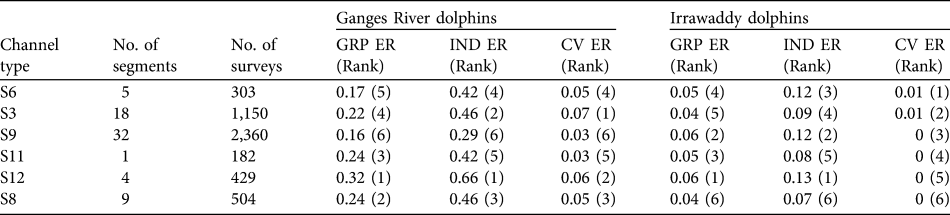
Forty-two segments were surveyed on < 3 occasions during each season and these were deleted from the analysis. From the remaining 38 segments the top six ranked were selected for priority conservation attention (Fig. 2). Encounter rates of Ganges River dolphins (mean = 0.46 sightings per survey, range = 0.25–0.71; mean = 1.12 individuals per survey, range = 0.42–2.21) were much higher than those of Irrawaddy dolphins (mean = 0.06 sightings per survey, range = 0.02–0.11; mean = 0.15 individuals per survey, range = 0.07–0.31; Table 2). Both species were recorded in three of the top six hotspot segments in all three seasons and were recorded in the other three segments during two seasons. For comparison, only two of the remaining 32 segments included sightings of both species during three seasons.
The study area in the eastern Sundarbans (see inset on Fig. 1 for location) showing the 38 segments surveyed on at least three occasions during the monsoon, post-monsoon and dry seasons during 2002–2005 and the six identified hotspot segments. Note that two hotspot segments, located in the far north of the study area and inclusive of the Dhangmari confluence and the Passur River near Mongla Port, are contiguous; and three hotspot segments, located slightly to the south and inclusive of the Mirgamari confluence and beginning of the Sela River, are also contiguous.

Summary of the number of surveys (total and during dry, monsoon and post-monsoon seasons), channel types (Table 1), and group (GER), individual (IER) and calf encounter rates (CER) of Ganges River dolphins Platanista gangetica gangetica and Irrawaddy dolphins Orcaella brevirostris, and composite scores for the top 40% ranked channel segments in the eastern Sundarbans (Fig. 1) based on sighting data collected during 2002–2005.

The channel-type classifications of the top six ranked segments were narrow straight with two small confluences or at least one large confluence (S3, Table 1; n = 3), wide straight with at least two small confluences or one large confluence (S9; n = 1), narrow sinuous with more than two small confluences or at least one large confluence (S6; n = 1) and wide sinuous with at least two small confluences or at least one large confluence (S12; n = 1; Table 2).
Channel-type preferences
Four channel types (S1, S2, S5 and S10; Table 1) were not found in the eastern Sundarbans and were therefore not included in the channel-type preference analysis. To comply with the minimum sample size requirements of χ2 statistics (Zar, Reference Zar1984) only those seasons and segment types with no zero values and those with > 5 sightings or individuals were considered in the hotspot analysis. This resulted in the deletion of data from the pre-monsoon season and two additional channel types (S4 and S7; Table 1), leaving a total of 69 segments that were surveyed in total on 4,928 occasions.
χ2 tests of pooled data from the dry, monsoon and post-monsoon seasons indicated significant differences (P < 0.05, df = 5) between observed vs expected frequencies according to channel type for Ganges River dolphin groups (χ 2 = 65.2) and individuals (χ 2 = 155.1) and for Irrawaddy dolphin individuals (χ 2 = 18.9) but not for groups, possibly because of the small sample size.
The data set for Ganges River dolphins was sufficiently large to analyse dry, monsoon and post-monsoon seasons separately. All χ2 tests of frequencies of occurrence indicated significant differences (P < 0.05, df = 5) between observed vs expected frequencies during the dry season (χ 2 = 33.7 for groups, χ 2 = 103.9 for individuals), monsoon season (χ 2 = 11.7 for groups, χ 2 = 28.3 for individuals) and post-monsoon season (χ 2 = 37.1 for groups, χ 2 = 48.6 for individuals). Irrawaddy dolphins only had a sufficient number of sightings to analyse data separately from the dry season, which indicated significant differences (P < 0.05, df = 5) between observed vs expected frequencies for individuals (χ 2 = 15.7) but not for groups.
The largest positive percentage differences among channel types from the pooled season data for observed vs expected frequencies of Ganges River dolphin individuals were for wide sinuous channels with > 2 small confluences or at least one large confluence (S12), narrow straight channels with > 2 small confluences or at least one large confluence (S3) and wide straight channels with 1–2 small confluences (S8), ordered from largest to smallest. The largest positive percentage differences among channel types for observed vs expected frequencies of Irrawaddy dolphin individuals were for wide sinuous channels with > 2 small confluences or at least one large confluence (S12), wide straight channels with > 2 small confluences or at least one large confluence (S9) and narrow straight channels with > 2 confluences or at least one large confluence (S6), ordered from largest to smallest (Table 3). The two species demonstrated inverse relationships in their preferences for narrow straight channels with > 2 small confluences or at least one large confluence (Ganges River dolphins + and Irrawaddy dolphins −), wide straight channels with 1–2 small confluences (Ganges River dolphins + and Irrawaddy dolphins −) and wide straight channels with > 2 small confluences or at least one large confluence (Irrawaddy dolphins + and Ganges River dolphins −), probably because of the greater availability of these channel types within the respective broad-scale distribution of the two species determined by water quality gradients operating on an estuary-wide scale (Reference ZarSmith et al., 2009).

Discussion
The observed preference of Ganges River and Irrawaddy dolphins for channels with large and small confluences is consistent with reports elsewhere in their freshwater range (Smith, Reference Smith1993; Smith et al., Reference Smith, Thant, Lwin and Shaw1997, Reference Smith, Haque, Hossain and Khan1998; Baird & Beasley, Reference Baird and Beasley2005; Kreb & Budiono, Reference Kreb and Budiono2005; Smith & Mya, Reference Smith, Mya, Smith, Shore and Lopez2007). The advantages of occupying these channel types are probably related to the hydraulic refuge provided by countercurrents induced by confluences that minimize energy loss (Smith, Reference Smith1993; Smith et al., Reference Smith, Haque, Hossain and Khan1998) and the greater biological productivity and stability (and therefore greater foraging opportunities) of low-velocity deep-water areas induced by countercurrents in running waters (Elwood et al., Reference Elwood, Newbold, O’Neil, Van Winkle, Fontaine and Bartell1983).
The results of the hotspot analysis were generally aligned with those from the channel-type analysis, i.e. preferred channel types were well represented in the top six scoring segments, although the advantage was probably skewed towards Ganges River dolphins. The first and second top-scoring segments were identified as types preferred by both species, and the third segment was identified as preferred habitat for Irrawaddy but not for Ganges River dolphins, and the fourth to sixth segments were identified as preferred habitat for Ganges River but not for Irrawaddy dolphins (Table 3).
Visual direct-count surveys for aquatic mammals (whether dedicated or opportunistic) generally underestimate occupancy and the number of animals present because of sighting biases (Marsh & Sinclair, Reference Marsh and Sinclair1989; Smith & Reeves, Reference Smith, Reeves, Reeves, Smith and Kasuya2000; Pollock et al., Reference Pollock, Marsh, Bailey, Farnsworth, Simons, Alldredge and Burnham2004). To address whether or not including only segments that had been surveyed at least three times during three seasons was sufficiently conservative to minimize sighting biases, the percentage of each species detected by The Guide Tours sighting network was estimated using (ERgt/ERsv)DTsv, where ERgt = composite encounter rate (ER) recorded by The Guide Tours sighting network in the same segments during the dry seasons of 2003–2005, ERsv = composite ER recorded in the 38 segments included in the hotspot analysis during a dedicated survey in the dry season of 2002 (Smith et al., Reference Smith, Braulik, Strindberg, Ahmed and Mansur2006), and DTsv = estimated proportion of groups detected of each species based on a mark–recapture analysis of double-concurrent counts made by independent observer teams during the 2002 dedicated survey (Smith et al., Reference Smith, Braulik, Strindberg, Ahmed and Mansur2006).
ERgt was calculated as 0.05 and 0.01 groups km-1 for Ganges River and Irrawaddy dolphins, respectively. This compares to ERsv of 0.05 and 0.04 groups km-1 for Ganges River and Irrawaddy dolphins, respectively. DTsv values taken from Smith et al. (Reference Smith, Braulik, Strindberg, Ahmed and Mansur2006) were 51.5% (CV = 8.7%) and 69.0% (CV = 5.3%) for Ganges River and Irrawaddy dolphins, respectively. Using these values The Guide Tours sighting network detected 51.5 and 17.3% of the total number of Ganges and Irrawaddy dolphin groups, respectively, in the sampled segments. The more quiescent surfacing characteristics of Irrawaddy vs Ganges River dolphins almost certainly account for the much lower detection rate recorded by the vessel captains vs the dedicated observers used in the survey reported in Smith et al. (Reference Smith, Braulik, Strindberg, Ahmed and Mansur2006).
This analysis implied that our scoring system was reasonably accurate at identifying priority habitat for Ganges River dolphins; MacKenzie & Royle (Reference MacKenzie and Royle2005) recommended that sampling units should be surveyed a minimum of three times for occupancy studies when detection probability is > 0.5 per survey. However, priority habitat for Irrawaddy dolphins could have been missed because the species may have been present in some segments but undetected because of sighting biases.
Our scoring system placed a strong emphasis on the recruitment value of channel segments by scoring encounter rates of calves the same as those of groups and individuals, both of which included contributions from calves. Calves accounted for 5.8 and 11.6% of the total number of Irrawaddy and Ganges River dolphins, respectively, recorded in the 38 segments included in the hotspot analysis. To investigate how this emphasis on calves may have affected the composite score values for each segment, encounter rates were calculated excluding calves and then their respective segment rankings compared. There were no changes in the segments included in the top six rankings based on composite scores except for minor changes in their order. Segment rankings of encounter rates were also directly compared for calves vs non-calves. For Ganges River dolphins there were no differences in the top six segments, although there were changes in their order. Four of these were also included in the top six hotspots identified based on composite scores. For Irrawaddy dolphins the situation was unclear, possibly because of low sample sizes. Only three of the top six ranked segments based on calf encounter rates were the same as the top six ranked segments based on non-calf encounter rates and only one of these was included in the top six hotspots identified using the composite score. Overall, these analyses indicated that the habitat selected by dolphin groups with calves vs groups without calves was similar for Ganges River dolphins and at least sometimes similar for Irrawaddy dolphins.
To investigate the effects of giving extra value to segments located adjacent to and separated by 5 km from other segments that were ranked in the top 40% of all segment rankings, these rankings were compared to those calculated without added points for adjacent high-value segments and those separated by 5 km. There was no change in the segments included in the top six based on the composite score except for minor changes in their order. These results indicate that high-scoring segments were generally located close to other high-scoring segments, regardless of extra points given for their proximity. Five of the top six hotspot segments occurred in two groups of two and three segments separated by only a single non-hotspot segment (Fig. 2).
To investigate whether or not the hotspot scoring criteria accurately reflected segment preferences of both species, scores were calculated separately for Ganges River and Irrawaddy dolphins not including extra points for adjacent high-value segments and those separated by 5 km. A potential scenario could be that there was little overlap in the habitat preferences of Ganges River and Irrawaddy dolphins and that by evaluating the species together, our scoring system prioritized segments that provided only marginal habitat for both. There were only minor differences between the segment rankings based on composite scores of both species vs those based only on encounter rates for Ganges River dolphin groups, individuals and calves. The top four ranked segments based on the former were the same as those based on the latter except for changes in their order. Greater differences were found between segment rankings based on composite scores for both species vs those based only on encounter rates of Irrawaddy dolphin groups, individuals and calves. Only two of the top six hotspots identified from the composite scores were included in the top six ranked segments based on Irrawaddy dolphin encounter rates.
Overall, the top six identified hotspots accounted for 49.3 and 23.2% of all encounters of Ganges River and Irrawaddy dolphins, respectively, in the 38 segments included in the analysis. The six hotspot segments also represented 31.3 and 2.9% of all encounters of Ganges River and Irrawaddy dolphins, respectively, made during a dolphin survey of virtually all navigable channels (1,510 linear km) of the Sundarbans mangrove forest in Bangladesh (Smith et al., Reference Smith, Braulik, Strindberg, Ahmed and Mansur2006), even though these segments represented only 2.0% of the total distance covered during the survey. The apparent greater importance of the top six hotspot segments for Ganges River vs Irrawaddy dolphins is not surprising considering the location of the study area in the low-salinity eastern portion of the Sundarbans that is strongly favoured by the former species but represents the extreme distributional fringes of the latter (Smith et al., 2009).
Despite the advantages of The Guide Tours sighting network there were some shortcomings in the data. These were mostly related to the route and scheduling logistics of nature tours and the limited searching effort possible by the captains and crew who had overriding operational responsibilities for navigation and safety. The spatial and temporal distribution of survey coverage was uneven because of the large number of surveys made in segments located along preferred cruising routes.
Establishing spatial and temporal priorities for conserving large mobile predators is especially important when competing resource needs of a large, growing and generally economically impoverished human population preclude setting aside extensive areas for wildlife protection. This analysis of sighting data collected by nature tourism vessels in the eastern Sundarbans provides important insights on the locations and channel-type characteristics of priority areas for conserving two threatened freshwater-dependent cetaceans. Conservation actions that could be taken in the identified hotspot segments after consultation with local stakeholders and resource managers include establishing no-fishing zones or prohibiting fishing gears that result in incidental deaths of dolphins (e.g. gill nets and longlines) and diminish fish and crustacean recruitment (e.g. mosquito nets). A proposal has been formally submitted to the Government of Bangladesh for establishing a protected area network for freshwater-dependent cetaceans in the six identified hotspot segments. These segments and six others chosen randomly from the remaining segments are the current focus of a comparative study of ecological characteristsics and human impacts that will provide insights into the conservation needs of freshwater dolphins in the Sundarbans. The Guide Tours sighting network is ongoing and a high priority is to obtain data on hotspots in the western Sundarbans that are particularly important for Irrawaddy dolphins. The hotspot scoring system and use of nature tourism cruises as an opportunistic platform for obtaining cetacean sighting data have strong potential for identifying priority habitat for freshwater-dependent cetaceans in other riverine and mangrove systems.
Acknowledgements
We gratefully acknowledge the efforts of all the members of The Guide Tours Ltd, especially Captain Shahabuddin Mollah, Captain Jahidul Islam Babu, Faruk Hossain and Monirul Islam Monir. Special appreciation is due to Hasan Mansur from The Guide Tours Ltd for his unwavering support. Zahangir Alom kindly drew the figures. Funding for this study was provided by the Wildlife Conservation Society, Kerzner Marine Foundation and Marine Conservation Action Fund.
Biographical sketches
Brian D. Smith directs the Wildlife Conservation Society’s Asian Freshwater and Coastal Cetacean Program and serves as Asia coordinator for the IUCN Species Survival Commission Cetacean Specialist Group and principal scientist for the Bangladesh Cetacean Diversity Project (BCDP). M. Abdullah Abu Diyan, Rubaiyat Mowgli Mansur and Elisabeth Fahrni Mansur compose the core team of the BCDP, the goal of which is to improve the conservation prospects of cetacean diversity in Bangladesh by building local capacity and developing a protected area network for critical cetacean habitat. Benazir Ahmed is a supervisor of the BCDP and is also a member of the IUCN Species Survival Commission Cetacean Specialist Group.