

This essay about writings on science in the juvenile magazines of late colonial Bengal discusses in some detail the knowledge of the physical world that they contained and the manner in which this knowledge was passed on to the young. Considering traditional Bengali knowledge about it and the manner in which modern knowledge was imparted in school, learning about distant lands and unfamiliar creatures from their magazines may be said to have been an entirely different experience for the young readers. The essay therefore describes how they took to it and discusses how it may have affected the experience of childhood in Bengali society. The agenda of shaping the mental world of children, however, reflected adult expectations at a particular juncture in the history of Bengal. Therefore, equally importantly, this essay attempts to understand the social significance of the endeavour to explain physical phenomena scientifically to children and develop in them a rational disposition in the context of what the avant-garde in colonial Bengal thought and did about science, society and children.
Expansion of the British Empire in the nineteenth century required Indians to fill the lower tiers of administration, first in Bengal. The earlier Persian-speaking, high-status ashraf Muslim ruling class,Footnote 1 still smarting from its loss to the British, refused to be drawn in. Other Muslims, a large peasant community, along with their Hindu counterparts, were always inconvenienced due to their low status and lack of education. Hence the situation was taken advantage of largely and for a long time by the intermediate, tenured landholding, literate, Hindu Brahman-Baidya-Kayastha caste elite – the bhadralok (‘genteel people’) – already used to a comfortable life and a respectable position during the previous regime. Admittedly, it was not an easy experience for most among them, but a tradition of literacy, prior administrative experience and a modicum of wealth did help them to learn English, and capture modern education and the professions – all of which went to reinforce their hegemonic status in Bengali society in changed circumstances.Footnote 2 The avant-garde among this new middle class strove to mould it into a new ‘cultural milieu’,Footnote 3 simultaneously contesting, rejecting, retaining and assimilating aspects of both traditional Bengali society and modern Western civilization.Footnote 4 Initiating and instructing the young into the ideals and mores of a new Bengali life were seen as necessary in the circumstances.
This liberal reformist milieu, featuring a high-caste Hindu literati turned modern professional intelligentsia, was instrumental in bringing about much of the political, economic and sociocultural transformation in colonial Bengal. Its agenda appears to have been to nurture children – intellectually, morally and emotionally – who would uphold a society envisaged to be bereft of both colonial indignities and traditional injustices.Footnote 5 The desire to be modern and self-reliant made essential the dissemination of scientific knowledge among the young in such a way as to forge them into thinking and critical beings, a novel aim. Science instruction in Bengali juvenile magazines therefore affords clues to understanding a new idea of childhood, a new attitude towards children and a new adult–child relationship that was intended to be a basis of that society. Also, because science and modernity were integral to the self-constructed image of the bhadralok, this instruction is revealing of how it viewed and represented ‘others’ to children – the traditional, the underprivileged, women, Muslims and Europeans – vis-à-vis itself.
A modern scientific outlook in Bengal
Rationality and rational enquiry into questions of interest to mankind were intrinsic to the world view of both the Brahmanical and Islamic literati in premodern Bengal. However, what is relevant to this discussion is that there is no ‘evidence of any tradition of assessment of social needs or enquiry into natural phenomena in the light of rational thought untrammelled by scriptural authority’.Footnote 6 On the other hand, the Bengali avant-garde in the nineteenth century, coming into contact with Europe and Enlightenment thought via colonial trade, rule and education, rejected the age-old perception of the divinely ordained and illusory nature of all things and initiated a critical engagement with human existence, with a deep desire to bring about improvement here and now. Rationalism and humanism became crucial tools for an intended transformation; also, the whole project was imbued with a novel and heightened sense of nationalism.Footnote 7
Enthusiasm about science generated the optimism among colonial Bengalis that application of useful knowledge could bring about material progress. Together with this faith in science there also developed a high regard for reason that went with it as crucial to the understanding and reform of all things social.Footnote 8 This was the outlook of all prominent Bengali thinkers, educators and social reformers like Rammohan Roy, Ishwarchandra Vidyasagar, Akshaykumar Dutt, Bankimchandra Chattopadhyay, Ramendrasundar Trivedi, Mahendralal Sarkar and Rabindranath Tagore.Footnote 9 They acknowledged the predominance of the West in the scientific discipline, but were not hesitant to borrow from its storehouse of knowledge and were confident about contributing to the discipline. They were aware of the role of science in British predominance in the modern world but hoped to emulate them in bringing about prosperity and change in their own country.Footnote 10 For a long time, they were convinced that British rule in India would inevitably carry her into the coveted modern age, hence their enthusiasm about it despite the ignominy of subjugation.Footnote 11 They had their reforms – like the introduction of Western education and the validation of widow remarriage – legally enforced, meaning that they sought British official support in the agenda of restructuring their own society too.Footnote 12 Those who wrote for children belonged to this modern, nationalist and scientific–rational milieu in colonial Bengal.
Children's science in colonial Bengal
New European Christian missionary-run schools necessitated writing books for children early in nineteenth-century Bengal. Digdarshan (Orientation), the picture book brought out by John Marshman in 1818, was the first to contain information about the physical world. Considering it proper instructional material, the government-patronized Calcutta School Book Society bought several volumes and distributed them among students. Writing about science for children was begun by Europeans, but Indians were quick on the uptake. Magazines like Krshnadhan Mitra's Jnanoday (Dawn of Knowledge) (1831), Ramchandra Mitra's Pakshir Brttanta (Account of Birds) (1844), and Brajamadhab Basu's Jyotiringan (Enlightenment) (1869) contained informative essays on flora and fauna, some with woodcut illustrations.Footnote 13 The greatly popular primer writers Madanmohan Tarkalankar (Shishushiksha (Child Education), Part 3, 1850) and Ishwarchandra Vidyasagar (Bodhoday (Rudiments of Knowledge), 1851) also wrote about science for children. Akshaykumar Dutt was the first to attempt to instil in boys the enchantment for science, through ‘entertaining lessons’ in Charu Path, around this time.Footnote 14
Cover of volume 1 of Sandesh. Sandesh (1913) 1, facsimile.
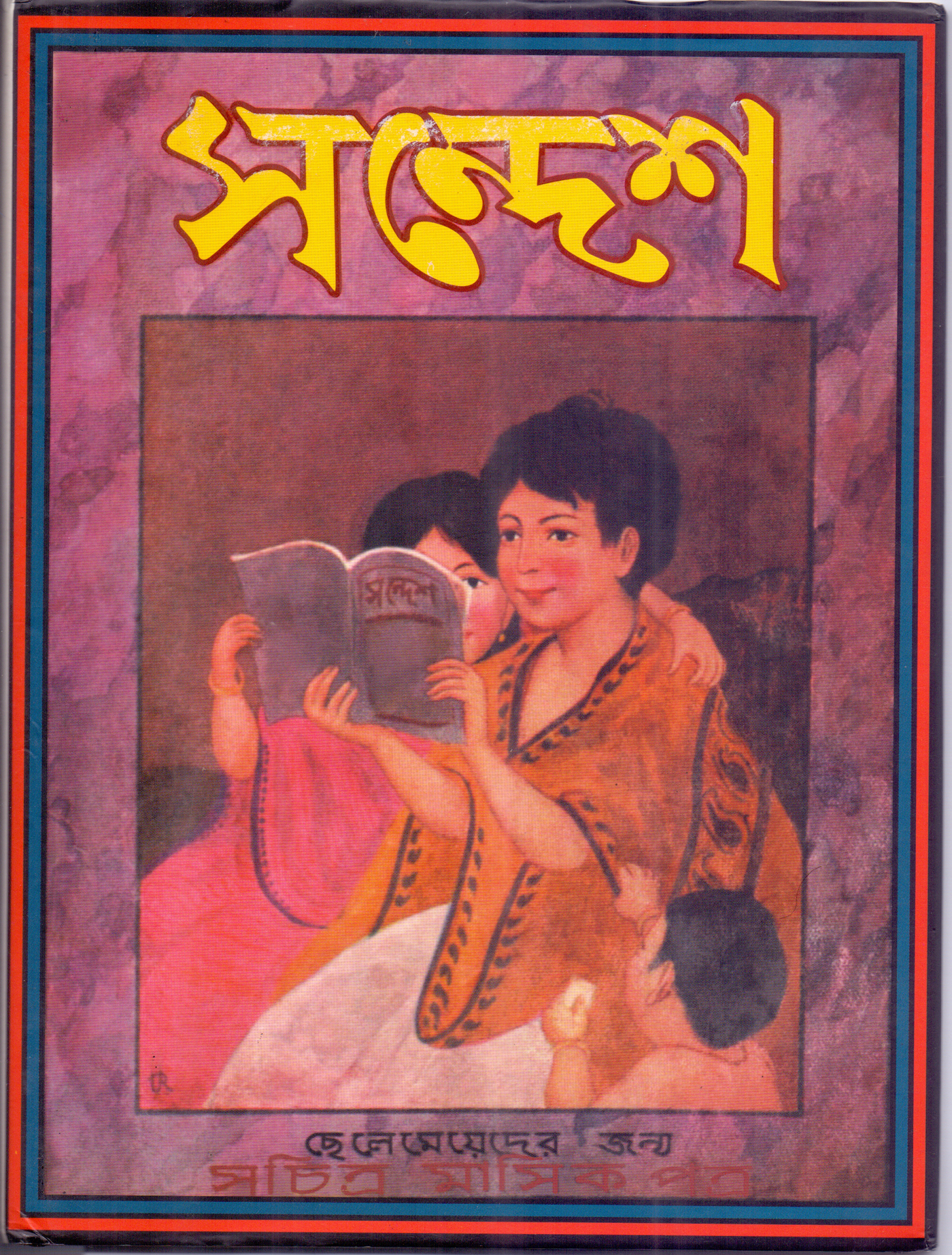
Writing about science for children, however, increased from the early 1880s, the time when their magazines started to properly proliferate. A band of men, along with some women, came together to bring out juvenile magazines and continued to do so until the early 1920s, when there appeared publishing firms and professional children's writers. They were not all skilled children's authors but disparate people accomplished in diverse fields.Footnote 15 They were mostly Brahmos, the reformed and puritanical Hindu community which, already into challenging established norms and setting new standards in outlook and lifestyle, now took up this new genre of child instruction seriously.Footnote 16 The Brahmo leader Keshabchandra Sen's Balakbandhu (Friend of Boys) (1878), although it came out only very briefly, has been acknowledged as having ushered in a new age in the world of Bengali juvenile magazines.Footnote 17 Sakha (Friend) (1883–1894), the first to continue for more than a decade, was conceived by another Brahmo, Pramadacharan Sen, teaching at the Rabibasariya Nitividyalaya Sunday school in Calcutta.Footnote 18 A number of editors and authors worked for and contributed to all the magazines of the time. To take two notable instances, after Pramadacharan Sen's sudden and untimely demise, the magazine came to be edited for a while by the radical Brahmo leader Shivnath Shastri, who later brought out Mukul, and another Brahmo, Upendrakishore Roychaudhuri, wrote for Sakha and other magazines before going on to bring out his own Sandesh. Bhubanmohan Roy, during whose editorship Sathi merged with Sakha, reminisced about working together with Pramadacharan Sen.Footnote 19
Unlike earlier ones, the new magazines increasingly came to be written in everyday parlance; were routinely illustrated; and contained numerous stories, novels, poems, essays on a great variety of topics and news from all around the world. While the adult intent remained the same throughout the period, as well as the content of the magazines, there was continuous effort to make the fare increasingly attractive to readers. The initial heavy borrowing from British juvenile literature gave way to more and more Bengali authors penning original material, among them scientific essays. Also, the explicit moralizing tone of the early magazines had almost totally disappeared towards the end of the period. Sakha was followed by Sathi (Companion) (1893–1894), Sakha O Sathi (Friend and Companion) (1894–1897), Balak (Boy) (1885, after which it merged with Bharati (Goddess of Learning, Saraswati) for adults), Mukul (Blossom) (1894–1914), Sandesh (Tidings) (1913–1923, also the name of a popular sweet in Bengal), and a host of other short-lived magazines. Compared to only thirteen in the preceding six decades, between 1883 and 1923 at least thirty-six juvenile magazines came out.Footnote 20
The reason for such profusion and enthusiasm lay in the prevailing situation. The late nineteenth century saw the emergence of a sizeable new middle class in Bengali society, when dwindling income from old sources like land made taking to modern education and the new professions necessary for more and more upper-caste people.Footnote 21 The existence of this class explains the massive expansion, in the last two decades of the century, of modern education in Bengal, which, although encouraged by the British government, was largely a private initiative.Footnote 22 A comprehensive education linked to the earning of livelihood, therefore, went on to create the objective condition of an extended, and moreover rigidly structured, childhood for the first time in Bengali society. Pondering the needs of a ‘new breed’ of children,Footnote 23 and taking appropriate measures to make them suitable for the modern world, thus became necessary in the circumstances. This is why the juvenile magazines of the time contained ‘ideal biographies, charming stories, easy articles on science and history, information about different sports and exercises, and whatever else is worth knowing’ – after all, the aim was sarbangin shiksa (‘all-round education’).Footnote 24
But the necessity of forging children into ‘new’ boys and girls had a more important subjective reason. It was a time when the earlier admiration for, and dependence upon, British rule was eroded and Indians came to be aware of its harmful, ‘colonial’ nature. A national movement for increased participation of Indians in administration began in the mid-1880s, soon to be accompanied by constructive programmes to achieve self-reliance. For instance, to counter racist and exploitative ‘colonial’ science, Mahendralal Sarkar founded the Association for the Cultivation of Science to further the cause of a ‘nationalist’ science that would help bring prosperity and dignity to the nation.Footnote 25 Inculcating a nationalist ethos among the young became necessary in the circumstances. Yet reason also took a beating in the emotionally charged atmosphere of the political struggle for freedom; indeed, there was now a ‘conservative’ backlash against liberal social reform backed by the colonial state. For instance, people opposed the Age of Consent Bill of 1891 intended to increase the minimum age of consensual/marital sex to twelve on the ground that it interfered with Hindu customs authorized by ancient scriptures.Footnote 26 Hence the liberal reformists, dismayed by ‘know-all’, ‘superstitious’ adults and the upsurge of an alternative public opinion, found it all the more necessary to place the hopes of the modern community-in-the-making, the Indian nation, on the young.Footnote 27 Emergence of middle-class childhood, disenchantment with British rule, bitterness at social inertia, and the desire for an alternative order – all of these, then, were equally urgent reasons for ‘teaching’ children anew. As Pramadacharan Sen, the editor of Sakha, put it,
Why do we publish Sakha – to become rich and famous? We hope no one thinks so. In fact, we have been incurring quite some loss … We love young boys and girls; to do some good for them has been our long-cherished desire. These boys and girls are our future citizens and helping them means contributing towards the future development of our country.Footnote 28
The idea of shaping juvenile minds by bringing out magazines specifically for children came from Europe.Footnote 29 But the idea in Bengal was also to replace magazines brought out by Christian missionaries and supplement English magazines like Boy's Own Paper and humdrum school instruction with something more suitable.Footnote 30 Here were adults who regarded both the ‘commodity manufacturing machine’ colonial school and the ‘neck-deep in the filth of sin’ average Bengali household as sites unsuitable for child rearing,Footnote 31 and so took upon themselves the responsibility of playing the role of foster parent/teacher to children of Bengal. They sought to inspire the young to ‘shed a tear for the hapless motherland’;Footnote 32 the fare in the magazines, science articles included, makes it clear that their desire was to mould children into disciplined, compassionate and productive members of the society of their choice. Distance and disparity among the new Bengali middle class, spread all over the subcontinent, made writing for children the most effective option to get across to them. They chose to write about science for children not primarily to dispel archaic notions of the physical world – for that exercise had been on since the early nineteenth century, both in the schools and outside. This leisurely and supplementary reading was intended to appeal to, and develop, children's faculties of imagination and reason. The new Bengali adults, themselves striving to bring about an alternative order, were convinced that this was needed to envision and usher in the novel. Rabindranath Tagore, who participated in a project of publishing juvenile books, expressed it thus:
The young cannot grow up into proper human beings unless you mix leisure reading with essential reading – [or else] even on attaining adulthood, one remains mentally a child to an extent … Where will they get leisure books? There is nothing in Bengali … We gobble up innumerable [school]books, [yet] our intellect does not mature and become robust … If one reads for pleasure, the ability to read develops more and more; the ability to comprehend, imagine and reflect develops with ease and by itself … There is no doubt that intellect and imagination are essential in daily life … Hence, if the two are not exercised from childhood itself, you will not find it at hand when needed later …Footnote 33
Ergo, gifting exciting science essays to young readers became an imperative; it is apparent that explaining natural phenomena to them and developing in them a rational attitude was considered an important task.
The circulation and acceptability of the magazines discussed in this essay – because actual figures are unavailableFootnote 34 – have to be gauged from various sources only indirectly. For instance, the editor of Sakha O Sathi mentioned that the cost of publishing the magazine was Rs. 2,400 per year and that if all the subscribers paid their dues, there would be no financial deficit at all. As the annual subscription for the magazine was one rupee, one may hazard that the magazine had at least 2,400 subscribers (for Sakha it was one rupee and four annas).Footnote 35 The actual number of readers was obviously far greater, if one considers that the magazines were read by more than one member in a family and they were often subscribed to by libraries and reading clubs.Footnote 36 Laudatory remarks by eminent personalities like, say, Bankimchandra Chattopadhyay, the greatly acclaimed author, and Chandra Nath Bose, the librarian of Bengal Office, and favourable reviews in major newspapers and periodicals like the Indian Mirror, Hindoo Patriot, National Guardian, The Statesman, Amrita Bazar Patrika, Nabyabharat, Bangabasi, Dhaka Gazette, Samay and Sanjibani, surely lent authority to the children's magazines.Footnote 37 The recommendation of the director of public instruction in Bengal, and the notifications from his office ordering inspectors and headmasters of schools to bring the magazines to the notice of students and to give them away as prizes, make clear that such children's magazines had the endorsement of the government too and that they were widely bought and read.Footnote 38 Books sent to be reviewed and advertisements for sport implements and toiletry articles placed in the children's magazines are testimony to their popularity as well.Footnote 39 Also, although almost all the magazines were published in the capital of Bengal, Calcutta, letters from subscribers and their lists make it clear that these magazines went wherever the new Bengali middle class travelled to earn a livelihood in the subcontinent – say, Bhagalpur, Dumka and Hazaribagh in Bihar; Balasore and Cuttack in Orissa; Dacca, Kishoreganj and Pabna in East Bengal; Tezpur in Assam; Banaras in the United Provinces; Jaipur in Rajasthan; and so on.Footnote 40
Editorials of both Sakha and Mukul regarding the unexpected, immediate increase in subscribers’ numbers soon after inception testify to the enthusiasm with which the magazines were received.Footnote 41 Letters demanding more news, stories and sports articles, and articles in the magazines giving advice regarding the language, and even posing questions on science, show that the juvenile magazines aroused curiosity and enthusiasm in Bengali society.Footnote 42 This instruction went on largely among the Hindu bhadralok, no doubt; but it would be more correct to say that it went on among whoever were disposed towards modern education, modern professions and, even more so, a different way of life. For there is evidence that the magazines were subscribed to by Christians, such as Reverend P.S. Smith of Calcutta and E.F. Ainslie, Esquire, of Rangamati; non-Bengali-speaking people, such as Mrs Yajneswari and Mr Dineshwar Agarwala of Tezpur; and Muslims, such as Munshi Golam Hafez of Ramnagar and Syed Amir Hossain of Rampurhat.Footnote 43 Those among the low caste and the poor who chose to go to schools were exposed to the ‘cultural capital’ of the juvenile magazines in school libraries and among fellow students,Footnote 44 as a rare peasant boy's reminiscences of his schooldays make clear.Footnote 45 In 1921, the literate in Bengal were 18 per cent of the population, and numbered no less than 8 million.Footnote 46
The physical world in Bengali juvenile magazines
In the juvenile magazines of the time the physical world was presented in all its strangeness and diversity – for the young readers to wonder at, to be amazed by, and to revel in. Thus essays on the Sun, the Moon, and the planets and their satellites were a frequent feature. Readers were introduced to Dhruba, the Pole Star, and the Saptarshimandal, or the Great Bear.Footnote 47 Their authors explained how movements of the Earth and the celestial bodies cause days and nights and the seasons, and how humans have come to calculate weeks, months and the year, and time in general.
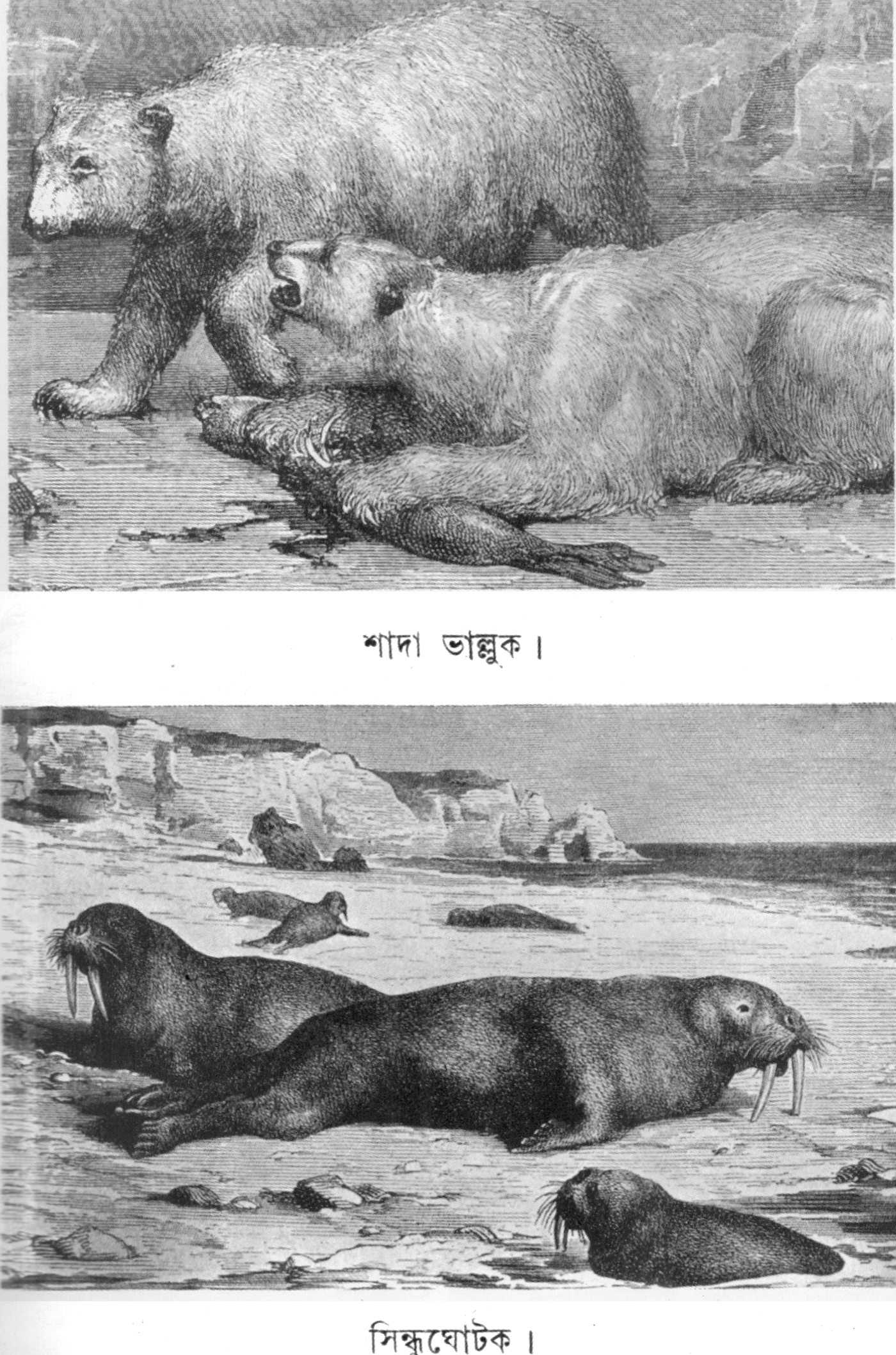
Arctic animals. Sandesh (1913) 1, facing p. 10, facsimile.
The intention was to broaden the cognitive horizon of the young and to instil in them an enduring interest in the wider world. Hence exotic lands were explored in expeditionary accounts to, say, the terribly cold, desolate Arctic and the Antarctic, and to the dense, animal-infested jungles of Africa.Footnote 48 Nearer home, the authors narrated to Bengali children visits to as far-flung places as Amritsar in the north and Tiruchirapalli in the south, the hill stations Darjeeling and Shimla, and regaled them with experiences in the jungles of Assam and Burma.Footnote 49 However, the intention here was more a nationalist one, to familiarize children of a regional community with a newly perceived, subcontinent-wide swadesh (literally ‘one's own land’) and instil in them love and respect for her.Footnote 50 The same attitude led children's authors to locate the heart of Bengal in the villages, depicting them as a tranquil retreat and waxing eloquent about their bounteous nature.Footnote 51
The magazines also dwelt on natural calamities and disasters like volcanoes, geysers, desert storms and avalanches, things that Bengali children were hardly likely to experience.Footnote 52
We find water underground when we dig holes. It is rain water that we get to see. Who knows how much water has gone into the earth's stomach?
It is probably not correct to call it ‘stomach’. Because what we call the earth's ‘stomach’ is three to four thousand miles deep. Of course, water cannot enter there, because the heat underground turns it into vapour.
There is no doubt that the inside of the earth is extremely hot. The deeper a mine goes, the hotter it gets. Temperature rises by a degree every 80 or 90 feet we dig, so water becomes vapour by the time it reaches a mile or two. Its temper is then no longer cool like water, and it forgets going down and wants to push itself upwards. Its pressure now is so great that nothing can stand before it.
This is how hot waterfalls or hot springs were created. There are hot springs in many places in India. But those in Iceland, in Wyoming in America, and in New Zealand are astonishingly strange. Some of them leap up, like the cracker flowerpot, up to 150 or 200 feet. There are some like children's toys, which go up only a few feet.Footnote 53
Children were given elementary lessons in physics and chemistry too, such as optical illusions, the properties of heat, shapes and the work of light and shadow.Footnote 54
Optical illusion. Sandesh (1913) 1, p. 197, facsimile.

Science writing in the juvenile magazines was more often about animal and plant life, though. The crocodile and the tiger of the nearby Sundarban mangrove delta featured quite often.Footnote 55 But essays also included such unheard-of creatures, hardly expected to be seen, as the walrus and the seal of the Arctic, the African okapi and chimpanzee, the piranha of the Amazon, the American flamingo, and the penguin of the Antarctic:Footnote 56
The bird that you see above is known as ‘Ostrich’ in English. In Bengali its name is ‘Utpakshi’. In ancient times, great thinkers like Aristotle and Pliny called it ‘Utpakshi (camel bird)’.
It is called Utpakshi because it has similarities with the camel … Like the camel, its breastbone is very hard and strong and, when it sleeps, it rests on it like the camel. Like the camel, the middle part of its body is very large too. Both have the same shape, way of walking, and habits. Both keep the head up by stretching the neck … This is why people mistake it for the camel from afar. The difference is that its two legs and its body are covered with small feathers and the camel's body and its four legs which are covered with hair.
In ancient times, the camel-bird used to be found almost everywhere on Earth. It is told that kings received its eggs as gift from their subjects. It is now found mostly in Africa-country. It loves to stay in groups … It can move very fast, even 26 miles per hour. Its call is like that of the cow in great pain. Sometimes it has been heard to roar like the lion too.Footnote 57
Readers learnt anew about the familiar fly, the mosquito, the spider, the squirrel, the bat and the lizard, and how harmful numerous microscopic germs can be for humans.Footnote 58 Just as the description of an unfamiliar carnivorous plant, the Venus flytrap of America, was expected to excite them, so were the structure and uses of the familiar household shiuli flower.Footnote 59 Accounts of the capture and killing of animals by laying traps and imitating calls were there for them to understand the ingenuity of human beings.Footnote 60
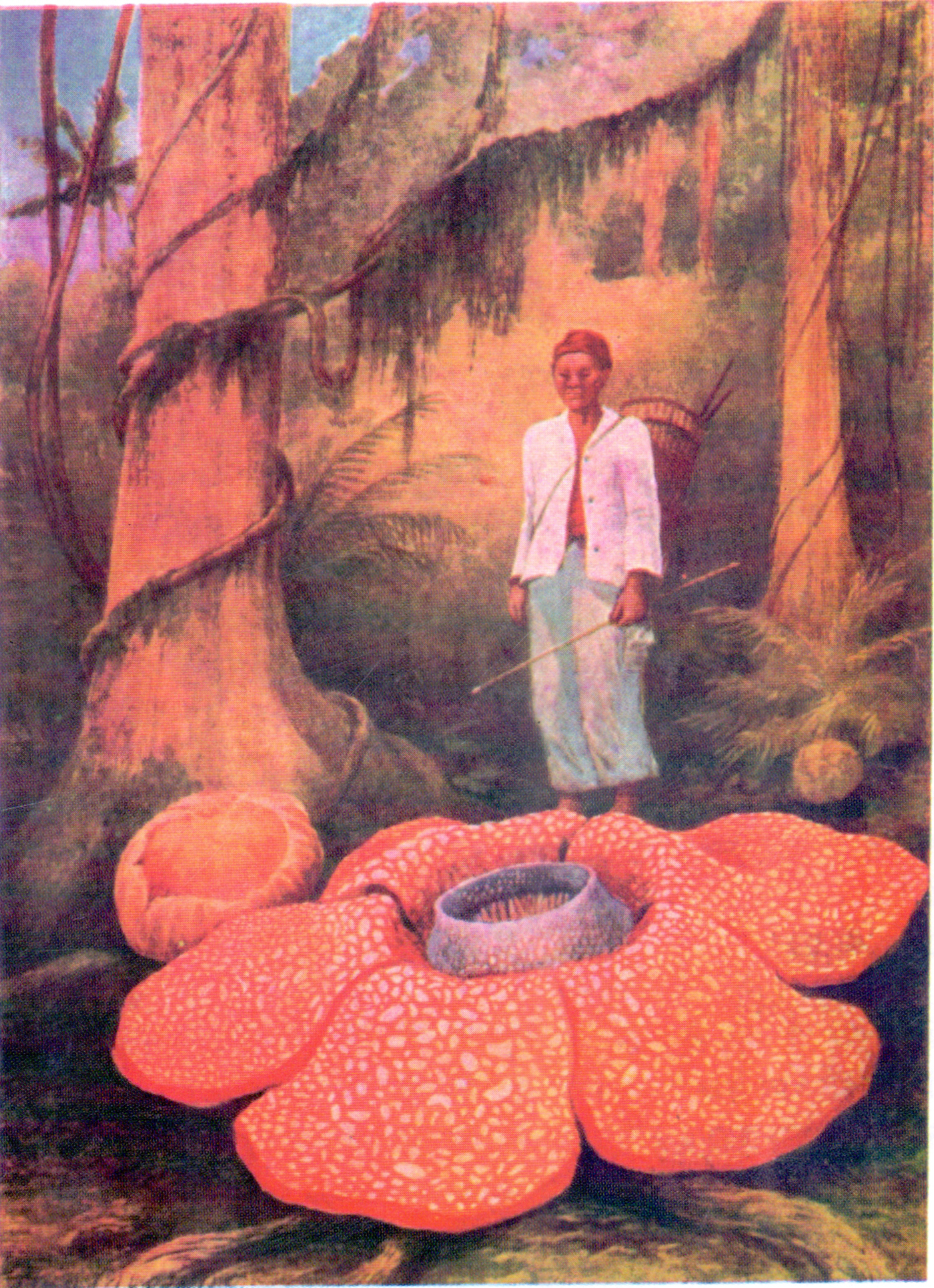
Rafflesia. Sandesh (1915) 3, frontispiece, facing p. 257, facsimile.
A section of the magazines was regularly about human achievements. Knowledge of the physical world was put down to intellect and endeavour that also lay behind scientific discoveries and inventions, something that has helped humans to dominate nature and all other creatures. The young thus read of the ‘boat’ that cruises the sky and the one that plumbs the depth of the sea; they read of buildings that soar high in the air and those that house people deep below the surface of the Earth.Footnote 61
People usually say, ‘As tall as the [Ochterlony] Monument!’ When we see a house as high, we exclaim, ‘Oh! What a tall house.’ But go around in America once, and that will appear quite small in your eyes. Place a few more monuments upon the Monument, and only then will Americans say, ‘Yes, it is somewhat tall!’ Here is a picture of a building in New York – no building anywhere in the world is as tall. It is fifty-five storeys high – almost seven hundred and fifty feet! An ordinary three-storey house is about forty feet – it will be seven hundred and fifty feet only if you place nineteen such houses one upon another! Cities in America are full of buildings thirty or forty stories high! Our heads swim to even imagine this.Footnote 62
Tall building. Sandesh (1914) 2, p. 316, facsimile.

Hence children came to know how some nations created paper, developed writing, and invented the modern warship, things that distinguish them from the ‘uncivilized’.Footnote 63 In all this, of course, the enthusiasm, ingenuity, and exploits of Europeans loomed large over all others:
After a bath and rest had cooled me down, I thought Bravo, Englishmen! People who with their wonderful enterprise and astonishing intelligence can run the railway in dangerous animal-infested areas, and discover oil and coal in the depths of the mountains – it is hardly surprising that they should lord over us Indians.Footnote 64
European endeavour. Sandesh (1913) 1, facing p. 92, facsimile.
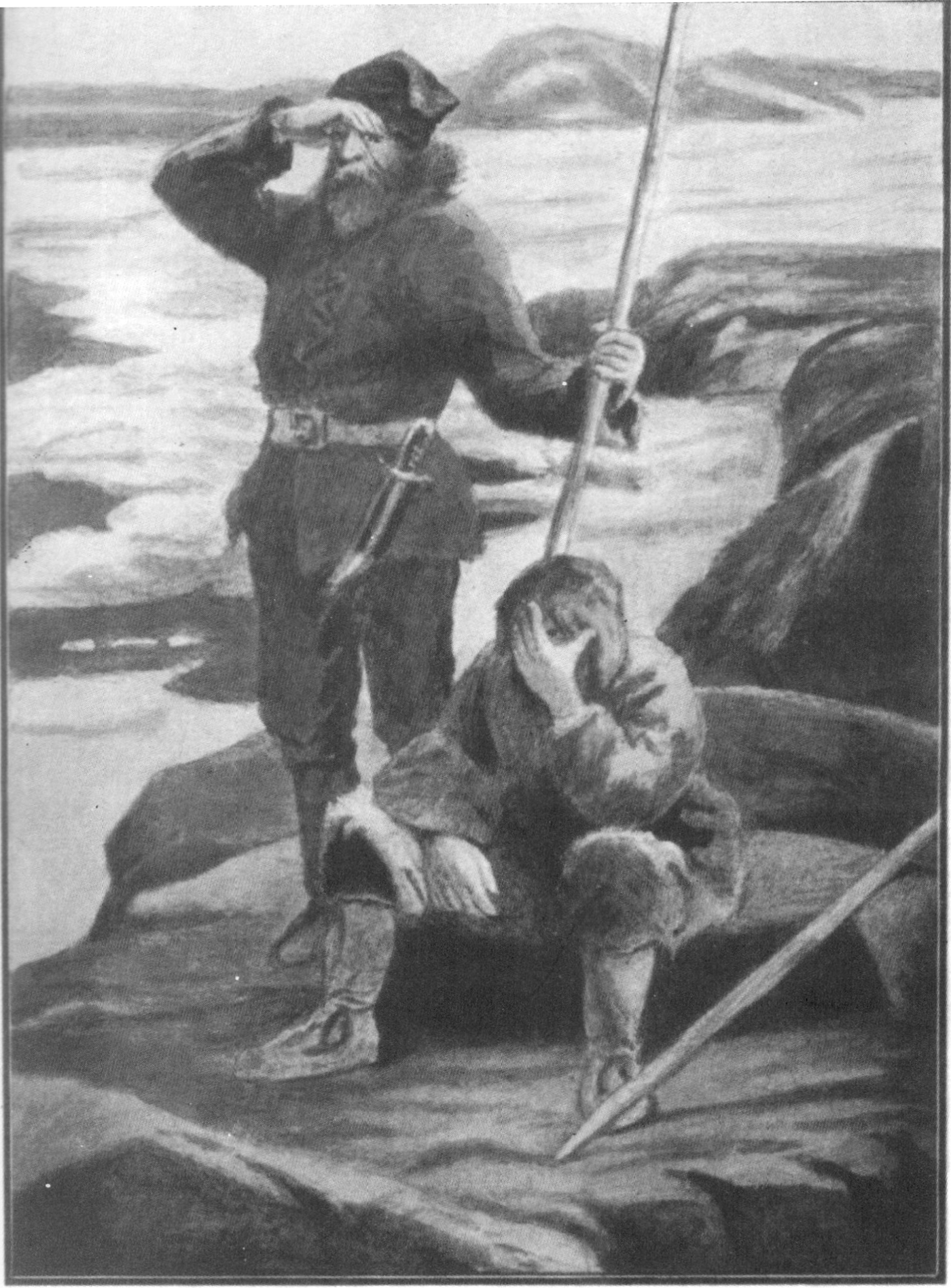
In circumstances that required striving and diligence to overcome backwardness, it was continuously impressed upon the readers that a person's industry and zeal, and the ability to surmount all obstacles, were most important – just as the lives of the scientists Tycho Brahe and Michael Faraday, and the Bengali scientist Sir Jagadish Chandra Bose, demonstrated.Footnote 65 Such knowledge as was advocated in the juvenile magazines, then, was not the superficial or the imagined kind, but entailed knowing something thoroughly – it demanded observation, methodical enquiry, and material evidence. This is why there was always some gentle goading and some spurring on to arouse readers into observing, thinking, and carrying out simple experiments.
Have you noticed … now that Biasakh (April–May) is over, the khanjan (wagtail) no longer prances around in the courtyard or in the streets … Flocks of chil (kite) are always seen in Kolkata and all over Bengal, but their numbers will decrease as soon as the rains arrive … Why do [the birds] come, why do they go away, do you ever investigate things like this?Footnote 66
Again:
You have now perhaps understood why things sink or float? You must have also noticed that some things sink in water but float in some other liquid? Think about it and find the answer to why this happens. We will tell you the reason later.Footnote 67
Time and again, this objective and rational knowledge was pitted against hearsay, folk knowledge, and myths abounding in Bengali society. For instance, Pramadacharan Sen narrated to children the epic Ramayana but only for its ethical content, brushing aside with contempt ‘exaggerated’ and ‘impossible stories’ (like the monkey god Hanuman capturing the sun in his armpit) that it contained.Footnote 68 Upendrakishore Roychaudhuri liked to present to readers quaint traditional Bengali ideas about the physical world, but he also clearly distinguished them from modern knowledge, and equally importantly, he actually went on to explain how such ignorance came about:Footnote 69
In our childhood we used to hear from old people that when clouds descend to feed on bamboo leaves, the Koch people … strike them with spears. They then sell these clouds to the plains people, and this is what abhra (mica) is. But you know that this isn't true. When sunlight falls upon … clouds, to many people they may appear to glitter like mica. Carried by winds, clouds may often touch upon mountains, and there is no lack of bamboo there too. Nowadays the railway has gone high up to Darjeeling, but it wasn't like this earlier. People of the past made up the mica story because they looked at it all from afar.Footnote 70
The magazines were replete with instances of how scientific knowledge had brought unprecedented power to the modern West. Expectedly, Ramendrasundar Trivedi exhorted his young readers to emulate the Europeans: ‘Knowledge begets power. Try to gain knowledge, and you will become powerful’.Footnote 71 Yet it appears that Bengali adults would not accept that the young acquire knowledge about the physical world only because such knowledge affords control over it and helps make life comfortable. For one thing, they did not preach ‘godless’ science to children; nor did they simply reproduce a borrowed ‘“evangelical” view of science’, the ‘Christian … morality’ of Boy's Own Paper, as alleged.Footnote 72 This was a milieu which had long declared divine law to be written in nature and man's duty to ‘peruse it with care and live by the commandments written clearly in that supreme text’.Footnote 73 Also, these adults deplored human cruelty towards creatures, extolled animal ‘intelligence’, and delighted in their ‘affectionate’ disposition.Footnote 74 The most popular British magazine of the time, Boy's Own Paper, too, taught an ‘appropriate attitude to animals in parables, reminiscences, pedagogical articles on pet breeding and in stories of adventure’.Footnote 75 This, then, may be regarded as indicative of a dilemma that troubled modern Bengalis, urban dwellers away from the villages where their origins lay – as it did the modern West – one between ‘an incalculable increase in the comfort and well-being or welfare of human beings’ and ‘a ruthless exploitation of other forms of life’.Footnote 76
But Bengali children's authors went further than this; they wished children to be aware of nature's treasures, develop a tender and caring attitude towards it, and rejoice in it and become at one with it. It is tempting to contrast this, as a ‘feminine’ Indian attitude towards nature, with a ‘masculine’ one emanating from the imperialist West. However, a detailed study shows that human attitudes towards nature on the Indian subcontinent had always been variegated and could be at odds too.Footnote 77 What may, then, be claimed with some certainty is that this passing on by Bengali adults to children was an age-old gentle, indulgent and intimate Indian attitude towards nature, of which there is hardly any parallel in the West, where ‘the established view was that the world had been created for man's sake and that other species were meant to be subordinate to his wishes and needs’.Footnote 78 This is why, because Bengali children's authors found nothing in contemporary English children's literature to express this sensibility, they fell back on literature of a different kind – folk tales, Puranic myths, contemplative essays and a host of poems, in all of which nature comes across as serene, picturesque, charming and a balm for the mind – by which to instill in young hearts a close affinity towards it:
On the bank of the river Tamasa was the sage Valmiki's ashram. Dense forest on two sides, and the river flowed between quietly. The water was so clean that you could plainly see the sand on the riverbed. Not a spot of mud, not even a bit of moss. It sparkled like glass. Valmiki came to stroll on the riverbank, and was very pleased to see the pure water. He remarked to his disciple Bharadwaj beside him, ‘[How] pure the water of the river is, just like the heart of an honest man.’Footnote 79
Efforts to make science attractive to children
The authors’ method and style complemented their desire to fashion curious, knowledgeable, rational and considerate beings out of children, and hence they made the effort to make the fare attractive to the young of a wondrous and compassionate nature. Behind this lay a new idea of child instruction that was gaining ground in Bengal at that time, one that rejected the traditional practice of learning all by rote and instead stressed catering to children's proclivities so that learning became a matter of joy. This is what the reviewer of Jogindranath Sarkar's primer, Jnanmukul (The Blossom of Knowledge) (1891), had to say about it:
We now understand that it is more fruitful to teach in an appealing rather than in an insipid and stern manner. The simpler and more attractive the method of teaching, the easier it will be for boys and girls to master the matter. If we instruct them through stories and with the help of pictures, learning will become both very easy and effective.Footnote 80
Thus the quality of the paper used in the magazines, the illustrations and the lettering were all taken care of meticulously. Also, explaining with the help of illustrations was a must. Although it was in Mukul that the words ‘Illustrated Monthly for Boys and Girls’ was printed under the masthead first, the practice began early in earnest; as Sathi editor Bhubanmohan Roy announced, ‘What will not be clear in words, will be explained through pictures; we shall pay special attention towards pictures.’Footnote 81 It was Sandesh, however, that was the novelty in the world of modern Bengali children's literature. Already reputed internationally for his innovations in printing methods, Upendrakishore Roychaudhuri's magazine had many more pictures and far clearer illustrations than hitherto, all in half-tone; the colour illustrations of Sandesh were a first too in Bengali children's literature.Footnote 82
The intention of the authors was to tell ‘the story of science in lucid language’, by leaving out its ‘complexities’; they believed that a ‘simple’ language would make it ‘attractive’ to children.Footnote 83 For instance, the author Manmathanath Mukhopadhyay chose to write about such abstruse matters as properties of water and air, the structure of animals and plants, and the atom and gravitation by way of a ‘conversation’ – an old and popular practice of discourse in Bengal, favoured occasionally also in modern times – between a grandfather and his grandchildren.Footnote 84 It was the literary language (sadhu bhasha) that was employed in the beginning, but to make it easier for children the more idiomatic everyday parlance (chalit bhasha) came into use increasingly. Here is how the adults carried on their tête à tête (kathabarta/galpa-salpa) with children in the magazines:
Suppose one day two persons begin travel from Kolkata. One travels continuously towards the north and the other goes straight east … Where will each finally arrive at? Maybe some of you will say, ‘Why, the Earth is round, and so they will both return to Kolkata after two or three years.’ This is true for one who travels east, but not for another who goes north … This may suddenly sound like a riddle, but there is really nothing to be surprised at.Footnote 85
The authors often came up with ingenious ideas to make clear abstract things to children. For instance, in an essay on planetary rotation around the axis, Upendrakishore Roychaudhuri first explained with the aid of illustrations how the top (presumably popular with boys of the time) spins on its iron tip and why motion helps steady it, and then went on to compare the whole thing with the whys and hows of the movements of the Earth and other planets.Footnote 86 In this manner Narendrabala Devi made it easy for her readers to grasp the immense distance between the Earth and the Sun in Balak:
The Sun is more than nine crore [1 crore = 10 million] miles away from the Earth, but knowing this hardly helps. We cannot imagine what four or eight hundred miles is, and this is nine crore miles! … If you had boarded … a train that moves at the speed of 60 miles an hour 171 years ago, you would have reached the Sun only today. If you had boarded it when the Mughal emperor Aurangzeb's grandson Faruksiyar had just come to the throne, you would have reached the Sun just as Lord Dufferin arrived in India.Footnote 87
Science and the ‘new’ children
There has been little discussion of this science instruction, let alone how children took to it and its significance in their lives. To Gargi Gangopadhyay, it is an example of ‘“apolitical polticising” of the juvenile reading domain’, through which ‘the hegemonies of power, control and authorities emerge[d] and [were] in turn confronted’. According to her, the ‘territorial geographies [in this literature were] simultaneously emulated as conformist pro-colonial gestures and appropriated to serve a nationalist agenda’.Footnote 88 Satadru Sen finds among the ‘geographies of [literary] childhood … not only the defeated present and the modern future, but also the premodern, pre-colonial past … [and these] hidden spaces … were profoundly disruptive towards the larger political project of producing the middle-class child as a modern subject’.Footnote 89 This seems to reflect a historiographical trend that regards modern Bengali children's literature as ‘a new epistemic space created by the subaltern subject’,Footnote 90 to ‘empower’ children and celebrate ‘them as active anti-colonial agents’.Footnote 91 It is opposed to the view that it was a means of ‘cultural subjugation’ of children employed by ‘colonized’ Bengali adults who imbibed the modern European idea of the child as an ‘inferior’ version of the fully developed adult and came to regard their own children as ‘emotionally stunted’ and ‘intellectually immature’, yet did not hesitate at the same time to use them to satisfy their grand ‘nationalist aspirations’.Footnote 92 Such interpretations result from preconceived notions and partial readings; a thorough reading of this literature and a comparison with what went on in traditional Bengali society affords a balanced and fuller understanding of a changed idea of childhood in modern Bengal and how that, and the consequent science instruction in juvenile magazines, affected children of the time.
In traditional Bengali society, children were expected only to emulate adults in learning appropriate domestic codes of conduct and those of the caste communities they belonged to. Such a closed, localized society did not need either to foster uniqueness of character or to encourage individual enterprise – the chief intention was to contribute towards the continuance of the established hierarchical and patriarchal order.Footnote 93 On the other hand, the new Bengali adults’ efforts to make knowledgeable, rational and compassionate beings out of children, apparent in the science essays in the magazines of the time, makes sense only when read against a new idea of childhood and this new attitude towards children. Theirs was an ‘education’ – an instance of retaining and borrowing, assimilation of the traditional Indian and the modern Western – intended to supplant both colonial education that produced only loyal subjects and lowly paid employees and average family instruction concerned only about fulfilling material aspirations through children.Footnote 94 They deplored both the overt indulgence that children often received in the average family and the harsh, indiscriminate physical chastisement at the traditional pathshala (‘study-place’) and the modern school. It is not that they did not prevail upon the young; they attempted to mould them by firmly instilling self-discipline in them, an element of child instruction that they inherited as the highest ancient Indian ideal of education, and, more so, that they had recently received from the modern West as an instrument of meaningful living. The aim of all this was to ‘prepare’ children, whose ‘student-days would not last forever’, to grow up into ‘human beings … to shoulder the serious responsibilities of the family, the society and the country’.Footnote 95 The new adults continued to harbour the traditional Indian adult attitude of ‘protective nurturance’ towards children,Footnote 96 to which was added a respectful attitude towards them as mortals with distinctive attributes, a Western Romantic notion that subsumed the traditional Indian attitude of adoration of infants. Hence, while never overindulgent, they were also never too overbearing – for that would defeat their purpose of forging them into creative individuals capable of envisaging the novel and responsible citizens needed to shoulder the expectations of the nation.Footnote 97 The new Bengali adults found nothing incongruous in the apparently contradictory strains in their idea of childhood; it is the historiography of childhood in colonial Bengal that has been unnecessarily and absurdly simple in assessing its character.
Boys going to the traditional pathshala learnt the alphabet, and memorized the arithmetical formulas and moral precepts of the legendary Subhankar and Chanakya, but not much more.Footnote 98 Hindus grew up believing mythical Puranic accounts that the Earth consists of seven islands and seven oceans and at the centre of all is their land, the lotus-like Jamvudwipa. Popular tracts were there to assure Muslims that the Earth rests on the horns of a huge fish that floats on endless waters.Footnote 99 Traditional Bengalis knew about creatures that they encountered and plants that they consumed in everyday life, but beyond that, one may surmise, they had no use for any other thing. There is no evidence that children's curiosity about the physical world was ever encouraged or gratified either in the pathshala or at home.
To know about how their magazines affected modern Bengali children, one has to depend upon reminiscences which, although few in number, do provide us with vignettes of shared childhood experiences. They show that even in the best schools and in most families very few cared to explain subjects and answer questions, that the textbooks were mostly dull, and so it was all learning by rote to pass examinations.Footnote 100 The following, the first from Rabindranath Tagore and the second from Buddhadeva Basu, show that not much changed in the entire period that this essay is about:
We read our physical science without any reference to physical objects, and our knowledge of the subject was correspondingly bookish. In fact, the time spent on it was thoroughly wasted.Footnote 101
I remember the Geography lessons vividly. There was a room allotted specifically for [it] – full of globes and models, big and small, and other curious tools and objects; but for whatever the reason, we were never ever taken to that room, and the tools lay totally unused.Footnote 102
On the other hand, from the way Punyalata Chakrabarty recalls her father teaching children at home, and Sunirmal Basu the eagerness with which children awaited the monthlies, it seems ‘learning’ from the new adults and their magazines became a matter of joy:
We went to school and had tutors at home, but we liked most our father's storytelling way of teaching science … about the origin of the Earth, the Moon and the Sun, planets and stars, and so many other things. Father showed us through a telescope a bright and large moon so that its mountains and craters appeared clear, and we saw the rings of the Saturn too.Footnote 103
We waited for the post the first day of every month … Our servant went to the post office in the morning to get it … if we did not see Sandesh in his hands, our faces fell. We waited eagerly again the following day; our hearts leapt with joy when we saw from far the brown packet of Sandesh lurking from among other letters.Footnote 104
Hence, and because, despite its potential, school education was fruitless, and at a time when the radio and the cinema were yet to arrive, the new magazines quickly became the sole ‘link’ between the readers and the wider world, and it was mainly from these magazines that they acquired all the knowledge about it.Footnote 105 This is how Buddhadeva Basu reminisced about Upendrakishore Roychaudhuri:
Aurora borealis, pyramids, penguins … this storyteller opened up the real world to the children of Bengal. We roamed the entire Earth holding his hand … Did we learn about all that in school? We learnt from reading ‘Sandesh’, ‘Mouchak’ … Compared to those, the school appeared so worthless and the teachers so uninspiring!Footnote 106
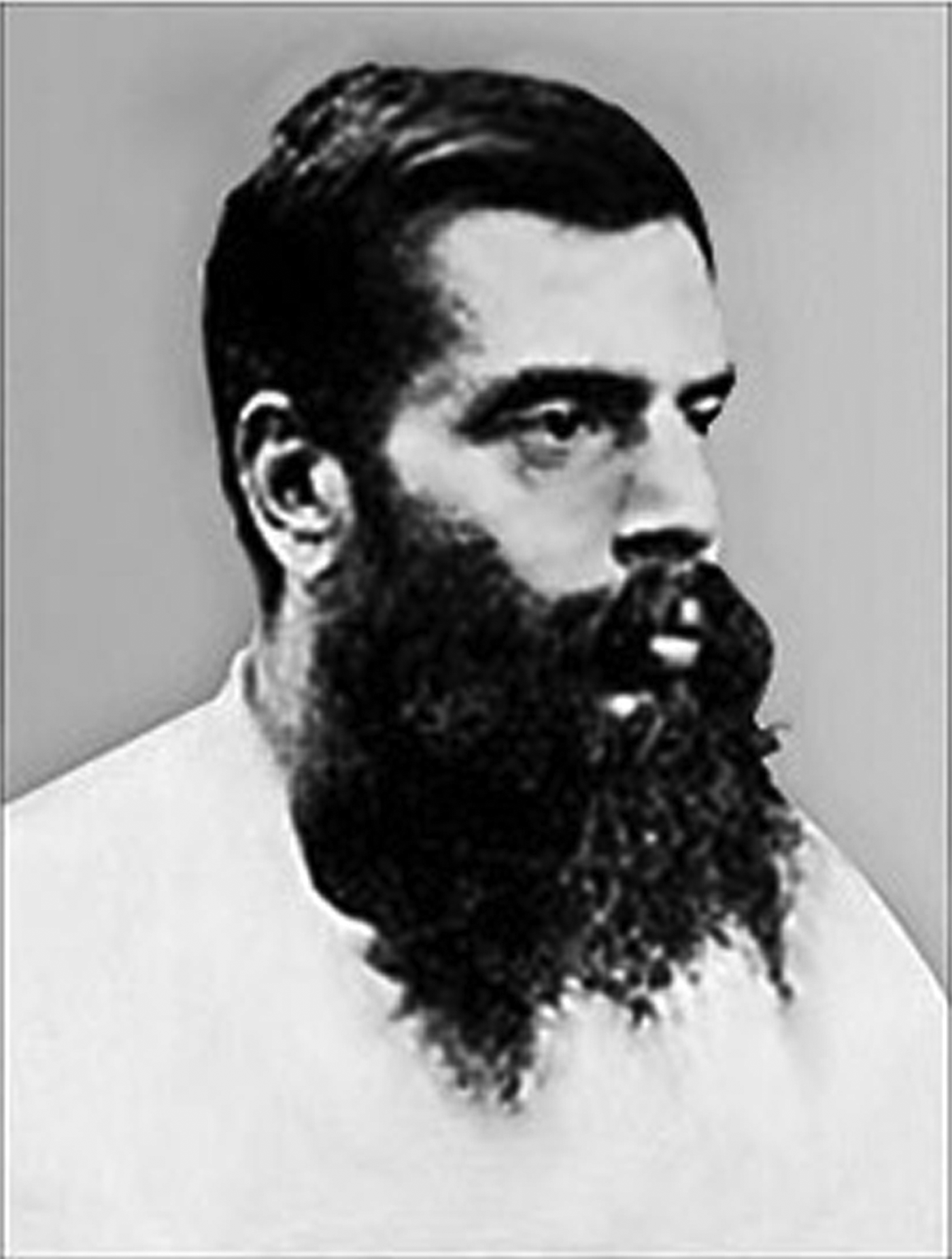
Upendrakishore Roychaudhuri. Editor, Sandesh, 1913–1915. At www.indianetzone.com/56/upendrakishore_ray_chauduri.htm, accessed 26 March 2017.
The knowledge that Bengali children found in their magazines not only was novel; it also helped widen their mental horizon as never before. The way they bragged about it among themselves and to others, it seems this knowledge became a matter of pride too.Footnote 107 Finally, their authors not only provided children with leisure reading but also afforded them the opportunity to exercise their intellectual and imaginative faculties.Footnote 108 Doubtless, the young usually follow standards set by their elders, but that Bengali children of the time were allowed to debate and express themselves early in life, in their magazines, is something that cannot be dismissed as altogether insignificant. This agenda of forging children into autonomous, socially conscious individuals certainly had no parallels in traditional Bengali society.
There is no doubt that all this altered mainly boyhood, but it helped alter girlhood too. Modern Bengali boyhood was largely the consequence of objective colonial conditions and typical family expectations of men as breadwinners. But these meant nothing for girls, most of whose lives went on as before; among the most progressive, too, they continued to be given away in marriage before puberty.Footnote 109 For instance, even as her mother gave birth to Bina De in 1906, one sister was married off at twelve and another sister taken away from school at ten because talks of her marriage were on. Discussing weddings and husbands was common among girls from ages six to seven; joining in household chores and performing brata rites initiated them early into the life of the average housewife.Footnote 110 A new adult notion of girlhood and the accompanying new adult attitude towards girls are therefore significant. It is evident from the words ‘Illustrated Magazine for Boys and Girls’ that the children's authors expected both of them to cultivate certain common traits, among them a compassionate and rational attitude towards the physical world. The new patriarchal/nationalist aim may have been to produce ideal mothers and wives essential for the new nation, but new adult expectations altering the experience of girls did go to usher in a qualitatively new girlhood in Bengali society as well. It ought to be noted that the magazines provided the opportunity to ‘voice’ their thoughts and sentiments to girl readers too.Footnote 111 Equally importantly, all mixing between boys and girls was strictly forbidden after marriage in traditional Bengali society except on certain social occasions,Footnote 112 and this continued into the modern era. The new juvenile magazines are, then, also significant because they created a common intellectual and emotional ‘space’ for boys and girls for the first time in Bengali society. These magazines, by including women authors, some of whom wrote about science – one important difference between them and contemporary British juvenile magazinesFootnote 113 – surely had a role to play also in the creation of this culture. It is for this reason that the likes of Shanta Devi and Sita Devi, when they went to their ancestral village, found it difficult to ‘mix freely’ with their ‘traditional’ cousins.Footnote 114
It takes adults and children to make a society, despite the hierarchy and differences. Modern Bengali juvenile magazines represented an unobtrusive yet significant shift in adult–child relations – they helped bring about an affinity between adults and children hitherto markedly absent in traditional Bengali society. If traditional adults harboured an attitude of ‘protective indulgence’ towards children, they were expected to reciprocate with unquestioning ‘devotion’; the worlds inhabited by the two appear to have been distinct and distant.Footnote 115 On the other hand, modern Bengali juvenile magazines created a new ‘space’ which both adults and children began to cohabit and share, and this thus helped create a new ‘kinship’ between the two. Saying that adults of the time did nothing to break/invert the universal authority–subordination nature of the adult–child relationship does not help us know the ‘newness’ of colonial Bengali society. It is important to recognize that adults, who are used to dominating, now ‘relented’, giving an importance to children who, used to being dominated, had never experienced this. This ‘space’ and its inhabitants were an alternative within the larger patriarchal, hierarchical and generally unmoving colonial Bengali society. The ‘new’ adults, disgruntled and disillusioned with what they saw around them, sought solace in the young. Children of the time, too, grew up to gratefully acknowledge the respect that their authors treated them with:
Imprisoned in adult fortress … I sought to immerse myself in the foibles of the child … to mitigate the soul, to cleanse it, to liberate it.Footnote 116
[They] … spoke … in a manner that made children feel that they were speaking after their heart … There was no trace of condescension … [or] an attitude of superciliousness or sense of duty. [They] entirely acknowledged the worth of the young …Footnote 117
Children and the ‘others’
Bengali children's authors expectedly stressed intellect, for this is what science as a critical, speculative enquiry requires. However, to speak to children about such an abstract thing as intellect or its lack may not produce the intended outcome and so it has to be concretized and personified for them to grasp the significance. In the juvenile magazines of the time, intellectual people, some scientists among them, were thus spoken of most glowingly. The lack of intelligence, however, was almost invariably reflected in stories about ‘foolish’ and ‘hilarious’ deeds of servants and peasants, the paschima, khotta, or the Hindustani of northern India and also the rustic paragneye of the Bengal countryside.Footnote 118 Hence, although intended as only evoking mirth and intended to goad the young into exercising intellect, this went to imbue middle-class Bengali children with the condescending attitude that their milieu harboured towards certain classes and certain communities in Indian society.
The way the authors passed on to readers the notion of superiority of modern scientific knowledge also went to instill in them a bias. This knowledge was presented in their magazines as the only kind worth the name and all other knowledge was dismissed as blind faith and worthless. However, such a notion can itself quickly become a matter of faith too, thus engendering a narrowness that may be said to go against the very spirit of rational enquiry. Repositories of all other kinds of knowledge were ridiculed and invariably portrayed as asabhya manush (‘primitive people’), rakshas (‘demon’), bura thakrun (‘old granny’), boka (‘foolish’), bujrug (‘fraud’, ‘trickster’), and paragneye (‘rustic’).Footnote 119 This surely bred in the young readers a prejudice against, and intolerance for, people who believed otherwise and lived a different kind of life.
Science instruction in the juvenile magazines carried an inherent gender bias too. There is no doubt that in the way the authors frequently portrayed the girl child as a loved being, they departed markedly from the attitude of ‘silent rejection’Footnote 120 in traditional Indian literature towards her. But it is difficult to shake off the feeling that the qualities of curiosity, intelligence and industry that they sought to impress upon readers, they liked to see not so much in girls as in boys. This is apparent when the science essays are read together with the many folk tales that portray girls as laksmi meye, the hearth goddess Laksmi incarnate: respectful, obedient, demure, affectionate, dutiful and free from greed, and therefore not primarily given to enterprise and independent, rational thinking.Footnote 121 It may, then, be presumed that boy readers of the time grew up with the notion of girls possessing a set of qualities and a role different from theirs, and that girl readers also imbibed that idea. The notion of men being superior to women could have followed from this.
Also, it appears that Muslims were kept out of the scheme of things. This was not deliberate, because contributors and readers of the juvenile magazines included both Muslims and Hindus. But the modern ‘colonial milieu’ in Bengal,Footnote 122 while it envisaged an ‘Indian’ nation accommodating all, could not but do so from its own point of view. Hence the possibly unconscious slips in the juvenile magazines like lamenting the subjugation of the last ‘Hindu’ kingdom of Nepal and praising the British for preserving ancient ‘Hindu’ monuments which the earlier Muslim rulers had destroyed.Footnote 123 This narrow ‘communal’ attitude is surely one reason why Muslims were compelled to bring out their own juvenile magazine, Angur (Grapes), in 1920. It was hardly different from other magazines of the time – indeed, the longest serialized essay was a scientific one – but different nevertheless because it contained references to the Quran and the Hadith for the benefit of young Muslim readers.Footnote 124 The fact that it did not last more than a year proves that a new milieu and a new child readership were almost non-existent among the Muslims in Bengal. Their magazines were therefore one reason why the Bengali young failed to feel an inter-community solidarity that was so essential for the imagined Indian nation to come into being.
Finally, the admiration for and praise heaped on Europeans in the magazines for their scientific and expeditionary endeavours leave no doubt as to whom the Bengali adults desired children to emulate. To say that they were fully ‘colonized’ is an exaggeration; rather, they borrowed selectively from both Indian tradition and European culture. They rejected the ritual-bound aspects of Indian culture and the injustice that traditional society meted out to women and lower castes, but favoured its aesthetic values, its dispassionate philosophical quest, and the spirit of service towards all. They admired the spirit of enterprise of Europeans and their propensity to change with times, but deplored the political aggression and the crass individualism that seemed to be the hallmarks of modern Western society.Footnote 125 Nevertheless, it was impossible to remain unscathed by the economic and technological superiority of the contemporary West, especially the British, who were then dominating the entire globe politically. This resulted in looking at people and things from the rulers’ point of view. For instance, Upendrakishore Roychaudhuri so imbibed the ‘sport ethic’ of the British that he declared that one was not a ‘gentleman’ if one did not play as the British did.Footnote 126 Also, those around the world at a different stage of civilization, for instance the Nagas of north-eastern India and American Indians, were unhesitatingly pronounced ‘uncivilized’.Footnote 127 Bengali adults, proud of their past achievements yet enamoured of the superiority of contemporary England, put it all down to the ‘national character’ that the British possessed and the Bengalis lacked.Footnote 128 They passed on to children this belief and attitude through science writings in juvenile magazines.
Conclusion
Science has been called the ‘discipline of curiosity’, its value ‘comparable to the value of artistic things’.Footnote 129 The colonial Bengali avant-garde was enchanted with the ability of science to unravel the mysteries of the physical world and was convinced that the cultivation of science engendered a rational and an imaginative mind. In a colonial situation over which they had no control, these liberal reformists relied upon education, a changed mindset and social affirmative action that they hoped would gradually help bring about a just society where all would live with dignity. Bengali children's authors wrote for those whom they considered appropriate for ‘social learning’ and seemed to be confident that, if suitably instructed, they would develop the capacity to reason and grasp the abstruse.Footnote 130 To replace a millennia-old Indian view of the world made enchanting by religion and magic with a modern Western notion that explains it rationally was no easy task; to combine it with a compassionate attitude towards nature made the task even harder. Hence the new adults attempted to indoctrinate the young, curious and wondrous, impressionable and imaginative, and innately receptive of all that is novel. The juvenile magazines of the time spread the enchantment of science by portraying it as the source of infinite amazement and delight. By persisting in publishing for the young despite financial losses, by both adapting from the West and creating an original literature for them, and by moulding them into a body of juvenile readership, the pioneering adults made it easy for publishing firms to profitably exploit the field at a later period, made it possible for professional writers who came after them to both emulate and innovate upon what went before, and made leisure reading a habit and a source of entertaining instruction for subsequent generations of Bengali children.
However, despite such intention and endeavour, the avant-garde failed to carry the new Bengali middle class with it, let alone the Indian nation. It has been commented that its ‘new outlook did not imbue the world-view of all, or even most Bengalis’.Footnote 131 The reasons are complex, both external to the milieu and internal. The changes brought about by colonial rule were limited only to the advantages that England accrued from it and consequently there was no genuine socio-economic transformation in the subcontinent. Most among the middle class seem to have looked upon education merely as a means to a livelihood; they had no use for science and rationality that questioned the traditional ways that they were so comfortable with. Hence caste, gender and religious differences remained deeply entrenched in Bengali society. This became a weapon for the colonial rulers, who took to selectively distributing largesse, which again worked to keep Bengalis divided along inimical caste and religious lines as always. And, even as the reforming milieu went about its task, the majority – first the high-caste Hindus and Muslims, and then the rising low castes too – with their uncritical faith in tradition intact, entered the public arena with upsetting ideologies and threatening activities that it had to grapple with. Presumably, because the challenges were within a sphere created and dominated by the avant-garde, these ‘others’ could not be totally dismissive of its hegemony, and its ideals and mores continued to be acknowledged by all those who wished to be included among the new respectable status group, the educated middle class. But the avant-garde too could not fully bridge their psychological and ideological distance from both the usual middle-class bhadralok and the chhotolok (‘inferior people’, hence low-caste, uncultured poor). It believed that modernity was the only path to individual dignity and national progress, and hence it led the way in all social reforms and the anti-colonial political struggle; but, as is to be expected, it could not overcome the obstacles inherent in the colonial structure. Also, claiming a monopoly on knowledge and intellect, it could not overcome its old social biases either, and added to these a new ‘modern’ bias. The juvenile magazines of the time bear testimony to their ingrained supercilious attitude towards ‘others’. Science became instrumental in the widening of the intellectual and psychological distance between the bhadralok milieu and these ‘others’ in Bengali society. It is not without reason that the ‘discipline of curiosity’ has also been called the ‘discipline of ends; political, moral, cultural …’.Footnote 132


 Open access

