Introduction
It has been more than 20 years since the implementation of the first community based natural resource management (CBNRM) projects in Africa, which enhance local user rights and stewardship over natural resources (Songorwa, Reference Songorwa1999; Songorwa et al., Reference Songorwa, Buhrs and Hughey2000; Adams & Hulme, Reference Adams and Hulme2001; Hulme & Murphree, Reference Hulme and Murphree2001). The approach arose out of the failure of Governments to manage wildlife and protected areas efficiently and was also an outcry against excluding communities from resources. Examples of success with community based models exist, such as the Communal Areas Management Programme for Indigenous Resources (CAMPFIRE) in Zimbabwe (Child, Reference Child1996a,Reference Childb), but overall there is increasing scepticism about what these processes can achieve and deliver in terms of improved economic and social services as well as effective conservation (McShane & Wells, Reference McShane and Wells2004). The severest critics call for reversion to a so-called fortress approach to conservation (Terborgh et al., Reference Terborgh, Van Achaik, Davenport and Rao2002; Conley & Moote, Reference Conley and Moote2003; Du Toit et al., Reference Du Toit, Walker and Campbell2003; Virtanen, Reference Virtanen2003; Bryan, Reference Bryan2004; Lybbert & Barrett, Reference Lybbert and Barrett2004; Walker & Hurley, Reference Walker and Hurley2004). Others have lamented that, from the beginning, CBNRM may have been a ploy to pacify communities into accepting the status quo, i.e. the maintenance of protected areas from which they would continue to be excluded (Songorwa, Reference Songorwa1999). Others have argued that transformation of management philosophy within 20 years is too much to expect, and that such a substantial change in management direction has so many dimensions and challenges that it essentially requires new ways of thinking about resources (Bryan, Reference Bryan2004). In addition, the long history of excluding and alienating people from use of their traditional lands (Murombedzi, Reference Murombedzi1998; Gibson, Reference Gibson1999), deterioration of traditional resource management regimes, and changing tenure regimes (Turner, Reference Turner2004) have bred feelings of betrayal and distrust between local communities and conservation authorities.
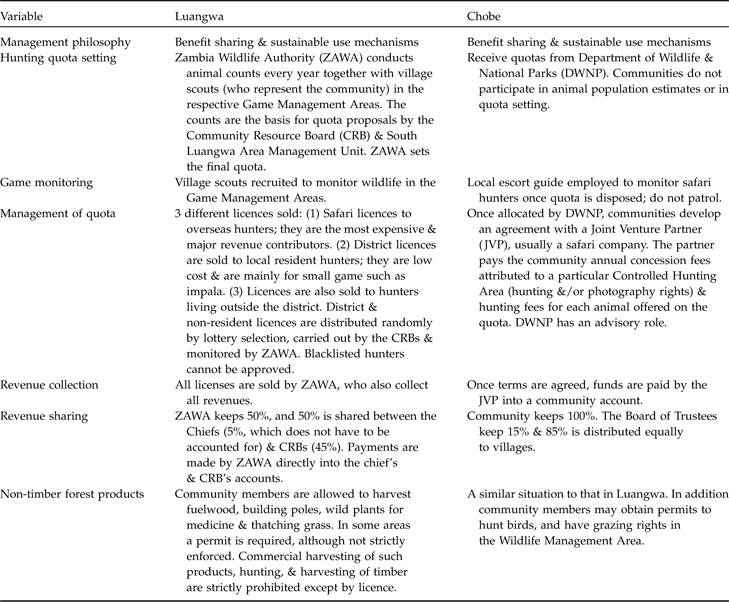
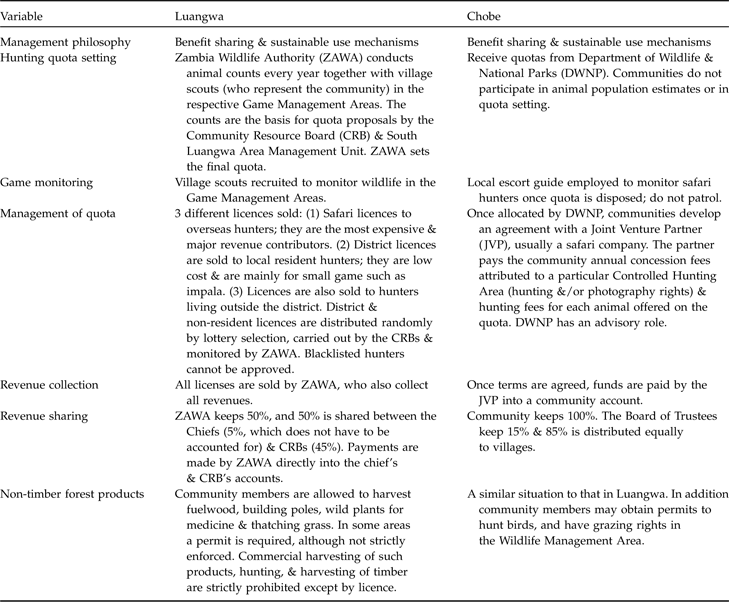
Historically, Zambia is a former colony and Botswana a former protectorate of Britain. During the colonial period natural resources were managed by central Government agencies in national parks and game reserves, and these methods constrained access by adjacent communities. After independence this approach continued to prevail. Illegal and unsustainable resource use followed and national wildlife authorities were overwhelmed. To meet the challenge, Zambia and Botswana developed similar policy and legislation regarding community inclusion to improve management, conservation and sustainable use of natural resources, particularly wildlife. New institutions were created to implement CBNRM in park buffer areas, namely Community Resource Boards in Zambia and Community Trusts in Botswana. Today, Zambia’s protected areas cover c. 30% of the country’s total land area, comprising 19 National Parks and 34 Game Management Areas (GRZ, undated). Botswana’s Protected Areas cover 18% of the country’s total land area, with an additional 24% designated as Wildlife Management Areas; the latter are further subdivided into Controlled Hunting Areas (Rozemeijer, Reference Rozemeijer2003). In both countries the Government wildlife authority is the main facilitator of CBNRM activities, providing advice and guidance, but also with decision-making authority (Table 1).
A summary of CBNRM implementation strategy with regard to community participation, rights and responsibilities in Luangwa, Zambia, and Chobe, Botswana.
Management and use of wildlife and protected areas has traditionally been the domain of natural scientists but society, history, economics and politics may equally influence community responses to CBNRM and its implementation. In this context there are criticisms that definitions of communities are simplistic (Leach et al., Reference Leach, Mearns and Scoones1999) and that concepts of participation are flawed (Kothari, Reference Kothari, Cooke and Kothari2001). As such, CBNRM and its challenges may be no different from any other political process. In this study we investigated the experience of CBNRM by communities adjacent to a National Park in Zambia and in Botswana. We attempted to answer two questions (1) What are the attitudes of local communities to such management? (2) How does the nature of the management approach to resource conservation and use, in terms of policy objectives, rights to resources, institutional participation, and roles and responsibility, influence a community’s experience of CBNRM?
Study areas
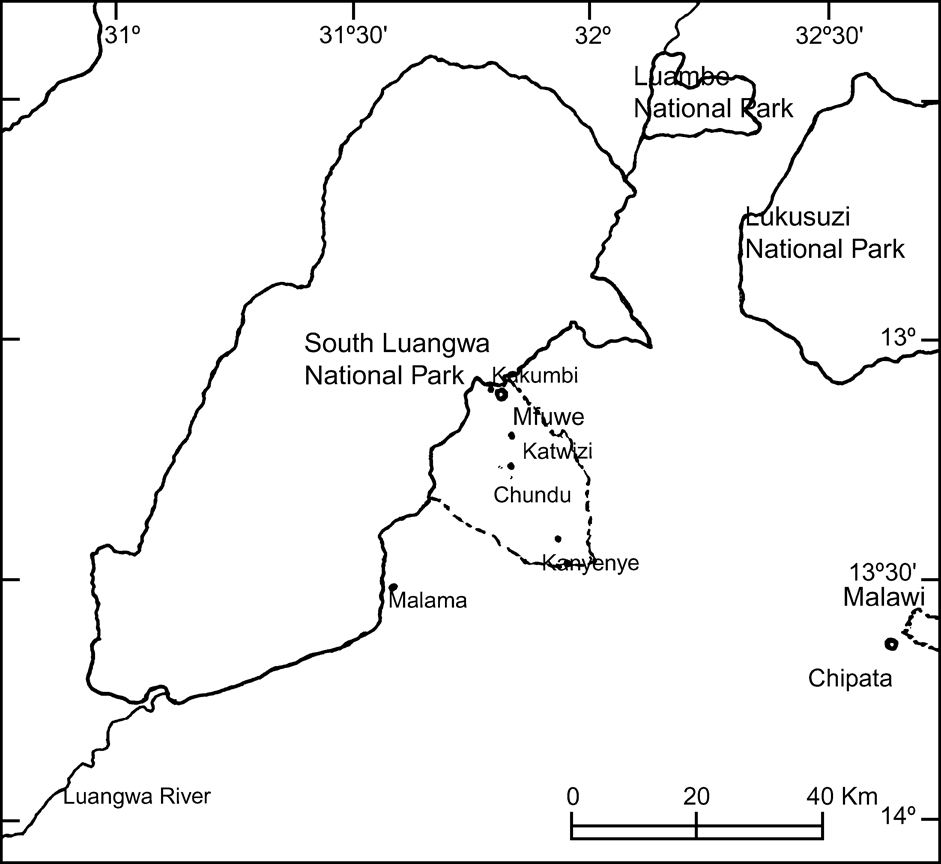
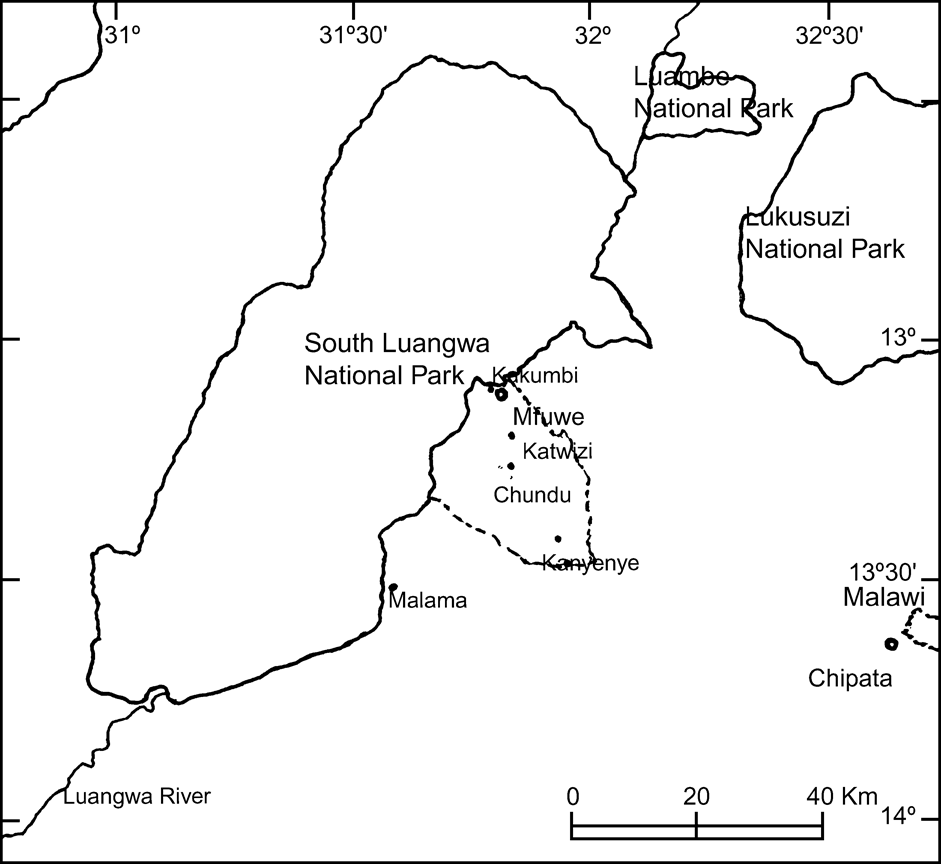
The two study areas have more than a decade’s history of the implementation of CBNRM and therefore provide an opportunity to gain insights into the achievements, constraints and general evolution of this approach. In Zambia the initiative in South Luangwa National Park was the first of its kind implemented in the country, in the early 1980s. Originally called the Luangwa Integrated Resource Development Project, it is today a CBNRM programme under the South Luangwa Area Management Unit/Zambia Wildlife Authority. It is implemented in Lupande Game Management Area adjacent to South Luangwa National Park (Fig. 1). It comprises the six Community Resource Boards of Jumbe, Mnkhanya, Nsefu, Malama, Kakumbi and Msoro. The livelihood of the 50,000 inhabitants of the area is characteristically subsistence agriculture.
Location of human settlements (indicated by dashed line) that benefit from natural resource use activity within the South Luangwa National Park Game Management Area in Zambia (after Dalal-Clayton & Child, Reference Dalal-Clayton and Child2003).
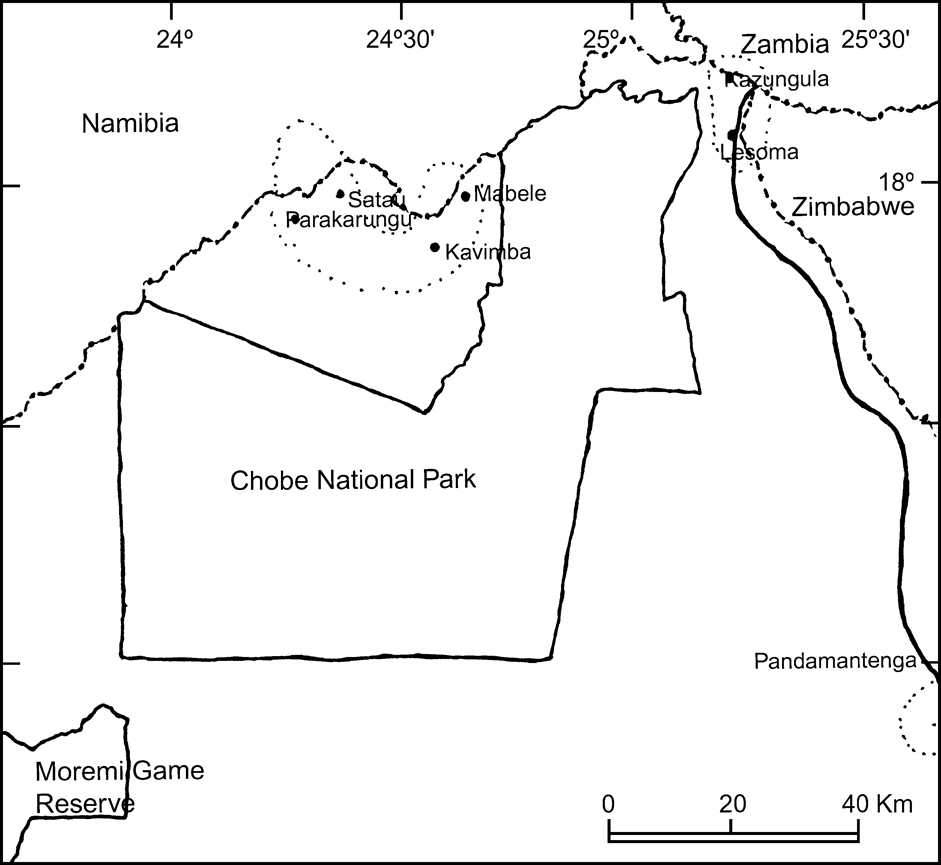
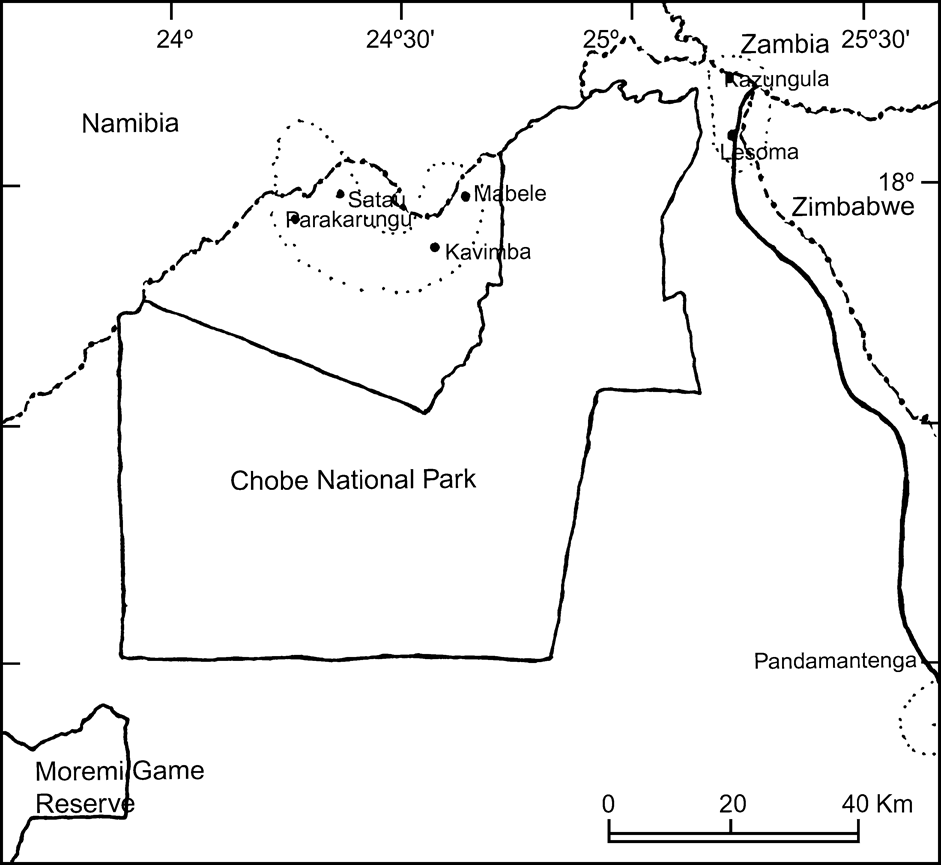
Similarly, the programme in Chobe National Park was also the first of its kind in Botswana. It is facilitated by the Department of Wildlife and National Parks in Chobe Wildlife Management Area adjacent to the Park (Fig. 2). Two Trusts exist, Chobe Enclave Community Trust and KALEPA (an acronym for the villages of Kazungula, Lesoma and Pandamatenga). Chobe Enclave Community Trust was the first of the two established, in 1993, and the programme was expanded, in 1996, in KALEPA to the east of the Park. Although the livelihood of the population in these areas is largely agricultural, 80% of inhabitants also keep cattle (L. Rutina, pers. comm.). The projects in both Zambia and Botswana were modeled on Zimbabwe’s CAMPFIRE and have the same basic implementation framework (Bond, Reference Bond, Hulme and Murphree2001).
Location of human settlements (indicated by dashed line) that benefit from natural resource use activity within the Chobe National Park Wildlife Management Areas in Botswana (after Namibweb, 2005).
Methods
We used qualitative (Silverman, Reference Silverman2001) and quantitative methods to examine community perceptions and attitudes towards current CBNRM practices. In Luangwa 60 households were randomly sampled from a village registry. Two Community Resource Boards, Kakumbi and Mnkhanya, were randomly selected from the six Boards, and a sample of 30 taken from each. The sample was taken from the catchments of four village area groups in the former and from five in the latter. In Chobe interval sampling was used because there is no village registry. A sample of 30 households was taken from each of the two Trusts, the Chobe Enclave Community Trust in Chobe west and KALEPA Trust to the east. The sample was taken from the catchments of five village trust committees in the former and from three in the latter.
Data were collected during October–December 2004. A research permit was obtained through the Department of Wildlife and National Parks in Botswana, and in Zambia permission was granted by the Zambia Wildlife Authority, and our findings have since been made available to these respective institutions. A structured interview comprising both open and closed questions relating to perceptions of CBNRM, the roles and responsibilities of its associated institutions, and extent to which expectations were met, was conducted with each household. Respondents were heads of households and/or their spouses. The respondents’ ages were 20–83 and there were more female than male respondents (63 and 53% of the respondents were women, in Zambia and Botswana respectively), probably because the research took place at the beginning of the agricultural season, when many men were in the field preparing the land for planting. The majority of respondents had not completed secondary education. The interviews were supported by key informant interviews with Community Resource Board/Community Trust Board members, wildlife authority officers and local Government officials.
Results
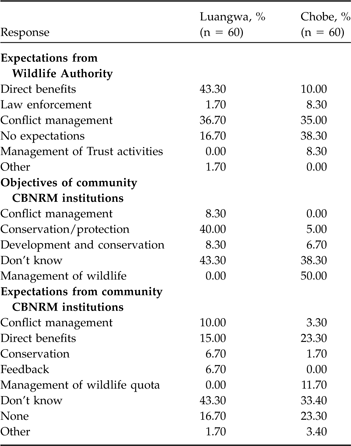
In response to the question ‘What is the objective of the Zambia Wildlife Authority?’ or ‘What is the objective of the Department of Wildlife and National Parks?’ 78 and 85% of people in Luangwa and Chobe, respectively, perceived the authorities’ main responsibility to be conservation and protection of wildlife. Table 2 provides an overview, based on responses to three open questions, of community perceptions of roles and responsibilities for the wildlife authorities and community CBNRM institutions. The majority (43.3%) in Luangwa expressed their wish for direct benefits from wildlife, namely employment, food, money, revenue paid directly to households, development of their area and game meat. In Chobe, respondents’ main expectation was for the authority to manage conflict (35%), with regards to crop raiding and predation of livestock in particular. In both areas a large proportion of respondents did not seem to know or understand the purpose of the community institutions, and did not know enough to comment about their expectations of the community institutions.
People’s perceptions (as %) of the roles and responsibilities of CBNRM institutions in Luangwa, Zambia, and Chobe, Botswana, as summaries of responses to three open questions.
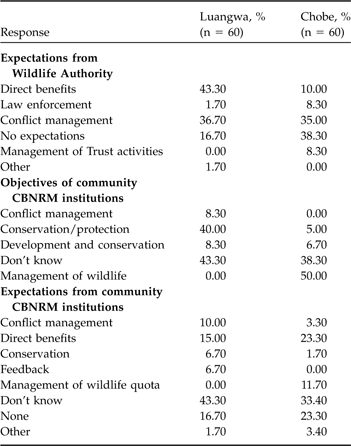
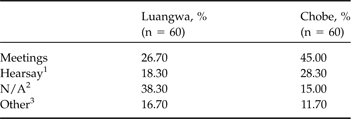
Table 2 shows that the communities are not satisfied with the benefits they expect the CBNRM institutions to deliver, and Table 3 illustrates a general lack of confidence and trust in these institutions. Community experience of compensation, for example, indicates great dissatisfaction in both areas. The lack of a compensation policy in Zambia exacerbates the problem and, although Botswana has such a policy, 80% of the respondents complained that compensation received was insufficient to replace livestock lost. It is clear that there are negative and indifferent attitudes towards local institutions and wildlife authorities in both areas. Negative perceptions in Luangwa were attributed to suspicions of corruption and mismanagement. Although overall perceptions are negative, the slightly more positive attitude in Chobe, in comparison to Luangwa, may indicate better communication and information flow there. Information about community institutions was mainly conveyed via meetings and hearsay in both cases (Table 4). Notably, 38.3% were unable to answer due to insufficient knowledge in Luangwa in contrast to 15% in Chobe.
Summary of responses (as %) of communities in Luangwa, Zambia, and Chobe, Botswana, to questions pertaining to their experience of CBNRM, and χ2 tests for differences in responses between the two communities.

1 CRB, Community Resource Board; ZAWA, Zambia Wildlife Authority; DWNP, Department of Wildlife and National Parks
* <5% in some categories precluded comparison
Summary (as %) of how respondents received information on CBNRM activity in Luangwa, Zambia, and Chobe, Botswana.
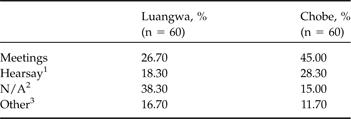
1 Information obtained through hearing others talk
2 Refers to those who knew nothing at all
3 Refers to the receipt of information through an interaction such as employment, or in the course of reporting crop raiding or predation
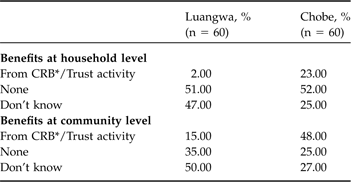
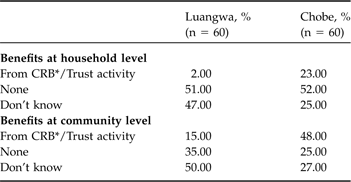
More than 50% of respondents in both Luangwa and Chobe did not perceive any benefits at the household level (Table 5). In both cases, however, perceptions of benefits at the community level were slightly more positive. In Luangwa 15% of respondents indicated that conservation and projects such as renovation of community schools and clinics were benefits. In Chobe 48% of respondents perceived community projects (shops and a campsite) as benefits, although half of them went on to comment that the projects were not functioning at the time.
Perceptions (as %) of benefits received at the household and community levels as a result of activity implemented by CBNRM institutions in Luangwa, Zambia, and Chobe, Botswana.
* Community Resource Board
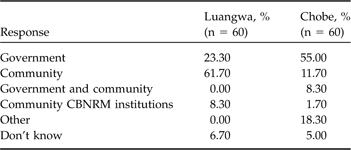
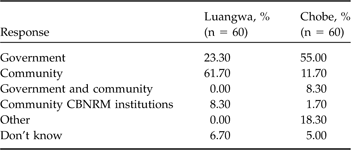
The majority of respondents in Luangwa believed that the community owned the resources in the Park buffer area, i.e. wildlife management area/game management area, whereas in Chobe the majority believed it was the Government (Table 6). There was however, general agreement on ownership of resources in the National Parks, with 90 and 83%, in Luangwa and Chobe respectively, stating that the resources were owned by the Government.
Opinions (as %) regarding the ownership of resources in the buffer areas of South Luangwa National Park, Zambia, and Chobe National Park, Botswana.
Discussion
The findings from this study illustrate that the communities studied feel they receive few if any benefits from CBNRM initiatives. Furthermore, significant confusion about roles and responsibilities appears to translate into unfulfilled expectations and frustrations. There appears to be a marked incongruence between community perceptions and expectations of the purpose and roles of the community CBNRM institutions and wildlife authorities. In Luangwa, for example, the Zambia Wildlife Authority is expected to provide benefits such as employment, development of the area, money and, in some cases, food. In Chobe the Wildlife Management Authority is expected to manage conflict and the Community Trusts to manage the allocation of the wildlife quota.
There are also significant differences in perception of ownership between the sites. The majority of respondents in Luangwa were of the opinion that the community owns resources in the game management area, whereas those in Chobe perceive that the Government owns the resources, and yet overall the latter are more positive regarding local benefits. Explanations for these differences may lie in variations in implementation structure, and specifically how they support processes of inclusion.
Although legislation and policy in both countries facilitates the creation of community based institutions, Zambia has been criticized for providing only ‘participation privileges’ and not ‘participation rights’ (Salomoa, Reference Salomoa2004). Critics of Botswana legislation and policy have noted that it doesn’t detail Government CBNRM objectives or implementation guidelines (CBNRM Status report, 2001).
The way communities are included may have consequences for their attitudes to CBNRM. In this case community participation seems mainly functional (to meet predefined objectives) and tending towards being passive (top down), as defined by Bass et al. (Reference Bass, Dalal-Clayton and Pretty1995). Our findings indicate there are limited choices and opportunities for the two communities. The level of transfer of entitlements varies but is restricted regarding the control of income and expenditure. In Luangwa 50% of the revenues derived from the game management area is retained by the wildlife authority, which undermines the Community Resource Boards’ capacity to meet community expectations. In Chobe, however, Trusts keep all revenues from the wildlife quota (Rozemeijer & Van der Jagt, Reference Rozemeijer and Van der Jagt2000). Communities in Luangwa, but not in Chobe, take part in game counting and the setting of the annual wildlife quota, although the wildlife authority makes the final decision. Use is limited to specific resources, mainly non-timber forest products; quantities are monitored and harvesting is sometimes limited to particular seasons. Commercial activity and hunting are managed by the wildlife authorities through permits in both areas.
All activity is therefore either controlled or policed by the wildlife authorities, and this frequently results in tensions. Among the most contentious is the subject of compensation. Even in the event of a fatality, communities cannot kill certain predators. In Chobe the killing of a lion has to be authorized by the Minister of Environment (District Officer for Development, pers. comm.), whereas in Luangwa any action regarding elephants has to be sanctioned from the capital. This exacerbates negative sentiments and has led community members to describe their position by the phrase ‘people are animals and animals are people’. The power of decision thus invariably lies with the Government, albeit to varying degrees. An extreme example was the suspension of hunting in Luangwa by the former President for 2 consecutive years (2001–2002; Dalal-Clayton & Child, Reference Dalal-Clayton and Child2003). Communities and their institutions seem to have little protection from interference, not even from interference within their own societies (Barrow & Fabricius, Reference Barrow and Fabricius2002). For example, although policy designates the chiefs as patrons only, they are more dominant. The firing of the Community Resource Board chairman by one chief in Luangwa (witnessed by us) is a case in point, and the outcome was generally accepted. When such a situation is tolerated, the whole concept of local democracy is undermined.
Ambiguities in roles and responsibilities cause more confusion, and are reflected in misplaced expectations. In Luangwa the perception of the wildlife authority as development provider has its origins in the Luangwa Integrated Rural Development Programme (Dalal-Clayton & Child, Reference Dalal-Clayton and Child2003), since 1999 restructured into the existing South Luangwa Area Management Unit. It seems to have left a legacy of dependency that is difficult to change. Lack of understanding is a factor affecting both the lack and loss of interest (Songorwa, Reference Songorwa1999). Compounding circumstances are further questions within the community regarding whether Community Resource Board and Trust members are looking after community interests or their own. Suspected corruption, mismanagement, irresponsibility and unrealized expectations also negatively affect community interest. KALEPA failed to account for its funds, and had subsequent allocations suspended by the Ministry of Environment (District Officer for Development, pers. comm.).
Perceptions of ownership, taken to encompass responsibility, vary. Communities in Chobe seem to have the attitude that they play no part in conservation but receive ‘manna from heaven’ (L. Rutina, pers. comm.). Boggs (Reference Boggs2000), carrying out similar research in the Okavango Delta, found that communities overwhelmingly perceived both management and ownership of land and resources to be the responsibility of the Government, and attributed this to the Government’s takeover of common property under the authority of the chiefs at independence in 1966. In Chobe, therefore, communities seem resigned to the reality of Government ownership; other communities elsewhere are also mistrustful and unsure of their position in relation to the Government (Shackelton et al., Reference Shackleton, Campbell, Wollenberg and Edmunds2002). It is worth remembering that antagonism has existed between wildlife authorities and communities for decades, not only in Botswana and Zambia but also in many other African countries (Gibson, Reference Gibson1999). Some researchers have suggested a link between perceptions of ownership and decision-making. According to Murphree (Reference Murphree2000) the strength of ownership is defined by the extent to which the owners’ decisions to use resources actually determines use. Adams & Hulme (Reference Adams and Hulme2001) also state that genuine power-sharing in terms of tenure security regarding resource access, revenues and/or decision-making are required for successful community conservation. In the cases described communities have limited powers of decision. Murphree’s statement makes the case of Luangwa particularly anomalous. Communities claim ownership to resources in the game management area but the claim seems to result from frustration and a wish for reversion to village ownership and control (Murombedzi, Reference Murombedzi1998).
There appears to be an impasse in CBNRM implementation. After two decades, local communities don’t really identify with the initiatives and few understand their purpose and roles. Inadequacies in transparency and accountability have led to loss of credibility and erosion of confidence: the state continues in its reluctance to legitimize local jurisdictions and thus leaves communities confused over their position. They have few opportunities to develop their capacities as resource managers, CBNRM institutions have not been successful in implementing their projects and sometimes fail to account for funds, poorly funded wildlife authorities retain portions of the generated revenues, and up-to-date information on what is happening is rarely available. These factors continue to undermine performance and strain relationships between the various stakeholders.
Meaningful inclusion and the fostering of responsibility cannot be instilled artificially. Communities must be given opportunities to make decisions, control actions that affect their lives, and benefit from their involvement for them to appreciate community based natural resource management. Local institutional competence, capacity, and outreach must be improved to enable the evolution of societal responsibility.
Acknowledgements
We thank the respondents in Luangwa and Chobe, the Department of Wildlife and National Parks Research division in Chobe, Botswana, and South Luangwa Area Management Unit in Luangwa, Zambia. Financial and academic support was received from UMB/Noragric and NINA.