




1. Introduction
In this paper, we draw upon the theoretical framework underlying Hon and Goldstein’s (Reference Hon and Goldstein2023) engagement with modern science to analyze Roger Bacon’s scientific practice in his Opus majus. Hon and Goldstein’s main claim is that the practice of modern science displays three salient features: commitment, methodology, and technique. The thesis we seek to substantiate is that, despite formally presenting these three features, Bacon’s own practice cannot be considered modern. Although his methodology involves the use of geometrical proofs and his technique employs diagrams and geometrical analysis of the relations embedded in them—both features seemingly indicative of modern scientific practice—a characteristic alien to modern practice surfaces in the feature Hon and Goldstein refer to as “commitment.” Specifically, Bacon’s commitment is rooted in theology and its dependence on sacred scripture.
It is this characteristic that sets Bacon’s scientific practice apart from modern science. In a nutshell, his commitment implies that final causes are not directly and fully known from the natural world but are revealed through scripture. Consequently, since understanding the nature of a thing requires knowing all four Aristotelian causes, those ignorant of sacred scripture cannot grasp the final cause and thus miss the true nature of the thing. It thus follows that Bacon’s approach is not what we associate with modern science. With this conclusion, we can pinpoint precisely how Bacon’s scientific practice differs from modern approaches.Footnote 1
Concepts such as “medieval science,” “method” or, for that matter, “scientific method,” are opaque; they are too general to be helpful when it comes to characterizing practices. Our appeal to the Hon-Goldstein claim highlights the difference between medieval and modern scientific practices. It facilitates the characterization of the nature of the difference by showing that the medieval practice includes an essential commitment discarded by the (early) modern practice. Thus, examining the alleged “modernity” of a thirteenth-century author offers a way to identify one essential element of the practice of science at that time.
To substantiate our thesis, we follow three steps. First, we outline Hon and Goldstein’s claim that commitment, methodology, and technique constitute universal features of modern scientific practice. Second, we analyze Bacon’s scientific practice in three passages from Opus majus, where he addresses (1) violent motion and the generation of heat; (2) the anatomical structure of the human eye, and (3) the formation of the rainbow. Finally, we show that, despite the formal alignment with the three features of modern scientific practice, Bacon’s approach remains unmistakably tied to theology.Footnote 2
2. The framework: Commitment, methodology and technique
In their 2023 monograph entitled Universal Aspects of Scientific Practice: Commitment, Methodology, and Technique, Giora Hon and Bernard R. Goldstein focus on processes that generate scientific knowledge. They identify universal features that characterize modern scientific practice—features inherent to the practice of science. The fundamental tenet of their analysis is that scientific knowledge is argumentative. Thus, they claim, the practice of science includes at least three features so that an argument can be formulated: presuppositions, modes of inference, and conclusions.
As a consequence of this claim, Hon and Goldstein discern three universal features of scientific practice: commitment, methodology, and technique. Commitment plays the role of presupposition, methodology constitutes the inferential mode, and technique facilitates the transition from the general to the specific—such as applying instruments, solving equations, calculating relevant magnitudes, etc.—to arrive at specific conclusions. These three features can invariably be found in any modern scientific practice, be it in constructing a theory, conducting an experiment, or exploring a new scientific domain. Their general claim is that scientific practice is a careful engagement with these three components, with the goal of drawing conclusions and thereby contributing to the corpus of scientific knowledge.
Commitment expresses a fundamental belief that lies in the background of the scientist’s actions and may be identified with a metaphysical view or a position in the philosophy of science that the scientist holds. It can be specific or general (e.g., a commitment to a certain principle or concept). It thus imposes constraints on agency, be it the construction of theories, the execution of experiments, or any other scientific investigation, for these activities must conform to the commitment. For example, Johannes Kepler (1571–1630) was committed to the priority of distance over time and motion: “Distance will be the cause of intensity of motion, and a greater or lesser distance will result in a greater or lesser amount of time” (Kepler Reference Kepler1992, 377). This presupposition is inherent to Kepler’s new astronomy of 1609 (Hon and Goldstein Reference Hon and Goldstein2023, 21–23).
Methodology conveys modes of research strategy. The subject matter of methodology is how knowledge is generated and extended. To act rationally, the scientist chooses an effective methodology in accordance with his or her commitment, which functions as a presupposition. Methodology stands in relation to a certain goal, so the question is not whether the chosen methodology is right or wrong; rather, the question is whether it is effective or not. For a brief illustration, consider the following two methodologies of experiment which may be referred to as propagation (say, in optics) and bombardment (for instance, in atomic physics). In the methodology of propagation, the experimenter’s goal is to measure the state of the system under study, ideally without any interference, thereby ensuring no loss of energy. Put differently, the experimenter insulates the system as much as possible to prevent the interaction with the environment, and yet measurement on the system is carried out by probing its properties. A typical example is the measurement of the velocity of light. The experimenter has to interact with light to measure its velocity, but one does not want to disturb the system or else the measurement will not be accurate. By contrast, in the methodology of bombardment, the experimenter adds probes with known energy to the set of constraints and measures the loss of energy in the interaction of the probes with the target system. The energy carried by the probes is transferred to the target at the moment of impact, and the energy of the recoiled fragments is measured. In this methodology, energy is purposely imparted to the target in order to study its nature. Here are, then, two contrasting methodologies of an experiment: in propagation, the goal is a measurement with ideally no energy loss, whereas in bombardment, energy loss is an essential feature of the experiment. The contrast serves as an illustration of methodology, in this case experimental, which plays a distinct role in scientific practice, different from commitment and technique.
Technique—often referred to as method (not to be conflated with methodology)—is always specific. It takes methodology from the general to the specific, namely, the accumulation of data and its rendering as a definite result. Thus, for the two methodologies of the experiment, namely, propagation and bombardment, measurements of the velocity of light with an interferometer illustrate a technique of the former, and the application of a cyclotron in the study of elementary particles is an example of a technique for the latter. It is notable that in the process of generating scientific knowledge, the technique is always explicit. By its very nature, it deals with the specific as distinct from the general; hence, its role is apparent in the production of knowledge. It is possible for a chosen methodology to be traditional, while the techniques are entirely novel. Similarly, there are cases where the same technique may be applied within different methodologies, like the extensive application of the mathematical techniques of calculus.
Hon and Goldstein argue that the three features—commitment, methodology, and technique—are inherent to the scientific practice and are interrelated. As distinct elements, these features form an argumentative structure which is characteristic of scientific knowledge. Commitment provides the fundamental presuppositions; methodology delineates strategy, which as rules of inference justifies the action taken; and then technique facilitates obtaining data which may be turned into a result. In other words, commitment offers the framework of discussion; methodology provides instructions for the form of action to reach a specific goal as well as the reasoning for the set of actions to be taken; and technique refers to the means of executing these actions.
3. Analysis of Bacon’s scientific practice: Three cases
Hon and Goldstein apply their scheme to a set of case studies in the history of modern science, beginning with Kepler in the early modern period and ending with the LIGO—a contemporary Nobel-winning scientific study. In our analysis, we go back to the past, to Roger Bacon in the thirteenth century, with the intention of determining whether his scientific practices align with the modern sense of “scientific” as outlined above. We focus on three passages from Opus majus.
3.1. Violent motion and the generation of heat
The first passage presents a relatively straightforward geometrical analysis of a natural phenomenon, and as we show, it exhibits all three features of scientific practice. Moreover, Bacon’s endeavor in this case is primarily oriented towards demonstrating the usefulness of mathematics in uncovering facts about nature and its phenomena—a distinct aspect of modern scientific practice.
In his Opus majus, Bacon constructs the following argument for the generation of heat by a heavy body falling, which we present in full below:
Natural [philosophers] believe that the downwards motion of heavy [bodies] is entirely natural, and similarly, the upwards motion of light [bodies] is entirely natural, so that neither involves violence. But a geometric figure shows us the opposite. [See Fig. 1.] For let dbc be a piece of wood or stone in the air; a, the center of the world; and gh, the diameter of the world. Therefore, d, b, and c are always completely equidistant as they descend towards the center [of the world] across equidistant lines. Thus, d will descend along line de, b along line ba, and c along line co, wherefore d will fall outside the center of the world in the diameter hg facing the sky,Footnote 3 namely at point e, and c at o, wherefore in this descent, d will deviate from the center a facing the center by the height ae and c by the height ao. But every deviation of a heavy [body] from the center [of the world] is violent. Therefore, d and c are moved violently, and this happens in all parts of dbc except b, which alone moves towards the center. Hence, there will be a lot of violence in this case. Moreover, the straight and natural motion of d itself is along the line da, from which, if it were separated from its whole, [d] would fall to a by straight motion, because every heavy [body] tends towards the center [of the world]. But every significant deviation from straight motion is violent, and the more d is moved along the line de, the more it deviates from straight motion, as is obvious to the senses, because the lines da and de diverge more below than above. Therefore, the more it [d] falls downwards, the more it is moved violently, and similarly c, and for this reason every part of the whole weight of dbc, except b, which alone always descends according to straight motion. It is clear, therefore, that there is a lot of violence and in many ways in the natural motion of a heavy [body]. And from this follows a certain truth in natural things, namely, that natural motion generates heat; because when violence has been demonstrated, and it is evident that a heavy [body] is naturally inclined to move downwards, it is clear that there are two powers in the heavy [body] moving downwards, inclining it in opposite directions. Therefore, one [power] pulls the parts of the heavy [body] in one direction, and the other [power] in another direction, and because of this pulling, it is necessary that the parts of the heavy [body] are rarefied. But rarefaction is an immediate disposition to heat, and thus, through experience, we know that a heavy [body] descending becomes heated. (Bacon Reference Bacon and Bridges1897, part 4, dist. 3, cap.15)Footnote 4
Bacon Reference Bacon and Bridges1897, vol. 1, 167.

Fig. 1 Long description
The diagram features a circle with various labeled points and geometric shapes. The points are labeled as a, b, c, d, e, g, h, and o. The diagram includes a rectangle with points b, c, and d at the top and point a at the bottom center. Lines connect these points, forming a geometric structure within the circle. The horizontal line passing through the circle is labeled g on the left and h on the right, with points e, a, and o marked along this line. The diagram visually represents the constraints imposed by commitment on scientific activities, illustrating how these activities must conform to underlying principles or concepts.
The passage first advances two supporting geometric arguments, and by “geometric,” we simply mean that the arguments are based on the analysis of a geometric figure. Both arguments make the case against the natural philosophers’ claim that a heavy falling body is affected only by natural motion. The first argument proves that, as the extremities of a body deviate from the center of the world, they are affected by a violent motion. The second argument highlights that the farther the extremities of the body deviate from the center of the world, the stronger the violent motion becomes. Thus, before examining the argument for the generation of heat by a heavy body falling, we consider these two supporting arguments.
The first one begins with a claim made by natural philosophers:
(1) The downwards motion of a heavy body is natural.
However, by analyzing the geometric figure representing a heavy body falling (Fig. 1), Bacon refutes this claim on the following grounds:
(2.1) The body maintains its shape as it falls. (This is an implicit assumption.)
(2.2) The extremities of the body, points d and c, move away from the center of the world, a, falling on points e and o, respectively.
(2.3) From 2.1 and 2.2, it follows that the deviation of points d and c from the center, a, results from violent motion, as their natural motion would follow the paths da and ca, respectively.
The second supporting argument builds on the same premises and proves that the violent motion can intensify:
-
(1) The natural motion of d follows the path da.
-
(2) Any deviation of d from a is the result of a violent motion.
-
(3) The farther d falls from a, the more violent the motion becomes.
Using these two arguments, Bacon supports the claim that violent motion generates heat in a heavy falling body. His proof is based on five assumptions that align with Aristotelian physical tenets:
-
(1) The distance between d, b, and c remains the same as the body falls; therefore, the same distances that exist among d, b, and c also exist among e, a, and o.
-
(2) Heavy bodies naturally tend downwards, towards the center of the world, while light bodies naturally tend upwards (see Aristotle Reference Barnes1991, IV, 4, 212a 24–25).
-
(3) Any deviation of a heavy body from its natural path towards the center of the world, or of a light body upwards, is the result of a violent motion (Aristotle Reference Barnes1991, VIII, 4, 254b 25).
-
(4) Powers acting in different directions within a body rarefy its matter.
-
(5) Rarefaction is a disposition of heat.
The diagram Bacon draws to represent the textual description is meant to illustrate how the body dbc falls to the ground along the diameter of the world, with only point b falling directly towards the center of the world. The divergence of points d and c from the center, as a consequence of the first assumption (1), implies that points d and c deviate from their natural place, which is a, the center of the world. From the second assumption (2), we know that when a body deviates from its natural path, it can no longer be affected by natural motion. In this case, and in agreement with the third assumption (3), the body is affected by violent motion. It thus follows that the body dbc, falling to the ground, is affected by both natural and violent motion. Consequently, based on the fourth assumption (4), the matter of dbc is rarefied, which, according to the fifth assumption (5), results in the generation of heat.
The geometric analysis accompanying the diagram proves that, due to the two powers acting on the falling body, there is a subsequent generation of heat. This kind of demonstration is a demonstration from causes—a propter quid demonstration (see Kedar Reference Kedar2024). Another type of demonstration is the demonstration from the effect (quia demonstration), which, in this case, begins with observing the heat generated by the falling body. According to Bacon, the geometric proof performed by a mathematician from causes offers far greater insight into the nature of things than the demonstration of a natural philosopher, which begins with the effect (Bacon Reference Bacon and Bridges1897, part 4, dist. 1, cap. 3).
Given that mathematics, particularly geometry, is essential to understanding the physical phenomenon of heat generation, Bacon’s commitment must be that nature is mathematically structured, and thus intelligible. Indeed, he makes assertions to this effect on many occasions in Opus majus. For example, he states that
…the gate and key to these sciences is mathematics, which was shown to the saints from the beginning of the world, as I will show, and which was always used among the saints and the wise before all other sciences. … And, conversely, knowledge of this science [mathematics] prepares the soul and elevates it to certain knowledge of all things and [the soul] rightly applies its principles to the other sciences and cognition of other things. Then, it will be able to know all that follows without error and without doubt, easily and effectively. (Bacon Reference Bacon and Bridges1897, part 4, dist 1, cap.1)Footnote 5
The passage contains several important epistemic claims about mathematics, which ultimately emphasize its crucial role in understanding nature in general. Such claims thus point to the underlying commitment that nature is intelligible, and that this intelligibility arises from its mathematical structure.
Once we know the commitment, the methodology becomes evident. A commitment to the belief that the world is mathematically structured, hence intelligible, narrows down the possible methodology for the application of mathematics to a physical phenomenon, as the methodology is the mode of research or the research strategy. In this specific case, the methodology is the application of geometrical analysis to the phenomenon of heat generation by heavy falling bodies. Bacon’s research strategy in proving that two powers are acting on a heavy body falling is the reliance on a geometrical analysis expressed in two arguments and the interpretation of a diagram. The technique in this case, based on the commitment to a mathematically structured nature and a geometrical methodology, amounts to the appeal to a diagram and the analysis of the geometrical relations embedded in it.
With these, we have characterized three features of Bacon’s approach to the phenomenon of heat generation in falling heavy bodies: commitment, methodology, and technique. It thus transpires, at least formally, that Bacon engaged in an exercise of modern scientific practice. The next passage we examine reinforces this claim.
3.2. Geometrical deduction of the anatomical structure of the human eye
The analysis in the previous passage from Opus majus is relatively simple and does not involve much underlying intricacy. By comparison, the next case requires a higher degree of complexity, as it entails deducing the anatomical structure of the eye from the laws of reflection and refraction.
In Opus majus 4, dist. 7, ch. 1, Bacon seeks to prove that the structure of the eye includes not only a glacial humor but also a vitreous humor. His demonstration presupposes (1) the mechanism of multiplication of species,Footnote 6 (2) the laws of reflection and refraction (Lindberg Reference Lindberg1978; Hackett Reference Hackett1997; Tachau Reference Tachau1988, and Smith Reference Smith2015), and (3) the assumption that vision is veridical.Footnote 7 The question of a second humor in the eye arises because, if there were only one—the glacial humor—then the assumption that vision is veridical (3) would be contradicted. To illustrate this potential contradiction, Bacon draws on the mechanism of species multiplication (1) and offers the following example.
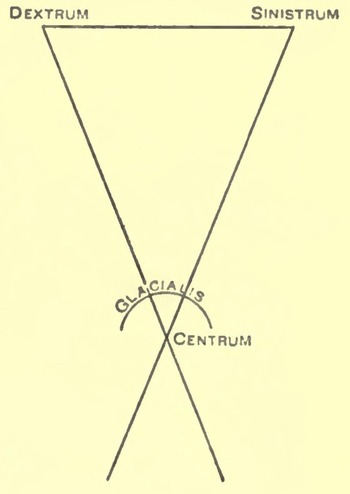
Suppose we have a two-dimensional object that emits only two species, one from its right side and one from its left (see Fig. 2). The species from the right side of the object travels along a rectilinear path to the eye, as does the species from the left side. These two lines converge, forming a triangle. According to the laws of reflection and refraction (2), the two lines along which the species travel reach the anterior glacial humor, where they intersect and follow an inverse path: the left species moves to the right and the right species moves to the left. The divergence causes the species from the left side of the object to be represented on the right side of the eye, and the species from the right side of the object to be represented on the left side, resulting in an inverted and askew image of the object.
Bacon Reference Bacon and Bridges1897, vol.2, 47.

Fig. 2 Long description
The diagram features a triangular shape with a horizontal line labeled ‘Dextrum’ on the left and ‘Sinistrum’ on the right. Below the triangle, two lines converge at a point labeled ‘Centrum,’ with an arc labeled ‘Glacialis’ above it. The diagram demonstrates the path of a heavy body, represented by points d, b, and c, as it falls towards the center of the world, a. The paths of these points are shown as lines de, ba, and co, respectively, indicating their deviation from the center. The diagram visually supports the argument that the motion of a heavy body involves violence and generates heat due to the deviation from straight motion.
And yet, in reality, we see things as they are (3). Thus, given the first two assumptions, it follows that something is amiss or missing in the traditional understanding of the process of seeing. Here is Bacon’s take on the matter:
Therefore, to avoid this error [of seeing things inverted], and for the species from the right side to travel according to its side and the one from the left according to its side, and in this way for the other [species], it is necessary that something exists between the anterior glacial humor and its center to impede this convergence. For this reason, nature has ingeniously placed the vitreous humor in front of the center of the glacial [humor]; [the vitreous humor] has a different transparency and a different center, so that refraction can occur within it, in such a way that the rays of the pyramid diverge from converging in the center of the anterior glacial humor. When, therefore, all the rays of the pyramid, except for the axis that passes through all the centers, are inclined at oblique angles upon the vitreous humor, which has a different transparency, it is necessary that all those rays are refracted at its surface, as has been established earlier concerning refractions. And since the vitreous humor is denser than the anterior glacial [humor], it is therefore necessary that the refraction occurs between the straight path and the perpendicular path from the point of refraction, as was demonstrated in the multiplication of the species. (Bacon Reference Bacon and Bridges1897, 4, dist. 7, cap. 4)Footnote 8
The solution to the issue, therefore, is that another humor must be placed between the anterior glacial humor and its center to refract the species from the right and left sides back to their original positions (see Fig. 3). This second humor has different transparency and density from the glacial humor, allowing it to refract the rays in a way that restores the representation of the object to its correct arrangement. This is the vitreous humor.
Bacon Reference Bacon and Bridges1897, vol.2, 48.

Fig. 3 Long description
The diagram illustrates the refraction of light through various humors in the eye. It features a triangular structure with points labeled m, p, and c. The humors are labeled as a, b, d, f, g, h, q, and u. The diagram shows how light is refracted through these humors, with lines indicating the path of light from the top to the bottom of the diagram. The central humor, labeled a, refracts the species from the right and left sides back to their original positions.
In this case, too, Bacon’s practice engages the three features of modern scientific practice: commitment, methodology, and technique. As before, the commitment is the belief that nature, given its mathematical structure, is intelligible. But in addition, we note that Bacon is also committed to the belief that nature is created such that it tends to avoid errors, visual errors in this case. This belief in nature’s avoidance of errors is linked to the existence of God. For Bacon, nature operates under a principle of perfection, striving towards completion. The principle is rooted in God, without whom nature would lack its orientation towards perfection. However, this does not mean that the veridicality of vision is directly ensured by God. Instead, the veridicality of vision arises from the universe’s intrinsic tendency toward perfection—a tendency rooted in God but operating independently within its own ontological framework. This independence allows for the possibility of imperfections, such as blindness, within nature.
The methodology involves conducting an analysis based on two complementary theories: optical theory and a variation of the theory of species. This analysis applies the rules of light propagation through different media, coherently combined with the rules governing the multiplication of species. Bacon employs two diagrams (Figs. 2 and 3). Figure 2 illustrates that an eye containing only a glacial humor would fail to produce a veridical act of visual perception. Figure 3 demonstrates how by postulating—on grounds of consistency—the presence of another humor in the eye, vision can avoid potential errors. The technique thus comprises the application of mathematics through geometrical diagrams to illustrate embedded relationships. The three features of scientific practice are thereby identified in this second case, too.
3.3. The formation of the rainbow
Given that it encompasses all three features—commitment, methodology, and technique—Bacon’s practice appears indistinguishable from that of a modern scientist. However, as one reads the section on mathematics in Opus majus, it becomes evident that Bacon views the mathematical structure of the world as dependent on God, with our understanding of it also dependent on theology and sacred scripture—a point we emphasize in the discussion that follows.
One central tenet, present throughout Opus majus, particularly in the section on mathematics, is that geometry provides a means to attain certainty about the world. However, to gain true knowledge of the world, one must first and foremost possess knowledge of sacred scripture. According to Bacon’s thought, natural philosophers had access to natural phenomena and their efficient causes. However, they lacked access to the final causes, which are crucial because “the end imposes necessity on things” (Bacon Reference Bacon and Bridges1897, 1, part. 4, cap.16). The implicit assumption here is that one must grasp all four Aristotelian causes to understand the true nature of a phenomenon. But while material, efficient, and formal causes can be traced in the physical world, final causes are described only in scripture.Footnote 9 This belief is succinctly expressed by Bacon when he explains why philosophers misunderstood the rainbow:
Avicenna, the leader and prince of philosophy after Aristotle, as all call him, confessed humbly that he himself was ignorant of the nature of the rainbow. And similarly, this is true of all philosophers, of which none could attain knowledge of the rainbow. This is not to wonder, since sacred scripture was not investigated carefully, as it would have been necessary for it. For all philosophers were ignorant of the final cause of the rainbow. But the end imposes necessity onto what is [ordered] towards [that] end, as Aristotle says in the second book of Physics, and this is true in all cases. However, the end for which the rainbow exists is made very clear only in the text of God, namely, when it is said: “I will set my bow in the clouds of heaven,” etc. From this it is understood that the bow of God was ordained against the flood and the abundance of waters. (Bacon Reference Bacon and Bridges1897, 1, part. 4, cap.16)Footnote 10
The argument is clear: to have knowledge of a thing is to know all its causes—efficient, material, formal, and final—as defined in Aristotelian philosophy. However, not all causes are fully accessible to natural philosophy. While efficient, material, and formal causes can be discerned through empirical or rational inquiry, the final causes, which impose a certain necessity on phenomena, are revealed through scripture’s revelation of divine purposes. For this reason, without knowledge of sacred scripture, there can be no comprehensive knowledge of nature.
In the case of the rainbow, the necessity imposed on it by its final cause has implications for how it is formed. When one understands from the scripture that the rainbow was made by God as a sign that no flood will ever occur again, one becomes aware that there must be something in the formation of the rainbow that accounts for this momentous signal:
Therefore, it is necessary that whenever this bow appears in the sky, there is a strong consumption of watery moisture; and this is true. For clouds dissolve abundantly, and infinite dews are formed, as the philosophers say, and as we see this for the most part. But the consumption of watery moisture occurs only because of something that has the power to consume it. However, in the generation of the rainbow, we come upon nothing except the rays of the sun and the clouds. The gathering of clouds is the material cause; therefore, the projection of the rays is the efficient cause. But the incident rays cannot execute great and marvelous operations, because they do not converge with each other; however, the convergence of powers is required from these so that a strong operation takes place. But convergence cannot occur except through reflection and refraction. For this reason, it must be that the rainbow is generated through infinite reflections or refractions in countless droplets falling without interruption, so that the truth of both its colors and shape is determined through such multiplications, based on figures, angles, and lines, and not through the diversity of the cloud’s material, as is stated in the texts of the Latins and believed by all—this I shall explain with certain experiments when I come to discuss the experimental sciences. (Bacon, Reference Bacon and Bridges1897, part 4, cap. 16)Footnote 11
Clouds must gather, but when they do, a large amount of watery moisture forms. For the rainbow to appear, there must be something capable of consuming this watery moisture. We know this from sacred scripture, which teaches us that the rainbow is a sign that no flood will ever occur again. Therefore, knowing that no significant amount of rain will ever fall upon the earth, we infer that there must be a mechanism to consume the watery moisture coming from the gathering of clouds. This mechanism comprises the power of rays of light, which are reflected and refracted through the countless drops of water that fall continuously.
Crucial to our argument is the dependence of understanding the world’s geometrical structure on theology, as presented in Opus majus 1, part. 4, cap.16. Geometry, to use Bacon’s own words, can only take us so far in understanding a phenomenon in “its ultimate dignity.” While final causes may not be directly observable in the natural world, their effects become apparent, enabling natural philosophers to discern them through the study of scripture. Without knowledge of scripture, the final causes of things remain hidden. This emphasis on final causes reveals that Bacon’s ultimate commitment is rooted in theology. The mathematical structure of the world is thus dependent on theology, as it is God who made the world intelligible by structuring it mathematically.
As in the first two cases, Bacon appeals in this third case to a geometrical proof. Here, the proof demonstrates the formation of colors through the infinite reflections and refractions of rays of light within countless drops of water. This constitutes the technique. The methodology involves the application of optical theory, specifically the rules governing the propagation of light. However, Bacon’s commitment differs here from the first two examples—or at least it seems to. In the earlier cases, the mathematical structure of the world and its intelligibility played the role of commitment, and the dependence on theology was only implicit. In this last example, the dependence is explicit. Bacon’s overall practice reflects here the intellectual context of his time (Hackett Reference Hackett1997, 1–2, 278–9, 303). Mathematics, while universal, is insufficient for fully exploring the natural world. In a world created by God, its mathematical structure serves as an expression of its intelligibility. Mathematics can describe and uncover the workings of the created world. However, it cannot account for the final causes of natural things and phenomena. Final causes are not directly observable in the natural world; they are accessible only through the knowledge provided by sacred scripture.
The three features of modern scientific practice are present in Bacon’s attempts to explain various natural phenomena but only in a formal way. We can identify an underlying commitment, an appeal to methodology, and the application of techniques. We might even call Bacon’s practice scientific. However, what we cannot do is label his practice as scientific in the modern sense. No modern scientist would engage in a scientific practice that is, at its core, dependent on sacred scripture. Modern science has long banned final causes.
The case of Isaac Newton (1643–1727), perhaps the most prominent early modern thinker, comes immediately to mind when drawing such a conclusion. Newton’s deep religious commitment and fascination with the Bible provide a useful point of comparison to Roger Bacon. How does Newton’s scientific conception differ from Bacon’s approach? In the “General Scholium,” at the end of the second edition of his monumental Mathematical Principles of Natural Philosophy, Newton famously admitted his inability to uncover the cause of gravity. He confessed:
Thus far I have explained the phenomena of the heavens and of our sea by the power of gravity, but have not yet assigned the cause of this power. This is certain, that this power must proceed from a cause that penetrates to the very centers of the sun and planets, without suffering the least diminution of its power; that operates not according to the quantity of the surfaces of the particles upon which it acts (as mechanical causes use to do), but according to the quantity of the solid matter, and propagates its action on all sides to immense distances, decreasing always in the duplicate proportion of the distances. (Newton Reference Newton1846, 505, translation slightly modified).
This is by all accounts an extraordinary statement, for Newton did not appeal to any sacred source to reveal the cause of gravity. It is “extraordinary” since in the preceding passage to this frank statement, Newton expressed his faith in what he called “the Lord God”:
This most elegant system of the sun, planets, and comets, could only proceed from the counsel and dominion of an intelligent and powerful being…. This being governs all things, not as the soul of the world, but as Lord of the universe; and on account of his dominion he is commonly called Lord God, Pantokrator in Greek…. He endures forever, and is present everywhere; and by existing always and everywhere, he constitutes duration and space…. The Supreme God exists necessarily. And by the same necessity he exists always and everywhere. (Newton Reference Newton1846, 504–5, translation slightly modified)
Given this declaration of faith in the Lord God as the ultimate necessity for any physical phenomenon to occur in time and in space, it is striking that Newton adhered strictly to his scientific methodology, refraining from allowing any sacred source—either theology or scripture—to intervene:
However, I have not been able to deduce the cause of those properties of gravity from phenomena, and I frame no hypotheses; for whatever is not deduced from the phenomena must be called a hypothesis; and hypotheses, whether metaphysical or physical, whether of occult qualities or mechanical, have no place in experimental philosophy. In this philosophy, propositions are deduced from the phenomena, and afterwards rendered general by induction. …And to us it is enough that gravity does really exist, and it acts according to the laws which we have explained, and abundantly serves to account for all the motions of the celestial bodies, and of our sea. (Newton Reference Newton1846, 506–7, translation slightly modified)
This approach can also be seen in Newton’s analysis of the rainbow phenomenon. Under the heading, “By the discovered Properties of Light to explain the Colors of the Rainbow,” Newton made the following observation and remarked:
This bow is never seen except when rain is falling and at the same time the sun shines. And it may be represented artificially by throwing water into the air so it falls down like rain. For indeed when the sun shines upon these drops it always causes the bow to appear to a spectator standing in the appropriate position between the rain and sun. And hence it is now agreed upon, that this bow is made by refraction of the sun’s light in drops of falling rain. This was understood by some of the ancients, and among the more recent scholars, it was more fully explained by the famous Antonius de Dominis Archbishop of Split, in his book De Radiis Visus & Lucis, published by his friend Bartolus at Venice, in the year 1611, and written 20 years before. In this book, the most celebrated scholar teaches in what way the anterior bow is made from two refractions of sunlight and one reflection between them in round drops of rain, while the exterior bow is formed by two refractions with two reflections between them in similar drops of water. He proves this explanation by experiments using a glass sphere full of water and places in the sun to make the colours of these two bows visible for observation. (Newton Reference Newton1962, 168–9, translation slightly modified)
And Newton proceeded to prove his claim: “For understanding therefore how the Bow is made, let a Drop of Rain, or any other spherical transparent Body be represented by the Sphere… .” We need not get into the details of the (geometrical) proof; suffice it to note that neither theology nor scripture is involved in the proof. This despite the fact that, to be sure, the overall commitment to faith in the Lord God is infused throughout Newton’s writing.
4. Conclusion
According to the theoretical framework proposed by Hon and Goldstein, a modern scientific practice exhibits three salient features: commitment, methodology, and technique. These features correspond to an argumentative structure comprising presuppositions, modes of inference, and conclusions, respectively. Ultimately, scientific practice is intended to generate knowledge supported by a coherent argument.
The analysis of three examples of scientific practice from Bacon’s Opus majus—concerning the generation of heat by the fall of a heavy object, the anatomy of the eye, and the rainbow—has convinced us that Bacon’s practice fulfils all three criteria of modern scientific practice. Prima facie, the commitment appears consistent across the three cases: the intelligible character of the world as reflected in its mathematical structure. The methodology involves applying geometry to physical phenomena, appealing to the rules of light propagation or the theory of species multiplication. The technique remains the same across the three examples, consisting of geometrical analyses and the use of diagrams. With these three criteria satisfied, Bacon’s scientific practice seems distinctly modern.
However, in analyzing the commitment in the third example—focused on the nature of the rainbow—we uncovered a characteristic that sets Bacon’s practice apart from that of a modern scientist. While the intelligibility of the world is expressed in its mathematical structure, the world does not exist independently of God. It is ontologically dependent on God, and this dependence extends to the realm of knowledge. This is evident in Bacon’s belief that understanding the nature of a thing requires identifying all four Aristotelian causes: material, efficient, formal, and final. Notably, the final cause—which reveals the ultimate purpose of all things—is not found in nature but in sacred scripture. To be sure, this theological dependence is not exclusive to the third example but is present throughout all three cases, though it was not explicitly stated in the first two. Such reliance on theology fundamentally distinguishes Bacon’s scientific practice from modern scientific practice.Footnote 12
Acknowledgments
This paper was supported by Israel Science Foundation (grant No. 2773/21). The authors would like to express their gratitude to the two reviewers, Yael Kedar and Sergiu Sava, for their comments and suggestions on various versions of this paper.
Giora Hon, Emeritus Professor for History and Philosophy of Science, University of Haifa, Israel, published widely on the theme of error in science, both from historical and philosophical points of view. Together with Bernard R. Goldstein he published a monograph on the concept of symmetry, From Summetria to Symmetry: The Making of a Revolutionary Scientific Concept (Springer, 2008), and a study of Maxwell’s methodological odyssey in electromagnetism, The Practice of Physics (Routledge, 2020). As a principal investigator, he has been leading (with Yael Kedar) several Israel Science Foundation (ISF) projects on the medieval philosopher, Roger Bacon.
Elena Băltuță is a researcher in philosophy at Charles University in Prague. Her work and publications focus on perception and intentionality in the Middle Ages. She is the editor of Medieval Perceptual Puzzles (Brill, 2020) and the author of a monograph on Aquinas’s theory of intentionality (Humanitas, 2013). She is currently a Czech Marie Curie Fellow and has previously held research positions and led projects at Humboldt University of Berlin, Babeș-Bolyai University in Cluj, Tel-Hai College, and the University of Cambridge.



 Open access

